
Part 1
“You really gave Uncle Darius ninety-five dollars for that dead hole?”
Preston Bennett stood several feet from the old stone well, his arms folded across his chest. His boots were planted in the dry ground as if he intended to stay there until the whole business proved as foolish as he had predicted.
Talia Bennett kept her hands on the winch control.
“I paid ninety-five dollars to find out whether it was dead,” she said.
Preston gave a short laugh.
“Grandpa couldn’t fix it. Darius couldn’t fix it. That pipe’s been stuck down there longer than you’ve been alive. What makes you think you’re going to do any better?”
Before Talia could answer, Wade Corbin glanced up from the tension gauge.
“Watch how close you’re standing,” he warned. “That stone lining isn’t getting any younger.”
Preston looked toward the rusted pipe rising out of the darkness.
“Then go ahead and pull it. Show us what everybody else missed.”
Talia looked at the cable, then at the narrow opening beneath the steel support frame.
“That’s what we’re trying to do.”
“Fine,” Preston muttered. “Another day wasted.”
She didn’t argue.
There was nothing she could say that would change Preston’s mind. He had already decided what the well represented: an old family failure that ought to have been left alone.
Talia had come to a different conclusion.
Something down there was moving.
It was not moving freely, and it was not coming up easily. But every time the galvanized pipe shifted under controlled tension, something heavier responded somewhere beneath the damaged section of stone.
The last time they had raised it, a sharp metallic sound had echoed up from the darkness.
Not the rough scrape of iron rubbing against rock.
Something else.
Now the cable stretched tight again, and Talia felt the winch resisting beneath her hand.
Wade watched the gauge.
“Easy,” he said. “Don’t try to make it move all at once.”
She eased back. The tension settled.
For a moment, nobody spoke.
Forty-three years was a long time for a family to give up on something. Long enough for memories to become accepted explanations. Long enough for a problem nobody had solved to be treated as one that could never be solved.
Talia knew she might be wrong.
She also knew she had seen enough to question the story everyone had been telling about that well.
And she had not come this far simply to win an argument.
She needed water.
The thirty-seven acres she had bought outside Cedar Ridge, Arkansas, were supposed to become the beginning of a different life.
Nothing extravagant. Nothing that required a large farming operation or the kind of money people liked to imagine when they talked about owning land.
She wanted a modest house, an orchard she could maintain herself, and vegetable rows that would produce enough to sell locally. She wanted to build steadily, expanding only when the property and her finances could support it.
Her plans existed in a notebook long before they existed in the ground.
There were sketches of planting areas, rough estimates for fencing, and lists of equipment she could afford to buy used. She had considered where the house would sit and how water lines might eventually reach the trees.
Almost every page led back to the same problem.
Without dependable water, the land would remain little more than an expensive promise.
A new drilled well in that part of the county could cost somewhere between nine thousand and thirteen thousand five hundred dollars. That was before adding the pump, electrical work, and distribution system.
Talia had written those figures down more than once.
Every time she studied them, she came away with the same feeling. She could manage the expense eventually, but spending that much at the beginning would delay nearly everything else she wanted to build.
Which was why she had asked Darius about the old well.
He had been reluctant even to include that northern corner when he sold her the acreage.
“There’s no use for it,” he had told her. “And I don’t want you thinking I sold you something dangerous without warning you.”
The well sat among weeds and neglected ground, its stone rim weathered and uneven. The cover had been left in place for years, and the surrounding earth showed little sign that anyone had worked there recently.
Darius knew its history too well.
His father had struggled with it before him. Years later, Darius had made an attempt of his own.
Both had encountered the same combination of muddy water, damaged stone, and a length of galvanized pipe jammed deep in the shaft.
Both had eventually stopped.
Whatever water the well once provided had become unusable, and nobody had successfully restored it in forty-three years.
Darius considered the matter settled.
Talia had stood beside the covered opening, studying the ground around it.
“How much for this corner?” she asked.
Darius looked at her as though he had misheard.
“You want the well?”
“I want the land it’s on.”
“Why?”
“I’d like to take a look at it.”
“You can look at it for free.”
She smiled slightly.
“I’d rather own the right to work on it.”
Darius shook his head.
“You’re going to spend money on a hole that’s already beaten two generations of us?”
“Maybe. But I’d like to know why it beat them.”
He laughed at that, though without much amusement.
“Ninety-five dollars,” he said. “If you insist on buying trouble, at least it won’t cost you much to get started.”
She agreed.
To Darius, the exchange was almost a joke.
To Talia, it was a small price for an unanswered question.
She did not confuse buying the well with knowing how to repair it.
That was an important distinction.
Talia had spent enough time helping around a farm equipment repair shop to understand pumps, worn fittings, pressure problems, and mechanical failures. She knew that rust could hide a usable part and that equipment sometimes failed because one small obstruction had been allowed to become a larger problem.
She also knew there was a considerable difference between working on a pump in a shop and dealing with a deteriorating stone shaft extending more than forty feet into the ground.
Confidence was useful.
Pretending to possess knowledge she did not have would be dangerous.
Her first investigation was therefore cautious.
After removing the old cover, she studied the exposed lining and the water below. The shaft held dark, stagnant water, with sediment suspended in it and heavier material settled beyond sight.
She arranged to pump it out.
The water that came up was foul-looking and thick with years of neglect. It carried fine mud and an earthy smell that clung to the equipment.
When the pumping was finished, Talia inspected what she could safely observe from above.
Then she returned later.
There was water in the bottom again.
Not much.
At first she thought some had simply remained trapped beneath the sediment. But after repeating the process, she began to see a pattern.
Water was slowly entering the shaft.
She measured the recovery over several days, recording the results in her notebook.
The numbers were disappointing if she judged them by what the property needed. The rate was too weak to support a house, trees, and vegetable beds.
But disappointing was not the same as meaningless.
The water came back.
Again and again.
She stood beside the well one afternoon, notebook in hand, studying the measurements.
If the underground source had truly vanished, why was the shaft recovering at a consistent rate?
Perhaps the source was weak.
Perhaps it had changed over time.
Or perhaps something inside the shaft was preventing water from reaching the well freely.
The old pipe was the most obvious suspect.
At roughly thirty-six feet down, it pressed against a damaged section of the stone lining. The pipe had been left jammed there after the unsuccessful repair efforts, and several feet of it extended beyond the visible obstruction.
Talia examined the available evidence before attempting to move it.
With a small hand winch, she applied limited pressure.
The pipe shifted upward.
Barely.
An inch, perhaps.
Then it stopped.
She released the tension, inspected the setup, and tried again from a slightly different angle.
This time, the pipe moved a little farther.
A hard metallic knock came from below.
Talia froze.
She had expected grinding. Possibly the sound of a fitting catching against stone.
That was not what she heard.
She waited until the well grew quiet again, then tried a gentler pull.
The sound returned.
A short, sharp strike.
Then a scraping noise that seemed to come from deeper than the jam itself.
She lowered the pipe and stopped working.
It would have been easy to decide that something was loose below, or that the pipe had struck another piece of discarded equipment.
But she could not see enough to know.
Instead of guessing, she spent the following days recording what actually happened.
She marked the pipe to measure its movement. She cleared loose debris near the top of the shaft where it could be handled safely. She tested how far the pipe would rotate under light pressure and noted where the resistance increased.
Every attempt produced the same troubling impression.
The pipe was stuck near the damaged stone, but its resistance did not seem to come entirely from that point.
Something farther down appeared to be responding.
Finally, she called Wade Corbin.
Wade had spent more than thirty years drilling and repairing wells around that part of Arkansas. He had eased into semi-retirement, though he still accepted occasional jobs when a problem interested him.
Talia explained the water recovery first.
Then the pipe.
Then the sound.
Wade listened without interrupting.
When she finished, he asked several questions about depth, movement, and whether the stone lining had shifted during her tests.
“Not that I could tell,” she answered.
“That’s not the same as saying it didn’t.”
“I know.”
He was quiet for a moment.
“You’ve got water coming back, but not enough to use. You’ve got a pipe hung up in damaged masonry. And you’re hearing metal below where you think the jam is.”
“That’s right.”
“Could be a pile of old junk.”
“Could be.”
“Could be something that tears that wall apart if you pull on it.”
“That’s why I called.”
That answer seemed to satisfy him.
He agreed to inspect the well.
When Wade arrived, he spent time examining the rim and the visible condition of the stone before setting up his camera.
Talia watched beside him as the image descended into the shaft.
The upper portion showed weathered stone and the signs of long neglect. Lower down, the view became darker, disturbed by sediment and the narrowness of the opening.
Near thirty-six feet, they found the damaged lining.
The galvanized pipe pressed against the stone at an awkward angle, exactly where Talia’s measurements suggested.
Wade leaned closer to the monitor.
“There it is,” he murmured.
The camera continued downward where space allowed.
Between roughly forty-four and forty-six feet, its light reached a dark shape partially buried in mud.
Talia moved nearer to the screen.
“What is that?”
“Can’t tell yet.”
The object had no clear outline. Sediment obscured much of it, and the light reflected unevenly from the water.
It might have been a stone.
It might have been old equipment.
It might have been debris left behind during one of the earlier attempts to repair the well.
Wade did not pretend to know.
“Bring the pipe up just a fraction,” he told her. “And stop when I say.”
Talia moved to the winch.
She raised the pipe carefully.
The damaged section shifted.
A moment later, the dark shape below moved, too.
Mud rolled across the camera’s view, turning the screen into a cloud of brown water.
“Stop.”
Talia stopped immediately.
Wade watched the monitor until the sediment settled enough to reveal part of the shaft again.
He did not ask her to repeat the movement.
“Well?” she asked.
He stood back and considered the image.
“That pipe’s connected to more than itself.”
The words changed the problem.
Until then, Talia had thought of the pipe as an obstruction to remove.
Now it appeared to be carrying an additional load.
Neither of them knew what that load was, how much it weighed, or what would happen if it became trapped against the weakened masonry.
Wade warned her against using force to settle the question.
“If you want to keep investigating, we’ve got to be able to control what moves down there.”
Talia nodded.
She did not argue.
But the image stayed with her long after Wade packed away the equipment.
Over the next few weeks, the well began consuming money without producing much visible progress.
She paid for stronger cable, rented pumping equipment, bought fittings, and covered the cost of another inspection.
She kept receipts beside the measurements in her notebook.
The growing total troubled her.
The entire point of trying the old well was to avoid the expense of drilling a new one. If she spent too much pursuing an uncertain repair, she could end up worse off than if she had simply accepted the original cost.
One evening, Darius found her cleaning mud from a clamp near the work area.
He stood watching for a while.
“Looks like you’ve put more than ninety-five dollars into it now.”
“A little more,” Talia admitted.
Darius gave her a look that suggested he knew the amount was not little.
She set the clamp down.
“I still have water coming in.”
“I’m not questioning your measurements.”
“You think I should quit.”
“I think you ought to remember you can.”
He pulled a chair nearer the workbench but did not sit.
“When I worked on that thing, every little bit of progress made me think the next pull would do it. Then the next one. Then the next one after that. Pretty soon I’d spent more time and money than I meant to.”
Talia wiped her hands on a rag.
“I know you tried.”
“That’s why I’m telling you. There’s no disgrace in putting a proper cover over it and walking away.”
She considered his words.
Darius was not mocking her. He knew what it felt like to believe a problem could be solved with one more effort, and he did not want her trapped by the same hope.
“I haven’t decided how far I’m going,” she said.
“Then decide while you still have a choice.”
The following morning, Preston arrived and took a less sympathetic view.
He looked over the rented equipment, the cable, and the work that had accumulated beside the well.
“How much longer are you going to keep chasing this?”
Talia was checking a fitting.
“I don’t know.”
“Seems to me the family already got its answer.”
“The family learned the pipe wouldn’t come out. That’s not the same as learning why.”
Preston shook his head.
“You really think Grandpa and Darius both missed something?”
“I think they ran into a problem they couldn’t solve with what they had.”
“And you can?”
She looked up.
“I don’t know that yet.”
That answer irritated him more than a boast might have.
Preston had come prepared to argue against her certainty.
He found it harder to argue against someone who was willing to admit she did not know.
Wade returned that afternoon.
He marked the pipe, reviewed the camera observations, and prepared another controlled test.
Talia handled the winch while Wade watched the tension.
At first, the pipe barely moved.
Then the line tightened with more force than the estimated weight of the pipe could explain.
Talia stopped.
Wade checked the reading.
“Lower it a little.”
She did.
The resistance eased.
“Now bring it back to the mark.”
She lifted again.
The additional load returned almost immediately.
From deep in the shaft came another distinct metallic knock.
Then a long, rough scrape.
Wade looked down toward the darkness.
“That’s not just a pipe caught against a rock.”
Talia loosened her grip slightly on the control.
“Could the whole lower section be hanging from it?”
“Maybe part of something is. We don’t know enough.”
He studied the position of the cable and the damage in the stone lining.
“What we do know is that this setup isn’t where I want it to be if that load shifts suddenly.”
He explained the risks plainly.
A harder pull could break the pipe or drive it deeper into the obstruction. Something attached below could swing sideways, catch against the narrow shaft, and make the jam worse.
The damaged wall might not withstand the movement.
And if a section collapsed, it could bury whatever opening remained beneath it.
Talia listened without interrupting.
There was no clever shortcut in Wade’s assessment.
They could stop, secure the well, and redirect the money toward another water source.
Or they could build a proper temporary steel frame, anchored beyond the damaged rim, so that any further lifting would be controlled and aligned vertically.
The second option would cost more.
It would also offer no guarantee.
When Wade finished, Talia looked down at the notebook lying on the work surface.
There were the recovery measurements.
The movement marks.
The tension readings.
The camera observations.
None of them proved the well could be restored.
Together, however, they suggested that the family had been dealing with a more complicated obstruction than anyone had understood.
She looked toward the old shaft.
“Can we build the frame safely?”
“With the right supports and enough care, we can improve the setup considerably.”
“And you’ll tell me if we’re getting close to doing something foolish?”
Wade gave her a steady look.
“I’ll tell you before that.”
Talia nodded.
“Then let’s build it.”
Wade did not smile or congratulate her.
He simply began discussing what they would need.
For the first time, Talia understood that the most important question was no longer how much force would free the old pipe.
It was what had made that pipe so heavy in the first place.
And whether the answer was still waiting beneath forty years of mud.
Part 2
By Saturday morning, the temporary steel frame stood over the old well.
It did not look particularly impressive.
There were no elaborate machines, no crowd of curious neighbors, and no expectation that something extraordinary was about to happen.
Only a carefully braced structure, a winch, a weathered stone opening, and several people who had spent more time thinking about that opening than any of them had intended.
Wade had insisted that the frame transfer its load into solid ground beyond the weakened rim.
He checked the connections twice, then examined the cable and the alignment of the pipe.
Talia stayed beside him, learning what she could and helping where he asked.
Darius arrived before they began pulling.
He walked around the setup, studying the supports with the practiced skepticism of a man who had seen too many repairs turn into larger repairs.
“You’re taking this seriously,” he said.
“We have to.”
He glanced at the well.
“I suppose you do.”
A little later, Preston came up the path.
Talia had not expected him to show much interest after their last conversation. Yet he approached the frame, looked over the equipment, and asked whether they had gotten the pipe moving.
“Not yet,” she told him.
“So today’s supposed to be the day?”
“Today’s supposed to be the day we find out a little more.”
Preston exhaled through his nose.
“You’ve got an answer for everything.”
“No,” Talia said. “That’s the problem.”
Wade stepped between them to check the line.
“Whatever anybody thinks about the well, I need everyone paying attention. We aren’t dealing with a sound piece of masonry.”
Darius moved where Wade could see him.
Preston stayed clear of the equipment.
Talia returned to the winch control.
The first pull raised the jammed section about two inches.
Then the resistance increased sharply.
“Hold it,” Wade said.
She stopped.
He examined the pipe’s position, checked the tension, and had her lower it again.
After adjusting the angle slightly, he instructed her to rotate the pipe only as far as it would go without forcing it.
They tried again.
This time, it gained about three inches.
Then it stopped.
Talia felt the temptation to keep pulling.
The movement was so small that another inch seemed almost certain. It was easy to imagine that the obstacle would suddenly give way if she maintained the pressure.
But Wade had already explained what could happen if the pipe broke or dragged the damaged stone inward.
She released the tension instead.
They repeated the procedure.
Lift.
Stop.
Lower.
Turn.
Check.
Lift again.
Progress came in inches, sometimes less.
Time passed slowly.
At one point, Preston leaned against a post beyond the work area and watched Talia wipe her hands.
“Still think there’s something down there?”
“I know there’s resistance we haven’t explained.”
“That’s a long way from finding anything.”
“It is.”
She picked up the notebook and entered another measurement.
Preston looked at the page.
“You write down every little thing?”
“Only the things I might need to remember.”
He had no reply to that.
By midday, Wade decided to lower the inspection camera again.
The repeated movement had altered the pipe’s position enough to offer a slightly better view beneath the damaged lining.
Talia stood beside the monitor.
Darius and Preston watched from a short distance away.
The image descended through the dark shaft, passing the uneven stone and the narrow section where the pipe had been trapped.
Wade adjusted the light.
“There,” he said.
At first, Talia saw only the galvanized pipe disappearing into muddy water.
Then the camera revealed something unusual near its lower end.
The pipe was bent.
Not merely crooked from pressure against the stone above, but bent into a rough hook.
Wade adjusted the camera again.
Around that bent metal lay a length of old steel cable.
It had tightened against the pipe, trapped by corrosion and years of movement.
The cable continued downward and disappeared into the mud.
Talia stared at the screen.
“So that’s what’s pulling against it.”
“Part of what’s pulling,” Wade corrected. “We still don’t know what’s on the other end.”
Darius moved closer.
“Could it have gotten wrapped around the pipe when we worked on it?”
Wade studied the angle.
“It’s possible the connection tightened or shifted later. I can’t tell how long it’s been caught like that.”
Preston looked from the monitor to the opening.
“You mean somebody left cable down there?”
“There’s cable down there,” Wade said. “That’s all I’m ready to say.”
The distinction mattered.
Talia had spent weeks imagining what might explain the strange noise and the added weight. Now the camera had finally revealed something concrete.
The pipe was not simply striking an unseen object.
It was caught on a cable extending deeper into the shaft.
And the cable was carrying something heavy enough to affect every pull.
That discovery did not make the job easier.
It made Wade more cautious.
He explained that an unknown object hanging beneath the pipe could swing as it rose. The shaft was narrow, and a badly positioned load might wedge against the stone.
If the cable broke, whatever hung beneath it could drop.
If the object shifted sideways, it might damage the lower lining.
Talia looked at the monitor again.
The cable vanished into murky darkness.
For the first time, the mysterious weight had a physical connection she could see.
Still, she had no idea what it was.
“Can we keep going?” she asked.
“Carefully,” Wade said. “As long as the readings stay manageable and the wall holds.”
They returned to the winch.
Darius watched for any new movement in the stone. Wade monitored the pipe and tension. Talia operated the control.
Even Preston stopped making remarks.
The afternoon settled into the same slow rhythm as the morning, with one difference.
Every movement now seemed to have a consequence deeper in the shaft.
When the pipe rose, the cable tightened.
When the cable tightened, the metallic scraping followed.
Sometimes the sound came immediately.
Sometimes there was a pause long enough to make Talia wonder whether the connection had finally slipped loose.
Then the noise would return, dull and heavy, echoing through the stone.
Her shoulders ached from holding herself steady at the control. Mud stained her sleeves and dried on the backs of her hands.
Wade called frequent stops.
He checked the cable, adjusted the position, and refused to let the little gains become an excuse for haste.
“That’s enough for a minute.”
Talia lowered the tension.
They waited.
Then began again.
At last, the jammed section cleared the narrowest part of the damaged lining.
For a moment, Talia hardly believed what she was seeing.
The section that had held the pipe for decades had finally released it.
Not with a violent snap.
Not with a sudden rush.
It moved upward under controlled pressure, the steel scraping briefly against stone before the resistance changed.
Wade watched the gauge.
“Keep it slow.”
Talia raised the pipe another few inches.
The load beneath it followed.
Then a foot.
The sound changed.
Instead of the long grinding scrape, there came a dull, hollow knock.
Wade leaned toward the opening with a light, keeping clear of the suspended load.
“I can see the cable.”
It emerged from below, dark with mud.
Talia held the winch steady.
The cable stretched downward into water disturbed by everything they had lifted.
Then something rectangular appeared beneath the surface.
It was visible only for a moment before sediment rolled over it.
Wade straightened.
“Stop right there.”
She stopped.
Nobody asked him why.
The shape had looked too solid and too regular to be ordinary debris.
They secured a second safety line around the cable before attempting to bring the load any higher.
Wade carefully reviewed the setup, and Talia waited for his signal.
“Easy now.”
She raised the winch in another controlled movement.
The surface of the water trembled.
Mud swirled against the stone.
A dark metal corner appeared.
Then another.
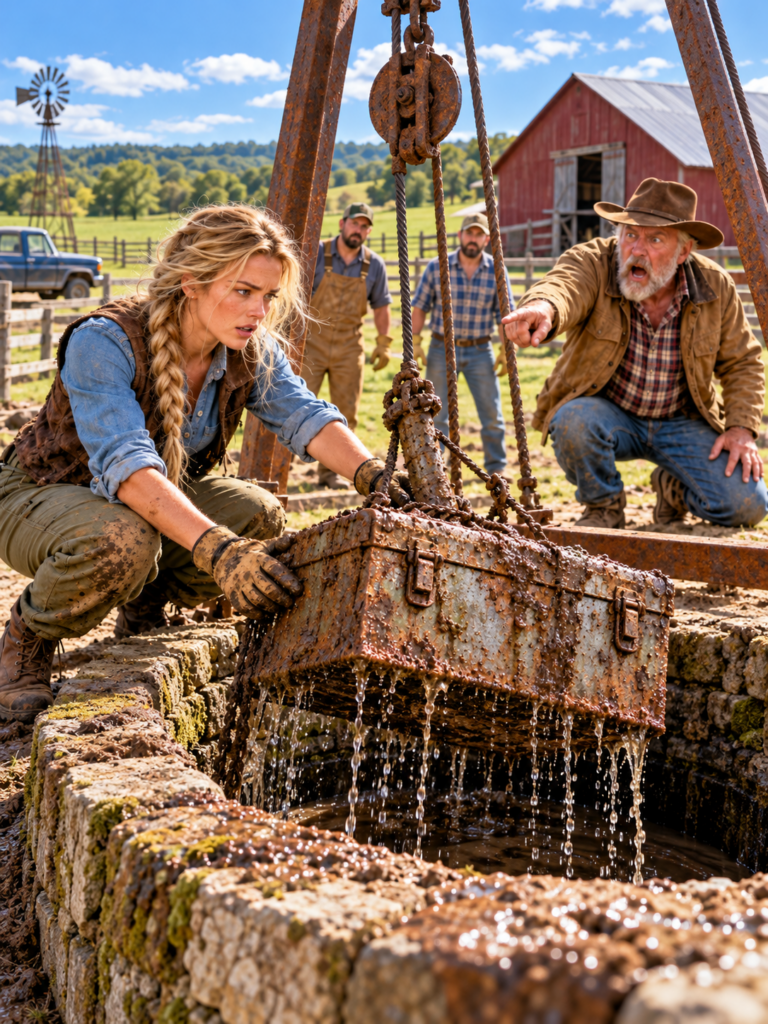
And slowly, hanging from the old cable, a heavy steel box emerged from the well.
For several seconds, none of them spoke.
The box was rectangular, blackened by mud, with thick edges and two badly rusted latches.
A steel handle was attached to it, and the old cable passed through that handle before continuing upward to the hooked end of the pipe.
The box hung beneath them, dripping muddy water.
It looked nothing like a piece of discarded farm machinery.
It looked as though someone had made a deliberate effort to protect whatever was inside.
Preston was the first to break the silence.
“What in the world is that?”
Wade kept his eyes on the suspended load.
“Something that needs to be put down safely before we start guessing.”
Talia followed his instructions.
Working slowly, they moved the box onto solid ground and secured it.
Only then did Wade relax his attention on the winch.
He crouched beside the object.
Mud covered most of its surface, filling the seams and obscuring the metal beneath.
He examined its construction without trying to open it.
“That’s a substantial box,” he said.
He estimated its weight at close to seventy pounds.
The edges were thick. The seams appeared tight. Beneath the lid were remains of an old gasket that might once have helped seal it.
Talia knelt beside it.
The steel was cold and scarred beneath the mud.
She examined the handle where the cable had been attached.
Whoever had lowered the box into the well had used a strong connection.
It seemed unlikely that the object had simply fallen in.
Preston crouched on the opposite side.
“Do you think there’s money in it?”
Talia glanced at him.
“I think there’s a box in it.”
“You know what I mean.”
“I know. But we haven’t opened it.”
Wade examined one of the rusted latches.
“Not going to be simple, either.”
Darius had said almost nothing since the box appeared.
He stood a few feet away, looking at it with an expression Talia could not read.
She rose.
“Uncle Darius?”
He seemed to return from somewhere far away.
“I remember a story,” he said.
Preston looked up.
“What story?”
Darius took a moment before answering.
“My grandfather. Luther Bennett.”
Talia knew the name.
Luther belonged to the older generations of family history, the kind preserved in photographs, scattered documents, and stories repeated at gatherings.
Darius looked at the steel box.
“There was a time a local bank failed, and the family lost part of its savings. Luther never trusted banks much after that.”
He crouched carefully beside the box.
“People said he kept things hidden. Cash, papers, anything he thought mattered enough to put away somewhere safe.”
“Where?” Preston asked.
“That was the question.”
Darius rubbed at a dried patch of mud on the steel.
“When he died unexpectedly, nobody knew where he’d kept it all. Folks looked around the property. The old barn, the sheds, the foundation where the house used to stand.”
He paused.
“Somebody even thought he might have buried money near a tree. People went looking everywhere they could think of.”
“Did they find anything?” Talia asked.
“Nothing worth talking about.”
Preston looked down at the box with fresh interest.
“You think this belonged to Luther?”
“I think my grandfather had a habit of keeping important things where other people wouldn’t think to look.”
Darius glanced toward the well.
“And nobody thought to look down there.”
For years, the old shaft had been known as a failed source of water.
A hazard.
A useless hole.
It had never occurred to the family that somebody might once have used it for another purpose.
Talia studied the mud-blackened steel.
The cable had not been tied carelessly. It passed through a handle designed to carry the weight of the box. The connection looked deliberate.
Someone had lowered it into the shaft.
Whether that person had been Luther was another matter.
The box might have been placed there long before the well stopped producing usable water. The cable might have shifted later, catching around the bent pipe when repairs disturbed the lower section.
There was no way to know yet.
But she understood why Darius had gone quiet.
He was no longer looking at an obstacle from a failed repair.
He was looking at something that might have been hidden by a man his family had spent decades trying to understand.
Preston stood up.
“Well, let’s see what’s inside.”
He reached toward one of the latches.
Wade caught his attention before he put any weight on it.
“Those are rusted nearly solid. Don’t start prying.”
“Why not? We’ve got tools.”
“We’ve got tools for breaking things,” Wade replied. “That doesn’t mean we ought to break this.”
Preston glanced toward the workshop.
“A grinder would get those off.”
“No,” Talia said.
Her answer was immediate.
Preston looked surprised.
“You don’t even know what’s in it.”
“Exactly. There could be papers inside. Old records, letters, anything. I’m not going to throw sparks and heat across a sealed metal box just to open it faster.”
Wade nodded.
He examined the hardware more closely and concluded that the latches appeared badly corroded, but the lid itself did not seem permanently welded shut.
A metal locksmith might be able to free them without cutting through the top.
They carried the box to the workshop.
There, under better light, Talia could see how heavily the years had marked it.
The steel was pitted in places, the corners discolored, and the handle worn where the cable had pulled against it.
But the seams remained remarkably intact.
The rusted latches resisted every gentle attempt to test their movement.
Preston was still convinced there must be money inside.
He speculated about gold, hidden cash, and valuables Luther might have saved after the bank failure.
Darius said less.
He sat near the workbench, studying the box and occasionally recalling small details of his grandfather’s habits.
“He wasn’t the sort of man who trusted luck,” Darius said eventually. “Not after losing money like that.”
Talia looked at the box.
“Maybe he put something in there because he was afraid of losing it again.”
“Could be.”
“Or maybe it has nothing to do with him.”
Darius accepted that possibility.
“We won’t know until it’s open.”
While they waited for the locksmith, Talia returned to the old question that had started everything.
Water.
The recovery measurements were still in her notebook.
The damaged lining still needed attention.
The lower part of the shaft remained restricted.
Even if the box contained something valuable, the well itself had not been restored.
She did not want the discovery to distract her from the reason she had bought that small piece of land.
Eventually, the locksmith arrived and inspected the hardware.
He worked patiently around the fused latches, loosening corrosion and freeing the pieces without cutting across the lid.
Preston watched with restless interest.
Talia stood near the workbench.
Darius remained quiet.
One latch finally moved.
Then the other.
The locksmith tested the lid.
It resisted.
The old gasket still held in places, gripping the metal after years underwater.
He worked the edge loose with care.
A faint tearing sound came from the seal.
The lid shifted.
Then, for the first time in decades, the heavy steel box began to open.
Part 3
For a moment, nobody moved.
The locksmith raised the lid carefully, making certain that no loose piece of rusted hardware would fall inside.
Beneath it lay several bundles wrapped in old oilcloth.
There were three protective layers, darkened by age but still recognizable.
Talia leaned closer.
The box had spent decades in a wet, muddy shaft. She had expected anything inside to be ruined, if anything survived at all.
Yet the heavy steel walls, tight seams, and remains of the gasket appeared to have protected much of the contents.
The first bundle contained old paper currency and silver money.
They examined it carefully.
At face value, the money totaled approximately five hundred twenty dollars.
Preston stared at the bills.
“Well, I’ll be.”
Talia set them aside without comment.
The next bundle held a small bag of silver coins and several expired savings certificates.
Preston picked up one of the certificates, studied it, and looked toward Darius.
“Luther really did hide his money.”
“Maybe,” Darius said. “Let’s see what else is there.”
Talia lifted the remaining oilcloth.
Beneath it lay something less immediately impressive than the coins.
A ledger.
An old hand-drawn map of the property.
A collection of repair notes.
And documents concerning water rights connected to the land.
Talia reached for the ledger first.
Its cover showed the marks of long storage, and the pages had yellowed. She handled it cautiously, turning them one at a time.
There were dates.
Numbers.
Measurements.
At first, the entries appeared to be ordinary records of work carried out around the property.
Then she recognized a repeated reference.
The well.
She drew the ledger closer to the light.
“Wade?”
He stepped beside her.
She pointed to a page.
“Look at these depths.”
Wade read the figures.
Then another entry.
Then another.
His expression changed.
“Where did you find this page?”
“Right here in the middle.”
He took a longer look.
The entries described water levels, recovery measurements, repairs to the stone lining, and conditions deep in the shaft.
Luther had been keeping records of the well.
More importantly, he had documented the location of a dependable water-bearing level beneath what later became the obstructed section.
Talia turned another page.
One passage described a bent pipe and damage to the lining.
Another referred to reduced flow after the lower portion of the shaft became restricted.
Wade brought his own notes over and placed them beside Luther’s ledger.
He compared the measurements carefully.
The correspondence was striking.
The depths recorded in the old book matched the areas where Wade’s camera had revealed damage.
The obstruction near thirty-six feet.
The deeper section where the dark mass had been visible between roughly forty-four and forty-six feet.
The points where the lining had shifted and where the flow might have been restricted.
Talia sat very still.
All those weeks, she had measured water slowly returning to a well everyone believed had failed.
Now she was reading the observations of a man who had watched the same source years before its final abandonment.
Luther’s notes suggested something the family had never understood.
The water source itself had not simply disappeared.
The well had become obstructed.
Damage to the pipe and stone lining had gradually restricted the lower flow. Later attempts to free the pipe had failed without revealing the full extent of what lay beneath it.
The box had apparently been lowered below the damaged area years before the well was finally abandoned.
Over time, the cable attached to its handle had shifted or tightened around the bent lower end of the pipe.
The obstruction had therefore become a combination of structural damage and an accidental connection.
The box had not caused every problem with the well.
But it had helped make the pipe much harder to remove.
Talia ran her finger beside one of Luther’s measurements.
“So the water was still there.”
Wade considered the records before answering.
“According to these notes, the source was never the main problem. Getting the water into a usable shaft was.”
She looked up.
“That’s what my measurements were showing.”
“Could be. We’ve got better information now than we had before.”
Darius moved closer to the ledger.
“Luther wrote all that down?”
“Looks like it,” Wade said.
For several moments, Darius studied the handwriting without speaking.
The man in the family stories had become something more specific.
Someone who measured, recorded, repaired, and tried to understand the same well that later generations had considered useless.
The documents did not prove every detail of how the steel box had ended up where they found it.
Nor did they establish with certainty that Luther himself had lowered it.
But the connection between the property records, the family story, and the box was difficult to ignore.
Preston looked from the money to the ledger.
“You’re telling me those old papers might be worth more than what’s in the box?”
Talia glanced at the coins.
“Depends on what you mean by worth.”
He held up his hands.
“I mean actual money.”
“Then we’ll have to find out what the coins are worth.”
“And the papers?”
She looked down at the measurements.
“The papers might tell us how to get the well working.”
That possibility meant more to her than any number Preston could imagine.
The family later had the recovered currency and coins examined by a specialist.
The estimate surprised them.
Depending on the condition and individual pieces, the collectible value was somewhere between eight thousand four hundred and nine thousand one hundred dollars.
It was substantial money.
Certainly far more than Talia had paid for the northern corner.
But it was not a fortune that would transform the family or eliminate every financial obstacle.
Talia found herself strangely relieved.
The discovery mattered, but it had not turned the old well into a story about sudden wealth.
The more important question remained whether Luther’s records could guide them toward a dependable source of water.
Wade thought they had enough information to attempt the next stage.
With the box removed and the pipe freed, they could work toward the restricted lower section using the old measurements.
But he warned Talia that removing an obstruction did not repair weakened masonry.
The shaft still had structural problems.
And those problems could become more dangerous as the lower section was cleared.
They approached the work carefully.
Talia helped with the pumping and the tasks Wade considered safe for her to perform. Wade directed the inspections and the steps needed to clear loose sediment without forcing the damaged walls.
Progress was gradual.
At first, the water recovery improved only slightly.
Then the readings began to change more noticeably.
Each time they removed material from the restricted lower section, more water entered the shaft.
Talia recorded the measurements with growing interest.
The improvement was not enough to declare the project finished.
But for the first time, the well seemed to be responding to repairs in the way Luther’s notes suggested it might.
One afternoon, she showed Wade the latest figures.
He compared them to the earlier readings.
“That’s better,” he acknowledged.
“Better enough?”
“Better enough to keep measuring.”
It was the sort of answer she had learned to expect from him.
Wade was never impressed by progress merely because it looked encouraging.
He wanted to know whether it would hold.
For several days, the work continued without a major setback.
The water recovered faster.
The lower restriction gradually opened.
Talia began to imagine the sound of a working pump where the old cover had sat for so many years.
She pictured water reaching the first young orchard trees.
She imagined beginning the house without having to solve the entire water problem through a new drilled well.
She did not say much about those thoughts.
The job was not finished.
But she allowed herself to hope.
Then the eastern wall shifted.
The first warning was a sharp cracking sound.
Wade heard it before Talia noticed anything moving.
“Everybody back!”
His voice left no room for argument.
Talia moved away from the opening.
A section of the old stone lining broke loose.
Rock struck rock deep in the shaft.
The noise rolled upward, followed by the sound of falling material hitting the lower section.
Then came silence.
For a few seconds, nobody approached.
Wade watched for additional movement before inspecting what he could from a safe position.
No one had been injured.
But the damage was serious.
Part of the lower opening had been blocked again.
The very section they had worked to clear was now buried beneath newly fallen stone.
Talia stood beside the equipment, staring at the well.
The progress of the previous days seemed to have vanished in a matter of seconds.
Wade finished his initial assessment and turned toward her.
“We can’t keep doing it this way.”
She looked at him.
“Can we clear what fell?”
“Not without dealing with the wall first.”
He pointed toward the damaged section.
“That collapse took away support from what’s left. We go in after those stones now, and we could bring more of the lining down.”
She said nothing.
“Another collapse might close the lower section completely,” he continued. “And if it happens while someone is working near it, we’ve got a much bigger problem than a blocked well.”
Talia looked toward the equipment they had spent so much time assembling.
“What would it take?”
“Proper stabilization. A crew that’s worked on old stone-lined wells. The right support before anything else gets removed.”
“Could that save it?”
“Possibly.”
It was not the answer she wanted.
But it was the only answer Wade was prepared to give.
They shut down the work.
That evening, Talia sat with her notebook open and the recovered documents beside it.
The figures told a frustrating story.
The original recovery rate had been weak but consistent.
After the pipe and steel box were removed, it had improved.
With the lower restriction partly cleared, it had improved again.
Then the eastern wall had failed.
She had evidence that she had been right about the underground water.
Yet being right had not brought her any closer to having a safe, finished well.
For the first time, the idea of walking away felt less like surrender and more like a decision she might have to make.
Darius found her studying the notes.
He looked at the pages, then sat nearby.
“Wade told me about the collapse.”
She nodded.
“He thinks we need a proper repair crew.”
“That won’t be cheap.”
“No.”
Darius waited.
Talia closed the notebook.
“I know what you’re going to say.”
“Then maybe I won’t have to say it.”
She gave him a tired smile.
He looked toward the northern corner.
“You’ve already done more than anybody expected. You got that pipe loose. You found a steel box nobody knew was down there. You found Luther’s records and money that had been missing for years.”
She listened.
“Nobody can say you wasted ninety-five dollars.”
“That wasn’t what I was worried about.”
“I know.”
Darius folded his hands.
“But you don’t owe that well another dollar just because you’ve already spent money on it.”
Talia understood.
He was offering her permission to stop.
He was telling her that a good discovery did not have to become an endless obligation.
She looked down at the ledger.
“What bothers me is that we know what’s wrong now.”
“We know more than we did.”
“And we know there’s water.”
“We do.”
“I didn’t buy that corner because I thought something valuable was hidden in it. I bought it because I thought it might still be useful.”
Darius said nothing.
Talia continued more quietly.
“But Wade’s right. I can’t keep trying to solve it by pulling harder or digging deeper. That’s what everybody tried before.”
She paused.
“If we’re going to finish it, we have to fix the part that’s failing.”
Darius looked at the documents.
“You’re thinking about using the money.”
“Some of it. If the family agrees.”
He considered that.
The currency and coins were part of Luther’s recovered property, and Talia had no intention of treating them as hers alone simply because she had purchased the well corner.
She spoke with Darius and the relatives who had an interest in what had been recovered.
They discussed the value of the money, the condition of the shaft, and what it would mean to use part of the proceeds to restore the old water source.
Eventually, they agreed.
A portion of the recovered value would fund proper stabilization.
The decision gave Talia a practical way forward without turning the discovery into a contest over who deserved the money.
Wade brought in a small crew experienced with repairing old stone-lined wells.
Their approach was different from the earlier efforts.
They did not begin by trying to remove more debris.
They began with the damaged structure.
The crew inspected the weakened section, established safe working conditions, and installed support where the eastern lining had shifted.
Only after the unstable areas were secured did they begin removing the fallen stone under controlled conditions.
Talia remained involved, but she no longer felt any need to prove that she could do every part of the work herself.
She watched the specialists handle the tasks that required their experience.
When Wade asked her to help, she helped.
When he told her to stand clear, she stood clear.
One day, after watching her accept a delay without arguing, Wade made an observation.
“You know what probably kept this old well from being destroyed completely?”
She looked toward him.
“What?”
“People stopping when they couldn’t safely go farther.”
Talia considered that.
Wade continued.
“Your family didn’t finish the job. But they didn’t destroy what was left trying to force it, either.”
He looked toward the repaired lining.
“You’ve learned something they didn’t have a chance to learn. Sometimes the best way to keep going is to know when to stop pulling.”
Talia smiled faintly.
It was not the kind of praise she had once imagined receiving for restoring the well.
But she understood what he meant.
The work went on.
With the damaged wall stabilized, the crew removed the obstruction from the lower section, guided by the measurements Luther had recorded decades earlier.
The change in water recovery became unmistakable.
Water entered the shaft more freely.
It continued returning after pumping.
The readings grew stronger and more consistent.
At last, Wade was satisfied enough to move forward with a new pump and a full test.
Darius came to watch.
So did Preston.
Talia stood near the equipment while Wade checked the system.
When the pump began running, the first water that came through was brown.
Decades of sediment and the recent repair work had left the source disturbed.
Talia watched the muddy discharge.
Preston looked uncertain.
“Doesn’t look very promising.”
“Give it time,” Wade said.
The water continued flowing.
The pump held steady.
Gradually, the color began to lighten.
Talia checked the flow as Wade directed and recorded the results.
There was no sudden burst of perfectly clear water, no dramatic moment when everyone could declare the problem solved.
The system had to be flushed.
The flow had to remain stable.
The source had to be tested before anyone could depend on it.
But the pump kept running.
And the water kept coming.
After additional flushing, the water became clear enough for proper sampling.
Laboratory results later showed that the source could be used safely with standard treatment.
Forty-three years after the old well stopped providing usable water, it was working again.
Talia read the results more than once.
Then she carried them out to the well and stood beside the repaired cover.
The northern corner looked different now.
Not because it had become beautiful.
The stones still carried the marks of age. The surrounding ground still showed where equipment had stood, where mud had been disturbed, and where people had struggled for weeks to move a length of rusted pipe.
But the shaft was no longer an abandoned hazard.
It had a repaired lining, a secure cover, a new pump, and a working purpose.
The well would not make Talia wealthy.
It would not eliminate the cost of running the farm or the work required to turn the thirty-seven acres into a productive home.
It would not solve every problem she would face.
But it could provide a dependable backup source for the house, support the orchard, and reduce the amount of water she needed to purchase during dry periods.
Those were practical gains.
And to Talia, they were worth far more than a dramatic story about finding treasure.
Some time later, she tested the irrigation line for the first row of young trees.
Water moved steadily through the system and reached the ground around them.
Talia watched the soil darken.
She checked the connections, adjusted the flow, and walked along the row to make sure the water was reaching where it should.
Preston came by while she was working.
He stood near the line and watched for a while.
Neither of them spoke immediately.
At last, he said, “Looks like you’ve got it going.”
Talia straightened.
“Looks that way.”
He watched the water for another moment.
Then he looked at her.
“I was wrong about the well.”
She had imagined hearing those words more than once during the weeks when his remarks had irritated her.
Now that he had said them, she felt no desire to make him repeat them.
“I know you thought I was wasting my time.”
“I did.”
He glanced toward the northern corner.
“Maybe that old well wasn’t sitting there waiting to prove everybody wrong after all.”
Talia considered the statement.
Then she smiled.
“No. I think it was waiting for somebody to try a different way.”
Preston nodded.
He did not make a long apology.
She did not demand one.
They stood together for a while, watching water reach the young trees.
Months later, the first stages of Talia’s house were underway.
The thirty-seven acres were still very much a work in progress. There were expenses to plan, improvements to make, and more work ahead than she could complete in a single season.
But the property was beginning to resemble the future she had drawn in her notebook.
The orchard had its first rows.
The vegetable ground was part of a realistic plan rather than a distant wish.
And the northern corner, once excluded from the land deal because Darius considered it useless, had become a working part of the farm.
Talia kept the recovered steel box in the workshop.
She cleaned away enough mud to preserve it but did not polish the rust away or repaint its damaged surface.
The scars belonged to its history.
Sometimes, when she was looking for a tool or putting equipment away, she would see the box sitting where she had left it.
Its thick steel sides reminded her of the day it rose from the water.
The old cable.
The rusted latches.
Darius standing silent beside the well.
Preston asking whether there might be gold inside.
Wade insisting they stop before forcing the load.
And the ledger that had changed everything.
Talia had never learned every detail of how the box came to rest so deep in the shaft.
She could not say with certainty who lowered it or exactly when the cable became trapped around the pipe.
But she knew what the discovery had given her.
The money helped pay for repairs.
The documents supplied the knowledge needed to understand the lower section.
And the records connected her own efforts to those of a man who had worked the same ground generations earlier.
Luther Bennett had known that the water source remained beneath the obstruction.
He had written down the measurements.
He had preserved information that later generations did not know existed.
For years, the family had remembered only that the old well had defeated them.
They had remembered the damaged tools, the muddy water, and the stubborn pipe that refused to move.
Now Talia understood that the men who had tried before her were not necessarily foolish or careless.
They had worked with the knowledge and equipment available to them.
They had encountered damage they could not safely overcome.
And they had stopped.
Their failure had left something unfinished.
It had not proved that the well was worthless.
One evening, Talia stood near the workshop and looked across the land.
The light was fading over the young trees.
There were still signs of construction near the house and bare ground where future planting would begin.
The place was not complete.
She doubted it ever would be in the simple sense of having nothing left to repair, improve, or understand.
A working farm was never truly finished.
But that no longer troubled her.
She thought about the day she had offered Darius ninety-five dollars for the old well.
He had laughed because he believed she was buying a problem.
In a way, he had been right.
The well had demanded far more time, money, and patience than she initially expected.
It had frustrated her, frightened her, and forced her to abandon methods that seemed to be working.
It had brought her within reach of success, then nearly taken that success away when the eastern wall collapsed.
And yet, because she had refused to confuse uncertainty with impossibility, the land now had something it had lacked for forty-three years.
A useful source of water.
Talia looked toward the repaired well in the northern corner.
The old steel box had been the most surprising thing they lifted from its depths.
The coins had been the easiest discovery to value in dollars.
The ledger had been the most useful.
But the lesson she carried into the rest of her work could not be measured in money or gallons.
An abandoned thing was not always an empty thing.
A failed attempt was not always proof that the goal had been impossible.
And sometimes the difference between losing something forever and finding a way to use it again was not greater strength or greater stubbornness.
It was better information.
The right tools.
The willingness to listen.
And the judgment to understand that knowing when to stop could be just as important as knowing when to keep going.
Talia had bought the old well because she believed it deserved one more careful look.
She had found a steel box, forgotten records, and a connection to a part of her family’s history that had nearly disappeared.
But when water finally reached the roots of her young orchard, she understood what she had really recovered.
Not a fortune.
Not a victory over everyone who had doubted her.
Something quieter and more lasting.
A future on the land she had chosen.
And a reason to believe that an old failure, understood differently, could still become the beginning of something good.


