
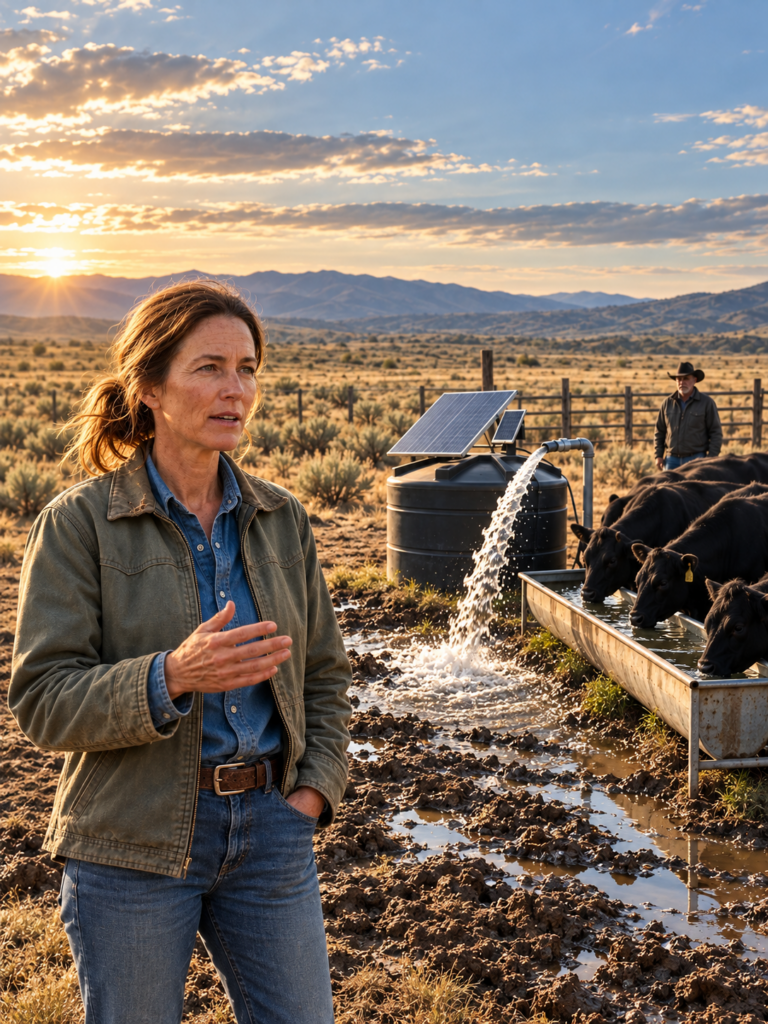
Part 1
Walt Hargrove turned the brass valve slowly, almost deliberately, as though he wanted Tessa Branvold to understand that what was happening could not be undone.
The first quarter turn brought a rough metallic squeal. The second weakened the steady vibration inside the black pipeline. By the time he finished, the familiar rush of water had faded into a faint hiss and then into silence.
For a moment, neither of them spoke.
September sunlight lay hard and white across the Montana pasture. Beyond the fence, sixty cow-calf pairs moved through grass so dry it cracked beneath their hooves. The creek had stopped running in July. Dust hung around the cattle’s legs, and the wind carried the smell of sagebrush and sunbaked earth.
Walt rested one hand on the valve.
“That’s all of it, Tessa.”
She looked at the pipe, then at him.
“You know what this means.”
“I know exactly what it means.”
He nodded toward the stock tanks scattered across her pasture.
“You’ve got nine days of water sitting in those tanks. Maybe less if the heat holds. After that, you’ll have to haul it.”
Tessa had already done the calculations. She didn’t need him to explain them.
Her savings would cover five weeks of delivered water. Not six. Not an extra few days if the trucking company raised its rates. Five weeks, provided nothing else broke and the weather did not grow worse.
At the end of October, the bank expected a payment on the ranch debt her father had left behind.
Without dependable water, she could not keep her cattle. Without her cattle, she had no reliable way to service that debt. And without the ability to service the debt, the six hundred and forty acres beneath her boots might soon belong to somebody else.
Walt seemed to know what she was thinking.
“Sell the herd while prices are still halfway decent,” he said. “You wait until everybody’s desperate, you’ll get half what they’re worth.”
She studied his face.
Walt wasn’t a stranger. She had known him most of her life. His father and hers had worked neighboring land for decades. They had borrowed equipment, helped mend fences, and made the kind of informal arrangements that seemed permanent because the same families had honored them for years.
The water pipeline was one of those arrangements.
Two miles of black polyethylene pipe carried water from the spring-fed reservoir on Hargrove property across the section line to four stock tanks on the Branvold ranch.
Tessa had been two years old when the two fathers shook hands on the deal.
There had been no contract, no recorded easement, no written promise that the water would continue flowing.
For most of her life, that hadn’t seemed important.
Now it was the only thing that mattered.
“Your father never would have done this,” she said.
Walt’s jaw tightened slightly.
“My father’s in a care home in Billings. I’m responsible for the property now.”
“And that means you can cut off the water?”
“It means I have to look after my own place. It’s a dry year. My hay meadows need every gallon I can save.”
Tessa looked toward his side of the fence. The explanation wasn’t entirely unreasonable. Everybody in the county was struggling with the drought.
But Walt had been talking about buying her ranch long before the creek went dry.
He shifted his weight and glanced across her pasture.
“I’ll make you a fair offer for the whole place,” he said. “Six hundred and forty acres. You can pay the bank, sell the cattle, and walk away without another year of headaches.”
There it was.
He didn’t have to threaten her. He didn’t have to raise his voice.
He only had to close the valve and wait.
A ranch without water was land that couldn’t support the livestock living on it. The longer she struggled, the more attractive his offer would become.
Tessa felt something cold settle beneath her ribs.
“You’ve thought this through.”
Walt didn’t deny it.
“I’m offering you a way out.”
She turned toward the nearest stock tank. Its surface reflected a pale strip of sky. A cow stood beside it, waiting for its calf to finish drinking.
“That’s what you call it?”
“I call it business.”
He climbed into his pickup.
“Think it over before those tanks run dry.”
The engine started. His truck backed away from the gate, turned onto the ranch road, and disappeared in a drifting trail of dust.
Tessa stood beside the silent pipeline long after he had gone.
Then she reached into her coat pocket.
Inside was a folded county tax-sale listing, creased from being opened and refolded over the last two weeks.
Parcel 14.
Forty acres.
Minimum bid: $1,500.
The county described it as land with severe erosion, no established road access, and no verified water source.
Most people would have seen forty acres of worthless sagebrush.
Tessa had been thinking about something else.
On the back of an old feed receipt, in her own hurried handwriting, were six words.
Ask Orville about the Dutchman’s well.
She folded the receipt again and looked toward the far end of her ranch.
She didn’t know whether that well still existed. She didn’t know whether it contained a drop of usable water.
But she knew one thing with absolute certainty.
She wasn’t ready to sell her father’s land.
At thirty-nine, Tessa had spent enough of her life around ranching to recognize when persistence was useful and when it was simply another way to lose money.
Her father had once told her that her greatest strength and her worst weakness were the same thing.
“When something won’t move,” he’d said, “you figure pushing harder ought to fix it.”
He had usually been smiling when he said it.
She hadn’t always found it funny.
At eighteen, she had left the ranch for Bozeman to study range management. She wanted a life where her work produced results she could measure, where a bad summer didn’t threaten everything her family owned, and where she could make decisions without worrying about the price of hay.
After four years of school, she spent fourteen years as a range technician for a conservation district.
She walked other people’s pastures, measured ground cover, examined soil, and helped landowners understand what their property could sustain.
Gradually, she learned to notice things most people overlooked.
A change in the grass along a slope.
A patch of rushes where no creek appeared on a map.
A lone cottonwood growing in an otherwise dry draw.
Land gave away its secrets, but seldom to somebody who looked only once.
Then her father became ill.
She returned home intending to help for one season.
Instead, she stayed through his final illness, the funeral, and the long evenings afterward when the house seemed to have lost its center.
The medical bills were worse than she’d expected. So was the ranch debt.
For the past two years she had worked to keep the place solvent.
She repaired fences that had been leaning since she was a girl. She changed the grazing rotation to give the exhausted pastures time to recover. She kept careful records, watched expenses, and sold what she could spare.
In the barn, her father’s pencil marks still climbed the inside of the doorway.
Each mark carried a date and the height of a girl who had once believed she would grow up and leave this place forever.
Sometimes Tessa stopped there longer than she meant to.
She had already lost the man who made those marks.
She couldn’t bear the thought of losing the doorway too.
But sentiment did not provide water.
In the days before Walt closed the valve, she had already tried the sensible options.
Twice, she asked him to reconsider.
He refused.
She called every neighboring ranch within twenty miles. Some had barely enough water for their own livestock. Others were hauling water themselves.
She contacted well drillers.
A new well could cost more than eighteen thousand dollars, and the earliest available rig was four months away.
By then, her problem would have solved itself in the worst possible way.
She considered selling cattle to reduce water demand, but prices were poor enough to make that a painful choice. Selling much of the breeding herd would sacrifice years of work and leave her ranch with far less earning power.
Each option bought a little time by giving up something she would need later.
And then there was Parcel 14.
A strip of neglected ground on the far side of her property, owned by the county after decades of unpaid taxes.
She had noticed it while studying old plat maps.
A forgotten parcel. An abandoned well. A story that an old sheep rancher had once watered hundreds of animals there during a drought.
She had no proof.
Only an old name and a rumor.
The morning after Walt closed the valve, she drove into town to find the man who might remember.
Orville Puit was sitting at his usual corner table in the Sail Barn Cafe, exactly where Tessa expected him to be.
At eighty-one, Orville had the weathered face and deliberate movements of a man who had spent most of his life outdoors. His coffee sat beside the weekly livestock report, and a folded newspaper occupied the other half of the table.
Tessa bought a cup and sat across from him.
Orville lowered the report.
“Something wrong at your place?”
She almost smiled.
“Is it that obvious?”
“People don’t come looking for me this early unless they need to borrow something or hear about something old.”
“I need to hear about something old.”
He leaned back.
“Go ahead.”
“The Dutchman’s well.”
Orville’s expression changed.
He put down his cup carefully.
“Now, there’s a name I haven’t heard in a while.”
“Was it real?”
“Of course it was real.”
“Where?”
“Old Hendrick Voss’s place. East of your far pasture, if I’m remembering the boundaries right.”
“Parcel 14?”
“That sounds like what the county calls it now.”
Tessa leaned forward.
“Tell me about the well.”
Orville looked out through the cafe window for a moment.
“Voss drilled it in fifty-eight. Kept sheep out there. Nothing fancy about the place, but that well kept him going.”
“Was it a good well?”
“Depends what you mean by good.”
“I mean, did it produce water?”
Orville gave her a patient look.
“In sixty-one, we had a summer so dry you could walk the creek beds without getting mud on your boots. I watered six hundred ewes off that well.”
Tessa sat a little straighter.
“Six hundred?”
“That’s right.”
“How much water did it produce?”
“Couldn’t tell you a number. We didn’t worry about gallons a minute the way people do now.”
He stirred his coffee.
“But I’ll tell you what I remember. It never ran dry.”
She felt a small movement of hope.
Then Orville added, “Never ran fast, either.”
“How slow?”
“Slow as a sleepy cat. Voss had to be patient with the thing. But even that summer, there was water.”
“What happened to the ranch?”
“Sheep prices went bad. Voss died. Taxes didn’t get paid. Nobody wanted the ground.”
He shrugged.
“Land’s been sitting there longer than you’ve been alive.”
Tessa stared into her coffee.
If the old well still worked, it might be something. But a memory from sixty-five years earlier was not a water supply.
“You thinking of buying it?” Orville asked.
“Thinking of looking.”
He nodded.
“That’s where I’d start.”
“Did Voss ever have trouble with it?”
“Not that I remember. Course, memory isn’t the same as a test report.”
Tessa appreciated that.
She needed information, not encouragement that would lead her straight into a mistake.
Orville returned to his newspaper.
As she stood, he looked up again.
“Tessa?”
“Yes?”
“Don’t mistake slow for empty.”
She carried those words with her all the way back to the ranch.
That afternoon she drove to the southeast edge of her property and walked along the fence toward Parcel 14.
The county listing had not exaggerated its shortcomings.
The land was rough and neglected, forty acres of sagebrush and cheatgrass broken by an ugly gully. Erosion had cut into the southern end, leaving exposed banks and scattered stones. There was no practical road into the parcel from public land.
Near its center stood the rusted stump of an old windmill tower.
The blades and upper structure had disappeared years ago. Only twisted steel remained, rising above the sage like the skeleton of something abandoned.
Beside it sat a cracked concrete cistern.
Tessa examined the walls. Several fractures ran through them, and one side had settled badly.
It would never hold water safely again.
A few feet away, a steel pipe protruded from the ground beneath a corroded plate.
The old well casing.
She knelt and brushed away dirt around its base.
The metal was rough and deeply weathered, but there was no way to know what condition it was in farther down.
For all she knew, the well might have collapsed years earlier.
She straightened and surveyed the parcel.
No road.
A useless cistern.
A rusted windmill.
Forty acres of ground that couldn’t support much grazing.
The price suddenly seemed less like a bargain.
Then she remembered what she had noticed on the county plat.
The southeast corner of Parcel 14 touched her far pasture.
For anybody else, lack of road access would be a serious problem. They would have to secure access before making meaningful use of the property.
Tessa already had land adjoining it.
A gate could connect the parcels.
That solved one difficulty.
It did nothing about the water.
She walked toward the eroded gully.
At first, it looked like every other wash on the ranch: loose soil, scattered stones, and sparse vegetation.
Then a narrow ribbon of green caught her attention.
She stopped.
The strip was no wider than a pickup truck, but it ran through the head of the gully where nearly everything around it had turned brown.
She recognized sedges and rushes.
Those plants needed more moisture than the season’s rainfall could explain.
Farther along stood a young cottonwood, perhaps four feet tall, its leaves still bright.
Tessa crouched and pushed her fingers into the earth.
The surface was dusty.
A few inches lower, the soil darkened.
At roughly a hand’s depth, she felt unmistakable moisture.
She stayed there with her fingers buried in the dirt.
There was water somewhere beneath this ground.
That was what the plants suggested.
It did not prove the old well could supply livestock.
Groundwater might be feeding the gully without entering the casing. The well might be clogged, damaged, or too weak to justify the expense of repairing it.
She had spent fourteen years telling ranchers not to confuse hopeful signs with confirmed resources.
She wasn’t about to ignore her own advice.
Still, she looked back at the broken windmill.
Someone had once found enough water here to justify drilling and building a livestock system.
And according to Orville, it had worked through a drought worse than this one.
For the first time since Walt shut off the pipeline, Tessa could imagine a way forward that didn’t end with somebody else owning her ranch.
She returned to the truck and opened her notebook.
Under Parcel 14, she wrote three observations.
Touches my pasture.
Moisture still present in gully.
Old well must be tested.
Then she drove home to find out whether she could afford the gamble.
The kitchen table was covered with bills by the time darkness settled over the house.
Tessa had sold four of her best yearling heifers to establish a project fund. Those animals had been intended to strengthen her breeding herd, and she felt their absence every time she counted the cattle.
The sale left her with $6,500 to spend on the possibility of water.
She had another account reserved for trucking water until she could establish a permanent supply.
That money was untouchable.
If she spent it on equipment and the project failed, her animals would pay the price.
She drew a line down the center of a sheet of paper.
On one side, she listed what she knew.
The land would cost $1,500.
If she bought it, she would have $5,000 left in the project account.
On the other side, she listed everything she didn’t know.
Would the county transfer ownership without complications?
Was the old water claim still valid?
Could she legally use water from the property for her cattle?
Would the casing hold?
Was the groundwater safe?
What would it cost to restore the well, install a pump, and store enough water to supply sixty cow-calf pairs?
She put down her pencil.
There were too many unanswered questions to justify signing anything yet.
The next morning she called the state water office.
A clerk searched the historical records while Tessa waited beside the kitchen phone, her notebook open.
Eventually, the clerk found an entry.
A stock-water well claim dating from 1958.
Registered to the old Voss property.
Tessa sat forward.
“So the claim exists?”
“Yes. But there are conditions you need to understand.”
She wrote down everything the clerk told her.
Buying the land would not automatically establish her right to use the water. The ownership information on the claim would need to be updated, and the authorized use was livestock watering on that particular parcel.
Not on the neighboring ranch.
Not wherever she happened to want to run a pipe.
Tessa looked out the window toward her pastures.
For a moment, she felt the plan slipping away.
She had imagined bringing water back to the existing tanks, replacing the supply Walt had taken away.
But the restrictions meant she couldn’t simply pump from Parcel 14 onto her home ranch.
Then she remembered the property boundary.
The gate.
The fact that cattle could walk.
“What if the livestock came onto that parcel to drink?” she asked.
The clerk explained that watering livestock on the claimed parcel was the use described in the record, though Tessa would still need to complete the appropriate ownership and compliance steps.
When the call ended, Tessa changed her drawing.
Instead of a pipeline leading away from the well, she sketched a trough inside Parcel 14, near the shared boundary.
Her cattle could cross through a gate to reach it.
The water would remain on the parcel where its authorized livestock use belonged.
She studied the new sketch.
It was a small adjustment, but it changed the entire project.
Next came the physical well.
She called D. Kesler, a driller who had spent twenty-two years working with wells across the county.
D listened while Tessa explained the abandoned parcel, the old claim, Orville’s memory, and the green vegetation in the gully.
When Tessa finished, D was quiet for a moment.
“Could be a dry hole,” she said. “Could be full of collapsed casing. You can’t tell anything from the top.”
“Can you inspect it?”
“I can get a camera down there. If the casing is open, we can test what’s happening.”
“And if there’s water?”
“Then we find out how much.”
Tessa hesitated.
“Orville says it never ran dry.”
“That doesn’t tell us the capacity today.”
“I know.”
“There’s something else you need to remember,” D said. “People give up on low-yield wells because they expect them to behave like high-yield wells.”
“What do you mean?”
“A slow well isn’t necessarily a dead well. Sometimes all it needs is the right storage.”
Tessa wrote the words down.
She didn’t yet understand how important they would become.
On Thursday morning she drove to the county courthouse.
The building smelled of paper, floor polish, and the faint dust that always seemed to follow ranchers indoors.
Tessa carried the tax-sale paperwork in one hand.
She had checked the maps again, called about the water claim, and spoken with D about inspection costs.
She still had no guarantee the well worked.
But at least she understood the risk she was taking.
At the counter, she discovered Walt Hargrove was already there.
He was renewing a grazing lease.
His eyes moved from her face to the document she carried.
“Parcel 14?”
She said nothing.
He gave a short laugh.
“You’re not serious.”
“Looks like I am.”
“Fifteen hundred dollars for that washed-out gully?”
“It’s forty acres.”
“It’s forty acres nobody wants, Tessa. No road, no decent grass, nothing but an old junk pile.”
She held his gaze.
“Then I guess I won’t have much competition.”
Walt shook his head.
“That’s the most expensive mistake in the county.”
He said it with something close to amusement, as though her decision confirmed what he had already believed about her chances of surviving without his pipeline.
Tessa turned back to the clerk.
She signed the required documents.
No other bidder appeared.
The clerk processed the sale and stamped the paperwork.
Parcel 14 belonged to Tessa Branvold.
She stood for a moment holding the deed.
Forty acres of unimpressive land.
An abandoned well she had never seen inside.
And $1,500 less in her project fund.
Walt was still smiling as she walked past him.
She didn’t offer an explanation.
Outside, the afternoon sun struck the courthouse steps, and traffic moved quietly along the street.
Tessa folded the documents carefully and placed them in the truck.
Then she climbed behind the wheel.
She had purchased a possibility.
Whether it would become a water supply was another matter entirely.
And the first day of her six-week fight had already begun.
Part 2
D. Kesler arrived the following Monday in a work truck loaded with inspection equipment.
She stepped out, looked across the property, and studied the rusted windmill stump.
“So this is the famous Dutchman’s well.”
“What’s left of it,” Tessa said.
D walked around the casing, examined the corroded cap, and glanced at the cracked cistern.
“Somebody built this to last. Just didn’t build the parts aboveground to last forever.”
The steel plate covering the well refused to move.
They worked at it with two pry bars, scraping away rust and dirt until the metal finally broke loose with a sharp crack.
Tessa stepped back as D lifted the plate clear.
The opening was dark.
There was no smell of fresh water, no reassuring sound from below.
Just an old steel casing disappearing into the ground.
D prepared a small inspection camera and lowered it carefully.
Tessa watched the monitor beside her.
For the first several feet, the picture showed nothing except stained metal.
The camera moved deeper.
Thirty feet.
Forty.
Fifty.
Tessa folded her arms against the morning chill.
At sixty-two feet, a dark reflective surface appeared on the screen.
D stopped lowering the camera.
“Well, look at that.”
Tessa leaned closer.
“Is that water?”
“That’s water.”
For several seconds, Tessa couldn’t speak.
She had imagined this moment since Orville first told her the story. Now she could see the proof with her own eyes.
Water still stood inside the Dutchman’s well.
She let out a long breath.
But D was already examining the casing below the surface.
“Don’t celebrate yet.”
The camera descended farther.
The steel looked reasonably sound down to approximately seventy feet. Below that, corrosion became more obvious.
Around eighty feet, the metal was heavily pitted.
D adjusted the camera angle.
“There’s damage here. But I don’t see a collapse.”
“Can it be fixed?”
“Probably needs a liner in the bad section. First we need to see whether the well can actually produce.”
Tessa glanced toward the green vegetation in the gully.
D followed her gaze.
“Those rushes suggest groundwater is still active,” she said. “They don’t tell us what this casing can deliver.”
Tessa nodded.
There was the same distinction she had made herself.
Evidence was not capacity.
D began preparing the test equipment.
They bailed water from the well, installed a temporary pump, and monitored how the level responded.
At first it dropped.
Tessa watched the readings with growing concern.
Then the decline slowed.
Eventually the level settled into a pattern, water entering the well as the pump continued drawing it out.
D allowed the test to continue.
When she finally shut off the pump, they watched the level rise again.
Not quickly.
Not dramatically.
But steadily.
D made another note and checked her calculations.
“About two and a half gallons a minute,” she said.
Tessa stared at her.
“That’s it?”
“Sustained yield, based on this test.”
“Two and a half?”
“That’s what the well is giving us.”
Tessa looked at the equipment.
She had expected more.
Not because she had any evidence the well could produce more, but because the problem waiting on her ranch felt too large for such a small number.
“That’s barely a garden hose.”
D closed her notebook.
“Do you know what two and a half gallons a minute means over twenty-four hours?”
Tessa started calculating before D could finish.
One hundred and fifty gallons an hour.
Three thousand six hundred gallons in a full day, if the pumping could be sustained continuously.
She went through the arithmetic again.
Her sixty cow-calf pairs needed approximately one thousand gallons a day in the cooler fall weather, though consumption could rise with heat and conditions.
She looked back at the well.
On paper, its measured yield exceeded the herd’s daily requirement.
D watched her expression change.
“Now you’re asking the right question.”
“How do I get that water to the cattle without pulling the well dry?”
“Carefully.”
D nodded toward the ruined cistern.
“And with storage.”
For the first time, the little well began to look less like a desperate gamble and more like a practical resource.
Tessa had found water.
Now she had to learn how to use it.
The next several days replaced her relief with a new set of worries.
The laboratory report arrived first.
The water was hard, and its sulfate concentration was somewhat elevated. It remained within a range considered acceptable for cattle at the time of testing, but D didn’t want Tessa treating one analysis as a lifetime guarantee.
“Sulfate can cause serious trouble if concentrations get too high,” she explained. “Retest in a month. And keep an eye on the animals.”
Tessa added the instruction to her notebook.
Next came the casing repair.
The corroded section needed a liner.
Cost: $1,350.
Tessa carried the estimates into the kitchen and spread them beside her bank statements.
The land purchase, camera inspection, test pumping, and laboratory work had already consumed $2,150.
With the liner expense added, she would have $3,000 left from the original $6,500 project fund.
Three thousand dollars to build everything above the well.
She needed a pump, power supply, controls, storage tank, and livestock trough.
Every additional piece of equipment seemed to carry a price she hadn’t anticipated.
Meanwhile, the water trucks continued arriving.
The hauling account was shrinking by the day.
She was ten days into the six-week period she had calculated as her best chance to establish another source of water.
She had proof the well worked.
But proof alone couldn’t water a herd.
On Saturday morning, she was setting a new gatepost along the boundary of Parcel 14 when she heard a pickup approaching.
She looked up.
Walt Hargrove.
He parked on the other side of the fence and climbed out carrying his hat in one hand.
Tessa drove the post deeper before speaking.
“Morning, Walt.”
“Morning.”
He examined the disturbed ground, the gate opening, and the equipment tracks leading toward the old well.
“I hear you found water.”
“That’s right.”
“Two and a half gallons a minute, isn’t it?”
Tessa stopped working.
“News gets around.”
“It does in this county.”
Walt rested his forearms on the fence.
“That’s not much water.”
“It’s more than I had last week.”
“You know what happens when a dry winter comes? That number can change. You’re putting a lot of faith in an old hole in the ground.”
She disliked hearing it from him.
Worse, she knew he had a point.
One autumn test did not guarantee dependable winter production. The well might decline in another drought. Equipment could fail.
She had been worrying about the same things.
“What are you here for?” she asked.
Walt reached into his coat and took out a folded sheet of paper.
“I came to offer you a better arrangement.”
He handed it across the fence.
Tessa read the first lines.
A five-year water agreement.
Walt would reopen the pipeline.
The price would be three times the old rate.
In return, she would sign a written agreement giving him the first right to buy her ranch if she ever decided to sell.
She read the clause twice.
“So you still control the valve.”
“I own the reservoir.”
“And I pay three times what I used to.”
“Water’s more valuable now.”
“And if I ever sell, you get the first chance at my property.”
“That’s fair business.”
Tessa lowered the paper.
She could almost feel the weight of the decision.
A reopened pipeline would solve her immediate problem. The cattle would have water tomorrow. She could stop the deliveries and preserve what remained in her hauling account.
The bank payment might become manageable.
She could have a normal night’s sleep for the first time in weeks.
But she could also see what the agreement would mean five years from now.
She would remain dependent on Walt.
She would be paying far more for water than before.
And if another crisis eventually forced her to sell, the man who had created this one would be standing at the front of the line.
Walt seemed to recognize her hesitation.
“Or,” he said, “I’ll buy this forty-acre parcel from you today.”
She looked up.
“How much?”
“Eight thousand dollars.”
Tessa said nothing.
She had paid $1,500.
The difference was $6,500 before considering the money she had already spent investigating and repairing the well.
An $8,000 check would provide immediate breathing room.
She could cover water deliveries for months longer. She could settle some bills. She could step away from the exhausting uncertainty of the project.
Walt watched her.
“You’ve taken a gamble and found something. I’m willing to pay you for it. You can walk away ahead on the land purchase and let somebody else worry about that well.”
Behind his truck, another pickup rolled to a stop.
Lyall Sandival sat behind the wheel.
He was a neighboring rancher from the next section, a man Tessa knew well enough to greet but not well enough to call a close friend.
Lyall switched off his engine and waited.
When Tessa glanced toward him, he lifted two fingers from the steering wheel.
He said nothing.
She turned back to Walt.
“If I sign your water agreement, I never get out from under you.”
Walt frowned.
“That’s not what I’m offering.”
“You keep the valve. You decide what the water costs. And you get the first chance at my ranch if I can’t make the numbers work.”
“I’m offering security.”
“For you.”
His expression stiffened.
She looked at the old well in the distance.
“And if I sell you Parcel 14, I’m giving away the only water source I might actually control.”
“You don’t even know if it’ll last.”
“No. I don’t.”
Walt folded his arms.
“Then what exactly are you holding on to?”
She took a moment before answering.
“The chance to make a decision without needing your permission.”
For the first time, he looked irritated.
“Plenty of people make arrangements like this.”
“I know.”
“There’s nothing wrong with depending on somebody.”
“Not when both people have a choice.”
Walt held out his hand for the agreement.
Tessa gave it back.
He folded it carefully.
“You’ve got about a month of hauling money left. We’ll see how you feel when that’s gone.”
He put on his hat, climbed into his truck, and drove away.
Lyall waited another moment.
Tessa thought he might get out and speak to her.
Instead, he started his engine and followed the road back toward his own place.
She watched both trucks disappear.
Lyall hadn’t defended her.
He hadn’t supported Walt either.
But his silence told her enough.
He didn’t expect her gamble to work.
She picked up the post driver and returned to the gate.
The steel handle was hot beneath her palms.
She struck the post harder than necessary.
By the third week, the problem had become brutally simple.
D prepared an estimate for a proper watering system.
A low-flow solar pump matched to the well’s sustainable production.
A dry-run protection controller that would shut the pump down before the water level fell too far.
A float switch to stop pumping when the storage tank was full.
A 5,000-gallon tank.
A livestock trough.
The total came to approximately $3,400.
Tessa had $3,000.
She was only four hundred dollars short, but four hundred dollars might as well have been four thousand when every available dollar already had a purpose.
She could sell something else.
She could delay installation.
She could ask the bank for more room.
Or she could find a cheaper system.
That last possibility kept returning to her.
One evening, she sat at her kitchen table searching used equipment advertisements.
A solar pump caught her eye.
Eight gallons per minute.
Asking price: $900.
She checked the specifications.
Eight gallons a minute.
More than three times the well’s measured sustained yield.
She understood the difference.
She did.
But another thought kept pushing its way forward.
If she could pump water quickly into a tank, perhaps she wouldn’t need the expensive storage system D had recommended.
Perhaps she could run the pump for a few hours, fill a smaller tank, and let the well recover between pumping sessions.
She found a used 1,500-gallon tank for $700.
Together, the pump and tank would cost $1,600.
That seemed manageable.
She called D.
“I found a pump.”
“What kind?”
Tessa told her.
There was a long silence.
“Eight gallons a minute?”
“Yes.”
“Tessa, the well gives two and a half.”
“I know. I wouldn’t run it all day.”
“That pump can draw the casing down faster than the formation can replace the water.”
“I could shut it off when the tank fills.”
“What happens if the water level drops before the tank fills?”
“I’ll monitor it.”
“Every minute?”
Tessa rubbed her forehead.
“I can’t afford the whole system right now.”
“I understand that.”
“Then what am I supposed to do?”
“Buy a pump matched to the well. Build storage as you can. And don’t skip the protection controls.”
“The tank costs more than the pump.”
“The wrong pump will cost you more.”
Tessa looked at the advertisement.
She heard the warning.
She even believed it.
But she was tired of water trucks. Tired of watching money disappear while the cattle waited behind drying fences.
She wanted to do something that would change the situation immediately.
She bought the pump.
Then she bought the smaller tank.
To keep the project under budget, she left out the float switch and dry-run controller.
She told herself she could add them later.
On Wednesday evening, she completed the installation.
The solar panels were mounted, the pump connected, and the delivery pipe ran toward the tank.
She checked the fittings once more and switched on the power.
At first, there was a faint mechanical hum.
Then water surged through the pipe.
Tessa hurried to the tank.
A strong stream poured into it.
She stared, hardly believing what she was seeing.
After three weeks of worrying over gallons, hauling schedules, and bank balances, there was finally water moving in a quantity she could see and hear.
She laughed.
It was the first moment in days when she felt almost lighthearted.
She watched the water splash against the bottom of the tank.
The pump was working.
Maybe D had been too cautious.
Maybe the old well could handle short bursts better than anyone expected.
Maybe she had found a way to save thousands of dollars.
For twenty-five minutes, the water flowed beautifully.
Then the sound changed.
A rough gurgle traveled through the pipe.
The stream weakened.
Tessa looked toward the well.
The motor’s steady hum became an ugly, strained noise.
A few seconds later, the water stopped.
She smelled hot metal.
She ran.
By the time she reached the wellhead and shut off the power, the damage had already been done.
The pump had drawn the water level down to its intake.
Without enough water, it had run dry.
The motor was ruined.
Tessa stood beside the casing as the evening light faded.
The pipe ticked softly while it cooled.
There was nothing to repair with a wrench, nothing she could fix by tightening a fitting or adjusting a valve.
The pump was finished.
She had lost $900.
Her project account was down to approximately $1,400.
The tank stood nearby with some water in it, but nowhere near enough to provide the reserve she needed.
And the water trucks would return in the morning.
It was day twenty-one.
Half the time she had allowed herself was gone.
She walked to the old cistern and sat on its cracked concrete edge.
For a long while, she watched the sun sink behind the hills.
She imagined what Walt would say if he learned she had burned out a pump after ignoring the advice of a professional.
She thought about the four heifers she had sold to finance the project.
She thought about her father’s truck in the machine shed, the bank note due in October, and the cows waiting for water on the other side of the fence.
Then she said aloud, into the empty pasture, “I treated a slow well like a fast one.”
The words sounded painfully simple.
She had spent years teaching people to work within the natural limits of their land.
Then, when her own future depended on that same principle, she had tried to force the well to behave differently.
Her father would have recognized the mistake immediately.
When something moved slowly, Tessa pushed harder.
This time, pushing harder had cost her nearly a thousand dollars.
She took out her phone.
Walt’s number was still there.
She stared at it.
One call could put the pipeline back in service.
One agreement could end the immediate danger.
For several minutes, she sat with her thumb above the screen.
Then she scrolled down.
D. Kesler.
When D answered, Tessa didn’t try to explain away what had happened.
“You were right.”
D was quiet.
“About the pump,” Tessa added.
“I figured.”
“I burned it out.”
“Ran the well down?”
“Right to the intake.”
D let out a slow breath.
“I’ll come tomorrow morning.”
“I’m sorry I didn’t listen.”
“I know. Don’t touch anything else until I get there.”
After the call ended, Tessa remained beside the cistern.
She was frightened now in a way she hadn’t been when she signed the deed.
Back then, the risk had been theoretical.
Now the mistake had a dollar amount and a ruined motor attached to it.
She went home after dark.
The house was silent when she entered.
She left the kitchen light on and sat at the table, listening to the refrigerator motor cycle on and off.
At some point she opened the notebook to the first page of her well calculations.
Two and a half gallons per minute.
Not eight.
She circled the number.
Then she drew a line beneath it.
D arrived the next morning without saying a word about the burned-out pump.
She unloaded a water-level probe and walked to the casing.
Tessa followed.
D lowered the probe carefully until its signal indicated the water surface.
She checked the measurement.
“Sixty-two feet.”
Tessa looked at her.
“What?”
“Water level. Sixty-two feet.”
“That’s where it was during the first inspection.”
“Exactly.”
Tessa stared into the opening.
“But I pumped it nearly dry last night.”
“And it recovered.”
“Overnight?”
D nodded.
“The well is doing what it did during our test. Drawing it down doesn’t mean the underground supply disappeared. It means you were withdrawing water faster than the well could replace it at that moment.”
Tessa looked toward the old windmill.
For the first time, she began to understand the distinction.
The well hadn’t failed.
Her equipment had.
D opened her notebook.
“Orville’s description makes sense. It isn’t a high-production well. But it replenishes steadily.”
“So the answer is still two and a half gallons a minute.”
“That’s the measured sustained yield. And it’s a useful number if you design around it.”
Tessa rubbed her hands together against the morning cold.
“I’ve been trying to make it give me more.”
“That’s right.”
“Instead of figuring out how to use what it gives.”
D smiled slightly.
“Now we’re getting somewhere.”
They stood beside the casing while D drew the system again.
A small pump delivering around two gallons a minute.
A controller to protect it from running dry.
A float switch.
A large storage tank.
The pump would move water slowly over many hours. The tank would collect it, allowing the cattle to drink at their own pace without depending on the well to deliver a sudden large flow.
Sixty cow-calf pairs could arrive at the trough thirsty.
The water level in the storage tank would fall, but the pump would keep adding water during its operating hours.
The storage tank, not the well, would handle the immediate demand.
“Think of it this way,” D said. “The well is a slow tap. The tank is where you save what comes out of it.”
Tessa studied the drawing.
A solar pump running ten productive hours at two gallons per minute could deliver roughly 1,200 gallons on a good day.
That was enough to meet her herd’s estimated fall consumption with a modest margin.
A 5,000-gallon tank would provide a reserve approaching five days of demand under those conditions, though less if weather or consumption changed.
The system would not make the well stronger.
It would make the well’s actual capacity useful.
Tessa looked back toward the rusted windmill.
For decades, the old water source had sat beneath abandoned land, dismissed as too weak to matter.
Now she understood that its weakness had never been the whole story.
The water was there.
She just had to stop demanding it arrive all at once.
D folded the drawing.
“That’s the system I’d trust.”
Tessa checked the price again.
Three thousand four hundred dollars.
She had fourteen hundred left.
The difference was two thousand.
She looked toward her truck.
There was one thing on the ranch worth enough to close that gap.
And it was the one thing she had promised herself she would never sell.
Part 3
The truck was parked at the back of the machine shed, beneath a roof her father had repaired so many times that hardly any of the original tin remained.
A 1984 Ford.
The paint was faded. The driver’s seat was worn through at one corner, and the dashboard carried the dust of countless miles on gravel roads.
Her father had driven it for thirty years.
Tessa remembered riding beside him as a child, too small to see over the dashboard without sitting forward. She remembered the smell of hot vinyl in summer and the way he tapped the steering wheel when he was thinking.
Even after his death, the cab had retained something of him.
Two months earlier, a man from Roundup had offered $2,800 for it.
She had refused without thinking.
Now she stood in the machine shed holding the estimate for the proper watering system.
She had $1,400.
She needed $3,400.
The truck would cover the difference.
Tessa opened the driver’s door and climbed inside.
For several minutes, she sat without turning the key.
She had come home intending to help her father for a season and had ended up burying him. She had sold animals he would have wanted her to keep, struggled with debts he had tried to manage alone, and watched a neighbor close a valve that both their fathers had trusted.
Selling the truck felt like surrendering one more piece of him.
Then she looked toward the barn.
The pencil marks on its doorway would still be there.
The pastures would still be there.
If she could keep the ranch, the place where his life had happened would remain.
The truck was part of that life.
It wasn’t the whole of it.
She called the buyer.
On Friday, he arrived with the money.
Tessa handed him the keys.
The man shook her hand, thanked her, and drove the old Ford down the ranch road.
She watched until the dust settled.
Then she went into the house, added the money to her project account, and called D.
“I can afford the system.”
D didn’t ask what she had sold.
“Then let’s do it right.”
The installation took three days.
This time, Tessa followed the plan without trying to improve it.
They installed a low-flow solar pump sized to the well’s measured production, along with a dry-run protection controller and a float switch.
The 5,000-gallon storage tank stood on prepared ground near the watering area. A trough would supply the cattle after they passed through the new gate onto Parcel 14.
D checked the electrical connections, pump settings, piping, and controls.
She made Tessa walk through the system with her.
“What happens when the tank fills?”
“The float switch stops the pump.”
“And if the well level drops too far?”
“The dry-run controller protects the motor.”
D nodded.
“Good.”
On the second day, Lyall Sandival arrived pulling a trailer.
A post-hole auger was secured behind his pickup.
Tessa walked over as he stepped out.
“Something you need?”
Lyall glanced toward the storage tank.
“Thought you might need a hand.”
She looked at the auger.
“Why?”
He shrugged.
“My own cattle might need a setup like this someday. Figured I’d see how one goes together.”
Tessa studied him.
It wasn’t an apology for sitting silently behind Walt’s pickup.
It wasn’t an admission that he’d been wrong about her chances.
But it was help.
She opened the gate.
“Well, bring it in.”
Lyall stayed for much of the day, helping with the posts and heavy work. He asked D practical questions about the system, listened to the answers, and worked without making a speech about anybody’s future.
Tessa appreciated that.
By the end of the third day, everything was connected.
The new system stood beside the remnants of the old one: fresh piping, a substantial tank, and solar panels near a windmill stump that had not turned in decades.
On the morning of day twenty-nine, D stood beside the controls.
Tessa looked at the empty tank.
“Ready?”
D nodded.
“Go ahead.”
Tessa switched on the power.
There was no great rush of water.
No violent surge through the delivery pipe.
Only a quiet, even mechanical hum.
A narrow stream began entering the tank.
Tessa stood watching it.
After the disaster with the oversized pump, the flow looked almost disappointingly small.
But the sound remained steady.
The pressure held.
The pump continued without straining.
One hour passed.
Then two.
Then three.
D checked the readings. Tessa checked them again.
Nothing dramatic happened.
That was precisely the point.
By evening, approximately 1,100 gallons had collected in the tank.
The following evening, the level stood a little above 2,300 gallons.
Tessa wrote both numbers in her notebook.
She was no longer waiting for the well to impress her.
She was waiting for it to prove it could be dependable.
On day thirty-one, she opened the gate.
The cattle approached cautiously at first.
The lead cow stopped, lifted her head, and sniffed the air. Then she moved through the opening onto Parcel 14.
Others followed.
Soon, sixty cow-calf pairs were moving toward the new trough.
The first cow lowered her head and drank.
Another crowded beside her.
Calves worked their way between larger bodies, and the quiet morning filled with the familiar sounds of livestock drinking.
Tessa stood near the fence.
The trough level dropped as the cattle drank, and the storage tank supplied more water.
The pump continued its slow work.
She didn’t cheer.
She didn’t move.
She just watched.
For weeks, every day had begun with the question of whether she could keep water in front of those animals.
Now the answer was flowing through a pipe she owned, from a well on land she owned.
By the end of the first day, the herd had consumed roughly 900 gallons.
The pump had replaced more than 1,000 gallons during its operating time.
Tessa measured again the next day.
And the next.
The system continued to meet the cattle’s demand.
That afternoon, she called the water-hauling company and canceled the remaining deliveries.
There was still nearly two weeks of hauling money in her account.
For the first time since September, she would not be paying a truck to bring water her ranch needed to survive.
By day forty-two, Tessa had eleven days of operating readings.
The numbers remained encouraging.
But she refused to confuse a successful start with a guarantee.
She and D reviewed the limitations carefully.
The well had been tested in autumn. Another long drought could lower the groundwater level, so they would measure it monthly.
The sulfate concentration needed another laboratory test.
Winter would create its own problems. The trough could freeze, meaning she needed a frost-free watering arrangement before November.
Shorter winter days would reduce solar production, and D wanted a backup pumping plan in place before January.
The well’s measured yield was sufficient for the herd she had now.
It was not a reason to expand the herd without further evidence.
Tessa wrote every limitation on the first page of her notebook.
She had no intention of forgetting how much one poorly matched pump had cost her.
The system had saved her from the immediate water crisis, not from every difficulty of ranching.
She still had the October bank payment to manage.
She still had fences to mend, feed costs to watch, and a breeding herd smaller than the one she had hoped to build.
And she no longer had her father’s truck.
But the cattle were drinking.
The ranch had a dependable working water system under the conditions tested.
And Walt Hargrove no longer controlled her only supply.
That was enough to change her future.
On the forty-second morning, a familiar pickup stopped near the gate.
Walt stepped out slowly.
He looked at the solar panels.
Then the storage tank.
Then the cattle standing shoulder to shoulder at the trough.
For a long time, he said nothing.
Tessa stood on the other side of the fence.
“Morning, Walt.”
He nodded.
“Morning.”
His eyes returned to the tank.
“That well was dead.”
She shook her head.
“No. It was slow.”
“Everybody said it was useless.”
“Nobody had bothered to find out what it could do.”
Walt watched the cattle drinking.
“I figured you’d be calling me by now.”
“I know.”
He shifted his hat in his hands.
“The pipeline offer still stands. Could probably work out better terms.”
Tessa considered him for a moment.
She knew the well had limits. A second supply might someday be valuable, depending on its conditions and cost.
But she no longer needed to sign a desperate agreement to keep her animals alive.
“I’ll pass.”
Walt looked at her.
“You’re sure?”
“For now, I’m sure.”
He glanced once more toward the old windmill and the new storage tank.
Tessa added, “You were right about one thing back in September.”
“What’s that?”
“A small well can be risky if you expect too much from it.”
Walt waited.
“I learned that the expensive way. But knowing its limits helped me build something that works.”
He almost smiled.
It wasn’t friendship.
Neither of them pretended the last six weeks hadn’t happened.
But there was a different look in his eyes now.
He had expected to find a desperate woman waiting for rescue.
Instead, he had found a working water system and cattle that no longer depended on his valve.
Walt put his hat on.
“Take care, Tessa.”
“You too.”
He drove away.
She watched him reach the road.
Then another pickup came into view behind the fence.
Lyall Sandival had been sitting there, watching.
He lowered his window.
“That driller’s number still in your phone?”
Tessa raised an eyebrow.
“Why?”
Lyall nodded toward the tank.
“I’ve got a dry pasture of my own.”
For a moment, she looked at him.
Then she laughed.
It was the first full, unguarded laugh she’d had in six weeks.
“I’ll give you the number.”
That evening, Lyall brought Orville Puit out to the old Voss property.
Orville climbed down from the pickup with a folding chair tucked under one arm.
Tessa offered to carry it.
He waved her away.
“I’m old, not helpless.”
He unfolded the chair beside the cracked cistern and settled himself where he could see the new tank and the cattle beyond it.
The sun was dropping behind the low hills, turning the dry grass copper and gold.
For a while, nobody spoke.
Orville watched the water entering the tank.
He listened to the soft, steady hum of the pump.
Then he nodded.
“Never ran fast.”
Tessa smiled.
“No, it didn’t.”
“Told you.”
“You did.”
Orville looked at her.
“But you listened.”
Tessa thought about the burned-out pump.
“Eventually.”
“That’s more than most people manage.”
She stood beside the old cistern, looking across the forty acres she had purchased for $1,500.
The land was still rough.
The gully was still eroded.
The windmill was still a useless tower of rusted metal, and the cracked cistern would never hold another gallon.
Nothing about the parcel looked valuable to somebody passing on the road.
But beneath it, the old well continued replenishing itself.
It had taken more than the original land purchase to make that water useful. Between the inspection, repairs, ruined pump, replacement equipment, and installation, the project had cost close to $8,500.
It had also cost her father’s truck and several painful mistakes.
The lesson had been expensive.
Six weeks earlier, she had stood beside a brass valve while Walt told her nobody could survive without his pipeline.
Now the sound drifting across her pasture was different.
Not a roaring stream.
Not a rushing pipe.
Just the modest hum of a pump doing exactly the job it had been built to do.
Tessa looked at Orville, sitting comfortably in the last warmth of the evening.
For years, she had believed survival meant working harder, moving faster, and refusing to yield.
Sometimes it did.
But the Dutchman’s well had taught her something her father had tried to explain long ago.
Not every problem could be solved by pushing harder.
Sometimes the answer was to understand what the land could give, accept its limits, and build patiently around them.
She looked toward the gate where her cattle had crossed that morning.
Her ranch was still hers.
There would be difficult seasons ahead. The bank still expected its money. The winter would test the new system in ways autumn had not.
She knew all of that.
But tomorrow morning, she would walk out to the pasture and find her cattle drinking water from land she owned.
For tonight, that was enough.
Behind her, the pump continued its quiet work.
And for the first time in six weeks, Tessa no longer needed to hear anything more.

