
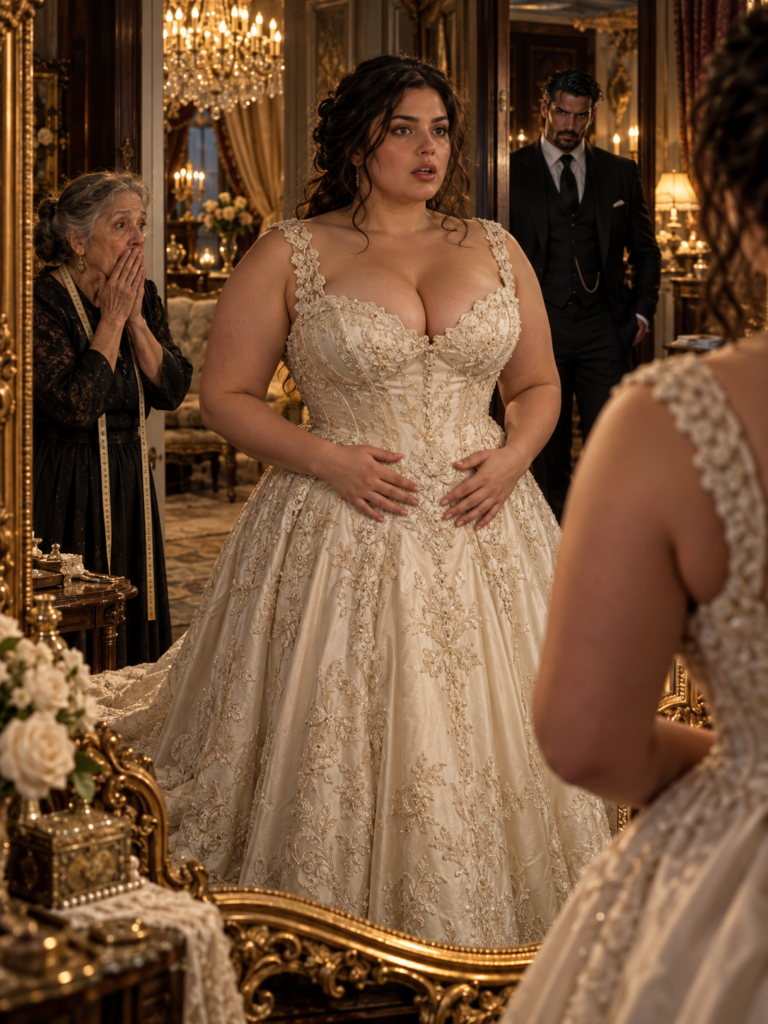
The thread slipped free, opening a narrow gap beneath Nadia’s arm.
Something inside the lining moved.
Mrs. Bellini gasped and reached forward, but Nadia caught the small shape before it could slide deeper into the gown.
It was wrapped in thin, yellowed fabric.
“What is that?” Casius asked.
“I don’t know.”
Nadia carefully eased it out.
A folded piece of oilcloth, no larger than a playing card, rested in her palm.
Behind them, Gemma’s heels stopped outside the door.
“Casius?”
Nadia closed her fingers around the object.
The door handle turned.
Casius looked toward the entrance.
“Mrs. Bellini, cover the gown.”
The seamstress grabbed a large silk robe from a nearby chair and placed it around Nadia’s shoulders just as Gemma pushed inside.
The heiress stopped.
Her eyes moved from the mirror to Nadia’s bare shoulders, then to the ivory skirt visible beneath the robe.
“What,” Gemma asked softly, “is she wearing?”
Nobody answered.
Gemma stepped closer.
“My dress?”
“No,” Mrs. Bellini said quickly. “The original.”
Gemma’s expression hardened.
“The original Leone gown?”
Nadia tightened her grip around the hidden packet.
“We needed to check its construction,” she explained.
“On you?”
“There wasn’t another fitting model available.”
Gemma looked at Casius.
“Tell her to take it off.”
He remained still.
“Gemma, go downstairs.”
The heiress laughed once, without humor.
“Are you seriously defending your secretary?”
“Assistant,” Nadia corrected.
Gemma turned on her.
“You think correcting me makes you important?”
“No. But it makes the conversation accurate.”
Casius glanced at Nadia.
Gemma noticed.
And something ugly entered her expression.
“My father expects an announcement tomorrow,” she said. “He’s not going to tolerate another humiliation.”
“I haven’t agreed to marry you,” Casius replied.
“Our families have spent two years discussing it.”
“Discussing isn’t deciding.”
For a moment, Gemma seemed genuinely shocked.
Then her gaze returned to Nadia.
“You did this deliberately.”
Nadia felt the old reflex rise.
Apologize.
Accept the blame.
Disappear.
But the packet pressing against her palm reminded her that something more important than Gemma’s embarrassment had just happened.
“I didn’t damage your gown,” she said. “And I didn’t ask to wear this one.”
Gemma moved toward her.
“Open your hand.”
Nadia went still.
“What?”
“You’re holding something.”
Casius stepped between them, not touching either woman.
“That’s enough.”
Gemma’s face flushed.
“You have no idea what my father will do.”
“I know exactly what your father is capable of,” Casius said.
His tone made the seamstress look away.
Gemma backed toward the doorway.
“This isn’t finished.”
When she left, the silence she abandoned was almost worse than her anger.
Nadia waited until the footsteps disappeared.
Then she held up the packet.
“We should open it.”
Casius locked the door.
“First, tell me why you hid it from her.”
“Because she was more interested in who touched the dress than what was inside it.”
He considered that.
“Fair.”
Mrs. Bellini brought a clean cloth to the worktable.
Nadia unfolded the oilcloth carefully.
Inside lay a small brass key and a letter.
The paper was brittle along its creases.
A woman’s handwriting covered the first page.
Casius moved closer.
He knew that handwriting.
Nadia could see it in the sudden tightening of his jaw.
“My grandmother,” he whispered.
She glanced down.
The first sentence sent a chill through her.
If this letter has been found, the gown has finally been worn without alteration.
Mrs. Bellini covered her mouth.
Nadia continued reading.
Victoria described the dress not as a test of beauty, but as a protection against changes that might destroy what she had hidden.
She had instructed that its original seams remain untouched.
And she had written that certain men within their world could never be trusted with the truth.
Casius reached for the letter, then stopped.
“May I?”
Nadia handed it to him.
He read the opening lines twice.
His face changed.
“What does she mean?” Nadia asked.
He looked at the small brass key.
“I don’t know.”
But she noticed that he avoided looking directly at her.
“Casius.”
It was the first time she had spoken his name without his title.
He looked up.
“Your grandmother hid this for forty years. Someone may have spent all that time trying to keep it buried.”
A hard knock interrupted them.
A man’s voice sounded beyond the door.
“Don Leone. Aldo Rizzo is downstairs.”
Casius folded the letter.
“Tell him I’ll be there.”
The guard hesitated.
“He says he knows about the gown.”
Nadia felt the room grow suddenly cold.
She looked toward the door.
Then at the key.
And she understood that discovering the hidden packet had not ended a mystery.
It had announced its existence to someone who desperately wanted it kept secret.
Casius turned toward her.
“Nadia, I need you to stay here until I know what he wants.”
She shook her head.
“No. If this concerns something your grandmother left behind, then I deserve to know what danger I’ve stepped into.”
He opened his mouth.
She raised her hand.
“And before you tell me it’s for my protection, remember that I found it.”
Casius looked at the letter, then back at her.
For once, he had no immediate answer.
Nadia held out her hand for the brass key.
And when he placed it in her palm, she heard Aldo Rizzo’s voice carrying up the hallway.
“I want the assistant brought downstairs. Now.”
Nadia closed her fingers around the key.
From the hallway came another voice, lower and more urgent.
“Don Leone, Mr. Rizzo says the presentation cannot proceed unless the assistant is dismissed.”
Casius turned toward the door.
“Tell Mr. Rizzo I’ll speak with him in my office.”
“And Miss Nadia?”
“She makes her own decisions.”
The guard left.
Nadia stared at Casius.
Three years of working for him had taught her that he rarely corrected his men in front of anyone.
“Thank you,” she said.
“Don’t thank me yet.”
He looked at the folded letter.
“Once Aldo knows something was hidden in that gown, he won’t stop asking questions.”
“Then why not tell him nothing?”
“Because he already knows the gown fit you.”
She considered that.
“He knew before he arrived.”
Casius nodded.
“Someone informed Gemma. Gemma probably informed him.”
Nadia glanced toward Mrs. Bellini.
The elderly woman looked close to tears.
“I never called anyone,” she whispered.
“I believe you,” Nadia said.
She thought about the room, the ringing telephone, Gemma’s sudden arrival.
The estate had staff, security cameras, and a constant movement of people whose loyalties were not always obvious.
But none of that explained how quickly Aldo had reacted.
“Maybe he’s not worried about the fitting,” she said.
Casius looked at her.
“Explain.”
“He might be worried about the dress itself.”
She picked up the letter.
“Your grandmother prohibited alterations. Everyone treated it as a marriage custom. But it kept these stitches untouched for forty years.”
Mrs. Bellini nodded.
“And every bride who came before wore a replica for her presentation. The original stayed protected.”
Nadia turned sharply.
“Then why was I allowed to put it on?”
“Because Gemma’s replica was ruined,” Mrs. Bellini answered. “I needed to compare the original construction so we could repair the presentation gown.”
“Which means this was the first time in years anyone actually wore it without altering anything.”
Casius looked toward the portrait of Victoria Leone.
For most of his life, his grandmother had been a legend.
Now she had become a woman who had hidden a message because she feared someone would destroy it.
He read the next paragraph of the letter.
The meaning sharpened.
Victoria warned that the greatest danger to the Leone family would not necessarily arrive carrying a weapon.
It might arrive dressed for a celebration, offering friendship and a marriage between powerful houses.
Nadia watched Casius’s face.
“What?”
He handed her the page.
She read it.
Then she thought of Gemma.
And Aldo.
And two years of negotiations over a marriage Casius had never agreed to.
“That’s not enough to accuse anyone,” she said.
“No.”
“But it’s enough to be careful.”
“Yes.”
Nadia folded the letter.
“Then let’s find out what the key opens.”
Casius hesitated.
“Nadia, if we move through the house now, Aldo’s people may notice.”
“You have staff access routes.”
He looked surprised.
She almost laughed.
“Who do you think coordinates repairs, deliveries, and overnight maintenance?”
Mrs. Bellini gave a nervous smile.
Casius looked at Nadia with an expression she had not seen before.
Respect without surprise.
As though he were finally examining everything he had taken for granted.
“Get changed,” he said. “Then show me.”
Nadia lifted an eyebrow.
“That’s better than ordering me to stay in this room.”
His mouth moved slightly.
“I’ll work on it.”
***
Twenty minutes later, Nadia emerged wearing her familiar navy dress and soft gray cardigan.
The wedding gown rested carefully on its stand.
She had placed the letter and key in separate protective envelopes.
Casius was waiting outside.
He offered his arm.
She looked at it.
“I’m capable of walking.”
“I know.”
He lowered it without embarrassment.
They descended a narrow service staircase behind the west wing.
Nadia knew every landing, every cleaning closet, every door that stuck during humid weather.
Casius, who owned the building, knew almost none of them.
At the basement level, she stopped before an older corridor.
“This section used to connect the wine storage rooms to the family archive,” she explained. “It was sealed off years ago.”
“How do you know?”
“I kept the renovation files.”
She took out her phone and opened a saved floor plan.
“There should be a small room behind this wall.”
Casius studied the drawing.
“My father told me the old archive had been emptied.”
“Maybe it was.”
“Maybe.”
They found a plain wooden door near the end of the corridor.
Its brass lock had darkened with age.
Nadia inserted the key.
It turned.
Neither of them spoke.
She pushed the door open.
The room smelled of paper, dust, and old wood.
A narrow cabinet stood against one wall.
Inside were documents tied with faded ribbon, photographs, handwritten accounts, and envelopes bearing Victoria’s initials.
Casius approached slowly.
For the first time that evening, Nadia saw him hesitate before touching something.
“My grandmother died when I was young,” he said.
“I know.”
“I remember her hands. She used to straighten my collar before family dinners. Everyone remembers the business she built. I remember that she always noticed when I was frightened.”
Nadia looked at him.
That confession was more personal than anything he had told her in three years.
“She sounds formidable.”
“She was.”
“And kind?”
“To people who deserved kindness. Sometimes to people who didn’t.”
Nadia smiled faintly.
They began examining the documents.
Victoria had recorded business arrangements, obligations, debts, and private conversations involving the Leone and Rizzo families.
The accounts did not prove a murder.
But they revealed something troubling.
Aldo Rizzo had spent decades trying to absorb Leone holdings through agreements that favored his family.
Several documents bore marks suggesting Victoria had refused those arrangements shortly before her death.
Nadia laid the pages in chronological order.
“This wasn’t a single disagreement,” she said.
“It was a campaign.”
“Yes.”
Casius stared at the papers.
“My father always told me Aldo had been a loyal family ally.”
“Your grandmother apparently disagreed.”
Nadia opened another envelope.
A dated note described a celebration at which Victoria had become suddenly ill after drinking from the family’s ceremonial silver cup.
Official family accounts had long claimed that Victoria died peacefully in her sleep.
But the letter suggested she had survived that initial illness long enough to write down her suspicions.
Nadia read the account carefully.
“This still isn’t proof of poisoning.”
“No,” Casius said.
“But someone was determined to conceal the circumstances.”
He nodded.
And then Nadia found something else.
A list of names.
Guests who had attended Victoria’s final celebration.
Near the bottom stood Aldo Rizzo.
Beside his name, Victoria had written a short warning.
He knows I refused.
Nadia turned toward Casius.
“Refused what?”
He searched the documents.
Finally, he found an agreement.
It proposed an alliance giving the Rizzo family substantial control over Leone business interests through a future marriage.
Victoria had rejected it.
Forty years earlier.
The same arrangement Aldo was pursuing now.
Nadia felt a cold sensation spread through her stomach.
“This is why he wants Gemma to marry you.”
Casius stared at the agreement.
“It’s possible.”
“You know it is.”
He looked at her.
“Yes.”
A sound came from the corridor.
Both of them froze.
Footsteps.
Then the distant closing of a door.
Casius moved toward the entrance.
Nadia caught his sleeve.
“Wait.”
She pointed toward the bottom of the cabinet.
Several folders were missing.
Dust marks outlined where they had once rested.
“Someone’s been here recently.”
Casius crouched beside the cabinet.
“Those spaces are clean.”
“Exactly.”
A cold silence passed between them.
The archive had not been forgotten.
Someone else knew it existed.
***
Back upstairs, Aldo Rizzo was waiting in Casius’s office.
A single bullet lay on the desk between them.
Nadia saw it when she entered.
She stopped.
Casius noticed her expression and quietly stepped to the side, giving her an unobstructed route to the door.
Aldo watched the movement.
“Your assistant joins private negotiations now?”
“She isn’t here to negotiate,” Casius said.
“Then why bring her?”
“Because you requested her.”
Aldo turned toward Nadia.
His smile was practiced.
“I understand you’ve caused quite a disturbance.”
“I tried on a dress.”
“You embarrassed my daughter.”
“That wasn’t my intention.”
“Intentions aren’t consequences.”
Nadia looked at the bullet.
“Neither are threats.”
The smile vanished.
Casius remained silent.
Aldo slowly folded his hands.
“You have no idea what you’ve involved yourself in.”
“Then explain it.”
His eyes narrowed.
“You think you’re clever.”
“No. I think you’re frightened.”
Casius glanced at her.
Aldo leaned back.
“Of what?”
Nadia answered carefully.
“Of a forty-year-old gown being worn exactly as it was made.”
For the first time, Aldo’s composure faltered.
It was brief.
But it was enough.
He looked at Casius.
“You’re allowing your employee to insult me?”
“She’s asking a question.”
Aldo stood.
“The Rizzo family will not be humiliated by some office girl who wants to play bride.”
“I don’t want to be anyone’s bride to settle a business dispute,” Nadia replied.
“Then stay out of it.”
“I would gladly have stayed out of it if your daughter hadn’t threatened to have an elderly seamstress punished over a stained dress.”
Aldo’s jaw tightened.
Casius’s voice turned cold.
“That’s enough, Aldo.”
The older man looked at him.
“You promised this alliance would be considered seriously.”
“It was.”
“Then prove your loyalty.”
“Loyalty isn’t obedience.”
For several moments, the men faced each other.
Nadia sensed decades of family obligation pressing against the space between them.
Finally, Aldo picked up the bullet.
“Tomorrow night,” he said. “The presentation happens. My daughter will be there.”
He looked at Nadia.
“And I suggest you remember where you belong.”
After he left, Nadia realized her hands were trembling.
Casius noticed but did not comment.
Instead, he placed a glass of water near her.
She accepted it.
“You didn’t have to let me confront him,” she said.
“You didn’t ask permission.”
“No.”
“I’m beginning to understand that.”
She looked at him for a long moment.
Then she asked the question she had been avoiding.
“Are you going to marry Gemma?”
“No.”
“Were you ever going to?”
“I thought an alliance might protect the family. I never promised marriage.”
“And now?”
“Now I think my grandmother spent the final years of her life warning us against exactly that alliance.”
Nadia lowered her eyes.
“Casius, if you ask me to stand beside you tomorrow, everyone will assume you chose me instead.”
“I know.”
“They’ll blame me for ruining negotiations I never agreed to join.”
He nodded.
“Then I won’t ask it of you.”
She studied him.
“You were going to.”
“Yes.”
“Why?”
His answer came slowly.
“Because I trust your judgment. And because you stood in front of Aldo when men who’ve known him for decades wouldn’t.”
“That isn’t a reason to make me your bride.”
“No,” he said. “It isn’t.”
The acknowledgment changed something between them.
Not love.
Not yet.
But the possibility of trust.
Casius continued.
“Tomorrow’s presentation can become something else. I can announce that the alliance is suspended pending an investigation into my grandmother’s records.”
“And what happens to me?”
“You keep your job if you want it. You can leave if you prefer. Either way, I will make sure you have the information necessary to protect yourself.”
Nadia considered the offer.
Then she looked at the envelopes on the desk.
“We need to know what happened to Victoria.”
“Yes.”
“And we need to make sure Aldo can’t destroy the rest of that archive.”
Casius nodded.
She drew a slow breath.
“Then I want one condition.”
“Name it.”
“No decisions about me without me.”
He held her gaze.
“Agreed.”
Outside, thunder rolled over the estate.
Nadia reached for Victoria’s final letter.
There was one folded page they had not yet opened.
As she separated the paper, she noticed a sentence written across the inner fold.
The handwriting was unmistakable.
And beneath the warning about Aldo Rizzo were five words that made Casius go completely still.
The cup will be used again.
Nadia read the warning twice.
Then she looked at Casius.
“The ceremonial cup?”
He nodded.
The Leone family had used the same silver vessel at formal unions for generations.
It represented continuity, family loyalty, and the solemn promises exchanged between households.
Nadia remembered coordinating its cleaning before several presentations.
She also remembered that it was normally kept in the private chapel.
“Who has access?” she asked.
“The chapel staff. Senior household employees. Anyone authorized to prepare the ceremony.”
“That includes people connected to the Rizzos?”
Casius hesitated.
“Yes.”
Nadia set the letter down.
“Then we have a problem.”
He reached for his phone.
She stopped him.
“Don’t announce what we found.”
He looked up.
“If Aldo knows we’re investigating the cup, whoever helped him can remove anything suspicious before tomorrow.”
Casius considered that.
“What do you suggest?”
“We preserve what we have, secure the archive, and change the ceremony.”
“Change it how?”
Nadia thought for a moment.
“Let everyone believe the presentation is proceeding normally.”
He studied her.
“You want to walk into that room knowing Aldo may be preparing another attempt?”
“I want him to believe his plan still works.”
“That puts you at risk.”
“I know.”
“Then I can’t agree.”
Nadia folded her arms.
“You can’t agree? We just discussed this.”
His expression tightened.
“I won’t deliberately place you in danger.”
“And I won’t be hidden away while decisions about my life happen without me.”
He turned away.
For a long moment, neither spoke.
Then Casius faced her again.
“You’re right. I promised you a choice, and the moment I was afraid, I started taking it back.”
Nadia’s anger softened, but she did not surrender her position.
“I’m not asking you to stop being concerned.”
“I know.”
“I’m asking you to trust me enough to discuss the risk honestly.”
He nodded.
So they talked.
Not as employer and assistant.
Not as a man offering a woman protection in exchange for obedience.
As two adults trying to understand a dangerous situation with incomplete information.
Nadia insisted that the event be monitored, that the original documents be secured, and that no one should drink from the ceremonial cup.
Casius arranged for the archive to be protected and the letter copied and preserved.
He also agreed that Nadia could withdraw from the presentation at any point.
She would not be presented as a bride.
She would attend as herself.
And if the commission wanted an explanation, they would hear one.
***
By the following evening, the Leone estate was filled with guests.
Three hundred invitations.
Five powerful families.
Rows of white flowers.
Gold chairs arranged beneath crystal chandeliers.
Every detail suggested a celebration.
Nadia knew better.
She stood upstairs wearing Victoria Leone’s gown.
Mrs. Bellini had repaired the small opening where the hidden packet had been removed, carefully preserving the original design.
The elderly woman stepped back.
“You look beautiful.”
Nadia smiled.
“Thank you.”
Mrs. Bellini shook her head.
“No, dear. I mean you look comfortable in your own skin.”
Nadia glanced toward the mirror.
For years, she had worn oversized cardigans to make herself less noticeable.
Today, she stood in a dress that had become an impossible standard for generations of women.
It fit her.
But that was no longer the important part.
It had contained the truth.
And she had found it because she had been willing to look closer.
A knock sounded.
Casius waited outside.
“May I come in?”
“Yes.”
He entered and stopped.
His expression softened.
“You look extraordinary.”
Nadia laughed quietly.
“You’re staring at the gown again.”
“No.”
His eyes met hers.
“I’m looking at the woman who found what my family failed to see for forty years.”
She felt warmth rise in her face.
Then she lifted her chin.
“Remember our agreement.”
“No decisions without you.”
“Good.”
He offered his hand.
She took it.
For a moment, neither moved.
There was something unfinished between them.
An attraction that had grown through late-night conversations, shared fears, and the unsettling discovery that they understood each other more deeply than either had expected.
But the room downstairs mattered more.
Nadia released his hand.
“It’s time.”
***
The doors opened.
Conversation died.
Nadia appeared at the top of the marble staircase.
Below her sat three hundred guests.
Several looked openly astonished.
Others whispered.
Gemma Rizzo stood beside her father near the front of the hall.
Her expression turned hard.
Nadia placed one hand on the railing.
For an instant, she remembered every time she’d been dismissed from a meeting, interrupted before finishing a sentence, or treated as though her contribution mattered less because of how she looked.
She remembered Gemma telling her to return to her corner.
Then she took the first step.
Casius remained near the foot of the staircase.
He did not rush forward.
He did not take her arm.
He had promised that this moment belonged to her.
Nadia walked down without hurrying.
When she reached the floor, an elderly commission member raised his hand.
“Casius,” he said, “what is the meaning of this?”
Casius answered evenly.
“Tonight, I am suspending the proposed marriage alliance with the Rizzo family.”
A ripple moved through the room.
Aldo’s face darkened.
“You cannot humiliate my daughter publicly.”
“I can decline a marriage I never agreed to.”
The older commission member looked toward Nadia.
“And the assistant?”
Nadia spoke before Casius could answer.
“My name is Nadia.”
The man blinked.
She continued.
“I have worked in this house for three years. I’ve scheduled your meetings, prepared your correspondence, organized your events, and made certain half the agreements discussed here happened on time.”
A few guests shifted uncomfortably.
“I know many of you don’t remember my face.”
She paused.
“But I remember yours.”
Silence spread.
“I also know that for forty years, women have been judged by whether they could fit into this dress.”
She looked down at its ivory silk.
“Some were pressured to alter their bodies. Others altered the gown. None of that made them dishonest or unworthy of respect.”
Gemma’s smile vanished.
Nadia looked toward the commission.
“Victoria Leone left strict instructions that the original seams never be changed. Everyone assumed it was about preserving her appearance.”
She raised the sealed copy of Victoria’s letter.
“It wasn’t.”
Aldo stepped forward.
“Enough of this nonsense.”
Nadia turned toward him.
“Your family has spent decades trying to gain control over Leone interests through marriage agreements.”
“That is business.”
“Victoria refused your proposal forty years ago.”
Several members of the commission looked at Aldo.
Casius stepped beside Nadia.
“We found her records,” he said. “Documents detailing attempted acquisitions, rejected agreements, and negotiations conducted under false pretenses.”
Aldo’s expression remained controlled.
“Old paperwork proves nothing.”
“Some of it establishes a pattern,” Nadia replied. “And one letter explains why Victoria feared you.”
The commission elder extended his hand.
Casius passed him a copy.
The man began reading.
His expression changed.
“Victoria believed her death was connected to the celebration where she became ill?”
“Yes,” Nadia answered.
Aldo laughed.
“A dead woman’s suspicion is not evidence.”
“No,” Nadia said. “It isn’t.”
The admission surprised him.
“Then perhaps you’d like to stop accusing me.”
“I haven’t finished.”
At the front of the hall, an elderly priest approached carrying the ceremonial silver cup.
He had prepared it for a traditional blessing scheduled after the presentation.
Nadia watched Aldo’s eyes move toward it.
Just once.
But the movement was unmistakable.
The priest lifted the cup toward Casius.
And Nadia stepped forward.
“Stop.”
Her voice cut through the hall.
The priest froze.
Every face turned.
Nadia crossed the short distance and took the cup carefully from his hands.
“Don’t drink from this.”
Casius looked at her.
She could see the question in his eyes.
Had she discovered something new?
No.
But she understood the warning.
Victoria had written that the cup would be used again.
And Aldo had watched it with the same intense attention he gave the marriage alliance.
Nadia turned toward the commission.
“This cup was part of the celebration where Victoria became ill. It was also prepared for tonight.”
Aldo folded his arms.
“Are you seriously going to accuse me because a family owns a silver cup?”
“No.”
She looked directly at him.
“I’m asking why you seem so interested in whether Casius drinks from it.”
“Ridiculous.”
“Then perhaps you’ll drink first.”
She held the cup toward him.
The hall went silent.
Aldo looked at the silver vessel.
His hand remained at his side.
“I’m not participating in this performance.”
“It’s only ceremonial wine,” Nadia said. “Isn’t it?”
He said nothing.
His daughter looked from him to the cup.
“Papa?”
“Be quiet, Gemma.”
Nadia lowered the vessel.
His refusal did not prove poisoning.
She knew that.
But the fear appearing behind his expression had become visible to everyone.
And that changed the room.
The commission elder rose.
“No one will drink from it.”
He instructed that the cup be secured.
Aldo turned toward the doors.
“I’m leaving.”
Casius moved into the aisle.
“You’re free to leave after we finish discussing my grandmother’s records.”
“You have no authority to detain me.”
“Then don’t make this worse.”
Aldo looked around.
For the first time, the men who usually stood beside him avoided his eyes.
He had spent decades building influence through obligation and fear.
But influence depended on trust.
And that trust was beginning to fracture.
***
The remaining truth emerged through the records Victoria had hidden.
The archive contained correspondence showing that Aldo had repeatedly pressed Victoria to accept an alliance giving his family control over valuable Leone interests.
When she refused, he sought support from other powerful figures.
Her notes described an increasingly hostile dispute.
Most importantly, the documents preserved testimony and contemporary accounts from people present when Victoria became ill at the celebration.
Those accounts contradicted the official story that she had died peacefully in her sleep.
The evidence was not complete.
But it was enough to force an independent inquiry and destroy the assumption that Aldo’s version of events could be accepted without question.
The ceremonial cup was preserved for examination.
With the commission’s support for Aldo collapsing, additional witnesses began speaking about their own dealings with him.
The investigation eventually established that Victoria’s death had been deliberately concealed and that Aldo had participated in the conspiracy surrounding it.
The attempted Rizzo-Leone marriage alliance had not been an innocent attempt to unite two families.
It was another route toward the control Victoria had denied him.
For forty years, the man who helped bury her truth had enjoyed the advantages of being treated as a trusted ally.
Now the documents she had hidden were exposing him.
The Rizzo family’s influence weakened as agreements were reviewed, obligations were challenged, and former supporters withdrew.
Aldo’s power did not vanish in a single dramatic moment.
It unraveled under scrutiny.
And Nadia watched the process carefully.
She had learned that exposing a powerful man was only the beginning.
Making sure the truth survived him required patience, evidence, and people willing to remain accountable.
***
Gemma approached Nadia several days after the presentation.
They met in the estate’s library.
For once, Gemma wore a simple dark dress.
No attendants followed her.
“I suppose you’ve come to enjoy your victory,” Gemma said.
Nadia closed the folder she had been reviewing.
“What victory?”
“My father is finished. The commission won’t return his calls. Casius won’t marry me. Everybody’s laughing.”
“I’m not laughing.”
Gemma looked away.
“You must hate me.”
“I disliked how you treated me.”
“That’s a polite way of saying it.”
“I don’t hate you.”
Gemma seemed genuinely confused.
Nadia stood.
“You told me I wasn’t a real woman because I didn’t look like the women your family approved of.”
Gemma lowered her eyes.
“You remember that.”
“Of course I do.”
A long silence followed.
Then Gemma said quietly, “My father spent years telling me I had to marry Casius or I’d be an embarrassment.”
Nadia studied her.
It did not excuse the cruelty.
But it explained something.
“You could have treated me differently.”
“I know.”
Gemma’s voice was barely audible.
For several seconds, neither woman spoke.
Then Nadia stepped aside, leaving the path to the door clear.
“You still get to decide who you become after this.”
Gemma looked at her.
“Why are you being kind?”
“Because being treated badly doesn’t give me the right to become cruel.”
Gemma swallowed.
Then she left.
Nadia returned to her paperwork.
For the first time, she did not feel the need to hide how much the encounter had affected her.
***
Months passed.
The Leone estate changed.
Victoria’s gown was no longer kept behind locked glass as a test that young women were expected to pass.
Nadia arranged for it to be displayed in the great hall beside a copy of Victoria’s letter.
The original documents remained securely preserved.
A small brass key rested in a protective case nearby.
Visitors who saw the exhibit learned about Victoria’s work, the alliances she resisted, and the evidence she had hidden.
They were not told that the dress had somehow chosen a bride.
It had not.
It had been made for a woman with a particular body.
And decades later, another woman had happened to share those measurements.
What mattered was not destiny.
It was what Nadia had done after discovering the secret.
She had refused to let powerful people decide who deserved to speak.
She had followed the evidence.
She had challenged a man everyone feared.
And she had made Casius confront the limits of his own authority.
One evening, as Nadia finished arranging a new set of documents in the archive, Casius came to find her.
He stood at the doorway.
“Are you busy?”
“Always.”
He smiled.
She turned toward him.
“Something wrong?”
“No.”
“That’s unusual.”
“For once, I’m bringing good news.”
He handed her a folder.
Inside was a formal proposal giving Nadia independent authority over the estate’s administrative and archival operations.
She read it carefully.
Then she looked at him.
“This isn’t an assistant’s position.”
“No.”
“You’re offering me control over the department.”
“Yes.”
“And I report directly to the governing board rather than to you personally?”
“Exactly.”
She studied him.
“Why?”
“Because you’ve been doing half that work for years without proper recognition.”
Nadia closed the folder.
“And because you want me close?”
Casius did not pretend otherwise.
“That too.”
She raised an eyebrow.
“At least you’re honest.”
“I’ve been practicing.”
Nadia laughed.
Then her expression softened.
“I don’t want to spend the rest of my life being grateful that someone finally noticed me.”
“I don’t want that for you either.”
“I want work that belongs to me. Decisions I can make. A future I can choose.”
He nodded.
“Then take the position only if it’s right for you. If you choose something outside this house, I’ll respect that too.”
She looked at him for a long time.
Three years earlier, she would have accepted almost anything simply because he offered it.
Now she was evaluating whether the offer matched her ambitions.
She liked the difference.
“I’ll have my attorney review the contract,” she said.
Casius smiled.
“I expected nothing less.”
***
Their romance did not begin with a grand declaration.
It began with conversations.
Late dinners after difficult meetings.
Walks through the estate gardens.
Arguments about business decisions that neither of them was willing to abandon merely to please the other.
Casius learned that Nadia loved old buildings, quiet Sunday mornings, and the kind of ordinary life his family had rarely allowed him to imagine.
Nadia discovered that the intimidating man who rarely smiled could be unexpectedly patient when listening to someone he trusted.
There were still difficulties.
He sometimes tried to solve problems before she had asked for help.
She sometimes assumed that accepting his care meant surrendering independence.
They talked through those habits.
Sometimes awkwardly.
Sometimes angrily.
But they kept choosing honesty.
The first time he kissed her, they were standing in the garden outside the great hall.
He had asked if he could.
She had smiled and answered yes.
Afterward, he rested his forehead gently against hers.
“I’ve wanted to do that for a long time.”
“How long?”
“Long enough to know I shouldn’t have rushed it.”
Nadia laughed.
“You weren’t always patient.”
“No.”
He looked at her seriously.
“But I’m learning.”
And she believed him because she had seen the change.
Not in promises.
In behavior.
***
The marriage came later.
Not to settle a dispute.
Not to satisfy the commission.
Not to obey a custom stitched into an antique gown.
Casius proposed privately, without witnesses or an audience.
He told Nadia he loved her.
He told her that her courage had changed the way he understood leadership.
Then he asked whether she wanted to build a life with him.
Nadia did not answer immediately.
She thought about the woman she had once been.
The assistant who pulled her cardigan tight before entering rooms filled with powerful people.
The woman who had apologized for occupying space.
The woman who had believed love and respect belonged to other people.
And then she thought about who she had become.
She was not fearless.
She still had difficult days.
She still sometimes heard Gemma’s cruel words in the back of her mind.
But those words no longer decided what she believed about herself.
“I love you,” she told Casius.
His expression softened.
“And yes,” she continued, “I want to marry you.”
He reached for her hands.
She smiled.
“But my work stays mine.”
“Of course.”
“And we make decisions about our life together.”
“Together.”
“And when I’m angry, you don’t send someone to fix the problem before you’ve listened to me.”
He laughed quietly.
“That one may take practice.”
“Then practice.”
He kissed her knuckles.
“I will.”
***
On their wedding day, the estate looked different from the night Nadia had first descended its staircase.
The guests had come by invitation, not obligation.
The ceremony was smaller.
The atmosphere warmer.
And Nadia had chosen what she would wear.
Victoria Leone’s gown remained on display in the great hall.
Nadia visited it briefly before the ceremony.
She stood before the ivory silk and the letter that had changed her life.
Mrs. Bellini joined her.
“Are you certain you don’t want to wear it?” the elderly seamstress asked.
Nadia smiled.
“I’m certain.”
She touched the glass lightly.
“That dress belonged to Victoria. I think she’d understand why I want something of my own.”
Mrs. Bellini’s eyes filled.
“I think she would, too.”
Nadia turned toward the doors.
Beyond them waited Casius.
Not a man choosing a woman because she had passed some ancient test.
A man who had learned to love her without trying to decide who she should become.
When the ceremony began, Nadia walked toward him wearing the dress she had selected for herself.
Casius watched her approach.
And when she reached him, he extended his hand.
Not to claim her.
To meet her.
She took it.
Their vows were simple.
They promised honesty.
Loyalty.
Respect.
They promised to stand together without demanding that either become smaller.
And when Nadia said yes, the word belonged entirely to her.
***
Later that evening, the guests gathered in the great hall.
The photograph of Victoria Leone watched over the room.
Her original gown stood nearby, surrounded by warm light.
Nadia looked at it once more.
Forty years of silence had ended because someone finally paid attention to what everyone else had dismissed.
She thought about the twenty women who had tried to fit that gown before her.
They had not failed.
They had been asked to pass a test that was never fair.
And Nadia had not succeeded because she possessed a more valuable body.
She had simply discovered something hidden in a dress that happened to fit her.
What made her extraordinary was everything she chose to do afterward.
Casius came to stand beside her.
“Ready?”
“For what?”
He smiled.
“Your speech.”
Nadia glanced across the room.
Members of the commission waited near the long table.
Former employees, friends, and family members filled the chairs.
Months earlier, she would have been terrified to address them.
Now she took Casius’s hand for a moment.
Then released it.
“I’ve got this.”
“I know.”
She walked toward the gathering.
And the room fell silent.
Not because someone had ordered it.
Not because she wore an expensive gown.
Not because she had married a feared man.
But because the people standing before her had learned that when Nadia spoke, she usually had something worth hearing.
She smiled.
And began.
The woman who once hid behind an appointment book no longer needed permission to be seen.
She had never needed to become smaller.
She had only needed the freedom to stand at her full height.


