
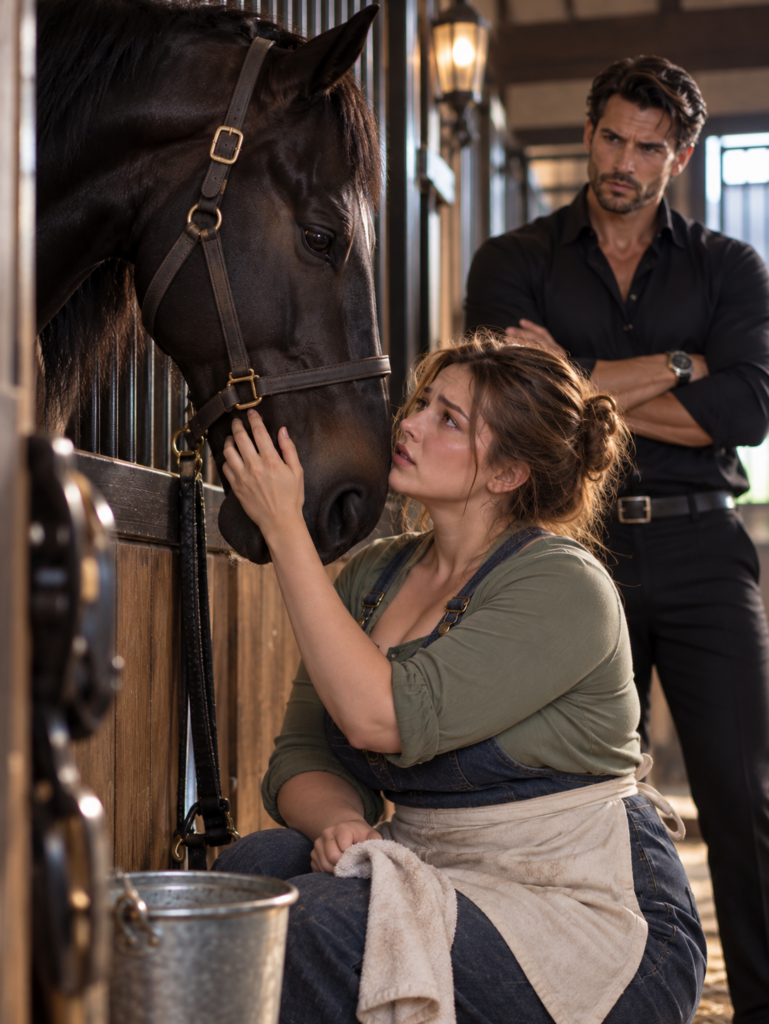
Weston Hargrove had watched three professional trainers hit the dirt trying to control the $1.4 million black stallion everyone at his estate called a monster.
Then Holly Bennett—the quiet twenty-seven-year-old nanny he had hired for his traumatized six-year-old daughter—walked past the armed guards, raised one empty hand, and made the animal lower its massive head into her palm.
By the time Weston understood that nobody learned to calm a creature like Midnight without surviving something terrible first, he had already ordered his men to uncover the one past Holly had spent eight years trying to bury.

PART 1 — THE HORSE THAT BROKE GROWN MEN BOWED TO THE WOMAN WHO CLAIMED SHE KNEW NOTHING ABOUT HORSES
Midnight had already broken one fence rail and nearly broken Finn O’Donnell’s shoulder when Holly appeared in the stable yard carrying a glass of warm milk.
Snow from the previous night had hardened along the edges of the gravel. The November air smelled of wet earth, leather, and the sharp animal heat rising from the black stallion’s flanks.
“Stay back,” Finn shouted.
Holly stopped.
Midnight spun inside the reinforced pen, six hundred kilograms of muscle and fury striking the ground hard enough to shake dirt from the lower rails. Three men had tried ropes. Another had tried a blindfold. Weston Hargrove had paid one of the best behavioral trainers on the East Coast twenty thousand dollars for a week of failure.
None of it mattered.
The horse hated everyone.
Weston stood outside the ring in a charcoal coat, one hand inside his pocket.
At thirty-six, he had built his name on the principle that anything could be controlled if you found the correct pressure point.
Men.
Banks.
Politicians.
Enemies.
Apparently not horses.
“Holly.”
His voice was quiet.
That made everyone else quiet too.
She looked at him.
“You’re here for Mary.”
“Yes.”
“Then go inside.”
Her gaze returned to Midnight.
The horse stopped striking the fence.
Only for a second.
But Weston saw it.
So did Finn.
Holly placed Mary’s milk on a wooden post.
Then stepped through the damaged gate.
“What the hell are you doing?”
Finn moved forward.
Weston raised one hand.
Finn froze.
Holly walked slowly into the dirt.
No rope.
No whip.
No apple.
Her shoulders remained loose, her hands visible beside her body.
Midnight’s ears pinned flat.
He charged three steps.
Holly stopped.
The stallion stopped too.
A strange silence dropped over the yard.
Holly raised one palm.
Nothing more.
Midnight breathed hard enough for vapor to spill from his nostrils.
Then, impossibly, his head lowered.
One inch.
Then another.
He crossed the remaining distance himself.
The huge black muzzle touched Holly’s open hand.
Every guard around the pen went still.
Holly did not smile.
Did not celebrate.
Did not stroke the horse like someone eager to prove she had won.
She simply stood with him until his breathing changed.
Fast.
Slower.
Slower still.
Then she withdrew her hand.
“Good.”
The word was nearly a whisper.
She walked out of the ring.
Finn stared.
“I’ve seen that horse send a man to the hospital.”
Holly picked up the milk.
“Then stop trying to beat him into being calm.”
Weston stepped into her path.
“Where did you learn that?”
Her eyes met his.
Brown.
Steady.
Far too steady for a nanny earning ordinary wages in a house full of armed men.
“A long time ago.”
“That isn’t an answer.”
“It’s the one I have.”
Weston moved half a step closer.
Most people backed away when he did that.
Holly did not.
“Mr. Hargrove,” she said, “Mary’s milk is getting cold.”
Then she walked past him.
Not hurried.
Not defiant.
Simply finished.
Weston remained beside the broken fence.
His younger brother, Tristan, emerged from the stable shadows.
“You want me to run her again?”
Weston watched Holly disappear through the mansion doors.
Midnight stood behind him, strangely quiet.
“Yes.”
Tristan waited.
“How deep?”
Weston’s eyes narrowed.
“Deep enough to explain that.”
Then his voice hardened.
“Run her background again.”
“This time, dig until you hit bone.”
PART 2 — WESTON WANTED TO KNOW WHY THE HORSE TRUSTED HER. WHAT HE FOUND WAS A WOMAN WHO HAD ONCE BURIED HER ENTIRE LIFE.
Mary Hargrove’s bedroom sat in the east wing where winter light reached the windows for barely three hours a day.
Holly found the little girl exactly where she had left her that morning.
Knees pulled to her chest.
Gray teddy bear pressed under one arm.
Face turned toward the frozen lake.
Six years old, and already very good at making herself invisible.
Holly set the milk on the nightstand.
“Still warm.”
Mary did not look around.
Holly had learned during her first week not to mistake silence for refusal.
Some children screamed.
Some clung.
Some learned that needing nothing was the safest possible version of themselves.
Mary belonged to the third group.
Holly took the same armchair she used every night.
Not the bed.
Never the bed unless Mary invited her.
She opened an old children’s book.
“A little brown horse walked out into the field one morning…”
Mary’s eyes shifted.
Barely.
Enough.
Holly continued.
No cheerful baby voice.
No performance.
Her tone remained low and even.
By the third page, Mary had moved three inches closer.
On the fifth, her shoulder touched Holly’s sleeve.
Holly kept reading.
At the final illustration, the little horse stood beneath a tree while rain covered the empty field.
Mary whispered:
“Does his mom come back?”
Holly stopped.
The question went through her chest.
For one second, she was seven again, sitting beside a stall in Montana asking almost the same thing about a mare that had lost her foal.
She shut that memory away.
“She’s still part of his story.”
Mary frowned.
“That’s not what I asked.”
No.
It wasn’t.
Children deserved better answers than adults often gave them.
Holly closed the book.
“Sometimes mothers can’t come back.”
Mary’s fingers tightened around the bear.
“But people who love you can still stay.”
The girl looked at her.
“Are you staying?”
Holly had been employed for eleven days.
She should have answered professionally.
As long as your father needs me.
Instead:
“I’m here tonight.”
Mary considered that.
Then nodded.
Apparently tonight was enough.
Holly began humming twenty minutes later.
An old Montana song about rivers leaving mountains and finding the plains.
Her father used to sing it badly while fixing fences.
By the third verse, Mary’s breathing slowed.
Her grip relaxed.
Then, for the first time since Holly arrived at Hargrove House, the child fell asleep before midnight.
Holly sat motionless.
She did not notice Weston outside the half-open door.
He had been walking toward his office when the song stopped him.
Now he watched his daughter sleep.
Really sleep.
No jerking.
No whimpering.
No waking with her hands over her ears.
Weston had hired specialists.
Grief counselors.
Two nannies.
A child psychiatrist from Boston.
Money had brought everyone.
Money had fixed nothing.
A woman in a faded gray sweater had read one horse story and hummed a song.
Mary slept.
Weston backed away before Holly could see him.
In the hallway, he rested one palm against the wall.
His late wife, Clara, had once sung badly too.
The memory came with enough force to make his chest hurt.
He kept walking.
Holly’s room overlooked the stable.
She discovered the problem that night.
Midnight stood beneath the amber yard lights.
Motionless now.
Head lowered.
Even from fifty yards away, Holly could still imagine the heat of his breath against her palm.
She closed the curtain.
Then opened it again.
Her fingers began trembling.
Eight years.
Eight years since she had voluntarily touched a horse.
The smell returned first.
Sweat.
Damp hay.
Leather warmed by sun.
Then came another smell.
Blood on concrete.
Holly pressed both palms against the windowsill.
“No.”
She said it aloud.
Her body did not listen.
Memory came anyway.
Her father, Jesse Bennett, believed horses spoke constantly.
Most people simply demanded too much noise to hear them.
“Ears.”
he would tell Holly when she was seven.
“Shoulders.”
“Breathing.”
“Skin.”
“Watch what moves before the feet move.”
By thirteen, Holly could identify fear before grown trainers noticed tension.
At fifteen, ranchers began bringing difficult horses to Jesse because they had heard about his daughter.
At seventeen, a Texas buyer offered them six hundred thousand dollars over three years to relocate.
Holly refused.
She hated being called a horse whisperer.
There was nothing magical about what she did.
Observe.
Wait.
Respond.
That was all.
Until October of her nineteenth year.
The chestnut stallion had been improving for weeks.
Her father trusted him.
So did Holly.
Sunlight cut through the barn in warm rectangles.
Jesse stepped into the pen.
The horse stood quietly.
Then something changed.
Holly never knew what.
A sound.
A smell.
Pain.
A neurological event.
Maybe nothing she could ever have predicted.
The stallion reared.
Her father moved too late.
Twenty seconds.
That was all.
Twenty seconds between an ordinary afternoon and Jesse Bennett dying on the concrete floor of the barn he had built himself.
Holly heard every sound afterward for years.
The hoof strike.
Her own scream.
Her mother calling emergency services.
Her father trying to breathe.
No trainer could identify a reliable warning.
That answer did not satisfy Holly.
If she had been as good as everyone said, she should have seen something.
That belief became poison.
She sold the ranch six weeks later.
Then her mother’s cancer appeared.
Lung.
Advanced.
Six years of appointments.
Debt.
Infusion rooms.
Plastic hospital chairs.
Night jobs.
Day jobs.
Caregiver shifts.
Her mother died two years earlier, leaving Holly alone with one hundred eighty thousand dollars in medical debt and a promise she made to herself beside the grave.
Pay everything.
Owe nobody.
Never touch a horse again.
She had kept the second promise for eight years.
Until Midnight lowered his head.
Three mornings later, Weston sat behind the walnut desk in his private study.
Tristan dropped a gray folder in front of him.
“Nothing criminal.”
Weston opened it.
“That disappoints you?”
“No.”
“It confuses me.”
Weston read.
Holly Bennett.
Twenty-seven.
Born near Livingston, Montana.
Father: Jesse Bennett.
Mother: Diane Bennett.
No arrests.
No lawsuits.
No substance history.
No suspicious financial activity.
Mostly debt repayment.
Then page six.
Jesse Bennett.
Fatal equestrian accident.
Weston’s hand stopped.
Tristan noticed.
Said nothing.
Weston continued.
Mother’s cancer.
Medical debt.
Multiple low-wage jobs.
Then page twelve.
His eyes changed.
“What?”
Tristan asked.
Weston reread.
Junior equestrian behavior competitions.
Specialist demonstrations.
Private consultations.
A regional article from when Holly was sixteen:
THE BENNETT GIRL WHO LISTENS BEFORE HORSES SPEAK
Weston leaned back.
“She wasn’t lucky.”
“No.”
“She knew exactly what she was doing.”
“Apparently she used to be extraordinary.”
“Used to?”
“After her father’s accident, nothing.”
Tristan tapped the folder.
“No competitions.”
“No ranch work.”
“No horses.”
“She erased herself.”
Weston closed the file.
“Stop surveillance.”
Tristan’s eyebrows rose.
“You ordered the dig.”
“I have what I need.”
“That isn’t like you.”
Weston’s gaze hardened.
“Do not weaponize her father.”
“I wasn’t planning—”
“Yes, you were.”
Tristan smiled slightly.
“Interesting.”
Weston’s voice turned colder.
“Nothing about her past leaves this room.”
The smile disappeared.
“Understood.”
Finn O’Donnell lasted another hour at the estate.
Weston called him.
“You’re done with Midnight.”
A long pause.
“Because of the nanny?”
“Because three weeks of force made the animal worse.”
“Boss—”
“You were hired to solve a problem.”
“You made it louder.”
Finn exhaled.
“What do you want me to do with my crew?”
“Clear them by noon.”
“You trust that girl?”
“No.”
Weston looked at the gray folder.
“I trust what the horse told me.”
A storm hit the estate four nights later.
Not snow.
Freezing rain.
Wind hard enough to rattle shutters.
At 12:14 a.m., lightning split an old oak near the lake.
Holly woke to another sound.
Thud.
Pause.
Thud.
Pause.
Her body recognized it before her mind did.
A horse striking its head against wood.
She was out of bed in seconds.
Jeans.
Sweater.
Boots.
No coat at first.
Then she doubled back and grabbed one.
The hallway was alive with men shouting into radios.
She ran downstairs.
“Where’s Midnight?”
A guard pointed toward the quarantine barn.
“Losing his damn mind.”
“Someone tried to go in?”
“Two men.”
“Then stop.”
“What?”
“Stop sending men at him.”
She found Otis, the elderly caretaker, near the servants’ hall.
“Mary.”
she said.
He blinked.
“Stay with her.”
“What’s wrong?”
“Storm.”
Otis looked at Holly’s face.
Whatever he saw convinced him.
“I’ve got her.”
Rain hit Holly sideways as she ran across the yard.
Six guards stood outside the pen.
No one had entered.
Good.
Midnight slammed himself against the back wall again.
Blood darkened one patch near his brow.
Holly’s own memory screamed at her.
Do not go in.
She opened the gate.
One guard grabbed her sleeve.
“Are you insane?”
She looked at his hand.
He released her.
Holly entered.
No standing.
No hand raised.
This time she sat.
Right in the mud.
Knees drawn up.
Hands open.
She stared at the ground.
Midnight kept moving.
Thunder.
Flash.
Strike.
Then he noticed her.
His head snapped around.
Holly did nothing.
Seven minutes.
The pounding stopped.
Ten minutes.
She began speaking.
Not commands.
The river song.
Almost under her breath.
Midnight’s ears moved.
Sixteen minutes.
He approached.
Twenty.
His enormous head lowered onto her shoulder.
Holly closed her eyes.
She did not know she was crying until warm tears crossed skin made numb by cold rain.
Beyond the pen, Weston stood without an umbrella.
He watched the horse settle against her.
And for the first time in years, the most powerful man on that property looked utterly helpless.
Holly made coffee at 5:30 the next morning because sleep had become impossible.
The mansion kitchen was black except for the stove clock.
She measured grounds.
Water.
Routine.
Weston entered without turning on the lights.
She knew it was him from the footsteps.
“You didn’t sleep.”
he said.
“Neither did you.”
He placed a leather folder on the island.
Then a black duffel bag.
Holly looked at the bag.
“What is that?”
“Money.”
“How much?”
“Enough to clear your debt.”
Her hand stopped.
For one second, temptation entered.
One hundred eighty thousand dollars.
Her mother’s hospital bills.
Collectors.
Interest.
Years of double shifts.
Gone.
She poured water over the coffee.
“No.”
Weston’s face changed.
“No?”
“I’ll work with Midnight.”
“I’ll take my normal salary.”
“That bag clears your mother’s debt.”
“Yes.”
“You don’t want that?”
“Of course I do.”
“Then take it.”
She looked at him.
“I’m not letting you buy the part of me I stopped using because it hurts.”
Weston went very still.
She pushed the bag back.
“I’ll help the horse.”
“Not for you.”
The kettle clicked off.
Weston stared.
“Why?”
“Because he’s terrified.”
“And nobody should have to become obedient before they’re allowed to feel safe.”
Something moved in Weston’s face.
Small.
Gone quickly.
He picked up the bag.
At the door, he stopped.
“You still haven’t told me the truth.”
Holly sipped her coffee.
“You still haven’t asked the right question.”
For once, Weston Hargrove had no answer.
Weeks passed.
Holly worked with Midnight in silence.
No breaking.
No domination.
She sat.
Walked.
Waited.
Introduced brushes.
Weight.
A saddle blanket.
Never climbed onto him.
That line remained too close to memory.
Mary watched from outside the fence.
One afternoon Holly brought in Biscuit, an old golden pony that belonged to the estate gardener’s daughter.
Mary gripped the fence.
“No.”
“You don’t have to ride.”
“I don’t want to.”
“Okay.”
Holly brushed Biscuit.
Mary watched.
The next afternoon, she touched his nose.
Two days later, Holly lifted her into the saddle.
Mary’s body became rigid.
Biscuit shook his mane.
The little girl laughed.
A clear, surprised laugh.
The sound carried across the yard.
Weston heard it from behind his office window.
He had not heard his daughter laugh like that since Clara died.
His hand flattened against the glass.
There were men in Boston who believed Weston Hargrove incapable of fear.
They were wrong.
That laugh frightened him more than gunfire.
Because suddenly he had something alive enough to lose again.
Two evenings later, Weston summoned Holly to dinner.
“Summoned?”
she repeated when Elena delivered the message.
Elena’s mouth twitched.
“He does not know how to invite.”
“Then he should learn.”
“Eight o’clock.”
Holly almost refused.
Instead she went.
Not in silk.
Not in jewels.
A faded black dress she had worn at her mother’s funeral.
Weston actually stood when she entered.
That told Holly more than the dining room’s paintings, silver, or ten-foot windows.
They ate quietly.
Talked about Mary.
Midnight.
Nothing dangerous.
Then Weston led her into his study.
Firelight moved over the dark walls.
He poured whiskey.
Holly declined.
He did not insist.
For several minutes, Weston stared at the flames.
Then:
“My wife.”
Holly waited.
“Clara.”
His fingers tightened around the glass.
“She died three years ago.”
“I know.”
“No.”
His eyes lifted.
“You know she died.”
“You don’t know why.”
Holly remained still.
Weston spoke slowly.
“There was a threat against me.”
“A vehicle.”
“A route.”
“I learned something was wrong six hours before she left.”
Holly’s chest tightened.
“Did you warn her?”
“No.”
“Why?”
“I thought changing plans would make the people watching us realize we knew.”
“So you let her take the car.”
He closed his eyes.
“Yes.”
Holly’s voice hardened.
“Why are you telling me?”
“Because you think your father died because you missed three seconds.”
His eyes opened.
“I had six hours.”
Silence.
The fire cracked.
Holly looked away.
“You don’t get to use your guilt to minimize mine.”
“I’m not.”
“Good.”
“I’m telling you because guilt lies.”
Weston set the untouched whiskey down.
“It tells us control was available.”
“That if we had been smarter, faster, stronger, the dead would still be alive.”
He breathed.
“Sometimes that is true.”
“Sometimes it is vanity disguised as grief.”
The sentence hit her.
Holly stood.
“I should go.”
Weston did not stop her.
At the door:
“I’m trying to dismantle the organization Clara died because of.”
Holly turned.
“What?”
“My father built it.”
“I expanded it.”
“Now I’m taking it apart.”
“Why tell me?”
“Because if you stay in this house, you deserve to know what you’re standing inside.”
“And if I leave?”
His expression remained unreadable.
“You leave.”
No threat.
No ownership.
Just the door.
For the first time, Holly wondered whether the man behind the reputation was not better than the stories—
but tired of becoming them.
Audrey Prescott arrived two days later.
White Mercedes.
Red heels.
Black trench coat.
She entered Hargrove House as though keys belonged to her.
In some ways, they did.
Five years as Weston’s lawyer.
Two years intermittently in his bed after Clara’s death.
Neither had called it love.
Audrey had apparently chosen to interpret silence optimistically.
She saw Holly through the study window.
Saw Weston’s gaze pause.
That was enough.
An hour later, Audrey found Holly in the downstairs sitting room.
“You’re the nanny.”
“Holly.”
“How charming.”
Audrey’s eyes moved over her boots.
Sweater.
Hair.
“You should know Weston has patterns.”
Holly poured Mary’s milk.
“Does he?”
“He keeps people around while they’re useful.”
“Then replaces them.”
“Thank you for the warning.”
Audrey frowned.
“I’m trying to save you embarrassment.”
“Very thoughtful.”
“You won’t last.”
“Probably not forever.”
Holly picked up the tray.
“Nothing does.”
Audrey’s mouth tightened.
Holly smiled politely.
“Drive safely.”
Then left.
Audrey sat alone with untouched tea.
There is no humiliation quite like arriving with a sword and discovering the other person refuses to enter the duel.
Audrey did not drive home.
She went downstairs.
The mansion security room sat behind an access-controlled door she had used hundreds of times while managing legal responses, emergency plans, and estate liability issues.
She stayed twenty minutes.
Long enough to compromise the emergency bunker’s access system.
Not enough for anyone watching casually to become suspicious.
Then she left the property.
At an isolated gas station, she made one call.
“Whitfield.”
A man answered.
“It’s time.”
Nine days later, Holly found an envelope among the mail.
No stamp.
Her name written by hand.
Inside:
LEAVE HARGROVE HOUSE OR THE GIRL DIES.
Everything inside Holly became ice.
Not her.
Mary.
She went upstairs.
Locked the bedroom.
Pulled a canvas bag from beneath the bed.
Sweaters.
Shirts.
Boots.
If she left, perhaps the threat followed.
If she stayed, perhaps Mary died.
Her father.
Three seconds.
She could not survive another missed warning.
Tears fell silently onto a folded shirt.
The door opened.
Holly looked up.
Mary stood there holding a paper crane.
Her eyes moved to the bag.
Then Holly’s face.
“Are you going?”
Holly could not answer.
Mary walked closer.
Stopped several feet away.
“Please don’t.”
The words came barely above a whisper.
“Daddy needs you.”
A pause.
“And I do too.”
Holly broke.
She dropped to her knees.
Mary ran into her.
Holly held the little girl while every argument for leaving collapsed.
She had spent years thinking disappearing protected people.
Maybe staying—with boundaries, with warning, with truth—could protect them better.
She pulled the threat from her pocket.
Tore it into pieces.
“I’m not going anywhere.”
Mary clung tighter.
Holly stared over the child’s shoulder.
But now she wanted to know who had tried to make her run.
Tristan already knew.
A discreet camera above the staff mail area had captured the delivery.
The courier’s vehicle linked to a shell company associated with Brandon Whitfield, an old rival trying to seize what remained of Weston’s organization before Weston could dismantle it himself.
More troubling:
Someone inside the estate had altered the bunker access records.
Tristan took everything to Weston.
“Audrey.”
Weston read the report twice.
No expression.
Then:
“Bring the courier.”
“Alive?”
Weston looked at him.
“Yes.”
“Information first.”
Tristan nodded.
It was a small decision.
Years earlier, Weston’s first order might have been different.
The courier broke under questioning without graphic persuasion.
Fear did most of the work.
Whitfield had paid him.
Audrey supplied access information.
An attack was being planned.
Weston called Audrey at two in the morning.
“Come here.”
She arrived at three.
Face pale.
Weston sat behind his desk.
Did not offer a chair.
Audrey began talking.
“It isn’t what it looks like.”
Silence.
“I was trying to protect you.”
Silence.
“She’s changing your judgment.”
Still nothing.
Audrey began crying.
“I love you.”
Weston’s face tightened.
“No.”
“You love what standing beside me makes you feel.”
She fell to her knees.
“Please.”
“You have three hours.”
“For what?”
“To leave Boston.”
Her mouth opened.
“After that, whatever protection my name once gave you ends.”
“Weston—”
“You endangered my daughter.”
The softness vanished from her face.
There was nothing left to discuss.
At four, Weston knocked on Holly’s door.
She opened wearing wrinkled clothes.
The packed bag remained by the bed.
His eyes dropped to it.
“You were leaving.”
“Yes.”
“You should have told me.”
“I thought telling you would start a war.”
“And running wouldn’t?”
She looked away.
Weston’s voice lost some of its steel.
“You should have trusted me with the threat.”
Holly looked back.
“You are asking for trust inside a house where people carry guns to breakfast.”
Fair.
Painfully fair.
Weston nodded once.
“Next time, tell me anyway.”
“Next time?”
His mouth almost moved.
“Optimistic phrasing.”
For the first time, Holly smiled.
It disappeared quickly.
Still, he had seen it.
A week passed.
Too quiet.
Weston doubled security.
Tristan investigated Whitfield.
Audrey disappeared from Boston.
Then a trusted lieutenant called with an emergency at Charlestown Harbor.
Weston almost ignored it.
Tristan checked the first layer.
It appeared legitimate.
Weston left.
Before he did, he stopped at Mary’s room.
She was drawing a sun.
He kissed her hair.
Then found Holly in the hallway.
“Lock the east wing tonight.”
“Why?”
“Instinct.”
“That bad?”
“Possibly.”
He hesitated.
“If something happens, follow Tristan.”
Then he left.
Three hours later, the harbor threat vanished.
Too cleanly.
Weston’s blood turned cold.
“Turn around.”
he ordered.
Then called Tristan.
“Bunker.”
“Now.”
The bunker code failed.
Tristan tried again.
Red light.
Thumb scan.
Nothing.
“Damn it.”
Gunfire erupted near the outer gates.
Holly lifted sleeping Mary.
The child woke instantly.
No screaming.
Just wide eyes.
“Game.”
Holly whispered.
“What game?”
“Hide-and-seek.”
Mary’s small arms tightened around her neck.
Tristan handed Holly an iron stable key.
“Go.”
“What about you?”
“I’m buying time.”
He ran upstairs.
Holly carried Mary into freezing night air.
Fifty steps.
She counted them.
One.
Two.
Three.
Focus on numbers.
Not gunfire.
Not screaming men.
Not the possibility that Weston was too far away.
At the stable, she forced the heavy door shut.
Midnight stamped nervously.
Horses whinnied in nearby stalls.
Holly moved sacks in the feed room, creating a narrow hiding space.
She placed Mary inside.
Gave her the teddy bear.
“Count to one hundred.”
“Then what?”
“Again.”
“Until?”
“Until I come back.”
Mary’s lips trembled.
“Holly—”
Holly kissed her forehead.
“Trust me.”
The little girl nodded.
“One.”
“Two.”
“Three…”
Holly closed the door.
The stable entrance burst open.
One armed intruder stepped inside.
Dark coat.
Covered face.
Weapon raised.
Holly stood between him and the feed room.
She did not look toward Mary.
Not once.
The man advanced.
Holly backed toward Midnight’s stall.
One step.
Another.
Midnight crowded the bars, furious at the noise and smell.
The gunman lifted his weapon.
Holly’s fingers found the latch behind her.
Her voice came out almost soundless.
“Midnight.”
She opened the stall.
The horse exploded forward.
The gun discharged once into a beam.
Midnight hit the man with enough force to throw him down.
After that, chaos became shadow and sound.
Holly pressed against the wall.
Midnight stood between her and the fallen attacker, chest heaving.
Then he turned.
Looked at Holly.
She lifted one shaking hand.
“Enough.”
The stallion stopped.
Not because she controlled him.
Because he trusted the voice.
That difference mattered.
Boots approached.
Holly grabbed a fallen piece of wood.
The door opened.
Tristan.
Blood along one cheek.
Alive.
He lowered his weapon.
“You hit?”
“No.”
“Mary?”
“Safe.”
He crouched by the feed room.
“Princess?”
A tiny voice:
“Seventy-seven.”
Tristan closed his eyes in relief.
“Keep counting.”
“Seventy-eight.”
“Good girl.”
Weston arrived minutes later.
Dust on his coat.
Blood on one hand.
He saw Holly against the stable wall.
Saw Midnight.
Saw the broken wood.
He crossed the space.
Then stopped.
Almost as though asking permission without words.
Holly nodded.
Weston pulled her into his arms.
Not possessive.
Desperate.
His entire body trembled.
“Mary?”
“Safe.”
He exhaled into her hair.
For three years, Holly would remember that as the first moment Weston Hargrove stopped feeling like a myth.
He was simply a terrified father holding the person who had kept his child alive.
By sunrise, the estate looked almost normal.
That disturbed Holly.
Broken areas isolated.
Investigators connected to Weston’s legitimate security counsel documenting the scene.
Mary returned to bed before daylight.
The violence had not vanished.
But Weston no longer ordered everything erased.
Police reports were filed through attorneys where appropriate.
Evidence preserved.
A line was changing.
Slowly.
Painfully.
Real change rarely arrives clean.
Holly sat in the stable with a bandage above one eyebrow.
Midnight stood close.
Weston entered carrying coffee.
He kept distance.
Handed her one cup.
Then:
“My wife’s name was Clara.”
Holly looked at him.
He sat on an overturned bucket.
“She died because of me.”
“You told me.”
“Not everything.”
He stared at the ground.
“I didn’t just fail to warn her.”
“I sent her to that warehouse because I thought putting her there would confuse the people watching me.”
Holly went still.
“I treated her like a move on a board.”
“She died in the car on the way.”
His voice roughened.
“That’s why I’m dismantling it.”
“The organization?”
“Yes.”
“Tristan knows.”
“Audrey knew pieces.”
“She thought my retreat made me weak.”
“Whitfield knew enough to attack.”
Weston looked toward Mary’s empty pony stall.
“I will not hand this to my daughter.”
“What will you hand her?”
“I don’t know yet.”
For the first time, the man who always had an answer admitted he did not have one.
Holly considered that more promising than any promise.
Over the next six months, Weston did what men like him almost never do willingly.
He surrendered control in pieces.
Illegal revenue channels closed.
Front companies were audited.
Legitimate holdings moved under professional managers.
Lawyers negotiated cooperation where crimes required it.
Tristan handled the dangerous unwinding while insisting Weston remain alive long enough to finish the job.
Whitfield attempted to escape pressure through shell entities.
He failed.
Not because Weston killed him.
Because financial records, communications, and cooperating witnesses built a case.
Federal agents arrested him after months of investigation.
Audrey’s role emerged too.
Unauthorized access.
Conspiracy.
Facilitating threats.
She faced charges through normal legal process.
Weston did not intervene.
For a man raised to solve problems through force, allowing institutions to work became a discipline of its own.
Holly watched from a distance.
She continued as Mary’s nanny.
Continued working with Midnight.
Refused every attempt Weston made to raise her pay beyond what a proper expanded role justified.
Eventually he stopped asking and simply funded the medical-debt payoff through a formal employment retention bonus reviewed by outside counsel.
Holly rejected that too.
“You’re impossible.”
Weston said.
“No.”
“I’m employed.”
“Pay me for work.”
“Not suffering.”
So he did.
Her salary increased when her responsibilities did.
Nothing more.
It drove him mad.
Which Holly occasionally enjoyed.
Spring came.
Mary laughed more.
Night terrors became less frequent.
She began riding Biscuit alone within the enclosed ring.
Never without supervision.
Never recklessly.
Midnight remained Holly’s project.
By March, he accepted a saddle.
Holly still refused to mount.
Weston never asked why.
That was progress too.
PART 3 — WESTON OFFERED HER AN EMPIRE. HOLLY CHOSE SOMETHING HARDER: A LIFE THAT DIDN’T REQUIRE HER TO BELONG TO ANYONE.
The first warm morning in April smelled like wet grass and thawing earth.
Holly stood outside Midnight’s stall brushing winter hair from his black coat.
Mary sat on an overturned bucket nearby, drawing something with purple crayon.
Weston arrived without guards.
That happened more often now.
Not because threats had disappeared.
Because the estate no longer operated like a war headquarters.
Several armed men remained.
Security remained serious.
But guns had stopped being furniture in every room.
Mary noticed before anyone.
“Daddy.”
Weston turned.
She sprinted toward him holding a wrinkled sheet of paper.
“I made us.”
She shoved the drawing against his chest.
Four figures.
A tall man.
A woman with long brown hair.
A little girl.
A giant black horse drawn wildly out of proportion.
Above them:
MY FAMILY
Weston stopped breathing.
Holly saw it.
The microscopic tremor in his jaw.
Mary had no idea she had detonated anything.
“Midnight is too big.”
Holly said gently.
“No.”
Mary insisted.
“He’s exactly that big.”
Fair.
She ran back toward the stall.
Weston remained holding the paper.
After a long silence:
“She put you there.”
Holly continued brushing Midnight.
“I noticed.”
“Does that scare you?”
“Yes.”
“Me too.”
He folded the paper carefully.
Placed it inside his jacket.
Over his heart.
Then:
“Will you stay?”
Holly’s hand stopped.
There it was.
The question that had been hiding behind every dinner, every quiet conversation, every moment Weston deliberately respected a boundary he once would have ignored.
She looked at him.
“I’m already here.”
“You know what I mean.”
“Yes.”
“Then answer the question I’m actually asking.”
Holly smiled faintly.
“You finally learned.”
Weston waited.
The old man inside him—the boss—would have filled the silence.
Pressed.
Negotiated.
Offered.
This Weston waited.
So Holly answered honestly.
“I will not be owned by this house.”
“You won’t.”
“I keep my own money.”
“Yes.”
“My own room if I want it.”
“Yes.”
“My work.”
“Yes.”
“I decide what happens with Midnight.”
He almost smiled.
“That one is clearly non-negotiable.”
“And Mary doesn’t become my responsibility because you don’t know how to be a father.”
His smile vanished.
Fair.
“I’m learning.”
“I know.”
She stepped closer.
“I didn’t come here to fit inside whatever place you had left empty.”
Weston’s eyes held hers.
“I came here to belong somewhere as myself.”
He extended one scarred hand.
Not grabbing.
Offering.
Holly looked down.
Then placed her hand in his.
Mary shouted from the fence:
“You’re supposed to kiss now.”
Holly closed her eyes.
Weston actually laughed.
A full laugh.
It startled Midnight enough to make him snort.
Mary laughed harder.
That was the closest thing they had to a perfect family moment.
Messy.
Embarrassing.
Real.
Holly did not marry Weston that spring.
That would have been too easy.
Instead, she rented a small cottage two miles from the estate.
Weston hated the idea.
He said so.
She rented it anyway.
That was one of the reasons their relationship had a chance.
If his love required proximity he controlled, it was not love Holly wanted.
He learned to drive over.
Knock.
Wait.
The first time she made him stand outside for four minutes because she was finishing a phone call, he looked personally offended.
“You left me on the porch.”
“Yes.”
“It’s raining.”
“You own a coat.”
He stared.
Then laughed.
Growth.
The cottage became Holly’s first home that was entirely hers.
No sick mother in the next room.
No boyfriend.
No employer.
No medical collection letters once the debt was finally repaid through years of work and a negotiated settlement with providers.
She bought a chipped blue mug at a flea market.
Hung her father’s old Montana photograph above the fireplace.
For weeks, the place felt empty.
Then it began feeling quiet.
Those are not the same thing.
Weston learned that too.
Midnight moved to a property Holly leased outside the Hargrove grounds.
Weston objected.
“The security there is terrible.”
“It’s a horse farm.”
“There are two gates.”
“Yes.”
“Both wooden.”
“That’s generally what farms use.”
He stared at her.
“You’re enjoying this.”
“A little.”
But the move served a reason.
Holly wanted to know whether she loved horses again when Weston was not watching.
When the Hargrove estate, Mary, trauma, and danger were not tangled into the work.
The first morning, she stood alone with Midnight.
No guards.
No mafia boss.
No child.
Just horse and woman.
She placed one foot into the stirrup.
Stopped.
Her father’s death rose inside her.
Heart racing.
Sweat.
Concrete.
Twenty seconds.
Holly stepped down.
Sat in the dirt.
Cried.
Then went home.
The next morning, she returned.
Again.
Again.
Three weeks later, she mounted.
Midnight stood still.
Holly’s hands shook around the reins.
She did not ask him to move.
For five minutes, they simply breathed.
Then she whispered:
“Walk.”
He walked.
Holly laughed and cried at the same time.
Nobody saw it.
That made it hers.
The Bennett Horse Program began as three Saturdays a month.
Holly partnered with a children’s care organization in Boston.
Children dealing with grief.
Foster placements.
Family trauma.
Not “problem kids.”
Holly hated that phrase.
“Kids with nervous systems doing exactly what nervous systems do after too much danger.”
she corrected people.
The program used calm ponies at first.
Then older horses.
Midnight stayed separate.
Eventually, a few advanced teenagers met him through the fence.
Never for spectacle.
Never because a “monster horse” made good publicity.
Holly refused media coverage for the first year.
The program was not about redemption branding.
It was about safety.
Mary attended almost every weekend.
Not as Weston Hargrove’s daughter.
As Mary.
She carried brushes.
Filled water buckets.
Learned that animals responded poorly to entitled children, even rich ones.
One afternoon, a twelve-year-old foster boy named Ethan snapped:
“Why do I have to clean stalls?”
Mary answered:
“Because horses poop.”
Holly covered her mouth to hide a laugh.
The boy stared.
Then began shoveling.
That was therapy too.
Weston funded the property through a legal charitable trust with an independent board.
Holly insisted.
“No hidden control.”
“You really think I’d interfere?”
“Yes.”
“That hurts.”
“It should.”
He signed the governance documents.
The program bore her family name.
THE BENNETT EQUINE PROJECT
Not Hargrove.
Weston never complained.
Publicly.
Privately, he once asked:
“Could there at least be a small plaque thanking the donor?”
“No.”
“What if the donor is extremely handsome?”
“Especially no.”
Mary voted with Holly.
Weston lost two to one.
His own transformation was less picturesque.
There were no horses gently teaching him goodness.
There were lawyers.
Audits.
Depositions.
Threat assessments.
Former associates who considered reform betrayal.
Some criminal ventures were shut down.
Others were sold where legitimate operations could be separated.
Money linked to criminal conduct was surrendered or addressed through legal settlements.
Weston entered cooperation agreements where counsel advised.
Nothing about the process felt noble.
It was expensive.
Humiliating.
Sometimes dangerous.
That was why Holly eventually believed it.
Real change costs something.
If a man claims transformation while keeping every benefit of the person he used to be, he has probably changed only vocabulary.
Weston lost power.
Money.
People.
Certain doors closed forever.
He kept going.
Tristan struggled more.
Violence had not merely been Tristan’s career.
It was his identity.
“What am I supposed to become?”
he asked Weston one night.
They sat by the lake.
“Alive.”
“That’s vague.”
“It’s a start.”
Tristan stared toward the water.
“You really think this woman changed you?”
Weston shook his head.
“No.”
“She made it impossible for me to pretend I didn’t want to change.”
That answer satisfied Tristan more than romance would have.
Eventually, Tristan took over security for Hargrove Capital’s legitimate properties.
Strict.
Paranoid.
Very good.
Holly still disliked how quietly he walked.
Hargrove Capital emerged from the dismantling as something smaller.
Cleaner.
Real estate.
Shipping infrastructure.
Private credit.
No illegal enforcement arm.
No shadow collections.
Weston hired a professional CEO.
The announcement shocked everyone who assumed he would never surrender control.
He remained chairman for a transition period.
Then stepped down from daily operations.
Holly asked why.
“I missed Mary’s school play last year.”
“That’s your reason?”
“It’s one.”
“What’s the other?”
“I spent half my life building something because being feared made me feel safe.”
He looked around the kitchen.
“Turns out fear is expensive to maintain.”
Holly handed him a plate.
“Set the table.”
Weston Hargrove, once feared by half the Northeast, carried forks to the dining table because Holly Bennett asked.
Mary found this endlessly entertaining.
Audrey’s case ended without Holly attending.
There was no need.
News reached them through counsel.
She accepted responsibility for conspiracy-related conduct connected to the estate attack and access sabotage.
Whitfield faced more serious charges tied to the planned violence, financial crimes, and other conduct investigators uncovered.
Weston never celebrated either outcome.
He simply closed the legal summary.
“You okay?”
Holly asked.
“I trusted Audrey once.”
“Yes.”
“I also used her loneliness when it was convenient.”
Holly studied him.
“That doesn’t make what she did your fault.”
“No.”
He nodded.
“But it makes me responsible for my part.”
That was the answer she wanted to hear.
Two years after Holly first entered Midnight’s pen with a glass of warm milk, autumn returned.
The Bennett Equine Project now operated five days a week.
Two therapists partnered with the program.
A veterinarian volunteered monthly.
Holly had hired experienced staff because she refused to turn herself into the indispensable martyr her father had once become.
That was another lesson grief taught her.
Building something healthy meant letting other people be necessary too.
On a cool October afternoon, a new boy arrived.
Eight years old.
No eye contact.
Would not speak.
His caseworker explained quietly that he had been moved between homes repeatedly after witnessing domestic violence.
Holly did not approach him with Midnight.
She brought Biscuit.
Old.
Golden.
Patient.
The boy sat on the fence.
Biscuit chewed hay.
Twenty minutes passed.
Nothing.
Weston stood far away with Mary.
“Shouldn’t she do something?”
he whispered.
Mary looked offended.
“She is.”
“What?”
“Waiting.”
Weston smiled.
Apparently the child understood before he did.
After forty minutes, the boy reached down.
Biscuit lifted his head.
The child touched one finger to his nose.
Then immediately withdrew.
Holly did not praise him.
Did not clap.
She only said:
“He’ll still be here next week.”
The boy looked at her.
“Really?”
“Yes.”
“Even if I don’t ride?”
“Yes.”
He considered that.
Then:
“Okay.”
From across the field, Weston felt something tighten in his chest.
He remembered Mary asking Holly almost the same question years earlier.
Are you staying?
Holly had answered:
I’m here tonight.
Sometimes permanence begins with somebody refusing to promise more than they can honestly give.
That winter, Weston finally visited Montana with Holly.
The ranch no longer belonged to her family.
Another couple owned it.
They had painted the barn green.
Holly hated the color.
Weston wisely said nothing.
The owners allowed them to walk the property after Holly explained who she was.
The concrete had been replaced inside the old barn.
That upset her more than expected.
“I thought there would be…”
“What?”
“A mark.”
She stared at the clean floor.
“Something.”
Weston waited.
“I spent eight years seeing blood here.”
“And now there’s nothing.”
He stood beside her.
“Does that help?”
“No.”
“Does it hurt?”
“Yes.”
“Okay.”
That was all.
No wisdom.
No explanation.
No attempt to convert grief into progress.
Holly loved him most in moments like that.
When he finally understood that being useful sometimes meant standing still.
They visited her parents’ graves afterward.
Snow gathered along the stones.
Holly knelt beside Jesse Bennett’s name.
“I rode again.”
she whispered.
Weston stood far enough away not to intrude.
“I have a program now.”
“Kids.”
“Horses.”
“Dad, you would hate our insurance premiums.”
She laughed through tears.
Then placed one gloved palm on the stone.
“I know it wasn’t my fault.”
The sentence barely came out.
She repeated it.
“I know it wasn’t my fault.”
For eight years, grief had waited for those six words.
Holly cried until the Montana cold hurt her lungs.
Weston did not touch her until she reached for him first.
They did not marry until the following spring.
Small ceremony.
At the sanctuary.
No criminal associates.
No society spectacle.
Mary carried wildflowers.
Tristan wore a suit and complained about mud.
Elena cried before anyone else arrived and denied it aggressively.
Midnight remained behind a fence because Holly had standards.
Weston waited beneath an oak tree.
No empire.
No armed men visible.
No symbol of ownership.
When Holly reached him, he whispered:
“You can still change your mind.”
She smiled.
“I know.”
That was why she could say yes.
Their vows were short.
Weston:
“I will never confuse protecting you with controlling you again.”
Holly:
“I will never confuse needing someone with belonging to them.”
Mary whispered loudly:
“Those are weird vows.”
Everyone laughed.
Holly crouched.
“What would you prefer?”
Mary considered.
“Promise not to leave when things get hard.”
Silence moved across the small gathering.
Weston looked at Holly.
Holly looked at Mary.
Then both answered:
“We promise to tell the truth before we leave.”
Not:
Never leave.
Because sometimes leaving is necessary.
Truth mattered more.
Mary accepted that.
Months later, Weston found the old crayon drawing inside his desk.
The paper had faded slightly.
MY FAMILY
Man.
Woman.
Girl.
Horse.
He brought it to the sanctuary office where Holly was reviewing invoices.
“Look.”
“I remember.”
“I want to frame it.”
“It belongs to Mary.”
“She gave it to me.”
“Then ask her.”
Weston sighed.
“You enjoy governance now.”
“Deeply.”
He sat opposite her.
On the wall behind Holly hung a photograph of Jesse Bennett working with a horse.
Beside it, another photograph:
Mary laughing on Biscuit.
No photograph of Weston.
He noticed.
Said nothing.
Three days later, Holly added one.
Weston standing beside Midnight.
Not touching him.
Just there.
That meant more than any portrait in Hargrove House.
One autumn evening, Holly finished late.
The sanctuary had gone quiet.
Orange light stretched across the fields.
Midnight grazed beyond the fence.
Mary had gone home with Weston.
Holly stood alone near the original training ring.
Her phone buzzed.
A message from Weston.
Dinner getting cold. Mary says this proves I’m a better cook. Please come home before she becomes unbearable.
Holly smiled.
Typed:
Five minutes.
Then slipped the phone into her pocket.
For years, the phrase come home had frightened her.
Home had meant medical bills.
Death.
People disappearing.
Obligations too heavy to carry.
Now home meant something different.
Not a place she could never leave.
A place where leaving remained possible—and staying was therefore meaningful.
Midnight lifted his head.
Holly opened the gate.
He walked toward her.
The same enormous black stallion Weston once purchased because he believed expensive things could be conquered.
The horse stopped in front of Holly.
She rested one hand against his face.
No audience.
No miracle.
No one applauding.
Just breath.
Warm against evening air.
She thought of her father.
Mary.
Weston.
All the versions of herself she had been.
The nineteen-year-old who believed missing a warning made her guilty of death.
The exhausted daughter paying medical debt.
The nanny in worn boots pretending she knew nothing about horses.
The woman standing in a barn while gunfire cracked through the night.
The wife she had eventually chosen to become.
Not because Weston saved her.
Because he learned he was not entitled to.
That distinction had changed everything.
Behind her, Mary’s voice suddenly shouted from the sanctuary driveway.
“Holly!”
Holly turned.
Mary ran toward her waving another piece of paper.
Weston followed at a slower pace carrying takeout containers.
“You came here?”
Holly asked.
“You said five minutes.”
Weston checked his watch.
“That was twelve minutes ago.”
Mary shoved the paper toward Holly.
Another drawing.
This time there were more figures.
Holly.
Weston.
Mary.
Midnight.
Biscuit.
Tristan.
Elena.
Three children from the program.
Even a badly drawn dog they did not own.
“What is this?”
Holly asked.
Mary grinned.
“Family.”
Weston looked over her shoulder.
“Why am I shorter than Tristan?”
“Because you’re farther away.”
“That is not how perspective—”
Holly elbowed him.
Mary ran toward the fence.
Weston watched her.
Then looked at Holly.
“She saved us.”
he said softly.
Holly shook her head.
“No.”
“What?”
“She didn’t save us.”
“She gave us reasons to do the work ourselves.”
Weston considered that.
Then nodded.
“Fair.”
He had become very good at that word.
The evening wind carried the smell of hay and cold soil.
Somewhere inside the stable, a horse shifted.
Mary laughed.
Weston held out his hand.
Holly looked at it.
Years earlier, she had spent her life thinking safety meant predicting every possible disaster.
Reading every twitch.
Every breath.
Every warning.
Her father’s death destroyed that illusion.
Weston’s old world had been built on the same lie in a different form.
Control enough people.
Own enough weapons.
Buy enough loyalty.
Then nothing unexpected can hurt you.
They had both been wrong.
Safety was not controlling the future.
It was knowing who you would become when the future refused to obey.
Holly placed her hand in his.
They walked toward the car.
Midnight remained behind them beneath a sky slowly turning violet.
The stallion did not bow.
He did not need to.
Neither did she.
And that, Holly finally understood, was what healing looked like:
not learning how to dominate the thing that once terrified you—
but becoming free enough to stand beside it without needing either one of you to surrender.


