
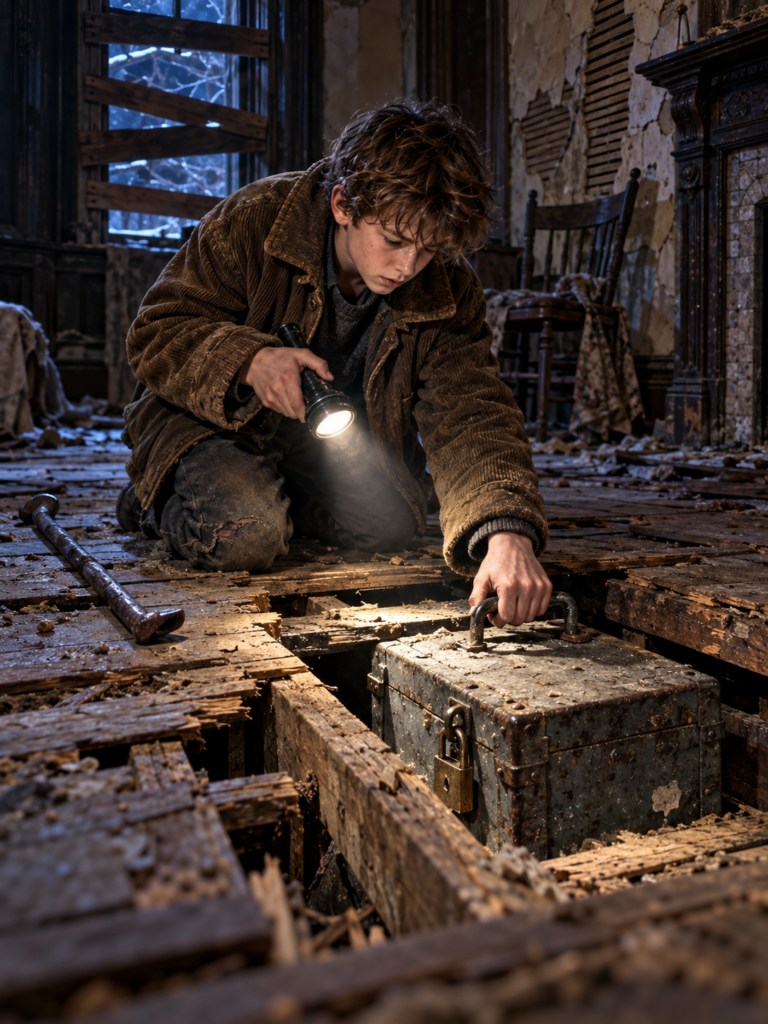
The tire iron struck the brass padlock with a sharp crack.
Leo hit it again.
The old locking mechanism finally broke, dropping against the dusty floorboards.
He lowered the iron and stared at the crate.
For several seconds, he listened to the wind rattling the plywood covering the windows.
Then he lifted the metal latches.
The lid resisted.
He pulled harder.
It opened with a stiff metallic creak.
Inside were tightly arranged rectangular bundles wrapped in yellowed oilcloth.
Leo frowned.
He had expected old tools, perhaps documents, or something left behind by people who once lived here.
These packages looked deliberately protected.
He touched the nearest one.
Hard.
Heavy.
Cold.
He lifted it from the box and carefully unfolded the cloth.
The flashlight beam struck a dull silver surface.
Leo went still.
He turned the object in his hands.
It was a metal bar, approximately the size of a brick, stamped with old foundry markings.
Another identical bundle lay beneath it.
Then another.
The crate was packed with them.
Leo set the first bar on the floor.
His heart began beating faster.
He didn’t know enough about precious metals to determine whether the bar was genuine silver.
But he understood what it might mean if it was.
He searched the remaining space inside the crate.
Wedged among the metal bundles were sealed glass jars.
Inside them, tightly rolled paper bills had been arranged in dense stacks.
Leo lifted one jar and held it near the light.
He could see hundred-dollar denominations through the glass.
The designs looked different from modern currency.
Some appeared decades old.
He set the jar down.
Then he counted the visible metal bundles.
There were far more than he could comfortably carry.
His first reaction was disbelief.
The second was fear.
He was fourteen years old.
He had been living alone in a condemned house after being expelled from his stepfather’s home.
He had obtained the property through an auction without understanding the legal paperwork.
And now he appeared to possess a collection of precious metal and old currency worth far more than anything he’d ever seen.
Who had hidden it?
How long had it been there?
And what would happen if somebody discovered that a homeless teenager had found it?
He looked toward the front door.
The deadbolt was an inexpensive replacement he had fitted himself.
The windows were boarded.
The walls had gaps large enough for rainwater to enter.
His home was barely secure enough to protect him from the weather, much less from people who might come looking for valuable property.
Leo wrapped the silver-colored bar again.
He examined the old foundry mark on its surface.
It didn’t tell him who owned it.
The crate offered no obvious explanation either.
Only carefully packed metal, sealed currency, and the unmistakable evidence that someone had once wanted the contents preserved and concealed.
He considered asking Frank at the diner.
Frank had helped him survive the winter.
But Leo knew that even a well-meaning person might react unpredictably to an enormous hidden fortune.
And he had no proof yet that the contents could legally be sold or that the papers he held gave him an unquestioned claim to them.
He returned the bundles to the crate.
Closed the lid.
Then dragged the heavy container toward the cellar.
Each movement took effort.
The crate scraped over damaged boards before he reached the steps.
He maneuvered it down carefully and pushed it into a dark corner beneath collapsed lumber and old stone.
He covered it until nothing remained visible.
By the time he finished, he was sweating despite the cold.
Upstairs, the heater hissed softly.
Leo sat beside it with the tire iron across his knees.
He wasn’t thinking about mansions or expensive cars.
He was thinking about a roof that didn’t leak.
Windows without plywood.
A bedroom with a real bed.
And enough money to stop worrying about where his next meal would come from.
But he needed to discover whether the metal was real.
He needed to learn what it was worth.
And he needed to decide how to handle an object whose ownership history he didn’t know.
For three days, he continued working at the diner.
He said nothing about the crate.
During a visit to the library, he read about silver bullion, old currency, and precious-metal pricing.
The information made the discovery appear even more valuable.
But it didn’t tell him who had placed it beneath the floor.
On the third day, Leo returned to the cellar.
He moved the lumber away.
Opened the crate.
Selected one wrapped silver bar.
Then placed it carefully inside his backpack.
He was going to take it to a dealer in another city.
And find out whether the $5 house had been hiding a fortune.
Leo tightened the straps of his backpack around the wrapped bar.
The weight pulled against his shoulders.
He closed the cellar door, checked the front lock, and stepped into the freezing morning.
Bracken Creek was still waking up.
A delivery truck passed along the main road.
The diner was dark except for a light above the kitchen entrance.
Leo had arranged to miss his usual shift.
He didn’t tell Frank where he was going.
Four miles beyond town, he reached an interstate bus stop and boarded a coach bound for an industrial city several counties away.
He sat near the back.
His backpack rested between his boots.
Every time the vehicle slowed, he looked toward the aisle.
The bar felt impossibly heavy.
He wondered whether it was genuine silver.
He wondered what a dealer would offer.
And he wondered what he would do if somebody asked questions he couldn’t answer.
His reading at the library had given him an approximate market price for silver.
It hadn’t made him an expert.
And it certainly hadn’t clarified whether he could legally sell something found beneath the floor of a condemned property.
Still, he needed information.
By the time the bus arrived, he had rehearsed his story so many times that the words seemed almost familiar.
He walked along a commercial street until he found a small pawnshop.
Metal bars protected the windows.
A faded sign hung above the entrance.
Inside, an older man with a gray beard stood behind a reinforced glass counter.
He was examining a watch when Leo entered.
“What can I do for you?”
Leo approached the counter.
He removed the newspaper-wrapped bar from his backpack and placed it in the transaction slot.
The man unfolded the paper.
His expression changed immediately.
He lifted the bar.
Turned it beneath a lamp.
Then examined the stamped markings through a jeweler’s loupe.
“Where’d you get this?”
Leo felt his heartbeat quicken.
He had expected the question.
But hearing it made him realize how vulnerable he was.
“It belonged to my grandfather,” he said.
The lie came out smoothly.
“My family needs money.”
The man studied him.
Then he weighed the bar.
“Old casting,” he said. “Might be about ninety percent silver. I’d have to process it.”
Leo watched closely.
The man examined the metal again.
“I can give you two thousand.”
Leo had spent hours studying prices.
He understood that the bar’s full theoretical value depended on its weight, purity, and the market.
He also understood that a dealer needed to make a profit.
But the offer seemed far too low.
“That’s four hundred ounces,” Leo said.
The man looked up.
“And?”
“Silver is around fifteen dollars an ounce. That would be six thousand at full value if it were pure.”
“Which it isn’t.”
“You haven’t established that.”
The dealer’s eyes narrowed.
Leo’s palms were damp.
He had never negotiated over more than a few dollars.
But he had spent years learning to recognize when an adult assumed he could be pushed around.
“I want four thousand,” he said. “Otherwise I’ll take it to another dealer.”
The man leaned back.
For a long moment, neither spoke.
Then the older man gave a reluctant smile.
“You’re a stubborn kid.”
Leo said nothing.
The dealer considered the bar again.
Then he opened a safe beneath the counter.
The transaction proceeded for cash, with no meaningful examination of Leo’s age or his story.
That was an extraordinary risk Leo did not fully understand.
When he stepped outside, four thousand dollars were hidden in his backpack and boots.
He stood beneath the gray winter sky, staring at passing traffic.
The money was real.
He had exchanged one bar for more than he had earned through months of exhausting labor.
But he couldn’t forget that the dealer had asked where it came from.
The question would follow him.
He didn’t know who had hidden the crate.
He didn’t know whether an earlier owner had intended someone to inherit it.
He didn’t know whether a future dispute might arise over the money.
For now, however, he had enough to begin fixing the house properly.
He returned to Bracken Creek that afternoon.
The following morning, he entered Miller and Sons Hardware carrying a handwritten list.
Hank, the owner, stood behind the lumber counter.
He knew Leo from occasional small purchases.
Usually, the boy bought a few nails, a roll of tape, or whatever inexpensive supplies he could carry home.
This time, the list was much longer.
Lumber.
Drywall.
Roofing materials.
Copper pipe.
Weatherproofing supplies.
Hank read the paper twice.
“That’s a serious amount of work.”
“I’m repairing a house.”
“Which house?”
“Forty-two Mercer.”
Hank looked up.
“That condemned place?”
Leo nodded.
“You can’t fix that with a few sheets of plywood, son.”
“I know.”
Hank studied the list again.
“Who’s helping you?”
“Mostly me.”
The man put the paper down.
“Some of this work requires people who know what they’re doing.”
Leo understood that.
He had already discovered how quickly rotting wood could fail and how dangerous damaged wiring and plumbing could be.
But he couldn’t afford to hire people for everything.
He needed materials for the work he could manage and better equipment to make the house secure.
He placed a stack of twenty-dollar bills on the counter.
“Can you deliver these?”
Hank stared at the money.
Then at Leo.
“Where did you get all that?”
Leo kept his expression neutral.
“I saved up.”
Hank wasn’t convinced.
But he began reviewing which supplies he could provide.
The delivery truck arrived at Mercer Street before noon.
Leo stood on the porch as the driver unloaded boards and building materials.
Neighbors slowed their cars to watch.
Until then, 42 Mercer had been a familiar disgrace.
A collapsing Victorian house at the end of a neglected road.
Nobody expected it to improve.
Certainly not because of a fourteen-year-old boy.
But over the following weeks, the place began changing.
Leo removed damaged interior materials.
He replaced sections of rotten wood where he could do so safely.
He installed weatherproofing.
He worked on the windows.
He bought a generator and basic power tools.
He spent long hours learning how materials fit together, sometimes making mistakes that forced him to tear out his own work and start again.
The job was physically exhausting.
There were days when he couldn’t lift his arms without pain.
There were nights when rain found new gaps in the roof.
Whenever progress seemed possible, another problem appeared.
A pipe leaked.
A floor section failed.
A wall concealed more damage than he’d expected.
But Leo had spent enough nights sleeping outdoors to appreciate even the smallest improvement.
A dry corner became a warm room.
A warm room became a usable living space.
And slowly, the house stopped feeling like somewhere he was temporarily hiding.
It began feeling like a place he was making his own.
The money from the first bar eventually ran low.
Leo returned to the cellar.
He uncovered the crate and examined the remaining bundles.
He had not touched the old currency.
It remained sealed inside its jars.
He didn’t want to damage the bills or try to spend something whose value and legal history he didn’t understand.
Instead, he selected another silver bar.
He made a second trip to a different city.
Another dealer.
Another cash transaction.
Another exchange he conducted without resolving the questions about ownership.
Leo convinced himself that caution meant using different shops and avoiding attention.
He was wrong to assume that secrecy solved the legal uncertainty.
But he was still a frightened teenager operating without adult guidance.
And he believed that losing control of the money might mean losing the first safe place he’d ever had.
He spent the proceeds on repairs.
Not luxuries.
Not expensive clothing.
Not entertainment.
He wanted a roof that wouldn’t leak, windows that would close, walls that would keep out winter air, and a kitchen where he could cook meals without worrying about rodents.
By spring, the neighbors were noticing.
The porch had been rebuilt.
The broken windows had been replaced.
The roof was no longer visibly collapsing.
The siding had been cleaned and painted a slate-gray color.
People slowed as they passed Mercer Street.
At the diner, customers began talking about the condemned house.
“That boy’s doing something with it.”
“Where’s he getting the money?”
“Probably somebody helping him.”
“Nobody helps a kid that much.”
Leo heard fragments of the conversations.
He didn’t respond.
Frank occasionally watched him from the kitchen doorway.
One evening, after Leo finished cleaning, Frank asked, “You getting enough sleep?”
Leo shrugged.
“Enough.”
“You look worn out.”
“I’m working on the house.”
Frank nodded.
“I heard.”
He didn’t press further.
Leo appreciated that more than he knew how to express.
Frank had given him work when nobody else had offered help.
But Leo kept the secret beneath the cellar hidden.
By summer, the repairs had advanced far enough that he no longer depended on the diner for regular income.
He stopped taking shifts in July.
Frank wished him well.
Leo left with a strange mixture of gratitude and sadness.
For months, the diner had been one of the few places where he knew he could find warmth and food.
Now he had a kitchen of his own.
As autumn approached, the house looked almost unrecognizable.
Its windows were intact.
The front porch stood straight.
The roof had new shingles.
Inside, the walls were painted.
The kitchen contained modern appliances.
The rooms were dry and warm.
Leo had transformed the building from a condemned shell into a usable home.
But the metal crate remained hidden in the cellar.
He still knew very little about its original owner.
And the greater mystery was no longer how such wealth had ended up beneath the floor.
It was how long he could keep it secret.
Then, on an October morning nearly eleven months after the auction, somebody began pounding on his front door.
Leo was in the kitchen preparing coffee.
He stopped.
The pounding came again.
Louder.
He put down the kettle.
Walked into the hallway.
And looked through the peephole.
Wayne stood on the porch.
Leo’s stepfather.
The man who had thrown him out into a November storm.
The man who had left him homeless at fourteen.
Wayne looked older than Leo remembered, but not much different.
The same worn denim jacket.
The same flushed face.
The same aggressive stance.
He raised his fist and struck the door again.
“I know you’re there, Leo!”
Leo stood still.
His hand rested on the new brass deadbolt.
He had spent nearly a year rebuilding this house.
Now the person who had driven him into the streets was standing outside it.
Leo took a slow breath.
Then he turned the lock.
The deadbolt slid back.
Leo grasped the brass handle and opened the door.
Wayne stood with his fist still raised.
He stopped when he saw Leo.
For a moment, neither spoke.
Wayne’s gaze moved over the boy’s face, then his shoulders, then the newly painted hallway behind him.
Nearly a year had passed since he forced Leo out of the family home.
During that time, Leo had grown taller.
Months of carrying lumber, hauling rubbish, and making repairs had strengthened his thin frame.
His hands were rough and marked by work.
But the most noticeable change was the way he stood.
He did not step aside.
He did not lower his eyes.
He remained in the doorway, waiting.
Wayne’s expression shifted.
“Well, look at you.”
Leo said nothing.
Wayne leaned slightly, trying to see past him.
The bright kitchen was visible from the entrance.
So were the clean walls, finished floors, and new light fixtures.
“I heard you’d bought yourself a broken-down shack,” Wayne said.
Leo watched him.
“Seems like the stories were wrong.”
“What do you want?”
Wayne laughed.
“That’s how you greet me?”
Leo didn’t answer.
Wayne looked around again.
“Place looks expensive.”
“It took a lot of work.”
“Funny thing about that. Nobody seems to know where you’re getting the money.”
Leo felt a familiar tightening in his stomach.
He had expected the question eventually.
Neighbors had been talking about the house for months.
Someone must have told Wayne.
But hearing his stepfather ask it made the hidden crate feel suddenly vulnerable.
Leo’s thoughts went to the cellar.
To the metal box concealed beneath lumber.
To the remaining silver bars and sealed currency.
He kept his expression still.
“That’s my business.”
Wayne’s smile faded.
“Your business?”
“Yes.”
Wayne took a step toward the doorway.
Leo remained where he was.
“Don’t start talking to me like that. I’m the one who raised you.”
Leo looked at the man who had stood over him for years.
The man who had shouted through the house after drinking.
The man who had made ordinary childhood mistakes feel dangerous.
He remembered being ten years old, grieving for his mother, and realizing that the person left in charge of him did not want him there.
He remembered four years of trying not to attract Wayne’s anger.
And finally, the cold November evening when Wayne shoved a garbage bag into his hands and locked him outside.
“You threw me out,” Leo said.
Wayne waved a dismissive hand.
“I was teaching you responsibility.”
“You left me without anywhere to live.”
“You needed to learn.”
Leo felt anger rise.
But beneath the anger was something new.
Distance.
Wayne had once seemed impossibly large.
His moods had controlled the entire house.
One angry glance could silence Leo for hours.
Now Wayne was standing on a porch that Leo had rebuilt himself.
And Leo was beginning to understand that the fear Wayne had created was not the same thing as actual authority.
“I learned,” Leo said.
Wayne narrowed his eyes.
“Then you know you owe me.”
Leo almost smiled, though there was nothing amusing about it.
“Owe you what?”
“Fourteen years of food and a roof. You think that came free?”
Leo stared at him.
He had slept behind a shopping center.
Worked long shifts cleaning restaurant equipment.
Spent winter nights shivering beneath a plastic tarp.
He had worked until his hands blistered just to make one room warm enough to sleep in.
And Wayne was standing there asking to be repaid for the responsibility he had abandoned.
“You don’t get to charge me for being a child,” Leo said.
Wayne’s face darkened.
“Watch your mouth.”
Leo felt the old instinct to retreat.
For a fraction of a second, his body remembered what usually happened after those words.
Then he looked behind him.
At the house.
At the walls he had rebuilt.
At the floorboards that no longer moved beneath his feet.
He had endured worse than Wayne’s anger.
He had endured being unwanted.
And he was still standing.
“This is my home,” Leo said.
Wayne laughed.
“You’re fifteen, at most. What makes you think you can own a house?”
“I bought it at the county auction.”
“With what money?”
“Five dollars.”
Wayne stared at him.
Then he laughed harder.
“Five dollars? You’re telling me all this is yours because you paid five bucks?”
“I’ve got the paperwork.”
“The paperwork doesn’t make you an adult.”
Leo knew that.
He had known it since the auctioneer accepted his bid without asking for proper identification.
The fact that the county had processed the paperwork did not mean every legal question had been settled.
He was still a minor.
There could be questions about the sale, his capacity to manage the property, the condemned building, and his living arrangements.
But Wayne didn’t know how the situation would ultimately be resolved either.
And the older man was behaving as though he could simply arrive and take everything.
“Then we can have the paperwork examined,” Leo said. “But you’re not walking in here and claiming my work.”
Wayne’s eyes narrowed.
“You’re living alone. I could take charge of this place.”
Leo felt a jolt of fear.
Not because Wayne had established any legal right.
But because the threat carried him back to childhood.
Wayne was used to telling him what would happen.
Used to making decisions without explaining them.
Used to treating resistance as disobedience.
Leo stepped forward just enough to keep the doorway blocked.
“You told me not to come back.”
Wayne snorted.
“That was almost a year ago.”
“You didn’t come looking for me.”
“I figured you’d learn.”
“You didn’t ask where I was sleeping.”
“Don’t start.”
“You didn’t ask whether I had food.”
Wayne’s jaw tightened.
“You’ve made your point.”
“No,” Leo said. “I haven’t.”
He looked directly at his stepfather.
“You only came here after somebody told you the house looked good.”
Wayne said nothing.
Leo continued.
“You didn’t come because you were worried. You came because you thought there was something here you could take.”
For a moment, Wayne appeared ready to deny it.
Then his expression hardened.
“You ungrateful little punk.”
He reached toward Leo’s shirt.
Leo reacted instinctively.
He caught Wayne’s wrist before the older man could grab him.
The sudden movement surprised them both.
Wayne stumbled against the doorframe.
“Let go!”
Leo released him and stepped back into the doorway.
His heart hammered.
He had not planned to touch Wayne.
He had wanted the conversation to end without violence.
But when Wayne reached for him, his body had reacted before his thoughts could catch up.
Wayne rubbed his wrist.
His face had turned red.
“You’re just like your mother,” he spat.
Leo went still.
The words landed differently from the others.
His mother had died when he was ten.
For years, her memory had been one of the few things Wayne couldn’t completely take away from him.
He remembered her voice.
The way she brushed hair from his forehead.
The smell of the kitchen when she cooked.
Her hands resting on his shoulders when she told him everything would be all right.
He had spent four years mourning her while living with a man who treated her absence as an inconvenience.
Now Wayne was using her memory as another weapon.
“Don’t talk about her,” Leo said.
Wayne scoffed.
“She’d be ashamed of the way you’re speaking to me.”
Leo felt a sharp ache behind his ribs.
Then he remembered something his mother had once told him.
He couldn’t recall the exact words.
Only the meaning.
That being kind didn’t mean allowing other people to hurt him.
For years, he had confused survival with obedience.
But surviving Wayne no longer required pleasing him.
“My mother loved me,” Leo said.
Wayne looked away.
“And she wouldn’t have left me outside in the rain.”
The porch became quiet.
From somewhere down the street came the sound of a passing vehicle.
Wayne’s gaze moved again toward the interior.
Leo could almost see him calculating.
The renewed house.
The unexplained money.
The apparent absence of any adult protecting the boy.
A part of Leo worried that Wayne might leave and return with someone who would listen to his claims.
That risk was real.
He had not solved all the legal questions surrounding his situation.
And he knew his secret could make everything more complicated.
But yielding now would not protect him.
It would simply place him back under the control of the person who had made his life unbearable.
“If you think you have a legal claim,” Leo said, “you can make it through the proper process.”
Wayne’s eyes widened slightly.
“You threatening me?”
“No. I’m telling you that you can’t just walk inside.”
“I raised you.”
“And then you abandoned me.”
Wayne opened his mouth.
Nothing came out.
Leo stepped back and rested his hand on the door.
“Leave.”
Wayne stood there.
For a moment, Leo thought he might try pushing past.
Instead, the older man gave the house another long look.
“You’re going to regret this,” he muttered.
Leo felt the old fear flicker.
He couldn’t know whether Wayne would return.
He couldn’t know what complications might come from the uncertain ownership documents or the money hidden in the cellar.
But he did know that he had a choice in this moment.
He didn’t have to open the door wider.
He didn’t have to surrender the house.
And he didn’t have to accept Wayne’s account of what he owed.
“Goodbye, Wayne.”
The older man’s expression tightened.
He turned sharply and walked down the porch steps.
At the edge of the yard, he paused.
Leo watched him.
Wayne looked as though he wanted to say something else.
Then he continued down Mercer Street.
He disappeared around the corner without looking back.
Leo remained in the doorway.
Cold October air brushed his face.
The neighborhood was quiet again.
He stood there until his heartbeat slowed.
Then he closed the door.
The brass deadbolt slid into place with a heavy metallic click.
It was nearly the same sound he’d heard when Wayne locked him out the previous November.
But this time, Leo was standing on the other side.
Inside.
Warm.
With the key in his own hand.
He looked around the entrance hall.
Sunlight entered through the windows he had installed.
The freshly painted walls reflected the pale afternoon light.
There was no water dripping from the ceiling.
No broken glass underfoot.
No mold-covered mattresses scattered through the parlor.
For nearly a year, the house had demanded everything he could give.
He had spent nights reading repair manuals, days hauling materials, and evenings trying to make one more section safe and dry.
There were still things he couldn’t do alone.
There were legal matters he hadn’t resolved.
And there was the complicated question of the metal crate and the fortune hidden beneath the building.
He couldn’t pretend those problems had disappeared.
But he could recognize what had already changed.
The condemned house had become somewhere he could live.
And he had become someone capable of defending his own boundaries.
Leo walked into the kitchen.
The kettle still sat where he had left it.
He poured water into a mug and stood beside the counter.
His hands were shaking.
Not from cold this time.
From the conversation.
He had imagined confronting Wayne many times during the nights he slept outdoors.
In some versions, he shouted.
In others, he begged for an explanation.
Sometimes he imagined proving to Wayne that he was successful, hoping that success would finally earn the older man’s respect.
But after the actual confrontation, none of those fantasies mattered much.
He didn’t want Wayne’s approval.
He didn’t want to impress him.
He simply wanted him gone.
The realization brought a quiet relief.
Leo looked through the kitchen window toward the overgrown fence.
The house still stood at the end of a neglected road.
The town hadn’t suddenly transformed.
The abandoned factories were still empty.
Many families were still struggling.
The local streets still carried the scars of an economy that had left people behind.
And Leo was still a teenager who had spent the previous winter sleeping outside.
Money hadn’t erased those facts.
Nor did the silver bars explain everything about the house.
He had no idea who had concealed them.
The aged padlock and old markings suggested that they had been hidden long before his arrival.
The carefully wrapped metal and sealed bills suggested an intentional attempt to preserve wealth.
But those observations did not establish the owner’s identity.
Or whether the property transfer gave Leo a clear legal right to the contents.
The discovery had provided an extraordinary opportunity.
It had not given him all the answers.
Leo understood that eventually, he would need to face those questions with reliable help.
But the immediate mystery that had brought him to Mercer Street was already clear.
The house that everyone dismissed as worthless had contained a hidden cache.
One which he had used, through risky and secret sales, to fund its restoration.
That was why a five-dollar ruin had become a warm, livable home.
The transformation was not magic.
It had required money.
But it had also required endless work, painful mistakes, and a boy who had refused to abandon the property when it became difficult.
He looked down at his hands.
The calluses were thick.
Small scars crossed his knuckles.
His nails were still stained from paint and woodwork.
Even with the money, no one had rebuilt the house for him.
That had been his choice.
He set down the mug.
Then walked toward the living room.
The floor near the old fireplace was smooth.
Fresh boards had replaced the damaged oak that once allowed freezing air to rise from beneath the house.
Leo knelt and rested his palm against them.
He remembered the night he had torn up the original boards.
He had been trying to stop a draft.
Nothing more.
He hadn’t been searching for wealth.
He hadn’t imagined a cache of precious metal.
All he had wanted was to sleep without shivering.
Now he could walk barefoot across this floor in winter.
He could cook food in his kitchen.
He could close the door against rain and wind.
And when somebody knocked, he could decide whether to open it.
That last change meant more to him than he’d expected.
The night Wayne threw him out, the closing deadbolt had sounded like a sentence.
A declaration that he didn’t belong.
Now the same sound meant something else.
A boundary.
A protection.
A choice.
Leo stood and walked toward the cellar door.
He rested his hand on the knob.
Beneath the house, the metal crate remained hidden.
The silver bars and sealed jars still carried unanswered questions about their past.
He didn’t need to open the container tonight.
He didn’t need to count the remaining metal.
He didn’t need to prove to anyone how much he possessed.
Instead, he turned away.
He went upstairs to the room he had finished repairing only weeks earlier.
A clean bed stood against the wall.
The window closed tightly.
Fresh paint covered the plaster.
For the first time since his mother’s death, Leo had a room where he could rest without listening for an angry adult moving through the hallway.
He sat on the edge of the mattress.
Outside, the light was fading.
Autumn was giving way to another winter.
Soon the nights would become bitterly cold again.
But this year, Leo wouldn’t be searching for a heating vent behind a shopping center.
He wouldn’t be sleeping in wet clothes.
He wouldn’t be wondering whether he had enough coins to buy something warm to eat.
He had survived one terrible winter.
And he had built a home in time for the next.
Leo lay back and stared at the ceiling.
He thought briefly of Frank at the diner, who had given him work without demanding an explanation for his circumstances.
He thought of Hank at the hardware store, who had helped deliver materials to a property everyone else had written off.
Neither man knew about the hidden crate.
Neither had been part of the discovery.
But their ordinary acts of practical help had mattered.
Leo had not been completely alone, even when he’d felt that way.
He would remember that.
His mother had once told him that a home was supposed to be somewhere a person could feel safe.
For years, Leo had believed a home depended on another person allowing him to stay.
Wayne had taught him how easily that permission could be taken away.
Mercer Street had taught him something different.
A house could be repaired.
A broken room could become a place of comfort.
A door could be locked from the inside.
And a boy whom everyone had dismissed could learn that his life was worth protecting.
He thought of the auction room.
The laughter.
The crumpled five-dollar bill.
The auctioneer’s impatience.
Nobody had expected him to accomplish anything.
They had seen only a homeless teenager buying somebody else’s problem.
Nobody knew about the silver beneath the floor.
Neither had Leo.
The town had been wrong about the house.
But it had also been wrong about him.
That mattered more.
As darkness settled outside the window, Leo reached for the bedside lamp.
He switched it off.
The room grew quiet.
He pulled the blanket over himself.
No wind entered through the walls.
No rain struck the floor.
No angry footsteps approached his bedroom.
Somewhere downstairs, the front door remained locked.
And for the first time in years, Leo could hear the quiet of his own home without being afraid of what it meant.
The five-dollar house had held a hidden fortune.
But the life Leo had built inside it was the part he never wanted to lose.
He closed his eyes.
And finally slept.


