
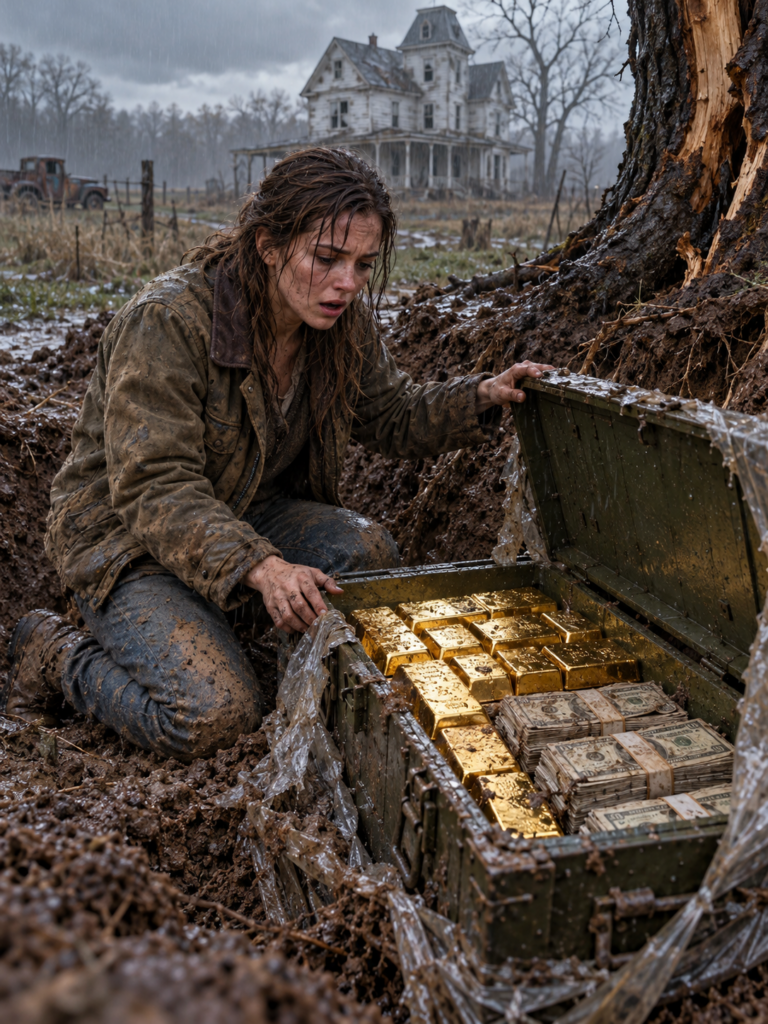
The flashlight illuminated rows of dull-yellow metal bars packed tightly inside the crate.
Jessica stared.
Rain struck the exposed metal, running between rectangular ingots marked with small banking impressions and weight stamps.
Gold.
Beside the bars sat thick, transparent packages containing stacks of old hundred-dollar bills.
For a moment, Jessica genuinely wondered whether exhaustion was making her see things.
She reached down and touched one of the bars.
Cold.
Heavy.
Solid.
She tried lifting it.
The weight dragged at her injured fingers.
“Oh, my God.”
She lowered it back into place.
This wasn’t a box of ordinary valuables.
Someone had buried gold and cash beneath six feet of clay, precisely where Margaret’s notebook said they would be.
Jessica looked toward the farmhouse.
The building seemed small and miserable across the rain-soaked field.
Her grandmother had lived there wearing patched clothes, eating inexpensive meals, and refusing to replace broken furniture.
Meanwhile, something worth potentially hundreds of thousands of dollars had been lying beneath a tree.
The contradiction made Jessica’s stomach tighten.
If Margaret had possessed this kind of wealth, why had she lived as though she had none?
More painfully, why had Jessica spent fourteen years struggling to survive?
She thought of the winters when her apartment had almost no heat.
The shifts she worked while sick.
The nights she counted the money in her wallet before deciding whether she could afford dinner.
She remembered the locked screen door.
Margaret telling her she didn’t belong.
And now gold was sitting at her knees.
Jessica pulled the notebook from her jacket and checked the entry.
The coordinates matched.
The depth matched.
The crate had clearly been placed here deliberately.
Which meant the other markings might also lead to buried objects.
Dozens of red X marks.
Dozens.
A wave of disbelief passed through her.
Could Margaret have concealed an entire fortune across Ashwood Farm?
Jessica searched the crate for anything explaining its origin.
She found no personal letter, no ownership document, no instruction about what should happen after Margaret’s death.
Only gold and sealed cash.
The discovery established that the notebook was accurate.
It did not establish where the wealth came from.
Nor did it establish that Jessica could safely spend it.
She thought of Greg Sullivan.
His expensive pickup.
His insistence that the land was worthless.
His willingness to raise an already substantial offer merely to hurry her signature.
Maybe he knew the property contained something valuable.
Maybe he was simply making an aggressive development offer.
Jessica couldn’t prove either possibility.
But she was no longer willing to sell without understanding what Margaret had hidden.
She closed the crate.
Leaving it exposed in a muddy hole felt impossible.
She began carrying the contents toward the house in manageable loads.
The work was punishing.
Her hands were blistered, her jacket soaked, and her boots made sucking sounds with every step through the clay.
Eventually, the last package reached the mudroom.
She tucked the contents beneath loose floorboards, away from the windows.
Then she returned to the pasture, replaced the empty crate, filled the hole, and scattered wet leaves across the disturbed soil.
By the time she finished, her clothes were ruined.
She locked the farmhouse door.
Changed into dry clothing.
And sat in the study with Margaret’s map spread across her knees.
She studied the next entry.
April 3, 2015.
Root cellar.
East wall behind the preserves.
Four feet.
Jessica remembered the cellar.
As a child, she had hated going down there because the steps creaked and the air smelled of damp stone.
Margaret used to keep jars of vegetables along the shelves.
Had something been hidden behind them all those years?
Jessica traced the red mark with one finger.
Then headlights swept across the study window.
She stopped moving.
A dark SUV had pulled up near the trees beyond the driveway.
It wasn’t Greg’s black pickup.
Nobody stepped out.
The vehicle remained stationary, its headlights illuminating the house.
Jessica moved away from the window.
She couldn’t see who was inside.
She couldn’t know whether the driver was interested in the farm or had simply stopped at the wrong property.
But after Greg’s suspicious offer and the discovery under the oak, she was unwilling to assume it was harmless.
The SUV stayed for nearly an hour before reversing toward the highway.
Jessica remained inside.
She didn’t sleep.
At dawn, she took the map, a flashlight, and a crowbar.
Then she opened the kitchen door leading down to the root cellar and descended the narrow wooden staircase.
The staircase groaned beneath Jessica’s boots.
She stopped halfway down, listening to the old house.
Nothing moved upstairs.
The root cellar was colder than the kitchen, and the air carried the sour odor of damp masonry and forgotten preserves.
Jessica aimed the flashlight across rows of shelves.
Old mason jars stood in uneven lines, their contents darkened by age.
Some labels had peeled away.
Others were covered in mold.
She looked at Margaret’s notebook.
East wall.
Behind the preserves.
Four feet.
Jessica turned toward the correct side of the room.
The shelves there were crowded, but she noticed something unusual about the brickwork behind them.
A section of mortar was lighter than the surrounding wall.
The bricks themselves looked less weathered.
She ran her hand across the surface.
Someone had repaired this section.
Or built it more recently than the rest of the cellar.
Jessica pulled the old jars from the shelves, setting them carefully on the floor.
She hated touching them.
As a child, she had been forbidden to waste food or break household objects.
Even now, fourteen years after leaving, she could almost hear Margaret telling her to be careful.
The memory irritated her.
“You’re not here anymore,” Jessica muttered.
But the words sounded less satisfying than she expected.
She had spent most of her life imagining what she would say if she ever confronted her grandmother again.
Now Margaret was dead, and the only conversation left was between Jessica and the things she had hidden.
Jessica wedged the crowbar against the lighter mortar.
The first blow loosened a small fragment.
The second cracked a brick.
She worked slowly, pulling pieces free and setting them on the dirt floor.
Dust gathered on her jacket.
Her injured palms protested every movement.
Eventually, a dark space appeared behind the masonry.
Jessica aimed the flashlight inside.
Something metallic reflected the light.
She continued removing bricks until the opening was wide enough to reveal a heavy steel safe.
It had been concealed inside a recess behind the wall.
The dial was missing.
The locking mechanism appeared damaged.
Jessica stared at it.
Margaret had gone to considerable trouble to hide something here.
But the safe itself had already been forced or disabled at some point.
She tried the remaining latch.
It moved.
Jessica pulled the door outward.
Inside were more gold bars.
Neatly stacked packages of bearer bonds.
And a white envelope resting on top.
She almost overlooked the envelope because of the valuables beneath it.
Then she noticed the handwriting.
A single name.
Jessica.
Her breath caught.
She reached inside.
For several seconds, she simply held the envelope.
The discovery beneath the oak had been astonishing.
But this was different.
Gold could be hidden for countless reasons.
A letter addressed to her suggested Margaret had expected Jessica to come looking.
Or at least had hoped she might.
Jessica wiped her hands on her jeans.
Then she opened the envelope.
The paper inside was thick and folded.
Margaret’s handwriting covered it in narrow, tightly spaced lines.
Jessica recognized the sharp strokes immediately.
There was no greeting filled with affection.
No apology at the beginning.
That, at least, was familiar.
Instead, Margaret began by telling Jessica that if she was reading the letter, she had resisted the first person who tried to buy the farm.
Jessica thought of Greg.
His polished truck.
His effortless smile.
The sudden increase in his offer.
She kept reading.
The letter told her that the truth about Ashwood Farm began with her grandfather.
A man Jessica remembered only through fragments of family conversation.
Margaret described him as quiet but deeply dishonest.
Over many years, he had accumulated wealth through illicit transportation arrangements, taking money and valuables from operations that were not entirely legitimate themselves.
Some came from armored shipments.
Some from accounts controlled by criminal associates.
He had hidden the proceeds around the property.
Margaret had inherited the burden of guarding them.
Jessica lowered the page.
The notebook.
The map.
The buried ammunition crate.
The safe.
They were not random caches.
They were part of a deliberately concealed collection.
The money was real.
But its history was far more dangerous than she had imagined.
She continued reading.
According to Margaret, Jessica’s father eventually discovered the hidden wealth.
He began to see it as a safety net.
A way out of ordinary responsibilities.
Margaret believed that knowledge contributed to his reckless decisions.
Then he died from an overdose.
Jessica stopped reading.
Her father’s death had been the dividing line of her childhood.
Everything before it had been uncertain but familiar.
Everything afterward had been temporary.
Foster homes.
Different schools.
A succession of adults who explained rules but rarely explained feelings.
She had spent years wondering whether she had done something wrong.
Whether being difficult or angry had made Margaret decide she was not worth keeping.
Now Margaret’s letter offered another explanation.
It claimed that people connected to Jessica’s grandfather had continued watching the farm.
They knew the hidden wealth existed.
And they believed Margaret still had access to it.
Margaret wrote that keeping Jessica close would have made her vulnerable.
A child could have been used to pressure her into revealing the buried assets.
So Margaret had chosen to make everyone believe she did not care about her granddaughter.
Jessica read those lines again.
The handwriting did not change.
It remained precise and uncompromising.
Margaret admitted that she had deliberately sent Jessica into foster care and maintained the separation.
She claimed it was protection.
She also claimed that making Jessica survive without help would teach her to withstand people who wanted to take what belonged to her.
Jessica’s eyes filled.
Not because she was immediately relieved.
Because the explanation was almost harder to bear than the silence.
Margaret had known what those fourteen years might cost her.
And had decided to pay that price with Jessica’s childhood.
Jessica remembered sleeping in unfamiliar bedrooms.
Waiting for phone calls that never came.
Learning not to unpack completely because she might have to move again.
She had not become strong because somebody lovingly trained her.
She had become resourceful because she had no dependable choice.
The letter could explain Margaret’s reasoning.
It could not make her decision harmless.
Jessica wiped her face and continued.
Then she reached Greg Sullivan’s name.
Margaret described him as a representative of people connected to the missing wealth.
According to the letter, his development business provided an explanation for his interest in the property.
He wanted control of the land.
The people behind him wanted what Jessica’s grandfather had hidden.
They believed Margaret was an eccentric old woman who could be pressured or outlasted.
And they would likely see Jessica as easier to manipulate.
Jessica sat on the cold cellar floor.
The rain had stopped outside.
Weak morning light filtered down from the top of the staircase.
She thought about Greg offering $150,000.
Then $160,000.
A fast closing.
No complications.
No questions.
He had known enough to want the farm.
Perhaps not enough to know where every cache was buried.
Margaret’s letter implied he was working from incomplete information.
The map gave Jessica an advantage he did not have.
But it also made her a target if the claims in the letter were true.
Jessica looked at the gold inside the safe.
Fifteen million dollars was the value Margaret associated with the total concealed fortune.
It was an astonishing figure.
But Jessica understood now that she couldn’t treat the whole amount as a simple inheritance.
Much of it might have been stolen.
Some assets might still be traceable to other people.
Margaret’s letter was a personal account, not a legal determination of ownership.
Still, it gave Jessica something she had not possessed since arriving at Ashwood Farm.
Context.
The house had not been neglected merely because Margaret had no money.
The old woman had been guarding wealth she was afraid to reveal.
The notebook was not a gardening record.
The red X marks were concealment locations.
Greg’s extraordinary urgency was connected to something more than development potential.
And Jessica’s abandonment had been part of Margaret’s attempt to protect the farm’s secret.
Jessica reached the final lines of the letter.
Margaret told her the land was hers.
That she should resist Greg.
That she should reclaim Ashwood Farm instead of surrendering it to people who wanted what had been hidden there.
Jessica folded the paper carefully.
She did not feel forgiveness.
Not yet.
Perhaps not ever in the simple way Margaret might have imagined.
But for the first time, she understood that her grandmother had not acted from indifference alone.
Fear had shaped her decisions.
Secrecy had shaped her life.
And whatever love Margaret had felt had been buried beneath choices that caused profound harm.
Jessica slipped the letter into her jacket pocket.
She looked around the cellar.
The safe remained open.
The broken brickwork lay scattered at her feet.
She needed to decide what to do with the evidence.
She could call Neil Reed.
She could ask him to help determine what was lawfully hers and what needed to be reported.
She could stop treating every discovery as treasure and begin treating the notebook as a record of an unresolved past.
She reached for the crowbar.
A heavy thud sounded above her.
Jessica froze.
Another sound followed.
Footsteps.
Someone was moving through the kitchen.
Then came the unmistakable noise of a drawer being opened and its contents dumped onto the floor.
Jessica gripped the crowbar.
She turned off her flashlight.
In the darkness, she heard a familiar male voice.
“Where is it?”
Greg Sullivan.
He was inside the house.
And he was searching for something specific.
Jessica moved toward the cellar steps.
The letter pressed against her chest beneath the jacket.
She climbed quietly.
At the top, she placed one hand against the cellar door, leaned forward, and pushed it open.
The cellar door creaked outward.
Greg Sullivan stood in the middle of Margaret’s kitchen.
He had removed several drawers from their cabinets.
Cutlery, paper, and old household objects littered the peeling linoleum.
A cupboard hung open behind him.
His expensive fleece was streaked with plaster dust.
When he saw Jessica, his expression changed.
He was not surprised to find someone in the house.
He was angry to find her still there.
“Where is it?”
Jessica kept one hand on the cellar door.
“Get out.”
Greg looked at the crowbar in her other hand.
Then he glanced toward the stairs behind her.
“So you found the cellar.”
Jessica said nothing.
“The old woman kept records,” he continued. “She had to. She was too organized to bury everything and trust herself to remember.”
He stepped toward her.
“Where’s the map?”
The question confirmed more than he probably intended.
Greg knew about the hidden wealth.
He knew Margaret had recorded its locations.
But he apparently did not possess the record he needed.
Jessica tightened her grip.
“You’re trespassing.”
Greg gave a short, impatient laugh.
“You have no idea what you’re dealing with.”
“Then tell me.”
He stopped smiling.
“For years, people have been watching this property. Margaret never let anyone close enough to find what was hidden. Now she’s gone, and you’re standing here playing treasure hunter.”
Jessica thought of the SUV that had watched the farmhouse the previous evening.
She still didn’t know who had been inside.
But Greg’s admission gave the incident a different meaning.
“Those people are connected to you?”
He didn’t answer directly.
Instead, he reached beneath his jacket.
A black handgun appeared in his hand.
He held it beside his leg.
Not pointed at her.
But unmistakably visible.
“Take the money I offered,” he said. “Sign the property over. Walk away while you still can.”
Jessica looked at the weapon.
The kitchen suddenly seemed smaller than she remembered.
There was no easy way around Greg.
No reliable escape through the cellar.
And no reason to believe he would respect a refusal.
She thought about Margaret’s letter.
The claim that her grandfather had taken money from people who would do anything to recover it.
The warning about Greg.
The insistence that Jessica had to learn to fight.
For a moment, anger overcame fear.
Not just anger at Greg.
Anger at Margaret for leaving this burden behind.
At her grandfather for creating it.
At every adult who had made decisions that Jessica was forced to endure.
“I don’t know what you think you’re entitled to,” she said. “But this is my home.”
Greg’s eyes narrowed.
“You’re making a mistake.”
“Maybe.”
He took another step.
“Put the crowbar down.”
Jessica looked toward the kitchen counter.
The telephone was too far away.
The back door stood behind Greg.
She felt the rough metal handle beneath her fingers.
The next few seconds happened faster than she could fully process.
Greg moved closer.
Jessica reacted.
She swung the crowbar low.
It struck his knee.
He cried out and fell sideways onto the floor.
The handgun slipped from his hand.
Jessica recoiled from the impact, horrified by what she had done but aware that he was reaching toward the weapon.
She moved it away from him with her boot.
Then she backed toward the doorway, still gripping the crowbar.
Greg was on the floor, clutching his injured leg.
His face had gone pale.
“You crazy—”
“Stay away from me.”
Her voice broke.
She forced herself to speak again.
“You came into my house with a gun.”
Greg looked toward the weapon.
Jessica followed his eyes.
“Don’t.”
For several seconds, neither moved.
Then Greg leaned against a cabinet and struggled to pull himself upright.
Jessica kept her distance.
The crowbar trembled in her hands.
Greg’s expression was no longer controlled or confident.
He looked frightened and furious.
“You think this is finished?” he asked.
Jessica thought of the notebook.
The map.
The gold beneath the mudroom.
The safe in the cellar.
And Margaret’s letter warning that Greg did not act alone.
“No,” she said. “I don’t.”
He stared at her.
She knew what he wanted.
The wealth.
The information.
Control of the farm.
He had offered her a fraction of its apparent value because he expected desperation to do his work for him.
Now he understood she had found something.
But he didn’t know how much.
Or where it was.
Jessica made a decision.
She would not show him the map.
She would not reveal the caches.
And she would not let him believe he could frighten her into signing away the property.
“The money you came looking for is gone,” she said.
Greg’s eyes narrowed.
“You’re lying.”
“Margaret spent years keeping this place going. You don’t know what she used, what she moved, or what remains.”
His gaze darted toward the cellar.
Jessica kept her expression steady.
She was not telling him the truth about the fortune.
But she was telling him something he needed to understand.
He did not have the information required to find it.
“You can search this house,” she continued. “You can threaten me. But I’m not giving you Margaret’s records.”
Greg tried to stand fully.
Pain forced him back against the cabinet.
Jessica raised the crowbar defensively.
“Leave.”
For a moment, she feared he would lunge.
Instead, he looked toward the kitchen door.
Then at the gun lying out of his reach.
He appeared to reconsider what another confrontation might cost.
Slowly, he used the furniture to support himself.
He made his way toward the exit.
Jessica kept her distance.
She watched him struggle outside, crossing the porch toward his pickup.
The engine started.
Gravel scattered beneath the tires.
Then he was gone.
Jessica shut the door.
Locked it.
And stood motionless in the kitchen.
Only when the sound of the truck disappeared did she let the crowbar fall from her hands.
It struck the floor with a sharp clang.
Her legs weakened.
She sat down.
For several minutes, she could do nothing but breathe.
Margaret had written that Jessica needed to be strong.
But there was nothing triumphant about what had just happened.
A man had entered her house and threatened her with a gun.
She had injured him while defending herself.
And he had left knowing that she was searching the property.
This was not a victory that made everything safe.
It was proof of how dangerous the secret had become.
Jessica looked toward the kitchen doorway.
The gun Greg had dropped was still inside the house.
His scattered belongings and the disturbed cabinets made the scene impossible to dismiss as an ordinary disagreement.
She understood that she needed help.
Not the kind of help Greg had offered.
Professional help.
Legal advice.
People capable of dealing with the money, the firearm, the threatening intrusion, and the unresolved ownership of the buried assets.
She picked up Margaret’s letter.
Then she went into the study.
Outside, the rain had stopped.
Sunlight broke through the clouds, illuminating the collapsed roof of the main barn.
Jessica sat behind Margaret’s old desk.
For fourteen years, she had imagined that returning to Ashwood Farm would feel like surrender.
She had survived foster care.
Low-paying jobs.
Cold apartments.
Being treated as disposable.
She had told herself that every mile between her and the farm was evidence that she had escaped it.
Now she was sitting in the same room where her grandmother had hidden the notebook.
And she understood something she hadn’t been prepared to admit.
She wanted the farm.
Not because of the gold.
Not because she believed every claim in Margaret’s letter.
And not because she wanted to prove Greg wrong.
She wanted the chance to decide what the place would become.
Margaret had lived there in secrecy.
Her grandfather had used the land to conceal stolen wealth.
Greg wanted to control it for whatever he could recover.
Everyone seemed to have treated Ashwood Farm as a means of obtaining or protecting something else.
Jessica looked out at the ninety acres.
The fields needed work.
The fences were collapsing.
The house had been neglected.
But the land itself had done nothing wrong.
For the first time, she separated the place from the people who had hurt her there.
She could hate what Margaret had done.
And still choose to keep the farm.
She could recognize that the letter revealed fear and complicated love.
And still refuse to call abandonment a necessary lesson.
She could preserve her grandmother’s records without accepting her grandmother’s judgment of who Jessica had needed to become.
That distinction mattered.
For years, Jessica had carried the belief that she had been rejected because she was somehow unworthy of care.
Margaret’s letter challenged that belief.
It showed that the decision had come from an adult’s fear, secrecy, and determination to control circumstances she could not truly control.
Jessica hadn’t caused it.
She hadn’t chosen it.
And she didn’t need to be grateful for the suffering it created.
She reread one portion of the letter.
Margaret believed a young girl who knew how to survive with nothing would eventually know how to defend everything.
Jessica shook her head.
“No, Grandma.”
She spoke quietly.
“I needed someone to defend me.”
The empty room offered no answer.
There would be no reconciliation at the kitchen table.
No conversation in which Margaret apologized.
No chance for Jessica to ask why she had not been given some other kind of protection.
That loss was real.
And inheriting a fortune could not undo it.
Jessica folded the letter.
She would keep it.
Not because it justified Margaret’s choices.
Because it was evidence of the woman Margaret had been.
Fearful.
Resourceful.
Controlling.
Capable of devotion she did not know how to express without causing harm.
The letter made Margaret more understandable.
It did not make her innocent.
Jessica reached for the telephone on the desk.
She called Neil Reed.
He answered after several rings.
“Jessica?”
His voice sounded sleepy.
“It’s me.”
“Is something wrong?”
She glanced toward the door.
“Yes. And I need your help.”
Neil became more alert.
“What happened?”
Jessica took a breath.
“Someone came into the house. He threatened me with a gun. His name is Greg Sullivan.”
There was a silence.
Then Neil asked whether she was safe.
“For the moment.”
“Have you called the police?”
“Not yet.”
“Jessica, you need to report that.”
“I know.”
She looked down at the notebook.
“There’s something else.”
She told him she had found records indicating that valuables were hidden around the property.
Gold.
Cash.
Bearer bonds.
She explained that Margaret had left a letter suggesting the wealth came from illicit dealings involving Jessica’s grandfather.
Neil did not interrupt until she finished.
Then he spoke carefully.
“Don’t sell anything. Don’t move anything else until we can work out what we’re dealing with.”
Jessica looked toward the window.
The nearest pasture glowed beneath the emerging sunlight.
“I already moved some of it.”
“Then we need to document that, too.”
His voice remained measured.
“We’ll have to determine what can be verified, what may be subject to claims, and what must be reported.”
Jessica closed her eyes.
For a moment, disappointment rose inside her.
She had imagined that discovering the gold meant she could simply stop worrying about money.
But the reality was more complicated.
The caches might be worth millions.
That did not mean she could deposit the proceeds into her bank account and call herself rich.
There were questions of ownership.
Questions about criminal proceeds.
Questions about her grandfather’s conduct.
Questions about whether Margaret had any legal right to pass along what was buried.
Neil understood those questions better than she did.
And that, Jessica realized, was exactly why she had called him.
She was tired of handling dangerous situations alone.
“I want to keep the property,” she said.
Neil paused.
“The farm?”
“Yes.”
“You’re certain?”
Jessica looked at the battered study walls.
The empty shelves.
The view of the damaged barn.
“I’m certain I don’t want to sell it to Greg Sullivan.”
“That’s a start.”
“I want to know what can be restored. I want to understand what Margaret left behind. And I want to do it properly.”
Neil agreed to help her begin the legal process and urged her to make an immediate report about Greg’s intrusion.
When the call ended, Jessica stayed at the desk.
The map remained unfolded before her.
Dozens of red X marks.
Each one potentially concealing something from a history she had only begun to understand.
She thought about returning to the pasture with a shovel.
A small part of her still wanted to uncover every cache immediately.
To see the gold.
To count the money.
To know whether Margaret’s estimate of fifteen million dollars was even close to accurate.
But she resisted.
There was no need to dig another hole that morning.
She knew the map was genuine.
She knew Margaret had hidden valuables in at least two locations.
She had the notebook and the letter.
The next step was not another dramatic discovery.
It was protecting the evidence and establishing the truth.
Jessica folded the map along its original creases.
She put it inside the notebook.
Then she slipped Margaret’s letter between the final pages.
The three objects belonged together now.
The notebook showed where the caches had been concealed.
The map translated the entries into locations.
And the letter offered Margaret’s explanation of how the wealth came to Ashwood Farm.
Together, they told a story.
Not necessarily a complete or fully reliable one.
But a story Jessica could investigate rather than simply inherit.
She stood and walked through the farmhouse.
In the living room, the grandfather clock remained silent.
She remembered being fourteen, standing beside that clock while Margaret refused to meet her eyes.
Jessica approached the front door.
The screen door had been repaired sometime after she left, but she remembered the old latch clearly.
The moment it closed.
The feeling of being shut out.
She placed her hand against the frame.
For years, the farmhouse had existed in her memory as a place she was not wanted.
Now she held the keys.
But possession was not the most important difference.
For the first time, she was the person who could decide whether to open the door.
Whether to stay.
Whether to leave.
Whether the farm would continue to be defined by fear.
Jessica unlocked the front door.
She stepped onto the porch.
The wood creaked beneath her boots.
Across the yard, the fields looked less hopeless in the morning sun.
They were overgrown.
Neglected.
Difficult.
But they were still there.
She imagined repaired fences.
A restored farmhouse.
Ground that could be worked again.
A place where no child would ever be told that grief or family history made them unworthy of belonging.
She didn’t know how much of that future she could afford.
She didn’t know how much of the buried wealth would ultimately be determined to belong to her.
She didn’t know what Greg or the people connected to him might do next.
Those uncertainties would require careful decisions and help from others.
But she had already made one decision.
Ashwood Farm was not going to be sold to the first man who arrived promising an easy escape.
Jessica would stay long enough to learn the truth.
And if she could build a future there, it would not be the one Margaret had planned for her.
It would be her own.
She looked once more toward the split oak.
Somewhere beneath its roots lay the place where her investigation had begun.
The first red X.
The first metal crate.
The first proof that Margaret’s life had contained far more than Jessica ever knew.
Fourteen years earlier, the farmhouse door had closed behind her.
Now she turned, walked back inside, and left it open.
Not because the past had been forgiven.
But because it no longer had the right to decide who belonged there.


