
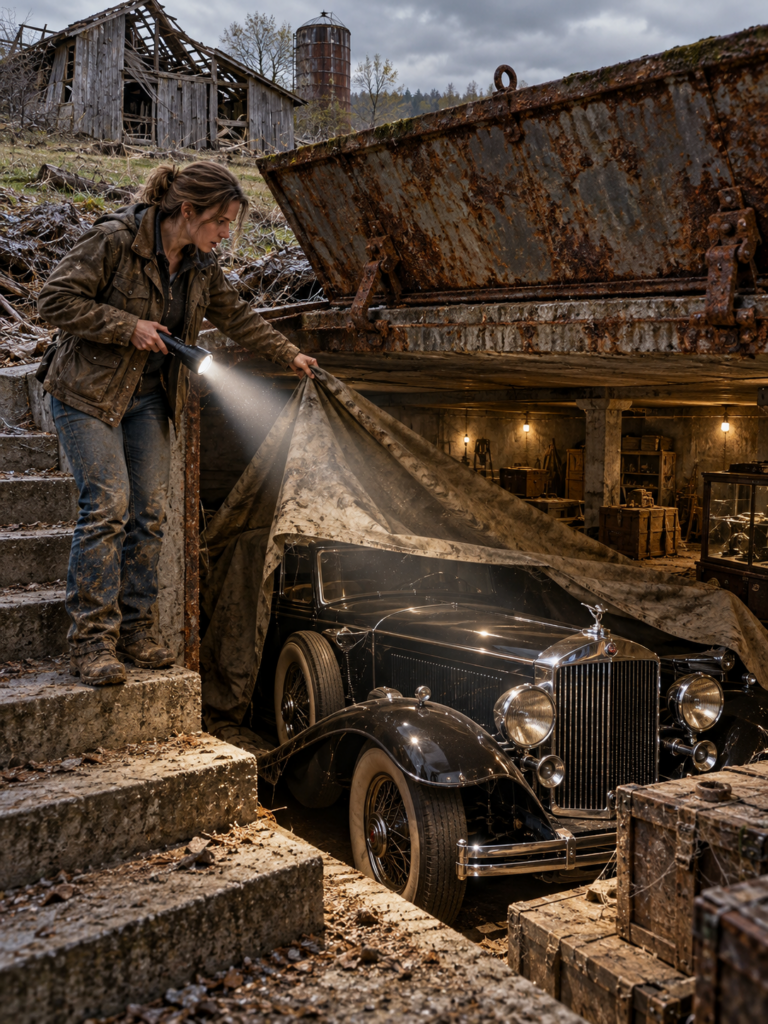
The canvas tore with a dry, rasping sound and slid from the enormous shape beneath it.
Maeve stumbled backward.
Her flashlight illuminated a long silver hood, huge wire-spoke wheels, gleaming metal fittings, and deep crimson leather seats.
It was a car.
Not an abandoned tractor.
Not a rusting piece of farm equipment.
An extraordinarily preserved antique automobile.
She moved the flashlight across the front, studying the distinctive radiator and elegant bodywork.
The vehicle appeared to be a Mercedes-Benz S-type from the late 1920s.
Maeve knew very little about collector cars, but she knew enough to understand that this one didn’t belong beneath a collapsing New York barn.
She touched a gloved finger to the fender.
Dust came away.
The metal beneath remained remarkably clean.
She examined the tires, leather, and exposed fittings.
The underground chamber had protected the vehicle from the weather far more effectively than the farmhouse had protected its owner.
Her flashlight moved toward the second canvas-covered shape.
She hesitated.
Perhaps the first car was simply something a wealthy former owner had hidden during difficult times.
That would explain one vehicle.
It would not explain three.
Maeve gripped the second tarp and dragged it down.
A towering black automobile emerged.
Its chrome radiator reflected her flashlight.
Its proportions were enormous, even beside the Mercedes.
She moved closer, reading the badges and examining the elegant, powerful body.
Duesenberg.
Model J.
She had seen photographs of such cars while browsing articles about rare automobiles.
Collectors treated surviving examples as extraordinary objects.
The possibility that she was standing beside an authentic one made her feel faint.
She circled it slowly.
There were no obvious signs of ordinary outdoor abandonment.
The underground environment had preserved both vehicles with astonishing care.
Then she noticed the third tarp.
Whatever was beneath it seemed lower and more aggressively shaped.
But Maeve didn’t touch it.
She needed to understand what she had already found before risking another assumption.
She turned toward the wooden crates.
There were dozens of them, stacked in orderly rows against the rear wall.
Their faded markings suggested bottled goods.
She worked her crowbar beneath the lid of the nearest crate.
The wood split with a brittle crack.
Inside were glass bottles packed in dry straw.
Maeve carefully lifted one.
The bottle held dark amber liquid.
Its old label carried the name Pappy Van Winkle and purported to identify whiskey from 1920.
She knew that valuable bottles of old whiskey could sell for remarkable sums.
But she also knew that an unfamiliar label, no matter how convincing, could not establish authenticity.
She returned it gently to the straw.
The crates extended far beyond the circle of her flashlight.
If their contents were genuine, the room held more than a remarkable collection of automobiles.
It held an entire cache of historical objects whose value she couldn’t estimate.
Maeve looked around.
Who had sealed this place?
Elias Reed, the wealthy original owner?
The Miller family, who acquired the farm in 1934?
Had the cars been hidden during the Depression?
Or had the chamber been used for decades afterward?
The records she had found offered no answer.
She raised her phone and photographed the vehicles, the storage arrangement, and the identifying details she could reach without moving the cars.
Then she replaced the bottle and cautiously set the damaged crate lid back in place.
For the first time since purchasing the farm, Maeve had discovered something that might solve her financial troubles.
But the feeling wasn’t simple happiness.
It was fear.
If the vehicles were genuine, their value could attract attention.
If the ownership history was complicated, people might challenge her right to sell them.
And if the chamber’s contents were fragile, one careless decision might destroy something irreplaceable.
She looked at the third covered vehicle again.
Her fingers tightened around the flashlight.
Then she made herself turn away.
She wasn’t ready to uncover it alone.
Maeve climbed the concrete staircase, secured the heavy entrance as best she could, and returned to the farmhouse.
That night, she barely slept.
At dawn, she drove into Grafton and bought stronger locks and two trail cameras from Dale.
Back at the farm, she secured the entrance and positioned the cameras where they could monitor the approach.
Then she opened her laptop.
She searched for specialists handling valuable historic automobiles.
One name caught her attention.
David Mercer.
A senior specialist at a New York auction firm experienced in major estate collections.
Maeve drafted a short message describing the Mercedes and Duesenberg.
She attached a photograph showing the Duesenberg’s engine bay and identifying number.
Then she pressed Send.
Four minutes later, her phone rang.
Maeve answered before the second ring had finished.
“Ms. Gallagher?”
The voice was precise, professional, and urgent.
“This is David Mercer. I received your photographs.”
Maeve gripped the phone.
“That was quick.”
“Where did you obtain the image of the Duesenberg?”
“I took it yesterday.”
There was a brief silence.
“Where?”
“On my property.”
“Your property?”
“An old farm in Grafton.”
Mercer lowered his voice.
“Ms. Gallagher, the identifying number in that photograph appears to correspond with a Duesenberg Model J that disappeared from a shipping record in 1934.”
Maeve stared through the kitchen window toward the barn.
She had been trying to establish when the underground chamber might have been used.
The year Mercer mentioned was the same year the Miller family acquired the farm.
“Are you certain?”
“I would need to inspect the vehicle and the records before making a definitive identification. But the correspondence is significant.”
“What happened to it?”
“The historical account I’ve seen suggests it was lost and later rumored destroyed in a warehouse fire. Collectors have searched for information about that specific chassis for decades.”
Maeve looked down at the photographs on her laptop.
The car beneath the farm was no longer just an expensive-looking antique.
It might be an automobile with a documented gap in its history.
And the gap coincided with a critical moment in the farm’s ownership.
“I found two cars,” she said.
“Two?”
“A Mercedes-Benz S-type and the Duesenberg. There’s a third vehicle I haven’t uncovered.”
Another pause.
“Anything else?”
“Wooden crates. A large number of bottles with old whiskey labels.”
“How many?”
“I haven’t counted them.”
Mercer exhaled slowly.
“Please don’t move anything else. Avoid handling the bottles or disturbing the vehicles. If you agree, I would like to examine the discovery personally.”
They arranged for him to visit the following morning.
After the call ended, Maeve sat motionless.
She had imagined that an appraiser might tell her the cars were worth a modest amount.
Perhaps enough to repair the roof, pay her debts, and keep the farm.
Now a specialist was rearranging his schedule because of one photograph.
She opened the property records again.
Elias Reed had established the farm in 1912.
He had made his fortune in shipping and later suffered financial losses.
The Miller family purchased the property in 1934.
The surviving records did not document the chamber.
But Mercer’s reference to a vehicle missing from a shipping record in that same year made the chronology impossible to ignore.
Had Reed owned the car?
Had he stored it beneath the farm before losing the property?
Had the Millers acquired the collection along with the land?
Maeve understood that a matching date was not proof.
Still, it gave her a question that could be investigated.
She photographed the relevant property documents so she could show Mercer.
Then she checked the trail cameras and the new locks.
Her nerves had been stretched thin by months of financial strain.
Now the possibility of a fortune had made her even more anxious.
She spent most of the night sitting near the window.
By morning, she was exhausted.
At 9:40, a black Range Rover turned into the driveway.
A gray-haired man in a charcoal suit stepped out carrying a metal briefcase.
He introduced himself as David Mercer.
His shoes sank into the mud almost immediately.
He seemed not to notice.
“May I see the entrance?”
Maeve led him behind the barn.
Mercer studied the exposed steel doors.
“How long were these buried?”
“I don’t know. The property was abandoned for years before I bought it.”
“Did the deed disclose anything like this?”
“No.”
She showed him the locks, then used the winch to raise the entrance door.
Mercer stood very still as the concrete staircase appeared.
“Extraordinary,” he murmured.
They descended carefully.
At the bottom, his flashlight settled on the uncovered Duesenberg.
He stopped walking.
For several seconds, he said nothing.
Then he removed his jacket and took a pair of white cotton gloves from his case.
Maeve watched him approach the car with an attentiveness she had rarely seen anyone give a machine.
He examined the identifying marks.
He studied the bodywork.
He compared details against material he had brought with him.
Finally, he looked at her.
“The number is consistent with the vehicle I told you about.”
“Then it’s the missing one?”
“It is strong preliminary evidence. We’ll need proper authentication and a fuller provenance review. But this deserves serious investigation.”
Maeve felt her knees weaken.
Mercer continued examining the automobile.
He noted the condition of the paint, chrome, interior, and mechanical components.
The storage environment had protected it from much of the damage associated with ordinary abandoned vehicles.
But he explained that a beautiful surface did not guarantee every component was original or mechanically sound.
That distinction mattered when collectors were paying extraordinary sums.
He moved to the Mercedes next.
Its elegant silver body and crimson leather drew another long look.
“This is a remarkable pair,” he said.
“How remarkable?”
Mercer considered his answer.
“Comparable vehicles can command many millions, depending on originality, provenance, condition, and the market. I wouldn’t responsibly give you a final figure without more research.”
Maeve nodded.
She appreciated the caution.
It sounded more trustworthy than an instant promise of riches.
Then his flashlight moved to the third canvas-covered shape.
“May I uncover that one?”
Maeve looked at the tarp.
She had left it untouched because the first two discoveries were already difficult to believe.
Now the specialist was asking permission.
“Yes.”
Mercer gripped the heavy fabric.
He pulled.
Dust rose into the flashlight beams.
The canvas slipped away.
Underneath stood a dark green racing automobile with an enormous front-mounted supercharger.
Its low stance contrasted with the long, stately bodies beside it.
Mercer inhaled sharply.
He stepped closer.
Then he walked around the vehicle, stopping repeatedly to examine the mechanical arrangements and distinctive body features.
“A Bentley,” he said.
“That much I guessed.”
“A supercharged racing model. Commonly called a Blower Bentley.”
He continued inspecting it.
The transcript of the car’s identity was written in its metalwork: the supercharger, the hood straps, the racing proportions, the period fittings.
Mercer was visibly affected.
“If its authenticity and configuration are confirmed, this could be a highly important example.”
Maeve stared at the green machine.
She had expected the third tarp to hide another antique car.
She had not expected Mercer to react as though it might be among the most significant objects he had ever seen.
He turned toward her.
“Do you understand what you’ve found?”
“Three old cars.”
“Three potentially exceptional historic automobiles preserved together in a sealed underground chamber. The context alone is remarkable.”
“What are they worth?”
He paused.
“Under favorable authentication and sale conditions, the collection could be worth tens of millions. But the final value must be established through specialist examinations and market evidence.”
Maeve leaned against the concrete wall.
For nearly a year she had been deciding which bill could wait until the next month.
Now she was trying to understand a sum so large that it scarcely felt like money.
But Mercer wasn’t finished.
“What are those crates?”
Maeve led him to the rear wall.
She showed him the bottle she had inspected.
Mercer studied the label and glass.
His expression shifted from excitement to intense concentration.
“Where did these come from?”
“I don’t know.”
“Have you checked how many there are?”
“Not precisely.”
He examined the bottle without opening it.
He studied the seal, label, fill level, and general condition.
Then he looked across the stacked crates.
“These require separate expert authentication,” he said. “Whiskey of this claimed age and origin can be extremely valuable, but labels can be misleading, and provenance is critical.”
Maeve was relieved to hear him say it.
The spectacular possibilities were becoming difficult to separate from wishful thinking.
She wanted facts.
Mercer replaced the bottle.
They spent the next hour discussing the discovery.
He explained that before any sale, Maeve would need a verified inventory, condition assessments, provenance research, insurance, security, and competent legal advice.
The cars might be valuable, but their ownership history could be complicated.
The whiskey introduced different authentication and regulatory questions.
And the discovery itself could attract unwanted attention if its location became public before the assets were secure.
Maeve listened closely.
Then she asked the question that frightened her most.
“Could someone take it away from me?”
Mercer didn’t pretend the answer was simple.
“Potential claims would have to be evaluated. Owning land does not automatically settle every ownership question involving movable objects discovered on it. That’s why the records matter.”
She showed him the tax auction documents.
He reviewed them briefly.
“We need counsel to examine the chain of title and the relevant estate history.”
Maeve folded her arms.
“I don’t have money for a legal battle.”
Mercer glanced at the Duesenberg.
“If these vehicles authenticate as strongly as I suspect, firms may be willing to structure arrangements around the eventual sale.”
“And what would your firm want?”
“Exclusive representation for the collection. Our standard commission would be twelve percent.”
Maeve had negotiated marketing contracts for years.
She knew the first number in a negotiation was not necessarily the final number.
“Ten percent,” she said. “And your firm advances the agreed legal expenses, with reimbursement from the proceeds.”
Mercer looked at her.
For the first time that morning, he smiled.
“You negotiate like someone who has done this before.”
“I used to do it for a living.”
They discussed the terms further.
The arrangement would require written contracts and proper review, but they reached a provisional understanding.
Security came next.
Mercer arranged for professional protection of the site while the collection was documented and plans were made for safe transport.
Maeve agreed.
For the first time in months, she felt she was not attempting to solve every problem alone.
But she also understood how much remained uncertain.
The cars were promising.
The whiskey might be valuable.
The farm’s recorded ownership history provided a starting point.
None of those things automatically proved she could sell everything.
And the matching year, 1934, continued to trouble her.
That evening, after Mercer left to begin arranging the next steps, Maeve spread the property records across her kitchen table.
She traced the sequence with one finger.
Elias Reed had owned the farm.
His financial difficulties deepened during the Great Depression.
In 1934, the Miller family acquired it.
The Duesenberg’s recorded disappearance also dated to 1934.
The coincidence suggested a possible explanation: the chamber’s contents might have been assembled or concealed before the property changed hands.
But it remained only a possibility.
Maeve looked toward the barn.
Beneath the frozen ground, three extraordinary machines had survived while successive owners came and went.
She had uncovered them because a thaw exposed two inches of rusted iron.
Now she needed to find out whether the history of the farm could explain how they had ended up there.
And whether she could prove that the discovery was legally hers.
The question of ownership became more urgent as Mercer’s team began documenting the underground collection.
Maeve had imagined that discovering the vehicles would be the difficult part.
She quickly learned that discovering something valuable and proving the right to dispose of it were entirely different problems.
The chamber could be photographed.
The vehicles could be authenticated.
The whiskey could be inventoried.
But the history of those objects had to be reconstructed from incomplete records.
That process began with the farm itself.
Elias Reed had acquired the land before establishing the property in 1912.
He had made his money in shipping, accumulated considerable wealth, and later suffered significant financial losses.
The historical record showed that the farm passed to the Miller family in 1934.
That much was reasonably clear.
What remained uncertain was precisely when the chamber had been constructed and how its contents had been handled during the transfer.
Maeve reviewed every document her advisers considered relevant.
She had spent years analyzing marketing information.
Now she applied the same discipline to deeds, inventories, shipping references, and historical ownership records.
The work was slower than she expected.
Sometimes a document answered one question while revealing a limitation in another.
The Duesenberg’s identifying number connected it to a missing shipping record, but the record alone did not establish every subsequent transaction.
The date was important.
It was not the whole story.
The fact that the cars had been concealed beneath the farm suggested intentional storage.
It did not, by itself, identify the person who sealed the entrance.
The Millers’ reputation for distrust of banks provided possible context.
It did not prove why they had kept the chamber hidden.
Maeve found herself returning to one realization.
The land had a history.
The chamber had a history.
And the objects inside had histories of their own.
Those histories overlapped, but they could not simply be treated as interchangeable.
Mercer’s specialists undertook detailed examinations.
The Duesenberg proved to be an extraordinary surviving example of the Model J, with documentation supporting its historic identity.
The Mercedes-Benz S-type was likewise confirmed as an exceptionally important vehicle.
The supercharged Bentley drew intense attention because of its rare configuration and remarkable preservation.
Each car required careful inspection before anyone would risk transporting it.
The tires, leather, mechanical systems, and structural components had spent decades under unusual storage conditions.
The dry chamber had protected the surfaces, but age still mattered.
Nothing was driven out under its own power.
The vehicles were prepared for controlled extraction by specialists.
Meanwhile, the crates were inventoried.
The bottles claimed to contain rare, historically significant whiskey.
Their labeling, packaging, and apparent age attracted substantial interest, but authentication remained essential.
The storage conditions had helped preserve the contents.
That did not mean every bottle could be accepted at face value.
Maeve approved the necessary examinations.
She wanted the eventual buyers to receive accurate information.
She also wanted to avoid discovering, after an auction, that an assumption had been presented as fact.
The same practical instinct had once guided her while repairing the house.
When a board looked solid, she tested it.
When a roof appeared sound, she inspected the underlying damage.
And when someone promised extraordinary value, she asked what evidence supported the claim.
As the inventory progressed, the legal work intensified.
Mercer’s advisers examined the chain of title and the circumstances surrounding the tax foreclosure.
The relevant records showed that Reed had transferred the property to the Millers in 1934.
The subsequent Miller ownership and eventual tax sale formed the documented path by which Maeve acquired the farm.
The advisers also examined how the underground structures and movable contents should be treated under the applicable law.
The distinction was essential.
A buried concrete chamber might be part of the real property, while valuable automobiles and bottles could raise separate questions about title.
Maeve was relieved that her legal team did not attempt to solve that complexity with a sweeping assumption.
They examined the actual documents.
They gathered the evidence.
And they prepared to defend her interests if claims emerged.
Mercer had warned that a discovery of this magnitude might attract litigation.
He was right.
Once preparations for moving the collection became visible, rumors began spreading through Grafton.
At first, people noticed unfamiliar vehicles traveling to the Miller farm.
Then private security personnel appeared.
The massive steel doors behind the barn were no longer entirely hidden.
People who drove along the county road started slowing down.
Someone claimed Maeve had discovered gold.
Someone else suggested the authorities were investigating something buried on the property.
Neither rumor reflected what the experts were actually doing.
But speculation traveled much faster than verified information.
Maeve’s first concern was security.
Her second was privacy.
She had moved to Grafton partly because she wanted distance from a life where everyone seemed to have an opinion about her failures.
Now the farm had become the center of attention.
Dale noticed the changes.
When Maeve came into the hardware store for supplies, he looked at her carefully.
“Got quite a bit of activity out your way.”
“There’s work being done.”
“So I heard.”
He did not ask what had been found.
Maeve appreciated that.
For nearly a year, Dale had treated her as a customer who needed tools, not as an outsider whose decisions required commentary.
When she needed advice about repairs, he answered her questions.
When she came in covered with mud, he sold her what she needed and let her get back to work.
She remembered those ordinary kindnesses.
They mattered more now that other people were beginning to show interest.
By the time the extraction operation was scheduled, Maeve had owned the farm for approximately one year.
The morning began with the sound of heavy trucks.
Four enclosed transport vehicles turned down the county road toward the property.
Professional crews arrived with specialized equipment for moving the collection safely.
State police assisted with traffic control as curious residents gathered near the road.
Dale stood beside his pickup, holding a cup of coffee.
Maeve watched from her porch.
The farmhouse was still weathered.
The driveway was still scarred by deep ruts.
And the barn remained a deteriorating shell behind the house.
Nothing about the setting suggested that extraordinary historic automobiles were about to emerge from underground.
The extraction team secured the chamber entrance.
The first car prepared for removal was the Duesenberg.
The crew worked slowly.
Protective equipment was positioned.
The heavy automobile was attached to the specialized recovery system.
Then the winch began pulling.
For several moments, the vehicle remained belowground.
Maeve held her breath.
She remembered her first glimpse of its black body beneath the flashlight.
Now daylight struck its chrome radiator.
The Duesenberg gradually rose from the chamber.
A murmur moved through the people watching beyond the controlled perimeter.
The automobile looked impossibly elegant against the muddy farmyard.
Its massive proportions, sweeping bodywork, and polished fittings belonged to another era.
When it reached the surface, the crew guided it carefully toward its enclosed transporter.
No one cheered.
The sight commanded a quieter reaction.
People simply watched.
Next came the Mercedes.
Its silver body gleamed beneath the pale sunlight.
The red interior was visible through the open cabin.
Maeve watched a vehicle that had been underground for decades move slowly across land where she had spent the previous winter shoveling snow.
Then came the Bentley.
The dark green machine looked powerful even while being moved at walking speed.
Its prominent supercharger gave it an appearance unlike the others.
Maeve remembered Mercer drawing back its tarp.
The sound of his surprised breath.
The way he had stopped thinking about fees and contracts for a moment because the machine itself demanded his attention.
Now all three vehicles were finally aboveground.
Their history would continue elsewhere.
The crates took longer.
Specialists moved them in controlled loads, taking care to preserve packaging, records, and fragile contents.
The complete removal operation continued over several days.
When the last transporter finally departed, the farm seemed suddenly empty.
Maeve walked behind the barn.
The steel doors were still there.
Below them lay a chamber that no longer contained the objects that had transformed her life.
She stared into the opening for a long time.
Finding the collection had been terrifying.
Losing sight of it was somehow worse.
The assets were now in professional custody, documented and protected.
But they were also physically separated from the land she owned.
Maeve understood the necessity.
Still, watching the trucks disappear had made the discovery feel less like a miracle and more like a responsibility.
The legal challenges followed.
The state raised claims based on its interpretation of the property’s history and applicable preservation and abandoned-property provisions.
Two families claiming descent from Elias Reed also asserted interests in the chamber’s contents.
Maeve had expected something like this after Mercer’s warning.
Even so, seeing formal claims connected to the most valuable discovery of her life made her stomach tighten.
Her legal team responded with documentation.
They established the sequence of property transfers.
They examined Reed’s 1934 conveyance to the Millers.
They reviewed the foreclosure and subsequent sale.
And they addressed the distinction between the underground structure and the collection of movable assets.
The claims of the purported Reed heirs required particular attention.
A family relationship with a previous owner was not sufficient, by itself, to prove continued ownership of every object once associated with his property.
The historical conveyance and later transactions mattered.
After extensive proceedings, the competing claims failed.
Maeve’s position was upheld.
The collection could move toward sale with the ownership issues resolved.
When her attorneys called with the news, Maeve sat at her kitchen table.
She had imagined she might scream.
Instead, she thanked them.
Then she closed her eyes.
For nearly two years, her life had been defined by one frightening uncertainty after another.
Would the farmhouse survive winter?
Could she afford heating oil?
Would the barn collapse?
What was beneath the doors?
Were the cars authentic?
Could someone else claim them?
Now, at last, she had answers.
The doors concealed a reinforced storage chamber.
The chamber had preserved three extraordinary historic automobiles and a substantial collection of rare whiskey.
The ownership chain had survived serious scrutiny.
And Maeve could finally make decisions about the collection’s future.
The eventual auction was held in Monterey, California.
Maeve chose not to attend.
She watched the livestream from her farmhouse kitchen.
A heater warmed the room.
Outside, the fields were quiet.
On her laptop, the Duesenberg appeared beneath bright auction-house lighting.
The bidding opened at ten million dollars.
Maeve stared at the screen.
When she had first bought the farm, ten million dollars had been a number belonging to other people’s lives.
Now collectors were competing to own something she had discovered behind her barn.
The bids climbed.
Eleven million.
Thirteen.
Sixteen.
Twenty.
The auctioneer continued.
Maeve barely breathed.
Finally, the hammer fell.
Twenty-four million dollars.
She sat absolutely still.
The Duesenberg alone had sold for more than she could have earned across many lifetimes at her former salary.
Then came the Mercedes.
Collectors competed for the beautifully preserved 1928 S-type.
The final price reached eighteen million dollars.
Maeve pressed one hand against the table.
The Bentley followed.
Its rarity and provenance attracted fierce international bidding.
The hammer fell at twenty-two million dollars.
The three automobiles had generated sixty-four million dollars in gross auction results.
Maeve felt almost detached from the numbers.
They were too large to connect with ordinary experiences.
She remembered buying inexpensive coffee at the Grafton diner because she couldn’t justify spending money on a full breakfast.
She remembered wearing two sweaters inside the farmhouse.
She remembered standing at the mailbox holding bills she couldn’t pay.
Now sixty-four million dollars had passed across an auction room in the course of one extraordinary sale.
The whiskey collection was handled through additional private sales.
After the necessary authentication and arrangements, those transactions produced approximately fourteen million dollars more.
The gross proceeds were staggering.
But Maeve had learned not to confuse headline prices with money she could actually use.
There were commissions.
Legal costs.
Transportation and security expenses.
Taxes.
Professional fees.
Other obligations arising from the collection and its sale.
She reviewed the accounting carefully.
When the remaining proceeds were finally transferred, the amount available to her was approximately forty-two million dollars.
Maeve opened her banking app.
The balance appeared.
She stared.
Then the screen dimmed and went black.
Her reflection replaced the numbers.
She saw a woman with tired eyes, weathered hands, and hair loosely tied back from her face.
The woman looked nothing like the glamorous people bidding at the auction.
She looked like the same person who had arrived at the Miller farm with a sleeping bag, a few tools, and no idea what she was doing.
For a long time, Maeve simply sat there.
She did not call her sister to announce the money.
She did not book a vacation.
She did not browse luxury houses.
The first thing she wanted was a roof that did not leak.
She hired local contractors to replace the failing roof and repair the farmhouse’s foundation.
The old plumbing was replaced.
The heating system was modernized.
The rooms were restored without erasing the building’s age and character.
For the first time since purchasing the property, Maeve could sleep through a storm without worrying about water entering the ceiling.
She also began restoring the land.
The seventy acres had been neglected for years.
Blackberry brambles had swallowed fields.
Fences had collapsed.
The barn was beyond sensible repair.
Maeve asked Dale whether he would be interested in helping oversee the property work.
He considered the proposal.
Then he asked practical questions about the responsibilities, hours, and pay.
Maeve offered him a strong wage.
He accepted.
Dale arrived early, just as he always had.
He helped coordinate clearing the overgrowth, repairing fences, and returning usable land to agricultural production.
Winter wheat eventually grew where thorny vines had stood.
The collapsing barn was replaced with a sound modern structure.
The farmhouse regained its place at the center of a working property.
Maeve watched the changes with quiet satisfaction.
This was the kind of progress she understood.
Not a number rising on a screen.
Not strangers raising bidding paddles.
Something damaged becoming useful again.
The underground chamber remained.
Its purpose had ended, but its existence was part of the farm’s history.
After the collection was removed and the site assessed, Maeve arranged to have the old steel entrance permanently sealed beneath concrete.
The chamber would remain empty.
She had no desire to preserve it as a tourist attraction.
She had already experienced enough curiosity from strangers.
She wanted the farm to become a home.
Two years after her arrival, Maeve stood on her repaired wraparound porch one cold November evening.
The air carried the unmistakable promise of snow.
Beyond the house, the fields stretched toward the tree line.
The new barn stood straight and secure.
The farmhouse was warm behind her.
She held a cup of tea.
For the first time in years, she did not feel that she was preparing to survive another disaster.
She remembered the day she had first driven up the cratered driveway.
How the house had leaned.
How the silence had frightened her.
How she had been ashamed to admit that she might have made another terrible mistake.
She remembered the winter, the bills, the cold, and the loneliness.
And she remembered falling into the mud behind the barn.
That accident had exposed two inches of iron.
Two inches.
Without the thaw, the protruding metal might have remained hidden.
Without her decision to inspect the barn, she might never have noticed it.
Without the stubbornness that had kept her working through the winter, she might have sold the farm and left before February.
Those facts astonished her more than the auction prices.
Her discovery had depended on an ordinary chain of decisions, weather, physical effort, and chance.
There had been no mysterious benefactor guiding her.
No secret letter promising a fortune.
No family member deliberately leaving her a test.
The hidden chamber was part of a complicated property history.
Its contents had been preserved through decades of silence.
Maeve had found them because she happened to own the farm when the ground finally revealed an entrance.
She could acknowledge the luck without minimizing the work that followed.
She had made the phone call.
Protected the site.
Demanded professional authentication.
Negotiated representation.
Insisted on clear legal advice.
And refused to spend money she did not yet securely own.
The discovery had changed her finances.
The investigation had changed her confidence.
She no longer felt the same urge to justify buying the farm.
The town had once wondered how quickly she would fail.
Now people drove past the restored property and spoke about the extraordinary collection that had been buried behind its barn.
Maeve knew the story would follow her for years.
But she no longer needed everyone to understand her reasons for staying.
She had made a home.
That mattered more.
The wind moved across the fields.
She could smell cold earth and damp leaves.
Inside, the heating system clicked on.
Maeve looked toward the hillside where the old doors had been sealed.
Once, the chamber had protected automobiles and bottles whose owners were long gone.
For decades, its greatest value had been hidden under mud and roots.
Now the chamber was empty.
And the land above it was alive again.
Maeve took another sip of tea.
She thought about Chicago.
About the marriage that had ended.
About the job that had disappeared.
About the version of herself who had believed losing those things meant losing everything.
She wished she could tell that woman how much life remained.
Not because a buried collection would make her rich.
Because she would endure long enough to discover that failure was not a permanent identity.
Maeve turned toward the warm light spilling from her front door.
She had purchased a ruined farm because she wanted somewhere to begin again.
She had found a fortune beneath it.
But what she chose to build aboveground was the part of the story she intended to keep.


