
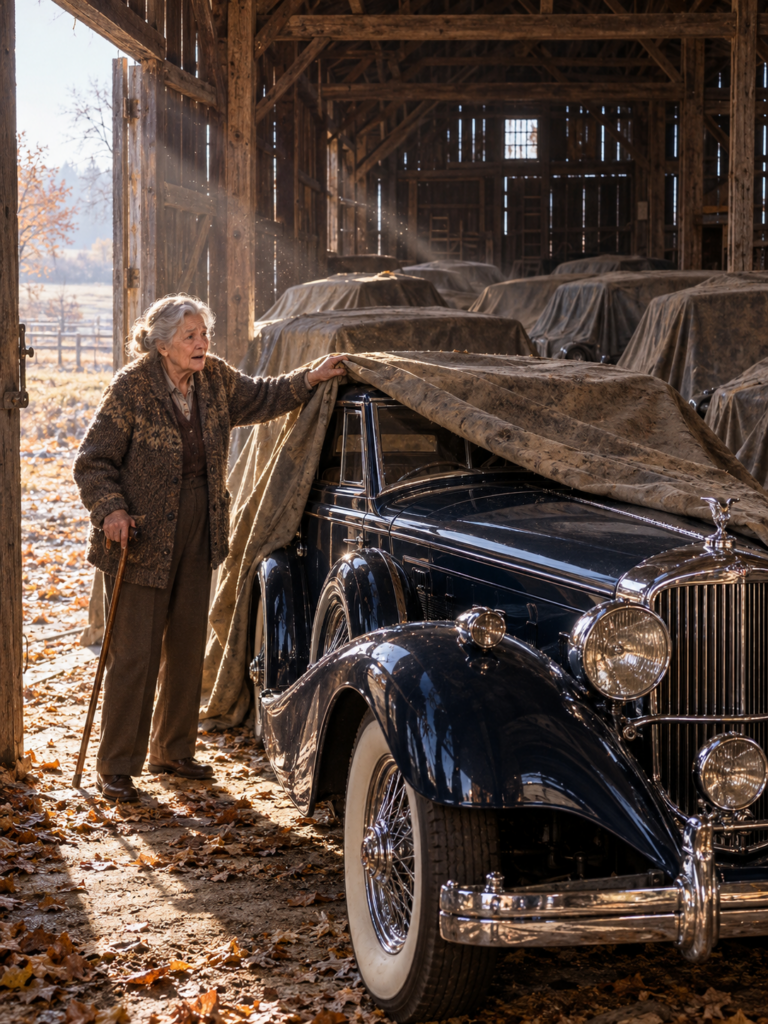
The second canvas covering slid backward, exposing the sweeping hood of a cream-colored roadster.
Edith stopped.
The vehicle had an immense front end, gleaming exhaust pipes, and a level of craftsmanship she had never seen outside old photographs.
She lifted the lantern higher.
Behind the windshield, the upholstery appeared carefully preserved.
Even the dashboard fittings gleamed.
This was not a forgotten automobile slowly decaying in a barn.
Someone had maintained it.
Edith looked toward the first car.
Then toward the five remaining shapes.
Arthur had lived in a farmhouse with failing windows and no reliable comforts, yet the machines inside his barn were protected with almost obsessive care.
She went to the third covering.
A jet-black coupe appeared beneath the dust.
Then a dark maroon convertible.
Each unveiling made the situation harder to understand.
Seven cars.
All extraordinary.
All stored in deliberate rows.
Edith’s hands began to tremble, and not entirely from the cold.
Her brother had always been difficult.
Proud.
Secretive.
Stubborn enough to lose contact with the people who loved him rather than admit he might have been wrong.
But she had never imagined this.
He had allowed his property to deteriorate while guarding a remarkable private collection.
Why?
And how had he paid for it?
Edith moved toward the back of the barn.
A partition made of corrugated metal separated the vehicles from a workshop.
Beyond it stood a broad wooden bench.
Tools hung in precise order.
Wrenches.
Measuring instruments.
Polishing cloths.
Containers of mechanical supplies.
Nothing looked carelessly abandoned.
At the center rested a thick leather-bound ledger.
Edith recognized Arthur’s handwriting as soon as she opened it.
Small.
Angular.
Closely spaced.
The first dated entries reached back decades.
One recorded a Duesenberg Model J acquired from a bankrupt Connecticut estate in 1974.
The engine had been damaged.
Arthur had paid $4,000.
Another entry described the search for an original supercharger for a Mercedes 540K.
The replacement component had come from Munich.
The purchase had exhausted money Arthur received from selling a lumber mill interest.
Edith slowly turned the pages.
Dates.
Parts.
Repair costs.
Transport arrangements.
Acquisitions.
Decades of painstaking work.
She had assumed Arthur spent his final years alone because he had nothing.
The ledger suggested a different story.
He had chosen to direct his resources toward restoring and preserving these cars.
It did not mean he had been happy.
It did not explain his estrangement from her.
But it explained why the barn had been secured and why its interior was better maintained than the house.
This building contained his life’s work.
Edith traced one handwritten entry with her finger.
Forty years.
Nearly half a century of collecting, repairing, and protecting machinery other people might never see.
Then she noticed a business card taped inside the ledger’s front cover.
Walter Graham.
Restorations and appraisals.
A telephone number had been written on the reverse side.
Edith carefully removed the card.
Arthur had known someone who understood these automobiles.
Perhaps Walter could tell her what she was looking at.
She stared through the workshop opening toward the midnight-blue car.
Its chrome caught a narrow strip of daylight from the barn doors.
For the first time since signing the inheritance papers, she allowed herself to consider that the farm might be worth far more than its assessed value suggested.
Then she remembered Harrison’s warning.
Twelve thousand dollars in back taxes.
The county might sell the property by winter.
If these automobiles were valuable, their ownership and condition would need to be established before she could safely use them to resolve the debt.
She had no expertise.
No working electricity.
Her phone battery was dead.
And the nearest town was three miles away.
Edith folded the business card and slipped it into her cardigan pocket.
She closed the ledger.
Her hands hurt, but she was suddenly too determined to care.
She covered the vehicles again as carefully as she could, secured the barn doors as well as the damaged chain allowed, and returned to the farmhouse.
There she placed the card beside her medication and prepared for the long walk into Oak Haven.
The next morning, as pale daylight spread over the fields, Edith took her cane, opened the farmhouse door, and stepped onto the gravel road.
She was going to call the one man whose name Arthur had left behind.
Edith’s cane struck the gravel in a slow, uneven rhythm.
The farmhouse disappeared behind her as she made her way toward Oak Haven.
Three miles.
Under ordinary circumstances, that distance would have been inconvenient.
With an injured hip, swollen joints, and a cold wind coming off the fields, it felt enormous.
But the business card in her cardigan pocket gave her a reason to keep moving.
Walter Graham.
Restorations and appraisals.
Arthur had preserved his name inside the ledger.
That could not be accidental.
Edith needed to find out what Walter knew.
The road wound past neglected fields, bare trees, and abandoned outbuildings.
She stopped repeatedly, leaning on her cane until the pain in her hip eased enough to continue.
Her thoughts returned to the seven vehicles.
She had never been especially interested in cars.
Her late husband had once owned an aging family sedan that seemed to require repairs every month, and that had been the extent of her mechanical education.
But even she recognized that the automobiles in Arthur’s barn were unusual.
The ledger suggested rare models.
Some had been acquired with damaged components.
Others had required years of work.
What she could not determine was whether their market value justified the expense.
People sometimes spent fortunes on hobbies and recovered very little.
Arthur could have been one of them.
At last, Oak Haven came into view.
The town was smaller than she remembered.
A boarded hardware store faced an empty gas station.
Several storefronts had faded signs.
Near the center of town, a diner still had its lights on.
Edith went inside.
Warm air touched her face.
The smell of coffee and fried potatoes nearly made her weak with relief.
She ordered black coffee and asked whether she could use the payphone.
The woman behind the counter pointed toward the hallway beside the restrooms.
Edith searched her purse for quarters.
Then she unfolded the business card.
The phone rang several times.
A gruff male voice finally answered.
“Graham.”
“Mr. Graham? My name is Edith Harper.”
A pause.
“I’m Arthur Pendleton’s sister.”
The silence deepened.
Then the man asked, “Arthur’s dead, isn’t he?”
Edith closed her eyes briefly.
“Three weeks ago.”
“I’m sorry.”
“He left me the farm.”
Another pause.
Edith tightened her grip on the receiver.
“I opened the barn.”
For the first time, Walter’s voice changed completely.
“You opened it?”
“Yes.”
“Are the cars still there?”
“There are seven.”
Edith could hear him breathing.
“The Duesenberg?”
“I don’t know which one that is.”
“The Bugatti?”
“I can tell you what they look like.”
“No,” Walter said. “Don’t move anything else. I’m coming.”
Edith straightened.
“I need somebody who understands what he kept there. And I’d prefer somebody who doesn’t announce it to the whole county.”
Walter asked for the address.
He said he would be there that afternoon.
Edith returned to her coffee.
For the first time since arriving in Oak Haven, she felt that she had made a practical decision.
She had found a person who knew Arthur and the collection.
Now she needed to determine whether she could trust him.
Walter arrived in an old flatbed truck approximately two hours later.
He was a wiry man in his late sixties, dressed in oil-stained coveralls and a faded baseball cap.
When Edith met him outside the farmhouse, he looked toward the barn before asking about her journey.
She noticed.
“You knew what was in there.”
Walter nodded.
“Some of it.”
“Arthur never mentioned the collection to me.”
“He didn’t mention much to anybody.”
They crossed the overgrown yard together.
Walter slowed his pace to match hers.
At the barn doors, Edith explained how she had cut through the chain.
Walter studied the damaged lock.
“Arthur wouldn’t have liked that.”
“Arthur isn’t here to open it for me.”
Walter accepted the answer without argument.
They entered.
The daylight streaming through the partially opened doors revealed the collection more clearly than Edith’s lantern had.
The midnight-blue car seemed even more impressive.
Its paint reflected the pale barn light.
Walter removed his cap.
He stood still for several moments.
Then he walked toward the jet-black coupe.
“Good Lord,” he whispered.
He looked around the vehicle, careful not to touch the paint.
“A Bugatti Type 57S.”
Edith watched him.
“Arthur said he sold it in 1989,” Walter continued. “Told me he needed money to settle things with the bank.”
“He didn’t sell it.”
“No.”
Walter knelt to examine a detail near the chassis.
“He kept it.”
Edith looked across the barn.
“What is it worth?”
Walter did not answer immediately.
He checked the vehicle’s condition, asked about the ledger, and explained that important identification numbers would need to match the documentation.
“If everything checks out, this one alone could bring ten million dollars. Maybe twelve.”
Edith stared at him.
She thought she had misheard.
“Million?”
Walter stood.
“Yes.”
He pointed toward the cream-colored roadster.
“That’s a Mercedes-Benz 540K. Depending on its originality and provenance, that could be worth several million more.”
Then he identified the Duesenberg.
An Alfa Romeo.
Other prewar collector automobiles.
Names Edith had heard only in passing.
Walter moved slowly from one to the next, growing quieter as he assessed the collection.
Finally, he turned to her.
“Edith, your brother didn’t leave you a barn full of old cars.”
“What did he leave me?”
“A collection that could be worth forty million dollars.”
She gripped her cane.
The figure made no sense.
She had accepted the farm knowing she owed twelve thousand dollars in back taxes.
She had slept in the cold because the farmhouse had no electricity.
She had eaten half a granola bar for breakfast because she was uncertain how long her money would last.
And now Walter was standing in front of her, calmly talking about forty million dollars.
“Are you certain?”
“Not without full appraisals and documentation. But I’ve worked with rare automobiles most of my life. I know what I’m looking at.”
He looked toward the workbench.
“Arthur kept records?”
Edith led him to the ledger.
Walter turned through several pages.
His expression softened.
“Of course he did.”
He recognized records of purchases, repairs, and parts he remembered helping Arthur obtain.
Some entries corresponded to work performed decades earlier.
The documents would need verification, but they supplied something crucial.
A traceable history.
In the collector-car world, Walter explained, rarity alone was not enough.
Buyers needed confidence that a vehicle was authentic.
Originality mattered.
Condition mattered.
An unbroken ownership record could make an extraordinary difference.
Arthur’s ledger might be almost as important as the cars themselves.
Edith sat on the workshop stool.
“He lived like he was broke.”
Walter closed the ledger.
“He put everything into them.”
“Why?”
Walter leaned against the workbench.
“He loved the machines. He liked bringing something back that everyone else had given up on.”
Edith looked out across the vehicles.
The answer unsettled her.
Arthur had been stubborn enough to preserve seven magnificent automobiles while allowing his own house to fall apart.
He had devoted years to restoring things that could not love him back.
Yet the care was visible everywhere.
Every polished surface.
Every repaired engine.
Every carefully maintained tool.
For the first time, Edith understood that her brother’s life had not been empty in the way she had assumed.
It had been full of something he had never learned to share with her.
Walter asked about the tax situation.
Edith explained everything.
The twelve thousand dollars.
The threatened county sale.
Her children.
The assisted living facility.
Walter listened without interrupting.
When she finished, he looked toward the vehicles.
“We need to protect the property and get proper appraisals before anybody tries to claim something they shouldn’t.”
“How?”
“I know a broker who works with major collector-car auctions. They can arrange transport, valuation, and a sale.”
Edith’s response was immediate.
“Call him.”
Walter looked surprised.
“You don’t want time to think?”
“I’ve thought about it enough to know I can’t pay twelve thousand dollars with an old farmhouse.”
He nodded.
Then he warned her that the process would require legal and financial documentation.
An auction estimate was not cash.
The estate records would have to be reviewed.
Ownership of the vehicles needed to be established.
Transport and insurance would be costly.
And the sale itself would take time.
Edith appreciated the explanation.
She had already allowed her children to turn complex financial decisions into conversations from which she was excluded.
She would not make that mistake again.
“Then we’ll do it properly.”
Over the following days, Walter helped arrange contact with the auction specialists.
Documentation was reviewed.
The cars were inspected.
The ledger provided records that supported their provenance.
A financing arrangement through the auction house made it possible to pay the overdue property taxes while preparations for the vehicles’ sale continued.
The county debt was cleared.
For the first time since Harrison’s visit, Edith was no longer facing the immediate loss of the farm.
Additional legal arrangements were made to protect her interests while the collection was prepared for sale.
The professional appraisal came in at approximately forty-two million dollars.
Edith read the figure several times.
Forty-two million.
The auction company would charge substantial fees.
Taxes and other costs would still need to be considered.
But even allowing for those expenses, the collection represented wealth far beyond what she had imagined.
She sat at the kitchen table with Walter and reviewed the documents carefully.
Every page.
Every signature.
Every condition.
She refused to sign anything she did not understand.
Walter seemed almost amused by her determination.
“You ask more questions than Arthur ever did.”
“Arthur knew the cars,” she replied. “I need to know the paperwork.”
By the fourth morning, enormous enclosed transport trucks approached along the gravel driveway.
Their engines filled the quiet farmyard.
Workers wearing gloves and protective clothing began moving the cars onto specialized equipment.
Edith watched from the porch, wrapped in a blanket with a cup of hot tea.
The barn doors stood wide open.
For the first time in decades, Arthur’s collection was leaving its hiding place.
Edith had imagined she might feel guilty.
Instead, she felt strangely at peace.
The cars would be preserved and appreciated.
The farm would no longer be lost to unpaid taxes.
And Arthur’s life’s work would finally be recognized.
Then she heard another engine.
A sleek black Range Rover appeared between the transport trucks.
It turned sharply into the yard.
The driver parked on the grass.
Edith recognized the vehicle before either door opened.
Richard stepped out.
Sarah followed.
Both stared toward the barn.
Then Richard saw the rare black coupe being prepared for loading.
He turned toward his mother with an expression Edith had never seen before.
Not concern.
Not affection.
Alarm.
“What the hell is going on here?” he demanded.
Edith set down her cup.
She knew exactly why they had come.
Edith watched Richard cross the muddy yard toward the porch.
His expensive shoes sank into the wet ground.
Sarah followed more carefully, lifting the hem of her coat as she tried to avoid the mud.
Behind them, workers continued preparing the rare automobiles for transport.
The movement seemed to offend Richard.
He pointed toward the barn.
“Who authorized this?”
“I did,” Edith answered.
He stopped.
“What?”
“They’re my cars, Richard.”
Sarah looked from her mother to the enormous enclosed trucks.
“What cars?”
Edith nodded toward the barn.
“Arthur’s collection.”
Richard glanced at the midnight-blue automobile being secured for transport.
“That’s ridiculous. Arthur didn’t have any money.”
“He had something he valued more than living comfortably.”
Sarah climbed onto the first porch step.
“Mom, Harrison told us about the taxes. He said they were paid by an auction company. Nobody explained any of this.”
Edith took another sip of tea.
“You didn’t ask me.”
Richard’s face tightened.
“We didn’t know there was anything to ask.”
Edith looked at him for a long moment.
She remembered the visitor’s lounge at Shady Pines.
The lemon disinfectant.
The institutional furniture.
The way Richard had kept checking his phone while Sarah explained why selling their mother’s house was necessary.
She remembered the certainty in his voice when he rejected Arthur’s inheritance.
Twelve thousand dollars in debt.
Not worth the trouble.
Now the same son stood on the porch of the supposedly worthless property, desperate to understand what it contained.
“The appraised collection is valued at approximately forty-two million dollars,” Edith said.
Richard went completely still.
Sarah’s mouth fell open.
For a moment, neither spoke.
The wind moved through the dead grass.
A truck engine idled nearby.
Then Richard asked, very quietly, “How much?”
“Forty-two million.”
He blinked.
Sarah took the railing in one hand.
Edith watched their expressions change.
First disbelief.
Then calculation.
Then something resembling panic.
“That’s incredible,” Sarah said at last.
Her voice had suddenly become warm.
Almost breathless.
“Mom, that’s wonderful. Why didn’t you call us?”
Edith remained silent.
“We could have helped you,” Sarah continued. “You shouldn’t be dealing with something this complicated by yourself.”
Richard nodded quickly.
“Exactly. There are taxes, contracts, insurance issues. This is way beyond what you should be handling alone.”
Edith looked toward Walter, who stood near the barn speaking with one of the transport supervisors.
He had helped her find qualified professionals.
He had explained the process.
He had allowed her to make her own decisions.
Her children, meanwhile, had arrived after the important work was done.
“Professionals are handling those matters,” Edith replied.
Richard frowned.
“What professionals?”
“People who know the difference between an appraisal and a bank balance.”
He stepped closer.
“Mother, don’t be difficult.”
There it was.
The same tone.
The same assumption that she was an obstacle to be managed.
Edith placed her teacup on the porch railing.
“I’m not being difficult, Richard. I’m answering your questions.”
Sarah smiled too brightly.
“We’re just worried about you.”
“Were you worried when I left Shady Pines?”
Sarah hesitated.
“Of course.”
“You didn’t come to say goodbye.”
“We had obligations.”
“I understand.”
Edith’s voice remained calm.
“You had obligations.”
Richard glanced toward the workers.
“Look, we need to put a stop to this until we know what’s going on.”
“No.”
“You can’t just sell a forty-million-dollar collection without family oversight.”
“I’ve already arranged the appraisal, transport, and legal representation.”
He looked genuinely offended.
“You didn’t consult us?”
“You didn’t consult me when you decided I should leave my home.”
“That was different.”
“Was it?”
Sarah stepped between them.
“Mom, nobody wanted to hurt you.”
Edith studied her daughter.
Sarah’s coat was expensive.
Her boots were already stained with mud.
There had been a time when Edith would have rushed to help her clean them.
She remembered Sarah as a little girl, crying because she had ruined her favorite shoes jumping in puddles.
Edith had sat beside her at the kitchen table and patiently brushed away the dirt.
For a brief moment, that memory hurt more than anything Richard had said.
Then Sarah continued.
“You know how stressful everything was. The house, the care arrangements, the bills. We did what we thought was best.”
Edith thought about her former home.
The four bedrooms.
The staircase.
The garden she had planted years earlier.
The place where she had watched her children grow.
She knew her hip had made the stairs difficult.
She knew the house had become harder to maintain.
Those were real problems.
But the decision to sell it had not been made with the respect she deserved.
Her children had controlled the conversation and the proceeds while insisting she could no longer manage her own life.
And when she chose to accept Arthur’s farm, they threatened to abandon her.
That had been real too.
“You told me I was on my own,” Edith said.
Richard folded his arms.
“You chose to come here.”
“Yes.”
“Against our advice.”
“Yes.”
“And now you expect us to stand aside while strangers take advantage of you?”
Edith’s expression hardened.
“The only people who have tried to make decisions for me without asking are standing on this porch.”
Richard stepped toward her.
“That’s unfair.”
“No,” Edith said. “It is accurate.”
He took out his phone.
“I’m calling Harrison.”
“You’re welcome to speak with him.”
“We need to discuss power of attorney.”
Edith felt the old familiar anger rise.
Not because Richard was shouting.
Because he was using the same argument he had used in the assisted living lounge.
Her age.
Her hip.
Her need for assistance.
As though requiring help with certain tasks meant she had surrendered the right to choose.
“I’ve already had my decision-making capacity evaluated,” she said.
Richard stared.
“What?”
“A physician examined me. The legal arrangements were reviewed. I understand what I own and what I’m doing.”
Sarah’s expression shifted.
“Why would you do that?”
“Because I knew someone might try to say I couldn’t make decisions for myself.”
Richard’s mouth tightened.
“You’re accusing us?”
“I’m preparing for the situation in front of me.”
She took a folded document from her cardigan pocket.
It summarized the arrangements she had reviewed with her legal advisers.
The collection was being transferred through the agreed professional sale process, with Edith’s ownership interests protected under the relevant trust structure.
Her estate planning had also been updated.
Richard reached for the paper.
Edith held it back.
“You can have copies through my attorney.”
“Your attorney?”
“Yes.”
“When did you get an attorney?”
“When I realized I needed someone who worked for me.”
Sarah looked stricken.
“Mom, we’re your family.”
Edith nodded slowly.
“I know exactly who you are.”
The words settled between them.
She was not saying she had stopped loving them.
That would have been a lie.
She had spent most of her life loving them.
She had held them through fevers.
Paid for lessons.
Stayed awake when they were sick.
Worried when they were late.
Celebrated their victories.
Forgiven their mistakes.
Those memories had not disappeared because they had treated her badly.
But love did not require pretending that betrayal had been care.
And motherhood did not obligate her to surrender every boundary.
“I’ve changed my will,” Edith said.
Sarah looked toward Richard.
“What does that mean?”
“It means my estate will be distributed according to my own decisions. Neither of you will inherit from this collection.”
Richard’s face reddened.
“You can’t be serious.”
“I am.”
“You’d punish your own children?”
Edith considered the question.
For months, she had imagined how satisfying it would be to see Richard and Sarah forced to recognize what they had done.
She had pictured speeches.
Apologies.
Perhaps even their humiliation.
But standing before them now, she found that revenge seemed exhausting.
She was tired of organizing her life around their approval.
“This isn’t a punishment,” she said. “It’s a decision about what I will do with property that belongs to me.”
Richard laughed bitterly.
“After everything we’ve done for you?”
Edith looked out across the fields.
She could have listed what she had done for him.
The years.
The money.
The sacrifices.
The countless ordinary acts of care that never appeared on a ledger.
But she knew he would only turn those memories into another argument.
“Richard, you told me not to expect help when I came here.”
“I was trying to make you see reason.”
“I saw it clearly.”
Sarah began to cry.
Edith could not know precisely what those tears meant.
Regret, fear, disappointment, or some painful mixture of all three.
She wanted to believe her daughter understood.
But she would not mistake tears for accountability.
“Please,” Sarah said. “Can’t we just talk about this?”
“We are talking.”
“I mean privately. Without all these people.”
Edith glanced toward the trucks.
“These people are doing their jobs. They aren’t involved in our family conversation.”
Richard stepped up another stair.
“You need to stop this sale.”
“No.”
“We’re your children.”
“Yes.”
“That has to mean something.”
Edith looked directly at him.
“It should have meant something when I had nothing you wanted.”
For the first time, Richard had no immediate answer.
The machinery of the transport operation continued around them.
One vehicle was slowly moved up a loading ramp.
A supervisor checked restraints.
Workers exchanged short instructions.
The entire process had been organized carefully.
Arthur’s collection was not being stolen away in the chaos Richard seemed to imagine.
It was leaving under documented arrangements Edith had authorized.
Walter approached the porch.
“Everything all right, Edith?”
She nodded.
“My children were just leaving.”
Richard turned toward him.
“And who are you supposed to be?”
“Walter Graham. I knew Arthur. I’m helping your mother with the collection.”
Richard looked him up and down.
“How convenient.”
Walter didn’t argue.
He simply turned back to Edith.
“Do you need anything?”
“No, thank you.”
She appreciated the question.
It was different from assuming she needed somebody to take control.
Richard looked between them.
“You trust this man more than your own family?”
Edith answered quietly.
“I trust people who explain what they’re doing and let me decide.”
Walter stepped aside.
He did not insert himself into the dispute.
That, too, mattered.
Edith faced her children again.
“I am not asking you to agree with my choices. I am telling you what they are.”
Sarah wiped her face.
“So that’s it? You don’t want us anymore?”
The question struck Edith with unexpected force.
For a moment, she saw her little daughter again.
The girl with muddy shoes.
The child who used to crawl into Edith’s lap and ask whether she would always be there.
She swallowed.
“I wanted you when I had nothing,” Edith said. “I would still welcome a relationship built on respect. But I will not buy your attention, and I will not give you control over my life.”
Sarah lowered her eyes.
Richard remained rigid.
He had spent the conversation searching for an argument that would change the outcome.
Every objection had met the same answer.
The farm belonged to Edith.
The vehicles belonged to her under the inheritance arrangements.
The appraisal had been professionally prepared.
The tax problem was being addressed.
And she had obtained legal advice independent of her children.
He could threaten.
He could protest.
But he could no longer make the decision for her.
Finally, Richard turned away.
“Come on, Sarah.”
Sarah hesitated.
She looked at her mother one final time.
Edith could not read her expression.
There might have been regret.
There might only have been shock.
Sarah did not say.
She followed her brother down the steps.
They crossed the muddy yard and climbed into the Range Rover.
The engine started.
The vehicle turned sharply, throwing mud from its tires.
Then it disappeared along the gravel driveway.
Edith watched until the road was empty.
She had imagined feeling triumphant.
Instead, she felt tired.
A little sad.
And extraordinarily relieved.
Walter remained beside the porch.
“You handled that well.”
Edith gave a faint smile.
“I don’t know about that.”
“You didn’t let them make the decision.”
“No,” she said. “I didn’t.”
For a while, they stood in silence.
Then Walter returned to the transport crews.
The last vehicles were secured inside the enclosed trailers.
Documents were checked.
Doors were sealed.
The trucks began moving slowly down the driveway.
Edith watched Arthur’s collection leave Oak Haven.
For forty years, he had assembled and protected those cars.
He had bought damaged machines.
Searched for original components.
Made repairs.
Recorded details.
Kept everything locked inside the barn.
His reasons had been personal, and not all of them could be recovered from a ledger.
Perhaps he had found peace working on the cars.
Perhaps he preferred machines because people disappointed him.
Perhaps the collection simply gave structure and meaning to a solitary life.
Edith knew better than to pretend she understood everything about her brother after reading a few dozen pages.
But one fact was undeniable.
He had cared deeply about preserving these automobiles.
And he had left them to her.
Not to Richard.
Not to Sarah.
To the sister with whom he had not spoken in nearly twenty years.
That decision carried an emotional weight no appraisal could measure.
Edith remembered the bitterness after their father’s funeral.
The arguments.
The silence that followed.
For years, she had imagined Arthur sitting alone in Oak Haven, too proud to telephone.
She had told herself she was equally justified in remaining silent.
Now she wished one of them had found a way to speak.
She wished she could ask him why he had left her everything.
The will provided the fact of his decision.
It could not provide every feeling behind it.
That answer was gone with Arthur.
Edith accepted that she would never know all of it.
She did not need to invent a perfect reconciliation that had never happened.
She could still be grateful for what he had left.
And grieve what they had lost.
When the last truck disappeared beyond the trees, Walter walked back toward the porch.
“Well,” he said, “that takes care of the hard part for today.”
Edith looked at the empty driveway.
“Only today’s hard part.”
Walter smiled.
“Fair enough.”
There were still financial matters to handle.
Sale proceeds would depend on the completed transactions.
Fees, taxes, and other obligations would need to be accounted for.
The final amount she received might differ from the appraisal.
But the arrangements already in place had secured the farm against the immediate county tax threat.
And the collection’s estimated value was so substantial that Edith could finally make plans without the fear that had followed her since leaving Shady Pines.
Walter put his baseball cap back on.
“What will you do now?”
Edith considered the question.
For the first time in months, nobody was telling her what she had to do.
She could repair the farmhouse.
She could keep the land.
She could sell it.
She could move anywhere she wished, subject to the practical realities of her health and the completed sale.
The possibilities felt almost overwhelming.
She thought about her old house.
The staircase that had become difficult.
The garden she missed.
The kitchen window overlooking the backyard.
Then she thought about something different.
Open water.
Morning light.
A small home without stairs.
A place where she could make tea without hearing another person discuss whether she was becoming inconvenient.
“The coast,” she said.
Walter looked at her.
“The coast?”
“I think I’d like a place near the water.”
He smiled.
“That sounds good.”
“One floor,” Edith added. “No stairs.”
Walter laughed gently.
“Very practical.”
“And a proper kitchen.”
“Of course.”
“And windows that close.”
“That too.”
Edith looked out over the property.
The farmhouse stood beneath the pale sky, its peeling paint and damaged porch unchanged.
The silo leaned in the distance.
The barn doors remained open.
The building that had guarded Arthur’s collection for decades was finally empty.
She felt no desire to fill it with something expensive.
No need to prove her fortune by collecting possessions.
She had spent too many years allowing other people to measure her value by what she owned, what she could provide, or how much assistance she required.
She did not want a life organized around impressing Richard and Sarah.
She wanted comfort.
Safety.
Dignity.
And the freedom to say no.
That evening, Edith returned to the barn alone.
The floor was bare except for a few pieces of equipment and the workbench.
The air still carried the faint scent of oil and leather.
She walked slowly toward the spot where the midnight-blue automobile had stood.
She remembered pulling back its cover.
The flash of chrome.
The impossible sight of seven immaculate cars inside a building that everyone had dismissed as worthless.
Arthur had protected them for forty years.
Now they were moving toward a future in which other people could see and appreciate them.
Edith reached the workbench.
The ledger remained there.
She opened it once more.
Her brother’s handwriting filled the pages.
Dates.
Costs.
Parts.
Repairs.
His careful account of work that had mattered to him.
She ran one finger down the edge of the paper.
“Thank you, Arthur,” she said.
Her voice echoed softly through the empty space.
Then she closed the book.
She decided to preserve it, along with the records needed to document the cars’ history.
The vehicles could be sold.
The story of how Arthur had cared for them deserved to remain.
Outside, the evening air was cold.
Edith stepped into the yard and looked toward the farmhouse.
Only days earlier, the property had seemed like an impossible burden.
A condemned refuge offered to a woman who had nowhere else to go.
Now she understood that its value had never been visible from the driveway.
Nor had her own.
Richard and Sarah had seen an elderly woman with a bad hip and decided she could no longer direct her life.
They had seen a neglected farm and decided it was worthless.
Arthur’s barn had overturned both judgments.
But Edith knew something important.
Even if the barn had contained nothing, her right to make decisions would have remained.
The fortune had given her options.
It had not created her dignity.
That belonged to her already.
She returned to the farmhouse and made herself a cup of tea.
The lantern lit the kitchen table.
For the moment, the house was still uncomfortable.
The repairs had not been made.
She was still tired.
Her hip still hurt.
Money would not erase the years of estrangement from Arthur or the pain her children had caused.
But soon she would be able to choose a safer home and the support she wanted.
No one would have to persuade her that she was allowed to live comfortably.
She had already decided.
Edith opened her suitcase and took out one of the framed family photographs she had carried from Shady Pines.
She placed it beside the lantern.
Arthur was absent from that photograph.
Richard and Sarah were younger.
Everyone was smiling.
She looked at their faces for a long time.
Then she set the frame upright rather than hiding it away.
The past had happened.
She would not pretend otherwise.
But she would no longer let it make her decisions.
The next chapter of her life would not be written by resentment.
It would be written by what she chose to do with the freedom Arthur had unexpectedly given her.
Edith took another sip of tea.
Beyond the window, the barn stood open beneath the darkening sky.
For decades, its heavy doors had protected a fortune no one outside a small circle knew existed.
Now the doors could remain open.
And so could the future she had nearly stopped believing was possible.
Somewhere near the coast, Edith imagined a little house with wide windows, a warm kitchen, and a view of the water.
She pictured herself sitting there in the morning, holding a cup of tea, with no one demanding an explanation for how she intended to spend her day.
For the first time in years, the thought did not feel like an impossible luxury.
It felt like a plan.

