
The thick paper separated beneath Joanna’s fingers.
Inside was a folded letter.
She unfolded it beneath the harsh red lights of the command center.
The first sentence made her stop breathing.
Harrison Trench had known she would come.
He had arranged the estate specifically for her, and his private security systems had been configured to recognize her identity.
Joanna kept reading.
The letter explained that Harrison hadn’t chosen her because of family affection.
He had been watching her for five years.
Five years.
Joanna looked sharply toward the security monitors.
She thought about the apartment where she lived with Leo, the shifts she worked, the nights she came home too exhausted to cook.
Somebody had been observing those years.
Harrison knew about her jobs.
He knew she had refused financial help that came with conditions.
He knew about her determination to keep Leo housed, fed, and safe.
And apparently, he had decided those qualities made her suitable for something.
“Mom?” Leo asked.
Joanna lowered the paper.
“Someone knew a lot about us.”
“Who?”
“The man who owned this place.”
Leo glanced around the room.
“Why?”
Joanna returned to the letter.
Harrison identified himself as the founder of an organization called the Aegis Group.
His description was disturbingly precise.
Aegis did not simply transport military supplies.
It controlled specialized personnel, equipment, logistical infrastructure, and strategic assets used in major conflicts.
Joanna looked toward the weapons lockers.
Suddenly, their presence was no longer mysterious.
The room was a headquarters.
But there was more.
According to Harrison, financial accounts connected to the estate contained approximately two billion dollars in liquid funds.
Joanna read the number twice.
Two billion.
She had walked into a lawyer’s office hoping that whatever inheritance awaited her might be enough to pay off the rent.
Now a dead relative was claiming to have left her control over more money than she could meaningfully imagine.
But the letter called those funds a minor part of the operation.
The real asset was an extraordinary energy material connected to exclusive extraction rights and specialized production facilities.
Harrison claimed that whoever controlled it could influence the future of global energy.
His competitors had spent vast sums attempting to produce something comparable.
Aegis already possessed it.
Joanna glanced at the metal lockbox.
Harrison wrote that the box contained a physical ledger and transfer protocols connecting her inheritance to the organization’s assets.
She set the letter down.
“This doesn’t make sense.”
Leo watched her.
“What doesn’t?”
“Why would he give all this to someone who knows nothing about it?”
She looked back at the letter, searching for an answer.
Harrison’s explanation was almost insulting.
He had chosen her because she had no ties to powerful institutions, no interest in commanding people, and a proven willingness to endure pressure without surrendering.
He had considered her an outsider who couldn’t easily be bought.
Joanna felt anger rise through her exhaustion.
The man had watched her struggle for years.
He had possessed billions.
Yet he had let her keep working herself sick until she was nearly evicted.
And now, after his death, he expected her to accept responsibility for an organization she had never heard of.
She read the final warning.
Harrison believed the energy asset would attract people willing to use violence to acquire it.
He specifically warned against selling the operation.
Anyone attempting to take control of it, he insisted, would consider its owner an obstacle.
Joanna looked at Leo.
There were armed men somewhere in the world who might care very much about what she had just inherited.
And her son was standing beside her.
She could still refuse to involve herself.
She could leave the mansion and seek professional help.
But abandoning the estate would not erase her name from Harrison’s documents.
Someone had deliberately placed her at the center of this arrangement.
She needed to understand how much control she actually had.
Joanna folded the letter and placed it beside the lockbox.
Then she grasped its heavy lid.
She pulled it upward.
Inside lay a leather-bound ledger and an unmarked black satellite phone.
Joanna picked up the phone.
There was one green call button.
She looked toward Leo.
Then she pressed it.
The green button depressed beneath Joanna’s thumb.
There was no ringing.
Only a faint click.
Then the sound of someone breathing.
“Protocol designation.”
The man’s voice was deep, measured, and utterly without warmth.
Joanna stared at the phone.
“Who is this?”
“Protocol designation.”
She looked down at the ledger.
On the inside cover, a short sequence of letters and numbers had been printed in block capitals.
“Echo seven tango black,” she read.
Silence.
Then the man asked, “Harrison is dead?”
“That’s what his lawyer told me.”
“Do you possess the ledger?”
Joanna hesitated.
She had never met the man on the other end of the line. She didn’t know whether he worked for Harrison, whether he knew her name, or whether giving him information would put her in danger.
But the call itself had confirmed something important.
Harrison’s organization was still operating.
And someone was expecting contact from whoever inherited his position.
“I have it,” she said.
“Your location?”
“You know where I am.”
Another silence.
“I’m at the Northern Ridge estate. How long before somebody can explain what’s going on?”
“Aircraft departing in ten minutes. Arrival in approximately forty.”
The call ended.
Joanna stood motionless.
Forty minutes.
She had forty minutes before strangers arrived at the mansion.
Forty minutes to learn whatever she could about a business that apparently employed heavily armed personnel.
Forty minutes to decide whether she had made the worst mistake of her life.
She opened the ledger.
It was not a conventional financial record.
There were columns identifying operational divisions, supply networks, accounts, payments, equipment, and personnel.
Some pages were marked with codes she didn’t understand.
Others outlined locations, transportation arrangements, and obligations that extended far beyond the United States.
The same name appeared repeatedly.
Aegis.
This was not an eccentric billionaire’s private collection.
It was an organized enterprise.
And its employees expected to be paid.
Joanna turned to the final section.
There, she found references to the energy operation Harrison had described.
The documentation outlined a distant extraction site, a specialized material identified through technical classifications she couldn’t decipher, and a valuation so enormous that she assumed she was misunderstanding it.
She understood one thing clearly.
The mansion wasn’t the wealth.
It was the administrative center of a system controlling that wealth.
The envelope hadn’t exaggerated the scale of Harrison’s operation.
If anything, it had understated it.
“Mom?”
Joanna looked up.
Leo was sitting on a metal storage crate, holding his backpack against his chest.
“Are we in trouble?”
She wanted to tell him no.
But he was ten, not foolish.
He had seen the weapons.
He had heard the man on the phone.
And he knew enough about their old life to recognize when his mother was frightened.
“I don’t know yet,” she said.
Leo’s eyes filled with worry.
Joanna crossed the room and knelt in front of him.
“Listen to me. Nobody has hurt us. But I need you somewhere safe while I talk to the people who work here.”
“Can we go home?”
The question cut deeper than anything in Harrison’s letter.
Home.
Their apartment had an eviction notice on the door.
The refrigerator was almost empty.
Their landlord had stopped pretending he was willing to wait.
Joanna could give her son nearly anything now, at least on paper.
But she couldn’t honestly promise him that this mansion was safer than the place they had left.
“Not right now, sweetheart.”
She took his hand and led him back up the stairwell.
The hidden door remained open behind the bookshelf.
They crossed the study and climbed to the bedroom floor.
Joanna chose a room with a sturdy door, an attached bathroom, and windows overlooking the front grounds.
She checked the closets and bathroom.
Then she placed Leo’s backpack on the bed.
“Stay here until I come back.”
“What if I hear something?”
“Keep the door locked. I’ll come for you.”
He nodded.
Joanna kissed his forehead.
At the doorway, he caught her hand.
“Mom, is that man going to make us leave?”
She understood immediately.
After so many years of temporary arrangements and threatened evictions, Leo assumed anyone with authority could take their home away.
“No,” Joanna said. “Nobody gets to throw us out without me standing up for us.”
It was the only promise she felt confident making.
She closed the door.
Then she returned downstairs.
In the command center, Joanna searched the ledger for anything that might tell her how ownership actually worked.
She found the records of transfer authority and references to a biometric control system.
Certain operational payments, including payroll, required authorization tied to the designated owner.
Harrison had built a structure in which the person controlling the ledger mattered.
It wasn’t enough to possess the weapons.
It wasn’t enough to command the personnel.
Someone needed the authenticated ownership protocols to keep the organization functioning.
Joanna wasn’t certain how such arrangements would hold up legally.
But the men who operated Aegis appeared to treat the system as binding.
And that gave her leverage.
She glanced toward the cabinets of tactical clothing.
Her cleaning jacket was stained with bleach.
Her boots were battered.
Every part of her appearance announced a woman who had never expected to walk into such a room.
She considered leaving things as they were.
Then she decided she needed clothes suited to the work she might be doing, not a costume meant to intimidate anyone.
She found a lightweight black jacket among the stored gear.
It fit closely enough.
She left the firearms untouched.
If the people arriving needed to be threatened with their own weapons before they would listen, she had already lost whatever authority the ledger was supposed to give her.
A warning sounded from the central console.
Joanna turned.
Two aircraft appeared on an exterior surveillance feed.
Black helicopters descended through the mountain fog toward a cleared landing area behind the mansion.
She checked the time.
The caller had kept his word.
Joanna returned to the foyer.
The helicopters’ rotors sent a low vibration through the building.
A few moments later, the front doors opened.
Four men entered.
They wore black tactical gear and carried weapons.
They moved with practiced precision, spreading just enough to observe the room without appearing surprised by its scale.
The man in front was older than the others.
Pale scars crossed his jaw.
His gray eyes moved from the marble floor to the staircase and finally settled on Joanna.
“Commander Hayes,” he said. “Aegis Group. First Division.”
Joanna held his gaze.
“I’m Joanna.”
He examined her clothing, then her boots.
“You’re Harrison’s relative.”
“I’m the person named in his estate documents.”
“And you have the ledger?”
“Yes.”
Hayes took several steps closer.
“Harrison built this organization over decades. He understood the people and the risks. You don’t.”
Joanna felt a flash of anger.
“You’re right.”
That answer appeared to surprise him.
“I don’t know how your organization works,” she continued. “I don’t know what the material is or why you’re keeping it secret. But I know Harrison selected me to control it, and I know you called back when I gave you the designation.”
Hayes’s expression remained guarded.
“That makes you an authorized successor. It doesn’t make you a commander.”
“Then perhaps you should stop trying to decide what kind of person I am and start explaining what I own.”
The three men behind him remained still.
Hayes studied her for a long moment.
Then he said, “Payroll is due in forty-eight hours.”
Joanna remembered the ledger.
“And the release requires the owner authorization.”
“Yes.”
“So you need me.”
“We need someone who understands the responsibility.”
“Then teach me.”
For the first time, Hayes’s expression changed.
Not into warmth.
Into calculation.
“The extraction perimeter is being tested,” he said. “Unidentified drones have been approaching the area. Someone knows we possess something valuable.”
“Does anyone know where the material is stored?”
Hayes didn’t answer immediately.
That hesitation was enough to concern her.
“You need to see the vault,” he said.
Joanna glanced toward the staircase.
“Is it safe?”
“The storage system is secure.”
“That wasn’t my question.”
He met her eyes.
“Under normal operation, yes.”
She almost laughed.
There was nothing normal about any of this.
“Show me.”
Hayes led her through the study and down the hidden staircase.
The three other men followed at a discreet distance.
The command center was still illuminated in red.
Hayes ignored the consoles and walked toward what appeared to be a solid concrete wall.
He pressed his palm against a concealed scanner.
A panel activated.
Then he stepped aside.
“Your authorization is required.”
Joanna frowned.
“How?”
“Harrison registered your identity for the succession system before his death.”
She remembered the letter.
Five years of observation.
The estate lawyer’s meticulous paperwork.
The way the gate had admitted her without difficulty.
Harrison hadn’t simply named an heir.
He had prepared his entire facility for her arrival.
Joanna placed her hand on the scanner.
A mechanical voice confirmed her as the primary shareholder.
The wall separated.
Behind it stood an industrial freight elevator.
She turned to Hayes.
“How much of this place is underground?”
“More than you saw on the property tour.”
They entered the elevator.
The doors closed.
The descent began.
Joanna watched the level indicator fall as the temperature dropped.
Hayes stood beside her.
“The extraction site isn’t here,” he explained. “The material comes from a separate operation. But the first refined production yield was brought here for storage and evaluation.”
“How much?”
“Enough to demonstrate that the technology works at a scale nobody else has achieved.”
Joanna waited.
Hayes finally looked at her.
“Enough to make possession of this facility strategically important.”
The elevator slowed.
A metal barrier slid open.
Joanna stepped forward.
She had believed the underground command center was the secret.
She had been wrong.
Before her stretched a vast industrial chamber carved into the mountain’s bedrock.
Overhead lighting illuminated enormous cooling pipes, heavy machinery, metal walkways, and personnel moving between workstations.
Forklifts crossed the polished concrete floor.
And in the center stood a cylindrical containment structure.
Behind thick protective walls, something glowed a deep blue.
The light rose and fell with a slow, almost rhythmic intensity.
Joanna approached cautiously.
“What am I looking at?”
“The core,” Hayes said.
He explained that the refined material was part of a highly concentrated energy system. A remarkably small amount could produce enough power to operate the estate for years.
A much larger reserve was contained inside the protected structure.
Joanna looked from the core to the cooling equipment.
“Is it dangerous?”
“The containment and cooling systems are essential.”
“That means yes.”
Hayes didn’t argue.
And suddenly, the mansion’s heavy doors, sealed windows, hidden access routes, and reinforced underground chambers made a terrible kind of sense.
Harrison had built a fortress not merely to protect his wealth.
He had built one around something that could become catastrophically dangerous if its systems failed.
Joanna stared at the blue light.
She thought of Leo upstairs.
“Who knows this is here?”
“Only authorized personnel.”
“How many people?”
“Those assigned to this facility, and a limited number within the organization.”
Joanna looked toward the far end of the chamber.
Something was bothering her.
Before the helicopters had arrived, she had noticed a yellow warning indicator on the command center’s far-left console.
She had assumed it was connected to the approaching aircraft.
But the other warning lights had appeared on a different section of the display.
“Hayes.”
He turned.
“What do the underground proximity sensors monitor?”
His expression tightened.
“Why?”
“Because something triggered one before you arrived.”
Hayes reached toward his radio.
And before he could speak, the mountain shook.
A deafening explosion struck the far side of the chamber.
Joanna was thrown off her feet.
Dust poured from the ceiling.
The white lights vanished.
Red emergency illumination flooded the hangar.
Then gunfire erupted.
Hayes grabbed Joanna by the jacket and dragged her behind a stack of steel shipping crates.
Across the chamber, a section of rock wall had been breached.
Armed intruders were entering through the opening.
Hayes drew his weapon.
“Stay down!”
Joanna crouched behind the crates as bullets struck machinery nearby.
She heard Hayes calling instructions into his radio.
Workers scrambled for cover.
Aegis security personnel moved to defend the chamber.
And Joanna realized that whoever had come through the mountain knew precisely where to find the facility.
She looked at Hayes.
He had said only authorized personnel knew the location.
Yet armed attackers had arrived at the exact underground chamber containing the core.
The possibility was unavoidable.
Someone had disclosed the location.
But before Joanna could decide whom she suspected, she saw something that frightened her even more.
The attackers were not advancing directly toward the blue containment unit.
A smaller group was moving toward the terminal controlling its locking systems.
They weren’t trying to destroy the core.
They were trying to take it.
And they were already dangerously close.
Joanna watched the smaller group approach the containment control terminal.
One of the intruders knelt beside it while another opened a hard equipment case.
The others positioned themselves between the terminal and the Aegis security personnel, using the machinery as cover.
Even through the noise, Joanna understood what she was seeing.
The gunfire was a diversion.
The real objective was the control system.
“Hayes!” she shouted.
He was firing toward the breach.
“What?”
“They’re at the containment terminal!”
He turned just long enough to see the extraction team.
His face hardened.
“Stop them!”
Two Aegis guards attempted to move across the chamber.
Gunfire forced them back behind a forklift.
The extraction team continued working.
A compact device was connected to the terminal.
Joanna recognized its purpose only in the broadest sense: the attackers were trying to defeat the locking system electronically.
She didn’t know whether the attempt would succeed.
But she knew what would happen if the intruders gained control of the material.
Harrison’s letter had warned her that people would kill to possess it.
The attackers had just demonstrated that he hadn’t been exaggerating.
For a moment, Joanna remained frozen behind the shipping crates.
Her thoughts traveled not to the money, the mansion, or the thousands of people supposedly under her authority.
They went upstairs.
To Leo.
To the bedroom where he was waiting for her to come back.
To his backpack sitting on a mattress in a house they had owned for less than a day.
She had promised that nobody would throw them out.
Now she didn’t even know whether the building would survive the next few minutes.
A sharp crack struck the crate above her.
Metal fragments scattered across the floor.
Joanna dropped lower.
Hayes shouted into his radio, ordering his personnel to protect the containment systems.
She watched security personnel trying to move toward the terminal.
They were badly exposed.
The extraction team was protected by its position near heavy machinery and the core’s reinforced enclosure.
Joanna looked around desperately.
A yellow forklift stood a short distance away.
A heavy pneumatic fastening tool rested on its frame.
It was the kind of industrial equipment used to drive steel fasteners into large materials.
Joanna had seen tools like it during maintenance work at the clinic.
She didn’t know this particular machine.
But she understood pressure, valves, and industrial equipment well enough to recognize that careless damage could be disastrous.
Above the containment terminal ran an exposed section of the cooling network.
She glanced at the controls.
Then at the glowing core.
Rupturing the line might stop the intruders.
It might also damage the very system keeping everyone alive.
There was no safe choice.
And nobody else was reaching the terminal.
“Hayes!”
He looked at her.
“I need you to keep them away from the forklift.”
He followed her gaze.
“What are you thinking?”
“That they’re about to open something you told me should never be opened.”
“Stay behind cover.”
Instead, Joanna moved.
She sprinted from the crates toward the forklift as gunfire struck the concrete behind her.
She slid beside one of its large tires, breathing hard.
Her hands shook as she reached for the pneumatic tool.
She checked its pressure indicator.
Then she looked toward the extraction team.
They had almost completed their work.
Joanna couldn’t see the display clearly, but one intruder was leaning toward the terminal while another watched the access mechanism.
She lifted the tool.
Not toward the men.
Toward the exposed coolant valve above them.
She steadied herself against the forklift.
And fired.
The steel fastener struck the valve assembly.
A violent hiss filled the chamber.
Pressurized coolant erupted from the damaged line, spreading a dense, freezing cloud across the terminal area.
The extraction team stumbled backward.
One man dropped the equipment case.
Another pulled away from the terminal as the spray engulfed the connected device.
The electronic unit vanished inside the cold vapor.
The attackers’ attempt to gain access stopped.
For several seconds, the extraction team could barely see.
Hayes recognized the opening immediately.
“Advance! Push them away from the controls!”
Aegis personnel moved from their positions.
The attackers near the terminal retreated, abandoning the connection equipment.
At the damaged section of wall, the main group began withdrawing under pressure from the defenders.
Gunfire continued.
But its direction changed.
The intruders were no longer advancing into the chamber.
They were trying to escape through the opening they had created.
Joanna lowered the pneumatic tool.
Her hands trembled so badly that she nearly dropped it.
She leaned against the forklift, forcing herself to breathe.
The chamber smelled of dust, hot machinery, and escaping coolant.
She could still hear occasional shots near the breach.
Then Hayes appeared through the thinning cloud.
He looked at the damaged valve.
Then at Joanna.
“What did you do?”
“They were opening the containment system.”
“You ruptured a primary coolant line.”
His voice was tight with alarm.
Joanna stared at him.
For the first time since meeting him, the commander’s rigid composure had slipped.
“If the pressure doesn’t stabilize,” he continued, “the core could overheat.”
Joanna felt her stomach drop.
She had stopped the attackers.
But she might have created a different catastrophe.
“Then isolate the damaged section,” she said.
“Our engineers are already responding.”
“Do they have enough time?”
Hayes looked toward the containment structure.
“That depends on how quickly they can restore pressure.”
The blue glow continued behind the protective walls.
Joanna had no way to tell whether that meant the system was stable.
She watched workers moving toward the emergency controls.
A technician signaled to another across the chamber.
Several personnel began examining the cooling network.
Joanna wanted to run upstairs.
She wanted to take Leo by the hand, get into her car, and drive down the mountain.
But the core was directly beneath the house.
Driving away wouldn’t be as simple as leaving a dangerous room.
And she could not ignore what had just happened.
Someone had organized an assault on a concealed underground facility less than a day after Harrison’s estate had passed to her.
She turned back to Hayes.
“Who knew how to find this room?”
His expression was grim.
“Authorized personnel.”
“That’s not an answer.”
“It’s the answer I have.”
Joanna gestured toward the damaged wall.
“Those people didn’t wander in from a hiking trail. They brought weapons, equipment, and explosives. They knew where the chamber was, and they knew which terminal controlled the core.”
Hayes said nothing.
“Someone gave them information.”
“That’s possible.”
“Possible?”
“We haven’t identified how the location was compromised.”
Joanna looked at the personnel moving through the chamber.
She was suddenly conscious of how little she knew about any of them.
Harrison had chosen her because she was an outsider.
But being an outsider meant she couldn’t identify who was trustworthy.
Not the guards.
Not the technicians.
Not even Hayes.
She remembered how quickly he had arrived after her call.
How easily he had entered the mansion.
How confidently he had explained the operational systems.
She had no evidence that he had betrayed anyone.
He had also fought to defend the chamber.
But she had no evidence that he could be trusted with everything Harrison left behind.
Those were two very different things.
“Hayes,” she said quietly, “I want the breach secured. I want everyone in this facility accounted for, and I want the security records preserved.”
He studied her.
“You’re issuing orders?”
“I’m trying to prevent another attack.”
His expression remained unreadable.
Joanna continued.
“If the cooling system fails, nothing else matters. Get the engineers what they need. Then we start finding out who had access to the vault information.”
For several seconds, the only sound between them was machinery.
Then Hayes inclined his head.
“Understood, Commander.”
The title surprised her.
Earlier, he had made it clear that he regarded her as an inexperienced civilian.
Now he was accepting her authority.
Joanna didn’t mistake that for friendship.
Or even complete trust.
But it was an important shift.
He had seen her take a risk to stop the theft.
He had also seen that she understood the consequences of that risk.
And she was beginning to understand something about power.
Having the authority to give an order was not the same as knowing whether it was the right order.
People could die because of a decision made in seconds.
She had just made one of those decisions herself.
Hayes turned toward his personnel.
“Secure the opening. Nobody departs until we’re accounted for. Engineering has priority on the cooling system.”
Joanna watched him move away.
The emergency lighting continued bathing the chamber in red.
The coolant cloud was thinning.
Beyond it, the core remained inside its reinforced containment structure.
No longer did the blue light seem beautiful.
It looked fragile.
Not because the material itself was weak.
But because so many human decisions stood between its extraordinary potential and disaster.
Harrison had described an energy source capable of transforming the world.
Yet the first thing Joanna had witnessed was men trying to seize it through violence.
She wondered what Harrison had expected her to do with it.
He had left no detailed explanation of how a woman who cleaned hospital floors could responsibly manage a private military network.
He had simply decided she possessed the necessary character.
And then he had died.
Leaving her to discover what that decision meant.
A technician approached Hayes.
Joanna couldn’t hear everything they said.
But she heard the words “isolated section” and “pressure returning.”
Hayes turned back toward her.
“The engineers have isolated the rupture. Cooling pressure is recovering.”
“Is the core stable?”
“For now.”
Joanna closed her eyes briefly.
Only then did she notice the pain along her cheek.
She touched her face.
Her fingertips came away bloody.
A small piece of flying debris had cut her during the assault.
She hadn’t even felt it happen.
Hayes noticed.
“You need medical attention.”
“I need to check on my son.”
He looked toward the elevator.
“Security can escort you.”
Joanna shook her head.
“I know the way.”
“There’s still an active security response.”
“Then make sure no one follows me who doesn’t belong here.”
She walked toward the freight elevator.
Every step reminded her that her legs were shaking.
She had spent years believing that money would solve the problems that frightened her.
Rent.
Groceries.
Medical bills.
A broken car.
An emergency she couldn’t afford.
Those problems were still real.
But now she possessed resources beyond anything she had dreamed of.
And for the first time in her life, she was afraid of what owning something could cost.
The elevator doors closed.
The machinery began lifting her toward the upper levels.
In the small metal enclosure, Joanna leaned against the wall.
She looked at the blood on her hand.
At the black jacket she had borrowed.
At the boots that had carried her through the clinic’s corridors only the night before.
She was still the same woman.
The inheritance hadn’t given her military experience.
It hadn’t made her a scientist.
It hadn’t made her immune to fear.
And it certainly hadn’t made her a natural ruler.
But she was beginning to see why Harrison might have chosen someone like her.
She had spent ten years learning how quickly a powerful person could destroy somebody else’s life through indifference.
A landlord could ignore a family facing eviction.
An employer could cut shifts without wondering how a worker would buy food.
Someone with money could make choices without ever seeing the consequences for those beneath them.
Joanna knew those consequences.
She had lived them.
If she intended to keep control of Aegis, she couldn’t afford to become another person who forgot.
The elevator stopped.
The doors opened into the underground command center.
Personnel were moving among the consoles.
An alert remained active on the main display.
Joanna resisted the urge to examine it.
The records would still be there later.
Leo was upstairs.
She climbed the staircase, passed through the open steel door, and crossed the study.
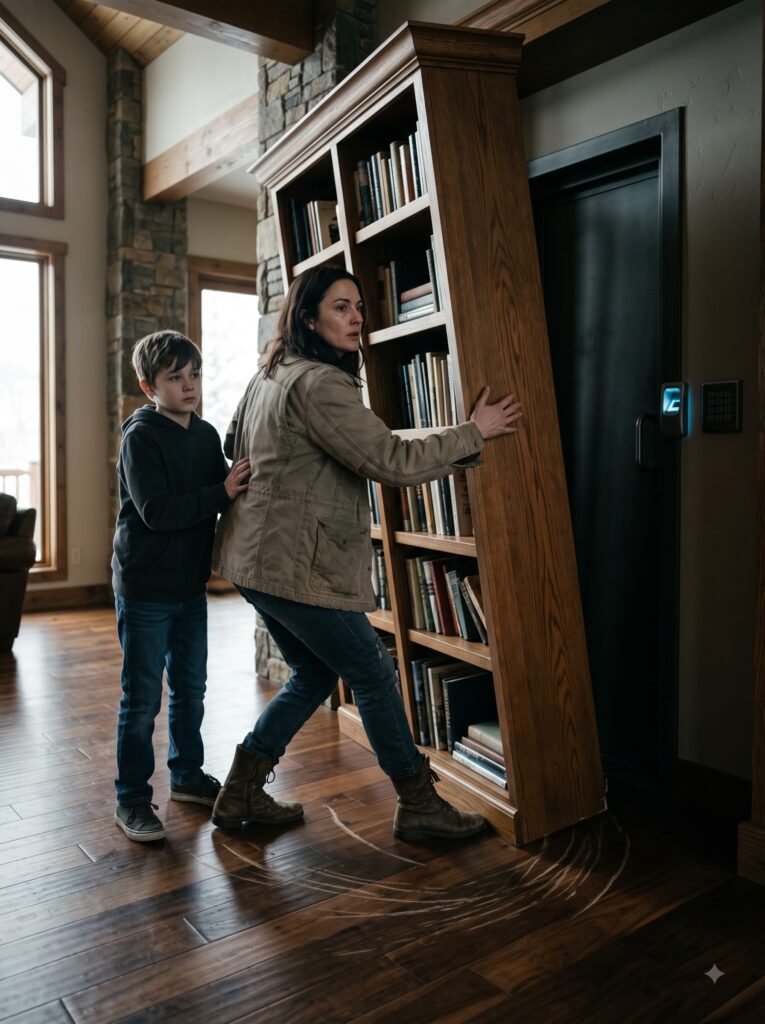
The enormous bookshelf stood away from the wall.
Only hours earlier, its scratches had been a strange detail her son noticed while exploring a mansion.
Now they marked the entrance to everything Harrison Trench had concealed.
Joanna paused.
The hidden door had not been made for a family secret in the ordinary sense.
There were no forgotten photographs waiting inside.
No sentimental collection.
No explanation of a lost relationship.
The concealment was operational.
Harrison had hidden the headquarters of an organization he believed needed secrecy to survive.
And he had arranged for a woman who didn’t know him to inherit it.
Joanna finally understood one part of the mystery.
The estate had never been the real gift.
It had been the means of transferring control.
A legal home attached to an enormous private enterprise.
An unfamiliar inheritance designed to bring her directly to the machinery of Harrison’s organization.
She hadn’t found a hidden room by accident.
At least, Harrison had intended her to discover it eventually.
He had provided the fob.
He had registered her identity.
And he had left a letter bearing her name at the central desk.
What remained uncertain was why he had trusted this particular successor with something so dangerous.
His letter offered one explanation.
But Joanna had no way of knowing whether he had told her everything.
That question could wait.
Her son could not.
She climbed the grand staircase.
Her boots left gray dust across the marble.
At the bedroom door, she stopped and listened.
No sound.
She knocked softly.
“Leo? It’s Mom.”
The lock clicked.
The door opened a few inches.
Leo appeared, clutching his backpack.
His eyes widened when he saw her.
“Mom, what happened?”
Joanna knelt.
He looked at the cut on her cheek.
“You’re bleeding.”
“It’s a small cut.”
“I heard a really loud noise.”
She reached for him.
He stepped into her arms immediately.
Joanna held him tighter than she had intended.
For a long moment, neither spoke.
Then Leo pulled back.
“Was something wrong downstairs?”
Joanna looked at him.
She could tell him the pipes had made a noise.
She could invent some ordinary explanation.
But she had already promised herself that whatever Harrison’s empire became, she wouldn’t build her relationship with her son on convenient lies.
“There was an accident,” she said carefully. “And some people came here who weren’t supposed to.”
Leo’s face tightened.
“Bad people?”
“People who tried to take something that doesn’t belong to them.”
“Did they hurt you?”
“Not badly.”
“Are they coming back?”
Joanna wished she knew.
Instead of pretending otherwise, she said, “I’m making sure we have people keeping us safe.”
He considered that.
Then he asked the question she had been expecting.
“Can we leave?”
Joanna sat beside him on the bed.
“We can leave this room whenever we need to. And we don’t have to decide everything today.”
Leo glanced toward the windows.
“I liked the big kitchen.”
Despite everything, Joanna almost smiled.
“You did?”
“And the bedrooms. And I thought maybe you wouldn’t have to work at the clinic anymore.”
That broke something inside her.
Not because Leo was asking for luxury.
But because his idea of happiness was so modest.
A kitchen.
A bedroom.
A mother who wasn’t constantly exhausted.
For years, that was all he had wanted.
Joanna brushed his hair away from his forehead.
“I don’t think I’ll be scrubbing clinic floors anymore.”
His eyes widened.
“Really?”
“Really.”
“Then are we rich?”
Joanna looked toward the hallway.
The mansion was worth ninety million dollars.
The documents downstairs claimed she controlled billions in available funds.
The energy operation could theoretically be worth vastly more.
But its value depended on systems she didn’t fully understand, people whose loyalty she hadn’t established, and a technology that might be immensely useful or catastrophically dangerous.
She couldn’t responsibly turn those claims into a number.
Not yet.
“We have more than we had yesterday,” she said.
Leo leaned against her.
“That’s good.”
Joanna kissed the top of his head.
“Yes. It is.”
They sat quietly.
Outside, the mountain fog had begun to lift.
Through the window, Joanna could see part of the long driveway and the dark line of pines beyond it.
She remembered the first time she drove through the gate.
She had imagined selling the entire property and buying a small house where no landlord could threaten them.
That had been her dream.
A safe place.
A refrigerator full of food.
A savings account that could survive one bad month.
She still wanted those things.
Nothing about the core or Aegis had changed that.
But she now faced a decision she had never imagined.
Harrison had given her the ability to walk away from ordinary poverty.
At the same time, he had placed her inside a struggle over an asset powerful enough to attract armed attackers.
Refusing to manage that struggle wouldn’t necessarily make it disappear.
She had seen what happened when people tried to take control of the core without regard for its safety.
She had also seen what her own desperate attempt to stop them had nearly caused.
If she kept the organization, she would need people who understood its systems.
Scientists who could verify the energy claims.
Engineers who could evaluate the containment risks.
Financial experts who could establish what the accounts really held.
And experienced operational personnel who could help her separate genuine security needs from Harrison’s legacy of secrecy and force.
None of that could be accomplished by intimidation.
Or by pretending she knew more than she did.
The greatest danger would be believing that ownership meant competence.
Joanna looked down at Leo.
He was examining the faint dust on her sleeves.
“Do you think that man wanted us to live here?” he asked.
“Harrison?”
Leo nodded.
“I think he wanted me to find the place,” she said.
“Why?”
Joanna thought of the letter.
Five years of observation.
Her refusal to give up.
Her unwillingness to trust authority merely because it wore an expensive suit.
“I think he believed I would make different choices from him.”
“Was he a good man?”
Joanna remained silent for a moment.
She knew Harrison had arranged an enormous inheritance.
She also knew he had watched her suffer without intervening.
His organization operated through military force and secrecy.
He had left her a potentially transformative energy asset, but also extraordinary danger.
Those facts did not fit neatly into good or bad.
“I don’t know,” she said finally.
Leo accepted that more easily than most adults might have.
“Can you be good?”
Joanna looked at him.
The question was simple.
The answer wasn’t.
“I can try.”
He nodded.
“Okay.”
And with that, he turned his attention back to the bedroom.
Joanna stood and walked to the window.
Far below the mountain, the city lay somewhere beyond the trees.
There were people there who would go to work tomorrow worrying about the same things that had frightened her yesterday.
Rent.
Food.
Electricity.
Jobs.
She thought of the blue core glowing beneath her feet.
If Harrison’s claims were true, the material might someday change how energy was produced and distributed.
It might become one of the most valuable resources on Earth.
But Joanna knew that value wasn’t the same as usefulness.
An asset locked behind armed guards could make its owners extraordinarily wealthy without improving anyone else’s life.
She had been on the wrong side of that kind of inequality for too long to forget it now.
The fact that she controlled the organization did not mean she had to preserve every decision Harrison had made.
She could demand evidence.
She could question its practices.
She could refuse to treat armed force as the first answer to every threat.
And before considering any broader use of the energy technology, she could insist on determining whether it was safe.
Those wouldn’t be easy choices.
They might not even be immediately possible.
But they belonged to her now.
That was what the lawyer’s signature had meant.
That was what the hidden ledger had meant.
That was what Hayes had acknowledged when he accepted her orders.
She had inherited the authority to decide what happened next.
And with it, the responsibility to live with the consequences.
Joanna returned to the bed.
Leo had finally relaxed enough to remove his shoes.
He placed them neatly beside the mattress, just as he always did in their apartment.
A small habit carried into an enormous unfamiliar house.
Joanna picked up his backpack and set it on a chair.
Then she sat beside him.
“Leo?”
“Yeah?”
“You remember when we talked about finding a place where we wouldn’t have to move again?”
He nodded.
“Do you think this could be it?” she asked.
He considered the room.
Then he looked at her.
“Would you stay too?”
Joanna felt the full weight of the question.
Not whether the mansion was expensive.
Not whether the rooms were beautiful.
Not whether they could afford it.
Would his mother be there?
Would she have time for him?
Would the new life give him the one thing poverty had so often taken away?
Her presence.
“Yes,” she said. “I’m staying with you.”
Leo smiled.
“Then I like it.”
Joanna reached for his hand.
She thought of the legal documents waiting in Hewitt’s office.
Of the leather-bound ledger downstairs.
Of the armed personnel securing the damaged underground chamber.
Of the unidentified attackers who had somehow located the vault.
There would be an investigation.
The leak remained unresolved.
The stability of the core needed independent confirmation.
And she would have to learn how to manage an organization far larger than anything she had ever known.
The danger hadn’t disappeared simply because the immediate assault had ended.
But one thing had become clear.
She didn’t have to become Harrison Trench.
His fortune might now be hers.
His responsibilities might now be hers.
His enemies might eventually become hers.
But his way of using power did not have to become hers.
She had survived ten years of exhausting work and constant financial fear without forgetting what mattered most.
She intended to remember it now.
Leo squeezed her fingers.
“Are we staying here tonight?”
Joanna looked around the enormous room.
She could hear the distant ventilation system.
Beyond the window, the fog was thinning above the pines.
Deep beneath the mountain, engineers were working to keep the core stable.
The mansion was not yet the peaceful refuge she had imagined.
But it was theirs.
And she was no longer powerless over what happened to their lives.
“For tonight,” she said softly, “we’re home.”
Leo rested his head against her shoulder.
Joanna held him.
She had begun the day as a woman with twelve dollars in her checking account and an eviction warning on her door.
Now she held ownership of a ninety-million-dollar estate, an organization controlling billions in funds, and rights to an energy resource whose potential value might dwarf even the fortunes of the world’s most famous billionaires.
But none of those valuations had been independently proven to her.
And none of them mattered as much as the boy beside her.
The true discovery was not that Harrison had made her wealthy.
It was that he had handed her an extraordinary kind of power without telling her how to use it.
She would have to learn.
She would have to question everything.
And she would have to decide what kind of future that power should create.
The scratches beneath the bookshelf had led her to an empire.
What she did with it would determine whether that empire remained a fortress built around one man’s secrets—or became something worth passing on.
Joanna looked at her sleeping son.
For the first time since the attorney had pushed those keys across his desk, she allowed herself to imagine tomorrow.
Not as a battle for survival.
But as a day in which she could begin making choices.
And that, she realized, was the first piece of wealth she truly understood.


