
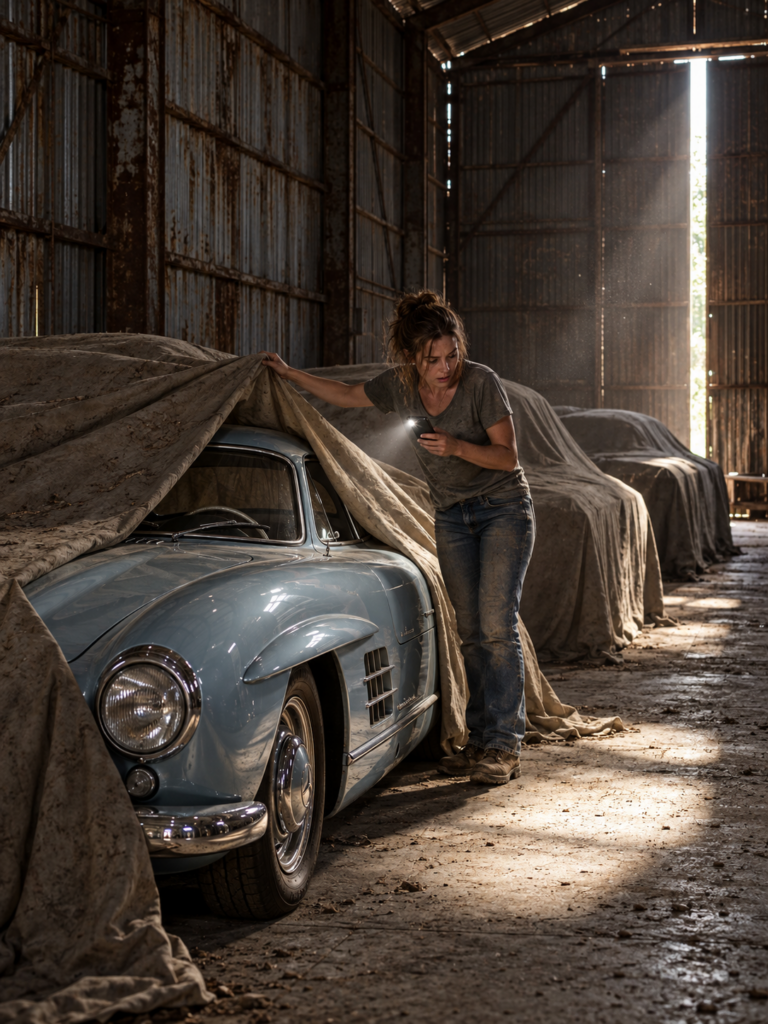
The trunk rose smoothly on its hinges, revealing six heavy olive-green metal boxes stacked tightly inside.
Harper stared at them.
They were nothing like the spare tires, tools, or automotive supplies she had expected.
Each box had reinforced corners and a thick carrying handle.
She reached for the nearest one.
It barely moved.
“What did you put in here?” she murmured.
She braced one knee against the bumper, gripped the handle with both hands, and dragged the container toward her.
The weight surprised her.
She nearly lost her balance before lowering it to the concrete.
There was no padlock on the box.
Only two metal clasps.
Harper released them.
Inside were small canvas bags arranged in neat rows against a dark velvet lining.
She selected one.
It was remarkably heavy for its size.
The fabric felt coarse beneath her fingers. A cord held its opening shut.
Harper untied it and tipped several pieces into her palm.
Gold coins.
Heavy, dull-yellow coins with designs she didn’t recognize.
She raised one toward the flashlight.
A Krugerrand.
She knew the name, even if she had never held one.
Her mouth went dry.
She looked at the remaining bags.
Then at the five unopened boxes still inside the Mustang.
There could be hundreds of coins.
Perhaps thousands.
For a few extraordinary seconds, Harper imagined that Martha had secretly accumulated an enormous investment and simply never told anyone.
Then she remembered the cars.
The locked barn.
The man’s offer to buy the farm without inspections.
And the fact that her grandmother had lived as though a new pair of shoes was an extravagance.
Harper returned the coins to their bag.
She closed the box and struggled to slide it back into the Mustang.
The trunk clicked shut.
She stood motionless beside it.
Finding valuable property was one thing.
Establishing who owned it was another.
Three expensive cars and a trunk filled with gold did not automatically mean she had inherited a fortune she could safely spend.
She needed records.
Some explanation.
Something showing where the vehicles and coins had come from.
Harper pulled the tarps back over the cars.
Then she examined the barn more carefully.
There were no windows and no rear entrance. At the far end, a heavy workbench stood beneath a sagging wooden shelf.
Old tools lay scattered across its surface.
Beside a vise, partly concealed by grease-stained cloth, sat a rusted metal filing box.
Harper approached it.
The latch was broken.
Inside was a thick leather ledger with a cracked spine.
She lifted it into the flashlight beam.
The first page contained columns of dates, names, quantities, and payments.
The handwriting was unmistakable.
Martha’s.
Harper recognized the compact letters and careful numbers from the birthday cards her grandmother used to send.
She read the first complete entry.
October 14, 1982.
A transport from Chicago.
Three units received and stored.
A retainer paid.
She turned the page.
More deliveries.
More payments.
References to inspected assets and percentages held in reserve.
The language was clinical.
Almost boring.
Like an ordinary inventory book.
Except Harper was standing in a sealed barn beside three extraordinary automobiles and enough gold to transform several lives.
A realization took shape.
Martha might never have owned these things.
She might have been storing them for other people.
Harper turned several more pages.
The records continued across decades.
There were dates when property arrived, dates when it departed, and sums Martha apparently received for keeping it secure.
Her grandmother hadn’t simply been collecting antique cars.
She had been operating a private storage arrangement that nobody in the family knew existed.
That answered one question.
It also made the others more troubling.
Who had trusted Martha with such valuable possessions?
Why had they stopped retrieving them?
And why had she kept everything locked away for so long?
Harper thought of Wyatt.
His quick cash offer.
His repeated insistence that there was nothing worth inspecting.
His eyes lingering toward the pasture.
Had he known?
She brought the ledger closer.
The final pages were different.
Fewer entries.
Long stretches without payments.
Then handwriting that looked less precise than the careful columns preceding it.
Harper turned toward the last written page, flattened the curling paper beneath her thumb, and began reading.
The first sentence was dated August 9, 2015.
Harper held the ledger nearer to her phone.
Martha had written that contact with Chicago was gone.
The payments had stopped.
The people who handled the stored property had disappeared from her life.
And the assets remained.
Harper read the closing thought twice.
Martha had become too old to move the valuables herself. If she died before anyone returned, they would remain where they were until someone unfortunate enough discovered them.
Unfortunate.
That was the word that troubled Harper.
Not lucky.
Not fortunate.
Not blessed.
Unfortunate.
She looked around the barn.
Three extraordinary automobiles.
Six boxes of gold.
Enough apparent wealth to make her debt problems seem almost ridiculous.
And Martha had regarded the person who discovered it as unlucky.
“Why?” Harper whispered.
She flipped back through the ledger.
The earlier entries contained just enough information to change her understanding of her grandmother.
Martha had accepted valuable items for storage.
She had been paid for it.
The transactions had continued for years.
But the ledger was not proof that Martha had been an owner, and it certainly wasn’t proof that everything inside the barn had been acquired legitimately.
There were no simple ownership certificates tucked between the pages.
No explanation of the people behind the deliveries.
The records were meticulously kept, but their plain language concealed more than it disclosed.
One recurring reference bothered Harper.
Chicago.
Again and again.
In the beginning, it was connected to orderly shipments and regular payments.
Later, the entries became sparse.
Missed collections.
Interrupted communications.
Uncertainty.
By the end, Martha appeared less like someone managing a profitable business and more like a woman waiting for people she hoped would never return.
Harper closed the book.
Then she heard gravel crunching beyond the brambles.
She froze.
The sound came again.
An engine idling.
Someone had driven onto the property.
She extinguished the flashlight.
The barn became almost entirely black.
For a moment Harper could hear nothing but her breathing and the faint metallic ticking of the roof as it cooled.
She pressed the ledger against her ribs.
Then she moved toward the sliding doors.
The narrow opening she had left between the door and its frame admitted a blade of daylight.
Harper leaned close enough to look outside.
A black pickup stood beyond the trees.
Wyatt.
His vehicle hadn’t been there when she entered the barn.
Now he was walking toward it through the brush.
He no longer wore that polished, neighborly expression.
His attention was fixed on the doors.
He paused near a wall of blackberry vines and examined the heavy iron hasp.
Then he reached behind him.
A pair of bolt cutters appeared in his hand.
Harper’s pulse jumped.
So much for a casual visit.
Wyatt had told her the barn contained nothing worth seeing.
Now he had returned with equipment specifically suited to breaking its lock.
She did not know exactly what he understood about the contents.
But she knew he had lied about his interest in the building.
And she knew she did not want to be trapped inside when he entered.
There was no back door.
No window.
No easy way to leave without confronting him.
Harper tucked the ledger into the waistband of her jeans and pulled her shirt over it.
She checked that the tarps covered every vehicle.
Then she moved to the door.
The metal track had screamed when she opened it earlier.
It would scream again.
There would be no slipping away unnoticed.
She waited until Wyatt moved close enough to begin clearing a thorny branch from the doorway.
Then she seized the handle.
With one hard pull, she dragged the door open.
The shriek of rusted metal split the afternoon.
Wyatt recoiled.
The bolt cutters fell into the weeds.
Harper stepped into the sunlight before he could see beyond her.
She looked down at the cutters.
Then at him.
“Is there a reason you’re sneaking around my barn with those?”
Wyatt’s expression tightened.
For a second he looked genuinely surprised.
Then his smile returned.
“Harper. Didn’t realize you were out here.”
“Clearly.”
“I noticed that old lock last week. Thought I might save you some trouble and cut it off.”
She raised the ring of brass keys.
“Already solved that problem.”
His eyes shifted toward the dark opening.
“Find anything useful?”
Harper forced a weary laugh.
“Depends on how much you like rust and rotten lumber.”
He studied her face.
“That’s all?”
“Old equipment. Scrap. More junk than I can afford to haul away.”
She gestured toward the exterior.
“Look at this place. I could spend every dollar I make selling the house just getting someone to clean it.”
Wyatt didn’t answer immediately.
He seemed to be deciding whether to believe her.
Harper was grateful for the dust on her shirt, the scratches on her arms, and the grease across one cheek.
She looked exactly like a woman who had spent a miserable afternoon exploring a ruined farm.
At last he glanced at the barn again.
“If you want, I can take another look at my offer.”
“I know.”
“You could be done with all this in a matter of days.”
“That’s tempting.”
She reached down for the padlock lying in the grass.
With deliberate movements, she slid the barn door shut, fastened the hasp, and locked it.
The click seemed astonishingly loud.
Wyatt watched the key disappear into her pocket.
Harper walked past him.
“I need to think. I’m staying at a motel tonight. I’ll call you tomorrow.”
“Take your time.”
His tone was friendly again.
“The offer isn’t going anywhere.”
She nodded and headed toward the farmhouse.
Every step through the thorns felt exposed.
She expected him to call her back.
He didn’t.
She reached her Honda, climbed inside, and locked the doors.
The engine hesitated before starting.
As she pulled away, she saw Wyatt standing beside his truck.
Watching.
Only when she reached the paved highway did Harper pull over.
Her hands began shaking so violently that she had to grip the steering wheel.
She took out the ledger.
The cover was still warm from being pressed against her body.
She had lied to a man who clearly wanted access to whatever Martha had hidden.
And she had walked away carrying the one thing that might explain the whole arrangement.
Her phone rang.
The familiar Omaha number filled the screen.
For the first time all afternoon, Harper answered.
She told the collector she needed forty-eight more hours.
She did not explain why.
There were some things that sounded unbelievable even when they were true.
That night, Harper checked into room seven at the Starlight Motel.
The air-conditioner rattled.
The carpet smelled damp.
An old neon sign sent intermittent red light across the walls.
Harper sat on the bed with the ledger spread across her knees.
She read every entry.
Then she began again.
As the hours passed, Martha’s history became clearer.
The barn had not been the private treasure chamber of a secretly wealthy widow.
It had functioned as a guarded storage site for people connected to Chicago.
For years, valuable property arrived under arrangements that appeared carefully organized.
Martha received payments for allowing it to remain there.
But those arrangements eventually deteriorated.
Near the end of the 1990s, the records grew increasingly uneasy.
Missed pickups.
Failed contacts.
Assets left unclaimed.
In one passage dated November 1999, Martha wrote that the men involved were dead or imprisoned.
She also noted something extraordinary about the gold.
The coins were marked.
The people who had deposited them had used identifying marks along their edges to keep track of their holdings.
Martha believed anyone trying to sell those coins might attract attention from people connected to the original owners.
She described the metal as poison.
Harper set the ledger aside and stared at the motel ceiling.
She had spent much of the afternoon imagining an escape from debt.
Now every possible escape seemed tangled with someone else’s history.
The cars were valuable.
The gold was valuable.
But she could not safely assume any of it was legally hers.
And Wyatt seemed prepared to cross boundaries to get at it.
There was another possibility.
If she could sell the land without becoming responsible for settling every question about the contents, perhaps she could leave the farm behind.
But Wyatt was offering far less than the property might reasonably be worth.
And the moment she accepted, he would have access to everything.
She was caught between a fortune she couldn’t claim and a neighbor she couldn’t trust.
Harper opened the ledger again.
Near the back, the binding felt unusually thick.
She tilted the book under the bedside lamp.
A small envelope had been taped to the inside cover.
The tape was yellow and brittle.
She peeled it away carefully.
Inside was a folded sheet.
A hand-drawn diagram.
Her grandmother’s kitchen.
Harper recognized the stove, the table, and the doorway leading into the living room.
A small X marked the floor beside the old cast-iron stove.
Beneath the drawing, Martha had left a note.
She hadn’t kept the valuables entrusted to her, the note explained.
But she had kept her own compensation.
Her retainer.
Money she considered earned.
Harper sat completely still.
She thought of the years Martha spent living frugally.
The patched clothes.
The aging farmhouse.
The complaints about rising prices.
Could there have been money hidden beneath her kitchen all along?
And if so, why hadn’t Martha used it?
Harper checked the clock.
2:14 a.m.
Outside, the motel parking lot was nearly empty.
She looked at the drawing again.
The mark was unambiguous.
If something was there, she needed to know what it was before Wyatt or anyone else gained possession of the house.
She put the ledger into her duffel bag, gathered her keys, and drove back toward the farm.
The road was dark and empty.
For the last half mile, Harper switched off her headlights and followed the dim outline of the track under the moonlight.
She parked behind the farmhouse, out of sight from the main approach.
No lights burned in the house.
No truck stood in the yard.
She entered through the back door.
The kitchen smelled exactly as it had that afternoon.
Dust.
Dry wood.
Faint traces of lavender.
Harper knelt beside the cast-iron stove.
The linoleum had curled away from the floor.
She pulled at one brittle edge.
A section came free.
Beneath it were narrow pine boards.
She examined them with her phone light partly covered by her palm.
One board had a small semicircular notch.
Her heartbeat accelerated.
The diagram had led her to something real.
Harper took a flathead screwdriver from her pocket and fitted its tip into the notch.
The wood resisted.
She pressed harder.
Then the edge of the board lifted, revealing a black space beneath the kitchen floor.
Harper raised the loosened board until she could slide her hand beneath it.
The cavity was shallow.
Her fingers touched dry earth, old cobwebs, and something smooth wrapped in thick plastic.
She gripped the package and pulled.
It came free with a soft scraping sound.
She set it on the floor beside the stove.
A heavy rectangular bundle, vacuum-sealed in clear plastic.
Through the wrapping she could see green paper.
Not old letters.
Not photographs.
Money.
Stacks of hundred-dollar bills pressed tightly together.
Harper stared.
She turned the bundle beneath the narrow beam of her phone.
The bills looked old but carefully preserved.
There appeared to be tens of thousands of dollars.
Perhaps eighty thousand.
More than enough, at least on paper, to wipe out the debts that had dominated her life for years.
She looked at the empty cavity.
Then back at the bundle.
Martha had hidden her compensation beneath the floor.
While three remarkable cars and six containers of marked gold sat in the barn, the money she regarded as her own had been concealed less than ten feet from the kitchen table.
Harper sat back on her heels.
Suddenly she remembered her grandmother counting change into small piles.
Refusing unnecessary purchases.
Insisting that good food could be made from whatever remained in the cupboard.
Harper had always assumed those habits came from having very little.
Now she wondered whether Martha had lived that way because she had decided some money should never be touched.
The discovery didn’t explain everything.
A handwritten declaration that the cash had been earned was not proof of its legal origin.
But it did explain why Martha had separated it from the assets in the barn.
She had considered one stash hers.
The other belonged to people she wanted nothing more to do with.
Harper reached for the plastic bundle.
A voice spoke from the darkness.
“I knew it.”
Her entire body went rigid.
A bright flashlight snapped on.
The beam struck her face so sharply that she turned away.
Someone stepped from the living room.
Boots sounded against the wooden floor.
Harper raised a hand to shield her eyes.
Wyatt stood in the kitchen doorway.
He held the flashlight in one hand.
A black handgun hung at his side in the other.
For several seconds, neither spoke.
Harper looked from the weapon to his face.
The easy smile was gone.
He seemed almost irritated to have found her there.
“Put that down,” she said.
Wyatt ignored her request.
“I knew you found something this afternoon.”
He advanced a few steps.
“You weren’t acting like a woman who’d opened a shed full of junk.”
Harper stayed on her knees.
The bundle of money rested on the dusty floor.
She kept both hands visible.
“How did you get in?”
“The front door wasn’t locked.”
It hadn’t been locked when she arrived that afternoon, either.
She had been so focused on the hidden money that she had neglected to check it.
Wyatt angled the flashlight toward the open floorboard.
“So that’s what she kept in the house.”
His gaze settled on the plastic package.
“Hand it over.”
Harper didn’t move.
“You’re pointing a gun at me on my own property.”
“Then don’t make this difficult.”
He spoke without raising his voice.
That frightened her more than shouting would have.
The afternoon conversation returned to her in painful detail.
His polished boots.
His cheerful manner.
The folded cash offer.
The promise to take the whole mess off her hands.
He had known enough to come looking.
And now there was no point pretending otherwise.
“You knew about the barn,” Harper said.
Wyatt’s expression barely changed.
“I knew she was keeping something valuable.”
“For how long?”
“Years.”
He shifted the flashlight.
“Five years I’ve wondered what that old woman had hidden.”
Harper looked toward the living room, calculating the distance to the door.
Too far.
Wyatt was between her and the most direct exit.
She could not be sure what he intended.
But the handgun made every wrong movement dangerous.
“You were waiting for her to die,” she said.
He gave a small shrug.
“I was waiting for a chance to buy the land.”
“Without inspections.”
“I made you an offer.”
“You wanted what was in that building.”
At that, Wyatt’s eyes narrowed.
He seemed to decide there was no reason to deny it.
“I saw trucks coming and going years ago. Martha always acted like nobody was supposed to notice.”
He glanced toward the dark window.
“About a month back, I got close enough to see through a gap in the siding. Saw part of a car.”
“What kind?”
He hesitated.
Harper already knew.
“A Mercedes?”
Wyatt looked at her sharply.
She had her answer.
He knew there was at least one valuable automobile in the barn.
But his reaction suggested he did not know everything.
“Pretty expensive piece of machinery,” he said.
“Very.”
“Then you understand why I wanted to buy the place.”
Harper glanced at the money by her knee.
Wyatt followed her gaze.
He raised the gun slightly.
“The cash. Now.”
Her mind raced.
If she handed it over, he might still refuse to let her leave.
If she tried to run, he was close enough to stop her.
If she argued about ownership, they could spend the entire night in the kitchen and the gun would remain in his hand.
She needed to change what he wanted.
Or rather, remind him what he wanted most.
“You’ve got no idea what’s inside that barn,” she said.
Wyatt looked toward her.
“I know there’s a car.”
“Three cars.”
He stopped moving.
Harper held his gaze.
“A powder-blue Mercedes-Benz Gullwing. A black Boss 429 Mustang. A silver Porsche Speedster.”
Wyatt’s breathing changed.
He tried to hide it, but she noticed.
“You’re making that up.”
“Go and look.”
He lowered his flashlight slightly.
Harper continued before he could answer.
“And that’s not the most valuable thing inside.”
Wyatt glanced toward the kitchen window.
“What else?”
“The Mustang’s trunk.”
His attention returned to her.
“What about it?”
“Six metal boxes.”
She watched his face.
No recognition.
He had never opened the trunk.
“What’s in them?”
“Gold coins.”
Wyatt said nothing.
“Krugerrands,” Harper added. “Bag after bag. Enough to make that little bundle on the floor look like grocery money.”
His grip tightened around the flashlight.
“How much?”
“I don’t know the exact amount. But it’s a fortune.”
Wyatt stared at her.
The darkness beyond the kitchen seemed to press closer.
At last he said, “Then open the barn.”
“I can.”
“Give me the keys.”
Harper shook her head.
“Not until we understand each other.”
The handgun lifted.
“You’re not bargaining from a very good position.”
“No,” Harper said. “I’m not.”
Her voice shook.
She let it.
“But neither are you.”
Wyatt studied her.
“What is that supposed to mean?”
“Those cars and coins were stored for people from Chicago.”
She nodded toward the duffel bag near her feet.
“Martha kept a ledger. Dates, deliveries, payments. The whole arrangement.”
Wyatt’s eyes flicked toward the bag.
He had been thinking about a secret fortune.
Now she was telling him it came with a history.
“The coins were marked,” Harper continued. “Martha wrote that the people who left them could identify them.”
“She’s been dead for years.”
“Martha has. That doesn’t mean every person who ever had an interest in those assets is dead.”
He considered that.
Then his expression hardened.
“You think I’m stupid enough to be frightened by an old woman’s notebook?”
“No. I think you’re smart enough to understand that finding gold and safely selling gold are different things.”
He took another step forward.
“Why are you telling me all this?”
Harper looked down at the bundle.
Because it was the only way she could see to survive the night.
Because Wyatt’s greed was already more powerful than his caution.
Because she needed him to believe that letting her leave would give him everything he had been trying to obtain.
She did not say any of those things aloud.
Instead, she said, “I don’t want the cars. I don’t want the gold.”
Wyatt waited.
“I want my debts paid. I want to walk away from this place.”
“Then walk.”
“With that money.”
She indicated the package.
His eyes moved to it.
Harper continued.
“You offered to buy the farm. You said you wanted the land and everything that came with it.”
“I did.”
“Then let’s make a deal.”
For the first time, his confidence faltered.
Harper slowly pushed herself upright, keeping her hands away from her pockets.
“The cash you offered for the land, less what Martha left under the floor. You take responsibility for the property and everything in that barn. I take this money and leave.”
Wyatt looked at her.
“You’d walk away from all that gold?”
“I don’t know whose gold it is. Neither do you.”
“Sounds like you’re scared.”
“I am.”
The admission surprised him.
Harper saw it.
She wasn’t pretending to be fearless anymore.
She was exhausted, in debt, and standing in her dead grandmother’s kitchen with a gun pointed at her.
“I don’t want to spend the rest of my life worrying about the people who left that stuff,” she said. “You wanted this place. I’m giving you a chance to have it.”
Wyatt glanced again at the package on the floor.
Then toward the darkness outside.
She could almost see the calculation taking place.
He knew what a Gullwing was worth.
He had seen enough of Martha’s barn to understand that something extraordinary was hidden there.
And Harper had just told him the contents exceeded his expectations by millions.
The money on the floor was suddenly a very small part of the bargain.
“Keys,” he said.
Harper moved slowly.
She removed the brass ring from her pocket and tossed it onto the kitchen counter.
It landed beside a pen and the folded purchase paper Wyatt had handed her that afternoon.
She had brought the paper back with her.
She had intended to examine it before making any decision.
Now it offered her a way to make the bargain appear immediate and real.
She took the document.
Wyatt watched closely.
“This is the offer you gave me,” she said. “I can sign it.”
He nodded toward the pen.
“Do it.”
Harper read the page quickly.
Her eyes passed over the proposed price and the blank signature line.
She understood perfectly well that signing a piece of paper in a kitchen at three in the morning did not automatically complete a lawful real-estate transfer.
A deed, a proper closing, and other steps would still be required.
But Wyatt wasn’t thinking about those details.
He was staring at the keys.
At the paper.
At his chance to claim the contents of the barn.
Harper signed.
She pushed the document toward him.
“You get the land at the offered price, adjusted for the money I’m taking. We finish whatever paperwork is needed. And I leave tonight.”
Wyatt examined the signature.
“You promise you won’t come back?”
“I don’t want to come back.”
He reached for the keys.
“Or tell anyone what’s out there?”
Harper hesitated.
She knew exactly what he wanted to hear.
“I don’t want anything to do with the barn.”
His expression softened into something resembling the smile he had worn that afternoon.
He set the flashlight on the counter.
Then he tucked the handgun into his waistband.
“All right.”
Harper did not relax.
“All right what?”
“You take that money. I get the farm.”
He picked up the purchase paper and folded it into his shirt pocket.
“You’re getting the easier end of the deal.”
Harper said nothing.
She bent slowly and picked up the plastic-wrapped bundle.
Wyatt watched every movement.
She placed it in her duffel bag beside Martha’s ledger.
He noticed the book.
“What’s that?”
“Old records.”
“About the cars?”
“About what Martha stored.”
He held out his hand.
Harper considered refusing.
Then she remembered that the ledger was more dangerous to possess than the cash.
It could connect her directly to the stored assets.
It also contained the information that had led her to the hidden retainer.
She took the ledger from the bag and opened it briefly.
Wyatt saw the handwritten columns.
The dates.
The amounts.
The entries spanning decades.
She could tell he wanted it.
But when she started to hand it over, he shook his head.
“Keep your grandmother’s book. I don’t need it.”
He held up the ring of keys.
“I’ve got what matters.”
Harper closed the ledger and returned it to her bag.
She did not correct him.
At that moment, the book was the only evidence she possessed explaining why Martha had hidden the valuables, and it contained the number of a contact in Chicago.
“Then we’re finished,” she said.
Wyatt stepped aside.
“You leave tonight. Don’t come back.”
Harper moved toward the back door.
She expected him to change his mind.
To reach for the weapon.
To demand the money after all.
But he didn’t.
He was already examining the keys.
Harper passed into the humid night.
The air outside felt impossibly fresh.
She walked toward her Honda, forcing herself not to run.
The car started on the third attempt.
She shifted into reverse.
As she backed around the farmhouse, a moving flashlight beam swept over the trees.
Wyatt was heading toward the pasture.
Toward the barn.
He had barely waited for her to leave.
Harper turned onto the dirt road and drove away.
She kept checking the mirrors.
No headlights followed her.
Still, she didn’t stop when she reached the highway.
She didn’t stop at the first gas station.
Or the next.
She drove until the sky began losing its darkness and the roads around Columbus started filling with early-morning traffic.
At a brightly lit roadside diner, she finally parked.
Her hands hurt from gripping the steering wheel.
Inside, she chose a booth near the window.
A waitress brought her coffee.
Harper wrapped both hands around the mug.
For a long time, she simply sat there.
The money was in her bag.
The ledger was beside it.
She had escaped Wyatt’s kitchen.
But she hadn’t escaped the question Martha had left behind.
What happened to the people who originally owned those assets?
The old woman had known the answer might be dangerous.
She had left the cars and coins untouched for years.
Not because she had forgotten them.
Because she was afraid of what might happen if someone tried to claim them.
Harper took out the ledger and opened it near the back.
There was a telephone number written in one of the final pages.
A Chicago area code.
She had noticed it at the motel.
It was the last contact information Martha had preserved for the people connected to the storage arrangement.
There was no guarantee the number still worked.
No guarantee the person answering would know anything about the assets.
And certainly no guarantee that calling would protect Harper.
She stared at the digits.
Then she thought about Wyatt.
He had entered her house with a firearm.
He had threatened her over money that was not his.
He had taken the keys and rushed toward the barn before she was even off the property.
He believed he had won.
And perhaps, in terms of money alone, he had.
Harper looked down at the old handwritten entries.
She remembered how carefully Martha had recorded every delivery.
How she had preserved the assets without trying to profit from their disappearance.
How she had warned that marked gold could attract the wrong people.
The ledger didn’t prove who was still alive or who could lawfully claim anything.
But it showed that Martha had never considered the valuables hers to give away.
Wyatt had ignored that distinction.
Harper considered calling the authorities instead.
She knew she had already made decisions she might later regret, particularly signing papers under threat and removing undocumented cash from the property.
But she also knew that making a call to Chicago could pull her even further into an arrangement she barely understood.
She should have stopped.
She should have found a lawyer and let someone qualified deal with Martha’s records.
Instead, still shaken by Wyatt’s threats, she entered the number.
The call connected.
It rang once.
Twice.
Three times.
Four.
Then a man answered.
“Yeah?”
His voice was rough with sleep.
Harper looked out through the diner window.
Cars moved steadily along the highway.
People were heading to work.
An ordinary morning.
She kept her own voice quiet.
“Martha is dead.”
Silence.
Harper continued.
“Her neighbor Wyatt is taking over the farm in Ohio.”
The man did not interrupt.
“He has access to the cars in the barn. And the gold.”
Another silence.
Harper swallowed.
“The coins are the marked ones. Martha kept the records.”
There was a faint sound at the other end.
Then the man said, “Who is this?”
Harper’s pulse quickened.
She could have explained everything.
Her name.
Her inheritance.
The gun.
The cash.
The unsigned legal questions still surrounding the property.
But she realized how little she knew about the person listening.
She had already said too much.
So she gave him one last piece of information.
“Wyatt knows what he found. He’s planning to sell it.”
Then she ended the call.
She removed the SIM card from her phone and snapped it in half.
The pieces went into the diner ashtray.
It was a rash gesture, and it could not erase the call or guarantee that anyone would leave her alone.
She knew that.
But she wanted, desperately, to feel that she had cut her last connection to Martha’s hidden business.
Across the table, the ledger lay open.
Harper stared at the page for several moments.
The number was still there.
The records were still there.
Nothing had become simpler because she had made the call.
And she had no way of knowing what the man in Chicago would do with the information.
Perhaps nothing.
Perhaps he was no longer connected to the people who had stored the valuables.
Perhaps he would take an interest in Wyatt.
Harper would not know that morning.
She looked at the duffel bag.
The vacuum-sealed money rested inside it.
For much of her adult life, she had dreamed about possessing enough cash to solve her problems.
Now she had more cash than she had ever held before, yet she understood she couldn’t simply spend it without addressing where it came from.
She would need professional advice.
She would need to examine what she had signed.
She would need to account for the money and the records rather than pretending that a frightening night had made every legal question disappear.
But those were problems she could face outside Wyatt’s kitchen.
Away from the gun.
Away from the barn.
Away from a man who had decided someone else’s stored valuables were worth threatening her life over.
Harper closed the ledger.
For the first time, she thought of Martha without resentment.
For twelve years, she had remembered her grandmother as cold and distant.
A woman who refused to explain herself.
A woman who let the family drift away.
Now Harper understood that Martha had carried an extraordinary secret for decades.
It had brought her money, but not the kind of freedom Harper had imagined.
Instead, it had left her guarding possessions whose owners had vanished from contact, living in a deteriorating house beside wealth she refused to claim.
Martha’s final note had been clear about one thing.
She had separated her own pay from everything entrusted to her.
Harper wasn’t sure whether her grandmother’s distinction would withstand scrutiny.
But she understood why Martha had made it.
To Martha, the cars and gold had never represented a gift.
They represented unfinished business.
The money beneath the stove represented work she believed she had done.
And the locked barn represented a responsibility she had been unable to escape.
Harper pictured the old brass key turning inside the padlock.
That single click had seemed like the beginning of her fortune.
Instead, it had opened a history of secrecy, dangerous bargains, and other people’s property.
She wondered whether Martha had once stood in the same barn, staring at the covered cars, wishing she could simply return everything and close the doors forever.
Perhaps that was why she had kept the records.
Not as a treasure map.
But as an account of what belonged to whom.
Harper took one final sip of coffee.
It was bitter and lukewarm.
She didn’t care.
Outside, sunlight spread across the road.
Somewhere far behind her, the old metal barn stood in the weeds.
Wyatt had the keys.
He had the apparent opportunity to claim extraordinary wealth.
And he had no idea what response, if any, Harper’s telephone call might bring.
She would not pretend to know his fate.
That was no longer a story she could control.
Her own future was uncertain enough.
Harper put the ledger carefully into her bag.
She would preserve it, rather than destroy the only record that might help untangle Martha’s arrangements.
She would get advice before using the money.
And she would never again mistake the visible price of something for the cost of owning it.
For years, she had believed her grandmother left behind almost nothing.
A dying farm.
A neglected house.
A rusted barn.
Now she understood that Martha had left behind something far more complicated.
A warning written into decades of records.
A choice between claiming everything and knowing when to walk away.
And a truth Harper had learned only after opening the one door her grandmother had kept locked.
Sometimes the most valuable thing you inherit isn’t what has been hidden.
It’s the chance to decide what you will refuse to carry.

