
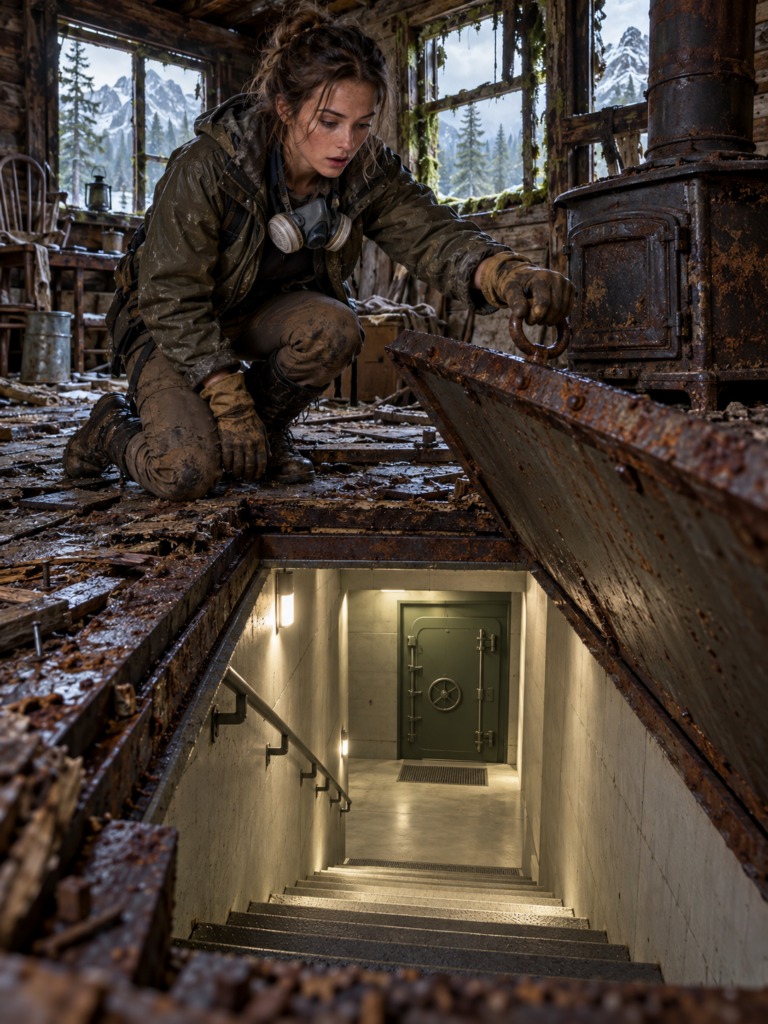
Harper descended toward the vault, each step producing a hollow metallic echo that seemed impossibly loud beneath the silent cabin.
The staircase ended roughly ten feet below the floor.
Up close, the door was even more substantial than it had appeared from above.
Heavy locking bolts disappeared into reinforced concrete. The circular wheel was thick enough to require both hands, and the keypad beside it looked strangely modern compared with the decaying building overhead.
Harper touched the keypad.
A red indicator continued blinking.
The system was alive.
But she had no idea what combination would open it.
She examined the door for a manufacturer’s plate, a maintenance label, even a scratched number.
Nothing.
She thought about Harrison.
He had spent decades buying and selling industrial scrap, obsolete machinery, and equipment from failed businesses. He understood mechanisms. He understood how much steel could be worth when everyone else saw junk.
A vault like this would have fascinated him.
It might even have come from one of his liquidation purchases.
But that didn’t explain what he had put behind it.
Harper tried the wheel.
It held firm.
She stepped back and considered returning to town for help.
Then she remembered the manila folder.
Abernathy had given her two things: a deed and a key.
The key had seemed ordinary, the sort used for a heavy padlock. She had intended to use it on the cabin entrance, but the old lock had yielded to a blow before she needed it.
The key was still in her jacket pocket.
She pulled it out.
There was no keyhole on the vault door.
For a moment, she almost laughed at herself.
Then she noticed tiny impressions beneath the green corrosion covering the brass head.
She rubbed the metal against her glove.
Six stamped digits gradually emerged.
824096.
Harper looked from the key to the electronic keypad.
The key didn’t physically fit anything she could see.
But six numbers might.
She hesitated.
A numerical stamp could have been a manufacturer’s code, an inventory number, or something entirely unrelated to the door.
Still, the possibility was worth testing.
She pressed the first digit.
A sharp electronic tone broke the silence.
The second produced another.
By the time she pressed the final number, her breathing had become shallow.
The red light continued blinking.
Harper waited.
A relay clicked.
Then the indicator turned green.
Something heavy shifted deep inside the door.
Harper pressed her palm flat against the steel.
The code had worked.
Whatever this place was, Harrison had provided the means to enter it.
She gripped the circular wheel and turned.
It moved more easily than she expected. The locking bolts withdrew with a series of dull mechanical impacts.
She pulled the door toward herself.
It swung outward on enormous, carefully maintained hinges.
Light appeared inside.
Not daylight.
Rows of warm ceiling lights illuminated a rectangular underground room.
Harper crossed the threshold.
The floor was clean concrete.
The air was dry.
Industrial dehumidifiers hummed quietly in opposite corners.
Steel shelving units lined the walls.
Nothing resembled the ruined cabin above.
At first she could not understand what she was seeing.
The shelves to her left held rows of rectangular yellow metal bars.
The shelves to her right contained larger gray-white ingots.
Heavy black storage cases stood beyond them.
Harper approached the nearest yellow bar.
She touched it, then cautiously lifted one end.
Its weight startled her.
On its upper surface was a familiar Swiss refinery marking and a designation identifying it as one kilogram of exceptionally pure gold.
Harper slowly lowered it.
There were dozens of identical bars in front of her.
More stood on the shelves behind them.
She turned toward the gray-white metal.
Silver.
Neatly stacked, heavy investment-grade silver.
Her grandfather had not merely built himself a shelter.
He had built a private repository for physical wealth.
Harper looked at the storage cases.
One sat near the edge of the nearest shelf, its two latches facing outward.
She approached it, placed both hands on the clasps, and opened them.
Inside were vacuum-sealed bundles of hundred-dollar bills.
She stared at the currency.
Then at the gold.
Then at the silver.
She had gone to Bitter Creek expecting to spend her savings repairing a worthless cabin.
Now she was standing among assets whose total value she couldn’t begin to calculate.
But why had Harrison given her this place?
Had he known she would find the vault?
And could the contents truly belong to her, or had she uncovered something that should have been included in the estate?
As she carefully closed the case, she noticed a small metal folding table in the center of the room.
A single sheet of white paper lay beneath a heavy paperweight.
She recognized the handwriting before she reached it.
Harrison’s.
Across the top was her name.
Harper lifted the paperweight, caught the edge of the sheet between her fingers, and began to read.
Harper began to read, the paper trembling slightly between her fingers.
The first sentence stopped her.
“If you’re reading this, Harper, you came to the cabin yourself.”
She stared at the words.
Harrison had anticipated this moment.
Not just the discovery of the vault, but the fact that she would personally enter the miserable building he had left her.
She continued.
He had written that Wade would probably have arranged for the place to be demolished without setting foot inside.
Evelyn, he believed, would have considered the property beneath her attention.
But Harper would inspect it.
She would get her hands dirty.
She would look at what needed fixing before deciding something was worthless.
Harrison had counted on that.
Harper lowered the letter.
She pictured the final weeks of her grandfather’s life.
His impatient expression whenever she contradicted him.
The way he would turn toward the television rather than admit she had made a reasonable argument.
The occasions when she had left his house believing he was disappointed in her.
Then she read the next passage.
Harrison wrote that Evelyn and Wade had spent years learning what he wanted to hear.
Harper had never bothered.
When she believed he was wrong, she said so.
When she thought he was neglecting his health, she challenged him.
He acknowledged that he had rarely thanked her.
But he had noticed.
Harper sat down on the folding chair beside the table.
The room’s ventilation system continued its soft mechanical hum.
She wanted to feel satisfied.
Instead, she felt a sharp, unexpected sadness.
If Harrison respected her honesty, why had he never told her?
Why had he allowed her to spend so many years assuming that she was the grandchild he valued least?
The letter continued with an explanation of the underground room.
Harrison had become convinced that the financial arrangements supporting his visible wealth were dangerously exposed.
The commercial properties carried debt.
Several holdings were overleveraged.
There were tax liabilities and potential legal expenses that could consume much of what his grandchildren thought they were receiving.
The public fortune, he wrote, was far less secure than it appeared.
He believed he had created a different kind of reserve beneath the Bitter Creek property.
Over several years, he had converted substantial liquid holdings into physical gold, silver, and cash.
Those assets had been stored in the climate-controlled chamber, outside his ordinary investment accounts.
According to his handwritten estimate, the contents were worth approximately $10.4 million at the prices he had used.
Harper read that figure three times.
Ten point four million dollars.
She thought about the broken window in her Subaru.
The envelopes of bills beside her kitchen sink.
Her habit of checking her bank balance before filling her gas tank.
Even if Harrison’s estimate was imperfect, the value represented by the room could alter the entire course of her life.
But the letter didn’t stop at the money.
He wrote that the assets were intended for her, along with the land concealing them.
He urged her not to boast.
Not to tell Evelyn and Wade.
Not to trade everything for the appearance of success.
Instead, he wanted her to use what she had found to build something that would endure.
The letter ended with his signature.
Grandpa Harrison.
Harper turned the sheet over.
Blank.
There was no additional explanation.
No affectionate memory.
No apology for the years he had kept her at a distance.
Only a written declaration from a man who had apparently trusted her more than he had allowed her to know.
She read it again.
Then a third time.
Her first wave of amazement gradually gave way to practical questions.
The gold was real enough to look at, but appearance was not authentication.
The cash would need to be counted.
The silver would need to be valued.
And even if Harrison had intended everything for her, a private letter did not necessarily settle who legally owned assets associated with a deceased person’s estate.
She knew just enough about large transactions from her hardware-store work to understand that intention and ownership were not always the same.
Her first instinct was to telephone Abernathy.
Then she remembered that her phone had lost service along the logging road.
She was alone underground with a letter, a fortune, and no immediate way to verify either its ownership or its value.
For the next hour, Harper examined the room without disturbing more than necessary.
The gold bars occupied several industrial shelving sections. Many carried refinery markings and weights.
Silver ingots filled much of the opposite wall.
The black cases contained bundles of currency, vacuum-sealed against moisture.
She found the equipment powering the lights and dehumidifiers, confirming that the chamber had been designed to function independently of the cabin.
The machinery appeared to have been maintained far more carefully than anything aboveground.
Harrison had let rain destroy the roof while keeping this room dry.
That contrast bothered her.
Not because it was inexplicable.
Because it meant the apparent worthlessness of her inheritance might have been deliberate.
He had allowed everyone, including Harper herself, to believe that the cabin was a cruel joke.
What he couldn’t have controlled was whether she would actually discover the entrance.
She returned to the table and examined the letter once more.
There was no elaborate treasure map.
No second set of secret instructions.
The six-digit stamp on the brass key had been enough.
She wondered whether Harrison had meant to explain the significance of the key while he was alive.
Perhaps he had trusted her curiosity.
Perhaps he had simply taken a gamble.
The distinction mattered to her more than she expected.
Eventually, Harper switched off the interior lights, closed the vault, and secured the hatch above the staircase.
She did not attempt to carry away gold bars or cases of money.
She took the letter, her photographs of the room, and her questions.
Then she drove back toward the nearest place she could make a telephone call.
When she reached Abernathy, she did not begin with the fortune.
“Before you answer anything,” she said, “I need to know whether the cabin was legally transferred to me with everything inside it.”
The attorney went quiet.
“Why are you asking?”
“Because Harrison left something there.”
“Something valuable?”
“Very.”
“Harper, I need you to come into the office. Bring whatever documentation you’ve found. And please don’t move or sell anything until we’ve examined the situation.”
She looked through her windshield at the damp mountain road.
“Did you know?”
“Know what?”
“About the vault.”
Another silence.
“No,” Abernathy said. “I knew Harrison regarded that property as unusually important. I didn’t know what was beneath it.”
Harper believed him.
The surprise in his voice sounded genuine.
But his next words reminded her how complicated the discovery could become.
“Your grandfather’s wishes are important. So are the actual terms of his will, the property conveyance, and the legal status of whatever you’ve found. We need to establish those things separately.”
For the first time since opening the vault, Harper felt something resembling fear.
Not fear of the underground chamber.
Fear that the most extraordinary thing anyone had ever given her might vanish into another family argument about money.
Over the following weeks, she worked with Abernathy and qualified professionals to document the assets, examine their provenance, establish values, and review the ownership and estate questions.
The process was not nearly as simple as the letter had made it sound.
Gold had to be authenticated.
Cash holdings required careful accounting.
The distinction between the land, the structures upon it, and movable property inside the vault required legal review.
Tax questions could not be dismissed merely because Harrison had preferred keeping physical assets outside banks.
Harper refused to spend anything until the relevant issues had been addressed.
That decision became the first significant test of her inheritance.
She had spent her entire life with too little money.
Now she had access to extraordinary wealth, but she would not jeopardize it by pretending she understood more than she did.
During the review, another truth began to emerge.
Harrison’s letter had not been written by a man who simply wanted to hide money.
The financial concerns he described were supported by records Abernathy could examine.
The commercial portfolio was heavily burdened.
The trusts and related arrangements carried complicated obligations.
Harrison’s assessment had been harsh, but it had not been invented merely to frighten his grandchildren.
The visible empire was vulnerable.
The underground reserve was substantial.
And Harper was the only grandchild who had been given a realistic opportunity to find it.
Eventually, after the documentation and legal review, Abernathy confirmed that the assets could be treated as Harper’s property under the circumstances of Harrison’s estate arrangements.
She kept copies of the written conclusions and the supporting records.
When the confirmation arrived, she sat alone at her kitchen table.
For several minutes, she simply watched the rain striking her apartment window.
She could have quit her job immediately.
She could have bought a mansion.
She could have called Evelyn and Wade and told them they had spent years laughing at someone who was now wealthier than either of them.
Instead, she repaired the Subaru.
She paid the bills she had been postponing.
And she began studying what Harrison had written about the failing parts of the family business.
The more she learned, the clearer one possibility became.
The same holdings her brother and sister had celebrated inheriting were beginning to consume their resources.
Harper knew those assets.
She also understood something her grandfather’s letter had only hinted at.
Harrison had spent years building businesses by buying neglected things, studying their underlying value, and repairing what other people had abandoned.
That was the part of him she recognized in herself.
One afternoon, she laid his letter beside the documentation from Abernathy’s office and looked again at the sentence urging her to build something real.
The money gave her the freedom to walk away from her family forever.
But it also gave her the means to make an entirely different choice.
She picked up the phone and called Abernathy.
“I want you to look into Wade’s commercial portfolio,” she said.
“Are you considering an investment?”
“Possibly.”
“Harper, those properties are facing serious difficulties.”
“I know.”
“They could require a substantial commitment.”
“I know that, too.”
Abernathy waited.
Harper looked at the photograph of the rusted cabin on her table.
“I’m not asking what the properties used to be worth,” she said. “I’m asking whether there’s anything there worth rebuilding.”
It was the same question she had asked when she first entered Pine Ridge.
And it would lead her back to the brother and sister who had believed she inherited nothing.
The question led to months of financial reviews, difficult decisions, and a plan Harper would once have considered impossible.
She had no intention of rescuing a failing collection of properties simply because Harrison’s name was attached to them.
She wanted to know what remained after the debts, obligations, and inflated valuations were stripped away.
Abernathy arranged for the necessary records to be reviewed.
Harper studied the results carefully.
Some properties were worth preserving.
Others were consuming cash.
Certain holdings had been used to support obligations that became increasingly difficult to meet.
The estate in Monterey still had value, but the financial pressures surrounding the family’s interests were far more serious than Evelyn or Wade had admitted.
Harper recognized the pattern.
It was the financial equivalent of the old cabin.
From a distance, everything looked impressive.
Underneath, crucial parts were deteriorating.
But unlike the cabin, the family’s empire could not be repaired with a crowbar and a box of nails.
It required money, disciplined management, and the willingness to accept unpleasant facts.
Harper had learned one of those skills long before she inherited the vault.
Now she had the resources to acquire the others.
She established a limited liability company called Black Pine Holdings.
The name came naturally.
The dark trees surrounding Bitter Creek had been the first thing she noticed when she arrived at her grandfather’s cabin.
At the time, they had seemed like a wall separating her from everything familiar.
Now they reminded her of where she had finally understood how deceptive appearances could be.
Black Pine began evaluating the family assets for a potential acquisition.
Harper did not approach Evelyn or Wade personally.
She wanted them to evaluate the proposal on its terms, not dismiss it because of who was making it.
By then, her siblings were facing consequences they could no longer conceal.
Evelyn’s trust arrangements had become tangled in aggressive tax scrutiny.
Accounts had been frozen or restricted, and professional fees mounted while the matters were being resolved.
The life she had displayed so confidently at Harrison’s will reading was becoming increasingly difficult to maintain.
Wade’s situation was equally painful.
His commercial portfolio included properties worth substantially less than their outstanding obligations.
Structural disputes and litigation added to the pressure.
The holding company that had once represented his success was now consuming his attention and savings.
He spent his days negotiating with creditors.
His nights were filled with spreadsheets that never seemed to balance.
The vintage cars he had proudly inherited no longer felt like trophies.
They felt like expensive possessions he might have to sell.
Harper followed these developments through the information available to her business advisers.
She did not call her siblings to gloat.
She did not send photographs of the vault.
She did not invite them to Bitter Creek.
For eighteen months, the truth remained mostly between Harper and the professionals who needed to know.
During that time, her life changed in ways that surprised her.
She bought better boots.
She stopped worrying about the next repair bill.
She began using her free hours to learn the language of finance and property acquisitions.
She still found herself comparing prices at the grocery store out of habit.
And occasionally, when someone asked what she did, she almost answered that she managed a hardware store.
That identity had shaped most of her adult life.
Having money did not erase it.
Nor did it erase the memory of sitting opposite Evelyn and Wade while they congratulated themselves on inheriting Harrison’s fortune.
Harper had thought about that afternoon many times.
Initially, remembering it made her angry.
Later, it simply made her tired.
Eventually, she began to understand that proving her siblings wrong would accomplish very little unless she could decide what to do with the advantage Harrison had given her.
She could let them fail.
She could buy assets from strangers and forget the family existed.
Or she could make an offer that preserved the worthwhile parts of the business while allowing Evelyn and Wade to escape the debts surrounding them.
It was not a simple choice.
They had never been particularly generous to her.
They had not helped when her car failed.
They had not offered practical support when she struggled to make ends meet.
Their occasional invitations usually left her feeling like an uncomfortable guest in her own family.
But Harper was no longer making decisions from a position of desperation.
She could afford to consider what was useful instead of what would feel satisfying for a few minutes.
Black Pine prepared a proposal.
The terms called for a cash acquisition of the relevant properties and holding-company interests, with arrangements designed to address the identified debts, fees, and obligations.
The total offer was $6.2 million.
It was not charity.
Harper would gain control of the remaining assets and assume the burdens specifically provided for under the agreements.
Evelyn and Wade would surrender the ownership positions they had once considered proof of their superiority.
In return, they would receive a path out of their immediate financial crisis.
Abernathy reviewed the structure with the parties and coordinated the negotiations.
Harper insisted that the documents be clear.
No vague promises.
No family understandings that could later be reinterpreted.
No emotional bargaining in place of actual contractual terms.
For once, she wanted everyone to know precisely what they were agreeing to.
The negotiations eventually reached the point where her siblings needed to make a final decision.
A meeting was arranged in Seattle.
And Harper chose to attend.
On the morning of the meeting, rain covered the city’s windows in long silver streaks.
Harper stood in a downtown conference room overlooking the traffic below.
She wore a charcoal blazer, dark jeans, and well-made leather boots.
Her clothing was expensive, but deliberately unremarkable.
The polished table reminded her of Abernathy’s office.
She remembered looking at her rough hands on the day Harrison’s will was read.
Today, those same hands rested on a manila folder.
The door opened.
Abernathy entered first.
Evelyn followed.
Wade came behind her.
For a brief moment, neither sibling seemed to register Harper’s presence.
Then Evelyn stopped.
“What are you doing here?”
Wade looked from Harper to Abernathy.
“Is something wrong with the offer?”
“No,” Abernathy replied. “The purpose of today’s meeting hasn’t changed.”
Evelyn set down her bag.
“Then why is Harper here?”
Harper turned away from the window.
“Because we need to discuss the terms.”
Wade pulled out a chair.
“Look, Harper, I’m sorry, but this isn’t a good time for a family conversation.”
“I know.”
“We’re dealing with a major transaction.”
“I know that, too.”
Evelyn gave a strained laugh.
“Are you working for the buyers?”
Harper rested her hand on the folder.
“In a manner of speaking.”
Wade frowned.
“The buyer is Black Pine Holdings.”
“Yes.”
“It’s a private investment company.”
“It’s a limited liability company,” Harper corrected.
Evelyn folded her arms.
“What’s the difference?”
“The difference is that I formed it eight months ago.”
For several seconds, nobody spoke.
Outside, the rain kept moving down the windows.
Wade stared at her.
“You’re Black Pine?”
Harper nodded.
Evelyn laughed again, but this time the sound was sharp and uncertain.
“That’s ridiculous.”
Harper opened the folder.
She placed the company’s relevant documentation on the table.
“Black Pine is the buyer. I’m here to finalize the acquisition if you’re willing to proceed.”
Wade picked up the papers.
His eyes moved across the pages.
He looked at Abernathy.
“Is this accurate?”
“Yes,” the attorney replied.
Wade lowered the documents.
“Where did you get that kind of money?”
Harper knew the question would come.
She had rehearsed several possible answers.
In the end, she chose the simplest.
“From the property Harrison left me.”
Evelyn blinked.
“What property?”
“The cabin near Bitter Creek.”
Wade leaned forward.
“The Pine Ridge tract?”
“Yes.”
“Harper, that place was falling apart.”
“It still is in places.”
“Then what are you talking about?”
Harper remembered the first clang of metal beneath her crowbar.
The ring concealed in the floor.
The cold staircase.
The blinking light beside the vault.
“I went there to clean it up,” she said. “I started pulling out the rotten floor beside the stove.”
Wade’s expression changed.
It was subtle at first.
Then he went very still.
“The missing money,” he whispered.
Evelyn turned toward him.
“What?”
Wade was staring at Harper.
“Harrison liquidated millions before he died. I tried to trace it. I thought he had moved it through companies nobody could find.”
Harper said nothing.
Wade slowly sat back.
“He put it at the cabin.”
“Yes.”
Evelyn’s hands tightened around the strap of her bag.
“What do you mean, put it there?”
“He converted a substantial amount of his money into physical assets. Gold. Silver. Cash.”
“At Pine Ridge?”
“Underneath it.”
Evelyn stared.
For the first time Harper could remember, her sister appeared completely unable to find a response.
Then the questions came all at once.
How much?
Who knew?
How long had Harrison kept it there?
Why had Harper not said anything?
Harper answered what she could.
She told them there was an underground vault.
She explained that Harrison had left a letter inside, describing the assets and his intentions.
She said the property and discovery had been reviewed through the appropriate legal and professional channels.
The assets had been documented and the relevant ownership issues addressed.
Wade rubbed a hand across his face.
“How much was there?”
“His letter estimated approximately ten point four million dollars.”
Evelyn sank into the nearest chair.
Her mouth opened, but no words came out.
Wade looked almost physically ill.
They had spent eighteen months trying to preserve inheritances that were slowly collapsing.
Harper had spent much of that time quietly learning how to manage a fortune they never knew existed.
Evelyn finally found her voice.
“That money belonged to the estate.”
Harper glanced at Abernathy.
The attorney opened a second folder.
“The ownership questions have been examined,” he said. “The conclusions and supporting documents are available for the appropriate review. Harper’s claim to the assets has been confirmed under the arrangements applicable to this estate.”
Evelyn shook her head.
“No. Grandpa wouldn’t have done that.”
“Apparently he did,” Wade said quietly.
“He gave her a shack!”
Harper looked at her sister.
“That’s what we all thought.”
“But why?”
There it was.
The question Harper had asked herself since the moment she read Harrison’s letter.
Why choose her?
Why hide the money?
Why leave the visible fortune to two grandchildren who believed they had won?
Harper could explain the contents of the vault.
She could explain the legal review.
She could explain the financial problems Harrison had anticipated.
But she could not pretend to know every private thought that had guided her grandfather’s decisions.
“He left a letter,” she said. “He wrote that you both spent your lives trying to impress him. And that I spent mine telling him things he didn’t always want to hear.”
Evelyn’s face flushed.
“That’s not fair.”
“Maybe it isn’t.”
“He loved us.”
“I never said he didn’t.”
Wade looked up.
“And he gave us all the debt.”
“He gave you valuable assets with serious problems attached,” Harper replied. “He knew some of those problems existed. His letter made that clear.”
“That was deliberate?”
“I can’t tell you everything he intended. I can only tell you what he wrote and what the records support.”
Evelyn shook her head.
“So this is revenge?”
Harper felt the familiar pull of anger.
For years, Evelyn had treated every difference between them as evidence that Harper was somehow less capable.
Now the possibility that Harper possessed financial power seemed to make her sister furious.
But Harper refused to let the conversation become another competition.
“No,” she said. “This is a business offer.”
Wade looked at the acquisition papers.
“You’re offering six point two million dollars.”
“Yes.”
“And assuming the agreed liabilities?”
“Under the terms written there.”
“You know how bad the portfolio is?”
“I had it reviewed.”
He gave a short, humorless laugh.
“Then why would you want it?”
Harper considered the question.
Because she wanted to prove she could.
Because she wanted control.
Because she remembered being overlooked.
All three thoughts had crossed her mind at one time or another.
But none was sufficient reason to invest millions of dollars.
“Because some of the underlying properties still have value,” she said. “Because there are parts of the business worth keeping. And because I think they can be managed differently.”
Wade studied her.
“You think you can run Harrison’s company?”
“I think I can hire the right people, understand the obligations, and make decisions without pretending the problems aren’t there.”
That answer seemed to trouble him more than a boast would have.
Evelyn looked from the documents to Harper.
“What happens to us?”
“The proposed payments and settlements are set out in the agreement. If the transaction closes as written, you can move forward without carrying the same immediate burdens. But you’ll be transferring control.”
“To you.”
“To Black Pine.”
“Which means you.”
“Yes.”
Evelyn looked away.
Harper could see how much the answer hurt her.
Not because the terms were designed to humiliate her.
Because accepting them meant acknowledging something she had never wanted to believe.
Harper was not incapable.
She had never been incapable.
She had simply built a life that looked different from Evelyn’s.
Wade set the agreement down.
“Why not let us go under?”
The room became quiet.
He asked it without hostility.
He sounded genuinely confused.
Harper watched him for a moment.
The expensive suit was still there, but it hung loosely now.
The confident posture had disappeared.
For years, he had looked at her as though her financial struggles were a personal failing.
Now he understood how quickly circumstances could strip away that confidence.
“Because I know what it’s like to worry about money every day,” she said.
Wade lowered his eyes.
“And because Harrison built something before it became all about appearances. I want to see whether the parts worth saving can actually be saved.”
“Even after the way we treated you?” he asked.
Harper was silent.
She could have told him exactly how often his casual remarks had hurt.
How many family gatherings she had left early.
How frequently she had driven home wondering why success was measured only by her salary and the brand of car she owned.
But those memories were not bargaining chips.
“How you treated me is part of our history,” she said. “It doesn’t have to determine every decision I make now.”
Wade nodded slowly.
Evelyn looked down at the papers.
“You expect us to just sign?”
“No. You should read everything. Ask your advisers whatever you need to ask. The offer is available until noon, under the terms you’ve already been reviewing.”
Evelyn checked the clock.
The deadline was close.
Harper did not urge her.
She watched her sister look through the final documents.
There was no triumph in the sight.
Only a strange sense of distance.
Once, Evelyn’s approval had mattered terribly to her.
Now Harper realized she could survive without it.
Wade picked up the pen first.
He paused over the signature line.
Then he signed.
Evelyn took longer.
She asked Abernathy one final question about the effect of transferring her interest.
After hearing the answer, she signed too.
Harper reviewed the completed pages and passed them to the attorney for the remaining closing formalities.
The transaction would still have to proceed through its documented steps.
But the central decision had been made.
Her siblings had accepted the offer.
Harper gathered her papers.
Wade remained seated.
“Harper?”
She looked up.
“I didn’t think you’d ever be the one sitting on that side of the table.”
“I know.”
He swallowed.
“I guess that says more about me than you.”
She held his gaze for a moment.
“Maybe.”
It was not a grand reconciliation.
He did not apologize for every unkind remark.
Evelyn did not suddenly become affectionate.
There were too many years between them for a few signatures to repair everything.
But Wade had acknowledged something he had never admitted before.
Harper accepted that for what it was.
And she refused to pretend it was more.
When she walked out of the building, Seattle rain was still falling.
She stood beneath the entrance awning and watched the traffic.
Eighteen months earlier, she had driven into the Cascades expecting to find nothing but rot.
Her grandfather had left her a building nobody wanted.
Her siblings had laughed.
She had believed the laughter was justified.
Now she understood the deeper irony.
The cabin really had been neglected.
The wood really was ruined.
The roof really leaked.
Its visible condition was not an illusion.
But appearance had never been the same thing as total value.
Harper had learned that lesson long before she discovered the vault.
She had simply never applied it to herself.
In the following months, Black Pine began the demanding work of managing the acquired holdings.
It was not glamorous.
There were repairs, financial reviews, difficult staffing decisions, and negotiations that lasted far longer than Harper preferred.
Some properties were retained.
Others were evaluated for sale or restructuring.
Harper discovered that owning a business was much less satisfying than fixing one, and fixing one required the discipline to admit when something could not be saved.
She continued relying on experienced advisers.
She asked questions.
She read the documents.
She refused to confuse a prestigious address with a good investment.
And she learned that money could remove many forms of insecurity without automatically creating wisdom.
Her siblings began rebuilding their own lives.
The distance between them did not disappear.
Sometimes Wade called to ask how a particular property was doing.
Sometimes Evelyn sent a brief message on a holiday.
The conversations remained cautious.
Harper no longer chased the closeness she had spent years wishing they would offer.
She answered when she wanted to.
She made room for change without demanding it.
And she kept Harrison’s letter.
It was the only thing she removed from the vault that mattered to her for reasons beyond its monetary value.
Eventually, Harper returned to Bitter Creek.
The logging road was still terrible.
Mist still hung among the Douglas firs.
The old cabin still looked fragile beneath the enormous trees.
She had arranged for necessary safety and stabilization work, but she had not transformed it into a luxury retreat.
The building’s rough character remained.
She stepped onto the reinforced porch and unlocked the door.
Inside, the ruined sofa was gone.
The worst floorboards had been replaced or secured.
The opening leading to the underground chamber was now carefully protected.
Harper stood beside the cast-iron stove.
She remembered the first day she had knelt there with a crowbar.
She remembered how angry she had been.
Every rotten board had seemed like proof that her family expected nothing from her.
Every nail she pulled had felt like another small argument with Harrison.
She had thought the old man had handed her the least valuable thing he owned.
Now she knew he had deliberately arranged for her to receive his most carefully protected reserve.
She still did not know whether his methods had been kind.
He could have told her he respected her.
He could have spoken to her openly while he was alive.
He could have explained why the visible estate carried so much risk.
Instead, he chose secrecy, a decaying cabin, and a handwritten letter that she might never have discovered.
Harper would not pretend that wealth made those choices perfect.
But she could acknowledge what the evidence showed.
Harrison had noticed her.
He had valued the quality she believed made him dislike her most.
And he had entrusted her with something that required judgment, not merely spending power.
She took the folded letter from her jacket pocket.
It had softened along the creases from being opened so many times.
She read it once more.
The line about using the money to build something real stayed with her.
For the first time, she did not hear it as a command from her grandfather.
She heard it as an invitation to decide for herself.
She folded the paper and placed it safely back inside its protective sleeve.
Then she looked around the cabin.
A building could be repaired.
A business could sometimes be repaired.
Relationships were more complicated.
And a person’s sense of worth should never depend on whether someone else finally recognized it.
Harper walked to the door and paused.
Beyond the porch, the trees moved gently in the damp mountain air.
She had arrived here eighteen months earlier believing she had inherited the leftovers.
Now she understood that the most important part of what Harrison left her was not the gold, the silver, or the cash.
Those things had given her security and opportunity.
But the discovery had forced her to see herself differently.
She had always been resourceful.
Always willing to do difficult work.
Always capable of looking beneath a damaged surface to understand what remained.
The vault had not created those qualities.
It had simply given her the means to use them on a scale she had never imagined.
Harper stepped outside and closed the door.
She did not look back with bitterness.
And she did not need to imagine Evelyn or Wade watching her.
For once, their opinions were irrelevant.
The cabin stood quietly behind her, surrounded by wet pine and mountain mist.
Under its repaired floor lay the remarkable fortune Harrison had hidden from the world.
But aboveground, Harper had finally found something she had spent much longer searching for.
A life she could build on her own terms.

