
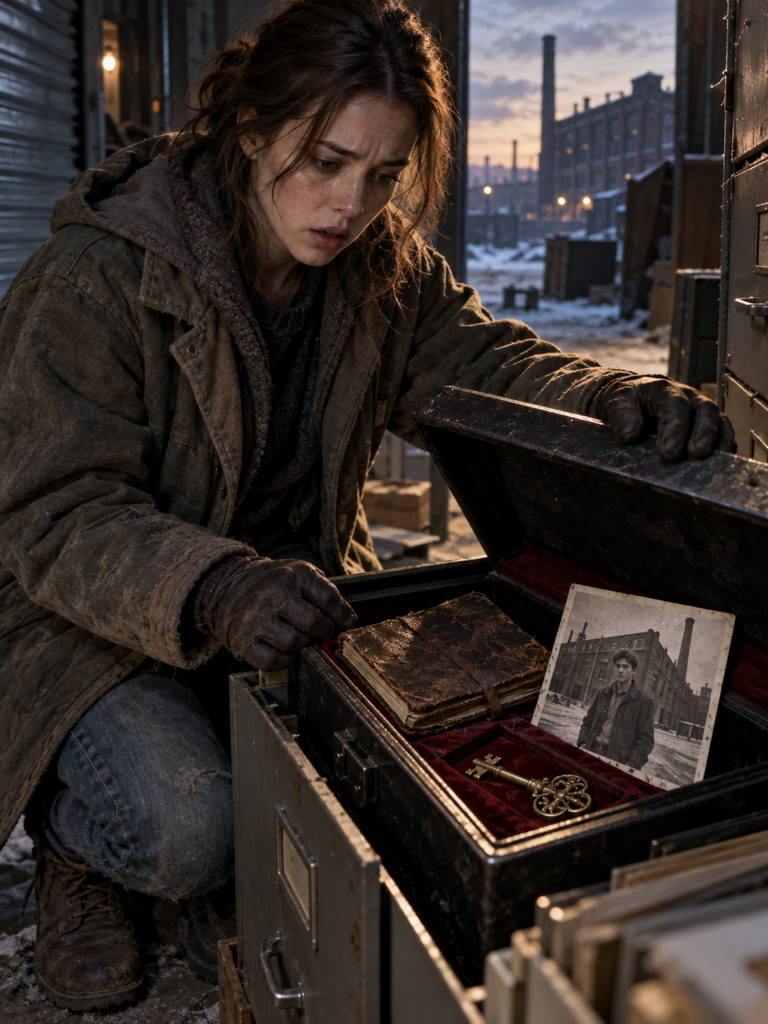
The first handwritten page was filled with such forceful strokes that the pen had gouged the paper.
Nora leaned closer.
The writer was furious with the people surrounding him.
He described his company’s board, his attorneys, and relatives who seemed to care more about dividing his wealth than preserving what he had built.
His words were not the careful reflections Nora expected from a celebrated businessman.
They were bitter.
Exhausted.
Almost desperate.
She checked the opening pages for dates.
There were none.
That made it difficult to establish when the entries had been written, much less whether the journal was authentic.
Still, she kept reading.
Arthur Pendleton, if these truly were his words, had come to hate the empire that made him famous.
Nora found the contradiction unsettling.
For years, she had calculated every expense before allowing herself to spend a dollar.
The man described in these pages had possessed more money than she could comprehend.
Yet he wrote as though wealth had trapped him.
One entry described the liquidation of Western Holdings.
Fifty million dollars.
Nora read the amount twice.
The journal implied that Pendleton had deliberately moved portions of his fortune away from the people he distrusted.
But it offered no account numbers or evidence showing where the money had gone.
She searched the remaining pages.
There were references to businessmen, lawyers, and the machinery of a vast organization.
Then the tone changed.
The writer began talking about beginnings.
About labor.
About what a man remembered before other people decided what he was worth.
Nora turned to the final written page.
Only one sentence occupied its center.
“The seed remains where the soil was first turned. Seek the iron.”
She said the words aloud.
At first, they sounded like the private philosophy of an aging man.
Then she remembered the photograph.
Nora laid it beside the journal and studied the building again.
Above its main doors, faded stone lettering identified Atlas Iron Works.
She searched Pendleton’s biography once more.
There it was.
Before developing his software business, Pendleton had worked at Atlas.
A workplace accident had interrupted his factory career and led him toward night classes in computing.
The factory was not simply a building he had once visited.
It was where his earlier life had ended and his new one had begun.
Nora placed the brass key between the journal and photograph.
Could “seek the iron” refer to Atlas?
Possibly.
But the phrase could also have meant something personal.
And nothing established that the key opened anything at the factory.
She considered selling the journal itself.
A genuine personal diary belonging to a deceased billionaire might attract interest.
But proving it was genuine would be difficult, and the estate dispute made the situation more complicated.
The box might contain private property connected to legal claims she did not understand.
For the first time that evening, she felt something more uncomfortable than excitement.
Responsibility.
She had legally bought the abandoned contents of Unit 412, or so the auction paperwork said. That did not necessarily settle every question about the documents or any property they might identify.
Her next choice mattered.
Nora examined the photograph’s silver frame.
The younger Pendleton stood on an uneven dirt road, wearing a heavy canvas jacket and flat cap.
The photograph was ordinary enough.
A worker posing outside his workplace.
But its inclusion with the journal and key was unlikely to be accidental.
She brought her phone closer and compared the photograph with old images of the factory.
The smokestacks and arched entrance appeared consistent.
Atlas was the strongest lead she had.
Nora checked the time.
2:41 a.m.
Outside, the city was dark and almost motionless.
She should have slept.
She knew it.
She should have investigated whether the site was accessible, whether the buildings were structurally safe, and who controlled the property.
Instead, she looked toward the final notices pinned to her refrigerator.
She thought of the empty grocery shelf.
And of fifty million dollars mentioned in a journal she still couldn’t authenticate.
She put on her coat.
Then she took her flashlight from the kitchen drawer and retrieved the crowbar she kept beneath her bed.
She slipped the brass key and photograph into her pocket.
Leaving the journal and fireproof box on the table, Nora crossed to the apartment door.
Her hand closed around the deadbolt.
She turned it, opened the door, and stepped into the dark hallway on her way to Atlas Iron Works.
The stairwell smelled of damp plaster and old cooking oil.
Nora descended three flights with the flashlight in one pocket, the brass key in another, and the folded photograph tucked safely inside her coat.
Every footstep made her question what she was doing.
She had spent the day moving garbage.
She had barely eaten.
It was nearly three in the morning.
And now she was heading toward a condemned factory because of a mysterious sentence in a journal that might not even be genuine.
At the bottom of the stairs, she stopped.
She could still turn around.
The photograph did not prove there was anything waiting at Atlas Iron Works.
The key did not establish that Pendleton had concealed money there.
Even the journal’s references to liquidated assets could have several explanations.
But she had one thing she had not possessed that morning.
A lead.
And desperation made the distinction between a lead and a promise dangerously easy to forget.
Nora went outside.
The cold struck her immediately.
Her sedan started on the second attempt, coughing through the freezing air before settling into an uneven idle.
She drove toward the river.
At night, the city looked stripped of its last defenses.
Empty bus stops stood beneath flickering streetlights.
Old storefronts faced deserted sidewalks.
Farther downtown, office towers rose beyond neighborhoods where boarded windows outnumbered occupied ones.
Nora passed the factory’s distant smokestacks long before she reached the riverfront.
She remembered seeing them from the bus when she was younger.
Atlas Iron Works had once employed generations of local families.
By the time Nora was old enough to understand what a factory closing meant, Atlas was already a decaying landmark.
Politicians periodically promised to demolish it.
Nothing happened.
The building remained.
Six stories of brick, broken windows, rusting steel, and unpaid attention.
She parked her car several blocks away behind a deteriorating billboard.
For a moment, she remained seated, staring at the empty passenger seat.
“This is ridiculous,” she whispered.
But she switched off the engine.
The factory stood beyond a stretch of abandoned industrial property.
A chain-link fence surrounded the site, though long sections had deteriorated badly.
Nora followed the perimeter until she found a wide gap.
She knew entering an abandoned industrial building was dangerous, and she had no permission to be there.
That knowledge did not disappear simply because she was frightened of being poor.
Still, she slipped through.
Frozen gravel shifted beneath her boots.
The wind carried the smell of river water and rust.
From outside, Atlas looked enormous.
Up close, it seemed almost impossible that human beings had once crossed its floors every day.
Nora raised the flashlight.
The beam passed over cracked masonry, exposed beams, and tall windows with broken glass remaining in their frames.
She approached the old loading dock.
The entrance opened onto a vast industrial floor.
Massive machinery stood where workers had abandoned it decades earlier.
Overhead tracks disappeared into darkness.
Water had gathered in low sections of the floor.
Nora moved slowly, avoiding damaged areas and checking each step before putting her weight down.
She took the photograph from her pocket.
The young Pendleton stood outside the factory’s original main entrance.
Behind him, the large doors had unusual wrought-iron hinges.
Their triangular shapes stood out even in the faded image.
Nora held the photograph beside her flashlight.
Then she studied the actual building.
The old main doors were chained shut.
Their hinges matched.
That established something small but useful.
The photograph had almost certainly been taken here.
Yet it told her nothing about the key.
She considered returning to the car.
If the journal’s message referred to the factory, the most obvious place to begin would be somewhere associated with Pendleton’s work.
But Atlas covered an immense area.
Searching it alone in darkness was unreasonable.
Nora looked at the floor plan suggested by the surviving structure.
The main production area stretched toward large brick furnaces.
The office spaces seemed to have been clustered near the center of the operation.
Pendleton had worked on the factory floor before his accident.
Perhaps what mattered was not the front entrance shown in the photograph but the industrial heart of the building.
She moved toward the furnaces.
The temperature seemed to drop as she went deeper inside.
Every movement stirred dust.
She passed a row of rusted machine housings, then a collapsed section of ductwork.
Behind the second large furnace, something interrupted the old brick wall.
Nora stopped.
A steel door.
Unlike the surrounding machinery, it did not look decades old.
Its surface was dark and reinforced.
The frame had been fitted into an altered opening in the brickwork.
Even from several feet away, the modification was visible.
She moved closer.
The door had no conventional handle.
At its center sat a circular keyhole.
Nora’s first thought was that somebody had converted part of the factory into secured storage after Atlas closed.
That would explain the newer construction.
It would not necessarily have anything to do with Pendleton.
She examined the hinges.
Their metalwork included triangular details resembling those on the factory entrance.
The similarity was interesting, but not decisive.
A common industrial design could have been repeated in many places.
She touched the brass key through her coat.
Then she drew it out.
The key was heavy enough that she had been aware of it during the entire walk.
For a few seconds, she simply stood there.
If it did not fit, she would have to accept that she had followed the wrong interpretation.
If it fit, she still wouldn’t know what lay behind the door.
She removed her right glove and brought the key toward the lock.
The brass shaft entered smoothly.
All the way.
Nora froze.
She withdrew it halfway, then eased it in again.
It seated in the mechanism with a solid metallic click.
Her mouth went dry.
The key had found its lock.
The journal’s message, the photograph, and the factory were no longer merely suggestive coincidences.
Someone had placed a matching key inside that fireproof box.
And she had followed it to a secured compartment hidden within Atlas Iron Works.
Nora wrapped her fingers around the carved head.
She turned.
At first, nothing happened.
She tried steady pressure in the same direction.
Deep inside the door, a heavy mechanism moved.
The sound traveled through the masonry.
One bolt released.
Then another.
A dull thud echoed behind the steel.
Nora pulled back instinctively.
The door remained closed.
She put her gloved palm against it and pushed.
It moved inward.
Unexpectedly smoothly.
The hinges were still functional despite the surrounding factory’s deterioration.
That detail frightened her more than a seized lock would have.
It suggested that this little enclosure had been constructed and maintained separately from the abandoned building.
But she could not establish when, or by whom.
Nora opened the door wide enough to shine her flashlight inside.
It was not a large chamber.
It was a narrow, steel-lined compartment built into a modified recess in the brick wall.
No windows.
No shelves.
No furniture.
Just bare concrete and two objects.
An olive-drab canvas duffel bag.
And a white envelope resting on top.
Nora remained in the doorway.
The compartment was dry.
There was less dust than in the surrounding factory.
Whatever this room had been built to protect, it had done its work.
She shone her light over the walls and floor, searching for obvious damage or signs of recent activity.
She saw none.
That did not prove the compartment had been untouched.
It only meant she could not see evidence otherwise.
Nora stepped inside.
The narrowness of the room made her suddenly conscious of the open doorway behind her.
She bent down.
The envelope was made from thick paper, yellowed slightly with age.
Across the front, in dark handwriting, were three words.
“To the finder.”
She stared at them.
No individual name.
No family member.
No business partner.
Just whoever eventually opened the compartment.
Nora was struck by how different that was from the journal.
The journal distrusted nearly everyone who had known Pendleton.
This envelope appeared to address a complete stranger.
She carefully lifted it from the bag.
The flap was closed.
She tore the edge open and removed a folded sheet of cream-colored stationery.
Her flashlight trembled against the page.
The letter began by anticipating the writer’s death.
It referred to an empire consumed by people who had never understood the labor behind it.
Then it described a realization.
Pendleton had spent his life building wealth as protection, only to discover he had trapped himself inside it.
The final instruction was unmistakable.
Whatever the finder discovered here was meant to purchase freedom, not another fortress.
The letter ended with initials.
A.P.
Nora read it again.
Nothing in the note specifically identified her.
There was no reference to the storage auction, Unit 412, or her circumstances.
She had not been chosen.
At least, there was no evidence she had.
The letter was addressed to whoever completed the journey.
That made the discovery both more extraordinary and more troubling.
Why would a man with a multibillion-dollar estate arrange for a stranger to find something after his death?
Why hide the directions inside a storage unit that had gone unpaid for years?
And if he wanted to protect the contents, why leave no clearer instructions about their legal status?
Nora folded the paper along its original creases.
Then she looked down at the duffel.
The bag was ordinary.
Faded canvas.
Reinforced seams.
Heavy brass zipper.
She had imagined something like a case of old financial records.
Perhaps photographs or documents connected to Pendleton’s career.
A private archive.
Even a collection of personal keepsakes might have justified the elaborate hiding place in the mind of an increasingly isolated man.
But the letter said something else.
It spoke about buying freedom.
Nora lowered herself onto one knee.
She touched the bag.
It was surprisingly dense.
Not soft like clothing.
Not irregular like a collection of miscellaneous possessions.
The weight inside was compact and evenly distributed.
She gripped the zipper.
The metal resisted at first.
Then it moved.
The canvas parted several inches.
Her flashlight fell across tightly packed, plastic-wrapped sleeves.
Inside them were rows of yellow metal coins.
Nora stopped breathing for an instant.
She opened the zipper farther.
More sleeves.
And beneath them, thick bundles of financial instruments held together with aging paper bands.
She recognized the word Krugerrand on the coin packaging.
Gold.
Actual gold.
She lifted one wrapped sleeve, surprised by its weight.
The coins were so orderly that the entire bag seemed less like forgotten property than a deliberately assembled reserve.
Nora looked toward the letter in her hand.
Pendleton had not simply left a cryptic account of his dissatisfaction.
He had concealed something valuable.
Something he apparently intended an unknown finder to discover.
But as Nora counted the visible sleeves, another realization arrived.
If these coins were genuine, she might be looking at more money than she had ever held in her entire life.
And she had absolutely no idea whether she could legally keep any of it.
She set the sleeve back in the bag.
The gold remained there, cold and unmistakably heavy.
Then she lifted one of the banded documents into the flashlight beam and saw what kind of instrument lay beneath the printed heading.
Bearer bonds.
Nora slowly lowered herself to the concrete floor.
The duffel bag was filled not merely with gold, but with the very kind of portable wealth a man might choose if he wanted to move assets beyond the ordinary channels of his business empire.
The journal’s reference to liquidated holdings suddenly carried a different meaning.
This could be where at least some of that money had gone.
She placed the bond carefully back in the bag.
Then she turned the letter over, searching for another page, another condition, anything explaining what Pendleton truly expected her to do.
There was nothing.
Just the message.
The initials.
And the heavy canvas bag between her knees.
Nora looked from the blank back of the letter to the open duffel bag.
For several seconds, she couldn’t make herself move.
The flashlight rested against her thigh, its beam illuminating the neat rows of gold.
She had imagined finding something valuable inside the storage unit.
An antique.
A collectible.
Perhaps a forgotten tool she could sell for enough to pay the electricity company.
She had not imagined sitting inside a concealed steel compartment in an abandoned factory, holding a letter apparently written by one of the richest men in America.
And she certainly had not imagined gold coins packed beside bearer bonds.
Her first instinct was to count.
That was what poverty had trained her to do.
Count money.
Count bills.
Count the days before another payment came due.
Count what could be postponed without losing something essential.
She picked up one plastic sleeve and examined it beneath the flashlight.
The coins inside bore the recognizable designs of South African Krugerrands.
Their markings indicated one ounce of fine gold per coin.
If they were genuine, each was worth a substantial amount.
The bag held dozens of sleeves.
Possibly hundreds of coins.
Nora tried to estimate the total, using the rough gold price she remembered seeing recently.
Even a conservative calculation pushed the value well into the hundreds of thousands.
Then came the bonds.
She knew almost nothing about them beyond their basic purpose.
Bearer instruments had historically been transferable through possession, although actual ownership, validity, redemption, and tax obligations could be far more complicated.
Some bearer bonds had matured or become difficult to redeem.
Others could be subject to legal restrictions or disputes.
Their presence did not make the money anonymous or automatically hers.
She looked at the signature on Pendleton’s letter.
A.P.
Two initials could not establish authenticity.
Neither could the stamped name on the journal.
But the combined evidence was difficult to dismiss.
The journalist’s accounts described Arthur Pendleton as a secretive billionaire who had moved significant assets before his death.
The journal claimed its author had liquidated holdings.
Its final message pointed toward iron and beginnings.
The photograph showed Pendleton at Atlas.
The brass key had opened this precise compartment.
And here, under a letter addressed to a future finder, lay portable assets resembling what the journal had suggested.
The pieces formed a coherent chain.
That did not answer every legal question.
It did, however, answer the mystery of why the three objects had been preserved together.
They were instructions.
Not a conventional map with marked routes and hidden landmarks.
A personal trail made of a remembered place, a sentence, and a key.
Nora imagined Pendleton arranging the contents of the fireproof box.
The journal he wanted someone to read.
The photograph of himself before he was wealthy.
The key to what he had left behind.
It was not possible to know every detail of his plan.
But the objects themselves revealed its structure.
A finder needed to recognize his name.
Read his private thoughts.
Connect the photograph with the clue.
And return to the place where he had begun.
Nora thought about the difference between that young factory worker and the billionaire whose death had made headlines.
In the photograph, Pendleton wore a practical work jacket.
His hands were visible against the front of his coat.
There was nothing about him that announced the fortune to come.
He looked like someone trying to make a living.
Someone who probably understood the end of a long shift, the ache of physical labor, and the necessity of earning the next paycheck.
That realization affected Nora more deeply than the number attached to his estate.
For the first time, she saw the beginning of his life as something closer to hers.
Not identical.
Not even necessarily comparable.
But close enough to understand why he might have returned, in memory, to the factory floor.
Before Pendleton Dynamics.
Before lawyers and corporate boards.
Before the fortune became the center of every relationship he distrusted.
There had been a man who worked at Atlas Iron Works.
The journal had not been celebrating that period.
It had been mourning something he believed he lost afterward.
Nora reread the letter.
The writer described wealth as a fortress he had built around himself.
Then he warned the finder against making the same mistake.
The instruction was not to grow the money indefinitely.
It was not to build another empire.
It was to use the discovery to become free.
Nora felt the dangerous pull of those words.
She pictured her refrigerator at home.
The notice from the electric company.
The pantry containing almost nothing.
The cracked window she had covered with plastic because she couldn’t afford repairs.
Then her imagination leaped further.
A warm apartment.
Groceries without a calculator.
A car that started reliably.
A medical appointment without checking the balance in her account first.
A home with working heat.
A life in which every unexpected bill did not threaten everything else.
Her eyes burned.
She blinked hard.
The letter was not a legal guarantee.
Pendleton might have wanted a stranger to take the bag, but wanting something did not automatically make it lawful.
The estate remained disputed.
The bonds might be subject to claims.
And the location itself raised questions about ownership that she was not equipped to resolve alone.
But the possibility had already changed something inside her.
Until that moment, the future had always seemed to be moving toward Nora from a position of power.
Rent could rise.
Hours could disappear.
A car could break down.
A bill could arrive.
She could respond, scramble, sacrifice, and fall behind.
Now an entirely different future existed, at least as a possibility.
The question was whether she could reach it without turning herself into someone she would later despise.
Nora examined the steel compartment again.
Its walls had been installed within older brickwork.
The door was reinforced.
The hinges moved freely.
Whoever arranged this hiding place had invested time and care.
The bag and letter had been protected against ordinary exposure.
That mattered.
Pendleton had not lost this wealth accidentally.
The placement suggested deliberate concealment.
And the envelope suggested deliberate discovery.
But there was a difference between finding someone’s intended gift and knowing all the legal rights attached to it.
Nora took a slow breath.
The immediate temptation was simple.
Zip the bag.
Carry it to her car.
Go home.
Tell nobody.
She could almost hear her own exhausted thoughts arguing for it.
After everything life had taken from her, why shouldn’t she accept one unexpected gift?
She had paid for the storage unit.
She had found the key.
She had done the work.
She had followed the clues.
Nobody else had even wanted to bid twenty-seven dollars.
And yet the journal described a man who came to believe everyone near him wanted to extract something.
Nora didn’t want the first important decision of her new life to be driven entirely by that same hunger.
She lifted the letter into the flashlight beam once more.
“Buy your freedom,” she whispered.
Then she folded it carefully and returned it to the envelope.
She decided she would not destroy or conceal the documents establishing the bag’s origins.
Whatever happened next, she wanted the discovery to be verifiable.
The journal, photograph, and letter formed a history.
The key proved a physical connection.
The bag was part of an unresolved estate story, not merely loose money lying in an empty building.
She could protect the evidence without surrendering hope.
Nora returned the bond to its original position.
She counted the visible sleeves carefully enough to understand the scale of what she had found, without pulling everything apart on the dirty factory floor.
Her rough estimate suggested that the gold alone could represent an enormous sum.
The bond values were harder to assess.
Some might be redeemable.
Some might not.
She would need professional help to determine that.
The total value could not be established from a flashlight inspection in an abandoned factory.
Neither could her right to it.
But the bag was clearly not an illusion.
She pressed one palm against the canvas.
Cold gold shifted faintly underneath.
For the first time since the storage auction, she allowed herself to smile.
It was small.
Almost embarrassed.
Not the expression of someone who believed all her problems had vanished.
The expression of someone who realized there might be a way out.
She zipped the duffel carefully.
Then she looked at the narrow doorway.
Getting the bag out would not be easy.
It was far heavier than it appeared.
Nora slid the strap over her shoulder and immediately felt it drag against her coat.
She adjusted her grip, keeping the weight close to her body.
The movement made her aching back protest.
She stopped to steady herself.
The factory was silent apart from the distant wind moving through broken windows.
A few hours earlier, she had hauled a ruined sofa from a storage unit with almost nothing to show for it.
Now she was carrying a bag whose contents might be worth more than she could earn over many years.
Both loads hurt her shoulders.
But only one represented possibility.
Nora stepped out of the steel compartment.
She placed the bag on the floor while she checked that the letter was secure inside her coat.
Then she pushed the heavy door closed and turned the brass key.
The locking bolts engaged.
The compartment was empty now.
Its purpose, whatever Pendleton had intended, had been fulfilled.
She pocketed the key.
The route back through Atlas was slower.
The duffel pulled against her balance.
She kept the flashlight directed at the floor, watching for broken concrete and openings near the old machinery.
Once, she had to set the bag down and rest.
Her breath rose in clouds.
Her hands ached inside the gloves.
It occurred to her that she could have left the bag where it was and returned with help in daylight.
That would have been safer.
But she had already committed herself, and the thought of abandoning it now felt impossible.
When she finally reached the loading dock, the wind struck her full in the face.
She stepped into the cold night.
Beyond the fence, the city lay under a colorless sky.
The road back to her car was deserted.
Nora carried the bag through the gap in the fence and continued toward the billboard.
She did not feel invincible.
In fact, she felt more vulnerable than before.
The weight on her shoulder was not simply valuable.
It was complicated.
Someone could dispute it.
Someone could demand proof.
Someone could tell her she had no claim.
And the financial instruments could turn out to be less valuable than they appeared.
But she had enough evidence to seek answers.
And enough reason to believe those answers might matter.
At her sedan, Nora lowered the bag into the trunk.
She stood with both hands resting on the edge for a moment.
Then she carefully removed the envelope from her coat and read it one final time.
The writer’s central message remained painfully simple.
He had spent his life accumulating power and wealth.
In the end, he wanted someone to use what remained to escape the fear and confinement that money had failed to cure for him.
Nora could not know whether Pendleton had envisioned someone like her finding the trail.
Perhaps he had expected a curious auction buyer.
Perhaps a former associate.
Perhaps a stranger drawn to the factory because of the photograph.
The note did not identify anyone.
That uncertainty mattered.
She refused to turn it into a story in which she had been chosen by fate.
She had been desperate.
She had taken a chance.
She had noticed a cabinet other people might have discarded.
And she had followed what she found.
Those were the facts.
She returned the envelope to her coat.
Then she closed the trunk.
The sound echoed through the empty street.
Nora drove home more carefully than she had driven out.
She knew she needed sleep, food, and a clear head before taking another step.
She also knew that eventually she would need independent authentication of the documents, confirmation of the bonds’ status, and reliable legal advice about the abandoned-unit purchase and Pendleton’s estate.
She had no intention of walking into a public office with a duffel bag and announcing that she was rich.
Nor would she rush to sell assets whose provenance she did not yet fully understand.
The first task was to keep everything together.
The second was to learn what it actually meant.
At her apartment, she carried the bag upstairs in stages.
By the time she reached the third floor, her arms were trembling.
She locked the door behind her.
The fluorescent kitchen light flickered as she set the bag on the floor beside the table.
The journal remained where she had left it.
The silver-framed photograph rested on the faded velvet inside the document box.
Nora sat down, unable to resist looking at the image once again.
Arthur Pendleton stood outside Atlas Iron Works.
A young man in a work jacket.
The factory rose behind him.
She wondered whether he had ever imagined the life waiting ahead.
The billions.
The companies.
The suspicion.
The isolation.
The strange decision to hide part of his wealth where his working life began.
Then she thought of the envelope.
“To the finder.”
No name.
No promise that the finder deserved anything.
Just an invitation to understand something the writer believed he had learned too late.
Nora turned the photograph toward the kitchen light.
For the first time, she did not look at the smokestacks or the doorway.
She looked at Pendleton himself.
The man in the photograph had been standing at the beginning of his story.
The man who left the letter had been looking back at it.
And Nora was sitting between those two versions of him, holding evidence of how far someone could travel without ever finding peace.
She placed the photograph gently beside the journal.
She wasn’t going to forget the message, even if the money turned out not to be hers.
But she wasn’t going to romanticize poverty, either.
There was nothing noble about an empty refrigerator.
Nothing character-building about being afraid to switch on the heat.
Nothing spiritually valuable about choosing between groceries and electricity.
If the discovery could lawfully change her circumstances, she intended to let it.
Just not at the cost of losing herself.
She gathered the journal, photograph, key, letter, and bag together, keeping the provenance of each item clear.
They were all part of the same chain.
A neglected storage unit.
A hidden filing cabinet.
A fireproof box.
An old photograph.
A brass key.
A forgotten industrial building.
And a letter from a dead billionaire who seemed to have understood the value of freedom only after spending his life purchasing everything else.
Nora put her hand on the duffel.
The room was still cold.
The bills were still on the refrigerator.
Her bank account had not changed overnight.
No court had established her rights to the assets.
No institution had confirmed their value.
She still faced difficult questions and potentially a long legal process.
But the future no longer felt entirely closed.
At sunrise, the city would wake to another ordinary day.
Phil would continue auctioning abandoned storage units.
Dave would look for things he could resell.
People would go to work, pay bills, and try to make their money last until Friday.
Somewhere, the Pendleton estate dispute would continue.
And in a third-floor apartment, a woman who had nearly lost her electricity sat beside a canvas bag holding a possibility she could scarcely comprehend.
She had not found guaranteed salvation.
She had found a secret deliberately left for someone to discover.
What she did with it would determine whether the lesson inside Pendleton’s journal meant anything.
Nora reached over and switched off the flickering kitchen light.
In the darkness, she remembered the $27 she had handed to Phil.
It was all the cash she had possessed.
A few hours ago, losing it had felt like the end.
Now she understood that the strangest part of the discovery wasn’t the amount of gold, the value of the bonds, or even the identity of the man who had hidden them.
It was that Arthur Pendleton, with billions to his name, had left behind a warning about what money could not give him.
And Nora, who had spent years without enough money to live comfortably, had stumbled upon that warning while searching for something worth selling.
The two of them had approached the same question from opposite ends of a fortune.
How much did a person need before they could finally feel free?
Pendleton had never written down an amount.
He had left a key.
Nora placed it beside the photograph.
Then, for the first time in many nights, she allowed herself to imagine a future in which survival would not consume every waking thought.
Whatever the legal and financial answers turned out to be, she would face them with care.
Because she understood the real danger now.
It wasn’t only that she might lose the treasure.
It was that she might gain it and forget why she had wanted a different life in the first place.
She closed the journal.
Outside, the first pale light of morning reached the windows.
And Nora began planning not how to become another Arthur Pendleton, but how to make certain she never had to live in fear of an empty pantry again.


