
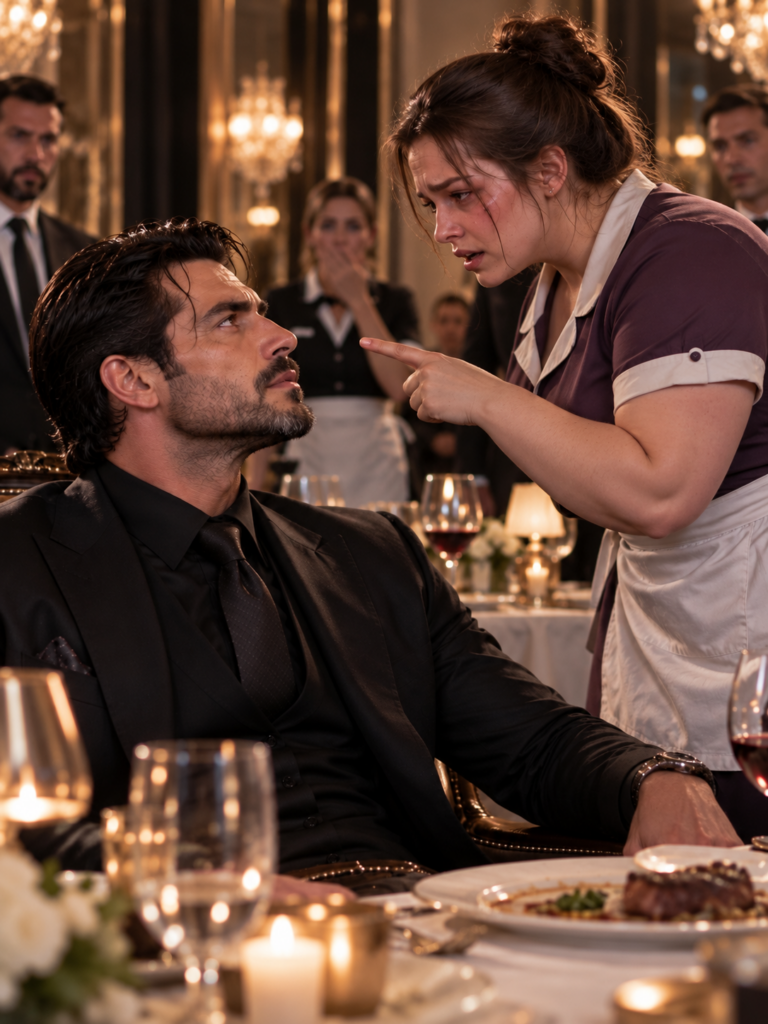
The porcelain cup shattered against the diner wall less than six inches from Emily Carter’s head, spraying hot coffee across her sleeve while fourteen customers stared at the floor.
Instead of apologizing, the exhausted waitress looked directly at Alessandro Romano—the man judges feared, cops avoided, and criminals called Boss—and said, “If you shout one more time, I’ll ask you to leave.”
Three weeks later, Emily would be tied to a metal chair on the abandoned East Docks because the one honest thing Alessandro had done in fifteen years had convinced his closest friend that the king had become weak enough to kill.

PART 1 — THE WAITRESS WHO TOLD THE MOST FEARED MAN IN THE CITY TO LEAVE
The coffee cup struck the wall at 9:42 on a Wednesday night.
It did not hit Emily Carter.
That distinction seemed important only to Alessandro Romano.
To everyone else inside Rosie’s Diner, the message was clear enough.
Coffee ran down the faded yellow wall in a brown ribbon. Two pieces of white porcelain spun across the cracked tile near Emily’s shoes, and one drop of hot liquid landed on the cuff of her pale-blue uniform.
She looked at the stain.
Then at him.
Alessandro Romano was thirty-eight years old, broad-shouldered, dark-haired, dressed in a charcoal overcoat that probably cost more than Emily earned in four months. Two men guarded the entrance while Victor Russo, his silver-templed right hand, stood beside the jukebox with his arms folded.
Everyone in the city knew the Romano name.
Emily knew it too.
She also knew she had been awake since 4:18 that morning because her mother’s oxygen alarm had gone off.
She knew there were three unpaid hospital envelopes hidden beneath flour coupons in her kitchen drawer.
She knew her checking account was twenty-nine dollars below where it needed to be before Friday’s rent cleared.
And somewhere during the last fourteen months of smiling politely at insurance representatives while her mother slowly lost the strength to cross a room, something inside Emily had become too tired to kneel.
“If you shout one more time,” she said, “I will ask you to leave this diner.”
The room stopped breathing.
Dana, the nineteen-year-old waitress behind the register, went visibly pale.
Victor’s head turned.
Alessandro stared at Emily as if she had begun speaking another language.
“Do you know who I am?”
Emily set the coffee pot onto the warmer.
The click sounded absurdly loud.
“I know exactly who you are.”
His eyes narrowed.
“Then you know what happens to people who waste my time.”
Emily leaned both hands against the counter.
“I also know what happens to customers who throw dishes.”
Victor let out a short, incredulous laugh.
One of Alessandro’s men shifted near the door.
Emily pointed toward the broken cup.
“That cost three dollars.”
No one moved.
“If you want another coffee, I’ll make one.”
She met Alessandro’s eyes.
“If you want to keep yelling and breaking things, you can pay your check and leave.”
Victor whispered:
“Jesus Christ.”
Alessandro took one slow step toward the counter.
Emily’s heart slammed painfully against her ribs.
She could feel sweat cooling beneath her collar.
She was afraid.
Terrified, actually.
But fear and surrender had stopped being synonyms sometime during her mother’s second hospitalization.
Alessandro leaned closer.
“You think this is courage?”
“No.”
Emily’s voice remained quiet.
“I think I have six tables, two people waiting on pie, and exactly eleven minutes before the kitchen closes.”
Something almost imperceptible changed in his expression.
Not amusement.
Recognition.
He looked toward the wall.
Then back at her.
Behind Emily, Rosa Morales emerged from the kitchen holding a dish towel.
Rosa was sixty-four and had survived a violent marriage, immigration, two restaurant bankruptcies, and a grease fire that took half her eyebrows in 1998.
Even Rosa looked nervous.
Alessandro reached inside his coat.
Dana gasped.
Victor straightened.
Emily did not move.
His hand came back holding a black leather billfold.
He removed a hundred-dollar bill.
Placed it flat on the counter.
Smoothed it once with two fingers.
“For the cup.”
Emily looked at the money.
Then at him.
“The cup cost three dollars.”
And for the first time that night, Alessandro Romano looked like a man who genuinely did not know what would happen next.
PART 2 — HE CAME BACK FOR COFFEE. HIS RIGHT HAND CAME BACK FOR BLOOD.
For several seconds, Alessandro stared at the hundred-dollar bill as though Emily had accused the money itself of wrongdoing.
Then he pushed it slightly toward her.
“Keep the change.”
“No.”
A pulse moved in his jaw.
Emily opened the register.
She removed ninety-seven dollars in bills and coins, counted it carefully, and placed the change in front of him.
“Three dollars.”
Victor made a sound that might have been a cough disguising another laugh.
Alessandro looked sideways at him.
Victor immediately became interested in the jukebox.
Emily waited.
Finally, Alessandro collected the change.
Not quickly.
Not angrily.
He slid the bills back into his wallet, left three dollars on the counter, and turned toward the door.
His men moved with him.
Before leaving, Alessandro stopped beneath the red neon OPEN sign and looked back at Emily.
There was no threat in his face anymore.
That almost frightened her more.
Then he walked into the night.
The door bell rang.
The black vehicles outside pulled away.
And fourteen customers exhaled at once.
Dana reached Emily first.
“What is wrong with you?”
“A lot.”
“You told Alessandro Romano to leave.”
“Yes.”
“You corrected his tip.”
“It wasn’t a tip.”
Dana grabbed both sides of her own head.
“He could buy this diner.”
“He didn’t.”
“He could buy the block.”
“Probably.”
“He could kill you.”
Rosa said sharply:
“Dana.”
“What?”
“She knows.”
That silenced her.
Emily took a rag and began wiping coffee from the wall.
Her hand remained steady for exactly thirty-eight minutes.
At 10:27, she climbed into her fifteen-year-old Honda in the nearly empty parking lot, closed the door, and collapsed forward over the steering wheel.
The shaking came so hard her teeth clicked.
She tried inserting the key into the ignition.
Missed.
Again.
Missed.
“Oh, God.”
Her forehead pressed against the wheel.
“What did I just do?”
The brave version of the story would later become very popular.
The waitress who feared nobody.
The woman who stared down a king.
It was not true.
Emily was frightened of nearly everything that mattered.
Her mother dying.
Losing the apartment.
Opening bills.
Falling asleep so deeply she missed the oxygen alarm.
What she had stopped fearing was embarrassment.
Once life took enough from you, shame became expensive luggage.
Emily finally started the car and drove home.
Their apartment occupied the ground floor of a tired brick building where pipes knocked whenever anyone above them showered.
The living room no longer looked like a living room.
A rented hospital bed occupied the center.
An oxygen concentrator hummed beside the sofa.
Prescription bottles lined the side table where Emily’s mother once kept knitting magazines.
Margaret Carter was awake.
“You’re late, baby.”
Her voice had become thin during the previous year, but her eyes had not changed.
Still sharp.
Still capable of seeing through every lie Emily produced before breakfast.
Emily dropped her purse.
“Long shift.”
Margaret studied her.
“What happened?”
“Nothing.”
“Emily.”
“Mama.”
“I made you.”
Margaret tapped one finger weakly against the blanket.
“Therefore I know when your face is lying.”
Emily sat beside the bed.
For several seconds, she watched the oxygen tubing rise and fall against her mother’s chest.
Then she told her.
The cup.
The shouting.
The name.
The hundred dollars.
Margaret listened.
When Emily finished, her mother’s mouth curved.
“Good.”
Emily stared.
“What?”
“I raised you to stand up straight.”
“I may have gotten myself murdered.”
“That would be inconvenient.”
“Mama.”
Margaret reached toward her.
The movement cost visible effort.
Emily leaned closer so her mother could touch her cheek.
“If he comes after you because you told him to behave like a human being, then whatever happens is on him.”
Margaret’s thumb brushed beneath Emily’s eye.
“But you remember something.”
“What?”
“You stood up straight.”
Emily began crying before she could stop herself.
Quiet tears.
The kind she had refused herself for almost two years.
She pressed Margaret’s hand against her face.
“I’m tired.”
“I know.”
“I’m so tired.”
“I know, baby.”
Emily slept on the couch beside the hospital bed.
Or tried.
Every passing set of headlights drew her eyes toward the window.
Every footstep in the hallway became Alessandro’s men.
Nothing happened.
Morning arrived gray and painfully normal.
Emily made oatmeal.
Measured medication.
Helped Margaret wash.
Then drove back to Rosie’s because rent did not pause when dangerous men entered your life.
The story had spread.
Regulars asked questions they pretended were jokes.
Pete Reynolds, a retired mechanic who had eaten meatloaf at table seven every weekday for eleven years, caught Emily’s sleeve.
“I heard.”
“Apparently everyone did.”
“Kid, Romano remembers things.”
“So do I.”
Pete frowned.
“That’s not what I mean.”
Emily poured his coffee.
“I know.”
The first day passed.
Then the second.
By day three, Emily had almost convinced herself Alessandro Romano had filed the incident under minor inconvenience and forgotten her.
At four in the afternoon, the bell rang.
She looked up.
Alessandro entered alone.
No Victor.
No guards.
No expensive overcoat.
Dark sweater.
Plain black trousers.
He looked almost ordinary.
Almost.
Dana saw him and retreated into the kitchen so quickly she hit the swinging door with her shoulder.
Alessandro sat at the counter.
Emily approached.
“What?”
“I would like coffee.”
“That’s brave.”
His mouth moved slightly.
“I was told the coffee here is terrible.”
“It is.”
“Yet people return.”
“People make mistakes.”
“Apparently.”
She poured a cup.
Set it down.
Alessandro wrapped both hands around the ceramic.
He did not drink.
“I came to tell you nobody is coming after you.”
Emily folded her arms.
“Why should I believe you?”
“You shouldn’t.”
The answer surprised her.
He continued:
“Not yet.”
“Then why say it?”
“Because you’re still looking at the door every thirty seconds.”
Emily hated that he had noticed.
“You walked into my diner with three armed men.”
“Two.”
“Victor counts.”
“He would appreciate that.”
“Not interested.”
Alessandro looked into his coffee.
“Fifteen years.”
“What?”
“That is approximately how long it has been since someone spoke to me the way you did.”
Emily leaned against the counter.
“I’m sure plenty of people think rude things about you.”
“Thinking is not speaking.”
“Maybe you should surround yourself with less terrified people.”
“Fear is useful.”
“For business?”
“For survival.”
Emily studied him.
He sounded tired.
Not physically.
Something deeper.
“You want my professional opinion?”
“Are you professionally qualified?”
“I serve coffee.”
“Apparently this includes psychological analysis.”
“You’re lonely.”
Alessandro looked up.
Emily continued before common sense returned.
“You have everyone afraid of you, so no one tells you anything real.”
“You can’t trust compliments because people want something.”
“You can’t trust loyalty because people need something.”
“So now you’re driving across town to sit in a diner because one exhausted waitress told you your coffee tantrum was embarrassing.”
The silence stretched.
Then Alessandro laughed.
Not loudly.
It came out rough, almost rusty, like something unused.
Emily stared.
He covered his mouth briefly.
“You are incredibly unpleasant.”
“So I’ve been told.”
“I believe them.”
He finally drank the coffee.
Made a face.
“This really is terrible.”
“Leave.”
He laughed again.
That was how it started.
Not romance.
Not friendship.
Something less comfortable.
Alessandro returned two or three times a week during the slow afternoon hours.
He chose the corner booth by the window.
Ordered meatloaf.
Pot roast.
Apple pie.
Foods that made no sense on a man whose suits looked hand-sewn in Milan.
He paid exact prices.
Eventually tipped normally.
No hundred-dollar performances.
After the second week, he pointed toward the seat opposite him.
“Five minutes.”
Emily looked around.
Only three tables occupied.
Dana waved from the register.
Go.
Emily sat.
“Five.”
“That sounded threatening.”
“It was.”
Their five minutes became ten.
Emily learned Alessandro had lost his father at twelve.
Killed over debts and territory.
His mother died two years later after working herself into illness.
The man who later raised Alessandro had treated affection like weakness and obedience like survival.
“He made you into what he needed.”
Emily said one afternoon.
Alessandro looked out the window.
“He kept me alive.”
“Those aren’t the same statement.”
“No.”
“You know that now.”
He turned his coffee slowly.
“Sometimes.”
She learned Victor Russo had been with him twelve years.
Matteo older.
Almost family.
Enzo young enough that Alessandro sometimes sounded protective when discussing him without realizing it.
Alessandro learned about Margaret.
Not the financial details.
Emily’s pride stopped those.
But he knew about the oxygen machine.
The heart failure.
The insurance battles.
He knew Emily slept beside the hospital bed.
Then one morning Margaret stopped breathing normally.
Emily woke to the oxygen machine alarming and her mother’s fingers clutching uselessly at the blanket.
The next fourteen hours happened in fragments.
Paramedics.
Emergency department lights.
A doctor with kind eyes.
Margaret stabilized by dawn.
The doctor pulled Emily into a consultation room.
Without surgery and aggressive follow-up treatment, he said, they might have weeks.
Maybe two months.
“How much?”
Emily asked.
He hesitated.
“Approximately eighty-five thousand for surgery and the initial treatment course.”
She laughed.
Not because anything was funny.
Because sometimes numbers became so impossible the mind rejected them as satire.
At home, Emily finally opened the bill drawer.
Envelopes covered the kitchen table.
She calculated.
Savings: $340.
Car value: perhaps $800.
Credit-card room: nearly none.
A small retirement account from a previous job: not enough to matter.
She put her head down on the bills.
Stayed there until the paper edges left marks against her cheek.
Then went to work.
Because rent still did not grieve.
Alessandro arrived at four.
Emily brought his coffee.
He looked at her.
“What happened?”
“Nothing.”
“You look like I did the morning my mother died.”
She stopped.
He pushed out the opposite seat.
“Sit.”
Emily should have refused.
Instead she sat.
“My mother had another crisis.”
Alessandro’s face changed.
“The doctor says weeks without surgery.”
“How much?”
“No.”
“How much?”
She stared at her hands.
“Eighty-five thousand.”
No response.
Good.
She did not want pity.
Then Alessandro stood.
Counted exact change for the untouched coffee.
Left.
Emily watched him cross the parking lot.
She felt strangely betrayed.
Not because he owed her anything.
Because she had spoken the ugliest truth in her life and he had responded by walking out.
The following morning, a young attorney entered Rosie’s carrying a leather folder.
“Emily Carter?”
She nodded.
He opened the documents.
Margaret’s surgery had been paid.
Not partially.
All of it.
Specialist retained.
Transport arranged.
Additional treatment funded through an irrevocable medical account whose paperwork contained no repayment clause, no lien, no access to Emily’s assets, and no personal obligation.
Emily read every page.
Then closed the folder.
“Take it back.”
“I’m afraid that instruction has to go to Mr. Romano.”
“Fine.”
She removed her apron.
Rosa watched from the kitchen.
“Where are you going?”
“To make a terrible decision.”
“Again?”
“Apparently it’s my brand.”
Alessandro’s office occupied the top floor of an old gray-stone building downtown.
Emily reached his desk and threw the folder onto it.
“Take it back.”
Alessandro looked up.
“No.”
“Nothing is free with men like you.”
His face remained still.
“You pay for my mother, and someday you need something.”
“A favor.”
“A package held behind the diner.”
“A lie.”
“A door left unlocked.”
“You come back and say her life cost eighty-five thousand dollars.”
Alessandro stood.
“No.”
“You don’t buy my mother.”
“I did not.”
“You don’t buy me.”
“I know.”
“How?”
He came around the desk.
Stopped several feet away.
“My entire life has been leverage.”
he said.
“Every gift has a hook.”
“Every favor creates a debt.”
“Every relationship has a hidden invoice.”
His voice lowered.
“I am asking you to let me do one thing without one.”
Emily’s eyes burned.
“Why?”
“Because I don’t remember the last time I did.”
She looked away.
He continued:
“Your mother should not die because you are afraid accepting help means becoming property.”
Her head snapped back.
“You don’t get to—”
“No.”
“You’re right.”
He corrected himself immediately.
“I don’t get to tell you what pride should cost.”
He looked exhausted.
“But you told me she raised you to stand up straight.”
“Standing straight does not mean refusing every hand.”
“It means knowing the difference between a hand and a chain.”
Emily stopped breathing for a second.
Alessandro did not move closer.
No comforting hand on her shoulder.
No ownership of the emotion coming next.
“Let the account remain hers.”
he said.
“Not yours.”
“Not mine.”
“Hers.”
Emily cried.
Not delicately.
Two years of fear came out in one ugly collapse.
Alessandro waited.
When she finally whispered:
“Okay.”
he nodded.
“For her.”
Emily wiped her face.
“For her.”
Margaret’s surgery happened the following week.
Recovery came slowly.
Then faster.
Within three weeks, she complained about hospital pudding.
Emily almost kissed the nurse who delivered it.
At night, Margaret began completing crossword puzzles again.
One evening she asked:
“Where did the money come from?”
Emily told her.
All of it.
The cup.
The diner.
The visits.
Alessandro’s offer.
Margaret listened.
Then said:
“There is no such thing as a bad man trying to be good.”
Emily frowned.
“That sounds harsh.”
“No.”
Margaret smiled.
“There is a man.”
“And then there is what he does next.”
Emily remembered that.
So did Alessandro, when she repeated it.
Because what he did next was visible.
He began withdrawing from businesses built on intimidation.
Refused certain port contracts.
Released debts.
Closed a gambling operation Victor considered essential.
Moved money toward legitimate real estate and hospitality holdings.
It made enemies.
More dangerously, it made his own people nervous.
Victor watched everything.
He watched Alessandro leave meetings early.
Watched him refuse profitable arrangements his old self would never question.
Watched him disappear twice a week during dead afternoon hours.
Finally, Victor followed.
Across the street from Rosie’s, inside a parked sedan, he watched Alessandro Romano laugh over meatloaf with a waitress.
Victor’s expression did not contain jealousy.
It contained fear.
A soft boss was a dead boss.
In Victor’s world, that was not philosophy.
It was arithmetic.
Months before Emily ever threw Alessandro’s change back at him, Victor had already taken one quiet meeting with Luciano Moretti.
One meeting became three.
Luciano was the head of the rival family that had fought the Romanos for two generations.
The agreement was simple.
Victor would provide security rotations, loyalist names, and one clean opportunity.
Luciano would remove Alessandro.
Afterward, the city would be divided.
Victor told himself he was protecting everyone who depended on the Romano structure.
Then Alessandro began changing.
Victor stopped feeling guilty.
He began feeling justified.
Emily knew none of this.
She knew Margaret was healing.
That was enough.
When the cardiologist finally used the words full recovery expected, Emily stood in the hospital corridor and cried into both hands.
Margaret ordered her to take Alessandro cookies.
“Homemade.”
“Mama, you nearly died.”
“And therefore I have earned authority.”
“You always had authority.”
“Exactly.”
The next afternoon, Emily carried a ribbon-tied box into Alessandro’s gray-stone building.
Something felt wrong immediately.
The receptionist’s desk was empty.
Coffee sat cooling beside an unanswered phone.
A man Emily did not recognize told her Alessandro was upstairs in a meeting.
“Wait in the third-floor lounge.”
Emily did.
Five minutes.
Then ten.
She stepped out looking for a restroom.
Voices came from a half-open office.
Victor.
She recognized him.
The second voice came through speakerphone.
Older.
Hoarse.
Victor said:
“The signing ceremony is Friday.”
“He’ll bring Matteo and Enzo.”
“My people control security.”
“The weapons stay outside.”
A pause.
Then:
“Romano dies before the ink dries.”
Emily’s blood turned cold.
The speakerphone voice asked about loyalists.
Victor answered:
“Twelve names.”
“Already sent.”
Then:
“And my territory afterward?”
Luciano replied:
“South side.”
“Exactly as promised.”
Emily pulled out her phone.
Pressed record.
Forty seconds.
Fifty.
Her hand trembled.
She stepped backward.
The floorboard creaked.
Silence inside.
Then Victor’s voice.
“Who’s there?”
Emily ran.
Stairwell.
Second floor.
First.
Her thumb hit Alessandro’s contact.
She attached the recording.
Typed:
Victor is betraying you. Luciano. Friday.
The rear exit burst open.
Afternoon light blinded her.
Her car waited across the lot.
Thirty yards.
Twenty.
A black SUV cut across her path.
Stopped.
Victor stepped out.
He adjusted one cuff.
Then the other.
“How much did you hear?”
Emily backed away.
“Enough.”
Victor sighed.
Almost sadly.
“I warned him about you.”
Two men appeared beside the SUV.
Emily looked down at her phone.
Message status:
Delivered.
Then Victor saw it too.
And every trace of politeness disappeared from his face.
PART 3 — HE HAD BUILT AN EMPIRE ON FEAR. SHE MADE HIM CHOOSE WHAT WAS LEFT WHEN FEAR WAS GONE.
Emily fought.
Not effectively.
That distinction mattered.
She kicked one man hard enough to make him curse and drove an elbow into another chest, but movies had lied about what size, leverage, and preparation meant.
Two trained men overwhelmed one exhausted waitress quickly.
A canvas hood came over her head.
Her wrists were bound.
Then she was inside the vehicle.
She did not scream.
Not because she was brave.
Because screaming felt like giving Victor something.
Instead, she counted.
Turns.
Stops.
Time.
Approximately twenty-six minutes before the smell changed.
Salt.
Diesel.
Cold metal.
Docks.
When the hood came off, Emily sat tied to a steel chair beneath a single industrial light.
Broken windows showed dead cranes against the night sky.
Luciano Moretti entered the pool of light wearing a silver-gray suit.
Elegant.
Relaxed.
Terrible.
“So.”
he said.
“You’re the waitress.”
Emily’s throat was dry.
“You’re the voice on the phone.”
Luciano smiled.
“I expected more.”
“Everyone does.”
He pulled another chair forward.
Sat.
“What did you do to Romano?”
“Served him bad coffee.”
Luciano laughed.
Victor remained near the edge of the light.
Uncomfortable.
“Enough games.”
he said.
“She sent the recording.”
“Friday is compromised.”
“Kill her and move the operation.”
Luciano lifted one hand.
Victor stopped talking.
Emily watched them.
Victor looked frightened.
Luciano looked entertained.
That difference mattered.
Luciano leaned closer.
“Romano was perfect once.”
“Efficient.”
“Predictable.”
“He understood that fear is the only currency that never inflates.”
“Then suddenly he’s closing businesses.”
“Giving away money.”
“Eating diner food.”
His smile sharpened.
“And saving mothers.”
Emily looked him in the eyes.
“I didn’t break him.”
“No?”
“No.”
“He was broken when I met him.”
The smile disappeared.
“I just told him.”
Victor shifted.
Luciano laughed once.
“Now I understand.”
Emily continued because fear had become too large to contain politely.
“You’re broken the same way.”
Victor stared.
Luciano became still.
“You think being feared means being respected.”
“You think everybody who stays is loyal.”
“You think power keeps you from being lonely.”
Emily swallowed.
“It doesn’t.”
For several seconds, nothing moved.
Then Luciano stood.
“You see?”
he said to Victor.
“This is why she matters.”
Victor frowned.
“She’s a waitress.”
“No.”
Luciano buttoned his jacket.
“She is the proof.”
“Romano will come because of her.”
Victor’s face tightened.
“That was never the plan.”
“Plans improve.”
“We were supposed to handle him Friday.”
“And now we handle him tonight.”
Luciano smiled toward Emily.
“She is not a loose end.”
“She is a bell.”
“When we ring it, Alessandro comes.”
Emily’s fear changed direction.
Until that moment, she had been afraid of dying.
Now she was afraid Alessandro would arrive.
She pictured him listening to the recording.
Seeing the broken message.
Knowing.
He would come.
That certainty became terrifying.
Across the city, Alessandro stood in his office listening to Victor’s recorded voice.
Once.
Twice.
He did not need a third.
Matteo arrived first.
Sixty-three.
Heavy coat.
Old eyes.
He saw the cookie box sitting abandoned in the third-floor lounge before anyone explained why it mattered.
“Girl came here?”
“Yes.”
“Where is she?”
“Taken.”
Matteo closed his eyes briefly.
“Victor?”
“Yes.”
“Damn.”
Enzo arrived next.
Then four men from Victor’s own list of people scheduled to be removed after Alessandro’s death.
That was the irony.
The betrayal told Alessandro exactly who remained trustworthy.
Enzo’s technician recovered the last known signal from Emily’s phone.
East Docks.
Old Moretti territory.
Matteo looked toward Alessandro.
“You’re thinking with your heart.”
“Yes.”
“That usually gets men killed.”
“Yes.”
“You going anyway?”
“Yes.”
Matteo sighed.
“Your father would hate what you’ve become.”
Alessandro looked at him.
“Good.”
Then he did something none of them expected.
He called an attorney.
Then a federal prosecutor named Caroline Webb.
She had been quietly receiving pieces of Alessandro’s archive for almost a year through an intermediary Victor did not know existed.
Caroline answered angrily.
“You understand what time it is?”
“Emily Carter was kidnapped.”
Silence.
“Who?”
“A civilian connected to none of this.”
“I have an audio recording of Victor Russo conspiring with Luciano Moretti to kill me and twelve associates.”
Caroline became fully awake.
“Send it.”
“I also have the complete archive ready.”
Another silence.
“Complete?”
“Yes.”
“What changed?”
Alessandro looked toward the safe where the old revolver his adoptive father once gave him remained locked away.
“Everything.”
Within forty minutes, an emergency operation began.
Not an army.
Not a private war.
Alessandro hated that he could not control every piece.
That was part of why he chose it.
Federal tactical agents staged near the docks under warrants Caroline obtained using the recording and years of corroborating evidence.
Alessandro was told to remain away.
He ignored half of that instruction.
Caroline met him near the staging site.
“You go inside and shoot somebody, I bury you with them.”
“Understood.”
“I mean it.”
“So do I.”
“Then let my people work.”
Alessandro looked toward the black warehouse buildings.
“She is in there because of me.”
Caroline’s voice stayed cold.
“No.”
“She is in there because Victor and Moretti kidnapped her.”
“Do not make yourself the center of a crime committed by other men.”
That sentence stopped him.
Nobody spoke to Alessandro Romano that way.
Nobody except Emily.
Caroline noticed his reaction.
“Good.”
she said.
“Now you’re listening.”
Inside the warehouse, Emily worked the rope against a rough edge beneath the chair.
Slowly.
Painfully.
She had learned patience beside her mother’s hospital bed.
You did not force difficult things simply because fear wanted speed.
You moved when movement worked.
Stopped when stopping kept you safe.
Victor paced.
Luciano received updates.
Then his phone rang.
His expression changed.
“What?”
he snapped.
Victor approached.
Luciano ended the call.
“Federal vehicles.”
Victor went pale.
“How?”
“The recording.”
“That isn’t enough for this response.”
Luciano turned toward him.
“What else did Romano give them?”
Victor understood.
“The archive.”
Emily saw the moment both men realized Alessandro had done something worse than attack them.
He had surrendered the leverage that made him untouchable.
Luciano grabbed Emily’s chair.
Pulled her upright.
“He wouldn’t.”
Victor whispered.
“He just did.”
The first command boomed from outside.
Federal agents identifying themselves.
Ordering surrender.
Luciano dragged Emily backward toward a side exit.
Victor followed.
“This is over.”
Victor said.
Luciano wheeled on him.
“It is over because you failed.”
“I gave you everything.”
“You gave me a compromised boss and a civilian who sent evidence before you took her.”
Victor’s face hardened.
“For twelve years I held Romano’s empire together.”
“And yet here you are holding nothing.”
Luciano shoved open a side door.
Cold harbor air rushed inside.
Emily’s wrists slipped free.
The rope had finally given way.
She said nothing.
Luciano pulled her outside.
The dock yard was washed in harsh white light from emergency vehicles beyond the fence.
Agents moved between structures.
Victor reached for Emily’s arm.
She twisted away.
Not gracefully.
Enough.
Luciano turned.
That half-second changed the geometry.
An agent shouted.
Victor froze.
Luciano attempted to pull a handgun from beneath his coat.
Everything stopped after that.
A single shot.
Not from Alessandro.
From the federal line.
Luciano dropped.
Alive.
Wounded through the shoulder.
His gun hit concrete.
Victor raised both hands.
Emily stood between them breathing so hard she could barely hear.
Then she saw Alessandro.
He had been kept behind the tactical perimeter until the yard was controlled.
Now he walked toward her.
Slowly.
No gun.
No coat.
No army.
Just Alessandro.
Victor looked at him.
Something like grief crossed his face.
“You gave them the archive.”
“Yes.”
“Everything?”
“Yes.”
“Fifteen years of leverage.”
“Yes.”
Victor laughed bitterly.
“For her?”
Alessandro stopped.
“No.”
Victor’s expression faltered.
“For me.”
Alessandro looked around at the officers, the evidence teams, Luciano bleeding while paramedics worked, the empire becoming paperwork around them.
“I should have done it years ago.”
Victor stared.
“You think this makes you clean?”
“No.”
“You think they forgive men like us?”
“I’m not asking them to.”
“Then what are you doing?”
Alessandro’s voice became quiet.
“Stopping.”
Victor shook his head.
“You can’t stop.”
“That’s the first lie men like us are taught.”
“You leave and somebody takes it.”
“You soften and somebody kills you.”
“You show mercy and everyone dies.”
His eyes moved toward Emily.
“She made you weak.”
Alessandro looked at Emily too.
Rope marks circled her wrists.
Dirt covered her uniform.
She was exhausted.
Furious.
Alive.
“No.”
he said.
“She reminded me weakness and cruelty are not opposites.”
Victor’s face twisted.
“I protected you.”
“For years.”
“Yes.”
“You should have told me you wanted out.”
Victor laughed.
“Would you have listened?”
Alessandro went silent.
Emily watched him.
Then he said:
“Maybe not.”
Victor looked almost startled.
Alessandro continued.
“That is mine to live with.”
“But you chose kidnapping.”
“Moretti.”
“Murder.”
“That is yours.”
Victor’s hands lowered slightly.
Agents immediately ordered them back up.
He obeyed.
Then Victor said:
“You were going to replace me.”
“No.”
“I saw the restructuring.”
“I saw contracts moving away from my control.”
“I saw you shutting me out.”
Alessandro looked tired.
“I was going to give you the legitimate restaurant division.”
Victor stopped.
“All of it.”
“Real estate too.”
“You could have walked away wealthy and clean.”
Something shattered behind Victor’s eyes.
For a second, he was not the traitor.
He was the younger man who once held an umbrella over Alessandro at a funeral.
Then the expression closed.
“You should have told me.”
“Yes.”
Alessandro said.
“I should have.”
Victor looked away.
Agents escorted him toward a vehicle.
No execution.
No dramatic final shot.
Just handcuffs.
Paperwork.
Consequences.
Perhaps that was crueler.
Emily’s knees finally gave.
Alessandro caught her.
Not lifting.
Supporting.
Different.
“Are you hurt?”
“Everything hurts.”
“Hospital.”
“No.”
“Emily.”
She looked at him.
“Do not start ordering me around now.”
For one heartbeat he almost smiled.
Then:
“Would you be willing to go to a hospital?”
“Yes.”
“That was unbearable.”
“You’ll survive.”
She looked toward the federal vehicles.
“The archive?”
“Transferred.”
“All of it?”
“All of it.”
“You actually gave up the thing that made you impossible to prosecute.”
“Yes.”
“What happens now?”
Alessandro glanced toward Caroline Webb.
“That depends on what is in it.”
“And what you’ve done.”
“Yes.”
Emily watched him.
“Are you scared?”
His answer was immediate.
“Yes.”
Good.
Truth again.
Margaret cried when Emily reached the hospital.
Not because Emily was badly injured.
She wasn’t.
Bruised wrists.
A cut near her eyebrow.
Dehydration.
Shock.
Margaret sat beside the bed holding Emily’s face.
“I leave you alone for one evening.”
“Mama.”
“You get kidnapped by organized crime.”
“I know.”
“I cannot take you anywhere.”
Emily began laughing.
Then crying.
Then both.
Margaret pulled her close.
“You stood straight?”
Emily nodded against her shoulder.
“Yes.”
“Good.”
Alessandro did not enter the room.
Emily noticed.
He waited in the hallway.
That mattered.
After Margaret calmed, Emily asked a nurse to let him in.
He stopped inside the doorway.
Margaret inspected him.
“So.”
Alessandro looked almost uncomfortable.
“You’re the bad man.”
Emily covered her eyes.
“Mama.”
Margaret ignored her.
Alessandro answered:
“Yes, ma’am.”
“Trying to be good?”
He looked at Emily.
Then back at Margaret.
“I’m trying to do better next.”
Margaret nodded once.
“Correct answer.”
Emily groaned.
Her mother turned toward her.
“What?”
“I taught you everything you know.”
The legal process lasted months.
The archive Alessandro surrendered implicated criminals, officials, contractors, and law-enforcement personnel.
Not every rumor proved true.
Some names were cleared.
Some cases collapsed under evidentiary problems.
Others became indictments.
Victor entered a plea after cooperating.
Luciano recovered and faced charges connected to kidnapping, conspiracy, racketeering, and multiple historic crimes.
Alessandro was not magically forgiven.
His own conduct was investigated.
Several businesses were forfeited.
Financial penalties followed.
His lawyers negotiated using years of cooperation evidence showing he had already begun providing prosecutors with information before Emily entered his life.
He avoided the fantasy where a criminal king simply walked away untouched.
He lost money.
Properties.
Control.
Reputation.
He kept his freedom under strict conditions because his cooperation dismantled networks prosecutors had failed to penetrate for decades.
Emily approved of exactly one thing.
He did not complain.
When one reporter asked Alessandro whether he believed he deserved leniency, he answered:
“That is not my decision.”
Then he walked away.
He closed every operation whose profit depended on coercion.
Restaurants remained.
Real-estate businesses.
A legitimate shipping company after independent compliance restructuring.
Enzo, recovered from his shoulder wound, became director of the restaurant group.
He was absurdly good at customer complaints.
Matteo retired.
He bought a small fishing boat despite disliking fish.
“Then why buy one?”
Emily asked.
“So nobody can call me.”
“That isn’t how boats work.”
“It is how mine works.”
Margaret recovered.
Fully.
The first time she walked three blocks without assistance, Emily followed beside her like a nervous bodyguard.
“Stop hovering.”
“I’m not.”
“You are practically breathing for me.”
“I spent two years watching your oxygen machine.”
Margaret stopped.
Took her daughter’s hand.
“I know.”
That evening, Emily opened the old bill drawer.
Empty.
Not because Alessandro paid everything forever.
Because Emily organized a repayment plan for the expenses that remained hers.
She insisted on supporting Margaret once she could.
The medical account Alessandro established stayed Margaret’s.
Exactly as promised.
He never referenced the amount.
Never used it in an argument.
Never made Emily thank him twice.
That mattered too.
Six months later, Emily left Rosie’s.
Dana cried.
Rosa pretended not to.
“You’ll come back.”
she said.
“To eat.”
“Not work.”
“Correct.”
Emily opened a coffee shop with a small-business loan and an investment Margaret made from selling an old inherited piece of land.
No Alessandro money.
Her choice.
He respected it.
The shop had sunlight.
Warm wood.
Plants Margaret insisted Emily would kill.
A long counter built slightly lower at one end so wheelchair users did not have to reach upward.
Emily hired people who needed second chances.
Single parents.
Older workers returning after caregiving.
A young woman named Zoe who apologized every thirty seconds.
On Zoe’s third week, a customer shouted because his sandwich took nine minutes.
He slammed his hand against the counter.
Zoe went pale.
Emily stepped beside her.
“Sir.”
“I’ve been waiting—”
“You may be frustrated.”
“You may not intimidate my staff.”
“I’m paying—”
“That does not purchase the right to frighten people.”
The man left.
Zoe immediately whispered:
“I’m sorry.”
Emily looked at her.
“For what?”
“The customer.”
“Was the delay your fault?”
“The kitchen printer jammed.”
“Then stop apologizing.”
Zoe blinked.
Emily softened.
“Listen to me.”
“You are allowed to take up room while doing your job.”
“Here, nobody bows their head because somebody louder wants them smaller.”
Zoe’s eyes filled.
Emily pretended not to notice.
That evening she hung one object on the wall.
The broken coffee cup from Rosie’s.
Rosa had saved it.
Margaret suggested repairing it using gold-colored resin.
The cracks remained visible.
Beautiful.
Not because breaking had improved the cup.
Emily hated that kind of sentimental lie.
Breaking was damage.
The beauty came from someone deciding damage did not automatically mean disposal.
Seven months after the docks, Alessandro disappeared from Emily’s daily life for almost six weeks.
Not mysteriously.
Court hearings.
Compliance work.
Travel connected to asset restructuring.
He called occasionally.
Never asked her to wait.
Emily did not.
She ran her shop.
Helped Margaret rebuild strength.
Argued with vendors.
Burned three trays of muffins.
Lived.
One afternoon, during the dead hour when sunlight turned gold through the windows, the bell above the entrance rang.
Emily looked up.
Alessandro stood there.
Plain dark sweater.
No convoy.
No Victor.
No shadow at his shoulder.
He looked older.
Lighter too.
He approached the counter.
Sat.
Emily said nothing.
She brewed coffee.
Placed it before him.
Alessandro looked toward the repaired cup hanging on the wall.
“Is that…”
“Yes.”
“You kept it?”
“Rosa kept it.”
“Why?”
“Evidence.”
“Against me?”
“Against bad tipping.”
He smiled.
Then his expression became serious.
“How is Margaret?”
“Complaining about everything.”
“So well.”
“Extremely.”
He looked down into his coffee.
“I came to say something.”
Emily leaned against the counter.
“That has historically been dangerous.”
“I know.”
He took a breath.
“I am done.”
“With what?”
“The old structure.”
“All of it?”
“Everything I could legally and practically close is closed.”
“What remains is legitimate and independently supervised.”
“The archive is no longer mine.”
“The officials whose names were in it are now somebody else’s problem.”
Emily watched him.
“And you?”
“I am learning how boring legal shipping can be.”
“Tragic.”
“It may kill me.”
“Imagine your obituary.”
She lowered her voice theatrically.
“Former feared underworld boss defeated by quarterly compliance review.”
Alessandro laughed.
The sound came easier now.
Then he asked:
“Would you have dinner with me?”
Emily did not answer immediately.
His expression tightened slightly.
She noticed.
“No diner?”
“Somewhere with respectable coffee.”
“Ambitious.”
“No bodyguards sitting at the next table?”
“I can keep security outside.”
“You still have security.”
“I still have enemies.”
“Fair.”
She wiped the counter.
“Dinner is not repayment for my mother.”
“No.”
“It isn’t gratitude.”
“No.”
“I don’t owe you access because you came to the docks.”
“No.”
“And if I decide afterward that I don’t want another?”
“I say thank you for the evening.”
Emily considered him.
He was still dangerous.
History did not vanish because a man changed direction.
He had done things she would probably never know in complete detail.
He carried consequences.
So did she.
Margaret’s voice returned to her:
There’s just a man and what he does next.
Emily untied her apron.
“Friday.”
Alessandro blinked.
“Friday?”
“Dinner.”
“Seven?”
“Seven-thirty.”
“I work until seven.”
“Seven-thirty.”
“No ridiculous restaurant.”
“What qualifies as ridiculous?”
“If the menu doesn’t show prices, I’m leaving.”
“That eliminates several options.”
“Good.”
He smiled.
“Seven-thirty.”
They went to dinner.
Then another.
Slowly.
Painfully slowly from Alessandro’s perspective.
Exactly right from Emily’s.
Their first argument happened because he sent a security car to follow her after she closed the coffee shop late.
Emily noticed within three blocks.
She called.
“Call them off.”
“Emily.”
“Call.”
“The Moretti remnants—”
“Do not secretly monitor me.”
“I was protecting you.”
“No.”
Her grip tightened around the phone.
“You were deciding for me.”
Silence.
Then:
“You’re right.”
She almost missed a red light.
“What?”
“I said you are right.”
“That was alarmingly fast.”
“I have lawyers who have spent eight months explaining consent in significantly more expensive language.”
Despite herself, she laughed.
Alessandro continued.
“I should have asked.”
“Yes.”
“What protection would you accept?”
The question changed everything.
They negotiated.
No covert car.
Emergency contact device she controlled.
Visible security only when a specific verified threat existed.
Emily received the same threat information Alessandro did.
No hiding danger “for her own good.”
Not romantic.
Real.
One year after Rosie’s, Margaret invited Alessandro for dinner.
He arrived with flowers.
Margaret looked at them.
“You know flowers die.”
Alessandro paused.
“I can return them.”
She smiled.
“Good answer.”
Emily closed her eyes.
The evening involved roast chicken, three arguments about politics, Margaret telling embarrassing childhood stories, and Alessandro voluntarily washing dishes.
Emily photographed that.
He looked offended.
“No one will believe me.”
she said.
“Delete it.”
“Never.”
He reached for the phone.
She pulled it away.
Margaret shouted from the living room:
“Leave her alone.”
Alessandro froze.
Emily burst out laughing.
“What?”
he asked.
“Nothing.”
“It’s just nice seeing someone else order you around.”
Margaret called:
“I heard that.”
Two years passed.
Alessandro sold the gray-stone office building.
The top floor became part of a legal-aid nonprofit after he donated it anonymously.
Emily knew because anonymous donations were apparently difficult when one person knew all your accountants.
He never rebuilt the old empire.
The legitimate Romano companies became boring.
Audited.
Tax-paying.
Profitable enough.
He disliked board meetings.
Emily considered this justice.
Victor’s final sentencing occurred two years and three months after the betrayal.
Alessandro attended.
Emily did not.
Afterward, he came to the coffee shop.
The repaired cup glowed in late sunlight.
“How was it?”
she asked.
“Quiet.”
“That’s all?”
Alessandro sat.
“He apologized.”
Emily waited.
“For kidnapping you.”
“For betraying me.”
“For believing fear was the only thing keeping us alive.”
“Did you forgive him?”
“No.”
The answer was immediate.
“Do you hate him?”
Alessandro thought.
“No.”
“What do you feel?”
“Sad.”
He looked toward the window.
“Which is worse in some ways.”
Emily brought him coffee.
“I spent years thinking betrayal would feel like rage.”
he said.
“It mostly feels like missing someone who no longer exists.”
Emily sat across from him.
“That’s grief.”
“I know.”
They remained quiet.
Some truths did not need solutions.
Three years after the broken cup, Emily expanded her café.
A second location.
Then a third.
She refused to call it a chain.
“It is mathematically a chain.”
Alessandro argued.
“It’s three coffee shops.”
“A chain.”
“No.”
“Emily.”
“Drink your coffee.”
He did.
Margaret began volunteering twice a week at a cardiac-recovery program.
She became infamous for arguing with doctors and telling newly diagnosed patients not to trust hospital pudding.
Enzo married.
Matteo bought a second boat.
He still disliked fish.
Caroline Webb became a U.S. attorney and continued occasionally calling Alessandro when some old document required explanation.
He always answered.
“That sounds terrible.”
Emily once said.
“It is.”
“You could ignore her.”
“She terrifies me.”
“Finally.”
Elena did not exist in this version of his life.
No daughter.
No secret family.
Just Alessandro, the men he had once called brothers, the woman who told him no, and the mother whose survival became the first decent act he allowed himself without charging interest.
Eventually, he proposed.
Not at the coffee shop.
Emily had threatened him with bodily harm if he turned her workplace into a public spectacle.
Instead, it happened in Margaret’s small backyard during a Sunday lunch.
No photographer.
No hidden musicians.
No expensive production.
He held a ring.
Then said:
“I am going to ask a question.”
Emily stared.
“That is usually how proposals work.”
“I need to finish.”
“Proceed.”
“You can say no.”
“I know.”
“And saying yes does not mean—”
“Alessandro.”
He stopped.
“You have spent three years learning how to ask permission.”
“Yes.”
“You are overperforming.”
Margaret shouted from the patio:
“Ask the girl before I die again.”
“Mama!”
“I already survived once.”
“I can joke.”
Alessandro laughed so hard he almost dropped the ring.
Then he looked at Emily.
No boss.
No king.
No name people feared.
Just a man.
“Will you marry me?”
Emily looked at Margaret.
Her mother smiled.
Then Emily looked at Alessandro.
At the hands that once controlled an empire.
Hands that had signed assets away.
Hands that had turned over evidence.
Hands that had learned they could open instead of close.
“Yes.”
He exhaled.
“Really?”
“Do not make me repeat it.”
He put the ring on her finger.
Then waited.
Emily kissed him first.
Their wedding was small.
Margaret.
Dana.
Rosa.
Pete from table seven.
Enzo and his wife.
Matteo complaining about the food while eating three servings.
Caroline attended for exactly forty minutes because prosecutors apparently had weddings scheduled in ten-minute increments.
No politicians.
No people Alessandro invited because they were useful.
No one afraid of him.
At one point, he stood near the back of the room and simply watched.
Emily found him.
“What?”
“I was thinking about something I told you at Rosie’s.”
“What?”
“That I wondered what it would feel like to enter a room where nobody was afraid of me.”
Emily looked around.
Dana was arguing with Enzo.
Margaret was cheating at cards with Matteo.
Rosa was giving catering instructions nobody requested.
Pete had fallen asleep.
Emily slipped her hand into Alessandro’s.
“Well?”
His eyes grew bright.
“It’s loud.”
“That’s your conclusion?”
“And I like it.”
Years later, people still told the diner story incorrectly.
They called Emily fearless.
She always corrected them.
“I was scared.”
“But you stood up to him.”
“Yes.”
“Doesn’t that mean fearless?”
“No.”
It meant fear had stopped getting the final vote.
That mattered more.
On the tenth anniversary of the broken cup, Emily closed her original café early.
Margaret had passed away peacefully two years earlier at seventy-three, after eight additional years no doctor had promised them.
Her death hurt differently from the one Emily once expected.
Not interrupted.
Not stolen.
Completed.
Margaret’s photograph hung beside the repaired coffee cup.
She was laughing.
No oxygen tubes.
Crossword puzzle in one hand.
Emily touched the frame.
Then began wiping the counter.
The bell rang.
Alessandro entered.
Gray now at the temples.
Still capable of silencing a room when he wanted.
He rarely wanted.
He sat on the original stool.
Emily poured coffee.
Set it down.
“You realize you have ordered the same drink for ten years.”
“I fear change.”
“That is demonstrably false.”
“I fear changing coffee.”
“More believable.”
He looked at the golden seams running through the old cup on the wall.
“Do you ever think about that night?”
“Sometimes.”
“Regret it?”
Emily smiled.
“The cup?”
“Everything.”
She leaned both hands against the counter.
The pose was almost identical to the first night.
Except nothing in her body was braced for attack.
“No.”
Then she corrected herself.
“I regret the people who got hurt afterward.”
“I regret the docks.”
“Victor.”
“Everything fear made expensive.”
She met his eyes.
“But I don’t regret telling you to stop shouting.”
Alessandro nodded.
“I regret shouting.”
“You should.”
“The coffee was genuinely terrible.”
“Careful.”
He smiled.
Then his expression softened.
“You know the strange part?”
“What?”
“I spent fifteen years believing power meant nobody could make me leave a room.”
Emily waited.
“And you taught me the opposite.”
“That sometimes the strongest thing you can do is leave the room you were never good inside.”
Emily looked at the man across the counter.
“Margaret would like that.”
“She would say it needs editing.”
“She absolutely would.”
They laughed.
Outside, evening light spread across the parking lot.
Ordinary cars.
Ordinary people.
No convoy.
No guards visible.
No empire waiting.
A young waitress at the far end of the counter dropped a glass.
It shattered.
The girl froze.
“I’m sorry.”
she blurted.
“God, Emily, I’m so sorry.”
Emily walked over.
Looked at the broken pieces.
Then at the terrified young woman.
“It’s a glass.”
“But—”
“Three dollars.”
The girl stared.
Emily smiled.
“Get the broom.”
“That’s it?”
“That’s it.”
The girl relaxed.
Alessandro watched from his stool.
Emily began helping gather the larger pieces.
Then noticed him smiling.
“What?”
“Nothing.”
“Alessandro.”
He lifted both hands.
“I know better than to argue with the woman who owns the cups.”
Emily laughed.
The bell above the door rang as another customer entered.
The shop filled slowly with evening voices.
Coffee steamed.
Dishes clinked.
Someone fed quarters into the old jukebox Emily had bought from Rosie when the diner finally closed.
Life moved around them without lowering its voice.
Years earlier, a porcelain cup had shattered against a wall and fourteen people had gone silent because one dangerous man expected fear to obey him.
Tonight, another glass broke.
Nobody flinched.
Nobody bowed.
Nobody became smaller.
A young waitress fetched a broom.
An older man drank his coffee.
And Emily Carter Romano stood beneath the warm lights of the life she had built, taking up every inch of space she needed.
She looked across the counter at Alessandro.
He lifted his cup.
“To three dollars.”
Emily raised one eyebrow.
“You still owe me ninety-seven.”
He laughed.
And this time, when the whole room looked toward him, not one person was afraid.

