
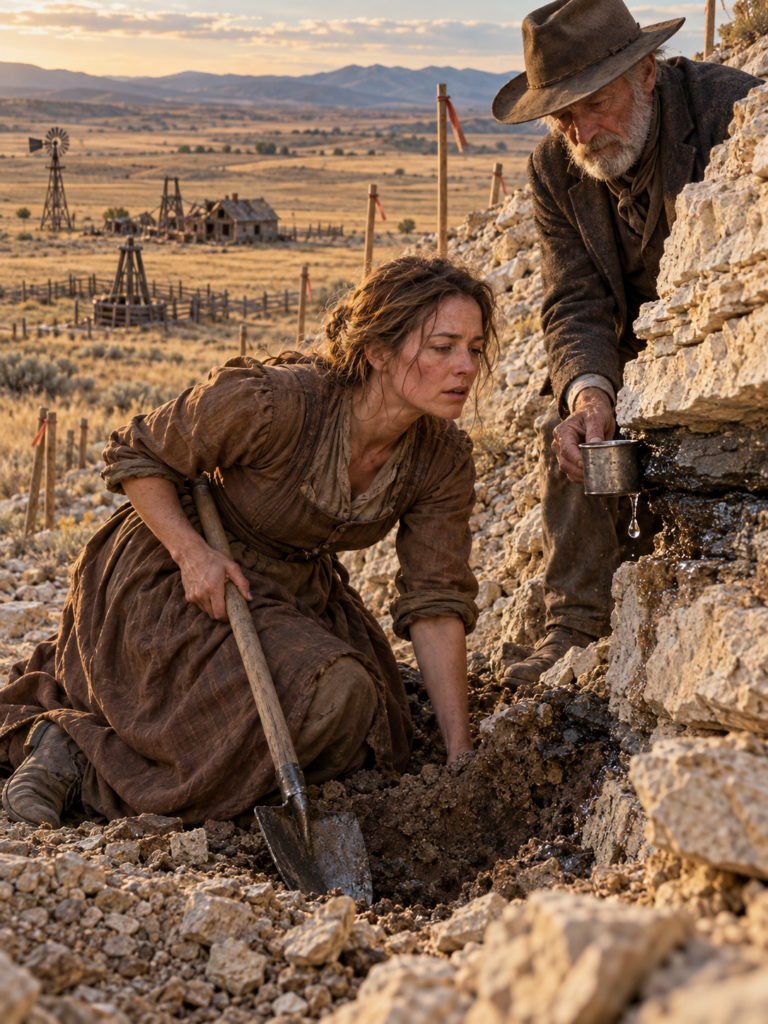
The first drop struck the bottom of Amos’s tin cup.
The sound was so small Zinnia might have missed it if the entire hillside had not gone quiet around them.
A second drop gathered.
Then another.
Amos crouched beside the exposed rock, examining the seam without touching it.
“From the side,” he murmured.
Zinnia nodded.
Every failed well on Harrow Reach had been dug downward, into the lowest available ground.
But this moisture was appearing horizontally, exactly where the fractured limestone met the darker shale.
It was the first physical evidence supporting the possibility Amos had described.
Not proof of a dependable spring.
Not yet.
Zinnia knew the difference.
She had spent three days digging seventeen feet into damp gravel only to find an empty hole.
She had watched bitter water rise inside a testing pipe and felt hope disappear when Alder refused it.
A few drops could not support a household, much less cattle.
Amos held the cup steady.
Zinnia examined the rock above the seam.
The limestone contained narrow fractures, some barely visible in the fading light. Beneath them, the shale formed a dense, continuous surface.
She traced its edge with one finger.
“Could this just be yesterday’s moisture?” she asked.
“It could be,” Amos answered.
That was why she trusted him.
He never offered certainty to make disappointment easier.
Zinnia reached for Warren’s measuring rope and checked the depth where her shovel had first struck shale.
Six feet, nine inches.
She repeated the measurement.
Then Amos examined the slope of the exposed layers.
The rock appeared to extend toward the old green strip and the north-facing stone where Zinnia had repeatedly found cool soil.
A possibility was becoming a physical pattern.
She looked toward the ridge above them.
During the June storm, she had watched runoff vanish into fractured limestone nearly three hundred feet from the lower ground.
The old military survey had marked a cold seep along the same general formation.
The freight driver’s journal had described water in that area decades before the flood.
And now an actual drop had emerged along the boundary between two different kinds of stone.
Each observation was limited.
Together, they were harder to dismiss.
Amos gently withdrew the cup.
A thin damp streak remained on its bottom.
“Leave it open tonight,” he said. “We need to know whether it keeps coming.”
Zinnia stared at the narrow seam.
She wanted to clear away the loose fragments packed against it.
She wanted to work the shovel into the gap and discover how much water might be trapped behind the stone.
For a moment, she understood why the previous owners had kept digging deeper.
Once a person believed the answer was almost within reach, stopping felt impossible.
But one careless blow could fracture the shale or loosen the soil holding the opening together.
She withdrew her hand.
“We measure first,” she said.
They secured the tools away from the edge and climbed out of the trench.
The late-afternoon light had turned the basin gold.
Below them stood the remains of the ranch’s failures: abandoned well structures, damaged fencing, a dry channel, and ground too poor to support the plans previous owners had made.
Zinnia looked down toward the cabin.
She remembered the first evening she had sat alone at its table.
She had placed two cups there out of habit.
Then she had returned Warren’s cup to the cupboard because no one would be coming through the door to use it.
For months she had carried his measuring rope across this property, not because it could bring him back, but because the patient habits he had taught her were among the few things she still owned.
She had almost sold those tools too.
Amos was watching the trench.
“If it’s trapped moisture,” he said, “we’ll know soon enough.”
“And if it isn’t?”
“Then we measure how much there is.”
No promises.
No celebration.
The old survey had already answered one important question: there had once been a recognized wet place beneath the ridge. Zinnia had not imagined every sign.
But the records could not tell her whether water still moved through that rock.
And if it did, they could not tell her whether it would last through summer.
Those were the questions that mattered now.
Zinnia returned to the edge of the excavation for one final look.
The seam was still damp.
Another drop gathered in the fading light.
She tightened her grip on the measuring rope.
Then she climbed down beside Amos, set the empty tin cup beneath the narrow opening again, and left it there for the night.
The tin cup remained beneath the rock seam as Zinnia climbed back out of the trench.
She looked down once more before following Amos toward the cabin.
A drop struck the metal.
Then another.
Neither of them tried to guess what the cup might contain by morning.
That night, Zinnia barely slept.
She had learned not to trust excitement, especially when excitement arrived after months of failure.
The seventeen-foot pit had looked promising until its walls began collapsing.
The water beneath the cottonwoods had looked promising until it coated her tongue with alkali.
This seam might become one more disappointment.
But it was unlike the others in one important way.
For the first time, her digging matched a pattern she could explain.
The water had not appeared simply because the ground was low.
It had appeared at a particular meeting of rock layers.
Before sunrise, Zinnia filled a bucket with the water she had hauled for household use, checked her pocket of tools, and led Alder toward the ridge.
Amos arrived carrying a pocket watch and another bucket.
The morning air was cold enough that Zinnia could see her breath.
They approached the trench together.
Zinnia descended first.
The tin cup had shifted slightly beneath the seam, but the dark shale was wet beyond the place where the cup stood.
More importantly, a thin ribbon of clear water was now sliding along the shale and entering the excavation.
It was not flooding the trench.
It did not gush from the rock.
It moved steadily, without interruption.
Amos lowered himself beside her and held out the bucket.
“Let’s find out what it can do.”
They measured the flow repeatedly.
One bucket.
Then another.
Amos kept time with his watch while Zinnia recorded the quantities in Warren’s ledger.
They repeated the procedure until their figures were consistent.
Approximately 2.3 gallons every minute.
Zinnia stared at the number.
She calculated what it meant over an hour.
Over a day.
A small amount of water, compared with the rivers that sustained larger ranches.
But unlike an isolated pocket, this water continued to arrive.
Amos would not call it permanent.
Neither would Zinnia.
They still needed to understand where it came from, whether clearing the opening would improve it, and how it responded to changing seasons.
She studied the fractured limestone immediately above the shale.
Loose roots and fragments of stone partially covered the narrow passage.
With Amos watching, she carefully removed the debris.
She did not widen the seam.
She did not strike the shale.
She lifted only what could be removed without damaging the rock.
The water spread into a slightly broader ribbon.
They measured again.
This time the average settled near 3.1 gallons per minute.
They checked it repeatedly.
The result held.
Zinnia sat back on her heels.
At last, Amos began explaining the structure they had uncovered.
Rain and melting snow entered the fractured limestone higher on the ridge.
The rock permitted water to travel through its cracks.
Beneath it lay dense shale, a layer that allowed far less water to pass downward.
Where the two formations met, groundwater could move sideways.
And where the surface of the hill cut across that boundary, water could escape.
A spring.
Not a hidden underground lake.
Not an endless supply.
A modest, moving source shaped by the geology of the land.
Zinnia looked toward the basin.
All five earlier wells had been dug in low ground.
Some had reached temporary water.
One had reached a deeper, bitter supply.
But they had not intercepted this particular moving layer.
The ranch’s history suddenly appeared different.
For thirty-one years, Harrow Reach had been treated as land that could not hold water.
Its owners had searched downward, trying to find where water collected.
The reliable source had been moving sideways beneath a ridge they had walked past countless times.
Zinnia took the old cup from Amos.
She washed it in the trickle, filled it, and examined the water.
Clear.
Cold.
No visible sediment.
She tasted a little.
The familiar bitterness of the cottonwood test was absent.
Then she climbed out of the trench and approached Alder.
She held the cup toward the horse.
Alder lowered his head.
Sniffed.
And drank.
Zinnia did not move until the cup was empty.
It was only one simple test, and she knew it did not establish everything about the water.
But she had watched Alder turn away from the earlier alkaline supply.
This time, the horse wanted more.
Amos stood beside the trench, waiting.
Zinnia took the ledger from her pocket and recorded the measurements.
She checked the flow once again.
Only then did she sit on the ridge and allow herself to feel what had happened.
She had purchased Harrow Reach with nearly all the money her old life had left her.
There had been mornings when she wondered whether Oren’s warning had been less a warning than a sentence.
This land takes more than it gives.
But the water had been here.
Not where anyone expected.
Not in a quantity that promised wealth.
Enough, perhaps, for something smaller and more durable.
Over the following days, word spread through Crowglass Basin.
Some people came because they were curious.
Others came because they had watched Zinnia marking the hillside with willow stakes and wanted to understand what she had been doing.
Then Oren Harrow returned.
He rode slowly past the old wells.
Zinnia watched him stop near one collapsed structure, then another.
Those wells represented years of his labor.
His family’s labor.
The effort of planting grain that burned at the roots, hauling water that never lasted, and trying to sustain cattle on ground that dried faster than the surrounding ranches.
When he reached the ridge, Zinnia showed him the trench.
Oren stepped down carefully.
He stared at the narrow stream crossing the dark shale.
For a long time, he said nothing.
Then he crouched beside it.
“Where does it come from?”
Zinnia pointed uphill.
She described the fractured limestone and the layer beneath it.
She explained what Amos had measured.
She showed Oren the route she had followed from the rainwater crack to the damp ground and finally to the place where the old maps had marked a seep.
Oren listened.
He had inherited the ranch in 1856.
The flood of 1869 had buried the old drainage.
Years later, he had leveled sections of the basin in the hope of making better pasture.
He remembered moving soil and stone.
He remembered the lost crops.
He remembered cattle becoming too weak to reach water.
During one terrible dry season, two animals had died before he could get them to a reliable source.
He had buried them himself.
Zinnia looked at the water.
She could have told him that he had dug in the wrong places.
She could have reminded him that she had asked about his wells before purchasing the land.
She could have made his failure the explanation for her success.
Instead, she showed him the seam.
The rock made the answer clearer than any judgment could.
Oren removed his hat.
“For thirty-one years,” he said, “I thought this land had failed me.”
Zinnia considered his words.
Then she answered, “We were asking it what we knew to ask.”
Oren crouched closer and washed the dust from his hands in the water.
He never suggested that Zinnia return the property.
He did not challenge her ownership.
He had come to see what he had missed.
Watching him, Zinnia understood that discovering water did not erase the damage caused by its absence.
His lost cattle were still gone.
The years spent struggling were still years he could never recover.
But the spring explained those years differently.
The land had not suddenly become generous because Zinnia owned it.
She had found a condition its earlier owners had not understood.
And she intended not to repeat their mistakes.
The first suggestions from neighbors were predictable.
Widen the opening.
Blast the rock.
Dig deeper.
Make the trickle into something large enough to serve every acre.
Zinnia refused.
The measurements did not justify those ambitions.
A spring producing just over three gallons per minute could be damaged by forcing the opening beyond its natural structure.
And even without damage, the flow was limited.
More land could be irrigated only if water were diverted from something else.
Zinnia began planning a system sized to the actual supply.
She and Amos checked the grades from the ridge toward a small forage field.
The proposed gravity ditch would need to travel 420 feet while falling only eight feet and four inches.
The margin for mistakes was narrow.
Water moving too fast could erode the channel.
Water moving too slowly could stagnate or fail to reach the field.
Zinnia built a small spring box using carefully fitted flat stones.
She left the main seam undisturbed.
Washed gravel protected the intake.
Cedar boards covered the structure, and a small overflow opening prevented water from backing up against the fragile rock.
Below it, she constructed a covered storage cistern designed to hold approximately 1,600 gallons.
Clay mixed with wood ash sealed its stone walls.
Heavy planks protected the stored water from the summer sun.
The system required adjustment almost immediately.
During the first irrigation trial, the water rushed through one section too quickly and carved a small channel through a planting row.
Zinnia shut the gate.
She narrowed the opening and divided the irrigation into alternating sections.
Later, early frost cracked part of the cistern lining.
She removed the damaged material and rebuilt the corner using fresh clay reinforced with dry grass fibers.
Each problem taught her something about the difference between locating water and making dependable use of it.
Amos checked her measurements.
He examined the grades.
He watched the flow stabilize after each adjustment.
But Zinnia made the repairs herself.
By the time the first forage rows responded, she was able to supply the field without drawing the storage reservoir dangerously low.
She had built a working system.
Soon, Caleb Noahr, a cattle buyer, made an offer for Harrow Reach.
The price was enough to clear Zinnia’s debt and leave her comfortably settled in town.
Elias Kroll, who still held the $35 note, advised her to consider it seriously.
Another rancher proposed leasing the spring to support a much larger herd.
Neither proposal was foolish.
Both offered financial security that Zinnia had scarcely known since Warren’s death.
She spent two evenings with her ledger.
She calculated the flow over a day.
Then she estimated summer losses, winter recovery, irrigation demands, and the water her animals would require.
When she reached the maximum herd the spring might support, she studied the number for a long time.
Then she drew a line through more than half of it.
The spring could sustain more than she currently owned.
That did not mean she should demand all of it.
She declined the sale.
She refused the large-scale water lease.
She fenced nearly two acres around the recharge ground above the limestone ridge, protecting it from trampling and unnecessary disturbance.
She kept her herd modest.
She limited the forage fields.
And she continued measuring the spring rather than trusting its early performance as proof that it would always produce the same amount.
Throughout the autumn, water moved through the covered box and into the cistern.
The ditch carried it toward the forage plots.
Alder drank from the trough.
The ranch was no longer without water.
But Zinnia knew a spring had to survive more than one favorable season before anyone could call it dependable.
That question was answered the following summer.
In 1889, heat settled over Crowglass Basin.
Rain became scarce.
The southern wind carried dust across the fields.
Stock ponds began shrinking.
Neighboring wells fell.
And one morning, Zinnia measured the spring’s flow and found that the figure in her ledger had changed.
It was no longer producing 3.1 gallons per minute.
The discharge had fallen toward two.
She closed the ledger and reached for the irrigation gate.
Zinnia wrapped both hands around the wooden irrigation gate and turned it shut.
The water stopped moving toward half the forage plots.
For a moment, she watched the remaining moisture disappear into the thirsty soil.
Those rows had taken months of work.
She had prepared the ground, planted carefully, repaired channels, and measured every small success.
Now she was deliberately allowing part of the field to dry.
But the figures in her ledger left her little choice.
The spring was still flowing.
It was simply giving less.
During its strongest measured period, it had produced approximately 3.1 gallons each minute.
In the summer heat of 1889, that figure had slipped toward two.
The difference was enormous when multiplied across every hour of every day.
The spring was dependable.
It was not inexhaustible.
Zinnia had understood that distinction before the drought began.
Now she would have to live by it.
For forty-three straight days, almost no rain reached Crowglass Basin.
The ground hardened.
Alkaline cracks widened in the fields.
Hot winds moved across the grasslands from morning until evening, carrying dust where green shoots had stood only weeks earlier.
Two stock ponds dried into mud.
On neighboring ranches, cattle crowded around shrinking water holes.
Harlan Pike’s well first became cloudy, then failed as loose sediment collapsed into the opening.
His animals could not survive on what remained.
At Harrow Reach, Zinnia continued recording the spring every morning and evening.
She measured the water in the cistern.
She checked the discharge.
She watched the recovery overnight.
Then she adjusted her daily use to fit what the water could actually replace.
She stopped irrigating the less important rows.
The remaining forage received only enough moisture to keep it alive.
She moved her modest herd closer to the troughs so less water would be spilled or lost during hauling.
She inspected the spring box for obstructions.
She protected the ground above the limestone from unnecessary traffic.
Most importantly, she resisted the temptation to open the system wider.
A rancher who saw a falling reservoir might try to force more water from the source.
Zinnia knew the spring’s limit had not disappeared merely because she needed more.
Its reduced discharge reflected what the dry season was doing to the recharge ground.
If she attempted to take more than the spring could replace, the consequences would be greater than a few sacrificed planting rows.
One evening, she sat near the cistern with Warren’s ledger open across her knees.
The earliest pages were crowded with descriptions of grass, rock, temperature, and soil.
Some notes recorded failed tests.
Others held corrections.
She found the entry describing her first seventeen-foot pit.
Damp gravel.
No sustained flow.
She remembered how she had stood at its edge, staring at the labor she had lost.
At the time, the result had felt almost like a judgment.
She had been certain she was closing in on water.
Instead, the pit had shown her only an old channel that no longer supplied it.
Then came the test near the cottonwoods.
Wet clay.
A little water.
Bitter alkali.
Alder turning away.
Those failures had been painful, but each had removed one incorrect explanation.
They had stopped her from believing that any moisture beneath the ranch would automatically solve its problem.
The real discovery had required a different question.
Not simply where she could dig deepest.
Not merely where the grass was greenest.
But where water entered the rock, how it traveled, and what forced it toward the surface.
She closed the ledger and looked toward the limestone ridge.
The system was behaving exactly as a limited natural supply should.
The drought was severe.
The output was lower.
Yet the spring still delivered water.
That night, the cistern recovered enough to support the next day’s carefully reduced demand.
And so Zinnia continued.
Day after day.
Measuring.
Adjusting.
Protecting.
Choosing what could survive instead of trying to preserve everything.
Then Harlan Pike appeared on the road leading into Harrow Reach.
He was driving twelve breeding cattle.
The animals moved slowly through the dust, their heads lowered.
Harlan stopped near the trough and removed his hat.
For nearly forty years, he had lived in Crowglass Basin.
He had known the Harrow property when its old owner was still struggling to keep it productive.
He had seen families fail on the same land.
And when Zinnia began marking the hillside with willow stakes, he had advised her to stop trusting a strip of green grass.
His reasons had not been malicious.
He knew what the dry basin could do to people who mistook hope for evidence.
He had watched enough failed wells to recognize the danger.
But he had been wrong about this particular hillside.
Now his own well was gone.
Without water before nightfall, he would need to sell the animals at a serious loss or attempt to move them more than twenty miles toward the nearest dependable river.
He explained the situation plainly.
Then he looked toward the covered spring box.
“I was wrong about that green strip,” he said.
Zinnia did not ask him to repeat the admission.
She walked to the cistern.
Harlan followed at a distance.
She opened the inspection cover and measured the remaining water.
Then she checked the spring’s current discharge and estimated how much the cistern could recover overnight.
The twelve cattle needed a substantial drink.
Her own animals would also need water.
The forage fields were already receiving less than she wanted.
She could not afford to make an emotional decision without checking the figures.
At last, she turned toward Harlan.
“They can drink,” she said. “But we’ll have to limit the time at the trough.”
Harlan nodded.
Zinnia opened the gate.
Clear water entered the wooden trough, and the first of the cattle lowered its head.
Harlan watched the animals drink.
Zinnia watched the water level.
The distinction mattered.
Gratitude could not refill a cistern.
Neither could pride.
Only the spring could do that, and the spring had limits.
When the cattle had received enough, she closed the gate.
The reservoir had fallen, but not beyond the level she had calculated.
Harlan brought his animals away from the trough.
For a moment, he appeared ready to speak again.
Zinnia shook her head gently and pointed toward the ridge.
“That’s where it comes from,” she said. “And there’s only so much.”
He looked up toward the protected limestone.
He understood.
The woman he had once advised to give up had found water where decades of effort had failed.
Yet the discovery had not made her careless.
She was sharing it only because she had measured what she could safely spare.
Not long afterward, Lottie Mears arrived leading two dairy cows.
She had two children.
The animals provided milk and income, and losing them before winter would place her family in a difficult position.
Zinnia listened.
Then she returned to the cistern.
She measured the level again.
She checked the time and estimated the water still entering the reservoir.
Lottie’s cows would need far less than Harlan’s twelve cattle.
Zinnia could admit them, provided the next day’s use remained tightly controlled.
She opened the gate.
Lottie stood nearby as the animals drank.
There was no ceremony.
No gathering crowd.
No speech about generosity or success.
The spring was a small one, and every decision had to account for what it could replace.
Zinnia could not save every ranch in Crowglass Basin.
She knew that.
She could not send water across twenty miles of dry country or support hundreds of additional cattle.
The offers to lease the spring would have demanded far more than its reduced summer output.
Even her own ranch had suffered.
Some forage rows were nearly dead.
Others had survived only because she rationed irrigation so carefully.
But Harlan’s breeding herd received enough water to continue.
Lottie’s dairy cows survived.
Zinnia’s own modest herd remained healthy.
The spring had not defeated the drought.
It had endured within its limits.
And that was enough to change what happened to several families.
When the rains finally returned, the first drops darkened the dust around the trough.
Zinnia stood outside the cabin and watched the water settle into the ground.
She did not rush to reopen all the irrigation gates.
She waited.
The spring’s recovery would depend on water entering the limestone and making its way through the fractured rock.
Rainfall on the surface did not guarantee an immediate return to its strongest flow.
She continued measuring.
Through the following weeks, the cistern responded.
The system remained intact.
The carefully protected intake had survived.
The spring box required ordinary attention but no desperate reconstruction.
Some of the forage recovered.
Other sections had to be planted again.
The ranch had suffered real losses, but it was still operating.
And unlike so many seasons in its past, there was enough water to begin again.
Zinnia’s debt to Elias Kroll had not vanished.
The spring did not turn her into a wealthy landowner.
Her fields had produced less during the drought than she had hoped, and she still had to live carefully.
But the ranch was now capable of sustaining a modest operation.
The note was paid later than originally expected.
When Elias saw the remaining forage and the animals that had survived, he accepted the delayed settlement.
Eventually, Zinnia paid the $35 in full.
The small debt had represented something much greater when she first signed the deed.
It was the last portion of a gamble made with nearly everything Warren had left her.
She had not known whether the land could provide a living.
She had only known that its failures deserved to be examined instead of accepted as permanent facts.
Now the balance was settled.
The deed remained hers.
And Harrow Reach was producing enough to justify the patience she had invested in it.
Amos Reddick returned after the drought.
He brought his measuring equipment and field book.
Together, he and Zinnia examined the spring.
They checked the discharge.
They compared the new readings with the earlier measurements.
They inspected the grade of the ditch and the condition of the stone spring box.
The water was still emerging along the shale.
It had decreased during the severe dry period without disappearing entirely.
The physical explanation continued to fit the observations.
Amos recorded his findings.
Then he closed his field book.
For Zinnia, that small gesture meant more than praise.
When she had first shown him her willow stakes and cloth bags of soil, he had refused to tell her that she had discovered water.
He had asked for evidence.
When the old surveys appeared to support her theory, he had insisted on measuring the rock.
When the first drop emerged, he had insisted on waiting.
When the flow began, he had insisted on recording it.
Now the spring had survived the harshest season she had experienced on the ranch.
They had enough evidence to understand what they had found.
The explanation was ordinary in the best possible sense.
Rain and snow entered fractured limestone.
Groundwater moved through the rock until it encountered dense shale.
The shale redirected the flow sideways.
Where the rock layers approached the hillside surface, the water escaped.
The flood of 1869 had buried an earlier outlet beneath mud and stone.
Subsequent leveling, grazing, and years of changing surface conditions had concealed the evidence.
The early surveyors and freight drivers had known there was a wet place near the northern rocks.
But that knowledge had disappeared from later maps.
Oren and his family had not been foolish.
They had dug wells according to methods that made sense to them.
The lowest ground often seemed the most reasonable place to search.
On this property, those attempts had missed the moving water in the hillside.
Zinnia had found the source not through a lucky strike of the shovel, but by challenging an assumption, comparing evidence, and changing her method.
That was the answer to the ranch’s thirty-one-year mystery.
No one had deliberately hidden the water.
There was no secret system built by earlier settlers.
No underground reservoir waiting to be opened.
No forgotten fortune beneath the limestone.
The land’s structure had remained there throughout the years of struggle.
What had disappeared was the visible sign of how it worked.
And with that sign gone, generations of effort had followed the wrong direction.
Harlan Pike became one of the first neighbors to apply what Zinnia had learned.
On his property, he stopped assuming that deeper or lower was always better.
He studied the relationship between fractured limestone and dense shale.
Then he began investigating a small collection trench where those formations met.
Zinnia did not promise him a spring.
Neither did Amos.
They had learned enough to understand that similar rock did not guarantee identical conditions.
But the method offered a better starting point than habit alone.
Other settlers visited Harrow Reach.
They studied the covered spring box, stone cistern, controlled overflow, and shallow irrigation grades.
Some were surprised by how modest the system appeared.
There was no enormous well.
No elaborate machine.
No rushing channel large enough to flood the valley.
Just a narrow spring, a protected intake, a carefully built storage reservoir, and a woman who could explain why each part existed.
The visitors often wanted to know how she had recognized the water.
Zinnia showed them the ridge.
She showed them where rain vanished into the fractured limestone.
She described the green grama grass, the cool north-facing stone, and the stand of struggling cottonwoods.
Then she explained why those signs alone had not been enough.
They could have indicated rain held in the soil.
The old channel could have contained only lingering moisture.
The alkaline test near the cottonwoods had produced water, but not water suitable for her animals.
The survey notation proved a seep had been observed decades earlier.
It did not prove one remained.
Only the excavation, repeated flow measurements, and the spring’s continued performance had established what she needed to know.
Visitors who expected a marvelous secret sometimes looked disappointed.
But those who worked dry land understood what she was telling them.
The discovery was not that water could hide beneath a hillside.
The discovery was that the direction of the search mattered.
Over time, the ranch’s reputation changed.
People gradually stopped referring to it as Dead Harrow.
The old name, Harrow Reach, returned to ordinary conversation.
Zinnia never altered the deed.
The words remained as they had been written at the county office.
To her, they were a reminder that the land had possessed its own history before she arrived.
Oren Harrow continued visiting occasionally.
He usually came in the evening, when the work was slowing and the light lay low over the ridge.
Sometimes he sat on an old fence post near the spring box.
For a long while he would say nothing.
He simply listened to the sound of water entering the wooden trough.
Zinnia never asked whether the sound made him happy or sad.
She suspected it was both.
He had spent more than three decades trying to make the ranch support his family.
He had exhausted himself digging wells.
He had buried animals lost to drought.
He had watched his children grow up on land that seemed determined to reject every effort.
And eventually he had sold it to a widow for $185 because he no longer believed it could be made to work.
The spring had not restored those years to him.
But it had given him an explanation that did not require believing the land itself had been hopeless.
One evening, he watched Zinnia lift the inspection cover from the spring box.
She checked the gravel around the intake and adjusted a cedar board that had worked loose.
Then she measured the flow.
Oren noticed the ledger resting nearby.
“Still writing everything down?” he asked.
“Every season,” she said.
He smiled faintly.
“You’ve already found what you came looking for.”
Zinnia looked toward the water.
“I’m not sure that’s how I would put it.”
Oren waited.
“I came here because it was what I could afford,” she told him. “Then I needed to understand what I’d bought.”
She closed the cover.
“Now I have to keep understanding it.”
Oren considered that.
Then he returned his attention to the trough.
The water continued moving.
It was not dramatic.
It never had been.
And perhaps that was what made the sound so difficult to forget.
Every drop was a small correction to a judgment that had stood for thirty-one years.
As autumn approached, Zinnia walked the ridge with Warren’s measuring rope.
The same rope she had once used to mark her first failed test pit now measured the boundaries of the protected recharge area.
She inspected the fence to ensure the cattle had not entered.
She recorded the first frost.
She noted where the grama grass remained green longest.
She examined small cracks in the stonework and repaired anything that might worsen during winter.
She kept the old survey information among her ranch papers, preserving the evidence that had pointed her toward the northern rocks.
It mattered to her that the story could be followed.
The original seep had been known in the nineteenth-century surveys.
The flood had altered the surface.
The outlet had been covered.
The later record had omitted it.
She had observed the land, tested the wrong places, compared the historical documents, and finally reached the correct layer of stone.
Every step explained the next.
Without that chain, the spring might eventually become just another tale about a widow who found water by luck.
Zinnia did not want that.
Luck had not dug the trench.
Luck had not protected the excavation after a failed pit collapsed.
Luck had not recognized the difference between bitter water and usable water.
Luck had not measured the spring through summer or made the difficult decisions necessary to preserve it during drought.
The years ahead would still require work.
The limestone could change.
The cistern could crack again.
A future drought might be worse.
She had no reason to believe that finding a spring exempted her from the ordinary uncertainties of ranch life.
But she had learned how to face them.
Observe first.
Measure carefully.
Test explanations.
Respect limits.
Revise the plan when the evidence changed.
One late afternoon, Zinnia returned to the cabin carrying the ledger.
The light fell across the same table where she had once placed two tin cups on her first night.
She stopped beside the cupboard.
For a long moment, she looked at the shelf where Warren’s cup had rested.
That first night, returning it to the cupboard had been an admission she had not yet known how to make.
He was gone.
The work they had shared was over.
She would have to build whatever came next without him.
Now the cup had been used for something neither of them could have anticipated.
It had helped test the water beneath Harrow Reach.
It had been held under a narrow seam in the limestone while she and Amos waited for proof.
And later, a clean cup had carried the first cold water that Alder willingly drank.
Zinnia took the two cups from the cupboard and set them on the table.
She filled one with water from the ranch.
The other remained empty.
She sat down and opened the ledger.
On its first page, beneath older marks and smudges from months of handling, she found the question she had written before digging her first hole.
“Where does the land keep what it cannot show?”
She did not cross it out.
She did not replace it with a triumphant answer.
Instead, she turned to a fresh page.
There she recorded the date, the condition of the spring, and the latest flow measurement.
She added a note about the fence above the ridge.
Then she closed the book.
Outside, the trough was filling.
The sound came faintly through the evening air.
Zinnia listened.
For years, people had looked at Harrow Reach and seen only the evidence of failure.
Five wells.
Dead crops.
Dry ponds.
An abandoned home.
A former owner who had given up.
Those facts had been real.
But the conclusion drawn from them had been incomplete.
The land had not been without water.
Its water had been moving in a place nobody had thought to examine closely enough.
And once Zinnia understood that movement, the ranch’s future no longer depended on forcing the ground to give her something it could not provide.
She only had to work with what was there.
The following morning, she rose before the sun cleared the limestone ridge.
Alder waited near the shelter.
The forage fields lay quiet beyond the cabin.
And beneath the pale stone, water continued slipping along the dark shale into the spring box.
Zinnia checked the trough, tightened one loose cedar plank, and took out her ledger.
She wrote another observation.
Then she looked across Harrow Reach, where generations had mistaken a hidden possibility for permanent failure.
The ranch was not rich.
It was not easy.
But it was alive.
And for the first time in thirty-one years, someone knew why.


