
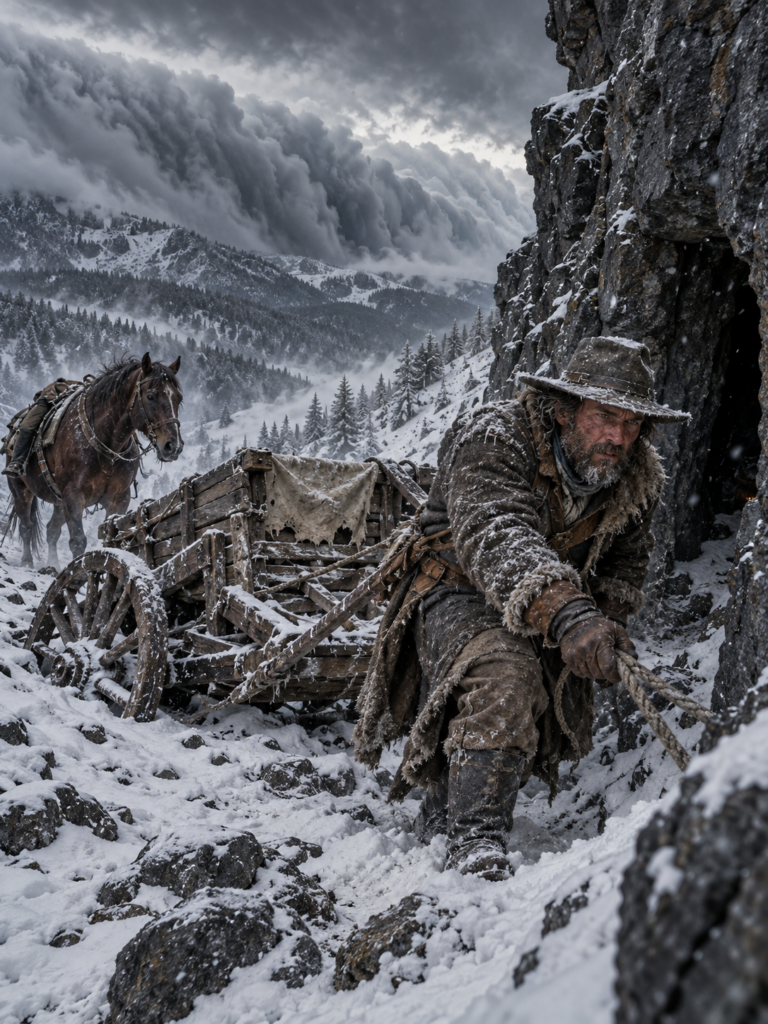
Brim’s front hoof crossed the threshold.
Then the horse stopped.
Pierce pulled gently on the reins, but the old animal raised his head and stared into the black hollow.
A fierce gust swept over the ridge.
Brim lunged sideways.
His shoulder struck the wagon boards with a sound that made Pierce’s stomach tighten.
The wall shook.
One leather fastening stretched.
Pierce grabbed the horse’s head before he could strike the structure again.
“Easy now,” he whispered.
Brim fought against him.
The tarp cracked overhead. The boards rattled. Snow swept into the narrow opening.
Pierce pressed his forehead against the horse’s neck.
“Easy now.”
The words sounded painfully familiar.
Clara had spoken them every winter morning while brushing frost from Brim’s mane beside the stable fence.
She had never raised her voice when the animal became frightened.
She simply stayed beside him until he trusted her again.
Pierce held the reins more loosely.
Brim’s breathing gradually slowed.
The horse took another step.
Then another.
Finally, his hind legs cleared the opening.
Pierce moved immediately.
He pulled a saddle blanket across the lower part of the remaining gap, wedged sagebrush into the corners, and pressed snow crust against the edges.
His trembling hands worked over the last exposed seam.
For the first time, the wall stood completely closed.
Pierce stepped backward into the darkness.
The change was extraordinary.
Outside, the mountain screamed.
Inside, the movement of air had almost disappeared.
But Pierce knew something his exhausted body desperately wanted to forget.
Stopping the wind did not mean stopping the cold.
The basalt floor remained frozen. His clothing was damp with sweat. His fingers had lost much of their feeling.
And even a well-sealed shelter could fail when a frightened horse and a violent storm pressed against the same fragile boards.
He lowered himself beside Brim.
The animal’s body gave off a small but welcome warmth.
Pierce leaned against the stone and listened.
The first full blast struck moments later.
It sounded like a freight train colliding with the mountainside.
The wagon frame trembled beneath the pressure.
Dust fell from the overhead rock.
Pierce heard snow hissing through the few imperfect joints.
Brim stamped against the ground.
Pierce reached for the horse’s neck.
For several seconds, he was certain the entire wall would collapse.
But it held.
The wind surged again.
The oil tarp snapped.
The wagon boards groaned.
Still, the main structure remained in place.
Pierce extended his hand toward the lower seam he had packed with mud.
No steady draft reached his fingers.
The little opening that had seemed insignificant minutes earlier was now blocked.
Amos Vaughn’s lesson had been more important than Pierce had ever understood.
The wagon did not need to keep the mountain warm.
It needed to keep moving air away from the people and animals inside.
Yet Pierce was not foolish enough to mistake this for safety.
The first blast was only the beginning.
As the storm continued, frost thickened along the inner surfaces of the boards.
The cold worked upward through his boots.
His injured fingers throbbed and then began to feel strangely distant.
He pressed his hands beneath his coat and moved them slowly, trying to restore some feeling.
Suddenly, a sharp crack broke through the darkness.
One of the upper fastenings had slipped.
A stream of icy air poured down from beneath the tarp.
Pierce stood too quickly and nearly fell.
He caught the wagon frame, pulled himself upward, and reached blindly for the loose leather strap.
The knot slipped through his stiff fingers.
He tried again.
The strap jerked violently.
Behind him, Brim kicked against the wooden wall.
A narrow ribbon of snow swept across the floor.
Now there were two leaks.
One above Pierce’s head.
Another somewhere beneath the wagon bed.
Pierce knew he could not ignore either one.
He caught the upper strap with both hands and dragged it toward the peg.
The next gust pulled against him so fiercely that his shoulders burned.
He wrapped the leather around the fastening.
Once.
Twice.
Then he forced the knot tight.
The upper stream of air diminished.
But the snow continued sliding across the floor.
Pierce climbed down, dropped to his knees, and began feeling along the base of the wagon.
His fingers found the opening.
The packed material had loosened when Brim struck the frame.
He gathered the remaining scraps of buffalo hide.
Then he reached for the frozen mud beside the basalt wall.
Behind him, the wagon creaked again.
Pierce pushed the hide toward the opening and realized that the smallest surviving weakness in his shelter might determine whether either of them lived until morning.
Pierce forced the buffalo hide into the opening with the heel of his hand.
A gust pushed against it from outside.
The material lifted.
He pressed harder.
Snow dust struck his cheek, then scattered across the frozen floor.
For a moment, he could feel the blizzard breathing directly against his fingers.
He remembered the bridge near Elk Creek Pass.
He remembered Amos holding the lantern near the narrow crack between two boards.
It had not been a dramatic lesson at the time.
Just smoke disappearing into an opening that looked too small to matter.
Now Pierce understood exactly how much a narrow opening could matter.
He pressed frozen mud around the hide and wedged small pieces of sagebrush into the remaining gaps.
His fingers were almost useless.
The skin around his knuckles had split, and dried blood stiffened the torn wool of his gloves.
He stopped using his fingertips.
Instead, he pressed with the side of his fist, forcing the mixture into the uneven ground beneath the wagon bed.
The wind pushed again.
A little snow entered.
He added another handful of mud.
Then another.
Finally, the thin white stream along the floor stopped moving.
Pierce sat back on his heels.
He waited.
The wall groaned.
The canvas shook.
But the draft did not return.
He moved his exposed wrist slowly along the base of the boards, checking for another stream of cold air.
Nothing.
For the moment, the lower seam was sealed.
Behind him, Brim shifted.
Pierce turned and found the horse standing with his head lowered, his sides moving steadily in the darkness.
“That’s it, old boy,” Pierce whispered.
His own voice sounded strange inside the hollow.
Outside, the storm seemed capable of swallowing an entire freight train.
Inside, the words scarcely traveled beyond the stone walls.
Pierce moved closer to Brim and rested his injured hands against the warmth beneath the horse’s winter coat.
He had wanted a fire when he first realized how desperate their situation was.
Every instinct told him to seek flame.
A little fire would have made the darkness less frightening.
It would have given his hands warmth and his mind something to focus on besides the storm.
But there was no proper stove, no chimney, and no safe arrangement for smoke to escape the confined space.
The available shelter depended on keeping the wind outside, while any fire would require careful ventilation.
In that cramped hollow, warmth from open flame was not a practical answer.
Pierce had to rely on his clothing, whatever heat his body could produce, and the presence of Brim beside him.
He pulled his coat closer around his chest.
His breath formed a faint cloud in the darkness.
He could not see the horse clearly, but he could hear the slow sound of air moving through the animal’s nostrils.
That breathing gave him something to concentrate on.
It also brought another memory of Clara.
During the last autumn before her illness became severe, she had asked Pierce to drive the wagon slowly along the road beyond Garnet Basin.
The leaves had already begun turning.
The air had carried the first suggestion of winter.
Clara had sat beside him beneath a wool blanket, her shoulders resting against his arm.
Brim had walked without hurrying.
Neither of them had spoken much.
Pierce had spent nearly every day since her death wishing he could return to that ordinary afternoon.
Not to change the world.
Only to remain there a little longer.
Now the wagon that carried that memory stood across a mountain hollow, its boards trembling beneath a storm that might still kill him.
For the first time, Pierce wondered whether he had been foolish to sacrifice it.
He had no money for another wagon.
Even if he survived, he would reach the valley with a horse, a few belongings, and little else.
He had dismantled the last substantial possession remaining from his marriage.
The thought hurt more than his injured shoulders.
Then another blast struck.
The boards held.
And Pierce understood the difference between preserving a possession and preserving what it meant.
He could not bring Clara back by keeping the wagon intact.
He could, however, stay alive because he had been willing to use it.
He rested his forehead briefly against Brim’s neck.
“She’d want you through this,” he murmured.
He did not know whether he was speaking to the horse or himself.
The storm offered no answer.
Its sound began changing as the hours passed.
At first, every gust had struck the wagon with a sharp, hollow impact.
The boards would shudder, and Pierce could hear the canvas snapping under the overhang.
Later, the blows sounded heavier and more distant.
He did not understand the difference immediately.
He listened carefully.
The gusts remained violent.
The mountain still shook.
But the sharp cracks against the wagon were becoming muffled.
Pierce reached toward the inner face of the wooden wall.
The boards felt cold, but their movement had diminished.
A thin dusting of snow lay near the bottom.
He brushed his fingers along the packed seams.
They remained closed.
Then it occurred to him.
Snow was accumulating outside.
The blizzard was driving powder against the wagon bed, forcing it into the crevices and piling it against the outer surface.
The same wind that had threatened to tear his shelter apart was helping block the remaining gaps.
Pierce did not celebrate.
Drifting snow could bury an entrance completely.
It could make escape difficult or dangerous.
And a shelter closed too tightly could become hazardous without sufficient fresh air, especially with a horse breathing inside.
He could not measure how much ventilation remained.
He knew only that the original drafts had been greatly reduced and that the outer snowpack was beginning to muffle the storm.
He pressed an ear against the boards.
The roaring sounded farther away.
The rock hollow had not moved.
The storm was still raging outside it.
Yet the world beyond the wall seemed strangely distant.
The blizzard was building another layer of protection around them.
Snow pressed against the wagon.
More snow gathered at its edges.
The packed material hardened beneath the pressure of the wind.
Pierce pictured the shelter from outside.
A broken wagon bed stood beneath a stone overhang, with torn canvas secured across its upper edge and snow filling the spaces around it.
The whole arrangement was crude.
Its boards were warped.
Its seams were packed with mud and brush.
Its roof was only a shallow extension of the mountain itself.
Yet the structure had one advantage over the open trail.
The strongest wind passed around the bluff instead of directly through the place where Pierce and Brim stood.
For that night, the difference was everything.
Pierce lowered himself against the basalt wall.
His body wanted to sleep.
But he forced himself to remain alert long enough to listen for changes in the shelter.
A crack in the wrong place could expose them.
A sudden shift of the wagon could release the trapped snow.
Brim might panic again.
The cold could still overwhelm Pierce even without a draft.
He flexed his fingers beneath his coat.
His hands hurt.
That was reassuring.
Pain meant he could still feel them.
Time passed without any reliable measure.
Sometimes Pierce thought he had been awake for hours.
Sometimes he realized he had lost several moments with his eyes closed.
He listened to the rhythm of Brim’s breathing.
He counted slowly.
He tried to remember the sound of Clara laughing when the horse once refused to cross a shallow stream.
He remembered Amos shouting instructions above the noise of men hammering planks into a freight bridge.
He remembered Eli Mercer looking at the wagon and shaking his head.
“Firewood waiting to collapse.”
Perhaps the trader had been right about the wagon’s condition.
But he had been wrong about its usefulness.
The distinction seemed important now.
Pierce’s life had become full of things that no longer served their original purpose.
The silver camp had failed.
His savings were gone.
The wagon could barely travel.
The future he and Clara had planned no longer existed.
Still, here he was.
Still breathing.
Still responsible for the animal she had loved.
Still capable of using his hands to protect what remained.
A violent gust swept across the ridge, shaking the basalt under his back.
Brim raised his head sharply.
Pierce reached toward him.
“Easy now.”
The horse moved closer.
For several seconds, Pierce held his arms around Brim’s head while the storm roared above them.
Then the noise eased.
Not completely.
Only enough to reveal the dull, steady sound of wind moving beyond the shelter.
The blizzard had not broken the wall.
Pierce slowly released the horse.
He checked the base of the wagon again.
The hide remained packed into place.
The mud had frozen hard.
No stream of snow crossed the floor.
The upper tarp still held.
He leaned back against the rock.
At last, his eyes closed.
He had not intended to sleep.
But exhaustion overtook him.
When he woke, he could not tell whether minutes or hours had passed.
He reached toward Brim immediately.
Warmth met his hand.
The horse shifted and exhaled.
Pierce listened.
Something was different.
The howling had faded.
The hard impacts against the wagon were gone.
There was still movement somewhere beyond the ridge, but the force of the storm had diminished.
He sat up.
Every muscle protested.
His coat had stiffened in the cold.
He touched the wagon boards.
They were rigid beneath a layer of frost.
The tarp felt almost as hard as thin metal.
But the wall remained standing.
He reached into his coat and found a strip of jerky.
He chewed the frozen meat slowly, then drank a little water from the canteen he had kept close to his body.
He listened again.
The blizzard was passing.
For the first time in many hours, Pierce began to believe they might survive.
He did not immediately attempt to open the shelter.
Outside, the snow could be piled high against the wagon.
Breaking the wrong section free might bring packed material down on him or Brim.
Instead, he felt along the upper seam, searching for a place where the snow was thinner.
Then he saw it.
A narrow line of pale light.
It appeared near the frozen edge of the tarp.
Pierce stared at it.
Night had ended.
Somewhere beyond the buried wagon wall, morning had returned to the Bitterroot Mountains.
He reached toward the light and pressed his fingers against the stiff canvas.
It would not move.
Snow had packed against it from the other side.
Pierce withdrew his hand, felt along the floor for the broken handle of his old shovel, and brought the wood up against the frozen edge.
He struck carefully.
A small piece of packed snow broke free.
Then another.
Cold daylight widened through the opening.
Pierce put his shoulder against the shovel handle and began digging toward the world outside.
The shovel handle broke through a final layer of packed snow.
A cold white brightness entered the hollow.
Pierce blinked against it.
For several moments, he could see nothing clearly.
He widened the opening with the broken handle, scraping and striking until snow began falling inward in hard chunks.
The sound seemed enormous after the muffled stillness of the night.
Brim shifted behind him.
Pierce stopped to make certain the horse was not frightened.
“Almost there,” he said.
He returned to his work.
The snow beyond the tarp was deeper than he expected.
Wind had driven it against the wagon throughout the night, raising a drift almost to the upper boards.
Pierce cleared enough space to reach the outer surface.
Then he crawled forward.
His coat scraped against frozen wood.
His injured hands sank into the powder beyond the opening.
He pulled himself through.
And suddenly he was outside.
The Bitterroot ridge had disappeared beneath a white landscape that scarcely resembled the country he had entered the previous afternoon.
The freight trace was gone.
The exposed patches of frozen grass were buried.
Sagebrush showed only in scattered dark tips above the drifts.
The familiar outline of the ridge had softened into long, pale curves.
Pierce stood carefully.
The air was cold enough to sting his face.
But the violent wind had stopped.
Snow lay across the mountains with a stillness that made the previous night’s roaring seem impossible.
He turned toward the hollow.
From outside, the shelter looked almost completely buried.
The wagon bed had disappeared beneath heavy drifts.
Only a few dark sections of wood showed where the snow had not fully covered them.
The oil tarp was frozen against the packed powder, held in place by the stones and fastenings Pierce had struggled to secure.
Snow had filled the spaces around the boards.
What had begun as a rough wall now looked like part of the mountain itself.
Pierce stepped closer.
He reached toward the frozen wood, testing the place where the lower seams had been exposed the night before.
The packed snow was firm.
He could barely distinguish the patched cracks.
The storm had pressed material against the outer surface until the hollow was sheltered behind an almost continuous barrier.
It was not perfect.
Pierce knew how close the wall had come to failing.
One loose strap.
One frightened movement from Brim.
One stubborn gap beneath the boards.
Any of them could have changed the ending.
But together, the rough materials had held long enough.
The basalt walls had blocked the strongest crosswinds.
The wagon had closed the open mouth.
The canvas had covered the upper gap.
The brush, hide, mud, and snow had reduced the drafts.
Then the blizzard itself had piled more snow against the shelter, muffling the impacts and closing many of the remaining openings.
Pierce had not found a warm room.
He had found a way to reduce his exposure to the wind.
And, despite the dangerous cold, exhaustion, and confinement, that had helped keep him and Brim alive through the storm.
He stepped back from the buried structure.
The sight made him think of Amos Vaughn.
Years earlier, Pierce had stood beneath the freight bridge listening to the old foreman’s explanation of moving air.
At the time, he had understood the lesson as practical advice.
Close the cracks.
Cover the openings.
Do not waste time trying to heat a place while the wind passes freely through it.
He had never imagined those words would become the difference between life and death on an isolated mountain ridge.
He was still looking at the wagon when Brim pushed his head through the opening.
The horse hesitated at the sight of the deep snow.
Pierce took the reins and carefully cleared a path large enough for him to follow.
Brim stepped out slowly.
His winter coat was damp with sweat and covered in frost.
The old animal lowered his nose toward the snow, then lifted his head and exhaled.
A white cloud formed before his muzzle and hung briefly in the windless morning.
Pierce stood beside him.
They had survived.
The truth arrived without triumph.
There was no audience.
No one applauded.
The storm had left the ridge empty.
Pierce could not know how many other freighters had been caught in the open, or how far the blizzard had traveled beyond the mountains.
He knew only that the cold had not taken the two lives hidden beneath the basalt overhang.
That was enough.
He reached into his coat for what remained of his food.
He ate a little more and rested before attempting to travel.
The country beyond the hollow would be difficult.
The trail had vanished, and the snow could conceal obstacles dangerous to a tired horse.
Pierce studied the familiar shapes of the hills and the direction of the southern valley.
He would have to proceed slowly.
He had no wagon now.
The larger pieces remained beneath the drift, serving as a wall that had already done everything he could ask of it.
He could not restore the cracked vehicle on the mountain.
Nor could he afford to spend the day trying.
The journey ahead had become a different kind of struggle.
Pierce gathered what he could carry.
He checked Brim’s harness, secured his remaining belongings, and returned once more to the buried shelter.
A small section of sideboard showed through the snow.
He placed his gloved hand against it.
The wood was frozen solid.
He remembered Clara sitting beside him on the wagon seat during the last autumn they shared.
She had been tired even then.
He had pretended not to notice because he wanted the afternoon to feel ordinary.
Brim had walked slowly beneath the changing leaves.
Clara had kept one hand beneath the wool blanket and the other resting against Pierce’s arm.
For months after her death, that memory had hurt him more than he could explain.
Now, standing beside the wagon’s remains, he felt grief again.
But there was something else beneath it.
Gratitude.
He had spent so much of the previous year watching things disappear.
Money.
Hope.
The strength in Clara’s body.
The future they had expected to share.
He had come to believe that a broken thing could offer nothing except another reminder of failure.
Yet the wagon had saved his life precisely because it was still made of useful parts.
Its wheels no longer mattered.
Its cracked axle no longer mattered.
Even its value as a vehicle no longer mattered.
The boards had remained.
And when Pierce needed a wall more than transportation, those boards had given him one.
He withdrew his hand.
“Thank you,” he whispered.
Whether the words belonged to Clara, the wagon, or the old horse waiting beside him, Pierce could not have said.
He took the reins and turned south.
The first few miles were punishing.
Snow rose against his legs.
The packed drifts made the ground uneven.
Brim struggled through deeper places, and Pierce repeatedly stopped to let him rest.
Without the wagon, there was less weight for the horse to pull, but there was also no shelter or transport for Pierce when exhaustion overtook him.
They had to keep moving carefully.
He followed the direction of the valley, using the larger shapes of the land to guide him where the freight trace had disappeared.
At intervals, the clouds thinned enough to reveal distant ridges.
Pierce used those landmarks to hold his course.
He did not hurry.
That was another lesson the storm had taught him.
Panic wasted strength.
A frightened horse could overturn a wagon.
A desperate man could choose the wrong shelter.
Survival sometimes required moving slowly enough to notice what the land was telling him.
By the end of the first day, Pierce’s legs trembled.
His hands remained painfully swollen.
Every movement of his shoulders reminded him of the rope that had dragged through his coat.
But Brim continued.
And because Brim continued, Pierce continued too.
During the following days, the damage left by the storm became impossible to ignore.
He passed freight equipment abandoned in the snow.
A sled lay half buried where a team had apparently been unable to move farther.
Near a broken rail fence, he saw a horse standing frozen and motionless, its head lowered toward the drifted ground.
Pierce stopped.
He looked at the animal for a long moment.
Then he led Brim away.
There was nothing he could do.
Farther along the route, he crossed tracks left by men recovering the dead from higher ground.
The marks were fresh enough to show that the work had begun after the blizzard.
Pierce could not determine how many people had been lost.
He had no way to know which travelers had found shelter and which had remained exposed.
But he understood that the storm had struck a wide section of mountain country.
His own survival began to feel increasingly improbable.
A few hours later, Brim stumbled in deep snow.
Pierce caught the reins and steadied him.
The old horse recovered, but his steps remained slow.
“Easy now,” Pierce said.
He heard Clara’s voice in the familiar words.
This time, the memory did not stop him.
It steadied him.
He remembered her patience with Brim.
The way she had understood that frightened animals responded better to calm hands than anger.
He had used that same patience beneath the basalt bluff.
Without it, Brim might have destroyed the fragile wall before the storm reached its worst.
Pierce realized then that Amos had not been the only person whose lessons had helped him survive.
Clara had taught him something too.
Not through a lecture.
Through years of ordinary kindness toward an aging horse.
A quiet voice.
A gentle hand.
The willingness to remain beside something frightened until it became calm.
Pierce tightened his grip on the reins and continued.
On the fourth day after leaving the basalt hollow, the southern valley finally opened before him.
The mountain slopes descended toward ranch country.
The wind was weaker.
The snow remained deep, but Pierce began recognizing signs that he had almost reached his destination.
Fences.
Distant buildings.
Tracks where livestock had crossed near a sheltered pasture.
He had imagined arriving at his cousin’s ranch in the old wagon, perhaps exhausted but still capable of driving into the yard.
Instead, he approached on foot beside a thin, weary horse.
His coat was stiff with frozen snow.
His beard was rimmed with frost.
His hands had begun healing in rough, painful cracks.
He looked less like a man completing a journey than someone who had narrowly escaped being buried.
Near dusk, the ranch buildings came into view.
Brim lifted his head.
Pierce saw the barn first.
Then the house.
Smoke rose from the chimney.
For a moment, the sight overwhelmed him.
He had spent days concentrating on immediate necessities.
Another step.
Another sheltered place to rest.
Enough water.
Enough strength to continue.
Now he could see a door behind which there would be fire, food, and people who knew his name.
His cousin stepped out from near the barn.
The man stopped when he recognized Pierce.
For several seconds, neither spoke.
His cousin looked at the exhausted horse, then at Pierce’s damaged coat and empty hands.
“Pierce?”
Pierce tried to answer.
His throat tightened.
His cousin crossed the yard quickly.
“We heard about the storm,” he said.
Pierce nodded.
“They’re bringing men down from the high routes.”
Another nod.
His cousin looked behind him toward the road.
“Where’s your wagon?”
Pierce glanced back.
There was nothing to see but their tracks through the snow.
“Up in the mountains.”
“What happened?”
Pierce rested one hand against Brim’s neck.
“The wagon got us through.”
His cousin stared at him.
Pierce was too tired to explain more.
Not there in the cold.
His cousin guided them toward the barn.
Brim was given shelter and care.
Pierce entered the ranch house, where stove heat radiated through the room.
The warmth hurt his stiffened hands at first.
He sat close enough to feel it but not so close that the heat became unbearable.
For a long while, he concentrated on eating and recovering from the journey.
Only when his breathing had settled and the worst of his exhaustion had eased did his cousin ask what had happened on the ridge.
Pierce began with Brim stopping on the freight trace.
He described the stillness that came before the storm.
The black northern horizon.
The basalt bluffs.
The three hollows.
He explained why he rejected the first two and chose the third.
His cousin listened without interrupting.
Pierce described the damaged wagon.
How he had removed the pins and braces.
How he had dragged the bed across the frozen ground.
How he had turned its sideboards into a wall beneath the rock overhang.
He showed the injuries on his hands.
Then he described sealing the upper gap with the torn oil tarp, filling the lower cracks with brush and mud, and bringing Brim into the shelter just before the blizzard struck.
His cousin leaned forward.
“You put the horse in there with you?”
“Had to.”
“And the wagon was the only thing across the opening?”
“That and the tarp. The stone made the other walls.”
Pierce paused.
Then he described the hardest part.
The upper fastening that loosened during the night.
The snow sweeping across the floor.
The narrow gap beneath the wagon bed.
How he had packed buffalo hide and frozen mud into the opening while the wind forced snow through it.
“The whole thing could’ve come down,” his cousin said quietly.
Pierce nodded.
“More than once.”
He explained how the storm gradually piled snow against the outer side of the wagon.
How the impacts became muffled.
How the drafts diminished as the snow pressed against the seams.
How the morning light finally appeared near the frozen edge of the tarp.
His cousin sat back slowly.
The stove cracked beside them.
Brim’s harness hung near the door, damp with melting frost.
The room remained quiet for several moments.
Then his cousin asked, “How did you know it would hold?”
Pierce looked at his injured hands.
He remembered Amos beneath the bridge, holding a lantern beside the cracked planks.
He remembered the thin stream of smoke passing through a gap that looked almost harmless.
He remembered the words about moving air.
And he remembered the small hollow beneath the basalt ridge, where every seam had become a problem that needed to be solved before the wind arrived.
“Didn’t need it strong,” Pierce said.
His cousin waited.
“Just needed it closed.”
He let the words settle.
Then he added that nothing about the shelter had been certain.
The boards might have failed.
The snow might have buried them too deeply.
The cold could still have taken them before morning.
He had been fortunate.
But he had given himself and Brim a better chance by getting out of the direct wind and making the shelter as secure as his limited materials allowed.
His cousin looked toward the window.
Outside, snow rested quietly against the ranch fence.
“All that from a wagon nobody thought was worth keeping?”
Pierce smiled faintly.
“All that was left of it.”
Later, when he was alone for a moment, Pierce thought again about Clara.
He had reached the ranch without the wagon.
Without the savings they had once worked to build.
Without the woman he had expected to grow old beside.
It would have been easy to look at those losses and see only emptiness.
But Brim was resting in the barn.
Pierce was sitting beside a stove.
Tomorrow existed.
He had not been able to give Clara more time.
He could not undo the days in Garnet Basin or the winter morning when he buried her.
What he could do was decide how to live with what remained.
The choice did not erase his grief.
It gave that grief somewhere to go.
In the years afterward, the story of the broken wagon traveled through the southern valleys.
Pierce’s survival was never recorded in a newspaper account or preserved in a county ledger, at least according to the tale that later circulated.
Instead, people repeated it wherever mountain winters were discussed.
Freighters spoke of it while warming their hands around coffee.
Ranch families remembered it when storms closed the trails.
Older teamsters told younger drivers about the man who pulled a wrecked wagon into a basalt hollow and sealed the cracks before the worst weather reached him.
As the years passed, details changed.
Some versions described heavier canvas than Pierce had possessed.
Others imagined that the rock hollow had once served as a shelter for trappers.
A few claimed he remained buried beneath the snow for three days.
Those embellishments made the story more dramatic.
But they were not the heart of it.
The essential account remained the same.
A grieving freighter encountered a blizzard while crossing exposed mountain country.
His wagon was nearly ruined.
His horse was old.
He had no cabin and no reliable way to outrun the storm.
He found a shallow hollow in a basalt bluff.
He dismantled his wagon and used its boards to close the opening.
He packed the seams with whatever material he could gather.
And he survived the night beside Brim while the blizzard moved over the ridge.
For the people who heard the story, the lesson was about mountain survival.
Notice the wind.
Choose shelter carefully.
Understand that even a narrow opening can allow moving air to carry heat away.
For Pierce, it became something more personal.
Clara had loved that wagon because it carried their ordinary life together.
He had loved it because it remained after she was gone.
But on the ridge, he had finally understood that the meaning of something did not disappear when its purpose changed.
The wagon had once carried the two of them along autumn roads.
Later, it had carried the last of their belongings away from Garnet Basin.
Finally, beneath a black basalt overhang, its broken boards had formed a wall strong enough to help preserve two lives.
Pierce would never see that wagon intact again.
The mountain would eventually release it from the snow.
The boards would weather.
The leather would decay.
The canvas would tear apart.
Nothing built from those materials could last forever.
But the life the wagon had helped save continued beyond that winter.
And perhaps that was why Pierce never forgot the old foreman’s lesson.
Amos had spoken about a practical danger.
A thin stream of smoke beneath a bridge.
Air moving through cracked wood.
A simple weakness that could grow deadly in winter.
Pierce had carried that knowledge for years without knowing when he would need it.
Clara had taught him patience.
Brim had given him a reason to remain calm.
The ruined wagon had supplied the material.
The basalt bluff had supplied the walls.
And Pierce had supplied the decision to use what remained rather than surrender because it was broken.
There had been no secret room hidden in the mountain.
No unexpected treasure beneath the snow.
No miraculous rescue arriving before the cold became unbearable.
Only a damaged wagon, a frightened horse, a grieving man, and a narrow opportunity to make the mountain wind pass around them instead of straight through their shelter.
Long after the snow melted, that was the detail people remembered.
Not that Pierce Holbrook had conquered the blizzard.
He had not.
The storm continued without regard for him.
It crossed the ridge, buried the trails, and took lives elsewhere in the mountains.
Pierce had merely found a place beyond its strongest reach and built what protection he could.
And when the storm passed, he emerged with the one companion Clara had left in his care.
He took Brim south.
He reached the ranch.
He lived to tell the story.
The last time Pierce looked back at the basalt hollow, his broken wagon was almost invisible beneath the snow.
From a distance, no traveler would have recognized the shelter as something made by human hands.
It looked like a dark section of mountain, sealed by winter.
But Pierce knew what lay beneath that drift.
The boards that had once carried his wife.
The torn canvas he had nearly discarded.
The narrow seams he had sealed with injured hands.
Every broken piece had found one final use.
And on a ridge where stronger wagons and better-equipped travelers had been overwhelmed, those pieces had helped keep Pierce and Brim alive.
He could not repair the life he had lost.
But he had discovered that losing one life did not mean surrendering the one still before him.
So he turned away from the frozen hollow, took the old horse’s reins, and walked toward the southern valley.
For the first time since Clara’s burial, he was no longer traveling only because there was nowhere else to go.
He was traveling because he had survived.
And there was still a life ahead of him worth protecting.


