
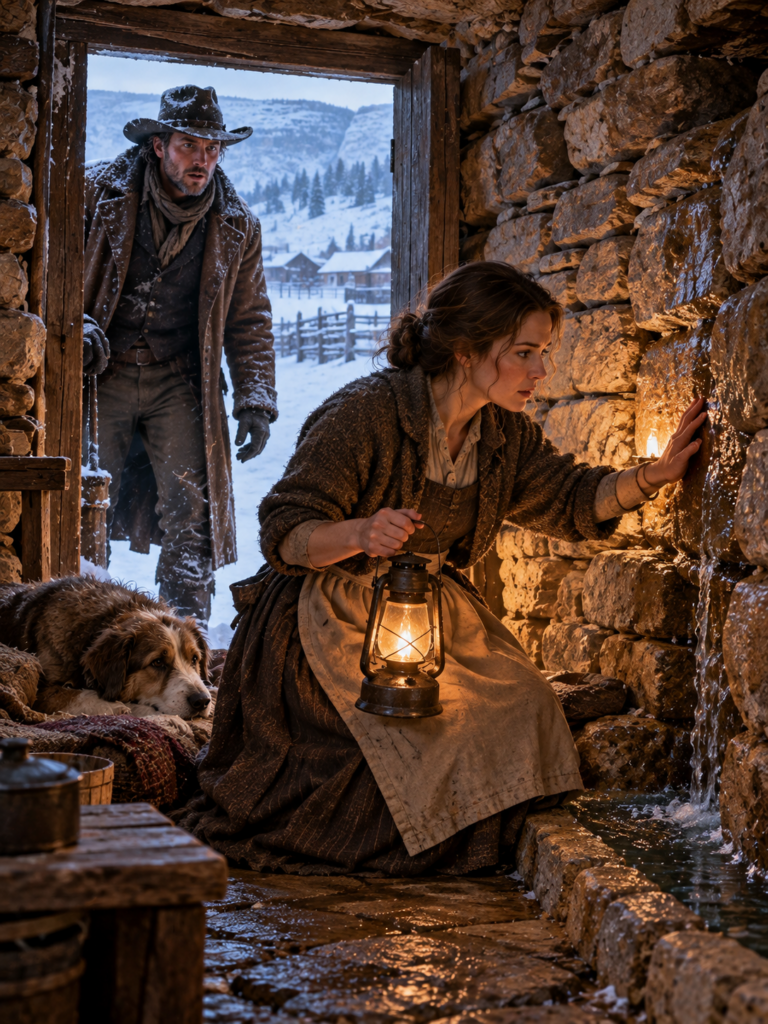
Boon crossed the threshold and immediately stopped.
The warmth was unmistakable, but there was no crackle of burning wood, no smell of smoke, and no stove tucked out of sight.
Zanthy closed the door behind him.
“Look at the stone beside your boot,” she said.
Boon crouched and touched the broad shelf along the southern wall. It retained warmth from sunlight that had entered earlier in the day.
He moved his hand to the rough stone on the opposite side.
That surface felt cooler.
“There’s a difference,” he admitted.
“There should be.”
Zanthy showed him the carefully sealed seams, the earth surrounding the rear chamber, and the place where the doorway had nearly defeated her during the storm.
Nothing she showed him was mysterious by itself.
What unsettled Boon was how deliberately every part had been arranged.
“You mean to tell me the sun does all this?”
“Not all of it,” she replied. “And not all the time. The walls slow the loss of warmth. The earth helps. Keeping the wind out makes a difference. I still have to watch the weather, and I have to let fresh air in.”
Boon studied the shelter again.
He had spent years tending cattle, repairing barns, and facing Dakota winters. He understood how quickly exposed animals lost warmth. Yet he had never imagined an abandoned hideout could be improved this way.
Zanthy handed him her notebook.
Its pages contained dates, thermometer readings, notes about dampness, and sketches of the doorway repairs.
He read several entries.
Then he looked at her.
“Did Elias teach you this?”
She shook her head.
“My father.”
For a moment, the room grew quiet.
Boon remembered the funeral. He remembered Amos Vale declaring that the farm belonged to the family. He had heard that Zanthy departed with little more than a blanket, tools, and the dog sleeping at his feet.
He had also heard people laughing about her shelter.
Now he was standing inside it with his coat unfastened.
“People think you’re hiding something up here,” he said.
“I am,” Zanthy answered.
He looked up.
She pointed toward the repaired wall.
“Every opening the wind used to find.”
Boon gave a short, reluctant laugh.
Then his expression darkened.
During the storm, he had lost two cattle. Others were weak, and another hard freeze could finish them.
Zanthy noticed the change.
“How many are struggling?”
“A few.”
“How many badly?”
“Two.”
She led him through the narrow passage into the chamber she had widened weeks earlier.
Boon looked around.
The space was sheltered by earth on three sides. Its floor was level. The walls were repaired. It was nearly empty.
“Why’d you make this room so big?” he asked.
Zanthy considered the question.
“Because I thought someone might need it.”
Boon looked at the doorway, calculating whether two weakened animals could be led through without injury.
“You think cattle could stay here?”
“For a while, if we keep the air fresh and the space clean. We would need to watch them.”
He stood there longer than she expected.
The widow whom everyone had pitied was offering shelter for animals that represented much of his livelihood.
And he knew something she did not.
The cold had already begun exhausting the valley’s fuel supplies.
Boon had seen shrinking woodpiles and families burning scraps that would ordinarily have been saved for repairs.
The danger was not confined to his ranch.
When he finally turned toward Zanthy, the question in his eyes had changed.
He no longer wanted to know whether she had gone mad buying this place.
He wanted to know whether it could help others survive.
Two days later, he returned with flat slate and hay tied to his saddle.
The weakest pair of cattle were brought up the ridge with considerable effort.
Zanthy helped guide them through the passage.
One animal trembled so badly that Boon feared it would collapse before reaching the rear chamber.
They settled the pair onto dry bedding, with enough room to rest.
The cattle continued shivering at first.
Then, slowly, their breathing steadied.
One lowered its head.
The other began chewing.
Boon watched without speaking.
At last, he touched the wall.
He knew the animals were not cured merely because they had stopped shivering. They still needed care, feed, and observation.
But they were no longer standing in the full force of the cold.
And that was enough to make him understand something important.
He turned toward Zanthy.
“There’s a family down in the valley,” he said quietly. “Their boy’s been sleeping in his coat.”
Zanthy looked toward the entrance.
Outside, snow had begun falling again.
“Then we had better make sure there’s room.”
She picked up her lantern and walked toward the sleeping chamber, already measuring the remaining floor space with her eyes.
Zanthy held the lantern higher, studying the narrow chamber and the passage connecting it to the main shelter.
Two cattle now occupied the rear space. Dry hay covered part of the floor. Buckets stood against one wall.
It would take careful arrangement to accommodate anyone else.
Boon followed her gaze.
“Didn’t mean to put another burden on you,” he said.
“You didn’t.”
She lowered the lantern.
“But bringing people up here isn’t the same as bringing cattle. We must make sure they can sleep without blocking the passage, and we must keep the air moving.”
Boon nodded.
He was learning that everything about the shelter depended on balance.
The next few days made his concern more urgent.
Down in Mercy Draw, Christmas was approaching, but the mood in many cabins was far from cheerful.
Harland and Mara Latch had been counting their firewood for weeks.
Their little boy, Amos, no longer asked when spring would arrive. He had begun sleeping in his coat, with blankets piled over him.
At first, Harland treated the declining woodpile as a problem that could be managed with determination.
He cut damaged fence boards into stove lengths.
Then he burned broken tool handles.
Then he looked at a piece of furniture Mara had hoped to repair.
Each evening brought another calculation.
Each morning, the cold made the previous day’s optimism appear foolish.
The moment Harland finally understood came at breakfast.
Amos sat at the table rubbing his fingers together.
Mara noticed that he was unusually quiet.
“Are your hands hurting?” she asked.
The boy shook his head.
“Not really.”
Then he looked down at them.
“I can’t feel my fingers.”
Harland pushed back his chair.
His first instinct was to check the stove.
His second was to look through the window at the woodpile.
Neither offered comfort.
By afternoon, Boon was leading the family up Crowbone Ridge.
They carried flour, salted meat, blankets, and what few necessities they could manage.
The climb was difficult. Amos needed help over the steepest stretch, and Mara kept looking toward the shelter as though afraid she might find an abandoned ruin after all.
She had heard the jokes.
Widow’s Tomb.
She had even smiled at one of them months earlier.
Now the name made her ashamed.
When they reached the entrance, Zanthy opened the door.
Mara felt the difference before stepping inside.
Warmth moved across her face.
She looked for the stove.
There was none.
Amos entered ahead of his parents.
Slate raised his head, sniffed the boy’s mitten, and settled down again.
The child removed one glove and placed his fingers on a section of stone near the southern shelf.
He waited.
Then he turned toward Mara.
“It’s warm.”
She could not immediately answer.
Harland stood just inside the door, holding their last sack of flour.
His expression was caught somewhere between relief and disbelief.
Zanthy showed them where they could sleep and explained that they would need to take turns checking ventilation and keeping the passage clear.
Mara listened closely.
By evening, she was helping arrange blankets.
Harland carried water and helped Boon tend the cattle.
What had been one woman’s refuge was becoming a shared responsibility.
Not everyone welcomed the news.
In town, Reverend Silas Crowe heard increasingly extravagant explanations for the shelter.
Some insisted that a hot spring ran beneath the ridge.
Others claimed the old outlaw had buried fuel or some other secret under the floor.
A few suggested that Zanthy was deceiving her visitors.
The minister was less interested in such rumors than in the growing number of people climbing the hill.
He worried that families desperate for shelter were placing themselves in an unfamiliar building during dangerous weather.
He remembered his earlier visit.
Zanthy had asked whether the families offering her rooms had enough fuel to last until March.
He had not answered.
Now that unanswered question followed him through the streets of Mercy Draw.
Meanwhile, Mara was watching the widow work.
One afternoon, Zanthy pressed a little fresh clay into a seam near the doorway.
She held the back of her hand beside the repaired section and waited.
Mara asked what she was testing.
“The draft.”
“But it’s such a small crack.”
“Small cracks don’t always mean small losses.”
Mara tried it herself.
Before the repair, she could feel a thread of cold air.
Afterward, it was gone.
The next day, Mara found another leak without being shown.
She called Zanthy over to check her work.
For the first time, the widow was not the only person who understood how to maintain the shelter.
The knowledge was spreading.
Boon started paying attention to the way his barn walls met the ground.
Harland began examining gaps around doors rather than assuming every cold room required more firewood.
Mara realized that much of the winter hardship she had accepted as inevitable was partly the result of heat escaping through places nobody bothered to inspect.
Their cabins still needed proper heat, and even a well-sealed building could not remain warm forever without an energy source.
But the rate at which precious warmth escaped could be changed.
That distinction mattered.
Marshal Gideon Rusk soon found reason to investigate it properly.
He had inspected Zanthy’s shelter in November and seen a competent woman maintaining an unusual building.
That had not told him whether her ideas could help the rest of the valley.
So he began keeping records.
The Prescott family had a dwindling woodpile.
Gideon examined the cabin and noted the gaps around the door, floor joints, and wall seams.
After repairs based on Zanthy’s suggestions, the family’s fuel lasted considerably longer than expected.
He wrote down the result.
Then he visited widow Ansel Pike, whose sleeping area had been bitterly cold even with the stove running.
After drafts were sealed, measurements near her bed averaged roughly eleven degrees higher than before.
Another entry went into the notebook.
Abel Griggs, the blacksmith, reported that useful warmth remained around his forge much longer after work stopped.
Gideon watched, compared, and recorded.
He was careful not to mistake each improvement for proof that every claim about the stone shelter was correct.
But the repeated pattern was difficult to dismiss.
Reducing uncontrolled air leakage was conserving fuel.
People who had once laughed at Zanthy’s work were now copying it.
By January, the winter had grown severe enough to make arguments about pride seem almost absurd.
The temperature outside plunged far below zero.
Eleven people were sheltering within the stone walls on Crowbone Ridge.
Two cattle occupied the rear chamber.
Slate wandered among blankets and buckets, accepting scraps of food and tolerating the crowded conditions with remarkable patience.
But the crowding brought a danger Zanthy had feared.
One morning, Mara woke with a headache.
The air felt heavy.
Harland complained of the same discomfort. One of the children seemed unusually tired.
The thermometer still showed a warm interior.
Zanthy examined the room.
She checked the doorway, the floor trench, and the ventilation route.
Ice had narrowed the southern air shaft.
Meltwater that had entered the cold-air trench during a brief thaw had frozen in one corner.
With so many people breathing in a limited space, the shelter’s fresh-air exchange was becoming inadequate.
The warmth had stopped being an uncomplicated advantage.
Zanthy studied the vent.
Boon watched her.
“What is it?”
“We’ve kept too much air inside.”
“Isn’t that what we’ve been trying to do?”
“We’ve been trying to keep warmth. That isn’t the same thing.”
She told everyone to move clear of the ventilation opening.
Then she instructed Boon and Harland to help widen the passage while she cleared the ice.
The moment the opening grew larger, warm air began escaping.
The thermometer slowly fell.
Boon looked at the descending mercury with obvious distress.
They had worked for weeks to preserve those degrees.
Now they were deliberately surrendering them.
But fresh air began circulating.
As conditions improved, the occupants gradually felt better.
The headaches eased.
The children became more alert.
Zanthy continued checking the vents.
She understood that the dangerous symptoms could not be dismissed simply because the room felt more comfortable again.
They would need to watch for further illness and keep the air exchange unobstructed.
That night, she sat beside the repaired ventilation opening.
Mara joined her.
“You knew how to make the place warm,” Mara said. “But you nearly lost that warmth fixing the air.”
Zanthy nodded.
“My father always said a building has to serve the people inside it. Not the other way around.”
Mara looked toward the sleeping families.
For months, townspeople had treated the widow’s shelter as either a foolish mistake or an impossible wonder.
Now Mara understood it was neither.
It was a system.
One that needed maintenance, judgment, and people willing to admit when something had gone wrong.
A few days later, Marshal Rusk climbed the ridge carrying his notebook.
The pages were crowded with observations from cabins throughout Mercy Draw.
He entered the shelter and found Mara sealing a seam near the eastern wall.
Harland was repairing a bucket.
Children rested beneath blankets.
The cattle were calm in their chamber.
Gideon looked around slowly.
Then he placed the notebook before Zanthy.
“I came up here the first time expecting to find a dangerous fool,” he said.
Zanthy said nothing.
“I found someone doing work I didn’t understand. And since then, I’ve watched the same principles improve homes all over the valley.”
He opened the notebook.
Fuel estimates. Temperatures. Repairs. Dates.
“This isn’t a trick,” he continued.
“No.”
“And it isn’t some blessing that belongs only to this building.”
Zanthy looked at him.
“That’s what I’ve been trying to show people.”
Gideon nodded.
Then his eyes moved toward the open ventilation shaft.
He had heard what happened during the overcrowding.
“Even this place can become dangerous.”
“Especially if we stop paying attention.”
The marshal closed his notebook.
For the first time, he understood the most important question was not how a widow had made one abandoned shelter comfortable.
It was why the town had waited until its woodpiles were nearly empty before learning how much warmth it had been throwing away.
A shadow appeared at the doorway.
Reverend Silas Crowe stood outside with snow on his coat.
He had climbed the ridge without anyone asking him to.
The minister removed his hat.
Then he looked at Zanthy.
“I owe you an apology.”
Zanthy looked toward the doorway but did not immediately answer.
Reverend Silas Crowe stepped inside, closing the door carefully behind him.
Snow melted from the brim of his hat and left small dark spots on the floor.
For a moment, nobody moved.
Mara still held a lump of clay in one hand.
Boon stood beside the entrance to the rear chamber.
Marshal Rusk remained near the table, his notebook closed beneath his palm.
The minister looked around.
Months earlier, he had climbed the same ridge convinced he would find a widow risking her life inside an abandoned outlaw’s refuge.
He remembered the unfinished plaster, the rough tools, and her refusal to come down into town.
He had mistaken that refusal for stubbornness.
What he saw now was different.
Children slept under blankets. A pot of thin soup stood near the table. Repaired seams ran across the old stone walls.
No roaring stove dominated the room.
The occupants were not sitting helplessly, waiting for rescue.
They were maintaining the place together.
Silas looked at Zanthy.
“I was wrong about you,” he said.
She held his gaze.
“About the shelter?”
“About that, too.”
The minister drew a slow breath.
“I believed you were shutting yourself away because you couldn’t accept what happened after Elias died. I thought you were allowing grief to put you in danger.”
Zanthy remained still.
Silas glanced down.
“When you asked whether those families offering you a room had enough wood for winter, I thought you were avoiding my concern.”
“And now?”
“Now I think you were asking a question I didn’t know enough to answer.”
The room was quiet.
The minister continued.
“I kept warning people away from something I hadn’t taken the trouble to understand.”
Zanthy considered him for a long moment.
She could have reminded him of every rumor.
Every whisper after church.
Every time someone called her home a tomb.
She could have asked why a woman with a tool bag and knowledge earned through years of work had been treated as less trustworthy than men who had never examined her repairs.
Instead, she looked toward the doorway.
A narrow draft was beginning to move through an old seam near the frame.
“That needs clay,” she said.
Silas followed her gaze.
For an instant, he seemed unsure what she meant.
Then he removed his coat, knelt beside Mara, and accepted the material she offered.
Zanthy showed him how to press it into the opening without leaving an uneven ridge.
The minister followed her directions.
Mara checked his work.
He had to redo one section.
Nobody laughed.
It was the beginning of a different kind of conversation.
The following morning, Gideon Rusk returned to Mercy Draw with more than a notebook full of measurements.
He carried a clearer understanding of what the figures meant.
A cabin did not need to resemble Zanthy’s stone shelter to benefit from careful repairs.
Not every house had thick stone walls or an earth-covered rear chamber. Not every household had time, money, or materials for major changes.
And simply sealing every opening without providing necessary ventilation could create its own danger.
The lesson was not that fire was unnecessary.
The lesson was that heat was too precious to waste.
That distinction became the foundation of everything Zanthy taught afterward.
She began by visiting homes where the need was greatest.
At the Prescott cabin, she placed her hand near the doorway and showed the family how to locate a draft that had been crossing the floor whenever the wind blew from the north.
At Ansel Pike’s home, she examined the repairs already made and checked that necessary airflow remained available.
Ansel had survived a frightening night after her stove failed.
The seals around her cabin had slowed heat loss enough to give her additional time before the room became dangerously cold.
She was alive.
But Zanthy refused to treat that outcome as a reason to trust sealed walls alone.
“A stove can fail,” she told Ansel. “And a room can grow dangerous even when it feels warm. We need both heat and fresh air, and we need to check on one another.”
Ansel nodded.
After that, she became one of Zanthy’s most determined supporters.
Her enthusiasm occasionally outran her understanding, and Zanthy had to correct her.
A properly built, maintained shelter was not magic.
It could not manufacture heat out of nothing.
Stone stored warmth it received and released it over time.
Earth moderated the movement of heat through the walls.
Air seals reduced unwanted drafts.
Ventilation kept occupants from trading cold for dangerous indoor conditions.
Those simple principles were becoming common knowledge in Mercy Draw.
One afternoon, Mara Latch accompanied Zanthy to a cabin near the edge of town.
They found cold air entering through a gap between the floorboards and the outer wall.
Mara identified the opening herself.
She prepared the patch, pressed it into place, and tested the result with the back of her hand.
Zanthy watched without interfering.
Only when Mara finished did she speak.
“That should help.”
Mara smiled.
“I would never have noticed it last autumn.”
“Neither would most people.”
Mara glanced toward the doorway.
“I called your shelter foolish once.”
Zanthy looked at her.
“I know.”
The admission hung between them.
Mara swallowed.
“I’m sorry.”
Zanthy accepted the apology with a small nod.
There was no need to pretend it had never happened.
Nor did she need to spend the rest of her life making Mara pay for it.
They carried their tools to the next house.
Boon Calder began making changes at his ranch.
He paid more attention to windward walls and the gaps around the barn entrance.
He also learned to distinguish between reducing drafts and shutting off the airflow animals needed.
That lesson had been earned during the crowded night on the ridge.
He had watched a thermometer fall as Zanthy opened the ventilation.
At the time, it had felt like undoing weeks of work.
Now he understood that conserving warmth was only one part of protecting living creatures.
His surviving cattle moved through the remainder of the winter under better shelter and care.
The two that had spent time in Zanthy’s rear chamber became a subject of considerable discussion.
Boon corrected anyone who spoke as though the stones themselves had healed the animals.
“They were exhausted and cold,” he explained. “The widow gave them protection while we tended them. That’s what made the difference.”
He was not a man who enjoyed lengthy explanations.
But this one mattered to him.
So did another fact he mentioned less often.
When he first rode past the shelter, he had believed the stories about Zanthy’s foolishness.
He had needed to touch the wall with his own hand before reconsidering.
He did not forget that.
As January gave way to February, Crowbone Ridge remained a place of work rather than wonder.
Zanthy continued observing temperatures and checking seams.
The repaired ventilation needed attention after freezing weather.
The doorway gasket had to be examined for shrinkage.
Water accumulation near the trench required monitoring.
When sunshine reached the southern stone shelf, it supplied useful warmth.
When storms blocked that sunshine for long stretches, the shelter needed the heat contributed by its occupants and stored in its structure, along with other practical measures appropriate to the conditions.
The building was not capable of defeating every possible winter emergency.
Zanthy never claimed otherwise.
That honesty gradually changed how the town talked about her.
People stopped asking for a secret.
They began asking for instructions.
Marshal Rusk helped keep the work organized.
His notebook became an informal record of what repairs had been attempted, how much fuel remained, and which households needed assistance.
He did not pretend that every improvement was scientifically precise.
Fuel use varied with weather, household habits, and the condition of stoves.
Temperatures varied with location and time of measurement.
But repeated observations showed enough improvement to justify continuing.
Abel Griggs at the forge was particularly pleased.
He had been accustomed to seeing most of the day’s useful warmth vanish soon after work ended.
After repairing major leaks, the forge area stayed warmer longer.
That did not eliminate his need for fuel.
It reduced the rate at which heat escaped.
For a blacksmith who depended on a steady supply of combustible material, the difference was practical and immediate.
Soon, Abel began explaining the same idea to customers.
He used fewer words than Zanthy.
He also used more gestures.
But the principle was the same.
Keep useful heat where it is needed, and do not mistake wasted fuel for the unavoidable cost of winter.
One afternoon, Reverend Crowe joined several men repairing an older family’s cabin.
He worked beside Harland Latch, who had brought spare materials from his homestead.
The minister’s hands were roughened from recent labor.
Harland noticed him rubbing a sore thumb.
“Never expected to see you doing this much plastering,” he said.
Silas looked at his hands.
“Neither did I.”
Harland smiled.
Then he became serious.
“Last month, my son was sitting at our table telling us he couldn’t feel his fingers. I kept thinking I could make our firewood last if I just cut it smaller.”
Silas continued pressing clay into the seam.
“I remember when you brought him up the ridge.”
“I should have asked for help sooner.”
The minister considered that.
“Perhaps I should have made it easier to ask.”
They continued working.
Neither man had a useful reply beyond that.
Some lessons could not be improved by adding another speech.
By the end of February, families were still enduring difficult weather.
But the town was better prepared than it had been at the start of the season.
Woodpiles were lasting longer in several homes.
Drafts that had gone unnoticed for years were being repaired.
People were checking on vulnerable neighbors more regularly.
The emergency shelter on Crowbone Ridge remained available, but fewer families needed to depend on it as their only refuge.
Zanthy preferred that arrangement.
She had not widened the rear chamber because she dreamed of turning her home into a crowded winter settlement.
She had widened it because she knew that one person could not predict every need.
Its use had proved her right.
Yet the greater victory was happening below the ridge.
People were learning to improve the places they already lived.
One evening, after returning from another day of repairs, Zanthy found herself alone inside the shelter.
Slate followed her to the southern wall.
She set down her tools and sat beside him.
The stone was still holding the last warmth of the afternoon.
For a while, she listened to the wind.
Then she thought of her father.
Nathan Mercer had never been a man of elaborate lessons.
He had preferred putting a tool in her hand and asking what she noticed.
When she was a girl, he had once held her small palm against a sun-warmed stone and waited until she stopped trying to give him the answer she thought he wanted.
He had taught her to observe.
Not merely to look.
To notice where dampness gathered, where cold air traveled, and which parts of a building carried the burdens others overlooked.
He had told her that stone could only retain warmth it received.
At the time, she had thought he was teaching her how to construct a wall.
Now she understood that he had given her something more durable.
The ability to question an accepted explanation.
The patience to test an idea.
The willingness to change a plan when evidence showed that it was failing.
Those lessons had survived his absence.
They had survived Elias’s death.
They had survived the evening Amos Vale spread the property papers across the farmhouse table and told her that the land would remain in his family.
Zanthy remembered how powerless she had felt leaving that house.
She had not fought over the cattle.
She had not pleaded to keep a room.
She had simply packed the things she was allowed to take.
At the time, she had mistaken the smallness of that bundle for the smallness of her remaining future.
A blanket.
A tool bag.
A few personal belongings.
A dog.
Now she looked around at the shelter she had restored with those same hands.
The walls were imperfect.
The roof still required attention.
The door seal would eventually wear out again.
Nothing about the place was grand.
But the property was hers.
More importantly, the life within it was being shaped by her own decisions.
That was something the Vale farmhouse had not offered her at the end.
She did not need Amos to acknowledge it.
She did not need Ruth to explain her silence.
She could recognize the hurt they had caused without allowing that hurt to determine what she became.
Spring began as a suggestion rather than an announcement.
For several days, snow softened along the southern slopes during the afternoon, then hardened again at night.
Water appeared beneath wagon ruts.
The creek began carrying more meltwater.
By March, the worst of winter had loosened its hold on Mercy Draw.
Families came out to inspect fences and roofs.
Children spent longer periods outdoors.
Abel’s hammer could be heard from the forge again.
There was work everywhere.
But something about the work had changed.
People examined their houses with new attention.
When they repaired a doorway, they considered how wind would move around it.
When they patched a wall, they looked for dampness as well as cracks.
When they improved a stove or fireplace, they paid closer attention to the flow of air and the condition of the structure around it.
The lessons of winter had become ordinary habits.
That pleased Zanthy more than any celebration could have.
On a clear spring morning, she walked back up Crowbone Ridge after visiting families in town.
Slate trotted ahead.
He paused near the shelter entrance, looked back at her, and then stretched out on a patch of sun-warmed stone.
Zanthy smiled.
The dog had chosen that same spot when they first arrived in autumn.
Back then, she had been exhausted, humiliated, and uncertain how she would survive.
Slate had found a comfortable place to sleep before she found a reason to hope.
She rested her palm against the wall.
The stone was warm.
Not because the building held some extraordinary power.
Not because an outlaw had left a secret beneath its floor.
And not because she had discovered a way to escape the laws of winter.
The warmth was there because sunlight had reached the stone, because the walls slowed its loss, and because months of careful labor had made the shelter better able to protect what warmth it received.
She withdrew her hand and looked toward Mercy Draw.
Thin lines of smoke rose from the chimneys below.
Families were beginning their spring work.
Some of the same men who had once mocked her were now checking the seals around their windows.
The minister who had warned against her shelter was helping neighbors repair their homes.
The marshal who had come to investigate her judgment had filled page after page with evidence that her methods could help the community.
Mara could locate a draft without Zanthy’s assistance.
Boon could explain why a warm room still needed fresh air.
And little Amos Latch was well enough to run outside without wearing his winter coat.
There would be no monument to the nine-dollar shelter.
No grand ceremony.
No official declaration that its owner had been right and everyone else wrong.
Zanthy found she did not need one.
She had been pushed out of a house because someone else controlled the papers that defined who belonged there.
On the ridge, she had made a home from what others discarded.
And when the town needed help, she had not asked its people to earn their way through her doorway by admitting how cruelly they had treated her.
She had shown them where to place their hands.
Where to look for a draft.
Where the warmth was disappearing.
She had given them the knowledge her father had once given her.
The next winter would still bring cold.
Some storms would be severe.
Some families would still struggle.
No wall could promise complete safety.
But more people would know how to prepare, what to watch, and when to help one another.
Zanthy stepped through the doorway and placed her old tool bag beside the wall.
Slate rose, followed her inside, and settled in his familiar corner.
She left the door open for a little while, allowing the gentle spring air to enter.
For the first time since Elias’s funeral, she thought of the future without first calculating what she had lost.
Down in the valley, the houses of Mercy Draw stood exactly where they had stood before winter.
Their owners were different now.
They knew something they had not known when autumn began.
And Zanthy finally understood the full meaning of her father’s lesson.
Stone could only keep the warmth it was given.
But knowledge, once shared, could carry that warmth far beyond the walls where it began.


