
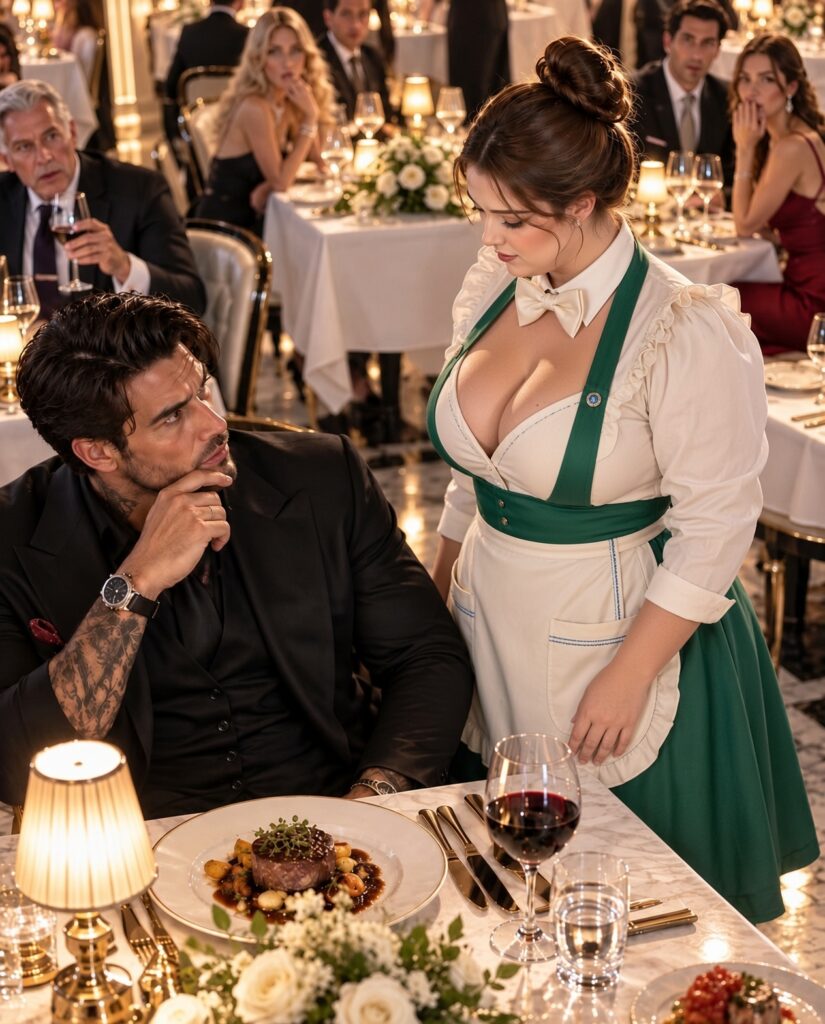
PART 2
Viktor Kovacs looked at me for three long seconds.
Not angry.
Not suspicious, exactly.
Assessing.
The voice on his phone continued in Hungarian.
“Viktor?
Are you there?”
Viktor never took his eyes off me.
“I’ll call you back.”
He ended the call.
Around us, Sterling House carried on pretending nothing unusual was happening.
Crystal touched porcelain.
A woman laughed too brightly at table four.
Somewhere near the bar, Daniel dropped a spoon and then attempted to make the sound seem intentional.
Viktor placed his phone face down.
“You understand Hungarian.”
It wasn’t a question.
I set my tray against my hip.
“My grandmother believed English was a character flaw.”
For the first time all evening, Viktor’s expression changed.
Only slightly.
One corner of his mouth almost moved.
“Where was she from?”
“Near Szeged.
Her name was Ilona Nagy.”
The almost-smile disappeared.
Not with alarm.
Recognition.
“You said Nagy?”
My hand tightened around the tray.
“Yes.”
“Ilona Nagy.”
“That’s what I said.”
He leaned back.
For a man everyone in the restaurant believed to be impossible to unsettle, Viktor Kovacs suddenly looked strangely human.
Tired, even.
“How old are you?”
“Twenty-eight.”
“And your grandmother?”
“She died six years ago.”
His gaze lowered to the table.
“I see.”
Something about the way he said it made my heart beat faster.
“You knew her?”
He didn’t answer immediately.
Instead, he nodded toward the chair across from him.
“Sit.”
I glanced toward Daniel.
He was standing near the service station, staring at me with the expression of a man watching his retirement account burst into flames.
“I’m working.”
“You are also pale.”
“I’m always pale.”
“Sit for thirty seconds.”
I should have refused.
Servers didn’t sit with guests at Sterling House.
We barely breathed at the same altitude as guests.
But Viktor wasn’t behaving like a difficult customer anymore.
And that frightened me more than if he had been.
I sat.
He studied my face.
Not rudely.
Carefully.
“You have her eyes,” he said.
I stopped breathing.
That was impossible.
“You knew my grandmother.”
“Yes.”
“How?”
Before he could answer, his phone vibrated.
He ignored it.
That, somehow, told me the answer mattered.
“I met Ilona Nagy once,” he said.
“A long time ago.”
“Where?”
“Budapest.”
My grandmother had never told me she’d been to Budapest after leaving Hungary.
At least, not after I was born.
“She moved to the United States in 1983.”
“I know.”
The words landed quietly.
Too quietly.
“You know?”
Viktor glanced toward the glowing chandelier, as though arranging memories somewhere behind his eyes.
“Your grandmother helped my family.”
A waiter passed us carrying oysters.
I watched him go because it was easier than looking at Viktor.
“My grandmother worked at a bakery.”
“In America.”
“She worked in a bakery in Hungary too.”
“No.”
That made me look back.
Viktor folded his hands.
“In Hungary, your grandmother worked for a legal archive.”
I laughed once.
Not because anything was funny.
Because the alternative was saying nothing at all.
“No, she didn’t.”
“She did.”
“She made apricot pastries and complained about Reagan.”
“That may also be true.”
“You have the wrong Ilona.”
“I do not.”
His certainty irritated me.
“She had flour under her fingernails every day of my childhood.”
“And before that, she translated legal records for a cooperative council outside Szeged.”
I stared at him.
My grandmother had been capable of hiding Christmas presents in the oven and forgetting them until Easter.
The idea that she had once translated legal documents sounded ridiculous.
Then I remembered the cabinet.
The locked wooden cabinet in her bedroom.
I had never been allowed to touch it.
After she died, my mother had emptied the apartment before I arrived from college.
When I asked what had been inside, she said, “Old papers.
Nothing useful.”
My stomach tightened.
“What did she help your family with?”
Viktor looked toward his untouched steak.
“Something complicated.”
“That’s convenient.”
“Yes.”
He almost smiled again.
“You are very much her granddaughter.”
“People keep saying that when they don’t want to answer me.”
His expression grew more serious.
“There are some stories that belong partly to the dead.
One should be careful before opening them.”
“My grandmother is dead.
My mother is dead.
At this point, I’m the only person left to inconvenience.”
The sentence came out sharper than I intended.
Viktor noticed.
His eyes softened.
Not pity.
That would have made me angry.
Recognition.
“I am sorry about your mother.”
I looked down.
“Thank you.”
We sat in silence.
Then I remembered why I had approached his table in the first place.
“Your vodka.”
“I no longer want it.”
“You’re the fourth person tonight to change your mind after I’ve taken an order.”
“The others were employees?”
“No.
Men I dated.”
That actually made him laugh.
Quietly.
Daniel nearly walked into a pillar.
I lowered my voice.
“The call you just received.
Someone delayed a document.”
Viktor’s amusement vanished.
“You heard too much.”
“You spoke Hungarian in front of a Hungarian speaker.”
“I did not know you were one.”
“Technically, I’m from Queens.”
“You understood every word.”
“Most of them.”
He considered me again.
Then he picked up the antacid.
“The document concerns a vote taking place tonight.”
“The council?”
He nodded.
“What council?”
“A private holding company.”
“That sounds much less ominous than everyone here thinks you are.”
“Most business is less interesting than rumor.”
“So nobody is disappearing?”
His eyebrows rose.
“Mara.”
“You know my name.”
“The manager said it while you were walking over.”
“Oh.”
“My hearing remains functional.”
I tried not to smile.
He turned serious again.
“The vote concerns a redevelopment project.”
“In Manhattan?”
“Queens.”
That caught my attention.
“Where?”
“Astoria.”
The room around me seemed to narrow.
Astoria wasn’t just where my mother had lived.
It was where my grandmother had lived.
Where I had spent summers sleeping on a foldout sofa while buses sighed beneath the apartment windows.
“What redevelopment?”
“A four-block parcel near Twenty-Third Avenue.
Warehouses, several small apartment buildings, commercial space.”
I knew the area.
Everyone in Astoria knew the area.
Old brick buildings squeezed between newer developments, family groceries beside luxury towers, mechanics beside coffee shops selling eight-dollar pastries.
“What are you voting on?”
“Whether the company accepts an acquisition offer.”
“From whom?”
“Pierce Urban Holdings.”
The name meant nothing to me.
Viktor continued.
“They intend to assemble the parcels and replace most of the existing properties.”
“With what?”
“Luxury housing.
Retail.
A hotel.”
My mouth went dry.
“My grandmother’s building was near there.”
“What address?”
I told him.
Viktor went completely still.
Then he slowly reached for his phone.
“What?”
He typed something.
“What?”
I repeated.
He found a document and turned the screen toward me.
A map.
Four city blocks outlined in blue.
My grandmother’s building sat almost exactly in the middle.
I stared.
“My mother sold that apartment after Grandma died.”
“No.”
I looked up.
“What do you mean, no?”
“The apartment was never individually owned.”
“That doesn’t make sense.”
“It was part of a cooperative trust.”
“She told me she owned it.”
“In practical terms, perhaps.
Legally, the ownership structure is different.”
I felt suddenly irritated with everyone who had ever used the phrase ownership structure.
“My mother handled the sale.”
“Are you certain?”
“She paid the lawyer.”
“That is not what I asked.”
I opened my mouth.
Then closed it.
My mother had told me she handled it.
I had been twenty-two, exhausted from finals, and still grieving my grandmother.
There had been papers.
Boxes.
Arguments with someone on the phone.
I remembered my mother saying, “I just want this finished.”
I had assumed she meant probate.
Viktor watched me carefully.
“What was your mother’s name?”
“Elena Nagy Hart.”
His face changed again.
“You recognize that too.”
“Yes.”
I stood.
This had gone far beyond a restaurant conversation.
“Okay.”
“Mara.”
“No.”
“You should listen.”
“I came over because I thought you had indigestion and everyone else thought you were terrifying.
I did not come over to discover my dead relatives apparently had secret careers in international paperwork.”
“It was not international.”
“That is somehow worse.”
I grabbed my tray.
Viktor remained seated.
“Your mother contacted me eleven years ago.”
I stopped.
The restaurant disappeared.
“What?”
“She wrote to my office.”
My voice came out barely audible.
“My mother knew you?”
“She knew of me.”
“Why?”
“She had discovered something in Ilona’s papers.”
I sat again.
Not because Viktor told me.
Because my knees suddenly felt unreliable.
“What did she discover?”
Viktor glanced at his watch.
“The document delayed at customs is connected to that answer.”
Of course it was.
Naturally, the mysterious document at federal inspection was also apparently related to the locked cabinet of my grandmother who may or may not have secretly worked in a legal archive.
I pressed my fingers against my forehead.
“I need approximately twelve fewer mysteries right now.”
“I understand.”
“No, you don’t.
I have forty-seven dollars.”
Viktor blinked.
I regretted saying it immediately.
But there it was.
“My rent is late,” I continued.
“My mother’s medical bills are everywhere.
I work six nights a week.
I haven’t taken the subway without checking my checking account first in eight months.
And now you’re telling me my grandmother had some legal secret involving property developers?”
“I am telling you that your grandmother believed ordinary people should not be displaced simply because someone wealthier found their homes inconvenient.”
That sounded exactly like her.
Painfully so.
Grandma Ilona had once spent six months fighting the city because they moved a bus stop half a block farther from senior housing.
She had written letters every week.
In three languages.
The bus stop had eventually returned.
I swallowed.
“What did she do?”
Viktor looked toward his phone.
“She designed part of the trust.”
I laughed again.
A soft, stunned sound.
“My grandmother?”
“Yes.”
“The woman who stored cash inside coffee tins because she didn’t trust banks?”
“That may explain why she understood complicated ownership arrangements.”
I covered my face.
For several seconds, neither of us spoke.
Then Daniel appeared beside the table.
“Mara?”
I looked up.
He was sweating through a shirt that probably cost more than my electricity bill.
“Everything okay?”
“Define okay.”
Daniel looked from me to Viktor.
Viktor answered calmly.
“Ms.
Hart has been extremely helpful.”
Daniel’s entire body loosened.
“Wonderful.
Wonderful.
Mara is one of our finest.”
“You threatened to fire me last Tuesday.”
“That was motivational.”
“You said I lacked respect for authority.”
“You called the wine director a grape dictator.”
“He was being a grape dictator.”
Viktor looked amused.
Daniel pointed toward the kitchen.
“Mara.
A word.”
I stood.
As soon as we were ten feet away, Daniel grabbed my elbow, then immediately released it as though remembering that touching employees during a panic was probably discouraged by human resources.
“What did you do?”
“I sat down.”
“I saw that.”
“He knew my grandmother.”
Daniel stared.
“What?”
“It’s complicated.”
“You met Viktor Kovacs four minutes ago and discovered a family connection?”
“Apparently my life has become badly written prestige television.”
Daniel lowered his voice.
“Is he angry?”
“No.”
“Then why has he sent away three servers?”
I glanced back.
Viktor was checking his phone again.
“I think he’s having a terrible night.”
Daniel stared at me as if I had just described a shark as emotionally misunderstood.
“He made Julian cry.”
“Julian cries when customers ask for substitutions.”
“That is not relevant.”
“It’s extremely relevant.”
Daniel rubbed his forehead.
“What should we do?”
The answer arrived before I could think about it.
“Feed him.”
“Mara.”
“He hasn’t eaten.
He’s taking antacids.
He’s been on stressful calls for an hour.”
“He sent back the steak.”
“Because Julian couldn’t answer where it came from.”
“Neither can I.”
“I can.”
Daniel blinked.
I knew because I had listened during lineup.
“Red Creek Ranch.
Sullivan County.
Dry-aged thirty-two days.”
Daniel stared.
“That is frightening.”
“It is called paying attention.”
I returned to Viktor.
“Your steak is cold.”
“I noticed.”
“I’m replacing it.”
“I did not ask.”
“No.
But if you’re going to reveal family secrets, you’re not doing it while your blood sugar is collapsing.”
His eyes narrowed.
For one strange second, I wondered if I had finally gone too far.
Then he nodded.
“Medium rare.”
“I know.”
“And still water.”
“I definitely know.”
Twenty minutes later, Viktor ate.
The atmosphere inside Sterling House slowly thawed.
Julian emerged from the kitchen.
Someone turned the music slightly louder.
Daniel stopped looking like he needed legal representation.
And I kept working.
That was the strangest part.
I refilled wine.
I carried plates.
I apologized to table sixteen because their sea bass was delayed.
All while my mind replayed the same impossible sentence.
Your grandmother designed part of the trust.
Near nine o’clock, Viktor waved me over.
“Sit for one minute.”
“I’m beginning to think you’re trying to get me fired.”
“I spoke to your manager.”
“You did what?”
“He agreed you may take ten minutes.”
I looked toward Daniel.
He raised both thumbs.
Traitor.
I sat.
Viktor placed his phone between us.
“The council meets in twelve minutes.”
“And the document?”
“Still held.”
“What happens without it?”
“A board member named Charles Pierce will argue that the original cooperative restrictions are no longer enforceable.”
“Are they?”
“Yes.”
“You sound sure.”
“Because your grandmother made them unusually difficult to remove.”
Something in me warmed despite everything.
That sounded like her too.
“What does your document prove?”
“That the trust was renewed in 2002.”
“Why does anyone doubt that?”
“The physical authorization disappeared.”
“Convenient.”
“Yes.”
“And you think someone inside your organization caused the delay.”
“I think someone gave Pierce information about the shipment.”
I watched him.
“But you said the vote was about accepting the acquisition.”
“It is.”
“Why would your company vote against making money?”
That question made Viktor quiet.
Eventually, he said, “Because not everything worth owning should be sold.”
I studied him.
It was difficult reconciling that sentence with Daniel’s description of a ruthless businessman.
Viktor seemed to read the question in my face.
“Your manager told you stories.”
“A few.”
“Some are true.”
“That doesn’t help.”
“When I was younger, I believed control solved most problems.”
“And now?”
“Now I know control creates different problems.”
There was no dramatic confession in his voice.
Just fatigue.
Experience.
“The properties in Astoria were acquired over decades by immigrants,” he continued.
“Hungarian.
Greek.
Italian.
Czech.
Later Egyptian, Colombian, Bangladeshi.
The trust was meant to prevent one investor from gaining enough influence to remove everyone else.”
“My grandmother built that?”
“She helped write the language.”
“Why?”
“Because she watched something similar happen in Hungary.”
He paused.
“Her father lost his workshop when she was young.
Not because he failed.
Because someone with greater authority decided his work belonged elsewhere.”
Grandma had never told me that.
I knew almost nothing about her father.
Only that she kept one photograph of him beside her bed.
A serious man with enormous hands.
“She hated talking about Hungary.”
“Some people protect themselves by remembering.
Others survive by choosing what not to remember.”
I looked at him.
“You knew her better than once.”
Viktor held my gaze.
“Yes.”
There it was.
The first lie revealed.
Quietly.
No dramatic music.
No slammed glass.
Just a man admitting he had not told me everything.
“How well?”
“Not romantically, before you ask.”
“I wasn’t going to.”
“You were.”
“I was.”
He took a sip of water.
“My father knew her.”
That surprised me.
“How?”
“He was an attorney.”
“The feared Viktor Kovacs had a lawyer for a father?”
“My reputation has apparently erased my childhood.”
I smiled despite myself.
“What was his name?”
“Andras Kovacs.”
Something moved deep in my memory.
Not a memory exactly.
A sound.
Grandma at the kitchen table.
Talking to my mother.
Andras.
I had heard that name.
I was certain of it.
I leaned forward.
“My grandmother mentioned him.”
Viktor’s expression sharpened.
“When?”
“I don’t know.
Years ago.”
“What did she say?”
“I was a kid.”
“Try.”
I closed my eyes.
Grandma’s apartment returned in pieces.
The yellow curtains.
Paprika hanging in braided strings.
My mother washing dishes.
Grandma angry.
Not shouting.
Grandma rarely shouted.
She became quieter when furious.
I remembered sitting under the table with colored pencils.
My mother saying, “You cannot keep carrying this.”
Grandma answering in Hungarian.
Something about Andras.
Something about a promise.
Then another word.
Örökség.
Inheritance.
My eyes opened.
“They were arguing about an inheritance.”
Viktor went still.
“What exactly?”
“I don’t know.”
“Mara.”
“I was eight.”
He looked down.
“Of course.”
The council call appeared on his phone.
He declined it.
“You’re missing your meeting.”
“I have already submitted my vote.”
“Against the sale?”
He didn’t answer.
He didn’t need to.
I looked around Sterling House.
At people spending hundreds of dollars on dinner.
At Daniel adjusting silverware because anxiety needed somewhere to go.
At my own reflection faintly visible in the dark window.
Twenty-eight years old.
Broke.
Behind on rent.
Working double shifts.
And somehow connected to a property trust worth enough money that serious businessmen were having emergency votes over it.
“This doesn’t make sense,” I said.
“It does not have to make sense tonight.”
“For you, maybe.”
“For either of us.”
His phone buzzed again.
This time he answered.
“Yes?”
He listened.
His expression changed.
“What?”
Another pause.
Then he looked directly at me.
“Send it.”
He ended the call.
“What happened?”
“The courier package cleared inspection.”
“That’s good.”
“Yes.”
“But?”
“It was opened.”
My stomach tightened.
“Was the document missing?”
“No.”
“Then what?”
Viktor’s phone chimed.
An image appeared.
He enlarged it.
The authorization document was old, yellowed, covered in signatures and stamps.
He scrolled toward the bottom.
Then stopped.
I leaned closer.
Several names were typed beneath signature lines.
One belonged to Viktor’s father.
ANDRAS KOVACS.
Another belonged to my grandmother.
ILONA NAGY.
And beneath hers—
ELENA NAGY HART.
My mother.
I stared at the screen.
“That’s impossible.”
“It appears not.”
“My mother never said anything about this.”
“She signed the renewal.”
“When?”
“April 2002.”
I calculated.
I had been four.
“What does her signature mean?”
Viktor enlarged another section.
“This is not only a renewal.”
I read what I could.
Legal Hungarian was dense, but Grandma had forced enough grammar into my childhood that the meaning slowly formed.
Successor trustee.
Beneficial interest.
Family representative.
I looked at Viktor.
“My mother was part of the trust.”
“Yes.”
“What happened to her interest when she died?”
His silence gave me the answer before he spoke.
“It should have transferred.”
“To whom?”
He scrolled lower.
There it was.
Successor beneficiary upon the death of Elena Nagy Hart:
MARA ILONA HART.
I forgot how to breathe.
“No.”
Viktor said nothing.
“I would know.”
“Not necessarily.”
“There would be paperwork.”
“There should have been.”
“My mother would have told me.”
His eyes held mine.
“Perhaps she intended to.”
The anger arrived before the grief.
That made me feel guilty.
“She had fourteen months.”
“She was ill.”
“She was ill for two years.”
“People postpone difficult conversations.”
“This isn’t a difficult conversation.
This is apparently property.”
“It may be more complicated.”
“Everything tonight is more complicated.”
Viktor leaned back.
“There is another page.”
I looked at the screen.
“Of course there is.”
He opened it.
This one was not part of the trust.
It was a scanned letter.
Handwritten.
In English.
My mother’s handwriting.
I knew it immediately.
The rounded E.
The way she crossed her t’s too high.
At the top:
Mr.
Kovacs,
If you are reading this, then I was not able to explain everything to Mara myself.
My throat closed.
I couldn’t continue.
Viktor turned the phone face down.
“You do not need to read it here.”
“Yes, I do.”
“Mara.”
“I have spent fourteen months wishing I had one more sentence from my mother.”
The words broke somewhere in the middle.
I hated that.
I had become very skilled at discussing my mother without crying.
Hospice.
Bills.
Funeral arrangements.
Closing accounts.
Canceling her phone.
I could say all of it calmly.
But one more sentence ruined me.
Viktor pushed a folded napkin toward me.
I laughed through tears.
“Very intimidating.”
“My reputation will survive.”
I wiped my face.
“Show me.”
He turned the phone back.
I read.
Mr.
Kovacs,
If you are reading this, then I was not able to explain everything to Mara myself.
My mother made me promise I would never let the trust become a burden to her.
She believed inheritance could become another kind of obligation, and she wanted Mara to choose her own life before discovering what had been preserved for her.
I disagreed with her.
I still do.
But I understood her fear.
Mara spent her childhood watching the women in our family sacrifice themselves for things they loved.
My mother for her neighborhood.
Me for work, for bills, for everyone except myself.
I did not want my daughter to believe duty was the same as love.
My vision blurred.
I kept reading.
If the trust is ever threatened, tell her the truth.
Tell her Ilona did not preserve those buildings because they were valuable.
She preserved them because homes become part of families.
And tell Mara that she owes the trust nothing.
Not loyalty.
Not work.
Not sacrifice.
The choice must be hers.
I lowered the phone.
Neither of us spoke for a while.
Sterling House continued around us.
Somewhere, someone ordered another bottle of Burgundy.
Daniel argued quietly with the kitchen.
Life did that.
It continued even when yours changed shape.
Finally I whispered, “Why did my mother write this to you?”
Viktor looked away.
And there it was again.
Another hidden truth.
Another hesitation.
“My father died before your grandmother.”
“What does that have to do with my mother?”
“He left his position in the trust to me.”
“So you became a trustee.”
“Yes.”
“And my mother knew.”
“Yes.”
“How well did she know you?”
“We spoke several times.”
“Several?”
“Over many years.”
I swallowed.
“Were you friends?”
“I would not claim that.”
“But?”
“She asked me for one promise.”
“What?”
“That I would not tell you unless the trust truly needed you.”
A strange ache opened inside me.
My mother had known Viktor Kovacs.
The man everyone in Sterling House feared.
She had called him.
Written to him.
Trusted him with words intended for me.
And she had never mentioned his name.
“What does the trust need from me?”
Viktor looked at his phone.
“The vote has not concluded.”
“But my name is on the document.”
“Yes.”
“What does that mean?”
“It means Pierce’s acquisition cannot proceed tonight.”
Relief passed through me.
Briefly.
Then I noticed his expression.
“What else?”
“Your mother’s successor interest changes the voting structure.”
“How?”
Viktor’s answer came carefully.
“You are not simply a beneficiary.”
I waited.
“You inherited your grandmother’s council seat.”
I stared at him.
“No.”
“Yes.”
“I serve steaks.”
“That is not legally disqualifying.”
“I have forty-seven dollars.”
“I believe you mentioned that.”
“I don’t know anything about property trusts.”
“You know the neighborhood.”
“That is not the same thing.”
“No.”
His voice softened.
“But perhaps it is not nothing.”
My phone vibrated inside my apron.
A message from Daniel.
TABLE 12 NEEDS CHECK.
The ordinary words almost made me laugh.
“I need to work.”
Viktor nodded.
“Then work.”
“That’s it?”
“What should I do?
Prevent you?”
“That would certainly help your reputation.”
He smiled.
I stood.
Then stopped.
“What happens now?”
“The council delays the vote until your status is verified.”
“And Pierce?”
“Will request a meeting.”
“With me?”
“Yes.”
“Why?”
“Because you now possess something he needs.”
I felt my shoulders tense.
Viktor noticed.
“He is a businessman, Mara.
Nothing more dramatic.”
“Tonight has permanently damaged my definition of dramatic.”
“You are safe.”
Oddly, I believed him.
Not because of his reputation.
Because when he said it, there was no performance in it.
I returned to table twelve.
A married couple celebrating their anniversary needed their check.
Table seven wanted coffee.
A woman near the window asked whether the chocolate tart contained hazelnuts.
I answered questions.
Carried plates.
Smiled.
Worked.
And somewhere between espresso and dessert spoons, I realized something that unsettled me more than the inheritance.
My mother had not hidden the truth because she thought I was incapable.
She had hidden it because she wanted me to become someone before anyone told me what I owned.
At ten forty-three, my shift ended.
Daniel was waiting near the employee lockers.
“You survived.”
“Apparently.”
“And Mr.
Kovacs left a twenty percent tip.”
“That’s normal.”
“He also wrote a note praising the service.”
“That is less normal.”
Daniel studied me.
“What happened at that table?”
I leaned against the locker.
“How much time do you have?”
He looked at the dining room.
“Seven minutes.”
“Not enough.”
He nodded sympathetically.
“Family?”
“Apparently.”
Daniel’s face softened.
“My least favorite category of emergency.”
I smiled.
“Mine too.”
When I collected my coat, I found Viktor waiting by the entrance.
No bodyguards.
No dramatic convoy.
Just a tall man in a charcoal coat holding an old leather folder.
“I thought you left.”
“I returned.”
“For what?”
He held out the folder.
“This.”
I hesitated.
“What is it?”
“A copy of documents your mother sent me.”
“I thought they were digital.”
“Some were.”
I took the folder.
It was heavier than expected.
Inside were letters.
Photographs.
Legal records.
And a sealed envelope.
My name was written across it.
Mara.
I knew the handwriting instantly.
My mother’s.
My hands began trembling.
“When did she give you this?”
“Three years ago.”
I looked up sharply.
“That was before she got sick.”
“Yes.”
“Why would she—”
“She had decided to tell you.”
“Then why didn’t she?”
“I do not know.”
I stared at the envelope.
Three years ago, my mother had been healthy.
Still working.
Still complaining about my dating life.
Still leaving me voicemails reminding me to buy decent shoes.
Something had changed her mind.
Or stopped her.
I slipped my finger beneath the flap.
Viktor stopped me with one sentence.
“There is something else you should know before you read it.”
I froze.
“What?”
“Your mother was not the last member of your family connected to the trust.”
I stared at him.
“What does that mean?”
He opened the leather folder and removed a photograph.
It was old.
Taken in Astoria, maybe twenty-five years ago.
My grandmother stood outside her apartment building, younger than I remembered her.
Beside her stood Viktor’s father.
Beside him was my mother.
And beside my mother stood a man I had never seen before.
Tall.
Dark-haired.
Smiling directly at the camera.
On the back, in my grandmother’s handwriting, were four names.
Ilona.
Andras.
Elena.
Tomas.
Underneath them was one additional line.
For Mara, when she is ready to know who stayed.
I turned the photograph over again.
“Who is Tomas?”
Viktor’s expression held something I could not read.
“I believe,” he said quietly, “that your mother’s letter will tell you.”
I looked down at the sealed envelope.
For fourteen months, I had believed death had closed every door my mother had forgotten to open.
Now, standing beneath the awning of Sterling House with traffic whispering across wet Manhattan pavement, I realized she had left one waiting for me.
And whatever was behind it had been waiting a very long time.
PART 3
I did not open my mother’s letter outside Sterling House.
I wanted to.
Every part of me wanted to tear into the envelope before Viktor could finish saying goodnight.
But some things deserve a table.
A chair.
A locked door.
Maybe tea.
My grandmother believed every serious conversation required tea.
My mother believed every serious conversation required coffee.
I had inherited both habits and neither woman’s ability to sleep afterward.
So I took the subway home.
The entire ride to Queens, the envelope sat inside my purse like a second heartbeat.
I did not touch it.
Across from me, a teenager slept against his mother’s shoulder.
An exhausted nurse scrolled through photographs on her phone.
Two college students argued quietly about whether they had missed their stop.
Ordinary lives surrounded me.
That helped.
Because everything Viktor had told me felt unreal.
My grandmother had written property protections.
My mother had inherited them.
Now, apparently, so had I.
And some man named Tomas had been important enough to appear in a photograph with three people connected to my family’s biggest secret.
When I reached my apartment, the eviction notice was still taped crookedly to the door.
FINAL NOTICE.
Five days.
I stood looking at it while holding a folder that might contain documents connected to Manhattan-sized money.
The absurdity was almost insulting.
I removed the notice.
Inside, my apartment was cold.
The radiator had stopped working properly two weeks ago, but complaining to my landlord while owing rent felt strategically unwise.
I filled the kettle.
Placed my mother’s letter on the kitchen table.
Then I made tea.
Grandma would have approved.
I sat.
The envelope had already been sealed once and carried across three years.
My name looked almost alive in my mother’s handwriting.
Mara.
She had always written my name carefully.
Even on grocery lists.
Even on birthday cards.
Even in notes that said things like:
Mara — stop stealing my good shampoo.
I touched the paper.
Then opened it.
My darling girl,
If you are reading this, then I made a mess of telling you something important.
I laughed immediately.
That was my mother.
No dramatic introduction.
Just an apology for poor scheduling from beyond the grave.
I continued.
I have rewritten this letter six times.
Your grandmother would tell me that means I am thinking too much.
She believed most problems could be solved by choosing the truth and making soup.
I have soup in the freezer, so I suppose this letter handles the other half.
My eyes burned.
I read slowly.
There are three things you need to understand.
First, the trust is not a fortune in the way people imagine fortunes.
It is mostly buildings, restrictions, responsibilities, and arguments.
Second, you do not owe it your life.
Third, Tomas is your father.
I stopped.
The kettle clicked behind me.
Even though I had already used the water.
For some reason, I turned and looked at it.
Then I looked back.
Third, Tomas is your father.
I read the sentence four times.
My father was supposed to have been named Mark Hart.
That was the name on my birth certificate.
Mark Hart.
My mother told me he left when I was a baby.
She said he was young.
Unreliable.
Not cruel.
Just not ready.
When I was thirteen, I asked if I could meet him.
She said she didn’t know where he was.
At nineteen, I stopped asking.
At twenty-four, I convinced myself I didn’t care.
Apparently, I had spent four years practicing indifference toward the wrong man.
My hands shook as I continued.
His full name is Tomas Kovacs.
I stood so quickly the chair scraped backward.
“No.”
I actually said it aloud.
Kovacs.
I grabbed the photograph.
Tomas.
Dark hair.
The shape of his eyes.
The line of his nose.
I rushed to the bathroom mirror.
Ridiculous.
Faces did not become evidence simply because your life had become strange.
But once the thought existed, I could not unsee it.
I returned to the letter.
Tomas was Andras Kovacs’s eldest son.
Viktor is his younger brother.
I sat down again.
Slowly.
My uncle.
Viktor Kovacs was my uncle.
The feared man at table nine.
The customer who had complained about steak sourcing.
The man who knew my mother.
My uncle.
I kept reading.
You may wonder why I lied.
You deserve the truth, even if you decide never to forgive me for it.
Tomas and I met when we were young.
We were reckless in the ordinary way young people are reckless.
We believed love solved practical problems simply because love was difficult to argue with.
He wanted a different life from his family.
I wanted a different life from mine.
For a while, we thought wanting was enough.
It wasn’t.
I lowered the page.
There it was.
Not betrayal.
Not tragedy.
Two young people discovering that love and compatibility were related but not identical.
That felt painfully believable.
Tomas cared about you.
Please believe that.
But he was struggling with obligations I did not understand and choices I could not make for him.
Your grandmother believed his family carried too much conflict around them.
She was afraid you would grow up inside expectations you never chose.
And I was afraid too.
So when Tomas left New York to work abroad, I told people your father was Mark Hart.
There was a Mark Hart.
He was my friend.
He agreed to help because your grandmother feared the trust would someday make you a target for people interested in the property rather than in you.
Mark moved away years ago.
He never pretended to be your father privately.
He simply allowed his name to protect yours publicly.
I pressed my fingers over my mouth.
Even the lie had been built out of protection.
Complicated protection.
Possibly misguided.
But not careless.
I read on.
Tomas returned when you were seven.
He asked to meet you.
I said no.
That was my choice, not his.
Your grandmother supported me.
Viktor did not.
I smiled unexpectedly.
That tracked.
He argued that keeping you from Tomas would create a larger wound later.
He may have been right.
I was angry with him for saying it.
He may also have been right about that.
The room blurred.
My mother’s voice seemed to fill the kitchen.
Practical.
Self-aware.
A little stubborn.
I missed her so much that for a moment the missing became physical.
There is more.
Tomas did not disappear.
He honored the boundary I set.
He sent letters.
I kept them.
He asked about your school, your music lessons, the first job you got at the movie theater, whether you still hated peas.
He remembered your birthday every year.
I never gave you those letters.
This is the thing I regret most.
I looked toward the leather folder.
There were dozens of envelopes beneath the legal papers.
All addressed to Mara.
All unopened.
My heart cracked quietly.
Not dramatically.
No revelation shattered me.
It settled.
Layer by layer.
A father I had believed absent had been writing.
A mother I trusted had hidden the letters.
A grandmother I adored had helped her do it.
And Viktor had disagreed.
Love had been present everywhere.
So had fear.
I continued.
If you decide I was wrong, you are allowed to be angry with me.
If you decide your grandmother was wrong, you are allowed that too.
Love does not require us to pretend the people we miss were perfect.
That sentence undid me.
I put the letter down and cried.
Not loudly.
I had done the loud crying in hospice bathrooms and funeral home parking lots.
This was different.
This was grief changing shape.
For fourteen months, I had missed the mother I believed I understood completely.
Now I was grieving the version of her I had just discovered.
A woman who had made mistakes.
Kept secrets.
Changed her mind.
Written apologies she never found the courage to deliver.
Somehow, that made me miss her more.
Eventually, I returned to the letter.
Tomas is alive.
I stared.
He lives in Budapest.
He teaches architecture and restoration at a university program and consults on historic buildings.
Of course he did.
Of course the man connected to my grandmother’s property trust restored old buildings.
Life had apparently lost all interest in subtlety.
Your father does not know I wrote this letter.
Viktor does.
I asked him to give it to you only if I could not.
If you want Tomas to remain a stranger, Viktor will respect that.
If you want to meet him, he will help.
Please understand one final thing.
I did not keep this from you because you were weak.
I kept it because I was.
I loved you so much that I kept postponing the possibility you might be hurt.
Eventually, postponing became lying.
I am sorry.
Choose differently from me when you can.
Choose courage before fear learns to call itself protection.
Love,
Mom
P.S.
Your grandmother absolutely knew I kept rewriting this.
She would like it noted that the soup solution was her idea.
I laughed through tears.
Then I read the entire letter again.
At two in the morning, I opened the first letter from Tomas.
He had written it when I was seven.
Dear Mara,
Today your mother told me you have started piano lessons.
I am told you dislike practicing scales.
This proves you are sensible.
Music should not begin by making children miserable.
Your grandmother disagrees with me.
She usually does.
I stopped.
Grandma had known he was writing.
Of course she had.
The second letter was from my eighth birthday.
The third asked whether I still collected smooth stones from the park.
I had forgotten that.
He hadn’t.
At four in the morning, I reached a letter written when I was sixteen.
Your mother tells me you are angry with her because she will not let you attend a concert in New Jersey.
I would like the record to show that at sixteen I also believed adults existed primarily to interfere with excellent plans.
My father once prevented me from traveling to Vienna with musicians I had met three hours earlier.
At the time, I considered this tyranny.
Twenty years later, I reluctantly admit he may have had a point.
I smiled.
Then cried again.
By six, I had read twelve letters.
There were twenty-one more.
I stopped.
Not because I didn’t want them.
Because I suddenly understood something.
I had spent my whole life receiving stories about my father from everyone except my father.
If I was going to change that, I wanted the next part to come from him.
At seven fifteen, I called Viktor.
He answered on the second ring.
“Yes?”
“It’s Mara.”
“I know.”
“How?”
“Caller identification.”
“Right.”
A pause.
“You read the letter.”
“Yes.”
Another pause.
“You’re my uncle.”
“Yes.”
“You could have led with that.”
“I considered it.”
“And?”
“I thought your mother deserved to explain first.”
That answer took some of the anger out of me.
Not all of it.
But enough.
“Did you know about the letters?”
“Yes.”
“Did you ever tell her she was wrong?”
“Frequently.”
I almost smiled.
“Were you close?”
“With your mother?”
“Yes.”
Viktor thought about it.
“We became friends in the way people sometimes become friends after disagreeing for many years.”
“That sounds exhausting.”
“It was.”
I looked at the stack of letters.
“Did my father stop asking to see me?”
“No.”
“When was the last time?”
“Three months ago.”
That hurt in an unexpected place.
“He still asks?”
“Every time we speak.”
“Does he know my mother died?”
“Yes.”
“Why didn’t he come?”
“He wanted to.”
“Then why didn’t he?”
“Your mother asked him years ago never to enter your life through a funeral.”
I closed my eyes.
Of course she had.
Even dying, she had managed boundaries.
“He respected that?”
“Yes.”
“Do you agree with everything he did?”
“No.”
“Do you agree with everything my mother did?”
“No.”
“My grandmother?”
“Absolutely not.”
I laughed.
“Good.”
“Mara?”
“Yes?”
“Families become dangerous to themselves when everyone must be declared innocent before anyone is allowed to love them.”
I went quiet.
That might have been the truest thing anyone had said all night.
“I want to speak to Tomas.”
Viktor exhaled.
Not relief exactly.
Something gentler.
“I will give you his number.”
“No.”
“No?”
“I want you to call him.”
Silence.
“Why?”
“Because I don’t want to spend three hours staring at the number.”
Viktor understood.
“I can do that.”
An hour later, my phone rang.
Budapest.
For several seconds, I watched it.
Then answered.
“Hello?”
Nothing.
Then a man inhaled softly.
“Mara?”
His voice was warm.
Older than I imagined.
And shaking.
“Yes.”
Another breath.
“I have practiced what to say to you for twenty-eight years.”
“That seems like enough preparation.”
He laughed.
The sound surprised me.
Because I recognized it.
Not from memory.
From myself.
I laughed exactly like that when nervous.
“I had an excellent opening,” he said.
“It has vanished.”
“That makes two of us.”
We were quiet.
Then he said, “I am very sorry about your mother.”
“Thank you.”
“Elena was…”
He stopped.
I waited.
“She was braver than she believed.”
That made my eyes fill.
“She wrote that she was afraid.”
“We all were.”
“Why didn’t you fight harder to see me?”
It was the question I had been afraid to ask.
Tomas answered slowly.
“Because fighting harder would have meant fighting your mother.”
“That’s not really an answer.”
“No.”
He accepted that immediately.
“I believed there would always be more time.
I believed when you were eighteen, I would explain.
Then you were eighteen, and your mother said you were in college and happy and did not know.
I told myself twenty-one.”
His voice tightened.
“Then twenty-five.”
I understood before he finished.
“Postponing became lying.”
“Yes.”
My mother’s words.
His too.
“I was cowardly in a different direction than Elena.”
He did not excuse himself.
That mattered.
“I kept writing because writing let me imagine I had not completely abandoned my place in your life.”
“You never mailed the letters to me.”
“I sent them to your mother.”
“That is not the same thing.”
“No.”
I closed my eyes.
“Did you love her?”
“Very much.”
“Then why didn’t you stay?”
“Because love was not the only thing we needed.”
Again, the answer was painfully ordinary.
“I was twenty-six,” he continued.
“My father had become ill.
Viktor was still young.
Our family businesses were changing.
I was angry about all of it.
Elena wanted stability.
I wanted escape.
We kept asking each other to become different people.”
“So you left.”
“Yes.”
“Do you regret it?”
“I regret many parts of it.”
“That’s careful.”
“I am trying not to lie to you on our first conversation.”
Fair enough.
“Are you really an architecture professor?”
“A lecturer.
Professor sounds much more impressive.”
“You restore buildings?”
“Yes.”
“That seems suspiciously connected to Grandma.”
He laughed.
“Your grandmother bullied me into caring about buildings.”
“That sounds right.”
“She once made me stand outside a bakery in January for forty minutes while she explained why replacing the original windows would destroy the proportions.”
“That also sounds right.”
Something loosened inside me.
Not forgiveness.
That would have been too fast.
But possibility.
We spoke for fifty-two minutes.
About nothing dramatic.
His work.
My job.
Grandma’s cooking.
My mother’s habit of reorganizing kitchen cabinets whenever stressed.
He knew that.
He knew so many small things.
Before hanging up, he said, “Mara?”
“Yes?”
“I do not expect anything from you.”
I swallowed.
“That seems to be the family motto now.”
“I mean it.”
“I know.”
“If you want another conversation, I will answer.”
“And if I don’t?”
“I will still be grateful for this one.”
After we hung up, I sat by the window until morning light turned the rooftops gray.
Then someone knocked.
My landlord.
I considered pretending I wasn’t home.
Unfortunately, he had heard me drop a spoon.
“Mara?”
I opened the door.
Mr.
Alvarez stood there holding my final notice.
He was sixty, perpetually tired, and had owned the building for fifteen years.
He was not a villain.
That made owing him money worse.
“I’m sorry,” I said immediately.
He nodded.
“I know.”
“I can pay part Friday.”
He rubbed his forehead.
“My sister handles the books now.
She’s pushing me.”
“I understand.”
“I gave you extra time because of your mom.”
“I know.”
“You need to give me something by Monday.”
“I will.”
I had no idea how.
But I said it anyway.
He left.
I looked at the leather folder.
There were documents in there connected to property worth millions.
For approximately five seconds, I let myself imagine one phone call solving everything.
Rent.
Bills.
Debt.
Maybe a better apartment.
Maybe sleep.
Then I remembered my mother’s letter.
The trust is not a fortune in the way people imagine fortunes.
Mostly buildings, restrictions, responsibilities, and arguments.
At eleven, Viktor called.
“The council reconvenes tomorrow afternoon.”
“I’m working.”
“You are a voting member.”
“I’m also an employee.”
“I can explain to your manager.”
“No.”
Silence.
“No?”
“I’ll explain to Daniel.”
A pause.
“Good.”
That one word carried approval, and I resented how much I liked hearing it.
I went to Sterling House early.
Daniel was in his office pretending to understand invoices.
“I need tomorrow afternoon off.”
“No.”
“I inherited a seat on a real-estate trust.”
He looked up.
“What?”
“My grandmother apparently helped create a property trust.
My mother inherited her position.
Now I have it.”
Daniel stared.
“You were gone twelve hours.”
“I know.”
“Last night you were my waitress.”
“I’m still your waitress.”
“Are you rich?”
“No.”
“Are you sure?”
“No.”
Daniel stood.
“This is the most interesting thing that has happened to this restaurant since a senator proposed marriage to the pastry chef.”
“What happened?”
“She said no.”
“Smart.”
Daniel sat again.
“Take tomorrow.”
“You said no.”
“I have received new information.”
“Thank you.”
He looked at me carefully.
“Mara.”
“What?”
“Whatever this is, don’t make a decision because you’re scared of coming back here.”
That surprised me.
Daniel could be vain.
Dramatic.
Obsessed with reservation notes.
But occasionally he understood people with uncomfortable accuracy.
“I need the job.”
“Maybe.”
“I have rent.”
“I know.”
He shrugged.
“But needing money and needing this exact life are different things.”
I carried that sentence with me into the next day.
The council meeting took place in an office overlooking the East River.
Nothing about it looked mysterious.
There were no shadowy men.
No hushed threats.
Just coffee.
Bottled water.
A conference table.
Two lawyers.
Three trustees joining by video.
Viktor sat beside an elderly woman named Eva Marcek who remembered my grandmother.
Across from us sat Charles Pierce.
He was younger than I expected.
Maybe forty-five.
Navy suit.
Reading glasses.
He stood when I entered.
“Ms.
Hart.”
“Mara.”
“Charles Pierce.”
“I gathered.”
He smiled.
Not charmingly.
Not coldly.
Professionally.
“I imagine this has been an unusual forty-eight hours.”
“That’s one word.”
He nodded.
“I knew your mother.”
I stiffened.
Apparently everyone had known my mother except me.
Pierce noticed.
“Only professionally.”
“Good to clarify.”
“She was formidable.”
“That sounds like her.”
We sat.
For the next hour, lawyers explained everything.
The trust controlled portions of thirteen properties across Astoria.
Not entire buildings.
Shares.
Development rights.
Restrictive covenants.
Voting powers.
The sort of ownership that sounded enormous until someone explained the maintenance costs, tax exposure, repair obligations, and legal restrictions.
Pierce Urban Holdings wanted to buy enough interests to dissolve the trust protections.
Their plan would create hundreds of housing units.
Some luxury.
Some affordable under city requirements.
New retail.
Public improvements.
It was not cartoonishly evil.
That irritated me.
Life was easier when people were obviously wrong.
Pierce spoke plainly.
“Some of these buildings require tens of millions in long-term capital.”
Eva frowned.
“They have stood eighty years.”
“That is not the same as being financially sustainable.”
He wasn’t wrong.
Viktor answered.
“Demolition is not the only model.”
“Neither is nostalgia.”
Also not entirely wrong.
I listened.
For once, nobody asked me to choose immediately.
Then the lawyer placed the missing authorization document in front of me.
“There is one issue remaining.”
I looked down.
“What?”
“Your mother added a rider in 2019.”
Viktor turned sharply.
“I have not seen this.”
The lawyer nodded.
“It was filed separately.”
My pulse quickened.
“What does it say?”
He slid another page toward me.
The language was simpler than the older documents.
Any sale involving more than thirty percent of the trust assets required not only council approval, but documented consultation with residents and commercial tenants affected by the transaction.
I looked up.
“Meaning?”
Pierce answered.
“Meaning the vote cannot occur until the people living there have been heard.”
I stared at the page.
My mother had changed the rules.
Not to block development.
Not to preserve everything forever.
To require listening.
A memory hit me.
My mother after Grandma’s funeral.
Standing outside the apartment building.
Talking to Mrs.
Georgiou from the second floor.
I had been impatient.
I wanted to leave.
Mom had stayed nearly an hour.
I thought she was saying goodbye.
Maybe she had been learning what the building needed.
“When did she file this?”
“Six months before her diagnosis,” the lawyer said.
I leaned back.
Suddenly I understood why she had rewritten the letter.
She had not simply been deciding whether to tell me about an inheritance.
She had been deciding what inheritance should mean.
Not possession.
Participation.
“We need a meeting,” I said.
Pierce nodded.
“With the residents.”
“Yes.”
Viktor looked at me.
“You understand this will delay everything.”
“I thought that was the point of the rider.”
Eva smiled.
For the first time all afternoon.
The tenant meeting happened six days later in the basement of St.
Stephen’s Community Center.
Seventy-four people came.
Then ninety.
Someone brought folding chairs.
Someone else brought coffee.
A bakery donated trays of pastries.
I stood at the front beside Viktor, Pierce, Eva, and two lawyers.
My stomach was worse than before any shift I had ever worked.
“Do I have to speak?”
Viktor looked at me.
“You called the meeting.”
“I was hoping that was enough participation.”
“It is not.”
“Terrible uncle.”
He glanced sideways.
“That is the first time you have called me that.”
I realized he was right.
Neither of us knew what to do with the moment.
So I handed him a stack of papers.
“Hold these.”
He smiled.
I stood before the room.
“My name is Mara Hart.”
A few people already knew.
Word had traveled.
“My grandmother was Ilona Nagy.”
That produced murmurs.
Several older residents smiled.
Mrs.
Georgiou raised both hands.
“Ilona’s granddaughter!”
“Yes.”
“Your grandmother cheated at cards.”
The room laughed.
Somehow that saved me.
“She absolutely did.”
I looked around.
“I learned last week that my grandmother helped create the trust connected to these properties.”
More murmurs.
“I also learned my mother served on its council.”
I paused.
“And I learned this only slightly before all of you did.”
Another laugh.
Good.
“I’m not here to tell you what should happen.”
Pierce looked at me.
So did Viktor.
“I’m here because my mother wrote a rule saying nobody gets to decide what happens to this neighborhood without hearing from the people who live and work here.”
The room became quiet.
“So we’re listening.”
For three hours, people talked.
Some wanted the development.
That surprised Eva.
A young father said his building had mold problems and ancient plumbing.
An elderly tenant feared relocation.
A grocer wanted more foot traffic but worried replacement retail would price him out.
A landlord said repair costs were becoming impossible.
A teacher asked whether affordable housing could be increased.
A mechanic asked why redevelopment always seemed to erase businesses that looked untidy in brochures.
Pierce took notes.
So did Viktor.
No one had simple answers.
That was the revelation.
The choice was not preservation versus greed.
It was not old versus new.
It was people with conflicting needs sharing the same few blocks.
At the end, Mrs.
Georgiou approached me.
She was eighty-two.
Tiny.
Sharp-eyed.
She touched my cheek.
“You look like Elena.”
“People usually say Grandma.”
“They are wrong.”
That nearly broke me.
“You knew my mom well?”
“Very.”
“Did she ever talk about Tomas?”
Mrs.
Georgiou’s eyes widened.
Then softened.
“So she told you.”
“In a way.”
She squeezed my hand.
“Your mother loved him.”
“I know.”
“She loved you more.”
I looked down.
“That caused problems.”
“Love usually does when mixed with fear.”
Apparently everyone in my family’s orbit had become philosophers.
Mrs.
Georgiou reached into her handbag.
“I have something.”
She handed me a key.
Small.
Brass.
Attached to a faded red ribbon.
“What is this?”
“Your grandmother gave it to your mother.”
“To what?”
“The storage room beneath the old bakery.”
My grandmother’s bakery had closed years ago.
“What’s inside?”
Mrs.
Georgiou smiled.
“Ilona said family papers.”
Of course.
Naturally there were more papers.
Viktor drove me there after the meeting.
The bakery space was now a stationery shop.
The basement smelled like dust and cardboard.
Behind a rusted metal door, the key opened a narrow storage room.
Inside were shelves.
Boxes.
Old ledgers.
Photographs.
Viktor looked around.
“I did not know this existed.”
“For once, neither of us knows.”
“That is refreshing.”
We spent two hours sorting.
Most of it was ordinary.
Tax records.
Recipes.
Neighborhood petitions.
Old Christmas cards.
Then I found a blue notebook.
Grandma’s handwriting covered the first page.
Mara,
If you find this, your mother has finally stopped being stubborn.
I laughed so loudly Viktor came over.
“What?”
I showed him.
He read it.
“Ilona remains consistent.”
The notebook was not another legal secret.
It was a journal about the trust.
Why Grandma had built it.
Why she had changed her mind over the years.
Why preserving buildings mattered less than preserving the possibility of community.
One passage had been underlined twice.
A building is not sacred because it is old.
A family is not sacred because it is family.
Both become worth preserving only when the people inside them can still grow.
I read that sentence several times.
Then I looked at Viktor.
“I think I know what to propose.”
Three months later, the council met again.
Pierce Urban Holdings returned with a revised plan.
Fewer demolitions.
Three preserved residential buildings.
Protected leases for existing elderly tenants.
Relocation guarantees.
Space reserved for current small businesses.
A larger affordable housing component.
A preservation fund financed partly through new construction.
Not everyone was happy.
That was how I knew the plan was real.
Eva thought too much was changing.
Pierce thought too much was being preserved.
Several residents still opposed it.
Others supported it.
Viktor questioned everything.
Twice.
But the revised proposal did something the first one had not.
It treated the neighborhood as inhabited.
Not empty land waiting for value.
When voting day arrived, I sat in my grandmother’s old council seat.
I thought about Mom.
About Grandma.
About Tomas.
About the tendency my family had to mistake protection for silence.
When my turn came, I voted.
Not because Viktor told me how.
He hadn’t.
Not because my mother left instructions.
She hadn’t.
Not because Grandma wanted the neighborhood frozen in time.
Her notebook made clear she didn’t.
I voted for the revised agreement because after months of meetings, arguments, spreadsheets, inspections, resident interviews, and more coffee than medical science could reasonably defend, I believed it gave the community room to continue changing without requiring everyone already there to disappear first.
The proposal passed.
Not unanimously.
Life rarely offered unanimity.
Afterward, Viktor and I walked outside.
“You did well,” he said.
“I mostly asked annoying questions.”
“That is often the work.”
I looked at him.
“Are you disappointed I supported the deal?”
“No.”
“You voted against the first one.”
“The first one deserved opposition.”
“And this?”
“This one deserved consideration.”
I smiled.
“That sounds suspiciously healthy.”
“I am getting older.”
We walked half a block.
Then he stopped.
“There is something I should tell you.”
“Oh, absolutely not.”
He looked confused.
“No more hidden documents.”
“This is not a hidden document.”
“No secret relatives.”
“No.”
“No buildings.”
“No.”
“Fine.”
He adjusted his coat.
“Your father is coming to New York.”
My heart stumbled.
“When?”
“Tomorrow.”
“You waited until now?”
“He bought the ticket this morning.”
“Why is he coming?”
Viktor gave me a look.
“You.”
That night, I barely slept.
Not because I was afraid.
Because there are people we spend our lives imagining so thoroughly that meeting the real person feels almost unfair to them.
Tomas had existed in letters.
Photographs.
Stories.
A voice across an ocean.
Real life meant he would interrupt.
Misunderstand.
Have habits I disliked.
Maybe disappoint me.
I might disappoint him.
That was the cost of letting someone become real.
The next afternoon, we met at my grandmother’s old neighborhood café.
I arrived first.
Then the door opened.
Tomas entered carrying no flowers.
No dramatic gift.
Just a worn leather satchel and the expression of a man trying very hard not to run away from his own life.
He saw me.
Stopped.
For several seconds, neither of us moved.
Then he smiled.
The same nervous laugh escaped both of us.
That helped.
“Hello, Mara.”
“Hi.”
“May I hug you?”
The question mattered.
“Yes.”
He hugged me.
Not like a father reclaiming lost years.
Nothing could reclaim them.
He hugged me like someone grateful for what was possible now.
When we sat, he looked at me for a long moment.
“You have Elena’s eyes.”
I laughed.
“Viktor said Grandma’s.”
“My brother is frequently wrong.”
From behind me came a familiar voice.
“I heard that.”
Viktor approached carrying coffee.
“You invited him?”
Tomas looked offended.
“He invited himself.”
“I was concerned.”
“You are always concerned.”
“Someone in this family must be competent.”
I stared at them.
Two grown men.
Brothers.
Immediately bickering.
For the first time, the word family felt less like a history and more like a present tense.
“Are you both always like this?”
“Yes,” they said together.
I laughed.
Later, Viktor left us alone.
Tomas and I talked for hours.
There were painful questions.
Some answers disappointed me.
Others healed things I had not known could heal.
He told me he had married briefly years ago.
No children.
He told me he had kept a photograph of me at age nine on every desk he had owned.
I told him that was both sweet and slightly strange.
He agreed.
I told him I was angry.
He said I should be.
I told him I did not know when I would stop being angry.
He said he was not keeping a calendar.
That helped too.
At sunset, we walked past my grandmother’s building.
Construction planning notices had gone up nearby.
Change was coming.
Not the version Pierce originally wanted.
Not the frozen neighborhood Eva first imagined.
Something negotiated.
Imperfect.
Alive.
Tomas looked up at Grandma’s old windows.
“Ilona hated those replacements.”
“I heard.”
“She gave a forty-minute lecture.”
“I heard that too.”
“She was terrifying.”
“That is extremely funny considering who your brother is.”
He smiled.
Then grew quiet.
“Your mother would be proud of you.”
I stopped walking.
For a moment, I resented him for saying it.
Because he could not know.
Then I realized he knew a version of her I didn’t.
Just as I knew versions he never would.
Maybe that was family too.
Different people carrying different rooms of the same house.
“I hope so,” I said.
He nodded.
“So do I.”
Six months later, I still worked at Sterling House.
Three nights a week.
Daniel claimed losing me entirely would destroy staff morale.
I suspected he simply enjoyed telling customers one of his servers sat on a property council.
I also started working part-time with the trust.
Not as a lawyer.
Not as a developer.
As a community liaison.
Which sounded impressive until you learned much of the job involved scheduling meetings, translating complaints, explaining paperwork, and reminding wealthy adults that tenants were people rather than line items.
I was surprisingly good at it.
The first time my paycheck arrived, I paid my overdue rent.
Then I paid another month in advance.
Then I sat on my apartment floor and cried over a banking app.
Not because I had become rich.
I hadn’t.
But for the first time in years, the number on the screen did not frighten me.
My mother’s medical debts took longer.
Some were negotiated.
Some were forgiven.
Some I paid.
I learned that financial recovery, like family repair, usually happened in boring increments.
Phone calls.
Forms.
Monthly payments.
Choices repeated until life looked different.
Tomas returned to Budapest, but we spoke every Sunday.
Sometimes for two hours.
Sometimes for ten minutes.
Once we spent an entire call arguing about whether pineapple belonged on pizza.
That was the conversation that made him feel most like my father.
Viktor became part of my life too.
Gradually.
He never pushed.
He came to dinner.
Corrected my Hungarian pronunciation.
Complained about my coffee.
I informed him that men with reputations like his should not be so opinionated about oat milk.
He responded that reputations did not require lactose intolerance.
I eventually learned that many of Daniel’s stories about him were exaggerated.
A few were not.
Viktor had spent much of his life building influence because he had once believed influence prevented loss.
He understood now that it mostly changed the shape of responsibility.
He did not become a different man because I entered his life.
I did not want him to.
But he became more willing to explain himself.
I became more willing to ask.
That was enough.
On the first anniversary of the night we met, Viktor reserved table nine at Sterling House.
“For how many?”
Daniel asked.
“Four.”
I arrived after my shift.
Tomas had flown in that morning.
Viktor was already seated.
The fourth chair remained empty.
I stared at it.
“Who else?”
Viktor nodded toward the entrance.
Mrs.
Georgiou walked in.
She wore pearls.
Daniel personally pulled out her chair.
“I hear,” she announced, “that somebody here serves terrible sparkling water.”
I laughed so hard I nearly knocked over my glass.
We ate for three hours.
We talked about Grandma.
About Mom.
About the neighborhood.
About nothing.
At one point, Tomas raised his wineglass.
“To Elena and Ilona.”
Viktor lifted his.
Mrs.
Georgiou did too.
I hesitated.
Then raised mine.
“To all the things they got right.”
Tomas smiled.
“And the things they didn’t.”
I nodded.
“That too.”
Because that was what I finally understood.
Forgiveness was not rewriting the past until everyone became blameless.
Trust was not pretending secrets had done no damage.
Family was not a magical word that repaired lost years.
Those things had to be built honestly.
Sometimes slowly.
Sometimes awkwardly.
Sometimes across oceans.
My mother had loved me and made a choice that hurt me.
My grandmother had protected me and underestimated what I could handle.
My father had respected boundaries so completely that respect became absence.
Viktor had known more than he told me.
And I had spent years believing asking for help meant failure.
None of us had been entirely right.
None of us had been entirely wrong.
We were simply people making choices with the courage, fear, love, and information we had at the time.
After dinner, I stepped outside.
The city was cold.
Bright.
Restless.
Tomas came beside me.
“Are you happy?” he asked.
I thought about it.
A year ago, I would have answered too quickly.
Now I understood happiness was not a permanent address.
It was more like a room you learned to recognize when you entered it.
“I’m getting there.”
He nodded.
“Good answer.”
Across the street, Viktor was arguing with Daniel about whether the restaurant’s coffee had deteriorated.
Mrs.
Georgiou was telling both of them they were ridiculous.
I watched them.
Then my phone buzzed.
A reminder.
Tomorrow afternoon: tenant meeting.
Tomorrow evening: Sterling House.
Sunday: call with Dad.
Monday: pay electric bill.
Ordinary things.
Beautifully ordinary.
I slipped the phone into my pocket.
My mother had spent years trying to protect me from an inheritance.
In the end, she had left me one anyway.
Not buildings.
Not money.
Not a council seat.
A choice.
I could repeat the silence our family had mistaken for protection.
Or I could build something different.
Something where people were allowed to speak before fear decided for them.
Something where love did not require secrets.
Something where leaving and returning could both be true parts of the same story.
I walked back toward the restaurant.
Viktor held the door open.
Tomas waited beside him.
And for the first time in my life, I did not wonder which version of my family was the real one.
All of them were.
The mistakes.
The hidden letters.
The arguments.
The empty years.
The second chances.
The people who stayed.
The people who returned.
And me—
still carrying plates sometimes,
still checking my bank account more often than necessary,
still learning Hungarian words I had forgotten,
still missing my mother,
still discovering my father,
still becoming someone my grandmother never had the chance to meet.
I stepped inside.
And this time, when the door closed behind me, nothing felt hidden anymore.


