
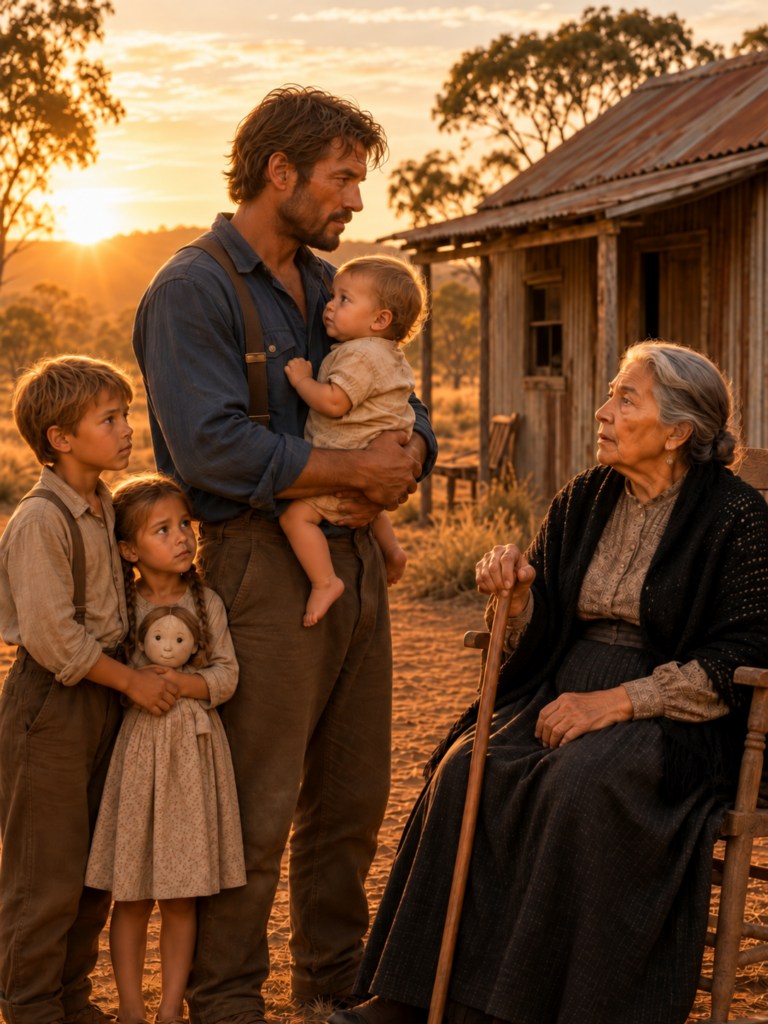
the lonely widow on the remote ranch never expected the dusty track to bring her the son of the man she had tried to forget for fifty years
Part 1
The late light lay across the dry grass of Kookaburra Ridge like hammered copper. Maggie O’Connell sat in the rocking chair on the veranda with her ash-colored shawl around her shoulders and the walking stick Arthur had carved resting against her knee. Her hands no longer trusted the ground without it. She was seventy-six. Arthur had been gone four years, killed when a dry lightning strike spooked his horse while he mended a fence. They had been married forty-seven years and had never had children of their own. The house that had once held his loud laugh now held only the slow turn of the windmill and the restless shifting of the goats.
Three hundred and fifty acres of scrub and pasture, a stone shearing shed Arthur had built with his own hands, a mud-brick house that still smelled faintly of the liniment he used on his knees. Rusty, the only hand left, came three days a week. The rest of the time Maggie managed alone, tea at six, black and hot, supper before full dark, and an hour on the veranda watching nothing arrive down the track.
That afternoon a different thought rose among the usual ones of Arthur. The face of a young man with quiet hands who had broken horses on her father’s place more than fifty years ago. Thomas Riley. He had left one day without a word. She had never asked after him. It had been easier not to know.
She was still looking at the empty track when the silhouette appeared. A man of about thirty-six carried a baby wrapped in a faded blanket. Two children walked behind him—a boy of nine dragging a canvas bag, a girl of six holding a rag doll. The man also carried a suitcase bound with twine and a swag across his chest. He walked straight, but Maggie, who had spent a lifetime reading people, saw what the straightness cost him.
They stopped at the bottom of the steps. The man took off his hat.
“Good afternoon. Are you the owner of this place?”
“I am.”
He adjusted the baby with the automatic care of a man who had done it alone for months. “My name is Jack Riley. I lost my homestead nine months ago. I won’t lie to you. I have nowhere left to go. My children need a roof before the cold comes. I can mend fences, tend stock, fix what breaks. I’m not asking for charity. I’m asking for the chance to earn it.”
Maggie looked at him a long time. The older boy met her eyes with a seriousness beyond his years. The girl pressed the doll tighter. The baby stretched one small hand toward the copper light as if he could catch it.
“Where do you come from, Mr. Riley?”
“From Willow Creek, out east. My father wasn’t from there. He came from farther off when he was young. Thomas Riley was his name. He died eight years ago.”
Something in Maggie’s face shifted, small as a stone yielding after decades of weight. She closed her hands on the stick so it would not show. Jack was too busy holding the sleeping child and measuring whether she would say no to notice.
“I haven’t heard that name in a long time,” she said at last. “Sit down. Tell me.”
Jack climbed the steps and sat, still not knowing what the surname had opened in the woman across from him.
He told her what he knew. Clara, his wife, had died in a flash flood nine months earlier while trying to free goats trapped in the rocks. The bank had come for the place she had borrowed against to expand the herd. He had walked more than forty miles in four days with the children. The night before they reached the ridge they had slept under a gum tree. Ruby had asked what the lady of the new station would be like. Cooper, pretending to sleep, had said people with big places who lived alone always needed help, and they knew how to help.
Maggie listened without interrupting. When he finished she looked at the children. “What’s your name, boy?”
“Cooper.”
“Do you know how to break a horse?”
“Dad’s teaching me.”
She nodded. Then she looked back at Jack. “I have a room out back next to the workshop. Two bunks and room for a third. The kitchen is big. The work here is more than I can do with these hands. I’m not giving you charity. I’m offering you work. You fix things and look after the cattle. In return a roof, food, and a small steady wage. Agreed?”
Jack took three seconds. Something tight in his shoulders eased. “Agreed.”
Ruby, who had been silent, asked in a small clear voice, “Are there chickens here?”
Maggie looked at her. The question, so free of the weight the adults carried, pulled the first brief smile she had managed in a long time. “There are chickens. And an old cat called Ginger who won’t let anyone catch her, so don’t try.”
Ruby smiled. For the first time since they had stopped on the track the air felt less like a negotiation and more like the beginning of a place to stay.
That night Maggie lay awake and did not think of Arthur. She thought of a name she had not spoken in more than fifty years and of how a tired stranger had carried it back to her door.
Part 2
The first days were ordinary in the way that ordinary things become unforgettable when a house has been empty too long. Jack rose before dawn, found the tack behind an unused saddle, and checked the stock with the careful eye of a man who had learned animals by necessity. A cow with a sore hoof. Two broody hens. Maggie’s horse with a worn bridle. When she came onto the veranda the sound of a hammer already rose from the shed. She had not heard that sound in four years.
“Good morning,” he said without turning.
“Good morning.”
He poured her tea from the billy he had heating over the coals. She drank it and felt something shift in her chest at the sight of a fire lit since dawn.
The children claimed the place in small ways. Cooper found the old tools and, without being asked, put them back in order after his father finished for the day. Maggie watched from the veranda and said nothing, but that night she gave him the larger piece of meat. Ruby discovered the room that had been Arthur’s carving workshop. The door stood ajar. Maggie found her on the floor among blocks of wood, eyes wide.
“That belonged to the man of the house,” Maggie said, her voice dryer than she meant.
“Where is he?”
“He went to heaven.”
Ruby considered this. “My mom’s in heaven too. Do you know her?”
Maggie had to breathe before she answered. “I’m sure they do.”
Ruby smiled, small and bright. “Can I learn to carve?”
Maggie, who had planned nothing for four years, said yes.
Oscar, the baby, understood none of the careful distances the adults kept. From the first day he reached for Maggie whenever he saw her. The first time Jack set him on her lap without asking, she went stiff. Oscar tugged a strand of white hair that had escaped her shawl. A short, surprised sound left her—half laugh, half something she did not recognize. Jack heard it from the shed and smiled where she could not see.
One afternoon Maggie went looking for a spool of thread and found Ruby with a half-carved bird. The wing was cut at a particular angle. “Who taught you to start the wing like that?”
“Nobody. It just occurred to me.”
Maggie stood a long time looking at the piece. The angle, the place where the wood was left rough at the beak—it was a style she had seen only once, more than fifty years earlier, in the hands of a quiet young man on her father’s place. She told herself any child with a good hand could arrive at the same cut. The feeling did not leave.
Rusty arrived the next Wednesday, stopped on the veranda at the sight of the stranger and the children, and looked at Maggie.
“You’ve got visitors.”
“I’ve got help.”
He nodded the way bushmen nod at change and went to put his tools away. Later he told his wife the new man’s name was Riley. She looked up from her work. “Riley. Like the drover who worked here so many years ago. The one who left so sudden. Gran used to say he was the best with horses she ever saw.”
Maggie went to town the following week, something she rarely did. Jack drove the old ute with the children in the back. At the market the woman who sold jam hurried over. “Missus Maggie, we thought you didn’t leave the station anymore.”
“Hardly ever. But today I had to show off my folks.” She gestured at Jack and the children.
The woman looked at him with open curiosity. “So you’re the one helping Mrs. Maggie. Where are you from?”
“Willow Creek. Though my father was around here a long time ago, so I’ve been told.”
Something tightened in Maggie’s chest. She bought a piece of cheese she did not need and said nothing.
On the way home she fell asleep in the seat. Jack drove slowly and let her rest. When he helped her down she said, voice already heavy, “It’s been years since I enjoyed going to town.”
“We’ll go back whenever you like.”
That afternoon, looking for something to give Cooper, Jack opened his father’s old tin box for the first time since he had carried it away from the homestead the bank took. Inside, among buttons and a frayed rosary, lay a small bird carved from gidgee wood. He held it a long time and remembered his father’s words the night before he died: I made this for someone a long time ago. I never gave it to them. Her name was Maggie. I worked for a while on a station called Kookaburra Ridge.
Jack sat on the bunk with the bird in his hands while Ruby sang outside and Oscar laughed at something Cooper told him. He thought of the way Maggie had gone quiet the first day he said his father’s name. He thought of how she sometimes looked at him now as if she were searching a face for something she could not quite find. He put the box at the bottom of his swag and decided to say nothing. Not yet. He told himself it might be coincidence. Deep down he knew the silence had an end.
Part 3
The secret began to show in small ways Jack did not fully control. He grew quieter when Maggie spoke of the old days. One night he let slip that Thomas had had a good hand for wood. From the kitchen Maggie heard it and felt the words like a fine needle, though she said nothing.
The first real friction came over a small thing that was not small. Maggie had always kept the station accounts herself in a plastic-covered notebook. One Thursday Jack saw a wire invoice left open on the table. There was a charge that did not match anything he had received. At supper he mentioned it.
“Mrs. Maggie, the wire invoice has an extra charge.”
Her eyes hardened. “You checked my accounts.”
“It was on the table. I saw it by accident. I only wanted you to know.”
The children went still. Maggie looked at him. He held her gaze the same way he had on the first day—no aggression, no apology, only the plain fact.
“I handle my own accounts.”
“With respect, the charge is extra. If you don’t claim it this week they won’t refund it.”
She looked away. “All right.”
The next day she sent Rusty to town. The money came back. She said nothing to Jack, but that afternoon, while Ruby carved and Oscar crawled and Cooper read on the veranda, she stopped beside him where he mended a harness.
“You have a good eye for numbers.”
“I learned out of necessity.”
“Necessity is a good teacher,” she said, and went to her room.
July brought heat that turned the western pasture to tinder. A dry lightning strike set fire to a stretch of grass less than a mile from the shed. Rusty shouted first. Jack ran with Cooper behind him. The three of them opened a break along a line Jack marked with a certainty that surprised even him.
“How do you know the wind stops there?” Rusty yelled.
“I don’t know. You just feel it.”
Ruby stayed on the veranda clutching Maggie’s shawl, eyes wide, not crying. “Don’t be scared,” Maggie said. “Your dad knows what he’s doing.”
“How do you know?”
Maggie watched Jack dig. “It shows.”
The fire stopped meters from the stone shed Arthur had built. That night, covered in ash, Rusty laughed with pure relief. Maggie leaned harder on her stick and asked Jack how he had known exactly where to cut. He looked at her for the longest moment of his time on the place. The words about his father and the bird rose in his throat. Exhaustion and the fear of breaking what had only begun to settle kept them down.
“I guess you learn the bush with your body, not just your head.”
She nodded, not entirely convinced. Later she took an old photograph from a drawer—station hands posed in front of the new shed. She searched the blurred faces for a thin young man in a crooked hat who smiled as if embarrassed to be photographed. She compared the jaw and the way the eyes narrowed to Jack’s face and could not make the likeness leave her.
A few days later old Joe Bailey rode over. He was nearly ninety, Arthur’s friend from youth. He sat on the veranda with a cup of tea and watched the children and the man working in the shed.
“Who’s that?”
“Jack Riley. He’s been helping me a few months.”
Joe squinted. “Riley. Wouldn’t be related to that young bloke who broke your dad’s horses. Thomas, I think. Good with his hands. Quiet. Left so sudden.”
Maggie felt the tea catch. “He’s his son.”
Joe laughed, an old sound that shook his shoulders. “Life comes full circle. I always thought that fellow left because he was sweet on someone around here. Showed on his face every time anyone mentioned the boss’s daughter. Then he was gone without a word.”
Maggie said nothing. She looked toward the shed where Jack worked, unaware. “Don’t tell the boy any of this. Not yet. It’s complicated.”
Joe nodded. In the bush some silences were left alone.
The following Saturday at the market Rusty’s wife approached Maggie while Jack bought wire. “Missus Maggie, do you remember a Thomas Riley who worked here so many years ago? My mother-in-law always said he was the best horseman she ever saw and that he left without hardly a word.”
Maggie went so still the jam woman noticed and came closer. “Why do you ask?”
“Well, Mr. Jack who’s helping you is also named Riley. And my mother-in-law said Thomas went east toward Willow Creek when he left.”
Maggie bought what they needed with a calm that cost her every remaining ounce of will. On the drive home she looked out the window and turned over a question she did not know how to ask without her voice shaking.
That night she could not sleep. She took her stick and walked to the workshop room. The door stood ajar. From the hallway she saw Jack’s swag open, clothes folded, and an old tin box with something wooden showing. She stepped in, took the box carefully, and opened it under the moonlight. The small gidgee bird lay inside, wings cut at the angle she knew. It was the same hand, the same care she had seen one afternoon in 1901 when a quiet young man named Thomas Riley had shown her a half-finished figurine and said it was for someone special without saying for whom.
She had been twenty-five then and already engaged to Arthur. She had pretended not to understand because understanding would have meant admitting something she was not ready to name. Thomas left two weeks later. She married Arthur months after in a noisy, happy wedding she remembered with affection. Now and then in the early years a small question had risen on quiet nights and gone unanswered.
Maggie sat on the hallway floor with the bird in her hands a long time. Outside the windmill turned. Inside the room Jack slept, not knowing his secret had ended.
Part 4
In the morning, after the children went out to play, Maggie set the tin box on the kitchen table in front of Jack and said nothing. He went pale. He recognized it at once and understood that the time he had given himself to find the right moment was over.
“Mrs. Maggie. When did you know? Before I came or after?”
“After. My father told me about a station called Kookaburra Ridge the night before he died, and about a woman named Maggie. I didn’t put it together until I was already here. By then I didn’t know how to tell you without it looking like I had come under false pretenses.”
“And why didn’t you tell me as soon as you knew?”
He ran his hands over his face. “Because I was scared. Scared you’d think we’d come to take advantage of an old story. Scared you’d send us away. Or worse, that you’d think I had arrived calculating something. My children had already lost everything once. I couldn’t risk them losing it again over a secret that wasn’t even mine. It was my father’s.”
“You didn’t think I deserved to know so I could decide for myself?”
He looked down. “I thought about it every day. Every day I found a new reason not to. That doesn’t justify it. I’m only explaining it.”
Maggie was quiet a long time, turning the bird slowly with one finger. “Your father never told me anything. He left without saying anything. I was engaged to Arthur. I don’t even know if what I felt was—” She stopped, searching for a word she had not looked for in fifty years. “I don’t know if it was love or only the affection of youth when everything feels larger than it is. But I do know I thought of him now and then for years, and that when he left without saying goodbye it hurt more than it should have hurt someone who had never spoken to me directly.”
“I’m sorry I didn’t tell you sooner. If you want us to leave, we’ll understand. We’ll go today if that’s what you prefer.”
Outside, Ruby laughed at something, unaware. Maggie looked toward the window, then back at Jack. “I don’t know what to think of this yet. I need time. Not to decide if you leave, but to sort out what I feel. Go to work. I’ll catch up with you when I can.”
She rose with more effort than usual, took her stick, and went to her room, leaving the bird on the table.
The six days that followed were hard in a different way from the months after Clara’s death. Maggie did not send them away, but she was not the same. She ate in her room. When she spoke to Jack it was only about troughs and feed and a cow that needed checking. Cooper noticed on the third day while they mended a fence.
“Are we leaving?”
“I don’t know. It depends on things that aren’t in my hands right now.”
Cooper thought. “I think Mrs. Maggie won’t send us away. But I also think she’s sad, and sadness sometimes looks like anger even if it isn’t.”
Jack looked at his son. “Where did you get that?”
“From you. You were like that when Mom left. Sad, not angry. Though sometimes it looked the same.”
Ruby felt the change differently. She stopped finding Maggie in the carving room. One night she asked, “Did I do something wrong?”
“No, love. No one did anything wrong. Sometimes adults need time to understand things.”
On the sixth day Maggie came out earlier than usual and sat in the rocking chair with the wooden bird in her hands. “Mr. Riley. Come here a moment.”
Jack wiped his hands and approached, expecting the worst.
“Sit down. I’ve been thinking about this for six days, and I want to tell you what I’ve decided so you don’t have to guess.”
He sat.
“At first I thought I’d been lied to,” she said. “Not in a big way, but in a quiet way, which sometimes hurts more. I thought, here comes a man, and without my knowing it he carries something of mine from before I met him. And I felt the ground shift under me. But I also thought of something else these past nights. You didn’t choose this. It was thrust on you one night without asking. A dying father who let go of a fifty-year secret. You carried it the same way I have carried mine—in silence, for fear something would break if I spoke it. We both kept silent out of fear. The difference is you had the courage to break yours when I laid it bare, and I’ve spent half my life without completely breaking mine. Not even with Arthur, who deserved to know everything about me.”
Jack looked at her, surprised.
“So no,” she continued. “You’re not going anywhere. But I’m going to ask you one thing, and I want you to truly promise me. In this house no more big secrets that weigh heavy are kept. The small ones everyone keeps as best they can. But the big ones, the ones that change a heart when they finally come to light—those are spoken. Even if it hurts. Even if it seems the worst time.”
“I promise.”
She nodded and, for the first time in six days, offered something like a smile. “Now then. Bring me a cup of tea. I haven’t had a decent one in days. And sit with me. We have a lot to talk about if we’re truly going to stop keeping things to ourselves.”
Part 5
The days after were different. A new closeness neither of them quite knew how to name settled over the ordinary work. Maggie asked Jack to tell her everything he knew about Thomas—his life after he left, the woman he married, what he had been like as a father. Jack, freed from the weight of hiding, spoke of his father with a freedom he had not felt in years.
“He was good,” Jack said one afternoon on the veranda. “Hardworking. I never saw him truly angry. Not once. Though sometimes he would stare off as if he were thinking about something he didn’t share. Now I understand what.”
“Arthur appreciated him,” Maggie said. “They got along well. Thomas had a way with horses my father had never seen. When he left, Arthur was puzzled. He didn’t understand why he had gone so suddenly without a proper goodbye. I never told Arthur about the bird either. I thought it wasn’t worth stirring up something that hadn’t truly happened.”
“Do you regret not telling him?”
She considered the horizon. “No. I was happy with Arthur. Forty-seven years with their troubles and their peace. Thomas was a door that never fully opened and that one had almost forgotten existed. What hurts is to think he carried that all his life alone, without telling anyone but you, until his last day. That a man leaves this world carrying something so small and so great at the same time without ever completely letting it go.”
That night Maggie walked to Arthur’s grave behind the vegetable patch and sat on the stone bench he had placed there years ago. “Arthur,” she said aloud, as she sometimes did. “Do you remember Thomas, the young man who broke horses? Turns out his son came to my door without knowing who I was. Carrying three children and a story not so different from ours. Life takes many strange turns, old man.”
It seemed to her, though it might have been only the wind in the gums, that the silence that followed held a kind of contained laughter. She stayed until full dark. When she walked back under the first stars she felt, for the first time in four years, that she was no longer carrying the weight of remembering alone.
The following spring Jack turned the side garden Arthur had once kept full of herbs and grafted plants. Maggie gave him the list of seeds in Arthur’s angular hand. Cooper helped on weekends. “My father had a garden in Willow Creek,” Jack said one afternoon. “Not as big as this, but he tended it with the same care. Now I understand he may have learned it here.”
Maggie smiled, the effort smaller than it had once been. “It’s very likely. Arthur taught half the region how to care for a garden in dry land. He used to say the earth needed patience, not force.”
They told the children a simple version: that their grandfather Thomas had worked on the same place long ago when Mrs. Maggie was young, and that was why, without knowing it, Jack had come to a station that already held something of his family. Cooper thought a long while. “So it wasn’t a coincidence that we came here?”
“It was a coincidence and it wasn’t at the same time,” Jack said. “I didn’t know until we were already here. But perhaps something in me remembered without my knowing it. Sometimes the body knows things the head hasn’t understood yet.”
“Like when you knew where to dig the fire break,” Cooper said.
Jack looked at him, surprised. “Exactly like that.”
Ruby looked up from her carving. “Then the little bird I made looks like the one my grandpa made.”
Maggie took the figurine and compared it in her mind to the one in her drawer. “It looks very much alike. More alike than you should be able to know without anyone teaching you.”
Ruby smiled, sensing that something good had happened. “Can I finish learning to do it properly like my grandpa?”
“You can. And if you like, one of these days I’ll show you the rest of the tools.”
Oscar crawled onto Maggie’s lap and tugged her shawl, indifferent to names and old stories, reminding the adults that what mattered most in the house was the present they were building each day.
That night Jack took the unfinished bird and sat on the veranda with a small knife and fine sandpaper. Maggie watched from her chair.
“What are you doing?”
“My father never quite finished it. The beak needs polishing and one of the wings. Since the story is finally complete, perhaps the bird also deserved to be completed.”
She said nothing. She listened to the soft sound of the knife on wood, a sound she had not heard on that veranda in more than fifty years, and for the first time it did not pain her. When he finished well past midnight he handed her the bird. She took it in her arthritic hands and held complete, for the first time in more than fifty years, something a young man named Thomas Riley had begun for her one afternoon in 1901.
“Thank you,” she said, barely audible.
“Thank you,” he answered, “for not sending us away when you could have.”
Later he wrote a short letter he knew had no real recipient and placed it in the tin box where the bird had been. Dad, I found the station. I found Maggie. I finished the bird and gave it to her. She received it as if she had been waiting fifty years. I don’t know if you did right or wrong by leaving without telling her. But what you left unfinished I finished for you, without looking for it, only out of necessity. Now I have a roof and my children have a roof and a lady who loves them as if they were her own. Thank you for telling me about this place, even if it was so late.
Autumn came. One morning on the veranda Oscar pointed at Maggie and said, with surprising clarity, “Gran.”
Maggie went still, but the stillness this time was different. “Yes,” she said, and held out her arms. “Gran.”
Jack, watching from the doorway, felt something settle in his chest that had been searching for its place for months. Ruby ran out. “Oscar said Gran!” Cooper came, saw Maggie with the baby, and something on his serious face eased just enough to show.
That afternoon Maggie asked for a photograph with the three children on the veranda. She kept it beside her wedding portrait with Arthur. She also took the finished wooden bird from the drawer and set it on the small table, no longer hidden.
Years later, after tea one ordinary afternoon, she told Jack she had gone with the solicitor to put her papers in order. The station, when the time came, would go to the family that already worked it and loved it. The solicitor had asked if she was sure. “I don’t have blood relatives who’ve muddied their boots on this place even once,” she had answered. “I have a family who has, even if they don’t share my surname. That counts more than blood to me.”
When she told Jack he only nodded and squeezed her hand. By then they both knew the papers were not the beginning of the story. They were only the confirmation of what they had already been living.
Cooper grew into the man neighbors called when livestock trouble came and the town vet was hours away. Ruby carved gidgee birds that people in town began to call Mrs. Maggie’s birds, some of the oldest smiling to themselves when they saw them at the market. Oscar grew up calling her Gran with dirt on his knees and the certainty that the world was a safe place because the world he knew was a veranda, a rocking chair, a father who smelled of the forge, and two siblings who were always there.
Maggie lived nine more years after the afternoon a tired man appeared on her track carrying, without yet knowing it, the last piece of a story she had thought was closed. She died in her bed with Jack beside her and the three young people present, the finished wooden bird on the table next to her wedding photograph. The last afternoon she was lucid she took Jack’s hand and said, voice already a whisper, “Thank your father when you see him.”
“I will.”
“And look after the station. And look after the children.”
“Always.”
She closed her eyes knowing that what had remained unsaid between her and Thomas Riley more than fifty years earlier had finally found a way to be completed. Outside the windmill continued to turn under a sky full of stars. The station went on. Jack worked it with his children beside him. Now and then on quiet afternoons he took the wooden bird from the drawer and set it on the veranda table for no special purpose, only to have it close. The place that had been built with hard work and with an affection that took half a century and two generations to find its final form remained what it had always been at heart: a roof waiting, without knowing it, for someone to finish a story that had been left unfinished. And that story, after so much time, was complete.


