
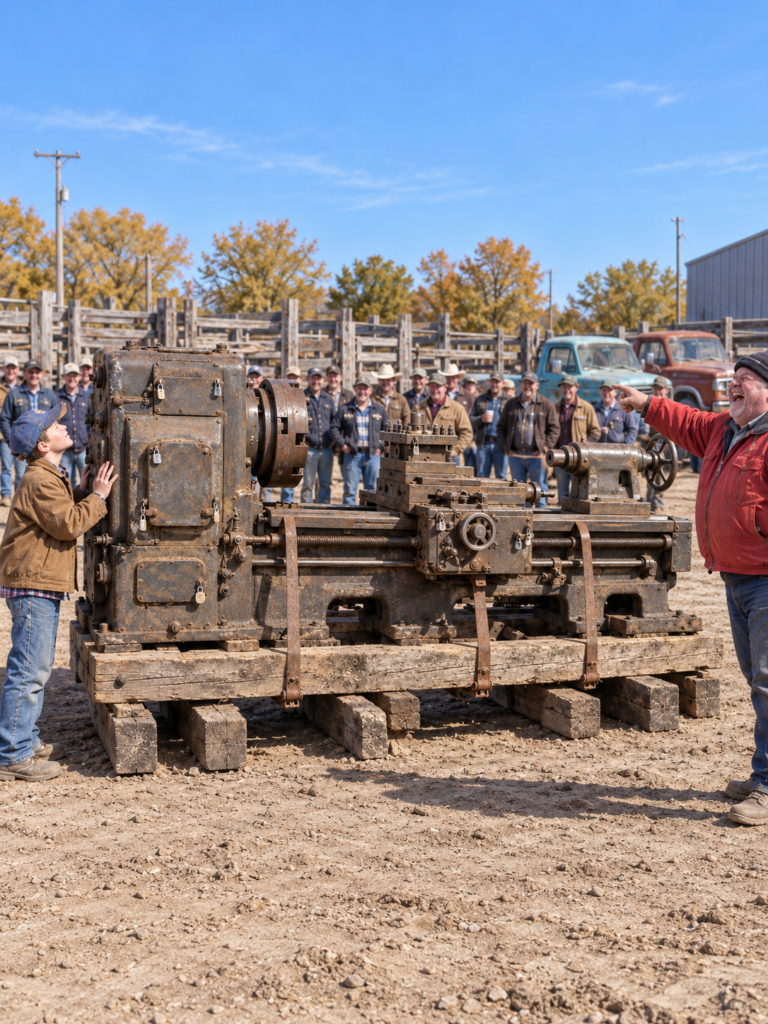
a twelve year old boy bid every dollar he had on fourteen tons of rusted iron the whole county called scrap not knowing the navy seals still hanging on it would bring two hundred sixty eight thousand dollars
Part 1
Sixty dollars. The boy said it with his hand high in the air, and for one second the whole sale yard went quiet. Then Dale Puit laughed so hard he grabbed a pickup’s tailgate, and the sound rolled out of his red jacket and caught the whole crowd. Thirty people laughing at a twelve-year-old who had just bid every dollar he owned on fourteen tons of rusted iron.
“Go on, son,” Dale hollered. “Cut those seals off and show us what sixty dollars of junk looks like inside.”
The boy had wire cutters in his pocket. Would he use them? His name was Ezra Pel, and he did not reach for the cutters. He lowered his arm, slow and careful, and walked straight through the laughing crowd to the thing he had just bought. He laid his hand flat on its cold iron side, the way you settle a nervous horse, and he stood there and let them laugh.
The thing was a lathe, or most people guessed it was. It lay in the dirt of the Brandt farm’s yard, where a tractor had dragged it out of the machine shed that morning. A long, low hulk of gray iron longer than a pickup truck, with a great square headstock at one end and a tailstock at the other, and a bed between them like the spine of some animal that had died a very long time ago. It was banded with rusted steel straps to an oak skid as thick as a railroad tie. Every cover over every gear was wired shut with small gray seals, each one stamped with a tiny anchor. And the whole machine, end to end, was caked in old brown grease that had gone as hard as roofing tar, with chaff and dust and the leavings of eighty years of barn mice stuck all over it.
The sale bill had called it lot number 104. One large old machine, it said. Condition and contents unknown. Buyer to remove within seven days.
Royce Mabry, the auctioneer, had been trying to sell it for twenty minutes. He had started at five hundred and gotten nothing. He had dropped to two hundred, then to one hundred, then he had pushed his white straw hat back and said, “Folks, I’ll take fifty from anybody with a pulse.” And still nobody moved. That was when Dale Puit had stepped up to explain to everyone at full volume why. Dale owned equipment and salvage out on the state highway. If you had bought a used tractor, a hay wagon, or a scrap trailer anywhere in the county in the last twenty years, you had probably bought it from Dale, and he had probably let you know he had done you a favor. He sat on the fair board. He was a big, heavy-set man who liked to be the loudest voice at any sale, and that morning he had decided the old machine was his stage.
“That there is a lathe,” he had announced, slapping its grease with the flat of his hand. “Built for a factory that’s been gone since your granddaddy wore short pants. There’s not a shop floor in this county that’ll hold it and not a power line that’ll turn it. Cast iron’s bringing a hundred and ten a ton at the scrapyard. Time you hire a crane and a lowboy to move it, you’re in the hole three thousand. This is scrap that costs you money, folks. That’s the worst kind of scrap there is.”
People had nodded. Dale knew iron. Nobody bid. And then a boy’s voice from the back said, “Sixty.”
Royce Mabry knew the Pel boy. Everybody in Quarters Mill did. He was the grandson of Walt Pel, who had run the big machines at the pump works down by the river for nearly thirty years until the works closed, and who had died two winters back. The boy had come to the sale that morning with Hollis Grange, the tow and rigging man, who had come to look at a gooseneck trailer, and had left Ezra by the coffee wagon with a cup of cocoa and strict instructions to stay out of trouble. Royce could have refused the bid. A twelve-year-old does not have a bidder number, but the old machine had cost him twenty minutes, and Royce wanted it gone.
“I’ve got sixty,” he said into the microphone, grinning, “from the young man in the blue cap. Do I hear seventy? Seventy? Anybody? No. Sold. Sixty on Hollis Grange’s number, I reckon, since he brought you.”
That was when Dale laughed, and the yard laughed with him. Hollis Grange came pushing through the crowd a minute later, a broad old man with a white beard and gray coveralls, wanting to know what in the world all the hollering was about. When somebody told him, he looked at the lathe and he looked at the boy with his hand on it and he did not laugh at all.
“Ezra,” he said quietly. “What did you just do?”
“I bought it,” Ezra said, “with my own money. I’ll pay the clerk myself.”
“Son, that’s fourteen tons.”
“I know.” The boy pointed at one of the little gray seals hanging on its twist of wire from a bolt on the headstock cover. “Mr. Grange, look at that. That’s a Navy seal. Grandpa showed me one once. He said when a Navy inspector seals a machine, it means nobody has ever run it. Not one time. Not since the day it left the factory.”
Hollis bent down and squinted at the little anchor stamped into the soft gray metal. He looked around at the yard, at Dale Puit still wiping his eyes, at thirty people still grinning over their coffee cups. Then he put his big hand on the boy’s shoulder.
“A man’s bid is his bid,” he said loud enough for the nearest of them to hear. “Go pay the lady.”
So Ezra Pel walked to the clerk’s trailer and counted out sixty dollars in tens and fives and a fistful of ones he had earned mowing lawns all summer while the line behind him snickered. The clerk wrote him a receipt for one large old machine. Condition and contents unknown.
Dale was waiting for him when he came back down the trailer steps. “Tell you what, son,” Dale said with that big easy grin of a man who has never once been told no at a farm sale. “You’re a good kid, and I don’t want you crying to your mama tonight. I’ll do you a kindness. Snip one of those seals right now, open up that gearbox, and if there’s anything in there but rust and mouse nests, I’ll buy it off you for a hundred cash. You’ll be up forty on the day. How’s that?”
The crowd waited. Ezra looked at the seals. He looked at Dale.
“No, sir,” he said. “I’m not going to open it.”
“Why the devil not?”
“Because my grandpa said you never break a Navy seal in a sale yard. You break it in front of people who know what they’re looking at and who can write down what they saw.”
For a second Dale’s grin went thin. Then he laughed again, louder, and turned to the crowd and spread his arms wide. “Well, you heard him, folks. The boy’s waiting on the Navy.” And the whole yard laughed one more time because that was the funniest thing anybody had heard all week.
Carla Pel heard about it before her shift at the county nursing home was over. Three different people called her. The third one was laughing so hard she could barely make out the words. She drove out to the Brandt place, still in her green scrubs, with her gray cardigan buttoned wrong, and she found the yard nearly empty. The pickups were pulling out one by one. And there, in the middle of the trampled dirt, sat her twelve-year-old son on the corner of a huge oak skid beside a machine the length of her kitchen, with Hollis Grange standing next to him like a bodyguard.
“Ezra Walter Pel,” she said, and then she ran out of words.
“I paid for it with my mowing money, Mom,” Ezra said. “All of it. Sixty dollars.”
“Honey, it’s not the sixty.” She looked at the thing. She looked at the size of it. “We can’t move that. We can’t pay somebody to move that. It’s got to be gone in seven days, and if it’s not, they’ll charge us.”
“I’ll move it,” Hollis said.
Carla turned to him. “Hollis, I can’t ask you to do that.”
“You’re not asking. In the flood of ’97, my boy put his truck in the river off the ferry road, and Walt Pel waded in up to his chest with a tow strap in the dark and pulled him out. Wouldn’t take a dime for it. I’ve owed this family a favor for twenty-nine years.” The old man shrugged. “Diesel and a Saturday. That’s all it costs me.”
Neil Brandt walked over while they were talking. He was the great-nephew who had driven down from Louisville to sell off the estate. A tired, decent man in a windbreaker who had spent the whole day watching strangers paw through his family’s things. “I’m glad it went to you, son,” he told Ezra. “Honestly, I was about to pay Dale Puit four hundred to drag it off for scrap.”
So that was it, Hollis thought. That was why Dale had laughed so loud. A boy with sixty dollars had just taken a haul job and fourteen tons of free iron right out of his pocket in front of the whole county.
“Mr. Brandt,” Ezra said, “do you know where it came from?”
Neil sat down on the skid beside him. “Some great-uncle Auggie bought it in the spring of 1947 at a government surplus sale up in Cincinnati after the war. Paid four hundred, which was a lot of money for a farmer. Then he had this dream of opening a repair shop out here, fixing tractors and combines for the whole valley. Borrowed a lowboy, hauled it home, slid it into the machine shed.” Neil smiled a little. “And then the power company never ran the heavy line out this far. You need big three-phase power to turn a machine like this, and the farm never got it. So it sat. Seventy-nine years it sat in that shed under a tarp. Did he ever open it? Never. I asked him once when I was a kid. He said the man who breaks those seals had better know what he’s doing, because he sure didn’t.” Neil looked at the little gray seals hanging on their wires. “I always figured he was just being stubborn.”
Ezra wrote that down in the spiral notebook he kept in his jacket.
That night, after supper, he went out to the old garage behind the house where his grandfather’s shop still stood the way Walt Pel had left it. The little bench lathe under its dust cover, the drill press, the rows of coffee cans full of bolts, every can labeled in his grandfather’s square hand. Ezra had spent half his childhood out here on an upturned bucket, handing over wrenches and learning the names of things. Chuck. Tailstock. Carriage. Lead screw. And once, when he was eight, his grandfather had shown him a little gray seal on a wire stamped with an anchor that he kept in a cigar box on the shelf. That came off a Navy pump, Walt had told him. Brand new, never run. When the inspector seals a machine, Ezra, it means nobody has turned it since the day he signed for it. A sealed machine has got a story, and the story is worth money. But only if that seal is still whole when somebody who matters reads it. You cut it yourself in a barn with nobody watching, and all you’ve got is an old machine and your own word.
Ezra found the cigar box. The seal was still in it. He held it up to the light from the shop bulb next to the picture he had taken that afternoon on his mother’s phone, and the anchors matched.
Part 2
Hollis Grange came at seven the next morning with his big red wrecker and the lowboy trailer hooked behind it. It took them most of the day. Hollis set the ramps and ran the winch cable out and hooked onto the oak skid and dragged the whole hulking thing up onto the trailer an inch at a time, with the cable singing and the skid groaning and Ezra standing well back beside his mother exactly where Hollis had told him to stand. Word had gotten around. A dozen cars stopped along the road to watch. Somebody had a lawn chair. Somebody had a thermos. And about two o’clock in the afternoon a white pickup with Puit Equipment and Salvage painted on the door rolled by slow, and Dale Puit leaned out the window in his red jacket.
“Careful, Hollis,” he called. “Don’t bust your back over sixty dollars of firewood.”
The people along the road laughed. Hollis didn’t even look up. They drove it through the middle of Quarters Mill at eight miles an hour. People came out of the diner to watch. People came out of the hardware store. Old men on the bench in front of the bank pointed and grinned, and somebody shouted, “There goes the Navy.” And the whole sidewalk laughed. Ezra rode in the cab of the wrecker beside Hollis with his cap pulled low, and he looked straight ahead.
By dark the lathe sat on a crib of stacked timbers on the gravel beside Walt Pel’s old garage, covered with a blue tarp and tied down at every corner. Ezra walked around it twice with a flashlight, his mother watching from the back step. Then he sat down at the kitchen table and copied every seal number into his notebook. There were nineteen of them. Every one was whole.
The laughing did not stop when the lathe left the road. On Monday morning at the feed store Dale Puit told the whole coffee counter that the Pel boy would be inside that gearbox with a hacksaw inside a week. “Kids are twelve,” he said. “Twelve-year-olds don’t wait on anything. Mark my words, by Friday he’ll be out there by flashlight, and all he’ll find is a pound of rust and a mouse with a pension.” The men at the counter laughed and slapped the table. On Wednesday at the gas station Dale saw Ezra buying a soda after school and called across the pumps, “Navy write you back yet, sailor?” Two men filling their trucks laughed out loud. By the end of the week half the town had started calling the lathe the Navy boat, and the other half called Ezra the Admiral. Grown men saluted him outside the post office. They meant it as a joke, mostly. Mostly it was not a kind one.
Carla saw how it was wearing on him. He came home quiet. He went straight out to the gravel lot and walked around the tarp, checking the ropes, and then he sat at the kitchen table writing in his notebook until bedtime.
“What are you writing, honey?”
“Letters,” Ezra said.
He had found the name in his grandfather’s shop on the shelf above the drill press, in a stack of old machinery auction catalogs that Walt Pel had kept for thirty years the way some men keep fishing magazines. There was one from an industrial auction house in Cincinnati. On the back page it listed the company’s appraisers. One name had a pencil check beside it in his grandfather’s hand. Ruth Anne Vickery, accredited senior appraiser, machinery and equipment.
So Ezra wrote to Ruth Anne Vickery. He wrote in pencil first and then copied it over in ink with his mother checking the spelling. He told her about the sale and the seals and the anchor stamps and the stencil on the skid that said USN and then a long row of numbers he wrote out in words because he was not sure how else to do it. He told her nobody had opened it and nobody would until somebody who knew what they were looking at was standing there. He folded in six photographs his mother printed at the drugstore. And then, because his grandfather had said the Navy was the one who sealed it, he wrote a second letter to the commanding officer of the biggest Navy shipyard he could find on the internet, and he sent the same six photographs there too.
They mailed both letters on a Thursday. Then they waited.
The second week was the hardest. Nothing came. Ezra checked the mailbox every afternoon, and every afternoon it held a power bill or a seed catalog or nothing at all. On the Saturday Dale Puit came by the house. He did not get out of the truck. He pulled up on the gravel, rolled the window down, and looked over at the blue tarp with a big tired smile, like a man doing a favor for a child who did not deserve it.
“I’ll tell you what, son. My offer’s gone up. Two hundred cash and I’ll haul it off myself. You’ll have tripled your money and your mama gets her yard back. That’s a better deal than anybody else in this county is going to give you.”
Two of Dale’s men were in the truck bed. They were grinning.
“No, thank you, Mr. Puit.”
“You haven’t even heard from the Navy, have you?” It wasn’t a question. Dale laughed, shaking his head. “Boy, the Navy doesn’t read letters from twelve-year-olds. Nobody’s coming. You’re going to sit out here waiting on a ship that’s never going to sail. And when you finally get tired of being the town joke, you call me. The price will be lower by then.”
He drove off. The men in the truck bed laughed all the way down the road.
That night the wind came up hard out of the west. Around midnight Carla woke to a sound like a rifle shot and then another, and she knew it was the tarp. She found Ezra already pulling on his boots in the kitchen. They went out together in their rain jackets with two flashlights, and in the slanting rain they caught the flapping corners and wrestled them down and tied them off again. Mother and son, soaked to the skin, laughing a little at the end because there was nothing else to do. When the tarp was tight Carla shone her flashlight on her son. He was standing by the headstock with his hand on the iron, and in his other hand she saw were his grandfather’s wire cutters.
“Ezra.”
“I wasn’t going to,” he said. Then honestly, “I thought about it. Mom, what if Mr. Puit’s right? What if there’s nothing? What if nobody ever comes and I spent all my money on a joke and everybody was right about me?”
Carla took the cutters gently out of his hand. “Then you’ll have learned what it costs to keep your word,” she said. “And that’s not nothing either. Your grandpa kept his word his whole life. It never once made him rich, but nobody ever laughed at him twice.”
They went inside. She put the cutters back in the cigar box on the shelf next to the old gray seal. Every seal on the lathe stayed shut.
Part 3
The phone rang on a Tuesday evening, twenty-three days after the sale.
“Is this Ezra Pel?” a woman’s voice asked. “My name is Ruth Anne Vickery. You wrote me a letter.”
Ezra stood up so fast his chair fell over. She asked him to go out to the lathe and read her three of the seal numbers slowly and then the long row on the oak skid. He did. On the other end of the line there was a silence long enough that he thought the call had dropped.
“Ezra,” she said at last, very carefully, “has anybody cut any of those seals? Even one? Even a little?”
“No, ma’am. Nobody’s touched them.”
“Good. Don’t let anybody. I’m going to make one phone call tonight and then I’m going to drive down there and I’m going to bring somebody with me.” She paused. “Your letter said you wanted people there when it was opened. People who could write down what they saw.”
“Yes, ma’am. My grandpa said so.”
“Your grandpa,” said Ruth Anne Vickery, “knew exactly what he was talking about. Pick a Saturday. Invite your witnesses.”
So Ezra made a list at the kitchen table. His mother. Hollis Grange. Royce Mabry, who had sold it. Neil Brandt, whose great-uncle had bought it. Mrs. Odum, who wrote the weekly paper. Mr. Kettering, who taught the machine shop class at the county career center. And at the bottom, in his neatest handwriting, Dale Puit.
“Why on earth Dale?” his mother asked.
“Because he’s the one who said it was scrap,” Ezra said. “He ought to see.”
Dale took the invitation at the feed store in front of the whole coffee counter and read it out loud in a funny voice. “Wouldn’t miss it,” he said. “I’ll bring a hacksaw in case the Navy forgets theirs.” The counter roared.
On the Saturday Carla borrowed eight folding chairs from the Methodist church and set them in a half circle on the gravel facing the lathe. Hollis pulled the blue tarp off and folded it. And for the first time in seventy-nine years the old machine sat out in the full October sun, banded to its skid, caked in its brown grease, every one of its nineteen little gray seals hanging whole on its wire. The witnesses came. Royce Mabry in his straw hat. Neil Brandt back from Louisville. Mrs. Odum with her notebook. Mr. Kettering with his reading glasses pushed up on his forehead. Hollis in clean coveralls. Dale Puit came last in his red jacket with a bag of sunflower seeds. He did not sit in a chair. He leaned against his truck with his arms crossed and grinned at everybody.
At ten o’clock a white car pulled up and a woman in her fifties, with short gray hair and a navy blazer, stepped out with a camera case and a clipboard. Behind her came a second car and a compact serious man in a khaki shirt climbed out carrying a long hard case of measuring instruments. He wore a badge clipped to his pocket from a Navy shipyard in Virginia.
“Ezra,” said Ruth Anne Vickery, shaking his hand like a grown man’s. “This is Gil Choa. He runs the heavy machine shop at the shipyard. Your second letter landed on his desk the same week I called him.”
Dale stopped grinning just for a second. Ruth Anne did everything slowly and out loud. She set her camera on a tripod. She walked the length of the machine and read every seal number into a little recorder, and Gil checked each one against a printed list he had brought, nodding. Then Gil took out a tape and a set of calipers and measured the bed and the height of the spindle over it and the distance between the centers and wrote every number down. His face gave nothing away, but Mr. Kettering, who stood closest, said afterward that the man’s hands were not quite steady.
Then Ruth Anne turned to the boy. “Ezra, it’s your machine. Do I have your permission to cut the seals?”
Every head turned. Dale stopped chewing.
“Yes, ma’am,” Ezra said.
She cut the first seal on the headstock cover with her own cutters and bagged it and labeled it. Hollis and Gil loosened the bolts. The machine was dead cold, the way it had been for seventy-nine years, with no power anywhere near it. Together they lifted the heavy iron cover off the headstock and set it down on the gravel, and the people in the folding chairs leaned forward.
Inside, the gears were bright. Not rusty. Not dull. Bright under a clear amber coat of old preservative, every tooth as sharp as the day it was cut. Not one mark of wear on any of them. Tucked against the inside of the cover was an envelope of stiff oilcloth, and inside it, folded twice, a card. Gil Choa read it aloud and his voice was not quite steady either.
“Strand and Whitam Machine Company, Cincinnati, Ohio. Heavy shaft lathe built to Navy drawing. Inspected and accepted August 1945 for installation at the Navy yard.” He lowered the card. “It was never installed. The war ended. They canceled the order and sold it surplus without ever unsealing it. This machine has never turned over. Not once.”
“Is that good?” Ezra asked.
Gil almost laughed. “Son, I’ve been looking for one of these for eight months.”
He explained it to the folding chairs. His yard kept a fleet of old harbor tugs working, the kind that pushed the big ships into their berths. Their propeller shafts were long and heavy and built to an old Navy drawing, and the yard had kept one old shaft lathe just to turn them. In April it had cracked its bed. A new machine big enough was two years away. The outside shops had quoted eighteen months, and meanwhile tugs were tied up at the pier waiting on shafts nobody could make. This lathe, Gil said, was built to that same drawing in that same year. It is exactly what we need.
Ruth Anne Vickery stepped forward with her clipboard. “For the record,” she said, “and for insurance purposes, I am appraising this machine as it stands. Never run. Fully documented, with its acceptance card and its seals intact until this morning, opened before witnesses. My figure is sixteen thousand.”
Nobody in the folding chairs said a word. Carla Pel put her hand over her mouth.
“And the Navy,” said Gil Choa, “would like to make Ezra an offer of its own. We’d like to lease it. We truck it to the shipyard at our cost. We insure it. We turn eleven shafts on it, and when the last shaft is done we send it home. For the use of this machine, for those eleven shafts, I am authorized to pay two hundred and sixty-eight thousand dollars.”
Royce Mabry let out a long low whistle. Over by the white pickup Dale Puit stood holding his bag of sunflower seeds with his mouth open. He stared at the bright gears. He said nothing at all.
Ezra looked across the gravel at him. He did not grin. He just said, in that same clear voice he had used at the sale, “Mr. Puit, you told me if there was anything in there but rust and mouse nests, you’d buy it off me for a hundred.”
Somebody in the chairs laughed. It was Royce Mabry. And once it started it went around the whole half circle. It was the first time anyone in Quarters Mill could remember people laughing at Dale Puit. Dale’s face went the color of his jacket. He cleared his throat.
“Son,” he said, “I’ll give you fifteen thousand cash right now and save you all that government paperwork.”
“No, sir.”
“Thirty.”
“No, sir,” Ezra said. “It’s going to the Navy. My grandpa served on a Navy repair ship. I think he’d like that.”
Dale Puit got in his truck and drove away, and he did not look back.
Part 4
The Navy’s heavy hauler came three weeks later, a long low trailer with a crane truck behind it. This time, when the lathe rode down Main Street at eight miles an hour, the whole town lined the sidewalks, and nobody laughed. The old men on the bench in front of the bank stood up and took their hats off. And out on the state highway, as the convoy passed Puit Equipment and Salvage, a big man in a red jacket stood alone at the edge of his lot with his hands in his pockets and watched it go by.
All that winter Gil Choa sent photographs: the lathe bolted to the shipyard floor, the headstock turning for the very first time, the first shaft gleaming as long as a school bus. In March the Navy flew Ezra and his mother to Virginia, and in safety glasses and ear protection, standing behind the yellow line next to Gil, Ezra watched the machinist lift the eleventh shaft off his lathe. The check came in April. Two hundred and sixty-eight thousand dollars. Carla paid off the house. She stopped working double shifts. The rest went into the bank in Ezra’s name for whatever he decided to become.
And in May the lathe came home, not to the gravel lot. Ezra lent it to the county career center where Mr. Kettering had a floor that could hold it and the power line that could turn it, and it stands there now with a small brass plate on the headstock. It says, In memory of Walt Pel, machinist. On Saturdays Mr. Kettering lets Ezra sweep the shop and then stand beside him at that lathe in safety glasses, learning the names of things on a machine his grandfather would have loved.
They say that at the very next farm sale in the county, when Royce Mabry put up a rusty old crate banded shut that nobody could name, the very first hand in the air belonged to Dale Puit. He paid four hundred for it. It was full of fence staples.
Part 5
The lathe still stands in the machine shop at the county career center, its bed longer than most of the classrooms, its gears oiled and bright under the fluorescent lights. On Saturday mornings Ezra Pel, now thirteen, sweeps the floor first the way his grandfather always made him do, then stands beside Mr. Kettering with safety glasses on and watches the carriage travel the length of a practice shaft. He learns the names again, slower this time, because the machine is big enough that a mistake costs more than a skinned knuckle. Chuck. Tailstock. Carriage. Lead screw. The lead screw is longer than he is tall.
Carla comes by sometimes with coffee for Mr. Kettering and stands in the doorway watching her son. She does not interrupt. Outside, the gravel lot behind their house is empty again except for the stacked timbers Hollis left, and the blue tarp folded neat in the garage next to Walt’s old cigar box. The little gray seal is still inside it. Ezra does not need to look at it anymore. He knows what the anchors look like.
Down at the feed store the coffee counter still talks, but the talk has changed. Dale Puit does not tell the story. When somebody else starts to, he looks at his coffee and does not laugh. Hollis Grange still drives the red wrecker. He stops by the career center once a month just to look at the lathe and run his hand along the bed the way a man checks a fence he helped set. Neil Brandt sent a letter from Louisville after the check cleared. He said his great-uncle Auggie would have liked knowing the machine finally turned, even if it turned for the Navy instead of for farmers along the Big Hole. Ruth Anne Vickery kept her appraisal notes. Gil Choa still sends a photograph once in a while when a new shaft comes off the machine, though the lease is long finished and the lathe is home.
Ezra keeps the spiral notebook on the shelf above the drill press in his grandfather’s shop. The last page has the seal numbers written out in ink, and under them, in smaller letters, the date the Navy truck left town and the date it came back. He does not write in it often anymore. He does not need to. The machine is no longer a story waiting to be told. It is a tool that turns, and a boy who knows how to stand beside it without reaching for the cutters until somebody who matters is there to write down what they see. On the brass plate the letters are small enough that you have to stand close to read them. In memory of Walt Pel, machinist. The words do not say what the lathe cost or what it earned. They only say whose name it carries now, and whose hand taught a boy to leave the seals whole until the right people were standing in the yard to watch them cut.


