
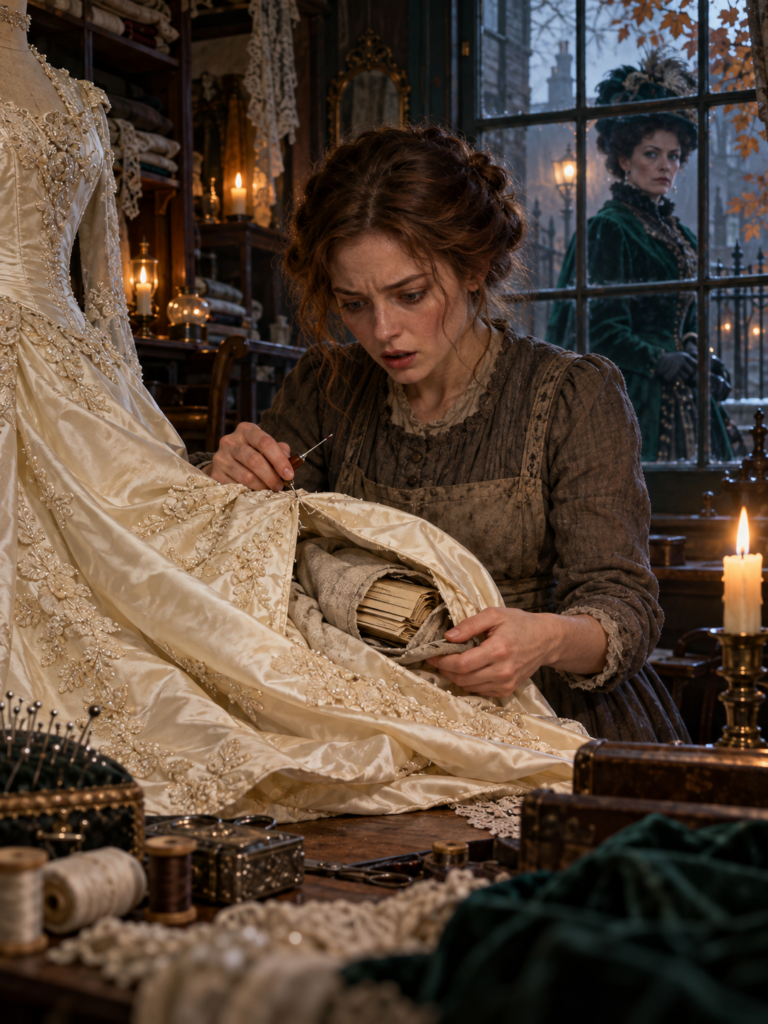
The thread slid through the silk, releasing a narrow opening in the heavy hem.
Adah lifted the folded edge.
Something crackled beneath her fingers.
Not silk.
Paper.
She stopped, afraid that another movement might damage whatever had been hidden there.
Then she widened the opening stitch by stitch.
Inside the doubled hem was a long, narrow sleeve of glazed linen. It had been sewn directly into the gown and protected with a wrapping of oiled cloth.
Within that covering lay several folded documents.
Adah drew them out carefully.
The first was a letter.
Its opening identified the writer as Honoria Slade, dressmaker of Calder Row.
Adah sat down.
The letter explained that Honoria had been entrusted with a will belonging to Edmund Marley, a wealthy gentleman who had died in March 1888.
The document had been signed shortly before his death.
Honoria claimed that she had witnessed it.
And she wrote that the dying man had placed it in her keeping because he feared members of his own household would destroy it.
Adah looked toward the shop door.
Mrs. Loach’s warning suddenly seemed much more dangerous.
She continued reading.
According to Honoria, after Edmund’s death, his relatives had produced an older will and insisted no later document existed.
The newer will had therefore remained hidden.
Honoria had feared that anyone powerful enough to suppress the document once might do so again.
She had been unable to find a surviving witness whose testimony could support her account.
So she had concealed the papers inside the bridal gown.
Adah unfolded the second document.
The handwriting was old-fashioned and densely arranged.
She was no solicitor.
But one provision was unmistakable.
Edmund Marley had left Marley House and the greater part of his estate to his daughter, Cecily Marley.
Not to the relatives who had apparently taken control after his death.
Adah read the names again.
Among the relatives receiving a comparatively modest provision was Prudence, who had married into the Loach family.
Her visitor.
The woman who had ordered the gown burned.
Adah felt her mouth go dry.
For ten years, a wealthy family might have been enjoying property that rightfully belonged to an absent daughter.
And the proof had been hanging in an abandoned dressmaker’s shop.
She looked at the empty pocket.
Now its strange construction made sense.
It was a distraction.
Someone searching the gown would notice the carefully sealed opening, unpick it, find nothing, and perhaps assume there was nothing else to discover.
The real secret lay below.
Protected within the hem.
Adah touched Honoria’s letter again.
The old woman had understood exactly what she was risking.
But understanding the secret did not mean Adah knew how to use it.
She possessed a document whose authenticity would certainly be challenged.
She did not know where Cecily Marley lived.
She did not know whether Cecily was still alive.
And she did not know which person in Marley could safely help her.
Mrs. Loach’s husband held financial influence over much of Calder Row.
Her family had connections with the people who had handled Edmund Marley’s estate.
A poor seamstress making accusations against them could lose everything.
Adah folded the papers.
She considered carrying them directly to a solicitor.
But which one?
Someone had already helped the relatives establish their claim years earlier.
She would not risk placing the only surviving evidence into the wrong hands.
Instead, she returned the documents to their protective wrapping.
Then she concealed them inside her clothing.
Outside, a carriage rolled past the shop.
Adah stood motionless until the wheels faded.
She looked toward the wedding gown.
For the first time, she understood that Honoria had not simply left her a place to work.
She had left her a responsibility.
But Adah could not fight for an inheritance on behalf of a woman she had never met without first learning the truth about what had happened to her.
She reached for a clean sheet of paper.
At the top, she wrote Cecily Marley’s name.
Then she took up her pen to begin a search that might cost her the only livelihood she possessed.
Adah’s pen hovered above the blank page.
She knew the name of the woman she needed to find.
She knew that Cecily Marley had been deprived of an inheritance, at least according to the documents hidden in the gown.
But she knew almost nothing about Cecily herself.
Where had she gone?
Why had she never returned?
And why had Honoria Slade hidden the will for ten years instead of revealing it?
Adah put down the pen.
Searching blindly would waste time and money she could scarcely afford.
She needed information.
And the only people likely to remember events from 1888 were those who had lived and worked in Marley at the time.
She began with the customers entering her shop.
A washerwoman named Bet had already become one of her most reliable visitors.
Bet had brought in a badly torn Sunday skirt during Adah’s first week.
Adah had repaired it so neatly that the damage was nearly invisible.
In return, Bet had recommended her to several neighbors.
Soon a railway clerk arrived with his late father’s coat.
Then came a woman needing cuffs turned, a mother seeking alterations for her daughter’s dress, and laborers with trousers worn thin at the knees.
The shop began earning enough to buy bread and coal.
Adah worked long hours, but she was no longer spending every day worrying whether anyone would enter her door.
A thin tabby cat also appeared.
He settled near the warm stove, accepted food when offered, and gradually behaved as though he owned the premises.
Adah called him Thimble.
Bet found this enormously amusing.
“Every proper dressmaking shop ought to have a cat,” she declared.
“Then I suppose he’s part of the establishment.”
“Whether you approve or not.”
One afternoon, as Bet collected a repaired garment, Adah raised the subject of Honoria’s old bridal work.
“Did Miss Slade often make wedding dresses?”
“Years ago, yes.”
“And do you remember one that was never collected?”
Bet stopped folding the garment.
“There was talk about that.”
Adah kept her voice casual.
“What sort of talk?”
“A young lady from a good family. A wedding expected. Then something went wrong after her father died.”
“Do you remember her name?”
Bet frowned.
“Marley, perhaps. There were several connected families, and I’ve never been clever at sorting one cousin from another.”
Adah felt her heart quicken.
“And the wedding?”
“Never happened. Her father’s estate went elsewhere. The young man she was to marry lost his enthusiasm when the money disappeared.”
Bet gave a disapproving sniff.
“Some men are devoted until the purse grows light.”
Adah continued working.
“What became of her?”
“She went north, I believe. To relations or to take a position. I don’t rightly remember.”
“Would anyone know?”
“Mrs. Pruitt might. She used to take in linen from Marley House.”
Adah looked up.
“Is she still in town?”
“Oh, yes. Doesn’t go out much these days, but she’ll remember.”
That evening, Adah sat by the stove and considered what she had learned.
The bride and the disinherited daughter were the same person.
The gown was not merely evidence of a marriage that had never taken place.
It was evidence of a future taken away.
Adah thought about her own mother.
Margaret Quill had worked honestly all her life.
Yet after her death, relatives had disposed of the cottage and left Adah without financial security.
The injustice done to Cecily Marley was vastly larger.
But Adah recognized the humiliation.
The terrible experience of watching others decide that a woman’s home and livelihood belonged to someone else.
She understood why Honoria had refused to forget.
***
Mrs. Pruitt came to the shop several days later.
She was elderly, slightly stooped, and grateful for a chair near the stove.
Adah made tea.
When the older woman had settled comfortably, she asked about Marley House.
Mrs. Pruitt remembered it vividly.
“Mr. Edmund Marley was a decent gentleman,” she said. “A widower. His daughter was everything to him.”
“Cecily?”
“Yes. A gentle girl. Rather shy. Her mother had died, and her father tried to give her a good home.”
“What happened when he became ill?”
“His relatives came around more often.”
“Which relatives?”
“His nephew’s family. Prudence was always particularly attentive.”
Adah remained silent.
Mrs. Pruitt continued.
“She took charge of the household while the old gentleman was failing. Visitors were managed. Letters were handled. Nobody reached him easily without going through her.”
Adah thought of Honoria’s warning.
“Did Mr. Marley make a will?”
“Of course. The family had one read after he died.”
“And Cecily inherited?”
Mrs. Pruitt shook her head.
“Not the house. Not the property everyone expected her to receive.”
“What did she get?”
“An allowance. Less than people thought her father meant to leave.”
“And the rest?”
“The nephew’s side received it.”
Adah set down her cup.
“Was anyone surprised?”
“Plenty. But the document was presented properly, and what could anybody do?”
Mrs. Pruitt looked toward the window.
“There were whispers about another will.”
Adah waited.
“One made later,” the old woman continued. “Some said Honoria Slade had witnessed it. But when people asked where it was, nobody could produce it.”
“And then?”
“The matter died away. The family said there was no such document.”
“What happened to Cecily?”
Mrs. Pruitt’s expression softened.
“Poor girl lost more than her home. She had been engaged. Wedding preparations were underway. Then her prospects changed.”
“The gentleman withdrew?”
“His people cooled toward the match. It all came apart.”
Adah glanced toward the workroom.
“And the wedding gown?”
“Miss Slade kept it. Wouldn’t take another bridal order afterward, so I was told.”
Mrs. Pruitt sighed.
“Cecily went away. Somewhere north, to relations. I never heard that she returned.”
Adah had learned enough to understand the shape of the injustice.
But she needed more than recollections.
She needed Cecily herself.
And she needed evidence that the will was genuine.
***
Over the following weeks, Adah divided her life between sewing and searching.
During daylight, she worked for customers.
At night, she wrote letters.
She contacted a northern parish connected with the family Mrs. Pruitt remembered.
She wrote to a dressmakers’ benevolent society her mother had once known.
She inquired after Cecily Marley, who had reportedly left the town around 1888 to work as a companion.
Each letter cost money.
Every stamp came from the small earnings of her shop.
She could not afford unnecessary journeys, and she was unwilling to risk sending the original will anywhere.
So she kept the documents hidden and sent only cautious inquiries.
Meanwhile, Mrs. Loach passed the shop more than once.
Sometimes she did not look toward it.
Other times, Adah saw her gaze settle on the workroom window.
The woman never entered again.
But Adah remembered her command.
Burn it.
That command was now reason enough to remain watchful.
The first replies were disappointing.
One parish knew nothing of Cecily.
Another had no surviving record that could help.
A third correspondent suggested an unrelated woman of the same name.
Adah crossed out leads and began new ones.
By November, she was exhausted.
The shop was earning modestly, but her search had consumed most of what she could save.
One cold morning, a letter arrived from a clergyman’s wife in a northern town called Harrow Bridge.
Adah opened it beside the cutting table.
The writer knew of a woman named Cecily Marley.
Years earlier, Cecily had served as a companion to an elderly Mrs. Danby.
When Mrs. Danby died, Cecily had remained in the town.
She had married a schoolmaster named Arthur Hale.
She was now Mrs. Hale, the mother of two children, and taught sewing to local girls to supplement the family’s income.
Adah read the letter again.
Then she sat down.
Cecily was alive.
Not wealthy.
Not restored to the life her father had intended.
But alive.
Adah covered her mouth with one hand.
For a long time, she sat without moving.
Honoria Slade had died believing the daughter she wanted to protect might never be found.
Yet the woman was living only a railway journey away.
Adah wanted to write immediately.
Then she hesitated.
She did not know who might read a letter before it reached Cecily.
Honoria had warned that the Loach family once controlled important correspondence.
Although Adah had no proof the danger remained, she would not put the original documents at risk.
Nor did she want to frighten Cecily with an extraordinary claim arriving from a stranger.
She decided to go herself.
***
Preparing for the journey required another sacrifice.
Adah counted the coins remaining in her purse.
Enough for the railway fare if she spent almost nothing else.
Bet agreed to watch the shop.
She promised to feed Thimble and keep the stove attended when necessary.
Adah did not tell her every detail.
She explained only that she had discovered something belonging to another woman and needed to return it personally.
Bet studied her.
“Is this about that old wedding dress?”
Adah nodded.
The washerwoman did not press.
“Then you’d best go carefully.”
“I intend to.”
Adah wrapped the documents in their protective covering.
Then she sewed them into the hem of her own petticoat.
She used small, close stitches, following the method Honoria had employed so many years before.
When she finished, no obvious bulge showed beneath her dress.
She carried a small traveling bag.
Everything else remained in the shop.
Early the next morning, she boarded the train north.
The journey gave her too much time to think.
She imagined Cecily’s reaction.
What if the woman wanted nothing to do with Marley?
What if she had found peace and refused to reopen the wound?
What if the will was challenged and the family defeated her again?
Adah could not answer any of those questions.
She could only bring the evidence.
The decision about what happened next would belong to Cecily.
***
Harrow Bridge was quieter than Marley.
Adah found the Hale household near the school.
The home was modest but orderly.
When Cecily opened the door, Adah saw a tall woman nearing forty, dressed simply, her expression kind but cautious.
“Mrs. Hale?”
“Yes.”
“My name is Adah Quill. I’ve come from Marley.”
Cecily’s face changed.
“Marley?”
“I believe you once knew a dressmaker named Honoria Slade.”
The older woman’s hand tightened around the door.
“Honoria?”
“Yes.”
A long silence followed.
Then Cecily stepped aside.
“You had better come in.”
The sitting room contained bookshelves, a small table, and a child’s slate.
Adah accepted a chair.
Cecily remained standing.
“I haven’t been back to Marley in years,” she said. “I’ve made another life here.”
“I understand.”
“If this concerns my father’s estate, I don’t wish to hear another story about what might have been.”
Adah looked at her.
“I haven’t come to ask anything of you.”
“Then why are you here?”
“Because Miss Slade left something in her shop that I believe belongs to you.”
Cecily stared.
Adah drew a breath.
“May I borrow your scissors?”
The request startled her hostess.
Nevertheless, Cecily brought them.
Adah knelt beside the chair, lifted the hem of her petticoat, and carefully cut the stitches she had placed there.
From the concealed fold, she withdrew the wrapped documents.
She laid them on the table.
“Miss Slade kept these safe for ten years,” Adah said. “I believe she intended you to have them.”
Cecily unfolded the letter.
The moment she saw Honoria’s handwriting, her expression broke.
She pressed a hand to her mouth.
Then she began reading.
Adah sat quietly.
She did not interrupt.
When Cecily reached the end, she turned to the will.
She recognized her father’s signature.
Her fingers moved slowly across the page.
Then she sat down as though her knees could no longer support her.
“He did remember me,” she whispered.
Adah felt tears rise.
Cecily looked at the signature again.
“He never meant to send me away.”
“No,” Adah said softly. “From what I’ve found, he tried to make certain you would be provided for.”
Cecily covered her face.
For nearly ten years, she had believed that her father’s final wishes had left her without the home she had grown up in.
Now she held a document suggesting the opposite.
Her father had entrusted his last wishes to a woman he believed would protect them.
And Honoria had done exactly that.
Even when doing so brought her no reward.
***
When Arthur Hale returned from his work at the school, Cecily told him everything.
He listened carefully.
Then he examined the papers with his wife.
Neither pretended that a hidden document automatically settled ten years of disputed inheritance.
There would be questions of authenticity.
Questions of witnesses.
Questions about the old will presented after Edmund Marley’s death.
And questions about why this later document had remained concealed.
Adah explained what she could.
She described the original stitching.
The deliberately sealed pocket.
The doubled hem.
The protective sleeve sewn into the gown.
She explained that the fabric had shown no signs of having been opened before she found it.
Arthur listened with growing interest.
“Would you be willing to say all of that formally?”
“Yes.”
“Even if it meant facing the people who have opposed Cecily?”
Adah thought of Mrs. Loach standing in her shop.
“Yes.”
Then she looked at Cecily.
“But only if Mrs. Hale wishes to pursue the matter.”
Cecily sat quietly.
She looked toward the children’s slate.
Then back at the will.
“I have a husband who has been good to me,” she said. “And children I love. I’ve worked hard to make peace with what happened.”
Arthur took her hand.
“You need not lose that peace because of this.”
She nodded.
“I know.”
Adah spoke gently.
“There may be more than one way forward. You could seek advice and decide not to proceed. Or you might pursue a private settlement if the other family accepts the will. No one could blame you.”
Cecily looked down at the paper.
“My father wanted me to have Marley House.”
“Yes.”
“And they told everyone he had left it to them.”
“That is what the town believed.”
Cecily’s voice grew steadier.
“If I accept money and let the matter remain secret, the town will still believe he abandoned me.”
Arthur watched her.
She continued.
“And people will still believe Honoria Slade was a bitter dressmaker clinging to an old rumor.”
Adah said nothing.
Cecily lifted her chin.
“I want the truth established openly.”
“Even if it is difficult?” Arthur asked.
“Even then.”
She looked at Adah.
“Will you help me prove how those papers were found?”
Adah answered without hesitation.
“Every stitch I can account for.”
Cecily held the will against her chest.
“Then I shall challenge them.”
And with those words, the woman who had spent ten years trying to forget Marley chose to return to the truth her father and Honoria had left behind.
Cecily’s decision settled the question that had troubled Adah throughout her journey.
They would not hide the will again.
But neither would they rush into a dispute without evidence strong enough to withstand challenge.
Arthur Hale spread the documents across the table.
“We must find someone independent who can examine this,” he said.
Adah agreed.
They needed legal advice outside the influence of the Loach family.
They also needed to establish what had happened in March 1888, when Edmund Marley signed the disputed document.
Honoria’s letter named witnesses.
One was the dressmaker herself.
Two others appeared on the will.
Those names now became the beginning of their search.
Cecily remained at the table long after supper.
She held the letter in her hands, studying the familiar writing.
“Honoria was almost like a second mother to me,” she said quietly.
Adah looked up.
“Was she?”
“She fitted my gowns. She scolded me when I was careless with good cloth. She always made certain I had something suitable to wear, even when Father was too occupied to notice.”
Cecily smiled through tears.
“When I was preparing for my wedding, she was happier than anyone.”
Adah thought of the ivory gown hanging in the shop.
The fine seams.
The painstakingly shaped bodice.
The skill poured into work that had never served its intended purpose.
“She loved you,” Adah said.
Cecily nodded.
“At my final fitting, before everything fell apart, she told me something I never understood.”
“What was it?”
“She told me that truth could be found in the work, and that I must remember the work when people told me things I could not understand.”
Adah felt a chill.
She thought of the sealed pocket.
The heavy hem.
The carefully concealed linen sleeve.
“She meant the dress,” Adah whispered.
Cecily’s eyes filled again.
“All these years I thought she was telling me to keep sewing. To make myself useful when I had nothing else.”
“You did.”
“Yes.”
She looked at the will.
“But she meant something more.”
Honoria had placed her trust in the one thing no one could take from her.
Her craft.
She had hidden the document not in a locked chest or a secret drawer, but within a garment she understood better than the people threatening to destroy it.
And at the end of her life, she had left that garment to another seamstress.
The daughter of a woman she had known long before.
Adah began to understand the full meaning of the inheritance.
Honoria had not chosen her because she was wealthy, influential, or connected.
She had chosen her because she knew how to read cloth.
***
The search for the surviving witnesses was slow.
One of the two people named alongside Honoria had died.
The other had left Marley years earlier.
He had once worked as a clerk and was believed to have gone north.
Arthur made inquiries through the available records and correspondence.
Cecily provided the family details she remembered.
Adah returned to Marley to continue running her shop, remaining in close contact by post.
Winter settled over Calder Row.
The cold found its way beneath the door.
Rain darkened the old stone walls.
Thimble spent most afternoons curled beside the stove.
And Adah worked.
She mended coats.
She altered dresses.
She fitted sleeves and replaced linings.
At night, she wrote letters and answered questions about the gown.
Bet frequently appeared with news from the town.
Mrs. Loach had heard rumors that Cecily Marley had been contacted.
The wealthy woman had begun speaking of malicious inventions and the dangers of trusting documents produced by strangers.
Adah listened without comment.
She understood the purpose.
If Mrs. Loach could make the dispute seem like an attempt by a poor seamstress to exploit a wealthy family, the evidence might be dismissed before anyone examined it.
Adah would not join a public quarrel.
She continued working.
She kept the gown safe.
And she preserved every detail of how she had found its contents.
***
At last, a useful letter arrived.
Arthur had located the former clerk.
He was elderly and living in another county.
When shown a description of the document, he remembered the occasion.
Edmund Marley had been frail.
His signature had been unsteady.
The old gentleman had nevertheless been clear about his intentions.
The clerk remembered witnessing the later will.
And he remembered Honoria Slade being present.
Most importantly, he was willing to confirm those facts formally.
Adah read Arthur’s letter twice.
Then she leaned back against her chair.
For the first time, Honoria’s account had support beyond the hidden papers themselves.
There was a living witness.
Someone who could speak to the act of signing.
Someone with knowledge of the events that had taken place in 1888.
Adah could scarcely believe it.
She had imagined Honoria searching desperately for this man during the final years of her life.
The old dressmaker had known he existed.
She had simply lacked the means to locate him.
Now, ten years later, the witness had finally been found.
Adah looked toward the gown.
“You kept it long enough,” she whispered.
Then she returned to her work.
***
The dispute continued through the winter and into spring.
Cecily obtained independent legal assistance.
The later will was examined.
The surviving clerk gave evidence confirming the circumstances of its signing.
Honoria’s written account explained how she had received and preserved it.
People familiar with her work and handwriting supported the identification of her signature.
And Adah was asked to explain the condition of the gown.
She had never spoken formally before people of such importance.
The thought frightened her.
But when the time came, she understood that she was not being asked to argue about property law.
She was being asked to describe something she knew.
Needlework.
She explained the structure of the hem.
The original folds.
The matching thread.
The concealed linen sleeve.
The deliberate construction of the sealed pocket.
She described how the stitches had remained undisturbed until she opened them.
A lawyer questioned her carefully.
“Miss Quill, you are not claiming that you can determine when a legal document was signed merely by examining a dress?”
“No, sir.”
“Then what exactly can you establish?”
“That the hidden sleeve was incorporated into the gown’s construction, rather than simply tucked into it afterward.”
“And how do you know?”
“Because the stitching belongs to the same work as the hem. To place the sleeve inside later, a person would have needed to open and remake that portion.”
“Which you say had not been done.”
“Not before I opened it.”
“How can you be certain?”
Adah steadied her hands.
“Because I have spent my life sewing such seams. I know what they look like when first made, and I know the marks left when they have been disturbed.”
She answered further questions.
She did not embellish.
She did not claim knowledge she lacked.
The will’s legal validity was for others to determine.
Her testimony concerned the workmanship and preservation of the hidden documents.
And on that subject, she spoke with confidence.
For years, fashionable employers had taken credit for the garments she had created.
Now the skill they had treated as ordinary labor had brought her into a dispute that could change another woman’s life.
Adah had never felt more certain of the value of her work.
***
The Loach side resisted the claim.
Their representatives questioned Honoria’s motives.
They suggested that age, resentment, or confusion might explain her letter.
They questioned the circumstances of the document’s discovery.
They attempted to portray Cecily’s challenge as an effort to disturb a settled estate.
But the difficulties facing them increased.
The later will existed.
Its surviving witness remembered the signing.
The concealed garment offered a credible account of how the document had been preserved.
And Honoria’s letter explained why she had not produced it sooner.
For years, the relatives had relied upon an older will and the absence of any later one.
Now that absence could no longer be maintained.
The prospect of a public determination, with the family’s conduct examined openly, became increasingly uncomfortable.
Negotiations began.
Cecily refused to accept a payment that would leave the disputed history unacknowledged.
She insisted that the later will and her father’s intentions be recognized.
Eventually, the opposing side agreed to resolve the claim.
Marley House and the estate provisions at issue were restored to Cecily through the settlement.
The outcome did not erase ten years.
It did not return the wedding that had failed.
It did not give Cecily back the home she had known as a young woman.
And it did not bring Honoria Slade back to witness the truth.
But it established that Edmund Marley had intended his daughter to inherit.
The family that had controlled the estate could no longer maintain the old account of events.
Mrs. Prudence Loach gradually withdrew from Marley’s public life.
The woman who had once marched into Adah’s little shop and ordered an old gown burned now had little reason to pass Calder Row.
***
When Adah learned the outcome, she was sitting beside her stove, repairing a child’s coat.
Arthur’s letter arrived with the morning post.
She recognized his handwriting.
Her fingers trembled as she opened it.
Then she read.
Cecily’s claim had succeeded.
The estate had been settled in accordance with the later will.
Honoria’s trust had finally been fulfilled.
Adah laid the letter beside her sewing.
For a long time, she sat quietly.
Thimble leaped onto the chair beside her, unconcerned with legal victories.
Adah scratched his head.
“We did it,” she whispered.
The cat closed his eyes.
Then she laughed.
Not because she had become wealthy.
She had not.
She remained a working seamstress in a modest shop.
The roof still needed proper attention.
The counter still bore its old scars.
There were customers whose bills would remain unpaid until their wages improved.
But something had changed.
A woman who had been denied her inheritance had recovered what her father intended her to possess.
A dead dressmaker’s careful work had finally been understood.
And Adah’s own skill had helped make it possible.
She thought of her mother.
Margaret Quill had taught her to use a needle when she was small.
She had corrected crooked seams, shown her how to handle delicate fabric, and reminded her never to rush a piece of work merely because nobody else might notice.
Adah wished her mother could have seen what those lessons had accomplished.
Then she picked up the child’s coat.
The sleeve still needed finishing.
And someone was expecting it that afternoon.
***
The news spread through Marley.
For weeks, townspeople had spoken cautiously about the dispute.
Now the outcome was known.
The young seamstress on Calder Row had discovered documents hidden in a wedding gown.
Her observations had helped establish how they had been preserved.
And her determination had brought the evidence to the rightful beneficiary.
Women who had once passed her shop without a glance began stopping outside the window.
Some came to ask questions.
Others brought sewing.
A customer from one of Marley’s prosperous households requested an alteration.
Then another arrived.
Soon Adah was receiving orders from people who previously would never have considered a shop on Calder Row.
Her reputation changed.
Not because she had suddenly become more skilled.
She had possessed the skill all along.
But now people understood something about her judgment and honesty.
She was meticulous.
She could be trusted.
And she knew the value of work that others overlooked.
For the first time, she could begin building a business under her own name.
The workroom grew busy.
There were dresses to fit.
Coats to alter.
Linings to replace.
New customers brought recommendations from old ones.
Adah kept her prices fair, but she no longer allowed anyone to treat her labor as worthless.
She had spent three years watching a fashionable employer accept praise for garments made by her hands.
Now the customers knew who had made their clothes.
One afternoon, Adah stood outside her shop and looked at the frontage.
The window was clean.
The interior was warm.
Cloth lay neatly arranged behind the glass.
Above the doorway, her own name identified the business.
Adah Quill.
Dressmaker.
She smiled.
The little shop that everyone had called worthless was finally hers in more than name.
It was her livelihood.
Her responsibility.
Her future.
***
Cecily returned to Marley that spring.
She came not to occupy Marley House but to consider what ought to become of the property.
For years, she had built a life in Harrow Bridge with Arthur and their children.
She had friends there.
Work she valued.
A home full of ordinary affection.
Regaining Marley House did not mean she wished to abandon those things.
She decided to let the great house at a fair rent.
Its income would provide greater security for her family.
But she also wanted part of what her father had left her to serve a purpose beyond her own household.
She sought out Adah.
They sat together in the workroom where the wedding gown still hung.
Cecily examined the silk.
For a long while, neither spoke.
Then she touched the repaired portion of the hem.
“I was meant to wear this,” she said softly.
Adah nodded.
“I know.”
“I thought losing the marriage was the worst thing that had happened.”
She looked toward the dress.
“But perhaps the marriage would have been a poor bargain, if his family cared so much about the money.”
Adah did not contradict her.
Cecily continued.
“I have a good husband now. Two children. Work that is useful. I wouldn’t exchange that life merely to recover the one I imagined at nineteen.”
She let the silk fall gently.
“Still, I am glad my father’s wishes have been known.”
“So am I.”
Cecily turned toward her.
“I want to establish a sewing school.”
Adah blinked.
“A school?”
“For girls who have no one to provide for them. Girls who might otherwise grow up dependent on relatives or employers who can take advantage of them.”
Adah listened closely.
“I would like them to learn a proper trade,” Cecily said. “Not merely decorative sewing. Work they can use to earn a living.”
“That would be a fine thing.”
“I want you to teach some of the advanced work.”
Adah stared.
“Me?”
“Who better?”
“I have my shop.”
“And you must keep it. I am asking for two days each week, with proper wages.”
Adah’s eyes filled.
“Mrs. Hale—”
“Cecily, please.”
“Cecily, I don’t know what to say.”
“Say you’ll consider it.”
Adah looked around the workroom.
She imagined young girls sitting at tables, learning how to measure cloth and cut patterns.
She imagined them discovering the satisfaction of a straight seam.
She imagined giving them skills they could carry anywhere.
Skills that would remain theirs regardless of changes in fortune.
“I would be honored,” she said.
Cecily smiled.
“Then it’s settled.”
***
The sewing school opened later that year.
It was not grand.
There were worktables, needles, shears, thread, fabric, and a few sturdy chairs.
But the girls who entered were given more than simple lessons.
They were taught to work carefully.
To understand the worth of their labor.
To keep proper accounts.
To recognize when cloth could be saved rather than discarded.
And to take pride in producing something sound and useful.
Adah taught the finer work.
She showed them how to maintain even stitches, shape seams, and handle delicate fabrics.
She never humiliated a girl for making a mistake.
Her own mother had corrected her firmly but patiently.
Adah tried to offer the same kindness.
Some pupils were quick.
Others needed more time.
One girl struggled for weeks with a curved seam.
Another could sew a perfect straight line but became nervous whenever asked to fit a sleeve.
Adah encouraged them.
“Good work isn’t made by wishing,” she told them. “It’s made by learning what your hands can do.”
Cecily visited when she could.
Sometimes she helped with lessons.
Sometimes she simply watched the girls working.
The sight moved her deeply.
Years earlier, she had lost an expected inheritance and believed her future ruined.
Yet the trade Honoria had encouraged her to practice had helped support the family she later built.
Now that same skill was becoming a source of independence for other girls.
The inheritance had finally reached beyond Marley House.
It was helping people who would never have been welcomed into its drawing rooms.
***
There remained one question concerning the wedding gown.
Cecily was its intended owner.
The garment had been created for her.
Adah therefore offered it back.
They stood together in the shop where Honoria had worked.
The gown hung against the wall, carefully cleaned and preserved.
The pocket had been repaired.
The hem bore the delicate marks of its opening and subsequent mending.
Cecily lifted the silk.
“I never wore it,” she said.
“No.”
“And I never shall.”
Adah waited.
Cecily turned the gown slightly, examining Honoria’s work.
“She made this for me when she believed I was going to begin a happy marriage.”
“Yes.”
“And when everything went wrong, she made it into something else.”
Adah nodded.
“A hiding place.”
“A safeguard.”
Cecily smiled sadly.
“A promise.”
She looked toward the shop window.
“Would you keep it here?”
Adah was surprised.
“Are you certain?”
“Yes.”
“You could take it home.”
“I have my home. I have my family. The gown belongs where its story can be understood.”
She touched the repaired pocket.
“Let the girls see it when you think the time is right.”
Adah felt her throat tighten.
“What should I tell them?”
“The truth.”
Cecily lowered her hand.
“Tell them what Honoria did. Tell them how she kept something safe when she had no other means to protect it.”
Adah nodded.
“And tell them the work mattered.”
“It did.”
“More than either of us knew.”
***
By the end of the year, Calder Row no longer looked quite so hopeless.
The buildings remained old.
The roofs still needed repairs.
The people who lived and worked there were not suddenly rich.
But Adah’s shop had brought new attention to the street.
Customers came from parts of Marley where nobody had previously bothered to visit.
Young women stopped to inquire about apprenticeships.
Working families continued bringing repairs.
And the little room behind the shop was seldom quiet.
Adah had steady work.
She had friends.
She had a growing reputation.
She had Thimble, who still claimed the warmest place beside the stove.
Most importantly, she had a future she had earned without surrendering her independence.
Sometimes she thought about her aunt and uncle.
The people who had sold her mother’s cottage and left her with nothing.
Their actions had hurt her.
But they had not determined the rest of her life.
She had found another place to work.
Another way to belong.
And a purpose that had grown from the very skills her mother gave her.
She understood now that Honoria Slade had offered her two inheritances.
The first was the shop.
The second was the chance to complete an act of courage begun ten years earlier.
Neither had looked valuable to Marley’s wealthy families.
Both had changed Adah’s life.
***
One evening, long after the last customer had gone, Adah remained in the workroom.
Rain tapped softly against the window.
The stove gave off a comfortable warmth.
Thimble slept nearby.
On the cutting table lay a length of fine cloth and a half-finished garment.
Adah had been working since morning.
Her eyes were tired.
But her hands remained steady.
She finished a seam and examined it carefully.
Ten stitches to the inch.
Even.
Clean.
Strong.
She thought of Honoria.
Then she put down her needle and approached the wedding gown.
The ivory silk caught the lamplight.
She lifted the left side of the skirt.
The pocket was no longer sealed shut.
Its opening had been carefully repaired so that its strange construction could be shown without damaging the gown.
Below it lay the hem where the documents had been hidden.
Adah touched the stitches.
Once, she had believed the unusual pocket was the secret.
Then she discovered that it was only a clue.
The real truth had been concealed where a careless person would never look.
She smiled faintly.
“Well done, Miss Slade,” she whispered.
On the mantel stood the seam ripper she had used to open the dress.
Beside it rested a small card from Cecily.
The handwriting was neat.
The message was simple.
The truth is in the work.
Adah looked at the words for a long moment.
Then she returned to the cutting table.
Tomorrow, the girls would arrive for their lessons.
There would be mistakes to correct.
Questions to answer.
Fabric to measure.
Needles to thread.
And perhaps one day, when they were ready to understand, she would show them the wedding gown and explain how a woman who possessed neither wealth nor power had protected another woman’s inheritance using nothing but patience, courage, and a needle.
She would tell them that Honoria Slade had spent ten years guarding the truth.
That Cecily Hale had chosen to reclaim it openly.
And that the value of careful work was not always visible to those who judged only appearances.
Then she would put a needle into each girl’s hand.
Because the finest lesson Honoria had left behind was not merely that a secret could be hidden in silk.
It was that a woman’s skill could become her means of survival, her independence, and sometimes even her voice.
Adah returned to her sewing.
Outside, Marley settled into the evening.
Inside, the fire burned warmly.
The wedding gown remained on its wooden support.
It had never been worn by a bride.
Yet it had fulfilled a purpose greater than anyone who first saw it could have imagined.
It had restored a daughter’s inheritance.
Vindicated a dead woman’s faithfulness.
Given a poor seamstress the chance to claim her own worth.
And helped create a place where other girls could learn never to surrender theirs.
Adah drew the needle through the cloth.
Another stitch followed.
Then another.
And in the quiet little shop that everyone had once dismissed as worthless, the work continued.


