
PART 1
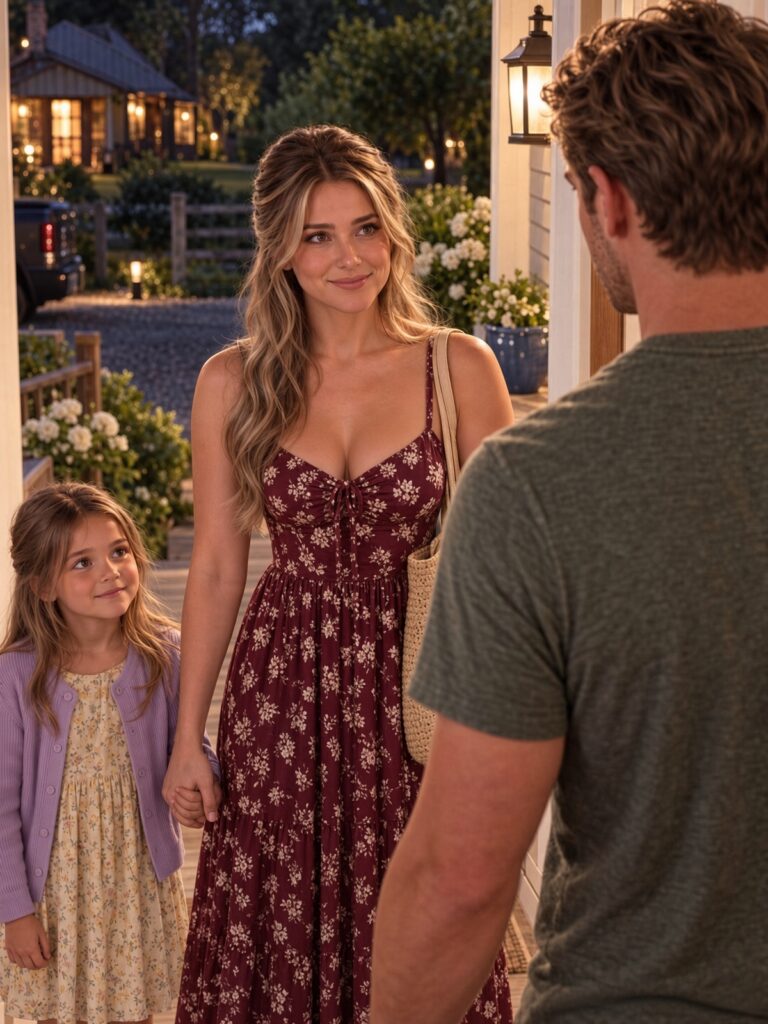
“You said to come by if I needed help,” Elizabeth said, pulling my business card from her pocket. “But do you have room for my daughter too?”
I stood in my doorway wearing a gray T-shirt and work pants, staring at a woman I had spoken to once for less than ten minutes.
Beside her stood a little girl in a pink cardigan over a flowered dress.
Six, maybe seven.
Sleepy.
Holding a canvas tote against one leg.
It was almost nine on a Saturday night.
The porch light caught the pale floral pattern on Elizabeth’s dress and the dark circles beneath her eyes.
Her fingers were wrapped so tightly around the strap of her tote that the knuckles had gone white.
I looked at the girl.
Then at Elizabeth.
“How many nights?”
“Three.”
She said it quickly.
Like she had rehearsed a number small enough to make asking less humiliating.
“Maybe four.”
“I’ll figure something out by Wednesday.”
A car passed beyond my front fence, headlights sliding across the gravel drive and over my pickup.
Elizabeth looked toward the road automatically.
Not frightened exactly.
Alert.
That mattered.
“What happened to the motel?”
Her expression tightened.
“We can’t go back there tonight.”
I could have asked why.
I didn’t.
Not with her daughter standing there.
I stepped aside.
“I have a guest room.”
“Come in.”
Elizabeth’s shoulders dropped by less than an inch.
Still, I saw it.
The little girl looked up at her.
Elizabeth nodded.
“It’s okay, honey.”
They entered.
I shut the door but did not lock it until Elizabeth saw me do it.
Then I pointed down the hallway.
“Guest room is the second door on the left.”
“Bathroom attached.”
“There are clean towels in the cabinet.”
I brought two glasses of water from the kitchen.
By the time I came back, Elizabeth had set the tote beside an armchair.
My business card lay on the coffee table.
The address I had written on the back three days earlier was smudged where her thumb had rubbed across the ink.
Elizabeth rested one hand on the little girl’s shoulder.
“Her name is Britney.”
I smiled.
“Hi, Britney.”
She gave me a sleepy wave.
“I’m Christopher.”
Britney whispered:
“Mom said you work with boats.”
“I do.”
“Big ones?”
“Some.”
“Pirate ships?”
“Unfortunately, management has rejected that expansion.”
Britney looked at her mother as if determining whether I was joking.
Elizabeth almost smiled.
“Bed.”
she said.
Britney nodded.
I handed Elizabeth the water.
“Get her settled.”
“We can talk afterward.”
“You don’t need to explain anything while she’s standing here.”
Elizabeth held my eyes for a second.
“Thank you.”
Then she led her daughter down the hall.
I went back to the kitchen.
My house was small enough that I could hear the bathroom tap.
Elizabeth’s low voice.
Britney asking something I couldn’t understand.
Then quieter movement.
Eventually the guest-room door clicked almost shut.
A few minutes later, Elizabeth returned alone.
Without Britney beside her, the control in her face looked thinner.
She rested one hand against the kitchen chair.
Didn’t sit.
“You can sit.”
I said.
She did.
Slowly.
For several seconds neither of us spoke.
Three days earlier, I had not known her name.
I had been sitting in the Aspen Cup after a long shift at Bridgewater Marina, drinking black coffee and pretending that caffeine at four in the afternoon was a responsible decision.
The café had been quiet.
Tourists studying maps.
Two college students sharing a pastry.
Rain tapping lightly against the windows.
Elizabeth walked in holding Britney’s hand.
I noticed them only because Britney immediately went to the window table and opened a battered children’s book while Elizabeth approached the counter.
A handwritten sign hung on the community board.
HELP WANTED.
Elizabeth pointed.
“I saw that last week.”
The manager frowned.
“I’m sorry.”
“We filled it Monday.”
“I forgot to take the flyer down.”
Elizabeth’s posture remained straight.
“Could I leave my name anyway?”
“In case something opens?”
“Sure.”
He reached for a notepad.
“What’s the best number?”
There was a pause.
“My phone isn’t working right now.”
“But I can check back in person.”
The manager gave her the expression people use when a simple question suddenly reveals a problem larger than they know how to address.
Britney kept tracing pictures in her book.
My own phone buzzed.
One of the dock leads.
A family had arrived late and wanted a rental after closing.
“No.”
I said.
“We close slips at six.”
“Don’t keep the crew late.”
“They can go first thing tomorrow.”
I ended the call.
Elizabeth was preparing to leave.
I still cannot explain exactly why I stood.
I manage marina operations.
Fuel.
Dock schedules.
Boat maintenance.
Weather.
Customers who believe return times are philosophical suggestions.
Walking up to strangers in cafés is not an operational skill.
Still, I recognized the look on Elizabeth’s face.
Someone solving the next problem while trying not to let the person beside her see how many remained.
“Excuse me.”
She turned.
I stopped far enough away that I wasn’t blocking the door.
“I know a few businesses around the lake.”
“If you’re looking for work, I might know places hiring.”
Her expression became cautious.
“I’m looking for days.”
“My daughter is in school.”
“My marina is fully staffed for the season.”
I said it before she could misunderstand.
“I’m not offering a job that doesn’t exist.”
“But I know some people.”
I took out my business card.
Christopher Hale.
Operations Manager.
Bridgewater Marina.
Then borrowed a pen from the counter and wrote my home address on the back.
“I’m usually home after seven.”
“If you need help, come by.”
She looked at the card.
Then at me.
“Thank you.”
Nothing dramatic.
No tears.
No questions.
She asked the barista for directions to another business and left with Britney.
I assumed I would never see either of them again.
Now the card sat on my coffee table.
Elizabeth sat in my kitchen.
And there was a six-year-old asleep in my guest room.
“I worked at an independent bookstore in Denver for six years.”
Elizabeth finally said.
“It closed six weeks ago.”
“My ex-husband hasn’t been in the picture for almost a year.”
“I had some savings.”
“I used most of it getting us here.”
“Why here?”
“My aunt lived near Willowrest when I was a kid.”
“She died years ago.”
“But I remembered it being cheaper than Denver.”
“Smaller.”
“I thought I could find work.”
She looked toward the hallway.
“I booked a weekly motel.”
“The money ran out this morning.”
“They wouldn’t extend without payment.”
“And your phone?”
“Broke about a month ago.”
“I’ve been walking places.”
“Paper applications.”
“Checking back.”
“Using library computers when I can.”
She rubbed one thumb across the other.
“Before I came here, I went back to Aspen Cup.”
I looked up.
“To ask whether I really worked at the marina?”
Her eyes widened slightly.
“Yes.”
“Good.”
That surprised her.
“You had an address handwritten on the back of a card from a man you met once.”
“Checking was smart.”
Some tension left her face.
“I walked past your street twice.”
she admitted.
“Before coming up.”
“I just need three nights.”
“Take the week.”
She immediately shook her head.
“Christopher—”
“Don’t try to manufacture a miracle in seventy-two hours.”
“I can’t pay you.”
“I’m not charging you rent for a guest room.”
Her shoulders stiffened.
“And this isn’t a trade.”
I continued.
“You don’t owe me cooking.”
“Cleaning.”
“Anything else.”
“You use the room.”
“We look at work and whatever comes next after you’ve slept.”
Her eyes lowered.
“Thank you.”
Then she looked up again.
“One thing.”
“What?”
“Please don’t talk about the motel or money in front of Britney.”
“I told her we’re staying with a friend.”
“I don’t want her thinking we’re some charity project.”
“Understood.”
Elizabeth nodded.
When she went back down the hall, I heard a zipper close.
Not open.
Close.
She had taken out what they needed for one night and packed the rest again.
The room was available for a week.
Elizabeth was sleeping like she might have to leave before breakfast.
Sunday started at six-thirty with my phone vibrating across the kitchen island.
I answered on speaker without thinking.
“Bridgewater.”
“Christopher, Dock Three fuel pump is sputtering.”
one of the morning leads said.
“Primary filter?”
“Looks clear.”
“Pressure?”
“Jumping.”
A floorboard creaked behind me.
Elizabeth stood in the hallway wearing a gray sweater, hair loose around her shoulders.
She glanced toward the guest-room door.
“The speaker woke Britney.”
she whispered.
“Could early calls happen somewhere farther away?”
I took the phone off speaker immediately.
“Yes.”
Into the phone:
“Give me thirty seconds.”
I went to my office, shut the door, and talked the crew through a valve check.
Ten minutes later, I came back.
Elizabeth stood beside the coffee maker holding a mug in both hands.
“Sorry.”
she said.
“I know it’s your house.”
“And speakers have an off setting.”
“We both learned something before seven.”
That almost made her smile.
Then she looked toward the kitchen table.
Maps.
Vendor invoices.
Employee schedules.
Maintenance logs.
My house had gradually become an extension of the marina without me noticing.
“Could I use one corner?”
she asked.
“For applications?”
“I’ll move everything when you need the table.”
I looked at the paperwork.
Then at her.
“Half.”
“What?”
“Half the table.”
“Permanently while you’re here.”
I carried the invoices into my office.
When I returned, Elizabeth had placed only her coffee on the cleared side.
Nothing else.
“You can leave things there overnight.”
I said.
She stared at the empty space.
Then nodded.
“Thank you.”
Monday morning, after Elizabeth walked Britney to the local elementary school, I offered her a ride into Willowrest.
“I need hardware-store supplies anyway.”
She accepted.
At the town square, she climbed out.
“I’ll meet you here at two?”
“If you want.”
“I can walk home.”
“That’s almost five miles.”
“I’ve done more.”
“I believe you.”
“I’m still coming through town at two.”
She gave me a look.
“Fine.”
At the hardware store, I bought fuel-line fittings, dock fasteners, and approximately twelve items that were not on my original list.
Then walked to Paige & Pine.
The only remaining independent bookstore in town.
I supplied the marina information kiosk with their local trail guides, so I knew the owner.
Steven Flores.
Sixty-one.
Half-moon glasses.
Memory for customers that bordered on supernatural.
When I entered, Elizabeth was standing near the front display.
An older man was waving both hands.
“It had a blue cover.”
“A man walks across Scotland.”
“Maybe Ireland.”
Steven looked helplessly at his computer.
Elizabeth stepped closer.
“Are you thinking of The Unlikely Pilgrimage of Harold Fry?”
The customer stopped.
“Yes.”
“It’s England.”
she said gently.
“But one paperback edition was pale blue with a walking figure.”
“That’s it.”
His whole face changed.
Steven found the book.
After the man left, he looked at Elizabeth.
“You know inventory.”
“Six years.”
“Bookstore in Denver.”
“I’m looking for work.”
Then she added immediately:
“But I need to be upfront.”
“I have a six-year-old in school.”
“I can work school hours.”
“Maybe occasional inventory evenings if I have notice.”
“I know that limits me.”
“I didn’t want to waste your time.”
No begging.
No tragic résumé.
Parameters.
Steven rubbed his chin.
“I may need somebody for days.”
“Let me look at next week.”
“Could I call you Wednesday about a paid trial?”
Elizabeth lost her rhythm for the first time.
“My phone still isn’t working.”
“But I can come back.”
“That’s fine.”
Steven said.
“I’ll know by noon.”
Outside, I waited until the door shut.
“Would you let me buy you a basic prepaid phone?”
Elizabeth stopped walking.
“Christopher.”
“That wasn’t yes.”
“I don’t have money for one.”
“And I’m not putting a luxury item on your tab.”
“It’s not much of a luxury if employers need to call you.”
She folded her arms.
I kept both hands in my jacket pockets.
“Basic phone.”
“First month of service.”
“You create the account.”
“It belongs to you.”
“No repayment.”
“If you say no, we go home.”
She stared at me for several seconds.
“I don’t like owing people.”
“Then don’t owe me.”
“I’m offering it as a gift.”
“You decide whether you want it.”
“Basic?”
“Basic.”
“I choose the account?”
“Yes.”
Another pause.
“Okay.”
At the electronics store, she rejected two phones as too expensive.
Chose a plain black model.
Calls.
Email.
School messages.
I paid for the handset and first month.
Then handed her the receipt.
She created the account herself on a bench outside.
Two days later, the phone rang while I was making coffee.
Elizabeth answered in the living room.
When she returned, she was smiling.
“Two paid trial shifts.”
I raised my mug.
“That phone has already outperformed mine.”
The important part was not that I bought it.
The important part was that the call went directly to her.
She answered.
Her decision.
Her work.
A rhythm settled over the house.
I opened Bridgewater early most days, handled rentals, slips, fuel deliveries, weather decisions, maintenance.
Elizabeth walked Britney to school.
PART 2
Went to trial shifts.
Filled out applications.
Picked Britney up.
They spent evenings quietly.
At first, our lives ran in parallel.
Elizabeth cleaned what she and Britney used.
Nothing more.
She never touched my marina paperwork.
Never folded my laundry.
Never cooked dinner to “earn” the room.
Good.
But she did something else.
She tried to become invisible.
If I entered the living room, she gathered her book.
Britney’s crayons disappeared every evening.
Shoes remained perfectly aligned beside the guest-room door.
Their tote stayed zipped.
Their coats never appeared on the hallway hooks.
I had told them to use the house.
Their habits still said:
Do not leave evidence.
By the second week, Paige & Pine hired Elizabeth for regular weekday shifts and occasional scheduled inventory nights.
She started bringing home damaged paperbacks Steven allowed employees to take.
One evening, she sat on the couch reading a thick novel while Britney slept.
I sat across from her with a beer.
“Any good?”
“It is.”
“What’s it about?”
“A town gets snowed in.”
“Everybody spends winter running out of places to hide from each other.”
“Efficient.”
“It’s actually very slow.”
“Less efficient.”
She laughed.
Then turned the book over.
“You might like the mechanics.”
“How they survive.”
“I read engine manuals.”
“I know.”
The way she said it made me look up.
She held my eyes one second longer than usual.
Then:
“I’ll leave it on the table when I’m done.”
“No pressure.”
Two nights later, the book appeared on my kitchen island.
I read one chapter.
Then another.
Then spent three days telling myself I was interested in the survival details.
That explanation failed when I reread one paragraph because I was already imagining what Elizabeth would say about it.
Friday evening, I came home while she rinsed a tea mug.
I placed the book beside her.
“This book has a problem.”
She looked at the cover.
“Too slow?”
“No.”
“It keeps making me think of reasons to ask the woman who recommended it what she thought about chapter four.”
Elizabeth went still.
I didn’t cover the sentence with a joke.
Didn’t retreat.
A faint flush reached her cheeks.
She looked at the book.
Then at me.
“I’m having tea on the porch tomorrow after Britney sleeps.”
“You can ask me then.”
That was all.
She walked down the hallway.
I stood in the kitchen staring at a book I had already finished.
Saturday night, she sat in one Adirondack chair with a mug.
I sat in the other.
We started with chapter four.

PART 3
Then bookstore customers.
Marina tourists.
People who became inexplicably confident around rental boats after watching one online video.
The conversation was easy.
Until it wasn’t.
At one point, Elizabeth turned toward me.
Stopped.
“What?”
“Nothing.”
I noticed the space between our chairs.
Less than a foot.
Close enough that I could reach her hand without leaning.
She seemed to notice too.
Neither moved.
Then she said:
“You were right about chapter four.”
I exhaled.
“That feels important.”
“It isn’t.”
The tension broke.
We talked until midnight.
Tea became a routine.
Not nightly.
That was probably why I noticed the missing nights.
Inventory night.
Late marina return.
Britney sick once.
But the porch became the only part of my week I did not schedule and still planned around.
On Tuesday of the fifth week, I opened my lunch cooler at the marina.
Turkey and tomato were wrapped separately from the bread.
Weeks earlier, I had complained once that sandwiches became wet by noon.
Elizabeth remembered.
No note.
No joke.
Just dry bread.
I ate beside the dock with my boots against a cleat and caught myself wanting to tell her the stupid solution had worked.
That was new.
Most of my workday usually ended where it happened.
Now parts of it wanted somewhere else to go.
Thursday, I came home early.
Elizabeth and Britney sat at the kitchen table surrounded by picture books, crayons, school papers, and half-finished drawings.
The door latched.
Elizabeth looked up.
Immediately started gathering everything.
“Leave it.”
“I was just finishing.”
Britney still held a green crayon.
I looked at her.
“You weren’t.”
Elizabeth stopped.
Her eyes moved toward the living room shelves.
Marina catalogs.
Engine schematics.
Boating manuals.
My things everywhere.
“Your things have places.”
she said.
“Ours don’t.”
“I don’t want you coming home feeling like we took over.”
I looked around.
She was right.
I had told them to use my house while leaving almost every visible inch defined by me.
“Leave the drawing.”
I said.
“And the books.”
Elizabeth put one book back down.
Not much.
Still a choice.
Then she drew a breath.
“There’s an apartment above the old bakery.”
I felt my stomach tighten.
“I saw the notice today.”
“Rent is something I can manage now.”
“Second bedroom for Britney.”
“Paige & Pine is walking distance.”
“The landlord will hold it until Sunday if I see it this weekend.”
There it was.
A good option.
One that did not depend on me.
My first instinct was immediate.
Don’t take it.
I did not say that.
“When can you see it?”
“Saturday morning.”
“I know the marina is busy.”
“I can take the bus.”
“It doesn’t run that route weekends.”
“I can walk from the square.”
“You could.”
She watched me.
“Or I can swap shifts and drive you.”
“Only if you actually swap.”
“Not if someone gets stuck.”
“Fair.”
Saturday at Bridgewater was chaos by eight.
Fuel dock line.
Pontoon rentals.
Two radios at once.
But I had arranged a legitimate shift swap the day before.
My dock lead covered the morning.
I took two closing shifts the following week.
Nobody lost hours.
Nobody absorbed my personal decision invisibly.
Before leaving, I handed over the rental board and made the next lead repeat the problem list.
Walking away on a busy Saturday felt unnatural.
So did recognizing that I had designed my own workplace in a way that treated my presence like infrastructure.
The apartment above the bakery was small.
Floors slightly uneven.
Narrow kitchen.
Old windows that actually closed properly.
Two bedrooms.
Bookstore twelve minutes away on foot.
Nothing secretly terrible.
I hated that.
And respected it.
The landlord talked to Elizabeth.
Not me.
She asked about utilities.
Lease term.
School-bus route.
Deposit.
Maintenance.
I stayed quiet.
At the sink she looked at me.
“Water pressure?”
I tested the faucet.
“Fine.”
“Really?”
“Really.”
Then stopped talking.
In the smaller bedroom, Elizabeth stood near the window.
“Britney’s bed would fit there.”
The sentence landed harder than it had any right to.
I pictured the small white bed from my guest room beneath that window.
Britney’s picture books on a shelf.
Elizabeth making tea in the narrow kitchen.
For the first time, moving out became physical.
Furniture.
Rooms.
A home where I wasn’t present.
I did not list flaws.
Did not compare my house.
If Elizabeth chose me later, I wanted there to have been somewhere else she could honestly choose.
Back in my truck, she stared at the brick bakery wall.
“The phone is yours.”
I said.
She turned.
“Wherever you live.”
“I covered the first month because that was the gift.”
“After that, the account is yours.”
“Does it make you sad?”
“What?”
“The idea of us moving out.”
A joke would have been easier.
“Yes.”
I said.
“The house will be quieter.”
“I’ll miss the porch.”
“I’ll miss knowing you’re in the next room.”
She held my gaze.
Then I added:
“But none of that is a reason to turn down a place that works.”
“You need an option that’s good even if I’m not part of it.”
She looked through the windshield.
After a while:
“I think it’s probably the sensible choice.”
There was no test in her voice.
Only calculation.
I forced myself to ask:
“Because you want it?”
She was quiet.
“Because it’s mine.”
she said.
“Or it could be.”
That made sense.
It still hurt.
The following afternoon, she walked the route from the bakery to Paige & Pine.
Texted:
12 minutes. Easy.
I answered:
Good.
Stared at the message for another full minute.
Five days before the landlord’s deadline, Elizabeth texted again.
Can you stop by the bookstore after work?
I arrived at five-thirty.
She stood behind the counter in a green cardigan helping a customer.
No hesitation.
No looking toward me.
Paige & Pine had become one place where she knew exactly who she was again.
When the customer left, Elizabeth came around the counter.
“Follow me.”
She led me to history.
Pulled out a heavy hardcover.
The Engineering of Inland Waterways.
“You read equipment manuals.”
“This has words and diagrams.”
“You might survive.”
I took it.
“High praise.”
“I’m buying it for you.”
“You don’t have to.”
“I know.”
That stopped me.
She used her employee discount.
Paid.
Handed me the bag.
Not repayment.
Not rent.
She had simply thought of me.
At home, Britney was drawing on the rug.
Elizabeth stood before my shelves.
“Can we move most of these marina catalogs into your office?”
“Most?”
“I’ve been patient.”
She pointed.
“Britney’s books on the lower shelf.”
“Mine above.”
“Enough that we don’t move everything back into the guest room every night.”
The apartment was still available.
I didn’t know whether she had changed her mind.
Or simply wanted the remaining days in my house to feel less temporary.
I did not ask.
“Show me what moves.”
We carried catalogs into my office.
Britney claimed the lowest shelf.
Crayons in a tin cup.
Picture books.
Elizabeth placed novels above.
One shelf remained partly empty.
“For future purchases?”
I asked.
“For breathing room.”
That night, after Britney slept, Elizabeth brought tea into the living room instead of the porch.
Sat beside me.
Not across.
I opened the waterways book.
Read the same paragraph three times.
“You’ve been on that page ten minutes.”
she said.
“Complex lock gate.”
“Very.”
We sat close enough to feel each other’s warmth without touching.
She turned one page.
I pretended to.
The silence became impossible to misunderstand.
Then she looked down again.
The next morning, I woke at five and reached for the coffee grinder.
Stopped.
Elizabeth had worked inventory until almost eleven.
The grinder was loud.
I put it away.
Made instant coffee.
It tasted like heated punishment.
That evening, Elizabeth saw the jar.
“You drank this?”
“I survived.”
She glanced toward Britney’s room.
Then at me.
“Thank you.”
I shrugged.
She didn’t let me make it disappear.
“Can we talk Saturday night?”
“After Britney sleeps?”
“Before I answer the landlord.”
There it was.
“Yes.”
“I’ll be home.”
Saturday came.
Day before the deadline.
I finished my marina shift at six.
Closing lead had the board.
Fuel count.
Boats outstanding.
No reason for me to stay.
Usually I could invent three.
That night I didn’t.
At home, Britney sat on the floor reading.
“Christopher.”
“The fox finally came back.”
“About time.”
“He was lost.”
“Then I withdraw my complaint.”
Elizabeth laughed from the kitchen.
As I walked past the guest room, I saw two flattened cardboard boxes leaning against the wall.
Empty.
Could mean anything.
After the apartment, I knew better.
Dinner was ordinary.
Britney talked about the fox.
Elizabeth asked about the marina.
I answered.
The boxes stayed in my head.
After Britney went to bed, Elizabeth carried tea to the porch.
Same chairs.
Same distance.
“I haven’t answered the landlord.”
she said.
“I know.”
“I have to tomorrow.”
“I know.”
She waited.
For six weeks, I had been so careful not to make my help conditional that I had turned caution into an excuse not to say what I wanted.
“I want to date you.”
Her fingers tightened around the mug.
“Not because you live here.”
“And not because I want to make the apartment sound like a bad choice.”
“I want to date you if you stay here.”
“I want to date you if you move above the bakery.”
I held her eyes.
“I miss you when you work late.”
“I look at the couch when I walk in because I hope you’re there.”
“I’m reading books I would never pick up because I like hearing what you think about them.”
A breath left her that was almost a laugh.
“That’s a lot of fiction for you.”
“It has been difficult.”
Then she grew serious.
“I want that too.”
“I have for a while.”
My chest tightened.
Before I could move, she continued.
“But I’m taking the apartment.”
I stopped.
She looked nervous and determined at once.
“I need to know I can pay for a home that belongs to Britney and me.”
“I need to sign a lease with my own name.”
“Buy my own groceries.”
“Pay my phone.”
“Have somewhere to go that has nothing to do with whether you and I work.”
I nodded slowly.
“Okay.”
Her eyes searched mine.
“That doesn’t mean no to you.”
“I know.”
“I want to date you.”
“After we move.”
“After I’ve slept in a place where I know one bad conversation with you cannot change whether my daughter has a bedroom.”
That hurt.
Not because it was unfair.
Because it was exactly right.
“Then we wait.”
Elizabeth’s shoulders loosened.
“You’re not angry?”
“I’m disappointed.”
I said.
She blinked.
“Different thing.”
“I want you here.”
“But I want you to have your own door more.”
For a long moment, neither spoke.
Then Elizabeth reached across the gap between the chairs.
Held out her hand.
I took it.
Nothing else.
No kiss.
No romantic loophole.
Her fingers stayed around mine.
The next morning, she called the landlord herself.
Signed the lease Tuesday.
Deposit came from her wages and the portion of savings she had rebuilt.
I offered nothing.
Not because I didn’t care.
Because she had not asked.
Move-in day was Friday.
I borrowed a marina utility trailer only after getting approval and paying the employee-use fee everyone else paid.
Steven Flores from Paige & Pine donated two shelves the store no longer needed.
Britney’s teacher gave Elizabeth a list of local families selling children’s furniture cheaply.
Elizabeth bought a used kitchen table.
A small sofa.
Britney’s bed fit beneath the window exactly as she had imagined.
When we carried the last box upstairs, Elizabeth stood in the narrow kitchen.
“This is weird.”
“What?”
“Having so little.”
I looked around.
Two mugs.
Four plates.
Secondhand table.
Books already multiplying.
“It doesn’t look like nothing.”
She smiled.
Britney ran in.
“Mom.”
“Can my crayons go in the living room?”
Elizabeth looked at me.
Then caught herself.
Her decision.
“Anywhere you want that isn’t the wall.”
Britney cheered.
I drove home alone that night.
My house felt enormous.
Which was ridiculous.
Same walls.
Same furniture.
But the kitchen table had too much space.
No crayons.
No novels on the couch.
No quiet conversation on the porch.
I wanted to call Elizabeth.
Didn’t.
Not because I was performing restraint.
Because moving day belonged to them.
The following evening, she texted.
Tea tomorrow?
At my place.
I answered:
Yes.
Sunday at seven, I knocked on the apartment door.
Both hands visible.
No business card needed.
Elizabeth opened.
Britney sat on the floor building something from cardboard.
Elizabeth stepped aside.
“Come in.”
The difference nearly undid me.
Six weeks earlier, she had stood outside my house waiting to find out whether I meant what I said.
Now she was opening her own door.
Her own home.
I sat at her table.
She made tea.
Britney showed me a paper marina she had drawn, including what appeared to be a pirate ship despite Bridgewater’s continuing refusal to diversify.
At eight-thirty, Britney went to bed.
Elizabeth returned.
Sat across from me.
“I paid the electric deposit yesterday.”
“Congratulations.”
“That was not sarcastic.”
“I know.”
She smiled.
“My phone bill is on autopay.”
“Dangerous level of adulthood.”
“I also have exactly fourteen dollars left in the fun category until Friday.”
“Tea was a reckless investment.”
“Very.”
Silence settled.
Not awkward.
Different.
Nothing I had provided remained necessary for the evening to continue.
No guest room.
No ride.
No phone.
No borrowed table.
Elizabeth looked at me.
“So.”
“So?”
“You said you wanted to date me.”
“I did.”
“Still true?”
“Yes.”
“Good.”
“I want to date you too.”
I stood.
Stopped beside her chair.
“Can I kiss you?”
“Yes.”
She stood before I crossed the full distance.
The kiss was warm.
Short.
Deliberate.
When we separated, she smiled.
“That was worth moving for.”
I laughed.
“Extremely expensive first kiss.”
“Security deposit.”
“Utilities.”
“Secondhand sofa.”
“Bookshelves.”
“The romance industry hides a lot.”
We dated slowly.
Especially around Britney.
That part mattered.
For the first month, most dates happened after Elizabeth arranged childcare through a coworker or another parent from school.
I never became automatic childcare.
Never wanted to.
Britney and I already knew each other, but dating her mother changed the context.
We needed to let that change happen carefully.
When Elizabeth first explained it to Britney, she said:
“Christopher and I are going to have dinners sometimes because we like each other.”
Britney looked at me.
“Like boyfriend?”
Elizabeth paused.
“Yes.”
Britney thought.
“Does that mean we move back?”
“No.”
Immediate.
“This apartment is our home.”
Britney accepted that.
Then asked whether I would still bring marina books.
Apparently the important question.
I said yes.
Elizabeth became permanent at Paige & Pine.
Not management immediately.
Bookseller.
Inventory.
Customer recommendations.
Then online orders.
Steven discovered she had a gift for remembering what regular customers liked.
A year later, he put her in charge of events and special orders.
She did not become successful because I introduced her to Steven.
I had not.
I had walked in after she had already started demonstrating what she knew.
That distinction mattered to her.
It mattered to me.
I changed too.
More slowly.
At Bridgewater, one of my dock leads, Marcus, asked why I had started taking scheduled days off.
“I always had them.”
I said.
“You used to be here anyway.”
That was true.
My identity had become tied to being the man who could always absorb one more late rental.
One more employee absence.
One more maintenance call.
Helping Elizabeth had forced me to notice the contradiction.
I could tell her:
You don’t owe the house your invisibility.
Then spend my own life acting like Bridgewater Marina deserved every unused part of me.
So I started training people differently.
If Marcus could make a weather call, he made it.
If Lydia could close the rental board, she closed it.
If my phone rang on a scheduled day off and there was a qualified manager on-site, I asked whether it was an actual emergency before inserting myself.
The marina did not collapse.
Humbling.
One afternoon, Lydia said:
“We can handle this.”
My instinct answered:
I know.
The truth was:
I’m learning to believe you.
Elizabeth teased me.
“Bridgewater survived four hours without Christopher Hale?”
“Barely.”
“National Guard?”
“Standing by.”
She smiled.
Then returned to her book.
That became one of my favorite parts of us.
She did not clap every time I learned a basic boundary.
Good.
We fought too.
Real relationships eventually become more informative than beginnings.
Our first serious argument happened nine months in.
Britney had a school performance on Friday.
Elizabeth invited me.
I said yes.
Then a severe storm warning came in.
Bridgewater had twenty-seven boats in slips and several rental customers scheduled to return before the weather reached us.
I stayed late coordinating closures.
By the time I called Elizabeth, the performance had started.
She said:
“I understand.”
Her voice told me she didn’t.
The next morning:
“You said you’d come.”
“I had weather.”
“I know.”
“Then what do you want me to say?”
She stared.
“I want you to notice you did the exact thing you spent a year claiming you had stopped doing.”
That made me angry.
“That isn’t fair.”
“A storm at a marina is not a casual choice.”
“I know.”
“Then why are we fighting?”
“Because Marcus was there.”
I stopped.
She continued.
“You told me two weeks ago he was qualified to run a weather closure.”
“He is.”
“But you stayed.”
“That doesn’t mean—”
“You didn’t even ask whether he had it.”
There it was.
Not work.
Control.
Again.
I sat down.
Elizabeth softened slightly.
“I am not asking you to choose me over safety.”
“I’m asking whether you actually had to be the person standing there.”
I called Marcus later.
He said:
“I thought you wanted to run it.”
Not:
I needed you.
That hurt more.
I apologized to Elizabeth.
Not for the storm.
For saying yes to Britney before deciding whether I trusted the system I claimed to have built.
Then I apologized to Britney too.
No dramatic explanation.
“I said I’d come.”
“I didn’t.”
“I’m sorry.”
She nodded.
“Mom recorded it.”
“I know.”
“Do you want to watch?”
“Yes.”
We did.
Repair did not require making my failure invisible.
Elizabeth and I stayed together.
Two years.
Then three.
She never moved back into my house during that period.
People found that strange.
I didn’t.
Her apartment became part of who she had rebuilt herself into.
She liked paying rent.
Not because rent was fun.
Because every month reminded her that she had done what once seemed impossible.
Eventually the landlord announced the building would be sold.
New owner planned renovations.
Leases ending.
Elizabeth called me.
“I have ninety days.”
My immediate thought:
Move in with me.
This time, I did not say it first.
“What are you thinking?”
“I could find another apartment.”
“Yes.”
“I could also move in with you.”
“Yes.”
She laughed.
“You’re working very hard.”
“I have training.”
We discussed it for weeks.
Not because we were uncertain about the relationship.
Because moving in involved Britney.
School routes.
Expenses.
Privacy.
Household authority.
What decisions I had with Britney and what remained Elizabeth’s.
If the relationship ended, how much time would Elizabeth need to secure another place.
We wrote things down.
Not a legal contract for love.
A practical plan.
Elizabeth kept an emergency fund in her own name.
We agreed she would contribute to groceries and utilities, not pay “rent” into my mortgage without a written ownership arrangement.
Eventually, when marriage became likely, we revisited property with attorneys.
Boring.
Healthy.
Britney chose which bedroom she wanted.
Not the old guest room.
The smaller room near the backyard.
“Why?”
I asked.
“Better light.”
She said.
“Also farther from your office.”
Fair.
The day they moved in, Elizabeth carried the old business card inside one of her books.
I did not know she still had it.
A year later, I proposed.
Not at the marina.
Not on the porch.
Not with Britney holding a sign.
Just one evening after dinner.
Britney was at a sleepover.
Elizabeth sat on the couch reading.
I sat beside her.
“Can I interrupt?”
“You already did.”
“I want to ask something expensive.”
She lowered the book.
I pulled out the ring.
Her expression changed.
“Christopher.”
“I’m not asking because you came to my door.”
“Or because we built something out of one bad week.”
“I’m asking because you had your own door.”
“And your own job.”
“And your own choices.”
“And you kept choosing to walk through mine.”
Her eyes filled.
“I love the life we have.”
“I want to marry you.”
“Do you?”
Elizabeth looked at me for a long time.
Then smiled.
“Yes.”
We married six months later.
Small ceremony beside the reservoir.
Britney stood with Elizabeth.
Steven Flores attended.
Half my marina crew attended.
The Aspen Cup manager came because Elizabeth invited him.
When he realized who she was, he laughed.
“I should’ve taken that hiring sign down.”
Elizabeth said:
“Apparently not.”
Life did not become perfect.
Paige & Pine struggled when online competition increased.
Bridgewater had two difficult seasons.
Britney became a teenager and developed the entirely reasonable belief that adults had never experienced anything important.
She and I clashed.
Especially after Elizabeth and I married.
One night, Britney shouted:
“You’re not my father.”
She was fourteen.
Angry because I enforced a curfew Elizabeth and I had discussed.
The sentence hit harder than she knew.
I almost responded from hurt.
Then remembered something obvious.
She was correct.
I was not her father.
Her biological father remained mostly absent, but absence did not automatically transfer that title to me.
I said:
“You’re right.”
Britney froze.
“I’m not your father.”
“I’m your stepfather.”
“And your mother and I agreed on the curfew.”
“You can still be angry.”
Her anger did not disappear.
But the argument stayed where it belonged.
Years later, Britney told me she remembered that.
“You didn’t try to make me call you Dad.”
“I had a perfectly good name.”
“You also had terrible jokes.”
“Still do.”
She eventually chose “Chris” most of the time.
Sometimes “my stepdad.”
At her college graduation, when introducing me to a professor, she said:
“This is Christopher.”
“He’s family.”
That was enough.
Elizabeth eventually became co-owner of Paige & Pine.
Not overnight.
Steven wanted to retire.
Instead of selling to a chain, he offered two longtime employees—including Elizabeth—a structured buyout.
She came home with documents.
“I’m terrified.”
“Good.”
She glared.
“I mean it.”
“So do I.”
“Why good?”
“Because you’re treating the numbers like they matter.”
We reviewed nothing together beyond what she wanted.
She hired her own accountant.
Her own attorney.
I did not lend money.
She financed her portion through savings, a small-business loan, and seller financing.
The bookstore survived.
Then adapted.
Events.
Online ordering.
Used books.
Local author nights.
Not huge.
Steady.
Elizabeth loved it.
At Bridgewater, I eventually became general manager.
Then part-owner through a long-term employee purchase arrangement.
Funny.
Two people who met with almost nothing eventually owned pieces of businesses they had once simply worked inside.
Neither happened because the other rescued them.
We mostly annoyed each other into being more honest.
When I was fifty-six, Bridgewater nearly lost a major tourism contract.
My old pattern returned.
Long hours.
Sleeping badly.
Telling Elizabeth:
“Just this month.”
She waited two weeks.
Then:
“What are you counting?”
I stopped.
The phrase belonged to another story now.
My own.
“What?”
“When you say you can handle this.”
“What are you counting?”
I looked at my calendar.
Not enough.
Again.
We adjusted.
Some lessons are not learned once.
They are practiced.
Britney grew up.
Studied elementary education.
Married a nurse named Jordan.
Had a daughter.
The first time she brought the baby to our house, Elizabeth cried.
I pretended dust had attacked me.
Nobody believed that.
Years later, Britney asked about the night she first slept in my guest room.
She remembered almost nothing.
“Mom told me you had a business card.”
“She carried it for three days.”
I said.
Britney looked at Elizabeth.
“Were you scared?”
“Yes.”
“Of him?”
Elizabeth thought.
“I didn’t know him.”
“So yes, a little.”
I nodded.
“Reasonable.”
Britney asked:
“Then why come?”
Elizabeth looked toward me.
“Because every other safe option had ended.”
“And because before giving me the card, he made it clear he wasn’t offering a job he didn’t have.”
“That sounds small.”
“It wasn’t.”
Britney frowned.
“Why?”
“Because desperate people hear promises differently.”
Elizabeth said.
“He didn’t promise more than he could actually give.”
That sentence stayed with me.
Because I had spent the rest of my life trying to become worthy of it.
The truth was, I had made plenty of promises badly after that.
But the guest room had been real.
One week.
No rent.
No trade.
A place to sleep.
The phone was real.
One month service.
Her account.
No repayment.
A ride was real when I had actually changed my shift.
The romance became real only when she had another home.
Maybe that was why it lasted.
Neither of us had to pretend gratitude was love.
When Elizabeth turned sixty-five, she retired from daily bookstore work but kept a small ownership interest.
Bridgewater was sold to a regional operator several years later.
I stayed through transition.
Then left.
My first month without marina calls was terrible.
At five in the morning, I woke automatically.
No fuel reports.
No wind forecast needed.
No one asking whether a rental should leave.
I wandered into the kitchen.
Elizabeth looked over her book.
“You know you don’t work there anymore.”
“I’m aware.”
“Your face isn’t.”
I learned eventually.
Walks.
Reading.
Fixing things slowly instead of urgently.
Cooking.
Granddaughter visits.
Ordinary life.
One rainy afternoon, Elizabeth found an old hardcover while reorganizing shelves.
The Engineering of Inland Waterways.
She laughed.
“You still have this?”
“You bought it.”
“I made thirty-eight dollars that week.”
“And spent some on a book you knew I’d read.”
“Questionable financial judgment.”
She opened it.
The old business card slid out.
Same one.
Address on the back.
Ink still faintly smudged.
I stared.
“You kept that?”
“It became a bookmark.”
“For forty years?”
“Apparently it’s durable.”
I picked it up.
My old marina title looked strange.
Younger version of my life.
Elizabeth sat beside me.
For a while we said nothing.
Then she said:
“I almost didn’t come.”
“I know.”
“No.”
“I mean I stood at the end of your road for almost twenty minutes.”
“Britney asked why we weren’t walking.”
“I told her I was checking the house number.”
“What changed your mind?”
She turned the card over.
“You wrote your home address yourself.”
“Not just the marina.”
“I thought either you were genuinely willing to help or you were incredibly reckless.”
“Comforting.”
“I checked with Aspen Cup first.”
“Smart.”
“Then I thought I could always leave.”
That mattered.
More than she realized.
The ability to leave.
People romanticize staying.
But staying means more when leaving remains possible.
Elizabeth had stayed in my guest room for six weeks because she needed time.
Then she left for an apartment because she needed ownership over her own life.
Then she came back later because she wanted a life with me.
Three different choices.
Each meaningful for different reasons.
That was our story.
Not:
A man rescued a homeless mother and she fell in love with him.
I hated that version.
Elizabeth was never mine to rescue.
She found the job.
She worked the shifts.
She signed the lease.
She rebuilt savings.
She bought into Paige & Pine.
She raised Britney.
What I did was smaller.
I opened a door when I had a safe room.
Bought a basic phone because a job market expects people to have one.
Shared some rides when I could honestly share them.
Then, when feelings became involved, tried not to make my help into evidence she should choose me.
Small does not mean meaningless.
The room mattered.
The phone mattered.
The ride mattered.
So did the bookstore manager giving her a trial.
The school letting Britney enroll quickly.
The landlord holding an apartment until Sunday.
Steven offering seller financing years later.
People built a life around Elizabeth through dozens of ordinary decisions.
No single hero.
Better that way.
At seventy-two, Elizabeth and I still read beside each other most evenings.
Different books.
Same couch.
Sometimes no conversation for an hour.
One night, I came in from the porch and found her looking at the old business card again.
“What?”
I asked.
She smiled.
“Nothing.”
“That expression is not nothing.”
“I was thinking about the first night.”
“Which part?”
“You telling me to take the week.”
“You looked terrified when I said it.”
“I was.”
“Why?”
“Because three days already felt like too much to owe somebody.”
I sat beside her.
“You didn’t owe me.”
“I know that now.”
She turned the card between her fingers.
“That was the thing.”
“You kept saying it.”
“But you also behaved like it.”
“What do you mean?”
“You didn’t become colder when I started earning money.”
“You didn’t become offended when I looked at the apartment.”
“You didn’t try to make the phone part of our relationship.”
“You didn’t ask me to stay once you admitted you wanted me.”
She looked at me.
“That is how I eventually believed you.”
I took her hand.
“Believed what?”
“That the help wasn’t an advance payment on affection.”
That sentence hit hard even after all those years.
I thought of how easily help can become power without the helper ever admitting it.
A room.
Money.
Transportation.
Introductions.
Every resource can carry an invisible sentence:
Remember what I did for you.
We had survived partly because we kept removing that sentence.
Not perfectly.
Enough.
Outside, rain tapped against the windows.
Elizabeth leaned against my shoulder.
“Do you know what I remember about the apartment?”
“What?”
“You looked miserable.”
“I was very supportive.”
“You looked like somebody had told you boats were illegal.”
“That seems exaggerated.”
“You hated that apartment.”
“I respected it.”
She laughed.
“I know.”
“That’s why I chose it.”
I looked down at her.
She continued.
“If you had tried to convince me it was bad, I think I would have left your life too.”
“Even though you wanted me?”
“Especially then.”
“Because I needed to know wanting me wasn’t more important to you than me having a choice.”
I nodded slowly.
Fair.
Still true.
Near bedtime, Elizabeth put the card back inside the book.
I stopped her.
“Give me that.”
“Why?”
I took it.
Walked to the small desk.
Found a frame we had not used.
Placed the card inside.
Front visible.
Christopher Hale.
Bridgewater Marina.
Then flipped the frame.
Address visible on the back through the glass.
Elizabeth watched.
“That’s ridiculous.”
“Probably.”
“Sentimental.”
“Definitely.”
I put it on the bookshelf.
Not as a symbol of the night I saved anybody.
As a reminder of something far less dramatic.
An offer should mean what it says.
A room is a room.
A gift is a gift.
A ride is a ride.
Love has to become something else.
Something freely chosen after the emergency ends.
Three days after I handed a stranger my business card, she came to my door with her six-year-old daughter and asked whether there was room for both of them.
There was.
Years later, Elizabeth created room for me in a life she had rebuilt herself.
That was the part I never took for granted.
The End.


