
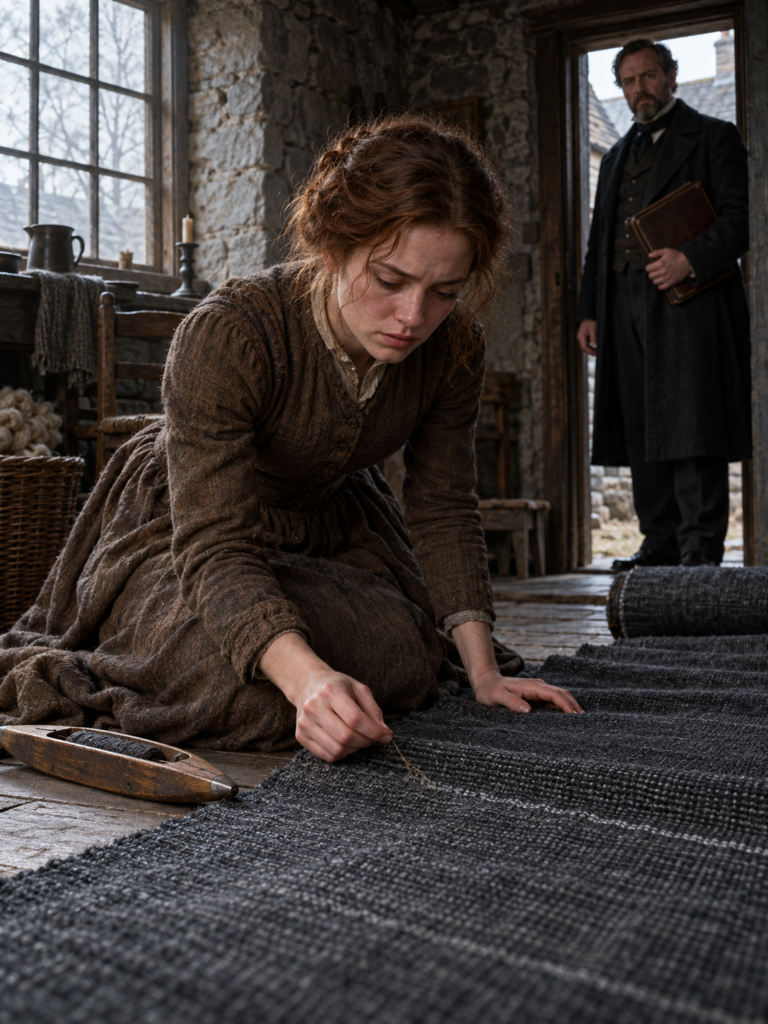
Ruth pulled open the cottage door so sharply that the latch struck the stone wall.
Cold rain blew into the passage.
She tucked the marked inventory sheet beneath her shawl, glanced back at the gray cloth on the floor, and stopped.
If Skerrow had overlooked something hidden in the wool, leaving it unguarded might be a mistake.
She closed the door again.
Taking the bolt beneath her arms, she carried it through the rain toward the chapel school.
Alice Dean answered before Ruth finished knocking.
The widow had taught village children their letters for twenty years, including Ruth, whose grandfather insisted that a good weaver ought to read the printed account as carefully as the cloth.
Alice looked at the wet shawl and heavy roll.
“Whatever is wrong?”
“I need you to examine something.”
Within minutes, the gray wool lay across the schoolroom floor.
Ruth showed her the eleven faults.
Alice adjusted her spectacles.
“You think these marks mean something?”
“I know they were made deliberately.”
“Can you prove it?”
Ruth demonstrated the changing lengths and positions.
Then she pointed to the even distances separating the marks.
“A damaged loom repeats a mistake. These are different. My grandfather chose them.”
Alice studied the fabric for several minutes.
“Then perhaps he meant someone to read them.”
Ruth felt a tremor pass through her.
“That is what I think.”
“But why hide words in cloth?”
“Because Skerrow could take every written account he owned.”
Alice looked up.
Ruth continued.
“The mill took his loom, tools, and cottage. Anything written on ordinary paper could disappear into the office. But this cloth was declared spoiled. Skerrow handed it to me himself.”
The schoolteacher’s expression changed.
“He may not have known what he was giving away.”
They moved to the table.
Ruth spread out her measurements.
Each fault had a length, a distance from the edge, and a direction.
Alice studied the figures.
“Three kinds of information.”
“Perhaps four, if we count the distance between faults.”
“Your grandfather loved keeping records.”
“He trusted nothing he couldn’t count in more than one way.”
Alice rested her finger on the list.
“Could it be an account?”
Ruth swallowed.
“Skerrow says Grandfather owed nine pounds. Yet these numbers cannot be a simple record of his debts.”
“Why?”
“Because the thread lengths never exceed seven.”
Alice looked toward the schoolroom window.
Below the chapel stood Weaver’s Row.
Seven cottages.
Seven families.
“All held under the mill,” she murmured.
Ruth nodded.
Her thoughts moved rapidly.
Elias had been the head weaver. Families receiving yarn advances often brought their accounts to him before they went to the office.
During hard winters, he had sometimes exercised the old authority to forgive small advances rather than let families fall hopelessly behind.
Ruth remembered Sarah Pike at the seventh cottage, her joints swollen so badly she could scarcely manage her loom.
And the Emmett family, whose sick child had kept them from working a full season.
Her grandfather had forgiven debts for both.
She had seen him do it.
Yet Skerrow had claimed the mill remained unpaid.
“What if,” Ruth said slowly, “those debts were never cleared from his ledger?”
Alice stared at her.
“Then the families might be paying what they no longer owed.”
“Or carrying interest against it.”
For the first time, Ruth understood the possible size of the wrong.
This was not merely about nine pounds.
It might concern every household on the row.
But Alice held up a warning hand.
“We have a suspicion, Ruth. Not proof.”
Ruth looked again at the measurements.
Alice was right.
They had not yet worked out how to read the marks.
Nor had they examined the mill’s actual accounts.
A false accusation might allow Skerrow to destroy the only evidence left.
Ruth breathed slowly.
“Then we must find the key.”
They worked until the afternoon light faded.
One attempted reading produced impossible sums.
Another failed to account for the direction of the raised threads.
Ruth’s frustration grew.
“Perhaps I’ve been foolish.”
Alice placed the list back before her.
“Your grandfather did not accidentally produce eleven different faults at regular intervals. We may be wrong about their meaning. That doesn’t make the question foolish.”
Ruth examined the central mark again.
Four picks.
No lean.
Grandfather’s cottage.
She remembered his voice, telling her that a number meant nothing unless a person knew what was being counted.
Suddenly she looked toward the door.
“Sarah Pike.”
“What about her?”
“She can tell us what Grandfather forgave.”
“And whether the office is still demanding payment.”
Ruth rose.
Alice caught her sleeve.
“If you go asking about accounts, word may reach Skerrow.”
“I know.”
“He can make your remaining days in the cottage very difficult.”
Ruth looked at the great length of wool.
Then she folded the measurements and reached for her shawl.
“If he has charged those families twice, keeping silent won’t help them.”
She placed the list in Alice’s hands.
“Keep this safe. I’m going to the seventh cottage.”
And she opened the schoolroom door as the mill bell began ringing across the wet village.
The bell was still ringing when Ruth stepped into the narrow lane.
She pulled her shawl around her shoulders and made her way down toward Weaver’s Row.
Water ran between the cobblestones.
Smoke rose from the cottage chimneys, and the sounds of evening cooking drifted through the rain.
Seven households stood in the terrace beneath the weaving sheds.
Ruth knew them all.
She knew which families struggled to buy coal during winter, which children had learned to wind bobbins before they could properly write their names, and which old workers could still judge a length of wool by touch.
Her grandfather had been more than a craftsman to these people.
He had kept their tallies.
Settled their arguments over yarn.
Warned them when the mill had weighed cloth incorrectly.
And helped families through seasons when their labor did not meet the cost of keeping them alive.
Now Ruth was beginning to suspect that his kindness had been used against him.
She knocked at the seventh cottage.
Sarah Pike opened the door.
The old woman was bent with rheumatism, her hands swollen and wrapped in worn wool.
“Ruth, child. Come in out of the rain.”
Ruth stepped inside.
The room smelled of peat smoke and damp cloth.
A small fire burned in the hearth.
Sarah offered tea, but Ruth shook her head.
“I need to ask you something about the yarn accounts.”
Sarah’s expression changed.
“Has Skerrow sent you?”
“No.”
The old woman relaxed slightly.
“Then what is it?”
“Two winters ago, when your hands were too painful to work, my grandfather forgave a debt against your yarn.”
Sarah nodded.
“Two pounds. God bless him. I thought I’d never get clear of it.”
“Did he tell you it was settled?”
“He did. Said the matter was finished.”
Ruth’s throat tightened.
“Has the mill asked for that money since?”
Sarah looked toward the small cupboard beside the fireplace.
Then she rose painfully and brought out an envelope containing several folded notices.
“They say I still owe it. With interest.”
Ruth stared at the papers.
“How long have they been sending these?”
“Since the next quarter.”
“But Grandfather forgave the debt.”
“I told Skerrow that.”
“What did he say?”
Sarah lowered her eyes.
“He said the head weaver had no authority to change what the office had entered.”
Ruth felt anger flare.
“That isn’t true.”
“Perhaps not. But he’s the one with the ledger.”
There it was.
The whole power of the mill reduced to a simple fact.
Skerrow possessed the book.
The villagers possessed memories.
And the man who could reconcile the two was dead.
Ruth folded Sarah’s notice carefully.
“May I borrow this?”
Sarah hesitated.
“Will it bring trouble?”
“I cannot promise it won’t.”
The old woman studied her.
Then she handed over the papers.
“Your grandfather never turned his back on us. If there’s something I can do for him now, tell me.”
Ruth squeezed her hand.
“Thank you.”
She crossed to the Emmett cottage next.
The family had three children, and the youngest had spent a terrible winter ill with fever.
Their yarn debt had grown during that season.
Elias had forgiven the balance.
Yet the mill continued to list two pounds and four shillings as owing.
The Emmetts showed Ruth another notice.
At the third cottage, she found a smaller debt of eighteen shillings still being carried forward.
By the time she returned to Alice’s schoolroom, the rain had stopped.
But the knowledge she carried felt heavier than the thirty yards of cloth.
Alice was waiting beside the fire.
“Well?”
Ruth spread the notices before her.
“Every household I’ve visited still owes money Grandfather said was forgiven.”
Alice examined them.
“The amounts differ.”
“Yes. And I think I know why the threads differ too.”
She returned to the list.
Four picks represented the fourth cottage.
Seven picks represented Sarah Pike’s.
One represented the Emmetts.
The remaining measurements appeared to record money.
But one question remained.
How could a series of short floating threads represent both pounds and shillings without confusing them?
Alice brought the cloth closer.
“Look at their direction,” she said.
Ruth followed the line of the first raised thread.
It leaned toward the left.
The next leaned toward the right.
The central fourth-cottage mark lay straight.
She stared.
“Grandfather was telling us which side to count from.”
Alice waited.
Ruth placed her finger near the edge of the fabric.
“A thread leaning left means pounds, counted from the left selvage. A thread leaning right means shillings, counted from the right.”
She studied the recorded distances.
“Always use the nearest edge. He was making certain there could be no disagreement about which distance mattered.”
Alice leaned closer.
“And the straight mark?”
“His own cottage.”
“What does it signify?”
Ruth’s voice dropped.
“Nothing owed.”
She sat back.
For several seconds, neither woman moved.
Then Alice reached for a clean page.
“Read me Sarah Pike’s entry.”
Ruth examined the fabric.
“Cottage seven. Two pounds. No further shillings.”
Alice wrote it down.
“The Emmetts?”
“Cottage one. Two pounds and four shillings.”
They checked the known figures.
Then checked them again.
The marks corresponded with the debts Ruth had confirmed.
When they reached the fourth cottage, Ruth placed her palm flat against the perfectly woven cloth.
Her grandfather had used a straight, neutral mark to identify his own account.
No debt.
No unpaid balance.
No arrears.
Nothing.
The man Skerrow had accused of owing nine pounds had hidden a declaration of innocence inside the last cloth he would ever weave.
Ruth bowed her head.
For a moment, the grief of the past week returned with such force that she could scarcely breathe.
She wanted to hear her grandfather’s voice.
Wanted to ask whether she had understood him correctly.
Wanted to tell him that his work had not been thrown away.
But there was no one left to answer.
Alice rested a hand on her shoulder.
“He trusted you to find it.”
Ruth looked up.
“How can you be sure?”
“Because he made the message in a language you understood better than anyone else in this village.”
The words steadied her.
They spent the night checking each mark.
Some cottages appeared more than once because pounds and shillings required separate entries.
By morning, they had accounted for all eleven marks and the seven households they concerned.
A little over eleven pounds in forgiven debt remained at issue, apart from accumulated interest and the nine-pound charge against Elias himself.
It was not a great sum to a prosperous mill owner.
But to families living week by week, it represented months of food, warmth, and peace.
And to Ruth, it represented her grandfather’s honor.
Alice read their completed list.
“If you’re right, Skerrow has kept these accounts open deliberately.”
“And made Grandfather appear dishonest when he questioned them.”
“Can we prove that last part?”
“Not yet.”
“Then we must be careful.”
Ruth nodded.
They possessed a remarkable piece of evidence.
But it was not enough merely to understand it.
They needed someone with authority to compare the woven figures with the mill’s books.
Someone who could order the ledger opened.
Someone Skerrow could not dismiss.
Nathaniel Harmon owned Heart’s Edge Mill.
He rarely visited the cottages, but he supervised the business from the counting house and relied upon Skerrow to manage its daily affairs.
Ruth had spoken to him only twice in her life.
Both times, he had seemed more interested in the mill’s accounts than in the workers whose labor produced them.
That might now become useful.
“He’s a man of figures,” Alice said.
“Then I’ll bring him figures.”
“And if he refuses to listen?”
Ruth looked down at the cloth.
“I’ll make him read them.”
***
The next morning, Ruth visited the Emmetts.
She explained that she needed to borrow their narrow loom.
Mrs. Emmett glanced toward her husband.
“You helped nurse our youngest through that fever,” she reminded Ruth. “And your grandfather stood by us when we had nothing.”
Mr. Emmett nodded.
“Use it as long as you need.”
Ruth thanked them.
The loom was smaller than the one she had worked at beside Elias, but its mechanism was sound.
She purchased plain undyed yarn, spending almost the last of her money.
Then she began weaving.
For two days and most of a night, she worked with fierce concentration.
She made a strip a handspan wide and roughly a yard long.
Into it she wove a single enlarged example of her grandfather’s code.
Cottage seven.
Two pounds.
The forgiven debt of Sarah Pike.
She placed each floating thread carefully.
Counted the picks.
Marked the direction.
Checked the distance from the edge.
This time, the pattern was larger and clearer, so that someone unfamiliar with the craft could learn to follow it.
Alice prepared a written explanation.
Together, they made something more persuasive than an accusation.
A demonstration.
Any person willing to count could test the strip and see whether it matched Ruth’s reading.
Then they sent a request to Harmon.
Miss Ruth Thorne wished to discuss serious discrepancies in the mill’s accounts.
She would bring physical evidence.
And she specifically requested the presence of Mr. Skerrow.
Alice studied her when the request was finished.
“You want him in the room?”
“Yes.”
“He may try to stop you.”
“Then I want Mr. Harmon to see him try.”
The schoolteacher gave a small approving nod.
A meeting was arranged for Thursday.
Ruth spent Wednesday examining the cloth one last time.
She checked the eleven marks against the written key.
She compared Sarah Pike’s notices.
She reread the statements from the Emmetts.
When darkness came, Alice found her seated beside the loom, the wooden shuttle across her knees.
“You ought to rest.”
Ruth shook her head.
“I’m frightened.”
“I should imagine you are.”
“If he refuses to hear me, Grandfather’s name will remain stained. I’ll lose the cottage, and the other families will keep paying debts they don’t owe.”
Alice sat beside her.
“That may happen.”
Ruth looked at her sharply.
The older woman did not soften the truth.
“But what you know now will still be true. And the people on the row have begun to know it too.”
Ruth turned the shuttle in her fingers.
Its wood had been polished smooth by years of use.
“My grandfather used to tell me that a thread pulled too tightly will break.”
“Did he?”
“He said a good weaver must know when to give the wool a little room.”
Alice smiled.
“Perhaps you should take your own advice.”
Ruth breathed slowly.
For the first time in days, she allowed herself to sit without working.
***
Thursday morning came gray and cold.
Ruth put on her best dress, the one she had worn to her grandfather’s funeral.
She wrapped the coded strip in clean cloth.
Alice helped her roll the larger bolt.
Together, they walked up the hill toward the counting house.
Ruth could feel people watching from the cottage doors.
Nobody called out.
Yet she knew that several families had entrusted her with something precious.
Their memories.
Their accounts.
Their hope that a powerful man’s version of the truth might finally be questioned.
At the counting house, the young clerk who had inventoried Elias’s possessions opened the door.
He recognized Ruth.
“Miss Thorne.”
“Is Mr. Harmon ready?”
“Yes.”
He glanced at the great roll of cloth.
“That’s a great deal to carry.”
“It has a great deal to say.”
He stepped aside.
Nathaniel Harmon stood behind a broad desk.
He was an older man with graying hair and the reserved manner of someone accustomed to having numbers placed before him rather than arguments.
Skerrow stood near the window.
The familiar leather ledger rested beneath his arm.
When he saw Ruth, his expression briefly tightened.
Then his smooth smile returned.
“Miss Thorne,” he said. “I trust you’ve had time to reconsider this unfortunate business.”
Ruth set the cloth on the table.
“No, sir. I’ve had time to understand it.”
Harmon studied her.
“I’ve been told you dispute the accounts against your grandfather.”
“I do.”
“The mill keeps proper records, Miss Thorne.”
“Then those records should withstand comparison.”
Harmon raised an eyebrow.
“With what?”
Ruth rested her hand on the gray wool.
“With a second ledger.”
Skerrow gave a small dismissive laugh.
“My dear girl, that is a roll of damaged cloth.”
“Yes,” Ruth replied. “That is what you called it.”
She turned toward Harmon.
“My grandfather wrote an account into this fabric before he died. I can show you exactly how to read it.”
Skerrow moved forward.
“Sir, I must object. Elias Thorne was in failing health, and his granddaughter is plainly grieving. The suggestion that a length of spoiled wool could overturn the mill’s books is—”
“Then you should welcome the examination,” Ruth interrupted.
The room became still.
Harmon looked from one to the other.
Then he extended his hand toward the cloth.
“Proceed, Miss Thorne.”
Ruth unrolled the gray wool across the counting-house table.
She laid her own newly woven strip beside it.
Alice placed the written key within Harmon’s reach.
Ruth pointed to the first raised thread.
“The number of picks identifies the cottage.”
Harmon leaned forward.
“The direction of the thread identifies whether the amount is in pounds or shillings.”
She demonstrated the two directions.
“And the distance from the nearest edge gives the number.”
Harmon inspected the strip.
“Can the figures be checked independently?”
“Yes. That is why I made this example.”
She stepped back.
“Please count it yourself.”
Harmon lifted the cloth toward the window.
He counted the picks.
Then the threads from the edge.
His brows drew together.
“Seven.”
“Cottage seven,” Ruth said.
He examined the lean.
“Shillings.”
Then he counted the remaining threads and converted the amount.
“Forty shillings. Two pounds.”
Ruth nodded.
“Sarah Pike’s forgiven debt.”
Skerrow shifted by the window.
Ruth turned toward him.
“Now, Mr. Harmon, I ask you to open the mill’s ledger to the seventh cottage and tell us whether that debt was removed.”
Harmon held out his hand.
“Mr. Skerrow. The book, if you please.”
For the first time since Ruth had known him, the overseer did not move at once.
His fingers tightened around the leather cover.
And Ruth understood that the most difficult part of her grandfather’s final message was about to be read.
Skerrow held the ledger against his chest.
“Mr. Harmon,” he said carefully, “surely the firm’s private accounts cannot be opened whenever a dissatisfied worker raises an objection.”
Harmon did not raise his voice.
“I have asked for the book.”
Skerrow remained motionless for another moment.
Ruth watched his hands.
They were pale, smooth, and carefully kept.
Her grandfather’s hands had been rough and permanently marked by work.
Yet every document produced by those hands had been treated as less authoritative than the overseer’s neat handwriting.
Now Skerrow was reluctant to let that handwriting be examined.
At last, he placed the ledger on the table.
Harmon opened it.
“Sarah Pike,” Ruth said. “Seventh cottage.”
The mill owner turned several pages.
He located the account and ran his finger down the entries.
“Two pounds,” he read. “Carried forward.”
He paused.
“Interest applied for four quarters.”
Ruth’s heart beat so loudly that she scarcely heard the next words.
Harmon looked up.
“You say this amount was forgiven?”
“Yes, sir.”
“By what authority?”
“My grandfather was the head weaver. Under the arrangement used on Weaver’s Row, he could cancel small yarn advances when circumstances justified it. He was required to report them to the office.”
Skerrow immediately intervened.
“That authority was frequently misunderstood.”
“Then produce the instruction withdrawing it,” Ruth said.
His expression hardened.
She continued.
“I was present when my grandfather struck Sarah Pike’s debt from his own tally. She believed it forgiven. He reported the adjustment.”
Skerrow shook his head.
“A family’s recollection is not reliable accounting.”
Ruth turned back to Harmon.
“Then test another figure.”
She pointed to a different mark in the gray wool.
“Cottage one. The Emmett family.”
Harmon studied it.
“Two pounds and four shillings.”
“That debt was forgiven when their youngest child was ill.”
The mill owner searched the ledger.
The amount remained outstanding.
Interest had been added.
Ruth showed him the entry for the third cottage.
Eighteen shillings.
Still outstanding.
Then another.
And another.
With each matching entry, Harmon’s movements became slower and more deliberate.
Skerrow stopped offering explanations.
Ruth did not rush.
She gave the mill owner time to check each figure against the written code.
She wanted him to understand that this was not a trick.
Not a fanciful interpretation of damaged wool.
Every deliberate error corresponded to a specific cottage and a specific amount.
And every amount matched a debt that Elias Thorne had forgiven but the office had continued to carry.
Finally, Harmon reached the fourth cottage.
Elias Thorne’s own home.
Ruth placed her finger against the single straight mark.
“This is Grandfather’s account.”
Harmon examined it.
“No leaning thread.”
“Because there is no sum owed.”
He turned back to the leather ledger.
There, beside Elias Thorne’s name, stood an arrears charge of nine pounds.
Harmon read it twice.
Then he looked at the earlier pages.
Elias had paid his rent and settled his account regularly for decades.
The nine-pound debt appeared comparatively recently.
Entered after the disputed adjustments to the other households.
Harmon looked toward Skerrow.
“Explain this charge.”
The overseer folded his hands.
“Elias fell behind in his later years. Illness made him unreliable.”
“Yet the prior entries show a consistent history of payment.”
“His decline was sudden.”
“And these other debts?”
Skerrow hesitated.
“The head weaver may have told the families their obligations were forgiven without properly informing the office.”
Ruth spoke quietly.
“He told the office. I helped carry the tallies.”
“That is your claim.”
“And the cloth is his record.”
“It proves nothing about my intentions.”
Ruth looked steadily at him.
“Then tell Mr. Harmon why you continued collecting interest on debts the families believed settled.”
Skerrow said nothing.
The silence seemed to lengthen across the entire room.
Harmon looked down at the ledger.
Then at the coded wool.
“I see two possibilities,” he said. “Either the accounts were kept with astonishing incompetence, or obligations known to have been forgiven were deliberately left open.”
He turned a page.
“And I find it difficult to believe that so many errors would occur in precisely the same direction.”
Skerrow’s face grew pale.
“Sir, I have served this mill faithfully.”
“Then you will have no objection to a full examination of your accounts.”
The overseer swallowed.
Harmon closed the book.
The sound carried through the quiet office.
“Until that examination is complete, you will no longer manage these records.”
Skerrow stared at him.
“You cannot mean—”
“I mean that the books will be checked without your assistance in altering them.”
Ruth felt her knees weaken.
She placed a hand against the table.
The moment she had feared most had passed.
Harmon had not dismissed her.
He had read the cloth.
And the figures had spoken.
Yet she did not smile.
Not yet.
There were seven households to protect.
Her grandfather’s name to clear.
A cottage lease still in question.
And an entire office of accounts that might reveal more than a young weaver could uncover from eleven marks in wool.
Harmon turned toward her.
“Miss Thorne, I must ask whether the families concerned will confirm these arrangements.”
“They will, sir.”
“You can bring them here?”
“I can.”
“Then do so. And ask Mrs. Dean to attend. I understand she helped you prepare this demonstration.”
“She did.”
Harmon nodded.
“I would also like to examine any notices or accounts those households possess.”
Ruth withdrew Sarah Pike’s papers from her bag.
“I brought these.”
The mill owner studied them.
Then looked at Ruth with something that had not been in his expression when she arrived.
Respect.
“You came prepared.”
“My grandfather taught me to check everything three ways.”
Harmon gave a dry, humorless smile.
“That appears to have been wise.”
***
The investigation took time.
There were old invoices to examine.
Interest calculations to verify.
The mill’s yarn advances to compare with delivered cloth.
The old authority of the head weaver to cancel certain debts had to be established from earlier instructions and long-standing practice.
Alice Dean helped collect the statements of the families.
Sarah Pike came despite her painful hands.
The Emmetts brought their papers.
Others on Weaver’s Row provided records of payments and deductions they had never fully understood.
At first, several workers were frightened to speak.
Their homes depended upon the mill.
Their wages came through it.
Skerrow had controlled those records for years.
Accusing him openly seemed dangerous.
Ruth did not ask anyone to take risks merely for her grandfather’s name.
Instead, she explained what the wool showed.
She let them see the figures themselves.
And she made certain they understood that Harmon’s inquiry concerned debts they had already been told were forgiven.
One by one, they agreed to speak.
The evidence revealed a pattern.
Amounts forgiven through the head weaver had been carried forward in the office books.
Interest had been added.
Payments had been recorded against charges that should no longer have existed.
And the nine-pound arrears against Elias Thorne had no proper supporting account.
The surviving records could not explain it as an honest charge.
Harmon was furious.
Not loudly.
He seldom raised his voice.
But his face became colder with every page he examined.
Skerrow had been trusted with the mill’s accounting.
That trust had allowed him to exercise power over households too poor to challenge his figures.
When the inquiry was finished, his position was ended.
He left Heart’s Edge within the month.
The mill provided him no favorable character.
As to the money improperly collected, Harmon ordered the accounts corrected and repayment made.
Where sums could be recovered from Skerrow, they were recovered.
Where they could not, Harmon made the households whole from the mill’s own funds.
He did not pretend that this made every previous hardship disappear.
Some families had already gone without necessities because of deductions they should never have paid.
Some had endured fear and shame.
One old woman had believed herself incapable of paying a debt that had ceased to exist.
Money could restore the balance.
It could not return the peace they had lost.
But Ruth insisted that the corrections be made openly.
Each household was shown its amended account.
Each forgiven debt was formally removed.
And no family was required simply to trust another unexplained entry.
The greatest moment came when the mill’s records were corrected for Elias Thorne.
Harmon called Ruth into the counting house.
Alice accompanied her.
The old ledger lay open on the table.
Harmon showed Ruth the fourth cottage.
The nine-pound arrears had been struck out.
Beside the corrected balance, the account showed that Elias owed the mill nothing.
Harmon rested his pen.
“Your grandfather’s name is cleared, Miss Thorne.”
Ruth stared at the page.
For several seconds, she could not speak.
She remembered her grandfather sitting at the loom through the last winter.
His shoulders aching.
His eyesight tiring.
Yet still keeping count.
She remembered helping him wind bobbins.
Bringing him tea.
Hearing the shuttle pass between the threads long after sunset.
And she remembered the day he had become too ill to continue.
She had thought the unfinished work was simply a loss.
Now she knew he had used the strength remaining to him to preserve a truth that powerful men had refused to hear.
“Thank you,” she whispered.
Harmon looked uncomfortable.
“I ought to have examined these accounts earlier.”
“Yes, sir,” Ruth answered.
He looked up sharply.
Then nodded.
“Yes,” he repeated. “I ought.”
For the first time, Ruth understood that a person with authority could acknowledge wrongdoing without losing that authority.
Indeed, the admission made her trust him more.
Harmon closed the ledger.
“There remains the matter of your cottage.”
Ruth went still.
The lease.
The loom.
The belongings already inventoried.
She had thought so fiercely about clearing the debts that she had almost forgotten her own future.
“The mill’s claim against your grandfather was unsound,” Harmon said. “The removal of his tools should never have proceeded upon that accounting.”
Ruth waited.
“I intend to restore the cottage tenancy on proper terms, along with the use of his equipment.”
Her eyes filled.
She blinked quickly.
“I can pay the rent.”
“I know.”
“And I can maintain the loom.”
“That, too, seems evident.”
Harmon paused.
“There is another matter.”
Ruth lifted her head.
“The position of head weaver on Weaver’s Row is vacant.”
She stared.
“The mill needs someone who understands the cottage accounts and can be trusted to keep them accurately.”
He looked toward the gray cloth, which remained folded at the far end of the table.
“I have seen sufficient evidence of your abilities.”
Ruth’s voice came slowly.
“Are you offering me Grandfather’s position?”
“Yes.”
She looked at Alice.
The schoolteacher’s eyes shone behind her spectacles.
Ruth turned back to Harmon.
“I would accept under one condition.”
He raised an eyebrow.
“Which is?”
“That the families receive written copies of their accounts and every adjustment made to them.”
He considered the request.
“You believe that necessary?”
“I believe much of this trouble began because one man could keep figures nobody else was permitted to see.”
Harmon nodded.
“Agreed.”
“And I would want the authority to question entries that do not correspond with the work delivered.”
“You will have it.”
Ruth extended her hand.
“Then I’ll take the position.”
Harmon shook it.
For a moment, she thought of the overseer who had dismissed her as a grieving girl incapable of understanding a ledger.
Now she had been entrusted with keeping the accounts he had abused.
Not because she was Elias Thorne’s granddaughter alone.
But because she had shown what she could do.
***
The loom returned to the fourth cottage before Christmas.
The men carried it carefully through the narrow doorway and positioned it where it had stood for decades.
Ruth watched each piece fitted into place.
The beams.
The heddles.
The frame.
The shuttle race worn smooth by years of use.
Everything seemed familiar.
Yet the room did not feel quite the same.
Her grandfather was still gone.
His chair remained empty.
His walking stick still rested beside the hearth.
Nothing could bring back the sound of his voice telling her when to tighten the warp or how to detect a thread that had begun to pull unevenly.
But the loom itself could work again.
And so could she.
Ruth spent a morning preparing it.
She checked the frame.
Set the threads.
Adjusted the tension.
Then she took the old wooden shuttle in her hand.
It had been polished by her grandfather’s fingers until the grain shone softly.
She sat down.
For a long moment, she did not move.
Then she sent the shuttle across.
The familiar sound filled the cottage.
Once.
Twice.
Again.
The loom began its steady rhythm.
Outside, Sarah Pike stopped in the lane.
She listened.
Then she smiled.
Later, she told Alice that hearing the fourth cottage’s loom again was like hearing a clock restart after the house had fallen silent.
Ruth learned of the remark and treasured it.
She did not believe the sound meant her grandfather had returned.
Only that what he taught her had continued.
And that was enough.
***
With the new position came responsibility.
Ruth was required to examine yarn advances, record finished cloth, and ensure that each family’s figures were accurately reported.
She took the work seriously.
She visited the cottages.
Listened when workers questioned deductions.
Compared the mill’s figures with the cloth delivered.
And refused to treat anyone’s inability to read a ledger as evidence that they were incapable of understanding fairness.
When Sarah Pike struggled with a calculation, Ruth explained it.
When the Emmetts needed to check a deduction, Ruth showed them the record.
No one had to rely solely on her word.
That was important.
She had seen what happened when one person’s authority could not be questioned.
She intended to keep her grandfather’s reputation for honesty without reproducing the conditions that had allowed Skerrow to abuse his own position.
The mill did not transform overnight.
Wages remained hard earned.
Winter remained cold.
Families still worried over rent and food.
Harmon remained a practical businessman, concerned with production and expense.
But the workers knew their accounts could be examined.
And when a number did not agree, they knew they could ask why.
That was a small change in the world of wealthy men.
It was an enormous one along Weaver’s Row.
***
The great bolt of gray wool remained in Ruth’s cottage through the winter.
Alice suggested making a warm coat from it.
“The weather will not improve merely because you’ve won an argument,” she said.
Ruth laughed.
“I know.”
“Then why keep thirty yards of sound wool sitting unused?”
Ruth touched the raised threads.
“Because Grandfather made this as his last letter.”
Alice softened.
“You could preserve a piece.”
“I could.”
“But you won’t.”
“No.”
Alice shook her head.
“Stubborn girl.”
“You taught me to read.”
“I did not teach you to argue with your elders so persistently.”
Ruth smiled.
“I think Grandfather helped with that.”
Eventually, Ruth decided where the cloth belonged.
She asked Alice whether the chapel school could keep it.
Not rolled away in a cupboard.
Not cut into smaller pieces.
But displayed along the schoolroom wall, where children could study the pattern.
Alice looked doubtful.
“Thirty yards is a considerable length.”
“Then we’ll find a way to show it in sections without cutting it.”
Together, they arranged the cloth along the room, folded carefully over supports where necessary so the significant marks remained visible.
Each deliberate fault could be examined.
The original pattern could be compared with the interruptions.
And Ruth’s woven demonstration strip remained beside the written explanation.
It was not merely a memorial.
It was a lesson.
Alice used it when teaching counting.
She showed children how a number could have meaning beyond a page.
How a pattern could carry information.
How a person skilled in one craft might discover something another person overlooked.
And why evidence mattered more than confident accusation.
Some pupils were fascinated by the secret.
Others wanted to know why the mill had been willing to throw away such beautiful cloth.
Alice told them that people often mistake unfamiliar knowledge for worthless knowledge.
Then she handed them a magnifying glass and asked them to count the threads for themselves.
Ruth occasionally visited the school.
She would see small faces bent toward the gray wool, fingers pointing along the raised bars.
They were the children of workers.
Some would become weavers.
Others might leave Heart’s Edge if opportunity allowed.
But every one of them was being taught that their knowledge mattered.
That their hands could produce something more than labor for another man’s profit.
And that truth sometimes survived in places nobody powerful had thought worth examining.
***
One afternoon in early spring, Ruth returned home from the mill with a fresh ledger.
She placed it on the table and opened the household accounts.
The cottage stood warm and orderly.
The loom was in use.
Her wages were dependable.
The rent was paid.
For the first time since her grandfather’s death, the months ahead no longer looked like a narrowing road.
She opened the little tin behind the clock.
Nineteen shillings had once been all that remained between her and the loss of everything familiar.
Now the tin held her savings.
Not a fortune.
Enough to purchase supplies without fear of the next day.
She sat near the hearth and looked toward the wall.
Two objects rested above the mantel.
The first was her grandfather’s old shuttle.
The second was the narrow strip she had woven to explain his code.
Its raised threads were larger and easier to see than those in the original cloth.
The pattern said something simple.
Cottage seven.
Two pounds forgiven.
To a stranger, it might look like nothing more than an awkward piece of weaving.
To Ruth, it represented the morning she walked into a counting house carrying proof no one had expected her to possess.
She took the strip down and examined it.
She remembered the fear in her stomach as Skerrow refused to surrender his book.
She remembered Harmon’s face when the first two figures agreed.
And she remembered the silence when her grandfather’s account showed a false nine-pound debt.
The cloth had not spoken by itself.
Someone had needed to recognize what it carried.
Someone had needed to count.
To question.
To test.
And finally, to insist that the truth be heard.
Ruth returned the strip to the mantel.
Then she opened her fresh ledger.
On the first clean page, she wrote the accounts for the seven cottages.
She checked each total.
Counted it again.
And marked the entries carefully, exactly as her grandfather had taught her.
***
Years later, the children of Heart’s Edge would still hear the story of Elias Thorne’s last bolt.
They would stand beside the long gray cloth in the chapel school and look for the eleven wrong threads.
Alice Dean would guide their fingers across the wool.
She would show them how one misplaced thread could identify a cottage.
How its direction could distinguish pounds from shillings.
How a carefully chosen mark could preserve an account when ordinary paper could be taken away.
And how a young woman, underestimated because she was poor and had no powerful protector, refused to accept that an official ledger must be true simply because a powerful man kept it.
The children often asked whether Elias had known his granddaughter would understand.
Alice never claimed to know what a dying man had thought.
But she would remind them that Elias had spent ten years teaching Ruth to weave, count, and question.
He had given her the skills needed to discover the message.
And Ruth had chosen to use them.
That was the part Alice considered most important.
The hidden record could have remained forever unread.
The debt notices could have continued arriving.
The false account might never have been challenged.
But Ruth had followed the evidence farther than was comfortable or safe.
She had sought witnesses.
Checked figures.
Constructed a demonstration.
And insisted that the mill owner examine the accounts with his own eyes.
The truth had been preserved by Elias.
It had been uncovered and defended by Ruth.
Neither achievement stood alone.
***
On quiet evenings, when the village settled beneath the moor and the last shift came down from the weaving sheds, Ruth still sat at the old loom.
The River Beck moved beyond the cottages.
The windows glowed with lamplight.
And the shuttle passed steadily through the warp.
Sometimes she thought about the afternoon the overseer had stood in her doorway and declared her grandfather’s final cloth worthless.
She remembered how alone she had felt.
How small the cottage seemed after the clerks left.
How impossible it had appeared to argue against a leather book held by a man who controlled the village’s accounts.
Then she looked at the loom before her.
The tool she had nearly lost.
The work she now performed by her own authority.
The home she could keep.
She knew her grandfather had not left her wealth.
He had left something that could not be seized with a cottage or entered falsely as a debt.
Knowledge.
Patience.
The discipline to look again when an easy explanation seemed wrong.
And the courage to trust what careful work revealed.
She would never forget the eleven crooked threads.
Nor would she repair them.
For in thirty yards of beautiful cloth, her grandfather had made eleven deliberate interruptions.
They had cost the bolt its market value.
They had caused a powerful man to dismiss it.
And in doing so, they had allowed the only record he could safely leave to pass into the hands of the one person he had taught to understand it.
Ruth drew the shuttle through another row.
The fabric grew beneath her fingers.
Straight threads.
Sound edges.
An honest pattern.
Outside, the mill bell rang across Heart’s Edge.
She did not look up.
She simply continued weaving, secure in the life she had reclaimed.
For the world had called her grandfather’s final work ruined.
But the flaw had been his warning.
The cloth had been his evidence.
And the granddaughter who refused to throw it away had made certain that every family on Weaver’s Row finally knew the difference.


