
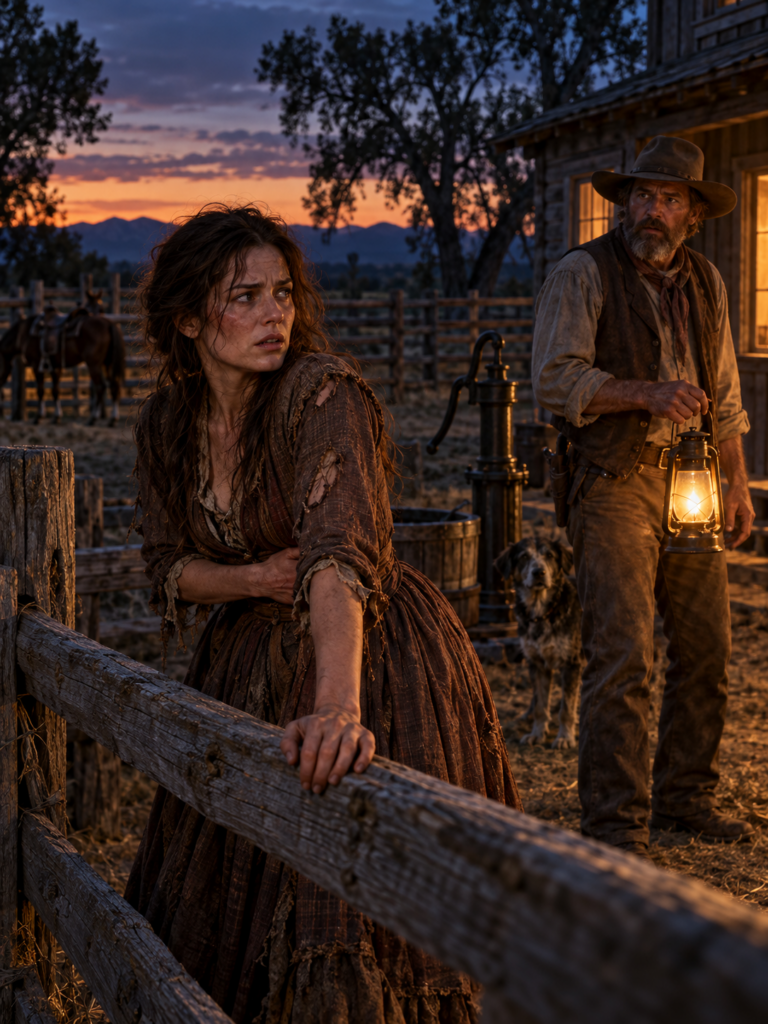
Ezra kept his hand on the door and listened.
Rufus barked once more, then fell quiet.
From the northern road came the faint clatter of iron against stone.
Ruth heard it too.
Her hand flew to the doorframe.
“They’ve found me.”
“Could be a traveler,” Ezra said.
“Or Otto.”
He did not pretend otherwise.
The sound faded beyond the cottonwoods. Whoever had passed the northern bend continued toward the higher road.
Ezra waited until Rufus settled again before closing the door.
Ruth stood perfectly still.
“You’re not locking it?”
“No.”
He pointed toward the spare bedroom.
“There’s a bolt on the inside of that door. You can use it. I’ll leave clean cloths and water outside.”
“And if someone comes asking?”
Ezra paused.
“I’ll hear what they have to say before anyone gets near you.”
That was not the guarantee she wanted.
But it was more than anyone else had offered.
At supper, she managed a little bread and stew.
She sat facing the doorway, watching every movement Ezra made.
When he reached across the table for the salt, she flinched.
He quietly moved the salt nearer his own plate.
“Would you rather eat alone?”
“No.”
“All right.”
He said nothing more about it.
Later, when she retired, Ezra heard the bedroom bolt slide into place.
He remained in the kitchen until the lamp burned low.
Beyond the walls waited fifty dollars, a grieving uncle, and a handbill declaring a frightened woman guilty before anyone had heard her.
By dawn, Ezra had made one decision.
He would not betray her whereabouts to a man seeking vengeance.
What he had not decided was how to keep that promise when vengeance came knocking.
For three days, Ruth remained at the ranch.
Her bruises changed from dark purple to fading yellow, but bending still hurt. Ezra left fresh water beside her door, brought food without comment, and never questioned how much she ate.
She began helping around the house of her own accord.
First a torn sleeve.
Then a loose button.
Finally a batch of bread that filled the kitchen with a warmth the room had long been missing.
“You aren’t obliged to work,” Ezra told her.
Ruth kept kneading.
“I know what happens when a man decides I owe him.”
“Not here.”
Her hands stopped.
“You can say that now.”
Ezra understood the accusation beneath those words.
“I can. You’ll have to judge whether I mean it.”
She studied him, then resumed working.
On the fourth morning, hoofbeats approached from the north.
Not hurried.
Not uncertain.
One horse, ridden by someone who knew exactly where he was going.
Ezra looked through the window.
His face changed.
Ruth noticed.
“Who is it?”
“Otto Kesler.”
The bowl slipped against the table.
Her breathing became shallow.
“He’s come for me.”
“He’s come to ask questions. I don’t yet know what else.”
Ezra indicated the root cellar.
“If you want to stay out of sight, there’s room below. You can come back up when he’s gone.”
She looked at the cellar opening.
Then toward the approaching horse.
“I don’t want to hide.”
“I know.”
“But if he sees me—”
Her unfinished words told him enough.
She went to the cellar and descended the ladder.
“Call my name three times,” she whispered.
“I will.”
Ezra settled the hatch, drew a feed sack partly across it, and stepped outside.
Otto Kesler rode into the yard carrying a rifle in his saddle scabbard.
His beard showed gray beneath its dark reddish color. His face bore the exhaustion of a man who had scarcely slept since receiving terrible news.
“Morning, Colton.”
“Otto.”
Kesler remained mounted.
“You heard about Nathaniel.”
“I heard.”
“My sister’s boy. Raised him myself after his father drowned.”
Ezra nodded.
“I remember.”
Otto looked slowly toward the house.
“There’s a woman traveling alone. Name of Ruth Vance. Thought she might have passed this way.”
“Why do you think that?”
“Because she’s hurt. Because she’d need water. And because this is one of the few places between Milbrook and the pass where a stranger could find shelter.”
Ezra felt the weight of that answer.
Otto knew the country.
And grief had made him thorough.
“There’s a reward,” Kesler continued. “Fifty dollars.”
“Seen the notice.”
“Then you know what she did.”
“I know what the notice claims.”
Otto’s eyes narrowed.
“She shot my nephew in his kitchen.”
“Was anyone else there?”
A muscle worked in Kesler’s jaw.
“No.”
“Then perhaps there’s more to hear.”
For the first time, the blacksmith’s expression shifted.
Not toward belief.
Toward anger.
“Careful, Ezra.”
Ezra stood still.
Otto glanced once more at the house, then toward the cellar side of the porch.
“Answer me plainly. Have you seen Ruth Vance?”
Ezra drew a measured breath.
The man before him had been his trusted neighbor for years.
The woman beneath his kitchen floor had trusted him for four days.
He could not satisfy both loyalties.
Otto leaned forward in the saddle.
“Well, Colton?”
Ezra placed one hand against the porch post and began to answer.
“I haven’t seen anybody here I’d call a murderer.”
Ezra’s words carried across the quiet yard.
Otto Kesler stared at him.
“That’s a mighty careful answer.”
“It’s the answer I’m giving.”
The blacksmith’s hand rested near his saddle rifle.
For a long moment, Ezra thought he might dismount and demand to search the house.
Instead, Otto looked toward the kitchen window.
“You’ve always been an honest man, Colton.”
“I aim to stay one.”
“Then I hope you’ll remember what honesty requires.”
Ezra held his gaze.
“I expect both of us ought to.”
The reply landed harder than Ezra intended.
Otto’s face tightened.
“Nathaniel was like a son to me.”
“I know.”
“Then don’t ask me to stand by while his killer walks free.”
“I’m asking you to find out what happened before deciding what justice requires.”
Otto drew his reins tight.
“There’s men looking for her who aren’t nearly as patient as I am.”
“Then you’d best tell them patience might save them from doing something they can’t undo.”
Kesler looked at him a final time.
Then he turned his horse toward the northern road.
Ezra remained on the porch until the hoofbeats disappeared.
Only then did he return inside.
He moved the feed sack aside, raised the cellar hatch, and called Ruth’s name three times.
She climbed the ladder slowly.
Her hands shook.
“Did he know?”
“He suspects something.”
“Did you tell him?”
“No.”
“Then he’ll come back.”
Ezra did not argue.
“He might.”
Ruth sat on the nearest chair.
“Otto isn’t a wicked man,” she whispered. “That’s what makes this so hard.”
Ezra waited.
“When Nathaniel was younger, Otto took him in after his father died. He raised him, taught him a trade, gave him a home.”
“Yes.”
“How does a man like that admit the boy he raised became someone else?”
Ezra pulled out the opposite chair.
“Maybe by hearing what he’s refused to hear.”
“He won’t listen.”
“Then we find somebody who will.”
Ruth looked toward him.
“You mean a judge?”
“A sheriff first. Somebody with the authority to keep those men from deciding your fate themselves.”
She shook her head.
“I told Nathaniel’s uncle once that his temper frightened me. Otto said patience would soften him.”
Ezra went still.
“He knew?”
“He knew Nathaniel had a temper. I never showed him what happened behind our door.”
“Did he ask?”
“No.”
That answer remained between them longer than either expected.
By evening, Ruth seemed tired of holding so many words inside herself.
They sat on the porch watching the last daylight settle over the western range.
She held a cup of coffee without drinking.
“It started early,” she said.
Ezra turned toward her.
“The marriage?”
She nodded.
“Second month. Nathaniel threw a plate. I thought it was an accident until he apologized for frightening me.”
Her fingers tightened around the cup.
“He was gentle afterward. So gentle that I believed him.”
Ezra said nothing.
“Then it happened again. And every time I thought I’d found the thing that angered him, he’d find another.”
She stared out across the pasture.
“For three years, I spent more time listening to his footsteps than listening to my own thoughts.”
A breeze moved through the dry grass.
“I began keeping track of doors. Which ones could be barred. How far the neighbors lived. How much money I could put away without his noticing.”
“Did you have somewhere to go?”
“My sister lives in Cheyenne.”
The answer was immediate.
“I thought about going to her more times than I can count.”
“Why didn’t you?”
Ruth’s mouth trembled.
“Because every time I gathered the courage, Nathaniel promised he would be different. And when I finally stopped believing him, I was afraid he’d catch me before I got away.”
Ezra lowered his eyes.
He had heard enough to understand that the road to safety had not been a simple one.
“There’s something else,” she said.
He looked up.
“A doctor in Milbrook treated me twice. Doctor Mercer. He set my wrist once, when Nathaniel said I’d fallen. Then he bound my ribs this spring.”
“Did he believe the explanations?”
“I don’t think so.”
“Did he keep records?”
“He wrote in his notebook every time. Even when I begged him not to.”
Ezra straightened slightly.
“That could matter.”
“How?”
“Someone who treated those injuries might be able to tell a magistrate what he saw.”
Ruth’s expression tightened.
“It would mean the whole town hearing what happened to me.”
“It might.”
“And still no promise they’d believe me.”
“No promise.”
She looked down into her coffee.
“Then I need time to think.”
“You have it.”
When she glanced toward him again, she saw no impatience on his face.
Only concern.
“Why are you doing this, Ezra?”
He was quiet.
She continued.
“I understand giving water to a stranger. I understand not turning away an injured woman at night. But you know Otto. You know the law could come asking why you sheltered someone named on a murder notice.”
“I do.”
“Then why?”
Ezra leaned forward, elbows against his knees.
“I had an older sister in Missouri.”
Ruth waited.
“She married young. I was fourteen the first time she visited with a bruise on her arm.”
He looked toward the fence.
“She called it an accident with a wagon. I believed her because it was easier than imagining the truth.”
“What happened?”
“More accidents. Fewer visits. My father finally went to fetch her, but she wouldn’t come home.”
“Is she still there?”
“Far as I know.”
“You haven’t heard from her?”
“Not in nine years.”
Ruth’s hands softened around the cup.
Ezra gave a small, unhappy smile.
“I can’t tell myself I was old enough to know better back then. But I grew old enough. And I decided I wouldn’t turn away again just because stepping forward might cost me something.”
“You’re not responsible for what happened to your sister.”
“Neither was she.”
Ruth swallowed.
For the first time, she understood that Ezra’s kindness was not born merely of pity.
He had a wound of his own.
Not the same wound.
But one that had taught him the cost of silence.
They sat together until the coffee cooled.
The next morning, Ruth found Ezra preparing to ride into Red Gate.
He needed salt, nails, and supplies for the coming cold.
Before mounting, he paused.
“Anything you want from town?”
She thought a moment.
“Thread. Brown, if they have it.”
He nodded.
“And Ezra?”
“Yes?”
“If Otto asks again, I don’t want you killed telling half-truths for me.”
He looked at her steadily.
“Then we’ll have to find a way to tell the whole truth where it’ll be heard.”
That answer stayed with Ruth after he rode away.
She spent the morning mending a work shirt, but her thoughts returned again and again to Dr. Mercer’s notebooks.
For three years, Nathaniel had made her doubt her own judgment.
Now the marks he had left might be the very things that kept her alive.
It felt like a bitter sort of justice.
In Red Gate, Ezra bought salt and nails, then stopped outside a boardinghouse.
A freshly painted shingle hung beside the entrance.
DR. SILAS MERCER.
He stood staring at it.
Ruth had told him the name the previous evening.
The doctor who had treated her in Milbrook was now in Red Gate.
For the first time since the wanted woman appeared beside his fence, Ezra saw a path forward that did not depend solely on his promise.
He rode home without knocking on Mercer’s door.
The decision belonged to Ruth.
When he told her what he had seen, she sat very still.
“Are you certain?”
“That’s the name on the shingle.”
“He moved?”
“Seems so.”
She covered her mouth.
Ezra waited.
Finally she said, “Ask him whether he kept the records.”
“I can do that.”
“But don’t tell him where I am until you know he means to help.”
“All right.”
“And if there’s a hearing, I want to choose what he tells them.”
“Your story is yours.”
Ruth drew a breath.
“Then go.”
Ezra rode back to town that afternoon.
Dr. Mercer answered his own door.
He was younger than Ezra expected, with wire spectacles and the quick, examining eyes of a man accustomed to studying injuries.
“I’ve come on behalf of Ruth Vance,” Ezra said.
The doctor’s face changed.
“Is she alive?”
“Yes.”
“Is she safe?”
“For the moment.”
Mercer motioned him inside.
“Tell me what she’s asking.”
“Whether you remember treating her in Milbrook. Whether you kept notes.”
Mercer removed his spectacles.
“A broken wrist. Later, injured ribs.”
“You remember?”
“Quite clearly.”
The doctor looked troubled.
“Her husband explained both injuries before she had spoken a word. She never contradicted him, although the damage didn’t sit comfortably with either explanation.”
“You recorded that?”
“I recorded what I observed.”
Ezra leaned forward.
“Would you testify to those observations?”
Mercer studied him.
“I’d need to hear from Ruth herself. And I’d need her consent before discussing her records formally.”
“She’s prepared to speak to you.”
The doctor’s expression grew grave.
“Then we should speak to Sheriff Pike.”
Ezra hesitated.
Mercer noticed.
“Mr. Colton, if men are searching for her with a reward notice, she needs more protection than either of us can provide alone.”
The sheriff’s office stood a short distance away.
Walter Pike listened to Ezra’s account, the doctor’s recollections, and the report of Otto Kesler’s visit.
Pike was an experienced lawman, broad-shouldered and deliberate, not easily stirred into promises.
When Ezra finished, Pike said, “If Ruth comes forward willingly, I can take her into lawful custody before Kesler’s men get near her.”
“Will that keep her from hanging?”
“It’ll keep her from being hanged without a hearing.”
Ezra accepted the distinction.
“And the doctor?”
“If he’s prepared to testify to what he observed, the magistrate can hear it.”
Pike leaned across the desk.
“But this has to be Mrs. Vance’s decision. She’s the one who must tell her account.”
Ezra nodded.
That afternoon, the sheriff and doctor accompanied him to the ranch.
Ruth listened to the proposal from the porch.
Then she asked to speak privately with Mercer.
Ezra and Pike waited near the fence while the two talked.
When they returned, Ruth’s face was pale but composed.
“I’ll go,” she said.
Ezra felt relief.
Then fear.
“Tomorrow morning,” she continued. “I’ll meet Sheriff Pike at the edge of Red Gate. I’ll ride there myself.”
Pike nodded.
“I’ll be waiting.”
Ruth looked directly at him.
“I want the chance to speak. Not merely be brought in as something the men have already judged.”
“That’s what the hearing is for,” Pike replied. “I can’t guarantee its outcome. I can guarantee I’ll do my duty.”
Ruth held his gaze a moment longer.
“Then I’ll do mine.”
The sheriff and doctor departed before sunset.
Ezra watched their horses disappear down the road.
Behind him, Ruth remained on the porch.
“Are you afraid?” he asked.
“Terribly.”
“Want to change your mind?”
“No.”
She wrapped her shawl tighter.
“I’ve been running since that kitchen. I’m tired of letting Nathaniel decide where I go, even after he’s dead.”
Ezra looked at her.
She was still bruised.
Still frightened.
But something in her bearing had changed.
For the first time, her next journey would be undertaken because she had chosen it.
Then Ruth asked a question that surprised him.
“If the magistrate lets me go, could I stay here a while longer?”
He answered carefully.
“You’d be welcome.”
“As a paying guest, once I’m earning.”
“Whatever arrangement suits you.”
She looked toward the darkening fields.
“I won’t know what I want until I’m certain I can choose it.”
“That sounds fair.”
Ruth smiled faintly.
Then she held out her hand.
Not because she was frightened.
Not because she needed help standing.
Simply because she wanted to.
Ezra took it gently.
The next morning, however, Ruth’s chosen journey met a danger neither had expected.
While she fastened her shawl and Ezra prepared the horses, the sound of several riders reached the northern road.
Too many for an ordinary farm visit.
Too fast for men coming to talk.
Ezra looked toward the lane.
Otto Kesler rode at their head.
Behind him came six armed men.
And hanging from the saddle horn of one young rider was a coiled rope.
Ezra turned toward Ruth.
“Get inside.”
She stared past him at the approaching horses.
Then she stepped backward through the doorway as Ezra reached for the bar.
Outside, Otto Kesler’s voice thundered across the yard.
“COLTON! I KNOW SHE’S IN THERE!”
Ezra lowered the heavy wooden bar into its brackets.
Ruth stood on the other side of the room, watching him.
And when he turned to face her, she asked the question neither of them could escape.
“Are you going to let them take me?”
Ezra looked at Ruth across the dim kitchen.
“No,” he answered. “But I won’t decide your life for you either.”
Outside, the riders spread across the yard.
Their horses stamped and blew clouds into the cold morning air.
Otto Kesler shouted again.
“Open that door, Colton!”
Ezra moved toward the window.
Seven men altogether.
Otto in front.
The others behind him, some carrying rifles, one with the rope hanging in an unmistakable loop from his saddle.
A week earlier, Ezra would have trusted Otto Kesler to settle nearly any quarrel fairly.
Now grief had brought him to a neighbor’s house with men prepared to do something no honest verdict could ever undo.
“Listen to me,” Ezra told Ruth. “Sheriff Pike knows where we’re meant to meet. Mercer knows too. If we can keep these men talking, there’s a chance they’ll come.”
“And if they don’t?”
Ezra hesitated.
“I’ll try to keep them out until you can decide what to do.”
She stepped nearer.
“Ezra, don’t let yourself be killed on my account.”
“I don’t intend to.”
“Neither did I.”
That stopped him.
She looked down at her hands.
“I didn’t intend for anyone to die that night. I wanted Nathaniel to let go of my throat. That was all.”
Ezra nodded.
“Then tell them that when you’re ready.”
She stared toward the door.
“What if they won’t listen?”
“Then I’ll listen. And if there’s a lawful hearing, other people will have to listen too.”
A fist struck the outer door.
“Colton!”
Ezra raised the bar.
“Stay here until you know what you want to do.”
He stepped onto the porch and closed the door behind him.
Otto sat his horse barely twenty yards away.
His face was gray with exhaustion, his eyes red-rimmed.
“You’ve been hiding her,” he said.
Ezra stepped down one stair.
“She’s here.”
The admission moved through the riders like a sudden gust.
One man straightened in his saddle.
Another glanced toward the house.
Otto’s mouth tightened.
“Then you’ve lied to me.”
“I kept you from someone you weren’t ready to hear.”
“I asked you a plain question.”
“And I gave you an answer that should have made you think.”
The blacksmith’s gaze hardened.
“Move aside.”
“No.”
“Ezra, this isn’t your quarrel.”
“It’s become my quarrel when men arrive at my house with a rope.”
Otto shifted in the saddle.
“That woman killed my nephew.”
“That woman says she stopped him from killing her.”
A murmur ran among the riders.
Kesler’s face reddened.
“Nathaniel wasn’t that kind of man.”
“How would you know what happened inside his house?”
“I raised him!”
“I know you did.”
“He was nine when he came to me. His father was gone, his mother couldn’t keep him, and I taught that boy everything I knew.”
Ezra felt a brief stab of pity.
Otto’s grief was real.
So was the danger it had brought into the yard.
“Then you loved him,” Ezra said.
“More than my own life.”
“That doesn’t mean you knew every part of him.”
The blacksmith leaned forward.
“She shot him!”
“He had his hands around her throat.”
“That’s her story.”
“It is. And she deserves the chance to tell it somewhere men aren’t waiting with a rope.”
The younger rider shifted uncomfortably.
Otto glanced toward him.
Then back to Ezra.
“You think a dead man can’t get justice?”
“I think dead men and living women both deserve the truth.”
Kesler’s eyes narrowed.
“She told you these things?”
“She did.”
“And you believe her?”
Ezra looked directly at him.
“I believe there’s enough reason to hear her before condemning her.”
Otto’s voice dropped.
“Stand aside.”
Ezra remained where he was.
“No.”
For one terrible moment, the yard seemed ready to erupt.
Then the front door opened.
Ezra turned sharply.
Ruth stood in the doorway.
She had dressed carefully that morning for the journey into town, fastening her plain brown dress and tying back her dark hair.
The fading marks on her throat remained visible above the collar.
Her face was pale.
But she had stopped trembling.
“Ruth,” Ezra began.
She shook her head.
“Please don’t send me back inside.”
He stepped aside.
The entire yard went quiet as she walked onto the porch.
Otto stared at her as though he were seeing a ghost.
“There you are,” he said.
Ruth gripped the porch railing.
“Here I am.”
“You’ve put this man in danger.”
“I know.”
“And you’re wanted for murder.”
“I’m wanted for surviving my husband.”
Otto recoiled.
“Don’t you dare speak of Nathaniel that way.”
Her voice shook.
“Then how would you have me speak of him?”
No one answered.
Ruth took another breath.
“I loved him once.”
That surprised the riders.
It seemed to surprise Otto most of all.
“When we married, I thought he was the kindest man I’d ever known. He could make me laugh. He remembered little things I said. He brought me flowers once when I had a fever.”
Her eyes filled.
“I’ve spent three years trying to understand how that same man could hurt me.”
Otto looked away.
“He had a temper.”
“Yes.”
“His father had one too.”
“Yes.”
“I told you once you needed patience.”
Ruth’s voice became very quiet.
“You did.”
The blacksmith swallowed.
“And were you patient?”
She looked at him with such sorrow that Ezra almost turned away.
“I was patient when he broke a plate and blamed me for frightening him. I was patient when he struck me and cried afterward. I was patient while the doctor set my wrist.”
Otto’s eyes moved toward her hands.
“I was patient when two of my ribs were hurt this spring.”
She took a breath.
“And I was patient until his hands closed around my throat and I couldn’t breathe.”
The men behind Kesler no longer looked certain.
Ruth continued.
“I carried his pistol because I was afraid. I hoped I would never need it. I didn’t want to kill him, Otto. I wanted him to stop.”
The blacksmith’s expression twisted.
“No.”
“It’s the truth.”
“No. Nathaniel would never—”
“You weren’t there.”
The words cracked across the yard.
Ruth stood straighter.
“You weren’t in that kitchen. Neither was anyone here. But I was.”
For a moment, her courage seemed to falter.
Then she lifted her chin.
“If you intend to hang me, you’ll have to look at my face while you do it.”
The younger rider glanced at the rope on his saddle.
Slowly, he moved his hand away from it.
Otto opened his mouth.
Before he could answer, hoofbeats sounded from the road.
Two riders appeared beyond the cottonwoods.
Sheriff Walter Pike.
And Dr. Silas Mercer.
Pike surveyed the half circle of armed men, the coil of rope, and Ezra standing beside Ruth.
He slowed his horse and rode directly into the yard.
“Morning, Otto.”
The blacksmith turned.
“Walter.”
“Looks like you’ve brought more men than you need for a conversation.”
Kesler’s jaw worked.
“She’s wanted for murder.”
“And I’m here to see she answers that accusation under the law.”
Pike dismounted.
His right hand remained well away from his pistol, but no one mistook his calm for weakness.
“Mrs. Vance arranged to surrender herself to me this morning. You and your friends are interfering with that arrangement.”
Otto looked toward Ruth.
“She was coming in?”
“Of her own choosing,” Pike answered.
Dr. Mercer dismounted beside him, carrying his leather satchel.
“I have something the magistrate should hear,” he said.
Otto frowned.
“And what business is this of yours?”
“I treated Mrs. Vance in Milbrook.”
The doctor opened his satchel.
“Her wrist was broken when I examined her. Months later, I treated two injured ribs. I recorded what I observed both times.”
Otto’s expression changed.
“She fell.”
“That was the explanation given.”
“Then what’s your point?”
“That the injuries concerned me, and I made notes of the circumstances. I also remember how closely her husband watched when she was questioned.”
The doctor closed his satchel.
“I won’t claim to know what happened on the night Nathaniel died. I wasn’t there.”
He glanced toward Ruth.
“But Mrs. Vance has asked me to testify to what I did see. And I’ll do it.”
Otto sat very still.
The sheriff turned toward the gathered riders.
“You gentlemen can put your weapons away. Nobody’s taking Mrs. Vance anywhere except into lawful custody, and nobody’s taking her from me.”
The young man with the rope reached down and untied it from his saddle horn.
He stuffed it into his bedroll without meeting anyone’s eyes.
Otto did not stop him.
For several long moments, the blacksmith stared at Ruth.
Then he spoke almost to himself.
“He was nine years old when I took him in.”
His voice had lost its anger.
“I taught him to handle tools. I taught him to shoe horses. I taught him not to take advantage of the weak.”
His eyes glistened.
“I never saw him strike a woman.”
Ruth answered softly.
“I know.”
He looked at her.
“Why didn’t you tell me?”
“I tried.”
That answer seemed to age him.
He remembered.
Ezra could see it.
The day Ruth had come asking about Nathaniel’s temper.
The advice about patience.
The insistence that a woman could gentle an angry husband.
Otto lowered his gaze.
Sheriff Pike waited.
At last, Kesler lifted his hand from his rifle.
“Take her in, Walter.”
“I will.”
“And I’ll be there when she speaks.”
Ruth held his gaze.
“Then I hope you’ll listen.”
The blacksmith bowed his head.
“I intend to.”
There was no embrace.
No forgiveness.
No easy peace between them.
Only a rope put away and a man beginning to understand how little he had known.
For that morning, it was enough.
***
Ruth traveled into Red Gate under Sheriff Pike’s protection.
Ezra rode nearby.
Dr. Mercer accompanied them.
She was frightened when they reached town, but she did not turn back.
The handbill still hung outside the feed store.
Ruth saw it as they passed.
Her own name stared back from the paper.
For a moment, she remembered how she had felt when Ezra first recognized it.
A condemned woman.
A person reduced to a few ugly words by someone who hadn’t heard her speak.
Now she sat upright on her horse, heading toward a lawful hearing.
Not toward certainty.
But toward the right to be heard.
The preliminary examination took place several days later before a local justice of the peace.
Ruth waited in a plain room with her hands folded tightly in her lap.
Ezra was there.
So was Otto.
Dr. Mercer brought his records.
When Ruth’s name was called, she stood.
At first, her voice shook.
She told the magistrate about her marriage.
About injuries hidden beneath clothing.
About the fear that had made her carry Nathaniel’s pistol.
She did not make herself appear faultless or fearless.
She admitted that she had stayed when she wanted to leave.
That she had concealed the violence from people who might have helped.
That she could not remember the exact instant her finger pulled the trigger.
But she remembered the hands around her throat.
She remembered struggling for breath.
And she remembered the silence afterward.
“Did you intend to kill your husband?” she was asked.
Ruth looked toward the magistrate.
“I intended to live.”
The room remained still.
Dr. Mercer testified next.
He read the notes he had made when he treated her injured wrist and ribs. He described their condition and the explanations he had been given.
He did not pretend the records proved every word Ruth had spoken.
He testified to what he knew.
That distinction mattered.
When Otto Kesler was called, the room seemed to hold its breath.
He stood heavily.
“I raised Nathaniel,” he said. “I loved him as a son.”
His voice grew rough.
“I never saw him strike anyone. But I never asked his wife plainly about the injuries I saw.”
He glanced toward Ruth.
“She came to me once. Said she feared his temper.”
The blacksmith lowered his eyes.
“I told her to be patient.”
No one moved.
“I wish I’d listened.”
He sat down without another word.
When the examination concluded, the justice found insufficient cause to hold Ruth for trial on the evidence presented and ordered her discharged.
It was not a declaration that the past had never happened.
It could not return the years she had spent afraid.
But the immediate accusation would no longer keep her under arrest.
Ruth stood quietly while the meaning of the decision reached her.
She was free to leave.
No handcuffs.
No rope.
No waiting for a man to permit her to walk through the door.
Ezra rose when she passed his bench.
“Ruth?”
She turned.
For a long moment, she could not speak.
Then she laughed once.
A small, astonished sound.
“I’m free.”
He nodded.
“You are.”
She stepped into the afternoon sunlight.
And for the first time in years, she did not feel the need to look over her shoulder before taking another step.
***
The first weeks afterward were not as simple as Ruth had once imagined freedom would be.
She still woke at small noises.
She still startled when a chair scraped suddenly across the kitchen floor.
Sometimes, hearing a man’s boots near the porch made her heart pound before she remembered where she was.
Ezra never mocked her.
Nor did he treat every frightened moment as an occasion to remind her what he had done.
If she wanted quiet, he gave her quiet.
If she wanted company, he sat with her.
And if she wished to go into town, he asked whether she wanted him to accompany her rather than assuming she could not manage alone.
Their life developed its own ordinary rhythm.
Ezra rose early to tend the stock.
Ruth worked at the kitchen table, repairing clothes and planning how she might earn her own living.
By winter, three Red Gate families were bringing her garments to mend.
She kept a careful account of the payments.
One evening, Ezra noticed the small collection of coins beside her sewing basket.
“You’re doing well.”
“I am.”
“Saving for something?”
Ruth smiled.
“Choices.”
He looked puzzled.
She explained.
“I want enough money to visit my sister in Cheyenne whenever I please. Enough to pay for things without asking anyone’s permission.”
Ezra nodded.
“Then you’d best keep collecting every penny.”
She studied him.
“You won’t tell me it’s foolish?”
“Doesn’t sound foolish.”
“And you won’t be offended if I leave?”
His expression softened.
“Ruth, I hoped you’d stay when you first asked. But I won’t make this another house you’re afraid to leave.”
She stared at him.
He seemed to realize there was more to say.
“I like having you here,” he admitted. “More than I expected. But I’d rather know you’re staying because you want to than have you here for any other reason.”
Ruth looked down at her sewing.
There was a strange ache in her chest.
For most of her marriage, affection had come tangled with commands.
Ezra offered his without fastening anything around her.
That made it harder to dismiss.
And far easier to trust.
***
Through the winter, their affection grew in ways neither announced.
Ruth learned how Ezra preferred his coffee, then laughed at herself for remembering.
Ezra discovered that she liked the morning light at the kitchen table, and moved a bulky shelf that blocked it.
She helped organize the household supplies.
He showed her how he judged which fence rails needed replacing before spring.
When he worked late, she sometimes carried him supper.
When she sat sewing after dark, he brought another lamp so she would not strain her eyes.
They talked more easily now.
About ordinary things.
About Ruth’s childhood in Ohio and the bees her father had kept.
About the hymn her mother sang while washing.
About Ezra’s boyhood in Missouri, before distance and unanswered letters became part of his family’s story.
He never asked Ruth to forget Nathaniel.
She never asked him to pretend his sister’s unhappiness had stopped mattering.
Their pasts were not things they could erase.
But they no longer had to bear them entirely alone.
On a clear morning near the end of winter, Ruth approached Ezra while he repaired a loose corral latch.
“I’ve been thinking about Cheyenne.”
He put down his tool.
“Your sister?”
“Yes.”
“Want me to help arrange the journey?”
“Perhaps when the roads are better.”
He nodded.
She looked toward the house.
“And I’ve been thinking about staying here afterward.”
Ezra waited.
Ruth clasped her hands.
“I don’t know yet exactly what that would mean.”
“Neither do I.”
She smiled slightly.
“Good. I was afraid you’d already decided.”
He returned the smile.
“No. I thought we might talk about it together.”
Her eyes filled unexpectedly.
“That would be new.”
“Then we can learn.”
She stayed beside him while he finished repairing the latch.
No promises were made that morning.
But neither of them needed one.
***
Early spring arrived slowly, loosening the hard ground and filling the cottonwood branches with the first signs of green.
One morning, Ezra found Ruth standing near the fence where he had first seen her.
She held a pistol.
Nathaniel’s pistol.
The weapon had been retained while the accusation was examined and returned once the authorities no longer required it.
Ruth had kept it put away ever since.
Ezra stopped several paces from her.
“Everything all right?”
She nodded.
“I wanted to look at it.”
He waited.
“For weeks before Nathaniel died, I carried this everywhere inside the house.”
Her voice remained steady.
“I slept with it near me. I thought if I kept it close enough, I might have a chance.”
She looked at the worn metal.
“Then for a long time after, I couldn’t bear to look at it.”
Ezra said nothing.
“I thought I ought to throw it away. Or bury it.”
“Do you want to?”
“No.”
She raised her eyes.
“I think it saved my life. I also think I’d give almost anything for my life not to have come to that.”
He nodded.
“Both can be true.”
Ruth looked back at the weapon.
“I don’t want to carry it anymore.”
“Then don’t.”
She checked that it was unloaded and carried it inside.
In the kitchen, she placed it on the highest cabinet shelf.
Not hidden from shame.
Not kept within reach out of fear.
Simply put away.
When she turned, Ezra was standing near the door.
“How does that feel?” he asked.
Ruth considered.
“Strange.”
Then she spread her empty fingers.
“Good, I think.”
Ezra smiled.
Later that evening, he brought her a letter.
“From Otto Kesler.”
Ruth took it but did not open it immediately.
“How long have you had this?”
“Picked it up in town today.”
She broke the seal and read it slowly.
Otto’s handwriting was uneven.
He wrote that he had spent much of the winter thinking about what she had said on Ezra’s porch.
He could not change the years when he had failed to listen.
Nor could he undo the morning he had arrived with armed men.
He did not ask her to forget either.
He only wanted her to know that he regretted them.
At the end, he offered to shoe her horse without charge if she would allow it.
Ruth lowered the paper.
“That’s an odd way to apologize.”
“Otto’s a blacksmith,” Ezra said. “He’s better with iron than words.”
She gave a short laugh.
Then her expression grew thoughtful.
“I don’t know whether I can forgive him.”
“You don’t have to decide tonight.”
“He did love Nathaniel.”
“He did.”
“And Nathaniel hurt me.”
“Yes.”
She folded the letter carefully.
“Maybe both truths can remain true.”
Ezra nodded.
Ruth placed the letter in her sewing basket.
She did not answer immediately.
And she did not feel guilty for needing time.
That, too, was part of being free.
***
The evening light fell golden across the ranch yard.
Ezra had finished checking the horses.
Ruth was seated at the kitchen table with a shirt spread across her lap.
The window was open enough to admit the soft spring air.
From outside came the familiar creak of the pump handle, the rustle of cottonwood leaves, and Rufus settling down beside the porch.
A year earlier, Ruth would have listened anxiously to every sound.
Now she knew them.
The latch.
The floorboards.
Ezra’s measured footsteps.
The old dog’s contented sigh.
These were no longer warnings.
They were the sounds of a place where she could rest.
Ezra entered carrying two cups of coffee.
He set one beside her.
“Thank you,” she said.
“You’re welcome.”
He moved toward his usual chair.
“Ezra?”
He stopped.
Ruth put down her sewing.
“Do you remember what you told me beside the pump that first night?”
He considered.
“I said quite a few things.”
“You said you wouldn’t turn me out to be hanged for staying alive.”
His expression grew serious.
“I remember.”
“You said it with God as your witness.”
He sat down.
“I did.”
Ruth looked through the window toward the fence.
“I thought you were making a promise no stranger could possibly keep.”
“I wasn’t sure what it would require.”
“But you kept it.”
He lowered his eyes.
“Others helped. The doctor. Sheriff Pike. You most of all.”
“I know.”
She reached across the table.
“And I want you to know something.”
He looked at her hand.
Then at her face.
“I’m not staying because you rescued me.”
“I know that.”
“I’m not staying because I have nowhere to go. I have my sister. My sewing work. Money I’ve earned. I can make a life elsewhere.”
“You can.”
She took a breath.
“But I think I’d like to keep making one here.”
Ezra’s eyes softened.
“With me?”
“If you’ll have me as someone who shares it. Not someone who owes it.”
His hand closed gently around hers.
“That’s the only way I’d want it.”
Ruth smiled.
There was still much they had not decided.
Whether they would marry.
How their household and earnings might be arranged.
When she would visit Cheyenne.
What the coming years might ask of either of them.
But for once, the uncertainty did not frighten her.
The future was not something Nathaniel could dictate.
Nor something Ezra intended to claim on her behalf.
It was hers to help shape.
“There’s one more thing,” she said.
Ezra waited.
“I want to see my sister when the roads are good.”
“Then you should go.”
“And when I come back, I’d like us to talk about what we both want.”
He smiled.
“I’ll be here.”
Ruth squeezed his hand.
“Not because I need you to wait.”
“No?”
“Because I think you want to.”
His smile deepened.
“I surely do.”
For a moment they sat quietly, their hands together on the table.
Then Ruth looked toward the open kitchen door and laughed softly.
“What?” Ezra asked.
“That door.”
He followed her gaze.
“The one you wouldn’t lock.”
“Yes.”
She remembered standing on the threshold in a torn traveling dress, too afraid to enter and too exhausted to keep walking.
She remembered asking whether he would come into her room.
Whether he would demand anything.
Whether she could leave.
And she remembered his answers.
No.
Nothing.
Yes.
A man who had offered shelter without asking her to surrender herself in return.
“You know,” she said, “I think that was the first time in years I walked through a doorway without someone telling me what I must be on the other side.”
Ezra looked at her with quiet affection.
“And now?”
Ruth rose, crossed the kitchen, and stood in the doorway.
Beyond it lay the repaired fence, the pump, the corral, and the road toward Red Gate.
The same road that had once seemed full of men who wanted her dead.
Now it led to a town where she had customers, to a sister she could visit, and to a world that no longer belonged entirely to her fear.
She stepped outside.
The evening breeze lifted a few strands of hair from her face.
After a moment, Ezra joined her.
He remained beside the door rather than blocking it.
Ruth turned toward him.
“Now I can go wherever I please.”
He nodded.
“Yes, ma’am.”
She reached for his hand.
“And tonight, I please to be here.”
Ezra took her hand.
They stood together while the last sunlight touched the cottonwoods.
There was no crowd to witness them.
No magistrate.
No blacksmith.
No frightened men gathered beneath a wanted notice.
Only a woman who had fought to keep her life, and a rancher who had learned that love, if it came, must never be another kind of captivity.
Ruth rested her head briefly against his shoulder.
“Not while God’s your witness,” she murmured.
Ezra turned toward her.
“You remember that?”
“I’ll always remember it.”
Then she smiled, the kind of smile he had once thought the world had taken from her for good.
“You told me that on the worst night of my life.”
He looked toward the fence where she had nearly fallen.
“I meant every word.”
“I know.”
She squeezed his hand.
“And I don’t think I ever thanked you properly.”
“Ruth, you don’t owe me thanks.”
She met his eyes.
“No,” she said gently. “I don’t.”
Then, with the freedom of a woman who could finally give affection without fear of what it might cost her, she added:
“But I can thank you because I want to.”
And when she kissed his cheek, it was not a payment for shelter, or gratitude mistaken for love.
It was a choice.
Her choice.
Outside, Rufus stretched beside the porch, the cottonwoods whispered in the spring wind, and the door behind them remained open.
For Ruth Vance, that open door was no longer an escape.
It was the entrance to a life she had chosen for herself.
And this time, she could walk through it without fear.


