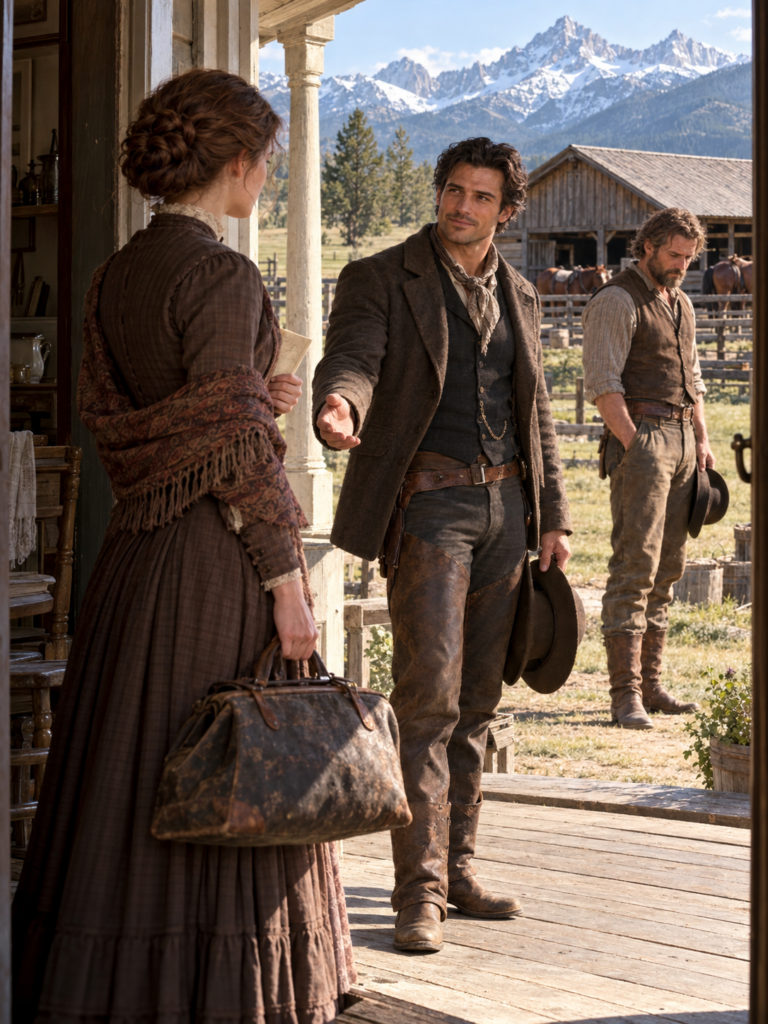
Helena stopped walking and turned toward the stable.
Richard stood in the doorway, one hand resting against the wooden frame.
For a moment, neither spoke.
“Were you looking for something?” he asked.
“The garden,” Helena answered.
“It’s behind the house.”
“I know.”
His eyes moved toward the narrow path beside the stable.
He seemed to be deciding whether she had overheard him.
Helena understood the question he was too proud to ask.
“I was gathering herbs for breakfast,” she said. “I ought to get back before the bread rises too far.”
Richard nodded.
But he did not move.
The young horse pushed its nose through the open doorway, nearly knocking against his shoulder.
Richard steadied it with a familiar hand.
“He gives you trouble,” Helena observed.
“Only when he thinks he’ll get away with it.”
“Then he’s an intelligent animal.”
A faint smile appeared.
For a moment, the distance between them seemed smaller.
Then Helena returned toward the farmhouse.
She did not mention what she had heard.
Not to William.
Not to Thomas.
Not even when Richard sat across from her at breakfast, looking as though he had slept badly.
But she began noticing things.
Richard was the first to rise and often the last to stop working.
He repaired what was broken without being asked.
He knew every horse’s habits and every weak place in the pasture fencing.
Yet whenever Thomas praised William, Richard’s expression grew strangely still.
He was not an unloved man.
That much became clear.
Thomas trusted him with difficult decisions.
William sought his judgment about cattle.
The ranch hands respected him.
Still, Richard behaved as though every kindness might someday be taken back.
Helena understood more than she wished to.
Her mother’s death had left her without the one place where she had never questioned her welcome.
Perhaps Richard, despite having a family, lived with a similar uncertainty.
By the beginning of May, the kitchen had settled into Helena’s rhythm.
The men arrived at meals on time.
The pantry stayed orderly.
The workers complimented her bread.
William found increasingly elaborate reasons to appear while she was cooking.
One morning he arrived carrying a piece of broken harness.
Helena stared at it.
“Is that supposed to interest me?”
“I thought you might appreciate the workmanship.”
“William, I’m kneading dough.”
“I can see that.”
“Then perhaps you should take the harness to someone who can repair it.”
He laughed and stayed for coffee.
She found herself looking forward to these visits.
Richard noticed.
Of course he noticed.
But he said nothing.
Then came an evening in the second week of May.
Helena was cleaning the kitchen after supper when Richard appeared at the doorway.
He had spent much of the afternoon working up the courage to ask her something.
The northern meadow was blooming.
He had thought perhaps she might like to see it.
He opened his mouth.
Before he could speak, William came through the same doorway.
“Helena,” William said, smiling, “the wildflowers are out along the north range. Would you care to ride there with me Sunday morning?”
Richard went still.
Helena turned from the table.
Her surprise gave way to a smile.
“I would like that.”
William’s face brightened.
“Then I’ll have the horses ready.”
Richard looked down at his hands.
For a moment he remained in the doorway.
Then he quietly stepped backward and left.
Helena did not see him go.
She was still looking at William.
Outside, Richard crossed the yard toward the stable, his boots grinding against the gravel.
He had known William liked her.
He had recognized it almost from the beginning.
But until this evening, he had allowed himself to imagine that his own feelings might remain harmless if he never spoke them.
Now he understood that silence would not make them disappear.
Inside, William was telling Helena about the meadow.
Richard gripped the stable door.
The horse inside lifted its head.
“I know,” Richard murmured.
He looked toward the warm kitchen window.
For thirty-two years, he had feared losing his place in the Callaway family.
Now he was watching his brother step toward a happiness Richard had already decided he had no right to seek.
He entered the stable, took down a saddle that needed repair, and carried it to the workbench.
There was nothing wrong with it that required immediate attention.
Nevertheless, he reached for his tools.
And he began pulling apart stitching he had finished perfectly only that morning.
The first stitch came loose beneath Richard’s knife.
He stopped.
There had been nothing wrong with the seam.
He knew it.
Yet he kept working because his hands needed something to do while his thoughts returned to the kitchen.
To Helena.
To William’s easy smile.
To the simple answer she had given his brother.
Yes.
She wanted to ride with William.
Richard had no reason to resent either of them.
That knowledge only made the feeling harder to bear.
He laid the knife aside before he damaged the saddle further.
Then he rested both hands against the workbench.
Outside, the last of the evening light touched the Bitterroot Mountains.
He had lived on this ranch for thirty-two years.
Thomas Callaway had raised him from childhood after he lost his parents.
Eleanor had fed him, clothed him, and called him her son.
William had grown beside him as a brother.
No one in the family had ever told Richard he was less deserving.
But somewhere in his childhood, he had begun believing that love offered to him was something he must continually earn.
William belonged by birth.
Richard believed he belonged only by permission.
It had become a private conviction so old that he scarcely knew how to question it.
And now, faced with a woman who stirred feelings he had never meant to entertain, he had slipped into the same old reasoning.
William would be chosen.
William would receive the happiness.
Richard would remain useful.
He told himself that was enough.
On Sunday morning, William saddled two horses before breakfast.
Richard saw Helena emerge from the farmhouse wearing her best practical riding coat.
She had pinned her hair neatly beneath her hat.
When she saw William, her face brightened.
Richard turned toward the stable before either noticed him.
He spent the morning repairing fencing, checking tack, and inspecting a gate that required no inspection.
By noon, he had accomplished several days’ worth of minor work.
None of it relieved him.
Meanwhile, Helena followed William across the northern pasture.
The valley opened around them beneath a pale Montana sky.
Wildflowers covered the rising ground.
Yellow and white blossoms mingled with patches of soft purple.
Helena stopped her horse at the crest of a low hill.
“Oh, William.”
He smiled.
“I told you it was worth seeing.”
“You did.”
He dismounted and waited while she settled her horse before stepping down.
For several minutes, they walked through the meadow.
Helena spoke about her mother.
About the years of illness.
About how strange it felt to wake in the morning with no medicine to prepare and no anxious listening for movement from the next room.
William did not try to improve the story.
He listened.
“She was a schoolteacher,” Helena said. “Twenty years in the same schoolroom. She remembered every child’s name.”
“She sounds remarkable.”
“She was stubborn.”
William smiled.
“I’m beginning to think that runs in the family.”
Helena laughed.
“She used to say a recipe worth knowing ought to live in your hands.”
“Does that mean she never wrote hers down?”
“Not a single one.”
“Then I suppose we’re fortunate you remember the bread.”
“You are.”
They walked farther.
At last William stopped.
“Helena, there’s something I want to ask.”
She turned.
He looked unexpectedly serious.
“I’d like to court you properly. Not because you work in our house. Not because I think you owe me your company. Because I’ve come to care about knowing you.”
Helena felt her heart quicken.
For years, she had arranged her life around duty.
Her own hopes had waited quietly behind everything her mother needed.
Now a man stood before her asking what she wanted.
Not assuming.
Not deciding.
Asking.
“Yes,” she said.
William’s smile returned.
And Helena found herself smiling with him.
Their courtship grew gradually.
They rode together on Sunday mornings when the weather permitted.
They talked over coffee.
They discovered that Helena’s reserve concealed a dry wit, and William’s cheerful manner concealed a serious devotion to the ranch and his family.
Thomas watched the change without interfering.
Once, finding William in the kitchen at an unusually early hour, he remarked, “You’ve developed a sudden interest in breakfast.”
“I’ve always liked breakfast.”
“Not at half past five.”
Helena kept her face carefully turned toward the stove.
William merely poured another cup of coffee.
Richard, meanwhile, became quieter.
His affection for Helena did not vanish.
But it changed into something he knew he must not place upon her shoulders.
She had chosen William’s company.
Richard respected that choice.
He did not attempt to compete.
Instead, he tried to bury his feelings beneath work.
Unfortunately, the old insecurity that had shaped his life was growing stronger.
In June, Thomas summoned both sons to his office.
Eighty acres adjoining the eastern boundary of the ranch had become available after old Henderson’s death in April.
The property contained access to a tributary that would improve the Callaways’ water supply.
Thomas wanted to purchase it.
The opportunity was valuable.
But the timing was difficult.
They would need to sell some spring cattle earlier than planned and postpone part of the brothers’ seasonal wages.
William agreed readily.
Richard agreed too.
Yet as Thomas discussed the terms, Richard’s attention drifted toward the family accounts.
He knew his father intended to divide the ranch equally between his sons.
He had read the will.
Still, a poisonous thought returned.
When Thomas was gone, William would surely be considered the rightful heir.
Richard would be the son taken in.
The son who had worked hard enough to deserve gratitude, perhaps, but never the same unquestioned belonging.
It was not true.
He knew it was not true.
But he had believed it privately for so long that the belief had begun to feel more trustworthy than evidence.
A few days later, Richard spoke with Harlan Cooper, a talkative neighbor who managed the nearby Grayson ranch.
During the conversation, Richard mentioned that William was negotiating the Henderson purchase.
He left out the fact that William was acting with Thomas’s full approval.
It was a small omission.
A deliberate one.
Cooper repeated the story.
Within days, people were speaking as though William intended to make the purchase independently.
When Thomas heard the rumor in Millbrook, he returned home deeply troubled.
At supper, he asked William to explain his dealings with the Henderson estate representative.
William did so plainly.
Thomas accepted the explanation.
Richard stared at his plate.
Helena poured coffee and sensed something strained beneath the conversation.
The rumor did not prevent the purchase.
Thomas corrected the misunderstanding directly.
Richard should have stopped there.
He knew it.
But his resentment had begun to feed upon its own failure.
A week later, alone in the office, he wrote an unsigned note to the estate representative’s lodging in Millbrook.
The message suggested that the Callaways’ finances might not be as sound as they appeared.
It hinted that another buyer would be wiser not to wait.
Richard sealed the note.
For several minutes, he held it without moving.
Then he sent it.
The consequences were greater than he expected.
The estate representative asked the bank in Missoula to verify the Callaways’ finances.
The sale was delayed.
A competing rancher showed interest in the acreage.
Thomas spent two exhausting weeks proving that the family possessed the means to complete a purchase that should never have been questioned.
William worked longer hours to ensure the spring cattle sale remained orderly.
Helena saw the strain in both men.
But Richard grew nearly unbearable in his silence.
He could see the cost of what he had done.
He could also see how absurd his suspicions had been.
William had not tried to take the land for himself.
Thomas had not favored him.
The delay had endangered a purchase intended to benefit them all.
Richard had harmed the very family whose love he feared losing.
The truth came through the bank clerk in Missoula.
While discussing the inquiry, the clerk mentioned an unusual phrase contained in the questions about the spring cattle sale.
Thomas recognized the wording.
It echoed something Richard had said during a private family discussion.
For a day, Thomas said nothing.
Then, before dawn, he went to the stable.
Richard was repairing a bridle.
“Son,” Thomas said, “I need to ask you something.”
Richard looked up.
Thomas’s expression was grave.
“The note that reached the Henderson representative. Was it yours?”
Richard felt the world narrow.
He could have denied it.
He could have argued.
Instead, he set the bridle down.
“Yes.”
Thomas closed his eyes briefly.
“Why?”
Richard struggled to answer.
At last the words came.
“I thought William would end up with everything.”
Thomas stared at him.
“Everything?”
“The ranch. Your trust. The place I’ve spent my life trying to deserve.”
Thomas took a slow breath.
“You are my son, Richard.”
“I know.”
“Do you?”
Richard looked away.
“I’ve tried.”
The older man’s voice trembled slightly.
“Then we have something to put right. But you’ve also done real harm, and you will answer for it.”
Richard nodded.
“I know.”
“You’ll speak to the estate representative yourself. And you’ll tell William.”
Richard’s hands tightened.
“He’ll hate me.”
“He’ll be hurt,” Thomas answered. “You’ve given him cause.”
Richard swallowed.
“But you cannot repair this by hiding from him.”
Two hours later, Richard entered the farmhouse through the kitchen door.
Helena turned from the stove.
“Richard?”
He looked exhausted.
“I need to tell you something.”
She set aside her spoon.
He told her about his childhood.
About Thomas and Eleanor taking him in.
About growing beside William while secretly believing that one brother had a permanent place and the other merely a borrowed one.
He admitted that the insecurity had grown worse after William and Helena began courting.
He told her about the rumor.
And the letter.
Helena listened without interrupting.
When he finished, she stood for a moment beside the kitchen table.
“Richard, you must tell William.”
“I know.”
“No,” she said gently. “I don’t think you understand. You’ve spent years believing he was taking something from you without ever allowing him to answer. Now you’ve hurt him. He deserves the truth.”
Richard lowered his head.
“Will he forgive me?”
“I don’t know.”
The honesty wounded him.
But it also steadied him.
Helena moved toward the stove.
“Your mother kept this kitchen carefully,” she said after a moment.
Richard looked up.
“Eleanor?”
“Yes. William told me how she arranged things. I could see she had thought about every shelf and every working surface.”
“She was a good woman.”
“I believe that.”
He studied her.
“How can you know?”
“Because she built a place where people could be cared for. And because, even now, both her sons remember what she gave them.”
Richard looked away.
For a moment, he seemed younger than his thirty-six years.
Then he straightened.
“I’ll speak to William.”
Helena nodded.
“Good.”
Richard left the kitchen.
The conversation that followed lasted nearly an hour.
Helena heard William’s voice rise once.
Then Richard’s.
Then a long silence.
At last William came into the kitchen alone.
His face was pale.
He sat opposite Helena.
“He told me.”
She nodded.
“All of it,” William continued. “The rumor. The letter. Why he says he did it.”
Helena covered his hand with hers.
William stared at the table.
“I grew up beside him. I thought I knew him.”
“You knew the things he allowed you to see.”
“That isn’t enough.”
“No.”
William lifted his eyes.
“I told you once I was usually right about people.”
“I remember.”
“I was wrong about my own brother.”
Helena squeezed his hand.
“You can know someone for years and still fail to hear what they never say.”
William sat quietly.
Then he looked toward the stable.
“I don’t know how to forgive him yet.”
“You needn’t pretend that you do.”
He nodded slowly.
“But I want to understand him.”
“That is a beginning.”
William rose.
At the doorway, he stopped.
“Helena?”
“Yes?”
“I thought loving a family meant knowing them well enough to trust them.”
She considered her answer.
“Sometimes it means learning what trust requires after it’s been broken.”
William looked toward the yard.
Then he went outside to find his brother.
William found Richard standing beside the southern fence, looking across the pasture toward the mountains.
For several moments, he remained behind him.
Then Richard turned.
Neither brother spoke.
They had grown up together on this land.
Worked the same pastures.
Eaten at the same table.
Shared the kind of history that seemed too ordinary to require explanation.
Yet the distance between them had never felt greater.
William finally broke the silence.
“You could have ruined the purchase.”
Richard nodded.
“I know.”
“You made Father explain our finances to strangers. You put the whole ranch under suspicion.”
“I know.”
“And you let people believe I was trying to buy land behind his back.”
Richard looked down.
“Yes.”
William’s jaw tightened.
“Why didn’t you talk to me?”
Richard tried to answer.
For thirty-two years, he had lived with a fear he barely understood.
Speaking it aloud now felt almost impossible.
“Because I thought you’d tell me I was foolish.”
“I might have.”
Richard looked up.
William’s expression was pained.
“But I would have listened.”
That hurt more than Richard expected.
He leaned against the fence.
“I’ve spent my whole life trying not to be trouble.”
William stared at him.
“Trouble?”
“Thomas took me in when I had no one. Eleanor raised me. You treated me like a brother. I thought the least I could do was never make anyone regret it.”
“Richard—”
“I know it doesn’t make sense.”
Richard’s voice hardened against his own shame.
“I’ve known that for years. Every time Father told us the ranch would be divided equally, I believed him for a day. Then I’d wake up and wonder again whether he’d change his mind.”
William looked across the pasture.
“You thought I wanted more than my share?”
“Sometimes.”
“Did I ever ask for it?”
“No.”
“Did Father ever promise it?”
“No.”
“Then why?”
Richard’s eyes filled with something he had spent decades refusing to show.
“Because I wasn’t born a Callaway.”
William turned sharply toward him.
For the first time, he understood what lay beneath the resentment.
He did not agree with it.
He did not excuse the damage it had caused.
But he could finally see the wound.
“You were raised a Callaway,” he said.
Richard looked away.
“That’s what everyone says.”
“Because it’s true.”
“I know.”
William exhaled slowly.
“Then perhaps it’s time we stopped saying it as though that alone ought to settle everything.”
Richard looked at him.
“What do you mean?”
“I mean we’ve let you carry this without knowing you were carrying it. That doesn’t excuse what you did. But I won’t pretend our family can fix things by repeating the same words and expecting you to believe them.”
Richard swallowed.
“What happens now?”
“Now you put right what you can.”
“And after that?”
William considered his answer.
“We keep working. We keep talking. And you stop making decisions about what I must think without asking me.”
For the first time in years, Richard almost smiled.
“That may take practice.”
“It will.”
William held out his hand.
Richard stared at it.
Then he grasped it.
The gesture did not erase what had happened.
But neither brother withdrew.
The following morning, Richard rode to Millbrook.
He met the Henderson estate representative and admitted that the unsigned warning had come from him.
He explained that it was misleading and that the Callaway family’s finances were sound.
The admission cost him his pride.
He made it anyway.
Thomas continued working with the representative to resolve the delayed purchase.
The bank’s questions were answered.
The competing offer remained a concern for a time, but the original agreement was ultimately honored.
Within the month, the purchase proceeded under its original terms.
The family had paid for Richard’s deception in lost time, worry, and embarrassment.
Richard could not undo those things.
What he could do was change how he conducted himself afterward.
He began by speaking more openly with Thomas.
Not easily.
Not gracefully.
But honestly.
They spent several evenings in the office discussing the ranch, the past, and the assumptions Richard had allowed to govern his life.
Thomas listened with the sorrow of a father discovering that love he believed obvious had never felt certain to one of his sons.
“You never had to earn your place twice,” he told Richard one evening.
Richard stared at the floor.
“I wish I’d believed that.”
“So do I.”
Thomas rested a hand on his shoulder.
“But we still have time to do better.”
Richard nodded.
For once, he did not attempt to dismiss his own feelings with a joke or a change of subject.
That summer brought slow changes.
William continued courting Helena.
They rode when the ranch work allowed.
They spoke of her mother, his childhood, the demands of cattle raising, and the ordinary pleasures of building a life alongside someone who enjoyed your company.
Helena had come to the ranch seeking employment.
She had not expected to fall in love.
Still less had she expected to witness the painful unraveling of a family secret.
But she understood now that the Callaways’ greatest difficulty had never been a shortage of affection.
It was the silence surrounding things they feared to say.
Richard had loved his family.
He had also feared them.
Thomas had believed his loyalty was understood.
William had believed their brotherhood required no explanation.
All three had mistaken familiarity for understanding.
Helena did not try to repair those years herself.
The men had to do that work.
Her role was simpler.
She listened when asked.
She spoke plainly when something needed saying.
And she continued building the life she had come to Montana to begin.
Her place in the kitchen became something she took pride in.
She tended the garden.
Prepared meals for the ranch hands.
Managed provisions with care.
But she also began to imagine a future beyond the wage she had first accepted.
William encouraged her to speak of it.
One afternoon, while they walked near the garden fence, he asked whether she missed Millbrook.
“Sometimes.”
“What do you miss?”
“My mother’s house. Not the burden of caring for her while she was ill. I would do that again if she needed me. But I miss the ordinary things.”
“Such as?”
“Her voice in the mornings. The sound of her moving about the house when she was well. The certainty that there was someone who knew me before I had to become so sensible.”
William listened.
“Do you feel you’ve lost that?”
“Yes.”
He took her hand.
“Then perhaps we ought to make room for you to be less sensible now and then.”
She smiled.
“Is that what you call your habit of visiting the kitchen at half past five?”
“That’s entirely practical.”
“Of course.”
“I like early breakfast.”
“You like conversation.”
“That too.”
Helena looked at him.
“I like it as well.”
He smiled.
And neither hurried to say more.
Richard watched their happiness with feelings he no longer tried to disguise from himself.
He had loved Helena.
Perhaps some part of him always would.
But he understood that she had never promised him anything.
His feelings were his responsibility.
They did not entitle him to interrupt her happiness or punish his brother.
One morning, he found Helena alone in the kitchen.
She was preparing bread.
He stood near the table for a moment.
“Helena?”
She looked up.
“Yes?”
“I wanted to thank you.”
“For what?”
“For telling me the truth when I didn’t want to hear it.”
She considered him.
“You already knew what you needed to do.”
“I wasn’t certain I could do it.”
“But you did.”
Richard nodded.
Then he said something he had never managed to express so simply before.
“The voice in my head hasn’t gone away.”
Helena set down her spoon.
“The one that tells you you’re not truly part of this family?”
“Yes.”
“Does it still trouble you?”
“Some mornings.”
“And other mornings?”
“Other mornings I remember what Father said. And what William said.”
She smiled gently.
“Perhaps that is enough for now.”
Richard looked toward the kitchen window.
“Some days, it is.”
That was the nature of his recovery.
Not sudden.
Not complete.
But real.
He was learning that belonging could not be secured by working harder than everyone else.
Nor could it be protected by silently resenting those who seemed more certain of their place.
It required trust.
And trust required honesty.
In August, the Henderson purchase was finalized.
Thomas arranged for the names of both sons to appear alongside his own on the new property’s deed.
It was consistent with the shared future he had intended for the ranch.
Richard, however, had requested the arrangement himself.
Not because he needed his father’s approval.
But because he had finally begun to believe he could ask plainly for what mattered to him.
When Thomas showed him the completed papers, Richard studied the names.
Thomas Callaway.
William Callaway.
Richard Callaway.
He looked at his father.
“Thank you.”
Thomas shook his head.
“You’ve worked this land most of your life.”
“I know.”
“It’s time you let that mean something.”
Richard folded the paper carefully.
For the first time, the words did not feel like consolation.
They felt like fact.
By October, the northern meadow had changed.
The wildflowers were gone.
The grass lay brown beneath a cold sky, and a dusting of early snow marked the higher slopes.
William asked Helena to ride with him one clear morning.
She recognized the route.
“The north range?”
“Yes.”
“There won’t be any flowers.”
“I noticed.”
She glanced at him.
“You promised me wildflowers the first time.”
“I promised you a good view.”
“And now?”
“Now I have something else in mind.”
They rode across the familiar ground.
Helena remembered the spring morning when William had first asked permission to court her.
She remembered how uncertain she had felt about allowing herself to want anything after years spent caring for her mother.
And she remembered the happiness that had followed.
When they reached the rise, William dismounted.
He helped Helena down, then kept her hand in his.
The valley lay quiet beneath them.
The stream wound through the pasture.
Beyond it, the Bitterroot Mountains stood against the pale sky.
William looked at her.
“I’ve spent the summer thinking about how to ask you something.”
Helena smiled.
“You usually ask things without so much preparation.”
“This one matters more.”
She waited.
“Helena, I love you.”
The words were simple.
He did not dress them in promises he could not keep.
“I love the way you laugh when you think nobody is listening. I love how you care for people without making them feel indebted. I love your stubbornness, though I reserve the right to complain about it.”
She laughed softly.
William continued.
“And I love that you came here with your own strength and made a place for yourself before any of us knew what we’d been missing.”
He took a breath.
“I don’t want to give you a life that belongs to me. I want to build one with you.”
Helena’s eyes filled.
“Will you marry me?”
For a moment, she looked across the valley.
She thought of the woman who had arrived with a carpetbag and a recommendation letter.
That woman had been exhausted by grief.
She had been afraid of being refused.
She had wanted nothing more than work she knew how to do and a place where she could rest.
Now she had both.
And she had found something else.
A man who asked before assuming.
A family learning to tell the truth.
A future she was free to choose.
“Yes,” Helena whispered.
William smiled.
“Yes?”
“Yes, William.”
He laughed and drew her gently into his arms.
The meadow held no flowers.
But Helena had never found it more beautiful.
They married in November at the little church in Millbrook.
The ceremony took place on the first Saturday after the autumn work was completed.
Thomas offered to walk Helena down the aisle.
She accepted.
It was not a customary arrangement for them.
But Helena had no family remaining, and Thomas’s offer was given with genuine affection.
She understood its meaning.
He was not replacing her mother.
He was welcoming her.
Richard stood as a witness.
Helena had asked him herself.
When she approached him in the kitchen several weeks before the wedding, he looked genuinely startled.
“You could ask one of the hands,” he said.
“I could.”
“Or someone from Millbrook.”
“Yes.”
He stared at her.
“Then why me?”
“Because I would like you there.”
Richard lowered his eyes.
For a long moment, he said nothing.
Then he nodded.
“I’d be honored.”
On the wedding day, the church filled with familiar faces.
Ranch hands.
Neighbors.
Friends from Millbrook.
Reverend Hale, whose practical kindness had first brought Helena to the Callaway ranch, stood ready to conduct the service.
William waited at the front.
When Helena entered beside Thomas, he smiled with an openness that made her heart ache pleasantly.
She wore a simple dress.
Nothing extravagant.
Nothing meant to impress people who had never known her.
It suited her.
Thomas placed her hand in William’s.
Then he stepped aside.
They made their promises clearly.
Neither offered the other a life without hardship.
They promised instead to meet hardship together.
When the service ended, Richard congratulated his brother.
Then he approached Helena outside the church.
The November light lay pale across the yard.
For a moment, Richard appeared uncertain.
Then he said, “Be good to him.”
Helena smiled.
“I will.”
He nodded and turned away.
“Richard?”
He stopped.
“He’ll be good to you too.”
Richard looked back.
“He already has been.”
He stood quietly for another moment.
Then he returned toward the wagon where Thomas waited.
Life at the ranch continued.
The seasons changed.
Cattle needed tending.
Fences required repair.
Meals had to be prepared.
Accounts had to be kept.
Marriage did not make these responsibilities vanish.
But it changed how Helena and William approached them.
She was no longer simply the hired cook who had arrived seeking a wage.
She was William’s wife, with a voice in the household and a future of her own to help shape.
He listened to her judgment.
She listened to his.
They learned where their skills differed and how to trust each other’s strengths.
Thomas watched the household settle into a new rhythm.
Richard continued his work with a steadier spirit.
He still had difficult days.
There were mornings when the old fear returned, whispering that he was merely a guest in a family that had taken pity on him.
But now he recognized the thought.
He could speak of it.
And sometimes, speaking was enough to keep it from governing his actions.
By the following spring, the kitchen had become the center of a household far warmer than the one Helena had first entered.
One Thursday morning, William appeared before breakfast and reached toward a loaf of fresh bread.
Helena caught his hand.
“Don’t.”
“Just one piece.”
“It’s too hot.”
“I’ve eaten hot bread before.”
“And regretted it.”
He reached again.
She slapped his fingers lightly with the back of her hand.
William withdrew them with an exaggerated expression of injury.
From the table, Richard looked up from his coffee.
“You’ve been married six months,” he remarked. “I’d have thought you’d learned better by now.”
“Marriage hasn’t improved my judgment,” William replied.
Thomas folded his newspaper.
“Nothing has.”
Helena laughed so hard she had to set down the bread knife.
For a moment, Richard watched her.
Then he laughed too.
A real laugh.
Warm and unguarded.
The sound startled William enough that he looked toward his brother.
Richard merely shook his head and returned to his coffee.
Outside the window, the first cattle from the Henderson acreage moved across the eastern pasture.
The land was now part of the Callaway operation.
Not because one brother had defeated the other.
Not because Thomas had favored one son.
Because the family had finally begun facing the truths that silence had allowed to grow dangerous.
Helena looked around the kitchen.
The shelves were orderly.
The bread was rising.
The morning light fell across the same worktable she had scrubbed on her first day.
She remembered how frightened she had been then.
How carefully she had guarded her grief.
How uncertain she had felt about asking for a place in someone else’s home.
Now she understood something she could not have known that April morning.
A home was not merely a building where people lived.
It was a place where they could be honest without being cast aside.
Where affection was not measured solely by what someone could provide.
Where mistakes carried consequences, but did not always have to destroy what remained.
And where love was strengthened not by silence, but by the courage to speak.
William reached for the bread again.
Helena caught his wrist before he touched it.
“William Callaway.”
He grinned.
“Yes, Mrs. Callaway?”
“Sit down.”
He obeyed.
Richard shook his head.
Thomas smiled into his coffee.
And Helena, who had come to Montana with a carpetbag, a letter, and almost nothing left to call her own, placed the warm loaf at the center of the table.
She had found work.
She had found love.
And in the quiet work of building an honest life together, she had found a family that was finally learning what it meant to belong.