Part 1
“Take your brother and get out of my house.”
Marin Kessler stood in the kitchen doorway, still wearing the faded blue uniform from her twelve-hour shift at the diner.
For a moment, she thought she had misunderstood.
Outside, snow was falling hard across the mountains of northern Idaho. The weather report had warned of dangerous temperatures, icy roads, and a storm that could bury the county highway before morning.
But inside the kitchen, her aunt Carla was pointing toward the front door.
A worn blue duffel bag sat beside it.
Marin recognized the bag immediately.
It belonged to her twelve-year-old brother, Toby.
“What’s going on?” Marin asked.
Carla didn’t look at her.
“I’m tired, Marin. I’m tired of paying for everything, and I’m tired of pretending this arrangement is working.”
Marin felt the forty-one dollars in her back pocket.
She had earned it that afternoon, counting every tip twice because thirty dollars was supposed to go toward household expenses.
The remaining eleven dollars had been reserved for Toby’s medication.
“I gave you money last Friday,” Marin said quietly.
Carla gave a bitter laugh.
“Thirty dollars? You think thirty dollars supports two people?”
“I buy groceries. I pay for his school things. I work every shift they’ll give me.”
“And you’re twenty years old. That’s what adults do.”
A man named Rick sat at the kitchen table, his heavy boots resting beneath the chair.
He had been seeing Carla for three months.
Marin disliked the way he looked at Toby, as though the boy were an inconvenience someone ought to remove.
Rick leaned back.
“Your aunt’s trying to start over. You need to respect that.”
Marin ignored him.
“Where am I supposed to go?”
Carla finally met her eyes.
“That’s something you should have figured out a long time ago.”
The words struck harder than Marin expected.
A year earlier, she had stood beside her mother’s hospital bed, promising to look after Toby.
Their mother, Elaine, had been only forty-four when illness took her.
In the final hours, she had gripped Marin’s hand and whispered, “Keep your brother close, sweetheart. Whatever happens, don’t let him feel alone.”
Marin had promised.
She had left nursing school.
She had taken two jobs when she could find them.
She had moved into Carla’s house because their aunt was the only relative willing to take both children.
And every morning since then, Marin had awakened with the same question.
How was she going to keep that promise another day?
Now her aunt was telling her to leave.
Marin looked down at the blue bag.
“Why did you pack Toby’s things?”
Carla folded her arms.
“Because he needs them organized.”
“For what?”
“He stays here.”
The kitchen fell silent.
Marin stared at her.
“What?”
“He’s twelve. I’m his legal guardian. The state provides assistance for his care, and I’m responsible for him.”
Marin felt her stomach turn.
“So you want me gone, but you want to keep his support money.”
“Don’t start.”
“Is that what this is about?”
Carla’s face hardened.
“That money keeps the electricity on.”
Marin looked toward the hallway.
She could hear Toby’s little radio playing softly in the bedroom.
It had belonged to their mother.
He carried it everywhere.
Since the funeral, Toby had barely spoken.
Once he had been a lively boy who loved taking apart broken appliances, asking questions about everything, and making ridiculous jokes during supper.
Now he spent hours sitting quietly, listening to old songs on the radio.
Sometimes Marin heard him whispering to himself.
But when she asked what he had said, he always shook his head.
She couldn’t lose him too.
“Toby,” Marin called.
Carla stood.
“Don’t you dare.”
“Toby, get your coat.”
Rick pushed back his chair.
“You’re making a mistake.”
Marin turned toward him.
“Stay out of this.”
He started to answer, but something in her voice stopped him.
Toby appeared in the hallway wearing socks and an oversized sweatshirt.
His dark hair fell over his eyes.
The radio was pressed against his chest.
He looked from Marin to Carla.
He understood more than anyone gave him credit for.
Marin crouched in front of him.
“Hey, buddy. We’re going for a ride.”
Toby looked toward the window.
Snow rattled against the glass.
His fingers tightened around the radio.
Marin gently helped him into his boots.
Carla stepped forward.
“You cannot take him. I have legal custody. I’ll call the sheriff.”
Marin straightened.
“Then call.”
Carla stopped.
“Tell them everything,” Marin continued. “Tell them you packed his bag before I came home. Tell them about the money. Tell them why you’re putting us out in a blizzard.”
For several seconds, Carla said nothing.
Rick looked away.
Marin lifted the duffel bag.
Then she took her mother’s heavy wool coat from the hook near the door.
It was brown, worn at the cuffs, and still carried a faint trace of her mother’s favorite perfume.
From the hallway closet, she retrieved an old cookie tin containing family photographs, a nursing aide pin, and letters her mother had saved.
She tucked it beneath her arm.
Carla watched.
“You’ll come crawling back.”
Marin opened the door.
Cold wind swept across the kitchen floor.
She looked at her aunt one last time.
“I came here because Mom trusted you.”
Carla’s expression changed.
Only slightly.
But Marin saw it.
“You don’t get to use her against me,” Carla whispered.
“I’m not.”
Marin put her hand on Toby’s shoulder.
“I’m trying to do what she asked.”
Then she led her brother into the snow.
The old hatchback started on the third attempt.
Marin breathed out shakily as the engine coughed to life.
The heater rattled.
The windshield wipers dragged across the glass.
Toby sat beside her with his seat belt fastened, holding the little radio in his lap.
Marin forced a smile.
“All right. Here’s the plan. We’ll get a room at the motel outside town. Tomorrow we’ll figure something out.”
Toby didn’t answer.
He reached across the seat and caught the sleeve of her mother’s coat between two fingers.
Marin looked at his hand.
She wanted to cry.
Instead, she put the car into gear.
The snow grew heavier as they drove.
By the time they reached the motel, the sign was dark.
A sheet of plywood covered the office window.
The parking lot had not been plowed.
Marin stopped at the entrance.
“No,” she whispered.
She checked her phone.
No nearby vacancy information.
The next town was thirty miles away.
She had barely enough fuel.
Then she remembered their mother’s cousin Renata, who lived in a valley beyond the mountain pass.
They hadn’t visited in years.
But Renata was family.
Perhaps she would allow them to sleep on the couch.
Marin glanced at Toby.
“Change of plans, buddy.”
He looked at her.
“We’re going to see Aunt Renata. She lives just over the pass.”
Toby lowered his eyes to the radio.
Marin squeezed the steering wheel.
“She’ll help us.”
She needed to believe that.
Six miles beyond the last streetlight, the heater stopped working.
The wind drove snow sideways across the highway.
Marin leaned toward the windshield, struggling to see the road.
The tires slipped on a bend.
She slowed to almost nothing.
A warning light appeared on the dashboard.
Low fuel.
“Come on,” she whispered.
The car shuddered.
She pressed the accelerator gently.
The engine recovered for a moment.
Then it coughed again.
Toby looked up.
“It’s okay,” Marin said quickly. “Just a little trouble.”
The engine made a harsh grinding sound.
Then stopped.
Marin guided the car toward the shoulder.
The wheels settled into deep snow.
Silence filled the cabin.
She turned the key.
The starter clicked.
Nothing.
She tried again.
Still nothing.
Marin stared through the windshield.
Beyond the weak headlights, there were only trees.
She checked her phone.
Four percent battery.
No service.
The temperature outside was nine degrees Fahrenheit.
She switched off the phone.
For nearly half an hour, they waited.
No headlights appeared.
The car grew colder.
Toby began shivering.
Marin took off her mother’s coat and wrapped it around him.
“Put your hands inside the pockets.”
He obeyed.
She rubbed his shoulders.
“Somebody will come.”
But nobody came.
Eventually, Toby’s shivering became less noticeable.
His eyes looked strangely distant.
Marin felt a surge of panic.
She had studied nursing long enough to recognize that severe cold could make a person dangerously quiet.
“Hey, look at me.”
Toby turned slowly.
“We can’t stay here.”
She looked back toward the road.
She remembered seeing a distant porch light several miles earlier.
If they could reach it, perhaps someone would help.
Marin took the duffel bag and the cookie tin.
She put on her thin work jacket.
Then she opened the car door.
The wind struck so hard it nearly pushed her back inside.
She helped Toby out.
Snow rose above his boots.
He stumbled immediately.
Marin wrapped an arm around him.
“Just stay close.”
Together, they began walking.
Behind them, the car disappeared into the swirling white.
Ahead lay a dark road, miles of forest, and a storm that seemed determined to swallow them.
Marin didn’t know it yet, but somewhere in those woods, a man who had been dead for two years had left behind the only thing that could save them.
Part 2
After twenty minutes, Marin could barely feel her feet.
The snow kept filling their tracks.
The wind blew against their faces, carrying needles of ice that stung every inch of exposed skin.
Toby stumbled beside her.
She tightened her arm around his shoulders.
“You’re doing great.”
He didn’t answer.
“Remember when Mom took us camping at Lake Pend Oreille?”
His eyes remained fixed on the ground.
“You complained because she made us carry our own sleeping bags.”
Marin tried to laugh.
“You said yours weighed more than you did.”
Toby took another step.
“And Mom said if you were strong enough to argue, you were strong enough to carry it.”
The memory hurt.
For an instant she could see her mother standing beside their old blue tent, laughing with a coffee mug in her hand.
Marin swallowed.
“Just keep moving, Toby.”
Then something appeared on the road.
At first she thought it was a wolf.
A large gray shape stood near the trees, almost motionless.
Marin stopped.
Toby bumped into her.
She pulled him close.
The animal stepped forward.
It was a dog.
Large, shaggy, and old.
Its muzzle had turned white.
One ear had a ragged notch.
And it was limping.
The dog stood in the snow watching them.
Marin whispered, “Easy.”
The animal made no threatening movement.
It simply turned and walked toward the pines.
After several yards, it stopped.
Looked back.
Then returned a few steps.
Marin stared.
“What do you want?”
The dog turned again.
Waited.
And for the first time in months, Toby spoke clearly.
“It wants us to follow.”
Marin looked at him.
Four words.
Her brother had spoken four words without being asked a question.
She felt an almost unbearable urge to grab him and celebrate.
But the cold was worsening.
The road behind them was empty.
And the dog seemed to know exactly where it was going.
Marin looked into the forest.
Following an unfamiliar animal away from a road was a terrible gamble.
But the road offered no shelter, and Toby could barely stand.
She took one more look in the direction of the distant porch light.
Then she followed the dog.
Inside the forest, the wind weakened.
The tall pines caught much of the blowing snow.
The ground remained difficult, but the air was quieter.
The gray dog moved ahead, limping yet determined.
Whenever Marin and Toby fell behind, it stopped and waited.
Sometimes it returned to nudge Toby’s leg with its nose.
Marin began talking to it.
“All right, old girl. I hope you know something we don’t.”
The dog continued.
They climbed a shallow slope.
Crossed a narrow depression filled with snow.
Passed several fallen logs.
Marin’s breathing grew ragged.
Her shoulders ached from supporting Toby.
More than once, she wanted to sit down.
But she knew that stopping could be dangerous.
She thought of her mother.
Keep him close.
“I’m trying, Mom,” she whispered.
The dog suddenly moved faster.
The trees began thinning.
Beyond them, Marin noticed a patch of open darkness.
Then the forest ended.
A clearing stretched across the snow.
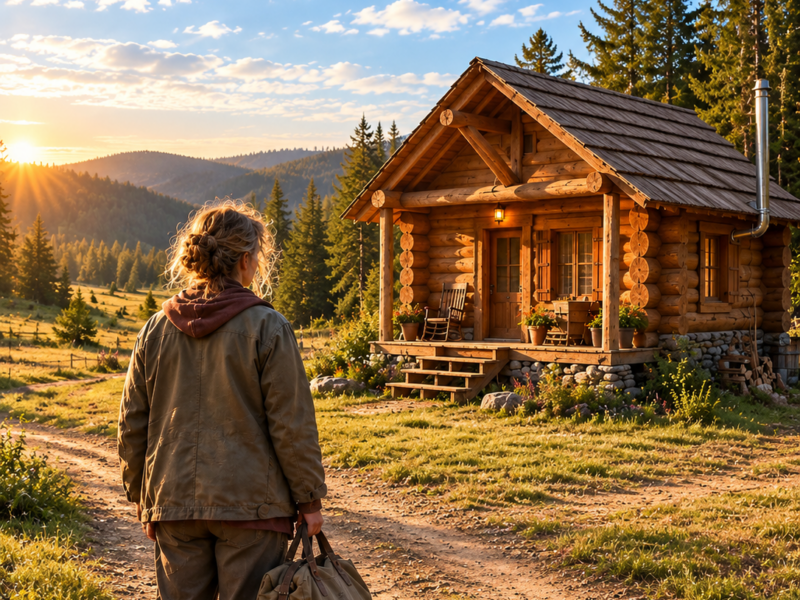
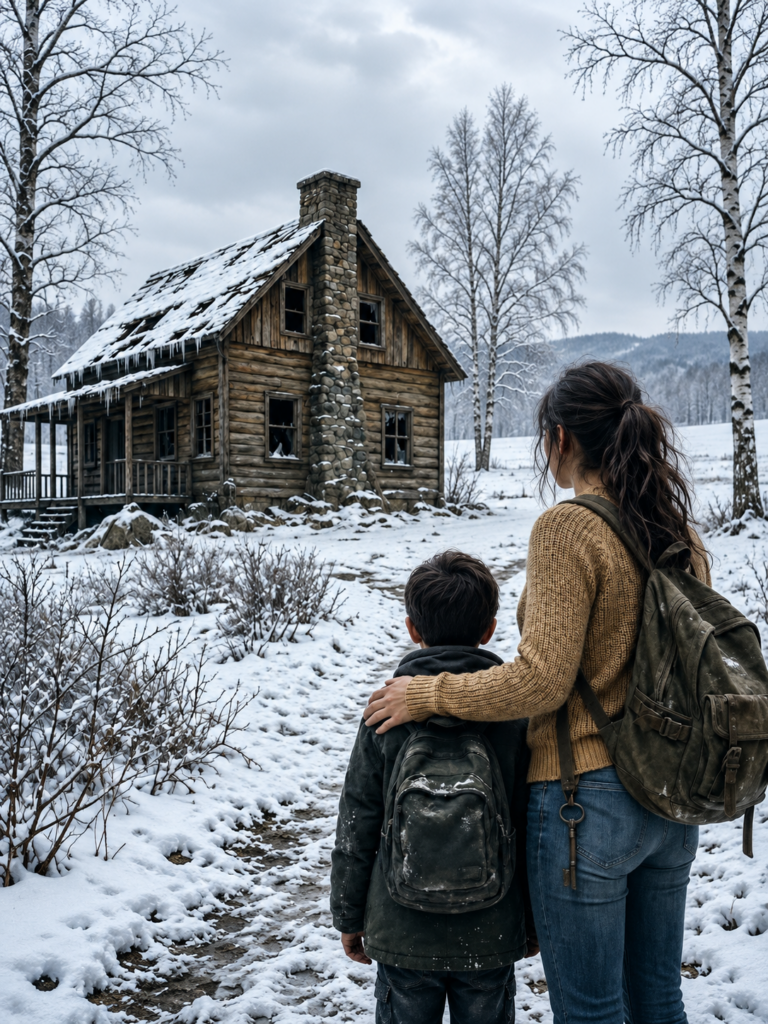
And at its center stood a cabin.
It was small.
Built of squared logs darkened by age.
Snow covered the pitched roof.
A stone chimney rose beside the back wall.
There was no smoke.
No light.
But the building appeared solid.
Marin almost collapsed with relief.
“Look, Toby.”
He lifted his head.
“A house.”
The dog was already limping across the clearing.
It climbed the porch steps and scratched at the door.
Marin half carried Toby after it.
She tried the handle.
Unlocked.
The door creaked inward.
She pushed Toby inside.
The dog followed.
Marin shut the door against the storm.
The sudden silence felt enormous.
It was cold inside, but there was no wind.
That alone seemed miraculous.
Marin switched on her phone long enough to examine the room.
There was a cast-iron stove.
A narrow bed.
A wooden table.
Two chairs.
Shelves lined with cans and jars.
A workbench beneath the window.
Beside the stove stood a wooden box filled with split firewood.
On top lay a tin of matches.
Marin stared.
Someone had prepared this place.
She didn’t have time to wonder why.
Toby was trembling again.
She helped him sit on the floor and began building a fire.
Her mother had taught her to start one during their camping trips.
Small pieces first.
Dry bark.
Kindling.
Then thicker wood.
The first match broke.
The second went out.
The third caught.
A thin flame flickered through the kindling.
Marin bent close, shielding it.
“Come on.”
The flame spread.
The wood crackled.
A moment later, the stove began giving off heat.
Marin shut the iron door and turned toward Toby.
“We did it.”
He looked at the fire.
His expression barely changed.
But he moved his hands toward the warmth.
Marin found clean blankets folded at the foot of the bed.
She wrapped them around him and removed his wet boots.
His socks were damp.
She hung them near the stove.
Then she knelt beside him.
“Stay right here. I’m going to get you something warm.”
She melted snow in a metal pot and helped him drink small amounts after the water had warmed.
Color gradually returned to his face.
Marin opened a can of peaches from the shelf and checked it carefully.
The seal was intact.
The fruit smelled normal.
She gave Toby several pieces.
He ate slowly.
Marin nearly cried with relief.
Then she noticed the dog.
It had climbed into a worn wooden chair beside the stove.
Not beside the chair.
Into it.
The old animal curled against the cushions and rested its chin on the armrest.
As though it had slept there every night of its life.
Marin looked around the room.
“Well,” she whispered, “I guess you live here.”
Once Toby was warm, Marin inspected the shelves.
Beans.
Corn.
Peaches.
Crackers.
Rice in a sealed container.
Coffee.
Matches.
A small first-aid box.
A kerosene lamp.
There was enough to keep them alive for several days if they were careful.
She lit the lamp.
Golden light spread across the cabin.
The place looked different now.
The furniture was old but well maintained.
The curtains were clean.
The shelves had been built carefully, with each board fitted neatly against the wall.
On the workbench lay a row of small carving tools.
Several wooden animals stood along the windowsill.
A bear.
An owl.
A running dog.
Marin picked up the dog carving.
One ear had a notch.
She looked toward the animal sleeping in the chair.
It was unmistakable.
Someone had loved this dog enough to carve her likeness.
Marin turned the little figure in her hand.
Then she noticed a name carved into the workbench.
MERCER.
The letters were deep and worn smooth.
She whispered the name.
“Mercer.”
It meant nothing to her.
Not yet.
Later that evening, Marin noticed that the dog’s front paw was swollen.
She approached carefully.
“Hey, girl.”
The animal opened one eye.
Marin extended her hand.
The dog sniffed it.
Then leaned its head into her palm.
“Let me see.”
There was a cut on the underside of its paw.
The injury looked painful, but Marin couldn’t see evidence of a broken bone.
She cleaned it gently with warm water and wrapped it using supplies from the first-aid box.
The dog remained remarkably still.
“You’re a good girl.”
Toby watched from the blankets.
“Juno.”
Marin turned.
“What?”
Toby touched the dog’s gray fur.
“Her name should be Juno.”
Marin smiled.
“Juno?”
He nodded.
“Like the big moon.”
“That’s Jupiter’s moon, buddy.”
Toby looked at the dog.
“Still Juno.”
Marin laughed softly.
“All right. Juno it is.”
The dog’s torn ear twitched.
Toby almost smiled.
Marin looked away quickly.
If she stared too hard at those small changes, she was afraid her brother would retreat into silence.
Instead, she fed another log into the stove.
“Well, Juno. You saved us. Guess we’re your guests tonight.”
The dog sighed and settled back into her chair.
Long after Toby fell asleep, Marin remained awake.
She sat beside the stove wearing her mother’s coat.
The cabin was warm now.
Outside, the storm howled through the trees.
She looked at the neatly made bed.
A pair of reading glasses rested on the shelf above it.
Beside them lay an old Bible.
A calendar hung on the wall.
The pages were two years old.
Someone had crossed off each day until a Tuesday in November.
Then nothing.
Marin stared at the calendar.
Something about it troubled her.
Whoever had lived here hadn’t packed and moved away.
The dishes were still in the cupboard.
The tools were still arranged on the bench.
His glasses remained beside the bed.
It looked as though someone had simply stepped outside one afternoon, expecting to return.
She glanced toward Juno.
The old dog slept in her favorite chair.
Marin whispered, “Where’s your owner, girl?”
Juno didn’t stir.
Marin looked again at the calendar.
And for the first time, she understood that the cabin might be empty because the person who owned it had died.
She felt a quiet sadness for the stranger.
Whoever he had been, his firewood was keeping Toby alive.
His blankets were warming them.
His food had rescued two children he had never met.
Marin folded her hands.
“Thank you,” she whispered into the empty room.
Then she stayed awake feeding the fire until morning.
Part 3
When daylight arrived, the entire clearing had disappeared beneath fresh snow.
Marin opened the door a few inches.
Cold air rushed inside.
The pine branches sagged beneath heavy white drifts.
The trail they had followed was almost invisible.
Their car was somewhere beyond the trees, buried beside the highway.
She shut the door.
They weren’t leaving today.
Possibly not tomorrow.
She checked the supplies again.
There was enough food if she rationed it.
The woodshed behind the cabin held a large supply of dry logs.
A hand pump stood near the back door, though its handle had frozen.
There was an outhouse and a small storage cellar.
Whoever had built the cabin understood how to live through mountain winters.
Marin made a simple breakfast.
Rice cooked with water.
A few crackers.
Coffee for herself.
Toby sat beside the stove with Juno’s head resting against his knee.
“Think she’ll be okay?” he asked.
Marin glanced at the bandaged paw.
“I think so. We’ll keep it clean. When we can get down the mountain, we’ll find somebody to look at it.”
Toby stroked the dog’s ears.
“She’s old.”
“She is.”
“Does she have a family?”
Marin looked around the room.
“I think she did.”
Toby watched Juno for a long moment.
“Maybe we can be her family now.”
Marin felt a tightness in her chest.
She crossed the room and kissed the top of his head.
“Maybe we can.”
After breakfast, Toby discovered the woodworking tools.
Marin found him standing beside the bench, studying the little carved animals.
“These are nice,” he said.
“They are.”
“Who made them?”
“I think the man who lived here.”
Toby picked up a small wooden bear.
Its ears were uneven, but someone had carved tiny claws into the paws.
“He was good.”
Marin smiled.
“Very good.”
Toby looked toward the woodpile.
“Could I make one?”
She hesitated.
There were sharp tools on the bench.
But Toby had always loved building things, and she hadn’t seen him interested in anything for months.
“Only if I’m right here with you.”
He nodded.
They found a scrap of soft pine.
Marin showed him how to secure it.
Toby began working carefully with a small carving tool.
At first he said nothing.
Then he began describing what he wanted to make.
“A dog.”
“Like Juno?”
“Yeah. But smaller.”
He paused.
“And with the ear.”
Marin watched him concentrate.
For the first time since their mother died, his face looked like the face of a boy doing something he enjoyed.
Not a boy holding himself together.
Just a boy.
She returned to the stove so he wouldn’t see her tears.
That afternoon, Marin began examining the cabin more carefully.
She discovered a row of handwritten notebooks on the shelf.
Each carried a year on its spine.
She opened the oldest.
Most entries were brief.
February 3. Heavy snow. Split wood.
March 12. Fixed fence by north meadow.
April 8. Dog chased a squirrel into the creek.
The handwriting belonged to a practical man.
He recorded weather, supplies, repairs, and the condition of the property.
Sometimes he mentioned his bad hip.
Sometimes he complained about the price of gasoline.
Sometimes he wrote about the dog.
Juno went missing two nights. Came back smelling like a skunk. She seems proud of herself.
Marin laughed aloud.
Toby looked over.
“What?”
She read the entry.
He grinned.
A real grin.
Marin closed her eyes for a moment.
She had missed that smile more than she could explain.
The notebooks eventually revealed the owner’s name.
August Mercer.
He preferred Gus.
A retired logger and woodworker who had lived alone in the mountains for many years.
He had a friend named Hollis, a former Forest Service worker who sometimes helped with supplies.
And he had once had a wife and daughter.
Marin discovered their photograph inside the Bible.
A young man stood beside a smiling woman holding a baby girl.
The woman had dark hair.
The baby wore a white knitted hat.
On the back, someone had written:
My whole heart, before the fire.
Marin sat down.
The words were painfully simple.
She turned the photograph over again.
The young Gus smiled so openly that it was difficult to imagine him living alone for decades.
She wondered what had happened.
Later, she found the answer in one of the older journals.
A house fire.
His wife had died.
His infant daughter had died.
Gus survived because he had been away working.
For years afterward, he drifted from town to town, unable to settle anywhere.
The entries were sparse.
But Marin recognized grief even when it appeared only between the lines.
She had lived inside it herself.
That evening, while Toby worked on his carving, Marin finally opened her mother’s cookie tin.
She hadn’t touched its contents since the funeral.
Inside were photographs, an old nursing aide pin, a dried flower, school certificates, and a small collection of letters.
The smell of her mother’s perfume still lingered in the tin.
Marin pressed a hand over her mouth.
She remembered coming home from school and finding her mother asleep in the recliner after a double shift.
She remembered how Elaine would wake, apologize for not starting supper, and get up even when her feet were swollen.
She remembered being annoyed because her mother volunteered to bring meals to elderly neighbors.
There had never been enough money.
Yet Elaine always found a way to feed someone else.
“Why do you keep doing that?” Marin had once asked.
Her mother had answered, “Because someday we might be the ones standing outside somebody’s door.”
Marin had rolled her eyes.
Now, sitting inside a stranger’s cabin while snow buried the road, she understood.
She lifted a folded sheet of paper from the bottom of the tin.
The handwriting wasn’t her mother’s.
It belonged to a man.
The letter began:
Dear Lainey,
You probably don’t remember me. Years ago, you gave a warm meal to a man outside a diner who had stopped believing his life was worth much.
Marin went still.
She continued reading.
The man described a bitter winter night.
He had been sleeping outdoors.
He had lost his family years before.
He had wandered through several states, living on odd jobs and whatever charity he could find.
One evening, he stood behind a diner, hungry and exhausted.
He believed nobody would notice if he disappeared.
Then a young waitress stepped outside carrying a plate of hot food.
She didn’t just hand it to him.
She sat on the back steps and talked.
She asked his name.
She asked where he came from.
And she listened.
The man wrote that the conversation had helped him decide to seek assistance and begin rebuilding his life.
He eventually found work.
Saved money.
Bought land.
Built a cabin.
For years, he searched for the woman who had helped him.
He had never forgotten her kindness.
Then Marin reached the last page.
I have forty acres up in the pines and a little cabin I built with my own hands. It isn’t fancy, but the roof doesn’t leak and the stove burns hot.
If you or your girl ever need somewhere to go, the door will be unlocked.
I cannot give you back everything you gave me that night, but I can give you a place where the world cannot turn you away.
Your friend, Gus Mercer.
Marin stopped breathing for a moment.
Gus Mercer.
She looked toward the workbench.
The carved name stared back at her.
Then she looked at the dog.
Juno lifted her head.
Marin reread the signature.
It was the same man.
The owner of the cabin.
The man whose supplies had saved them.
He had known their mother.
And he had promised her a place to stay.
Marin pressed the letter against her chest.
“Oh, Mom.”
Toby looked up.
“What?”
Marin motioned for him to come closer.
He sat beside her.
She read the letter aloud.
When she finished, Toby was quiet.
Then he looked around the cabin.
“So this was for Mom?”
“Yes.”
“And she never came?”
“I guess not.”
“Why?”
Marin shook her head.
“I don’t know.”
Toby thought carefully.
Then he said, “Maybe she was saving it for us.”
Marin stared at him.
Outside, snow fell silently through the trees.
She looked around the room again.
The full wood box.
The blankets.
The food.
The unlocked door.
Perhaps her mother had kept that letter because she believed there might come a day when her children needed it.
Or perhaps she had simply been too proud to accept a stranger’s gift.
Marin would never know.
But one thing was certain.
The man who owned this cabin had been grateful to their mother.
And somehow, years later, his old dog had led her children straight to his door.
On the third morning, Toby decided to repair the frozen hand pump.
Marin found him outside in Gus’s oversized canvas coat, studying the handle.
“What are you doing?”
“Trying to fix it.”
“You’re going to freeze.”
“I won’t be long.”
He explained that ice had probably seized part of the mechanism.
He had found lubricating oil in the shed.
Marin helped him warm the pump housing carefully with water.
They worked together for more than an hour.
Toby removed a small pin.
Cleaned the mechanism.
Reassembled it.
Then he pulled the handle.
Nothing.
He tried again.
A hollow coughing sound came from deep inside.
Then water splashed into the bucket.
Toby shouted.
“Marin! It works!”
She laughed.
“You fixed it!”
He grinned.
The sound of his voice echoed across the snowy clearing.
And Marin felt, for the first time in a year, that something inside their little family was beginning to heal.
That evening, she returned to Gus’s journals.
She read about his years in the cabin.
About planting trees.
About repairing fences.
About Juno growing old.
Then she found several entries mentioning Lainey.
Her mother.
Gus had continued looking for her.
He had visited the diner where she once worked.
He had asked neighbors whether anyone remembered her.
Eventually, he learned her married name.
Then he found out she had died.
Marin stared at the entry.
Found her. Too late.
The words had been pressed so hard into the paper that the pencil nearly tore through it.
She turned the page.
Several months later, Gus had written about meeting a lawyer.
He wanted to leave his property to Elaine’s children.
He didn’t know their names.
He knew only that she had a daughter and a younger son.
But he was determined.
If I can’t thank their mother, he wrote, I can make sure her children have a place to go.
Marin’s hands began shaking.
She read the next entry.
It mentioned a will.
A lawyer in town.
And Hollis, the friend who had promised to keep the property maintained.
Gus had left instructions.
Keep the wood stacked.
Keep the food stocked.
Look after Juno.
Leave the door unlocked.
Marin sat motionless.
The cabin wasn’t simply an abandoned shelter.
It might be an inheritance.
But before she could understand what that meant, she heard something outside.
An engine.
Coming closer.
Juno rose from her chair.
And Marin suddenly remembered that Carla had threatened to call the sheriff.
Part 4
The sound grew louder.
Marin crossed to the window.
A snowmobile emerged from the trees.
Its engine echoed across the clearing before the rider stopped near the porch.
The man climbing off looked nearly seventy.
He wore a weathered green parka and carried a canvas bag.
His gray beard was crusted with snow.
He stared at the smoke rising from the chimney.
Then Juno began barking.
Marin’s heart raced.
She opened the door only a few inches.
“We’re not trying to steal anything,” she called. “Our car broke down in the storm.”
The man stopped.
He looked toward Juno.
His expression changed.
“Well, I’ll be.”
Juno pushed past Marin and limped into the snow.
The old man crouched with difficulty.
“There you are, girl.”
The dog pressed its head against his chest.
He rubbed her ears.
“I thought I’d lost you.”
Marin watched.
The man looked up.
“Name’s Hollis Bennett. I look after this place.”
Marin felt a flicker of recognition.
“Hollis?”
He stood.
“You know me?”
“Not exactly. I read your name in Gus Mercer’s journals.”
The old man’s face softened.
“Then you know Gus.”
“I know he owned this cabin.”
Hollis looked at the smoke again.
“And I suppose you know he passed away.”
Marin nodded.
“Two winters ago?”
“That’s right.”
Hollis glanced past her toward Toby.
“Mind if I come inside? It’s a little cold for porch visiting.”
Marin hesitated.
Then stepped aside.
Hollis removed his boots beside the door.
He stood for a moment looking at the cabin.
The burning stove.
The blankets.
The dishes on the table.
Toby sitting beside the workbench.
Something moved across his face.
“Lord,” he whispered.
Marin watched him.
“Are we in trouble?”
Hollis looked surprised.
“Trouble?”
“We didn’t know where else to go. We got stuck during the storm, and Juno brought us here.”
Hollis turned toward the dog.
“She did?”
Marin nodded.
The old man smiled faintly.
“That sounds like her.”
He walked to the stove and rested his hands near the warmth.
“Gus always said that dog had more sense than most folks.”
Toby looked up.
“She saved us.”
Hollis studied him.
“Did she now?”
“She brought us here when Marin couldn’t walk anymore.”
The old man’s expression became serious.
He looked at Marin.
Then at Toby.
“Well, I’m glad she did.”
Marin reached into her pocket.
“There’s something I need to show you.”
She unfolded the letter from her mother’s cookie tin.
Hollis accepted it.
His eyes moved across the page.
Halfway through, he stopped.
He looked at Marin.
“Where did you get this?”
“It belonged to my mother.”
“Your mother?”
“Elaine Kessler. Gus called her Lainey.”
Hollis sat down.
He read the letter again.
Then removed his glasses.
“Sweet Lord.”
Marin felt the room grow very quiet.
“Did you know her?”
“No. But I heard about her.”
He looked toward the photograph beside the Bible.
“Gus told me that story more times than I can count.”
Hollis explained that Gus had lost his wife and baby daughter in a house fire.
The tragedy had broken him.
He spent years moving from town to town.
Then one winter, a waitress outside a diner gave him food and treated him with dignity.
Her kindness helped him find the courage to begin again.
“Your mother didn’t know what she’d done,” Hollis said.
Marin wiped her eyes.
“She never told us.”
“That’s the sort of thing Gus said about her. Helped somebody and went right back to work.”
He looked around the room.
“This cabin was his way of saying thank you.”
Marin swallowed.
“I found something about a will.”
Hollis became still.
“What did you find?”
“Some of his journal entries. He wrote that he wanted to leave the place to Mom’s children.”
The old man opened his canvas bag.
He removed a long envelope.
It was yellowed and worn along the edges.
“Gus gave me this before he died.”
Marin stared.
“What is it?”
“A letter. And instructions.”
Hollis placed it on the table.
“He made arrangements with a lawyer in town. Said if the children ever turned up, I was to bring them the papers.”
Marin looked at the envelope.
Her hands began trembling.
Hollis spoke softly.
“I’ve been keeping this cabin ready for two winters, hoping somebody would come.”
He glanced toward Toby.
“Never imagined they’d arrive in a blizzard.”
Before Marin could open the envelope, Juno lifted her head.
Her ears stiffened.
A low growl came from her throat.
Then Marin heard an engine.
Not a snowmobile.
A heavier vehicle.
Headlights appeared between the trees.
Hollis looked toward the window.
“That’ll be the county.”
Marin’s stomach dropped.
A dark SUV rolled into the clearing.
Two people climbed out.
One wore a deputy’s uniform.
The other was a woman with a county identification badge.
Then the back passenger door opened.
Carla stepped into the snow.
Marin’s entire body went cold.
Toby stood and moved behind her.
His fingers closed around her sleeve.
Carla had found them.
The deputy knocked.
Marin opened the door.
“Evening, ma’am. We’re looking for Tobias Kessler.”
Marin pulled Toby closer.
“He’s my brother.”
The deputy nodded.
“Your aunt reported that you took him from her home without permission.”
A woman stepped forward.
“I’m Denise Walker with County Family Services. We need to make sure he’s safe.”
Marin looked at Toby.
His face had gone pale.
She remembered the night at Carla’s house.
The packed bag.
The threats.
The terrible drive through the storm.
She forced herself to speak.
“Come inside.”
The little cabin suddenly felt crowded.
Denise looked around.
Her eyes moved from the stove to the food shelves, the clean blankets, and the bandaged dog sleeping near Toby.
“How long have you been here?”
“Four days.”
“And how did you find the place?”
“Our car broke down. We walked. The dog led us here.”
Denise took notes.
“Do you have any legal right to stay here?”
Marin hesitated.
Hollis stepped forward.
“I can explain the property situation.”
Denise held up a hand.
“First, I need to understand what happened with the child.”
Carla spoke from near the door.
“She took him without my permission.”
Marin turned.
“You told me to leave.”
“I told you that you needed to find another place to live.”
“You packed Toby’s bag.”
Carla looked away.
“You were upset.”
“Tell her about the money.”
The room went silent.
Carla’s face tightened.
“What money?”
“The support payments you receive for Toby. You said he had to stay because you needed them.”
Denise looked up from her notebook.
“Mrs. Kessler, is that accurate?”
Carla folded her arms.
“Those payments help support the household.”
Marin stepped forward.
“I worked every week. I gave her money for rent and groceries. I bought Toby’s medicine. Then she decided she didn’t want me there anymore.”
Carla’s voice rose.
“You have no idea what I’ve been dealing with!”
Marin stared at her.
“Then tell us.”
Carla looked toward the stove.
For several seconds, she said nothing.
Then the words came out.
“Your uncle left.”
Marin frowned.
“What?”
“He walked out in October. He left debts. He left the mortgage. He left me trying to keep a house I couldn’t afford.”
Carla’s voice broke.
“I was drowning.”
Marin remembered how exhausted her aunt had looked that winter.
The unopened bills.
The arguments behind closed doors.
The way Carla sometimes sat alone in the kitchen long after midnight.
For the first time, she understood that something had been happening beneath the cruelty.
But understanding didn’t erase what Carla had done.
“You could have told me.”
Carla shook her head.
“I couldn’t.”
“You could have asked for help.”
“I was ashamed.”
Marin looked toward Toby.
Her brother stood against her side.
“You made him feel unwanted.”
Carla’s eyes filled.
“I know.”
“You put us out in a snowstorm.”
Carla lowered her head.
Denise closed her notebook for a moment.
Then asked, “Mrs. Kessler, did you tell Marin to leave that evening?”
Carla nodded.
“And did you intend to retain Tobias because of the support payment?”
Carla pressed her lips together.
Finally, she whispered, “Partly.”
The deputy looked toward the window.
Nobody spoke.
Hollis stepped forward.
“There’s something else everybody needs to know.”
He placed the old envelope on the table.
“August Mercer owned this cabin and forty acres around it. He died two years ago.”
Denise nodded.
“And?”
“He left a will naming the children of Elaine Kessler as his intended beneficiaries.”
Marin felt Toby’s hand tighten.
Hollis continued.
“He couldn’t locate them before he died. The estate has been tied up while the lawyer tried to identify the heirs.”
Denise looked at Marin.
“Elaine Kessler was your mother?”
“Yes.”
Hollis held up the letter.
“There’s documentation. Letters. Records. A lawyer in town.”
He looked at Marin.
“Gus wanted these kids to have a home.”
Denise studied the envelope.
“That will need to be verified legally.”
“Of course,” Hollis said.
“But I believe this is exactly who he was waiting for.”
Then Denise turned toward Toby.
She crouched so their eyes were level.
“Tobias, I need to ask you something.”
He looked down.
“Do you feel safe with your sister?”
He nodded.
“Has she been taking care of you?”
Another nod.
Denise waited.
“Would you like to tell me anything?”
Toby moved closer to Marin.
For a long moment, he remained silent.
Then he spoke.
“She didn’t leave me.”
Denise looked at him.
Toby’s voice trembled.
“Mom died. Dad wasn’t there. Everybody kept talking about where I should go.”
He swallowed.
“But Marin stayed.”
Marin felt tears rise.
Toby continued.
“She makes sure I eat. She remembers my medicine. She comes home even when she’s tired.”
His eyes filled.
“She’s the only person who never left me.”
Nobody moved.
Then Denise gently stood.
“I hear you.”
But the legal situation remained complicated.
Carla was still the appointed guardian.
Marin was an adult, but she had no custody order.
Denise explained that a temporary safety arrangement and a court review would be necessary.
She couldn’t simply transfer guardianship based on what she had heard in one evening.
Marin felt panic tightening around her chest.
“You can’t take him.”
Denise’s voice softened.
“I have to make sure everything is done properly.”
Toby grabbed Marin’s hand.
“No.”
“Toby—”
“No!”
His voice broke.
“Please don’t make me leave her.”
Marin wrapped her arms around him.
He began crying.
Not quietly.
Not the silent tears she had seen after their mother’s funeral.
He sobbed against her chest.
“I don’t want to go.”
Marin held him.
“I’m here.”
Denise looked toward Carla.
Carla was crying too.
Then Carla stepped forward.
“Stop.”
Everyone turned.
She wiped her face.
“I’ll cooperate.”
Denise looked at her.
“What do you mean?”
“I’ll sign the temporary placement papers. Whatever needs to be done to let him stay with Marin while the court decides.”
She looked at Toby.
“I’ve already hurt him enough.”
Marin stared at her aunt.
Carla shook her head.
“I kept telling myself I wasn’t a bad person. That I was just tired and frightened.”
Her voice cracked.
“But I put two children outside in a storm because I couldn’t admit I needed help.”
She turned toward Denise.
“Please. Don’t make him pay for what I did.”
Denise spoke with the deputy privately.
She made several calls.
She reviewed the circumstances with Hollis and Carla.
There were documents to complete and further checks to arrange.
The matter would still require a judge.
But with Carla’s cooperation, an available kinship placement, and a safe temporary arrangement, Denise was able to begin a process that could keep Toby with Marin.
When she returned, she looked at the siblings.
“Tobias can remain with Marin under the temporary safety plan while we complete the necessary review.”
Marin covered her mouth.
Toby clung to her.
Denise held up a finger.
“That doesn’t mean the matter is settled. There will be interviews, a home assessment, and a court hearing.”
Marin nodded rapidly.
“I’ll do whatever you need.”
Denise glanced around the warm cabin.
“I can see you’ve been doing your best.”
The deputy stepped toward the door.
Hollis helped Carla into her coat.
Before leaving, Carla looked at Toby.
“I know you’re angry.”
He didn’t answer.
She swallowed.
“You have every right to be.”
Marin watched her aunt walk into the snow.
For the first time that night, she realized she wasn’t afraid of Carla anymore.
But her hands were still shaking when she turned back toward the table.
The envelope from Gus Mercer lay there unopened.
And whatever it contained was about to change their lives.
Part 5
After the county SUV disappeared down the mountain road, the cabin became quiet again.
Juno returned to her chair.
Hollis added wood to the stove.
Toby sat beside Marin with his head resting against her shoulder.
For several minutes, nobody spoke.
Then Hollis pushed the envelope across the table.
“Go on, honey.”
Marin looked at him.
“Are you sure?”
“It’s addressed to you and your brother.”
She carefully opened it.
Inside was a handwritten letter.
The paper had yellowed at the edges.
She recognized Gus’s handwriting from the journals.
She began reading aloud.
To Lainey’s children,
You don’t know me, and that’s all right.
Your mother knew me for only a few minutes one cold winter night. She probably never understood how much those minutes meant.
Marin paused.
Toby lifted his head.
She continued.
I had lost my wife and daughter. After that, I lost my home and my way in the world.
Your mother gave me food when I was hungry, but the food wasn’t what saved me.
She sat down beside me when everyone else walked past.
She asked my name.
She looked at me as though I was still somebody worth talking to.
Marin’s voice began shaking.
I spent years trying to find her so I could say thank you.
By the time I found her, she was gone.
I learned that she left two children behind. I tried to find you, too, but the trail went cold.
I have no family of my own now, and there isn’t much use keeping a warm house empty.
So I’m leaving what I have to you.
The cabin. The forty acres. The money I’ve saved.
It won’t make you rich, but it will give you a place where you can close the door against the cold and know you belong.
Your mother helped me when I had nothing to offer in return.
Now it’s my turn.
Take care of each other.
And when you’re able, leave a light burning for somebody else.
Your friend,
August “Gus” Mercer.
Marin stopped reading.
Toby reached for the letter.
He traced his finger beneath the final sentence.
Then whispered, “He knew Mom.”
Hollis nodded.
“He never forgot her.”
Toby looked at the stove.
Then at Juno.
Then around the little cabin.
“So he made this for us?”
Hollis smiled sadly.
“He made it for himself at first. But when he realized how much your mother’s kindness had changed his life, he decided he wanted to pass that kindness on.”
Marin pressed the letter against her heart.
For a year, she had believed their mother was gone in every way that mattered.
She had thought there was nothing left of Elaine except photographs, memories, and a promise she was struggling to keep.
But here was proof that something her mother had done years earlier was still moving through the world.
A plate of food.
A conversation.
A little kindness.
And now a home.
The following weeks were not easy.
Marin and Toby had to remain in regular contact with County Family Services.
They attended interviews.
Marin supplied employment records and information about Toby’s medical needs.
The county evaluated whether the cabin was suitable for year-round living.
Hollis helped repair the porch steps, inspect the chimney, and arrange transportation while their car remained unusable.
There was also the matter of Gus’s estate.
His lawyer, Charles Whitcomb, worked from a small office above the feed store in the nearest town.
The first time Marin entered that office, she felt terribly out of place.
Her boots were old.
Her coat was patched.
She had never met a lawyer before.
Charles was a quiet man in his sixties with silver hair and a desk covered in neatly stacked files.
He greeted Hollis warmly.
Then looked at Marin and Toby.
“So you’re Elaine’s children.”
Marin nodded.
He studied the letter she carried.
“Gus would have been pleased.”
He opened a folder.
“The estate has been waiting for the proper beneficiaries to be identified. We have records of his intentions, but we still need to establish everything formally.”
Marin’s stomach tightened.
“Can someone take it away?”
Charles answered carefully.
“There are outstanding taxes and administrative matters, but we have a path to resolving them.”
He looked at her.
“Do you understand why Mr. Mercer wanted this?”
Marin glanced at Toby.
“Because our mother helped him.”
Charles nodded.
“He said a person doesn’t always know when they’ve saved somebody.”
He adjusted his glasses.
“I think he wanted your mother to know that her kindness mattered.”
Marin looked down at the letter.
“She never did.”
“Perhaps not,” Charles said. “But you do.”
The estate proceedings took months.
The lawyer verified family records and resolved the outstanding tax issues.
The county reviewed the guardianship arrangement.
Carla cooperated with the investigation.
She acknowledged that she had used Toby’s support payments for household expenses and agreed to provide records.
The authorities reviewed those circumstances separately.
Marin did not follow every detail.
She had enough to worry about.
She worked part-time in town.
She helped Hollis maintain the cabin.
She made sure Toby attended medical appointments.
She filled out forms.
She attended meetings.
And every night, she sat beside her brother while he worked on his wood carvings.
Eventually, the court approved the guardianship arrangement placing Toby in Marin’s care.
Marin cried when she heard the decision.
Not because she was surprised.
But because she had been afraid to believe it could happen.
Toby squeezed her hand.
“Does that mean I stay?”
She looked at him.
“Yes, buddy.”
“Forever?”
Marin smiled through tears.
“As long as you want me.”
He shook his head.
“Forever.”
She pulled him close.
“Then forever.”
By late spring, Gus Mercer’s estate was finally settled.
Marin and Toby became the legal beneficiaries.
The property included forty acres of pine woodland and meadow, the cabin, its sheds, and a modest savings account containing a little over nine thousand dollars.
There was also the coffee can beneath the workbench.
Inside were three hundred and twelve dollars in carefully folded bills.
Marin laughed when she counted them.
“Gus really did save everything.”
Hollis chuckled.
“Man could squeeze a nickel till the buffalo hollered.”
The money wasn’t a fortune.
Marin still needed to work.
She still had bills.
But the cabin was theirs.
There was no landlord demanding rent.
No aunt threatening to put them outside.
No uncertainty about where Toby would sleep.
For the first time since their mother died, Marin could make plans beyond the following week.
She used part of the savings to repair the water pump properly.
She replaced a cracked windowpane.
She bought a used pickup truck that Hollis helped inspect.
And she enrolled in classes at the community college to finish her nursing aide training.
The first evening she returned home with textbooks, Toby was sitting at the workbench.
He looked up.
“What’s all that?”
“School.”
His eyes widened.
“You’re going back?”
“Just a couple of classes at a time.”
“To be a nurse?”
Marin smiled.
“Maybe someday. First, I have to finish what I started.”
Toby considered that.
“Mom would like it.”
Marin nodded.
“I think she would.”
He returned to carving.
Then added, “You’re already good at taking care of people.”
Marin stared at him.
He didn’t even seem to realize what he had said.
She crossed the room, kissed his hair, and went to put the kettle on before he could see her crying.
Toby changed that year.
Not all at once.
Some mornings he was still quiet.
Some nights he woke frightened.
There were days when he missed their mother so badly that he couldn’t bear to hear her favorite songs.
Marin learned not to push.
She sat beside him.
She listened when he wanted to talk.
She let him be silent when he couldn’t.
Juno helped.
The old dog followed him everywhere.
She slept beside his bed.
Waited near the door when he went to school.
And rested her head on his knees when he sat reading.
Toby joined a woodworking class.
His teacher noticed his talent.
One afternoon, he came home carrying a small wooden dog with a notched ear.
It was almost identical to Gus’s carving.
Marin turned it in her hands.
“This is beautiful.”
Toby smiled.
“I made it for Juno.”
“She’ll appreciate it.”
“She can’t really appreciate carvings.”
“Then why did you make it?”
He shrugged.
“Because I love her.”
Marin looked at the little wooden dog.
Somewhere in that answer was a piece of their mother.
And perhaps a piece of Gus, too.
Hollis became part of their family.
He came every Sunday when the road was clear.
Sometimes he brought groceries.
Sometimes he brought tools.
Sometimes he brought nothing except stories.
He told Toby about working in the Forest Service.
He taught him to split firewood safely.
He showed Marin how to protect the water line during hard freezes.
He explained how Gus had built the cabin one wall at a time.
“Gus wasn’t much for talking,” Hollis said one evening.
Toby looked up.
“Like me?”
Hollis smiled.
“A little. But he noticed everything.”
He pointed toward the window.
“See that shelf? He built it because Juno liked sitting there watching the snow.”
Toby looked at the dog.
Juno snored beside the stove.
“He must’ve loved her.”
“He did.”
Hollis leaned back.
“And I think he would have loved you two.”
Marin felt something warm settle inside her.
She had never met Gus Mercer.
But sometimes, when the fire burned low and the wind moved through the pines, she felt as though the old man had left more than a cabin behind.
He had left an example.
A way of living.
A belief that no one should have to face the cold alone.
In early summer, Marin learned that Carla had lost her house.
The bank had foreclosed after months of missed payments.
Rick had disappeared.
Carla was renting a small room in town and cleaning offices at night.
Marin heard the news from a woman at the grocery store.
For several days, she thought about it.
She remembered the blue duffel bag beside the door.
The cigarette smoke in the kitchen.
The cruel words.
The storm.
She could have walked away and never spoken to Carla again.
Part of her wanted to.
But then she remembered her mother’s voice.
Be kind to whoever’s in front of you.
Marin sat at the kitchen table and wrote a letter.
She told Carla that Toby was doing well.
That he was talking again.
That he had started school.
That the cabin was theirs.
She didn’t say everything was forgiven.
It wasn’t.
She didn’t pretend the past had disappeared.
But she wrote that if Carla wanted to visit Toby, and if Toby agreed, they could arrange a time.
She mailed the letter before she could change her mind.
Carla came three weeks later.
Marin saw her standing beside a dusty sedan at the edge of the clearing.
She looked thinner.
Older.
Nervous.
Marin stepped onto the porch.
“Hello, Carla.”
“Hello.”
For a moment, neither knew what to say.
Then Toby appeared behind Marin.
Carla looked at him.
“Hi, sweetheart.”
Toby didn’t move closer.
But he didn’t hide.
“Hi.”
Carla’s eyes filled.
“I heard you’ve been making things.”
Toby looked at Marin.
She gave him a small nod.
He disappeared into the cabin.
When he returned, he carried a birdhouse.
He had made it in school.
It had a little roof, a perch, and a crooked painted door.
Carla took it carefully.
“This is wonderful.”
Toby shrugged.
“Teacher said it was good.”
“Your teacher’s right.”
They sat on the porch for a while.
Carla apologized.
Not with excuses.
Not with arguments.
She simply said she had been wrong.
She told Toby he had deserved better.
And she told Marin that she was ashamed of how she had treated them.
Marin listened.
Then said, “I don’t know if things can ever be the way they were.”
Carla nodded.
“I know.”
“But maybe we can find a different way.”
Carla began crying.
Toby looked at his sister.
Then he moved his chair a little closer to his aunt.
It was a small gesture.
But Marin understood what it meant.
Sometimes forgiveness didn’t begin with a grand declaration.
Sometimes it began with someone making room on a porch.
The following winter was harsh.
Snow arrived early.
The mountain road disappeared beneath drifts several times.
But Marin was prepared.
She stocked the shelves.
Split wood with Hollis.
Checked the stove.
Filled extra containers with water.
And every evening, she set a lamp in the window facing the old road.
Toby asked about it one night.
“Why do we keep that lamp burning?”
Marin looked at the golden light reflected in the glass.
“Because Gus wanted someone to find this place.”
“But we already found it.”
She smiled.
“Maybe somebody else will need it someday.”
Toby thought about that.
Then nodded.
“Okay.”
In February, a hunter lost his way during a sudden storm.
His truck became stuck on a logging road.
He wandered through the trees for nearly an hour before noticing a light in the distance.
He followed it.
When he reached the cabin, his hands were numb and his clothes were soaked.
Marin opened the door.
The man almost fell into her arms.
She helped him inside.
Hollis was visiting that evening.
Together they removed the man’s wet coat, warmed him carefully, and arranged for help once the storm eased.
Marin gave him soup.
Toby brought a blanket.
Juno watched from her chair.
The stranger stared into the fire.
“I thought I was going to freeze out there.”
Marin sat beside him.
“You’re safe now.”
He looked around the room.
“This place saved my life.”
Marin glanced toward the old workbench.
The name MERCER was still carved into the wood.
She smiled.
“Someone saved ours here once, too.”
The hunter frowned.
“Who?”
“A man named Gus.”
“Does he live here?”
Marin looked toward the window.
Snow swept across the pines.
“No,” she said softly. “But this was his home.”
Years passed.
Toby grew taller.
His voice grew stronger.
He continued woodworking and eventually began making furniture.
Marin completed her nursing training and found steady work at a care facility.
Hollis grew older and visited less often during the harshest winter months, so Marin and Toby began visiting him.
Juno eventually became too old to follow Toby down the road.
She spent most of her days sleeping near the stove.
When she died peacefully one spring morning, Toby buried her beneath a pine near the clearing.
He placed two little wooden dogs beside the grave.
One was Gus’s original carving.
The other was his own.
Marin stood beside him.
“She was a good girl.”
Toby nodded.
“She found us.”
Marin put an arm around him.
“Yes, she did.”
They remained there a long time.
The wind moved gently through the trees.
Toby wiped his eyes.
Then he whispered, “I think Gus sent her.”
Marin didn’t answer.
She couldn’t know whether an old dog had simply followed the trail she remembered, looking for shelter, or whether there had been some extraordinary coincidence at work that night.
But she knew that Juno had led them to the cabin when they needed help most.
And she would always be grateful.
On the anniversary of their first winter in the cabin, Marin brought out the old cookie tin.
She placed it on the table beside Gus’s Bible.
Toby sat across from her.
He was older now.
Nearly grown.
But when he smiled, she could still see the little boy who had once held onto her sleeve because he was afraid she might disappear.
Marin opened the tin.
Inside were their mother’s photographs.
Her nursing pin.
Her old letters.
And the folded note from Gus Mercer.
Toby picked it up.
“Do you ever think about what would’ve happened if Juno hadn’t found us?”
Marin looked toward the stove.
“Sometimes.”
“We might’ve died out there.”
She nodded.
It was the truth.
Toby studied the letter.
“Mom never knew what she did for Gus.”
“No.”
“And Gus never knew we’d end up here.”
“No.”
He smiled faintly.
“That’s kind of strange.”
“It is.”
“One meal. And all this happened.”
Marin looked around the cabin.
The shelves.
The workbench.
The repaired pump.
The bed where her brother had slept safely through his first winter there.
The little wooden animals he had carved.
The family photographs she had placed beside Gus’s.
She thought about the night their mother had given food to a lonely stranger.
A kindness so ordinary that she probably forgot about it by the following morning.
Yet that act had traveled through the years.
It helped a grieving man rebuild his life.
It gave him a reason to create a home.
And eventually, that home sheltered the very children of the woman who had helped him.
Marin reached across the table and took Toby’s hand.
“Mom used to say kindness was the only thing you could give away and still keep.”
Toby nodded.
“I remember.”
Marin smiled.
“I think I finally understand what she meant.”
That night, snow began falling again.
The wind moved through the pines.
Marin checked the wood box and banked the stove.
Toby finished cleaning his tools.
Then he went to the window.
“The lamp’s getting low.”
Marin brought fresh oil.
Together, they filled it.
She lit the wick.
A steady golden flame rose behind the glass.
Outside, the clearing was dark.
Beyond it lay the snow-covered road where their old car had died years earlier.
Marin remembered that night.
The terrible cold.
Toby’s pale face.
The fear that she might not be strong enough to keep her promise.
She remembered the gray dog standing in the road.
The unlocked cabin door.
The first crackle of fire.
And the old man’s letter.
Then she looked at her brother.
He was healthy now.
Growing into a capable young man.
He had friends.
A future.
A home.
And a voice that filled the little cabin with stories and laughter.
Marin rested her hand on his shoulder.
“Ready for bed?”
Toby nodded.
Then paused.
“Marin?”
“Yeah?”
“Do you think Gus would be happy?”
She looked at the burning lamp.
Then at the old wooden chair beside the stove.
“I think he’d be very happy.”
Toby smiled.
“Me too.”
He went to his room.
Marin remained by the window.
She watched the light reach across the snow.
Once, a woman had opened a diner door to feed a stranger.
Years later, that stranger had left an unlocked cabin for her children.
And now those children were keeping the same light burning for someone else.
Marin adjusted the curtain.
Outside, the forest was silent.
Inside, the fire was warm.
For the first time in years, she no longer wondered where she belonged.
She knew.
She belonged in the home that kindness had built.
And before turning away from the window, she whispered into the quiet room:
“Thank you, Mom. Thank you, Gus.”
Then she left the lamp burning.
Because somewhere beyond the dark pines, another lost traveler might be searching for a door that would open.
And this time, Marin would be the one waiting on the other side.