
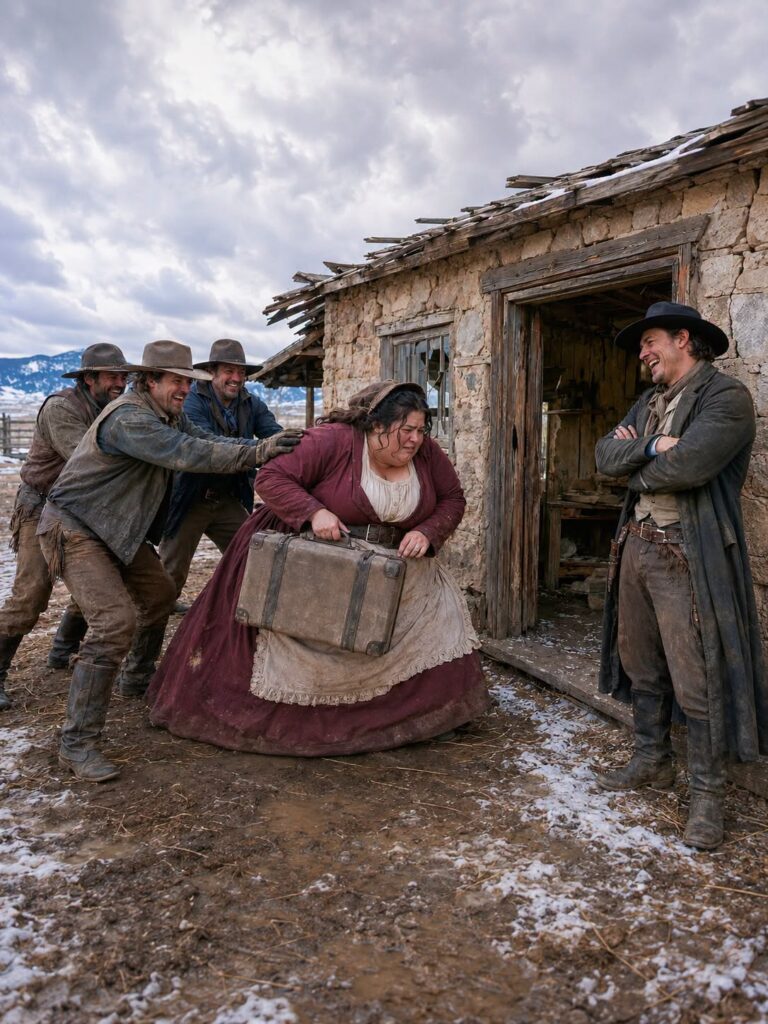
PART 2 — THE WOMAN WHO FED FIFTY MEN AND THE LIE THAT NEARLY DESTROYED HER
Levi Hawthorne set his bowl on the table.
For a long moment, he said nothing.
The fire cracked inside the old iron stove. Snow rattled against the patched roof, and fifty ranch hands stood shoulder to shoulder in the cramped stone kitchen, watching their employer stare at the woman who had kept them alive.
Dexter Hayes stood in the doorway, breathing hard, his face red with triumph.
“I told you, boss,” he said. “She’s been stealing from your stores for weeks. Flour, meat, butter, everything. That’s why the main house is running short.”
Beatrice Gallagher folded her flour-dusted hands over her apron.
“Is that so?”
Dexter jabbed a finger toward her.
“Don’t you play innocent, woman.”
Levi turned his head.
“Mr. Hayes,” he said quietly, “how much flour did you issue Mrs. Gallagher when she arrived?”
Dexter blinked.
“What?”
“The flour. How much?”
“Enough to feed the men.”
“That wasn’t my question.”
A strange stillness settled over the room.
Dexter glanced toward the ranch hands, searching for support. Nobody moved.
“Three sacks, I reckon.”
“Three?” Beatrice repeated.
She walked to a shelf beside the stove and lifted a little wooden box. Inside lay a folded square of brown paper, stained with grease and covered in neat handwriting.
“You gave me forty pounds of flour crawling with weevils, twelve pounds of salt pork that had begun to spoil, and a crate of turnips so rotten I had to throw half into the compost pit.”
Dexter laughed.
“Now she’s keeping fairy-tale accounts.”
“No,” Beatrice said. “I’m keeping yours.”
She unfolded the paper.
“October fourth. Forty pounds of flour. October eleventh. Twenty pounds of cornmeal. October eighteenth. One sack of potatoes, mostly frozen. October twenty-fifth. No delivery at all.”
Levi reached for the paper.
Beatrice handed it over.
Every entry carried a date.
Every quantity was carefully recorded.
Beside each entry, she had written how many men were fed and what she had cooked.
“Where did the rest come from?” Levi asked.
“The men brought me what they could. Samuel found wild onions along the creek before the ground froze. Thomas trapped rabbits. Old Pete taught me which roots were worth digging. I made sourdough from the flour I could save, stretched the meat with beans, and used every bone twice.”
Levi looked around the kitchen.
A dozen loaves rested beneath clean cloths.
Bundles of dried herbs hung from the rafters.
Jars of rendered fat stood in tidy rows.
Nothing was wasted.
Nothing looked stolen.
Dexter stepped forward.
“She’s lying! Martha can tell you. Martha’s been keeping the main house inventories.”
At the mention of Martha Higgins, something changed in Beatrice’s expression.
Not fear.
Recognition.
“Then perhaps,” she said, “Mr. Hawthorne ought to ask why his house manager has been signing for supplies that never reached this kitchen.”
Levi raised his eyes.
“What do you mean?”
Beatrice reached beneath her cot and pulled out a ledger wrapped in oilcloth.
“This is what arrived here. Not what was ordered. Not what was paid for. What arrived.”
Dexter’s face lost its color.
“You had no right to keep records!”
Beatrice looked straight at him.
“My father taught me something when I was twelve, Mr. Hayes. When a powerful man tells you not to write something down, that is precisely when you ought to find a pencil.”
A few ranch hands chuckled.
Levi did not.
He was studying the ledger.
On one page, written in Beatrice’s neat hand, was an entry that made his jaw tighten.
November 2 — No beef delivered. Foreman reported cattle too poor for slaughter. Four fresh beef hides discovered behind the lower barn.
Levi looked up.
“Four hides?”
Old Pete stepped forward.
“Yes, sir.”
“Where did they come from?”
Pete removed his hat.
“That’s what we’ve been wondering.”
Dexter moved toward the door.
Levi’s voice stopped him.
“Stay where you are.”
It was not loud.
It did not need to be.
For the first time that evening, Dexter Hayes looked frightened.
Then a ranch hand named Jonah spoke from the back of the room.
“Sir, there’s something else.”
Levi turned.
Jonah held his hat against his chest.
“Mr. Hayes told us you were selling off the breeding stock because the bank was taking the ranch. Said there wasn’t enough money for proper wages or feed.”
Levi went completely still.
“I sold no breeding stock.”
The words seemed to empty the air from the kitchen.
Beatrice watched Dexter carefully.
A bead of sweat rolled down the foreman’s temple despite the bitter cold.
“Then,” she said, “I think you’ve found the reason your estate has been starving.”
Dexter suddenly lunged for the ledger.
He never reached it.
Samuel, a broad-shouldered ranch hand with a scar across his chin, seized him by the collar and drove him backward against the stone wall.
“Easy,” Samuel growled. “The lady’s been feeding us while you’ve been feeding yourself.”
“Let him go,” Levi ordered.
Samuel released him.
Levi stood slowly.
He was a tall man, though exhaustion had bent him. At forty-six, silver had begun threading through his dark hair, and the last year had carved lines around his eyes that had not been there before.
He looked like a man who had lost so much that grief had become part of his posture.
But when he faced Dexter, something old and formidable returned to his bearing.
“You have until morning,” Levi said, “to bring every inventory book, cattle bill, and supply receipt to my study.”
Dexter opened his mouth.
“And if a single page is missing,” Levi continued, “I’ll send for the sheriff before you finish your breakfast.”
Dexter said nothing.
He turned and walked out into the snow.
The door slammed behind him.
For several seconds, nobody spoke.
Then Beatrice picked up Levi’s bowl.
“You’ve barely eaten.”
Levi stared at her.
“Mrs. Gallagher—”
“Sit.”
One of the men coughed to hide a laugh.
Levi Hawthorne, owner of three thousand acres, a fine stone mansion, and the finest breeding cattle in the county, sat down without argument.
Beatrice ladled more stew into his bowl.
“Whatever mess you’ve got waiting for you tomorrow,” she said, “you’ll face it better with something warm inside you.”
Levi looked at the food.
Then at her hands.
Her knuckles were cracked and scarred.
A fresh burn marked her wrist.
He had never seen a woman carry herself with such quiet certainty.
“Why did you stay?” he asked.
Beatrice hesitated.
“Because I needed the work.”
“You could have left after seeing this place.”
“Yes.”
“You could have gone to town.”
“Yes.”
“Then why?”
Beatrice glanced toward the men crowded around the tables.
“Because they were hungry.”
Levi swallowed.
Something in that simple answer hurt more than any accusation could have.
He had spent months negotiating loans, fighting creditors, and trying to keep the estate his father had built.
Meanwhile, the people depending on him had been eating scraps.
And a woman he had never bothered to meet had saved them.
He lowered his head.
“I’m sorry,” he said.
Beatrice’s expression softened.
“Then make it right.”
Outside, the blizzard swallowed the mountains.
Inside, for the first time in many months, Levi Hawthorne believed he might still have something worth saving.
But before dawn, a scream came from the main house.
Martha Higgins had been found unconscious beside the study fireplace.
The estate’s financial records were missing.
And Dexter Hayes had vanished with six of Hawthorne’s finest horses.
What nobody yet knew was that the missing horses were only part of his plan.
Because hidden beneath the abandoned kitchen, inside a stone cellar sealed decades earlier, lay something Dexter had been searching for since the day Beatrice arrived.
And when Beatrice finally broke through that cellar door, she would discover why someone had burned the kitchen down in the first place.
PART 3 — THE SECRET BENEATH THE STONE KITCHEN
The scream woke Beatrice just before sunrise.
She was sleeping in her coat, beneath two patched quilts, when the sound carried across the frozen courtyard.
By the time she reached the main house, Levi was kneeling beside Martha Higgins.
The house manager lay near the fireplace, her silver hair loosened from its severe knot.
A dark bruise marked her temple.
Levi pressed two fingers against her wrist.
“She’s alive.”
Beatrice dropped to her knees.
“Fetch clean water and blankets,” she told the nearest servant. “And send someone for the doctor.”
Levi looked up sharply.
“The roads are buried.”
“Then send your strongest rider.”
She turned Martha’s head gently, checking her breathing.
“Who found her?”
“A maid,” Levi answered. “The study door was open.”
Beatrice glanced toward the room.
Drawers hung crookedly from the desk.
Papers littered the floor.
The wall safe stood open.
“What was kept there?” she asked.
Levi’s face hardened.
“My father’s original deeds. Loan documents. Cattle contracts.”
“And the money?”
“Some. Not enough to explain this.”
Beatrice looked again at Martha.
The house manager had treated her cruelly from the moment she arrived.
Yet Beatrice found herself brushing the woman’s hair away from her face.
“Whatever she’s done,” Beatrice said, “she doesn’t deserve to die on a cold floor.”
Levi watched her in silence.
When Martha stirred, her first words were barely audible.
“Dexter…”
Levi leaned closer.
“What about Dexter?”
Her fingers seized his sleeve.
“Don’t let him… find the cellar.”
Then her eyes rolled shut.
Beatrice felt a chill that had nothing to do with winter.
“The cellar?” she whispered.
Levi frowned.
“What cellar?”
Martha gave no answer.
By midmorning, the storm had grown worse.
The main road disappeared beneath drifts taller than a horse’s chest.
The ranch hands gathered in the courtyard while Levi searched the stables.
Six horses were gone.
So were two saddlebags, a crate of ammunition, and nearly all the remaining cash from the estate office.
But Dexter had made one mistake.
He had left tracks.
They led not toward the county road, but around the back of the property.
Toward the burned-out kitchen.
Beatrice followed them with Samuel and Levi.
Snow had drifted against the stone walls.
The old kitchen stood alone beneath its patched roof, smoke rising stubbornly from its chimney.
Levi stopped beside the pantry.
“Why would he come here?”
Beatrice stared at the ground.
Near the wall, the snow had been disturbed.
Someone had scraped away ice and earth, exposing a flat slab of stone.
She knelt and brushed it clean.
An iron ring emerged.
Samuel crouched beside her.
“That’s a trapdoor.”
Levi stepped closer.
“I’ve owned this estate twenty years. I’ve never known there was a cellar here.”
Beatrice traced the ring with her fingers.
The stone around it was blackened.
Not from weather.
From fire.
“Perhaps,” she said, “someone wanted it forgotten.”
Samuel wedged an iron bar beneath the slab.
Levi helped him pull.
The stone lifted with a grinding groan.
Cold, stale air rose from the darkness.
Beneath them, narrow stairs descended into the earth.
Samuel fetched a lantern.
Levi reached for it.
But Beatrice put a hand on his arm.
“Careful. If that fire weakened the beams, the floor could collapse.”
Levi met her eyes.
“You’ve been living above this for two months.”
“And I’d prefer to live above it a good while longer.”
Despite himself, he smiled.
Then they descended.
The cellar was small, with walls of dressed stone and a low timber ceiling.
Dust coated everything.
Broken jars lay scattered beneath shelves.
At the far end stood a heavy oak chest.
Its lock had been smashed.
Levi moved toward it.
Inside were bundles of letters, ledgers, and a leather folder stamped with the Hawthorne family crest.
He opened the folder.
His expression changed.
“These are my father’s records.”
Beatrice lifted a lantern higher.
Levi began turning pages.
The first contained old cattle inventories.
The second detailed land purchases.
The third was a contract dated twenty-three years earlier.
Across the bottom were two signatures.
One belonged to Levi’s father.
The other belonged to a man named Elias Hayes.
Dexter’s father.
Levi whispered, “Good Lord.”
“What is it?”
“My father bought the north pasture from Elias Hayes. Dexter’s been claiming for years that his family was cheated.”
“Was it?”
Levi shook his head slowly.
“No. According to this, the land was paid for in full.”
He turned another page.
Then another.
His breathing grew shallow.
“There’s more.”
The ledger showed that Elias Hayes had been hired as an estate accountant after selling the land.
Over several years, he had diverted thousands of dollars through fraudulent accounts.
When Levi’s father discovered the theft, he dismissed him but chose not to prosecute because Elias had a young family.
Instead, Elias signed an agreement surrendering further claims against the estate.
Beatrice looked toward the broken chest.
“Dexter knew.”
“He must have suspected.”
“And he wanted these records destroyed.”
Levi stared at the blackened ceiling.
“The summer kitchen burned the same winter my father died.”
Beatrice understood.
“The fire wasn’t an accident.”
Before Levi could answer, Samuel called from the stairs.
“Mr. Hawthorne! Riders coming!”
They hurried upward.
Through the snow, four mounted figures approached the courtyard.
At their head rode Dexter Hayes.
Behind him were three armed men.
Dexter smiled when he saw Levi.
“Good morning, boss.”
Levi stepped forward.
“You’ve stolen my horses.”
Dexter shrugged.
“Depends who owns the land they’re standing on.”
He pulled a folded document from his coat.
“This says the north pasture belongs to the Hayes family. And unless you can prove otherwise, the sheriff will have to recognize the claim.”
Levi’s expression remained unreadable.
Dexter continued.
“Now, given your debts, I’m willing to be generous. Sign over the remaining grazing rights, and I’ll leave you the house.”
Beatrice stared at him.
“You’d take the ranch from the men who worked it?”
Dexter laughed.
“There’s the kitchen queen.”
One of the armed riders grinned.
Dexter looked her over.
“Still stuffing yourself with Hawthorne’s food?”
Beatrice felt the familiar sting.
But this time, she did not lower her eyes.
“I’ve fed fifty men from what you threw away,” she said. “And I’ve never needed to steal a thing.”
Dexter’s smile disappeared.
“Shut your mouth.”
Levi moved between them.
“You will not speak to her that way again.”
The words were quiet.
But something in them made even Samuel straighten.
Dexter glanced at the other riders.
Then he raised the document.
“Sign, Hawthorne.”
Levi reached inside his coat.
For one terrible moment, Beatrice feared he was about to surrender.
Instead, he unfolded the original land agreement.
Dexter stared.
His mouth opened.
Then closed.
“No.”
Levi held the document where everyone could see.
“Your father sold that land. He was paid in full. And he signed away every future claim.”
Dexter shook his head.
“That’s a forgery.”
“The county clerk has another copy. This one carries the original signatures.”
One of the riders shifted uneasily.
Dexter’s face twisted.
Then his hand went toward his revolver.
Samuel moved.
So did Jonah and three other ranch hands who had been watching from behind the barn.
Within seconds, Dexter found himself surrounded.
Nobody fired.
Nobody needed to.
The ranch hands had spent too many winters obeying a man who starved them.
They were finished obeying him.
Dexter looked from face to face.
“You’d turn on me for a cook?”
Old Pete stepped forward.
“No,” he said. “We’re standing with the woman who stood with us.”
The words landed harder than a fist.
Dexter slowly lifted his hands.
By noon, he and his companions were locked inside the carriage house, under guard, until the roads cleared enough to bring the sheriff.
The next three days changed Hawthorne Estate forever.
Martha Higgins regained consciousness.
With Beatrice sitting beside her bed, she confessed everything.
Dexter had blackmailed her for years.
He knew she had falsified a small number of household expenses while paying for her sick sister’s treatment.
At first, he demanded silence.
Then he demanded cooperation.
She had signed fraudulent receipts, hidden missing food deliveries, and helped conceal cattle sales.
“He told me you’d send me to prison,” she whispered to Levi.
Levi stood by the window.
“You should have told me.”
Martha began to cry.
“I know.”
Then she looked at Beatrice.
“I was cruel to you.”
Beatrice said nothing.
“I made you sleep in that ruin. I laughed when he insulted you. I knew the food was spoiled, and I let him deliver it anyway.”
Her voice broke.
“Why did you help me?”
Beatrice looked at the older woman for a long moment.
“Because a person’s worst choices shouldn’t decide whether someone brings them water when they’re hurt.”
Martha covered her face.
For the first time in years, she wept without trying to hide it.
Levi required Martha to surrender her position and give a full accounting to the sheriff. He promised no immunity, but he agreed to tell the truth about Dexter’s threats.
Dexter, meanwhile, faced accusations of theft, fraud, intimidation, and attempting to claim property through forged documents.
Most importantly, Levi recovered enough evidence to trace the missing cattle money.
It would not erase every debt.
But it would give the estate a chance.
And Beatrice intended to make sure that chance wasn’t wasted.
December arrived with a cold no one in the valley could remember.
The mountain pass closed.
The river froze solid.
Snow buried fence posts and climbed halfway up the barn doors.
The estate’s remaining supplies dwindled.
Levi stood in his study one evening with an account book open before him.
“We have enough flour for sixteen days,” he said.
Beatrice studied the figures.
“Twenty-three if we stretch it.”
“Meat?”
“Less than two weeks.”
“Feed for the cattle?”
“That’s the real trouble.”
He rubbed his forehead.
“The bank wants payment by January first.”
Beatrice pulled out a chair.
“Then we’re going to need more than stew.”
Levi almost smiled.
“What do you propose?”
She spread a hand-drawn map across the desk.
There were old apple trees on the southern slope.
A root cellar beneath the carriage house.
Dried beans in the storehouse that nobody had inventoried.
Three milk cows whose yield could be improved with better shelter.
And an abandoned smokehouse behind the creek.
Beatrice had found them all.
“You’ve been studying my property,” Levi said.
“I’ve been studying our chances.”
The word our lingered between them.
She continued before either could acknowledge it.
“We can preserve what we have, trade cured meat with the neighboring ranch, and sell baked goods in town when the road opens. But the men need steady meals, and the animals need feed before anything else.”
Levi leaned over the map.
“And how do we pay the bank?”
Beatrice hesitated.
“I have an idea.”
He looked up.
“I’m listening.”
“My mother ran a boardinghouse in Pennsylvania. During the worst winter I remember, she kept seventeen families alive by selling meals to passing freight crews. She taught me how to make a little food go a long way without making people feel poor for needing it.”
Beatrice took a breath.
“There are logging camps beyond the eastern ridge. Railroad workers down in Silver Creek. Men living on coffee and biscuits. They’d pay for proper hot food.”
“The pass is closed.”
“Then we take food as far as the lower station once a week, weather permitting.”
Levi stared at her.
“You want to turn this estate into a food business?”
“I want to turn it into an estate that earns money even when the cattle can’t.”
For the first time in months, Levi laughed.
A genuine laugh.
He leaned back in his chair.
“Mrs. Gallagher, you may be the most dangerous woman I’ve ever hired.”
Beatrice raised an eyebrow.
“Only to men who don’t listen.”
By Christmas Eve, the old stone kitchen had become the center of the ranch.
Levi had ordered the roof fully repaired.
New windows had been installed.
The floor was scrubbed clean, and the stove shone black as polished coal.
Samuel built long wooden tables.
Jonah repaired the chimney.
Old Pete carved shelves for jars and crockery.
Even the youngest stable boys took turns hauling water and splitting firewood.
But the greatest change was not in the building.
It was in the people.
Men who had once eaten in silence now laughed over supper.
They checked on one another.
They brought extra blankets to the older hands.
They worked harder because they knew someone noticed when they came home cold and tired.
And Beatrice noticed everyone.
When Thomas developed a fever, she made him broth and insisted he rest.
When Samuel received word that his wife had given birth in town, Beatrice baked him a sweet bread to carry home.
When Jonah confessed he could barely read, she spent evenings teaching him letters from old newspapers.
She never called any of it charity.
She simply called it looking after people.
On Christmas Eve, Levi entered the kitchen carrying a small velvet box.
The men fell quiet.
Beatrice was kneading bread.
“Mrs. Gallagher,” he said, “could I have a word?”
She wiped flour from her hands.
“Have you finally decided to eat breakfast before sunrise?”
A few men laughed.
Levi smiled.
“Not quite.”
He opened the box.
Inside lay a silver key.
Beatrice frowned.
“What’s that?”
“The main kitchen.”
She stared at him.
“I’ve dismissed the old household arrangements. From now on, the entire estate’s kitchens and food stores are yours to manage.”
She looked down at the key.
Then at the men.
“That’s kind of you, Mr. Hawthorne.”
“It’s not kindness. You’ve earned it.”
Beatrice’s eyes filled unexpectedly.
For most of her life, people had looked at her and seen an inconvenience.
A woman too large for delicate furniture.
Too broad for fashionable dresses.
Too plain to be admired.
She had learned to make herself useful because useful was the closest she had ever been allowed to feel worthy.
And now a man was looking at her as though she mattered.
Not despite who she was.
But because of everything she had done.
She took the key.
Then she closed the box gently.
“I’ll manage your kitchen,” she said.
Levi nodded.
“But I’m not abandoning this one.”
He looked around the warm stone room.
At the bread.
The fire.
The smiling faces.
“I wouldn’t ask you to.”
Beatrice swallowed.
“Good.”
He reached into his coat again.
“I have something else.”
This time, he produced a folded paper.
It was an official agreement making Beatrice the estate’s food operations manager, with a proper salary, authority over purchasing, and a share of profits from the new food business.
Beatrice read the terms twice.
“You’re giving me a share?”
“You built this.”
“On your land.”
“With your hands.”
The room grew quiet.
Levi stepped closer.
“And when I came home expecting to find my life ruined, you fed me before you asked me a single question.”
His voice softened.
“I haven’t forgotten.”
Beatrice looked at him.
For a moment, she could think of nothing to say.
Then old Pete shouted from the back of the room.
“Well, kiss her or let us eat! Supper’s getting cold!”
The kitchen erupted in laughter.
Beatrice turned scarlet.
Levi laughed so hard that he had to put a hand against the table.
Then, slowly, he held out his hand.
“Would you dance with me, Mrs. Gallagher?”
Beatrice glanced at her flour-covered apron.
“I haven’t danced in twenty years.”
“Neither have I.”
“I’m liable to step on your boots.”
“They’ve survived worse.”
Someone picked up a fiddle.
The first notes rose uncertainly above the crackling fire.
Beatrice placed her hand in Levi’s.
And there, in the kitchen where she had once been sent to disappear, she danced.
Not gracefully.
Not perfectly.
But freely.
For the first time in years, she did not feel the need to shrink.
The deepest winter came in January.
A blizzard trapped the estate for nine days.
Three cattle died.
Two barns lost their doors.
The bank sent a final notice before the roads closed again.
Yet the people of Hawthorne Estate survived.
They survived because Beatrice had prepared food for the worst.
Because Levi had learned to listen.
Because the ranch hands had stopped waiting for one man to solve every problem and had begun helping one another.
When spring finally broke through the mountains, the estate was battered.
But it was standing.
The food business had begun bringing in money, and the recovered cattle proceeds allowed Levi to negotiate an extension on his loans.
By April, wagonloads of Beatrice’s bread, preserves, smoked meats, and dried soup mixtures were traveling to logging camps and railroad stations throughout the county.
By June, Hawthorne Estate had paid its workers every dollar owed.
By September, Levi had repaid the most urgent bank debt.
And the old kitchen had a new sign above its door.
GALLAGHER’S TABLE — NO ONE LEAVES HUNGRY.
Beatrice stood beneath it one bright autumn morning, staring at the words.
Levi came up beside her.
“Do you approve?”
She pressed a hand against her mouth.
“You shouldn’t have.”
“Probably not,” he said. “You’ve been telling me what I shouldn’t do for nearly a year.”
She laughed.
Then grew quiet.
“Levi?”
He turned toward her.
She seldom used his first name.
“Yes?”
“When I arrived, Dexter told me I didn’t belong here.”
Levi’s expression darkened.
“He was wrong.”
“I know that now.”
She looked at the sign again.
“But for a long time, I believed men like him.”
Levi gently took her hand.
“You gave this place more than food, Beatrice. You gave it a reason to keep going.”
She turned to face him.
“And you gave me something too.”
“What?”
“A place where I wasn’t treated as though I ought to apologize for taking up space.”
His eyes softened.
The morning breeze moved through the yellow grass.
Somewhere beyond the barn, cattle lowed peacefully.
Levi reached into his coat.
When Beatrice saw the little ring box, she stopped breathing.
“Beatrice Gallagher,” he said, his voice unsteady, “I spent twenty years believing this estate was everything I had to protect.”
He opened the box.
Inside rested a simple gold ring.
“But last winter, I learned that a house without kindness is only a pile of stones. And a table without someone to share it with is only wood.”
Tears slipped down her cheeks.
Levi lowered himself onto one knee.
“I don’t need a woman to save my estate anymore. You already did that. I’m asking because I love you, and because every day I spend beside you feels like a life I never thought I’d have.”
Beatrice covered her face.
He smiled through his own tears.
“Will you marry me?”
She looked down at him.
At the man who had once arrived half frozen and hopeless.
At the man who had learned that strength did not always carry a whip or command a horse.
Sometimes strength wore a flour-dusted apron.
Sometimes it knelt beside a stranger.
Sometimes it stood in an abandoned kitchen and refused to leave.
“Yes,” she whispered.
Then louder:
“Yes, Levi Hawthorne. I will.”
The ranch hands, who had been watching shamelessly from behind the stable doors, burst into cheers.
Old Pete tossed his hat into the air.
Samuel whistled.
Jonah shouted that there had better be a wedding feast.
And Beatrice laughed until she cried.
They married in the stone kitchen on the first Sunday of October.
Not in the grand drawing room.
Not beneath the chandeliers.
Not in the church where wealthy families had once gathered to whisper about Beatrice’s appearance.
They married where it had all begun.
The tables were covered with clean white linen.
Wildflowers filled old blue jars.
Fresh bread cooled beside apple pies.
Fifty ranch hands stood with their families beneath the repaired rafters.
Martha Higgins attended quietly, having completed her cooperation with the authorities and taken work caring for her recovered sister. Before the ceremony, she approached Beatrice with trembling hands.
“I never properly apologized,” she said.
Beatrice looked at her.
“No, you didn’t.”
Martha swallowed.
“I’m sorry for what I did.”
Beatrice considered her for a moment.
Then she placed a warm roll in Martha’s hands.
“Eat something,” she said gently. “It’s going to be a long afternoon.”
Martha began to cry.
And Beatrice, who had learned that forgiveness did not mean forgetting, let her sit among the guests.
When Levi took Beatrice’s hands before the minister, he looked at the scars across her knuckles.
The scars from scrubbing the old stove.
From hauling water.
From saving everything his family had nearly lost.
He kissed them before placing the ring on her finger.
“Those hands saved my home,” he whispered.
Beatrice smiled.
“No,” she answered. “They helped us build a better one.”
Years later, people throughout the county would tell the story of the woman who came to Hawthorne Estate with one canvas bag and was given a burned-out kitchen as an insult.
They would speak of the winter she fed fifty hungry men.
Of the thief she exposed.
Of the ranch she helped save.
And of the wealthy widower who fell in love with the woman everyone else had underestimated.
But Beatrice herself rarely told the story that way.
When children asked how she became mistress of the estate, she would lead them into the old stone kitchen.
She would show them the stove.
The patched wall.
The table where Levi had eaten his first bowl of stew.
Then she would smile and say:
“People will sometimes give you the worst place in the world because they believe that’s all you deserve.”
She would set a loaf of warm bread on the table.
“But never let their cruelty decide what you can build there.”
And whenever someone asked what had become of the old kitchen, she would open the door wide.
Beyond it were the sound of laughter, the smell of supper, and a long table with room for anyone who came in hungry.
Because Beatrice Gallagher had never needed a grand house to become a queen.
She had only needed a fire that refused to go out.
THE END.


