
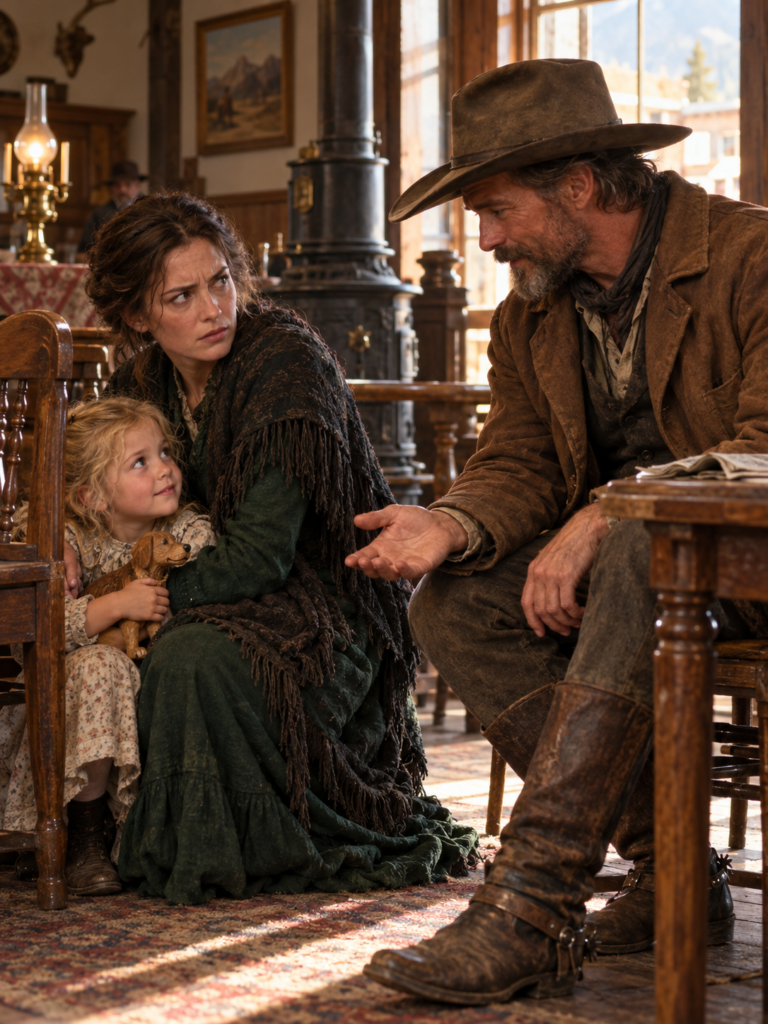
The hardware store door swung inward, and Mae found Caleb standing before a shelf of iron nails, examining two boxes with the seriousness of a man deciding the fate of a kingdom.
“Mr. Morrow.”
He turned.
His eyes went immediately to the wooden dog in her hand.
“Something wrong with it?”
“No. Quite the opposite.”
Mae approached, turning Button over in her fingers.
“You didn’t need to do this.”
“Clara named her.”
“That doesn’t mean she belongs to Clara.”
Caleb considered that.
“Seems somebody should have told Clara.”
Mae smiled despite herself.
“She’s going to carry this everywhere.”
“Then Button will see more of Wyoming than I have.”
She laughed softly.
He seemed pleased, though he tried not to show it.
For several seconds, neither spoke.
Then Mae noticed the careful smoothing along the dog’s back.
He had spent real time finishing it.
Time a working man could have used elsewhere.
“Thank you,” she said.
Caleb nodded.
“You’re welcome.”
She might have left then.
Instead, she asked whether he ever attended the church’s Saturday gatherings.
Caleb looked genuinely alarmed.
“Not regularly.”
“Children play games there. Folks visit.”
“I know what happens at a church gathering.”
“Of course.”
Mae watched him struggle with the sudden importance of a box of nails.
“Perhaps Clara will bring Button.”
He glanced up.
“Perhaps.”
She left him there.
By that evening, Caleb had bought the wrong nails and appeared beside the churchyard fence.
Clara discovered him within minutes.
“You came!”
“Looks that way.”
She proudly raised Button.
“She’s being good.”
“Glad to hear it.”
Clara studied his face, apparently satisfied, then hurried back to the other children.
Across the yard, Mae saw the exchange.
So did Ruth, the dry-goods shopkeeper.
Ruth leaned closer.
“He doesn’t usually come to these things.”
“Perhaps he likes the games.”
“Mae.”
“What?”
Ruth gave her a patient look.
Mae turned away before her cheeks betrayed her.
Later, while Caleb helped stack chairs, Clara entrusted him with Button so she could put on her coat.
He held the tiny carving in both hands.
Mae watched the gesture.
Daniel had once held Clara’s first little shoes exactly that way.
As though the size of something had no bearing on its importance.
The memory hurt.
But for the first time, it did not make her want to turn away from the man who had caused it.
On Monday, Gerald Briggs found her at the hotel desk.
“Mrs. Harding.”
“Mr. Briggs.”
“I trust you’ve considered my offer.”
“I have.”
“Then you’ve reached a sensible conclusion.”
Mae continued sorting the laundry receipts.
“I haven’t agreed to sell.”
Briggs’s smile barely shifted.
“The mortgage company will expect payment regardless of your intentions.”
“I know the date.”
“My offer would spare you considerable difficulty.”
She looked directly at him.
“At a considerable discount.”
His expression cooled.
“I’m offering you certainty, Mrs. Harding.”
“And I’m not ready to surrender my daughter’s home.”
Briggs placed his gloved hand upon the counter.
“Pride can become expensive.”
Mae held his gaze.
“So can buying the wrong piece of land.”
He withdrew his hand and left without another word.
Only after the door closed did Mae notice she was gripping the counter hard enough to hurt her fingers.
She needed a solution.
Not another argument.
Not sympathy.
Certainly not a husband chosen for his ability to pay a mortgage.
Two days later, Caleb visited the county records office.
The recorded mortgage amount confirmed what he suspected: Mae’s difficulties were serious, but the land itself had not lost its worth.
He possessed enough savings to settle the debt.
The thought troubled him.
Money offered carelessly could make a proud woman feel trapped, and he had no wish to become another man treating Mae’s property as a thing to be acquired.
An older clerk named Fletcher watched him studying the figures.
“You thinking of doing something foolish?”
“Probably.”
“Then make certain it’s useful foolishness.”
Caleb left with the figures fixed in his mind.
The following morning, Mae looked through her kitchen window and saw him beside the eastern fence, a tool in one hand.
He pressed against a leaning post.
The post shifted.
Mae put down her sewing.
She knew what Caleb was about to do.
She also knew what she could not allow.
Crossing the yard, she caught the gate and swung it open between them.
“Caleb Morrow, before you drive one nail into that fence, you’re going to tell me exactly why you’re here.”
He straightened, set down his tool, and turned toward her.
His answer was going to matter far more than either of them understood.
Caleb rested his hand on the fence post but made no move to pick up his tool.
“Your fence needs mending.”
“I can see that.”
“Figured I could mend it.”
“And what exactly do you expect in return?”
The question landed harder than Mae had intended.
Caleb looked at her for a moment.
“Nothing.”
“Men don’t usually work for nothing.”
“Sometimes they work because something needs doing.”
Mae folded her arms.
“And sometimes they do favors so a woman will feel obliged to them.”
Caleb let go of the post.
“Then I won’t touch it unless you ask.”
His answer unsettled her more than an argument would have.
She had spent eighteen months fighting to keep control of her own life.
Bank men spoke of figures.
Merchants spoke of accounts.
Briggs spoke of practical arrangements.
Every conversation seemed to end with another person deciding what would be best for her.
Caleb stood quietly beside the gate, waiting.
Finally Mae said, “You know about Briggs?”
“I know he’s trying to buy your place.”
“And?”
“And he knows what the pasture is worth.”
She glanced toward the long stretch of autumn grass.
“Most folks see a widow who can’t afford to keep it.”
“I see good grazing land.”
“You don’t know what I owe.”
“I know enough to believe selling isn’t your only choice.”
Mae stared at him.
It was the first time anyone had spoken those words to her without attaching a marriage proposal or a purchase price.
“What other choice?”
Caleb looked toward the eastern pasture.
“I know a cattleman in Cheyenne who places stock on good grass. The landholder provides grazing and care. He supplies the cattle. They divide the proceeds according to an agreement.”
Mae’s arms slowly relaxed.
“You think he’d consider my land?”
“I think he ought to.”
“And would you make that decision for him?”
“No.”
“For me?”
“Certainly not.”
She studied the man’s face, searching for the hidden condition.
“And if I tell you I don’t want your advice?”
“Then I’ll go home.”
“What about the fence?”
He glanced at the damaged post.
“That depends on whether you’ll permit me to fix it.”
Mae almost smiled.
“You’re a stubborn man.”
“I’ve heard.”
“Fix the fence.”
Caleb retrieved his tool.
“And when you’re finished,” she added, “come inside. We’ll look at those numbers.”
He raised his head.
“Coffee?”
“If you’re fortunate.”
It was the beginning of an arrangement neither had expected.
Caleb repaired the broken posts while Mae finished her washing and fed Clara.
When he came inside, Button was occupying the place of honor beside three rag dolls on the kitchen floor.
Clara looked up.
“Did you fix our fence?”
“Part of it.”
“Did Button help?”
“Not much.”
Clara looked disappointed.
“She’ll learn.”
Caleb agreed gravely.
Mae set coffee beside him and brought out her account book.
She was embarrassed by its worn cover and the careful columns recording every pound of flour, every repaired shirt, every payment received.
Then she saw how attentively he studied the pages.
No smirk.
No impatience.
No suggestion that her figures were beyond a woman’s understanding.
“Your laundry work keeps the household going,” he observed.
“Just barely.”
“But it doesn’t give you enough at once for the mortgage.”
“That’s the trouble.”
Caleb laid out a piece of paper and began explaining the proposed livestock arrangement.
He knew the grazing requirements, the expenses, and the sort of agreement his Cheyenne acquaintance had accepted before.
Mae listened closely.
Then she asked the questions that mattered.
Who would bear a loss if cattle died?
Who paid for transportation?
Who decided when the stock was sold?
Would the investor have any claim upon the land?
Caleb answered what he knew and marked what would need to be settled in writing.
He had expected questions.
He had not expected to enjoy being challenged quite so thoroughly.
When Mae noticed that one proposed expense would fall entirely upon her, she drew a line through it.
“Not unless he reduces his share.”
Caleb looked up.
“That’s fair.”
“You agree?”
“Yes.”
“You don’t have another argument?”
“Not a useful one.”
She laughed.
At some point, Clara fell asleep on a blanket beside the stove, Button tucked beneath her chin.
Mae covered her daughter and returned to the table.
Caleb had stopped speaking while she tended the child.
He waited until she was seated again.
Then he resumed the same calculation without requiring her to ask what she had missed.
It was an ordinary courtesy.
Mae felt its weight all the same.
When they finished, the figures showed a possibility.
Not certainty.
There would be work, expenses, risk, and months before a successful grazing arrangement might provide steady returns.
But if the proposed agreement included an initial advance against the use of the pasture, she might have enough to meet the immediate mortgage payment.
“What if he refuses?” Mae asked.
“Then you’ll still have the right to choose what comes next.”
She looked at him over the paper.
“You really mean that.”
“It’s your property, Mae.”
She lowered her eyes.
Daniel had said something similar when they first chose the place.
He had always spoken of their future, not merely his.
“Daniel thought this pasture was the best part of the holding,” she said quietly.
Caleb looked toward the window.
“He knew good land.”
“You remember him?”
“Not personally. I knew of him.”
Mae traced a finger along the edge of the account book.
“He would have loved seeing Clara run through those fields.”
Caleb waited.
“He wanted to build her a proper home. Something she could always return to.”
“You’ve kept it standing.”
“Some days that doesn’t feel like enough.”
“Looks like a great deal from where I sit.”
She swallowed.
For eighteen months, people had either pitied Daniel’s widow or urged her to move beyond her losses.
Caleb did neither.
He allowed Daniel to remain part of the room.
And somehow that made Caleb’s presence easier to bear.
Over the following weeks, their arrangement grew through small, practical tasks.
Caleb helped repair more of the fencing after Mae approved the work.
They inspected the eastern pasture together and decided which stretches needed attention before any cattle arrived.
Mae continued her laundry and sewing, refusing to let her household expenses become Caleb’s responsibility.
She reviewed every proposed business term herself.
When a letter needed answering, she wrote it.
When a figure seemed unreasonable, she questioned it.
Caleb gave advice where he had experience and admitted uncertainty where he did not.
He never once asked for her property as security.
Clara took a different view of the arrangement.
She believed Caleb had come because Button liked him.
Each Thursday she watched the road.
Sometimes he arrived with tools.
Sometimes with news from town.
Sometimes merely to drink coffee and talk.
Clara considered every visit equally necessary.
One Saturday, Caleb was working on the barn roof when Clara decided she needed to speak to him.
Mae had left her playing in the yard.
The child noticed the ladder.
By the time Mae heard the scrape of a shoe against wood, Clara had climbed several rungs.
“Clara!”
Mae rushed from the house.
Her daughter was already climbing higher.
Caleb turned at the sound.
For one dreadful instant, he saw the little girl close to the top, her small hands clasped around the ladder rails.
His face drained.
He did not shout.
He knew a startled child might lose her grip.
“Clara,” he said evenly.
She looked up.
“I’m coming to visit.”
“I’m glad to see you.”
“Are you?”
“Very. But I’d like you to climb down now.”
“Why?”
“Because your mama’s frightened.”
Clara considered this.
“Are you frightened?”
Caleb looked at her.
Then, without trying to protect his pride, he answered.
“Yes.”
That changed everything.
Clara examined his expression.
“All right.”
She began coming down.
Mae stood at the bottom, close enough to steady the ladder but careful not to shake it.
Every movement seemed painfully slow.
At last Clara reached the ground.
Mae caught her and held her so tightly that the child protested.
“Mama, I came down!”
“Yes,” Mae whispered. “You did.”
Above them, Caleb remained motionless for several seconds.
When he finally descended, Mae saw that his hands were trembling.
He had worked half his life around difficult cattle and frightened horses.
But the thought of Clara falling had shaken him to the bone.
“You were frightened for her,” Mae said when the little girl went inside.
Caleb looked toward the house.
“Of course.”
There was nothing grand in his answer.
Nothing rehearsed.
He simply could not imagine feeling otherwise.
That evening, Mae watched Clara settle Button beside her pillow and remembered the expression on Caleb’s face.
For the first time, she wondered whether the place he might occupy in their lives was changing.
Not because he was useful.
Not because he had money.
Not because the town approved.
Because her daughter had begun trusting him with the absolute confidence children give to people who keep returning.
And Mae was beginning to understand why.
The town noticed too.
Ruth made comments over bolts of cloth.
The minister’s wife developed an inconvenient habit of asking whether Caleb would attend each Saturday gathering.
Mae insisted there was nothing to discuss.
Nobody believed her.
Meanwhile, the most important matter remained unresolved.
The Cheyenne cattleman had not yet answered.
The mortgage deadline was approaching.
Mae continued sewing long after dark, calculating what she could earn if the agreement failed.
Caleb heard her worries without offering to purchase the debt himself.
Once, during an evening visit, he asked whether she wanted to know the amount he could lend her.
Mae looked at him sharply.
“Would that make you my creditor?”
“It would if you accepted a loan.”
“And if I couldn’t repay?”
“Then we’d have made a poor arrangement.”
She sat back.
“Don’t offer me something that would make it harder to look you in the eye.”
Caleb nodded.
“Then I won’t.”
She was quiet for a long moment.
“Does that offend you?”
“No.”
“Most men would be offended.”
“Most men aren’t sitting at your table.”
Mae had no answer.
The following week, the long-awaited letter arrived.
It bore the name of Caleb’s acquaintance in Cheyenne.
Mae carried it home without opening it.
Her hands shook too badly to manage the envelope in the street.
At the kitchen table, she unfolded the paper.
The cattleman was willing to proceed.
The grazing terms included an advance sufficient to cover the approaching mortgage installment, provided the final arrangements were completed.
Mae checked the figures.
Then she checked them again.
For months, she had imagined this moment arriving as a miracle.
Instead, it arrived as a business agreement she had examined, negotiated, and chosen.
That made it better.
She covered her mouth.
Clara came to her side.
“Another bad letter?”
Mae laughed through sudden tears.
“No, sweetheart.”
“Why are you crying?”
“Because this one is good.”
Clara climbed into her lap.
“Does that mean we keep our house?”
Mae pressed her cheek against her daughter’s hair.
“It means we have a real chance.”
They sat together until the afternoon light faded.
Then Mae wrote a note asking Caleb to visit.
He arrived after sunset.
His horse stood tied near the barn while the two adults sat on the porch with their coffee.
Inside, Clara was supposed to be asleep.
Both knew she was probably watching from the window.
Mae told Caleb the agreement had been accepted.
He smiled.
“You’ve done well.”
“We’ve done well.”
“You made the decisions.”
“You showed me another way.”
“And you took it.”
Mae looked toward the dark eastern pasture.
“There is something I need to say.”
Caleb waited.
“Clara had a father.”
“I know.”
“A good one. Daniel loved her dearly.”
“I believe you.”
“And I won’t have her made to feel that loving someone new means she must love him less.”
Caleb’s expression changed.
He set his coffee down.
“I would never ask her that.”
Mae searched his face.
“Even if she starts thinking of you as family?”
“Especially then.”
A small movement disturbed the curtain behind them.
Clara was listening.
Mae saw it.
Caleb did too.
For a while, neither spoke.
Then Mae turned fully toward him.
Her voice was hardly louder than the wind across the porch.
“Caleb, there’s something that frightens me more than losing the land now.”
He did not move.
Mae looked toward the window where her daughter’s little face had disappeared.
“I think Clara has already chosen you to be her father.”
Caleb went utterly still.
Then he looked at Mae and quietly asked the question she had not yet found the courage to answer.
“And what have you chosen?”
Mae’s fingers tightened around her coffee cup.
Caleb had asked his question without accusation, without urgency, and without the smallest suggestion that Clara’s affection gave him a claim upon her mother.
That somehow made answering more difficult.
She looked toward the yard where his horse stood under the fading light.
“I haven’t quite caught up with Clara,” she admitted.
Caleb lowered his eyes.
For a moment she feared she had hurt him.
Then he gave a quiet laugh.
“That sounds like Clara.”
“She usually gets where she’s going before anybody else realizes she’s started.”
“She certainly found my chair that way.”
Mae smiled.
The memory returned with astonishing clarity.
The little girl.
The wooden dog.
The awkward cattleman holding his newspaper as though it could protect him from a determined four-year-old.
Six weeks earlier, Mae had entered the hotel afraid her daughter was missing.
Now she sat beside the man Clara had found and wondered when she herself had begun hoping he would stay.
“I know something about you,” Mae said.
“That sounds dangerous.”
“You’re careful.”
“Not always.”
“With us, you are.”
Caleb leaned back in his chair.
“I don’t want to make a mistake that costs either of you something important.”
Mae watched the light catch the side of his face.
“What do you want, Caleb?”
He remained quiet long enough that she thought he might not answer.
Then he looked directly at her.
“I’d like to keep coming here.”
“You already do.”
“I’d like to know I’m welcome.”
“You are.”
“And if, in time, you find you’d rather I came for something besides fence repairs, I’d like to know that too.”
Mae felt warmth spread across her cheeks.
“That’s a modest request.”
“Seems plenty ambitious from where I’m sitting.”
She laughed.
Inside the house, a small shadow moved behind the curtain again.
Mae shook her head.
“She’s been listening to every word.”
“Most likely.”
“She’ll have opinions.”
“She’s never been short of those.”
Mae folded her hands.
“Come tomorrow.”
Caleb studied her.
“Are you certain?”
“I am.”
His face changed in a way she wanted to remember.
Not triumph.
Relief.
As though the simple permission to return had become something he valued beyond any reward he might have demanded.
He reached for his coffee.
Mae added, “Clara has also renamed your horse.”
He stopped.
“My horse has a name.”
“Not according to her.”
“Buck has been Buck for years.”
“Apparently he’s Gerald now.”
Caleb stared at her.
“Gerald?”
“She says it suits him.”
“That’s also the name of the butter churn.”
“I know.”
“Why does she keep naming things Gerald?”
Mae began laughing.
“I haven’t been able to get an explanation.”
Caleb looked toward the barn, where Buck stood quietly, entirely unaware that his identity had been altered.
“I’m not calling my horse Gerald.”
“Then you’ll have to explain it to Clara.”
He considered that.
“I may have to live with it.”
Mae laughed harder.
He watched her with a strange, tender expression.
She had spent so much time holding herself upright beneath grief and responsibility that laughter had become something she rationed.
Caleb had never asked her to be cheerful.
He had simply helped make joy possible again.
That night, after he rode home, Mae remained on the porch.
She thought of Daniel.
Not as a distant memory, but as the young man who had once stood on that very ground and talked eagerly of grazing cattle in the eastern field.
She remembered his hands, his laugh, the way he had lifted Clara when she was still small enough to fit against his chest.
She did not want those memories to fade.
And she began to realize that loving Caleb would not require it.
Daniel’s death had ended their shared life.
It had not canceled the love that had existed within it.
Perhaps a new life could grow beside that truth rather than over it.
The following Monday, Gerald Briggs arrived.
Mae saw him riding toward the house and knew exactly why he had come.
Caleb’s horse was tied beside the barn.
The sight did not escape Briggs.
Mae met her neighbor on the porch before he could knock.
“Good morning, Mr. Briggs.”
“Mrs. Harding.”
He removed his hat.
“I understand there have been developments concerning your mortgage.”
“There have.”
“And you’re considering entering the cattle business.”
“I’m arranging to use my pasture for grazing.”
Briggs glanced toward the barn.
“With Morrow’s help?”
“He’s advised me.”
“Running livestock requires experience.”
“I know.”
“Experience your husband possessed, perhaps, but that you’ve had limited opportunity to acquire.”
Mae felt the familiar sting.
Then she remembered the hours spent studying costs and pasture capacity, the careful negotiations, the figures she had checked herself.
“I’ve learned quite a bit.”
Briggs regarded her.
“My offer remains available.”
“I’m grateful you’ve made it clear.”
“Then perhaps you’ll reconsider.”
“No.”
He looked surprised.
“Mrs. Harding, you’re taking considerable risk.”
“Yes.”
“Cattle prices can fall.”
“I know.”
“An agreement with a man in Cheyenne isn’t the same as money in hand.”
“The terms have been settled. The payment arrangements are proceeding.”
Briggs’s mouth tightened.
“You believe this solves everything?”
“No. I believe it gives me a way forward.”
He followed her gaze toward the eastern pasture.
“That land would fit my holding very well.”
“I expect it would.”
For the first time, Mae allowed herself to say what she had known for months.
“It’s why you’ve been so eager to buy it below its worth.”
Briggs looked at her sharply.
“I made an offer in good faith.”
“You made an offer you believed I might be desperate enough to accept.”
He said nothing.
Mae’s voice remained steady.
“I’m not selling.”
Behind the barn, Caleb continued working.
He had heard voices, but he did not come to stand over her shoulder.
Mae was grateful.
Briggs looked past her again.
“Has Morrow put you up to this?”
“No.”
“Then what’s changed?”
Mae glanced at the house Daniel had bought, the pasture he had loved, and the place where Clara played beneath the autumn sky.
“I found another choice.”
Something in her tone told Briggs that the matter was finished.
He replaced his hat.
“If circumstances alter, you know where to find me.”
“They won’t alter my answer.”
He rode away.
Mae stood on the porch until his horse disappeared down the road.
Only then did she sit.
Her knees were shaking.
Not because she regretted what she had said.
Because she had spent so long fearing that very conversation.
A few minutes later, Caleb approached from the barn.
“He gone?”
“Yes.”
“You all right?”
Mae considered the question.
Then she nodded.
“I think I am.”
Caleb sat on the porch step, leaving the chair beside her empty.
He did not ask what Briggs had said.
Mae told him anyway.
Every word.
When she reached her final refusal, Caleb smiled.
“Good.”
“You don’t think I was too harsh?”
“No.”
“You aren’t going to tell me what I ought to have said?”
“Sounds as though you said it plainly enough.”
Mae leaned back.
“Caleb?”
“Yes?”
“I used to think being strong meant never needing anybody.”
He looked at her.
“Daniel and I were supposed to do everything together. When he died, I thought the only way to prove I could keep his place was to manage without help.”
“And now?”
“Now I think there is a difference between receiving help and surrendering your life.”
Caleb considered that.
“A considerable difference.”
“I want you to remember it.”
“I will.”
She looked toward the empty chair.
“Would you sit beside me?”
He rose from the step.
“Gladly.”
It was the first time she had asked him to sit there without the shelter of account books, contracts, or repairs.
He understood.
And he did not spoil it by saying so.
As autumn moved toward winter, the arrangements with the Cheyenne cattleman proceeded.
The promised advance was applied to the mortgage payment.
Mae kept copies of the terms with her household accounts.
The remaining debt and the work ahead still required care, but the immediate threat of losing the property had receded.
Her next task was to make the grazing arrangement succeed.
Caleb helped her plan for the stock, inspect the fencing, and prepare the holding for the coming season.
He explained what he knew.
She questioned what she needed to understand.
When she disagreed, he listened.
When he was right, she admitted it.
Neither confused partnership with obedience.
The work brought them closer in ways neither had expected.
Mae knew how to mend worn clothes so carefully that a hired hand could scarcely find the repaired seam.
Caleb knew how to recognize a weakness in a fence before cattle discovered it.
She could make a limited supply of household money last through a difficult month.
He could judge the condition of a pasture with a single thoughtful ride.
Their knowledge was different.
Together, it became useful.
Sometimes they spent an evening reviewing plans.
Other times Caleb arrived after supper and did nothing more important than listen while Mae described her day.
Those became her favorite visits.
It was no longer a matter of how much work he could accomplish.
She simply wanted him there.
Clara found the entire development satisfactory.
She had long since decided that Caleb belonged in her world.
Every time he visited, she brought Button.
She told him where the wooden dog had traveled, what she had eaten, and whether she had behaved well.
Her accounts of the final matter were rarely reliable.
Caleb listened as though she were delivering important news.
Once, when she complained that Button could not stay warm in the winter, he carved a small piece of thin wood for the dog’s covering.
Clara informed him that blankets were supposed to be soft.
He admitted the flaw in his design.
She accepted it anyway.
By December, the fence lines were edged with snow, and the Harding home had acquired a new rhythm.
Caleb still kept his own place.
Mae still kept hers.
He did not appear at the house without consideration for her work or her wishes.
He came to supper on certain evenings.
He helped with cattle matters when there was work to be done.
And occasionally he came because Mae had asked him to.
No other reason was necessary.
One evening, Clara fell asleep beside the stove while Mae and Caleb drank coffee.
The little wooden dog lay beneath her hand.
Mae watched her daughter for a while.
“She’s happy.”
Caleb followed her gaze.
“She seems to be.”
“Do you know why she trusts you?”
He looked genuinely uncertain.
“Button, I expect.”
Mae smiled.
“That might have been the beginning.”
“What’s the rest?”
“You listen.”
Caleb said nothing.
“You never make fun of what matters to her. You never promise something you don’t mean. And when you tell her you’ll return, you do.”
He looked down at his hands.
“Those don’t sound like difficult things.”
“They can be.”
Mae remembered the ladder, the trembling in his fingers after Clara reached the ground, and the way he had admitted his fear instead of hiding it.
“She’s learned she can count on you.”
Caleb gazed at the sleeping child.
“I hope she always can.”
Mae put her hand on his.
He turned toward her.
For a long moment, neither spoke.
Then Caleb covered her hand gently with his own.
It was the first time they had allowed that simple closeness to linger.
Mae felt no guilt.
Only warmth.
Only the quiet astonishment of discovering that a heart could remember one love and still make room for another.
Weeks passed.
Caleb learned that Clara liked the crust of fresh bread better than the soft center.
Mae learned that he sometimes grew thoughtful before speaking because he worried about saying too much, not because he had nothing to say.
He learned how carefully she guarded Daniel’s belongings.
She learned that Caleb’s own years of solitary work had made him accustomed to a house in which nothing moved unless he moved it.
He had not been hiding from a terrible secret.
He had simply allowed a solitary way of living to become easier than risking the complications of loving other people.
Now those complications had names.
Mae.
Clara.
Even Button.
He found himself looking forward to every one of them.
One Thursday in December, Caleb arrived earlier than usual.
Clara met him at the gate.
He was carrying no tools.
That alone caught Mae’s attention.
She stood on the porch, watching him remove his hat.
Clara looked between the adults with an expression of almost unbearable importance.
Mae knew that expression.
“What have you two been discussing?” she asked.
“Nothing,” Clara answered much too quickly.
Caleb looked at the fence.
Mae smiled.
“Caleb, you’re doing it again.”
“Doing what?”
“Looking at the fence because you don’t know how to begin.”
He looked at her in astonishment.
“Who told you that?”
“Your little accomplice.”
Clara immediately became fascinated by Button.
Mae stepped down from the porch.
“Whatever it is, you may as well say it.”
Caleb took a breath.
He had faced injured cattle, long drives, dangerous crossings, and more than one animal determined to break his bones.
None of those moments had required quite this much courage.
“Mae, I would like to marry you.”
No flourish.
No speech prepared to impress the town.
Just the truth.
“If that’s what you want too.”
Mae felt her heart turn painfully in her chest.
For a moment, she saw Daniel as he had been when they first stood on this land together.
She remembered the life they had hoped to share and the years illness had taken away.
Then she looked at Caleb.
The man who had never tried to buy her gratitude.
The man who had helped her preserve her independence.
The man who had walked into Clara’s life without demanding the name of father.
The man who had waited until Mae could see him clearly.
“What about Clara?” she asked.
Caleb answered without hesitation.
“I’ll never demand she call me Papa.”
Mae nodded.
“And Daniel?”
“His picture stays wherever you want it.”
She swallowed.
“He was her father.”
“He always will be.”
“She needs to remember him.”
“Then we’ll help her remember.”
Caleb’s voice grew softer.
“I don’t want to take anything away from the life you’ve already had, Mae. I’d like to share whatever life you choose next.”
Tears gathered in her eyes.
He continued.
“The land is yours. I’d never expect you to give it up. We can settle where we live and how we manage things together, and we can make certain it’s done fairly.”
Mae took a shaky breath.
“And you would truly be content if Clara never called you anything but Caleb?”
From behind the water barrel came an indignant voice.
“I won’t!”
Both adults turned.
Clara stepped into view with Button tucked beneath her arm.
Mae put a hand over her mouth.
“Clara Harding! Have you been listening?”
The child ignored the question.
“Well?”
Caleb stared at her.
“Well, what?”
“Is Mama saying yes?”
Mae laughed through her tears.
“Your mama hasn’t had the opportunity.”
Clara frowned.
“She’s had lots of time.”
Caleb bowed his head to hide a smile.
Mae looked at him.
He was waiting.
Still leaving the choice entirely hers.
She thought of that first afternoon in the hotel.
Of the way he had surrendered his wooden carving to a child without understanding what it would cost him.
Of how he had come to the church gathering and stood awkwardly by the fence because Clara had wanted to show him Button.
Of the day he offered to examine the cattle figures instead of simply paying the mortgage.
Of the ladder.
Of the porch.
Of Daniel’s name spoken without discomfort.
And of every time Caleb had come back.
“Yes,” Mae whispered.
Caleb lifted his head.
She smiled.
“Yes, Caleb. I’d like to marry you.”
His face opened into the broadest smile she had ever seen.
Clara shrieked with delight.
Then she ran between them and thrust Button into Caleb’s hands.
“You hold her!”
Caleb accepted the wooden dog with both hands.
Mae watched him.
Once again, he held that small thing as though it mattered enormously.
She leaned closer.
“I told you,” she whispered.
“Told me what?”
“That Clara had chosen her father before I knew what I wanted.”
Caleb looked at the little girl, who was now examining Mae’s hand for a ring that had not yet been given.
Then he looked back at Mae.
“And you?”
She smiled through tears.
“I finally caught up.”
They were married the following April, when winter loosened its hold on Wyoming and wildflowers began appearing along the edges of the eastern pasture.
The ceremony took place on a Saturday.
Clara appointed herself flower girl and treated the responsibility with tremendous seriousness.
She supervised the gathering of blossoms.
She corrected where people stood.
She informed Ruth that some flowers were better than others.
And on the morning of the wedding, she insisted that Button accompany her.
Mae stood in her wedding dress, looking through the window at the land Daniel had chosen.
For a brief moment, grief brushed against her happiness.
Not to forbid it.
Only to remind her where her life had begun.
She touched the small picture of Daniel that remained among their treasured belongings.
“You would love how happy she is,” she whispered.
Then she went to meet Caleb.
At the church, Clara carried a little basket of wildflowers in one hand and Button beneath her other arm.
She walked down the aisle as though entrusted with the most important business in the territory.
At the front, she stopped beside Caleb.
He offered her his hand.
She took it.
And there she remained while Mae came forward.
The minister spoke.
Caleb made his vows.
Mae made hers.
Nobody asked Clara to decide between the father she remembered and the man now standing beside her.
That choice had never been required.
Afterward, Caleb lifted Clara onto his shoulders.
She looked across the churchyard with amazement.
“I’m taller!”
“You are,” Caleb agreed.
“Is this what being tall feels like?”
“More or less.”
Clara considered the world from her new height.
“I like it.”
Caleb laughed.
Across the yard, Mae stood speaking with Ruth.
When she turned, she saw him with her daughter sitting proudly on his shoulders.
Their eyes met.
There was no mortgage deadline hanging over her head that afternoon.
No unwanted offer from Briggs.
No need to calculate whether her husband’s home would be lost.
The cattle arrangement still required work, and the land would never take care of itself.
But the house was hers to keep.
The future was hers to help shape.
And the man she loved had chosen to build that future beside her, not in her place.
Their married life did not turn every difficulty into an easy one.
Fences still needed mending.
Bills still required careful attention.
Livestock required work regardless of the weather.
Mae continued to manage the household accounts and the matters connected to the Harding land.
Caleb brought his years of cattle experience to their shared decisions.
They argued occasionally about expenses, repairs, and the proper way to accomplish a stubborn task.
Sometimes Mae was right.
Sometimes Caleb was.
More often, the answer improved because both had spoken.
And in a house that had once echoed with the absence of one beloved man, there was now room for laughter again.
Daniel was never erased.
His photograph remained.
Clara heard stories of him as she grew.
Mae spoke his name without fearing that Caleb would feel diminished.
Caleb listened and sometimes asked questions, wanting to know the man whose love had helped shape the family he had joined.
He understood something the town occasionally failed to appreciate.
Clara did not need to stop being Daniel Harding’s daughter to love Caleb Morrow.
She could carry both truths.
As the years passed, Button remained on a shelf in their home.
The wood darkened.
One ear broke.
Clara refused to let Caleb repair it.
“She’s old,” Clara explained.
“So am I,” Caleb answered.
“You aren’t on a shelf.”
“Not yet.”
They laughed, as they often did.
Years later, Clara could no longer recall precisely where Caleb had been sitting that September afternoon.
She had forgotten the newspaper, the hotel sounds, and the drink he hardly touched.
But she remembered Button.
She remembered that he listened.
And she remembered that when he said he would return, he did.
Whenever somebody asked Caleb how he had met his wife, he liked to tell the story differently from everybody else.
“I didn’t meet her first,” he would say.
Then he would point toward Clara.
“She arranged it.”
Mae never corrected him.
Because in a way, it was true.
A little girl had opened the door.
A grieving widow had decided whether to walk through it.
And a cattleman who once valued his quiet afternoons above almost everything else had learned that the finest part of his life was waiting at home.
There had always been enough room in that house for Daniel’s memory.
There had been enough room for Mae to remain herself.
Enough room for Clara to love two fathers.
And enough room for Caleb to become part of a family without taking another man’s place.
The little wooden dog had not predicted their future.
It had simply been the first gift in a long succession of ordinary, freely offered kindnesses.
And every time Mae looked at Button on the shelf, she remembered the moment it all began.
A crowded Wyoming hotel.
A frightened mother.
A little girl hiding behind a stranger’s chair.
And a quiet man who gave a child something he had made with his own hands, never imagining she would one day lead him home.


