
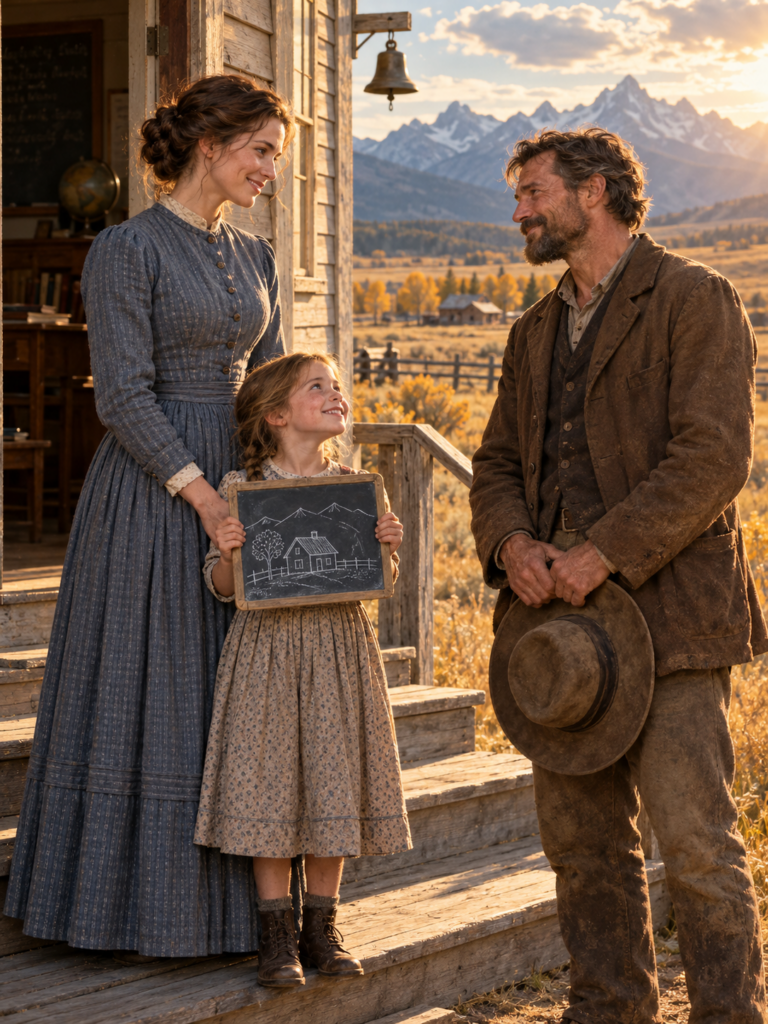
The chalk dust spread beneath Charlotte’s thumb, revealing the unmistakable outline of a woman standing beside the farmhouse fence.
She held the slate nearer the window.
The woman wore a long skirt, and Emily had drawn something that might have been a book in her hand.
Charlotte recognized herself.
For several seconds, she did nothing.
Then she set the slate on her desk.
Emily was a child who had lost her mother. It would be unkind to pretend a cheerful drawing meant more than it did.
And yet Charlotte could not forget Benjamin’s startled smile.
Outside, the schoolyard emptied beneath the lowering autumn sun.
The following Monday, Emily arrived before the bell.
“Did you see my picture?”
“I did.”
“Did you like the house?”
“Very much.”
Emily studied her teacher.
“Did you see the lady?”
Charlotte crouched beside her.
“Yes.”
“She’s visiting.”
The answer brought unexpected relief.
“That’s a lovely idea.”
Emily hesitated.
“Pa doesn’t have many visitors anymore.”
Charlotte rested a hand on the desk.
“Your father works very hard.”
“He used to sing while he worked. Before Mama got sick.”
There was no accusation in the child’s voice. Only memory.
Charlotte chose her answer carefully.
“People sometimes need a long while before singing feels natural again.”
Emily thought about that.
“Maybe he could start with humming.”
Charlotte nearly laughed.
Instead, she gave the girl her arithmetic lesson.
By the end of September, their friendship had begun to travel between the schoolhouse and the Carter farm in the form of books.
Charlotte lent Emily readers beyond the standard lessons.
Occasionally she enclosed a volume she believed Benjamin might enjoy.
He returned each book promptly, often with a brief note expressing his thanks.
One mentioned a railroad journey his father had taken years earlier.
Another disputed a mapmaker’s description of a western pass.
Charlotte smiled over that one.
The quiet farmer was capable of considerable stubbornness on paper.
He was also thoughtful enough to repair the loose schoolhouse step without making a public occasion of it.
Charlotte discovered him working there one afternoon while the children played nearby.
“Does the school board know you’ve appointed yourself our carpenter?”
“No, ma’am.”
“They might object to unauthorized improvements.”
“Then I’d better finish before they hear.”
She laughed.
Benjamin glanced up, pleased with himself.
But the moment was interrupted by the arrival of Wallace Cobb.
Wallace stepped down from his buggy carrying flowers.
“Miss Bennett. My mother thought these might brighten your rooms.”
“They’re very kind.”
He noticed Benjamin’s hammer.
“Carter. Still keeping busy, I see.”
“Always something needs fixing.”
Wallace smiled without warmth.
“Indeed. Some things more than others.”
Charlotte heard the slight in his voice.
She took the flowers but made no move to invite him inside.
“Thank your mother for me, Mr. Cobb.”
Wallace’s gaze moved between them.
“My father says your farm note comes up for renewal in the spring, Carter.”
Benjamin stood slowly.
“That’s a matter for the bank.”
“Naturally. Though a man should be careful about taking on obligations he can’t afford.”
Charlotte looked directly at Wallace.
“Mr. Carter is repairing a step that children use every day. I should think that obligation has been well judged.”
For a moment, Wallace seemed uncertain how to answer.
Then he tipped his hat and departed.
Benjamin picked up his hammer.
“You needn’t have spoken for me.”
“I wasn’t speaking for you.”
“No?”
“I was speaking for the children whose step you’re repairing.”
He studied her, then nodded.
“Fair enough.”
That small exchange remained with Charlotte long after he finished his work.
It also remained with Benjamin.
Because Wallace’s mention of the mortgage had not been casual.
The Cobbs knew exactly how much Benjamin owed.
They knew how desperately he needed another decent harvest.
And Wallace had made it plain that his interest in Charlotte was becoming entangled with his opinion of Benjamin’s prospects.
Two days later, Benjamin stopped coming to the schoolhouse.
Emily carried the books herself.
A week passed.
Then another.
Charlotte told herself she had no reason to be disappointed.
She had come west for work, not courtship.
Yet every afternoon she found herself glancing toward the road.
One Friday, Emily approached her desk with a folded primer.
“Pa says thank you.”
“You’re welcome.”
“He says he’s busy.”
“Farmers often are.”
Emily narrowed her eyes.
“He wasn’t this busy before Mr. Cobb talked to him.”
Charlotte’s hand stopped on the book.
“What did Mr. Cobb say?”
“I don’t know. But Pa came home quiet.”
Charlotte looked through the open schoolhouse doorway at the empty road.
She could allow Benjamin to withdraw.
Perhaps she ought to.
But she would not allow a banker’s son to decide what either of them was permitted to feel.
She closed the primer, placed it in Emily’s hands, and reached for her own coat.
“Tell your father something for me,” she said.
Emily’s eyes widened.
“Tell him I would rather hear an unwelcome truth than be protected by silence.”
Emily nodded solemnly.
Then, before Charlotte could reconsider, the girl hurried out through the schoolhouse door.
Emily hurried down the schoolhouse steps with the primer pressed against her chest, already rehearsing the message she intended to deliver.
She repeated the words twice on the walk home.
By the time she reached the Carter farm, she had decided they sounded exactly like something important adults ought to say to one another.
Benjamin was beside the barn, examining a worn length of harness.
“Pa!”
He looked up.
“You’re home early.”
“Miss Bennett gave me a message.”
Benjamin’s fingers stopped working.
“About school?”
“About telling the truth.”
He watched his daughter carefully.
Emily stood straighter.
“She said she’d rather hear an unwelcome truth than be protected by silence.”
Benjamin lowered the harness.
“Those were her words?”
“Yes, sir.”
“And what did you say?”
“I said I’d tell you.”
He rubbed a hand across his jaw.
Emily waited.
“Did I do something wrong?” she asked.
“No, sweetheart.”
“Did Miss Bennett?”
“Not a thing.”
“Then why doesn’t anybody look happy?”
That question followed Benjamin through the evening.
It followed him while he fed the animals, washed the supper dishes, and helped Emily finish her arithmetic.
It followed him after she went to bed.
Finally, he opened the little drawer beneath his writing table.
Inside were the notes Charlotte had sent with the borrowed books.
He read the last one.
It concerned a chapter she thought he would enjoy about the expansion of the western railroad.
Beneath the recommendation, she had added a simple sentence.
She hoped he would tell her whether the author had described the country fairly.
Benjamin had never answered.
Not because he lacked an opinion.
Because answering would mean beginning another conversation.
And he had frightened himself with how badly he wanted one.
The next morning, he went to the schoolhouse before classes began.
Charlotte was arranging lessons when he appeared at the open door.
“Good morning, Miss Bennett.”
She looked up.
“Mr. Carter.”
“I received your message.”
“I hoped you would.”
Benjamin stepped inside, leaving the door open to the schoolyard.
For a moment, neither spoke.
Then he said, “I owe you an explanation.”
Charlotte set down her chalk.
“Please.”
He looked toward the children’s desks.
“Wallace Cobb spoke to me about the bank note.”
“I heard part of it.”
“There’s more to it than what he said here. His father holds the mortgage on my place. The winter before last took most of what I had in reserve. I’ve kept up the payments, but renewal comes in spring.”
“And you thought that meant you should avoid me?”
“I thought it meant I had no business asking anything of you.”
Charlotte folded her hands.
“Have I asked you to manage my decisions?”
“No.”
“Then why have you taken that responsibility upon yourself?”
The question landed harder than accusation would have.
Benjamin turned his hat slowly.
“I have a daughter. A farm that needs every dollar it earns. A grave I visit every Sunday.”
Charlotte’s expression softened, but she did not interrupt.
“You have your position,” he continued. “You’re young. You ought to have the opportunity to choose a life without worrying over the debts and grief of a man who’s already lived through more than he wanted.”
“And what if I have already seen what a comfortable life can cost?”
Benjamin looked up.
Charlotte took a measured breath.
“I was engaged once, back in Ohio.”
He had not known that.
“My family’s business failed. My father was ill, and the gentleman I expected to marry had relatives willing to settle what we owed.”
Benjamin said nothing.
“At first, I thought they were generous. Then I began to understand that I was becoming part of the bargain.”
She walked toward the classroom window.
“His mother discussed my future as though she were reviewing an account book. Where I would live. Whom I should visit. What I ought to be grateful for.”
“Did he know?”
“Yes.”
“Did he object?”
“No.”
Charlotte turned.
“So I ended the engagement, took my certificate, and came west.”
Benjamin’s gaze remained on her.
“That couldn’t have been easy.”
“It wasn’t. But I would do it again.”
Outside, the wind stirred dry leaves against the steps.
“I do not intend to exchange one comfortable arrangement for another,” Charlotte said. “And I will not surrender my freedom because someone thinks he knows what is best for me.”
Benjamin nodded slowly.
“I understand.”
“Do you?”
“I think I’m beginning to.”
She looked at him for a long moment.
“Your daughter loves you. Your neighbors respect you. And I have come to admire a man who seems to do the right thing even when no one is watching.”
Benjamin swallowed.
“Charlotte…”
It was the first time he had called her by her given name.
She noticed.
So did he.
“I don’t know what I can offer,” he admitted.
“The truth would be a beginning.”
He let out a breath.
“Then the truth is that I’ve missed talking with you.”
Charlotte smiled.
“And I’ve missed your arguments with the railroad books.”
He laughed.
It was an awkward, startled sound.
But it was real.
Then a small voice came from outside.
“Are you finished being serious?”
Emily stood at the window, pretending to examine a horse tied near the fence.
Benjamin closed his eyes.
Charlotte pressed her lips together to keep from laughing.
“Emily Carter,” her father said, “how much of that did you hear?”
“Not all of it.”
“Emily.”
“Most.”
Benjamin shook his head.
Charlotte stepped toward the door.
“You may come inside, Emily. Classes will begin shortly.”
The girl entered wearing an expression of extreme innocence.
And for the first time in weeks, the three of them shared an easy smile.
But happiness in Willow Creek did not make the weather kinder.
Nor did it make the bank note disappear.
Over the following days, Charlotte and Benjamin resumed their careful acquaintance.
She continued lending books.
He continued helping with schoolhouse repairs when his farm work permitted.
They spoke in daylight, with doors open and other townspeople nearby, conscious that Charlotte’s employment depended upon more than her ability to teach.
One afternoon, Benjamin brought a repaired wooden shelf to replace one that had begun sagging beneath the classroom readers.
Charlotte helped him measure the wall.
“You’ve made it sturdier than the original,” she observed.
“I’ve seen how many books you keep piling on it.”
“Children need books.”
“Apparently enough to bring down a building.”
She looked at him.
He smiled.
The moment was small.
Yet Charlotte began to understand that affection need not announce itself through costly gifts or elaborate speeches.
Sometimes it arrived carrying a shelf that would keep twenty children from having their lessons scattered across the floor.
Benjamin, meanwhile, discovered that Charlotte was not merely gentle with Emily.
She was firm.
When the girl neglected an assignment because she had been helping her father with chores, Charlotte praised her sense of duty but insisted she complete the work.
“Your father needs your help,” she told Emily, “but your education matters too.”
Benjamin heard about the conversation that evening.
Instead of objecting, he rearranged their morning chores.
Emily was delighted.
Her father was quietly impressed.
Neither adult spoke of marriage.
Neither promised a future.
But they had begun making room for one another in the ordinary business of their days.
Then November arrived.
And Emily Carter decided patience had become a tiresome occupation.
One Thursday, she informed her father that Miss Bennett needed him to collect a special book too important for a child’s satchel.
She told Charlotte that Benjamin had a question about the schoolhouse roof.
Both messages were inventions.
Both adults arrived expecting entirely different conversations.
Emily disappeared into the schoolyard, where she occupied herself beside the horses while keeping a close watch on the open classroom doorway.
Charlotte met Benjamin between the desks.
“I don’t have a book for you.”
Benjamin frowned.
“I don’t have a question about the roof.”
They stared at one another.
Then understanding dawned.
Benjamin laughed.
“She’s done this deliberately.”
“I’m beginning to suspect so.”
Through the window, Emily abruptly became fascinated by a fence post.
Charlotte’s smile faded into something more thoughtful.
“Perhaps she’s tired of watching us behave like strangers.”
Benjamin turned his hat in his hands.
“I haven’t meant to hurt you.”
“I know.”
“I’ve been afraid.”
“Of the bank?”
“Partly.”
“Of Emily needing someone?”
“More than that.”
He hesitated.
“Of letting myself believe there might be something good ahead and discovering I was wrong.”
Charlotte looked at him with unexpected tenderness.
“Nothing worth having comes with a promise against sorrow.”
“I know that better than most.”
“Then perhaps you also know why we must not spend every day avoiding happiness.”
For a moment he looked as though he might reach for her hand.
He did not.
Instead, he asked, “Would you permit me to court you properly, Charlotte? Without interfering with your work, and without pretending I have more to offer than I do?”
She considered the question carefully.
“I would like us to get to know one another without rushing to promises.”
“I can do that.”
“And if we disagree?”
“Then I suppose we’ll have to talk.”
Her smile returned.
“That would be a welcome change from silence.”
Outside, Emily leaned so far toward the window that her shadow fell across the floor.
Benjamin cleared his throat.
“Should we tell her?”
“Not yet.”
“Why not?”
“Because she would have the entire county informed before supper.”
Benjamin laughed again.
Neither of them knew that in three days, the weather would make all their caution seem terribly small.
The storm began with falling temperatures and a hard wind descending from the Bitterroot Mountains.
By midafternoon, snow swept across the road in thick, blinding sheets.
Most of Charlotte’s pupils had already gone home.
Emily remained.
Her father had not arrived.
Charlotte stood at the schoolhouse doorway, trying to judge how much of the road remained visible.
The answer grew worse by the minute.
She closed the door against the wind.
“We’re staying here tonight,” she told Emily.
“But Pa will come.”
“I know he’ll try.”
Charlotte knelt beside the child.
“Your father would want you safe. And the safest place for us is beside this stove.”
Emily looked toward the window.
Charlotte took her hand.
“We have firewood, water, and food enough for the night. We’ll keep the fire going and wait for morning.”
The girl nodded bravely.
They moved the desks nearer the stove.
Charlotte brought out the food she kept for unexpected delays and laid blankets beside the warm wall.
She did not tell Emily how quickly the storm was worsening.
She did not tell her how much she feared Benjamin might be somewhere on the road.
Instead, she read aloud until Emily’s eyes grew heavy.
Then she checked the door again.
Far across the white fields, Benjamin Carter was fighting his way toward them.
A neighbor had brought word that Emily was still at school.
Benjamin had saddled his mare and started immediately.
He knew the road.
He knew the landmarks.
But the drifting snow buried the familiar fence lines, and darkness gathered beneath the storm.
When his mare stumbled into a concealed drift, she fell with a terrible cry.
Benjamin struggled through the snow to reach her.
Her forelegs were broken.
He understood what had to be done.
The shot from his old Colt disappeared into the wind.
For a long moment he knelt beside the animal that had carried him through years of work and hardship.
Then he removed what he could, took his bearings, and began walking.
The cold worked steadily through his clothing.
Snow gathered in his beard.
His hands lost feeling.
He moved toward the place where the schoolhouse ought to be, following fragments of fence and the faintest suggestion of light.
By the time he saw the amber square of the schoolhouse window, he could barely make his legs obey.
Inside, Charlotte had just covered Emily with another blanket.
A violent blow struck the door.
She rose.
Another blow followed.
Then the latch shook.
Charlotte seized the lantern and hurried across the classroom.
“Who’s there?”
A voice answered through the wind.
“Charlotte.”
Benjamin.
She lifted the bar and pulled the door open.
He stood beyond it, covered in snow, one hand braced against the frame.
His eyes searched the room.
“Emily?”
Charlotte reached toward him.
“She’s safe. Come inside.”
He tried to move.
His knees buckled.
Charlotte caught his coat and pulled him across the threshold as the wind drove snow over the schoolhouse floor.
Then she pushed the door shut with all her strength.
The door struck its frame, and Charlotte shoved the wooden bar into place while Benjamin struggled to remain upright behind her.
Wind rattled the schoolhouse windows.
Snow was already melting across the floorboards.
“Sit down,” Charlotte told him.
He tried to look past her.
“Emily…”
“She’s asleep beside the stove.”
“Let me see her.”
“You will. But first, you must sit before you fall.”
Benjamin took one uncertain step.
Charlotte steadied him.
His coat felt stiff beneath her hands.
His fingers were so cold that he could barely close them around her arm.
She guided him to the chair nearest the stove, then knelt to remove the wettest of his outer clothing.
“Can you feel your feet?”
“A little.”
“Your hands?”
“Not much.”
She looked closely at his face.
“Stay awake and talk to me.”
Benjamin’s gaze found the small bundle of blankets near the stove.
Emily lay curled beneath them, one hand resting outside the covers.
He stared at her.
“She’s all right?”
“She is.”
“She wasn’t frightened?”
“Of course she was. But she was brave.”
His expression shifted.
“Her mother used to say that about her.”
Charlotte paused.
It was the first time he had spoken of Sarah without retreating immediately into silence.
“Then her mother knew her well.”
Benjamin lowered his head.
The cold had exhausted him.
But Charlotte sensed something beyond exhaustion.
“What happened on the road?”
He looked at the stove.
“My mare went down.”
“Was she hurt?”
He nodded.
“Badly.”
Charlotte waited.
“I had to shoot her.”
Her hands became still.
“I’m sorry.”
“She carried me through the winter after Sarah died. Through the great die-up. Through every planting season since.”
He swallowed.
“And tonight I left her out there.”
Charlotte pulled a chair beside him.
“You didn’t leave her to suffer.”
“No.”
“You did what you could.”
Benjamin looked toward Emily again.
“I thought I’d lost my girl.”
The words came out quietly.
Charlotte had heard the fear beneath his questions from the moment he entered.
Now it stood plainly between them.
“She’s here,” she answered.
He nodded, but his eyes remained fixed on his daughter.
Charlotte found another blanket, placed it around his shoulders, and brought him a cup of warm water.
He accepted it awkwardly.
“You’re doing a considerable amount of ordering, Miss Bennett.”
“One of the advantages of being a teacher.”
His mouth moved toward a smile.
Then his hand began to shake.
Charlotte steadied the cup until he could hold it himself.
They sat quietly as warmth returned to the room around him.
Several minutes passed before he spoke again.
“I was angry with Sarah the night before she died.”
Charlotte looked at him.
He continued staring at the fire.
“She’d been ill for days. I was tired. Emily was crying. I kept telling Sarah she had to rest, as though she could choose to get well.”
His voice roughened.
“I remember wishing the house would be quiet for one hour. Just one.”
Charlotte said nothing.
“Then she was gone. And the house was quiet.”
The confession seemed to cost him more than the long walk through the storm.
“I’ve hated myself for remembering that wish.”
Charlotte considered her words.
“You were exhausted. You were frightened. And you loved her.”
“That doesn’t make it right.”
“No. But one tired, desperate thought cannot erase the years you cared for her.”
Benjamin looked at her then.
“You don’t know all the things I failed to do.”
“No,” she answered. “I don’t.”
She allowed the truth to remain.
“But I know what Emily tells me about her mother. And I know she has never been made to feel guilty for remembering her.”
Benjamin’s eyes shone.
“I try.”
“I can see that.”
He looked away.
For three years, neighbors had praised his endurance.
They had admired the farm he kept running, the daughter he raised, the debts he continued paying.
Few had asked what happened to the man who was carrying it all.
Charlotte did not pretend she could undo his loss.
She merely remained beside him while he found the courage to speak of it.
After a while, Benjamin said, “I didn’t come out here because I expected you to save me.”
“I know.”
“I came because Emily was here.”
“I know that too.”
He studied her.
“And I was grateful you were here with her.”
Charlotte’s expression softened.
“She has been good company.”
“She’s taken quite a liking to you.”
“I’ve taken a liking to her.”
His gaze lingered on hers.
“And to you,” she added quietly.
Benjamin looked startled.
Outside, the storm battered the walls.
Inside, Emily stirred in her blankets.
Charlotte rose at once and went to the child.
“Miss Bennett?” Emily murmured.
“I’m here.”
“Did Pa come?”
Charlotte touched her shoulder.
“He did.”
Emily sat upright.
Benjamin tried to rise, but Charlotte gave him a warning look.
“Stay where you are.”
Emily scrambled from her blankets and ran to him.
“Pa!”
He caught her carefully, drawing her against his chest.
For a long moment, he simply held her.
“I knew you’d come,” Emily whispered.
Benjamin closed his eyes.
“Your teacher was right to keep you here.”
Emily looked over his shoulder.
“She said the road was dangerous.”
“It was.”
“Did you find it?”
“Most of it.”
Emily frowned.
“Where’s Molly?”
Benjamin’s face changed.
Charlotte watched him gather himself.
Then he told his daughter what had happened to the mare.
He did not make it easier by pretending the animal might return.
Emily cried.
Benjamin held her and let her.
Charlotte brought another blanket, and the three of them remained near the stove until the child’s tears subsided.
Eventually Emily fell asleep again, this time in the chair beside her father.
Benjamin kept one arm around her.
Charlotte tended the fire.
The hours passed slowly.
Now and then the wind weakened, only to strike the building with renewed force.
Near midnight, Benjamin asked Charlotte to sit.
“You’ve been on your feet since I arrived.”
“Someone has to keep the fire going.”
“I can manage that much now.”
She examined him.
“Your hands are still stiff.”
“Then I’ll manage slowly.”
Charlotte gave him the poker.
He tended the coals without rising.
It was such an ordinary exchange that both of them smiled.
They were not rescuing one another from everything life had done.
They were sharing a task.
And somehow that felt more promising.
Before dawn, the wind began to diminish.
The schoolhouse windows turned gray with morning light.
Charlotte opened the door just far enough to survey the yard.
Snow lay deep against the fence, but the air had cleared.
A distant horse and wagon appeared on the road.
One of Benjamin’s neighbors had come to check the schoolhouse after the storm.
With his help, they arranged the journey home.
Benjamin was still stiff and exhausted, and his hands ached as feeling returned.
He accepted assistance without argument.
That, Charlotte thought, was another kind of courage.
Before leaving, he stood in the doorway looking at the classroom.
The desks.
The little stove.
The blankets gathered beside the wall.
And Charlotte, who was fastening her coat.
“Thank you,” he said.
“You’ve thanked me already.”
“Not for everything.”
She looked at him.
Benjamin took a breath.
“I’ve spent a long time thinking the best I could do was keep Emily safe and ask nothing more of life.”
“That’s an honorable responsibility.”
“It is. But I may have mistaken being responsible for never allowing myself to want anything.”
Charlotte waited.
“I’d like to see you, properly,” he said. “Not just when a book needs returning or a step needs fixing.”
She smiled.
“I’d like that.”
He glanced toward Emily, who was already watching them from the wagon.
“Though I expect we’ll have an audience.”
“I suspect we always have.”
The ride toward the Carter farm was cold but gentle compared with the night before.
Emily sat between them beneath a blanket.
For several minutes, she said nothing.
Then she lifted her head.
“Pa?”
“Yes?”
“Are you courting Miss Bennett?”
Benjamin looked at Charlotte.
This time, he did not hide the question.
“I would like to,” he said. “If she’ll permit it.”
Charlotte looked down at Emily’s expectant face.
“I believe your father and I have agreed to know one another better.”
Emily considered this.
“That sounds like courting.”
Benjamin coughed.
Charlotte laughed.
“And what would you call it?” he asked his daughter.
“Something you should have done weeks ago.”
The neighbor driving the wagon laughed outright.
Benjamin shook his head, but his hand rested near Charlotte’s on the seat.
She let her fingers touch his for a brief moment.
It was not a promise of marriage.
It was not payment for a rescue.
It was simply a choice neither of them wished to conceal anymore.
Word of the storm traveled quickly through Willow Creek.
By the following week, nearly everyone knew that Benjamin had lost his mare while trying to reach the schoolhouse and that Charlotte had kept Emily safe through the night.
Some praised Benjamin’s devotion.
Others praised Charlotte’s judgment in refusing to travel through the storm.
Mrs. Thatcher, who had witnessed enough winters to distrust romantic nonsense, declared that both of them had shown more sense than half the county.
There were whispers, of course.
An unmarried teacher and a widowed farmer together through the night could furnish gossip for a month.
But the school board knew Charlotte had sheltered a pupil during dangerous weather and had kept the schoolhouse stove burning until help arrived.
Several parents publicly thanked her.
The storm had tested her competence, not compromised it.
Wallace Cobb was less generous.
He met Charlotte outside the mercantile a few days later.
“I hear Carter has become something of a hero.”
“He was fortunate to survive.”
“Heroes still have obligations. His mortgage doesn’t disappear because he walked through snow.”
Charlotte studied him.
“Nor does my judgment disappear because your father owns a bank.”
Wallace stiffened.
“I was only concerned for your future.”
“Then you may be pleased to know I am taking care of it.”
She stepped past him.
He did not follow.
That evening, Charlotte told Benjamin what had happened.
They sat in the front room of the Carter farmhouse with Emily working on her lessons nearby.
Benjamin’s expression darkened.
“I don’t want you drawn into my dealings with the bank.”
“I’m already acquainted with Wallace’s opinion of your prospects.”
“That isn’t the same as being responsible for what I owe.”
“I know the difference.”
Benjamin looked at her.
“And I’d prefer that you remember I have my own wages, my own work, and my own mind,” she continued.
He nodded.
“You’re right.”
“I don’t need you to spare me every difficulty.”
“I know.”
“But I do need you to tell me when something troubles you.”
Benjamin considered that.
“Then I’ll tell you the figures.”
He brought out the farm accounts.
For the first time, he laid the full state of his finances before her without apology or embellishment.
The losses from the terrible winter had been considerable.
Yet the farm was not ruined.
He had reduced expenses, preserved equipment, and kept the remaining animals in reasonable condition.
His trouble was the approaching renewal.
He needed time to rebuild what the winter had taken.
Charlotte examined the figures.
She was familiar with accounts from her father’s grocery.
“Have you shown the bank these records?”
“Not in this form.”
“Then perhaps you should. It would help them see what the farm actually earns.”
Benjamin glanced at her.
“You’re not offering to pay the note.”
“No.”
“Good. I wouldn’t ask it.”
“I’m offering to help you put your books in order.”
He looked at the columns.
Then at her.
“I’d be grateful.”
Emily raised her hand from across the room.
Both adults turned.
“Yes, Emily?” Charlotte asked.
“May I help?”
Benjamin smiled.
“You may finish your sums.”
Emily sighed with theatrical disappointment.
But she smiled too.
Over the following weeks, Benjamin reorganized his accounts and prepared for the meeting with the bank.
Charlotte helped him check his calculations when he asked.
She did not surrender her wages or take responsibility for his debt.
The farm remained his concern.
And he treated her assistance as a kindness freely offered, not an obligation.
Their courtship continued.
Some evenings Charlotte visited the farm while neighbors or Emily were present.
Other afternoons Benjamin accompanied her on walks through town after school.
They attended church gatherings and community suppers.
They argued about books.
They laughed more often.
And slowly, Benjamin began to speak of Sarah without treating her memory as a locked door.
Charlotte learned that Sarah had loved music, could handle a horse better than Benjamin, and once spent an entire summer trying to persuade him to plant flowers beside the kitchen window.
“Did you?” Charlotte asked.
“No.”
“Why not?”
“I told her vegetables made better use of the ground.”
Charlotte raised an eyebrow.
“And were you right?”
Benjamin looked toward the bare patch beneath the window.
“Not entirely.”
Charlotte smiled.
She never suggested that Sarah’s place should be erased.
There was no need.
Benjamin’s past was part of him.
So was Emily’s love for her mother.
Charlotte wanted a future with both of them, not a household pretending the years before her arrival had never existed.
As winter gave way to the first uncertain signs of spring, Benjamin approached the bank with his records.
The meeting was uncomfortable.
Wallace was present, his face carefully impassive.
His father reviewed the accounts, questioned the expected harvest, and considered the remaining livestock.
Benjamin answered plainly.
He did not ask for favors.
He did not invoke the storm.
He presented the work he had done and the income he reasonably expected.
The bank agreed to continue the loan under terms he believed he could meet.
It was not a gift.
The debt remained.
But the immediate threat of losing the farm receded.
Benjamin came out of the bank and stood for a moment beneath the cold spring sun.
Then he went directly to the schoolhouse.
Charlotte was dismissing her pupils.
She saw him waiting beyond the fence.
His hat was in his hands.
But he was smiling.
“Good news?” she asked.
“The note is renewed.”
Charlotte’s face brightened.
“I’m glad.”
“I couldn’t have put the accounts together so clearly without your help.”
“You did the work, Benjamin.”
“We both did some.”
She smiled.
“That’s true.”
He hesitated.
“Would you walk with me after school tomorrow?”
“Of course.”
“There’s something I’d like to ask.”
Charlotte studied his expression.
She suspected what it might be.
And for the first time in her life, the possibility of a proposal did not make her feel like an item being entered into someone else’s ledger.
Still, she intended to hear every word before making her decision.
The following afternoon, Benjamin waited until the schoolyard had emptied.
Emily remained nearby, watching with undisguised anticipation.
The grass beside the schoolhouse had begun to green beneath the melting snow.
Benjamin led Charlotte toward the bell post.
It was the same bell whose rope he had repaired months earlier.
The same schoolhouse where Emily had arranged their first honest conversation.
The same place where Charlotte had chosen to keep a frightened child safe rather than risk a dangerous road.
Benjamin stopped beneath it.
“Charlotte, I can’t promise there won’t be hard winters.”
“I wouldn’t believe you if you did.”
“Or difficult years.”
“I know.”
He smiled faintly.
“The farm is still a small one. And Emily will always be my daughter.”
“I should hope so.”
His expression grew serious.
“I loved Sarah. I always will, in the way a man loves someone who helped make his life.”
Charlotte nodded.
“I know.”
“But I love you now.”
Her breath caught.
He took her hands.
“Not because Emily needs a mother. Not because my house needs keeping. And not because I think you owe us anything for loving us both.”
Charlotte’s eyes filled.
“I love you because you’ve made me want to live honestly again. Because you tell me when I’m wrong. Because you see my daughter as herself. Because you’ve shown me that opening my heart doesn’t mean closing the part of it that remembers Sarah.”
He paused.
“And because I would like the rest of my days to include you, if you choose that life.”
Charlotte looked down at their joined hands.
She thought of Ohio.
Of Edwin’s family and the careful calculations that had nearly decided her future.
Of the lonely train journey west.
Of the first morning she stood before a classroom full of unfamiliar children.
And of a weathered farmer who had removed his hat and made her laugh when she least expected it.
“I have something to ask you first,” she said.
“Anything.”
“I want to keep teaching.”
“Then you should.”
“Not simply until it becomes inconvenient.”
“Charlotte, I’ve seen what your work means to those children.”
“And I want a say in the home we make.”
“You’ll have it.”
“Even when we disagree?”
“Especially then.”
She studied him.
“Would you have asked me to marry you if the bank had refused the renewal?”
Benjamin considered the question.
“I would have wanted to,” he said. “But I’d have told you the truth about what I could offer. And I would have understood if you chose differently.”
Charlotte nodded slowly.
That was the answer she needed.
Not a promise of comfort.
Not a promise that hardship would never reach them.
A promise that her choice would remain her own.
Benjamin lowered himself to one knee in the thawing grass.
“Charlotte Bennett, would you marry me?”
For a moment, she could only look at him.
Then she smiled through tears.
“Yes, Benjamin.”
His shoulders sagged with relief.
“Yes?”
“Yes.”
A delighted shout came from behind the fence.
Emily had been waiting there, both hands clamped over her mouth in a heroic but unsuccessful effort to remain silent.
She ran toward them.
Benjamin had barely risen before his daughter threw her arms around his waist.
“She said yes!”
Charlotte laughed.
“I believe the entire valley heard me.”
Emily looked from one adult to the other.
“Does that mean you’ll be staying?”
Charlotte crouched beside her.
“It means your father and I are going to make a home together.”
Emily’s smile wavered.
“And you’ll still teach?”
“Yes.”
“And I can still talk about Mama?”
Charlotte’s eyes softened.
“Always.”
Emily hugged her.
Charlotte held the child close, then looked up at Benjamin.
He was wiping his eyes with the back of his hand.
For once, he did not pretend otherwise.
The school board considered Charlotte’s request to continue teaching after her marriage.
Her record was strong, the community valued her work, and the board agreed to let her finish the school year in her position.
The wedding itself was modest.
Friends and neighbors gathered beneath the warming spring sky.
Mrs. Thatcher brought food.
Several pupils carried flowers.
Emily wore her best dress and watched the ceremony as though she had personally arranged every necessary part of it.
Benjamin spoke his vows steadily.
Charlotte answered without hesitation.
Neither entered marriage with the illusion that affection would make the farm profitable or keep every winter mild.
They entered it knowing they would have to work, speak honestly, and allow one another room to remain themselves.
When Charlotte moved into the Carter farmhouse, she brought her trunk, her books, and the school materials she kept carefully sorted.
Benjamin cleared space for her belongings.
He did not ask her to dispose of Sarah’s keepsakes.
Charlotte did not demand that he should.
Together they chose what remained in its place and what could change.
One afternoon, Emily brought out an old drawing slate.
It was the same slate on which she had drawn her father, the farmhouse, and a visiting woman by the fence.
Charlotte recognized the crooked roof immediately.
“Emily, you kept this?”
“Of course.”
The girl held it proudly.
“I thought you might like it.”
Benjamin examined the drawing.
“Who’s that third person?”
Emily looked at him as though the answer ought to have been obvious.
“Miss Bennett.”
Charlotte laughed.
“Mrs. Carter now, I suppose.”
Emily grinned.
“I drew her before she knew.”
Benjamin shook his head.
“You were meddling long before November.”
“I was helping.”
“That’s what you call it?”
“Yes, sir.”
Charlotte smiled at her husband.
“In fairness, she did have better judgment than either of us for a little while.”
Emily accepted the compliment with complete satisfaction.
That spring, Benjamin prepared the small patch beneath the kitchen window that Sarah had once wanted filled with flowers.
He worked the soil himself.
Charlotte joined him with the seeds.
Emily insisted upon choosing where the first row should go.
No one spoke of replacing anyone.
The flowers were simply something good the household had room for now.
As the months passed, the Carter farmhouse changed through ordinary acts.
Charlotte’s books took their place on a shelf Benjamin built in the front room.
Emily practiced her reading beside the lamp.
Benjamin occasionally fell asleep in his chair while listening to Charlotte read aloud, and Emily delighted in correcting him when he missed the end of a chapter.
There were disagreements.
There were difficult mornings.
The mortgage still required payments.
The remaining animals still needed feeding.
And grief did not vanish from Benjamin’s heart as though marriage had erased it.
But he no longer faced every worry alone.
Nor did Charlotte surrender the independence she had crossed the country to claim.
She earned her wages, continued teaching, and took part in decisions about the household they were building.
Benjamin learned that loving her meant not merely giving shelter, but accepting her voice.
Charlotte learned that accepting love did not require giving up herself.
One evening, after the chores were finished, the three sat on the porch watching the sunlight settle over the fields.
Emily leaned against Charlotte’s shoulder.
“Do you remember what you said when you first met Pa?” she asked.
Charlotte smiled.
“I said you were beautiful.”
“And then?”
Benjamin covered his face with one hand.
“Emily.”
“And then?” the child repeated.
Charlotte laughed.
“Your father said something very bold.”
“I remember,” Benjamin admitted.
Emily looked delighted.
“Say it again.”
He regarded Charlotte with the same gentle humor that had once surprised them both.
“I told her I hoped she’d notice me, too.”
Charlotte reached for his hand.
“I did notice you.”
“Eventually?”
“Almost immediately.”
Emily grinned.
“Then why did you both take so long?”
Benjamin looked across the fields toward the fence he had spent so many years building and mending.
For a long time, he had believed keeping everyone outside his sorrow was the safest way to endure it.
Now his daughter sat between two people who loved her.
His wife’s memory remained honored.
His farm remained his responsibility, though no longer his burden alone.
And beside him sat a woman who had chosen this imperfect life without surrendering the freedom that had brought her west.
He turned back toward Emily.
“Because sometimes grown people need a little help recognizing what’s right in front of them.”
Emily considered that answer.
Then she nodded.
“I thought so.”
Charlotte laughed softly.
Benjamin took her hand and held it.
Beyond the fence, the last light settled over the road to Willow Creek.
It was the same road Charlotte had traveled as a stranger with a trunk and a teaching certificate.
The same road Benjamin had walked in the snow, afraid he might lose the last person who gave his life meaning.
Now it led to a house where laughter could be heard through the open windows.
And as Emily began telling another long, important story about her school day, Benjamin listened with his wife’s hand in his own.
For the first time in years, he was not waiting for happiness to be taken away.
He was simply there, living it.


