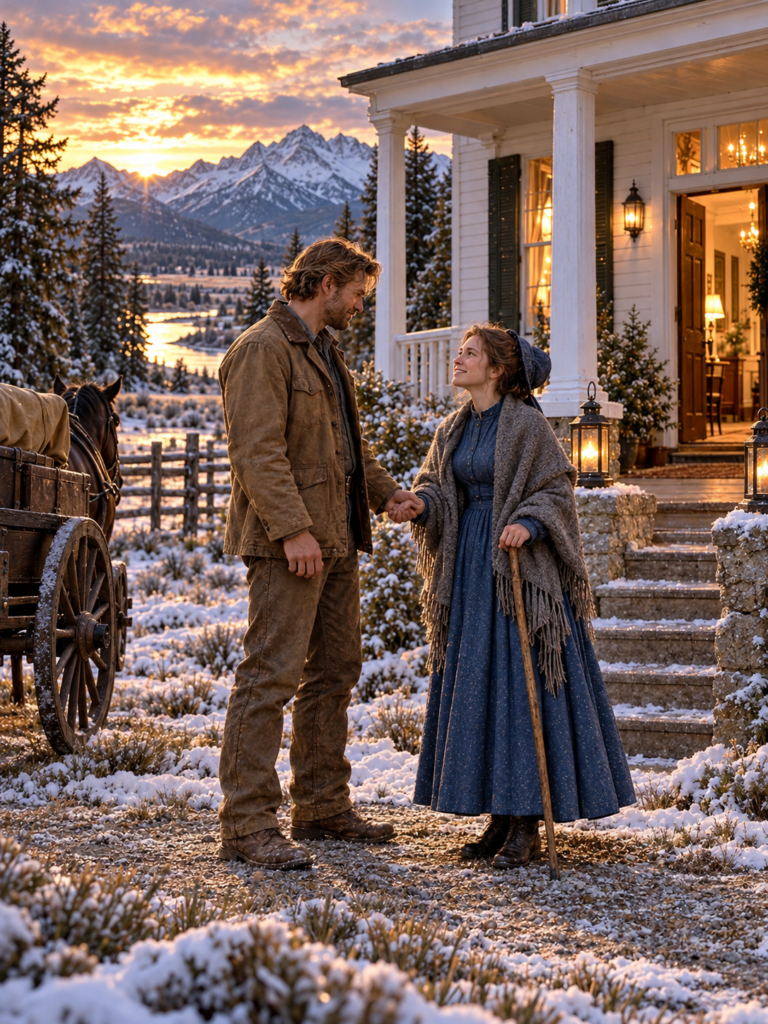
she stood at the door of the big white house with a limp no dowry and two sisters and told the quiet rancher the hard parts first and he said i have six empty rooms and no one to fill them
Part 1
The wagon creaked as it rolled the last stretch of frozen road into the Bitterroot Valley. November wind cut across the open ground and carried the smell of pine and coming snow. Clara Donnelly held the reins with both hands. Her left leg had stiffened during the long cold ride from Missoula, and every dip in the ruts sent a dull ache up into her hip. She did not let it show on her face. Behind her on the wagon seat, Ada and Rose sat close together under a patched quilt, their hands clasped so tightly the knuckles were white.
Clara was twenty-six. The limp had been with her since she was seven, when she had fallen from the hayloft on her father’s farm and the doctor had set the broken bone crooked. People in the valley had grown used to the hitch in her step, the way one shoulder dipped. They had also grown used to not asking her to dances. By the time she was twenty she had decided she would be the aunt and the daughter and the sister, and that would have to be enough. Then her father had died in the spring, and the note at the bank had come due, and everything she had decided no longer mattered.
Daniel Donnelly had farmed forty acres along the river. He had been a careful man who paid what he could and asked for little. Roscoe Pell had been lending money to small farmers for years. When the dry years came or the sickness came, the notes somehow always came due at the worst moment. Two men had arrived in the autumn with papers. They set the Donnelly furniture in the road while the girls watched. One of the men had looked almost sorry. “You have a week,” he said. “Mr. Pell says to tell you he is sorry.” He was not sorry. Clara had seen Pell that same day, sitting easy on his big black horse at the edge of the lane, smiling the way a man smiles when a plan has gone the way he wanted it to. He tipped his hat to her as the wagon rolled past.
She had found work in a boarding-house kitchen in Missoula. Mrs. Gantry would not keep Ada and Rose. They were too young, she said, and too pretty, and trouble. The church helped for a few weeks. Then the money stopped and the first real cold settled in, and Clara had to think very hard. It was the postmaster, old Mr. Teague, who told her about Jonah Whitlock.
“Whitlock,” he said when she mentioned she needed work and a roof for her sisters. “Up in the valley. He built that big house six years ago for a girl who changed her mind at the last minute. She went east and he stayed. He has lived there alone ever since with a house full of empty rooms. He keeps horses. He is quiet and honest and a good man. I would trust him with my own daughter.” He peered at her over his spectacles. “Why do you ask?”
“Because I am out of choices,” Clara said. “And I think I would rather ask a good man for something than wait for a bad one to take it.”
Now the big white house stood at the end of the lane, two stories under a steep roof, its windows dark against the gray sky. Smoke rose from the kitchen chimney. A man stepped out onto the porch with a feed bucket in one hand. He was tall, with sandy hair gone a little thin at the temples and a weathered face. He wore work boots and a canvas coat. He looked past Clara at the wagon, then back at her.
Clara stopped the horses. She climbed down carefully, the bad leg taking the weight last. She held her chin up the way she had practiced on the road.
“I have a limp, no dowry, and two sisters,” she said. Her voice was steady. “If that is too much for you, Mr. Whitlock, tell me now, and we will be gone by supper.”
Jonah Whitlock set the bucket on the step. For a moment the only sound was the wind moving through the pines and the soft snort of the horses. He looked at the two girls in the wagon. Rose had pulled the quilt higher so only her eyes showed. Ada sat very straight.
“Miss Donnelly,” he said, “I have six empty rooms and no one to fill them.”
Clara felt something loosen behind her ribs. She had not expected the words to land that way. She had expected questions, or a polite refusal, or the careful distance people used when they did not want to say no outright.
“I’m not asking for charity,” she said. She had practiced this part too. “I want to work. I’m quick with figures. I can keep your books and run your house and cook. My sisters can cook and sew, and they are not afraid of work. What I am proposing is a marriage, Mr. Whitlock. A real one in the eyes of the law and of God, so that nobody can say anything about us, and so that my sisters will have a home that no one can take from them. I know it is a strange thing to ask. I know I am not what a man dreams of, but I will be a good wife to you. I will keep faith with you every day of my life.”
Jonah was quiet for a long moment. Then he came down the steps. Up close she saw that his eyes were a calm blue, the kind that looked as if they had seen a great deal and decided not to be in a hurry about any of it. He still held the feed bucket, though he had set it down a moment before. He looked, she thought, like a man who had been waiting for something for a very long time and had stopped believing it would come.
“When I built this house,” he said, “I gave it eight rooms because I planned for children and company. For six years I have walked past these doors every night. I have been so quiet in here that I hear the clock tick from the kitchen to the barn.” He glanced at the wagon again. “I do not think you have asked too much. I think I have been waiting for someone to ask.”
Clara’s eyes burned. “You do not know me.”
“I know you drove a wagon through a cold morning with your sisters, and you looked me in the eye and told me the hard parts first. I have met a great many people in my life, and very few would have done that.” He held out his hand. “I would be honored, Miss Donnelly. And I will say this plainly. You will be treated as an equal in my house. You will have a key to your own room and your own say in every matter. Your sisters will be welcome as long as they like. You owe me nothing, and you will never be afraid here.”
It was the kindest thing anyone had said to her in a year. She took his hand. It was warm and rough. She found that she was crying, quietly, the way a person cries when the cold has been in their bones for a long time and something finally offers heat.
“Ada,” Jonah called over his shoulder. “Rose. Come in out of the cold. I believe there is a very large pot of stew on the stove and not enough people to eat it.”
The girls scrambled down. Rose, the younger, looked up at the big house with her mouth open. “Is it really ours?” she whispered.
“It is yours as long as you want it,” Jonah said. “And I have to warn you there is a lot of dust.”
They were married three days later in the little valley church. The women of the congregation filled the pews, curious and kind. Clara wore her mother’s blue wool dress. Ada pinned a sprig of pine in her hair. When Clara walked up the aisle, the limp as plain as ever, she held her head high. She noticed Jonah did not look at her leg. He looked only at her face, as if he had never seen anything better.
That winter the big house filled up with life. Ada took the kitchen and learned the old stove until it answered her. Rose took the garden plans Jonah had sketched years ago and never used, and she spent hours at the kitchen table drawing rows of beans and squash and the place where the raspberry canes could go in the spring. Clara took the books. She found, to her surprise, that Jonah had been losing money on his horses for years only because he did not like to bargain. In a month she had set the prices right and written the new figures in a clear hand. At supper she would lay out the ledgers and he would listen with his chin on his hand, laughing when she pointed out his mistakes.
“You are a menace,” he said once. “I have never been so thoroughly corrected.” He looked so happy about it that she blushed.
He mended things for her without being asked. When her bad leg hurt on cold mornings, a heated brick wrapped in flannel was waiting at the foot of her bed. He built a low bench in the kitchen so she could sit at her work and still reach the counter. He never mentioned the bench or the brick. He only noticed.
In the evenings they sat by the fire after the girls had gone upstairs. Jonah read aloud from an old book of poems in his slow, quiet voice. One night when the wind was howling outside and the snow had drifted against the porch, Clara said, “Jonah, why did she leave? The girl you built the house for.”
He was quiet for a minute. “She said the valley was too small and I was too plain. I think she was right about the valley.” He looked at the fire. “I thought I would never fill these rooms.”
“They are full now,” Clara said softly.
“Yes.” He looked at her, and the firelight lit his face. “I did not know how much I wanted that, or how much I wanted you at the end of the day with your ledgers and your frown. Clara, I need you to know. I do not think of your leg when I look at you. I think of how steady you are. I would take a hundred steady steps over a thousand quick ones.”
She could not speak. She only laid her hand on his and left it there. Outside the wind moved the pines. Inside the clock ticked, and for the first time in six years the sound did not travel through empty rooms.
Part 2
The trouble came in the middle of December. Jonah had ridden up to the south pasture that morning to check the water. When he came back his face was hard and the horse was lathered. He swung down in the yard and stood for a moment with the reins in his hand, looking at the house as if he needed to be sure it was still there.
Clara met him at the door with a cup of coffee. She saw the set of his shoulders and the way he did not take the cup right away.
“Roscoe Pell has put a fence across the creek,” he said. “He has dammed my water. I rode over and he said the creek is his.”
Clara stopped with her hand still on the doorframe. “The creek runs through your land. It has run through it for forty years.”
“I know it. But Pell says my land claim was never properly filed. He says there is a mistake in the record at the land office in Missoula, and that my land is open for new claims. He has filed his own.” Jonah sat heavily on the porch step. The coffee cup steamed in the cold air. “He says he will have the sheriff here by the first of the year.”
“That cannot be true,” Clara said. “You have the deed.”
“I do. But he says it is a forgery.” He rubbed his eyes with the heel of his hand. “Pell has been after this valley for years. I did not think he would go this far.”
Clara went very still. She was thinking of her father’s farm and the men who had set the furniture in the road. She remembered Pell smiling on his horse. She remembered the way the bank note had come due the week after the hay was cut and there was no money left to pay it. She set the coffee cup down on the step and went inside. When she came back she had the old ledger from her father’s desk, the one she had kept since she was fourteen. She sat beside Jonah and opened it across her knees.
“Every deed has two copies,” she said. “Every copy has a number. Every number is written in two places. If the office says your record is missing, then someone has taken it out of the book. And if someone took it out, they had to put something else in, and that leaves a mark.” She looked up at him. “I want to go and look.”
“It is a three-day ride in this weather,” Jonah said. “With the storm coming.”
“Then I had better start in the morning.”
“Clara.”
“I’m not asking you for permission, Jonah,” she said. She put her hand on his arm the way she had that first day. “I am telling you what I am going to do. I think it is the best way I can help. Please let me.”
He looked at her for a long moment. The wind moved the edge of her shawl. Behind them the kitchen window was lit and Ada was moving past it with a bowl. Rose’s voice drifted out, asking about the sugar.
“Then I am coming too,” he said.
“The girls cannot be left alone with Pell’s men about.”
“No,” he admitted. He stood and looked toward the barn. “Then I will send for old Mr. Teague’s nephew to stay in the house, and I will ride behind you as far as the river. But Clara, listen to me. You come home safe. This house has been empty too long. I will not lose it again.”
She left on the stage the next morning, bundled to the nose in a buffalo robe with Jonah’s own gloves on her hands. The storm broke while she was still ten miles out. By noon the road was gone in a white roar. The stage driver pulled up in a stand of cottonwoods and said they could go no further. There was one other passenger, a salesman from Helena who was already sulking and talking about the price of rooms. The driver wanted to wait out the storm. Clara sat and thought. The land office closed the following day for the Christmas holiday, and Pell’s filing deadline was the day after that. If she was not at the counter by morning, it would be too late.
“I will walk,” she said.
“You cannot,” the driver said. “Lady, you have got a bad leg.”
“I know I do,” Clara said. “It has not stopped me yet.”
She took the buffalo robe and the small canvas bag with the papers and the extra pair of socks Jonah had put in that morning. The salesman watched her with his mouth open. The driver shook his head and said something under his breath about stubborn women and Montana weather. Clara stepped down into the snow. The wind pushed at her like a hand. She put her head down and started walking.
The first mile was the hardest because the snow was soft and deep and her bad leg sank with every step. After that the cold settled into her bones and the pain became a steady burn she could measure against. She said the Lord’s Prayer out loud to keep the time. She thought of Ada’s soup and Rose’s laughing and the way Jonah’s blue eyes had looked when he told her she would never be afraid in his house. Twice she fell. The first time she went down hard on her bad knee and the snow went up her sleeves. She lay there for a moment with the wind roaring over her and thought about staying. Then she thought about the empty rooms and the girls and the creek that had run through the land for forty years, and she got up. The second time she fell she caught herself on a fence post and held on until the dizziness passed. She kept walking.
When she saw the lights of Missoula she was crying, though the tears froze on her face before they could fall. Her coat was stiff with ice. Her hands inside Jonah’s gloves had gone numb past the point of pain. She found the land office by memory and sat on the bench outside the door with the bag between her feet until morning. The snow kept falling. She did not sleep. She counted the windows that were still lit and tried to remember the exact numbers from the deed Jonah had shown her.
At first light the clerk came. He was a thin man named Ames. When he saw her sitting there in the buffalo robe with snow still melting off her boots, he went pale.
“Miss, the office is not yet open.”
“It is open for me,” Clara said. She stood, careful of the leg. “I am here to examine record number 312 in the Bitterroot book. I have a right to see it. It is the law.”
Ames stammered. He looked past her at the empty street as if he hoped someone else would come and take the decision away from him. Clara kept her eyes on him and did not move. After a moment he unlocked the door and let her in. He brought the big book from the back room and set it on the counter. His hands shook.
Clara turned the pages with care. She read down every column in her small, clear hand. On the third page she stopped. There was a place where the paper was thinner, a place where a fresh page had been cut and sewn into the binding. The ink on it was a different color from the ink on either side. She touched the seam with one finger. The thread was new.
“Mr. Ames,” she said quietly, “whose hand is this?”
“I do not know what you mean.”
“Then let us ask the registrar.” She stood with her hand on the book. “Please send for him, sir, and please send for the sheriff too, because I do not think I should go out of this room until someone with a badge has seen what I have seen.”
Ames began to shake. In the end it did not take long. He was not a brave man, and he had never been paid enough to lie once the lying was no longer private. By the time the registrar arrived, red with hurry and still buttoning his coat, the clerk was sitting on the bench with his face in his hands, talking so fast he could hardly be understood. Roscoe Pell had paid him two hundred dollars a year for six years. Every year Pell had paid him to cut out a record or change a number so that some small farmer’s deed would be found wanting. Three families had lost their land that way. A dozen more were being watched. The Donnelly farm was the most recent.
“All of them,” Clara whispered. “He took all of them.”
“He did,” said the registrar grimly. “And you, Mrs. Whitlock, have just caught him.”
Part 3
The sheriff rode out to the Pell ranch that afternoon with six deputies and a federal marshal who happened to be passing through on his way to the territorial capital. Clara stayed in Missoula with the registrar and the book. She would not leave the room until the papers were copied and the new pages marked and the clerk’s statement taken down in full. Her leg had swollen inside the boot. She sat with it propped on a chair and drank the coffee someone brought her and did not take her eyes off the book.
Word traveled faster than the riders. By the time the sheriff reached the big ranch house, half the valley already knew something was wrong. Pell tried to bluster. Then he tried to bargain. Then he tried to run. He did not get far in the snow. They brought him back to Missoula in irons, and the courtroom the following week was crowded with people who had been waiting a long time to see it. Clara stood at the back with her hand on the rail. She watched Pell’s face as the clerk’s statement was read. She watched the way the color left it when the registrar set the sewn page on the table and the different ink was plain for everyone to see.
Their land was restored. The Donnelly farm was returned to Clara and her sisters, with the dam torn down and the creek running free again. Pell was sentenced to ten years to be served in the territorial prison at Deer Lodge, and every penny he owned was ordered paid back to the families he had robbed. When it was over Clara stood on the courthouse steps with the cold air on her face and the sun coming out for the first time in days. She did not feel proud, exactly. She felt as if something that had been crooked for a long time had been set straight, the way a bone is set when the doctor finally gets it right.
A horse came pounding up the street. She knew the sound before she turned. Jonah Whitlock threw himself out of the saddle before the animal had fully stopped. He had ridden half the night after hearing the news at the stage stop. His hat was gone. His face was gray with worry and the cold. He took her by both shoulders and looked at her as if he was afraid she would vanish if he blinked.
“You walked,” he said hoarsely. “Six miles in that storm.”
“I did.”
“You foolish, stubborn, wonderful woman.” He pulled her into his arms and held on tight with his face in her hair. “I told you to come home safe.”
“I am coming home,” Clara said, laughing and crying into his coat. “I am right here.”
They went home in the wagon with the Donnelly farm papers in her bag and the mountains shining all around them. When they reached the big white house, Ada and Rose ran out onto the porch, shrieking, and flung themselves on her. There were tears and kisses and a great deal of shouting. In the middle of the noise Jonah stood in the yard with his hat in his hands, looking up at the house with all its windows lit.
“What are you thinking?” Clara asked, taking his arm.
“I am thinking,” he said, “that I used to count the empty rooms. I do not count them anymore. Every light is on and there is a smell of bread and somebody is arguing in the kitchen.” He smiled down at her. “It is a very loud house, Mrs. Whitlock.”
“Is that a complaint?”
“It is the best thing I have ever heard.” He lifted her hand and kissed it. “I love you, Clara. I think I loved you at the door when you told me the hard parts first. I want to say it every day for as long as I live.”
“Then you had better start,” Clara said, with her heart full to the brim. “Because I have a limp and a great deal of patience, and I intend to be here a very long time.”
He laughed, and she laughed, and they went in together, one steady step at a time, while the snow began again, soft and kind over the quiet valley.
Part 4
Spring came late that year. The creek ran high with meltwater and the willows along the bank turned green first. Jonah spent the mornings riding the fence lines and checking the foals. Clara spent them at the kitchen table with the ledgers open and the window cracked so she could hear the horses. The Donnelly farm sat empty for a while. They went out one Sunday after church and walked the old fields. The house had been stripped of everything that could be carried, but the walls still stood and the barn roof had held. Rose stood in the doorway of what had been her bedroom and was quiet for a long time. Ada touched the place on the wall where their father’s coat had hung and did not say anything.
“We could fix it,” Jonah said. “If you wanted to live there again.”
Clara looked at the creek running clean past the bend and at the mountains standing white along the sky. She thought about the empty rooms in the big house and the way the clock no longer traveled through silence. She thought about the low bench in the kitchen and the heated brick on cold mornings.
“Not yet,” she said. “Maybe not ever. This place was my father’s. The other place is ours.”
Jonah nodded. He did not push. They walked back to the wagon and Ada and Rose climbed in without looking back. On the way home Rose said, “I think I would like to plant the raspberries this year. The way Father always said we should.”
“Then we will,” Jonah said.
In May the valley filled with the smell of turned earth and new grass. Clara’s limp still ached when the weather changed, but the ache was smaller than it had been. She had learned the shape of the house so well that she could walk from the kitchen to the barn in the dark without thinking about the bad leg. Jonah had begun to leave the ledgers on her side of the table without being asked. Sometimes he sat across from her and watched her write and did not say anything at all. The silence between them had changed. It was no longer the silence of an empty house. It was the silence of two people who had run out of reasons to be careful with each other.
One evening in June, after the girls had gone upstairs, Jonah closed the book he had been reading and set it on the table. The fire had burned down to coals. Outside the frogs were loud along the creek.
“Clara,” he said. “There is something I have been thinking about.”
She looked up from the last of the day’s figures. “What is it?”
“When I built this house I left two rooms on the second floor with nothing in them but the frames for the beds. I told myself it was because I did not know yet how many children there would be. I think I was waiting to see if anyone would stay long enough for the rooms to matter.” He was quiet for a moment. “I would like to finish them. If you want that.”
Clara set the pencil down. She looked at his face in the firelight and thought about the six empty rooms and the way he had said the words the first day. She thought about walking six miles in the snow and the way his arms had felt when he pulled her close on the courthouse steps.
“I want that,” she said. “I want all of it.”
He reached across the table and took her hand. Outside the wind moved the pines the way it always had. Inside the house the rooms were no longer empty, and the clock ticked, and somewhere upstairs Rose laughed at something Ada had said. The sound traveled down the stairs and into the kitchen and settled between them like something that had always belonged there.
Part 5
They finished the two rooms that summer. Jonah built the beds himself from the pine that grew on the ridge behind the barn. Clara sewed the quilts from the wool she had carded and spun in the long evenings. Ada and Rose helped with the mattresses and argued about the color of the curtains until Jonah settled it by saying the curtains could be whatever color the girls wanted as long as the windows still opened. On the day they carried the last of the furniture upstairs, the valley was bright with the last of the bitterroot blooming white along the fence lines.
That autumn a letter came from the territorial prison at Deer Lodge. Pell had died of a fever in the second year of his sentence. The money that had been ordered returned to the families was still coming, slow and steady, through the court. Clara read the letter at the kitchen table and set it aside. She did not feel triumph. She felt the way a person feels when a long stretch of bad weather finally breaks and the ground is still there underneath.
The Donnelly farm stayed empty for another year. Then a young couple from the eastern part of the territory asked if they could rent it and put cattle on the high pasture. Jonah and Clara talked about it for a week. In the end they said yes, with the understanding that the creek stayed open and the old house was not to be torn down. Ada and Rose went out with them the first spring to show the new people where the raspberry canes should go and where the best place for the garden had always been. Rose stood in the doorway of her old room for a long time again, but this time she smiled when she came out.
Years later, when the house was loud with the sound of children running on the stairs and the smell of bread was always in the kitchen, Clara would sometimes stand at the upstairs window and look out at the valley. The limp was still there. It had never left. On cold mornings the heated brick was still waiting at the foot of the bed, though Jonah no longer had to be reminded. He simply knew. The ledgers were still hers. The creek still ran. The big white house was no longer quiet enough for a person to hear the clock from the kitchen to the barn.
One evening Jonah came in from the barn with snow on his shoulders and found her at the window. He stood behind her and put his arms around her waist the way he had learned to do, careful of the bad leg, steady and sure.
“What are you thinking?” he asked.
“I am thinking,” she said, “that I used to count the empty rooms. I do not count them anymore.”
He rested his chin on the top of her head. Outside the snow fell soft and kind over the quiet valley, the way it had on the day she first stood at his door and told him the hard parts first. Inside the house every light was on, and somewhere downstairs someone was arguing in the kitchen, and the sound of it traveled up the stairs and settled around them like something that had been waiting a very long time to be heard.
“It is a very loud house,” he said.
“Is that a complaint?”
“It is the best thing I have ever heard.”
She turned in his arms and laid her hand on his, the way she had that first winter by the fire. Outside the wind moved the pines. Inside the rooms were full, and the clock ticked, and the house held them both the way it had held them from the beginning, one steady step at a time.