Part 1
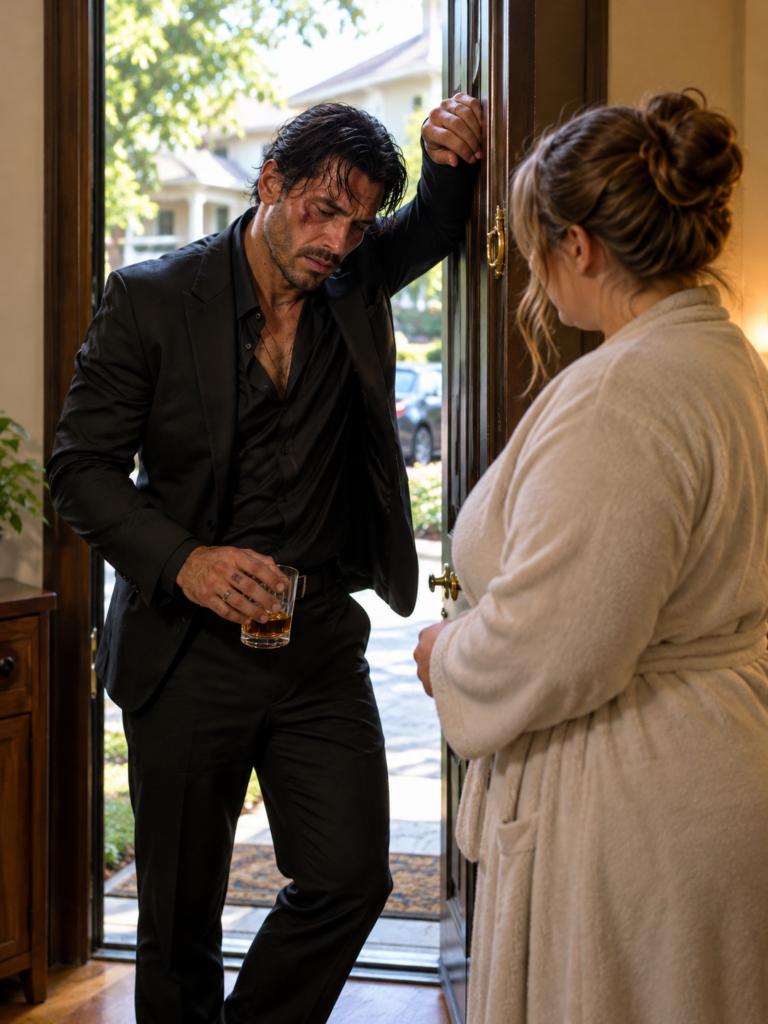
At 11:47 p.m., Clara Bennett opened her apartment door and found the most feared man in the city struggling to remain on his feet.
Dante Rays had never looked like someone who needed permission to enter a room.
At thirty-four, he commanded the kind of influence that made wealthy businessmen reconsider their words and dangerous men lower their voices. His name traveled through the city in cautious conversations, usually followed by a glance over someone’s shoulder.
Yet the man standing outside Clara’s apartment barely resembled the figure people whispered about.
His expensive charcoal suit was wrinkled. His collar hung open, exposing the hollow at his throat. Dark hair that ordinarily looked untouched by wind had fallen across his forehead, partly concealing a cut above his left eyebrow.
The wound had stopped bleeding some time ago.
His eyes were another matter.
They were bloodshot, unfocused around the edges, and filled with an exhaustion that seemed far older than the night itself.
Whiskey reached her before his words did.
Dante steadied himself against the doorframe.
Then he lifted his head, met her eyes, and said something she would never have imagined hearing from him.
“I need you.”
Three words.
No command. No explanation. No attempt to remind her who he was.
Just a confession spoken so quietly that Clara almost believed she had misunderstood him.
She stood barefoot in the doorway, wearing an old cotton shirt and loose pajama pants, with her grandmother’s faded blanket still hanging from one shoulder.
For a moment, neither moved.
Then Dante’s hand slipped slightly against the wood.
Clara stepped aside.
“Come inside.”
His expression changed.
Only slightly, but she caught it.
For a man accustomed to having every door opened through fear, money, or obligation, he seemed genuinely surprised that someone had opened one simply because he needed help.
He entered without another word.
Clara locked the door behind him.
She did not know it yet, but the danger that had followed him through the city was already close enough to find her building.
And before sunrise, she would learn that Dante had been keeping a secret about her for eight months.
The evening had begun in a way so ordinary that Clara would later find herself remembering every insignificant detail.
The half-empty cup of chamomile tea.
The television playing something she had stopped paying attention to almost an hour earlier.
The book lying open on her lap, its pages already soft from being turned back and reread.
Outside her third-floor apartment, traffic had dwindled to the occasional car. Headlights passed across her ceiling, briefly illuminating the small cracks in the paint before disappearing.
Clara was twenty-eight years old and had lived long enough to understand that peace was rarely something life handed you.
More often, it was something you assembled.
A little money saved when possible. A dependable job. A door that locked. People who knew your face without needing to know your business.
Her apartment was small, but everything inside it belonged to her.
There were plants crowded along the windowsill, photographs arranged unevenly above a narrow bookshelf, and a couch whose cushions had lost their original shape.
The blanket around her shoulders had belonged to her grandmother.
Clara had considered replacing it several times, especially where the fabric had grown thin along one corner.
She never had.
Some things were worth keeping long after they stopped looking new.
She worked as a nurse at the city hospital three days a week, though those shifts were demanding enough to make the remaining days feel necessary rather than luxurious.
She liked her work.
She liked knowing what to do when someone was frightened, bleeding, or unable to explain where the pain was coming from.
She liked that competence mattered more than appearances when a life was at stake.
But competence did not pay every bill.
An electricity notice lay folded beneath a magazine on her coffee table. She had already calculated how much she could spare toward it and how much would have to wait.
Earlier that afternoon, she had spoken with her mother.
The conversation had left her with a heaviness she couldn’t fully explain. Nothing catastrophic had happened. There had simply been the familiar accumulation of worries, obligations, and questions she did not yet have answers for.
By eleven-thirty, Clara had decided she was finished worrying for the evening.
She had made tea, settled onto the couch, and opened the book she had been attempting to finish for three weeks.
Then came the knock.
Three uneven taps.
A pause.
One more, quieter than the others.
Clara looked toward the door.
She knew the sounds of her building.
She recognized the heavy steps of the man upstairs, the elevator’s unreliable machinery, and the scrape of the neighbor’s key against the lock across the hall.
She even knew that an elderly man walked past the building every night at almost exactly 10:11.
Growing up where she had taught Clara that paying attention was not paranoia.
It was survival.
The knock did not belong to anyone she expected.
She set down her book and crossed the living room without switching on another light.
At the door, she stopped to listen.
No voices.
No second set of footsteps.
She leaned toward the peephole.
And every reasonable thought she possessed disappeared for three seconds.
Dante Rays.
She recognized him immediately.
It would have been difficult not to.
Even stripped of his immaculate appearance, there was something unmistakable about the breadth of his shoulders and the severe lines of his face.
She had seen that face before.
Not often.
But enough.
Clara unlocked the door.
Now, with him standing in her living room, she found herself facing a problem no amount of hospital training had prepared her for.
What did you do when a dangerous man arrived at your home looking as though the world had finally succeeded in hurting him?
“Sit down,” she told him.
Dante glanced around.
His gaze passed over her plants, the crowded bookshelf, the blanket slipping from her shoulder, and the framed photographs on the wall.
His attention lingered on the room’s ordinary details.
Not with disdain.
With something closer to disbelief.
“You’re not going to ask why I’m here?” he said.
“I expect you’ll tell me.”
“And if I don’t?”
“Then you’ll still need to sit down before you fall down.”
For the first time, a faint expression disturbed his face.
It might have been amusement.
It vanished before she could decide.
He crossed the room and lowered himself onto the couch.
Not comfortably.
He sat forward, elbows resting on his knees, with both hands clasped as though he were trying to hold something inside himself together.
Clara studied him.
The cut above his eyebrow concerned her, although it appeared to have dried. His movements were slow but coordinated. He was drunk, certainly, yet aware of his surroundings.
She had questions about the injury.
She also recognized that he was in no condition for an interrogation.
“I’m making tea,” she said.
Dante nodded without raising his head.
In the kitchen, Clara filled the kettle and placed it on the stove.
Her hands moved automatically.
Two mugs.
Tea bags.
Water.
Simple things.
The kind of small, familiar actions that gave her a moment to think.
Through the open doorway, she could see him sitting almost motionless.
It was the strangest sight.
Dante Rays, the man whose presence reportedly changed the atmosphere of entire rooms, looked painfully out of place on her old couch.
His suit probably cost more than several months of her rent.
His shoes were polished despite the rest of his disheveled appearance.
Yet neither money nor reputation seemed to be doing him much good.
He lifted his hands to his face.
Clara looked away.
Whatever had happened to him, he deserved a moment in which nobody watched.
When the tea was ready, she carried both mugs into the living room.
She set one in front of him and took the armchair across from the couch.
“How much have you had to drink?”
Dante rubbed a hand over his face.
“Enough.”
“That’s not a measurement.”
“I know.”
“Are you going to be sick?”
“I don’t think so.”
“Dizzy?”
“Mostly tired.”
She observed him for another moment.
“And your eyebrow?”
“Nothing serious.”
“That’s usually what people say when they don’t want me looking at something.”
His eyes flickered toward her.
“You’re always this persistent?”
“Only when someone arrives at my apartment looking like he’s lost an argument with a brick wall.”
A breath escaped him.
Not quite a laugh, but close enough that she noticed.
Clara leaned back.
“You don’t have to explain everything right now.”
Dante stared at the tea.
“You don’t know what you’re offering.”
“I’m offering you a place to sit until you can tell me what’s wrong. Nothing more complicated than that.”
His fingers closed around the mug.
For several seconds, he said nothing.
Then, very softly, he answered, “All right.”
Fourteen months earlier, Clara had met Dante Rays beneath the harsh fluorescent lights of the hospital’s emergency department.
It had been near the end of a double shift.
Her feet hurt. She had not eaten a proper meal in hours. Someone had spilled coffee near the nurses’ station, and she was considering whether she had enough energy left to be irritated about it.
Then the doors opened.
A young man was rushed in with two gunshot wounds.
He was barely twenty.
There was no identification with him, and the information accompanying his arrival was incomplete.
What mattered immediately was that he was losing blood and his condition was deteriorating.
Clara moved without waiting for fear to catch up.
She assisted in stabilizing him, followed the emergency team’s instructions, monitored his condition, and kept speaking to him while they prepared for surgery.
His name, she later learned, was Marco.
But in those first desperate minutes, he was simply a frightened young man trying to survive.
His fingers had found hers.
They held on with surprising strength.
“Stay with me,” she had told him.
His eyes moved toward her face.
“You’re in the hospital. People are helping you. Just listen to me.”
For seventeen minutes, she remained beside him while the surgical team was being assembled.
She talked because silence frightened people who were fighting to stay conscious.
She told him to listen to her voice.
She told him what was happening when she could.
She repeated that he was not alone.
Seventeen minutes could pass unnoticed in an ordinary day.
That night, they seemed impossibly long.
Marco survived.
Clara learned that three days later, when a man in a dark suit appeared in the hospital corridor.
She noticed him before he approached.
Not because he made a scene.
Quite the opposite.
He moved through the fluorescent brightness with unnerving composure, as though he belonged somewhere entirely different and had decided the difference did not matter.
Two members of the hospital staff recognized him.
Clara saw the recognition travel across their faces.
Then the man stopped in front of her.
“Clara Bennett?”
“Yes?”
“My name is Dante Rays.”
She knew.
Of course she knew.
But she waited.
“I understand you helped save someone named Marco three nights ago.”
“I was part of the team.”
“I know.”
His voice was measured.
There was no attempt to exaggerate her importance or dismiss the contributions of the others.
That surprised her.
“I wanted to thank you personally,” he continued.
Clara adjusted the files in her arms.
“He’s alive because a lot of people did their jobs.”
“And you were one of them.”
Something about the way he said it made her look more carefully at him.
She had expected arrogance.
Perhaps a demonstration of power disguised as gratitude.
Instead, she found a man looking at her with an intensity that seemed less like assessment than recognition.
“Is he family?” she asked.
Dante hesitated briefly.
“He’s someone who matters to me.”
She accepted the answer.
Hospital corridors were full of relationships that didn’t fit neatly into labels.
“I’m glad he made it,” she said.
“So am I.”
He should have left then.
Instead, he remained for another moment, his attention fixed on her face.
“Did he say anything to you?”
“Nothing that matters outside his medical care.”
Dante studied her.
Then he nodded.
“Thank you, Nurse Bennett.”
He walked away without asking another question.
She remembered that.
A man with a reputation for demanding answers had accepted the boundary she’d given him.
It was their first conversation.
Not their last.
He returned to the hospital once on a separate errand, and they exchanged a few words.
On another occasion, they encountered one another in the parking lot.
Their conversation stretched longer than either seemed to anticipate.
They spoke about ordinary things.
Her work.
The weather.
How the hospital seemed to exist in a different time zone from the rest of the city.
She never asked him about his business.
He never pretended to be an ordinary businessman.
That unspoken honesty had made their brief encounters easier, and somehow more dangerous to remember.
Clara found herself noticing details afterward.
The way Dante listened without interrupting.
The way he waited until she had finished a thought.
The curious restraint of a man who could have dominated every conversation and apparently chose not to.
She also knew what people said about him.
Cold.
Ruthless.
Unforgiving.
Capable of making decisions that changed lives without so much as raising his voice.
Clara was not foolish enough to believe those stories had all been invented.
She understood that kindness in one moment did not erase the harm a person might cause in another.
And whenever she caught herself thinking about him, she reminded herself of a simple distinction.
An interesting man was not necessarily a safe one.
By the time their paths stopped crossing regularly, she had convinced herself that the fascination would fade.
Now he was sitting on her couch.
Drunk.
Injured.
Holding a cup of tea with both hands.
And looking more lost than anyone she had seen in a very long time.
It was shortly after midnight when Dante finally began speaking.
Not about the cut.
Not about his enemies.
Not even about why he had come to her specifically.
He started with the drive.
“I sat outside your building for twenty-two minutes.”
Clara looked at him.
“Twenty-two?”
“I checked the time.”
“Why?”
He stared into his tea.
“I couldn’t make myself come upstairs.”
That answer unsettled her more than a dramatic confession would have.
Dante Rays afraid to knock on a door?
It contradicted everything she knew about him.
“What changed your mind?”
“I don’t know.”
He considered it.
“Maybe I was more afraid of going somewhere else.”
She did not answer immediately.
Dante shifted on the couch, and his expression tightened as though his own honesty had caught him off guard.
“I went to a bar tonight,” he said.
“All right.”
“An old place. Not one I visit much anymore.”
His thumb moved along the handle of his mug.
“I used to go there with someone.”
Clara waited.
“Someone who mattered,” he added.
“Do you still see them?”
“No.”
The single word contained enough finality that she understood.
“I’m sorry.”
He lowered his eyes.
For a while, there was only the low murmur of the television and the occasional sound of a vehicle outside.
Clara let the silence remain.
She had learned at the hospital that grief could not be hurried.
People often wanted to fill painful pauses because they felt compelled to repair them.
But there were things that could not be repaired with words.
Sometimes the kindest thing was to leave enough room for the truth to arrive.
Dante looked at his hands.
“Her name was Elina.”
Clara sat a little straighter.
“She was my mother’s closest friend,” he continued. “She knew me when I was a child.”
His voice changed.
It lost some of the hard precision Clara remembered from their earlier meetings.
“She died six days ago.”
Clara felt her chest tighten.
“Was she ill?”
Dante looked toward the window.
“She died in her sleep.”
He swallowed.
“In a little house at the edge of the city.”
He told Clara that he had quietly paid for the house.
Elina had never known.
He had made sure of that.
“Why didn’t you tell her?”
“Because she wouldn’t have let me.”
A faint, devastated smile touched his mouth.
“She hated owing anyone anything. Especially me.”
“Then why pay for it?”
He turned the mug slowly between his hands.
“Because she deserved to have somewhere peaceful.”
Clara said nothing.
Dante looked down.
“And because it was one thing I could give her without asking her to accept what I’ve become.”
The words hung between them.
For the first time, Clara understood that his grief was not only about death.
It was tangled with shame.
With memory.
With years that could never be returned.
“Did you go to the funeral?” she asked.
His hand stopped moving.
“No.”
The answer was immediate.
Then he added, “I was there.”
Clara waited for him to explain.
“At the cemetery. I stood near the trees, far enough away that nobody noticed.”
“Why stay so far back?”
“Because my presence would have changed the day.”
He looked at her.
“People would have watched me. Wondered what I wanted. Wondered whether they should be afraid.”
He lowered his gaze again.
“She deserved better than that.”
The room grew painfully still.
“So I watched them bury the one person who remembered who I was before all this. And I stood there like a stranger.”
Clara looked at him.
His expression remained controlled, but his eyes had filled.
He blinked once.
A tear slid down his cheek.
He did not wipe it away.
“I didn’t cry at the funeral,” he said.
His voice was almost inaudible.
“I thought something was wrong with me.”
Clara set her mug down.
“Nothing about grief happens on a schedule.”
He gave a small, humorless exhale.
“Apparently not.”
Another tear fell.
Dante bowed his head.
Clara rose from the armchair and moved to the couch.
She sat beside him, leaving enough space that he would not feel trapped by her closeness.
She did not touch him.
She simply stayed.
For a while, Dante stared straight ahead.
Then he spoke.
“She was the only person who never wanted anything from me.”
Clara turned slightly toward him.
“She wanted you to be all right,” she said.
Dante shut his eyes.
“Yes.”
His next breath shook.
“And I don’t know what that even means anymore.”
Part 2
Clara had heard people describe Dante Rays as a man without a conscience.
She had heard that he never hesitated, never apologized, and never allowed his personal feelings to influence his decisions.
Yet sitting beside him, she saw no evidence of a man who felt nothing.
She saw someone who had spent years learning not to show what he felt.
There was a difference.
It did not erase his choices.
It did not excuse anything he might have done.
But it changed what she understood about the person sitting beside her.
Dante rested the untouched mug on the coffee table.
“Do you know what people usually say when someone dies?” he asked.
Clara considered the question.
“They say a lot of things.”
“They tell you to be strong.”
“Sometimes.”
“They tell you the person is in a better place. That time makes it easier. That there’s a reason for everything.”
His mouth twisted.
“I’ve heard all of it this week.”
Clara studied his profile.
“And none of it helped.”
“No.”
He looked at her.
“You haven’t told me any of those things.”
“I don’t know what happens after someone dies,” she said. “And I’m not going to pretend I know why you lost her.”
Dante held her gaze.
“Then what do you know?”
“That you loved her.”
His expression shifted.
“And that you miss her,” Clara continued. “And that both of those things can be true even if you couldn’t stand beside her grave.”
For several seconds, he seemed unable to speak.
Finally, he whispered, “She used to make me breakfast.”
Clara listened.
“When I was little. My mother worked constantly, and there were mornings when Elina would come over before sunrise.”
His fingers tightened together.
“She’d complain that I was too thin. That I never ate enough. She would put food in front of me and pretend not to notice when I asked for more.”
Clara smiled faintly.
“Sounds like she knew you well.”
“Better than anyone.”
He looked toward the small kitchen.
“She used to tell me I could become whatever I wanted.”
He paused.
“I believed her.”
The sadness in his voice went deeper than the loss of one person.
Clara understood that Elina had represented something Dante no longer possessed.
Not innocence exactly.
Permission.
The right to imagine a life before the world decided what sort of man he would become.
He leaned back against the couch, looking suddenly exhausted.
“Why did you open the door?” he asked.
Clara frowned slightly.
“What?”
“Tonight. You knew who I was. You could have left me standing in the hallway.”
“Probably.”
“I wouldn’t have blamed you.”
She looked at the cut above his eyebrow.
“Would you have gone away?”
“Eventually.”
“That isn’t a very convincing answer.”
Dante almost smiled.
Then the question returned to his eyes.
“Why, Clara?”
She thought about it.
She could have said that he had once thanked her for saving Marco.
She could have mentioned their conversations at the hospital or admitted that she had occasionally wondered about him afterward.
All those things were true.
None quite explained the decision.
“Because you knocked like you needed someone to open the door,” she said at last. “Not like you expected me to.”
Dante went very still.
Clara looked away, giving him time to absorb it.
She was not sure why the answer had affected him so strongly.
But she could see that it had.
The clock on the wall moved beyond one in the morning.
Outside, a siren rose somewhere in the distance and gradually faded.
Dante reached inside his suit jacket.
For one brief second, Clara’s attention sharpened.
She had not forgotten the world he inhabited.
Then his hand emerged holding a photograph.
It was small and worn, its edges softened from years of handling. A crease ran through the middle, as though it had been folded and unfolded too many times to count.
Dante stared at it without speaking.
Eventually, he handed it to her.
Clara took it carefully.
The picture showed a young boy, perhaps seven or eight years old, standing in front of a bright red door.
Sunlight fell across his face.
He was squinting and smiling, one of those unguarded childhood grins that appeared without any concern for how the world might judge it.
The smile caught her attention.
Then the eyes.
Clara looked from the photograph to the man beside her.
“Dante?”
He nodded.
“That was me.”
She studied the image again.
“You look happy.”
“I was.”
The simplicity of his answer made her heart ache.
“What happened?”
Dante looked at the picture.
“For a long time, I thought I’d forgotten.”
“Forgotten what?”
“How that felt.”
He reached toward the photograph but didn’t take it back.
“I carried that picture for years because I was afraid I’d eventually convince myself that boy never existed.”
Clara looked at the child’s broad smile.
The boy was clearly delighted by something outside the frame.
There was no caution in his expression.
No calculation.
No trace of the man whose name made people nervous.
“He’s still part of you,” she said.
Dante’s expression hardened with something that resembled pain.
“I’m not sure you’d say that if you knew everything.”
“Then don’t ask me to judge someone I haven’t finished listening to.”
He turned toward her.
For a moment, she saw the same startled attention he’d shown in the hospital corridor.
Then he began to tell her the story.
Dante was ten when his father disappeared.
One evening, the man left home.
He never returned.
There was no final conversation that Dante could remember, no explanation that made sense to a frightened child.
There was simply a door that closed and a family that waited.
At first, Dante had expected his father to come home.
Then he had tried to understand why he hadn’t.
Eventually, he stopped asking questions that nobody could answer.
His mother did everything she could to keep them afloat.
Dante spoke about her without resentment.
“She worked harder than anyone should have to,” he said.
“But it wasn’t enough?”
He shook his head.
“Sometimes working hard doesn’t change what’s available to you.”
Clara understood that.
She had seen enough of the city to recognize that poverty did not always have anything to do with effort.
Dante described the neighborhood where he grew up.
The narrow opportunities.
The men who seemed to possess everything other people lacked.
The way children learned to recognize power long before they understood where it came from.
He had wanted something different.
“I used to draw buildings,” he told her.
Clara looked up.
“Buildings?”
“Houses. Bridges. Towers. Anything I could imagine.”
For the first time that night, his expression softened with something almost like pleasure.
“I’d fill notebooks with them. I used to draw the same house over and over until I could get the windows exactly right.”
“Why buildings?”
He considered the question.
“Because they made sense.”
She waited.
“If you wanted a wall to stand, you needed a foundation. If you wanted a roof not to fall, you had to understand what held it up.”
He gave a small shrug.
“It seemed like a world where things worked according to rules.”
Clara watched him.
“What did you want to do?”
“Become an architect.”
She smiled before she could stop herself.
Dante noticed.
“What?”
“Nothing.”
“Clara.”
“It’s just difficult to picture you arguing with someone about window placement.”
Something resembling genuine amusement moved across his face.
“I would have been very good at it.”
“I believe you.”
For a few seconds, the darkness around his memories lifted.
Then he looked away.
“What happened to the notebooks?” Clara asked.
Dante’s hands became still.
“They burned.”
Her smile disappeared.
“When I was twelve, we lost the apartment.”
He spoke slowly, as though he could still see the scene.
“There was a fire. By the time we were outside, there was nothing we could do.”
Clara said nothing.
“I stood on the sidewalk watching smoke pour out of the windows.”
His voice flattened.
“Everything I owned was inside. My drawings. My clothes. The little things I’d saved.”
He rubbed his thumb against one finger.
“Forty minutes. That’s about how long it took for everything to be gone.”
“That must have been terrifying.”
“It was.”
He nodded once.
“But I remember being angry more than afraid.”
“At what?”
“At how easily someone could lose everything.”
He looked directly at her.
“I decided that day I wasn’t going to be powerless again.”
Clara felt the significance of the words.
She had heard many explanations for how dangerous men became powerful.
Greed.
Ambition.
Cruelty.
Dante’s answer was more complicated.
It began with a frightened child standing outside a burning home, watching the life he understood disappear.
That did not make his later choices inevitable.
It did, however, explain the fear beneath them.
“When did you get involved with the people you work with now?” she asked.
“Fifteen.”
Clara glanced at him.
“That young?”
“Young enough to think being useful was the same thing as being safe.”
He told her about a man who had drawn him into the criminal world.
Dante did not speak of him affectionately.
There was no nostalgic admiration in his voice.
The man had recognized an intelligent boy with no money, few options, and a fierce determination never to depend on anyone again.
He had offered Dante a place in a system that rewarded obedience and punished weakness.
Dante learned its rules.
He learned who could be trusted, who could not, and how quickly protection could become another kind of debt.
He learned that people sometimes called an arrangement fair simply because they were too afraid to object.
And he learned how to become powerful enough that other people hesitated before trying to use him.
“I didn’t enjoy it,” he said.
Clara looked at him.
“Not even when you started gaining power?”
He thought before answering.
“There were times I was proud of surviving.”
She accepted the distinction.
“And there were times I liked knowing nobody could take everything from me again.”
He looked down.
“But surviving something doesn’t mean you come out unchanged.”
The words remained between them.
Clara understood he was not offering a confession that wiped away responsibility.
He was describing the choices that had led him further and further from the boy in the photograph.
Each decision had seemed necessary when he made it.
Together, they had created a life he no longer knew how to leave.
“I never planned to become this,” he said.
Clara studied the photograph.
“Do you still draw?”
Dante shook his head.
“Not anymore.”
She traced the worn edge of the picture with one finger.
“That’s a shame.”
He looked at her curiously.
“Why?”
“Because the boy who drew those buildings deserves to be remembered for more than what happened to him afterward.”
Dante turned his face away.
For several seconds, he stared toward the window.
When he spoke again, his voice was rough.
“Elina used to say things like that.”
Clara handed the photograph back.
He accepted it carefully.
This time, instead of returning it immediately to his pocket, he held it where he could see the boy’s face.
By three in the morning, Clara had stopped thinking about how strange it was to have Dante Rays in her apartment.
The hours had stretched into something separate from ordinary life.
There were still unanswered questions.
She was still aware of the danger attached to his name.
But he had shown her pieces of himself she suspected few people ever saw.
And somewhere between the photograph and the memory of the burning apartment, she had begun to understand why he had come to her door.
At least, she thought she understood.
Then Dante said, “There’s something else.”
Clara looked up.
His entire manner had changed.
The vulnerability remained, but he was sitting straighter now.
His voice had regained a measure of control.
“What is it?”
He set the photograph on the coffee table.
“There’s a reason I came to you tonight.”
“You already told me.”
“Not all of it.”
A faint uneasiness passed through her.
Dante watched her carefully.
“I need you to hear me out before you decide what you think.”
Clara’s gaze sharpened.
“That depends on what you’re going to tell me.”
He accepted the answer.
Then he spoke.
“I’ve been making sure you’re protected for the past eight months.”
Clara stared at him.
For a moment, the sentence made no sense.
“Protected?”
“Yes.”
“From what?”
“People who were interested in you.”
The warmth she had felt toward him began to cool.
“What people?”
“People connected to my world.”
Clara slowly straightened.
“Dante, what are you talking about?”
He looked at his hands.
“After you saved Marco, certain people began asking questions about the nurse who had been with him.”
She remembered Marco’s frightened face.
His hand gripping hers.
The blood.
The seventeen minutes waiting for surgery.
“I was doing my job.”
“I know.”
“Then why would anyone care about me?”
“Because they didn’t know what you might have seen. Or what Marco might have told you.”
Clara stared at him.
The hospital had always been a place where she understood the rules.
Privacy.
Care.
Professional responsibility.
Now Dante was telling her that a moment in an emergency room had drawn the attention of people she had never met.
“Did they think I was involved in something?”
“They wanted to find out.”
“And were you asking questions about me too?”
He did not answer immediately.
Clara felt her shoulders stiffen.
“Dante.”
“I knew who you were. I knew you’d done nothing wrong.”
“That isn’t what I asked.”
He met her eyes.
“No. I wasn’t investigating you to find something against you.”
“Then what did you do?”
He exhaled slowly.
“I made sure the questions stopped.”
She waited.
“I kept your name out of conversations where it had no business being.”
He paused.
“And I arranged for someone to keep an eye on things in the background. To make sure you weren’t being approached or threatened.”
Clara sat very still.
“Someone has been watching me?”
“Not in the way you’re imagining.”
“You don’t know what I’m imagining.”
Dante stopped.
She placed both feet firmly on the floor.
For the first time that night, the difference between their worlds felt immense.
In his world, protection apparently meant making arrangements without asking.
In hers, trust required people to be honest about decisions affecting her life.
“Eight months?” she asked.
“Yes.”
“And you never thought to tell me?”
“I didn’t want to frighten you.”
“But you were comfortable making decisions about my safety without my knowing?”
His expression tightened.
“I thought it was better if you could keep living normally.”
“Better for whom?”
The question caught him.
Clara did not raise her voice.
She had no need to.
“If someone was interested in me because of what happened at the hospital, I deserved to know.”
Dante looked at her.
“You’re right.”
She had not expected him to concede so quickly.
That did not make the situation easier.
She glanced toward the door.
Nothing had changed outside.
The same narrow hallway lay beyond it.
The same neighbors were presumably sleeping in their apartments.
But she could no longer think of her ordinary routines in quite the same way.
“Have these people ever come near me?”
“Not that I’m aware of.”
“Have they threatened me?”
“Not directly.”
Clara heard the qualification.
“Not directly?”
Dante looked exhausted again.
“They were interested enough that I didn’t want to take chances.”
She pressed her fingertips together.
“What exactly did you tell the people protecting me?”
“That you weren’t involved in my affairs. That you weren’t to be disturbed.”
“And that’s all?”
“That was the purpose.”
Clara looked down at her hands.
Part of her wanted to be grateful.
Another part felt deeply uncomfortable.
She understood why a man like Dante might respond to danger by exerting control.
She also understood that good intentions did not give him the right to decide what she was allowed to know.
“You should have told me,” she said.
“I know.”
She studied him.
“Do you?”
“Yes.”
He held her gaze.
“I can’t change how I handled it. I can tell you the truth now.”
Clara considered the answer.
“Then tell me why now.”
The expression on his face changed.
And at once, she knew this was the question he had been dreading.
Dante leaned forward.
“Because the people asking about you eight months ago have started asking again.”
Clara felt a coldness settle beneath her ribs.
“Why?”
“Things have shifted.”
“What things?”
“Certain people are becoming more aggressive. They’re looking for weaknesses.”
“And you think I’m one of yours?”
He did not look away.
“I think they might decide you are.”
Clara’s heart began beating harder.
He continued, carefully.
“Eight months ago, I could keep them from taking an interest. Now I’m not certain I can.”
She thought of the quiet streets outside.
Her work schedule.
The walk to the hospital.
The apartment door she had opened without expecting trouble.
“Are you telling me someone’s coming after me?”
“I’m telling you I don’t want you to find out too late that someone might.”
The distinction offered little comfort.
For a moment, Clara imagined every ordinary thing in her life acquiring a second meaning.
A car parked too long outside.
A stranger asking questions.
Someone appearing at the hospital who seemed unusually interested in her schedule.
She forced herself not to race ahead of what she actually knew.
There was a threat.
She did not know how immediate it was.
And the man sitting beside her had chosen to tell her while he was exhausted, grieving, and far from his usual composure.
She looked directly at him.
“Is this why you came?”
Dante did not answer at once.
Then he nodded.
“Partly.”
“What’s the other part?”
He looked toward the untouched remains of his tea.
“Elina.”
Clara waited.
“And something I don’t know how to explain.”
He struggled with the next words.
For a man who had built his life on speaking precisely, the hesitation seemed almost painful.
“When I left that bar tonight, I thought about every place I could go.”
He looked around her small living room.
“Everywhere else, somebody would want an answer from me. Or a decision. Or something I didn’t have left to give.”
He swallowed.
“Then I thought about you.”
Clara remained silent.
“You’re the only person I know who can make a room feel safe without demanding anything in return.”
The confession settled between them.
Not a declaration of love.
Not a promise.
Something quieter, and perhaps more difficult for him to admit.
A man feared by the city had come to the one woman who had never seemed to fear him enough to flatter him.
“I know that isn’t fair to you,” Dante said. “I know being near me carries risks.”
He looked at her steadily.
“I’m not asking you to take those risks for my sake.”
Clara studied his face.
“What are you asking?”
“Nothing.”
He glanced toward the door.
“I came because I needed somewhere safe for a few hours. And because you needed to know that your life may not be as untouched by mine as I wanted it to be.”
Clara looked at the photograph on the coffee table.
The smiling boy before the red door.
Then at the man beside her.
For the first time, she understood the terrible contradiction of Dante Rays.
He possessed enough power to frighten much of the city.
Yet he had spent the night seeking something power could not provide.
And now he was admitting that the protection he had silently offered her might no longer be enough.
Part 3
For a long time, Clara said nothing.
Dante didn’t try to fill the silence.
He had given her enough to think about.
She was a nurse, not someone involved in the business of powerful men. Her days were measured in hospital shifts, errands, meals, and the ordinary responsibilities of keeping herself afloat.
She had never asked to become part of Dante’s world.
She had never imagined that saving a young man’s life might place her name in conversations among people who considered violence an acceptable solution to their problems.
And she certainly had never imagined that Dante Rays would spend eight months making decisions about her safety without telling her.
Yet there was one important difference between what he had told her and what she had feared when he first appeared at her door.
He was not asking her to surrender control of her life.
At least, not yet.
Clara intended to make certain he understood that she wouldn’t.
“What do I need to do?” she asked.
Dante looked at her.
“To be careful?”
“Yes.”
He considered the question, and she could almost see him pulling himself back into the practical world of risks and consequences.
“Change your routines.”
“How?”
“Don’t always leave at the same time. Don’t take the same route simply because it’s familiar.”
Clara nodded slowly.
“Check who’s outside before you open your door.”
“I already do that.”
“I know.”
She raised an eyebrow.
The faintest trace of embarrassment crossed his expression.
Clara noticed.
Under other circumstances, she might have smiled.
Tonight, the admission carried too much weight.
“If something feels wrong,” Dante continued, “call me.”
She looked toward the phone lying on the coffee table.
“You gave me your number a long time ago.”
“Yes.”
“I’ve never used it.”
“I know that too.”
A tired hint of amusement touched his face.
“That’s one of the things I’ve always respected about you.”
“What?”
“You don’t ask for things just because someone is willing to give them.”
Clara folded her arms loosely.
“That doesn’t mean I won’t ask when I need something.”
“I know.”
“Good.”
She paused.
“Because I need something from you right now.”
Dante straightened.
“Tell me.”
“Honesty.”
His expression grew serious.
“I’ve told you the truth.”
“Tonight, you have. But you let me live eight months without knowing there was anything to be concerned about.”
He accepted the criticism without interruption.
“I’m not asking you to explain every detail of your business,” she continued. “I understand there are things I probably don’t need to know.”
Dante listened.
“But if something affects me, my work, my home, or the people around me, I need you to tell me.”
She held his gaze.
“Before it becomes an emergency.”
Something passed over his face.
Recognition, perhaps.
Or the realization that this woman, sitting barefoot in a modest apartment, was asking him for something more difficult than obedience.
She was asking him to trust her judgment.
“All right,” he said.
Clara studied him.
“I mean it.”
“So do I.”
“No deciding for me what I can handle.”
Dante looked down briefly.
Then he met her eyes again.
“I’ll tell you what I can when it affects your life.”
She considered the answer.
It wasn’t a promise that danger would disappear.
It wasn’t a guarantee he would always get everything right.
But it was a boundary he had acknowledged.
For tonight, that mattered.
“Then we understand each other,” she said.
“Yes.”
The word was quiet.
Yet Clara sensed he understood the importance of the agreement.
He was used to protecting people through influence and secrecy.
She was telling him that protection without information was not enough.
And he was listening.
The next hour passed more quietly.
The conversation shifted away from direct questions.
Sometimes Dante spoke.
Sometimes Clara did.
Sometimes neither said anything.
She asked whether he wanted more tea.
He declined.
She asked again about the cut above his eyebrow.
He told her it was no longer hurting much, and she reminded him that he should have it properly examined if he developed concerning symptoms.
He accepted that without arguing.
Gradually, the tension in his shoulders eased.
Clara watched the change with an emotion she couldn’t quite identify.
Dante was still the man people feared.
He was still capable of making decisions she might never understand or approve of.
She had not forgotten his warning.
But she had seen something beneath the composure he usually carried.
Not weakness.
A kind of loneliness so familiar to him that he seemed to have stopped noticing it.
She wondered how many evenings he spent surrounded by people who wanted his attention while having nobody he could speak to without calculating the consequences.
Then she stopped herself.
She could feel compassion for him without turning that compassion into responsibility for his life.
It was a distinction she had learned through years of nursing.
You could care deeply about someone and still recognize that their choices belonged to them.
Dante glanced at her.
“What are you thinking?”
“That you look exhausted.”
“That’s not what you were thinking.”
“Part of it.”
He waited.
Clara sighed.
“I’m thinking you shouldn’t have had to come here drunk to tell someone you’re grieving.”
He looked at her for a long moment.
Then he turned toward the window.
“I didn’t know how else to do it.”
The admission was so quiet that she almost missed it.
She looked at him.
“You could have come here without drinking.”
“I know.”
“You could have called.”
“I know that too.”
“Would you have?”
He considered the question.
“Probably not.”
Clara shook her head.
At least he wasn’t pretending.
Dante looked down at his hands.
“I’ve spent years making sure nobody sees me when I’m not in control.”
“That sounds exhausting.”
“It is.”
He gave a faint, tired smile.
“I didn’t realize how exhausting until tonight.”
Clara settled back in the armchair, where she had returned after their conversation.
“Maybe you should remember that.”
“Maybe.”
Outside, the city slowly approached morning.
The silence changed.
Clara could hear distant traffic beginning to gather again. Somewhere beyond the buildings, the first birds were calling.
The television still murmured in the background.
She had forgotten to turn it off hours earlier.
Her blanket lay across her knees now.
She pulled it higher, intending to rest her eyes only for a moment.
Dante was still sitting on the couch.
The photograph of the boy in front of the red door remained on the coffee table.
Clara’s thoughts drifted.
She wondered whether Elina had ever seen that photograph.
Whether the woman who made breakfast for a lonely little boy had known how much her kindness would matter to him thirty years later.
She wondered if Dante would ever return to drawing buildings.
Then her thoughts dissolved.
Sometime between four and five in the morning, Clara fell asleep.
She woke to gray light.
For several seconds, she didn’t remember why she was in the armchair instead of her bed.
Her neck felt stiff.
The blanket had slipped halfway down her legs.
The television was still on, its volume so low that the words were barely distinguishable.
Then she looked across the coffee table.
Dante was still there.
He had turned slightly on the couch and was looking out the window.
In the pale light, he seemed different.
The sharpness of his features remained, but the tension that had defined him the previous night had softened.
His hair was still disheveled.
His shirt was creased.
The cut above his left eyebrow stood out against his skin.
And he looked more tired than ever.
Not simply from whiskey.
Not merely from staying awake.
It was the accumulated exhaustion of a man who had spent years carrying more than he allowed anyone else to see.
Clara watched him for a moment.
Then she shifted in the chair.
He turned immediately.
“You’re awake.”
“Apparently.”
Her voice was rough with sleep.
He glanced toward the clock.
“You should have gone to bed.”
She looked at him.
“You’re one to talk.”
For a moment, they simply regarded each other.
Then Dante smiled.
It was small.
Almost reluctant.
But unlike the strained expressions from earlier, this one reached his eyes.
Clara felt an unexpected warmth settle in her chest.
She looked away first.
“How are you feeling?”
“Better.”
“That’s a very broad answer.”
He inclined his head.
“Less drunk. Still tired.”
“Good. At least we’ve made progress.”
The corner of his mouth lifted again.
Clara stretched carefully.
The room looked ordinary in daylight.
Her books were still stacked crookedly on the shelf.
Her plants still crowded the windowsill.
The electricity notice still waited beneath the magazine.
Nothing about the apartment had physically changed.
Yet the room felt different.
She had learned more about Dante Rays during one night than she had learned in fourteen months of brief encounters.
And she knew that she would not be able to return to the simpler version of him she had carried in her mind.
“Go home,” she said gently.
Dante looked at her.
“Get some sleep,” she added. “You need it.”
He nodded.
“You’re right.”
But he didn’t move immediately.
Instead, he looked around the apartment once more.
At the bookshelf.
The framed photographs.
The plants catching the first thin light.
The blanket across Clara’s knees.
She wondered what he saw in those things.
Perhaps it was their ordinariness.
Perhaps it was the fact that nobody had arranged them to impress him.
Perhaps, after years spent surrounded by wealth and influence, he had forgotten what it was like to enter a place where nothing was expected of him.
Finally, he rose.
His movements were careful, but the uncertain heaviness of the previous night had eased.
As he stood, Clara saw something familiar return.
The straightening of his shoulders.
The composed expression.
The deliberate way he adjusted his clothing.
It was almost as though he were putting on an invisible uniform.
Dante Rays was becoming Dante Rays again.
But Clara had seen the man beneath that uniform.
And she suspected he knew it.
He reached for his jacket, which had been draped over the arm of the couch.
Then his gaze fell on the coffee table.
The photograph.
He picked it up.
For a few seconds, he studied the smiling boy outside the red door.
Clara watched the care with which he held it.
“You should keep that somewhere safe,” she said.
Dante looked at her.
“I do.”
He slipped the photograph into the inside pocket of his jacket.
Something about the gesture touched her.
For all the expensive things he undoubtedly owned, that worn piece of paper seemed to matter more than anything else he carried.
He turned toward the door.
Clara stood.
She followed him across the living room.
At the threshold, he stopped.
“Clara.”
“Yes?”
He looked at her with the same unwavering attention she remembered from their first conversation at the hospital.
“Thank you.”
She offered a small smile.
“For the tea?”
“For opening the door.”
She said nothing.
“And for everything that came after.”
His voice was steady now, though something vulnerable remained beneath it.
Clara looked at him.
“You needed somewhere to go.”
“I did.”
“Everybody does sometimes.”
Dante considered her words.
She wondered whether anyone had ever told him that needing another person did not diminish him.
He looked as though he might say something more.
Instead, he nodded.
Clara unlocked the door.
Cool morning air entered the apartment, carrying the faint damp smell of concrete and the distant suggestion of brewing coffee.
Beyond the threshold, the hallway was empty.
Dante stepped outside.
For a moment, he stood facing her.
“Be careful,” he said.
The warning returned the seriousness of the night.
Clara nodded.
“I will.”
She paused.
“You too.”
Something changed in his expression.
Perhaps surprise.
Perhaps the unfamiliar experience of being worried about for reasons that had nothing to do with his usefulness or his power.
Then he gave a small nod.
“Goodbye, Clara.”
“Goodbye, Dante.”
He turned and walked toward the stairwell.
Clara remained in the doorway.
She listened to his footsteps moving away.
The stairwell door opened.
Then closed softly.
Only then did she shut her own door.
She locked it.
And stood still.
For several minutes, Clara did nothing.
She looked around the living room.
Two mugs sat on the coffee table.
Her book lay abandoned beside the couch.
The blanket had slipped from the armchair onto the floor.
The room contained all the evidence of a night she had never planned to experience.
She crossed to the couch and picked up Dante’s mug.
The tea had gone completely cold.
She held it for a moment, remembering the way he’d wrapped both hands around it when he had first arrived.
Remembering his voice when he spoke about Elina.
The photograph.
The red door.
The boy who wanted to design buildings.
And the confession about the people who had been asking questions about her.
That last memory returned with sudden force.
Clara set the mug down.
Dante had said the situation was changing.
He had warned her that people connected to his world were becoming interested in her again.
He had not told her exactly who they were.
He had not promised the danger would disappear.
And despite the strange intimacy of the night, she understood that she knew very little about the forces surrounding him.
She walked toward the window.
Outside, the city was waking.
A delivery truck moved along the street.
A woman walked a dog past the opposite building.
Sunlight touched the highest windows first, turning the glass briefly gold.
Everything appeared normal.
Then Clara noticed the black car.
It was parked along the curb below, partly hidden in the shadow of the building.
She couldn’t remember seeing it when she had looked outside the previous evening.
Perhaps it had arrived during the night.
Perhaps she had simply failed to notice it.
The vehicle began to move.
Slowly.
Almost cautiously.
Clara watched it pull away from the curb.
Something about the movement unsettled her.
The driver did not accelerate immediately.
The car eased into the street with a deliberate patience that suggested someone trying not to attract attention.
As it emerged from the shadow, Clara caught a glimpse of the license plate.
She couldn’t explain why she kept watching.
Maybe it was Dante’s warning.
Maybe she was noticing details that would have meant nothing to her yesterday.
But the car seemed wrong for the street at that hour.
Wrong in a way she felt before she could articulate it.
It turned the corner.
Disappeared.
Clara remained at the window.
Her heartbeat had quickened.
She told herself that a black car was not proof of anything.
People parked on her street every day.
Vehicles came and went.
She had no reason to assume the driver had been watching her building.
Still, she remembered what Dante had said.
They’re asking about you again.
She looked toward her apartment door.
The lock was still turned.
The hallway beyond it remained quiet.
Then her phone lit up.
The vibration against the coffee table sounded startlingly loud.
Clara turned.
For a second, she simply stared at it.
Then she crossed the room and picked it up.
A message had appeared.
The number was familiar.
Dante’s.
The number he had given her long ago.
The number she had never used.
There was no greeting.
No explanation.
Only five words.
Don’t go to work today.
Clara read the message.
Then she read it again.
Outside, someone laughed on the sidewalk.
A vehicle passed.
Somewhere nearby, a door slammed.
The world continued moving as if nothing unusual had happened.
But Clara could no longer pretend the morning was ordinary.
Dante had left her apartment only minutes earlier.
She had watched a suspicious black car pull away.
And now the man who had spent eight months quietly trying to keep her safe was telling her not to go to the hospital.
The hospital.
The place where all of this had begun.
She thought of Marco, barely twenty years old, bleeding beneath the emergency room lights.
She remembered holding his hand while they waited for the surgical team.
Seventeen minutes.
A small piece of her life.
An ordinary act of care performed on a terrible night.
Until now, she had believed that moment ended when Marco survived.
Instead, it had reached forward through fourteen months and brought Dante Rays to her door.
Clara slowly lowered herself into the armchair.
Her mind was already working.
She thought about her routines, the warnings, and the agreement she had made with Dante.
He had promised to tell her when something affected her life.
Now he had sent a warning without an explanation.
She would need one.
Her gaze returned to the phone.
The message remained on the screen.
Don’t go to work today.
She should have felt only fear.
Part of her did.
But beneath it lay another emotion she could not easily name.
It wasn’t excitement.
Not exactly.
It wasn’t trust, either, because trust had become something she understood would have to be earned carefully.
Perhaps it was the realization that she could no longer stand at a safe distance from the man she had tried so hard not to think about.
She had seen the loneliness beneath his power.
He had admitted the danger beneath his protection.
And somewhere during those long hours together, they had crossed a boundary neither had expected to cross.
Not into a romance.
Not into a promise of forever.
Into something less certain, but unmistakably real.
The knowledge that each now mattered to the other in a way neither could easily dismiss.
Clara looked toward the window.
The sun had risen higher.
Golden light spread slowly across the apartment, touching the books, the photographs, and the empty mug where Dante had been sitting.
Only a few hours earlier, she had been reading beneath her grandmother’s blanket, worrying about an overdue bill.
Now she was sitting in the same room with a warning on her phone and the knowledge that unseen people had been taking an interest in her life.
She did not know what would happen next.
She did not know whether Dante could protect her from whatever was approaching.
And she did not know whether the feelings beginning to stir inside her would become something she welcomed or something she regretted.
But she understood one thing with unsettling clarity.
The night had not ended when Dante walked away.
Whatever had begun with that hesitant knock was still unfolding.
And Clara Bennett, who had spent years building a quiet life on her own terms, knew that she was no longer standing outside Dante Rays’s dangerous world.
Somehow, without ever intending to, she had become part of it.
What frightened her most was not simply the danger.
It was the quiet, inexplicable sense that some part of her had been waiting for something to change long before Dante arrived.
She looked down at his message one final time.
Then she lifted her eyes toward the morning light.
And for the first time, she wondered whether opening her door at 11:47 the previous night had been the beginning of the greatest mistake of her life.
Or the beginning of something neither of them had ever believed they could have.