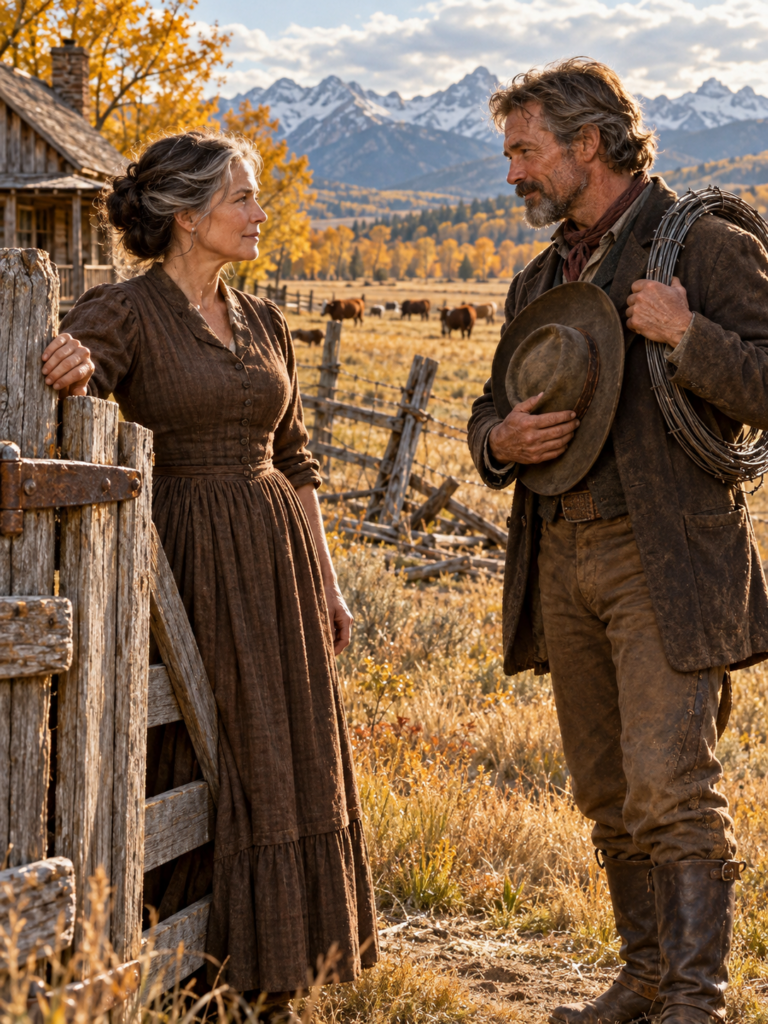
Eleanor lifted the latch and swung the repaired gate halfway open.
Samuel’s horse shifted beneath him, and he shortened the reins while she inspected the fastening.
“Why did you come yourself?” she asked. “You’ve hired men at your ranch.”
Samuel glanced at the wire.
“Thought I could manage it.”
“That wasn’t my question.”
He looked down at her.
The autumn breeze stirred the silver strands beside her temples.
“I know.”
Eleanor waited.
She had negotiated cattle prices with men who mistook silence for uncertainty. Samuel Mercer would not escape a plain question merely by being polite.
At last he said, “I saw the fence down when I rode past yesterday.”
“And?”
“I knew you’d have a long list of work before winter.”
“Everyone around here has one.”
“True.”
He paused.
“I suppose I wanted to make your list a little shorter.”
Eleanor felt an unexpected warmth.
She gave the gate a final push.
“It holds well.”
“Good.”
“But the next time you see something needing repair, I’d appreciate being asked before you bring tools.”
Samuel inclined his head.
“Fair enough.”
She moved aside, leaving the gate clear.
He rode through, then stopped beyond it.
“Would you object to another visit?”
Eleanor studied him.
“For coffee?”
“If you’ve any to spare.”
“That would be agreeable.”
Samuel’s expression softened.
“Then I’ll see you again.”
She watched him ride north until he disappeared beyond the rise.
Only afterward did she notice how long she had stood beside the gate.
The following week, Samuel returned with firewood.
Not an armful.
A full cord.
Eleanor came out of the barn and stopped in disbelief.
“Samuel, what in heaven’s name are you doing?”
“Stacking wood.”
“I can see that.”
“Your pile looked short for winter.”
“I have arrangements for my firewood.”
He set down the piece he was carrying.
“Then I’ve overstepped.”
Her irritation faltered.
Most men she knew would have argued that they were doing her a favor.
Samuel simply stood waiting.
Eleanor examined the stacked wood.
Her own supply was indeed lower than she preferred. She had planned to purchase more before the heavier cold.
“What do you want for it?”
“Whatever’s fair.”
“Then come inside and we’ll work it out.”
They agreed on a price for the wood. Eleanor paid him and insisted on keeping the terms clear.
Samuel accepted without complaint.
But he stayed afterward for coffee.
And when he left, the kitchen seemed quieter than it had before he came.
A week later, he mentioned a man who could repair the barn roof.
This time he asked before arranging anything.
Eleanor appreciated the difference.
She hired the man.
Samuel brought no ladder and issued no instructions.
Then, one Thursday afternoon, he appeared with no supplies at all.
No wire.
No wood.
No roof repair to discuss.
He stood at the door, holding his hat.
“I was passing and wondered whether you might have coffee.”
Eleanor looked at his empty hands.
Something in her chest gave a little, unexpected leap.
She stepped aside.
“Come in.”
They talked for nearly an hour.
About the ranches.
About the coming winter.
About the orchard Robert had planted.
And eventually, about the people they had lost.
Samuel spoke of Catherine without bitterness.
Eleanor spoke of Robert without pretending his death had stopped hurting.
For the first time in years, she discovered how comforting it could be to speak of grief without someone urging her to move beyond it.
When Samuel left, she walked him to the porch.
“I enjoyed that,” she admitted.
“So did I.”
After his horse disappeared, she remained outside until the cold forced her indoors.
That Sunday, Martha Greer approached her after church.
“Samuel Mercer’s been visiting.”
“Yes.”
“I hear he fixed your fence.”
“He did.”
“And brought firewood.”
“I paid him for it.”
Martha smiled knowingly.
“He seems a fine man.”
“He is.”
“Well, Eleanor, I suppose companionship is a pleasant thing, even at our age.”
The words were kindly spoken.
They hurt nevertheless.
Eleanor felt herself stiffen.
Even at our age.
As though enjoying another person’s company were something she ought to apologize for.
She gave Martha a restrained nod and went home.
That evening, she sat alone at the kitchen table.
The accounts were finished.
The lamp burned steadily.
Everything on the ranch was in order.
Yet she kept glancing toward the road.
She knew why.
And she knew she had been pretending otherwise.
Three days later, Samuel brought a jar of honey from his own hives.
Eleanor found it on the porch rail after returning from the pasture.
He had left it without knocking.
She held the jar against the fading light.
It was such a small thing.
But Samuel had remembered her.
Not as a widow requiring pity.
Not as a woman whose useful years were over.
Simply as Eleanor.
She carried the honey inside, placed it on the table, and sat down.
For a long time, she considered the difference between being capable of living alone and actually wanting to.
Then she made a decision.
She would invite Samuel to supper.
Not because she needed work done.
Not because she owed him anything.
Because she wanted him there.
She rose, took a sheet of paper from beside her ledger, and began writing an invitation.
But halfway through the first sentence, her hand stopped.
She stared at the words.
For seven years she had made every important decision without consulting anyone.
Now she was frightened by the simple act of asking a man to share an evening.
Eleanor lowered the pen.
Then, with a firmness that surprised even her, she picked it up again and finished the invitation.
Eleanor folded the invitation, pressed the crease flat, and addressed it to Samuel Mercer.
She had written a dozen difficult letters since Robert’s death.
Letters to cattle buyers.
Letters concerning debts and supplies.
Letters asking hired hands to return for another season.
None had made her feel as uncertain as this one.
Mr. Mercer,
If you are free Saturday evening, I would be pleased to have you to supper.
Eleanor Hail.
She read it twice.
Then she nearly tore it up.
The invitation was harmless. Any neighbor might accept an offer of supper.
But Eleanor knew why she had written it.
And she suspected Samuel would know, too.
The following morning, she sent the note north with a hired hand making the journey past the Mercer ranch.
Samuel’s reply arrived the next afternoon.
He would be honored.
Just three words of consequence, delivered through a courteous note.
Eleanor read them at the kitchen table.
Then she placed the paper beside her ledger and began planning supper.
On Saturday, she prepared venison stew.
It was the recipe Robert had favored, rich with potatoes and onions, cooked slowly until the meat was tender.
She had made the stew many times since his death, but rarely for company.
That afternoon, she laid out her best tablecloth.
Then she stood back and examined the table.
Two places.
Two cups.
Two chairs.
For a moment, her eyes moved toward Robert’s old chair beside the wall.
It remained where it had always stood.
She did not move it.
There was no need.
At six o’clock, Samuel knocked.
He wore his good coat and had brushed his boots carefully.
He carried no wire, no firewood, and no other explanation for his arrival.
Eleanor opened the door.
“Good evening, Samuel.”
“Evening, Eleanor.”
His eyes moved toward the prepared table.
For a brief moment he seemed at a loss for words.
“You’ve gone to some trouble.”
“I wanted to.”
That was all she said.
It was enough.
They ate slowly, discussing cattle and the coming winter before the conversation turned to quieter matters.
Samuel told her about Catherine’s fondness for early mornings.
“She could never bear to let a clear sunrise go unwatched,” he said.
“Robert was the opposite. He believed the sunrise could manage perfectly well without him.”
Samuel laughed.
They spoke easily after that.
When the dishes were cleared, Eleanor poured coffee.
Outside, November darkness lay over the pasture.
The house was quiet.
And Eleanor understood that the moment she had avoided for weeks had finally arrived.
“Samuel, I ought to tell you something.”
He set down his cup.
“All right.”
She looked at the hands resting on her lap.
They were strong hands, marked by work and cold weather.
Hands that had kept eighty acres productive through seven years of widowhood.
“I know why you’ve been visiting.”
Samuel said nothing.
“And I believe you know why I asked you here tonight.”
“I had hoped I did.”
Eleanor drew a breath.
“I’m fifty-two years old.”
“I know.”
“I’ve been alone seven years.”
“I know that, too.”
“People speak as though there’s an age when a woman ought to stop thinking about certain things.”
Samuel’s expression changed.
Eleanor forced herself to continue.
“They don’t mean to wound me. But they say I’m settled. That I have my land and my work. That I don’t need anyone.”
She looked at him.
“And somewhere along the way, I began believing that wanting companionship was foolish.”
Samuel leaned forward.
“Eleanor.”
She lifted a hand.
“Please let me finish.”
He nodded.
“I loved Robert. We had twenty-three good years. I would not exchange them for anything.”
“Nor should you.”
“But I’ve begun to wonder whether honoring that marriage means spending the rest of my life alone.”
Her voice grew softer.
“And I’m ashamed to admit how much I’ve listened to people who think I’m too old to be loved again.”
Samuel reached across the table.
He placed his hand near hers without touching it.
“May I?”
Eleanor looked at his hand.
Then placed hers in it.
He held her gently.
“Those people are mistaken.”
She tried to smile.
“You say that rather firmly.”
“I mean it.”
Samuel looked directly at her.
“I’m fifty-six. Catherine has been gone four years. For much of that time, I believed I had already been given all the happiness a man could reasonably expect.”
His thumb moved lightly against her hand.
“I didn’t ride past your property looking for another wife, Eleanor.”
“I never imagined you did.”
“But one morning I noticed your east fence had fallen.”
She listened.
“I knew you could mend it. I knew you’d find time somehow. Yet I kept thinking about how much work you already had before winter.”
He paused.
“Then I noticed your woodpile.”
Eleanor lowered her eyes.
“Samuel.”
“I went home and spent the evening wondering whether you’d have enough wood come February.”
She looked up again.
“And the next morning I found myself gathering fence wire.”
A faint smile touched his face.
“I had three perfectly good reasons for visiting you. Unfortunately, none of them was the whole truth.”
“What was?”
“I wanted to see you.”
The words were plain.
They carried no grand declaration.
Yet Eleanor felt their weight more deeply than any elaborate speech could have managed.
Samuel continued.
“I enjoy your company. I admire the way you manage this place. And I find myself looking forward to hearing what you have to say about things.”
She studied him.
“Even when I disagree?”
“Especially then, sometimes.”
She laughed softly.
But there was something he needed to understand.
“Samuel, this ranch is mine.”
“I know.”
“My name is on it. I make the decisions here.”
“As you should.”
“I won’t have someone coming into my life and behaving as though I’ve spent seven years waiting for a man to take charge.”
Samuel released her hand gently.
“I wouldn’t ask that of you.”
“And I won’t apologize for being particular.”
“I’ve noticed you’re particular.”
“Very.”
“Fortunately, I’m accustomed to careful ranchers.”
Eleanor smiled.
“Then perhaps we understand each other.”
“I hope we’re beginning to.”
She turned her hand over and took his again.
For a long moment they sat without speaking.
Then Eleanor said, “I should like to see where this leads.”
Samuel’s face softened.
“So would I.”
Nothing dramatic happened that night.
There was no hurried promise.
No demand for marriage.
No suggestion that their separate lives had suddenly become unimportant.
Samuel finished his coffee.
Eleanor walked him to the door.
Before leaving, he took her hand once more.
“May I come next Saturday?”
“Yes.”
“Without bringing anything?”
She considered.
“You may bring yourself.”
Samuel smiled.
“That I can manage.”
By December, Willow Creek had begun noticing.
Samuel came to supper regularly.
Sometimes he helped with practical work.
Sometimes Eleanor accompanied him to inspect a troublesome section of fencing on his own ranch.
They spoke about winter feed, cattle prices, and hired labor.
But they also spoke about books, memories, and the loneliness neither had admitted to others.
The town’s curiosity followed them into the general store and church.
Eleanor disliked it.
She disliked the exchanged glances and the little smiles that suggested her private life had become common entertainment.
One Sunday, Martha Greer approached her again.
“Eleanor, may I speak with you?”
“If you wish.”
Martha looked uncomfortable.
“I believe I said something thoughtless last year.”
“You’ve said several thoughtless things, Martha.”
Martha accepted that.
“I meant the remark about it being easier to find companionship when you’re younger.”
Eleanor waited.
“I was wrong.”
“Yes,” Eleanor said. “You were.”
Martha’s eyes softened.
“I never meant to suggest you were less deserving of happiness.”
“Then I’m glad you understand now.”
They stood together for a moment.
Then Martha smiled.
“Samuel looks happier than he has in years.”
“So does Eleanor Hail, I’m told.”
Martha laughed.
And Eleanor found herself laughing, too.
The following weeks did not transform her into a different woman.
She still inspected her fences.
She still kept her accounts.
She still negotiated prices firmly and expected hired men to fulfill their agreements.
Samuel did not interfere.
When she asked for his opinion, he offered it.
When she made a decision, he respected it.
And when he disagreed, he said so plainly.
Their companionship grew through precisely those ordinary exchanges.
One January morning, they found a gate hinge frozen nearly solid.
Eleanor had spent twenty minutes working at it when Samuel arrived.
“May I try?”
She stepped aside.
“Be my guest.”
He examined the hinge, worked the fastening carefully, and freed it within several minutes.
Eleanor folded her arms.
“I would have managed eventually.”
“I know.”
“Then why did you bother?”
Samuel looked at her.
“Because I was standing beside you.”
She stared at him.
The simplicity of the answer unsettled her.
He hadn’t helped because he doubted her ability.
He had helped because two people working together could sometimes make a difficult task easier.
“Thank you,” she said.
“You’re welcome.”
He closed the gate.
And they went inside for coffee.
February brought colder weather.
One morning, a section of fencing needed attention before the next hard freeze.
The hired man Eleanor generally used for the heavier work was ill.
Samuel was occupied at his own ranch.
Eleanor decided to move the wire herself.
She had done harder things.
But the ground was icy.
Halfway across the yard, her boot slipped.
She fell awkwardly, scraping her hands and striking her knee.
For several moments she sat in the cold, angry more with herself than with the ice.
Then she rose.
She finished carrying the wire.
And she said nothing about the fall.
When Samuel visited on Saturday, she moved carefully enough to conceal the worst of the soreness.
He did not notice immediately.
But the next day, as she descended the porch steps, she favored her knee.
Samuel stopped.
“What happened?”
“Nothing serious.”
“Eleanor.”
She sighed.
“I slipped while carrying fence wire.”
“When?”
“Thursday.”
He looked toward the south pasture.
“That section needed attention.”
“It did.”
“You could have sent for me.”
“I know.”
Samuel remained quiet.
Eleanor looked away.
“I thought I could manage it.”
“And you did. But you got hurt.”
“Not badly.”
He sat on the top step.
After a moment, she joined him.
The cold February air lay still around the house.
Samuel rested his hands on his knees.
“Eleanor, I’m not asking you to prove you need me.”
“I know.”
“And I’m not measuring how well you can manage alone.”
She watched the distant cattle.
“I’ve spent seven years depending on myself.”
“You’ve done remarkably well.”
“Sometimes I wonder whether I’ve become so determined not to need anyone that I refuse help when I ought to accept it.”
Samuel turned toward her.
“I know something about that.”
She looked at him.
“Do you?”
“After Catherine died, I wouldn’t ask my neighbors for much of anything. I told myself I was being considerate.”
“Were you?”
“Mostly I was afraid to let anyone close enough to notice I wasn’t managing as well as I claimed.”
Eleanor was quiet.
“I believe we may both be stubborn fools.”
Samuel smiled.
“That seems likely.”
She reached for his hand.
“Next time, I’ll ask.”
“And next time,” he said, “I’ll be glad to come.”
They sat together until the cold finally drove them indoors.
Spring reached Willow Creek in April.
The pasture began greening.
The orchard showed the first promise of blossoms.
And one morning, Eleanor and Samuel went to reset a fence post that had been troublesome since autumn.
They worked on opposite sides, steadying the post and packing the earth firmly around it.
Eleanor stepped back.
“That should hold.”
Samuel tested it.
“Looks sound.”
She watched him for a moment.
Then she said, “Will you stay for supper tonight?”
“I’d be pleased to.”
“There is something else I’d like to discuss.”
Samuel studied her face.
“Something troubling you?”
“No.”
She smiled.
“Something I’ve finally made up my mind about.”
He set down the tool.
And waited for her to speak.
Eleanor looked at the newly settled fence post and brushed the earth from her gloves.
Samuel waited beside her.
She had spent the winter considering what it meant to love someone again.
The answer had not come all at once.
It had arrived through small things.
A repaired gate.
An invitation to supper.
A hand offered across a kitchen table.
A disagreement about work that ended in understanding instead of resentment.
A man who knew she could manage her life and wanted to share it anyway.
“I’ve been thinking about Robert,” she said.
Samuel nodded.
“He was a good husband.”
“You’ve told me enough to make that plain.”
“We worked this land together for twenty-three years. He planted those trees. We built much of what stands here.”
Her eyes moved toward the orchard.
“When he died, I thought keeping everything going was the best way to honor him.”
“And you did.”
“Yes.”
She turned toward Samuel.
“But I began mistaking the life we’d built for a rule that I must never build anything more.”
Samuel remained silent.
Eleanor continued.
“I was a good wife to Robert. I’ve been a good steward of this property. And for seven years, I’ve been a capable widow.”
“You have.”
She drew a breath.
“But I don’t want widowhood to be the last word anyone uses to describe my life.”
Samuel looked at her for a long moment.
Then he nodded.
“I understand.”
They finished gathering their tools and walked toward the house together.
That evening, after supper, they sat on the porch while the Montana sky faded toward blue.
The creek could be heard beyond the pasture.
A mild spring wind moved through the orchard.
Eleanor rested her hands on the porch rail.
“I want to tell you something plainly, Samuel.”
“All right.”
“I was enough before you came.”
He turned toward her.
“I’ve never doubted it.”
“I don’t want you to think I was merely waiting for someone to complete my life.”
“I don’t.”
She looked at him.
“That’s part of why I want you in it.”
Samuel’s expression softened.
For a while, neither spoke.
Then he said, “I remember riding past here in October.”
Eleanor smiled.
“With your wire?”
“Before the wire.”
She turned.
“What do you mean?”
“I passed your place three times before I gathered the nerve to stop at the gate.”
Eleanor stared.
“Three times?”
“Over several days.”
“And the fence?”
“It was down.”
“But you could have told one of my hands.”
“Yes.”
“Or sent word.”
“Yes.”
She began to laugh.
Samuel smiled.
“I was a little uncertain whether you’d welcome my company.”
“Well, you did arrive with a very convincing excuse.”
“I thought so.”
Eleanor shook her head.
Then she grew serious.
“I’d like to stop hiding behind excuses.”
Samuel reached across the space between their chairs.
“That would suit me.”
She took his hand.
“My land remains mine.”
“Certainly.”
“My accounts remain under my direction.”
“I’d expect nothing else.”
“And I don’t intend to become a woman who asks permission to make decisions about her own property.”
Samuel’s smile deepened.
“Eleanor, if you ever started asking me permission to manage your own cattle, I’d wonder whether you were feeling unwell.”
She laughed again.
Then she looked directly into his eyes.
“Samuel Mercer, would you care to ask me something?”
He seemed to stop breathing for a moment.
Then he rose from his chair.
Eleanor turned toward him.
He did not kneel.
They were not young people in a storybook.
They were a woman of fifty-two and a man of fifty-six who had known grief, work, and years of ordinary responsibility.
Samuel stood before her, holding her hand.
“Eleanor Hail, I’d like to marry you.”
Her eyes filled.
“I’d like to share the work and the evenings, and whatever years we’re fortunate enough to have.”
He paused.
“I don’t need your land, and I don’t want your authority over it. I have my own ranch to manage.”
She smiled through her tears.
“And what do you want?”
“You.”
The word was almost a whisper.
“The woman who tells me when I’m wrong. The woman who balances her accounts before supper. The woman who can run a ranch and still laugh when a foolish widower arrives with fence wire.”
Eleanor squeezed his hand.
“That is a rather peculiar proposal.”
“I feared it might be.”
“It’s also the best one I’ve heard in a very long time.”
He searched her face.
“Is that a yes?”
“Yes, Samuel.”
His shoulders relaxed.
She rose and stepped closer.
“And I believe it’s time you kissed me.”
He looked at her with such open surprise that she laughed.
Then he gently touched her cheek and kissed her.
It was not a youthful kiss, hurried by uncertainty or made grand by imagination.
It belonged to two people who knew what years could take away and had decided not to waste the tenderness still available to them.
When they parted, Samuel rested his forehead briefly against hers.
“I thought I might never have this again,” he said.
“So did I.”
Eleanor smiled.
“We were mistaken.”
They married in June 1885 at the Willow Creek church.
The ceremony was small.
Neither wanted elaborate arrangements.
The reverend stood before them.
Neighbors filled the pews.
Martha Greer sat near the front, having brought a pie for the supper afterward.
Eleanor wore a cream-colored dress.
It was simple and carefully made, fitted to a woman who had lived fifty-two years without apology.
Her dark hair, threaded generously with silver, was pinned neatly at the back.
Samuel stood in his best coat.
He looked more nervous than he had during any cattle negotiation Eleanor had witnessed.
When she reached his side, she whispered, “You appear troubled.”
“I’ve discovered marrying you is a considerable undertaking.”
“Too late to reconsider.”
“I wouldn’t dream of it.”
The reverend cleared his throat.
Eleanor bit back a smile.
They spoke their vows.
Not as strangers hoping love might follow an arrangement.
Not as two lonely people afraid to face another winter.
But as partners who had taken the time to know one another and understood the lives they were choosing to share.
Afterward, Martha Greer embraced Eleanor.
“I’m happy for you.”
“Thank you.”
Martha stepped back.
“I hope you’ll forgive some of the things I’ve said over the years.”
Eleanor regarded her.
“I believe you meant well.”
“I did.”
“Then I hope you’ll think more carefully before telling another woman what sort of happiness her age permits.”
Martha nodded.
“I will.”
Eleanor embraced her again.
That was enough.
The wedding supper filled the little church hall with laughter and conversation.
Samuel remained close to Eleanor, not because he feared she would disappear, but because he enjoyed being beside her.
At one point, he brought her a cup of coffee.
She accepted it.
“You remember how I take it.”
“I should hope so.”
“And you didn’t forget the cream.”
“That would have been a poor beginning to our marriage.”
She smiled.
“You’ve done rather well so far.”
The townspeople who had once assumed Eleanor’s romantic life was finished now watched her laugh with her husband.
Some looked surprised.
Others seemed quietly pleased.
Eleanor gave little thought to either reaction.
She had spent too many years allowing casual opinions to determine what she believed possible.
She would not carry them into her marriage.
After the wedding, Samuel moved into the Hail farmhouse.
Their properties remained separate.
The Hail ranch stayed Eleanor’s.
The Mercer ranch remained Samuel’s operation.
Each continued managing the work and accounts for which they were responsible.
They consulted one another often.
Sometimes they agreed immediately.
Sometimes they disagreed for an hour.
But neither assumed marriage had made the other less capable of judgment.
Samuel traveled north when his own cattle required attention.
Eleanor continued supervising her herd, orchard, garden, and hired help.
When work demanded more hands, they shared labor by agreement.
When it did not, they respected each other’s routines.
The arrangement puzzled a few neighbors.
One man at the feed store asked Samuel why he hadn’t simply taken over Eleanor’s property.
Samuel regarded him.
“Why would I do that?”
“Well, you’re married now.”
“That doesn’t make me better acquainted with her land than she is.”
The man laughed awkwardly.
Samuel did not.
He bought the supplies he needed and went home.
That evening, he mentioned the conversation to Eleanor.
She listened without interrupting.
Then she said, “Did you explain that I’ve managed this ranch successfully for seven years?”
“I believe I made that clear.”
“Good.”
He hung his coat beside the door.
“Though I did neglect to mention that you negotiate prices more fiercely than anyone I’ve met.”
“Then you failed to give the fellow the full picture.”
Samuel laughed.
She came to him and kissed his cheek.
“Thank you.”
“For what?”
“For understanding what matters.”
He rested his hand against hers.
“I’ve been learning.”
Their first winter as husband and wife was busy.
The cattle needed feed.
Fences required watching.
Ice made travel troublesome.
But when Samuel returned from his ranch in the evening, he no longer entered a silent house.
Eleanor would often be at the kitchen table finishing her accounts.
Sometimes she looked up immediately.
Sometimes she held up one finger and finished a calculation before greeting him.
Samuel grew fond of both responses.
There were evenings when he sat beside the stove reading while she sewed.
Others when they talked late into the night.
Neither needed the other to fill every silence.
They were comfortable enough to let ordinary life continue.
In 1886, both ranches enjoyed an excellent cattle season.
Eleanor credited the weather, careful management, and the steady work of the hired men.
Samuel insisted her calculations on feed and grazing had made a difference.
“Don’t flatter me,” she told him.
“I wouldn’t dare.”
“You frequently do.”
“Then I must become more cautious.”
She laughed.
The following year, Eleanor grafted two new apple trees from the orchard Robert had planted.
Samuel helped construct protective frames for the young trees.
They worked together on a clear morning, placing the supports carefully so the growing branches would have room.
When they finished, Eleanor stepped back.
“Robert planted the originals our first spring here.”
Samuel looked at the older trees.
“They’ve done well.”
“They have.”
She touched one of the young branches.
“I wanted something of them to continue.”
Samuel rested his hand lightly against the frame.
“Then we’ll look after these.”
Eleanor turned toward him.
He had not suggested removing the old trees.
He had not treated Robert’s work as an uncomfortable reminder.
Instead, he had helped make room for something new to grow from it.
She slipped her arm through his.
“Thank you.”
Samuel looked toward the orchard.
“For the frames?”
“For understanding.”
They stood together in the spring sunshine.
Years later, those two grafted trees would bear fruit of their own.
And Eleanor would remember that morning with particular fondness.
Montana became a state in November 1889.
Eleanor and Samuel rode into Willow Creek for the celebration.
They stood among neighbors as the town marked the occasion.
The settlement was changing.
New businesses appeared.
Families grew.
Some old friends moved away.
Others stayed and watched the familiar streets become busier.
Through it all, Eleanor continued tending her property.
Samuel continued working his.
They did not regard the years of their marriage as an escape from responsibility.
They regarded them as years in which responsibility was easier to carry because someone cared whether they were tired at the end of the day.
Martha Greer eventually retired to her daughter’s home in Helena.
She wrote Eleanor every Christmas.
Eleanor answered faithfully in January.
Sometimes the letters mentioned children, weather, or town news.
Sometimes they contained little beyond the pleasure of staying acquainted.
Neither woman needed to revisit every thoughtless remark of the past.
Martha had apologized.
Eleanor had accepted.
Their friendship continued.
As Samuel grew older, his hair became entirely white.
Eleanor’s dark hair gave way to silver.
They moved a little more slowly in the mornings.
Tasks that had once required an hour sometimes needed an afternoon.
Both learned to ask for help more readily.
Yet neither surrendered the satisfaction of doing what remained within their abilities.
One January, Samuel strained himself trying to move a heavy piece of equipment without assistance.
Eleanor found him resting by the barn.
She folded her arms.
“Samuel Mercer.”
He looked up.
“I know.”
“What do you know?”
“That I should have called one of the hands.”
“And why didn’t you?”
“Thought I could manage.”
Eleanor stared at him.
Then began to laugh.
Samuel sighed.
“I suppose I’ve earned that.”
“Every bit of it.”
She sat beside him.
“Do you remember my fall on the ice?”
“Very well.”
“And what you told me?”
“That asking for help wasn’t the same as needing to be saved.”
She nodded.
“Wise advice.”
“Apparently easier to give than to follow.”
“Most wise advice is.”
He took her hand.
“I’ll ask next time.”
“See that you do.”
Their laughter carried into the cold barnyard.
By the autumn of 1891, seven years had passed since Samuel first approached her gate with a coil of wire.
Eleanor was sixty.
Samuel was sixty-four.
The orchard was preparing for another winter.
The original trees Robert had planted stood tall and weathered.
The younger grafted trees were growing well.
The cattle grazed in the fading afternoon light.
And the east fence, repaired and maintained through the years, ran straight along the property.
One October evening, Eleanor sat on the porch with a book resting unopened in her lap.
Samuel sat beside her, drinking coffee.
The sky beyond the mountains had turned amber.
She looked at the orchard, the pasture, and the long fence line.
Then she smiled.
“Samuel?”
“Yes?”
“I nearly refused to let you through that gate.”
He glanced toward the road.
“I remember.”
“I thought you were interfering.”
“I feared you’d think so.”
“Then why did you come?”
Samuel considered.
“The fence truly needed mending.”
“Samuel.”
He smiled.
“And I wanted to see you.”
She shook her head.
“Seven years married, and you’re still relying on that excuse.”
“It worked the first time.”
“Only just.”
He laughed.
Then Eleanor leaned back in her chair.
“I was frightened, you know.”
“Of me?”
“Of what wanting your company might mean.”
Samuel listened.
“I had convinced myself that being content was all I should expect. That because I could manage alone, I ought to want nothing more.”
She watched the last sunlight touch the apple trees.
“I had a good life before you came.”
“I know.”
“I was proud of it.”
“You should have been.”
“And I was lonely.”
Samuel reached for her hand.
“I was lonely, too.”
Eleanor looked at him.
“Do you suppose everyone knew?”
“Everyone except us, perhaps.”
She laughed.
Then her expression softened.
“I wonder what would have happened if I hadn’t opened the door.”
Samuel looked toward the repaired gate.
“I expect I’d have found another reason to pass by.”
“More wire?”
“Possibly.”
“More firewood?”
“Likely.”
“More honey?”
“Certainly.”
She smiled.
“You are an exceedingly persistent man.”
“Only when the matter is worth attending to.”
Eleanor turned her hand beneath his and held on.
For a while they watched the evening settle over the land.
Robert’s orchard stood behind them.
Samuel’s horse grazed nearby.
The house carried memories of two marriages, two kinds of happiness, and years of difficult, honest work.
Nothing had needed to be erased.
Nothing Eleanor had built before Samuel arrived had become less valuable.
She still owned her land.
She still balanced her accounts.
She still made decisions with the authority of a woman who understood the cost of every fence, every animal, and every season.
But now, when the daylight faded, she had someone who noticed.
Someone who asked whether she was tired.
Someone who listened when the accounts troubled her.
Someone who knew when she wanted help and respected her when she did not.
At sixty, Eleanor no longer wondered whether she was too old to be loved.
The question itself seemed strange to her now.
She had not become younger.
She had not become less independent.
She had not exchanged the life she built for one that belonged to a man.
She had simply allowed herself to share it.
Samuel finished his coffee and rose.
“Getting cold.”
“A little.”
“Shall we go inside?”
Eleanor looked once more toward the east fence.
Seven years earlier, she had stood at that gate, certain that the years ahead would contain work, responsibility, and the quiet satisfaction of endurance.
She had not expected romance.
She had not expected a second marriage.
She had certainly not expected a widowed rancher to arrive carrying wire and discover a reason to keep returning.
Yet here he was.
Older.
Whiter-haired.
Still considerate enough to ask rather than assume.
She closed her book.
“Yes, Samuel. Let’s go inside.”
He offered his hand.
She took it.
Together they crossed the porch toward the warm kitchen.
And on the table, just as there had been on that first October afternoon, waited two coffee cups.
Neither was there by accident.
Eleanor Hail had once believed that a woman of fifty-two had already lived the years in which love might find her.
At sixty, she knew better.
Love had not come to replace her strength.
It had come to stand beside it.
And the gate she had opened for a neighbor carrying fence wire had become the beginning of a home where two independent hearts could finally rest together.