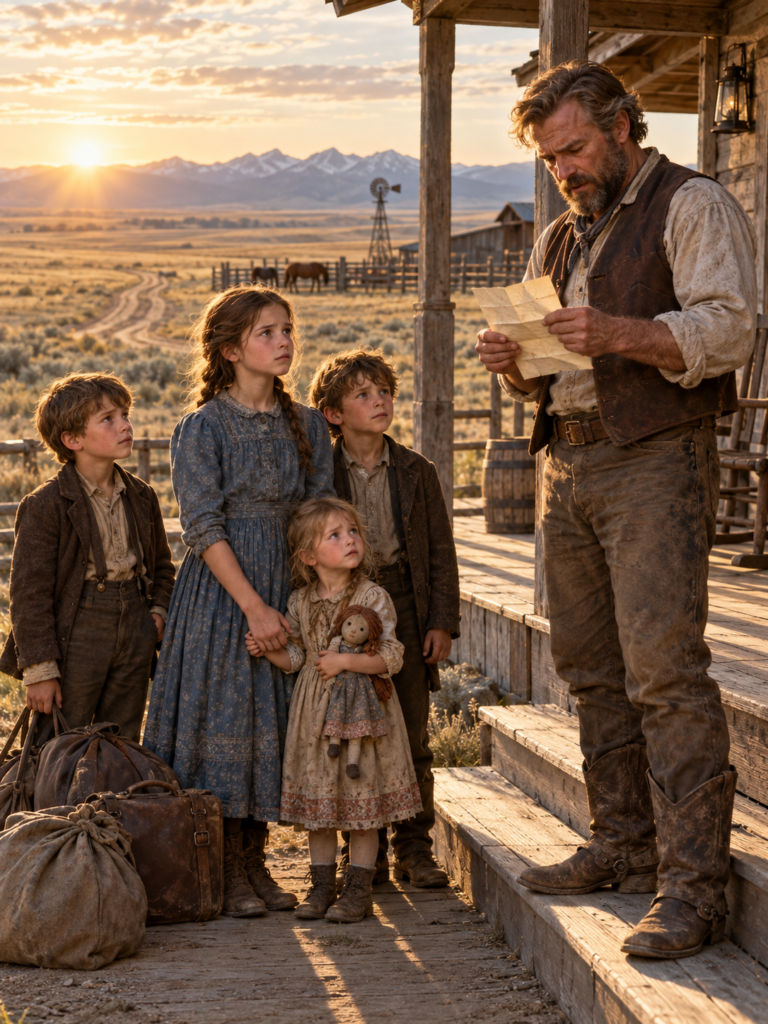
The thin paper trembled slightly in Ezekiel’s hand as he held it toward the lantern.
Vera had written those final words with such force that the nib had nearly torn the sheet.
Do not come looking for me.
He knew her well enough to understand that this was no casual request.
Whatever had taken her away, she had meant to keep him out of it.
But she had also placed four children directly in his care.
That contradiction troubled him.
A floorboard creaked behind him.
Ezekiel turned.
Delia stood in the kitchen doorway, barefoot and carrying Nell’s rag doll.
“She’s asleep,” the girl said. “But she kept asking whether Mama would know where to find us.”
Ezekiel set the letter down.
“What did you tell her?”
“That Mama knows the way.”
“She does.”
Delia came nearer.
“Mr. Barrow, are we in trouble?”
He considered lying.
Instead, he pulled out the chair beside him.
“Come sit.”
She obeyed, keeping the doll in her lap.
“Your mother has something important to attend to,” he said. “I don’t know everything about it. I won’t pretend otherwise.”
“Does it have to do with Papa?”
Ezekiel went still.
“Why do you ask?”
“Because she started worrying more after those men came asking about our land.”
There it was.
The first piece of the trouble Vera had not dared explain in her letter.
“What men?”
“I don’t know their names. They asked Mama whether she’d considered selling.”
“And what did she say?”
“That the land wasn’t theirs to ask for.”
Ezekiel recognized Vera in every word.
Delia looked down at the doll.
“She told us to stay together. She said you were someone she trusted.”
“She was right about that.”
“How do you know?”
He glanced at the little girl’s guarded expression.
“Because whatever happens, you four will have food, beds, and somebody watching out for you while you’re here.”
Delia studied his face.
Then she placed the doll on the table.
“Good. Because Sam’s brave until he’s scared, and Eli gets angry when he doesn’t know what to do. Nell needs somebody to sit with her sometimes.”
“And what do you need?”
The question seemed to catch her completely unprepared.
She opened her mouth.
Closed it.
Finally she said, “I don’t know.”
Ezekiel felt something painful settle in his chest.
“Then we’ll work that out too.”
The next several days revealed just how little he knew about raising children.
Sam was happiest near the horses, though Ezekiel kept him away from unfamiliar animals unless supervised.
Eli wanted to repair anything with a loose nail.
Delia knew more about keeping a household orderly than most adults Ezekiel had met.
And Nell rarely spoke.
She followed him from room to room at a cautious distance, always with the rag doll tucked beneath her arm.
One morning, Ezekiel attempted to braid her hair.
He had repaired saddles, handled stubborn horses, and managed difficult livestock.
Three strands of a little girl’s hair defeated him.
“You’re pulling,” Delia informed him.
“I’m trying not to.”
“Then try differently.”
He handed over the comb.
“Show me.”
She did.
He watched closely.
By the third attempt, the braid was crooked but considerably less painful.
Nell touched it, considered his efforts, and permitted it to remain.
It felt like a victory.
That afternoon, while the twins helped with small chores near the house, Delia brought him another question.
“Are you going to send us away?”
Ezekiel looked up from a loose fence post.
“No.”
“Even if Mama takes a long time?”
“Even then.”
She looked toward the road.
“She said we might have to be brave.”
“Being brave doesn’t mean doing everything yourself.”
Delia gave him a doubtful look.
He offered her the small hammer he had been using.
“Hold this while I steady the rail.”
She took it.
For the first time, she seemed less like a frightened girl protecting three younger children and more like a child who had been allowed to put down part of her burden.
That evening, Ezekiel returned from checking livestock to find all four waiting near the gate.
Sam was shouting before the horse had stopped.
Eli claimed he had finished his chores first.
Delia demanded they let the horse stand quietly.
And Nell raised one small hand in greeting.
Ezekiel dismounted.
The little girl walked toward him and placed her hand in his.
Then she looked up.
“Will Mama still know where we are?”
It was the first full question she had asked him.
He crouched beside her.
“Your mama knows this ranch. She’ll know where to find you.”
Nell squeezed his fingers.
Ezekiel wanted to promise that Vera would return soon.
But he could not know that.
So he made the promise he could keep.
“Until she comes, you’re staying right here with me.”
Nell nodded.
Then, beyond the yard, a faint movement caught his attention.
Far out on the road, several mounted figures were approaching.
Ezekiel rose slowly.
He took Nell’s hand and turned toward the house.
“Delia,” he said, keeping his voice level. “Take your brothers and sister inside.”
The girl saw the riders.
She understood immediately.
“Are those the men?”
“I don’t know.”
Ezekiel opened the front door for them.
“Stay together.”
Delia gathered the younger children.
And as the first rider turned toward the ranch gate, Ezekiel stepped out onto the porch and pulled the door shut behind him.
The door clicked shut behind Ezekiel just as the riders reached the gate.
There were several men, their horses dusty from the road.
The leading rider studied the ranch house before looking at Ezekiel.
“Afternoon.”
“Afternoon.”
“We’re looking for Vera Langley.”
Ezekiel rested one hand against the porch rail.
“Can’t help you with her whereabouts.”
The man shifted in his saddle.
“She’s been moving around the territory. We thought she might have come this way.”
“Haven’t seen her.”
It was true.
He had not seen Vera since before the children arrived.
The rider looked beyond him.
Four tin cups stood drying along the porch rail.
A little coat hung from a low peg.
Nell’s doll, forgotten when Delia hurried her indoors, lay near the top step.
The man’s gaze lingered.
“Got company?”
“Family visiting.”
“That so?”
“That is so.”
The man looked at the closed door.
“Children?”
“Sometimes.”
Ezekiel’s voice remained calm.
He knew the rancher was not being asked an innocent question. He also knew that anger would only encourage further inspection.
The rider smiled without much warmth.
“We’ve heard Mrs. Langley might have left her children with somebody.”
“Have you?”
“Wouldn’t happen to know anything about that?”
Ezekiel met his eyes.
“You asked whether Vera was here. I told you she wasn’t.”
For several seconds, neither man spoke.
The other riders waited.
Finally, the leader touched the brim of his hat.
“Well, if she comes around, tell her some folks are interested in speaking with her.”
“I’ll remember you called.”
The men turned away.
Ezekiel stayed on the porch until their horses disappeared down the road.
Only then did he go inside.
Delia stood near the kitchen table, holding Nell against her.
Sam and Eli were unusually silent.
“Did they find Mama?” Delia asked.
“No.”
“Did they ask about us?”
Ezekiel removed his hat.
“They asked some questions.”
“Did you tell them?”
“No.”
Relief crossed her face, but it did not last.
“They’ll keep looking.”
He could not honestly deny that possibility.
“I know.”
Delia glanced toward the window.
“What should we do?”
“Carry on with our work and tell me if you see strangers coming toward the house. Don’t go out to meet them.”
She nodded.
Then Nell pulled at his sleeve.
“Bad men?”
Ezekiel crouched.
“Men asking questions they had no business asking here.”
Nell considered this.
“Will you stay?”
“I’m right here.”
She slipped her hand into his.
That evening, Ezekiel checked the doors and made sure the children’s beds were settled well inside the house.
The riders had not threatened him outright.
But their interest confirmed something he could no longer dismiss.
Vera’s absence had a purpose.
And someone powerful enough to send men searching the countryside wanted to discover where she had gone.
Ezekiel had heard the name Edmund Voss more frequently since Thomas Langley’s death.
Voss owned extensive grazing land across several counties and possessed the sort of influence that made other men cautious when they spoke of him.
The Langley property had attracted his attention.
Thomas had resisted selling.
Then Thomas had died.
A man could draw conclusions from that sequence, but conclusions were not proof.
Vera understood that distinction.
She also understood, Ezekiel now suspected, that her children were safer beyond the reach of men who might use them to influence her decisions.
He looked toward the back room.
Sam and Eli were arguing softly over a blanket.
Delia was trying to persuade them to sleep.
Nell held her doll beneath her chin.
Ezekiel had spent years believing that the only lives he was responsible for were his own and those of the animals in his care.
Now he would have stood against every rider in the territory before willingly delivering those children into danger.
But he understood that protecting them required more than stubbornness.
He must keep the ranch running.
He must maintain their routines.
Most importantly, he must avoid doing something reckless that would leave them without a dependable adult.
So he remained watchful without turning their days into a state of alarm.
In the weeks that followed, the children gradually made themselves part of the ranch.
Sam learned that a horse’s trust could not be hurried.
Ezekiel showed him how to approach calmly, observe an animal’s ears, and keep clear of its feet.
The boy listened with a concentration that surprised his brothers.
“He’s always talking to horses,” Eli complained one afternoon.
“Perhaps they prefer his conversation,” Ezekiel replied.
“They don’t answer.”
“Not in words.”
Sam grinned triumphantly.
Eli rolled his eyes.
His own interests lay in fixing things.
When Ezekiel worked on fence rails, Eli watched every movement.
He asked questions, challenged the reason for particular repairs, and developed a fierce desire to do the work correctly.
Ezekiel let him handle only tasks appropriate to his age, but he treated each effort seriously.
A crooked nail became an opportunity to learn rather than an occasion for ridicule.
Eli proved especially pleased whenever his work earned a simple, “That’ll hold.”
Delia remained the most difficult child to reassure.
Not because she misbehaved.
Because she behaved too well.
She anticipated meals, corrected her brothers, and watched Nell with a vigilance no eleven-year-old should have needed to maintain.
One evening, Ezekiel found her standing over a pot of potatoes.
“Where are the boys?” he asked.
“Finishing their chores.”
“And why are you fixing supper by yourself?”
“Somebody has to.”
“Then I’ll help.”
She hesitated.
“I know how to do it.”
“I’ve no doubt.”
He took another knife and began peeling potatoes beside her.
After a while, Delia asked, “Do you think Mama’s frightened?”
Ezekiel laid a peeled potato into the water.
“I expect she misses you.”
“That isn’t what I asked.”
“No.”
He considered his answer carefully.
“Your mother is a brave woman. Brave people can be frightened too.”
Delia watched his hands.
“Was she brave when she was little?”
“More than was sensible.”
That earned a faint smile.
“Tell me.”
Ezekiel told her about the creek and the summer afternoon when Vera had marched into his father’s barn, furious that he had been fishing in what she considered her favorite spot.
“She told me I was a thief,” he remembered.
“Was it her creek?”
“Wasn’t anybody’s creek.”
“Then she was wrong.”
“She was wrong about owning it.”
“What was she right about?”
Ezekiel smiled.
“It was the best fishing place.”
Delia laughed.
The sound surprised them both.
Then she asked another question.
“Did you like Mama?”
“I did.”
“Even when she argued?”
“Especially when she argued honestly.”
Delia thought about that.
“She still does.”
“I expect she always will.”
That night, she allowed Ezekiel to finish washing the supper dishes while she went to sit with Nell.
He noticed the change.
Small as it was, it mattered.
She was beginning to trust that another adult would take responsibility when she set hers aside.
Meanwhile, far from the ranch, Vera Langley was pursuing the answers that had forced her to leave.
Her husband’s death had been recorded as an accident.
She had tried to accept that explanation.
But after Thomas was buried, questions about their property had become more persistent.
Men connected to Edmund Voss wanted to know what she intended to do with the land.
Some seemed remarkably interested in records Thomas had kept before his death.
Thomas had left papers behind.
Purchase records.
Receipts.
Notes concerning transactions that had seemed ordinary until Vera began comparing them.
Individually, many of the documents revealed little.
Together, they suggested a pattern of manipulation surrounding land Voss wanted to control.
Vera had brought her concerns to the sheriff.
He had listened.
He had not dismissed her as foolish or incapable.
But he had told her plainly that suspicion would not be enough.
If she expected him to act against a man with Voss’s influence, she needed evidence that could withstand serious questioning.
So she began looking for it.
She traveled between settlements, land offices, and county record rooms.
She studied old entries and sought out people who had dealt with Voss before.
Some were willing to talk.
Others became frightened as soon as they heard his name.
One prospective witness disappeared before a lawyer could take his account.
Vera learned to ask precise questions.
She also learned not to reveal her destination to everyone who inquired.
In larger towns, she sometimes used her family name from before marriage, hoping to avoid attention from anyone looking specifically for Vera Langley.
At night, in rented rooms, she made careful notes by lamplight.
The hardest part was not the searching.
It was the absence of her children.
She imagined Nell asking for her at bedtime.
She pictured the twins arguing over chores and Delia trying too hard to be grown.
Several times, she nearly abandoned the search and returned home.
Then she remembered the men who had come asking about her land.
She remembered how easily her children might be used to frighten her into surrendering what Thomas had worked to protect.
And she continued.
A letter from Delia finally reached her during that difficult stretch.
It described Ezekiel’s disastrous pancakes.
It reported that Sam had become convinced he could converse with horses.
It included an account of Eli’s latest argument over chicken feed.
Inside the envelope was a pressed wildflower.
Delia explained that Nell had picked it for her mother.
Vera held the flower in her palm for a long time.
Then she tucked it into her travel notebook.
She had entrusted her children to Ezekiel because she knew the man he had been.
The letter was teaching her something about the man he had become.
At the ranch, Ezekiel had his own reminders that Vera remained absent.
Nell began speaking more freely.
But she continued asking when her mother would come back.
Sometimes the question came during breakfast.
Sometimes while Ezekiel braided her hair.
Sometimes just as she was falling asleep.
He never invented a date.
Instead, he told her what he knew.
“Your mama loves you.”
“She’s doing something important.”
“And when she can return safely, she’ll know where you are.”
One evening, as he tucked the blanket around her, Nell studied his face.
“Will you still be here?”
Ezekiel smiled faintly.
“Where else would I go?”
She considered this as though it required serious thought.
Then she reached for his hand.
“Good.”
He stayed beside her until she slept.
In time, Nell began falling asleep against his chest in the evenings.
Sam and Eli raced toward the gate whenever they heard his horse returning.
Delia started asking his opinion before making decisions that she once would have taken upon herself.
The ranch house grew louder.
Boots collected near the door.
Small belongings appeared where Ezekiel would never have thought to leave them.
The kitchen table became a place for disagreements, stories, and laughter.
Occasionally he missed the old silence.
More often, he realized he would miss the noise terribly if it disappeared.
Nearly two months after she had begun searching in earnest, Vera found the man whose account could connect her scattered evidence.
His name was Colby.
He had once worked for Voss.
He had left that employment quietly and was living in a town two counties away.
When Vera finally located him, he was reluctant to speak.
He had reason to fear his former employer.
But he also carried guilt.
He admitted that he had been paid to follow Thomas Langley during the week before Thomas died.
He had reported Thomas’s movements to Voss’s foreman.
Colby had not witnessed the death.
He could not truthfully say who had caused it.
But he had seen an entry in Voss’s private account records concerning the Langley matter.
The wording disturbed him.
It suggested that the problem of Thomas Langley had been settled.
Vera listened without interrupting.
Then she asked the question upon which everything depended.
“Will you give that account formally?”
Colby looked away.
“I don’t want my name in the papers.”
“I cannot promise what a court might require. But I can promise I won’t pretend you saw something you didn’t.”
He studied her for a long while.
Finally, he agreed to make a statement.
When Vera brought that testimony together with the questionable land records and accounts from two other families who had suffered pressure from Voss, she finally possessed more than suspicion.
She had corroborating evidence.
Enough, she hoped, to make further investigation unavoidable.
She carried the assembled papers to the sheriff.
He examined them carefully.
He compared names, dates, and entries.
Then he looked at Vera.
“You’ve done a great deal of work.”
“I had to.”
“This warrants action.”
For the first time in months, Vera felt her shoulders loosen.
But she did not yet feel safe.
Evidence could begin a case.
It could not, by itself, guarantee what the case would uncover.
The sheriff laid Colby’s statement beside the suspicious ledger entry.
Then he said, “Mrs. Langley, I believe it’s time Mr. Voss answered some questions.”
The sheriff gathered Vera’s documents and began the questioning that Edmund Voss had avoided for months.
Vera watched him compare the entries again before placing the papers in order.
She had imagined this moment during countless sleepless nights.
Yet now that it had arrived, she felt no triumph.
Only exhaustion.
Thomas was still dead.
Her children were still miles away.
And no matter what the sheriff uncovered, the life her family had known before Thomas’s death could not be restored.
But the truth mattered.
Her husband’s memory mattered.
And the land he had struggled to protect could not simply be surrendered because another man possessed greater wealth and influence.
Edmund Voss arrived at the sheriff’s office expecting the matter to be settled quickly.
He was accustomed to authority.
He owned extensive grazing property across several counties.
His acquaintances included influential men who had reason to value his favor.
Voss had spent years conducting business in a manner that discouraged disagreement.
He did not expect a widow’s investigation to present him with serious difficulty.
When he entered the office, he looked from Vera to the papers on the desk.
“Mrs. Langley,” he said. “Still troubling yourself over old matters?”
Vera remained seated.
“Old matters have a way of remaining important when they’ve never been settled honestly.”
Voss gave a thin smile.
The sheriff gestured toward the chair opposite him.
“Sit down, Mr. Voss.”
“I assume this concerns Mrs. Langley’s unfortunate suspicions.”
“It concerns several records and a statement from a former employee.”
Voss’s expression hardened.
The sheriff laid out the evidence.
There were land transactions that deserved scrutiny.
Accounts from families who had faced intimidation.
And Colby’s signed statement concerning the surveillance of Thomas Langley before his death.
Voss dismissed Colby as unreliable.
He questioned Vera’s interpretation of the financial records.
He insisted that Thomas’s death had been an accident and that nothing in his business dealings established otherwise.
His lawyer soon arrived and challenged the significance and origins of the documents.
But the sheriff did not simply accept those objections as an end to the matter.
Vera’s evidence was substantial enough to justify further investigation.
The questions multiplied.
Others who had previously remained silent began to speak.
Records that had once appeared unrelated were examined together.
What emerged was a pattern of pressure against families whose property Voss wanted.
Some had been intimidated into accepting terms they did not want.
Others had encountered suspicious obstacles when attempting to protect their interests.
Vera’s own land had become one more target.
Thomas had noticed irregularities before his death.
His notes showed that he had begun piecing together the relationship between Voss’s business dealings and the pressure placed upon nearby property owners.
That discovery had made Thomas an obstacle.
And the examination of the evidence revealed that his death had not been the innocent accident the county had initially believed.
The inquiry established a connection between the attempts to silence him and the interests Voss had sought to protect.
Vera learned more than she had ever wanted to know about the final days of her husband’s life.
She heard testimony.
She examined records.
She endured the painful distinction between what witnesses knew, what they suspected, and what the evidence could establish.
Colby never claimed to have been present when Thomas died.
His account concerned the surveillance he had carried out and the troubling entry he had seen afterward.
That limitation mattered.
So did the supporting records and testimony.
The case was built from the combined evidence rather than from any single dramatic accusation.
As the investigation proceeded, Voss’s ability to dismiss the matter as a grieving widow’s imagination collapsed.
The pressure he had exercised upon other families became part of the scrutiny.
The manipulation surrounding the land transactions was exposed.
And Thomas Langley’s death, so long treated as a closed matter, was formally reconsidered in light of the wrongdoing uncovered.
Vera had achieved what she had set out to do.
The truth had been brought into the open.
Her family’s property was no longer vulnerable to the same hidden pressure.
She could return to her children without continuing to search alone.
Yet when she finally prepared for the journey home, she felt strangely afraid.
She had spent so many weeks determined to uncover the truth that she had barely permitted herself to imagine what returning would be like.
Would Nell remember the sound of her voice?
Would the twins be angry?
Would Delia forgive her for leaving?
And what would she say to Ezekiel, the man whose help had made her search possible?
She had known him since childhood.
But knowing a person and asking him to care for four frightened children were very different things.
She owed him more thanks than she could easily put into words.
She also understood that gratitude would not explain everything she might find waiting at his ranch.
During the journey, Vera took out the pressed wildflower Nell had sent.
Its petals had flattened between the pages of her notebook.
She touched them gently.
Then she put the flower away and continued toward home.
It was afternoon when her wagon approached Ezekiel’s property.
The familiar house appeared beyond the rise.
The porch stood in the same place.
The fence still followed the yard.
But the scene was not as she remembered it.
Children’s clothing hung near the house.
There were small boots by the steps.
And from somewhere behind the barn came the unmistakable sound of two boys arguing.
Vera felt tears rise before she had even stopped the wagon.
Then someone shouted.
“Mama!”
Delia came running first.
Sam and Eli followed, nearly colliding as they hurried around the corner of the house.
Nell appeared last.
For a heartbeat, the little girl simply stood staring.
Then she dropped her rag doll and ran.
Vera climbed down from the wagon just in time to catch her.
Nell threw both arms around her neck.
“Mama!”
Vera held her so tightly that the little girl squeaked.
“My darling. Oh, my darling.”
The boys reached her next.
Delia wrapped her arms around them all.
For several minutes, no one seemed capable of speaking properly.
There were tears.
There were questions.
There were four children trying to explain everything that had happened during their mother’s absence at once.
Vera could scarcely make sense of a word.
She did not need to.
Her children were safe.
They were warm, healthy, and plainly loved.
When she finally looked beyond them, Ezekiel stood near the barn.
He had stopped at a respectful distance, allowing them their reunion.
His hat rested in his hands.
For a moment, Vera saw him as he had been at eight years old, standing stubbornly beside the creek and refusing to surrender the fishing place she had claimed.
Then she saw the man before her.
Older.
Weathered.
Quietly dependable.
He had taken the greatest responsibility she had ever placed upon another person and carried it without demanding recognition.
Vera rose, still holding Nell.
“Ezekiel.”
He nodded.
“Vera.”
Her voice trembled.
“I don’t know how to thank you.”
He glanced toward the children.
“They did most of the work.”
Sam immediately objected.
“That’s not true! He made us pancakes.”
“Bad ones,” Eli added.
“Terrible ones,” Delia confirmed.
For the first time in weeks, Vera laughed without forcing it.
Ezekiel looked offended.
“I kept you fed.”
“You certainly tried,” Delia replied.
Vera laughed harder.
And in that moment, standing in a yard that had been so frightening in her imagination, she felt something ease inside her.
The children were not merely surviving.
They had found reasons to laugh.
They had found someone who listened.
They had found a place where fear did not govern every hour.
That evening, Vera stayed at the ranch.
She wanted the children near her.
She also wanted time to understand what their lives had become during her absence.
The changes were visible everywhere.
Sam knew which horse preferred to be approached from the left and which required extra patience.
Eli could explain the difference between a temporary fence repair and one that would last.
Delia no longer insisted upon handling every household decision herself.
And Nell, though still tender and easily overwhelmed, had begun speaking with greater confidence.
Most surprising of all was their familiarity with Ezekiel.
He knew which cup Sam preferred.
He knew that Eli argued most fiercely when embarrassed.
He recognized when Delia was tired but unwilling to admit it.
And he had learned that Nell needed gentle reassurance before sleep.
Vera watched him place a small portion of food on Nell’s plate without being asked.
The gesture moved her more deeply than any speech could have done.
Later, as the children settled, she said, “You know them.”
Ezekiel looked puzzled.
“Of course.”
“No. I mean you’ve learned who they are.”
He leaned against the kitchen table.
“They’ve had plenty of opportunity to make themselves understood.”
Vera smiled faintly.
“I can imagine.”
“Delia’s been a great help.”
“She’s taken on too much.”
“She had. We’re working on that.”
Vera looked at him sharply.
Ezekiel continued.
“She doesn’t have to be the grown person in every room anymore.”
Vera felt her throat tighten.
That was precisely what she had hoped he would understand.
She had not written those instructions.
She had only trusted him to care enough to notice.
“And Nell?”
“She talks when she’s ready.”
“You didn’t push her?”
“No.”
Vera nodded slowly.
“Thank you.”
He looked uncomfortable.
“You don’t have to keep saying that.”
“I haven’t begun to say it enough.”
For once, he could find no answer.
During the next several days, Vera remained at the ranch while the children adjusted to having her home again.
There were many questions to answer.
She explained as much as they could understand about why she had left.
She told them that their father’s death had not been properly investigated and that men had tried to gain control of their land.
She had needed to find evidence.
She had not left because she wanted to be away from them.
And nothing they had done had caused her absence.
Delia listened with grave attention.
Sam and Eli asked questions about the men who had come to the ranch.
Nell wanted to know whether her mother would leave again.
Vera drew her close.
“Not like that, sweetheart.”
“Never?”
Vera kissed her hair.
“I won’t disappear without telling you where I’m going. And you can always ask me about it.”
Nell leaned against her.
The answer seemed enough for the moment.
But returning home also meant facing the changes in herself.
Vera had loved Thomas.
She still did, in the form that love takes when the person is gone and memory becomes the only place left to meet him.
She remembered his laugh.
She remembered the way he hummed badly while repairing harnesses.
She remembered arguments over ordinary household matters, reconciliations over supper, and all the small habits that had made their marriage a living thing.
No new happiness could erase that history.
She did not want it erased.
Yet she found herself increasingly aware of Ezekiel.
Not merely as the childhood friend who had helped her.
As a man whose steady care had made her children feel secure.
As someone who could make Delia laugh and persuade Nell to trust the world again.
As someone who had learned to share his life without asking for anything in return.
One afternoon, they walked along the old fence line between their properties.
Ezekiel was repairing a loose post.
Vera watched him drive a nail.
“You’re still hitting them crooked.”
He glanced up.
“You’re still noticing things nobody asked you to notice.”
“Somebody ought to.”
He smiled.
“Always was your way.”
She leaned against the rail.
“That sounds like a complaint.”
“More like an observation.”
“You used to complain plenty.”
“You used to accuse me of stealing fish.”
“Fishing places.”
“Same difference.”
“It is not.”
He laughed.
The sound was so familiar that Vera felt the years fold briefly between them.
For an instant, she was eight years old again, standing beside the creek and arguing with the boy next door.
Then the moment passed, leaving behind a warmth she had not expected.
“Nell tells me you’ve been learning to braid hair,” Vera said.
Ezekiel looked resigned.
“Apparently everybody in the territory knows that now.”
“She says you’ve improved.”
“She’s generous.”
“I noticed her braid this morning.”
“It took me three weeks to achieve that particular crookedness.”
Vera burst out laughing.
Ezekiel watched her with a softened expression.
It was the first time he had heard her laugh so freely since Thomas died.
He made no attempt to comment on it.
Some things were better allowed to happen naturally.
That evening, after the children had gone to bed, Vera joined Ezekiel on the porch.
He sat in his accustomed chair.
She took the other.
For a while, they listened to the sounds of the ranch settling around them.
Then Vera spoke.
“Nell called you Papa today.”
Ezekiel looked toward her.
“I heard.”
“She did it quite confidently.”
“She’s a confident little girl when she makes up her mind.”
“She is.”
Vera folded her hands in her lap.
“I don’t want you to feel bound by that.”
He remained silent.
“She loves you,” Vera continued. “They all do, in their different ways. But a child’s affection shouldn’t decide a grown person’s future.”
Ezekiel nodded.
“I know.”
“You’ve done more for them than I could reasonably have asked.”
“They’re good children.”
“That doesn’t mean you owe them a lifetime.”
He looked toward the dark yard.
“Vera, I’ve spent most of my life choosing to be alone. I know what it means to decide where I belong.”
She waited.
“I care about those children. That won’t change simply because you take them home.”
“Of course.”
“But whatever happens between you and me ought to be something we choose ourselves. Not something we let Nell decide because it sounds pleasant.”
Vera looked down.
He had understood the very question she was afraid to ask.
“And if we choose differently?” she said.
“Then we’ll still be neighbors. And I’ll still be glad to see those children.”
She studied him.
There was no pressure in his words.
No attempt to turn her gratitude into obligation.
He was offering her time.
Freedom.
And the same respect he had shown her when they were children arguing beside the creek.
That night, Vera lay awake thinking.
For months, every decision had been governed by danger.
She had traveled because she feared losing her land.
She had left her children because she feared they might be used against her.
She had searched for evidence because Thomas deserved the truth.
Now the danger had receded.
For the first time, she had room to ask what she wanted.
The answer frightened her less than she expected.
She wanted her children safe and happy.
She wanted Thomas’s land cared for rather than abandoned.
She wanted a home filled with warmth.
And she wanted Ezekiel to be part of that life.
Not because he had rescued her family.
Not because Nell had already chosen a name for him.
Because Vera herself loved the man he had become.
She understood that loving Ezekiel would not mean she had loved Thomas less.
Her marriage to Thomas had been real.
Its happiness had been real.
Its ending had been cruel.
But grief did not require her to remain alone forever.
The following evening, Vera sat with the children near the hearth.
Ezekiel had been helping Eli with a small repair and was now listening to Sam explain why a particular horse understood him better than his brother did.
Nell climbed onto Ezekiel’s lap.
She settled herself comfortably against his chest.
Then she announced, “You’re staying too, Papa.”
Ezekiel went very still.
He looked toward Vera.
She could see the question in his face.
Should he correct the child?
Should he allow the name?
Vera rose and crossed the room.
She sat beside them.
“Let her say it,” she said gently.
Ezekiel looked at her.
“Vera?”
She took his hand.
“I’ve had time to think about what we discussed.”
Nell watched them with serious interest.
“So have I,” Ezekiel admitted.
Vera smiled.
“I’m choosing this, Ezekiel. Not because the children want it. Not because you helped us when we needed you. I’m choosing it because I trust you, because I know you, and because I believe we could build a good life together.”
For a moment, Ezekiel could only look at her.
Then he tightened his hand around hers.
“I’d choose that life too.”
Delia, who had been listening from the table, slowly smiled.
Sam looked at Eli.
Eli looked at Sam.
Nell nodded as though the adults had finally managed to understand something painfully obvious.
“Good,” she announced.
Ezekiel laughed.
And Vera leaned closer, resting her head briefly against his shoulder.
The choice was theirs.
The happiness belonged to all six.
During the autumn that followed, Vera and Ezekiel began repairing the Langley property.
Months of neglect had left work unfinished.
Fence rails required attention.
Buildings needed maintenance.
The household itself needed to become a place where the family could feel settled again.
Vera did not want to surrender the land Thomas had loved.
Ezekiel did not ask her to.
They discussed how to manage the two neighboring properties in a practical way.
Each retained its own place and responsibilities.
But their work could support the same family.
Some days, they worked on Ezekiel’s ranch.
Other days, they attended to Vera’s land.
The children moved between both homes according to the day’s needs.
Sam spent whatever supervised hours he could near the horses.
Eli continued learning repairs, though he remained firmly convinced he could improve upon certain methods Ezekiel used.
Delia took an increasing interest in household accounts.
And Nell became an enthusiastic supervisor of practically everything.
One afternoon, Vera and Ezekiel rode together to inspect the Langley buildings.
Vera stopped near a fence Thomas had once repaired.
She rested her hand against the weathered wood.
“He loved this place,” she said.
Ezekiel dismounted beside her.
“I know.”
“I don’t want it to stand empty simply because he’s gone.”
“Then it won’t.”
She looked at him.
“That sounds very certain.”
“We have work to do. And I know two boys who’ll complain about helping us the whole time.”
Vera smiled.
“Three, if you count yourself.”
“I only complain when you criticize my hammering.”
“Then you’ll have plenty of opportunities.”
He took her hand.
Together, they walked toward the house.
Their growing attachment did not erase the past.
They spoke of Thomas when memories arose.
They allowed the children to remember him openly.
When Nell asked whether she could still love her first papa, Ezekiel answered without hesitation.
“Of course you can.”
“Even if I love you?”
“Even then.”
She considered this.
“That’s a lot of love.”
“There’s room.”
He never tried to take Thomas’s place as though a family history could be replaced.
Instead, he became another person the children could trust.
And Vera loved him more deeply because of that restraint.
By the following spring, the two households had become so closely connected that the distinction between them mattered less in daily life.
Vera and Ezekiel decided to marry.
They chose a place along the old fence line dividing their properties.
It was a fitting location.
As children, they had spent years crossing that boundary to visit one another, argue, fish, and explore.
Now, after nearly thirty years, they would stand there together and make a promise neither could have imagined during those childhood summers.
The ceremony was small.
The children stood proudly beside them.
Delia wore the composed expression of a young woman who had finally learned she did not have to manage everything herself.
Sam and Eli behaved with a solemnity that surprised the adults.
Nell insisted on holding both Vera’s and Ezekiel’s hands.
For once, neither objected to her certainty.
When the vows were spoken, Vera looked at Ezekiel and saw the man who had opened his door to four frightened children without knowing how long they would need him.
Ezekiel looked at Vera and saw the stubborn girl who had always refused to give up something worth protecting.
They had traveled very different roads.
Now those roads had met.
The years that followed brought the familiar demands of ranch life.
There were early mornings, broken fences, difficult animals, and seasons when expenses required careful attention.
The children grew.
The houses changed.
The family learned to meet difficulties together.
Delia developed into a capable young woman whose understanding of accounts made both adults proud.
She retained her mother’s determination but no longer carried the anxious conviction that every responsibility must fall upon her shoulders.
Sam continued loving horses.
He spoke to them as though they understood every word, and he remained convinced that their responses were perfectly clear to anyone patient enough to listen.
Eli disagreed regularly.
He also became skilled at repairing the equipment and fencing needed to keep the properties operating.
The brothers argued with impressive dedication.
But they remained devoted to one another.
Nell grew into a lively girl who no longer stood silently in doorways wondering whether the adults she loved would disappear.
She learned to braid hair far better than Ezekiel ever had.
Occasionally, she still insisted on examining his efforts.
One summer afternoon, while he attempted to braid the hair of a younger visiting cousin, Nell watched over his shoulder.
“You’re pulling too hard,” she said.
Ezekiel sighed.
“I’ve heard that before.”
“Then you should have learned.”
Vera, standing nearby, burst out laughing.
“She has a point.”
“You always say that.”
“Because she’s usually right.”
Nell took the comb from him and demonstrated the proper method.
Ezekiel watched obediently.
For a moment, Vera remembered the tiny girl who had arrived at this same ranch clutching a rag doll and refusing to speak.
Now she stood surrounded by people she trusted, instructing a grown man with complete confidence.
The change was almost too much for Vera to comprehend.
Later that evening, after supper, she found Ezekiel sitting on the porch.
The house behind them was full of familiar sounds.
The twins were disagreeing over something insignificant.
Delia was reminding them that they had work to finish.
Nell was laughing.
Vera sat beside her husband.
“Do you ever miss the quiet?” she asked.
Ezekiel considered the question.
“Sometimes.”
She smiled.
“Only sometimes?”
“Usually when the boys start arguing before sunrise.”
“And the rest of the time?”
He looked through the open doorway toward the noisy family within.
“I didn’t know how much quiet a house could hold until I heard what it sounded like with people in it.”
Vera took his hand.
They sat together as the evening settled across the Wyoming countryside.
The porch was the same one on which four frightened children had stood years earlier.
The wooden boards had been repaired.
The rail had been strengthened.
The steps showed the wear of countless boots.
But the greatest change was not in the wood.
It was in the life surrounding it.
There had been a morning when Ezekiel opened his door expecting nothing more complicated than another day alone with his livestock.
Instead, he found four children, a few small bags, and a letter from a woman who had trusted him with everything she loved.
There had been nights when Vera feared she might never safely return to those children.
Nights when she held Nell’s pressed flower and wondered whether the search for justice would cost her more than she could bear.
They had both been afraid.
Both had been uncertain.
Neither had known what would follow.
Yet the promise born on that porch had endured.
Vera rested her head against Ezekiel’s shoulder.
“I still have that letter,” she said.
He looked at her.
“The one you sent with the children?”
She nodded.
“I found it among the things we’d put away. I couldn’t bear to throw it out.”
“I remember every word.”
“You remember the last line.”
“Especially that.”
She smiled sadly.
“Don’t come looking for me.”
Ezekiel nodded.
“I was tempted.”
“I know.”
“But you asked me to stay.”
“And you did.”
He looked toward the yard.
“I had four fairly persuasive reasons.”
Vera laughed softly.
Then her expression grew thoughtful.
“I was so frightened when I wrote it. I thought I was asking you to keep them alive and safe until I could finish what Thomas had begun.”
“You were.”
“I never imagined I was sending them to the man who would become part of their lives forever.”
Ezekiel turned toward her.
“Neither did I.”
Inside the house, Nell called for him.
“Papa!”
He looked toward the doorway.
Vera squeezed his hand.
“Go on.”
He rose.
But before entering, he turned back.
“Vera?”
“Yes?”
“Remember that fishing place on the creek?”
She laughed.
“Of course.”
“You were right about something.”
“Only one thing?”
“It was the best spot.”
“I told you so.”
“And I was right about something too.”
“What was that?”
“You couldn’t own the water.”
She smiled at him.
“No. But we could both come back to it.”
Ezekiel nodded.
“That’s what I liked best.”
Then he went inside to answer Nell.
Vera remained on the porch a moment longer.
The Wyoming sky stretched wide above two neighboring properties that had become one family’s home without either needing to lose its history.
Thomas’s land was still cared for.
His children still remembered him.
And the man who had once believed that solitude was all he needed now lived surrounded by more laughter, arguments, muddy boots, and affection than he had ever thought possible.
Vera rose and followed the voices inside.
Behind her, the porch stood empty beneath the evening sky.
Years earlier, four children had waited there with a letter and no certainty about what morning would bring.
Now those same steps led into a home where every one of them belonged.
And this time, nobody had to stand outside wondering whether the door would open.