
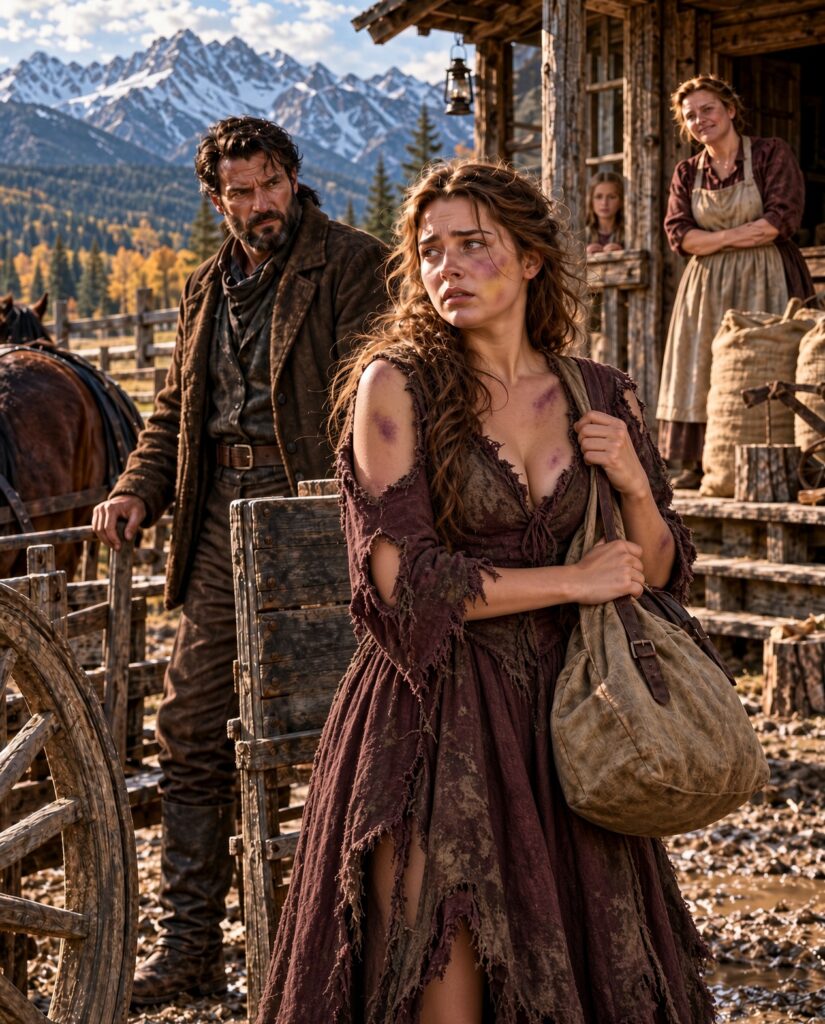
My Stepmother Traded Me for Three Sacks of Flour—Then the Crippled Mountain Man Did Something I Never Expected At nineteen, I watched my stepmother trade me to a crippled mountain man for three sacks of flour, a rusted plow, and medicine money for her own daughter.
Before sunset,
I was sitting beside a stranger on a wagon climbing toward a cabin above the clouds,
carrying everything I owned in one canvas bag.
** And I still had no idea whether Hollis Croft meant to treat me like a wife,
a servant, or simply another thing he had purchased.
My stepmother Ruth called it an arrangement.
I called it what it was.
She had sold me.
That morning,
I stood on our crooked porch with two dresses, a pair of worn boots,
and my dead father’s bone-handled skinning knife packed into my bag.
Behind me, Ruth counted the sacks being unloaded from Hollis’s wagon.
One.
Two.
Three.
Then she looked at the rusted plow.
Her eyes brightened.
“It’s for the best, Sarah,” she said.
She wasn’t looking at me.
She was looking at the flour.
“He asked for Emiline first,” Ruth continued.
“But she’s got that chest cough.
She wouldn’t survive a winter up there.”
Through the gingham curtains, I saw Emiline watching us.
She looked pale.
She also looked comfortable.
She had always known how to make a cough useful when
there were chores waiting outside.
I said nothing.
There was no point.
In our valley,
fairness was something people discussed only when they had enough food to spare.
So I looked at the man who had come for me.
Hollis Croft sat high on the buckboard beneath a heavy buffalo coat.
He was broad through the shoulders, dark-bearded,
and weathered by years of mountain winters.
His pale gray eyes were the strangest thing about him.
They weren’t cruel.
They weren’t eager.
They simply studied me.
Then he climbed down.
That was when I understood why people whispered about him.
His right leg barely bent.
He dragged it behind him as he walked.
**Thump-drag.
Thump-drag. ** Three winters earlier,
a fallen pine had pinned him beneath it for two days.
A trapping party had eventually found him half-frozen.
The doctor had wanted to remove the leg.
Hollis had refused.
Now he lived with the damage.
He lifted the rusted plow into the wagon using his powerful arms,
then turned toward me.
“Get in.”
His voice was rough and low.
I didn’t hug Ruth goodbye.
I didn’t wave at Emiline.
I simply walked through the mud and climbed onto the
wooden seat beside the man who had just become my
husband—or something close enough to it that I couldn’t
tell the difference.
The wagon began climbing.
For six hours, we said almost nothing.
The valley disappeared behind us.
Oak trees gave way to dark pines,
and the trail narrowed until it seemed to hang above the mountainside.
The cold grew sharper.
I pulled my thin coat tighter around myself.
I had expected fear.
Instead, I felt almost nothing.
**I had already learned that morning what it felt like to be unwanted.
** Then Hollis spoke.
“You cold?”
I turned.
He wasn’t looking at me.
His eyes remained on the trail.
Without another word,
he reached behind the seat, found a folded wool blanket,
and dropped it into my lap.
It smelled like woodsmoke and horses.
I stared at it.
Then at him.
He said nothing more.
Neither did I.
But for the first time since Ruth had counted those three sacks of flour,
something inside me shifted.
Not trust.
Not yet.
Just confusion.
By sunset, we reached the final ridge.
A small cabin appeared through the trees, built firmly into the mountainside.
Smoke curled from the chimney,
and the last light of day turned the peaks beyond it pale gold.
There were no neighbors.
No fences.
No easy road back.
Just the cabin, the forest, the wind—and the man beside me.
I climbed down slowly.
My fingers tightened around the strap of my canvas bag.
Then I walked to the cabin door.
For one brief moment,
I stood there with my hand on the latch,
wondering what kind of life could possibly wait on the other side.
**I had been sold to this man before I ever learned his heart.
** And now I was about to discover what exactly I had been traded into.

Cole Walker remained standing at the end of the table.
The evening breeze moved through the cottonwoods beside the house, carrying the smell of mesquite smoke and warm earth across the yard.
Seven boys sat around Clara’s old wooden supper table.
Luke, sixteen, sat nearest the lantern.
Noah, eleven, had both hands wrapped around a piece of cornbread.
Sam, eight, was swinging his legs beneath the bench.
The four younger boys—Matthew, Daniel, Ben, and little Eli—were unusually quiet.
Hannah stood behind the table with one hand resting against the back of her chair.
She didn’t know what Cole was going to say.
She only knew that the man looked different.
Three years of grief had carved deep lines around his eyes.
For months after Hannah arrived, she had watched him move through the house as if every room contained a memory he was afraid to disturb.
But tonight, he wasn’t looking at the empty chair where Clara used to sit.
He was looking at his sons.
Then at Hannah.
Cole cleared his throat.
“There’s something I should have told all of you.”
Luke lowered his eyes.
Hannah noticed immediately.
Cole continued.
“The bank came yesterday.”
Nobody moved.
“They gave me thirty days.”
The younger boys looked confused.
Luke wasn’t.
He knew exactly what thirty days meant.
“Thirty days for what?”
Noah asked.
Cole swallowed.
“To pay the overdue equipment loan.”
“And if we don’t?”
Luke asked.
Cole looked directly at him.
“We lose the south pasture.”
Luke’s face tightened.
“And the house?”
Cole didn’t answer.
That silence was enough.
Sam stopped swinging his legs.
Daniel’s spoon slipped from his hand.
Little Eli looked at Hannah.
“Are we going to have to move?”
Hannah felt something tighten inside her chest.
Cole leaned forward.
“I won’t lie to you.
If I can’t fix the loan, we may have to sell part of the ranch.”
Luke stood.
“How much?”
“Four thousand eight hundred dollars.”
Luke gave a bitter laugh.
“That’s impossible.”
“Luke—”
“We don’t have that.”
“No.”
“You should have told me.”
“I didn’t want you carrying it.”
Luke’s chair scraped backward.
“I’ve been carrying everything else!”
The words struck the yard like a gunshot.
Cole went still.
Luke’s face flushed.
For a moment, Hannah thought he might run.
Instead he looked at his father.
“I’ve been fixing fences since Mom died.
I’ve been riding the north pasture alone.
I’ve been taking care of the little ones when you were too tired to get out of bed.”
Cole’s jaw tightened.
“I know.”
“No, you don’t.”
Luke’s voice broke.
“You don’t know because nobody ever asked.”
Silence settled over the table.
Hannah looked at Cole.
She saw the pain in his face.
Then she saw something else.
Recognition.
Cole slowly nodded.
“You’re right.”
Luke blinked.
“What?”
“I said you’re right.”
Cole pushed his chair back.
He walked around the table until he stood in front of his oldest son.
“I thought keeping this ranch together was the same thing as keeping this family together.”
Luke stared at him.
“I was wrong.”
The boy’s eyes filled.
Cole’s voice dropped.
“I lost Clara, and I didn’t know how to be a father and a rancher at the same time.
So I worked.
I worked until I couldn’t feel anything.”
Luke’s chin trembled.
“And I let you become a man when you should have been allowed to remain my boy.”
Luke looked away.
A tear slipped down his cheek.
Cole didn’t wipe it.
He simply stood there.
“I’m sorry.”
Those two words seemed to break something open.
Luke’s shoulders shook.
“I missed her.”
“I know.”
“No, Dad.
I really miss her.”
Cole pulled him into his arms.
Luke resisted for perhaps half a second.
Then he collapsed against his father’s chest.
The other boys watched.
Then Sam began crying.
Noah wiped his face with his sleeve.
Hannah looked away, giving them privacy.
But Cole reached for her hand.
She took it.
And somehow, that small gesture mattered more than anything else that evening.
The next morning, Hannah woke before sunrise.
She walked into the kitchen and found Luke already there.
He was sitting at the table with a cup of coffee he was too young to be drinking.
“You’ll ruin your appetite,” Hannah said.
Luke glanced at her.
“Couldn’t sleep.”
“Neither could I.”
He looked at her for a moment.
Then he said, “I’m sorry.”
“For what?”
“For the way I treated you.”
Hannah leaned against the counter.
“You were grieving.”
“I was cruel.”
“Sometimes grief makes people cruel.”
Luke stared into the coffee.
“I thought if I accepted you, it meant I didn’t love Mom anymore.”
Hannah’s expression softened.
“I know.”
“How?”
“Because I was afraid of the same thing.”
Luke looked up.
“You?”
Hannah nodded.
“I was afraid that if I loved you boys, I would somehow be taking something away from your mother.”
Luke’s eyes widened slightly.
“You loved her?”
“I never met her.”
“Then how?”
Hannah smiled.
“Because I saw the way you all talked about her.”
Luke looked toward the hallway.
“She was good.”
“I know.”
“She made the best peach cobbler.”
Hannah smiled.
“Then I have competition.”
Luke laughed.
It was small.
But it was real.
“She’d probably like you,” he said.
Hannah’s heart tightened.
“I hope so.”
Luke stood.
“She would.”
He walked toward the door.
Then turned.
“Hannah?”
“Yes?”
“What do you need?”
Hannah smiled.
“Actually, I need you to do something very important.”
“What?”
“Tell your brothers breakfast is ready.”
Luke grinned.
“That’s all?”
“For now.”
He ran down the hallway shouting.
“FOOD!”
Within seconds, the house exploded with footsteps.
Hannah laughed.
For the first time since she arrived at Walker Ranch, it sounded like home.
But four thousand eight hundred dollars did not disappear because a family had begun healing.
Hannah knew that.
The bank would still come.
The loan would still be due.
And the Walker Ranch was still in danger.
So she began working.
She took Clara’s old garden seriously.
She expanded it.
Tomatoes.
Peaches.
Beans.
Squash.
Jalapeños.
Herb bundles.
She started making preserves and selling them at the Saturday market.
Then she had an idea.
The ranch produced more hay than the Walkers needed during good seasons.
But they had always sold it through a middleman.
Hannah spent an afternoon going through old receipts.
She found something strange.
The middleman was buying their hay for nearly half the market price.
“Who negotiated these contracts?” she asked Cole.
“Mr.
Pritchard.”
“The man at the feed store?”
“Yes.”
“How long?”
“Six years.”
Hannah put the papers on the table.
“He’s been taking advantage of you.”
Cole frowned.
“What makes you say that?”
She pointed to the numbers.
“Look at this year’s price in Abilene.”
Cole leaned closer.
“That’s nearly twice what Pritchard paid us.”
“Exactly.”
Luke stood behind his father.
“Can we sell directly?”
“That’s what I’m thinking.”
Cole looked at Hannah.
“You know how to do that?”
“I know how to make people hungry for something they don’t have.”
Luke grinned.
“What does that mean?”
“It means if we have the best hay, we don’t need to beg someone to buy it.”
She pointed toward the barn.
“We find ranchers who need it.”
And that’s exactly what they did.
Luke helped.
So did the younger boys.
Hannah wrote letters.
Cole rode to neighboring ranches.
Luke delivered samples.
Within two weeks, they had orders from three ranches.
Then six.
By the end of the month, the Walker hay was sold at a price that changed everything.
But it still wasn’t enough.
They needed another thousand dollars.
Then two thousand.
Then a storm came.
It began on a Tuesday.
By noon, the sky had turned black.
Cole looked toward the horizon.
“Get the boys inside.”
Hannah knew that tone.
“How bad?”
“Bad enough.”
The first thunder cracked before she could answer.
Rain came down in sheets.
Then hail.
The younger boys screamed when the roof shook.
Hannah got them into the kitchen.
Luke ran toward the barn.
“Luke!”
He stopped.
“The cattle!”
Cole grabbed his coat.
“I’ll handle it.”
“I’m coming.”
“No.”
Luke’s jaw tightened.
“Dad—”
“Stay with your brothers.”
For a moment, Luke looked like the boy he had been before.
Then he nodded.
Hannah watched Cole disappear into the rain.
The storm lasted forty minutes.
It felt like four hours.
When it finally passed, the ranch looked wounded.
Two sections of fencing were down.
One shed roof had collapsed.
A water trough was overturned.
And twelve cattle were missing.
Cole returned soaked to the bone.
Luke followed him.
“Did you find them?”
“No.”
Hannah looked at the pasture.
“We’ll find them.”
Cole shook his head.
“It’s getting dark.”
“Then we’ll search at first light.”
But Hannah noticed Luke staring at the horizon.
He looked frightened.
“What’s wrong?” she asked.
He pointed.
“Those aren’t our tracks.”
Hannah followed his finger.
Near the broken fence were hoofprints.
But some were fresh.
Others weren’t.
Someone had driven cattle through the opening.
Cole crouched.
He examined the mud.
“You’re right.”
Luke looked at him.
“You think somebody stole them?”
“I think somebody tried.”
Hannah’s stomach tightened.
“And the missing cattle?”
Cole stood.
“We need to find out.”
The next morning, they discovered the truth.
The storm had hidden something.
Behind the far ridge, twelve Walker cattle were trapped inside an old dry creek bed.
They hadn’t been stolen.
They had fallen through a broken section of fence and followed the ravine.
Cole and Luke spent four hours getting them out.
By noon, all twelve were back.
The boys cheered.
Hannah laughed.
But when Cole counted them, his smile disappeared.
“One is missing.”
Luke grabbed his hat.
“I’ll find him.”
“I’ll come.”
Hannah watched them ride away.
She didn’t know it then, but that missing calf would change everything.
Three hours later, Luke returned alone.
He was pale.
Hannah ran onto the porch.
“Where’s your father?”
“With the calf.”
“What happened?”
Luke dismounted.
“It’s stuck in the old quarry.”
“Is your father hurt?”
“No.”
Luke looked toward the kitchen.
“Can I ask you something?”
“Of course.”
“Did you really mean it?”
“Mean what?”
“When you said last night that this was our home.”
Hannah stared at him.
“Yes.”
Luke swallowed.
“Even if we lose the ranch?”
Hannah walked toward him.
“The ranch isn’t the home.”
He looked confused.
She touched his shoulder.
“You are.”
Luke’s eyes filled.
“So are your brothers.”
“And Dad?”
Hannah smiled.
“Especially your father.”
Luke nodded.
Then he whispered:
“I think Mom would like you.”
Hannah hugged him.
And this time, he hugged her back.
The calf survived.
So did the ranch.
But the bank did not wait.
On the final Friday of the month, a black automobile appeared at the end of the Walker road.
A man in a gray suit stepped out.
Mr.
Everett Pike.
The bank representative.
He carried a leather case.
Cole met him on the porch.
Hannah stood behind him.
Pike removed his hat.
“Mr.
Walker.”
“Came to collect?”
“I came to discuss options.”
Cole laughed without humor.
“What options?”
“You can sell the south pasture.”
“No.”
“Refinance.”
“At what rate?”
Pike hesitated.
Cole understood.
“Exactly.”
Pike looked toward Hannah.
“And you must be Mrs.
Walker.”
“Hannah.”
“Mrs.
Walker.”
She smiled politely.
“I understand you’ve been selling produce and hay.”
“Yes.”
“Very industrious.”
There was something insulting in the way he said it.
Hannah ignored it.
“How much would the bank accept today?”
Pike blinked.
“What?”
“If we pay a portion now.”
“Why?”
“Because you wouldn’t be standing here if you believed the ranch had no value.”
Pike studied her.
She continued.
“We have confirmed hay contracts for the next six months.”
She handed him the papers.
“We’ve expanded the garden.”
More papers.
“We’re negotiating two cattle contracts.”
More papers.
Pike’s expression changed.
“These are legitimate?”
Cole almost smiled.
“They are.”
Pike looked at Hannah.
“How much can you pay?”
She named the amount.
Pike stared.
“Where did you get that?”
“From selling what the ranch already produces.”
He looked toward Cole.
Then back at Hannah.
“You’ve changed the books.”
“No.”
She shook her head.
“I changed the way the ranch uses what it already has.”
Pike was silent.
Finally he closed his case.
“I’ll give you sixty days.”
Cole stared.
“Why?”
“Because I think you’re finally running this ranch.”
He looked at Hannah.
“Both of you.”
Then he walked away.
Cole stood on the porch long after the automobile disappeared.
Hannah touched his arm.
“What?”
He turned.
“I don’t know how to thank you.”
“You don’t have to.”
“I do.”
He stepped closer.
“I thought I was marrying a woman who needed a place to start over.”
Hannah’s heart beat faster.
“I did.”
“No.”
Cole shook his head.
“You gave this family a place to start over.”
She looked at him.
“I didn’t do it alone.”
“I know.”
His hand found hers.
“That’s what scares me.”
“Why?”
“Because I don’t want to imagine this house without you.”
Hannah’s eyes softened.
“You don’t have to.”
Cole stared at her.
“Are you sure?”
“Yes.”
He leaned forward.
Then stopped.
“May I?”
Hannah smiled.
“You’re asking now?”
“I’ve learned a few things.”
She laughed softly.
“Then yes.”
He kissed her.
It wasn’t dramatic.
There was no thunder.
No music.
No grand declaration.
Just two people standing on an old porch beneath the Texas sun.
And somehow, it was enough.
That evening, Hannah walked into the kitchen.
Noah was sitting at the table.
He held the old photograph of Clara.
“You okay?”
Hannah asked.
He nodded.
“Can I show you something?”
He handed her the photograph.
Behind it was a small piece of paper.
Hannah read it.
It was Clara’s handwriting.
For my boys.
Hannah’s breath caught.
“What does it say?”
Noah shook his head.
“I can’t read all of it.”
Hannah sat beside him.
Together, they read.
Clara had written the note shortly before she died.
She had known she was getting weaker.
She had written about each of her sons.
Luke’s courage.
Noah’s gentleness.
Sam’s imagination.
Matthew’s stubbornness.
Daniel’s kindness.
Ben’s laughter.
Eli’s curiosity.
At the bottom she had written:
If someday another woman comes into this house, don’t make her pay for loving your father.
Hannah covered her mouth.
Noah whispered:
“Mom knew.”
“She knew.”
“Do you think she meant you?”
Hannah shook her head.
“She couldn’t have known me.”
Noah smiled.
“Maybe she knew someone would come.”
Hannah pulled him close.
“I think your mother loved you very much.”
“She did.”
“And she still does.”
Noah nodded.
Then he put the photograph back.
“Can you stay?”
Hannah smiled.
“I wasn’t planning on leaving.”
The ranch survived.
Not because of one miracle.
Because of hundreds of small choices.
Cole worked harder.
Luke stopped pretending he didn’t need his father.
Hannah turned the garden into a profitable business.
The boys helped with the hay contracts.
The Walker family paid down the bank loan.
Then paid it off.
A year later, they bought back the south pasture.
Two years later, the ranch expanded.
But the biggest change wasn’t financial.
It was the supper table.
Clara’s old wooden table became the center of the house again.
Sometimes Hannah cooked.
Sometimes Luke did.
Once, Sam burned biscuits so badly that Cole claimed they could be used as horseshoes.
The boys laughed.
Hannah laughed.
And nobody apologized for laughing.
One evening, three years after that first supper, Hannah found Luke standing beside the barn.
He was taller now.
Almost a man.
He had received an offer from a cattle program in Fort Worth.
He had been afraid to tell Cole.
Hannah found him staring at the letter.
“You should go.”
Luke looked at her.
“But the ranch—”
“Will still be here.”
“What if Dad needs me?”
Hannah smiled.
“Then he’ll tell you.”
Luke looked toward the house.
“You think he will?”
“I know he will.”
Luke nodded.
“I’ve been thinking about something.”
“What?”
“When Mom died, I thought loving her meant staying exactly where she left me.”
Hannah waited.
“But that’s not what she wanted.”
“No.”
Luke folded the letter.
“She wanted me to grow up.”
“She did.”
“And you?”
“What do you want?”
Luke smiled.
“I think you want me to go.”
“I want you to choose your own life.”
He nodded.
“Thank you.”
Then he hugged her.
Not like a grieving boy.
Not like a frightened son.
Like a young man saying goodbye to the woman who had helped him become himself.
Years later, people in the county still talked about the Walker Ranch.
They talked about its cattle.
Its hay.
Its peaches.
Its famous Sunday suppers.
But if anyone asked Cole Walker what saved the ranch, he never mentioned the bank.
He never mentioned the contracts.
He never mentioned the garden.
He always looked at Hannah.
And said:
“She did.”
Hannah always corrected him.
“We did.”
By then, the seven boys had grown.
Luke became a cattleman.
Noah became a teacher.
Sam became a veterinarian.
Matthew ran the ranch’s horse operation.
Daniel loved machinery.
Ben became a carpenter.
And Eli, the youngest, eventually took over the garden and orchard.
Every year, they returned to Texas for one supper.
Every year, they used Clara’s table.
And every year, Hannah made peach cobbler.
On one particular evening, Luke brought his own wife.
Noah brought two daughters.
Sam brought a newborn son.
The table was crowded.
Too crowded for proper seating.
Exactly the way Hannah liked it.
Cole stood at the end of the table.
His hair had turned silver.
His hand rested on Hannah’s shoulder.
He looked around at the people gathered there.
Then he raised his glass.
“To Clara.”
Everyone lifted theirs.
Hannah smiled.
“To Clara.”
Cole continued.
“To the woman who built this family before any of us understood what family meant.”
Luke lowered his head.
Noah smiled.
Then Cole looked at Hannah.
“And to the woman who never tried to replace her.”
Hannah’s eyes filled.
Cole’s voice softened.
“She simply loved us.”
Hannah shook her head.
“I was the lucky one.”
Cole kissed her forehead.
“No.”
He looked around the table.
“We were.”
Then little Eli’s youngest daughter held up a piece of bread.
“Can I have another?”
Everyone laughed.
Hannah reached for the basket.
“Of course.”
The girl grinned.
And for a moment, beneath the warm Texas evening sky, Hannah remembered the woman she had been when she first arrived.
Forty-two years old.
Two suitcases.
Almost no money.
A strange ranch.
A grieving widower.
Seven boys who didn’t want her.
She had thought she was marrying a man.
She had been wrong.
She had married into a family.
And that family had taught her something she had never expected to learn:
Love didn’t always arrive with flowers.
Sometimes it arrived with muddy boots.
Sometimes with seven stubborn boys.
Sometimes with a piece of cornbread saved beside a photograph of a woman who had died years before.
Sometimes it looked like a frightened child leaving a flashlight outside your bedroom door.
Sometimes it sounded like a sixteen-year-old boy asking:
“What do you need?”
And sometimes, if you were very fortunate, love meant sitting at an old wooden table with the people who had once been strangers and realizing that somehow, without anyone announcing the moment, they had become home.
Hannah looked at Cole.
He squeezed her hand.
“Happy?” he whispered.
She looked around the table.
At Luke laughing with his brothers.
At Noah’s daughters fighting over peaches.
At Clara’s photograph resting on the shelf near the kitchen.
At the garden outside, still blooming.
At the ranch they had nearly lost.
Then she looked back at the man she had married.
“More than I ever imagined.”
Cole smiled.
“Me too.”
And beneath the golden Texas sky, seven sons gathered around the woman who had never tried to replace their mother—
but had somehow become another kind of love entirely.
Not a replacement.
Not a shadow.
Not a stranger.
Family.
And that was the supper that changed everything.


