
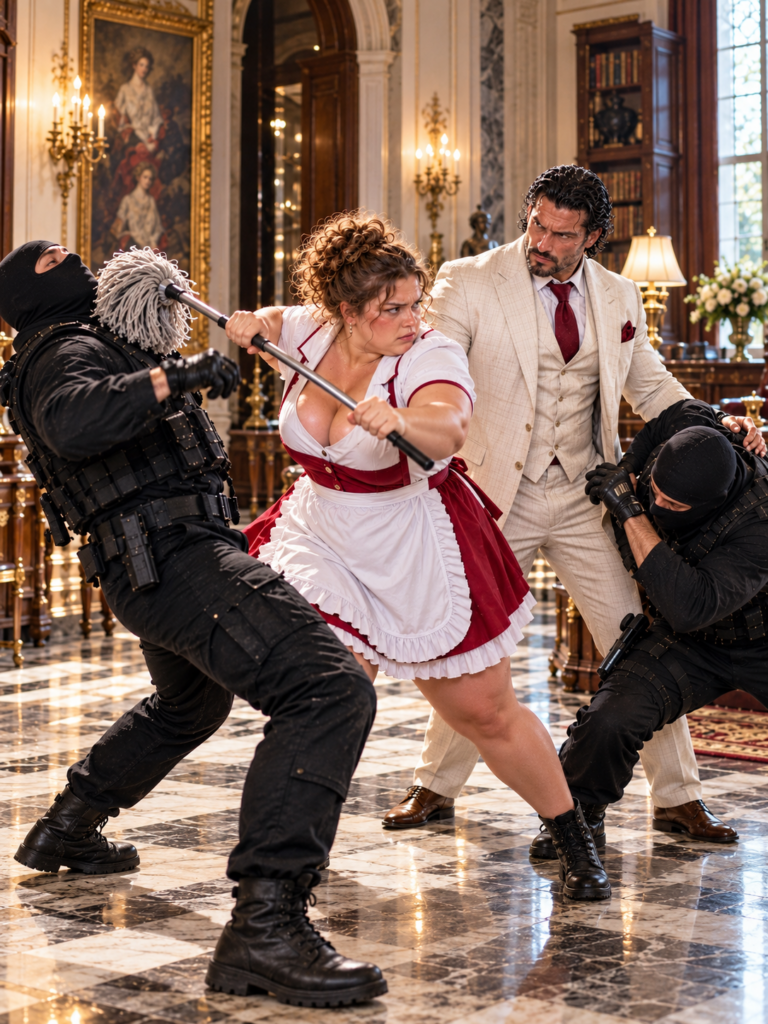
I’ll Take the Night Shift, the Heavyset Maid Told the Mafia Boss — By Dawn Two Assassins Lay Bound at His Door
Part 1
The servants’ hall went quiet in the way rooms go quiet when a clipboard is looking for a sacrifice.
Mrs. Tandy stood at the head of the long table, knuckles white on the board, and told them Delia had quit at dawn. Quit crying. Left her apron on the hook and walked the mile of driveway rather than wait for a car. Nobody asked why. Everyone knew which shift Delia had been working. The night rotation needed a body by Friday. Outside, boots crunched gravel in pairs. The guards had walked in pairs since the car burned at the west gate, a fire nobody claimed and nobody reported.
“I’ll take the night shift.”
Every head turned.
The new girl from the kitchens, nine days in, heavyset, wide through the hips and soft through the middle, the one who moved along walls as if she were apologizing for the space she took, sat with her coffee cooling. Her voice did not wobble. Odessa Hail. Two of the maids traded the smirk they had already built around her name and the pantry inventory. Mrs. Tandy’s pen hovered.
In the hallway, Rhett Callaway stopped.
He did not stop for staff business. Thirty-eight, iron-calm, two captains at his shoulders, mid-sentence about floodlights. He looked through the doorway at the wide, steady woman with her hand half raised, like a schoolgirl, like it was nothing. Three seconds. Then he walked on, and the captains hurried after him, and Mrs. Tandy wrote the name with a hand that was not quite steady.
Nobody asked why the new maid had volunteered. She offered nothing.
The house could have told a stranger something was coming. Gate count doubled since the first of the month. Scorch marks scrubbed off the west stone. Dogs fed twice, kept hungry-sharp. Through it moved the boss, the same flat expression for espresso and for the new lights. He had taken the family at twenty-six, the week they buried his father. An ambush on a rain-slick road. Three cars. No survivors on either side except the son who had not been in the convoy. Twelve years had taught him one lesson. The bullet never comes from a stranger. It comes from someone with a key. He trusted locks, cameras, dogs. People, almost never.
In the laundry that evening the sneer found a voice. Night shift was where things happened, an older maid said, with a look toward the west wing. Ren, the youngest, jumpy since the car fire, caught Odessa alone by the linen press.
“Take it back. Tell Mrs. Tandy you changed your mind. Delia didn’t quit over ghosts.”
Odessa listened all the way through, thanked her, and sat on the bench to relace both shoes. A strange, particular pattern. The lace crossed low, doubled at the ankle, knotted flat against the tongue where nothing could snag. She did it the way other people say a prayer without looking. Ren watched and felt colder without knowing why.
The first round began at eleven. Moon-gray marble. The sea grinding the cliffs under the terrace. Doors bolted that stood open in daylight. She walked with a flashlight and a cart, slow, heavy-footed, unremarkable, until the west wing. Under the sound of the water she caught a small metallic tick, rhythmic, patient, like something breathing behind the wall. New maids did not investigate noises in a house with doubled guards. She noted the spot and moved on.
On the second pass she brought a screwdriver from the cart. The tick was a vent cover, rattling when the heat cycled. Almost funny. Then she stopped. The screw heads were bright, scratched fresh, silver torn at the slots. Not worn loose by years. Backed out recently, deliberately, by someone in a hurry or someone in gloves. The vent behind them was wide enough for a man’s arm. She rescrewed the cover, snugged it tight, and wrote nothing in the log.
Upstairs, Rhett had her hiring file open. Two pages. Kitchen references from a diner two states away. Neat. Checkable. A five-year gap sitting in the middle like a hole cut with scissors. Files that clean cost money. He read it twice, closed it, and looked at the big man by the door.
“Amos. Cameras on the new maid.”
Below them, the vent had gone quiet.
Two mornings later she was sent to sweep the service corridor behind the west wing. She took her time near the crawl hatch. A low steel door she had no business noticing. The padlock hung open. In the dust of the space behind the guard office, someone had knelt recently. Two knees. A braced hand. She followed the scuffs and went cold. Through a gap in the paneling you could see straight into the office, straight at the rotation board. Every shift. Every name. Every gate assignment, chalked up like a menu. Someone had crouched in the dark and photographed it.
She backed out, replaced the padlock exactly as she had found it, and said nothing.
Amos was already pulling hatch logs. The boss’s people had found the same kneeling marks a day before her. The household was now two hunts pretending to be one quiet house.
The smudge answered faster than the marks. On the hatch frame, at shoulder height, an ungloved hand had steadied itself. The grease carried a scent. Citrus. Sweet. Expensive. Only one man on the senior staff wore pomade like that. Kester Braun, logistics captain, easy laugh, beautiful manners, the one who kissed Mrs. Tandy’s hand at Christmas. Odessa caught the scent again that evening as he breezed past her in the gallery. Her spine went to iron. Her face stayed pleasant and slow. A kitchen girl does not accuse a captain. She filed it behind her eyes and kept mopping.
The house gave them one quiet day, the way the sea goes flat before weather.
It broke at lunch for the Marchetti envoy, a silk-suited man under a flag of truce who smiled too much when the wide woman in the maid’s uniform leaned in to pour his coffee. He said something lazy about the Callaways economizing, buying their help by the pound. Two of his men chuckled.
Rhett did not look up from his plate. “She works for me. Insult my house again and you’ll leave it through a window.”
The room went still. The envoy’s smile stayed nailed on. Everything behind it died. Odessa’s hand did not shake on the pot. She finished the pour and stepped back, and for the first time since she had taken the uniform she felt the weight of a man’s attention that was not a joke. Not hunger. Recognition. He had put his name between her and the room, and he had not asked her to shrink to deserve it.
She found the boy three nights later behind the garages because she heard what she first took for a dog. It was not. Joby, the stable lad, sixteen, mute since birth, the one who talked to the horses with his hands, lay curled against cold brick, lip split, two ribs that made him whimper when he breathed. He grabbed her wrist when she knelt and shook his head hard. Don’t tell.
She read the rest off the bruises. A guard had done this. One of the men rotating out that week. The boy had been beaten for seeing something he had no voice to describe. She got him to the tack room, splinted what she could with a torn pillowcase, and understood by the heat coming off him that the cuts were going bad. So she broke curfew. Walked the mile of driveway in the dark. Passed the burned patch on the stone. Caught the last bus to town. Put her entire first week’s wages on the pharmacy counter. Antibiotics. Antiseptic. Tape. Every dollar, folded so many times the bills had gone soft.
The bus back had stopped running. She walked.
The gate log recorded her at 1:40 a.m., soaked to the knees. Mrs. Tandy waited with the incident book open and a pen trembling with fury. One question, three ways. Where were you, and for whom?
Odessa looked at the write-up that could end a probationary hire. One strike. She signed it without offering a name.
In the gatehouse, on the night feed, Rhett watched all of it in silence. The pharmacy bag. The ruined shoes. The pen. He rewound it twice. He said nothing to anyone.
Amos brought him the loose thread instead. The guard whose knuckles matched the boy’s face had signed out a full hour before the beating. Someone had gone into the ledger afterward and forged a later exit. Same ink. Wrong hand. The man had stayed on the grounds off the books, and someone senior had scrubbed the record to hide not the beating, but the meeting the boy must have witnessed.
Rhett stood at the window a long time with the ledger open. Whoever cleaned that page had keys, clearance, and no fear at all.
Fresh flowers came in for the east hall, and for an afternoon the place almost looked innocent. The chandelier ended that.
She was steadying the ladder under it when the winch chain slipped its gear with a sound like a shot. Two hundred pounds of crystal dropped a yard before the brake bit. She never saw him move. A hand closed on her collar and hauled her back. Then his palm was flat against her sternum, holding her to the wall, while glass dust sifted down where she had been standing. He held on one second longer than the danger required.
“Watch the ceilings in this house.”
This close she could see the old scar splitting his knuckles, deep and ugly and never explained. Then he was gone down the hall, and a man was sent up to check whether the chain had slipped or been helped.
Her pulse had moved. She hated that it had. Not from the crystal. From the hand. From the fact that he had crossed a room for a woman the envoy had priced by the pound, and had not made a performance of it.
Kester made his move on paper, sweetly. A maintenance order, properly stamped. The night-corridor cameras in the west wing to go dark Thursday for rewiring. He announced it at the staff meeting with an apology and a joke. She laughed with the others and counted. Thursday was her wing. Thursday was her shift.
That evening she sat on the bench in the boot room and relaced both shoes in the flat, snag-proof pattern. From then on she slept in two-hour blocks with her uniform on.
Near midnight before the dark day, Rhett came down for coffee and found his kitchen occupied. The maid at the stove. The mute boy at the table with his ribs taped. A pot of thick, army-plain stew between them. She filled a third bowl without asking. He took it. For a few minutes the man who ran the coast ate standing up in his own kitchen like a soldier, and something in his face unlocked half a degree.
She did not ask about his knuckles. He did not ask about her five missing years. The boy watched them both and, for the first time that week, smiled.
“You didn’t have to spend the wages,” Rhett said.
“He was going septic.”
“Most people would have told Tandy and let the house sort it.”
“The house sorted the ledger,” she said, mild. “I sorted the fever.”
He looked at her then, really looked, past the uniform and the soft heavy line of her and the calm she wore like a second apron. “You’re not afraid of this place.”
“I’m afraid of the right things.”
“And I’m not one of them?”
“Not yet.”
A corner of his mouth moved. It was not a smile. It was the first crack in twelve years of not stopping for staff. He set the bowl down. “Thursday the west cameras die. If you hear anything that isn’t the sea, you do not investigate it. You come to me.”
“Yes, sir.”
She did not promise she would obey. He heard the omission and let it stand, because pushing her would tell her he had already decided she was either a threat or a salvation, and he was not ready to say which.
Thursday came down in a long red dusk. At six the west-wing cameras blinked off, one by one, right on schedule. At 6:15 the logistics captain’s car rolled out through the gate, waved off early for a dinner in town. In the corridor upstairs, Odessa stopped Ren with a hand on her arm and kept her voice level.
“Lock your door tonight.”
At three in the morning the east corridor held its breath. A gloved hand closed over the brass knob of the boss’s study. Slow. Patient. The kind of slow that has practiced being invisible. The latch gave a whisper of metal.
A shadow peeled out of the alcove by the window. A wide silhouette in a maid’s uniform, holding a mop the way other people hold nothing at all.
The glove froze.
Somewhere below, a guard’s radio crackled and went dead.
Part 2
She swept the first man’s knee sideways, rode him down, and had his wrist locked behind his skull before his gun cleared leather. The second lunged from the stairwell and met an elbow that folded him over the banister. Thirty seconds of ugly, economical work. A choke. A zip tie from her apron pocket. Tape. Two Marchetti killers laid on the marble, bleeding quietly, staring up at a heavy maid who was not breathing hard.
Because she was not a maid.
Sergeant First Class Odessa Hail. Army combatives instructor. Eight years teaching soldiers how to end fights like this one, until a superior’s botched ambush killed her team and she signed the blame to save his stars. Five years buried. She had read this house’s holes her first day, and she had sworn over four flag-draped boxes that no one else would die on her watch. That was why she had raised her hand.
Dawn came up gray over the two bound men. Boots came down the corridor fast. Rhett arrived with Amos and six guns, fully dressed, weapon low and steady, and he did not gape. He read the scene the way he read ledgers. The zip ties. The taped mouths. The mop standing in the corner like an alibi.
“Five-year gap,” he said. “Start talking.”
She gave him the shortest, hardest version, flat as a report. Rank. Specialty. The operation. The blame she took. The discharge.
“You lied on your file.”
“I omitted, sir.”
“Why my house?”
“It was hiring. And it leaks.”
Something crossed his face. Not anger. Recognition.
Amos knelt and cut open the dead-eyed one’s jacket. What he pulled out ended the questions. A folded page. Tonight’s rotation, hand-drawn. Every post. Every gap. The camera outage marked in red. Only four men had access to Thursday’s full map. When Amos laid the forged stable-log entry beside a duty ledger, the correction in the margin matched one captain’s hand.
The citrus-pomade captain. The one who had scheduled the cameras dark and driven out smiling at six.
Rhett looked at the proof for three seconds. His voice never lifted. “Kester left at six. He doesn’t know they failed. Nobody calls out. Nobody touches a phone.”
But somebody already had.
The Marchettis kept a spotter on the cliff road. When no signal came by four, the man made a call, and by sunrise the captain in town knew his assassins had gone silent inside a house that should have been screaming. He was silver-tongued for a reason. He did not run. He turned the board around. By seven he had called his buyers and sold them the one variable that had beaten them. The maid. He put a number on her head.
By eight he was back at the estate, tie straight, face grave, asking to address the captains. The story he told was beautiful. A new hire with a forged clean file. A five-year hole. A curfew break to meet a contact in town. A formal write-up she had signed rather than explain. And now, how convenient, she alone awake and armed the one night the cameras died. He never raised his voice. That was the horror of it. Half the guards shifted their weight. Their eyes moved to her like rifles traversing.
The house law was older than any of them. An accusation between the family’s people had to be judged before the assembled captains. That morning, in the open, Rhett could not wave it away without cracking his own table. Three captains were already trading looks. A fractured table was exactly what the rivals were paying for.
Her proof came down to one witness who could place the departing guard and the captain together at the stables the night of the beating. Joby. Sixteen. Mute. Terrified of armed men. A boy whose whole testimony lived in his hands.
And the boy was gone.
Not in the tack room. Not in the loft. His blanket still warm. Down at the stables, one of Kester’s men, Doss, a thick smiling ex-cop, was already helping with the search, walking the stalls slow, calling the boy’s name in a singsong voice, a shovel swinging loose in one hand.
They gave her ten minutes under guard before the judgment. Rhett came himself. He stood in the doorway, studying her the way he had studied the forged ledger. She looked back without flinching, hands open on the table, steady as a range instructor on a cold morning.
“Everyone who ever stood that close to me was selling something,” he said quietly.
“I know. Your father’s road. I read the papers five years ago in a barracks. I remember thinking the son survived because he was lucky. Then I saw this house. You’re not lucky. You’re careful. So be careful now. But be careful of Kester, not of me.”
Outside, across the yard, the singsong voice reached the last stall and stopped.
She was moving before the tribunal understood she had stood. The captains were still arguing over the forged ledger when she went through the side door, because the silence from the stables had told her everything. The boy had not run to the woods or the cellars. Scared things go to ground in holes they know are secret. There was only one secret hole on this estate. The crawl space behind the guard office. The one she had found in week one. The one with the loose padlock. The one Doss would reach the second he stopped pretending to search the stalls.
Two guards shouted behind her. Detain on sight. Those were the orders. She was already across the yard, ribs deep in the morning cold, unarmed, winded, and completely out of permissions.
She came around the service corridor and froze. He was already there. The big ex-cop stood at the hatch with the shovel leaned on the wall and his hand on the steel door, head tilted, listening to something inside. A breath. A shift of weight. A terrified boy trying not to exist. One more minute and there would be no witness. Just a hole and a shovel and a story.
So she stepped into the open and let him see her.
It was the worst move on the board and the only one left. If this went wrong, the family buried a traitor and a stable boy in the same hour, and the smiling captain won everything.
Doss straightened. The arithmetic crossed his face. The woman with the price on her head. Alone. No gun. Worth more to his boss than any mute kid. He took the bait. He came off the hatch fast for a big man.
The fight in that narrow aisle was ugly, close, and cost her. A fist like a brick found her ribs and something cracked. The shovel handle split her brow and painted her eye red. But narrow was her country. She had taught this exact problem for eight years. Big man. Tight walls. She broke his balance off the corner post, took his arm into a lock that made him scream, and put him face down in the straw. The zip tie came out of the apron. The third bound man since midnight.
The hatch creaked. Joby came out shaking so hard his teeth clicked, tears cutting the dust on his face, and he held something out to her with both hands like it burned. A phone. Cheap. Cracked. Powered off since the night of his beating. He had lifted it off the guard who broke his ribs, hidden it inside his shirt through everything, too frightened to show anyone because the men in the messages carried guns and he had no voice to explain.
She powered it on with blood running into her eye. Rotations. Camera windows. Prices. A name at the top of every thread.
The boy she had bought antibiotics for with her last dollar had just become the loudest voice in the house.
Boots filled the corridor. Rhett. Amos. The captains behind them. Guns drawn on a scene already finished. He took it in the way he took in everything. The bound man. The bleeding woman. The trembling boy. The phone held out to him.
He read three messages aloud, slowly, in the flat voice that never rose, and each one landed on the captains like a dropped coffin. Thursday’s window sold. The rotation board priced. Her name with a number after it.
Nobody breathed. Then noise from the gate. Two of his men dragging the logistics captain back up the drive. Caught on the coast road with a suitcase of Marchetti cash. Silk tie askew. Silver tongue going fast until a look shut it off. They put him on his knees in the straw next to his shovel man.
Everyone waited for theater. For the gun. For the cliff.
Rhett handed the phone to Amos instead. “Copy everything. Then our federal friend gets both of them, gift-wrapped, with the Marchetti prices attached.”
Quiet. Total. Worse than a bullet. Every captain in that corridor understood exactly whose house they were standing in.
Then he crossed to her, and the room held still. She was listing against the stall rail, brow split, one arm cinched to her cracked side, too spent to stand straight and trying anyway. He took off his own coat, dark, tailored, worth more than her year, and set it over her bleeding shoulders in front of all of them. His hand stayed.
“The next man who calls her a maid answers to me,” he said. “She runs my security.”
A murmur, silenced by nothing but his stillness. She was too tired to argue. Too smart to refuse. And for the first time in five buried years, she did not move away from a hand on her shoulder. The boy watched, hugging the coat’s hem, grinning through tears.
The reckoning took less than a week. Kester Braun went to the federal contact in handcuffs, the phone’s contents printed and indexed. The indictment that followed ran forty pages. Conspiracy. Racketeering. Two counts of solicitation of murder. His lawyers stopped returning calls by Friday. Doss flipped before his split lip healed and gave up the Marchetti go-between for a bunk in protective custody. The two assassins she had bound at dawn were traded in a deal that burned the crew that sent them. No one who had touched this house walked free. The guards still walked in pairs, because the house had learned.
A week later Rhett slid an envelope across the study desk. Severance thick enough to disappear on. A clean identity. A car key.
“You can go,” he said. “No one will stop you. No one will follow.”
She looked at the door for a long moment. Freedom. Quiet. A life with no rotation boards. Then she picked up the security roster instead and drew a line through Thursday’s old holes.
“I finish my shifts.”
He did not quite smile. He opened a drawer and set a small brass whistle in her palm. His father’s. Scratched and dark. The only thing that had come back from that road.
“For when you need the whole house to come running.”
She laced it into her boot, low-crossed, doubled at the ankle, the way she laced everything that mattered.
At three in the morning they drank coffee in the kitchen. Her shift. His company. For once the silence between them was not a warning. He told her, halting, about the rain road and the convoy he had not been in, and the years of wondering whether survival was luck or a debt. She told him about four caskets and a signature that had saved a colonel’s stars and ended her name. He did not offer pity. She did not offer absolution. Something quieter settled in the space where both might have been.
“You could have let the chandelier teach me a lesson,” she said.
“I don’t spend women to make a point.”
“You spent a coat in front of your captains.”
“That wasn’t spending.” His eyes stayed on her, on the bruise yellowing at her brow, on the solid unhidden shape of her in a chair that had never been meant for a queen and held her anyway. “That was so they would stop looking at you like a punchline. I should have done it the day the envoy opened his mouth.”
She felt the heat and did not dodge it. “Careful, Callaway. I run your security now. Falling for the help is a leak.”
“Then patch it,” he said. “Or don’t.”
On her round near dawn she clocked a gray sedan beyond the gate, parked through three heating cycles of its engine. Long enough to matter. Empty when she reached it. Under the wiper, facing in, one photograph.
The estate at night. Shot from inside the fence line.
Her breath stopped. Whoever took it had already been through the wire. Past the dogs. Past her.
Part 3
She pocketed the photograph, checked the tree line, and did not run for the house like a civilian. She finished the sweep, because panic was a light, and then she went to the study and set the picture on his desk beside the whistle.
Rhett looked at it for a long time. “Inside the wire.”
“After Kester. After the deal. Someone who still has a key, or someone who watched me walk the fence and learned the gap I haven’t closed yet.” She tapped the corner of the frame. “This isn’t a threat to the shipments. It’s a threat to the fact that I stayed.”
“Then we close it together.” He stood. “And you stop calling yourself the help when you say it.”
They spent the day on the grounds with Amos and the dogs, not as boss and maid, as two people who knew how a house gets entered. She found the soft place in the north hedge where the camera’s sweep left a four-second blind and a man patient enough could belly through. Rhett stood in it himself, coat off, and let her time him. When he came out with leaves on his shoulder he looked almost young.
“My father would have fired you for finding that,” he said.
“Your father died because someone already knew the version of that on a road.”
He went quiet. Then he nodded. “Stay for the fix. Stay after. Not because the roster needs a name. Because I do.”
She did not answer yet. The answer was not a strategy. She wanted it to be chosen in daylight, not in the shadow of a photograph.
The man who had taken the picture was not a Marchetti soldier. He was a cousin of Doss, paid in spite, who had slipped the hedge at two and meant to leave the photo as a message that the fat maid could still be reached. Amos took him at the cliff path before noon, unarmed, shaking, more messenger than killer. Rhett did not make a theater of it. He sent him to the same federal friend with a statement and a warning that the Callaway house no longer leaked for sport.
That night the kitchen was warm. Joby signed something quick and grinning and went to bed with the horses quiet. Odessa stood at the stove in a clean shirt that finally fit her shoulders, the uniform retired, the whistle in her boot. Rhett came in without captains.
“The envelope is still in the drawer,” he said. “The offer stands. Clean name. Car. No one follows. If you stay, you stay as yourself. Security. Equal. The woman I want beside me when the cameras die, and when they don’t. I am not asking you to be a shield. I am asking you to be mine, if you want that word. Love, not a contract. You can refuse and keep the job. The job is not the bride price.”
She looked at him. The scarred knuckles. The calm. The man who had hauled her off a falling chandelier and then waited to hear the report before he believed the fight.
“I raised my hand for the night shift because I was done watching people die for someone else’s stars,” she said. “I stayed after the envelope because this house still had holes, and because a boy needed the wages I spent, and because you ate stew standing up and didn’t ask me to be smaller. I love you. That isn’t the omission. That’s the file. I’ll take the shift. I’ll take you. Freely. If you ever tell me to wait in the kitchen while the corridor burns, I’ll ignore you.”
“I would expect nothing else.”
He kissed her there, careful of the healing brow, one hand at the solid curve of her waist, the other respectful at her back. She kissed him like a woman who had spent five years unnamed and had decided the name she wanted was not a rank. When they parted, the sea was still grinding the cliffs, and the house, for once, was only a house.
She laced the whistle into her boot before the round. He walked the first corridor with her, not as a guard, as company. At the alcove where the mop had waited, he stopped.
“You could have died on that marble.”
“So could you. That’s why I was there.”
“And now?”
“Now I’m here because I choose the door, not because I’m blocking it.”
He took her hand, scarred knuckles against her palm, and they finished the round together. Beyond the gate the road was empty. No sedan. No photograph. Only the dark, and the woman who had volunteered, and the man who had finally learned the difference between a key and a person he could trust with one. By dawn the estate breathed easier, and Odessa Hail, no longer the heavyset joke in the pantry joke, poured two cups and did not apologize for the space she took at his table.


