
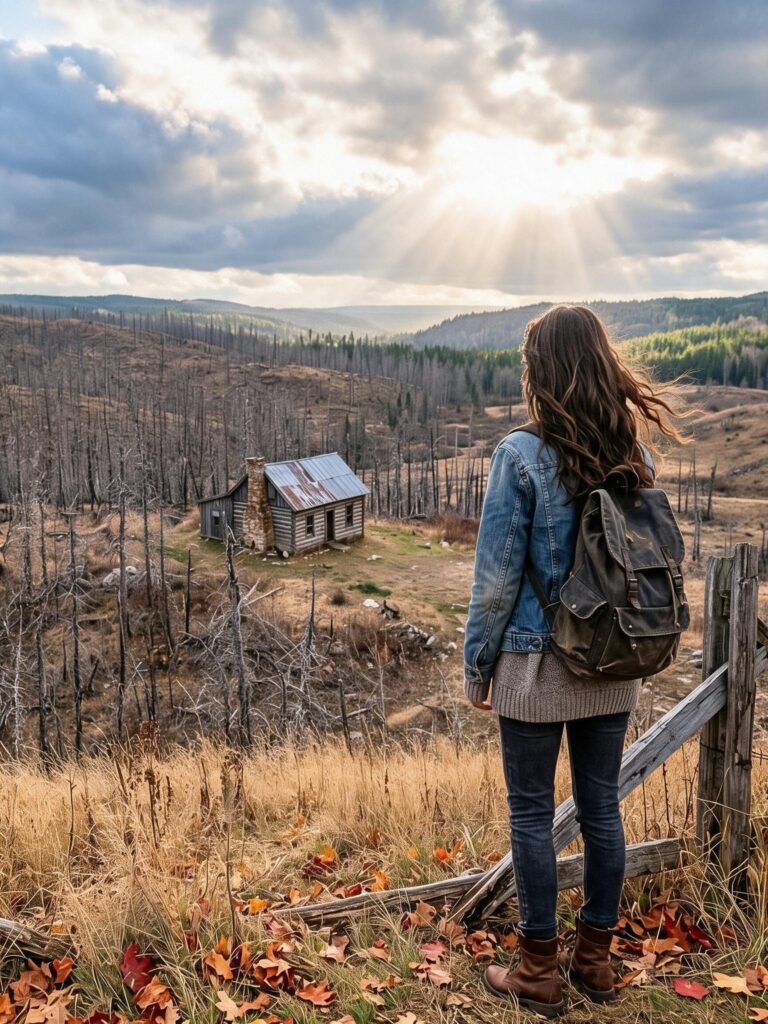
her brothers took the mansion and the company, but the dead land their father hid for her was the only thing that could set her free
Part 1
The morning Claire Holloway turned twenty-three, the state of Michigan finished with her.
There was no cake at the Lansing Transition Center. No balloons. No one waiting in the lobby with a car running. Denise Mercer, the social worker who had carried Claire’s file longer than anyone else, set a manila folder on the counter and slid a prepaid debit card across the scratched laminate.
“Two hundred dollars,” Denise said. “That’s the exit stipend. Bus passes are in the folder. You’ve got the number for the shelter on Cedar if you need a bed tonight. I’m sorry it ends like this, honey. I really am.”
Claire nodded because nodding was easier than speaking. She had learned that in five different placements. Speak less. Take up less room. Do not give anybody a reason to write something down.
Outside, November wind cut straight through her denim jacket. The sky over Lansing was the color of wet concrete. She stood on the sidewalk with a faded duffel bag at her feet and the folder pressed against her ribs, and for a minute she could not make her legs move. Eighteen had been bad. Nineteen had been worse. Twenty-three was supposed to mean something. It meant the county no longer had to pretend she belonged to anybody.
Her name was still Holloway. That was the strange part. The brothers had kept the name polished and useful. Victor Holloway. Damien Holloway. Holloway Development, the company their father had built out of empty northern woods and stubborn credit. The mansion on Blackwater Ridge. The lake lots. The resorts. All of it had gone to them the week Richard Holloway died, when Claire was seventeen and still smelling like hospital soap.
They had told the town she was troubled. Better off in professional care. Victor had said it in the hallway after the funeral, in a black suit that fit him too well, his voice soft enough that the nurses would not turn their heads.
“Dad knew you’d be better off away from all this.”
She had believed him. Grief makes a person easy to steer.
Claire walked toward the bus station because the shelter on Cedar smelled like bleach and arguments, and she was not ready to sleep under another fluorescent light. The station was half empty. Burnt coffee. Wet coats. A speaker that crackled names nobody answered. She bought nothing. She sat under a flickering tube and opened the folder because Denise had said there was one more thing.
The cream envelope was heavier than the rest of the papers. Her name was typed clean across the front. Not Claire M. Holloway, the way the state wrote it. Just Claire Holloway. The return address belonged to Whitmore & Cain, Attorneys at Law, Blackwater Ridge.
Her stomach went tight. Lawyers had been the last sound in her father’s house. Boxes. Whispering. A door closing on his office while she stood in the hall in socks.
She almost threw it away. Then she opened it, because throwing things away had never once improved her life.
Dear Ms. Holloway. This correspondence concerns a private inheritance directive established by your late father, Mr. Richard Holloway. Upon reaching the age of twenty-three, ownership of the property designated as Parcel 14-C, locally referred to as Dead Land, is to be legally transferred into your name.
Dead Land.
The words sat on the page like a joke told too late. She remembered the place. Rocky ground behind the estate, near the forest line. Twisted trees. Soil that would not hold a garden. Local kids said animals would not cross it after dark. She had gone there once with her father when she was nine, while he reset a sagging fence. She had asked why nothing grew.
Richard Holloway had smiled in that tired way he had near the end of a long day. “Some things only look lifeless because people stopped believing they could grow.”
She had not understood him then. She was not sure she understood him now.
The letter went on. The transfer had been delayed on purpose until her twenty-third birthday. The land and all structures on it were solely hers. Property taxes were unpaid. Ninety days, or the county could take it. Additional instructions waited at the office of Harold Whitmore, if she wished to proceed.
Structures. She remembered a caretaker’s cabin, half fallen even then.
Victor and Damien had inherited millions. She had inherited a patch of dirt nobody wanted and a bill attached to it. The Holloways had always known how to put a knife under velvet.
Claire leaned back against the plastic seat and laughed once, quiet, so the man two rows over would not look at her. Then she read the last line again. Additional instructions.
Outside, rain ticked the terminal glass. A driver called final boarding for Detroit. People stood. People left. Claire stayed where she was with the envelope in her lap and the prepaid card sweating in her palm.
She had nowhere that was hers. Not a room. Not a key. Not a person who would notice if the bus she did not take arrived without her. Blackwater Ridge was the town she had sworn she would never see again. The mansion. The brothers. The way wealth lived there behind iron gates and polite voices.
But the land was the first thing in five years that did not have a case number on it.
She stood before she could talk herself out of it and walked to the ticket window.
“Blackwater Ridge,” she said.
The woman behind the glass did not look up. “Forty-six.”
Claire paid. The printer coughed out a ticket. Almost a quarter of everything she owned. Fear moved up her spine cold and familiar. Under it, smaller and more dangerous, was something she had not felt since the hospital: the sense that her father might still be waiting on the other side of a decision.
The bus smelled like damp wool and diesel. Claire took a window seat and watched the Lower Peninsula flatten into pines. Rain stitched the glass. Every mile pulled up something she had worked hard to bury. Her father’s old pickup bouncing on these roads. Cedar on his coat. Late milkshakes in the kitchen when the house was quiet. Then the hospital room. Then lawyers. Then nothing.
They reached the little station outside Blackwater Ridge just after dusk. The town had not changed. Bookstore. Bakery. White lights on the iron lamp posts. Money that did not have to announce itself. Claire stepped down into air that smelled like wet leaves and chimney smoke and understood, with a clarity that hurt, that she did not belong to it anymore. Maybe she never had.
Dead Land sat nearly two miles past the estate, near the forest boundary. No sidewalks. Just a narrow road between gates and old trees. She walked because a cab would have cost more than pride, and she did not have much of either.
The mansion showed itself through the dark the way it always had. White stone. Three stories. Gold light in the tall windows. The fountain out front, the one her father used to let her throw pennies into. Victor and Damien had made the place look like a hotel that had forgotten how to be a house. Claire stopped on the shoulder and stared until her hands went numb. Nobody came to the door. Nobody ever looked toward Dead Land. That had been the point, even if she had not known it.
She turned onto the overgrown track behind the estate. Branches caught her jacket. Wet leaves gave under her boots. The woods went quiet in the way woods do when the weather is about to turn.
Then the land opened.
It was worse than memory. Rocky soil. Gray weeds. Fence posts rusted to lace. Trees that had died standing. In the middle of it, the caretaker’s cabin leaned like a man who had been hit and had not yet decided to fall. Half the windows were gone. The porch sagged. Moonlight made the rotten boards look like broken ribs.
Claire stood at the edge of the clearing and felt the laugh come up bitter.
“This,” she said to nobody. “This is what you left me.”
The letter had mentioned additional instructions. That was the only reason she crossed the yard.
The porch groaned. One board nearly went. Inside, the air was mold and wet wood and years of nobody caring. An iron stove. A collapsed table. A mattress stained past use. Claire set the duffel down and pressed both hands to her face.
Maybe it had been guilt. A dying man leaving his daughter something so he could say he had not left her nothing. The thought landed harder than the cold.
She turned toward the door.
The floor cracked under her boot.
Not a break. A shift. She looked down. One board near the stove had moved, and the sound under it was hollow.
Claire crouched. Pressed her palm to the warped pine. It gave again. Her pulse started up hard in her throat. She found a rusted crowbar against the wall, worked it under the board, and leaned her weight in. The wood fought, then split. Dust lifted into the moonlight.
Beneath the floor was a compartment. Inside it sat a black steel lockbox, filmed with dirt and old oil, heavy enough that her shoulders complained when she lifted it clear.
Not Victor’s. Not Damien’s. Her father’s. She knew it the way a person knows a voice in a dark hall.
Wind moved through the dead trees outside, low and steady. Claire set the box on the floor, worked the latches, and opened it.
Cash. Bundles of hundreds, wrapped tight in plastic. More money than she had seen in her life. Enough to make her hands shake. Under the cash, two envelopes. The thicker one had her name on it in handwriting she would have known in the dark.
Claire.
The thinner envelope carried five words in sharp black ink.
If they ever betray you.
She sat back on her heels. The cabin no longer felt abandoned. It felt hidden. Kept. Like something dangerous had been put here on purpose, long before the funeral, and the rest of the world had been encouraged not to look.
Part 2
For a long time she could not touch either envelope.
The money was real. She counted one bundle with numb fingers and stopped, because counting made it feel like a trick. Tens of thousands, easy. Maybe more. After shelters and borrowed coats and the question of next month’s food, the sight of it should have been the whole story. It was not. The second envelope made the cash feel like bait.
People did not write If they ever betray you unless they were afraid.
Claire opened the letter with her name on it first. The paper was worn at the edges, as if her father had held it more than once before he sealed the box. She unfolded it under the broken roof.
My dearest Claire. If you are reading this, then my plan worked.
The tears came before she could stop them. Not because the line was grand. Because it sounded like him. Calm. Steady. The voice that used to sit on the edge of her bed when thunderstorms walked over the ridge.
I need you to understand something before anything else. I did not abandon you. And despite what Victor and Damien may have told you, you were never unwanted.
She stopped breathing right. For five years she had replayed Victor in that hospital hallway. Soft voice. Certain eyes. The foster placements that followed. The way nobody came back. She had built a life on the belief that her father had agreed to let her go.
The letter took that belief apart one sentence at a time.
I knew long before my illness became public that your brothers were dangerous men. Not violent. Not reckless. Worse. Hungry. They saw our family legacy as ownership. As power. As something owed to them. You never cared about those things. That is why I trusted you.
Trusted. The word felt foreign. The system had trained people to look at a girl like Claire and see damage first. Her father, even at the end, had still seen her.
When I discovered what Victor and Damien were doing to the company, I realized I had very little time left to protect you. They were stealing from me.
Claire read it twice. Then a third time. The handwriting did not wobble.
They created shell corporations through overseas accounts and began siphoning money from Holloway Development nearly two years before my diagnosis became terminal. They believed the medication made me weak enough not to notice. They were wrong.
Rain tapped the roof. Claire’s hands had started to shake hard enough to blur the page. After the funeral, Victor and Damien had told the town the company was collapsing under medical debt. Assets had to be sold. People believed them. Claire had believed them most of all.
I confronted them only once. What frightened me was not their denial. It was how little remorse they felt.
She remembered a night near the end. Shouting behind the office door. Victor. Damien. Then silence. In the morning her father had looked older in a way that was not only sickness. She had assumed it was the cancer. The letter made a different sense of it.
I realized then that once I died, they would destroy anyone standing between them and control. Especially you.
Claire lowered the pages. The cabin seemed too small. All the lonely birthdays. All the beds that were not hers. All the nights she had cried because she thought nobody wanted her. Her father had not cast her off. He had hidden her the only way he thought would hold.
The pain of that was almost worse than the old story. A sacrifice made knowing she might hate him for it.
Dead Land was never worthless, he wrote. People called it cursed because nothing commercial would grow there. That made it perfect. Nobody would fight over it. Nobody would look closely. The cash inside this box belongs to you. I moved it slowly over several years so it could not be traced through company audits. It is enough for you to disappear if that is what you choose.
Disappear.
Then the last paragraph.
The second envelope contains proof of everything Victor and Damien have done. Bank records. Wire transfers. Property fraud. Embezzlement. Enough evidence to destroy them completely. What happens next is your choice.
Claire looked at the unopened envelope. If they ever betray you. She understood it now. He had not left her a war. He had left her a door with two ways out. She could expose them. She could take the company, the mansion, the name, everything they had polished into a monument. Or she could walk.
Outside, thunder moved over the dead trees.
She did not sleep. She sat on the dusty floor while the storm crossed the ridge, the letter in one hand, the sealed envelope in the other. Revenge had a face. She could see Victor in handcuffs. Damien losing the lake lots. The town finally looking past the charity galas. For the first time in years she had power that was not borrowed.
Under the anger was exhaustion so deep it felt like weather. She was tired of surviving inside other people’s damage. Tired of letting her brothers live in her head rent free. If she opened that envelope, her life would become depositions and headlines and years spent tied to them by hate. Her father had tried to tell her something, and she was only now hearing it.
Dead Land was not the inheritance. The choice was.
Claire stood. She walked to the iron stove. For a long moment she only looked at it. Then she picked up the sealed envelope. Her hands trembled, not from doubt. From the cost, finally clear.
Revenge asked for a lifetime. She had already paid in years.
She opened the stove door and set the envelope inside. Found an old lighter under the cash, probably left there on purpose. One spark. Then another. Flame took the paper. She watched the edges curl black. The secrets went to ash. Victor and Damien would never know how close they had come. Claire found she did not need them to know.
That was the point.
By morning the storm had thinned. Sunlight came through the holes in the roof and lay on the floor in broken bars. Claire sat beside the cold stove with soot on her fingers and made the decision that would run the rest of her life.
She was staying.
The next days were ugly in a practical way. The cabin barely qualified as shelter. Wind came through the walls. The roof wept when it rained. The plumbing was a rumor. She used the cash carefully, afraid of every dollar, the way a person is afraid of the last can of food in a long winter. Cleaning supplies first. Then tools. Gloves. Contractor bags.
For three days she hauled out collapsed furniture, rotten blankets, junk left by nobody in particular. Dust coated her hair until she did not recognize her hands. By the fourth day her palms blistered. By the sixth her back hurt so badly she had to sit on the porch step and wait for the pain to become ordinary.
Slowly the place changed anyway. Sunlight reached boards that had been buried. The windows looked less haunted once the glass was wiped. Under the grime, the pine walls still held a little warmth. The land was not dead. It had been neglected. Claire understood the difference in her bones.
One afternoon she drove a borrowed hardware-store truck into town for roofing felt and nearly turned around at the first expensive storefront. The fear was still there. Every polished window reminded her of what had been taken. This time she did not want back inside that world. She wanted enough to build a smaller one.
At the hardware store on the edge of town, an older man behind the counter watched her spread warped measurements and phone photos of the east roof.
“You fixing up the old property past Hollow Tree Ridge?” he asked.
Claire went still. For one bad second she thought he knew her face.
He only pushed his glasses up. “Didn’t think anybody still owned that land.”
“I do,” she said.
He studied her, then nodded once. “Roof won’t survive winter unless you reinforce the east side. Don’t cheap out on the flashing. Water finds the lazy spots.”
No judgment. No story about the Holloways. Just advice. It startled her more than kindness should have.
Small things kept happening after that. A woman at the diner put an extra sandwich in Claire’s bag when she saw the paint on her sleeves. The librarian offered a few hours of shelving after Claire asked, too carefully, whether they needed anyone. An older neighbor from the next ridge, Mrs. Alvarez, brought tomato soup on a freezing evening and mentioned, casual as weather, that Richard Holloway used to help reset her fence every spring.
“He never made a show of it,” Mrs. Alvarez said. “Just showed up with the post driver. You have his mouth when you’re thinking.”
Claire did not know what to do with that. For years she had believed the world only took from people like her. Now it was giving something back in pieces too small to brag about. Not wealth. Not the old name. Something quieter.
Community, if she could stand to call it that.
One cold morning she stood outside the cabin with cheap coffee and watched the sun move across Dead Land. Wild grass. Broken fence. Bare trees against a gray sky. The property still looked rough. For the first time she saw a kind of beauty in it, not because the ground had changed, but because she had.
Less than a mile away, Victor and Damien still lived inside the white stone house. Still surrounded by what they had taken. Claire did not envy them. They had inherited power. She had inherited a door that locked from the inside.
Her father had written that sometimes the people who take everything accidentally leave behind the one thing that can save a life. Standing there with cold coffee and blistered hands, Claire began to believe he might have been right.
Part 3
Winter came early to Blackwater Ridge.
By December the grass on Dead Land wore frost, and thin snow glittered on the rocks at morning. The cabin no longer looked like a place a person had given up on. Warm light showed in the repaired windows after dark. Smoke lifted from a chimney Claire had rebuilt with library books open on the table and Mrs. Alvarez calling instructions from the yard. The porch held a person’s weight. It was not beautiful. It was alive.
Claire woke before sunrise, made coffee on the iron stove, and worked until her library shift. Her hands had changed. The skin along her palms had gone rough from nails and frozen lumber. Exhaustion felt earned instead of inflicted. That difference mattered more than she could explain to anyone.
People in town started to notice her, and not as Richard Holloway’s forgotten daughter. Not as the girl from foster care. Just Claire, the quiet one rebuilding the dead property past the ridge. A few of them admired it out loud. That admiration traveled farther than she knew.
It reached Victor Holloway at a charity dinner, then at the country club, then at a planning meeting where somebody mentioned, lightly, that the old parcel was lit at night.
Victor tried to ignore it. Damien did not give him the chance.
He came into the mansion office one afternoon with photographs printed from a neighbor’s social media page and dropped them on the desk.
“She’s still there.”
Victor did not look up from his glass. “So.”
“Look.”
Claire in work gloves. Claire laughing, actually laughing, beside an older woman while they carried lumber through snow. Claire on the porch with paint on her jeans and the cabin behind her looking less like a ruin.
Victor stared at the pictures. Something moved behind his eyes that was not brotherly concern.
“She was supposed to disappear,” he said.
Damien sat. “That’s what worries me.”
“You think she knows?”
Damien waited too long to answer. The wait told Victor enough. The files. The accounts. The years they had told themselves their father died before he understood the full size of what they had done.
“What exactly did Dad leave her?” Victor asked.
“I don’t know.”
That answer frightened both of them. For the first time since the funeral, they were not holding every string.
Three days later Claire came home after sunset with groceries and library books, snow falling steady, and stopped at the edge of the clearing.
A black Mercedes sat outside the cabin. Engine running. Headlights cutting the trees.
The driver’s door opened. Victor Holloway stepped out in a dark wool coat and leather gloves. Tall. Composed. Expensive in the way men get when they have not been told no in a long time. Older than she remembered. Sharper.
Snow drifted between them. Neither spoke.
Then Victor smiled, and the smile was worse than anger.
“Well,” he said. “There you are.”
Claire said nothing.
He glanced at the cabin. “You’ve done impressive work with the place.”
She walked past him toward the porch. “What do you want?”
He followed. “You vanish for five years, then you come back and move onto Holloway property.”
“It’s not Holloway property,” Claire said. “It’s mine.”
Something flickered across his face. Calculation, not rage. He stepped onto the porch.
“Damien and I were worried about you after you left.”
The word worried sounded obscene in his mouth.
“You let me disappear into foster care.”
Victor sighed, as if she were being difficult in a meeting. “You were unstable back then.”
“Don’t.”
The word cut the cold clean. Victor looked at her and saw, too late, that she was not the seventeen-year-old in the hospital hallway. Not fragile. Not easy to steer. The recognition unsettled him more than he wanted her to see.
His voice softened into something practiced. “Claire. Whatever you think happened after Dad died, we did what we thought was best.”
She unlocked the door without looking at him. “You did what benefited you.”
His jaw tightened. The performance slipped a fraction.
“You always were dramatic,” he said.
The sentence hit the old place. Seventeen. Crying in a hallway. Grief treated like an inconvenience. This time she did not shrink. She looked at him and smiled, calm, the kind of smile that makes a powerful man check his footing.
“You should leave, Victor.”
Uncertainty entered his eyes. She was not begging. She was not accusing. She looked peaceful, and peace in her unsettled him more than a threat would have.
He stepped closer. “Did Dad leave you something out here?”
There it was. The real reason for the snow and the Mercedes.
Claire kept her face still. “Just land.”
Victor studied her. Searching. Then his eyes moved past her shoulder, through the window, to the kitchen table where the black steel lockbox sat under the warm light.
He went pale. Only for a second. Claire saw it.
Her father had been right. Victor knew what a box like that might hold.
The silence turned dangerous. Victor recovered too fast.
“Well,” he said, stepping off the porch, “I’m glad you’re doing all right.”
He walked to the car. Before he got in, he looked back, and the mask was gone. No warmth. No concern. Only warning.
“If I were you,” he said quietly, “I’d be very careful digging around old family secrets.”
The Mercedes disappeared into the snow. Claire stayed on the porch long after the taillights were gone. Her father had hidden her. Protected her. The past had found the clearing anyway.
She knew this was not the end of it.
That night she opened the lockbox again. The cash was where she had left it. The letter too. Under the money, her fingers found a seam she had missed. A false bottom. She lifted the panel.
A small leather journal lay underneath, worn soft, initialed with an R.
Richard Holloway.
Claire sat at the table and opened it. The entries ran nearly three years. Not ledgers. Private thoughts. The deeper she read, the more the room blurred.
He had been terrified. Not of dying. Of leaving her behind.
He wrote about overheard conversations. Hidden accounts. The way hunger had moved into his sons until he barely recognized them at the dinner table. Between those pages were smaller things. The first fish she ever caught off the dock. The wildflowers she painted across the garage wall at nine. How she used to fall asleep during storms beside the fireplace, one hand on the dog they no longer had.
The last entry had been written weeks before his death. The handwriting shook.
If Claire ever finds this, then she survived. That is all I truly wanted. Not revenge. Not the company. Not the Holloway name. Just her freedom. I hope someday she understands why I let her hate me. I hope someday she forgives me. Most of all, I hope she builds a life untouched by the ugliness that destroyed this family.
Claire put her fingers on the page and finally understood the shape of what he had done. He had given up being loved by her in order to keep her clear of them. He had spent his last years trying to preserve the one part of the family greed had not finished.
Victor and Damien had inherited the empire. Her father had given her a chance to remain whole.
She cried until the crying ran out, then she banked the stove and slept in the chair with the journal under her hand, snow ticking the new windows, the Mercedes already miles away and still somehow in the room.
Part 4
Victor did not come back the next day. That was its own kind of pressure.
Claire went to the library. She shelved returns. She smiled at Mrs. Alvarez when the woman stopped in for a mystery novel and a report on the chimney draft. On the walk home she checked the tree line the way a person checks a dark road. The clearing was empty. The lockbox was where she had left it. Nothing had been forced.
The absence did not comfort her. Men like Victor did their real work where you could not see it.
She learned what that work looked like on a Thursday, when Harold Whitmore called the library and asked her to come by the office before close.
Whitmore was older than his letter had suggested. Thin. Careful with his hands. He shut the door and did not offer coffee.
“Your brother Victor paid me a visit,” he said. “He wanted to know the terms of Parcel 14-C. I told him the transfer was private and complete. He suggested the taxes might be a problem. He suggested the county might appreciate a concerned citizen pointing out an unsafe structure.”
Claire stood with her coat still on. “Can he do that?”
“He can try. Men with his letterhead often try. The deed is clean. Your father recorded the directive years ago, separate from the estate. Victor can make noise. He cannot unmake the paper unless you fail to answer the tax claim, or unless you sign something foolish.” Whitmore slid a folder across the desk. “Pay the back taxes from the account I set aside for that purpose. Your father funded it. Do not use the cash in the cabin for anything with your name on a receipt if you can help it. And do not meet Victor alone again if you can help that either.”
“I burned the envelope,” Claire said.
Whitmore looked at her for a long moment. He did not ask which envelope. “Then you already made the choice your father hoped you would make. That does not mean your brothers will believe you made it. Hungry people assume everyone else is hungry.”
She paid the taxes that afternoon. The number hurt less than she expected, because the account had been waiting, quiet, in her name. Walking out of the county building, she felt the land settle under her in a way that was almost physical. It was hers on paper now, not only in a letter and a lockbox.
Winter hardened. She learned the cabin the way a person learns a body that has been hurt and is trying to knit. East wall draft. North window that wept in a hard thaw. The stove that ate wood faster on windy nights. She split kindling until her shoulders burned. Mrs. Alvarez taught her how to bank coals so the fire would still be alive at dawn. The librarian, whose name was Ellen, started leaving leftover soup in the staff fridge with Claire’s name on the lid.
“You don’t have to,” Claire said the third time.
“I know,” Ellen said. “Eat it anyway. You look like a person who forgets lunch when she’s proving a point.”
In February the pipes she had coaxed back to life froze. She spent a night with hair dryers and towels and language she did not use at the library. In the morning the line ran again. She sat on the kitchen floor and laughed, shaky, because a working faucet felt like a victory large enough to embarrass her.
Victor’s pressure arrived in smaller cuts. A surveyor’s truck slowed at the edge of the property and did not stop. A man from the township asked, too politely, whether the cabin was permitted for year-round occupancy. Claire showed him the paperwork Whitmore had prepared. The man nodded, unsatisfied, and left. At the diner, a woman Claire did not know said, just loud enough, that some people had a talent for living off land they hadn’t earned.
Claire paid for her coffee and did not answer. Answering would have been a kind of war. She was done feeding that.
Damien came in March, alone, which surprised her more than Victor’s visit had.
He was the younger brother, softer in the face, harder in the habits. He did not bring a Mercedes up the track. He walked in from the road in a coat that cost more than her stove repair, hands in his pockets, snow melting on his shoulders.
“I’m not here to fight,” he said from the yard.
“Then don’t come closer.”
He stopped. Looked at the porch. The garden beds she had framed even though the ground was still iron. The smoke.
“Victor thinks you have files,” Damien said. “He doesn’t sleep. He keeps asking me what Dad might have written down. I told him I don’t know. That’s true.”
“Good.”
“If you have something, Claire, sell it to us. Or burn it. Just don’t take it to a prosecutor. We’ll survive a scandal. You won’t survive what Victor does when he feels cornered. I’m trying to be decent.”
“You were stealing from him while he was dying,” Claire said. “Don’t use the word decent with me.”
Damien’s mouth tightened. For a second he looked like the boy who used to sneak her extra pie at Christmas, before the company became the only religion in the house.
“He was going to leave it to you,” Damien said quietly. “Not all of it. Enough. Victor couldn’t stand that. I went along because I was a coward. I’m still a coward. That’s the truest thing I can offer you.”
“I don’t want an offering.”
“Then what do you want?”
Claire thought of the ash in the stove. The journal in the drawer. The tax receipt in Whitmore’s folder.
“I want you off my land,” she said. “And I want you to tell Victor the box was cash and a letter telling me to stay away from both of you. That’s all that was in it. If he comes back, I call the sheriff, and I don’t care whose name is on the donation list.”
Damien studied her the way Victor had, looking for the lie. He did not find the one he expected.
“You really burned it,” he said.
“I really did.”
He nodded once, almost relieved, and that relief told her the shape of his fear. He walked back down the track without another word. Claire watched until the trees took him. Her hands were steady. That felt new.
Spring arrived late and then all at once. Snow pulled back from the rocks. Birds returned to trees that had looked finished. Claire turned the soil in the beds Mrs. Alvarez had sworn would fail, and the soil, stubborn as the rest of the place, took seed. Peas. Tomatoes. The same kind her father used to plant behind the mansion, back when the mansion was still a house.
Neighbors stopped by more often. Bread on Sundays. Children from the next property who wanted to know if the ghost stories were true. Claire told them the only ghost on the land was neglect, and neglect could be argued with. Ellen offered her a permanent shift in the local archives after watching how carefully she handled a box of old township minutes.
“You have a feel for paper people gave up on,” Ellen said.
Claire almost smiled. “I’ve had practice.”
In late April a letter came from Whitmore & Cain. Inside was the finalized deed, Parcel 14-C severed from every Holloway estate holding. No claims. No shared access. No polite ambiguity a brother could lean on. Claire read it twice on the porch, then walked out into the yard and stood in the warm light with the paper in her hand.
Birds moved through the branches. Wind carried pine and turned earth. The cabin held. The garden showed green. Smoke lifted, thin and ordinary.
Dead Land had never been cursed. People had quit on it too early. They had quit on her the same way.
She did not need the mansion. She did not need the company. She needed a door that was hers and a morning that did not begin with somebody else’s story about who she was.
Victor still had the money. He still had the town’s polite respect. Claire had the deed, the journal, and a life that no longer required his permission to continue. She tucked the paper inside the lockbox, above the false bottom, and went back to the peas.
Part 5
The last time Claire saw Victor, it was by accident, and it was enough.
Months had passed. Summer sat on Blackwater Ridge in long evenings and the smell of cut grass. The cabin had a real bed, a tight roof, a garden that embarrassed the old stories about cursed soil. Claire had paint under her nails more often than not. Ellen had started introducing her as the archive assistant without the careful pause people used when they were about to explain a person’s damage.
She was coming out of the bakery with a loaf under her arm when she saw him across the street. Expensive coat, even in the heat, phone to his ear, one foot already in a luxury SUV while he talked too loudly for the sidewalk. Still powerful. Still known. A woman leaving the restaurant smiled at him the way people smile at men who sign checks.
Victor’s eyes found Claire’s.
For a second the street noise thinned. He saw the flour on her wrist. The ordinary loaf. The absence of fear in the way she stood. He looked for the weapon he had been dreaming about since the snow, and he did not find it. What he found was a sister who had declined the war.
He looked away first.
Not her. Him.
Claire did not smile. She did not need the moment to be larger than it was. She crossed with the light, and the SUV pulled off toward the mansion, and the day continued. That was the justice, such as it was. Not handcuffs. Not a headline. A man who had taken everything visible, glancing away from a woman who had kept the one thing he could not price.
Damien sent one letter in July. No return address on the envelope, though she knew the hand. He wrote that Victor had stopped asking about the files. He wrote that he was sorry in a way that asked for nothing back. Claire read it once, burned it in the stove the way she had burned the other envelope, and did not answer. Some apologies were true and still not hers to carry.
On an evening in August she sat on the porch with the journal open to the last page and the deed in the lockbox inside, where it belonged. Sunset laid gold across the field. The tomatoes were coming in. Mrs. Alvarez had already claimed two jars of whatever Claire managed to put up. A boy from the next ridge had left a jar of tadpoles on the step and forgotten them; Claire had walked them back to the ditch before dark.
She thought of the hospital hallway. Of the prepaid card. Of the bus ticket that had cost forty-six dollars and a future. Of the ash that had been enough to ruin her brothers, gone on purpose. Of her father’s shaking line: I hope she builds a life untouched by the ugliness that destroyed this family.
She had not reclaimed the empire. She had not wanted it, once the wanting was no longer a wound. The mansion could keep its gold windows. The company could keep its letterhead. Victor could keep his fear, and Damien his cowardice, and the town could keep whatever story it liked about the Holloway name.
What she had was smaller and harder to steal. A tight roof. Work that used her hands. People who brought bread without asking for the family history. A piece of ground everyone had called dead, green now because someone had stayed long enough to argue with it.
Peace, she had learned, was not softness. It was a decision made over and over, in bad weather, with blistered hands, when revenge was still available and still declined. Her brothers had inherited power and remained trapped inside it. She had inherited a choice, and she had used it.
Claire closed the journal. The light went lower over the trees. Smoke rose from the chimney she had rebuilt herself. Somewhere beyond the ridge the white stone house was lighting its windows for another evening of being looked at.
She did not look toward it.
Dead Land had never been the curse. It had been the waiting. And she had come back in time to meet it.
Sometimes the ground people quit on is only quiet. Sometimes the daughter they erase is only hidden. And sometimes the greatest thing a father can leave behind is not the fortune, not the proof, not the war.
Just the freedom to become someone the people who betrayed you do not get to name.


