
Part 1
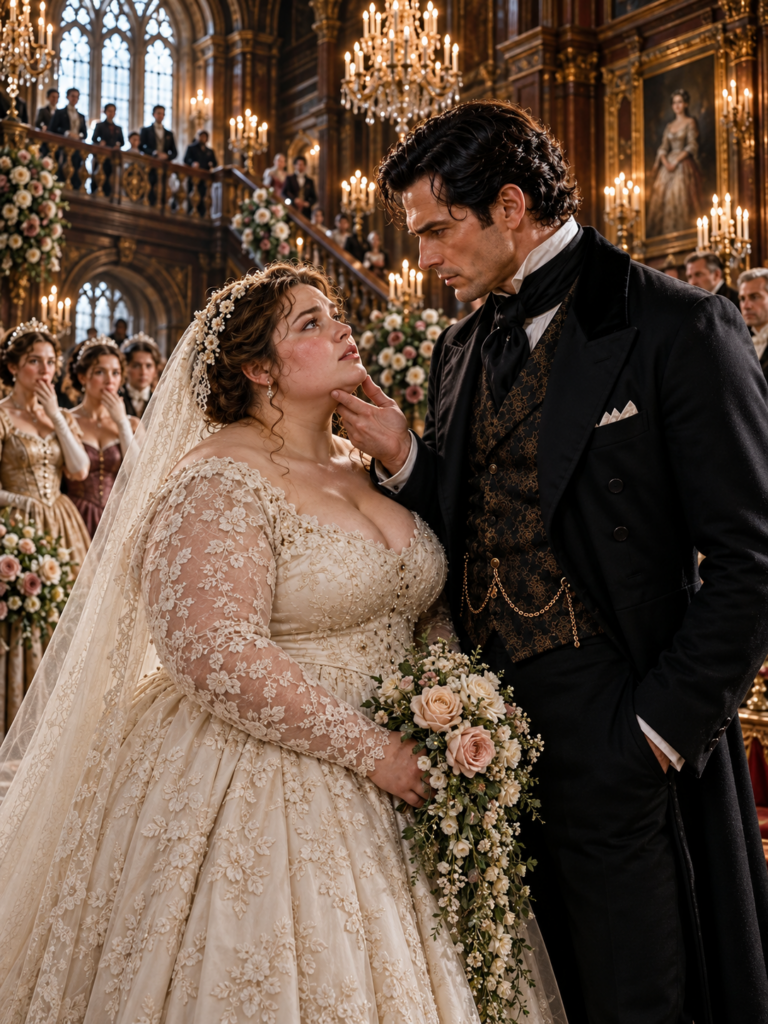
The first time Nathaniel Hastings saw his bride, she was standing in a room full of people who had come to watch her humiliation.
It was a quarter past eleven on a wet Thursday morning in April 1814. Rain struck the tall windows of St. George’s Church in Hanover Square, and the assembled aristocracy whispered behind embroidered gloves and carefully raised prayer books.
The wedding was supposed to unite two of England’s most prominent families.
Instead, the Duke of Rothmere was about to marry the wrong daughter.
Beatrice Harrington stood near the church entrance, one gloved hand gripping the polished wooden handle of her cane. Her ivory wedding gown had been altered overnight, but the seamstress had lacked both sufficient fabric and sufficient kindness. The bodice pulled painfully across her left shoulder, exposing part of the twisted scar that traveled from her collarbone toward her jaw.
A woman in the second pew whispered something to her companion.
Both laughed.
Beatrice heard them.
She had always heard them.
What surprised her was that, for once, she did not particularly care.
She was twenty-four years old. She had spent fifteen of those years being told that her appearance was an offense against polite society. She had learned that silence could preserve dignity when explanations were useless, and that a woman who owned nothing could nevertheless refuse to surrender her self-respect.
But she had never imagined she would become a duchess.
Three days earlier, the Duke of Rothmere had been engaged to her younger half-sister, Cecilia.
Beautiful Cecilia, whose golden curls and flawless complexion had inspired poetry from gentlemen who had never read a complete book.
Cecilia, who possessed six silk evening gowns and an extraordinary talent for discovering weaknesses in other people.
Cecilia, who had abandoned her engagement and fled north with Viscount Henry Fitzwilliam, a charming young man whose principal assets were his smile and his unpaid debts.
The scandal had reached London before their carriage reached the Scottish border.
And Nathaniel Hastings had responded with a cruelty so calculated that society would discuss it for years.
He had demanded Beatrice instead.
Not because he loved her.
Not because he knew her.
He had chosen her because Cecilia hated her.
At the altar, Nathaniel waited in a black coat cut with immaculate precision. At thirty-five, he possessed a tall, commanding figure, dark hair touched with silver at the temples, and the severe composure of a man who believed emotion was a weakness best concealed.
His fortune was immense. His estates stretched across several counties. His political influence reached into Parliament.
And he had never been publicly humiliated.
Until Cecilia Harrington.
When Beatrice finally approached, her uneven footsteps sounded against the stone floor.
One step.
A pause.
Another step.
Nathaniel glanced toward her.
For the briefest moment, his gaze moved over her scar, then toward the watching congregation.
His jaw tightened.
Beatrice understood.
She was not merely his replacement bride.
She was his public revenge.
The ceremony began.
When the clergyman asked whether she would take Nathaniel Hastings as her lawful husband, Beatrice hesitated.
Only an instant.
But Nathaniel noticed.
Earlier that morning, Lord Reginald Harrington had told his eldest daughter that the wedding was her duty. He had spoken of family honor, of creditors, of the Duke’s anger.
He had not asked whether she wished to marry.
Yet now, at the altar, the answer belonged to her.
“I will,” she said.
Her voice did not tremble.
Nathaniel looked at her properly for the first time.
There was something in her expression he had not expected.
Not gratitude.
Not terror.
Something closer to weary defiance.
He gave his vows with the same grave precision he used when signing a parliamentary document.
And when the service ended, the congregation watched the Duke of Rothmere lead his scarred duchess into the rain.
No one applauded.
The carriage was halfway through Mayfair before Nathaniel spoke.
“I believe it would be wise to establish our arrangements immediately.”
Beatrice sat opposite him, her injured ankle elevated slightly upon a folded traveling blanket. Rainwater dripped from the brim of Nathaniel’s hat onto the carriage floor.
She waited.
“You will have your own rooms at Rothmere Abbey,” he continued. “You will receive a generous personal allowance. The household will recognize your rank, and you may occupy yourself as you please.”
“And what shall you do, Your Grace?”
He looked surprised by the question.
“I shall attend to my responsibilities.”
“Which do not include a wife.”
His expression hardened.
“I will not pretend affection where none exists.”
“How reassuring,” she replied quietly. “I have had quite enough pretending in my life.”
Nathaniel studied her.
There was no bitterness in her tone. That disturbed him more than an accusation would have.
“You understand why this marriage occurred?”
“Perfectly.”
“And you object?”
She turned toward the window.
“I object to being treated as an object, Your Grace. But that is hardly a new experience.”
Silence followed.
Nathaniel had intended to punish the Harrington family by placing its most despised daughter in the position Cecilia had coveted.
It had not occurred to him that the woman herself might understand his motives so clearly.
Rothmere Abbey stood beyond the Yorkshire moors, a vast gray house overlooking a valley of tenant farms, narrow streams, and stone-walled pastures.
On the sixth evening after the wedding, their carriage passed through enormous iron gates crowned with the Hastings crest.
The Abbey emerged from the mist.
Its towers rose against the darkening sky. Hundreds of windows reflected the pale evening light, and the surrounding grounds seemed to stretch toward the horizon.
Beatrice watched in silence.
It was larger than anything she had ever called home.
And somehow lonelier.
The household assembled in the entrance hall.
Mrs. Danvers, the senior housekeeper, gave her new mistress a curtsy so shallow that it bordered on insult.
Beside her stood Mr. Silas Arbuthnot, the estate steward, a narrow-faced gentleman with carefully polished boots and watchful gray eyes.
“Welcome to Rothmere, Your Grace,” Mrs. Danvers said.
Her gaze lingered upon Beatrice’s damaged cheek.
Nathaniel noticed nothing.
He was already discussing correspondence with his secretary.
Within an hour, he had withdrawn to his study.
Within two days, Beatrice understood that her new position would resemble her old life in one important respect.
She would be invisible.
Her breakfast arrived cold.
Her bedroom fire was allowed to die before midnight.
Servants who hurried to obey the Duke moved slowly when she rang.
Once, she heard two maids discussing her appearance in the corridor.
“At least the master needn’t look at her,” one whispered.
Beatrice opened the door.
Both girls froze.
“That is quite enough,” she said.
She did not raise her voice.
One maid blushed.
The other looked away.
“I have no desire to punish you for repeating foolishness,” Beatrice continued. “But I expect my servants to distinguish between gossip and their duties.”
The girls curtsied and fled.
Beatrice closed the door.
Then she sat beside the extinguished fireplace and rested her aching ankle upon a cushion.
She had defended herself.
It should have felt like a victory.
Instead, tears came unexpectedly.
Not because of the servants.
Because she had believed that becoming a duchess might finally mean being treated as a human being.
The following morning, Beatrice discovered something peculiar.
A little girl was crying outside the kitchens.
She could not have been older than ten. Her worn shoes were soaked with mud, and she clutched a folded paper against her chest.
When Beatrice approached, the child tried to hide behind a stone pillar.
“Are you lost?”
The girl shook her head.
“Then perhaps you are looking for someone.”
“My father,” the child whispered. “He works on the lower farms.”
“What is his name?”
“Thomas Miller, Your Grace.”
Beatrice crouched carefully, despite the discomfort in her ankle.
“And why are you crying?”
The girl extended the paper.
It was a rent demand.
The amount was astonishing.
Beatrice read it twice.
“Has your father been told he owes this sum?”
The child nodded.
“Mr. Arbuthnot says if Papa doesn’t pay by Michaelmas, we’ll be turned out. Mama says we haven’t money enough for flour.”
Beatrice looked down at the figures.
Something was wrong.
The rent was far beyond what a small tenant farm could reasonably produce.
“Did your father sign an agreement?”
“He says he did, years ago. But not for so much.”
Beatrice folded the paper.
“Tell your father that the Duchess of Rothmere wishes to speak with him tomorrow.”
The girl’s eyes widened.
“Will you be angry with him?”
“No.”
Beatrice smiled gently.
“I wish to understand why someone else appears to be.”
Before the fire that had changed her life, Beatrice’s mother had taught her arithmetic at the kitchen table of their country home.
Eleanor Harrington had possessed very little wealth, but she had possessed a remarkable mind and a stubborn belief that a girl’s education should not end with French verbs and needlework.
She had shown Beatrice how to calculate interest, measure grain, and recognize errors in household accounts.
After Eleanor’s death, those lessons had become Beatrice’s refuge.
While Cecilia attended balls and practiced the pianoforte, Beatrice studied the dusty books left by her maternal grandfather, a country clergyman who had believed numbers revealed patterns that words sometimes concealed.
By the time she was twenty, she could read accounts more accurately than most estate clerks.
She had simply never been allowed to use that ability for anything important.
Now she had been handed an opportunity.
And someone at Rothmere had made a serious mistake.
The next morning, Beatrice requested the estate ledgers.
Mr. Arbuthnot received the request with amusement.
“Those are rather complicated documents, Your Grace.”
“I am aware.”
“The Duke himself leaves such matters to me.”
“Then perhaps he should reconsider.”
Arbuthnot smiled thinly.
“I assure you everything is in perfect order.”
“How fortunate. You will have no objection to demonstrating it.”
For several seconds, the steward said nothing.
Then he bowed.
“Of course, Your Grace.”
The ledgers arrived after luncheon.
Beatrice spent the afternoon examining entries for grain purchases, timber repairs, rents, and tenant relief.
By evening she had filled three sheets of paper with discrepancies.
By midnight she had discovered that the estate had been charged twice for the same shipment of wheat.
And by dawn she had found something more disturbing.
Payments intended for damaged tenant cottages had been entered as completed repairs, although Thomas Miller’s daughter had described a roof that leaked whenever it rained.
Beatrice’s hands went cold.
This was not careless bookkeeping.
It was theft.
Nathaniel discovered her in the breakfast room the next morning, surrounded by ledgers.
He stopped in the doorway.
“What is this?”
Beatrice did not look up immediately.
“An investigation.”
“Into what?”
“Your estate.”
Nathaniel glanced at the stacks of books.
“Mrs. Danvers tells me you demanded access to the accounts.”
“I did.”
“Without consulting me.”
She raised her eyes.
“Would you have permitted it?”
“I might have preferred an explanation.”
“And would you have listened?”
The question struck him with uncomfortable precision.
He approached the table.
Beatrice turned one ledger toward him.
“Your steward has been charging the estate for repairs that were never completed. He has inflated certain grain purchases, increased rent demands without proper authorization, and redirected funds intended for tenant assistance.”
Nathaniel examined the figures.
His expression changed.
“These entries have already been approved.”
“By Mr. Arbuthnot.”
“He has served this family for twelve years.”
“Then he has enjoyed twelve years in which to learn your habits.”
Nathaniel’s gaze sharpened.
“Are you accusing him of dishonesty?”
“I am presenting evidence of it.”
He studied her notes.
The calculations were exact.
Payments had been compared across multiple years. Invoices had been matched against delivery dates. Changes in rent had been checked against earlier tenancy agreements.
Nathaniel understood financial records.
He also understood that the woman seated before him had done extraordinary work.
“How did you discover this?”
“A hungry child brought me a piece of paper.”
He looked at her.
Beatrice closed the ledger.
“Your Grace, I do not know what sort of duchess you expected. But I refuse to live comfortably in a house whose tenants cannot afford bread because someone is stealing their earnings.”
For the first time since their wedding, Nathaniel found himself without an immediate answer.
The investigation continued for three days.
Nathaniel summoned his solicitor from York.
Beatrice interviewed the estate clerks and compared old receipts.
Together, though neither acknowledged the partnership, they uncovered evidence that thousands of pounds had been diverted through false invoices and altered accounts.
Arbuthnot was dismissed.
His records were secured for the magistrates.
The tenants received temporary protection from eviction while their agreements were reviewed.
And Mrs. Danvers, who had been accepting gifts from the steward in exchange for ignoring complaints, was relieved of responsibility for the household accounts.
Nathaniel could have declared the matter finished.
Instead, he remained troubled.
He had neglected his estate.
He had trusted a dishonest servant.
And the woman he had married out of vengeance had accomplished in one week what his paid advisers had failed to do for years.
Late one evening, he found Beatrice alone in the library.
She sat beside the fire, reading a small, worn book bound in dark blue leather.
“What are you reading?” he asked.
She closed it.
“My mother’s Bible.”
Nathaniel glanced at its cracked spine.
“I did not know you had brought anything from your former home.”
“Very little.”
He noticed a folded letter protruding between the pages.
Before he could speak, Beatrice tucked it inside.
Nathaniel moved toward the shelves.
“I wished to thank you for your work.”
“You have already done so.”
“I have offered thanks for the accounts. I have not thanked you for caring about people whose names I barely knew.”
She looked at him with an expression he could not interpret.
“Then perhaps you should learn their names.”
He bowed his head.
“Perhaps I should.”
He turned to leave.
At the doorway, Beatrice spoke again.
“Your Grace?”
“Yes?”
“There is something I have wondered since our wedding.”
He waited.
“Did you ever consider that your quarrel was with Cecilia, and not with me?”
Nathaniel felt the weight of the question.
“No,” he admitted.
Beatrice looked back at the book in her hands.
“That is what I thought.”
Later that night, Nathaniel sat alone in his study.
Her question troubled him more deeply than the missing money.
He had spent years believing himself fair because he never allowed sentiment to interfere with judgment.
Yet he had used an innocent woman as an instrument of punishment.
And the worst part was that she had understood him from the beginning.
He reached for his brandy.
Then set it aside.
There was something else he could not forget.
When Beatrice had opened her Bible, he had glimpsed the edge of a letter.
Across its yellowed paper, in faded brown ink, he had seen four words.
The night of the fire.
Part 2
The first snow arrived at Rothmere in November, covering the moors in a thin white silence.
By then, the estate had begun to change.
Cottage roofs were repaired. A neglected schoolroom near the village church reopened. The Duke authorized the purchase of winter grain, and Beatrice organized a fund for families whose rent arrears had accumulated under Arbuthnot’s dishonesty.
The tenants spoke of their new duchess with affection.
The servants, once contemptuous, grew fiercely loyal.
And Nathaniel found himself increasingly drawn toward the east wing of the house.
He began to seek Beatrice’s opinion on estate matters.
At first, their conversations took place across polished desks, with legal documents between them.
Then he began joining her for tea.
Eventually, their discussions moved to the library, where they argued over politics, agriculture, Shakespeare, and whether a gentleman who never lost at chess might benefit from learning humility.
Nathaniel discovered that his wife possessed a dry wit.
Beatrice discovered that her husband sometimes smiled when he forgot to be severe.
Neither knew quite what to make of the discovery.
One December evening, she defeated him at chess for the fourth consecutive time.
Nathaniel stared at the board.
“That,” he declared, “was a thoroughly dishonorable maneuver.”
“I thought it rather elegant.”
“You sacrificed your knight.”
“And gained your queen.”
He leaned back in his chair.
“You planned that twelve moves ago.”
“Fourteen.”
He laughed.
It was a genuine, unguarded sound.
Beatrice looked up sharply.
“What?”
“Nothing.”
“You are staring.”
“I had not realized you were capable of laughter.”
His smile faded slightly.
“Then I fear I have given you little reason to expect it.”
Beatrice lowered her eyes to the chessboard.
“No,” she said softly. “You have not.”
The silence that followed was not hostile.
But it was honest.
Several days later, Nathaniel encountered his wife outside the village school.
A cold wind swept across the lane, and Beatrice stood beside a small boy whose boots were tied with string.
The child had dropped a bundle of firewood.
Beatrice was helping him gather it.
Nathaniel dismounted.
“Allow me.”
He collected the remaining pieces and tied the bundle securely.
The boy stared at him in astonishment.
“You’re the Duke.”
“I have been accused of it.”
The boy grinned.
Beatrice laughed.
Nathaniel looked at her.
Her scar caught the pale winter light. The cold had reddened her cheeks, and a strand of dark hair had escaped beneath her bonnet.
For months, Nathaniel had been conscious of her injury as something the world had taught him to notice.
Now he found himself noticing other things first.
Her patience.
Her intelligence.
The way children trusted her instinctively.
The courage required for her to move through a world that had offered her so little gentleness.
As they walked toward the waiting carriage, Beatrice stumbled upon an icy patch.
Nathaniel offered his arm.
She hesitated.
“I can manage.”
“I know.”
“Then why offer?”
“Because I would like to walk beside you.”
She regarded him for a long moment.
Then she accepted.
They moved slowly along the lane.
Nathaniel shortened his stride to match hers.
Neither spoke.
Yet something important passed between them.
For once, Beatrice was not being hurried, hidden, or left behind.
The matter of the old fire returned unexpectedly in January.
Nathaniel was reviewing a box of documents recovered from Arbuthnot’s locked office when he discovered a packet of correspondence bearing the Harrington seal.
At first, he assumed it concerned ordinary financial dealings.
Then he opened a letter dated fifteen years earlier.
It was addressed to Lord Reginald Harrington.
The handwriting belonged to a man named Edwin Vale, formerly a solicitor in Warwickshire.
My lord, the matter concerning the nursery fire has become increasingly difficult to conceal. Mrs. Eleanor Harrington’s papers remain unaccounted for, and the child may someday remember more than is convenient.
Nathaniel read the sentence again.
Eleanor Harrington.
Beatrice’s mother.
He examined the remaining correspondence.
Most of the letters concerned loans secured against properties in the Harrington family’s possession. But two referred to an inheritance that had been placed under trusteeship for a minor child.
The child’s name appeared in a marginal note.
Beatrice Eleanor Harrington.
Nathaniel felt a slow uneasiness.
His wife had been told that her mother possessed almost no personal property.
These letters suggested otherwise.
He continued reading until he reached a memorandum describing a trust valued at more than twenty thousand pounds, including income from farmland and securities.
A substantial inheritance.
One that Beatrice had never mentioned.
One that should have belonged to her.
At the bottom of the page, a small handwritten instruction appeared.
The original deed must not be produced.
Nathaniel sat very still.
Then he summoned his solicitor.
Mr. Pembroke arrived from York the following afternoon.
He was a careful man with thinning white hair and an almost religious devotion to legal documents.
When Nathaniel showed him the papers, he grew visibly concerned.
“Your Grace, where were these found?”
“Among my former steward’s records.”
“And you have reason to believe they concern the Duchess?”
“Every reason.”
Pembroke examined the names and dates.
“If these documents are genuine, Lady Beatrice may have been deprived of property legally settled upon her.”
“By her father?”
“Possibly. But the matter requires careful inquiry.”
Nathaniel looked toward the window.
“Why would Arbuthnot possess these papers?”
Pembroke studied a second letter.
“Because he may have been involved in later transactions. Here, Your Grace. This refers to the purchase of Harrington obligations through a private intermediary.”
Nathaniel understood.
Lord Harrington’s debts had been sold, resold, and concealed beneath a complicated arrangement of securities.
Arbuthnot had apparently used estate funds to invest in some of those obligations.
“And the fire?” Nathaniel asked.
Pembroke hesitated.
“A letter referring to concealment does not prove arson. Nor does it establish who started the fire. We must not mistake suspicion for evidence.”
Nathaniel agreed.
But the words troubled him.
The child may someday remember more than is convenient.
What could a nine-year-old girl have witnessed that powerful men feared fifteen years later?
That evening, Nathaniel found Beatrice in the conservatory.
She was examining a collection of potted herbs, attempting to save several plants from the bitter winter.
He stood silently for a moment.
“Beatrice.”
She turned.
Something in his voice made her straighten.
“What has happened?”
“I found documents concerning your mother’s estate.”
The color drained from her face.
“My mother’s estate?”
He explained what he had discovered.
Beatrice listened without interrupting.
When he finished, she set down the watering vessel.
“My father told me my mother left nothing.”
“I believe he lied.”
She turned away.
For a long time, she said nothing.
Then she whispered, “I suspected.”
Nathaniel stepped closer.
“Why?”
She looked toward the frosted glass.
“Because my mother spoke of land near Warwick. She told me it would provide for me when I was older. After the fire, my father said she had been confused by illness.”
“What illness?”
“She was ill before she died. I was very young.”
Beatrice pressed a hand against the wooden table.
“Later, when I asked about her papers, my stepmother told me everything had burned.”
Nathaniel thought of the letters.
“Perhaps not everything.”
Beatrice looked at him.
“There is something I have never told anyone.”
He waited.
“On the night of the fire, I heard voices outside the nursery.”
Nathaniel remained still.
“Whose voices?”
“My father. And another man.”
“Are you certain?”
She closed her eyes.
“I remember my father saying, ‘It must be done before the trustees return.'”
Nathaniel felt a chill.
“And then?”
“I heard something break downstairs. There was a strange smell. A little later, Cecilia began crying.”
Beatrice’s fingers tightened upon the edge of the table.
“I went to fetch her. Smoke was coming beneath the nursery door.”
She stopped.
Nathaniel waited, resisting the urge to press her.
“When I opened it, the corridor was already burning. I wrapped Cecilia in a blanket and carried her toward the back stairs. A beam fell.”
Her voice became smaller.
“I remember the pain. I remember being unable to move.”
Nathaniel moved beside her.
“Beatrice.”
She shook her head.
“For years, they told me I had caused the fire by playing with a candle.”
“Did you?”
“No.”
The answer was immediate.
Then her certainty faltered.
“At least, I do not remember doing so. I began to wonder whether they were right. I was only nine.”
Nathaniel felt a surge of anger so powerful that he had to control his breathing.
“Why did no one question the story?”
“Because my father said it was true.”
She looked at him.
“And because afterward, no one wished to look at me long enough to ask.”
That night, Beatrice brought her mother’s Bible to the library.
Nathaniel had not asked her to.
She placed it on the table between them.
“I hid these papers when my stepmother searched my room.”
Inside the back cover were several folded sheets.
One was a letter written by Eleanor Harrington shortly before her death.
Another was a rough inventory of property and investments.
The third was a page torn from a diary.
Nathaniel read it carefully.
Eleanor had written of growing alarm over her husband’s mounting debts and his attempts to gain control of money placed beyond his reach.
She feared that Reginald was borrowing against assets he did not own.
The diary ended with a disturbing observation.
Mr. Vale says the deed may be challenged, but I do not believe him. Reginald insists that Beatrice’s inheritance must be brought under his management. I will not consent.
Nathaniel looked up.
“This is important.”
“I know.”
“Why did you keep it hidden?”
Beatrice gazed at the fire.
“Because after my mother’s death, everything that belonged to her disappeared. Her gowns, her jewels, even her portrait. I thought if they found this, it would disappear too.”
“And you never sought legal advice?”
She smiled sadly.
“With what money? And from whom? I was a disfigured daughter living under her father’s authority. The only solicitor I had ever met was Mr. Vale.”
Nathaniel lowered the paper.
He had spent his life surrounded by lawyers, influence, and unquestioned authority.
For Beatrice, those same institutions had existed only as locked doors.
“I shall help you recover what was taken.”
She shook her head.
“I do not want charity.”
“Nor am I offering it.”
“Then what are you offering?”
Nathaniel met her eyes.
“Justice.”
She studied him for several seconds.
Then she said, “Justice would also require you to admit why you married me.”
The words struck him hard.
“I know.”
“Do you?”
He lowered his gaze.
“I wanted Cecilia to suffer. I wanted your father to feel powerless. I chose you because I believed your humiliation would deepen theirs.”
Beatrice’s face remained calm.
But her eyes shone.
“And did it?”
Nathaniel’s voice became rough.
“Yes.”
“Then your revenge succeeded.”
He could not answer.
She stood, reaching for her cane.
“Good night, Your Grace.”
He moved instinctively to help her.
She stepped away.
“No.”
The single word stopped him.
“Beatrice—”
“Do not mistake your guilt for love.”
Then she left him alone with the evidence of her father’s crimes and the evidence of his own.
The following weeks were painful.
Nathaniel continued the investigation, but Beatrice withdrew from their growing intimacy.
She was courteous at meals.
Professional in estate matters.
And distant whenever he attempted to speak personally.
He accepted the distance.
He had no right to demand forgiveness.
Yet he began to understand how deeply he had changed.
He missed her laughter.
He missed the sharp intelligence behind her questions.
He missed the quiet evenings by the library fire.
Most of all, he missed the possibility that she might one day look at him without remembering the circumstances of their wedding.
Then disaster struck.
On a bitter February evening, a groom came running toward the house.
“Your Grace! The old stable block is burning!”
Nathaniel was reviewing correspondence when he heard the shouting.
He hurried into the courtyard.
Flames were spreading across the roof of the western stables, where several horses were housed while the main building underwent repairs.
Grooms rushed with buckets.
Wind drove sparks toward the adjacent hay barn.
Nathaniel seized the senior groom by the shoulder.
“Are all the men accounted for?”
“Yes, Your Grace.”
“And the horses?”
“Three are still inside.”
Nathaniel looked toward the doors.
Then he heard someone shout from behind him.
“The Duchess went in!”
The world seemed to stop.
Nathaniel turned.
“What?”
“She was helping move the animals. She went back for the last mare.”
He ran.
Inside the stables, smoke pressed downward from the ceiling.
Nathaniel covered his mouth with his sleeve.
“Beatrice!”
A horse screamed.
He followed the sound.
Near the rear stalls, he found her struggling with a terrified bay mare whose halter had become caught on a broken iron fastening.
Beatrice’s injured ankle was dragging painfully beneath her.
“Nathaniel!”
Her voice was hoarse.
“The strap!”
He seized the fastening and pulled.
It refused to move.
Flames spread along a beam above them.
Nathaniel drew his pocketknife and cut through the leather.
The mare sprang free.
“Go!” he shouted.
Beatrice staggered.
He caught her around the waist.
Together, they moved toward the open doors.
Then a burning section of timber fell across their path.
Nathaniel pulled her backward just as the beam struck the ground.
Sparks scattered.
He felt heat against his face.
There was another exit, partly concealed by stacked feed sacks.
He remembered it from childhood.
“This way.”
They struggled toward the side passage.
Beatrice coughed violently.
Her damaged ankle buckled.
Nathaniel lifted her into his arms.
For once, she did not protest.
He carried her through the narrow doorway and out into the freezing air.
They collapsed upon the snow.
Around them, servants shouted and horses stamped in terror.
Nathaniel held Beatrice against him.
Her face was blackened with soot.
She was breathing.
She was alive.
He had never known fear like it.
“Never do that again,” he whispered.
Beatrice coughed.
“The mare—”
“The mare is safe.”
“And the others?”
“Safe.”
Her eyes closed briefly.
Nathaniel’s arms tightened.
“Beatrice, look at me.”
She opened them.
He touched her cheek, his hand shaking.
“You could have died.”
She looked at him with exhausted bewilderment.
“So could you.”
Nathaniel swallowed.
“Yes.”
“Then why did you come after me?”
He stared at her.
For once in his life, he had no calculated answer.
“Because I could not bear to lose you.”
The words seemed to frighten him as much as they surprised her.
Beatrice looked away.
“Nathaniel—”
“I know what I did,” he said quietly. “I know what I made of our marriage. And I know you owe me nothing.”
He touched her hand.
“But I would have gone into that fire a thousand times.”
Beatrice did not answer.
Yet she did not withdraw her hand.
The following morning, the fire was declared suspicious.
The first flames had appeared near a side door where no lamps were ordinarily kept.
A stableboy reported seeing a stranger leaving the grounds shortly before the alarm.
Nathaniel ordered the remains examined.
Near the damaged doorway, a groom discovered an oil-soaked length of cloth.
Nathaniel stared at it.
Another fire.
Another deliberate act.
And this time, Beatrice had nearly died.
That afternoon, a letter arrived from London.
It was written by Mr. Pembroke’s assistant, who had been searching records connected with Edwin Vale.
The message was brief.
Vale had been located.
He had agreed to speak.
But only after securing a written promise that he would not be arrested before giving his account.
Attached was a copy of an old payment receipt.
The signature belonged to Lord Reginald Harrington.
The date was two days before the fire that had destroyed Beatrice’s childhood home.
And beside the sum paid to Vale was a chilling notation:
For removal of the original settlement documents and disposal of the remaining papers.
Nathaniel read the words in silence.
Then he looked toward the east wing, where Beatrice lay recovering.
He had believed the man who scarred his wife’s life was merely a coward.
Now he feared Reginald Harrington had done something far worse.
Part 3
Lord Reginald Harrington arrived at Rothmere Abbey during a snowstorm.
He did not arrive alone.
Cecilia accompanied him, dressed in a traveling cloak trimmed with silver fox fur that had once been fashionable in London. Her beauty remained striking, but there was an anxious sharpness about her mouth.
Beside her stood Viscount Fitzwilliam, whose charm had deteriorated under the burden of unpaid bills.
The three entered the grand hall with the air of people who had exhausted every other refuge.
Nathaniel met them at the foot of the staircase.
His expression was unreadable.
“Reginald.”
The older man bowed deeply.
“Your Grace. I must apologize for arriving unannounced.”
“You may begin by explaining why you are here.”
Cecilia stepped forward.
“Nathaniel, surely you cannot mean to turn us away in such weather.”
He looked at her.
“Your Grace,” she corrected reluctantly.
“We have suffered the most dreadful misfortune,” she continued. “Henry’s creditors have behaved disgracefully, and Papa has encountered certain temporary financial difficulties.”
Nathaniel’s gaze moved toward Fitzwilliam.
“Your misfortunes appear remarkably consistent.”
The viscount colored.
Reginald cleared his throat.
“We hoped to discuss a private arrangement.”
“Concerning money?”
“Concerning family.”
Nathaniel’s expression hardened.
“Those words seem interchangeable in your household.”
Cecilia looked toward the staircase.
“Where is Beatrice?”
“Resting.”
“How fortunate for her. I trust her health is not too delicate for married life.”
Nathaniel took one step forward.
“You will speak of my wife with respect.”
Cecilia blinked.
For the first time, she seemed to recognize that the man before her was not the gentleman she had abandoned.
Something had changed.
And she did not understand it.
The visitors were permitted to remain until the roads became passable.
Nathaniel insisted upon separate rooms and made it clear that no financial assistance would be offered.
He also instructed his solicitor to remain at the Abbey.
Beatrice learned of her family’s arrival the following morning.
She was sitting beside the bedroom window, her ankle wrapped and elevated, when Nathaniel entered.
“I must tell you something.”
She looked up from her book.
“What is it?”
“Your father is here.”
The color left her face.
“Cecilia?”
“With him.”
Beatrice closed the book.
“Why?”
“They claim financial distress.”
She gave a humorless smile.
“Then nothing has changed.”
Nathaniel approached.
“You need not see them.”
For several moments, she remained silent.
Then she said, “I spent fifteen years hiding from them.”
He waited.
“I will not spend another day doing it.”
They gathered in the morning room.
Reginald appeared considerably older than Beatrice remembered.
His once-impressive figure had become stooped, and his hands trembled when he lifted his teacup.
Cecilia sat beside him, her posture rigid with resentment.
Fitzwilliam remained near the fireplace.
Beatrice entered with her cane.
Nathaniel walked beside her.
Reginald rose.
“My dear girl.”
Beatrice stopped.
“Father.”
He glanced toward Nathaniel.
“I am pleased to see you looking so well.”
“Are you?”
The question embarrassed him.
Cecilia gave a small laugh.
“Must we begin with unpleasantness? We are family.”
Beatrice looked at her.
“Family is not a word that excuses everything.”
Cecilia’s expression hardened.
“I see becoming a duchess has encouraged you to forget your manners.”
“No,” Beatrice replied. “It has allowed me to stop pretending that cruelty is good breeding.”
Nathaniel remained silent.
He knew this moment belonged to his wife.
Reginald attempted a conciliatory smile.
“Beatrice, we have come to ask only for a little understanding.”
“Understanding of what?”
“Our circumstances.”
She watched him.
“Would those circumstances concern the money my mother left me?”
The teacup slipped in Reginald’s hand.
Tea spilled across the saucer.
Cecilia looked sharply toward her father.
“What money?”
Reginald recovered himself.
“I do not know what nonsense you’ve been told.”
Beatrice reached into the leather portfolio she had brought.
She removed a copied inventory.
“These are records of my mother’s settlement. They describe property placed in trust for me. Property that disappeared after her death.”
Reginald’s face became pale.
“Those documents are private.”
“They concern my inheritance.”
“You were a child!”
“And I remained one for many years after you began using what was mine.”
Cecilia rose.
“This is absurd. Papa supported you for years. You should be grateful.”
Beatrice turned toward her sister.
“Supported me?”
Her voice remained quiet.
“He kept me in rooms unfit for servants. He denied me proper medical treatment after the fire. He told everyone I had caused it.”
Cecilia’s cheeks flushed.
“Well, you were always careless.”
Beatrice stared at her.
For an instant, the old wound opened.
She remembered the nursery.
The suffocating smoke.
The terrible weight of the fallen beam.
And Cecilia, small and terrified, clutching her nightdress while Beatrice carried her toward the stairs.
“I saved your life,” Beatrice said.
Cecilia looked away.
“You have reminded me often enough.”
“No,” Beatrice replied. “I have never reminded you. I have allowed you to forget.”
Silence settled over the room.
Nathaniel looked at his wife with an admiration so fierce that it almost hurt.
Then the door opened.
Mr. Pembroke entered.
And beside him stood Edwin Vale.
Vale had once been a prosperous solicitor.
Now he was an elderly man with a hollow face and trembling hands.
He paused upon seeing Reginald Harrington.
The older nobleman rose abruptly.
“What is the meaning of this?”
Nathaniel closed the door.
“Sit down, Reginald.”
“I will not be interrogated in my own daughter’s presence.”
“Then you may answer before a magistrate.”
Reginald sank slowly into his chair.
Pembroke placed several documents upon the table.
“We have examined the original settlement held in the archives of a former trustee’s firm,” he began. “Mrs. Eleanor Harrington established a trust for her daughter. Its assets were not subject to Lord Harrington’s personal debts.”
Beatrice gripped her cane.
Pembroke continued.
“After Mrs. Harrington’s death, attempts were made to transfer control of those assets. Several signatures were forged.”
Reginald stared at the carpet.
Vale spoke.
“I prepared the papers.”
His voice was barely audible.
“I did so under Lord Harrington’s instructions.”
Cecilia turned toward her father.
“Papa?”
Reginald did not answer.
Vale continued.
“Mrs. Harrington had discovered irregularities before her final illness. She instructed another solicitor to prepare additional protections for her daughter’s inheritance.”
“Protections?” Beatrice repeated.
Vale nodded.
“Your mother feared that the money would be misused.”
Beatrice felt her throat tighten.
Her mother had known.
She had tried to protect her.
Even while dying.
“What happened to the papers?” Nathaniel asked.
Vale looked toward Reginald.
“He ordered them removed from the house.”
“And the fire?”
Vale closed his eyes.
For several seconds, the only sound was the wind against the windows.
“Lord Harrington instructed me to arrange the destruction of documents stored in a locked room adjoining the old schoolroom.”
Beatrice’s heart began to pound.
“The schoolroom was beneath the nursery,” she whispered.
Vale nodded miserably.
“I was told the house would be empty in that wing. I was told the children had been taken to the other end of the building.”
Reginald suddenly stood.
“That is enough!”
Nathaniel’s voice cut across the room.
“Sit down.”
Reginald froze.
Vale’s hands shook.
“I did not set the fire myself. I engaged a man to burn the papers after the household had retired. He used lamp oil. The flames spread much faster than anticipated.”
Beatrice felt the room sway.
She reached for the back of a chair.
Nathaniel moved toward her.
She shook her head and remained standing.
“Who knew?” she asked.
Vale looked at Reginald.
“Your father knew the papers were to be destroyed. He authorized the arrangement. He claimed he had ordered the nursery emptied.”
The silence became unbearable.
Beatrice turned toward her father.
“Did you?”
Reginald’s mouth opened.
No words came.
“Did you know Cecilia and I were sleeping upstairs?”
“I thought—”
“Did you know?”
His face collapsed.
“I believed the nursemaid had moved you.”
Beatrice stared at him.
He began to weep.
“I never intended anyone to be hurt.”
She spoke so quietly that everyone leaned forward to hear.
“But you intended to destroy my mother’s papers.”
Reginald covered his face.
“Yes.”
“And when I was injured, you allowed people to believe I had caused the fire.”
He did not answer.
“Because the truth would have exposed you.”
Reginald’s shoulders shook.
“Yes.”
Beatrice had imagined learning the truth a thousand times.
As a child, she had believed it would bring relief.
As a young woman, she had believed it might bring anger.
But now, standing before the father who had sacrificed her safety to conceal his dishonesty, she felt something stranger.
An immense and aching emptiness.
Fifteen years.
Fifteen years of shame.
Fifteen years of being called monstrous.
Fifteen years of believing her own carelessness might have destroyed her mother’s home.
And all the while, her father had known.
Cecilia broke the silence.
“This cannot be true.”
No one answered.
She looked from Vale to Reginald.
“Papa, tell them.”
Reginald lowered his hands.
His face was wet.
“It is true.”
Cecilia sank into her chair.
For the first time in her life, she seemed genuinely speechless.
Beatrice studied her sister.
She wondered whether Cecilia would finally understand.
Whether the memory of the little girl carried through burning smoke might return.
Whether gratitude could emerge from beneath fifteen years of contempt.
Cecilia looked up.
“If this becomes public, we shall be ruined.”
Beatrice closed her eyes.
There it was.
Not sorrow.
Not remorse.
Fear of humiliation.
When she opened her eyes again, she felt strangely calm.
“You may be,” she said. “But I will not be.”
Pembroke continued the questioning.
Vale confirmed that the original trust papers had been removed before the fire. Some had been destroyed, but others survived in the records of trustees and banks.
He had retained copies because he feared Reginald would eventually deny his involvement.
Those copies, together with the original settlement and correspondence, established a pattern of financial fraud.
The estate’s former steward, Arbuthnot, had later become involved in concealing several transfers.
Nathaniel asked about the recent stable fire.
Vale appeared genuinely shocked.
“I know nothing of it.”
Pembroke produced another document.
Arbuthnot had been seen near Rothmere two days before the fire, traveling under an assumed name.
A groom had identified him from a description.
Further inquiries had uncovered an innkeeper who remembered a payment for lamp oil and a borrowed horse.
The evidence suggested that Arbuthnot, fearing prosecution, had returned to destroy records he believed were stored in an old tack room adjoining the stables.
He had apparently expected the building to be empty.
Once again, a fire intended to eliminate evidence had endangered Beatrice.
Nathaniel’s hands tightened.
“The man will answer for this.”
“He is being sought,” Pembroke replied.
“But the immediate question,” the solicitor continued, “concerns the Duchess’s property and Lord Harrington’s actions.”
Reginald looked toward Beatrice.
“My daughter, surely you cannot wish your own father imprisoned.”
She stared at him.
There had been a time when those words would have broken her.
A time when any expression of disappointment from him would have sent her desperate for forgiveness.
Now she saw the plea clearly.
He was asking her to protect him from the consequences of what he had done.
Just as he had once demanded that she bear them.
“I do not wish you harm,” she said.
Hope flickered across his face.
“But I will not conceal the truth.”
His expression crumpled.
“You would destroy your family?”
Beatrice shook her head.
“No, Father.”
Her voice was steady.
“You did that yourself.”
The legal proceedings continued through the spring.
Reginald’s involvement in the fraudulent transfers was established through surviving papers and testimony. Vale cooperated with the authorities and faced the consequences of his own participation.
Arbuthnot was apprehended after attempting to leave the country.
The investigation connected him to both the stolen estate funds and the deliberate stable fire.
The older nursery fire proved more difficult to prosecute after so many years, especially given the deaths of several witnesses.
But the surviving documents established enough to expose the financial motive and the deception that had followed.
Beatrice’s inheritance was restored through a combination of recovered securities, property transfers, and compensation secured against what remained of her father’s assets.
The money mattered.
Not because it could erase her childhood.
But because it represented something that had been stolen from her mother as well as herself.
Eleanor Harrington had intended her daughter to be independent.
At last, Beatrice would be.
Cecilia and Fitzwilliam left Rothmere before the proceedings concluded.
Their marriage had already begun to unravel under the strain of debt.
Cecilia made one final attempt to speak with Beatrice.
She found her sister in the garden.
“You have everything now,” Cecilia said bitterly.
Beatrice looked up from the rosebushes.
“Everything?”
“A title. A fortune. A husband who adores you.”
Beatrice did not answer.
Cecilia’s voice sharpened.
“I suppose you are satisfied.”
Beatrice studied her.
“I wanted something from you once.”
Cecilia frowned.
“What?”
“A kind word.”
For a moment, Cecilia looked uncomfortable.
Then she lifted her chin.
“You always were sentimental.”
Beatrice returned to her roses.
“Goodbye, Cecilia.”
Her sister remained standing for several seconds.
Then she turned and walked away.
Beatrice felt no triumph.
Only the quiet relief of recognizing that she no longer needed Cecilia’s approval.
Nathaniel had not entered his wife’s rooms without invitation since the night of the stable fire.
He continued to treat her with consideration.
He accompanied her to meetings when she requested it.
He supported her decisions concerning her inheritance.
But he did not presume that their marriage had become a love story merely because he had fallen in love.
One evening in early May, Beatrice found him in the library.
The windows stood open to the spring air.
He was seated at the chessboard, staring thoughtfully at an unfinished game.
“Your Grace.”
He looked up.
“Beatrice.”
“May I join you?”
He stood immediately.
“Of course.”
She lowered herself into the chair opposite him.
For a while, neither spoke.
Then Beatrice moved a white pawn.
Nathaniel studied the board.
“You are beginning aggressively.”
“You have always told me that hesitation invites defeat.”
“I fear you have learned too much from me.”
She smiled faintly.
“Perhaps.”
He moved his knight.
Beatrice watched him.
“Nathaniel, why have you been avoiding me?”
His hand stopped above the board.
“I did not wish to impose.”
“By speaking to your own wife?”
“By assuming I had earned her affection.”
Beatrice lowered her gaze.
He continued.
“I married you for an unforgivable reason. I humiliated you before a church full of people. I allowed you to arrive at this house without protection or friendship. And when you revealed your kindness and intelligence, I had the arrogance to believe that recognizing your worth might be enough to repair what I had done.”
His voice grew quieter.
“It was not.”
Beatrice looked at him.
“No.”
Nathaniel nodded.
“I know.”
She folded her hands.
“What do you want from me?”
He considered the question.
Once, he would have answered without hesitation.
Obedience.
Discretion.
A suitable wife.
A respectable household.
Now those desires seemed pitiably small.
“I want you to be happy,” he said.
“Even if that means you leave Rothmere.”
Beatrice blinked.
He reached for a document lying beside his chair.
“I asked Pembroke to prepare an arrangement securing your personal property entirely under your own control, insofar as the law permits. I will not interfere with it. And if you wish to establish a separate household, I shall make the necessary provisions.”
Beatrice stared at him.
“You would allow me to go?”
“I cannot undo the circumstances of our marriage. But I can refuse to make them another prison.”
She looked toward the window.
Outside, the last light of evening touched the moors.
For most of her life, Beatrice had imagined freedom as a distant place.
A cottage.
A garden.
A room filled with books.
Somewhere no one knew her face.
Now that freedom was being offered, she discovered she wanted something more difficult.
She wanted to choose where she belonged.
And whom she loved.
“Nathaniel,” she said softly.
He looked at her.
“I have spent years believing that affection must be earned through usefulness. If I was clever enough, quiet enough, helpful enough, perhaps someone would find me worthy of kindness.”
His expression tightened.
“My father taught me that I was a burden. Cecilia taught me that I was something to be ashamed of.”
She paused.
“And you taught me, at first, that I was a punishment.”
Nathaniel bowed his head.
“Yes.”
“But you have changed.”
He said nothing.
“I have watched you change. You listen to the tenants now. You ask questions. You admit mistakes. You no longer treat kindness as weakness.”
She looked down at the chessboard.
“And when you look at me, I no longer feel that you are searching for the scars.”
Nathaniel’s breath caught.
“Beatrice—”
“I cannot forget our wedding.”
“I would never ask you to.”
“But I do not wish to spend the rest of our lives imprisoned by it.”
He remained utterly still.
She extended her hand across the table.
“I would like to begin again.”
Nathaniel looked at her offered hand as if it were something infinitely precious.
Then he took it.
“How?”
Beatrice smiled.
“Perhaps you might begin by asking whether I would care to walk with you tomorrow.”
His eyes shone.
“Lady Beatrice, would you do me the honor of accompanying me through the gardens tomorrow morning?”
“I should be delighted, Your Grace.”
He lifted her hand and kissed it.
“And perhaps,” she added, “you might stop calling me Lady Beatrice.”
“What would you prefer?”
She leaned closer.
“My husband may call me Beatrice.”
Nathaniel smiled.
It was a smile she would remember for the rest of her life.
The following winter, Rothmere Abbey hosted its first grand ball in nearly a decade.
The decision had been Beatrice’s.
She wished to celebrate the restoration of the village school and the completion of the tenant repairs.
Nathaniel agreed, though he privately suspected his wife enjoyed the prospect of watching him endure several hours of social conversation.
Guests arrived from York, Leeds, and London.
Some had attended the infamous wedding.
Some remembered the cruel nickname that had followed Beatrice through her childhood.
Others came because they had heard remarkable things about the Duchess of Rothmere.
That evening, Beatrice stood before her dressing-room mirror wearing an emerald-green gown.
Its fabric was soft and richly colored. The neckline had been designed to follow her natural shape rather than conceal her scars.
A delicate gold comb held her dark hair in place.
She studied her reflection.
For years, mirrors had been instruments of judgment.
Tonight, she saw a woman who had survived.
A woman who had reclaimed her inheritance.
A woman who had learned that courage did not require the absence of fear.
There was a knock at the door.
“Come in.”
Nathaniel entered.
He stopped upon seeing her.
For several seconds, he said nothing.
Beatrice raised an eyebrow.
“Have I forgotten something?”
“Only my ability to speak.”
She laughed.
He approached slowly.
“You look beautiful.”
She glanced at her reflection.
“Do I?”
Nathaniel stood beside her.
“Yes.”
She searched his face.
There was no pity in his expression.
No discomfort.
Only love.
He took her hand.
“Are you ready?”
Beatrice looked toward her cane.
“I fear I shall disappoint the guests if they expect a duchess who dances elegantly.”
“Then the guests may learn to adjust their expectations.”
She smiled.
“You make it sound simple.”
“No. I know very well that it is not.”
He offered his arm.
“But I shall be beside you.”
The ballroom was filled with candlelight.
Musicians waited upon a raised platform, and fresh greenery decorated the enormous stone fireplaces.
As Nathaniel and Beatrice entered, conversations softened.
Some guests stared.
Others bowed.
Lady Kensington, an elderly dowager famous for knowing every scandal in London, watched from a velvet chair near the orchestra.
She had once called Beatrice the most unfortunate bride in England.
Now she studied the Duke and Duchess with open curiosity.
Nathaniel led Beatrice toward the center of the ballroom.
The musicians began a waltz.
Beatrice hesitated.
“Nathaniel.”
“Yes?”
“My ankle.”
“I know.”
“I cannot manage the ordinary steps.”
He took her hand.
“Then we shall find steps that suit us.”
She looked into his eyes.
There was a time when those words would have sounded like charity.
Now they sounded like a promise.
They began to dance.
Slowly.
Carefully.
Nathaniel adjusted his movements to hers.
He did not conceal her limp.
He did not attempt to draw attention away from it.
He simply held her with steady affection and moved at a pace they could share.
Around them, the guests watched in silence.
Beatrice’s gown shimmered beneath the candles.
Her scar remained visible.
And for the first time in her life, she felt no urge to hide it.
Nathaniel leaned closer.
“I have been meaning to ask you something.”
“What is it?”
“Are you happy?”
She looked around the ballroom.
At the people who now greeted her with respect.
At the servants standing proudly near the doors.
At the home she had helped transform.
Then she looked at the man who had learned, painfully and imperfectly, how to love her.
“Yes,” she whispered.
“I am.”
Nathaniel’s eyes closed briefly.
When he opened them, they were bright with emotion.
“I love you, Beatrice.”
She smiled.
“I know.”
He laughed softly.
“That is a rather unsatisfactory answer.”
“Then perhaps you should ask a better question.”
He regarded her with mock severity.
“Very well. Do you love me?”
Beatrice lifted her hand to his cheek.
“More than I once believed I could love anyone.”
Nathaniel bent his head.
And before the entire ballroom, he kissed his wife.
Not as an act of defiance.
Not to shock the spectators.
But because he loved her.
When they separated, the musicians continued playing.
And Beatrice, who had once walked down a church aisle to the sound of cruel whispers, heard something she had never expected.
Applause.
Four years later, the gardens of Rothmere Abbey were filled with spring flowers.
The old stone walls had been repaired, and the grounds echoed with the laughter of children.
Nathaniel sat upon the grass beneath an apple tree, attempting to persuade a three-year-old boy that his father’s pocket watch was not an appropriate toy.
Arthur Hastings disagreed.
He had his mother’s dark eyes and his father’s determined expression.
Nearby, a sleepy spaniel lay among the daisies.
Beatrice watched from a garden bench, one hand resting upon the rounded curve of her stomach.
Their second child was expected before autumn.
Nathaniel finally surrendered the watch.
Arthur squealed with triumph.
“You are teaching him terrible habits,” Beatrice called.
Nathaniel looked up.
“I appear to have married a woman who excels at defeating me. Our son is merely continuing the tradition.”
She laughed.
He lifted Arthur into his arms and crossed the garden.
When he reached the bench, he sat beside her and kissed her cheek.
His lips brushed the scar without hesitation.
“How are you feeling?”
“Very well.”
“And the little one?”
“Apparently determined to become a champion boxer.”
Nathaniel rested his hand gently upon her stomach.
For a moment, they sat together in silence.
Beyond the gardens, the moors stretched toward the horizon.
The estate was prosperous.
The tenants were secure.
The village school welcomed children whose parents had never expected them to receive an education.
And the inheritance Eleanor Harrington had fought to protect now supported a charitable foundation in her name.
Beatrice had chosen to establish it herself.
Each year, its funds paid for the education of girls whose families could not afford books or tutors.
She believed her mother would have approved.
Nathaniel looked toward the house.
“Do you ever think of London?”
Beatrice considered.
“Sometimes.”
“Does it trouble you?”
She shook her head.
“Not anymore.”
He studied her face.
“The things they called you—”
“Belong to them,” she finished gently. “Not to me.”
Nathaniel smiled.
Arthur tugged at his father’s sleeve.
“Papa, again!”
Nathaniel sighed theatrically.
“Again?”
The child nodded.
Beatrice laughed as her husband lowered himself to the grass and allowed their son to climb onto his shoulders.
Watching them, she remembered another day.
A cold church.
An ill-fitting gown.
A silent congregation.
A marriage entered into for cruelty.
She had once believed that day marked the end of her freedom.
Instead, it had begun a long and difficult journey toward discovering what freedom truly meant.
It did not mean that the past had never happened.
Her scars remained.
Her ankle would always trouble her.
Her father could never return the childhood he had stolen.
And love, however profound, could not change those truths.
But her suffering no longer defined the boundaries of her life.
She had found a home where she could speak and be heard.
A family that delighted in her presence.
A husband who honored her choices.
And, most importantly, a peace that belonged to her alone.
Nathaniel looked up from the grass.
His son sat triumphantly upon his shoulders.
“Beatrice!”
“Yes?”
“Your future duke has declared himself king of the garden.”
She smiled.
“Then I suggest you obey him.”
Nathaniel bowed his head.
“As my duchess commands.”
Arthur laughed.
The sound rose into the warm spring air.
And Beatrice Hastings, Duchess of Rothmere, watched the two people she loved most in the world tumble laughing among the daisies.
Long ago, society had given her a cruel name because of the marks a fire had left upon her face.
Years later, the people of Yorkshire had called her an angel because of the kindness she had shown them.
But Beatrice had finally come to understand something greater than either judgment.
She was neither a monster nor an angel.
She was a woman who had survived cruelty without surrendering her capacity to love, who had uncovered the truth others had tried to bury, and who had claimed the right to determine her own worth.
And that, she knew, was more than enough.


