
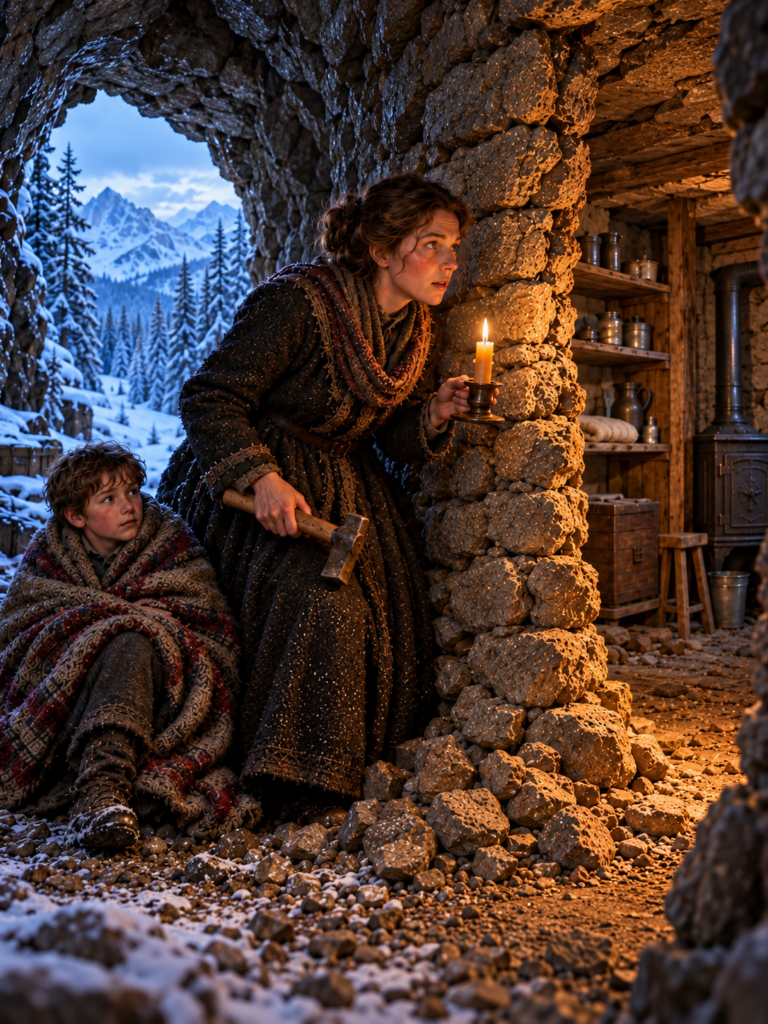
a widow carried her feverish son into a frozen mountain cave—then an old hammer uncovered the home, inheritance, and truth someone had tried to bury
Part 1
By the time Martha Sullivan reached the north face of Blackstone Mountain, the road behind her no longer existed.
Snow had erased it.
Snow covered the wagon tracks, the horse’s hoofprints, and the narrow trail she had been following since dawn. It settled in the folds of Martha’s brown wool coat and clung to the hem of her dress until the fabric felt as heavy as wet rope.
Eight-year-old Samuel lay across her back beneath a blanket.
His arms hung loosely over her shoulders.
Every twenty or thirty steps Martha turned her head and listened.
Breathing.
As long as she could hear breathing, she kept moving.
“Samuel?”
Nothing.
She stopped.
“Sam?”
A faint groan touched her ear.
“I’m here, Mama.”
Relief nearly buckled her knees.
“Good boy.”
“My head hurts.”
“I know.”
“Can we stop?”
“Soon.”
It was the same answer she had given him for two hours.
Soon.
Soon they would find shelter.
Soon she would build a fire.
Soon his fever would break.
Soon there would be water that wasn’t frozen, food that didn’t need rationing, a bed that wasn’t the ground.
Martha had lived thirty-four years and had learned that sometimes a person survived simply by believing the word soon longer than circumstances justified.
She shifted Samuel higher.
His body felt frighteningly hot against her back.
Three days earlier he had developed a cough.
Yesterday morning the fever came.
By evening, he was too weak to walk more than a few yards.
Their horse, Daisy, went lame shortly after dawn.
Martha had removed the saddle, whispered an apology into the mare’s ear, and turned her loose near a stand of firs where the snow was thinner.
Two miles later the wagon axle snapped against a buried stone.
That was when Martha abandoned almost everything.
The iron skillet.
The second sack of flour.
Isaac’s winter coat.
Two chairs tied to the wagon.
A cedar chest containing her wedding dress.
The blue china plate her mother had given her.
Things accumulated over a lifetime became choices when survival reduced life to weight.
Martha kept a sack of flour.
Dried venison.
Salt.
Matches sealed in waxed cloth.
A tin cooking pot.
A small knife.
Two blankets.
A coil of rope.
And the leather satchel containing Isaac Sullivan’s survey maps.
She would have thrown away her own boots before abandoning that satchel.
Those papers were the reason somebody had searched her barn.
The reason Martha had fled Alder Creek before sunrise.
Maybe the reason Isaac was dead.
Wind screamed through the pines.
Martha lowered her head and continued climbing.
Her husband had died seven months earlier.
Officially, Isaac Sullivan’s death had been an accident.
He had fallen from a narrow ridge while surveying timber boundaries north of Alder Creek.
That was what Harlan Pike said.
Pike owned the sawmill, the general store, half the freight business, and enough local debt to make men remove their hats when he walked by.
He was also the last person known to have seen Isaac alive.
Martha had disliked him before the accident.
Afterward, she feared him.
Isaac had spent his final winter arguing about a boundary claim near Blackstone Mountain.
At first Martha barely listened.
Land titles were Isaac’s world.
He understood survey stakes, deeds, county ledgers and those old government descriptions that began with phrases such as “from the northwestern stone at the bend of the creek.”
Martha understood chickens.
Gardens.
Children.
Bills.
How much flour remained after winter.
She knew when the milk cow would calve and how long a fever could safely burn before fear became necessary.
Then Isaac began coming home late.
He carried maps to bed.
Sometimes Martha woke at two in the morning and found him staring at old papers beside the kitchen stove.
One evening she asked what troubled him.
Isaac had looked toward the window before answering.
“There is land up on Blackstone that doesn’t belong to the men claiming it.”
“Whose is it?”
He had touched Samuel’s hair as the boy slept beside the fire.
“Ours, maybe.”
Martha laughed.
Isaac didn’t.
Two months later, he was dead.
The bank seized their farm in October.
Isaac had borrowed against it to buy equipment.
Martha discovered that only after his burial.
She sold the milk cow.
Then his tools.
Then the good wagon.
It wasn’t enough.
The day after the bank posted notice, Harlan Pike came to the farmhouse.
He stood on her porch with his left boot dragging slightly behind his right.
Step.
Scrape.
Step.
An old logging injury, people said.
He removed his hat.
“I’m sorry about the farm.”
Martha did not invite him inside.
“No, you’re not.”
Pike smiled.
He had a pleasant face until his eyes settled on something he wanted.
“I suppose grief makes people sharp.”
“What do you want?”
“Isaac carried survey records home.”
“Isaac carried lots of records.”
“Blackstone records.”
Martha said nothing.
Pike’s smile faded.
“Those belong to the county.”
“Then ask the county.”
“I am asking you.”
“You can stop.”
He leaned closer.
“Martha, you have a boy to think about.”
That sentence changed everything.
The same night, someone entered the barn.
Martha heard the door.
Then footsteps.
Step.
Scrape.
Step.
She sat beside Samuel’s bed holding Isaac’s shotgun until dawn.
The next morning she packed.
Now, somewhere above the tree line, Samuel’s weight sagged suddenly.
Martha dropped to one knee.
“Samuel.”
No answer.
She eased him onto the snow.
His lips looked pale.
She pressed her fingers beneath his nose.
Nothing.
Her heart stopped.
Then the faintest warmth touched her skin.
Martha closed her eyes.
“God, don’t.”
Not him too.
Anything but him.
She lifted her head.
White.
Trees.
Rock.
Wind.
No farmhouse.
No barn.
No chimney smoke.
No human being.
She looked toward the cliff above them.
Something was strange.
A narrow strip of exposed stone held almost no snow.
Everywhere else drifts clung against the mountain.
There, the rock remained dark.
Martha crawled closer.
Cold air touched her face.
Not wind from behind.
Air coming from the mountain.
She pushed snow-heavy branches aside.
Behind them opened a black gap.
A cave.
“Samuel.”
She shook him gently.
“I found something.”
He did not wake.
Martha lifted him again.
Twenty feet inside, the cave widened into a shallow chamber.
The floor was mostly dry.
The wind disappeared.
For the first time all day, Martha believed they might live until morning.
She lowered Samuel carefully.
Then survival narrowed her world.
Fire.
Water.
Warmth.
She scraped dry needles from beneath a rocky shelf.
She broke dead branches and split the thicker ones with her knife to expose the less-damp wood inside.
Her first match blew out.
Martha stared at the small blackened stick.
She had thirty-one left.
The second flame caught.
She sheltered it between both palms.
“Come on.”
The flame trembled.
Smoke rose.
A twig blackened.
Then burned.
Martha nearly wept.
She fed it slowly.
Too much wood would smother it.
Too little and it would die.
Soon a weak fire flickered against the cave wall.
She removed Samuel’s damp coat.
Built a bed from pine boughs.
Wrapped him in their driest blanket.
His eyelids fluttered.
“Mama?”
“I’m here.”
“Where are we?”
“A palace.”
Samuel opened one eye.
“Looks like a cave.”
“Needs decorating.”
His mouth moved as if trying to smile.
Then he coughed.
Martha filled the cooking pot with clean snow and placed it near the fire.
She had done this before during winter outages.
Still, the result felt cruel.
A pot filled to the rim became a few inches of water.
She packed it again.
Samuel drank three swallows.
Then vomited everything onto the stone.
Martha stared at the wasted water.
Her throat tightened.
She wanted to cry.
Instead she cleaned him.
Filled the pot.
Started again.
By darkness, she understood the arithmetic.
Water cost wood.
Heat cost wood.
Cooking cost wood.
Wood cost strength.
Her strength was finite.
So were the matches.
Food was worse.
She divided the flour and meat into portions.
Samuel’s pile larger.
Hers smaller.
Then she separated tomorrow’s food from the rest so fear wouldn’t convince her to eat what belonged to another day.
Outside, snow thickened across the entrance.
Inside, shadows moved against the stone.
Samuel slept fitfully.
Martha sat beside the fire with Isaac’s leather satchel against her stomach.
She opened it.
Survey papers.
An old map.
Notes in Isaac’s writing.
Boundary descriptions.
Names.
Numbers.
One sentence circled twice:
Original Foss claim not extinguished. Sullivan descent line probable.
Martha had never understood what it meant.
Maybe she never would.
She closed the satchel.
Tap.
Martha lifted her head.
The fire snapped.
She waited.
Tap.
Not fire.
Stone.
The sound came from the far side of the cave.
Martha picked up a burning branch.
One wall was unusually straight.
She had noticed that earlier but had assumed nature had formed it.
Now she walked closer.
Cold stone.
A crack ran vertically near the center.
She held the flame toward it.
The flame leaned.
Air.
Something was behind that wall.
Tap.
Samuel stirred.
“Mama?”
Martha turned.
“I’m here.”
“What is it?”
“Nothing.”
She didn’t believe that.
But Samuel was shaking again.
She returned to him.
Whatever the mountain was hiding could wait.
A sick child could not.
Before dawn his fever climbed.
Martha used the last of the driest wood.
She stripped off her own outer sweater and wrapped him in it.
She sat against the wall with Samuel against her chest.
“Stay with me.”
“I’m tired.”
“I know.”
“Papa used to sing.”
Martha’s throat closed.
“Yes.”
“Can you?”
“I don’t sing as well.”
“I don’t care.”
So Martha sang.
Quietly.
The old hymn Isaac used to hum while repairing fence.
Her voice broke twice.
Samuel slept.
Martha stayed awake listening to his breathing and to the wind building outside.
Morning came without sunlight.
The entrance had nearly vanished beneath snow.
Martha had no shovel.
She used the cooking pot.
Scoop.
Throw.
Scoop.
Throw.
Her fingers went numb.
Snow fell down the front of her dress.
When she finally opened a tunnel large enough to crawl through, daylight entered.
Martha stood outside, exhausted.
The entire mountainside had disappeared beneath white.
She looked at the cave.
They had found shelter.
Now they had to survive long enough for it to become something more.
Part 2
The first lesson Blackstone Mountain taught Martha was that survival rewarded organization more than courage.
Courage helped when a person needed to climb into a storm.
Organization kept a person from needing to do it twice.
Martha spent the next two days changing the cave.
She built a thicker bed of pine boughs so Samuel no longer lay near frozen stone.
She stretched one blanket across the narrowest point of the chamber to hold warmth around the fire.
She created three wood piles.
Wet.
Drying.
Dry.
The piles could not touch.
She stacked the dry wood against an inner wall and guarded it as carefully as she guarded food.
Each morning she tied Isaac’s rope around her waist before leaving.
The other end remained secured around a stone pillar inside the cave.
Without it, blowing snow could erase her footprints in minutes.
On her second fuel-gathering trip, Martha lost sight of the entrance from twenty yards away.
That frightened her enough to create another rule.
Never trust memory in a storm.
Trust rope.
Never chase dropped supplies downhill.
Never use the last dry wood except for Samuel.
Never leave the cave without the knife.
Never leave Samuel alone longer than necessary.
Rules gave fear edges.
By the third morning Samuel could sit upright.
That alone felt miraculous.
His fever remained, but his eyes were clearer.
Martha cooked thin flour porridge with a little salt.
He ate six spoonfuls.
“You want more?”
“Yes.”
Martha almost gave it.
Instead she waited.
“Half an hour.”
“But I’m hungry.”
“Good.”
Samuel frowned.
“Good?”
“Hungry means you’re fighting.”
He accepted that.
While Martha cleaned the pot, Samuel looked around the cave.
“Someone was here.”
Martha turned.
“Why?”
He pointed.
Near the wall lay a black stain beneath gray dust.
Ash.
Not theirs.
Martha knelt.
She brushed the floor.
More ash.
Then a bent iron hook.
Then marks in the stone.
Parallel.
Too regular to be natural.
“Tools,” she whispered.
They searched together.
Samuel’s strength faded quickly, so Martha made him sit while she worked.
Behind several loose stones she discovered a wooden box so rotten one side collapsed when she moved it.
Inside lay three candles wrapped in cloth.
A short iron pry bar.
A wedge.
And an old carpenter’s hammer.
The handle was smooth with age.
Samuel took it.
“There’s writing.”
Martha held it near the fire.
CALEB FOSS.
She stared at the name.
“Foss.”
“Who is he?”
“I don’t know.”
But Isaac had written that name.
Original Foss claim not extinguished.
Martha retrieved the survey paper.
Foss.
Caleb Foss.
She looked again at the wall.
“Samuel, your father knew something about this mountain.”
He leaned against her.
“What?”
“I wish I knew.”
The hammer became useful immediately.
Martha drove small wooden pegs into cracks.
Repaired the pot handle.
Broke ice.
The old tool felt unusually balanced.
Well used.
Well cared for.
Like holding another person’s hand across time.
That night the tapping returned.
Martha opened her eyes.
Tap.
Samuel heard it too.
“It’s the wall.”
Martha lit one of Caleb’s candles.
She carried the hammer across the cave.
A shallow draft touched her fingers near the center.
She tapped stone.
Hard sound.
Again.
Hard.
She moved two feet right.
Tapped.
The sound changed.
Hollow.
Martha’s skin prickled.
Samuel sat up.
“What?”
She struck again.
Hollow.
She raised the candle.
There.
A thin line between stones.
Mortar.
Not natural rock.
A wall.
Built deliberately inside the cave.
Someone had closed something off.
Samuel whispered, “Open it.”
Martha wanted to.
More than anything.
But the woodpile was low.
Darkness had already covered the mountain.
Curiosity was not more valuable than fire.
“Tomorrow.”
Samuel groaned.
“Your father would’ve said the same thing.”
“Papa would’ve opened it.”
Martha almost smiled.
“That is why I had to keep your father alive.”
Morning brought work.
First wood.
Then water.
Then food.
Only when Samuel was warm and the day sufficiently advanced did Martha bring Caleb’s hammer to the wall.
She positioned the iron wedge against the mortar.
Hit.
Dust fell.
Again.
Nothing.
Again.
The vibration ran through her wrist.
After twenty minutes, her palm blistered.
After forty, it split.
Martha wrapped it with cloth.
“Stop,” Samuel said.
“Not yet.”
“You’re bleeding.”
“I’ve done that before.”
One hour of work opened a crack no wider than her little finger.
Martha sat back, discouraged.
She had wasted strength.
Then the candle flame bent toward the gap.
Air moved steadily.
Not merely a cavity.
A larger space.
Martha examined the stones.
One rectangular block had smoother edges.
A plug.
She repositioned the wedge.
Hammer.
Hammer.
The mortar fractured.
Samuel crawled beside her.
“Can I help?”
“When I tell you.”
Martha forced the pry bar into the widening gap.
“Now.”
They pushed.
The block shifted.
Once.
Twice.
Then fell inward.
A dark opening appeared.
Warm? No.
But dry air touched Martha’s face.
She widened the gap.
Enough for shoulders.
“Stay here.”
Samuel immediately said, “No.”
“Samuel.”
“What if you fall?”
Martha knew the argument because it sounded like Isaac.
“You stay where I can hear you.”
She took the candle and crawled through.
For several seconds she saw nothing.
Then shapes emerged.
Boards.
A table.
Shelves.
An iron stove.
A narrow sleeping platform.
A workbench.
Cabinets.
Martha stood.
The candle trembled in her hand.
Someone had built a room inside Blackstone Mountain.
Not a mine.
A home.
A hidden home.
Samuel’s face appeared through the opening.
“Mama?”
“Come carefully.”
He crawled inside.
His eyes widened.
“Whoa.”
The room was perhaps sixteen feet by twenty.
Stone walls had been faced in timber.
A stovepipe disappeared upward into a narrow shaft cut through rock.
Shelves held tin plates and glass jars.
Canvas bundles rested on the bed.
A barrel stood beside the workbench.
Martha opened it.
Empty.
The second cabinet contained tools.
The third contained dried beans.
Not many.
But enough for weeks if rationed.
A small sack held salt.
Another held oats.
Against one wall was stacked firewood.
Dry.
Perfectly dry.
Martha touched the logs.
She began crying.
Samuel looked alarmed.
“What’s wrong?”
“Nothing.”
“You’re crying.”
Martha covered her mouth.
For weeks everything had been taken.
Isaac.
Their farm.
The cow.
The wagon.
Their security.
Samuel’s health.
Every day demanded another surrender.
Now the mountain had given something back.
Not wealth.
Time.
Time was more precious.
Martha knelt beside the stove.
She checked the flue.
Used only a handful of kindling.
Smoke rose cleanly.
She added one log.
The iron warmed slowly.
Samuel sat before it wrapped in an old canvas-stored blanket.
“This is better.”
“Much.”
“Can we live here?”
“For now.”
“Forever?”
Martha looked around.
She did not know.
But for the first time, she allowed herself to imagine next month.
They moved their belongings inside.
Martha rebuilt the loose stones from the outer side as best she could, leaving an opening she could close.
The cave became camouflage.
The inner room became shelter.
That night Samuel slept warmly.
His fever broke before dawn.
Martha woke because he was sweating.
She touched his forehead.
Cooler.
“Samuel.”
He opened his eyes.
“I’m hungry.”
Martha laughed and cried at once.
She cooked beans until soft.
Samuel ate one bowl.
Then another half.
Martha ate what remained.
The next problem was water.
Snowmelt consumed too much wood.
Martha searched the room.
Under the workbench she found a leather journal.
CALEB FOSS.
Pages had warped.
Some writing was lost.
But enough remained.
November 12.
Spring passage must be kept clear before hard freeze.
Martha sat upright.
Spring.
She searched every wall.
Behind the cabinets.
Beneath shelves.
Nothing.
Samuel walked slowly around the room.
He still tired easily.
Suddenly he said, “Mama.”
“What?”
“That rock is wet.”
A dark line crossed the floor behind the bed.
Martha touched it.
Moisture.
She moved the bed platform.
Behind it, near the floor, was a narrow opening.
Too narrow for Martha.
Samuel crouched.
“I fit.”
“No.”
“Mama.”
“You have been sick.”
“I’m better.”
“You were nearly dead four days ago.”
“But I’m not now.”
That was also an Isaac answer.
Martha stared at the hole.
Water might mean life.
It might also mean an underground drop.
She tied the rope around Samuel’s waist.
“You go ten feet.”
“Okay.”
“Not eleven.”
“Okay.”
“If I pull twice, come back.”
“Okay.”
“Keep the candle in front.”
“Mama.”
“What?”
“I know.”
He crawled inside.
The rope moved.
Five feet.
Eight.
Ten.
Then more.
“Samuel.”
“It bends.”
“Stop.”
“I hear something.”
Martha’s heart slammed.
“What?”
“Water.”
He vanished around the bend.
“Samuel!”
“I’m here!”
A moment later he returned.
His hands were wet.
He grinned.
“Come see.”
Together they widened the opening with the hammer.
Martha squeezed through.
Beyond the narrow gap was another stone passage.
Twenty feet deeper, clear water emerged from a fissure and collected in a natural basin before disappearing beneath rock.
Martha dipped her fingers.
Freezing.
Clean-looking.
Moving.
A spring.
She carried a cup back.
Boiled it.
After it cooled, Samuel drank.
Martha watched.
No snow melting.
No wasted firewood.
She looked at Caleb’s journal with new respect.
The dead man had designed the shelter around the mountain itself.
Other entries mentioned an eastern passage.
Miller Ridge.
A trapper trail.
Weather signs.
One sentence was underlined:
When western ridge disappears beneath cloud and the birds leave the lower forest, storm within three days. Usually severe.
The next morning Martha stepped outside.
She looked west.
Blackstone’s opposite ridge had vanished into cloud.
She listened.
No birds.
The forest had become too quiet.
Martha returned to Samuel.
“We have three days.”
“For what?”
“To get ready.”
Part 3
Day one belonged to wood.
Martha worked until she thought her shoulders would separate from her body.
She searched beneath fir trees for dead branches sheltered from snowfall.
Found standing deadwood.
Used Caleb’s saw.
Cut.
Dragged.
Split.
Stacked.
Samuel helped with kindling.
At first Martha objected.
Then she understood that keeping him useless would not keep him safe.
So she taught him.
“Small pieces here.”
He stacked them.
“Dry bark separately.”
He obeyed.
“Nothing against the stove.”
“Because sparks.”
“Exactly.”
By sunset, one wall of the hidden room held wood.
Not enough for winter.
Enough for a storm.
Day two belonged to food.
Martha checked three snares she had set near rabbit tracks.
Two empty.
One held a rabbit.
She whispered thanks before killing it.
Samuel watched from a distance.
He had seen animals butchered on the farm.
Still, hunger made the lesson different.
Martha cooked some meat.
Cut the rest into thin strips.
Salted it lightly.
Dried it near the stove.
She inventoried everything.
Flour.
Beans.
Oats.
Venison.
Rabbit.
Salt.
Samuel used charcoal to mark portions on a board.
“Why are we writing it?”
“So fear doesn’t do the counting.”
He looked confused.
Martha explained.
“When people get scared, they think everything should be used now.”
“Like eating all the candy.”
“Exactly.”
“Papa did that.”
“Your father had poor emergency candy discipline.”
Samuel laughed.
The sound filled the hidden room.
Martha had not realized how badly she needed to hear it.
Day three belonged to shelter.
She cleaned the stovepipe.
Packed cracks with wool from a damaged blanket.
Moved half the wood away from the stove.
Filled every container with spring water.
Then explored the eastern passage.
Beyond the spring, it climbed steeply.
Martha carried rope, candle and hammer.
Samuel remained at the room entrance.
She went farther than before.
Fifty feet.
A hundred.
The passage narrowed, then widened.
Cold air flowed from ahead.
There was another exit somewhere.
Caleb’s journal had been right.
Miller Ridge.
Martha returned without reaching it.
Not enough daylight.
The storm arrived before evening.
Snow began gently.
Large flakes.
Beautiful.
Samuel watched from the cave mouth.
“Doesn’t look bad.”
“It will.”
“How do you know?”
“Because Caleb knew.”
By dark the wind increased.
Martha sealed the hidden wall.
Inside, the stove burned low.
Outside, Blackstone Mountain vanished.
The storm screamed through the outer cave.
Even behind the stone wall, they could hear it.
On the second night Samuel woke coughing.
Martha’s body tightened with fear.
But no fever returned.
Dry throat.
Smoke perhaps.
She lowered the stove.
On the third day, the outer cave entrance disappeared beneath snow.
Martha knew because she opened the hidden wall and found complete darkness.
She crawled toward the mouth.
Snow had packed solid.
She returned.
“We’re buried.”
Samuel’s eyes widened.
“Can we breathe?”
“The chimney.”
That was what she hoped.
On the fourth morning Martha counted the wood.
They were burning faster than planned.
Cold seeped constantly through stone.
She reduced daytime heat.
They wore coats indoors.
Meals became strict.
Oat porridge in morning.
Beans or meat at night.
No midday meal.
Samuel complained once.
Then stopped when he saw Martha’s smaller portion.
“Mama.”
“What?”
“Take some.”
“I’m not hungry.”
“That’s a lie.”
She looked at him.
“How do you know?”
“You say it different.”
Martha smiled faintly.
He pushed two beans onto her plate.
“There.”
“Thank you.”
That night smoke entered the room.
At first only a faint smell.
Then Samuel coughed.
Martha looked at the stove.
A gray ribbon escaped from the stovepipe joint.
“No.”
She shut the damper.
Smoke increased.
Chimney blocked.
Snow or ice had clogged the outside vent.
Without the stove they might freeze.
With it they could suffocate.
Martha covered her mouth.
“Samuel, put on your coat.”
“What are you doing?”
“Clearing it.”
She smothered the fire with ash.
Opened the concealed wall.
Darkness swallowed her.
She tied the rope around her waist.
“Do not follow me.”
“Mama—”
“Samuel.”
He went quiet.
“If I don’t come back in fifteen minutes—”
“Don’t say that.”
Martha crouched.
“Then I will come back.”
She crawled through the outer cave.
Reached the buried entrance.
Started digging with the pot.
Snow collapsed behind each scoop.
Again.
Again.
Her arms burned.
The air grew thinner.
Martha dug until her fingers lost feeling.
Then the pot struck something different.
Space.
She shoved upward.
Wind exploded through a narrow opening.
Snow filled her collar.
Martha forced one arm outside.
Felt along the rock.
Found the vent area.
Ice.
She struck it with Caleb’s hammer.
Once.
Twice.
The third blow broke the plug.
A rush of trapped smoke moved past her.
The mountain could breathe again.
So could they.
Martha crawled backward.
Samuel waited beside the hidden wall.
His face went pale when he saw her.
Her dress was stiff with ice.
Her lips shook uncontrollably.
He helped pull off her outer coat.
Wrapped the blanket around her.
Then he walked to the stove.
“What are you doing?”
“Fire.”
“You know how?”
“You showed me.”
He laid kindling carefully.
Not too much.
Lit one match.
Shielded it.
The flame caught.
Martha watched her eight-year-old son rebuild their heat.
Pride hurt almost as much as fear.
The storm lasted eight days.
On the eighth morning Martha woke to silence.
No wind.
No roaring snow.
Only the faint crackle of the stove.
She and Samuel opened the hidden wall.
It took nearly two hours to dig out.
Then sunlight broke through.
Actual sunlight.
Samuel laughed.
Martha crawled outside.
The entire valley had changed.
Drifts swallowed trees to their lower branches.
The trail disappeared.
Broken pine limbs covered the slope.
Martha stood breathing cold air.
Alive.
Samuel emerged behind her.
“Mama.”
His voice had changed.
Martha turned.
He pointed.
Footprints.
Human.
They came from below.
Fresh.
A line leading toward the cave.
One normal print.
Then a dragged mark.
Normal.
Drag.
Step.
Scrape.
Step.
Scrape.
Martha’s stomach went cold.
Harlan Pike.
She pushed Samuel inside immediately.
“Move.”
“What?”
“Now.”
She erased the nearest tracks with pine branches.
Scattered old ash near the entrance to make the cave look abandoned.
Then sealed Samuel behind the hidden wall.
“You stay quiet.”
“Mama, come with me.”
“If he sees nobody, he’ll search harder.”
“Who?”
She looked at her son.
“Harlan Pike.”
Samuel understood enough.
His face changed.
“Did he hurt Papa?”
Martha hesitated.
“I don’t know.”
“Do you think he did?”
“I think he knows why Papa died.”
Martha closed the wall.
She remained in the outer cave holding Caleb’s hammer beneath her coat.
Minutes passed.
Then:
Step.
Scrape.
Step.
Martha heard him before she saw him.
Harlan Pike entered wearing a heavy fur-lined coat.
Snow dusted his shoulders.
He carried a rifle.
He smiled.
“Martha Sullivan.”
She forced herself not to look at the hidden wall.
“You followed us.”
“Took some work.”
“My son is sick.”
“I don’t care about your son.”
Martha’s hand tightened around the hammer.
Pike looked around.
“Where is he?”
“Dead.”
The word nearly destroyed her to say.
Pike studied her.
Martha made her face empty.
“Fever.”
His eyes moved toward the ashes.
The bed of pine.
The empty space.
For one terrible second Martha thought he believed her.
Then Samuel coughed.
Soft.
Behind the wall.
Pike turned.
Martha’s heart stopped.
He approached the stones.
Touched them.
Tap.
Tap.
Martha gripped the hammer.
Pike stared at the wall.
Then looked back at her.
“Interesting.”
He did not open it.
Not that day.
Instead he walked toward the cave mouth.
“Isaac’s papers.”
“I burned them.”
“No, you didn’t.”
“Why do you care?”
Pike smiled.
“Your husband found an old ownership defect.”
“What kind?”
“Something no widow needs to worry about.”
“Then why chase one into a mountain?”
His smile vanished.
“You have something that belongs to me.”
“My husband thought differently.”
“Your husband thought too much.”
There.
The sentence hung between them.
Martha whispered, “Were you there when he fell?”
Pike’s eyes changed.
Only slightly.
Enough.
Martha knew.
Maybe Pike had pushed Isaac.
Maybe threatened him.
Maybe merely watched him fall.
But Pike had been involved.
Martha felt murder rise inside her.
Caleb’s hammer suddenly seemed heavy enough.
She could cross the space.
One swing.
Maybe two.
Instead she thought of Samuel behind the wall.
Pike had the rifle.
Rage was not a plan.
He left.
Step.
Scrape.
Step.
“Think about those papers, Martha.”
His voice faded.
“When I come back, I won’t ask as politely.”
Martha waited until she heard nothing.
Then opened the wall.
Samuel flew into her arms.
“You said I was dead.”
“I know.”
“Don’t say that.”
“I’m sorry.”
“Never say that.”
She held him.
“Never again.”
That night Martha read Isaac’s papers beside Caleb’s journal.
Now she read with purpose.
Not as a widow trying to understand her husband’s obsession.
As a mother trying to defend her son.
Names matched.
Dates aligned.
Caleb Foss had acquired a large Blackstone parcel decades earlier.
Later deeds claimed the Foss line abandoned it.
But Caleb’s journal suggested otherwise.
He had transferred an interest to his sister, Eleanor Foss Sullivan.
Isaac’s great-grandmother.
The claim had never been properly extinguished.
Harlan Pike had purchased nearby timber rights based on a faulty boundary.
Isaac had discovered the error.
If the original chain held, much of the land Pike planned to log belonged to Samuel as Isaac’s heir.
Martha sat back.
This was never about a few papers.
It was land.
Timber.
Water.
Maybe minerals.
Pike had not chased her because he wanted records.
He wanted Samuel’s claim erased.
Samuel watched her.
“Are we leaving?”
Martha looked around the hidden home.
The stove.
The spring.
The wood Samuel stacked.
The hammer.
Every place they had lived had been taken by death, debt or stronger people.
She was tired of moving because someone else wanted what was theirs.
“No.”
Samuel blinked.
“What?”
“We’re done running.”
Part 4
Martha prepared for Harlan Pike with the same care she had used preparing for the blizzard.
Fear became tasks.
First, protect the documents.
She copied every name and claim number from Isaac’s papers.
Boundary descriptions.
Dates.
Witness names.
Caleb’s notes.
She checked the copies twice.
Then wrapped Isaac’s originals in oiled cloth and hid them behind a loose stone beside the spring.
Caleb’s journal went elsewhere.
Farther into the eastern passage, above the waterline, Martha found a narrow crack.
She wrapped the journal and pushed it deep inside.
Next she built a decoy.
Real survey sheets.
Old maps.
Measurements.
Nothing false enough to reveal the trick immediately.
Nothing complete enough to prove Samuel’s ownership.
She wrapped the packet in Isaac’s familiar leather covering.
Samuel watched.
“So we’re lying.”
“We’re making a thief steal the wrong thing.”
“Papa said lying is wrong.”
“Your father also kept a shotgun beside the door.”
Samuel considered.
“Okay.”
Martha smiled despite herself.
Next came escape.
She followed the eastern passage all the way.
It took nearly forty minutes.
The tunnel rose gradually.
Twice she crawled.
Once she crossed water.
Eventually weak daylight appeared.
The exit opened beneath a shelf of rock on Miller Ridge.
Caleb had chosen brilliantly.
A person could enter one side of Blackstone and emerge nearly a mile away.
Below the ridge, Martha found the trapper trail mentioned in the journal.
Two days later she saw smoke.
A small camp.
Two men.
Brothers named Amos and Eli Turner.
They had trapped the region for twenty years.
Amos recognized Isaac’s name.
“Surveyor?”
“My husband.”
“He came through last summer.”
Martha’s chest tightened.
“Did he say why?”
“Asking about old markers.”
“Was he alone?”
Amos thought.
“At first.”
Martha leaned forward.
“At first?”
“Pike came up later.”
Samuel looked at her.
Martha’s hands went cold.
“Did they leave together?”
“No.”
“What happened?”
“Argument.”
“About what?”
“Didn’t hear.”
Amos scratched his beard.
“Pike left angry. Isaac headed north toward Crow Ridge.”
Crow Ridge.
Where Isaac died.
Martha took the copies from her coat.
“I need these delivered to the county land office.”
Eli looked at the papers.
“Road won’t clear for weeks.”
“First person who goes.”
“Why?”
“Because Harlan Pike is trying to destroy the originals.”
That was enough.
Mountain people understood disputes over land.
They also understood men who used money to make law feel optional.
Amos took the packet.
“I’ll see it gets there.”
Martha returned to Blackstone before dark.
The next three days passed quietly.
Too quietly.
On the fourth morning she found fresh tracks.
Pike returned after noon.
This time he carried a pry bar.
Martha and Samuel hid in the eastern passage.
They heard stone fall.
He had found the wall.
Pike entered the hidden room.
Drawers opened.
Furniture moved.
Metal struck wood.
Samuel trembled.
Martha pressed one finger to her lips.
Pike found the decoy packet.
Silence.
Then footsteps retreating.
Martha waited one hour.
Only then emerged.
The room was wrecked.
Blankets thrown aside.
Food scattered.
One cabinet broken.
Samuel looked around.
“He ruined it.”
“We fix it.”
“Why?”
“Because it’s ours.”
They spent the afternoon restoring everything.
That act mattered.
Pike could enter.
He could frighten them.
He could break a shelf.
But he would not determine whether the place remained home.
The following afternoon Pike returned.
Furious.
He entered openly.
No pretense.
No smile.
“You gave me garbage.”
Martha stood beside the stove.
“I gave you nothing.”
“You hid the real papers.”
“I don’t have them.”
“Where?”
“Somewhere you can’t reach.”
He stepped forward.
Martha saw a knife beneath his coat.
Samuel was already in the passage.
Good.
Pike grabbed Martha’s arm.
“Where are they?”
She looked at his hand.
“Take it off.”
He squeezed.
Martha did not flinch.
“You think because your husband scribbled lines on maps you’re a landowner?”
“I think you’re scared of a dead man’s handwriting.”
Pike struck her.
Martha’s head snapped sideways.
Pain flashed across her cheek.
She tasted blood.
For one second all restraint vanished.
She wanted Caleb’s hammer.
Wanted bone beneath iron.
Instead she stumbled toward the spring passage.
Exactly as planned.
“You want the papers?”
Pike followed.
“Take me to them.”
Martha entered the narrow tunnel.
He came behind.
She knew every rock now.
Every drop.
Every low place.
Pike knew none.
At the icy bend above the spring, Martha stepped carefully over frozen runoff.
Pike lunged.
His bad left boot landed on ice.
He fell hard.
His knife flew.
Martha kicked it into the water.
Pike cursed and grabbed for her dress.
She pulled free.
Then reached for the pry bar already positioned beside three loose stones.
Caleb had once built an old retaining barrier there.
Time had weakened it.
Martha had weakened it more.
She yanked the bar.
One stone moved.
Then another.
Pike saw it.
“What are you doing?”
Martha pulled again.
Rock collapsed between them.
Not enough to crush him.
Enough to block the passage.
Dust filled the tunnel.
Pike shouted.
“You stupid woman!”
Martha stood on the opposite side.
Her body shook.
“The papers are gone.”
Silence.
“What?”
“They’re on their way to the county office.”
Pike slammed something against the rocks.
“You don’t know who you’re dealing with.”
“I do.”
Martha stepped closer.
“I know you followed Isaac to Crow Ridge.”
Pike stopped.
“I know you argued.”
No answer.
“Did you push him?”
Still nothing.
Then Pike laughed.
It was quieter than she expected.
“Your husband should’ve minded his own property.”
Martha closed her eyes.
Not a confession.
Enough.
“He found the marker, didn’t he?” Pike said. “Old fool thought a boundary stone could undo twenty years of contracts.”
Martha listened.
“He wouldn’t sell.”
“So you killed him.”
“I didn’t touch him.”
Pike’s voice hardened.
“He backed away. Ground gave way. I wasn’t going over after him.”
“You left him.”
“He was dead.”
“You don’t know that.”
Silence.
Martha felt sick.
Isaac might have survived the fall.
Minutes.
Hours.
Pike had abandoned him.
Martha gripped the wall.
She wanted to remove the rocks.
Wanted to face him.
Wanted justice immediately.
But Samuel waited.
The documents were moving toward people who could make the truth harder to bury.
Justice delayed was still better than a widow dead in a tunnel.
“Leave Blackstone,” Martha said.
Pike laughed.
“This mountain isn’t yours.”
“We’ll see.”
“If those papers reach the county, I’ll contest every page.”
“Then do it in a courthouse.”
“You think the law protects people like you?”
Martha looked toward the spring.
“No.”
She thought of their farm.
The bank.
The barn search.
Isaac.
“No, I don’t.”
Her voice became steady.
“That’s why I made copies.”
She retreated.
Hours later, Pike cleared enough stone to escape toward the cave.
Martha and Samuel remained deep in the eastern passage.
They heard him leave.
Step.
Scrape.
Step.
That night Martha did not sleep.
Samuel did.
His head rested against her arm.
Martha watched the stove.
She thought about Isaac lying somewhere below Crow Ridge.
Perhaps alive for a while.
Perhaps calling.
She had spent months imagining he died instantly.
Now uncertainty reopened everything.
At dawn Samuel woke.
“Are you crying?”
“Yes.”
“Because Papa?”
“Yes.”
He hugged her.
Martha held him.
“Did Mr. Pike kill him?”
Martha chose truth carefully.
“I think Mr. Pike could have helped him.”
“But he didn’t.”
“No.”
Samuel’s face hardened.
Martha touched his cheek.
“Don’t carry him.”
“What?”
“Harlan Pike.”
She tapped Samuel’s chest.
“Don’t put that man in here.”
“He hurt Papa.”
“I know.”
“I hate him.”
“I know.”
“Don’t you?”
Martha looked at the fire.
“Sometimes.”
Samuel seemed shocked.
“But hate takes food too.”
He frowned.
“What?”
“It eats whatever you give it.”
Martha thought of Isaac.
“He would not want us feeding that man forever.”
Outside, winter slowly weakened.
Days lengthened.
The sun reached places it had missed for months.
Martha and Samuel remained alert.
Pike never returned.
In March, they found deer tracks near the lower trail.
In April, running water appeared beneath snow.
Samuel grew stronger.
His cheeks regained color.
He learned to set snares.
Sharpen tools.
Read Caleb’s weather notes.
Use Isaac’s compass.
By May he could climb to Miller Ridge without stopping.
One afternoon a figure appeared there.
Amos Turner.
He carried a folded paper.
Martha ran the final yards.
“County office.”
Her hands shook as she opened it.
The survey clerk had reviewed the copies.
A formal inquiry had begun.
The Foss-Sullivan descent chain appeared valid.
Harlan Pike’s timber claim had been suspended pending title review.
Samuel read over her arm.
“What does that mean?”
“It means he can’t cut our trees.”
“Our trees?”
Martha laughed.
“Maybe.”
Three weeks later another notice came.
This one carried a seal.
Samuel Sullivan, minor heir of Isaac Sullivan, had a recognized claim to the Blackstone parcel subject to final boundary confirmation.
Martha sat beside the spring and read the letter four times.
Then she handed it to Samuel.
He sounded out the difficult words.
Finally he looked up.
“It’s ours?”
Martha looked around.
The hidden stove.
The shelves.
The water.
The passage that had saved their lives.
“It’s becoming ours.”
Samuel smiled.
“No.”
“What?”
He touched the wall.
“It already is.”
Part 5
Spring did not turn Blackstone Mountain gentle.
It merely changed the kind of work required.
Snowmelt flooded lower trails.
Mud swallowed boots.
The roofless world outside the cave came alive with mosquitoes, ticks, weeds and animals hungry after winter.
Martha loved every inconvenience.
Cold had taught her to fear stillness.
The sound of water rushing beneath ice felt like resurrection.
She and Samuel began rebuilding life.
Not the old life.
Martha understood now that some doors truly closed.
Their farmhouse in Alder Creek belonged to the bank.
The kitchen where Isaac had kissed her each morning belonged to another family.
Her apple trees would bloom for strangers.
At first that thought still hurt.
Then Martha realized home did not have to mean the place where life had been easiest.
Sometimes home was the place from which you finally refused to be driven.
County surveyors reached Blackstone in June.
Three men came with chains, instruments, record books and Amos Turner.
Martha led them through the lower ridge.
They found two of Isaac’s marked trees.
Then an older stone marker half buried beneath moss.
The letters CF remained faintly visible.
Caleb Foss.
One surveyor removed his hat.
“Well, Mrs. Sullivan.”
Martha stared at the stone.
Isaac had found it.
This was what he died protecting.
The final boundary placed nearly six hundred eighty acres within the old Foss claim.
Much of it timber.
Some pasture.
A spring-fed creek.
Blackstone’s northern cave system.
Harlan Pike had been logging the southern edge illegally for years.
The county ordered him to halt operations.
Pike challenged the decision.
Then lost.
He challenged again.
Lost again.
When investigators questioned him regarding Isaac’s death, no murder charge followed.
There was not enough proof.
That hurt Martha.
She wanted a courtroom to declare what she knew in her bones.
But witnesses confirmed Pike had lied about when he left Crow Ridge.
The county prosecuted him for false statements related to the land filing and illegal timber harvest.
His business weakened.
Creditors came.
Men who once feared him stopped removing their hats.
Martha heard all of it through travelers.
She never went to watch.
Justice did not always arrive carrying the punishment a grieving person wanted.
Sometimes it merely removed a cruel man’s power.
Martha learned to accept that.
Summer became autumn.
The hidden room changed.
Martha built additional shelves.
Samuel carved hooks.
They stored beans, cornmeal and salt.
Amos helped bring a small iron cookstove better than Caleb’s aging one, though Martha refused to discard the original.
A widow from Miller Ridge gave them quilts.
A farmer traded potatoes for help repairing fencing.
Martha planted herbs near the cave entrance where sunlight reached.
Samuel called it their garden.
It contained nine onions, six sad carrots and a determined row of beans.
Martha praised it as though he had planted the entire Shenandoah Valley.
Travelers sometimes used the outer cave during storms.
Most never discovered the concealed home.
Martha began leaving a small stack of firewood there.
A tin cup.
Matches sealed against damp.
Samuel asked why.
“What if it’s somebody bad?”
“It might be.”
“So why help them?”
“Because it might be somebody carrying a sick child.”
That silenced him.
In October they visited Alder Creek.
Martha had avoided the town for nearly a year.
Returning frightened her more than she expected.
The road passed their old farm.
New curtains hung in the kitchen window.
A strange wagon stood beside the barn.
Samuel stared.
“Do you want to stop?”
Martha thought.
“No.”
“You sure?”
“Yes.”
She meant it.
At the county courthouse, a clerk handed her the finalized title.
Samuel Sullivan owned the Blackstone parcel, held in guardianship by Martha until he reached adulthood.
The clerk adjusted his spectacles.
“Valuable timber there.”
Martha folded the document.
“We won’t clear-cut.”
He looked surprised.
“You could make considerable money.”
“So could my son after I’m gone.”
The clerk studied her.
“Most people don’t think that way.”
“My husband died because men didn’t.”
Outside the courthouse, someone called her name.
Martha turned.
Harlan Pike stood across the street.
He looked older.
His coat was worn.
His left leg dragged more noticeably.
Step.
Scrape.
Step.
For one second Martha returned to the cave.
Dark wall.
Hammer in her hand.
Samuel hidden behind stone.
Pike crossed slowly.
Samuel moved closer to Martha.
Pike stopped six feet away.
“So you got it.”
Martha said nothing.
“Congratulations.”
Still nothing.
Pike looked at Samuel.
The boy stared back.
“You look like your father.”
Martha stepped between them.
“Don’t.”
Pike’s face tightened.
Then something resembling shame crossed it.
“I didn’t push Isaac.”
Martha’s voice came quietly.
“You left him.”
Pike looked toward the courthouse.
“He fell.”
“And you left him.”
“I was afraid.”
Martha almost laughed.
All that cruelty.
All those threats.
All that land.
Fear beneath it.
“You could have brought help.”
“I know.”
Two words.
Not enough.
Nothing would ever be enough.
Pike removed his hat.
“I hear you have a road going in.”
“Eventually.”
“If you sell timber—”
“No.”
He nodded.
Martha started walking.
Pike called after her.
“I’m sorry.”
She stopped.
Samuel looked up.
Martha did not turn.
For months she had imagined what she would say if that moment came.
She had rehearsed speeches while splitting wood.
While carrying water.
While lying awake beside Samuel.
Now the words seemed unnecessary.
She looked at her son.
Then continued down the street.
Pike’s apology could remain where he placed it.
Forgiveness was not another debt Martha owed.
By November, Blackstone’s first heavy snow arrived.
This time Martha was ready.
Wood filled an entire wall.
Food crowded the shelves.
The chimney was clear.
The spring passage remained open.
Three lanterns hung above the workbench.
Samuel had grown nearly two inches.
He no longer looked like the feverish child Martha had carried uphill.
One evening he held Caleb’s hammer.
The letters on the handle had faded further.
CALEB FOSS.
Samuel looked at Martha.
“Can I put my name?”
She hesitated.
“It’s old.”
“So?”
“It belonged to Caleb.”
“He’d want to know who used it next.”
Martha smiled.
“Maybe.”
Samuel took his knife.
Carefully, beneath Caleb’s name, he carved two letters.
S.S.
He held it up.
“Now people will know.”
“Know what?”
“That we were here.”
The words struck Martha deeply.
She looked around the hidden room.
Caleb had lived here.
Isaac had searched for the truth here.
She and Samuel had survived here.
People could disappear quickly.
A fall.
A fever.
A winter.
A bank notice.
A greedy man’s lie.
Maybe that was why marks mattered.
Names.
Stories.
Tools passed from one hand to another.
Proof that somebody had stood in the cold and refused to vanish.
Years passed.
Martha never became wealthy in the way people in Alder Creek predicted.
She sold selective timber.
Enough to build a proper house below Blackstone.
Enough to send Samuel to school in winter.
Enough to buy livestock and restore pasture.
But she never sold the mountain.
The first house was modest.
Two bedrooms.
A stone chimney.
A kitchen window facing the ridge.
When Samuel was fourteen, he built Martha a pantry shelf crooked enough that every jar leaned slightly left.
She kept it that way.
When he was sixteen, he could walk the eastern passage in darkness.
When he was eighteen, the title passed fully into his name.
Martha placed it in his hands.
“Your father’s.”
Samuel shook his head.
“Ours.”
When he was twenty-three, Samuel married Anna Mercer, the daughter of a miller from two valleys east.
Martha cried through the whole ceremony.
Isaac’s absence remained beside her.
But grief no longer stood alone.
Grandchildren followed.
First Isaac.
Then Clara.
Then Caleb.
Samuel named the last boy after the man whose hammer had opened a hidden wall decades earlier.
Martha pretended not to cry at that too.
The cave remained.
Samuel repaired the hidden room but never modernized it beyond recognition.
Caleb Foss’s original stove stayed in the corner.
His journal sat in a dry cabinet.
The hammer hung above the workbench.
CALEB FOSS.
S.S.
Later another set of initials appeared.
I.S.
Samuel’s oldest boy.
Travelers still used the outer chamber.
Firewood always waited there.
So did a tin cup.
Matches.
A wool blanket sealed in waxed canvas.
One January afternoon, nearly thirty years after Martha first climbed Blackstone, a young couple became stranded in a storm.
Their horse broke a leg.
The woman carried a baby.
They found the cave.
They found the wood.
They found matches.
They survived the night.
They never discovered the hidden room.
They didn’t need to.
When Martha heard the story weeks later, she sat beside the stove and smiled.
“What?” Samuel asked.
“Nothing.”
He was thirty-eight now.
Broad-shouldered like Isaac.
Gray beginning near his temples.
Martha touched the old hammer.
“Just thinking Caleb Foss probably never knew us.”
“No.”
“But he kept us alive.”
Samuel nodded.
“And now you kept them alive.”
Martha looked toward the concealed wall.
“Maybe that’s what home is.”
“What?”
“Something you make safe enough that a person you will never meet might survive because you were here.”
Samuel smiled.
“That sounds like something Papa would’ve said.”
“No.”
Martha laughed.
“Your father would’ve taken three pages and a survey diagram to say it.”
On Martha’s seventieth birthday, the family gathered at Blackstone.
Snow had fallen during the night.
Children ran near the ridge.
The hidden room smelled of beans, bread and woodsmoke.
Anna complained there were too many people.
Martha said that was the point.
Samuel’s youngest grandson discovered the spring passage and emerged soaked to the elbows.
Nobody admitted who failed to watch him.
Martha sat by the stove wrapped in a blue shawl.
Her hands had become thin.
The scars from that first winter remained across her palms.
Samuel sat beside her.
“You tired?”
“Yes.”
“Want to go down to the house?”
“No.”
He smiled.
“I knew you’d say that.”
Martha looked around.
For years people had called the hidden room Caleb’s shelter.
Then Martha’s cave.
Then the Sullivan place.
To her, none of those names were quite right.
It was simply home.
Not because it had been comfortable.
It hadn’t.
Not because it was beautiful.
Mostly it was stone.
Not because it made them rich.
The land had value, but value was never the same as worth.
It was home because on the worst day of Martha Sullivan’s life, when her child was burning with fever and snow had erased every road behind them, the mountain had offered one opening.
Martha had entered carrying a dying boy.
She had expected only to survive the night.
Instead she found a dead man’s tools.
A spring beneath stone.
A hidden passage.
Proof of Isaac’s work.
A claim nobody could erase.
And enough time to become the woman she had not known she could be.
She looked at Samuel.
He caught her watching.
“What?”
“Nothing.”
“You’re doing that thing.”
“What thing?”
“Looking at me like I’m eight.”
“You’ll always be eight somewhere.”
Samuel rolled his eyes.
Martha laughed.
Outside, snow began again.
Large quiet flakes.
The kind that would have terrified her once.
Samuel stood.
“I should bring more wood in.”
“We have plenty.”
“Storm might last.”
Martha nodded approvingly.
He had learned.
Samuel crossed to the woodpile.
Martha closed her eyes.
She heard Isaac’s voice in memory.
He was standing in their old farmhouse kitchen.
Young.
Alive.
Complaining about boundary stones.
Samuel was four.
Martha was kneading bread.
At the time she had thought it an ordinary evening.
Years taught her there was no such thing.
Ordinary evenings were treasures people recognized only after they were gone.
“Mama?”
Martha opened her eyes.
Samuel was holding Caleb’s hammer.
“The handle’s splitting.”
She extended her hand.
He gave it to her.
Martha turned the old tool.
Caleb’s name.
Samuel’s initials.
Isaac’s grandson’s marks.
Three generations.
One piece of wood.
“We can replace the handle,” Samuel said.
Martha shook her head.
“Not yet.”
“It’ll break.”
“Everything does eventually.”
Samuel sat.
Martha placed the hammer across her knees.
“That doesn’t mean you throw it away before its work is finished.”
Samuel looked at her.
Then understood.
They sat without speaking.
Snow covered the world beyond Blackstone.
Inside, firelight moved across stone.
Children laughed in the passage.
Food filled the shelves.
Fresh water ran beneath their feet.
Dry wood reached almost to the ceiling.
Martha thought of the first night.
Samuel burning with fever.
Her fingers numb.
Thirty matches.
Almost no food.
No road home.
She remembered wondering whether he would survive until morning.
Now that frightened little boy sat beside her as a grown man with children and grandchildren of his own.
Martha placed one hand over his.
“You know what I was most afraid of that night?”
“Dying?”
“No.”
“What?”
“That you would.”
Samuel squeezed her hand.
“But I didn’t.”
“No.”
Outside, wind rose.
Martha listened.
Not fear.
Weather.
Only weather now.
Samuel added one log to the stove.
The flames curled around it.
Martha looked toward the stone wall she had once broken open with a dead man’s hammer.
Beyond it waited the outer cave.
Beyond that, Blackstone Mountain.
Beyond the mountain, roads.
Towns.
Banks.
Courthouses.
People still fighting over things they believed they owned forever.
Martha had learned better.
Land outlived owners.
Money changed hands.
Houses burned.
Deeds yellowed.
Even mountains eventually changed.
What remained longest were the things people did for one another.
Isaac had left papers because he wanted Samuel protected.
Caleb had stored wood because he expected winter.
Amos Turner carried documents because a widow asked for help.
Martha left firewood for travelers whose names she would never know.
Samuel would teach his children the spring passage.
One life making the next life slightly safer.
That was inheritance.
Not merely acres.
Not timber.
Not a claim stamped by county officials.
The true inheritance was knowledge passed forward with love.
How to read weather.
How to split wet wood to find the dry center.
How to ration food without surrendering hope.
How to refuse a bully without becoming one.
How to know when to run.
And when to stop.
Martha leaned back.
“Samuel?”
“Yes?”
“Close the door.”
He rose.
Walked through the opening.
Checked the outer cave.
Returned.
Then pulled the concealed panel into place.
Stone covered darkness.
Wind became distant.
The hidden home filled with warmth.
Martha smiled.
The first time she had entered Blackstone Mountain, she had been running from everything she had lost.
Now there was nowhere she wanted to go.
This time, nobody was hunting them.
Nobody was taking the farm.
Nobody was searching the barn.
Nobody was waiting outside in the snow.
This time the door closed because they chose to close it.
This time Samuel was strong.
This time the shelves were full.
This time Martha Sullivan was home.


