
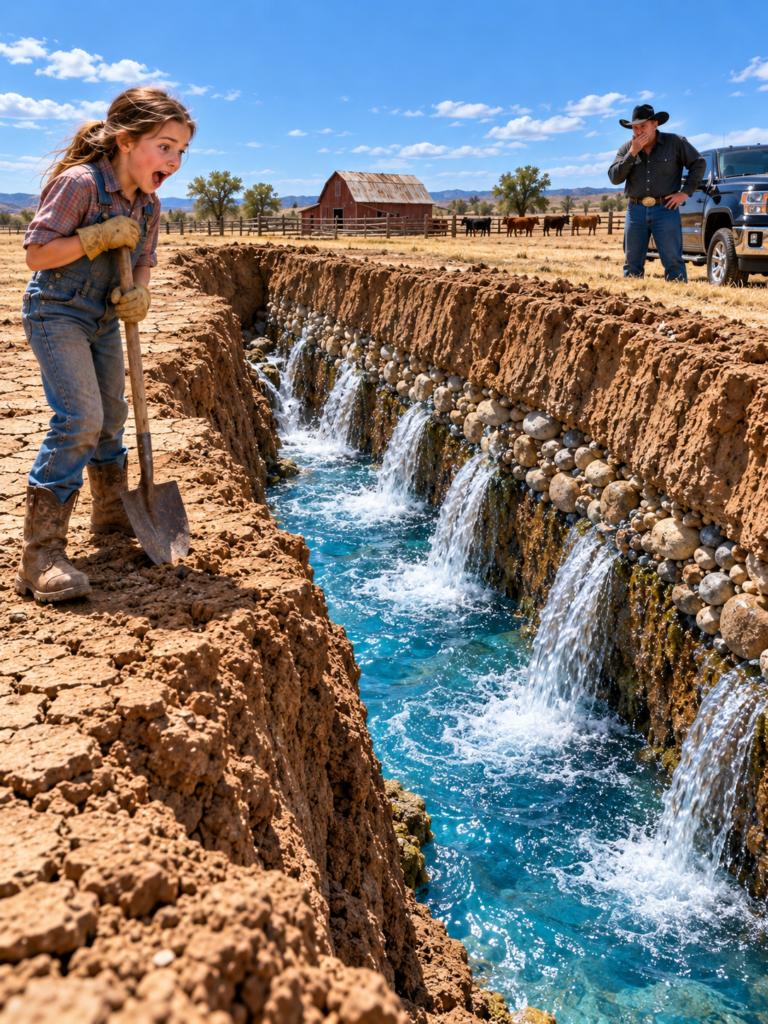
the richest rancher in the valley bought every water right to force a widow off her land—then her daughter found what their family had buried beneath the old barn
Part 1
By nine o’clock in the morning, Mara Bell knew the ranch was in trouble.
The irrigation ditch behind the alfalfa field should have been carrying six inches of cold mountain water by then.
Instead, sunlight flashed off a strip of mud barely wider than her palm.
Mara killed the tractor engine.
For a few seconds she remained in the seat with both hands resting on the steering wheel.
The sudden silence felt wrong.
No water moving over stones.
No splash at the diversion gate.
No steady whisper coming through the cottonwoods.
Only grasshoppers.
A distant bawling calf.
And the dry August wind crossing 126 acres that had belonged to Bells for four generations.
Mara climbed down.
The heat hit her immediately.
Western Colorado had been baking beneath the same white sky for nearly three weeks. By afternoon, temperatures were climbing toward a hundred degrees. The foothills above the valley had turned the color of old leather, and even the sage along the fence lines seemed tired.
She walked to the ditch.
Nothing.
She crouched and touched the mud.
Warm.
“Damn.”
She stood and looked upstream.
The ditch curved beyond the north pasture, crossed two neighboring properties, and eventually tied into the main irrigation network that carried snowmelt across the valley.
For seventy-three years, some version of that water had reached Bell land every summer.
Mara’s grandfather had used it.
Her father had used it.
Mara had learned to set irrigation gates beside him when she was twelve.
She could still hear George Bell’s voice.
Never trust water just because it came yesterday.
Water had moods.
Water had memory.
Water had law attached to it.
And lately, water had Silas Vane.
“Mom!”
Mara turned.
Her sixteen-year-old daughter Ellie was running from the newer pole barn, boots kicking up dust.
Her brown hair had escaped its ponytail.
“The stock trough is almost empty.”
“I know.”
“Did the pump quit?”
“No.”
Ellie stopped beside her.
She followed Mara’s gaze toward the dead ditch.
“Oh.”
That one word held more fear than a question.
Mara wiped her palms on her jeans.
“Go shut off the line to the south pasture.”
“What about the yearlings?”
“Move them to the upper tank.”
“That’ll last maybe a day.”
“I know.”
“Should I call Ben?”
“For what?”
“Maybe there’s a blockage.”
Mara shook her head.
“There’s no blockage.”
She knew before she said it.
Silas Vane had finally done what everyone in the valley had been afraid he would do.
Over the previous eighteen months, Silas had bought water rights from six properties.
A dairy family who wanted to retire.
Two brothers buried in medical debt.
A widower who moved to Arizona after losing his wife.
The Collins place after the bank foreclosed.
Then three smaller rights attached to grazing parcels east of the highway.
One by one, he accumulated senior ditch interests.
Water that used to pass through half a dozen independent farms increasingly passed under the control of one man.
Silas already owned nearly four thousand acres.
Good land.
Bad land.
River bottom.
High pasture.
He had bought ranches not because he needed every acre but because he could afford to wait for the people between them to become tired enough to sell.
The Bell Ranch sat in the middle of his holdings like one missing piece in a puzzle.
He had tried to buy it four times.
The first offer had been almost friendly.
One hundred twenty thousand dollars.
Mara had laughed.
The second was one hundred forty-five.
The third was one hundred sixty.
She had rejected every one.
The ranch had problems.
A mortgage.
Ancient fencing.
A farmhouse roof that needed work.
Pasture too rocky in places to produce what modern ranch accountants liked to see.
But Mara’s father had died in that house.
Her mother’s apple trees still stood behind the kitchen.
Ellie had learned to ride in the south pasture on a patient old mare named June.
Mara had buried her husband, Daniel, in the cemetery twelve miles down the road, but nearly everything she remembered of their marriage lived on this land.
Daniel repairing the porch.
Daniel carrying a newborn Ellie from the truck.
Daniel laughing the afternoon their bull tore down a gate ten minutes after they repaired it.
Daniel dying had nearly broken her.
Selling the ranch afterward would have finished the job.
So she stayed.
She learned to run the cattle operation without him.
Learned to negotiate feed prices.
Learned which banker smiled before giving bad news.
Learned how to replace frozen water valves at two in the morning.
And slowly, painfully, she became something she had never intended to become.
The person responsible for making sure the Bell Ranch still existed when Ellie became old enough to decide whether she wanted it.
Now the ditch was dry.
At one thirty that afternoon, a black pickup came down the gravel lane.
Ellie saw it first.
“Mom.”
Mara was inside the barn cutting open the last mineral block.
She did not need to look.
“Stay here.”
“I’m sixteen.”
“Then be sixteen inside the barn.”
Ellie’s mouth tightened.
She had inherited that expression from Mara’s father.
Mara walked into the sunlight.
The black truck stopped beside the house.
Silas Vane stepped out.
Fifty-three.
Broad shoulders.
Gray beginning at the temples.
Clean denim shirt despite the dust.
Boots polished enough to irritate anyone who actually worked cattle.
Silas had grown up twenty miles away.
He was not an outsider.
That was part of what made him harder to hate cleanly.
His father had lost their first ranch when Silas was fifteen.
People still remembered the auction.
Silas remembered it better than anyone.
He had spent the rest of his life making certain nobody could ever force him off land again.
Unfortunately, somewhere along the way he had decided the safest way to avoid being pushed was to own enough that he could push first.
“You got my letter?” he asked.
Mara folded her arms.
“I got it.”
“The offer stands.”
“My answer stands.”
Silas glanced toward the pasture.
Cattle gathered near the half-empty tank.
Dust coated their lower legs.
“You may feel different in another week.”
Mara stared at him.
“You shut off our water.”
Silas lifted one shoulder.
“I exercised rights I purchased legally.”
“That ditch has supplied this place since my grandfather was young.”
“History and ownership aren’t the same thing.”
Mara took one step closer.
“You waited for August.”
Silas’s expression barely moved.
“I don’t control the weather.”
“You control the gate.”
“I control water I paid for.”
From the barn doorway Ellie watched silently.
Silas noticed her.
Then looked back at Mara.
“I didn’t come here to argue.”
He opened the passenger door and removed an envelope.
He set it on the hood.
“One hundred eighty thousand.”
Mara said nothing.
“Cash purchase. I assume the bank balance. No foreclosure. No auction. You keep the equipment that’s clearly yours.”
“How generous.”
“I’m being practical.”
“You always are.”
Silas glanced across the yellowing pasture.
“So should you be.”
Mara did not touch the envelope.
He lowered his voice.
“Dry land is worth what dry land can produce.”
The words landed exactly where he intended.
Mara’s bank payment was due in six weeks.
Hay prices had nearly doubled.
The cattle needed water whether history was sentimental or not.
Her checking account did not care that her father’s hands had set the fence posts.
Silas knew all of it.
Men who bought distressed ranches usually did.
He opened his truck door.
“Think about it.”
“I already have.”
“You’re thinking with memory.”
“And you’re thinking with somebody else’s hardship.”
Silas looked at her.
Something hard flickered in his face.
Then disappeared.
“I know what it’s like to lose a ranch.”
“Then you ought to know better.”
He climbed into the truck.
The engine started.
Before driving away, he lowered the window.
“I learned something from losing ours, Mara.”
“What?”
“Land belongs to whoever can afford to keep it.”
Then he left.
Mara stood beside the unopened envelope until the black truck disappeared.
Ellie came outside.
“You should’ve thrown it at him.”
“Wouldn’t change the number inside.”
“You’re not considering it.”
Mara picked up the envelope.
Ellie’s face changed.
“Mom.”
“I said nothing.”
“You picked it up.”
“Because leaving paper on the hood doesn’t make us noble.”
She walked toward the house.
That night they rationed water.
The cattle got priority.
Then Duke, the old cattle dog.
Then the chickens.
The garden got nothing.
Mara stood at the kitchen sink and watched a thin stream fill a pot.
Their domestic well still worked.
But it was not rated to supply a ranch.
If she ran it too hard, she could burn out the pump or drop the well faster than it recovered.
Ellie carried a metal bowl toward the door.
“Where are you going?”
“Duke.”
“He has water by the porch.”
“He won’t come out.”
The old dog had begun spending hot afternoons inside the abandoned barn.
That barn stood fifty yards uphill from the house.
It was the oldest building left on the Bell property.
The roof sagged.
One wall leaned east.
The boards had grayed almost silver.
Mara’s father stopped keeping livestock there twenty years earlier after building the newer structure downhill.
Silas once called it worthless.
Said he would knock it flat his first week after buying the ranch.
Ellie found Duke lying inside, not in shade near the doorway, but stretched across bare dirt where broken floorboards exposed the ground.
“You idiot.”
The dog lifted one eyebrow.
Ellie set down the bowl.
He drank.
Then put his head back on the earth.
Ellie knelt to scratch his neck.
Her palm touched the ground.
She stopped.
Cold.
Not cooler than the air.
Cold.
She moved her hand.
Six inches away, the dirt felt hot and dry.
Back toward Duke.
Cold.
Ellie frowned.
She pressed both palms down.
The old dog sighed.
“What are you lying on?”
The next morning Mara found her daughter in the barn before sunrise.
Ellie knelt over the same patch with a kitchen thermometer shoved two inches into the dirt.
Mara leaned against the doorway.
“I’m deciding whether to ask.”
Ellie looked up.
“Fifty-eight degrees.”
“What?”
She pulled out the thermometer.
“Ground temperature.”
“It’s early.”
“It was ninety-eight yesterday.”
“Maybe there’s an old pipe.”
“That’s what I thought.”
Mara stepped closer.
Duke wagged his tail from the corner.
She pressed her hand to the earth.
Cold.
Unmistakably.
Mara looked around the old barn.
The interior smelled of mouse nests, dry hay, weathered timber, and dust.
A beam near the back wall still carried knife marks her father had made.
MARA – 8
MARA – 11
Below them:
ELLIE – 6
Mara touched the letters.
Her father had measured Ellie there only months before the barn was abandoned completely.
For a moment she saw him alive.
George Bell in his stained work shirt.
Pocketknife open.
Ellie standing straight against the beam, demanding he not cheat her out of half an inch.
Then another memory surfaced.
Her father’s voice during drought.
If everything dries up, watch the barn before you watch the creek.
Mara had heard him say it dozens of times.
She always assumed he meant livestock.
Keep animals shaded.
Protect feed.
Watch for fire.
Now the sentence felt different.
Ellie was studying her.
“What?”
“Get a shovel.”
Mara removed the first rotten floorboard.
Packed soil underneath.
The second showed the same.
Under the third, Ellie’s shovel struck something hard.
Clank.
Both froze.
“Rock?” Ellie asked.
“Maybe.”
She scraped away dirt.
A straight edge appeared.
Then another.
Flat stones.
Not random.
Fitted.
Mara crouched.
Ellie brushed faster.
The line turned ninety degrees.
“A wall,” Mara whispered.
They kept digging.
By noon Mara had told Ellie twice they needed to stop.
By twelve thirty she was holding the flashlight.
The soil grew colder toward the center.
Then Ellie uncovered a narrow opening.
Cool air touched Mara’s face.
They stared at each other.
Outside, August burned the ranch brown.
Inside an abandoned barn, air was rising from beneath the earth.
Ellie smiled for the first time since the ditch went dry.
“Mom.”
“Don’t.”
“There’s something under here.”
Mara looked at the dark gap.
Her father’s old words came back again.
Watch the barn before you watch the creek.
Mara swallowed.
“All right.”
She reached for the pry bar.
“Let’s find out what he meant.”
Part 2
The first step appeared beneath eighteen inches of packed earth.
Stone.
Hand cut.
Worn smooth in the middle.
The second lay beneath it.
Then a third.
Ellie sat back on her heels.
“That’s not a foundation.”
“No.”
“Somebody walked down there.”
Mara looked toward the sagging roof.
“That does not mean we are doing it today.”
Ellie gave her the look sixteen-year-old daughters reserve for mothers saying obviously unreasonable things.
“We just spent six hours finding stairs.”
“And the roof is older than I am.”
“So?”
“So I would like to avoid explaining to the sheriff why my daughter died under a collapsed barn because neither of us had enough sense to stop digging.”
Ellie sighed dramatically.
Mara ignored her.
They braced the loose section of flooring.
Mara tied rope around a support post.
She called Ben Carter, their neighbor, and made him promise to come by in the morning before they went farther.
Then she spent the entire night wondering what was under the barn.
At six ten she heard Ellie’s bedroom door.
At six twelve Mara called from the kitchen.
“If you go down there without me, I will sell your horse.”
Silence.
Then footsteps returned.
“Blackmail.”
“Parenting.”
Ben arrived at seven.
Fifty-eight years old, sunburned, thick through the shoulders, and rarely impressed.
He looked at the opening.
Then at Mara.
“You dug under a collapsing barn.”
“Yes.”
“With your daughter.”
“Yes.”
“Because the dirt was cold.”
“Yes.”
Ben rubbed his jaw.
“I’m trying to decide whether I admire this or report you.”
“Inspect the floor.”
He did.
He reinforced the edge with scrap lumber and declared the back corner “probably not going to kill anybody immediately.”
That was as close to approval as Ben came.
Mara went first.
Rope around her waist.
Flashlight in hand.
By the fourth step the air changed.
The barn smell disappeared.
Stone.
Wet earth.
Mineral cold.
Six steps down, the stairs ended in a small room.
Mara ducked.
“Come on.”
Ellie followed.
The chamber was perhaps eight feet wide and ten feet long.
Three walls were fitted stone.
The fourth had partially collapsed inward.
A shallow trough crossed the floor.
Ellie aimed her flashlight.
A dark mineral line ran through it.
Old water mark.
Against one wall stood rusted brackets.
Wooden pegs had almost rotted away.
A narrow stone-framed opening disappeared into the collapsed uphill side.
Ellie whispered, “What was this?”
Mara shook her head.
“Root cellar?”
“Too wet.”
“Milk room?”
“Maybe.”
Ellie knelt near the blocked opening.
Mara heard it at the same moment.
Tick.
Silence.
Tick.
Ellie lifted one finger.
Water.
Somewhere beyond the stone.
“Mara?”
Ben’s voice came from above.
“We’re alive.”
“Disappointing. Find anything?”
Mara looked at Ellie.
“Maybe.”
That afternoon she drove into town.
Walter Hensley sat outside the feed store in his usual chair.
At eighty-one, Walter knew where nearly every original homestead in the valley had been, who had married whom, which wells had sulfur, which creek crossings killed horses, and why two families had not spoken since 1967.
Mara described the underground room.
Walter stopped rocking.
“Which barn?”
“The old cattle barn.”
“The one behind George’s house?”
“Yes.”
Walter stared toward the road.
“That wasn’t always a cattle barn.”
Mara leaned closer.
“What was it?”
“A milk shed.”
“Before my time.”
“Before mine too, mostly.”
He looked at her.
“There was a springhouse under it.”
Mara felt something cold move through her that had nothing to do with underground air.
“A springhouse.”
Walter nodded.
“Your great-grandfather built stone around running water. Bell family cooled milk there before electric refrigeration.”
“Where did the spring go?”
Walter shrugged.
“Channel stopped flowing sometime after the war, then came back weak, then stopped again. Your grandfather covered parts of it when the barn was enlarged.”
“Why?”
“Probably thought it was finished.”
“Did Dad know?”
“George knew there’d been a springhouse.”
“Did he know exactly where?”
Walter smiled faintly.
“Your father knew more about that land than he ever told anybody all at once.”
The next morning Walter came to see it.
He descended the stairs slowly with his cane.
At the bottom, his expression softened.
“I remember this.”
Ellie crouched beside the trough.
“You were down here?”
“Boy once or twice.”
“You said before your time.”
“Before my working time. I wasn’t born old.”
Ellie smiled.
Walter ran his hand over the stone.
“George’s mother used to set milk cans along here.”
He pointed toward the uphill opening.
“Cold water entered there.”
Then the trough.
“Ran across.”
Then the downhill groove.
“Out there.”
“So there’s a spring,” Ellie said.
Walter looked at her.
“No.”
The answer disappointed her.
“A springhouse does not create a spring.”
“But water ran here.”
“Once.”
“What happened?”
“Could be source dried.”
“Could be channel collapsed.”
“Yes.”
“Could still be water.”
Walter nodded.
“Could.”
Mara heard hope trying to enter the room.
She resisted it.
Hope could be expensive.
She had a bank payment coming.
Cattle losing weight.
A man waiting down the road for her to become desperate.
She could not afford to turn a historical curiosity into salvation before it produced one gallon.
They cleared debris slowly.
Ellie found an old outlet groove.
Outside, she noticed a strip of surviving green growth running downhill from the barn.
Broad-leaf plants.
A few stubborn grasses.
Even insects.
Then Duke began pawing at one patch.
“Mom.”
Mara walked over.
Ellie pointed.
“Look.”
A broken green line crossed the otherwise yellow ground.
Walter squinted.
“Follow it.”
They did.
It led away from the springhouse.
Not toward the source.
Toward what had once been a lower orchard and garden.
“Overflow,” Walter said.
Ellie turned.
“So the springhouse wasn’t the end.”
“No.”
“They used the water after cooling milk.”
“Likely.”
Mara crouched.
She touched soil beneath one green patch.
Cooler.
Not wet.
But alive.
She looked toward the old barn.
Then uphill.
If the room had received water from above and sent it below, then the system was larger than they realized.
Ben returned with his small excavator.
“Tell me again why I’m doing this.”
“Because you love history.”
“No.”
“Because you’re a good neighbor.”
“Less believable.”
“Because I’ll pay diesel.”
“Now we’re talking.”
He dug outside the barn, far enough from the foundation to avoid collapsing it.
Eight feet uphill, the bucket uncovered flat stones.
Two rows.
A narrow channel between them.
Ellie jumped into the shallow trench.
“There.”
Mara climbed down.
The channel pointed directly toward the blocked springhouse inlet.
They followed it.
Twelve feet.
Then roots from an old cottonwood swallowed the structure.
The dirt beneath them was dark.
Ellie grabbed a handful.
Squeezed.
Moisture shone between her fingers.
Her face lit.
Ben immediately ruined it.
“Wet dirt isn’t a spring.”
“I know.”
“You look like you found the Mississippi.”
“Let me have thirty seconds.”
By evening, they had nothing more.
No flow.
No underground pool.
No miraculous burst of water.
Only a buried channel filled with roots and silt.
Mara stood beside the trench.
Her back hurt.
Her hands were blistered.
The pasture above them looked as dead as it had that morning.
For the first time, embarrassment joined fear.
Maybe she had chased a story because reality was worse.
Maybe this was what desperation did.
Turned cold dirt into prophecy.
A black pickup slowed on the county road.
Silas.
He pulled beside the fence.
Saw Ben’s excavator.
Saw the open barn floor.
Saw Mara covered in mud.
“I heard you found water.”
Mara said nothing.
He smiled faintly.
“So you didn’t.”
“We found an old springhouse.”
“Old stones don’t feed cows.”
Mara’s jaw tightened.
“My offer is still there.”
“You came to tell me that?”
“I came because people talk.”
He glanced toward the trench.
“You should be careful how much money you put into proving the past existed.”
Mara looked at him.
“At least mine did.”
Silas’s expression hardened.
Then he drove away.
Mara went inside.
She did not eat dinner.
She sat at the kitchen table with Silas’s envelope unopened beside her.
One hundred eighty thousand.
Enough to clear the mortgage.
Enough to rent somewhere.
Maybe buy a smaller house in town.
Ellie could finish school without worrying about hay prices.
Mara could take a job at the agricultural cooperative.
She was forty-three.
Still young enough to start over.
Old enough to know starting over was rarely the brave adventure people claimed.
She touched the envelope.
Daniel’s voice came back to her.
We can always sell if we have to. But once it’s sold, we can’t decide to unsell it.
He had said it during their hardest year.
The year Ellie was two.
They had kept the ranch.
Daniel was gone now.
Mara wondered whether she was preserving his dream or using his memory to justify bad arithmetic.
Outside, she heard a shovel.
Mara closed her eyes.
“Ellie.”
No answer.
She walked out.
Her daughter sat beside the trench.
Not digging.
Thinking.
“The wettest dirt isn’t down there,” Ellie said.
“What?”
“It’s here.”
She pointed toward the uphill side.
“We keep looking under the barn.”
“That’s where the springhouse is.”
“Exactly.”
Ellie stood.
“The springhouse is where water arrived.”
Mara stared.
Ellie pointed uphill.
“The source has to be higher.”
It was obvious once she said it.
So obvious Mara felt foolish.
Ellie went inside and returned with a notebook.
She drew.
Springhouse.
Inlet.
Channel.
Cottonwood.
Green plants.
Then one arrow.
Uphill.
“We’ve been digging at the receiving end.”
Mara looked toward the dry upper pasture.
The slope rose nearly forty yards before leveling.
One old cottonwood stood alone halfway up.
Farther beyond, brush covered a small rise.
Six thin trees grew near it.
Willows.
Mara had seen them all her life.
Never thought about them.
Willows liked water.
Her father’s voice came back again.
Animals find water before people do.
Watch the barn before you watch the creek.
Mara looked toward Duke.
The dog had already walked uphill and stopped beneath the willows.
Ellie smiled.
“Still think I’m crazy?”
“Yes.”
“Are we going?”
Mara stared toward the hill.
Then back at the envelope inside the kitchen.
One hundred eighty thousand dollars.
A clean exit.
No foreclosure.
No fight.
All she had to do was stop asking questions.
Mara picked up the shovel.
“Show me your line.”
Part 3
They stopped guessing.
That was Ellie’s idea.
Instead of digging wherever grass looked greener, she treated the old system like a problem that could be reconstructed.
She stood at the springhouse inlet while Mara moved uphill with a fence post.
“Left.”
Mara moved.
“More.”
Again.
“Stop.”
They marked the line.
Thirty yards up it crossed the huge cottonwood.
Behind the trunk, Ellie found a shallow depression.
She scraped dry grass aside.
Flat stone.
Then another.
The remains of a water trace.
The direction aligned perfectly with the buried channel below.
Ben arrived with coffee and skepticism.
“You two sleep?”
“No,” Mara said.
“That explains this.”
They followed the trace uphill.
Roots had broken stones.
Livestock hooves had filled sections.
Decades of sediment erased others.
But enough remained.
Near the willow stand, the soil changed.
Mara pushed her boot into it.
Soft.
Everywhere else the ground was hard enough to ring beneath a shovel.
Ellie crouched.
She dug with her hands.
Dark soil.
Cool.
Ben stopped making jokes.
They cleared brush from the low rise.
Underneath sat three squared stones positioned too evenly to be natural.
Mara’s pulse quickened.
“Hand tools.”
Ben looked toward his excavator.
“You pay me to bring machinery and then tell me not to use it.”
“You’re welcome to go home.”
“I didn’t say I was leaving.”
They dug.
Slowly.
A narrow stone channel appeared.
Older than the lower sections.
Cruder.
But heading downhill exactly toward the barn.
They followed it six feet uphill.
Then struck a mass of clay, roots, and collapsed stone.
Ellie scraped near the bottom.
Water collected in the groove.
One teaspoon.
She wiped it away.
Another formed.
Mara crouched.
“Slow.”
Ellie nodded.
They cleared around the blockage instead of through it.
Ben cut one root.
Then another.
Ellie removed clay by handfuls.
For several seconds nothing happened.
Then a bead appeared between two stones.
It swelled.
Dropped.
Another.
Another.
A thread formed.
Thin.
Clear.
Cold.
It ran across Ellie’s palm.
Nobody spoke.
Mara sat back on her heels.
Then laughed.
One short sound.
Almost disbelief.
Ellie looked at her.
“You laughed.”
“I do that.”
“Not lately.”
Ben placed a metal pan beneath the trickle.
They waited.
Ten minutes.
More water.
Thirty.
Still flowing.
They left it overnight.
At dawn the pan had overflowed.
Not a lot.
But continuous.
That distinction mattered.
They spent four days clearing the old channel.
Every few feet, the same pattern appeared.
Stone.
Silt.
Roots.
Stone again.
Some sections could not be restored exactly, so Ben helped them lay narrow pipe along the original grade.
Nothing pumped.
Gravity carried the water.
On the fourth evening Ellie ran into the springhouse.
Mara heard her yell.
“Mom!”
She climbed down.
Water entered through the old inlet.
A stream no wider than a finger crossed the stone trough.
Not dramatic.
Not enough to irrigate acres.
But moving.
Continuously.
Ellie placed an old tin cup beneath it.
Cold water rang softly against metal.
Mara touched the surface.
For a moment she could not speak.
Her great-grandfather had built those stones.
Her grandmother cooled milk there.
Her father remembered enough to leave a riddle.
Now her daughter had followed it backward.
Walter came at sunset.
He stood at the bottom of the steps listening.
Then smiled.
“That’s it.”
“You remember the sound?”
“Yes.”
“When?”
“Your grandmother used to send me down here when I was a boy visiting George.”
Ellie looked at the trough.
“So it really ran.”
Walter nodded.
“Then.”
The warning in one word brought Mara back to reality.
“How reliable?”
Walter shook his head.
“Don’t know.”
“Year-round?”
“Used to be.”
“During drought?”
“Some.”
Mara looked toward the small stream.
It was tempting to make it larger in her mind.
She refused.
“Then we measure.”
For one week Ellie measured flow.
Every morning.
Noon.
Evening.
Night.
She recorded the amount in a notebook.
The flow changed slightly.
Never stopped.
At roughly the same time, they installed a temporary storage tank downhill from the springhouse.
By morning it held enough to refill part of a cattle trough.
When Mara opened the valve, clear water ran through a hose.
Cows crowded toward it.
The sound of them drinking made her chest ache.
The ranch was still in danger.
One small seep could not replace six inches of irrigation water across alfalfa.
But they were no longer completely dry.
That mattered more than Mara expected.
Three days later Silas returned.
He drove past the house and stopped beside the new storage tank.
Mara crossed the pasture.
“What do you need?”
Silas pointed.
“Where did that water come from?”
“My property.”
His eyes moved toward the old barn.
Fresh disturbed earth marked the restored channel.
“You opened a spring.”
“We restored an old system.”
Silas’s face changed.
Not fear.
Calculation.
“I own senior ditch interests through this drainage.”
“This water never touches your ditch.”
“That may not settle it.”
Ellie came up behind Mara.
“The source is on our land.”
Silas looked at her.
“That does not automatically determine how it can be used.”
Ellie frowned.
Mara stayed silent.
Silas continued.
“If that seep historically contributed to a drainage where I hold appropriated rights, and you’ve changed its path—”
“We didn’t change it.”
“You excavated it.”
“We restored an existing channel.”
“Prove it.”
The word sat between them.
Silas returned to his truck.
Pulled out photocopied pages.
Water filings.
Priority dates.
Diversion language.
Parcel numbers that no longer matched modern property maps.
He put them on a fence post.
“I’m not demanding you shut it down today.”
“How decent.”
“I’m warning you before attorneys get involved.”
“Your attorney.”
“Yes.”
Mara looked at the documents.
He had the advantage again.
Not because she believed him.
Because she did not know enough to prove him wrong.
Silas knew cattle too.
But he also employed a lawyer who specialized in water.
Mara employed Ben when fences broke.
Silas climbed into his truck.
“My purchase offer drops twenty thousand next week.”
There it was.
The legal uncertainty was not separate from the sale.
It was the sale.
Pressure her while the pasture browned.
Make the alternative look safe.
After he left, Ellie said, “He’s bluffing.”
“Maybe.”
“You think he owns our spring?”
“I think I don’t know.”
That frightened Mara more than if she did.
They drove to the county records office.
Four hours produced almost nothing.
Old parcel books.
Maps.
Deeds.
Photographs.
The courthouse clerk, June Alvarez, kept bringing boxes from storage.
Ellie opened a property file.
Inside lay a black-and-white photograph.
She froze.
“Mom.”
The Bell Ranch.
Nearly a century earlier.
Behind the family stood a low stone building beneath the location of the modern barn.
Mara turned the photograph over.
Faded pencil.
SPRINGHOUSE BUILT 1912.
Her heart beat faster.
“It proves it existed.”
Ellie smiled.
Mara shook her head.
“It proves a building existed.”
“That matters.”
“It matters. It doesn’t prove rights.”
They kept searching.
A 1936 farm map showed the springhouse.
A thin line ran uphill.
Exactly where Ellie had reconstructed the buried channel.
June found a reference to an earlier improvement survey.
The corresponding folder was tied with cotton string.
Inside lay a 1914 record.
Bell family name.
Description:
Stone cooling house supplied by hillside seep.
Mara read farther.
Overflow carried toward lower garden and livestock area.
Ellie leaned closer.
“They used the overflow.”
“Yes.”
“For livestock.”
“Yes.”
“Before any of Silas’s current ranch parcels existed.”
Mara almost smiled.
“Don’t become a lawyer.”
“Why?”
“You’re too happy.”
Walter confirmed it.
He studied the old photograph beneath his kitchen lamp.
“George Bell.”
Mara’s great-grandfather.
Walter tapped the downhill line.
“Garden stock water.”
He turned the photograph.
Then squinted.
“There’s more writing.”
Ellie held it closer to the light.
Under SPRINGHOUSE BUILT 1912 were three nearly vanished words.
KEEP CHANNEL OPEN.
Mara sat back.
Her father had said almost the same thing without explaining any of it.
Maybe George Bell had heard those words from his father.
Maybe the knowledge survived as a sentence long after everyone forgot what it referred to.
Mara looked at the old man.
“Would you testify that you remember water being used there?”
Walter nodded.
“If anybody wants to listen to an eighty-one-year-old who forgets where he leaves his glasses.”
Ellie pointed to the glasses on his head.
Walter ignored her.
The documents changed their position.
Not enough to guarantee victory.
Enough to make Silas’s claim less simple.
Mara hired an attorney.
She hated doing it.
Rebecca Sloan practiced agricultural and water law in the next county.
Her first sentence after reviewing everything was not encouraging.
“Old use helps. It doesn’t automatically win.”
Mara rubbed her forehead.
“What would?”
“Depends what Silas actually claims.”
“He says the seep contributes to water he owns.”
“Maybe.”
Ellie leaned forward.
“It starts on our land.”
Rebecca looked at her kindly.
“Water law has ruined simpler facts than that.”
“So he can take it?”
“I did not say that.”
“Can we use it?”
“Possibly under domestic and stock-use principles, depending on historic use and whether this is tributary groundwater, developed water, or part of an adjudicated system.”
Mara stared.
“That sounds intentionally impossible.”
Rebecca smiled slightly.
“It took lawyers generations to make water complicated enough to employ us.”
“What do we do?”
“Document everything. Do not increase your diversion wildly. Maintain the historical path as closely as possible. Measure the flow. Keep photographs. Keep every record.”
Mara sighed.
“And pay you.”
“That too.”
“How much?”
Rebecca told her.
Mara almost laughed.
Instead she wrote the retainer check.
It hurt.
The bank payment now hurt worse.
That night she sat at the kitchen table with bills spread around her.
Mortgage.
Attorney.
Feed.
Fuel.
Veterinary account.
The ranch could not survive on principle alone.
Ellie came downstairs.
“You okay?”
“No.”
“Useful answer.”
Mara looked at her.
“We may have to sell cattle.”
“How many?”
“Maybe a third.”
Ellie’s face dropped.
“That’ll kill next year.”
“Better than killing this year.”
“What about the alfalfa?”
“Let it go.”
“All of it?”
“We save the cattle.”
Ellie sat.
“Dad would hate this.”
The words came out before she meant them.
Mara became very still.
Ellie immediately regretted it.
“Mom—”
“No.”
Mara looked toward Daniel’s photograph on the shelf.
“He would.”
Her voice softened.
“He would hate every minute.”
Silence.
“Would he sell?”
Ellie asked.
Mara thought.
Daniel had been practical.
More practical than she was.
He also loved the ranch.
But loving land did not mean worshipping it until your family broke.
“I don’t know.”
Ellie’s eyes filled.
“I don’t want to leave.”
Mara reached across the table.
“I know.”
“You always say I get to decide later whether I want this place.”
“You do.”
“How do I decide later if it’s gone?”
Mara had no answer.
That was the wound beneath everything.
She was not fighting because she needed Ellie to become a rancher.
She was fighting because she wanted her daughter to have a choice.
Silas’s pressure would take that choice away before Ellie became old enough to make it.
Mara looked at the account book.
Then at the springhouse measurements.
A thought began forming.
Their mistake had been assuming the ranch had to remain what it had been.
Alfalfa fields needing huge irrigation volumes.
Large open troughs.
Broad grazing patterns.
Every acre expected to produce.
What if survival meant less?
The next morning she stood beside the storage tank.
Ellie joined her.
“We don’t have enough water,” Mara said.
“I know.”
“Not for the ranch we’ve been running.”
Ellie looked at her.
Mara continued.
“So we stop running that ranch.”
For the first time in weeks, the decision felt like hers.
They sold thirty-two head.
It hurt.
Mara knew every cow.
Which one calved easily.
Which one kicked.
Which one had belonged to Daniel’s original breeding line.
The truck carrying them away left dust over the road.
Mara stood beside Ellie until it disappeared.
Then they went to work.
Ben installed a covered stock tank with a float valve.
Ellie ran drip irrigation through the kitchen garden.
They mulched beds with straw.
The orchard received water only twice a week.
They divided pasture into smaller grazing sections to protect roots.
The farthest field went dormant.
No heroic attempt to keep the ranch green.
Every gallon received a job.
Walter watched them one evening.
“You’re using less water than George did.”
Mara wiped sweat from her neck.
“We have less.”
Walter shook his head.
“No.”
He pointed toward Ellie adjusting a drip line.
“You know more about what you have.”
The spring had not become more powerful.
The Bells had simply stopped asking it to do the wrong work.
And slowly, something changed.
The ranch still looked dry from the road.
But cattle drank.
The garden survived.
The apple trees held on.
Mara stopped opening Silas’s purchase letters.
Then, two weeks before the bank payment, Rebecca called.
“Silas filed a petition.”
Mara gripped the phone.
“For what?”
“To prevent expanded use of the seep until rights are determined.”
“Expanded?”
“That’s his word.”
“We restored a hundred-year-old channel.”
“I know.”
“What happens?”
“There’ll be a hearing.”
“When?”
“Three weeks.”
Mara closed her eyes.
“The bank payment is before that.”
“Yes.”
“So even if we win, we may lose the ranch first.”
Rebecca was quiet.
“That is possible.”
Mara looked through the kitchen window.
Ellie was outside measuring the spring flow.
Duke slept beside her.
Silas had not needed to prove he owned the water.
He only needed to keep the question alive long enough for debt to do his work.
Part 4
Mara went to the bank alone.
She wore the cleanest jeans she owned.
Not because the banker cared.
Because her father always dressed decently when asking someone for money.
The bank occupied a brick building in town between the pharmacy and a closed hardware store.
Clay Morrison had handled Bell Ranch accounts for twelve years.
He knew Daniel.
Had attended his funeral.
That made what happened harder, not easier.
Clay folded his hands.
“Mara, you’re already carrying the equipment note.”
“I know.”
“And the operating line.”
“I know.”
“You sold cattle?”
“Thirty-two head.”
“That helps cash flow.”
“Then extend the land payment sixty days.”
Clay looked uncomfortable.
“Under ordinary circumstances—”
“Don’t.”
He stopped.
“Don’t give me ordinary circumstances. Tell me yes or no.”
Clay sighed.
“The pending water dispute affects collateral value.”
Mara almost laughed.
“Silas shut off irrigation, offered to buy me cheap, filed against the only water we found, and now the bank values my land lower because he filed.”
“That isn’t how I would phrase it.”
“That is exactly how it works.”
“I’m not saying it’s fair.”
“Fair is not on the application?”
Clay looked down.
“No.”
Mara stared out the window.
People walked along Main Street.
A woman pushed a stroller.
Two ranchers she knew drank coffee across the road.
Ordinary life continued while her family history sat inside a folder on a banker’s desk.
“How long?” she asked.
“I can give you thirty days without board approval.”
“The hearing is in three weeks.”
“That’s the best I can do personally.”
Mara nodded.
It was something.
Not enough.
But something.
She stood.
Clay said, “Mara.”
She turned.
“I remember your dad coming in here when I was a junior loan officer.”
“For what?”
“Drought year. Ninety-four.”
Mara remembered.
Bad year.
“He sat where you are.”
“What did he do?”
“Argued with my boss for two hours.”
That sounded right.
Clay smiled faintly.
“He got sixty days.”
Mara swallowed.
“Then you’re giving me half what he got.”
“He was more frightening.”
She laughed despite herself.
“True.”
Outside, Silas stood beside his truck.
Mara stopped.
“Do you wait outside banks now?”
“I had business.”
“You always do.”
He looked toward the folder in her hand.
“How’d it go?”
“None of yours.”
His face showed something almost like regret.
“You can still walk away without foreclosure.”
“There it is.”
“Mara—”
“No.”
She stepped closer.
“You keep telling yourself you’re saving me from something.”
Silas’s jaw tightened.
“I’m offering value for land that cannot support its debt.”
“Because you choked off the water.”
“I bought rights from willing sellers.”
“And waited.”
“For what?”
“Until enough families were desperate.”
His expression hardened.
“You know nothing about what those sellers needed.”
“I know exactly.”
Silas looked past her.
“My father refused an offer once.”
Mara went quiet.
“He said land was family. Said men who sold were weak.”
Silas’s voice flattened.
“Six months later the bank auctioned everything.”
“I know the story.”
“No, you know the valley version.”
He looked at her.
“My mother packed our kitchen in apple boxes while strangers walked through the house deciding what furniture they wanted.”
Mara said nothing.
“I was fifteen. My father stood behind the barn and cried because pride had left us with nothing.”
Silas pointed toward her folder.
“I promised myself I would never confuse staying with winning.”
For one second Mara understood him.
Not agreed.
Understood.
Silas continued.
“You think I’m trying to humiliate you. I’m trying to give you an exit my family never had.”
“You’re giving me the exit after helping start the fire.”
He flinched slightly.
“I bought what was for sale.”
“And you’re trying to buy what isn’t.”
They stood facing each other.
Neither was a monster.
That somehow made the fight sadder.
Silas was a boy from a foreclosure who grew into a man determined to control every risk.
Mara was a widow on old land determined not to let fear make her daughter’s decision.
Both thought they were protecting family.
Only one had decided someone else’s loss was acceptable collateral.
The hearing approached.
Rebecca prepared documents.
Historical photograph.
1914 farm improvement record.
1936 map.
Walter’s sworn statement.
Flow measurements.
Modern survey of the restored channel.
Silas’s lawyers filed thick responses.
Mara tried reading them at night.
Words blurred.
Consumptive use.
Return flow.
Priority.
Tributary.
Abandonment.
Enlargement.
She slammed the packet shut.
“I can rebuild a calf puller from scrap but I can’t understand one paragraph written by people wearing ties.”
Ellie looked up from homework.
“I can.”
Mara stared.
“You can what?”
“Understand some of it.”
“Since when?”
“I’ve been reading water-law websites.”
“You’ve been doing what?”
“Rebecca gave me links.”
“You’re supposed to be doing chemistry.”
“This is chemistry with lawyers.”
Mara almost told her to stop.
Then did not.
Ellie spread papers across the table.
“Silas keeps arguing abandonment.”
“Yes.”
“He says because the springhouse stopped being used for decades, the old use died.”
“That’s what Rebecca says.”
“But Grandpa always talked about the springhouse.”
“He talked about the barn.”
“Exactly.”
Ellie stood.
She went to a cabinet and pulled out one of George Bell’s old notebooks.
Mara had kept them after his death.
Mostly cattle records.
Calving dates.
Hay tonnage.
Repair lists.
Ellie flipped pages.
“I saw this last winter.”
“What?”
“Something I thought was a feed note.”
She found a page dated May 1978.
Mara leaned in.
George’s handwriting.
Cleared north trace to old milk room. Flow weak. Cottonwood roots bad. Diverted overflow to garden. Need rebuild stone inlet someday.
Mara stared.
“1978.”
Ellie nodded.
“That’s not 1914.”
“No.”
Another entry.
Spring trace dry by July. Opened after September rain. Used for orchard only.
Another.
Old spring weak again. Keep channel open anyway.
Mara sat down.
Her father had documented use.
Not continuous.
But recurring.
Within her own lifetime.
“Why didn’t he tell me?”
Ellie looked at her.
“He did.”
“What?”
“Keep channel open. Watch the barn.”
Mara covered her mouth.
All those sayings.
She thought they were country habits.
Old-man phrases.
They were instructions.
They called Rebecca.
For the first time, the attorney sounded excited.
“This matters.”
“How much?”
“Potentially a lot.”
The notebooks showed the water had not simply been forgotten for a century.
George maintained the channel intermittently.
Used overflow.
Recognized the source.
The system weakened physically.
That differed from deliberately abandoning a right.
Still not guaranteed.
But stronger.
Then Walter remembered something else.
A flood.
Mudslide above the Bell property.
“Buried half the upper trace,” he said.
“George’s father tried digging it out.”
“Did anybody document it?”
“Newspaper maybe.”
Ellie and Mara searched the local library microfilm.
Two hours.
Three.
Then Ellie shouted loud enough for the librarian to glare.
A photograph.
June 1963.
Storm damage across Bell and Hensley properties.
The image showed George Bell’s father standing beside a washed-out hillside.
Caption:
FAMILY SPRING CHANNEL DAMAGED AFTER RECORD CLOUD BURST.
Mara felt the case become something bigger than law.
For weeks Silas’s argument had quietly suggested the Bells had invented a spring use because they needed water.
Now the record said otherwise.
The system had existed.
Been damaged.
Maintained.
Used when flow allowed.
Forgotten in pieces, but never completely surrendered.
The night before the hearing, someone opened the upper gate.
Mara heard Duke barking after midnight.
She went outside with a flashlight and shotgun.
Ellie followed despite being ordered to stay inside.
Water was running wrong.
The storage tank was half empty.
At the springhouse, the temporary diversion line had been pulled loose.
The restored channel was flooding into a side ditch.
“Who did this?” Ellie whispered.
Mara’s stomach turned.
Boot prints marked the mud.
Large.
Work boots.
No way to identify them.
“Silas.”
“We don’t know.”
“Who else?”
“We don’t know.”
“That’s what you always say.”
“Because it matters.”
Ellie was furious.
“He’s trying to ruin the flow measurements.”
“Maybe.”
“Stop defending him.”
“I’m not.”
Mara turned sharply.
“I’m teaching you not to call something true because anger makes it convenient.”
Ellie stared.
Then looked away.
They repaired the line until nearly dawn.
Mara’s hands shook from exhaustion.
At six, she sat in the springhouse.
Water moved through the trough again.
Ellie sat beside her.
“I’m sorry.”
Mara leaned against the stone wall.
“So am I.”
“For what?”
“For making you carry this much.”
“I live here too.”
“You’re sixteen.”
“I know.”
“You should be worried about school and boys and whatever terrible music you listen to.”
“My music is good.”
“It is criminal.”
Ellie smiled weakly.
Then rested her head on Mara’s shoulder.
“Are we going to lose?”
Mara looked at the water.
“I don’t know.”
“Are you scared?”
“Yes.”
“You don’t act like it.”
“I’m your mother.”
“That’s not an answer.”
Mara thought of Daniel.
Of her father.
Of bank letters she had hidden from Ellie.
Of crying quietly in the shower because that was the one place her daughter could not hear.
“I’m terrified.”
Ellie raised her head.
Mara continued.
“I’m terrified the bank takes this place and you remember me as somebody too stubborn to know when to quit.”
“I won’t.”
“You don’t know that.”
“I do.”
Mara looked at her.
Ellie’s eyes filled.
“If we lose after fighting, that’s different from selling because Silas made us afraid.”
The words hit Mara harder than she expected.
“You may feel different at forty.”
“Maybe.”
Ellie smiled.
“But you said I get to choose.”
Mara laughed softly.
“Yes.”
Outside, dawn began pushing gray light through cracks in the barn.
The old spring ran between them.
Not enough water to save the old Bell Ranch.
Maybe enough to support a new one.
Maybe enough to prove history.
Maybe enough to keep a choice alive.
The hearing began at nine.
Silas arrived with two attorneys.
Mara arrived with Rebecca, Ellie, Walter, Ben, and a cardboard box containing one hundred years of stubborn people refusing to stop writing things down.
Part 5
The county hearing room had fluorescent lights, hard chairs, and no understanding of how much fear could fit inside an ordinary Tuesday morning.
Mara sat beside Rebecca.
Ellie sat behind them with Walter.
Silas sat across the aisle.
He did not look at Mara.
The first hour was technical.
Maps.
Filings.
Priority dates.
Diversion points.
Silas’s attorney argued that Vane Ranch had lawfully acquired senior irrigation interests and that Mara’s recently restored collection system might intercept water historically contributing to the larger drainage.
Rebecca did not deny Silas owned what he bought.
That mattered.
She refused to make him a thief where paper said he was an owner.
Instead she argued something narrower.
The Bell hillside seep had been historically captured on Bell property for stock, domestic-farm, cooling, garden, and orchard use generations before Silas consolidated neighboring rights.
The Bells had not invented a new diversion.
They had restored an old one.
Then came the evidence.
1912 photograph.
1914 improvement record.
1936 map.
The springhouse.
The channel.
George Bell’s notebooks.
The 1963 newspaper photograph.
Walter testified.
His voice shook slightly with age.
His memory did not.
“I drank from that spring when I was a boy.”
Silas’s lawyer stood.
“Mr. Hensley, you are eighty-one?”
“That is what people keep telling me.”
A few people laughed.
“Memory can be imperfect.”
“So can paperwork.”
More laughter.
The chairman asked for quiet.
The attorney continued.
“You cannot tell us the exact gallons historically diverted.”
“No.”
“Exact dates?”
“No.”
“Exact legal basis?”
Walter leaned toward the microphone.
“Son, when I was eight years old, nobody made me file a legal basis before Mrs. Bell handed me a tin cup.”
Even the chairman smiled.
But humor did not decide the case.
Measurements did.
Maps did.
Intent did.
History did.
Rebecca called Mara.
Mara hated the witness table.
She would rather repair fence in sleet.
Rebecca asked about discovering the springhouse.
The channel.
The restoration.
“How much water are you diverting?”
“Only what flows naturally into the old system.”
“Have you installed pumps at the source?”
“No.”
“Drilled?”
“No.”
“Dammed a creek?”
“No.”
“Do you irrigate the former alfalfa acreage with it?”
“No.”
“Why not?”
“There isn’t enough.”
“What do you use it for?”
“Stock water. Kitchen garden. Limited orchard use.”
“Consistent with the records?”
“As close as we can make it.”
Silas’s attorney approached.
“Mrs. Bell, you are in financial distress.”
Mara looked at him.
“I have bills.”
“Your mortgage payment was recently extended.”
“Yes.”
“You received purchase offers from Mr. Vane.”
“Yes.”
“You refused them.”
“Yes.”
“Despite your financial situation.”
“Yes.”
“Wouldn’t recognition of an independent water source increase your property value?”
“Probably.”
“So you have a financial incentive to characterize this seep as a separate historical use.”
Rebecca started to object.
Mara answered first.
“I have a financial incentive for my cattle not to die.”
The attorney paused.
Then tried again.
“You stand to benefit.”
“So does Mr. Vane if I lose.”
Silence.
He changed direction.
“Your own father allowed this system to fall into disrepair.”
“Yes.”
“Doesn’t that suggest abandonment?”
Mara looked toward the notebooks.
“No.”
“Why?”
“Because he kept trying to open it.”
“Intermittently.”
“Yes.”
“Sometimes years apart.”
“Yes.”
“Then perhaps it was no longer important.”
Mara felt something sharpen inside her.
“My father raised cattle through droughts, recessions, bad beef prices, my mother’s cancer, and forty years of winters.”
The attorney waited.
“He repaired whatever needed repairing most.”
She looked at the county board.
“The spring became weak. The main irrigation ditch was reliable then. So the old channel became something he cleared when he had time.”
Her voice steadied.
“That isn’t the same as saying it meant nothing.”
The attorney sat down.
Then Silas testified.
Rebecca surprised Mara by going gently at first.
“You legally purchased water rights from neighboring owners?”
“Yes.”
“You paid negotiated prices?”
“Yes.”
“You did not forge deeds or alter records?”
“No.”
“You are entitled to exercise rights you lawfully purchased?”
“Yes.”
Silas looked almost suspicious.
Rebecca continued.
“When did you first offer to purchase the Bell Ranch?”
“Three years ago.”
“Before the irrigation interruption?”
“Yes.”
“Why?”
“Consolidates my holdings.”
“Any other reason?”
“No.”
Rebecca handed him an old map.
“Did you know about the Bell springhouse?”
Silas looked at it.
“No.”
“Did you know about the hillside seep?”
“No.”
“Did you know Bell family records showed historic stock and garden use?”
“No.”
“Then when you claimed the restored spring might belong within rights you purchased, you did not actually know its historical status.”
Silas’s attorney objected.
The chairman allowed the question to stand.
Silas’s jaw tightened.
“No.”
Rebecca nodded.
“You were uncertain.”
“Yes.”
“But three days after discovering Mrs. Bell had water again, you told her your purchase offer would decrease by twenty thousand dollars.”
Silas looked toward Mara.
“Yes.”
“Why?”
Silence.
“Mr. Vane?”
“Because the property’s condition was changing.”
“Improving?”
Silas hesitated.
“Possibly.”
“Usually improved property commands a higher price.”
His attorney objected again.
Rebecca stepped back.
“No further questions.”
The hearing recessed.
Everyone walked outside.
Mara stood beneath a cottonwood with Ellie.
“I hate lawyers.”
Rebecca, five feet away, said, “I heard that.”
“I meant other lawyers.”
“Better.”
Walter sat on a bench eating crackers.
Ben paced.
Silas stood alone beside his truck.
For several minutes Mara avoided him.
Then he approached.
Ellie stiffened.
Silas stopped several feet away.
“Can I speak to your mother?”
“She can hear you with me standing here.”
Mara almost smiled.
“Ellie.”
Her daughter reluctantly stepped away.
Silas stared toward the courthouse.
“You think I sabotaged your channel.”
Mara looked at him.
“Did you?”
“No.”
“Do you know who did?”
“No.”
“Then that’s all.”
He shoved his hands into his pockets.
“My attorney told me this morning the historic-use evidence is stronger than we expected.”
Mara said nothing.
“I can withdraw the petition.”
Her heart kicked.
“What do you want?”
“An agreement.”
“There it is.”
“No.”
Silas looked tired.
For the first time since Mara had known him, he looked his age.
“Recognition that my acquired ditch rights remain untouched by your seep use.”
“If that’s legally true, fine.”
“And you maintain roughly historical use unless you seek proper adjudication.”
“Rebecca decides wording.”
“Of course.”
Mara studied him.
“Why now?”
Silas looked toward Ellie.
“Because I don’t need your 126 acres badly enough for this.”
She almost laughed.
“You’ve spent three years proving otherwise.”
“I wanted the land.”
“Yes.”
“I still do.”
His voice dropped.
“But there’s wanting something and there’s becoming the man my father thought the banker was.”
Mara went still.
Silas looked down.
“When the ditch went dry, I knew it would pressure you.”
“That was the point.”
“Yes.”
The admission hurt more than denial would have.
“But I did not know there was an old spring.”
“No.”
“And once I did, I treated uncertainty like leverage.”
“Yes.”
Silas nodded once.
“I’m not proud of that.”
Mara folded her arms.
“You want forgiveness?”
“No.”
“Good.”
“I want to end it.”
The county never issued a dramatic judgment.
There was no gavel striking down greed.
No sheriff dragging Silas from the room.
Justice arrived the way rural justice often did.
Through negotiated pages.
Verified history.
Survey lines.
Signatures.
Silas withdrew his challenge.
The Bell family’s historic use of the hillside seep was recognized subject to measured flow and defined stock, household-farm, garden, and limited orchard purposes.
Silas kept the water rights he had lawfully purchased.
Mara kept the spring system her family had lawfully used.
Neither received everything.
Mara considered that proof the result was probably real.
The bank renewed her operating line after the dispute ended.
Not generously.
Not sentimentally.
Numbers had improved.
Thirty-two fewer cattle meant lower feed costs.
The water system reduced hauling expenses.
The garden and orchard survived.
And most importantly, the ranch no longer depended entirely on a ditch Silas controlled.
Mara did not reopen the full alfalfa acreage.
That surprised people.
“You won,” Ben told her one morning.
“No.”
“You kept the ranch.”
“Yes.”
“So put the field back.”
Mara shook her head.
“We learned something.”
“What?”
“Winning isn’t going backward.”
The old Bell Ranch had been built for more water.
The new one would be built around what the land actually had.
They converted part of the former alfalfa field to drought-tolerant forage.
Reduced herd size permanently.
Added more rotational grazing.
Installed additional covered tanks.
Built rain catchment off the pole barn.
Improved soil with compost and reduced tillage.
Nothing glamorous.
No miracle technology.
Mostly restraint.
Water stored.
Shade.
Better timing.
Less waste.
The far pasture remained brown longer than Mara liked.
She learned to tolerate it.
A ranch did not have to look lush to be alive.
Silas stopped making offers.
For almost a year they barely spoke.
Then one March morning his black pickup came down the drive.
Mara walked outside.
He remained beside the truck.
“No envelope,” she said.
“No.”
“What do you want?”
Silas looked uncomfortable.
“My daughter’s coming home.”
Mara waited.
“College.”
“That usually happens between semesters.”
“She wants to run part of our ranch.”
“Good.”
Silas nodded toward the old springhouse.
“She’s interested in conservation systems.”
Mara stared.
“You came for advice?”
“Apparently.”
Mara smiled despite herself.
“That must hurt.”
“More than you know.”
She did not become Silas’s friend.
Some wounds did not require friendship to heal.
But over time they became something more useful.
Neighbors who understood where the line stood.
When Silas later proposed lining part of the main irrigation ditch, Mara attended the meeting.
When Mara needed emergency hay during a wildfire year, Silas sold her some at cost.
Neither mentioned generosity.
That would have embarrassed them both.
Walter died two winters after the hearing.
Eighty-three.
In his sleep.
At the funeral, Ellie placed a tin cup beside his photograph.
The same kind people once used in the springhouse.
Mara cried harder than she expected.
Walter had belonged to that generation of rural men people assumed would always be there until suddenly they were not.
Men who remembered which barn had once been a milk shed.
Which road used to cross the river.
Who owned the sorrel team in 1952.
Where water ran before pipes taught everyone to stop watching the land.
After the funeral, Mara and Ellie went into the springhouse.
Water still crossed the stone trough.
Ellie sat on the step.
“I’m going to study this.”
Mara looked at her.
“Study what?”
“Water.”
“At college?”
“Hydrology. Maybe agricultural engineering.”
Mara leaned against the stone.
“I thought you wanted veterinary school.”
“I was twelve.”
“You announced it for four straight years.”
“I changed my mind.”
Mara smiled.
“You’re allowed.”
Ellie watched the stream.
“I want to understand why everybody knew this water existed and somehow nobody my age knew.”
“That sounds like history.”
“And engineering.”
“And law.”
Ellie grimaced.
“Not law.”
“Good.”
By the time Ellie graduated high school, the abandoned barn was no longer abandoned.
They did not restore it into something pretty.
Mara refused.
The weathered boards stayed.
The old measurement marks remained.
But Ben stabilized the roof.
They rebuilt safe stairs into the stone room.
A local historical group helped preserve the springhouse.
Schoolchildren visited twice.
Mara hated the first tour.
Thirty children ran across her yard asking where the buried treasure was.
“There is no treasure,” she told them.
A boy pointed toward the water.
“Then why did we come?”
Ellie answered.
“Because this kept a farm alive for more than a hundred years.”
The boy looked disappointed.
Mara understood.
At nine years old, treasure needed to shine.
At forty-five, treasure could be a trickle of cold water that arrived every hour whether anyone applauded or not.
Duke lived long enough to become part of the springhouse legend.
Visitors heard the old dog discovered the cold ground.
Ellie exaggerated this more every year.
Eventually her version had Duke deliberately leading them to the exact stair location and barking until they dug.
“He was asleep,” Mara would say.
“Still counts.”
“He was hot.”
“He knew.”
“He was an elderly dog lying on cold dirt.”
“Heroically.”
Duke died at fifteen.
They buried him under the cottonwood halfway between the spring source and the barn.
Ellie carved a small stone.
DUKE
HE KNEW FIRST
Mara laughed and cried at the same time.
Four years passed.
Ellie went to college.
The ranch became painfully quiet.
Mara had spent years thinking loneliness meant losing Daniel.
Then discovered another version when her daughter’s room stayed empty for months.
She kept Ellie’s mug in the cabinet.
Kept her old boots beside the back door longer than necessary.
The first fall Ellie was gone, Mara went into the springhouse every evening after chores.
Not because anything needed checking.
Because moving water made a house feel less empty.
She thought about her father.
Daniel.
Walter.
All the people who had left information behind without knowing who would need it.
One October afternoon, Mara found another mark in George Bell’s notebook.
A sentence in the margin.
For whoever keeps this place next: drought makes people panic. Don’t ask first how to get more. Ask where you’re wasting what you have.
She sat at the kitchen table for a long time.
Her father had been gone twelve years.
He still managed to tell her what she needed after she needed it.
When Ellie returned after college, she brought plans.
Mara saw the rolled papers.
“No.”
“You haven’t looked.”
“You have engineer plans.”
“Yes.”
“Engineers are expensive.”
“I’m an intern.”
“That’s worse. Interns have ideas.”
Ellie spread the drawings.
They were not plans for bigger pumps.
Not plans for more extraction.
They mapped the original Bell water system.
The seep.
Springhouse.
Overflow.
Historic orchard.
Modern storage tanks.
Rain catchment.
Pasture rotation.
Soil moisture zones.
Mara stared.
“What is this?”
“My senior project.”
“On us?”
“On water resilience for small western ranches.”
Mara looked toward the old barn.
“Sounds fancy.”
“It means Grandpa was right.”
“Which thing?”
“Most of them, annoyingly.”
They laughed.
Ellie eventually returned to the valley permanently.
Not because Mara asked.
That mattered.
She worked with small farms on water efficiency and watershed systems.
Some clients had old springs.
Some did not.
Some only needed better storage.
Some needed to stop pretending they could produce what their land and water no longer supported.
Silas’s daughter became one of her first major clients.
That amused Mara enough to sustain her for months.
“You charge her full price?” Mara asked.
“Mom.”
“Professional curiosity.”
“Yes.”
“Good.”
Years later, Silas stood beside Mara at a valley water meeting.
His hair had gone mostly silver.
“You know,” he said, “I could’ve saved myself a fortune if I’d hired your daughter instead of lawyers.”
Mara looked at him.
“I could’ve told you that.”
“You would’ve charged me too.”
“More.”
He laughed.
Time did not erase what happened.
It changed the size of it.
Silas had pressured her.
Mara remembered.
She also remembered he withdrew the fight when he no longer wanted to become worse than his fear.
People were allowed to remain complicated.
Mara had learned that from grief.
Daniel had been loving and stubborn.
George wise and terrible at explaining anything directly.
Mara herself courageous some days and foolish others.
Ellie brilliant about water and incapable of putting tools back where she found them.
No one needed to be perfect for the land to remember them kindly.
On the hundred-and-twentieth anniversary of the springhouse, Ellie hung the original 1912 photograph inside the restored barn.
Beside it she framed the 1936 map.
Then George Bell’s notebook entry.
Cleared north trace to old milk room.
Under that, Ellie placed a photograph from the summer they rediscovered the channel.
Sixteen-year-old Ellie stood covered in mud.
Mara beside her.
Ben behind them holding a shovel.
Walter seated on an overturned bucket.
Duke lying directly in the center as if he owned the ranch.
At the bottom of the display, Ellie added three words.
KEEP CHANNEL OPEN.
Mara stood reading it.
“You know that was probably just maintenance advice.”
Ellie smiled.
“I know.”
“You made it sound profound.”
“It became profound.”
Mara looked toward the beam where her father marked heights.
MARA – 8.
MARA – 11.
ELLIE – 6.
Below those, Ellie had recently carved another.
SOPHIE – 4.
Her own daughter.
Mara’s granddaughter.
The little girl came running into the barn carrying a metal cup.
“Grandma!”
“What?”
“Mom says I can taste the spring.”
Mara looked toward Ellie.
Ellie shrugged.
“She asked.”
Mara took Sophie’s hand.
They descended the stone steps.
The room was cool.
Always cool.
Outside, late-August heat pressed against the ranch.
Inside, water moved through the same shallow trough the Bell family had built generations before.
Sophie crouched.
Mara filled the cup.
“Small sip.”
The girl drank.
Her eyes widened.
“It’s cold!”
Mara laughed.
“That’s the point.”
“Did you find this?”
“Your mother did.”
Sophie looked at Ellie.
“How?”
Ellie pointed upward.
“An old dog was lying on cold dirt.”
Mara groaned.
“Here we go.”
“And I knew immediately that there was an ancient hidden springhouse beneath the barn.”
“You absolutely did not.”
Sophie looked delighted.
Ellie continued.
“Then Grandma bravely followed me into the darkness.”
“Your grandmother told your mother not to dig at least twelve times.”
“But she dug anyway.”
“That part is true.”
Sophie looked at the water.
“Why did nobody know?”
The question silenced them.
Mara sat on the step.
“People forget.”
“Why?”
“Because life gets busy.”
Ellie sat beside her.
“Sometimes a thing stops being useful for a while, so people stop looking at it.”
“Was the water gone?”
“No,” Mara said.
“The path was.”
Sophie frowned.
“What’s that mean?”
Mara looked at Ellie.
Her daughter smiled.
“Water was still up in the hill. But the channel that brought it here got buried.”
“So you fixed the path?”
“Yes.”
The child seemed satisfied.
Mara was not.
Because after all those years, she understood the answer meant more than water.
Families were like that.
Land was like that.
Memory was like that.
Sometimes what kept people connected disappeared beneath neglect.
A story.
A promise.
A handwritten notebook.
An old woman’s recollection.
A phrase repeated so long everyone forgot why it mattered.
Then hardship came.
And if you were lucky, somebody young enough to ask questions and stubborn enough not to stop found the buried path.
That evening Mara stood outside the barn.
The ranch spread below her.
It looked different from the place she inherited.
Fewer cattle.
No broad alfalfa field.
More native grass.
Covered tanks.
Smaller garden.
Healthier orchard.
The changes once felt like defeat.
Now they looked like survival.
Not survival in the dramatic sense.
No one had become wealthy.
No magazine came to photograph them.
Mara still had bills.
Fence still broke.
Calves still chose terrible weather to be born.
The tractor still developed expensive noises at inconvenient times.
But the Bell Ranch belonged to itself.
More importantly, it belonged to a future nobody had been forced to choose yet.
Ellie could stay.
Or leave.
Sophie might ranch.
Or become a teacher.
Or hate cows.
That was not the point.
The point was that Silas Vane had once tried to make desperation choose for them.
And he had failed.
Not because Mara found enough water to overpower him.
She never did.
Not because some judge handed her a fortune.
No fortune came.
Not because the drought ended.
There were worse droughts later.
They survived because Ellie discovered that underneath an old barn sat evidence of another way.
A smaller way.
An older way.
A way that depended less on owning everything and more on understanding what was already there.
Mara walked uphill to the source.
Willows still marked the damp ground.
The restored channel disappeared beneath them.
She knelt.
Cold water moved between stones.
For generations, Bells had believed the irrigation ditch was what made their ranch possible.
It turned out the ranch had another heart.
Quieter.
Buried.
Easy to overlook.
Not powerful enough to flood a field.
Strong enough to keep going.
Mara understood why her father never said, If everything dries up, there is water under the barn.
That would have been inaccurate.
The water was never under the barn.
The springhouse only received it.
His words had been better.
Watch the barn before you watch the creek.
Look where your people looked.
Look at what survived.
Look at what the animals know.
Look at what everyone else has decided is worthless.
And when the path disappears, do not assume the source is gone.
Mara stood.
The evening light stretched across the valley.
Far away, Silas’s fields lay green beneath purchased irrigation water.
For years Mara might have looked at them with envy.
She no longer did.
Silas had built security by owning more.
Mara had built hers by needing less.
There was dignity in both kinds of knowledge.
But only one had allowed her to remain herself.
She walked back toward the barn.
Ellie and Sophie waited near the doorway.
From beneath the floor came the faint, steady sound of water traveling over stone.
The same sound Mara’s grandmother had heard.
The same sound Walter remembered.
The same sound Ellie had pulled back into daylight with a shovel, a notebook, and the refusal to accept that dry ground told the whole truth.
Mara looked at her daughter.
“You checking flow tonight?”
Ellie smiled.
“Already did.”
“And?”
“Same as yesterday.”
“Good.”
Sophie tugged Mara’s hand.
“Grandma?”
“Yes?”
“When I’m big, can I dig for another secret?”
Mara looked at the old barn.
Then at the little girl.
“You can.”
Sophie grinned.
Mara squeezed her hand.
“But first you learn where the shovel belongs.”
Behind them, the spring kept running.
Not loudly.
Not endlessly.
Not enough to make anyone rich.
Just enough.
And after everything the Bell family had nearly lost, Mara knew there were few words in the world more powerful than those.
Just enough.

