
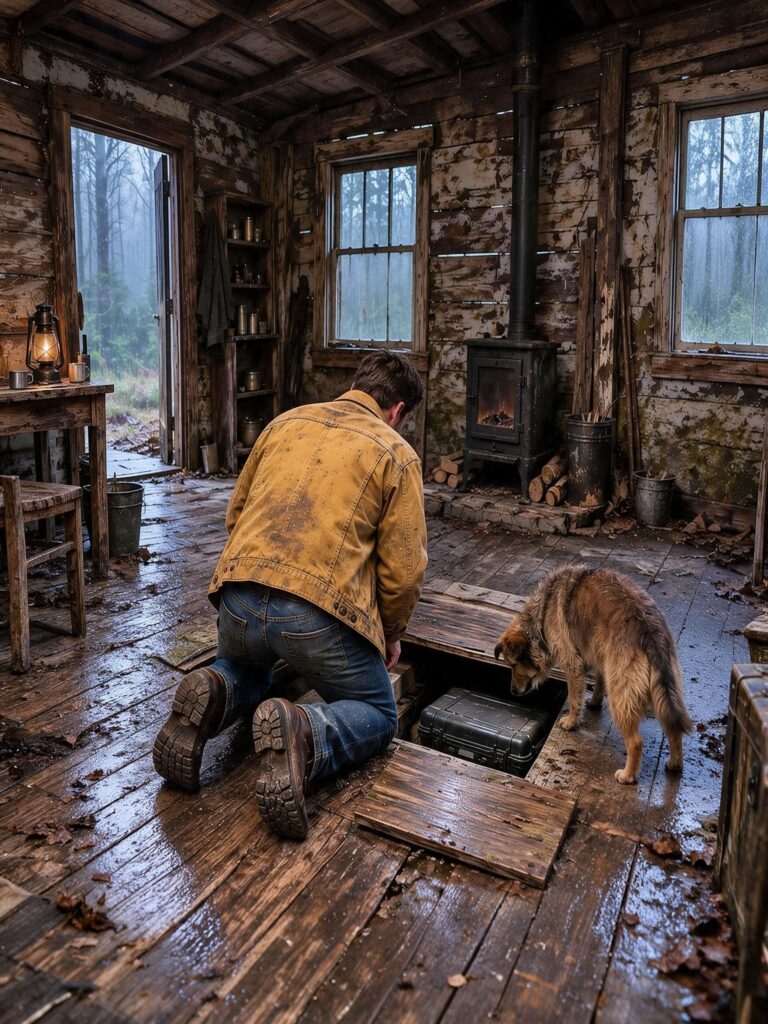
they threw a navy seal and his twins into the november cold for the sake of a house they could no longer afford — and the dog found what the old man had buried under the floor
Part 1
Arthur didn’t cry when the heavy oak door slammed in his face. He zipped the twins’ coats against the bitter November wind and kept his hands where the children could see them, steady, doing a small ordinary thing. Six years as a Navy SEAL had taught him how to survive the unforgiving cold of a desert night. It had not taught him how to explain to two shivering six-year-olds why their grandparents had just thrown them onto the street.
He had forty-two dollars, a sputtering truck, and a rescue hound named Barnaby. He did not know he also had two hundred million.
The foyer of the Carmichael estate had smelled of lemon oil and old money, the kind of sterile scent that clung to the back of the throat. Arthur had stood on the imported marble in worn work boots, faint dusty scuffs under his heels, hands stuffed deep in the pockets of his denim jacket. Partly because the house was kept at a crisp sixty-five degrees. Partly to keep his fists from clenching.
Richard and Patricia Carmichael had looked like they had been cast for the role of grieving aristocratic parents. Richard wore a cashmere sweater draped over his shoulders. Patricia stood rigid, her lips pressed into a thin line, a diamond tennis bracelet turning once on her wrist and then still.
“It’s not working, Arthur,” Richard said. His voice was smooth, practiced, the same voice he used to lay off hundreds of factory workers at his manufacturing plants. “We tried. God knows we tried to accommodate you for Claire’s sake. But her passing — it’s been six months, and frankly, having you here is a constant, agonizing reminder of what we’ve lost.”
The sting of Claire’s name hit him like a blow to the ribs. Claire. His wife. The woman who had defied her blue-blood family to marry a military man with dirt under his fingernails. A drunk driver had taken her in a twisted mess of steel on a rainy Tuesday afternoon, leaving Arthur with two kids and a hole in his chest that did not close when the funeral flowers died.
“You’re kicking us out,” Arthur said. It wasn’t a question.
“We are asking you to transition to an independent living situation,” Patricia corrected. She couldn’t look him in the eye. She was looking at the collar of his jacket, which was fraying at the edge. “This house is a sanctuary for our grief. Your presence disrupts that. The children are loud. That mutt of yours tracks mud onto the Persian rugs. It’s too much.”
Down the hallway, Barnaby sat quietly by the staircase, one ear flopped, the other half-up, sensing the room the way a dog senses weather. Upstairs, Leo and Maya were packing their small backpacks. Arthur had told them they were going on a camping adventure. It was the only lie he could conjure on short notice, and he hated it already.
“They’re your grandchildren, Patricia,” he said, his voice dropping into the quiet register he had used on deployment. “They lost their mother. You think they need to lose the only home they’ve known for the last six months, too?”
“Don’t you dare lecture us on loss,” Richard snapped. A flash of real anger broke through the country-club veneer. “If you had been a proper husband, if you hadn’t dragged her across the country for your pointless military career, she might still be here.”
The silence that followed was heavy and absolute. Arthur felt the hot spike of rage and held a breath for three seconds, let it out for three. He was not going to give them the satisfaction of a reaction. He was not going to let them paint him as the violent, unhinged veteran they had always claimed he was, the story they told at dinners when Claire wasn’t in the room.
“I’ll have our things in the truck in ten minutes,” he said.
He found the twins in the guest room they had been sharing. Maya was trying to stuff a battered rabbit into her bag. Leo was lining up his toy cars on the windowsill as if order might keep the room from ending.
“All right, monkeys. Time to move out. Grab your bags. Barnaby is waiting.”
“Are we coming back, Daddy?” Maya asked. Her eyes were Claire’s, large and brown and unwilling to be lied to for long.
“No, sweetie.” He crouched to her level, zipped her bag, tapped her nose. “We’re going to a new spot. Just the four of us.”
They walked down the stairs in a single file. The Carmichaels had retreated to the sitting room. They did not come out. They did not offer a hug. The oak door clicked shut behind them, and the sound of it stayed in the cold air longer than the heat of the house did.
He loaded the kids into the back seat of his rusted 2008 Ford. Barnaby hopped into the passenger seat and let out a soft whine, not afraid, only paying attention. Arthur climbed behind the wheel and stared at the brick facade a moment. His military pension barely covered the debt Claire’s last medical bills had left. The checking account held forty-two dollars. He turned the key. The engine coughed, sputtered, and roared, a rough sound that did not belong on that street. He put the truck in gear and drove. He did not look in the rearview mirror.
The rain started an hour in. Not a shower. A freezing, relentless downpour that turned the highway into a black sheet. The heater had died three years ago and blew only lukewarm air that smelled of exhaust and wet dog.
“Daddy, I’m cold,” Leo mumbled, pulling his thin fleece tighter.
Arthur’s jaw tightened. “I know, buddy. We’re almost there. I promise.”
There was nowhere to go but north. A week before Claire died, Arthur’s estranged father, Thomas, had passed from a sudden heart attack. Thomas Pendleton had been a reclusive, eccentric man who lived off the grid in the dense woods of the Appalachian foothills. They had not spoken in nearly a decade. Thomas hoarded junk, muttered about collapse, and trusted no one. The only thing he had left Arthur was a dilapidated hunting cabin fifty miles from the nearest town. Worthless, rotting, a punch line in a will. Tonight it was the only piece of the world Arthur actually owned.
They stopped at a gas station off the interstate. Arthur counted the bills in his wallet and bought two hot dogs, a bag of chips, and two small cartons of chocolate milk. Twelve dollars. The math in his head was a running ticker of dread. Back in the truck the kids ate in silence. The wipers slapped. Barnaby rested his chin on the console and watched him with sad, intelligent eyes. Arthur broke off a piece of bun and fed it to the dog.
“Eat up, Barnaby. It’s a long way to the bottom.”
They turned off the highway onto cracked asphalt, then onto a washed-out dirt path. The trees pressed in, skeletal in the headlights. The truck jolted over ruts. Finally the lights caught the cabin. It was worse than he remembered. The porch roof sagged on one side. The windows were grimed. The front door hung off its hinges. The yard was a graveyard of rusting scrap, old tires, and weeds the cold had turned to brittle stalks.
“Is this the camping spot?” Maya asked. She sounded skeptical, and she had reason.
“This is it,” Arthur said. He killed the engine. The silence of the woods came down all at once. “It’s an adventure. We’re roughing it.”
He carried Maya. Leo held his jacket. Barnaby trotted ahead, nose to the damp earth. Inside, the single room smelled of mildew, dust, and old tobacco. A cast-iron stove sat in the center. A metal cot with a stained mattress stood against the far wall. Rough shelves held rusted cans and Mason jars full of screws. Arthur set Maya down and swept a flashlight across the floor.
“First things first. We need a fire.”
He broke apart a rotted chair from the porch and used it as kindling. The wood was damp. It took a dozen matches before a weak, smoky warmth moved into the room. He laid the twins’ sleeping bags near the stove and wrapped them in every spare blanket from the truck. When they finally slept, exhausted past fear, Arthur sat on the edge of the cot and put his head in his hands.
The adrenaline was gone. The training, the stoicism, the pragmatism — stripped away, leaving a hollow exhaustion. He had failed them. He had failed Claire. He had dragged his children into the freezing woods because he could not put a roof over their heads that did not belong to people who did not want them. The Carmichaels had called it a transition. The room called it what it was.
A wet nose nudged his hand. Barnaby was standing there, but the dog was not looking for affection. He let out a low, persistent whine and looked toward the back corner of the cabin.
“Go to sleep, Barn.”
Barnaby didn’t listen. He trotted to the corner near a stack of molding firewood and began to scratch. Frantic. Deliberate. Claws tearing at rotted wood.
“Hey. Knock it off. You’ll wake them.”
The dog ignored him. A sharp, urgent bark. Arthur sighed, stood, bones aching, and took the collar.
“Come on, buddy. There’s nothing there but rats.”
As he pulled the dog back, the flashlight caught the boards. They were different. Not nailed. Fitted together with a crude but deliberate tongue-and-groove, unattached to the joists underneath. Barnaby’s scratching had pushed one up. Arthur knelt and ran his fingers along the edge. The craftsmanship did not belong in that shack. He wedged his fingers under the lip and pulled. The wood groaned and gave with a crack. Maya shifted in her bag and did not wake.
Beneath the board was a dark square cavity lined with thick black plastic. Barnaby pushed his snout past Arthur’s arm. Arthur moved the dog’s head aside and reached into the cold void. His fingers brushed metal.
Part 2
It was heavy. He grunted and hauled it onto the floor. A military-grade Pelican case, airtight, covered in fine gray dust. His father had kept broken toasters and tin foil. He did not buy three-hundred-dollar waterproof cases. The latches were stiff. Arthur used the heel of his boot to pop them. The lid swung back and broke a vacuum seal with a soft hiss.
Inside there were no gold bars and no stacks of cash. There was a thick manila envelope, a small black ledger, and a handwritten letter resting on a velvet box.
The handwriting was unmistakable. Thomas Pendleton’s cramped, frantic scrawl. Dated a year ago.
Arty, if you’re reading this, I’m dead, and you’re probably swearing at me for leaving you this miserable shack. Good. You always were too rigid, too much like your mother. But you’re a good man. A better man than I ever was. I know what you think of me. A crazy old bat living in the dirt. I wasn’t always just that. Long before you were born, before I went off the deep end, I started a little software company. I sold it in the eighties, put the money into the market, bought Apple before it was Apple, bought server farms before anyone knew what the internet was. I didn’t want the life. The suits. The taxes. The vultures. So I hid it. I grew it, and I hid it. I didn’t give you a dime because money ruins people. I watched it ruin my partners. I wanted you to build your own spine. You went to the teams. You built it. You proved yourself. You don’t need my money to be a man. But you might need it to be a father. In the ledger you’ll find the account numbers. The trust is in Zurich. The corporate shell is in Delaware. The law firm managing the blind trust is Winston and Hayes in New York. The code word to access the principal is Barnaby. I liked your dog more than your in-laws. The current valuation after taxes and reinvestment is somewhere north of two hundred million. Don’t waste it on fancy cars. Buy yourself some decent land. Protect the kids. Dad.
Arthur stopped breathing. The air in the cabin felt thin. He read the words again. The cynic in him, the grounded realist, rejected it at once. A delusion. A final prank from a man who had lost his mind to paranoia and isolation.
He dropped the letter and opened the ledger. It was not a rambling manifesto. It was a meticulous accounting. Compound interest. Offshore wires. Routing numbers. Corporate entities stretching back thirty years. Contact names. Phone numbers. Encryption keys. He opened the envelope. Certified bank statements from a private Swiss firm, Thomas Pendleton named as sole beneficiary. The bottom line on the most recent statement, dated weeks before Thomas’s death, read two hundred million, four hundred and fifty thousand dollars.
Arthur’s hands began to shake. He gripped the edges of the case. The rough plastic grounded him. He looked at his children, sleeping on a filthy floor in hand-me-down coats, rejected by the people who were supposed to love them. He looked at the papers. He thought of Richard’s polished face and Patricia’s eyes on his fraying collar. They thought they had crushed him. They thought they held the wealth and the leverage.
He opened the velvet box. A heavy gold signet ring with the Pendleton crest, and a brass key for a safe-deposit box in Manhattan. Barnaby let out a soft boof and nudged his elbow. Arthur buried a hand in the scruff behind the dog’s ears. The smile that came was not joy. It was the smile of a man who had just been handed a loaded weapon after bringing a knife to a gunfight.
“Good boy,” he whispered. “Good boy.”
He put the documents back, snapped the case shut, and pushed it under the boards. He did not need to count cash. The proof was enough. Tomorrow he would drive to town. He would call Winston and Hayes. And then he would decide what a father did with a weapon he had not asked for and could not pretend he did not have.
The cold didn’t wake him. The silence did. The wind had died over the ridge, leaving a stillness that felt heavy on his chest. His breath plumed in the weak morning light. The stove had burned to ash. Across the room the twins were huddled together, only the crowns of their heads visible. Barnaby was curled at their feet, a living heater. Arthur looked at the corner where he had hammered the boards back at three in the morning. His knuckles were raw. He had not dreamed it.
He built another fire with the last of the dry kindling. Breakfast was stale pretzels and the rest of the chocolate milk. Leo didn’t complain. His shoulders were hunched against the chill. Maya chewed in silence, eyes wide. They were tough kids. Claire had made sure of that. They were also six, and they were scared.
“Boots on. We’re heading into town. Time for some real food.”
The drive to Oak Haven took forty minutes. It was a depleted mining town: boarded storefronts, a rusting gas-station canopy, a relentless gray. It had a diner, a hardware store, a bank branch, and, most importantly, a cellular tower. Arthur parked in front of Dottie’s. The neon sign buzzed, half the letters burned out. Inside, the air smelled of bacon grease, old coffee, and bleach. It was the best thing he had smelled in a week.
He slid into a cracked vinyl booth and put Barnaby on a short leash under the table. A tired waitress named Brenda came over with a coffee pot. Her eyes skimmed his worn jacket and the kids’ cheap sweaters.
“Three short stacks, a side of bacon, two orange juices, and a black coffee.” He put a ten and a five on the table, almost all he had left. “Keep the change. Can you keep an eye on them for five minutes? I need to make a call.”
Brenda looked at the money, then at the twins staring at the menus with quiet desperation. Her face softened. “Sure thing, honey. Go do what you need to do.”
Outside, the wind cut through his jacket. He had a cheap prepaid phone from a gas station months ago, and a crinkled paper he had copied from the ledger before dawn. He dialed the New York number. His thumb hovered. The cynical part of his brain said this was a dead end. The memory of Patricia looking at his collar pushed his thumb down.
“Winston and Hayes, how may I direct your call?”
“David Hayes, please.”
“Mr. Hayes is in a partner meeting. May I ask who’s calling?”
“Arthur Pendleton.”
A pause. Keys clicking. “I don’t have a Pendleton on Mr. Hayes’s schedule. If you’d like to leave a message—”
“Tell him Thomas Pendleton’s son is on the line. Tell him I have a Pelican case, a ledger, and the word is Barnaby. Pull him out of the meeting.”
The line went silent for forty-five seconds. The wind bit. He didn’t shiver.
“Mr. Pendleton.” An older man, breathless, the corporate pleasantries already gone. “This is David Hayes.”
“My father left me a letter. He said you manage a blind trust. Delaware shell. Zurich accounts.”
“Arthur. My God.” Hayes sounded shaken. “We’ve been trying to locate you for eight months. Your father was an incredibly private man. He forbade us from using private investigators. He insisted you would find the cabin when the time was right.”
“I found it.”
“The verification code.”
“Barnaby.”
A long exhale through the speaker. “Verification confirmed. Arthur, first, allow me to offer my condolences on your father’s passing, and your wife’s. We were informed of the accident. It is a tragedy.”
“Save it. I don’t need condolences. I need liquidity. Right now.”
Hayes shifted at once, recognizing a man who did not want his hand held. “The principal is fully vested and entirely at your disposal. The current valuation as of market open today is two hundred and fourteen million, six hundred thousand dollars. The holding company is wholly owned by you. We are merely the administrators.”
Hearing the number spoken by a man in a glass tower made the breath catch. The world tilted. Through the diner window, Leo was pouring too much syrup. Maya was laughing at something the waitress said.
“I need cash today.”
“I can wire fifty thousand to any account you specify within ten minutes. Petty cash from the holding accounts. We’ll arrange the primary transfer next week. Do you have a routing number?”
Arthur didn’t have an account that wouldn’t swallow the money for Claire’s medical debts. “No. I’m in Oak Haven. There’s a First National branch across the street. Wire it there for a cashier’s check. Name’s Arthur Pendleton. Have them hold it.”
“Done. Fifteen minutes. Arthur — where have you been?”
“Camping,” he said, and hung up.
The warmth of the diner hit him like a blow. He sat. The kids were demolishing their breakfast. Barnaby thumped his tail against the floor.
“Everything okay, Daddy?” Maya had syrup on her cheek.
He wiped it with his thumb. The weight that had sat on his chest for six months — starvation, failure, the fear of losing his children to the state — did not vanish. It changed shape. It became a cold, quiet clarity.
“Everything is perfect, Maya. Eat up. We have a lot of shopping to do.”
Part 3
Thirty minutes later he walked into First National looking like a vagrant: unshaven, scuffed boots, a dirty jacket. The teller, a young man in an ill-fitting suit, looked at him with immediate suspicion, one hand hovering near a button under the desk.
“Arthur Pendleton. I have a wire waiting from Winston and Hayes in New York.”
The teller sighed and typed with agonizing slowness. “Sir, we don’t usually process walk-in wires for non-account — oh.” He leaned closer to the monitor. The color left his face. “The transfer is here. Fifty thousand. Cleared and authorized.”
“I want ten thousand in cash. Hundreds and fifties. Put the rest in a new checking account under my name. No overdraft. No credit line. A debit card.”
The manager was called. Hands were shaken. Free coffee was offered. Arthur ignored the sudden sycophancy, took the envelope, shoved it into his inner pocket, and walked out. Money changed how a room treated a man. It did not change what the room had been ten minutes earlier. He filed that away the way he filed a terrain feature: useful, not trustworthy.
Their first stop was the outfitter. He bought Leo and Maya the warmest coats the store carried, waterproof boots, wool socks, thermal underwear, fleece hats. He bought himself Red Wings and a heavy Carhartt. He bought Barnaby a thick collar and a giant bag of decent food. When they walked back to the truck, the kids looked like insulated marshmallows.
“Dad, this coat is so warm,” Leo said, burying his face in the hood.
“I know, buddy. We’re not going to be cold like that again.”
They did not go back to the shack that night. Arthur drove forty miles south to a tourist town near a ski resort, bypassed the cheap motels, and put two thousand dollars down on a month-long lease of a secluded timber lodge. When he unlocked the door, the kids ran. Heated floors. A stone fireplace. A kitchen that worked. Barnaby trotted to the center of the rug, spun three times, and collapsed with a sigh of absolute contentment.
“Go pick your rooms.”
Their laughter echoed in the vaulted ceiling. Arthur set a new laptop on the granite island, made black tea, and sat. Survival was secured. Strategy came next.
For the next week he ran the days the way he had run a small team. Breakfast. Workbooks. Afternoon hikes in the snow. Movie nights by the fire. A woman from the resort kitchen delivered meals so he would not have to cook and also watch a balance sheet. While the kids slept, he went to work. Encrypted calls with Hayes and a team of forensic accountants. He did not want to sit on a pile of money. He wanted to understand the weapon, and he wanted to know exactly what Richard and Patricia had done, and why.
“I want a complete financial teardown of Carmichael Industries,” he told Hayes on a Tuesday night. “Every supplier. Every debt. Every line of credit. Public records. SEC filings. Credit reports. Pay the best auditing firm you have double to do it in three days. I want to know how Richard pays for his cashmere.”
By Friday the file arrived. Arthur sat by the fireplace with a glass of bourbon and read. It was a bloodbath. The estate, with its lemon oil and Persian rugs, was a facade crumbling under its own weight. Richard’s manufacturing company had failed to modernize. Three major contracts lost to overseas competitors in eighteen months. To keep the lifestyle afloat — the club, the jewelry, the cars — Richard had leveraged everything. The estate was double-mortgaged. The company was drowning in high-interest mezzanine debt from a private equity firm in Chicago. They were bleeding cash.
Arthur leaned back and watched the flames. A cold realization settled on him, worse in its way than simple cruelty. They had not kicked him and the twins out only because they hated him, or only because grief had made them small. They had kicked them out because they were preparing to downsize and could not afford the optics of a struggling veteran son-in-law in the house while they courted investors and hid the rot. They had thrown their own grandchildren onto the street to protect a country-club image while the ship sank.
“They’re drowning,” he said to the empty room.
He called Hayes at eleven. The lawyer answered on the first ring.
“They owe twenty-two million to a firm called Vanguard Capital. The note is callable in thirty days if they miss their quarterly revenue target. Which they will.”
“Vanguard is known for aggressive liquidations. If Carmichael misses, they’ll call the debt, seize the collateral, and strip the company. The estate will be foreclosed.”
“I want that debt.”
A long silence. “Arthur, buying distressed debt is risky. You’d be purchasing a failing loan.”
“I don’t care about the return. Set up an anonymous holding company in Delaware. Call it Pendleton Holdings. Offer Vanguard a ten percent premium. They want cash, not a messy liquidation. Give them the cash. Buy the paper.”
“You’re talking about spending roughly twenty-four million dollars to become Richard Carmichael’s primary creditor.”
“Do it. I want the mortgage on his house. I want the machines in his factory. I want the ground he walks on. And I don’t want his name anywhere near it until the trap is shut.”
“I understand.” Hayes sounded slightly intimidated, which suited Arthur fine.
He hung up and went upstairs. Leo was sprawled sideways, one leg off the mattress. Maya was curled around a new bear, breathing evenly. In his wallet, behind the license, was a creased photograph of Claire laughing on a beach in San Diego, hair across her face, young and unbroken.
“I’m going to fix the part I can fix,” he whispered. He did not promise her revenge. He promised her that the people who had put her children in a truck with a dead heater would not be left standing at those children’s backs with the power to do it again. In his world you did not leave a proven threat unaddressed. You neutralized it. Then you built something that did not depend on their permission.
Over the next three weeks the lodge settled into a healing rhythm. The children gained weight. The dark circles under their eyes faded. Barnaby chased deer he would never catch. And in the shadows of the paperwork, Pendleton Holdings moved into position. Vanguard, thrilled to offload a toxic asset for premium cash, signed over the Carmichael debt without a second thought. By the end of the month Arthur Pendleton was the sole owner of the twenty-two-million-dollar note hanging over Richard Carmichael’s head.
The trap was set. All he had to do was wait for the quarter to end, and for Richard to step where the numbers had already put him.
Part 4
The catalyst arrived on a Tuesday morning. Arthur was at the kitchen island helping Maya with a subtraction problem when the email came. Subject line: Q3 earnings, Carmichael Industries. The message was brief. Revenue targets missed by fourteen percent. The note was in default. They had the legal right to call the debt immediately. Orders?
Maya chewed her pencil, staring at the page.
“Seven minus three, sweetie.”
“Four.” She wrote it down, proud.
“Good job.” He kissed the top of her head and typed a single word in reply. Call.
Richard Carmichael hated waiting. He sat in the glass-walled conference room of a downtown firm, checking his Rolex for the fourth time in ten minutes. Beside him Patricia sat motionless in a slate-gray suit, posture perfect, knuckles white in her lap. They were ruins pretending to be castles. Across the table David Hayes reviewed documents, unbothered by Richard’s impatience.
“Mr. Hayes,” Richard finally snapped. “We were told the principal of Pendleton Holdings would be here. I am not accustomed to being summoned like an errant employee, let alone kept waiting by an anonymous debt buyer who thinks they can seize my life’s work over one bad quarter.”
“It was more than one bad quarter, Richard,” Hayes said, without looking up. He did not use the title. A muscle feathered in Richard’s jaw. “Your debt obligations exceeded your operating revenue eighteen months ago. You have been running on fumes and leverage. Vanguard had every right to call the note. Pendleton Holdings purchased that right.”
Patricia leaned forward, voice brittle. “What does this company want? We can restructure. We can offer equity. Just give us the terms.”
“The terms are drafted,” Hayes said. He looked at the double doors. “And the principal is here.”
The doors opened. Arthur did not wear a suit. Suits were for men who needed to borrow power from a tailor. He wore dark denim, heavy boots, and a charcoal sweater over a collared shirt. Clean-shaven. Hair cut. He did not look like the man they had thrown onto the street. He looked like a man who owned the room, which, as of the paper on the table, he did.
He sat across from Richard and did not speak. He looked at them. The silence stretched until it felt like pressure. Richard’s mouth opened and no sound came. The blood left his face. He stared at Arthur, then at Hayes, then back.
“What is this? Is this a joke? Hayes, what is he doing here?”
Patricia’s hand flew to her throat, fingers in her pearls. “Arthur. How did you get in here? Security.”
“Security works for the building management company,” Arthur said, the same dead calm he had used in their foyer. “Pendleton Holdings bought the management company yesterday afternoon. They know who I am.”
“Pendleton Holdings,” Richard whispered. The name made a terrible sense. “That’s impossible. You don’t have this kind of capital. You were penniless. You were begging in my house.”
“I wasn’t begging. I was surviving. And you taught me a lesson that day. You taught me that family and grief mean nothing to you when the balance sheet is in the red. You taught me that leverage is the only language you answer.”
He slid a bound document across the wood. It stopped three inches from Richard’s hands.
“That is the notice of default. You owe twenty-two million, four hundred thousand, payable immediately in cash.”
Richard didn’t touch the paper. His hands were shaking too badly. He looked at his wife. “We don’t have it. You know we don’t. The factories are operating at a loss. The estate is double-mortgaged.”
“I know. I read your financials. They’re a disaster. You spent millions keeping up appearances while the business rotted. You threw your grandchildren into the freezing rain because you couldn’t afford the look of feeding them, and you were too proud to admit you were broke.”
“Arthur, please.” Patricia’s tears broke through the makeup. “We were grieving. We weren’t in our right minds. Claire would be horrified. She loved us.”
Arthur’s eyes went flat. “Do not say her name. You don’t get to use my wife as a shield. Not anymore.”
He sat back. There was no euphoric rush. There was the grim satisfaction of a ledger coming level, and under it a grief that money did not touch. Claire was still gone. The highway was still wet in his memory. What he could do was stop these two from ever again deciding that his children were an inconvenience to be transitioned.
“Here is what happens. Pendleton Holdings takes the collateral. We liquidate the manufacturing assets to cover the corporate debt. The workers get severance out of the sale, not out of your pocket, because you don’t have a pocket. As for the personal guarantee you signed, I am foreclosing on the estate. You have twenty-four hours to vacate. Leave the keys on the kitchen counter. If you take fixtures, art, or appliances, my attorneys will press theft charges. Bags packed by noon tomorrow.”
Richard slumped. A dry sob tore out of him. “You’re taking the house. You’re taking everything.”
“I’m taking exactly what you owe. Nothing more. Nothing less.” Arthur stood. He did not offer a handshake. They were not owed a performance. “Good luck, Richard. I hear independent living situations build character.”
He walked out. In the elevator his hands were steady. In the truck, with the city moving past the glass, he sat for a full minute before he turned the key. Neutralizing a threat was not the same as getting his wife back. He had known that going in. Knowing it did not make the elevator feel like victory. It made it feel like a door closed that should have been closed in November, before two children slept on a shack floor.
Hayes handled the mechanics. By the end of the week Richard and Patricia had moved into a small rented apartment on the outskirts of the city. The club memberships were revoked for nonpayment. The cars were repossessed. The lemon-oil house stood empty, waiting on an auction. Arthur did not keep it. He sold it to a developer who planned to tear it down and build condominiums. He did not want the ghost of that foyer anywhere near his children. Claire’s childhood photographs, the ones that were hers and not the estate’s, he had Hayes box and send west. The rest could go with the walls.
He did not call them. He did not drive by. A neutralized threat did not require an audience.
Part 5
Four months later the bitter cold had broken, and an early Montana spring smelled of pine, wet earth, and rain. Arthur stood on the wraparound porch of a timber lodge with a mug of black coffee and watched the mist burn off a valley. Three thousand acres of working ranch land spread below him, cattle in the lower pasture, snow still holding on the peaks. He had bought it in cash and put the deed in an irrevocable trust for Leo and Maya. His father’s letter had said buy decent land and protect the kids. He had done the first thing the letter asked before he did anything that felt like winning.
Down in the tall grass Barnaby was running at a dead sprint after a jackrabbit he had no mathematical chance of catching. His floppy ear bounced with every stride.
“Barnaby, leave it,” Leo yelled.
The twins came out of the house and let the screen door slam. Faded overalls. Scuffed boots. Faces flushed. They did not look like the children who had asked, in a marble foyer, if they were coming back. They looked like children who had a place to get dirty.
“Don’t run in the mud, Maya.”
“I’m not in the mud, Dad. I’m in the dirt.” She stepped in a puddle to the knees and laughed, a clear sound that came back off the trees.
Arthur smiled. It reached his eyes. Inside, the living room was vast and warm, anchored by a river-stone fireplace. On the oak mantel, in the center, sat a small framed photograph of Claire. Next to it the gold signet ring and the yellowed letter from Thomas Pendleton. He had not touched the two hundred million to buy yachts or jets. Ninety percent of it sat in municipal bonds, index funds, and a stake in a local grain cooperative that needed a dryer and did not need a savior. A portion had quietly cleared the medical debts of five men from his old team, men who would not have taken a check if he had put his name on the envelope. He lived comfortably and quietly. He understood, finally, what his father had known and had been too broken to say in person. The money was not a better personality. It was a tool. In a fool’s hands it destroyed the wielder. In an arrogant hand it built a wall against reality. In a father’s hands it could be a fortress, and a fortress was only as good as the people it kept warm.
He went to the kitchen to start pancakes from scratch, not the kind bought with a crumpled ten in a desperate diner. Boots thumped on the porch. Dog paws scratched. Barnaby barked, sharp and demanding.
“All right. Hold your horses.”
He opened the door. The twins tumbled in, smelling of air and wet dog. Barnaby stopped at the edge of the Navajo rug, paws coated in mud, and looked up with guilty, intelligent eyes.
“Don’t even think about it.”
The dog whined and backed up one step. Arthur knelt with the towel he kept by the door and wiped the front paws. Barnaby licked his chin and left a streak of mud on his jaw. Arthur didn’t care. He listened to his children argue over who got to pour the syrup, and he felt the solid presence of the dog who had scratched a floorboard until a father found what an old man had hidden from the world and from his own son.
They had survived the fall. They had slept in a shack and eaten pretzels for breakfast and been looked through by people who shared their blood. The money had not made that untrue. What it had done was give a man the means to make sure it did not happen twice, and the land to raise two children where a slammed door could not reach them.
Arthur wiped his face with the back of his hand, stood, and walked into the kitchen to feed his family. On the mantel Claire kept laughing into a wind that no longer had the last word. Outside, the valley held. The cattle moved. The dog, muddy and unrepentant, waited by the towel for the next time the door opened, which was the only inheritance that had ever mattered in that house: a creature who noticed what everyone else walked past, and a father who finally listened.


