
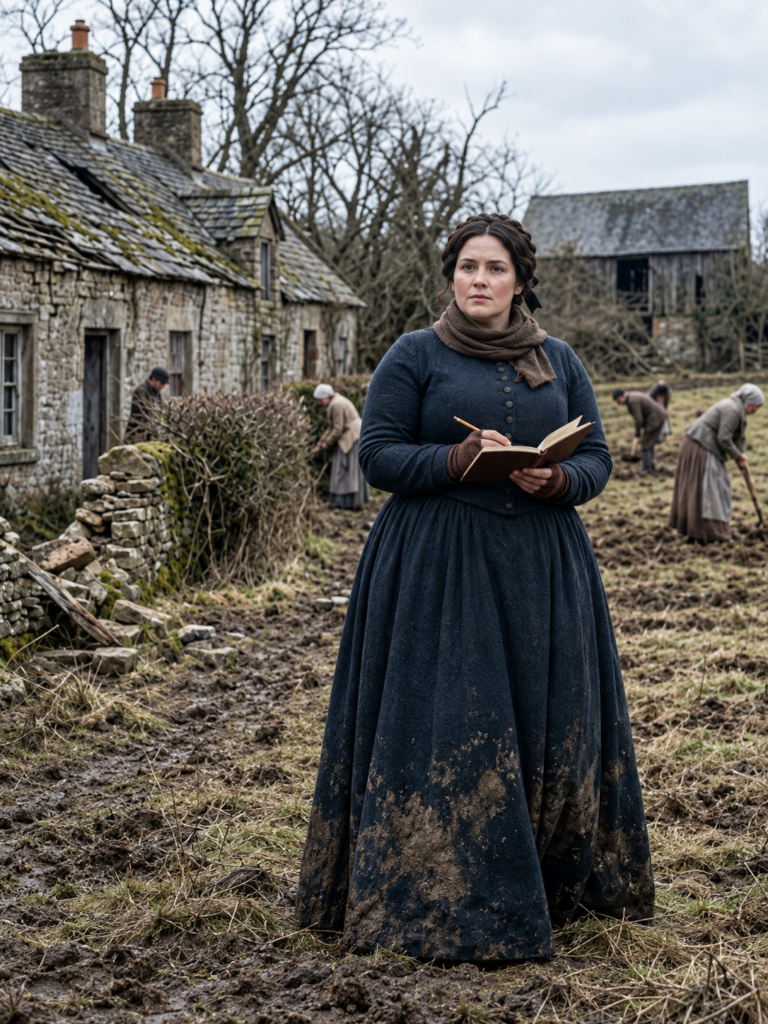
Part 1
The Duke of Ravensmere had never raised his voice to Lady Clara Renford.
That, she had come to understand, was how a gentleman could wound a woman without ever appearing cruel.
He spoke to her with perfect courtesy. He remembered to inquire after her health. He ensured that her rooms were warmed before the first frost and that her allowance arrived at the beginning of every quarter.
And on a bitter November afternoon in 1858, he summoned her to his library and offered her a ruined estate so that she would no longer have to live beneath his roof.
The deed lay upon his desk, tied with a narrow blue ribbon.
Beyond the tall windows, rain swept across the lawns of Ravensmere House. The great oaks stood black and motionless against a sky the color of pewter.
Clara remained standing while Edmund Vale, Duke of Ravensmere, indicated the chair opposite him.
“Please sit, Lady Clara.”
“I believe I would rather stand.”
A faint movement touched his eyebrows.
“As you wish.”
He was thirty-six, a man of precise habits and considerable inherited wealth, with dark hair beginning to show silver at the temples. His appearance suggested someone who had learned early that feelings were best concealed beneath good tailoring and correct manners.
Clara had once mistaken that reserve for strength.
She now suspected it was sometimes merely convenience.
“I have been considering your circumstances,” Edmund began.
“How very alarming.”
He looked up.
Clara folded her hands before her.
“Forgive me, Your Grace. Continue.”
“Your position here has become unnecessarily difficult.”
It was a delicate phrase.
It meant that his widowed aunt disliked having another woman of respectable birth involved in the household arrangements. It meant that the servants were uncertain whose instructions carried authority. It meant that visiting ladies had begun to wonder whether a young widow might eventually become something more troublesome than a dependent relation.
And it meant that Edmund had finally decided to remove the source of the discomfort.
“I have arranged to transfer Hawthorne Grange into your name,” he said.
Clara knew the property.
Everyone in the county knew Hawthorne Grange, although almost no one had visited it in years.
It was the estate that appeared in conversations only when gentlemen wished to complain about unprofitable land, unreliable tenants, or the misfortunes of maintaining inherited property.
“Hawthorne Grange,” she repeated.
“The house, the adjoining farmland, the cottages, and all existing leases. The property is free of mortgage. A separate sum has been provided for essential repairs.”
“How generous.”
Her voice contained no warmth.
Edmund drew a slow breath.
“I had hoped you would regard the arrangement as an opportunity.”
“For what?”
“Independence.”
Clara looked at the ribbon.
Her husband, Captain Henry Renford, had died nearly two years earlier after a sudden fever contracted during military service abroad. He had left her a modest settlement, a few pieces of jewelry, and a collection of letters that she still could not bring herself to reread.
His family’s affairs had placed her under Edmund’s protection.
Protection, she had discovered, was a curious condition.
It could provide everything a woman required while allowing her to decide almost nothing.
“And how much income does Hawthorne produce?” she asked.
Edmund hesitated.
“At present, very little.”
“How little?”
“The accounts are complicated.”
“Then I should like to see them.”
“Clara—”
“You have never called them complicated before. You have called the estate unfortunate, burdensome, and on one memorable occasion a perpetual expense disguised as an inheritance.”
A brief silence followed.
Edmund leaned back.
“I see that you remember my opinions.”
“I have had little else to occupy me at your dinner table.”
The remark struck more deeply than she intended.
For an instant, his expression tightened.
Then he recovered his composure.
“The estate needs attention. But you would have a household of your own and sufficient freedom to arrange your life as you choose.”
“Provided I can afford to keep the roof above my head.”
“The repair allowance should cover the most urgent work.”
“Should?”
“I have been advised that it will.”
Clara considered him.
“By someone who has recently inspected Hawthorne?”
Edmund said nothing.
There was her answer.
She approached the desk and rested her fingertips upon the deed.
“Do you know what troubles me most about this proposal?”
“I suspect you are about to tell me.”
“That you have decided what will make me happy without asking what I want.”
His face changed.
Not dramatically.
Edmund Vale was not a dramatic man.
But something behind his eyes grew guarded.
“I have tried to discharge my obligations honorably.”
“I know.”
“Your comfort has never been neglected.”
“No,” Clara said quietly. “Only my usefulness.”
The rain filled the silence.
Then she untied the ribbon.
“Very well. I accept.”
Edmund straightened.
“You do?”
“Yes. But I must make one thing perfectly clear.”
“Of course.”
“If Hawthorne is to be mine, it must truly be mine. I will not ask your permission to repair a roof, hire a workman, dismiss a merchant, or alter a tenant’s lease.”
“Naturally.”
“And I will not accept an arrangement in which you continue to direct my affairs from Ravensmere.”
He studied her for several moments.
Then he took up his pen.
“The deed will give you complete control.”
Clara inclined her head.
“Then I thank you, Your Grace.”
Her words were polite.
Her expression was not.
She turned to leave.
“Clara.”
She stopped at the door.
“I did not intend to insult you.”
She looked back at him.
“That is precisely why you have done it so effectively.”
Three weeks later, she arrived at Hawthorne Grange beneath a sky heavy with snow.
The carriage turned between two stone gateposts nearly swallowed by ivy.
One had lost its ornamental cap. The other leaned at an angle that suggested surrender.
Beyond them, the drive disappeared beneath wet leaves and encroaching brambles.
Clara caught her first proper sight of the house as the carriage rounded an enormous, untended yew.
Hawthorne Grange was not beautiful.
Not anymore.
It stood upon a low rise overlooking a shallow valley, a sprawling stone manor with a weather-darkened façade and a roofline that dipped sharply above the eastern wing.
Several windows were boarded. Others stared across the grounds like blind eyes. A chimney had been patched with mismatched brick, and a long crack ran down the plaster beside the old entrance porch.
The gardens were wilderness.
The stables looked abandoned.
The fountain before the house contained nothing but rainwater and rotting leaves.
Beside the entrance waited an elderly gentleman in a brown coat whose cuffs had been carefully mended.
He held his hat in both hands.
“Lady Clara Renford?”
“Yes.”
“Pritchard, my lady. Samuel Pritchard. Estate steward.”
He bowed stiffly.
Behind him stood a housekeeper, a young maid, and a broad-shouldered stableman whose expression suggested he had been ordered to attend and considered the entire occasion unnecessary.
Clara stepped down into the mud.
“How many servants remain?”
“Five indoors, my lady. Three others come when required.”
“And the estate workers?”
“Nine receive regular wages.”
“How many received wages ten years ago?”
Pritchard blinked.
“Perhaps twenty-five.”
“Then we have lost rather a great deal.”
His eyes shifted toward the manor.
“Things have been difficult.”
“I can see that.”
He appeared relieved, as though she had already decided to abandon the place.
“Shall I show you to your rooms?”
“In a moment. Where are the accounts kept?”
“The accounts?”
“The rents, wages, livestock records, repair estimates, and contracts.”
The steward stared at her.
Clara smiled faintly.
“Surely they have not all blown away.”
“No, my lady.”
“Excellent. Then we shall begin with those.”
By evening, the housekeeper had lit fires in three rooms, the maid had unpacked Clara’s two trunks, and Samuel Pritchard had discovered that his new mistress possessed a disturbing appetite for figures.
The ledgers were kept in a small room overlooking the kitchen garden.
The paper smelled of damp.
Several pages had begun to curl at the edges.
Clara sat at a table beneath a wavering lamp while Pritchard stood opposite her, explaining what he called the estate’s unavoidable difficulties.
There were fourteen tenant farms.
Five cottages required substantial repairs.
Three stood empty.
The dairy had declined until it barely paid for its own feed.
The sheep produced less wool than they had a decade earlier.
The orchards, once a reliable source of income, had become increasingly unproductive.
The southern mill had been closed for eleven years.
Clara listened without interruption.
Then she asked a question.
“Why?”
Pritchard frowned.
“Why, my lady?”
“Why have the orchards failed?”
“The trees are old.”
“All of them?”
“Most.”
“And the dairy?”
“Poor winters.”
“Every winter?”
“The grazing has deteriorated.”
“Why?”
The steward grew visibly uncomfortable.
Clara closed the ledger.
“Mr. Pritchard, I do not doubt your knowledge of this place. But each difficulty you describe appears to have been accepted as inevitable long before anyone attempted to discover its cause.”
He stiffened.
“With respect, my lady, the previous trustees were not inclined to spend money on uncertain improvements.”
“Then perhaps uncertainty was less expensive than investigation.”
“I cannot answer for their decisions.”
“No. But you can help me avoid repeating them.”
He looked at her properly for the first time.
She was not an imposing woman.
She was twenty-nine, slender, with chestnut hair drawn into a practical knot and gray-green eyes that seemed to miss very little. Her dress was plain by the standards of Ravensmere, and she wore no jewelry beyond her wedding ring.
Nothing about her suggested the sort of authority Pritchard had grown accustomed to obeying.
Yet she had already examined more accounts in a single afternoon than the last three trustees had requested in five years.
“What is it you intend to do?” he asked.
Clara opened another ledger.
“Find out whether Hawthorne is ruined because the land has failed, or because everyone has agreed that it must.”
The following morning, she walked the estate.
Pritchard had arranged a carriage.
Clara refused it.
“I cannot inspect a drainage ditch from a carriage window.”
“My lady, the ground is exceedingly wet.”
“Then I shall discover precisely how wet.”
By noon, the hem of her skirt was stained with mud.
Her gloves were damp.
The cold had penetrated her boots.
And she had learned more than the ledgers could tell her.
At the first tenant cottage, she found a family of six living beneath a roof that leaked into the children’s bedroom.
The father, Joseph Mercer, had fallen behind on his rent after a fever kept him from working through the summer.
His wife had sold nearly everything of value to purchase food.
When Clara asked why they had not reported the roof, Mrs. Mercer lowered her eyes.
“We did, my lady.”
“To whom?”
“The estate office.”
“When?”
“Last Michaelmas. And again before Christmas.”
Clara glanced at Pritchard.
The steward’s face reddened.
“The repairs were judged too expensive.”
“How expensive?”
“Twenty-six pounds, according to the carpenter.”
Clara looked toward the children, who stood beside a cold hearth in clothes that had been repeatedly altered to fit them.
“And how much rent has this family been unable to pay?”
Pritchard consulted his notebook.
“Twenty-three pounds and some shillings.”
Clara said nothing for a moment.
Then she turned to Joseph Mercer.
“If the roof were sound and you had sufficient strength to work, could you manage the holding?”
“I believe so, my lady.”
“Do not tell me what you think I wish to hear.”
The man’s expression changed.
“Yes,” he said. “Provided the lower meadow drains. It flooded twice last spring.”
Clara made a note.
Outside, Pritchard spoke cautiously.
“We cannot simply forgive every arrear.”
“I have no intention of doing so.”
“Then—”
“We shall repair what prevents a willing tenant from earning his rent. Afterward, we shall expect him to pay it.”
She looked back at the cottage.
“An estate cannot prosper by demanding money from people while allowing the means of earning it to rot.”
At the next farm, however, the circumstances were different.
The tenant owned healthy livestock, sold wool at a satisfactory profit, and was several months behind on his rent because he had used the money to purchase an adjoining piece of private land.
When Clara questioned him, he attempted to charm her.
“My lady, I was certain a woman of your kindness would understand.”
Clara looked at him steadily.
“I understand perfectly, Mr. Wilkes. You chose to invest money that was already owed.”
His smile vanished.
“I had hoped—”
“Your arrears will be paid according to the lease. If you require a reasonable schedule, we may discuss one. But I will not ask the Mercer children to endure a leaking roof because you prefer to enlarge your holding before settling your obligations.”
Pritchard remained silent until they had left the farm.
Then he cleared his throat.
“You are rather less indulgent than I anticipated.”
Clara looked at him.
“Good.”
It was nearly dusk when they reached the southern fields.
The land descended gently toward a wooded stream, where reeds stood stiff with frost.
Beyond the trees, Clara could make out the roof of a small stone building.
“What is that?”
“The old mill.”
“The one in the accounts?”
“Yes, my lady.”
“Why was it closed?”
“The machinery failed. Repairs were considered uneconomical.”
“By whom?”
“The trustees.”
“Did a millwright inspect it?”
“I could not say.”
“Then we must find out.”
Pritchard drew his coat more tightly around him.
“The building has been abandoned for years.”
“Buildings do not become useless merely because people stop visiting them.”
He gave her a long, unreadable look.
Then he turned toward the manor.
They returned in darkness.
That night, Clara ate a solitary supper beside the fire and spread her notes across the dining table.
There was too much to be done.
The roofs.
The drainage.
The livestock.
The cottages.
The contracts.
Even the manor required immediate repairs before the winter storms arrived.
Edmund’s allowance would not cover everything.
If she spent it carelessly, Hawthorne would remain a burden, and the only difference would be that the burden belonged to her.
She thought of Ravensmere’s polished rooms and warm corridors.
For one tired moment, she wondered whether Edmund had understood exactly what he was giving her.
Perhaps he had expected her to fail.
Perhaps failure would eventually compel her to sell the estate and return to some quiet arrangement in which other people made the decisions.
The thought hardened something within her.
She reached for the oldest ledger.
A loose sheet slipped from between its pages and drifted to the floor.
Clara bent to retrieve it.
It was a list of estate possessions compiled almost forty years earlier.
Among the ordinary entries for carts, agricultural implements, and livestock were several references to maps.
One line caught her attention.
Survey of Southern Holdings, Watercourses, Orchard Boundaries, and Mill Rights — 1821.
She searched the cabinet.
Nothing.
She examined the shelves.
Nothing.
Finally, she found a narrow wooden chest beneath a stack of discarded lease papers.
Its brass clasp was broken.
Inside lay old correspondence, several faded plans, and a large roll of stiff parchment wrapped in linen.
She carried it to the table.
The linen smelled of dust.
When she loosened the cord, the parchment opened with a reluctant crackle.
A detailed survey of Hawthorne Grange spread across the polished wood.
Clara leaned closer.
The southern fields were marked with precise measurements.
The orchard occupied far more land than Pritchard’s current records suggested.
Several abandoned drainage channels appeared along the hillside.
And beside the stream, where the ruined mill now stood silent, a series of blue lines showed a millrace, sluice, and additional watercourse that had disappeared from the modern estate plans.
Clara traced the lines with one finger.
Then she noticed the figures written beneath the surveyor’s signature.
They recorded the mill’s former capacity, the adjoining grain routes, and the toll agreements of several neighboring farms.
The sum was not small.
Indeed, if even a portion of that trade could be restored, Hawthorne might possess an income no one had considered for years.
She stared at the parchment.
Outside, the wind rattled a shutter.
Then she rose, crossed the room, and rang the bell.
Pritchard arrived several minutes later, visibly surprised to be summoned at such an hour.
“My lady?”
Clara pointed to the map.
“Have you ever seen this?”
He approached.
His eyes widened.
“Good heavens.”
“Do you recognize it?”
“Yes. My father was assistant steward when that survey was made. He spoke of it often.”
“Then you know about the second watercourse.”
Pritchard bent over the parchment.
For several moments he did not speak.
“I had forgotten,” he said at last.
“Forgotten what?”
“The mill did not serve Hawthorne alone.”
Clara waited.
“It once handled grain from the eastern farms as well. There was a special agreement concerning the use of the upper channel. The neighboring owners paid for access, and Hawthorne maintained the sluice.”
“What happened to the agreement?”
“I do not know.”
“Was it surrendered?”
“I cannot remember.”
“Then we shall investigate.”
He looked from the map to her face.
“My lady, the mill has not turned in eleven years.”
Clara laid her palm upon the parchment.
“Then eleven years may be quite long enough.”
“Restoring it could cost hundreds of pounds.”
“Perhaps.”
“And if the water is insufficient?”
“Then we shall discover that before spending the money.”
Pritchard shook his head.
“You speak as though the place can be rescued by questions.”
“No,” Clara answered. “But I believe questions are preferable to surrender.”
She rolled the map carefully.
“Find me someone who understands watermills. Someone who repaired them before everyone decided old machinery was beyond saving.”
“There is Thomas Bell, my lady. He worked on the mill when he was young.”
“Where is he?”
“At Willowbrook, less than three miles away.”
“Send for him.”
“And what shall I tell him?”
Clara looked toward the dark window.
“Tell him Hawthorne Grange has an owner who wishes to know what the place is capable of.”
The steward hesitated.
Then he bowed.
For the first time, the gesture contained something more than obedience.
The next afternoon, Thomas Bell arrived.
He was a broad-handed man approaching sixty, with a graying beard, a damaged finger, and the patient expression of someone who had spent his life repairing things other men had broken.
Clara showed him the survey.
Bell studied it for a long time.
Then he asked to see the mill.
They walked through the southern fields beneath a pale winter sky.
Inside, the mill smelled of damp timber and old grain.
The wooden wheel was partly rotten, the gearing worn, and the floor buried beneath dust and fallen plaster.
Bell inspected every beam.
He tested the stonework.
He descended into the wheel pit with a lantern.
He examined the channel where years of accumulated silt had choked the water.
Finally, he emerged into the cold afternoon.
“Well?” Clara asked.
“The wheel must be rebuilt.”
“That much is plain.”
“The gearing needs new teeth. One shaft may need replacing. The race must be cleared, and the upper sluice repaired.”
“And the building?”
“Sound enough.”
She looked toward the stream.
“Could it work again?”
Bell rubbed his chin.
“Aye.”
Pritchard stared at him.
“You are certain?”
“I did not say it would be cheap.”
“But it could work?”
“With proper repairs.”
Clara held out the old map.
“And the second channel?”
Bell studied it.
Something in his expression sharpened.
“Now, that is interesting.”
He walked upstream, following a shallow depression almost hidden beneath brambles.
At the edge of a tangled thicket, he stopped.
He thrust his walking stick into the ground.
Wood struck stone.
He scraped away several inches of soil with his boot.
Beneath the earth lay the upper corner of a dressed stone wall.
“The old sluice,” he said.
Pritchard stepped closer.
“Good Lord.”
Bell looked at Clara.
“The water is still there, my lady. Someone simply let the channel disappear.”
Clara gazed down the valley.
The dead orchards stood on the slope above them.
The ruined mill waited among the trees.
Beyond the southern boundary lay farms whose grain had to travel miles to the nearest working mill.
For the first time since arriving, she did not see a dying estate.
She saw a place whose usefulness had been buried beneath years of indifference.
“Mr. Bell,” she said, “I should like a complete estimate.”
He nodded.
“And Mr. Pritchard, find every document concerning the mill rights and the neighboring farms.”
The steward opened his mouth.
Clara continued before he could object.
“We shall not spend a pound without knowing why. But we shall not abandon an opportunity merely because no one has thought to pursue it.”
As they turned toward the manor, the first snow began to fall.
Clara stopped for a moment beneath the bare trees.
High above them, Hawthorne Grange stood dark against the winter sky.
Edmund had given her a property he believed had no future.
But he had also given her something no one at Ravensmere had ever permitted her to possess completely.
The right to decide what happened next.
And Clara Renford had no intention of wasting it.
Part 2
By the end of January, the Duke of Ravensmere had received three letters concerning Hawthorne Grange.
The first came from a timber merchant requesting confirmation that Lady Clara Renford possessed the authority to commission substantial repairs.
The second came from Sir Malcolm Avery, whose adjoining property shared a boundary with Hawthorne’s southern fields.
The third came from Edmund’s own steward.
It was the last letter that made him set aside his breakfast.
Your Grace, Lady Clara has engaged local workers to restore the southern mill and has begun substantial improvements to the tenant holdings. Her methods are unusual, though the preliminary accounts suggest that she has examined the expenditures with considerable care.
Edmund reread the passage.
Then he reached for the quarterly report.
He had expected Hawthorne to require repairs. Indeed, the conveyance had included an allowance for precisely that purpose.
But Clara appeared to be spending money on cottages, drainage channels, orchards, and a mill that had been abandoned before she married into the family.
He turned to the income column.
Rental receipts had improved.
The dairy’s losses had narrowed.
Expenditure on emergency livestock replacements had fallen.
The figures were modest, yet their direction was unmistakable.
He rang for his steward.
“Mr. Hollis, what do you know about the work Lady Clara has undertaken?”
Hollis, a careful man who had managed Ravensmere’s affairs for nearly twenty years, stood beside the desk.
“She has hired a former millwright, Your Grace. Thomas Bell. He is overseeing repairs to the old waterwheel.”
“At what expense?”
“Approximately three hundred pounds, including the channel works, although the work is being performed in stages.”
Edmund frowned.
“That seems a considerable gamble.”
“Lady Clara apparently disagrees.”
“On what grounds?”
Hollis hesitated.
“She has obtained written indications of future custom from neighboring farmers. The restored mill would save them a lengthy journey, and the proposed tolls are competitive.”
Edmund looked up.
“She arranged contracts before authorizing the work?”
“So I understand.”
“And the orchards?”
“She has engaged two experienced orchardmen and altered the drainage. Some of the older trees are being grafted.”
“Who advised her?”
“Several people, apparently.”
Edmund set the report down.
The answer disturbed him more than he cared to admit.
During Clara’s residence at Ravensmere, he had regarded her as a quiet young widow whose principal requirements were security and suitable companionship.
He remembered her sitting beside his aunt at dinner, answering questions politely, often remaining silent when the gentlemen discussed rents, harvests, and investments.
He had never imagined that she possessed much interest in estate management.
But then, he realized, he had never asked.
That was an unpleasant thought.
He pushed it aside.
“I shall visit Hawthorne in the spring.”
Hollis bowed.
“Very good, Your Grace.”
Meanwhile, at Hawthorne, winter had become a season of relentless work.
The first cottage roofs were repaired before the February storms.
Joseph Mercer returned to his fields, his health gradually restored. The lower meadow remained troublesome, but Clara authorized a narrow drainage cut after discovering that repeated flooding had cost more in lost production than the proposed repair.
The sheep were moved from their most exposed pasture.
A damaged stone shelter was rebuilt.
The dairy herd received better winter feed, purchased under a revised contract that eliminated a merchant’s long-standing and excessive transport charge.
None of these changes produced a miracle.
Some proved less successful than Clara hoped.
One drainage ditch collapsed after heavy rain and had to be cut again. A replacement dairy cow fell ill. The timber merchant delivered poor-quality boards, forcing Clara to reject the shipment and endure an angry exchange over payment.
She learned that improvement was expensive, complicated, and rarely graceful.
But the estate began to respond.
Workers who had expected to leave for railway construction found steady employment repairing cottages and clearing channels.
Tenants started bringing questions to the estate office instead of waiting for warnings about rent.
And Samuel Pritchard, who had once dreaded Clara’s arrival, developed the peculiar habit of appearing at her door with a ledger whenever he discovered a discrepancy.
One evening in March, he came into the study holding a folded account.
“My lady, I believe we have been paying far too much for the orchard transport.”
Clara looked up from her correspondence.
“How much?”
“Nearly a quarter more than the neighboring estates.”
“Why?”
“Because the old agreement required us to use one merchant.”
“Does the agreement remain binding?”
Pritchard’s face brightened.
“It expired seven years ago.”
Clara set down her pen.
“And no one thought to renegotiate it?”
“Apparently not.”
She regarded him.
Then she laughed.
It was the first time Pritchard had heard her laugh without restraint.
“Mr. Pritchard, at this rate we may discover the entire estate has been paying dearly for its own neglect.”
The steward smiled.
“I believe, my lady, that we already have.”
Yet it was the mill that demanded the greatest courage.
Thomas Bell had calculated his estimates carefully, but restoring machinery that had stood idle for eleven years brought unforeseen difficulties.
A shaft had cracked beneath the old wheel.
The sluice foundation required rebuilding.
And the timber available locally proved insufficient for the larger components.
By late March, Clara had spent most of the sum initially reserved for the project.
The waterwheel remained motionless.
Pritchard entered her office one morning carrying Bell’s revised estimate.
“My lady, we may have to stop.”
Clara read the figures.
“How much remains?”
“Forty-eight pounds beyond what we planned, if there are no further surprises.”
She looked out the window.
In the lower valley, workers moved along the millrace, their figures small against the dark fields.
“And if we stop now?”
“The mill remains unfinished.”
“What can be recovered?”
“Some of the machinery could be sold.”
“At a loss.”
“A considerable one.”
Clara folded the estimate.
For several moments she thought of Edmund.
She could write to him.
He would probably send the money. His fortune could absorb such a sum without inconvenience.
But accepting his help would risk reopening the very relationship from which she had struggled to escape.
She imagined his measured response, his inquiries, his concern that she had undertaken more than she could manage.
Then she looked back at Pritchard.
“Ask Mr. Bell whether forty-eight pounds will complete the work or whether it merely postpones another request.”
“He believes it will finish the restoration.”
“And do you trust his judgment?”
The steward considered.
“Yes.”
“Then we shall proceed.”
“My lady, where will the money come from?”
“We shall delay the drawing room repairs. The furniture has survived twenty years without new upholstery. I imagine it can endure another season.”
Pritchard hesitated.
“You are quite certain?”
Clara glanced at the worn carpet beneath her desk.
“Mr. Pritchard, I would rather possess a working mill than a beautiful room in which to contemplate an empty purse.”
Three weeks later, Thomas Bell sent word that the wheel was ready.
Clara walked to the mill before breakfast.
Morning mist lay over the valley.
The restored wheel rose beside the stone building, its fresh timber pale against the weathered walls.
Bell stood near the sluice, with two younger workmen waiting beside him.
Pritchard arrived breathless, having hurried down from the manor.
“Are we ready?” Clara asked.
Bell nodded.
“As ready as men can make her.”
He moved to the gate.
For one suspended moment, nothing happened.
Then water surged into the channel.
It rushed through the narrowed passage and struck the first paddles.
The wheel shuddered.
A deep groan traveled through the timber.
Clara held her breath.
The wheel moved another inch.
Then another.
The gearing inside the mill began to turn.
A heavy, rhythmic sound rose from the stone building, filling the morning silence.
Thomas Bell watched the machinery with fierce concentration.
After several revolutions, he gave a slow nod.
“She’s turning true.”
Pritchard removed his hat.
One of the younger workmen cheered.
Clara stood still.
She had imagined this moment for months, yet the sight of the turning wheel affected her more deeply than she expected.
It was not simply machinery.
It was proof that something abandoned could become useful again.
Bell came toward her, wiping his hands on a cloth.
“Well, my lady. I believe Hawthorne has its mill back.”
Clara extended her hand.
Bell hesitated, then took it.
“You have done extraordinary work, Mr. Bell.”
He glanced toward the wheel.
“She was always a good mill. Just needed someone willing to mend her.”
Clara followed his gaze.
A strange tightness formed in her throat.
“Yes,” she said. “I believe I understand.”
By April, Edmund could no longer ignore the reports.
He arrived at Hawthorne without announcing his visit more than a day in advance.
The first surprise awaited him at the gate.
The drive had been cleared.
The boundary wall had been repaired.
Two carts passed one another without difficulty.
At the cottages, fresh slate shone beneath the afternoon sun. Children played beside a newly repaired fence, and a tenant greeted Edmund with a bow before returning to his work.
Hawthorne was still worn.
Its lawns remained uneven, its gardens imperfect, and the eastern wing was partly closed.
But the estate no longer appeared defeated.
Clara met him in the courtyard.
She wore a brown walking dress, sturdy boots, and gloves marked with orchard soil.
“Your Grace.”
“Lady Clara.”
She looked past him toward his carriage.
“Have you come to inspect the property?”
Edmund hesitated.
“I wished to see how you were managing.”
“Then you have come to inspect the property.”
A reluctant smile touched his mouth.
“I suppose I have.”
“Very well. We shall begin with the mill.”
He had expected to be received in the drawing room.
Instead, he followed her down the southern path while she explained the drainage works, the revised tenant arrangements, and the cost of restoring the old machinery.
She spoke without seeking his approval.
That unsettled him.
At Ravensmere, Clara had often deferred to him in matters of household administration.
Here, she moved with the confidence of someone who knew every field, cottage, and troublesome account.
When they reached the valley, the waterwheel was turning.
Edmund stopped.
For several seconds he said nothing.
“I was told that mill could never be made profitable.”
“So was I.”
“And yet you restored it.”
“After obtaining estimates and arranging sufficient custom to justify the expense.”
He entered the building.
Sacks of grain stood beneath the beams.
The machinery moved with a steady rumble, and Bell was instructing a young apprentice beside the grinding stones.
Edmund examined the work.
“How long before the investment is recovered?”
“Approximately four years at the present volume. Perhaps less if the eastern farms continue to use us.”
“And if they do not?”
“The mill will still serve Hawthorne and the adjoining holdings. It will take longer to recover the cost.”
“You anticipated that possibility?”
“Naturally.”
He looked at her.
There was nothing boastful in her answer.
It was the ordinary response of someone who had considered the question before being asked.
They continued uphill toward the orchards.
The trees had been pruned, the worst branches removed, and several young grafts protected against the wind.
Clara showed him the old survey map.
“According to this, the southern orchard once occupied almost twice the productive acreage recorded in the recent accounts.”
Edmund studied the faded lines.
“Where did you find it?”
“In a chest beneath forty years of neglected papers.”
“And no one knew it existed?”
“Mr. Pritchard remembered hearing about it. The previous trustees had apparently considered it irrelevant.”
Edmund traced the watercourse.
“The map showed you where to restore the millrace.”
“It showed us where to begin looking. Mr. Bell discovered what remained.”
He handed the parchment back.
“You have made remarkable progress.”
Clara rolled it carefully.
“We have made necessary repairs.”
“You are determined not to accept a compliment.”
“I am determined that you understand the difference.”
“Between what?”
“Between creating value and recognizing what already exists.”
Her voice was quiet.
“The land did not become useful because I arrived. The mill did not become sound because I wished it to be. Thomas Bell knew how to repair it. The tenants knew which fields flooded. Mr. Pritchard knew the accounts. The orchardmen knew the trees.”
Edmund listened.
“What was missing,” Clara continued, “was someone willing to pay attention.”
He looked across the valley.
Below them, the millwheel turned steadily.
He remembered the afternoon he had placed the deed before her.
He had called the arrangement generous.
Now he wondered how much generosity there had been in giving away a property because he could not be troubled to understand it.
“You believe I neglected Hawthorne.”
“I believe you stopped looking at it.”
“And you?”
Clara met his eyes.
“I believe you stopped looking at me in much the same way.”
There was no anger in her expression.
That made the words harder to bear.
Edmund glanced toward the manor.
“I cannot dispute that.”
Clara appeared surprised.
It was a small admission.
But it was the first one he had offered without explanation.
As summer approached, Hawthorne’s improvement became impossible to conceal.
The first orchard harvest exceeded cautious expectations.
Clara refused the customary merchant’s offer and obtained quotations from three buyers instead.
She negotiated transport separately.
The resulting increase in revenue paid for another two cottage roofs and repairs to the western pasture.
The dairy began producing a dependable surplus.
The mill attracted regular business from neighboring farms.
Tenant arrears fell.
More importantly, the estate’s income no longer depended upon a single uncertain harvest.
Clara still worried over every substantial expense.
There were nights when she lay awake calculating wages, livestock feed, and the cost of next year’s repairs.
But the fear that had accompanied her first weeks at Hawthorne gradually changed into something steadier.
Responsibility remained.
Helplessness did not.
One September afternoon, Sir Malcolm Avery came to inspect the mill.
He was an affable landowner whose enthusiasm for innovation generally began after someone else had proved it profitable.
After examining the machinery, he approached Clara in the yard.
“Extraordinary work, Lady Clara. I confess I never thought Hawthorne worth saving.”
“Neither did most people.”
“Ravensmere must be delighted.”
“I cannot speak for His Grace.”
Sir Malcolm chuckled.
“Well, he made a shrewd decision, sending you here.”
Clara’s expression cooled.
“Did he?”
“Of course. One might almost say he recognized the estate’s potential before anyone else.”
“One might say that,” she replied. “But one would be mistaken.”
Sir Malcolm blinked.
Clara smiled politely.
“Would you care to examine the orchard accounts?”
He accepted the change of subject with visible relief.
Yet the remark followed Clara for the remainder of the day.
She had worked through a brutal winter, endured doubtful merchants, questioned old customs, and risked nearly everything available to her.
Now the county was preparing to credit Edmund for having placed her where she could succeed.
She understood how easily a woman’s labor could be converted into a gentleman’s foresight.
And she had no intention of allowing it.
The following autumn, trouble came to Ravensmere.
Unusually persistent rain delayed the harvest.
Several northern farms flooded.
Grain prices weakened.
Edmund’s tenants began requesting reductions in rent, while his steward presented increasingly costly estimates for work that should have been completed years earlier.
One evening, Edmund sat alone in his library studying the figures.
He saw the same pattern repeated from farm to farm.
Deferred repairs.
Inefficient contracts.
Unproductive holdings left unchanged.
And accounts that explained little about the reasons for failure.
He thought of Hawthorne.
For the first time, he understood how an estate of considerable wealth could conceal years of careless management.
He summoned Hollis.
“Have you examined Lady Clara’s latest reports?”
“Yes, Your Grace.”
“How is Hawthorne weathering the rain?”
“Better than most. The orchard crop was brought in before the worst weather, and the restored drainage has prevented significant losses.”
“And the tenants?”
“Most remain current with their payments.”
Edmund stared at the papers.
“How?”
Hollis hesitated.
“Lady Clara treats the holdings individually. She distinguishes between temporary hardship and persistent poor management. Repairs are recorded separately, and rent adjustments are tied to actual conditions.”
Edmund leaned back.
“We have never done that.”
“No, Your Grace.”
“Why not?”
The steward looked uncomfortable.
“Because the old system has always been considered sufficient.”
Edmund was silent for some time.
Then he said, “I believe I should like her advice.”
Two days later, he returned to Hawthorne.
Clara received him in the estate office.
He placed a bundle of Ravensmere accounts upon her desk.
She looked at the papers, then at him.
“What are these?”
“The northern tenancy schedules.”
“Why have you brought them?”
“Because I need your judgment.”
She stared at him.
“Mine?”
“Yes.”
“Have you exhausted every other possibility?”
Edmund almost smiled.
“I have exhausted my confidence in the existing arrangements.”
Clara opened the first ledger.
She read several entries.
Then another.
Her expression sharpened.
“These repair expenses are entered against the estate generally.”
“Yes.”
“How do you determine which holding is responsible for the losses?”
“We have not always done so.”
“And these rent reductions?”
“Proposed.”
“On what basis?”
“The tenants have complained about the harvest.”
“All of them?”
“Several.”
“Then why do you propose reducing everyone’s rent?”
Edmund drew a long breath.
“I begin to understand why Mr. Pritchard looks perpetually exhausted.”
Clara’s mouth twitched.
“He has become accustomed to answering questions.”
“So I see.”
She turned another page.
“Your Grace, I cannot tell you what to do merely by examining these figures. I must see the farms.”
“Will you?”
She looked up.
“That depends.”
“Upon what?”
“Whether you intend to hear my judgment or merely demonstrate that you were sufficiently broad-minded to request it.”
He met her gaze.
“I intend to hear it.”
“Even if it is inconvenient?”
“Especially then.”
Clara considered him.
At last she closed the ledger.
“Very well.”
For three days, they inspected the northern farms.
They walked flooded fields and examined failing drains.
They questioned tenants about weather, livestock, transport, and the terms of their leases.
They listened to an elderly farmer explain why an expensive drainage scheme had failed almost immediately after completion.
And Clara discovered something she had not expected.
Edmund could learn.
He could be stubborn, certainly.
He questioned her calculations and challenged her recommendations.
But when the evidence proved him wrong, he changed his mind.
He did not always do so gracefully.
Nevertheless, he did it.
One afternoon, they stood beside a flooded meadow where a tenant had requested money for another attempt at drainage.
Clara studied the soil.
“You are trying to make this land suitable for grazing throughout the year.”
“Yes,” Edmund replied.
“And how many times have you attempted to drain it?”
“Three, I believe.”
“With what result?”
He looked across the standing water.
“Plainly, not a satisfactory one.”
“Then perhaps you should stop.”
“Abandon the field?”
“Change its use. Willow might thrive here. Seasonal grazing may be possible after the main channel is cleared. But the soil has already informed you that it will not behave as you wish.”
Edmund looked at her.
“You speak as though the land has opinions.”
“It does. Owners are simply very skilled at refusing to listen.”
He laughed.
The sound startled them both.
It was unguarded and warm, utterly unlike the restrained amusement he displayed in drawing rooms.
Clara found herself smiling before she remembered to be cautious.
Their work continued into winter.
One evening, after a long day examining leases, they remained in the Ravensmere estate office while rain beat against the windows.
A fire burned low.
Clara reviewed a set of revised rent proposals.
Edmund stood beside the table.
“You have altered Mr. Hale’s rent too substantially,” she said.
“He lost nearly a third of his grain.”
“But his dairy income increased. You are reducing the entire rent because of a loss affecting only part of the holding.”
Edmund leaned closer.
“Then you would alter the charge on the affected acreage alone.”
“Precisely.”
He made the correction.
For several minutes, the only sounds were the fire and the turning of paper.
Then Edmund spoke.
“I owe you an apology.”
Clara’s pen stopped.
“For the rent schedule?”
“For something considerably older.”
She looked at him.
He remained standing, one hand resting upon the table.
“When I gave you Hawthorne, I believed I was providing for your future.”
“You were also removing an inconvenience.”
“Yes.”
The admission was immediate.
Clara sat very still.
“I had persuaded myself,” Edmund continued, “that kindness consisted of ensuring you lacked nothing. I never considered that you might want the opportunity to accomplish something.”
“You were not alone in that assumption.”
“No. But that does not excuse it.”
He looked toward the fire.
“I mistook your dependence upon my household for an absence of ability. I treated your silence as proof you had little to say, when in truth I had given you very little reason to speak.”
Clara’s eyes lowered.
She had imagined many versions of this conversation.
In some, Edmund defended himself.
In others, he tried to turn her achievements into evidence of his generosity.
She had not imagined him simply acknowledging the truth.
“I was angry with you,” she said.
“I know.”
“Not because you gave me Hawthorne. I was grateful for the deed even then.”
He waited.
“I was angry because you expected me to be grateful for being sent away.”
Edmund nodded slowly.
“You had every reason.”
Clara looked at the papers between them.
“And yet,” she said, “I would not give the estate back.”
“I would never ask you to.”
She lifted her eyes.
“Then perhaps we understand one another better than we did.”
“I hope so.”
He moved no closer.
He made no demand for forgiveness.
And Clara, who had learned to distrust generosity accompanied by unspoken obligations, found that restraint unexpectedly comforting.
By the end of their work together, Ravensmere’s northern farms had begun adopting several of Hawthorne’s methods.
Not all were suitable.
Clara insisted upon that distinction.
The richer soil required different rotations.
Some tenants needed assistance with drainage; others needed firmer contractual expectations.
Several unproductive fields could be better used for timber.
The old merchant agreements were renegotiated.
Repairs were prioritized according to the losses they prevented.
Edmund increasingly took an interest in decisions he had once left entirely to subordinates.
He also began visiting Hawthorne without always bringing accounts.
Sometimes he came to see the mill.
Sometimes he walked the orchards.
Sometimes he remained for supper, discussing books, county affairs, or the absurdities of people who spoke confidently about work they had never performed.
Clara found herself enjoying his company.
It was an unwelcome complication.
She had built her independence carefully.
She was determined that affection, if it came, should never again become a reason to surrender it.
Edmund seemed to understand.
He never suggested that Hawthorne required his direction.
He never asked why she preferred to remain in its weathered rooms rather than return to Ravensmere’s splendor.
And when Clara disagreed with him, he listened.
Their companionship grew slowly, without promises.
Then, in October, a letter arrived from the County Agricultural Society.
Hawthorne Grange had been invited to present its restoration records at the annual county gathering.
Pritchard entered Clara’s office carrying the invitation with unusual solemnity.
“My lady, this is an honor.”
“It is an invitation to discuss drainage, Mr. Pritchard.”
“With the most distinguished landowners in the county.”
“Then I hope they will bring sensible questions.”
He hesitated.
“There is something else.”
Clara looked up.
“The society intends to consider Hawthorne for its annual distinction in estate management.”
She stared at him.
“Surely they cannot be serious.”
“I believe they are entirely serious.”
Clara took the letter.
There it was, written beneath the society’s seal.
An invitation to submit complete accounts for preliminary examination.
For a long moment, she said nothing.
Then she looked toward the window.
Beyond the garden, the southern hills glowed beneath the autumn sun.
Two years earlier, she had arrived with two trunks, a modest allowance, and an estate everyone considered worthless.
Now the county wished to examine whether Hawthorne’s management might stand among its finest.
Pritchard waited for her response.
At last Clara folded the letter.
“Then we shall give them the accounts.”
“All of them?”
“Naturally.”
“Even the failed repairs?”
“Especially those. They may learn more from our mistakes than from our successes.”
Pritchard smiled.
But the steward’s expression darkened as he glanced at another letter upon his desk.
“What is it?” Clara asked.
“Sir Malcolm has been speaking rather freely about the Duke’s wisdom in placing you here.”
Clara’s smile disappeared.
“Has he?”
“He is telling people that His Grace recognized Hawthorne’s potential and arranged for you to develop it.”
Clara stared at him.
Pritchard continued carefully.
“Some of the society’s gentlemen appear to believe the improvement was planned at Ravensmere.”
For several moments, the room was silent.
Then Clara set down the invitation.
“That is unfortunate.”
“Shall we correct them?”
She looked toward the old map mounted beside her desk.
The map that had shown her what earlier owners had forgotten.
The map that had helped restore the mill.
The map that had first taught her how much could be lost when people preferred comfortable assumptions to inconvenient facts.
“Not through gossip,” she said.
Pritchard waited.
“We shall present the work exactly as it happened. Every decision. Every expense. Every failure. Every improvement.”
“And if they still give the Duke the credit?”
Clara’s expression grew steady.
“Then they will have to do so in the presence of the evidence.”
What she did not yet know was that Edmund would soon face a choice far more difficult than anything he had encountered in a flooded field.
He could accept the county’s admiration for a triumph he had never intended.
Or he could tell the truth before the very gentlemen whose opinions had shaped his life.
And in doing so, he would have to admit publicly that the woman he had dismissed had become the one person whose judgment he most respected.
Part 3
The annual gathering of the County Agricultural Society was held beneath a brilliant October sky.
Carriages crowded the approach to the exhibition grounds.
Farmers led prize cattle toward the livestock enclosures. Merchants arranged displays of machinery, seed, and agricultural implements. Landowners in polished boots stood beneath canvas awnings discussing soil improvements with the confident air of men who had never personally dug a ditch.
The principal exhibition hall had been decorated with autumn branches and sheaves of wheat.
Clara arrived shortly after ten, accompanied by Samuel Pritchard and Thomas Bell.
They brought three leather-bound volumes of estate accounts, a detailed drawing of the restored millrace, records of the orchard harvests, and a comparative statement showing Hawthorne’s financial condition before and after the improvements.
Bell carried a small wooden model of the mill sluice.
Pritchard had polished his spectacles twice during the journey.
Clara looked at the crowded hall.
“Well, gentlemen. We appear to have brought rather more paperwork than anyone else.”
Bell glanced toward a nearby display of prize turnips.
“Aye, my lady. Though I wouldn’t say ours looks quite as cheerful.”
Pritchard gave him a disapproving glance.
Clara laughed.
They arranged their materials upon a long table.
Above it, a modest sign read:
Hawthorne Grange — Estate Restoration and Agricultural Improvement.
Clara had specifically refused the more elaborate description suggested by the society’s secretary.
She wanted the figures to speak for themselves.
By noon, they were doing precisely that.
A neighboring steward examined the dairy accounts.
Another gentleman studied the reduction in livestock losses.
Two farmers questioned Bell about the mill’s gearing and the cost of clearing the race.
Clara answered inquiries about drainage, tenant arrears, and orchard management.
When a landowner suggested that her improved rental receipts must have resulted from raising rents, she opened the corresponding ledger.
“On the contrary,” she explained. “We recovered more of what was owed because we began distinguishing between inability to pay and unwillingness.”
The gentleman frowned.
“Surely such distinctions encourage tenants to plead hardship.”
“Only if the owner accepts every explanation without examining it.”
“And you personally investigate these matters?”
“With Mr. Pritchard’s assistance.”
She indicated the steward.
“He knows the tenants far better than I do. But I have found that neither numbers nor appearances tell a complete story.”
The gentleman examined the ledger again.
“And these improvements were made without additional borrowing?”
“Yes.”
“How?”
“By deciding which expenditures would prevent greater losses later.”
She turned to the repair schedule.
“A cottage roof repaired promptly costs less than a cottage allowed to become uninhabitable. A drainage channel maintained regularly costs less than a ruined harvest. A productive tenant is generally worth more to an estate than an empty holding.”
He stared at the figures.
Then he nodded reluctantly.
Edmund watched from the far end of the hall.
He had arrived with several members of the county society and expected to find Clara occupied with polite conversation.
Instead, he found a small crowd gathered around her table.
She stood before the accounts with her head slightly inclined, listening to a question about orchard yields.
Her manner was composed.
She was neither timid nor theatrical.
She answered with the quiet certainty of someone who could support every claim with evidence.
Edmund remembered the young widow who had once sat silently beside his aunt at dinner.
He understood now that she had not been without opinions.
She had simply learned that Ravensmere had little interest in hearing them.
Sir Malcolm Avery approached him.
“Ravensmere! Your lady is causing quite a sensation.”
Edmund glanced at him.
“Lady Clara is not my lady, Malcolm.”
“Of course, of course. Family connection and all that.”
Sir Malcolm smiled broadly.
“Still, you deserve congratulations. Giving her Hawthorne may be the cleverest act of estate management you ever performed.”
Edmund’s expression did not change.
But his gaze returned to Clara.
He could see how easily the story was being rewritten.
A duke had possessed a failing property.
The duke had recognized that a capable widow could restore it.
The duke had placed her there.
And therefore the duke deserved admiration for the result.
It was a pleasing narrative.
It was also entirely false.
“Clara deserves the congratulations,” Edmund replied.
Sir Malcolm waved the distinction aside.
“Naturally. Naturally. But surely you recognized something in her.”
Edmund thought of the day he had presented the deed.
The rain against the windows.
The blue ribbon.
The resentment he had chosen not to see.
“No,” he said quietly. “That was precisely what I failed to do.”
Sir Malcolm was distracted by the arrival of another acquaintance and did not hear him.
The formal luncheon began shortly after two.
The principal members of the society gathered around long tables beneath chandeliers hung with autumn greenery.
Clara was seated between Mrs. Fenwick of Easton Park and an elderly gentleman who had spent most of the morning questioning her about drainage channels.
Edmund sat nearer the head of the table.
After the first course, Sir Malcolm rose to offer a brief toast.
He praised the society, the county’s agricultural traditions, and the improvements undertaken by several distinguished estates.
Then his attention turned toward Hawthorne.
“And among this year’s most remarkable achievements,” he announced, “we must surely include the extraordinary recovery of Hawthorne Grange.”
Several guests applauded.
Clara inclined her head.
Sir Malcolm continued.
“Lady Clara Renford has accomplished a great deal. Yet we must also recognize the foresight of our distinguished friend, the Duke of Ravensmere, whose decision to place the estate in her hands has produced such splendid results.”
There was appreciative laughter.
Sir Malcolm raised his glass.
“To the Duke, for recognizing an opportunity where lesser men saw only inconvenience!”
Clara sat motionless.
Across the table, Edmund lowered his glass.
He knew what was expected.
He could smile.
He could accept the praise with graceful modesty.
He could allow everyone present to believe that Hawthorne’s restoration had been his idea.
No one would question him.
Indeed, most would prefer the more comfortable explanation.
A duke’s intelligence was easier to admire than a dependent widow’s independence.
Then Edmund looked at Clara.
She was staring at the tablecloth.
Her hands lay folded beside her plate.
He remembered her words in the orchard.
You stopped looking at me in much the same way.
Edmund rose.
The room grew quieter.
“Sir Malcolm,” he said, “I am afraid I cannot accept that toast.”
Malcolm lowered his glass.
“Surely you are being too modest.”
“No.”
Edmund spoke without raising his voice.
“I am being accurate.”
The remaining conversations faded.
He looked around the table.
“When I transferred Hawthorne Grange to Lady Clara, I did so because I believed the property troublesome and unprofitable. I also believed that giving her a household of her own would resolve a family arrangement that had become inconvenient.”
Someone shifted uncomfortably.
Edmund continued.
“I did not recognize Hawthorne’s potential. I did not anticipate the restoration of the mill, the improvement of the orchards, or the changes to the tenant holdings.”
Clara slowly raised her eyes.
“I had neither the imagination nor the patience to investigate the property properly. Lady Clara did.”
The silence deepened.
“She examined the accounts. She walked the fields. She found the people capable of repairing what had been neglected. She made the difficult decisions, accepted the risks, and bore the responsibility.”
He paused.
“The credit belongs to her and to the men and women who worked alongside her.”
Sir Malcolm’s expression had become uncertain.
“My dear Ravensmere, surely—”
“I ask only that the county judge Hawthorne upon the work actually performed, rather than upon a convenient account of how it came into Lady Clara’s possession.”
Edmund raised his glass.
“To Lady Clara Renford, and to Hawthorne Grange.”
For a moment, no one moved.
Then Mrs. Fenwick lifted her glass.
“To Lady Clara.”
Another voice joined her.
Then another.
The toast spread along the tables.
Clara remained very still.
Edmund did not look toward her for approval.
He simply resumed his seat.
For the first time since her husband’s death, Clara felt the strange relief of having a powerful man refuse an honor that did not belong to him.
After luncheon, she found Edmund beside the exhibition doors.
Sunlight fell across a stack of crates containing Hawthorne apples.
“You made the room rather uncomfortable,” she said.
He turned.
“I am aware.”
“Sir Malcolm will never forgive you for interrupting his toast.”
“I shall endeavor to endure the loss.”
A smile touched her mouth.
Then she became serious.
“You did not have to say all that.”
“Yes,” Edmund answered. “I did.”
She studied him.
“Why?”
“Because I have spent too much of my life allowing other people to preserve my dignity at the expense of the truth.”
Clara looked away.
Outside, visitors moved between the displays.
“Thank you,” she said.
Edmund shook his head.
“You owe me no gratitude for acknowledging what should have been evident.”
“Perhaps not.”
She looked back at him.
“But I am grateful nonetheless.”
He smiled faintly.
It was enough.
The society’s preliminary assessment of Hawthorne was favorable.
A full inspection was scheduled for the following spring.
The announcement delighted Pritchard.
Thomas Bell was less impressed.
“Another set of gentlemen wanting to look at the mill,” he muttered. “I hope they know enough not to put their fingers in the gearing.”
Clara assured him that she would warn them.
Winter brought fresh difficulties.
A severe frost damaged several young orchard grafts.
One tenant’s cattle developed illness.
A section of the newly repaired western boundary wall collapsed after prolonged rain.
And for six weeks, the mill operated below its expected capacity because neighboring farms had less grain to process.
Pritchard worried that the inspection would come at an unfortunate time.
Clara refused to disguise the setbacks.
“If the society wishes to reward an estate that never encounters difficulty,” she said, “it will have to search somewhere beyond England.”
She continued the work.
The damaged grafts were replaced.
The wall was rebuilt with better foundations.
The livestock problem was contained.
The mill’s lower winter receipts were entered faithfully into the accounts.
When the inspectors arrived in April, Hawthorne was not perfect.
That was precisely what impressed them.
They found clear records of both successes and failures.
They inspected repaired cottages and questioned tenants without Clara present.
They examined the mill’s machinery, its income, and the maintenance costs.
They walked the orchards, inspected the drainage channels, and studied the estate’s changing financial position.
One inspector, a gray-haired gentleman named Mr. Weatherford, paused beside a low meadow that remained stubbornly wet.
“This field appears to have received little improvement,” he observed.
Clara nodded.
“That is correct.”
“Why?”
“Because we have not yet determined the most sensible use for it.”
He raised his eyebrows.
“You have considered drainage?”
“Yes. The cost would exceed the likely improvement in agricultural return. We are considering other uses.”
“You are not concerned that leaving it unimproved may reflect poorly upon the estate?”
Clara glanced across the meadow.
“Sir, the field will not become more productive because I conceal it from your inspection.”
Weatherford stared at her.
Then he laughed.
“A refreshing answer, Lady Clara.”
The inspection lasted two days.
When the gentlemen departed, Pritchard was exhausted.
Bell declared that he would prefer repairing three waterwheels to explaining one to a committee.
Clara sat in her office that evening and felt an unexpected emptiness.
For months, she had worked toward the inspection.
Now there was nothing to do but await the result.
She disliked waiting.
So she returned to the leases.
Three weeks later, a letter arrived bearing the society’s seal.
Pritchard brought it to her while she was reviewing orchard expenses.
His face was solemn.
“My lady.”
Clara looked up.
“Has someone died?”
“No, my lady.”
“Then why do you look so grave?”
He held out the envelope.
“The society.”
Clara set down her pen.
For a moment, she could not bring herself to open it.
Then she broke the seal.
The letter was formal.
It began with the committee’s appreciation for the hospitality extended during the inspection.
It continued with observations concerning the estate’s agricultural improvements.
Clara read the first paragraph.
Then the second.
Her eyes stopped upon a single sentence.
She read it again.
Pritchard shifted anxiously.
“My lady?”
Clara slowly lowered the letter.
“Hawthorne has received the society’s highest annual distinction.”
The steward stared at her.
“Has it?”
She nodded.
“For excellence in estate management.”
Pritchard removed his spectacles.
He polished them with a handkerchief.
Then he put them on again.
“Well.”
Clara laughed.
“Is that all?”
He looked at her helplessly.
“My lady, I do not believe I can remember a more satisfactory occasion in my entire service.”
Clara held out the letter.
“Then read it yourself.”
He took it with trembling hands.
The committee praised Hawthorne’s diversified income, improved tenant conditions, careful restoration of neglected facilities, disciplined expenditure, and long-term financial stability.
The award recognized not merely an increase in profit, but the recovery of an estate once considered incapable of supporting itself.
Pritchard finished reading.
He sat down without being invited.
Clara pretended not to notice.
Outside the window, the southern orchard stood in bloom.
The same trees that had appeared exhausted when she first arrived now lifted pale branches against the spring sky.
Below them, the millwheel turned.
For a moment, Clara saw Hawthorne as it had been that first winter.
The cracked walls.
The leaking cottages.
The empty stables.
The darkened windows.
She remembered Joseph Mercer’s children standing beside the hearth.
She remembered Bell discovering the buried sluice.
She remembered Pritchard’s doubtful expression as she unrolled the old survey.
And she remembered herself, alone in a cold dining room, wondering whether Edmund had given her a future or merely another form of dependence.
Now, at last, she knew.
He had given her property.
What she made of it had been her own decision.
That evening, the household gathered in the kitchen.
There was no elaborate celebration.
The cook produced a plum cake she had been saving for a special occasion.
Bell arrived with his apprentice.
Several estate workers came from the cottages.
Pritchard read the society’s letter aloud.
When he finished, the stableman who had regarded Clara’s arrival with such suspicion raised his mug.
“To Hawthorne!”
The others echoed him.
Clara looked around the room.
At the familiar faces.
At the work-roughened hands.
At the people whose knowledge and labor had restored the estate.
Then she lifted her own glass.
“To everyone who refused to give up on it.”
The celebration lasted well into the evening.
Edmund arrived the following afternoon.
He found Clara in the orchard, where workers were checking young grafts against the possibility of late frost.
She wore the same brown walking dress he had seen on his first visit.
A little faded now.
One cuff had been mended.
Her gloves were marked with soil.
Nothing about her appearance suggested a woman whose estate had just received the county’s highest agricultural honor.
Edmund stopped beside an old apple tree.
“Lady Clara.”
She turned.
“Your Grace.”
“I hear congratulations are in order.”
“So the society informs me.”
“I read the announcement.”
“Then you know almost as much as I do.”
He smiled.
“They are calling Hawthorne the finest estate in the county.”
“They are exaggerating.”
“Are they?”
“There are larger estates. Wealthier estates. Properties with better soil and finer houses.”
“Perhaps.”
She looked at him.
“You intend to argue.”
“I intend to suggest that excellence is not always measured by the advantages with which one begins.”
Clara considered that.
Then she smiled.
“That sounds suspiciously like something I might have said.”
“I have been fortunate in my instruction.”
They walked beneath the flowering branches.
For several minutes, neither spoke.
The orchard workers moved along the rows, carefully examining the grafts.
Beyond the slope, the millwheel continued its patient turning.
At last Edmund stopped beside the old stone wall overlooking the valley.
“I have been thinking about the day I gave you this place.”
Clara glanced at him.
“An unfortunate subject.”
“An instructive one.”
“Very well.”
He rested one hand upon the wall.
“I thought I was giving you a comfortable independence.”
“You were giving me a considerable amount of work.”
“Yes.”
“And a roof that leaked.”
“Unfortunately.”
“And a mill that did not turn.”
“That as well.”
She smiled.
Then Edmund grew serious.
“I believed I understood what you needed. I never considered that I might be wrong.”
Clara looked toward the house.
Its eastern roof had been repaired.
The windows stood open to the spring air.
The gardens were not yet elegant, but the paths had been cleared, and young roses climbed the trellis beside the terrace.
“You were wrong about several things,” she said.
“I know.”
“About the estate.”
“Yes.”
“About my abilities.”
“Certainly.”
“And about why I remained so quiet at Ravensmere.”
He looked at her.
“I know that now.”
Clara lowered her eyes.
For a moment, the silence between them held the memory of everything that had changed.
Then Edmund spoke again.
“I have come to value your judgment more than I can properly express.”
She looked up.
“And I yours, when you have taken the trouble to examine the facts.”
His laughter was soft.
“A fair qualification.”
He hesitated.
“There is something I should like to ask.”
Clara’s expression grew cautious.
“About the northern farms?”
“No.”
“Then this must be serious.”
“It is.”
He faced her fully.
“I should like to continue seeing you. Not because of family obligation, nor because there is work requiring your attention at Ravensmere.”
Clara was silent.
Edmund continued.
“Because I find that the days when I speak with you are better than those when I do not.”
A breeze moved through the orchard blossoms.
Clara watched a few pale petals settle upon the stone wall.
“That is a dangerous confession, Your Grace.”
“I am beginning to suspect so.”
“You understand that I have no intention of leaving Hawthorne.”
“Perfectly.”
“Nor placing its management in anyone else’s hands.”
“I would not ask you to.”
“And I will not become another convenient arrangement in your household.”
His expression softened.
“Clara, I have spent two years learning how inadequate my arrangements can be.”
She laughed quietly.
He stepped no closer.
“I ask for nothing today except your willingness to allow our friendship to continue.”
Clara studied him.
He was still the man who had sent her away.
He was also the man who had returned to seek her advice, accepted her criticism, changed his judgment, and publicly refused credit for what she had accomplished.
She had learned that people, like estates, could contain possibilities concealed by long habits of neglect.
Yet people required something more than repairs.
They required choices.
And Edmund had begun making different ones.
“I should like that,” she said.
Relief crossed his face.
“But there is one condition.”
“I should have expected no less.”
“When you visit, you must announce yourself properly.”
He looked amused.
“Is that all?”
“And you must not complain if I am occupied.”
“Naturally.”
“And should you wish to inspect the accounts, you will find Mr. Pritchard an extremely demanding guide.”
Edmund laughed.
“I have already discovered that.”
Clara extended her hand.
He took it.
For a moment, they stood beneath the apple blossoms, neither attempting to turn the moment into more than it was.
A beginning.
Not a promise made under pressure.
Not a debt.
Not a rescue.
Simply two people who had finally learned to see one another clearly.
By the following summer, Hawthorne’s reputation had spread throughout the county.
Visitors came to inspect the mill, the orchards, and the drainage works.
Young stewards requested copies of its accounting methods.
Neighboring landowners asked for advice.
Some were genuinely interested in improvement.
Others were interested chiefly in discovering how a property once regarded as worthless had become the standard against which their own estates were measured.
Clara welcomed those willing to learn.
She remained politely impatient with the rest.
At Ravensmere, Edmund continued reforming the northern farms.
The changes were gradual.
Some succeeded.
Others required revision.
But he no longer regarded inherited custom as sufficient reason to preserve an inefficient practice.
His relationship with Clara grew through shared work, long conversations, and the ordinary disagreements of two people who had learned that respect did not require constant agreement.
Their friendship deepened into affection, but neither allowed it to disturb the independence they had come to value.
Clara remained mistress of Hawthorne.
And Edmund, to the surprise of several county gentlemen, appeared entirely content with that arrangement.
One autumn evening, almost three years after the day he had given her the deed, Clara sat alone in her study.
The fire burned warmly.
The windows overlooked the southern valley.
Beside her desk hung the old survey map.
Its parchment had been cleaned and mounted behind glass.
The faded blue lines of the forgotten watercourses remained visible.
Beneath it stood a cabinet containing the estate’s earliest ledgers.
On the mantel rested the certificate awarded by the County Agricultural Society.
Clara looked at the objects for a long time.
The map.
The ledgers.
The certificate.
Each marked a different part of Hawthorne’s recovery.
The map had shown what the estate once possessed.
The ledgers had revealed what neglect had cost.
The certificate acknowledged what careful work had accomplished.
But none of them was the thing she valued most.
She rose and crossed to the window.
Below the manor, lanterns shone in the tenant cottages.
Smoke rose from repaired chimneys.
Carts followed the cleared lane toward the mill.
The waterwheel turned steadily in the fading light.
The estate was not perfect.
It never would be.
There would be failed harvests, unexpected repairs, difficult tenants, troublesome merchants, and seasons when even the best decisions produced disappointing results.
There would be more accounts to examine.
More questions to ask.
More choices to make.
And that, Clara thought, was precisely what made the place worth possessing.
A knock sounded at the door.
Pritchard entered carrying the latest accounts.
“My lady, the October figures.”
Clara turned.
“Anything alarming?”
“Nothing particularly so.”
“How disappointing.”
The steward smiled.
“The mill receipts are ahead of estimate. The dairy has had a satisfactory month. And the southern cottages are fully occupied.”
Clara took the ledger.
“Excellent.”
Pritchard hesitated.
“There is one other matter.”
“Yes?”
“His Grace has written to say he will arrive tomorrow afternoon.”
Clara raised an eyebrow.
“With proper notice?”
“Indeed, my lady.”
“Then he is improving.”
“Considerably.”
Pritchard moved toward the door.
Then he stopped.
“My lady?”
Clara looked up.
“Yes, Mr. Pritchard?”
He glanced around the study.
At the restored walls.
The carefully kept accounts.
The old map.
The county certificate.
“When you first arrived, I believed you would leave within a month.”
“I remember.”
“I thought the place was finished.”
“So did many people.”
The old steward lowered his eyes.
“I am glad you proved us wrong.”
Clara considered him for a moment.
Then she closed the ledger.
“We were all wrong about something, Mr. Pritchard.”
He looked at her.
“The land was never worthless. We had simply forgotten how to understand it.”
Pritchard nodded.
“Good evening, my lady.”
“Good evening.”
When he had gone, Clara returned to the window.
The last daylight had faded from the orchard.
Across the valley, the wheel continued turning, its movement steady and unhurried beneath the glow of the mill lamps.
She remembered Edmund’s library.
The rain.
The mahogany desk.
The deed tied with blue ribbon.
She remembered how small her future had seemed when he placed the papers before her.
He had believed he was sending away a woman who had become an inconvenience.
He had given her an estate that everyone considered a failure.
He had expected distance, quiet, and the gradual disappearance of a troublesome obligation.
Instead, Hawthorne had become one of the most admired properties in the county.
But that was not the greatest change.
The greatest change was the woman standing at the window.
She no longer measured her worth by the rooms another person permitted her to occupy.
She no longer mistook financial security for the freedom to shape her own life.
She no longer waited for someone more powerful to decide whether her opinions deserved consideration.
Hawthorne had taught her the difference between possession and purpose.
Between being provided for and being trusted.
Between receiving something and making something of it.
The Duke of Ravensmere had given her a ruined estate because he believed it would remove her from his life.
He had never imagined that its forgotten map, silent mill, neglected orchards, and struggling tenants would reveal the strength he had failed to recognize.
And Clara had discovered something more important than the admiration of an entire county.
She had discovered that being overlooked did not mean being without value.
Outside, the old millwheel turned through the darkness.
And within the warm rooms of Hawthorne Grange, Lady Clara Renford opened another ledger, took up her pen, and continued the work of building a life that belonged entirely to her.


