
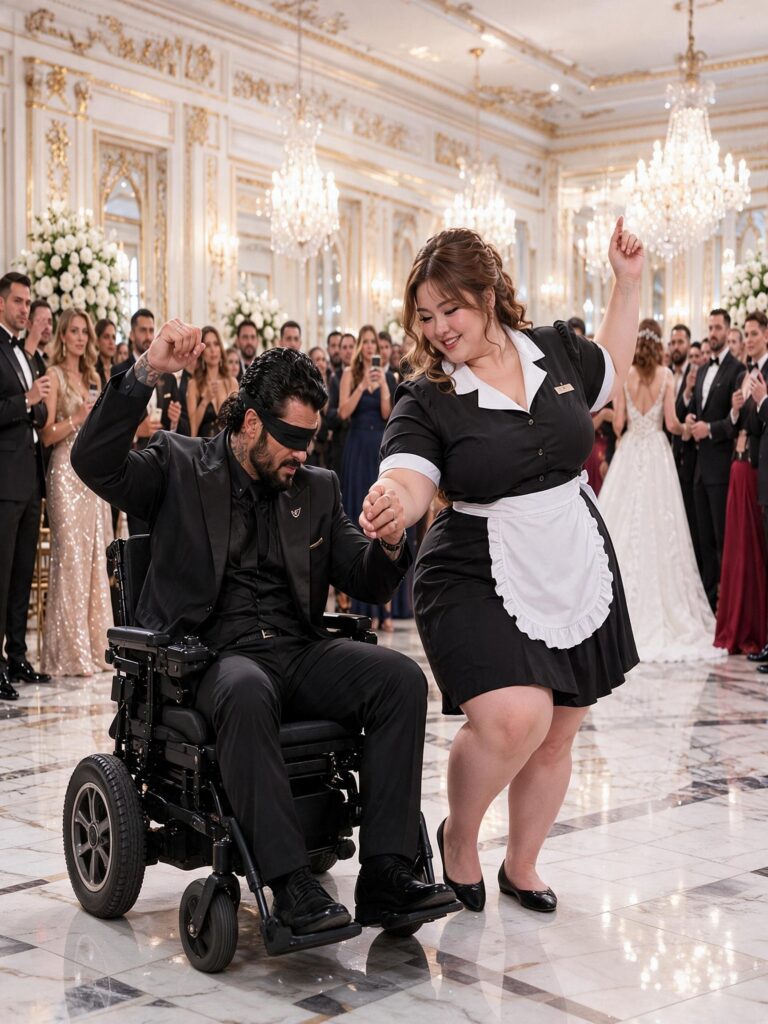
The Maid Nobody Saw Asked a Blind Mafia Boss to Finish the Song, and He Answered by Trusting Her With the Truth
Part 1
The band did not stop playing, because nobody in the Valtieri ballroom was brave enough to tell them to.
That was the first thing Winnie Dubois noticed. The second was the phones.
They rose all at once, a flock of black glass startled off a wire. Donors. Cousins. A city councilman whose glass she had refilled twice. A woman in green sequins who had not once looked at Winnie’s face when the champagne arrived. Every screen pointed at the center of the polished floor, where Nico Valtieri stood alone with one hand lifted into empty air.
Arabella Straud had already taken the ring off his finger. She had pressed it into his palm in front of three hundred people and said, clearly enough for the back tables to hear, that she could not spend her life beside a man who would never see her face again. Then she had walked out. The doors had shut. The most feared man in Pittsburgh had turned his head toward the sound, then back again, and reached for a railing that was not there.
Winnie stood by the bar with a tray of flutes gone warm in her hands. Four years at the estate in Sewickley. Four years of ironing his shirts on Tuesdays, carrying his mail up the east stairs, cleaning a study he no longer crossed without someone telling him where the chair was. In all that time he had spoken nine words to her, and six of them had been thank you.
She knew the hand. She had watched that exact reach, for exactly that nothing, more times than she could count in her grandmother’s kitchen in Homewood.
A man near the bar laughed under his breath. “Hard to feel sorry for a mob boss.”
His wife did not lower her phone. “Keep filming. This is brutal.”
Winnie set the tray on the bar.
Marcus, hired two weeks ago and still afraid of his own vest, whispered her name like a warning. “You can’t go out there. Security’s by the stage. Those men carry guns.”
“I know,” Winnie said, and walked.
Forty feet of parquet. A chandelier the size of a car. A black-and-white uniform with a sauce stain on the apron, past tables of people who had spent the evening looking through her as if she were a useful piece of furniture that happened to have hands. The whisper started before she was halfway there.
“Who is that?”
“The help.”
A woman laughed, bright and delighted. “Oh my God. Is she serious? Look at her.”
Winnie knew what they were looking at. She had known it her whole life. Thirty-one years of being the biggest girl in every room. The section at the back of the store. The quick polite calculation in a stranger’s eyes that ended in a decision about what she was worth. She kept walking anyway.
Nico’s head turned toward her footsteps. His face went hard at once, the face of a man who had been the most dangerous person in every room for twenty years and had spent the last eighteen months unable to see whether anyone was coming at him.
“Stop,” he said. Low. Final. “Whoever you are. Stop right there.”
She stopped three feet away. She did not take his arm. Her grandmother Josephine had taught her that when Winnie was fourteen, the week the glaucoma finished what it had started. You never grab a blind person’s arm and drag them. It is the fastest way to make someone feel like luggage.
She touched the back of his hand with two fingers. Lightly.
He flinched.
“My name is Winnie Dubois,” she said. “I work in the house. I’ve ironed your shirts every Tuesday for four years. You don’t need to remember that.”
His jaw tightened. “What do you want?”
The words left her before she could make them smaller. “Will you finish this song with me?”
Silence moved out from the two of them like a stone dropped in water. Even the band faltered for half a measure.
He said nothing.
She kept her voice low enough that the phones could not have it. “If you stand here until the music ends, every person in this room will remember tonight as the night you were left. If you dance, they’ll remember it as the night you didn’t run.”
The quiet lasted long enough for her to feel every camera on the back of her neck. Long enough to think she had just ended four years of steady work and would be packing a locker by midnight.
Then Nico Valtieri turned his hand over, slowly, and let her fingers rest in his palm. His other hand found her shoulder. Not gripping. Learning the shape of where she was.
Winnie was not a good dancer. She knew exactly one waltz. Josephine had taught it to her on a scratched linoleum floor in a two-bedroom apartment, back when Josephine could still see the steps. Later, after the last of the sight was gone, they had danced it anyway on Sunday nights, Winnie counting out loud so her grandmother would know where the turn lived.
So Winnie counted.
“One. Two. Three.” Barely a whisper. “The head table is four steps to your left. The stage is behind us. We have room for two full turns before we reach it. There’s a server on your right—never mind. He moved.”
The corner of his mouth shifted. Barely.
She guided him through the first turn with the smallest pressure, not pulling, suggesting. On the second turn she stopped naming every step. She could feel him finding the rhythm on his own. On the third, he began to lead.
Three hundred people watched the most feared man in Pittsburgh waltz across his own ballroom with a plus-size maid in a stained apron. He did not stumble once.
Near the end of the song, the tension left his shoulders. “My mother used to dance this.”
“My grandmother did too.”
“She taught you.”
“Yes. She went blind when I was fourteen. I was her eyes for six years. This was the only song we ever danced, because it was the only one I could count.”
He did not answer. His hand tightened on hers, just slightly.
When the last note faded, nobody applauded. Nobody knew whether they were allowed to.
He leaned in. “The side door.”
“Nine steps behind you. A little to the right. If you want, I’ll walk you there. Nobody in this room will see your face when you get to it.”
“Yes.”
She walked him. She opened the door. Two of his men waited in the corridor and looked at her as if she had stepped out of weather they did not recognize.
Nico let go of her hand. “Thank you.” Then, quieter, the thing that closed her throat: “I don’t even know what you look like.”
“That’s all right,” Winnie said. “Most people who do know haven’t bothered to look either.”
She turned, went back through the kitchen doors, and was scraping plates at the dish station before anyone could ask her name.
By nine the next morning the video had four million views.
Six guests. Six angles. One of them had set it to sad piano. One caption read, The maid really said I got you, king, which Winnie had absolutely not said. The top comment, forty thousand likes, said nobody would remember the bride’s name, but everybody would remember the woman in the apron.
Winnie found out because her mother called at 6:15, screaming her name into the servants’ locker room.
“You’re on the news,” Marguerite Dubois said. “Channel 11 showed it twice. The lady at the bakery called me crying.”
“I have to be on shift in fifteen minutes.”
“You’re a hero.”
“I’m a maid who knows one waltz,” Winnie said. “I still have to vacuum the east wing.”
Her mother was quiet for a second. “Josephine would have been proud of you.”
Winnie sat down on the bench and did not trust her voice.
Inside the house, nothing had changed. Sal, the head cook, handed her the heaviest box on the counter without looking up, the way he did every morning, because he said she was built for it. Two of the younger housekeepers stopped talking when she came in. Then Kayla said, loudly, that some people would do anything for fifteen minutes of fame. Brianna laughed and said at least she’d finally found a man who couldn’t see what he was getting.
Winnie heard it. She always heard it. She carried the box to the pantry and did not cry, because she had learned a long time ago that crying in front of people like that was like handing them a gift. She cried later, for four minutes, in the linen closet on the third floor where nobody ever went. Then she wiped her face and went back to work.
Dorene Pratt found her in the east wing at eleven.
“In the future,” the head housekeeper said, “you will remember that staff are not permitted on the ballroom floor during events.”
“I understand.”
“Mr. Valtieri was very displeased.”
Winnie looked up. “What did Mr. Valtieri say?”
Dorene’s mouth tightened. “It isn’t your concern. Keep your head down. This will blow over in a week.”
The name stayed anyway. Giani Valtieri. Nico’s cousin. Forty-one, always smiling, moved into the east wing eighteen months ago, right after the car on Route 65 killed Nico’s driver and took Nico’s sight. Everybody in the house knew Giani ran most of the business now. He read the contracts. He summarized the accounts. He decided who got a meeting. Everybody said it was lucky Nico had a cousin like that.
Winnie had never liked him. Not for any reason she could have put on paper. He was polite to the staff. Generous at Christmas. He remembered birthdays. He was also the only person in the house who looked at her the way a man looks at a chair he is about to move.
And last night, at 11:40, she had been alone in the service corridor behind the ballroom, stacking glass racks, when Giani walked past the door on his phone. He had not seen her. Nobody ever saw her.
He had been laughing softly. “Arabella did it perfectly. Every word. Just like we practiced.”
Winnie had frozen with a rack in her hands.
Then he had said the dance was a problem, and that he would handle it.
She had stood in that corridor for a full minute with her heart beating in her ears. She had spent the night telling herself she had misheard. She had spent the morning knowing she had not.
At three, Tomas came to find her in the laundry. Fifty-some, gray at the temples, longer with the family than Winnie had been alive.
“Mr. Valtieri would like to see you in the library.”
Her stomach dropped. “Am I being fired?”
He studied her. “In twenty-six years I have never once seen him ask to meet a member of the house staff. I don’t know what that means. I doubt it’s that.”
She folded her apron and followed him upstairs.
Nico sat in the leather armchair by the window, facing the room, dark glasses on. A cup of coffee waited beside him with a skin on top. He turned his head when the door opened.
“Ms. Dubois is here,” Tomas said.
“Let her in. Close the door.”
Tomas hesitated, then did.
For a moment neither of them spoke.
“I listened to the video,” Nico said. “My sister-in-law played it twelve times this morning. I heard the room go silent. I heard somebody laugh. I heard a woman ask if the maid was serious, and say, look at her.” He paused. “That was when I realized I had no idea what everyone was looking at.”
Heat climbed Winnie’s face.
“I want to ask you something,” he said. “I want an honest answer. Why did you do it?”
She looked at the cold coffee and thought about lying. Something humble. Something forgettable. The kind of sentence a maid was supposed to offer the man who signed her paycheck.
Instead she told him about Josephine.
About the church that came for a month with casseroles and promises, and stopped coming by the third. About people talking slowly and loudly, as if blindness were a failure of the mind. About being spoken past, in the same room, as if the woman in the chair had already left. About a church picnic in 2009, Josephine standing alone beside a folding table, waiting for someone to remember she was there.
“She told me once, near the end, that going blind wasn’t the worst part,” Winnie said. “The worst part was the day she realized everyone she loved had started treating her like furniture. Last night, when I saw you reaching for nothing, I didn’t see the most powerful man in Pittsburgh. I saw her. I promised myself at that picnic that if I ever saw that look again, I would walk over.”
The library was silent for a long time. Nico found the cup by touch, lifted it, and set it down again.
“I’ve been in this chair since six.”
“I can tell,” she said. “Your coffee has a skin on it.”
His head turned sharply.
“I’m sorry. It’s a habit.”
Something happened to his face that was not a smile. It was the place a smile used to live. “Nobody told me the coffee was cold.”
“Was someone supposed to?”
“Giani usually handles things like that.”
Her stomach turned. Arabella did it perfectly. Just like we practiced. She opened her mouth and closed it. She was a maid. He was her employer. The man she would be accusing was the person Nico trusted to be his eyes. She had a phone call overheard through a doorway, and a lifetime of people telling her that what she saw did not count.
“You started to say something,” he said.
“It was nothing.”
He was quiet. Then: “For eighteen months, every person who has walked into this library has told me exactly what I wanted to hear. I have gotten very good at recognizing the sound of it. That was not the sound you just made.”
Footsteps stopped in the hall. A knock, warm and pleasant.
“Hope I’m not interrupting.”
“You never are,” Nico said.
Giani came in smiling, handsome in the careful way of a man who knew his best angle. He put a hand on Nico’s shoulder. “Worried about you all day.” Then he looked at Winnie. Less than a second. Pleasant. Curious. Utterly cold. “This must be the famous dancer.”
“Winnie Dubois. Housekeeping.”
“Of course you are. The whole internet knows your name. You must be very proud.”
“Mostly tired.”
He laughed as if that were charming, and turned back to his cousin. “Holland freight renewal. Needs a signature before five. I read it through. Standard terms. Nothing unusual.”
Nico held out his hand for the pen.
Winnie heard herself speak before she could stop it. “I can read it to him, if he wants.”
The room went quiet. Giani’s smile did not move. Something behind it did. “Kind of you. Not necessary. I’ve been handling his paperwork for a year and a half.”
Nico’s hand stayed out. Then he lowered it. “Actually, I’d like to hear it.”
Giani blinked. “It’s twenty-two pages.”
“Then she’d better start.”
For a long moment Giani looked at his cousin. Then he set the folder on the table. “Of course. I’ll come back for it at five.” He squeezed Nico’s shoulder on the way out. He did not look at Winnie again. That was worse.
When the door closed, Nico let out a breath. “I have no idea why I just did that.”
“Maybe you’re tired of summaries.”
“That is exactly it. For eighteen months, everything that touched my life arrived already chewed. Read.”
She read all twenty-two pages. An hour and ten minutes. She stumbled over the legal language. He corrected her twice, patiently, without making her feel stupid. She read it the way she used to read Josephine’s mail. She did not skip a word.
It was a standard freight renewal. Standard terms. Nothing unusual, except page nineteen.
Page nineteen changed the payment account for all Holland freight revenue from Valtieri Logistics to a holding company she had never heard of. Ridgeline Transport Partners.
She read it twice. Then a third time, out loud, very slowly.
Nico did not move.
“Do you know what Ridgeline Transport Partners is?”
“No.”
“Did Giani mention that clause?”
“He told me it was a standard renewal.”
The library went completely silent.
“Read page nineteen one more time.”
She did. When she finished, he sat for a full minute without speaking. Then he found the folder by touch and set the pen on top of it without signing anything.
“Can you come back tomorrow?”
“To do what?”
“To read. I’ll pay you twice your rate. Two hours every afternoon.”
Twice her rate would clear her mother’s credit card in four months. It would fix the transmission. It might let Marguerite drop the night job cleaning offices downtown, the one that made the bad knee worse. It was more money than anyone had ever offered Winnie for anything.
“Yes,” she said. “On one condition.”
His eyebrows lifted above the glasses.
“I’ll read to you every afternoon if you let me teach you to stop needing me to. A cane. Screen reading on your phone and your computer. Learning where everything in this house is, so nobody can move it without you noticing. I’ll teach you to pour your own coffee.”
“I have people for that.”
“That is exactly the problem.”
He turned his head toward the window. For a moment she thought she had lost the job she had held for thirty seconds.
Then, stiffly: “I suppose I could learn to pour coffee.”
“Good. We start tomorrow.”
On the back staircase she met Giani coming up. He stopped. He smiled.
“Did the reading go well?”
“It did.”
“I’m so glad someone is helping. Nico can be difficult. It’s important he feels independent. Even if he isn’t really.” His voice stayed pleasant. “I hope you understand your place in all this.”
Then he kept walking.
Winnie stood on the stairs with her heart pounding, the unsigned folder still in her mind, and understood that the song was over and the dangerous part had just begun.
Part 2
Nico Valtieri hated every lesson.
He hated the cane. He said it made him look like an invalid. Winnie said he was holding it like a baseball bat. He hated the screen reader. He said the voice sounded like a bored airline pilot. She changed it to a British woman. He said that was worse. He hated the coffee most of all.
The first time he tried to pour it himself, he missed the cup and sent half a pot across the table and down his left sleeve. He swore in Italian for twenty seconds.
Winnie handed him a towel. “Josephine used to say much worse things in Creole. You have a long way to go.”
He stopped swearing. Then, very slowly, he laughed. Short and rusty, like something pulled out of a drawer that had not been opened in years.
Outside the library door, Tomas turned to the other man on the detail. “Did you just hear that?”
“Eleven years,” the other man said. “I have never heard him laugh once.”
By the second week he could pour a cup without spilling it, finger hooked over the rim, feeling for the heat the way she had taught him. By the third week he could walk from the library to the kitchen with the cane and not touch a single wall. The first time he did it, three people in the kitchen stopped what they were doing and stared.
Sal’s voice changed into something Winnie had never heard him use. “Good afternoon, Mr. Valtieri.”
“Good afternoon, Sal. What’s for dinner?”
Sal was so startled he told him in full detail, including the marinade.
Every afternoon, after the lesson, she read. Contracts. Bank statements. Quarterly reports. Letters from lawyers. Everything Giani had been summarizing for eighteen months. She was not an accountant. She did not have a finance degree. She had spent six years managing Josephine’s disability checks, Medicare paperwork, and pharmacy bills, and she knew what it looked like when numbers did not match the story being told.
These numbers did not match.
Three of the Valtieri trucking companies had reported losses every quarter since the explosion on Route 65. Before the explosion, all three had been profitable for seven straight years. Every contract those companies lost had gone to one place. Ridgeline Transport Partners.
She did not say it yet. Not without more than a pattern.
On her own time, on her own phone, in the break room at eleven at night, she looked up the company on the Pennsylvania business registry. Registered twenty months ago. Two months before the explosion. The listed owner was a woman named Christina Valtieri.
Giani’s wife.
Winnie sat in that break room until her eyes burned.
Meanwhile the house decided what it thought of her, and it decided badly. The story among the staff was that she had timed the dance for the cameras. That she had been going after the boss for years and saw her chance when the bride walked out. That the afternoon reading was a long walk toward his bed and his bank account. Kayla and Brianna started calling her the queen. Not to her face. Just loud enough.
On Monday her cleaning cart disappeared. She found it forty minutes later in the garage, tipped on its side, supplies dumped in an oil stain. On Wednesday someone taped a diet pamphlet to her locker. Across the top, in black marker: Since you’re moving up in the world.
She peeled it off, folded it into quarters, and threw it in the recycling. Then she stood in the third-floor linen closet with her forehead against the shelves for six minutes.
She told Dorene the next morning.
“I’ll look into it,” Dorene said.
“When?”
“You’ve drawn a great deal of attention to yourself. Attention has consequences. If you spent less time upstairs, the other girls might settle.”
“I’m being paid to be upstairs.”
“Then perhaps you should consider whether that’s appropriate.”
Winnie walked out of that office understanding that nobody in the house was coming to help her.
She was wrong.
Walter, the gardener, seventy-three and good for about twelve words a week, had seen the cart in the garage. He had seen her carrying it back, dripping oil. He spent his twelve words on Tomas. Tomas spent them on Nico.
The next morning every member of the house staff found a printed letter in their mailbox, signed by Nico Valtieri. Any harassment, humiliation, or interference with another employee’s work would result in immediate termination. No second warning. No reference.
Kayla and Brianna did not speak to Winnie for the rest of the week. Sal started handing her the lighter boxes. She thought Dorene had finally done something. She found out three weeks later, when Tomas mentioned it in passing, and she had to excuse herself and stand in the linen closet for an entirely different reason.
Somewhere in the fourth week, the afternoons stopped being only about reading.
He asked about Josephine. She told him about the Sunday waltzes, the church picnic, the way her grandmother used to say you could tell everything about a person by how they spoke to a waiter. He asked what she read for herself. Mystery novels from the Carnegie Library, three at a time, because that was the limit. He said he used to read history. He had not opened a book in eighteen months.
The next day she brought an audiobook on her phone, a biography he would have chosen for himself, and played the first chapter. He listened to the whole of it without a word. Then he asked if she could bring the second tomorrow.
He asked what things looked like. The color of the sky over the Ohio at six in October. The way the leaves in the estate garden turned from the top of the tree down. The exact shade of the old wallpaper in the library.
“Weak tea,” she said.
“I chose that wallpaper.”
“I’m sorry.”
He laughed again, easier this time.
One afternoon near the end of October, in the middle of a quarterly report, he stopped her.
“What do you look like?”
Winnie put the report down. Nobody had ever asked her that and wanted the honest answer. People asked it at the start of a phone call from an app. People asked it the way you ask a question you already expect to be disappointed by.
“I’m big,” she said. “I’ve been big since I was nine. Brown skin. My grandmother’s cheekbones. Hair I wear in a bun because it’s easier. My whole life, people have taught me to apologize for the amount of space I take up. I’ve gotten very good at it.”
He was quiet. “I can’t see the size of anything anymore. All I know about you is that you’re the only person in this house who reads me every word. You have never once told me what I wanted to hear. When you walk into a room, I can hear the floor. It sounds like somebody who knows where she’s going.”
She had to look out the window.
“Did I say something wrong?”
“No,” she said. “You said something nobody has ever said.”
That was the moment she decided to tell him about Ridgeline.
She opened her mouth. There was a knock, and Giani walked in without waiting, another folder in his hand.
“Need a signature. Power of attorney update for the family trust. Routine. Lawyers want it by morning.”
Winnie’s hands went cold.
“Winnie will read it,” Nico said.
“This one is confidential. Family trust. Some things should stay between family.”
“She has read everything else.”
Giani’s voice stayed pleasant and hardened underneath. “With respect, you’ve known this woman five weeks. I’ve been managing your life for eighteen months.”
The room went still.
“I’ll sign it tomorrow,” Nico said calmly, “after she reads it to me.”
Giani stood there. Then he smiled. “Of course. I’ll leave it on the desk. See you at dinner.” He set the folder down. He walked out. He did not look at Winnie.
She read the document before she left. Eleven pages. On page eight, buried inside a paragraph about trust administration, a clause that would transfer full signing authority over every Valtieri business account to Giani, effective immediately, without further consent.
Nico listened to all of it. When she finished, he did not speak for a long time.
“Leave it where he left it.”
“Why?”
“Because for the first time in eighteen months, I want him to think I still can’t see anything.”
She took the back stairs at 6:40. The servants’ hall was empty. Halfway down the last flight, she saw him at the bottom, leaning against the wall with his hands in his pockets, as if he had been waiting.
He did not smile.
“I think it’s time we had a conversation.”
She stopped three steps above him.
“I asked around,” he said. “Talked to the catering staff from the engagement party. A bartender named Marcus remembers you leaving the bar around eleven-thirty to stack glass racks in the back service corridor. The corridor behind the ballroom.” He looked up at her. His voice went soft. “I was in that corridor at eleven-forty. On the phone. What exactly do you think you heard?”
“Nothing.” It came out steadier than she expected. She had been smiling at men who looked through her for her entire working life. This was only a sharper version of the same skill.
“Good,” Giani said. “Very good. A woman in your position, hearing the wrong thing, could make a lot of trouble for herself.” He said her mother’s name as if he were reading it off a card. “Marguerite Dubois. Early shift at the Oakmont Bakery on Allegheny River Boulevard. Second job cleaning offices downtown, three nights a week. Exhausting, at fifty-eight, with a bad knee.”
Winnie gripped the railing.
“I admire women like that. Hardworking. Proud. It would be a shame if the bakery lost its lease. Or the cleaning company lost the building. Or if anything at all made that knee worse.” He said it in the same tone he used to wish the kitchen staff a happy birthday. “The reading is over. Tomorrow you’ll tell Nico you’ve changed your mind. Overwhelmed. You want to go back to housekeeping full time. Do that, and your mother keeps both her jobs.”
He pushed off the wall, smiled for the first time, and said good night.
Winnie sat down on the stairs after he left, because her legs refused to hold her.
She drove home to Homewood with both hands locked on the wheel. Her mother was asleep on the couch in her bakery uniform, the television still on, the swollen knee propped on a cushion. Winnie stood in the doorway and looked at her for a long time. She thought about walking into the library and saying she had changed her mind. How easy it would be. How safe. How nobody would ever know.
She thought about Josephine at that picnic, standing alone beside the folding table while two hundred people decided it was not their business.
She did not sleep.
At seven the next morning she knocked on the library door and asked Tomas to let her in and close it.
Nico was in his chair. He had poured his own coffee. No skin on it.
“You’re early.”
“I need to tell you something,” she said. “You are not going to want to hear any of it.”
Then she told him all of it. The phone call at 11:40. Arabella did it perfectly, just like we practiced. The dance is a problem, I’ll handle it. Ridgeline. The registry. Christina’s name on the filing. Three trucking companies bleeding money since the week of the explosion. Giani at the bottom of the stairs, saying her mother’s name like a lever.
She talked for eleven minutes. He did not interrupt once.
When she finished, she could hear the grandfather clock in the hall.
“I understand if you don’t believe me. I’m a housekeeper. He’s your family. I have no recording. No photographs. My word, and a state website.”
Nico did not answer. Then he did something she did not expect. He reached up and took off his glasses.
He had never taken them off in front of her. His eyes were brown, clouded at the edges, pointed very precisely at the window.
“Three months ago,” he said, “I started seeing light.”
Winnie stopped breathing.
“Mornings first. A gray patch where the window is. Then shapes. The difference between a doorway and a wall. Between a person standing still and a person moving. My neurologist calls it partial return of light perception. It might improve. It might not. No way to know.” He turned his head toward her. “I told nobody. Not the doctor’s office staff. Not security. Not my sister-in-law. Not Giani.”
“Why?”
“The week before the explosion, my driver, Paulie, told me somebody had been asking questions around the garage. Which routes I took on Thursdays. Paulie died in that car eleven days later. When I started seeing shapes again, the first thing I felt wasn’t hope. It was fear. Because the only person who loses anything if I can see again is the man who became my eyes.”
She sat down slowly on the edge of the leather sofa. “Can you see me now?”
“A shape where you’re sitting. Darker than the window. I can see when you move your hands. For three months I’ve been sitting in this chair, letting him read me contracts, watching the shape of his hands, wondering if I was losing my mind.” His voice roughened. “You just told me I wasn’t.”
Her eyes filled. She did not know why.
He put the glasses back on. “The power of attorney is still on the desk. He’s expecting it signed by tonight. I’m going to call a forensic accountant in New York I’ve never met and he’s never heard of. I’m going to have two men I trust sit outside the Oakmont Bakery every morning, and outside the building on Liberty Avenue every night your mother cleans it.”
She opened her mouth.
“That isn’t a gift,” he said. “Your mother was threatened in my house, by my family. It’s the minimum.” He was quiet a moment. “And I’m going to tell Giani I signed the power of attorney after the foundation gala on Saturday. I want him comfortable. I want him confident. I want him to walk into that ballroom thinking he has already won.”
For the next four days she did the hardest thing she had ever done. She kept going to work. On Wednesday, in front of Giani, she told Nico in a small tired voice that she was overwhelmed and wanted to cut the reading back to an hour a week. She did not look at Giani. He looked at her for exactly one second and smiled.
She went back to housekeeping. She let Kayla and Brianna whisper that the queen had been dethroned. She let Sal hand her the heaviest box again. She cleaned the east wing and scrubbed the servants’ bathrooms. And every afternoon at three she took her break in the linen closet and read Nico’s statements to him over a call routed through Tomas’s personal phone.
The accountant arrived on Thursday. Ruth Adami. Sixty, reading glasses on a chain, twenty years auditing people who thought they were smarter than paper. Six hours in a hotel room in Squirrel Hill with every document Winnie had read aloud in five weeks. When she came out, she told Nico she had never seen anything this sloppy from a man who thought he was this smart.
On Friday morning Winnie opened her locker and found a gold watch.
Heavy. Swiss. Engraved on the back with the initials N.V. She stared at it. Then Dorene was behind her, with Kayla, and a security guard Winnie did not recognize.
“Mr. Valtieri’s watch was reported missing from the upstairs dressing room this morning,” Dorene said, very calmly.
“I didn’t take it.”
“It was in your locker.”
“Somebody put it there.”
“That’s what they all say.”
Kayla filmed the whole thing.
They walked Winnie out through the servants’ entrance at 8:40, apron still on, bag over her shoulder, in front of the entire kitchen. Sal would not look at her. Walter stood by the greenhouse with pruning shears in his hand and watched her go without a word. Later she would learn he walked straight to Tomas’s office and stood in the doorway until Tomas looked up.
Dorene said Mr. Valtieri had decided not to press charges, out of kindness.
Winnie sat in her car in the employee lot for twenty minutes. Then her phone rang.
“Tomas just told me,” Nico said.
“I didn’t take it.” Her voice broke on the last word.
“I know. The watch was in a drawer in my dressing room. Three people have keys. One of them is Giani. I can reverse this in five minutes.”
“Then he’ll know.”
A long silence. Then the thing that made her put a hand over her mouth. “I spent three days asking you to be invisible for me. You were perfect. And I just watched the house I own humiliate you for it. I’m sorry.”
She could not answer.
“The gala is tomorrow,” he said.
“I know. What do you need?”
He was quiet. “The foundation hired an outside caterer. Allegheny Events is short servers. In a ballroom full of three hundred people, there is exactly one kind of person nobody will ever look at twice.”
She laughed through the tears, ugly and brief. “A woman in a black-and-white uniform.”
“Yes,” Nico said. “And this time, when they finally look, I want them to hear you.”
Part 3
The Valtieri Foundation gala raised money every year for low-vision programs across western Pennsylvania. It had been Nico’s mother’s idea, twenty years ago. It was the only public event he had refused to cancel after the explosion. Giani had spent the week telling him not to go. The press would be there. People would bring up the engagement. There was no reason to put himself through another spectacle.
Nico had listened to all of it. Then he had said that if he hid now, Arabella had won.
Winnie arrived at the hotel at four in a borrowed catering uniform, hair in the same bun she always wore. The catering captain handed her a tray and a section map and did not look at her face once. She thought Josephine would have found that funny.
Nico arrived at seven with Tomas at his side and a white cane in his right hand. He had never used the cane in public. The room noticed. Conversations dipped. People turned. A few of them straightened, the way people do when they realize they are looking at a man who has decided not to be pitied.
Giani stood near the head table with a drink in his hand and Christina at his elbow. He smiled as his cousin approached, clapped him on the back, and said he was proud of him for coming. He did not look toward the bar. Nobody ever looked toward the bar.
For an hour, everything held.
At 8:20 the ballroom doors opened and Arabella Straud walked in on the arm of a real-estate developer named Preston Hale. Silver dress. Breathtaking, and aware of it. She crossed the floor toward Nico, and the room went quiet the same way it had on the night of the engagement party.
“I wondered if you’d actually show up,” she said.
“I had no reason not to.”
“You’ve certainly bounced back. I saw the video. Everyone did.” Her eyes moved across the room and landed on the bar. The smile went slow and delighted. “Oh my God. I heard the maid was fired for stealing. I didn’t realize they let thieves carry champagne now.”
Heads turned. Winnie felt the tray go heavy. She felt every eye find the uniform, the body, the face.
Arabella walked toward her. “I have to know. What was it like, being the only woman in Pittsburgh desperate enough to dance with a man who couldn’t see what he was holding?”
Somebody laughed.
Arabella turned back toward Nico, loud enough for the room. “You really are perfect together. Two failures, comforting each other.”
The silence afterward was absolute.
Winnie put the tray down.
She had spent thirty-one years walking away from sentences like that one. Walking away was what she was good at. It was the only thing anyone had ever taught her. She did not walk away. She reached into the pocket of the borrowed apron and took out a folded sheet of paper.
“I have one question for Ms. Straud.”
Arabella laughed. “The maid has a question.”
“Yes. Who paid you to walk out of your engagement party at 9:14 on the night of October fourth?”
The laugh died.
“At 11:40 that same night,” Winnie said, and her voice carried farther than she meant it to, “I was stacking glass racks in the service corridor behind the ballroom. A man walked past the door on his phone. He told someone that Arabella did it perfectly. Every word. Just like they practiced.”
Every head in the room turned toward the head table.
Giani set his drink down and smiled. “This is very sad. This woman was dismissed from the household yesterday morning for stealing my cousin’s watch. She clearly has some kind of fixation on the family. I’m sorry everyone has to witness it.”
A murmur moved through the room. Winnie heard the word thief.
Giani turned to the catering captain, pleasant as a host. “Have her removed.”
The captain started toward the bar. Winnie unfolded the paper.
“Ridgeline Transport Partners was registered with the Pennsylvania Department of State twenty months ago. Two months before the explosion on Route 65 that killed Paulie Duca and blinded Nico Valtieri. Since that explosion, Ridgeline has absorbed every contract lost by three Valtieri trucking companies that had been profitable for seven straight years.” She looked straight at Christina, frozen at the head table. “Ridgeline’s registered owner is Christina Valtieri.”
Christina’s glass slipped out of her hand and shattered on the parquet.
For one second Giani’s smile was simply gone. What was underneath it was the thing Winnie had seen at the bottom of the back stairs. Then he moved. Around the head table, fast, straight toward the bar, saying something about lies and lawyers and how this woman would never work in the city again.
He was ten feet from her when Nico lifted one hand.
Every security man in the ballroom moved at the same time. Tomas. The two by the east doors. The one by the stage. They stepped into Giani’s path, and not one of them looked at Giani for permission, because not one of them had ever worked for him.
Giani stopped. He turned, slowly, toward his cousin.
Nico reached up, with the whole ballroom watching, and took off his glasses. He turned his head not toward the sound of Giani’s voice, not toward the noise. He turned it directly toward the shape of the man standing in the middle of the floor.
“I watched you move,” he said.
Giani laughed. Warm. Incredulous. The laugh of a man who had talked his way out of every room he had ever been cornered in. “He’s been through a terrible trauma. His doctors warned us about confusion. Stress. Seeing things that aren’t there. Nico, you need to sit down.”
Nico did not sit down. “For three months, every morning, the window in my library has been a gray square. For six weeks, the shape of your hands has been darker than the pages you were pretending to read me. Tonight I watched a dark shape come around the head table, fast, toward a woman standing still at the bar. I can’t see your face. I don’t need to.”
The room was so quiet Winnie could hear the ice settling in the champagne buckets.
Giani’s smile held for one more second. Then it cracked at the edges. “This is a family matter. It should be handled privately.”
“It stopped being private the night you paid a woman to walk out of my engagement party in front of three hundred witnesses.” Nico said a name. “Ruth.”
Ruth Adami stood up from a table near the back. Nobody had noticed her all evening. She walked to the front of the room without hurrying, a leather portfolio in her hands that looked heavier than she was.
“I spent the last forty-eight hours reviewing every financial record related to Valtieri Logistics and its subsidiaries,” she said. “I was retained independently by Mr. Valtieri. No one in his household knew I existed. Three companies lost 4.1 million dollars in contracts over eighteen months. Every one of those contracts was reassigned within thirty days to Ridgeline Transport Partners. Every payment authorization that moved them was approved from an account controlled by Giani Valtieri.”
“That’s a lie,” Giani said.
Ruth looked at him over the top of her glasses. “I worked twenty years for the federal government, auditing people who thought they were smarter than paperwork. I have not yet met one who was.”
Somebody in the crowd actually laughed.
Then Arabella started to cry. It was not graceful. It was the kind of crying a person does when the floor disappears. Preston Hale took one deliberate step away from her, the way a man steps away from a puddle.
“I didn’t know about the money,” she said. “Giani came to me three weeks before the party. He said you were never going to get better. That the family was falling apart. That I was about to tie myself to a blind man who would be pushed out of his own business within a year. He offered me two hundred thousand dollars to end it publicly. With the ring. He wrote the speech. He made me practice it in his car four times.”
Nico said nothing at all. Winnie watched his face and thought she had never seen a man stand so still while being broken.
Then the thing happened that nobody in the ballroom expected, least of all Giani.
Christina spoke.
She had been frozen beside the head table since the glass hit the floor. Her voice came out small and shaking. “I have never heard of Ridgeline Transport Partners.”
“Christina,” Giani said, and her name was a warning.
“I have never registered a company. I have never signed a single document with the state of Pennsylvania in my life. I signed whatever you put in front of me at the kitchen table for fifteen years, because you told me it was taxes.”
Ruth opened the portfolio and held up a single page. The Ridgeline registration. Signed Christina M. Valtieri.
Christina looked at it. “That isn’t my handwriting. My middle name isn’t M.”
The room broke into noise.
Giani looked at his wife, then at his cousin, then at the woman in the catering uniform behind the bar. For the first time in eighteen months, he looked like a man who had run out of rooms.
The Allegheny County police arrived at 9:20. Nico had called them himself at 7:30 and asked them to wait in the lobby until the accountant finished speaking. They walked Giani out through the main doors, past every family in Pittsburgh who mattered.
He stopped once near the bar and looked at Winnie. “You have no idea what you just started.”
“I have a pretty good idea,” she said.
For the first time in her life, she did not look away first.
She thought it was over. It was not.
At eleven the next morning, Ruth called Nico’s personal phone and asked to speak with both of them. He put her on speaker in the library.
“I went back through his personal accounts overnight,” Ruth said. “Once you find one lie in a man’s books, you keep pulling until the thread stops. The thread did not stop. Forty-six hours before the explosion on Route 65, Giani transferred eleven thousand dollars in cash from a personal account to a man named Dale Kowalik.”
Nico’s hands went flat on the armrests. “Who is Dale Kowalik?”
“He worked six years as a mechanic at the private garage in Sewickley where the family serviced its vehicles. He quit the day after the explosion and moved to Arizona.”
Nobody in the library spoke.
Paulie Duca had driven for the family for nineteen years. He had two daughters in college. He had told Nico, eleven days before he died, that somebody had been asking about his Thursday routes.
“Thank you, Ruth,” Nico said.
“I’m sorry.”
“You did exactly what I asked.”
After the call ended, he sat in the chair for a long time. Winnie sat on the sofa across from him and did not fill the quiet, the same way she used to sit beside Josephine on the nights Josephine could not sleep and did not want to talk about why.
After almost twenty minutes, he said, “My father would have handled this a certain way. He ran the family for thirty-one years. There is a way men like my father dealt with a cousin who murdered a loyal driver and tried to steal an empire. Everyone in this house is waiting to see whether I’ll do it that way. Tomas already asked me this morning what I wanted done.”
“What did you tell him?”
He turned his head toward the gray square of the window. “I told him that for eighteen months other people decided what happened in my life because I couldn’t see. I am not going to let my father decide this one from the grave.”
He picked up the phone and called the United States Attorney’s Office for the Western District of Pennsylvania. He gave them everything. Ruth’s audit. Arabella’s statement. The forged registration. The eleven thousand dollars. Dale Kowalik’s new address in Tucson, which Tomas had found by nine that morning.
When he hung up, his hands were shaking.
“That was the bravest thing I’ve ever watched anyone do,” Winnie said.
“It doesn’t feel brave.”
“The brave things never do.”
The watch came back to the surface three days later, from the last person anyone expected.
Walter had worked the estate for thirty-eight years. On Tuesday morning he walked into Tomas’s office holding a small digital camera that looked as if it had been manufactured in 2006. He kept it in the upstairs hall, he said, to watch for the raccoons that got into the attic. It faced the dressing-room door.
On the footage, timestamped 6:14 on the morning Winnie was fired, Giani Valtieri walked into Nico’s dressing room with a key and walked out forty seconds later with something small in his hand. At 6:31 the camera caught him in the servants’ corridor, in front of the locker room.
Dorene watched the footage with her hand over her mouth. She asked for Winnie’s number.
Winnie was at her mother’s apartment in Homewood when the call came. She almost did not answer.
“I watched it,” Dorene said. “I knew for months the younger girls were cruel to you. I let it happen because it was easier. When Giani told me to check your locker, I didn’t ask a single question, because some part of me wanted it to be true. I have no excuse. I’m sorry.”
Winnie sat on the edge of her mother’s couch for a long time before she answered. “I accept the apology. I don’t want to punish anybody for who they were, if they really mean to be somebody different.”
“Is that all?”
“No. Kayla filmed me being walked out. I want that video deleted. I want Kayla to be the one who tells me it’s gone.”
It was done by eleven. Kayla called, crying, and apologized for a long time. Winnie listened to all of it.
“I was twenty-two once too,” she said. “The only thing that matters now is what you do the next time somebody else is the easiest person in the room to laugh at.”
On Friday, Nico asked her to come to the library. She had not been back to the house since the gala. She walked in through the front door for the first time in four years, because Tomas was standing on the steps holding it open and refused to let her use the servants’ entrance.
Nico had poured two cups of coffee. Both of them were hot.
“I want to offer you a job,” he said. “Personal assistant. Five times what the household was paying you. Correspondence. Documents. Meetings. The person I trust to tell me the truth.”
Five times her salary would clear her mother’s debts in a year. It would get Marguerite off her feet and out of the building on Liberty Avenue. It would mean the knee surgery she had been putting off for three years. It was the most money anyone had ever offered Winnie for anything.
“No,” she said.
He went very still. “Why?”
“Because you just spent eighteen months with somebody else as your eyes. I am not going to become the next one. You don’t need a new Giani. You need to learn to see the world in every way you still can. I will not do that for you by standing in the way.”
He was quiet. Then, stiffly: “You just turned down a very large amount of money.”
“I know. It hurts.”
“What do you want instead?”
She had been thinking about it since the night of the gala. “The foundation raises a million dollars a year for low-vision programs. Nearly all of it goes to hospitals and clinics. None of it goes to the thing that actually saved Josephine. Somebody teaching her how to live in her own house again. I want the foundation to start an independent-living program. Cane training. Adaptive technology. Home orientation. The things I taught you. I want to apply to run it. Apply. I want it posted like any other job. I do not want you anywhere near the hiring committee.”
He was quiet for a very long time. “That is the most insulting thing anyone has said to me in a month.”
“I’m aware.”
“I agree to all of it.”
The position was posted on the first of November. Thirty-one people applied, including two occupational therapists from UPMC and a woman with a master’s degree in rehabilitation counseling. Nico recused himself in writing and did not ask a single question. Winnie interviewed with three people she had never met. She brought no resume worth mentioning. She brought six years of Josephine’s appointment calendars, a stack of Medicare appeals she had written herself at nineteen, and a handwritten list of forty-two things a person who has just lost their sight needs to relearn in their own kitchen.
One of the interviewers, Dr. Leah Okafor, read the list twice. “Where did you learn all of this?”
“On a linoleum floor in Homewood,” Winnie said. “From the best teacher I ever had.”
On the second of December, at 4:10 in the afternoon, her phone rang in her mother’s kitchen.
“Congratulations,” Dr. Okafor said.
Marguerite dropped a wooden spoon into a pot of rice and started screaming. Winnie sat down on the kitchen floor, on the same kind of linoleum she had learned to count a waltz on, and cried until her mother sat down beside her.
Nobody had given it to her. She had earned every inch of it herself.
The program opened in February in a rented storefront on Penn Avenue. Two desks. A donated kitchen. A hand-painted sign Walter insisted on making himself. The sign was slightly crooked. Winnie refused to let anyone fix it.
Her first client was a seventy-one-year-old retired steelworker named Harold Biggs, who had lost the last of his vision to diabetes the previous summer. He sat across from her with his arms folded and said he did not need a program. He needed his eyes back. Since nobody could give him that, he did not see the point.
“My grandmother said exactly the same words to me in 2008,” Winnie said. “Almost exactly that tone.”
Harold went quiet.
“What do you miss most?”
His daughter started to answer. Winnie lifted one hand, gently, and waited.
“Making my own breakfast,” he said at last. “My wife died four years ago. Every morning since, I fried two eggs in the same cast-iron pan she used. Now my daughter comes over at seven and makes them, and I sit at the table like a child.”
“Then that’s where we start.”
It took three weeks. The first time he cracked an egg on his own, half of it went onto the counter and he swore so loudly a woman in the waiting room laughed. The fourth time, the egg went in the pan. Harold stood at the donated stove with the spatula in his hand and did not say anything at all. Then his shoulders started shaking. His daughter had to go outside.
Winnie stood next to him and said nothing, because she had learned on a linoleum floor in Homewood that some moments do not need a single word added to them.
By April the program had twenty-six clients and a waiting list. By June she had hired two more instructors. One of them was Tess Duca, Paulie’s older daughter. She had called in March after reading about the program in the Post-Gazette. Occupational therapy degree. Six years at a nursing home in Cranberry. She did not know whether it was strange, applying for a job at a foundation tied to the man whose car her father had died in.
“Do you blame him?” Winnie asked.
Tess was quiet for a long time. “My father drove for the Valtieri family for nineteen years because he loved it. He used to say Nico was the only boss he’d ever had who knew his daughters’ names. I don’t blame Nico. I blame the man who paid a mechanic eleven thousand dollars.”
The first time Tess met Nico in the program’s little office, he stood up from his chair, found her hand, and held it for a long time without speaking. Tess cried. So did he. Winnie left the room and gave them the office.
Dale Kowalik was arrested in Tucson on the ninth of March. He did not fight extradition. He was fifty-three, drank too much, and had spent eighteen months, according to the agent who arrested him, waiting for somebody to knock. He confessed in his second interview. Giani had come to the garage in person. He had told Dale the garage was about to lose its contract. He had paid him to make sure the Thursday car would not hold the long downhill curve on Route 65. He had said nobody would be in the car but the driver, and the driver was just the help. Dale had found out afterward that Nico had been in the back seat. He said he had never meant for anybody to die.
The federal prosecutor told Nico all of this in a conference room downtown. Winnie was with him because he had asked her to be.
When the prosecutor finished, Nico said, “Thank you.” Then: “Does he know Paulie Duca’s daughters’ names?”
“I don’t know.”
“I want him to know them. Tess and Maria. I want that in whatever statement is read at sentencing.”
The prosecutor wrote it down.
Giani’s trial began in September. His attorneys were expensive and very good, and their entire strategy rested on one person. They could not argue with Ruth’s audit. They could not argue with Dale’s confession or the cash. They could not argue with Arabella, who had taken a plea and testified for two days in a gray suit without once looking at the defense table. So they went after the woman who had started it.
Bradford Keel spent two hours cross-examining her. He established that she had been a housekeeper. That she had no training in finance. That she had been dismissed for theft, and that the accusation had only been withdrawn after she became close to the victim’s cousin.
“I have never been romantically involved with anyone,” Winnie said.
“Not yet,” Keel said.
A few people in the gallery murmured.
Then he set down his notes and looked at her. “Is it fair to say that before the night of the engagement party, very few people had ever paid attention to you?”
“That’s fair.”
“Is it fair to say you had been overlooked, underestimated, perhaps even mocked for most of your life because of your appearance?”
The courtroom went very quiet. Winnie felt it land exactly where he had aimed it. Thirty-one years. The back of the store. The glance that did the math. The pamphlet taped to her locker.
“Yes,” she said. “That’s fair too.”
Keel nodded, almost sympathetic. “Then it would be understandable, wouldn’t it, if a woman like that, suddenly finding herself on every television screen in the country beside a very rich and very powerful man, might be tempted to keep that attention. Might be tempted to make herself the hero of a story. Might be tempted, even without meaning to, to hear something in a dark corridor that she wanted to hear.”
The silence afterward was total.
Winnie looked at him. Then she looked past him, at the defense table, at Giani Valtieri in his gray suit and his careful hair and his pleasant expression. The man who had stood at the bottom of the back stairs and said her mother’s name.
“Mr. Keel is right about almost everything,” she said.
He blinked.
“I have been overlooked my whole life. I have been mocked and underestimated and treated like furniture in more rooms than I can count. That is precisely why your client never once noticed me standing in that service corridor at 11:40 on the night of October fourth. He walked past a woman stacking glass racks and never turned his head, because in his entire life it had never once occurred to him that someone like me might be listening. That was not my fantasy. That was his mistake.”
Keel had no further questions.
The jury deliberated for eleven hours. Giani Valtieri was convicted on all counts, including conspiracy to commit murder in the death of Paulie Duca. When the verdict was read, Tess put her face in her hands. Maria reached over and held her. Nico sat very still beside Winnie in the second row and did not move until the courtroom had nearly emptied.
“It doesn’t feel the way I thought it would,” he said.
“How did you think it would feel?”
“Like getting something back.”
“It isn’t that kind of thing. It’s the kind of thing that lets you stop carrying one particular weight, so you can finally pick up the rest of your life.”
He turned his head toward her. She could tell now when he was looking at her. His sight had not come back the way anyone hoped. In the months since the gala, the gray shapes had sharpened. He could see the outline of a doorframe, the shape of a person across a room, light and shadow in the general place where a face was. He could not see faces. His neurologist said he probably never would.
“Will you come to the foundation gala next month?”
“I’ll be there working.”
“No. As a guest.”
“I don’t have anything to wear to a gala.”
“That is the least interesting reason I have ever heard for declining an invitation.”
In the end it was Marguerite who took her shopping. The knee surgery had happened in April. She had quit the office-cleaning job in May. She still worked mornings at the Oakmont Bakery, because she said she would go crazy sitting at home. She took Winnie to a boutique in Shadyside that specialized in plus-size formal wear. When Winnie started to apologize to the saleswoman for being difficult to fit, Marguerite put a hand over her daughter’s mouth.
“You are not going to say that word in this store.”
The saleswoman, a size twenty herself, laughed and said she liked Winnie’s mother very much.
The dress was emerald green. Winnie tried to refuse it three times. Her mother bought it anyway.
The gala that November was held in the same hotel ballroom where Arabella had walked out and where Giani had been led away in front of the city. Winnie almost did not go in. She stood outside the doors in the emerald dress with her mother beside her and her heart pounding, and she thought about a forty-foot walk across polished parquet in a stained apron.
Then Tomas opened the door. “You’re going to be late for your own table.”
She was seated at the head table. Nico had not told her. There was a place card with her name on it. Ms. Winifred Dubois, Director, Valtieri Independent Living Program. She had to stand behind her chair for a full minute before she could make herself sit in it.
When Nico stood to speak, he walked to the podium with his white cane and no one helping him. He read his speech in braille. She had taught him for seven months. He read slowly, fingers moving across the raised dots, and nobody in the ballroom made a sound.
He talked about Paulie. He talked about Tess and Maria. He talked about Harold Biggs, sitting at table eleven with his daughter, who had fried his own eggs every morning since March. Then he talked about an October night one year earlier, when he had been left standing alone in the middle of this exact floor.
“Three hundred people watched,” he said. “Many of them filmed it. I don’t blame them for that anymore. Most people freeze when they don’t know what to do, and freezing isn’t cruelty. One person didn’t freeze. She walked across forty feet of this floor, past every person in Pittsburgh who mattered, in a uniform nobody in this room had ever bothered to look at. And she told me the truth about the room, so that I could walk through it on my own. That is the only thing she has ever done for me. Tell me the truth, and trust me to walk. It saved my life.”
The ballroom was silent. Then someone at the back began to applaud, and it spread until every person in the room was on their feet. Winnie sat at the head table with tears running down her face and could not stand, because her legs had stopped working.
Later, after the dinner and the auction and the speeches, the band started to play. She knew the song within three notes. Josephine’s waltz. The only one she had ever been able to count.
She looked across the table at Nico. He had asked the bandleader. She knew it without asking.
She stood to go to the bar, because that was what her body did in a ballroom when music started. It went to where it was useful. It went to where it would not be seen.
Before she could take a step, he was beside her. He had walked around the table with the cane in his left hand. Now he folded it and handed it to Tomas. He held out his right hand.
It was exactly the gesture she had made a year earlier, on the other side of this same room.
“People keep telling me the night Arabella walked out was the night that changed my life,” he said. “They’re wrong. The night that changed my life was the night a woman nobody in the room could see walked toward me and asked me to finish the song.” His voice went quiet. “I still can’t see your face. I asked my neurologist a month ago whether I ever would. The answer was probably not. I went home that night and sat in my library, and I realized I didn’t mind. I fell in love with you in a room where I couldn’t see anything. I will keep loving you in every room for the rest of my life, whether I ever see your face or not.”
Winnie could not breathe.
“The first dance was your gift to me,” he said. “I would like this one to be my choice. Will you dance with me?”
She laughed through the tears. “You don’t have to ask.”
“I do. That is the whole point.”
She put her hand in his.
He drew her in, carefully, the way a man draws in something he has decided not to break. For a moment they only stood there, her forehead near his, the ballroom moving around them and not mattering. Then he kissed her. Not a performance. Not a claim for the room. A quiet, certain kiss, his hand at her waist, hers at the side of his neck, the kind of kiss that said he had been waiting until she could choose it in the light.
When they parted, she was shaking, and she was smiling.
This time she did not count. She did not tell him where the tables were. She did not warn him about the edge of the stage, or the server with a tray, or the steps to the left. She did not need to. He had spent a year learning this room, and every room, the way she had taught him. He led. He turned her across the ballroom in the same waltz Josephine had taught her on a scratched linoleum floor, and he did not stumble once.
Winnie Dubois, who had spent thirty-two years apologizing for the amount of space she took up, let herself be led through the brightest room in the city with three hundred people watching. Nobody lifted a phone. They did not need to. Everyone who was there would remember it anyway.
A year later, a framed photograph hung in the entrance hall of the Valtieri estate. It showed a man with a white cane folded under his arm, turning a woman in an emerald dress across a ballroom floor. Beneath it was a small silver plaque Walter had engraved himself, slightly crooked, with one sentence on it.
The strongest people are not the ones who never fall. They are the ones who walk toward someone else when the whole room stands still.
Winnie had spent her life being the woman nobody saw. In the end, it was the man who could not see at all who understood exactly who she was. A person’s worth had never lived in the eyes of the people watching. And she had been worth seeing every single day of her life.


