
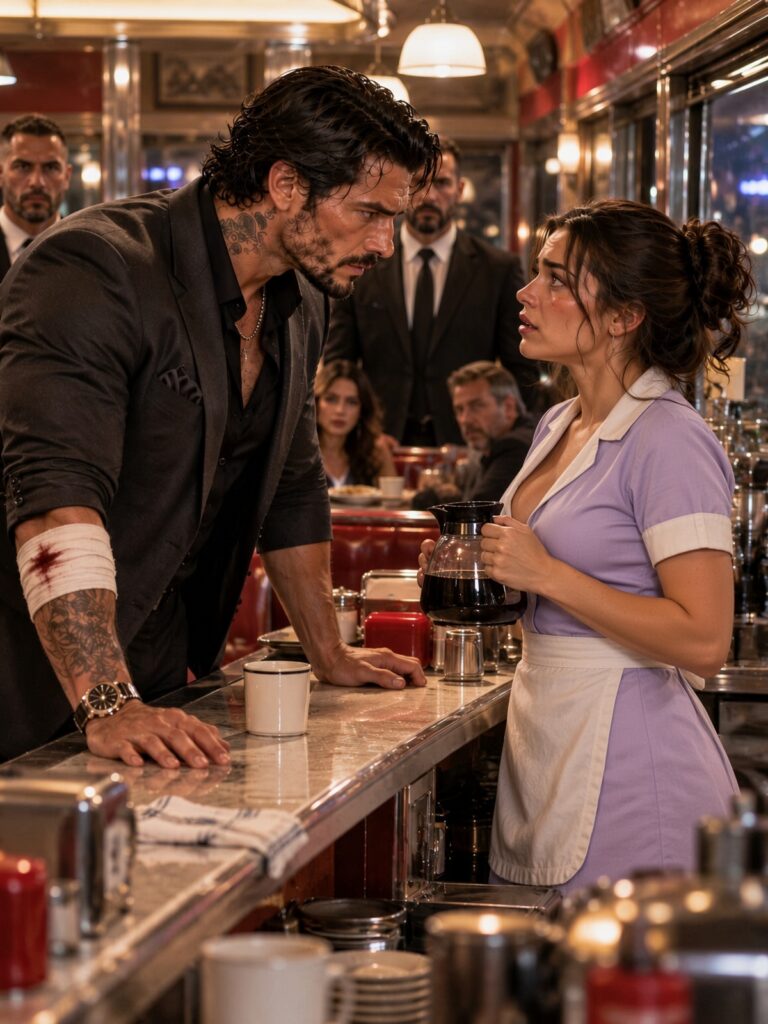
Most people froze when they looked down the barrel of a loaded gun.
They cried.
They begged.
Dora had discovered that after enough consecutive double shifts at a grease-stained diner off Interstate 95, while earning minimum wage and trying to keep her landlord from changing the locks, fear could eventually be replaced by something more dangerous.
Exhaustion.
That was why, when the city’s most brutal syndicate boss slammed his bloody fist onto her counter and shouted in her face, Dora did not flinch.
The clock above the pie case marked the kind of hour when the world seemed hollowed out, leaving only truckers, drunks, and people running from things they could not name.
Dora wiped booth 6 for the third time.
The rag smelled of industrial bleach and old lemon.
Her feet throbbed inside cheap non-slip shoes, the ache running steadily into her lower back.
Outside, relentless rain turned the neon sign of Rusty’s 24-Hour Diner into a bleeding red blur against wet asphalt.
Dora was calculating exactly how many more shifts she needed to cover the electric bill when the front door was thrown open.
The brass bell above it gave a violent chime.
Cold wind entered with the metallic scent of blood and the sharp chemical trace of gunpowder.
Three men walked inside.
The room changed instantly.
Two truckers sitting over coffee at the counter dropped cash beside their mugs and disappeared through the side exit without waiting for change.
Dora remained where she was.
She tightened her grip on the bleach rag.
The man standing in the center was the reason the room had gone still.
Leonardo Costas.
Everyone in the city knew his face, even those who pretended not to.
He looked like the sort of man who purchased politicians before breakfast.
His dark suit was tailored perfectly and soaked through at the shoulders.
Rain had slicked his dark hair back from his face.
Then Dora noticed his left arm.
It hung almost uselessly.
Blood had spread through the white shirt beneath his jacket until the fabric looked as though it belonged in a slaughterhouse.
The 2 men beside him were enormous, both wearing cheap leather jackets and watching the diner with hands tucked inside their coats.
Leonardo moved toward the counter.
His breathing was shallow but controlled.
He lowered himself onto a vinyl stool.
The seat creaked beneath him.
Then he looked at Dora.
His eyes were pale hazel and completely without warmth.
They were the eyes of someone constantly calculating the distance between himself and violence.
“Coffee.”
His voice sounded scraped raw.
“Black. And get the first-aid kit.”
Dora looked at him.
Then at the blood hitting the freshly mopped floor.
“We don’t have a trauma kit.”
He stared.
“This is a diner. I have off-brand Band-Aids and burn cream.”
Leonardo slammed his right hand onto the Formica counter.
The sugar dispensers rattled.
“I didn’t ask for an inventory.”
His voice hardened.
“Get the kit. Get me a towel. Pour the damn coffee before I decide you’re not worth the oxygen in this room.”
Silence followed.
One of the guards moved forward.
Dora stood still.
Seven years inside the same grease trap.
Seven years of low wages.
Seven years of being spoken to as though she should feel grateful simply for being allowed to work.
The overdue electric bill.
The aching feet.
The indignity.
Everything collected inside her into one hard point.
The filter between thought and speech disappeared.
Dora lifted the glass coffee pot from the burner.
Steam curled from the top.
She walked toward Leonardo.
She did not pour.
“Listen carefully.”
Her voice was quiet.
Steady.
“I make $7.25 an hour. I have been on my feet since noon.”
She glanced toward the floor.
“I just mopped that.”
Then back at him.
“If you shout at me again, I will pour this boiling coffee directly into your open wound and finish you before your gorillas can clear leather.”
Dora held the pot inches from his injured arm.
“Do we understand each other?”
The larger guard pulled a gun.
The click of the hammer sounded unnaturally loud.
Dora did not blink.
The barrel aimed between her eyes.
Her pulse hammered so hard it hurt.
Her hand did not move.
She realized with detached clarity that she might die beside a rotating case of stale cherry pies.
The guard stepped closer.
“Boss, say the word.”
Leonardo stared at Dora.
Pain remained in his expression.
Then disbelief displaced it.
His jaw tightened.
Blood continued hitting the floor.
Drop.
Drop.
Drop.
His gaze traveled over the dark circles beneath Dora’s eyes.
The frayed collar of her pink uniform.
The absolute absence of bluff.
Then Leonardo laughed.
It was a rough sound.
The movement hurt him immediately.
He winced and pressed a hand against his ribs.
Still, genuine amusement entered his eyes.
“Put it away, Dante.”
The guard hesitated.
“But boss—”
“I said put it away.”
The amusement vanished.
The authority underneath it made the room seem smaller.
Dante lowered the weapon.
He holstered it with visible reluctance.
Leonardo looked back at Dora.
He rested his head against the napkin dispenser and exhaled.
“You’ve got balls, waitress.”
“It’s Dora.”
She lowered the coffee pot.
“And it’s not bravery. I’m too tired to deal with an attitude.”
She turned her back.
Dante made a sound of outrage behind her.
Dora ignored him and walked into the office.
She returned with a roll of duct tape, several clean bar towels, and a dusty metal first-aid box that looked as though no one had opened it since 1998.
Leonardo was gripping the counter.
His knuckles had gone white.
The adrenaline was leaving him.
Blood loss was taking over.
Dora dropped the supplies in front of him.
“Jacket off.”
Leonardo lifted an eyebrow.
“Excuse me?”
“You’re bleeding on my floor. If I mop it again, I’m charging you.”
She pointed.
“Jacket. Off.”
Leonardo allowed his good arm to slide free.
Dante helped ease the ruined sleeve away from the injury.
It was not a bullet wound.
A knife had opened a long, deep gash along the bicep.
Dora poured black coffee into a thick ceramic mug and pushed it toward him.
Then she opened the first-aid box.
She ignored the useless bandages and pulled out a bottle of hydrogen peroxide.
“This is going to burn.”
Leonardo took a swallow of coffee.
“I’ve had worse.”
Dora poured the peroxide into the wound.
His body locked.
Breath hissed between his teeth.
His hand clamped the counter hard enough to make the Formica crack.
He did not cry out.
“Told you.”
Dora worked fast.
Her hands were unexpectedly gentle.
She pressed thick bar towels into the wound until the bleeding slowed.
Then she wrapped the arm with gauze and secured everything with 3 wide strips of silver duct tape.
It looked terrible.
It worked.
“You need stitches.”
She washed her hands.
“And probably a tetanus shot.”
She glanced toward the cabinet.
“That duct tape was stored beside rat poison.”
Leonardo examined the bandage.
Then he looked at her.
Under the harsh fluorescent lights, without the jacket and with blood loss draining the color from his face, he looked less like a feared syndicate boss and more like an exhausted man.
“Why didn’t you run?”
Dora dried her hands.
“I have 2 hours left on my shift.”
She threw the towel aside.
“If I close early, my boss docks my pay.”
Leonardo absorbed that.
Then he reached into his pocket.
He removed a silver money clip.
He peeled off several bills without counting and slid them beneath the coffee mug.
“For the floor.”
He stood.
His color had not returned, but the aura of absolute authority settled over him again.
Dante moved immediately.
He draped Leonardo’s ruined coat over his uninjured shoulder.
They reached the door.
Leonardo stopped with one hand on the handle.
“Make sure the coffee is fresh tomorrow night, Dora.”
Then he left.
The bell chimed behind him.
Dora stood alone in the diner.
She walked to the counter.
Under the mug were 5 $100 bills.
She stared at them.
Then at the streak of blood across the counter.
Dora sighed.
She picked up the bleach rag.
She did not sleep that day.
She lay in her cramped studio apartment listening to the radiator clang while a neighbor’s television leaked through the thin wall.
The 5 crisp bills sat on her nightstand.
They felt radioactive.
Mob money.
Blood money.
She considered throwing them away.
Donating them.
Then she saw the final utility notice on the counter.
Principles suddenly seemed expensive.
Dora folded the bills and pushed them into her cracked wallet.
When she returned for the graveyard shift that night, Rusty’s felt different.
The shadows seemed deeper.
Every passing set of headlights tightened something inside her.
She expected retaliation.
Men like Leonardo Costas did not usually tolerate waitresses threatening them with boiling coffee.
Maybe the cash was a joke.
Maybe a down payment on her funeral.
By 2:00 a.m., the diner was almost empty.
At 2:15, the bell chimed.
Dora stopped wiping the counter.
Leonardo walked in.
No blood this time.
He wore a dark charcoal overcoat tailored perfectly to his body.
His left arm remained stiff, evidence of the wound beneath.
Otherwise, he looked immaculate.
Dangerous.
Untouchable.
He was alone.
No Dante.
No guards.
He walked directly to the same stool where he had bled the previous night.
Dora swallowed.
“You’re back.”
Her voice contained less fire now.
“It was exhaustion talking.”
Leonardo looked toward the coffee machine.
“I told you to make sure the coffee was fresh.”
She poured him a mug.
Placed it in front of him.
Said nothing else.
Leonardo drank slowly.
“Dante wanted to burn this place down today.”
Dora stopped moving.
She looked at him.
“Is that why you’re here? To inform me my workplace is flammable?”
“No.”
Leonardo set the cup down.
“I told him that if he touched a single rusted panel on this building, I’d break both his legs.”
Dora leaned against the pie case.
“Why?”
“Because you didn’t flinch.”
His voice softened.
“In my world, everyone flinches.”
He leaned forward.
“They lie. Scheme. Kiss my ring and hope I don’t notice the knife behind their back.”
A small cynical breath escaped him.
“You told me you’d boil my skin because I was being an asshole.”
“You were.”
“I was bleeding out.”
“I was working a double shift.”
Dora crossed her arms.
“We all have problems.”
For 1 second, the old danger returned to the silence.
Then the corner of Leonardo’s mouth moved.
Almost a smile.
“I need a place.”
Dora waited.
“A place where no one asks questions.”
He glanced around the diner.
“A place my enemies would never consider because the coffee tastes like battery acid and the floor smells like industrial bleach.”
He looked at her again.
“I need a quiet corner for an hour every night.”
“This is a diner.”
Dora shook her head.
“Not a safe house.”
“I’ll pay for the stool.”
Leonardo paused.
“$500 a night.”
Dora stared at him.
Five hundred dollars every night.
More than she made in a week.
Rent.
Groceries.
A way out of the constant pressure tightening around her life.
It was also danger.
“If someone comes through that door looking to shoot you, I’m not catching a stray bullet for minimum wage.”
“If anyone comes looking for me, they won’t get past the parking lot.”
He held her gaze.
“You have my word.”
“A mobster’s word.”
Dora turned away and reached for the sugar dispensers.
“Forgive me if I don’t write that in my diary.”
She expected anger.
Instead, Leonardo dragged the mug slowly across the counter.
“I’m not a mobster.”
Dora glanced back.
“I’m a businessman operating in a market with insufficient regulation.”
Dora laughed.
“That’s a lot of syllables for someone who got stabbed in an alley.”
This time Leonardo did not smile.
Weariness entered his face.
“I’m drowning.”
The confession seemed intended more for the room than for Dora.
“My father left me a syndicate tearing itself apart from inside.”
He rubbed his face.
“I haven’t slept more than 3 hours a night in 6 months.”
He looked toward the dark windows.
“I need somewhere people don’t expect anything from me.”
Dora studied him.
He was still a violent man.
Still dangerous.
Still responsible for a world she did not understand.
But he also looked like someone trapped inside machinery larger than himself.
The difference was that his machinery killed people.
Dora unscrewed the sugar dispenser.
“The coffee is $2.”
She began filling it.
“Cherry pie is $3.50.”
Leonardo watched her.
“If you leave a mess, you’re out.”
A pause.
“And if you ever shout at me again, the coffee threat still applies.”
The tension left his shoulders slowly.
“Understood.”
That became their arrangement.
A contract formed over cheap linoleum and bitter coffee.
Dora did not know that allowing Leonardo Costas to buy 1 stool every night would make her the only place in the city where the most dangerous man alive could stop pretending he was invulnerable.
November became December.
Cold rattled the diner’s single-pane windows.
The graveyard shift acquired a predictable rhythm.
Drunks near midnight.
Long-haul truckers around 1:00.
The crushing emptiness after 2:00.
And at 2:15, Leonardo.
He never missed.
Sometimes he stayed 20 minutes.
Sometimes until dawn began turning the sky purple.
If he needed space for paperwork, he took booth 6.
Manila folders.
Columns of numbers.
Property deeds.
If he wanted silence, he sat at the counter and stared at the rotating pie case.
Dora kept the coffee hot.
Leonardo left $500 under his mug.
At first, she stored the money in a rusted can beneath the sink.
She was certain he would eventually ask for it back.
Or the police would break down her apartment door.
Then her landlord threatened eviction.
Dora used 5 of the bills.
The next week, she bought winter boots that did not leak.
Then a functioning radiator.
She was being supported by organized crime.
What disturbed her most was how quickly the relief became normal.
Poverty was a constant alarm.
Leonardo had reached over and silenced it.
For the first 3 weeks, they barely spoke.
The silence between them was not uncomfortable.
It was the structure holding the arrangement together.
Leonardo came specifically because Dora demanded nothing.
Dora had no desire to ask questions.
Still, proximity created knowledge.
She noticed he favored his left side after the knife wound.
He never sat with his back to the entrance.
His jaw tightened whenever his phone buzzed against the counter.
Sometimes he stared at the caller ID for a long time before sending it to voicemail.
Leonardo noticed Dora too.
One Thursday morning near 4:00, a regular named Hayes was still sitting in booth 3.
He was heavyset, smelled of stale beer and cheap cigars, and had been unpleasant for most of the night.
Dora placed his check on the table.
“I didn’t ask for this.”
Hayes knocked the slip to the floor.
“I want coffee.”
“The machine is off for cleaning.”
Dora bent to pick up the check.
“It’s 4:00. Go home.”
Hayes grabbed her wrist.
Hard.
His thumb dug against her pulse.
“I said I want coffee, sweetheart.”
His face moved closer.
“Don’t give me attitude. You need my tips.”
Dora’s anger rose instantly.
She began pulling away.
Before she could move, a shadow covered the booth.
Leonardo stood behind Hayes.
No sound.
No warning.
His expression contained no obvious anger.
That made him more frightening.
He reached down and wrapped one hand around Hayes’s wrist.
Then applied pressure.
Hayes’s face lost color.
A strangled sound escaped him as the bones compressed.
“Let go of the waitress.”
Leonardo’s voice was almost gentle.
Like soil hitting a coffin.
Hayes released Dora.
Leonardo kept holding him.
“Stand.”
Hayes obeyed.
“Walk to the door.”
He started moving.
“If you ever touch her again, Dante will find where you sleep.”
Leonardo’s tone never changed.
“And you will not wake up.”
He looked directly at Hayes.
“Nod if you understand.”
Hayes nodded frantically.
Leonardo released him.
Hayes stumbled from the diner.
Only after the door shut did Leonardo turn toward Dora.
Red marks were forming around her wrist.
“You didn’t need to do that.”
Dora rubbed the skin.
“I had it.”
“I know.”
Leonardo looked at the marks again.
“But you shouldn’t have to.”
He returned to his stool.
Dora watched him.
Something changed that night.
He was no longer merely a criminal purchasing silence.
He was paying attention.
And despite every warning inside her, so was she.
By January, Rusty’s felt less like a workplace and more like a protected pocket outside the rest of the city.
Their routine became specific.
Leonardo sat.
Waited 3 minutes to shed his coat and check his phone.
Dora poured the coffee.
He began bringing small things.
An expensive box of Earl Grey because he noticed she hated the diner tea.
A space heater placed without comment beside the draft near the register.
He did not present them as gifts.
He simply left them there.
Dora began anticipating the doorbell at 2:15.
She hated herself for it.
She understood exactly how absurd the attachment was.
You did not grow fond of syndicate bosses.
You did not look forward to the company of a man whose business depended on extortion and violence.
But the man sitting at her counter was no longer merely a newspaper photograph.
He was Leonardo.
He developed migraines.
Preferred cherry pie to apple.
Listened when she complained about the broken jukebox.
Then the illusion collapsed.
It happened on a Tuesday at 3:02 a.m.
Leonardo was late.
Snow buried the streets beneath a thick white silence.
Dora cleaned the milkshake machine while checking the clock almost constantly.
At 3:10, headlights crossed the windows.
Not Leonardo’s sedan.
A battered SUV with dark tinted windows climbed the curb and stopped roughly in the snow.
Two men entered.
They lacked Leonardo’s polished restraint.
Leather jackets.
Heavy boots.
Scarred faces.
They brought violence openly.
Dora tossed the rag onto the counter.
“We’re closed.”
The taller man had a scar through his left eyebrow.
He smiled.
“The sign says 24 hours.”
“The sign lies.”
Dora pointed toward the door.
“Leave.”
The second man approached.
“We’re not here for food.”
He looked around.
“We heard a certain somebody spends a lot of time here.”
Dora’s stomach dropped.
“We’re looking for Leonardo Costas.”
She forced her expression flat.
“Never heard of him.”
Her hand moved toward the telephone.
“Coffee to go or get out before I call the police.”
The scarred man laughed.
He leaned over the counter.
“Kostas likes them feisty?”
The other man looked around.
“Our boss wants to talk to him.”
He moved nearer.
“We thought we’d wait.”
Then his hand shot out.
He grabbed the front of Dora’s uniform.
“And if he doesn’t show, maybe we take something to make sure he gets the message.”
Dora did not panic.
She reached beneath the counter.
Her fingers closed around the heavy iron handle of the ice mallet.
“Let go.”
The man smiled.
“Or what?”
The door did not chime.
It exploded inward.
Glass cracked through the frame.
Cold wind rushed into the diner.
Leonardo came through it.
He looked nothing like the weary man who ate pie and drank black coffee at 2:15 every morning.
His overcoat hung open.
Snow covered his shoulders.
His hazel eyes had gone black with rage.
He did not speak.
He moved.
The scarred man turned and reached beneath his jacket.
Leonardo crossed the diner before the gun appeared.
He caught him by the back of the neck and drove his face directly into the glass pie case.
The display shattered.
Glass sprayed across the floor.
The second man drew a revolver.
Before he could raise it, Dante appeared in the broken doorway.
A suppressed gunshot snapped through the room.
The man’s knee exploded.
He collapsed screaming.
His weapon slid beneath a stool.
The first attacker tried to rise from the shattered pie display.
Leonardo dragged him backward.
He threw him across the counter.
The man crashed into the grill station and knocked over a container of old fryer grease.
Leonardo followed.
He drew a black handgun.
Pressed it to the man’s forehead.
“Who sent you?”
There was nothing human in the voice.
The wounded man spat blood.
“Screw you, Costas.”
Leonardo shifted the weapon approximately 2 in lower.
He fired.
The bullet tore through the man’s shoulder.
The scream filled the kitchen.
Leonardo placed the gun against his head again.
“I will not ask twice.”
The attacker broke.
“Carmine.”
His voice became a sob.
“It was Carmine.”
He clutched the wound.
“He said you were slipping.”
Leonardo remained still.
“Said you were hiding in a diner like a coward.”
Then Leonardo looked toward Dora.
She stood against the wall beside the kitchen door.
Her hands shook.
The ice mallet was gone.
She was staring at the blood.
The ruined case.
Then the gun.
For the first time since meeting her, Leonardo looked afraid.
Not for himself.
Because Dora was afraid of him.
He lowered the weapon.
“Dante.”
His voice sounded breathless.
“Get this trash out.”
Dante removed the men within 4 minutes.
Four minutes of silence.
Wind blew through the destroyed entrance.
Red neon flickered over the blood.
Broken pie.
Glass.
Dora picked up a broom.
Her mind had stopped processing anything except the immediate physical mess.
She began sweeping.
Scrape.
Scrape.
Scrape.
“Dora.”
Leonardo stood across the counter.
His white shirt carried tiny dark bloodstains.
His hands trembled.
“Stop.”
Dora swept harder.
“I have to clean before the manager gets here.”
Her voice sounded mechanical.
“The pie case is ruined.”
Scrape.
“He’ll take it from my paycheck.”
“Dora, put the broom down.”
“Blood stains the wax.”
She kept speaking.
“Bleach isn’t enough. I need ammonia.”
Leonardo moved behind the counter.
He reached for the broom handle.
Very gently.
Dora flinched.
Barely.
Still, Leonardo reacted as though she had hit him.
He released the broom immediately.
Stepped back.
Raised both hands.
“I’m sorry.”
The gravel disappeared from his voice.
“I promised you.”
Dora looked up.
“I gave you my word they would never cross the parking lot.”
His jaw tightened.
“I failed.”
The numbness inside Dora began to break.
“They were going to hurt me.”
“I know.”
Leonardo dragged one hand through his hair.
“Carmine tracked one of my cars.”
He breathed unevenly.
“I didn’t find the tracker until we were 3 blocks away.”
His eyes closed briefly.
“When I saw that SUV outside—”
He stopped.
“When I saw his hand on you—”
He could not finish.
“This was a mistake.”
Dora stared.
“Coming here.”
Leonardo looked around the ruined diner.
“Dragging my world into yours.”
He removed a thick bundle of cash from his coat.
Thousands of dollars.
He set it beside the register.
“This covers everything.”
The glass.
Door.
Floor.
“Enough remains to pay your rent for a year.”
Dora said nothing.
“Quit tomorrow.”
His voice became harder because he needed the order to disguise what he felt.
“Move somewhere safer.”
He looked at her.
“I’ll dismantle Carmine’s people by morning.”
Then the part that mattered.
“You’ll never see me again.”
Leonardo turned.
It should have been what Dora wanted.
Money.
Safety.
The danger walking away.
She watched him step over broken glass.
“Leonardo.”
He stopped.
His hand rested on the broken doorframe.
“Did you think I was stupid?”
He did not move.
“Did you think I didn’t know who you were when you bled on my floor 3 months ago?”
Leonardo looked back slightly.
“Did you think I didn’t understand this was dangerous?”
Dora dropped the broom.
It struck the cabinet.
She walked toward him.
“I’m not some fragile civilian you get to pay off and send away.”
Her voice grew stronger.
“I chose to pour your coffee.”
She stepped closer.
“I chose to take your money.”
Another step.
“I chose to let you sit at that stool.”
She stood inches from him.
“You don’t get to make my choices because you feel guilty.”
Leonardo turned fully.
He towered over her.
“They touched you because of me.”
His voice was raw.
“If I had been 2 minutes later—”
“But you weren’t.”
“I am toxic.”
Leonardo stepped nearer.
Dora could smell gunpowder, cold air, and blood.
“Everything I touch rots.”
He looked around.
“I came here because this diner was the only clean thing in my life.”
His eyes returned to hers.
“You were the only real thing.”
The words were almost painful.
“And I painted it in blood.”
He swallowed.
“Don’t ask me to stay.”
Dora waited.
“Because if you ask me to stay, I won’t have the strength to leave again.”
She reached up.
Her fingers touched his jaw.
Leonardo inhaled sharply.
His eyes closed.
For 1 moment, he leaned into her palm like a man starved for tenderness.
“I have bleach.”
Dora’s thumb moved over his cheek.
“We can clean the floor.”
She looked directly at him.
“I’m not afraid of you, Leonardo.”
His eyes opened.
Nothing remained guarded.
He moved toward her.
His hands entered her hair.
Then he kissed her.
Not gently.
Desperately.
Cold night air.
Adrenaline.
Inevitability.
Dora grabbed the front of his coat and pulled him closer.
The red neon flickered across the destruction behind them.
When they separated, Leonardo rested his forehead against hers.
Neither stepped away.
Then distant sirens appeared in the night.
Reality returned immediately.
“We have to go.”
Leonardo’s voice changed.
The vulnerable man disappeared behind calculation.
“I can’t leave.”
Dora gestured toward the diner.
“The police.”
“They’ll find broken glass and blood.”
Leonardo took her coat from a peg.
“If you stay, you answer questions.”
He wrapped it around her shoulders.
“You explain why Carmine’s men were bleeding on your floor.”
He tightened the collar.
“Your name enters a police report.”
His eyes hardened.
“Then Carmine learns exactly who you are.”
The logic ended the argument.
Dora looked at the blood speckling her uniform.
Then toward the money Leonardo had left earlier.
She shoved the $500 into her pocket.
“Fine.”
They left as red and blue lights appeared at the far end of the avenue.
Dante waited in a black sedan.
The rear door stood open.
Dora climbed inside.
Leonardo joined her.
The door closed.
Sound disappeared inside the expensive cabin.
“Penthouse?”
Dante looked through the mirror.
His eyes moved briefly toward Dora without surprise.
“No.”
Leonardo pulled out a burner phone.
“Penthouse is compromised if Carmine tracked the fleet.”
He looked forward.
“Shipyard office.”
Then into the phone.
“Call the sweepers.”
Dante nodded.
“Already done.”
The city passed outside in orange lights and gray slush.
Dora stared at her hands.
She was still holding the bleach rag.
She had walked away from the only life she knew.
It was miserable.
It was exhausting.
It was hers.
Now she was in a soundproof sedan beside a man organizing a criminal war.
Leonardo ended a message.
He looked at her.
Then gently removed the rag from her grip.
He dropped it to the floor.
He took her hand instead.
The warmth grounded her.
“You’re terrified.”
“I just abandoned my job.”
Dora looked forward.
“Possibly became an accessory after the fact.”
She swallowed.
“And I’m in a car that smells like gunpowder and expensive cologne.”
The corner of Leonardo’s mouth moved.
“If I wasn’t terrified, you should be concerned.”
“The shipyard is secure.”
His expression hardened.
“You’ll stay there while I deal with Carmine.”
Dora turned.
“Deal with him how?”
Whatever warmth remained disappeared.
“He sent men to touch what is mine.”
Leonardo’s voice became cold.
“He broke the rules.”
A pause.
“By sunrise, Carmine’s operation will no longer exist.”
Dora did not ask further.
Twenty minutes later, they entered an industrial lot filled with shipping containers.
Armed men patrolled in heavy coats.
The office building looked ordinary.
Cheap desks.
Fluorescent lights.
Filing cabinets.
Leonardo led Dora to a private room containing a leather couch, mahogany desk, and a wall of surveillance monitors.
“Stay here.”
He pointed toward the door.
“Lock it.”
He continued.
“Dante is outside.”
Then the desk.
“There’s a pistol in the top-right drawer.”
Dora stared.
“Safety is on the left side.”
He demonstrated with his thumb.
“Down. Point. Fire.”
Dora looked at him.
He was reloading his own weapon.
“Don’t do anything stupid.”
Leonardo paused.
He crossed back to her.
Placed one hand behind her neck.
Kissed her hard.
“I’ll bring the coffee tomorrow.”
Then he left.
The door shut.
The lock engaged.
Dora stood alone with the hum of electronics.
She opened the drawer.
A black pistol rested on top of invoices.
She did not touch it.
Instead, she walked toward the monitors.
And watched.
Part 2
Three hours passed.
The security monitor showed 6:45 a.m.
Morning was beginning to stain the industrial horizon purple.
Dora had spent the time pacing.
She inspected the entire office.
Brewed terrible coffee in a corner machine.
Watched the cameras until her eyes burned.
Most feeds showed nothing.
Empty docks.
Silent streets.
The shipyard perimeter.
Then the burner phone on the desk vibrated.
Dora jumped.
Leonardo had left it behind.
One scrambled number appeared.
She answered.
Said nothing.
“Leonardo.”
The voice was breathless.
Wind tore through the connection.
Dante.
Dora went cold.
Dante was supposed to be outside.
“It’s Dora.”
Silence.
Then urgency.
“Dora, listen to me.”
Gunfire cracked behind his voice.
“Carmine didn’t hide.”
Dante gasped.
“He pushed.”
More noise.
“He brought everyone.”
Dora stood.
“We walked into a meat grinder at the Southside warehouse.”
Her throat tightened.
“Where’s Leonardo?”
“He’s hit.”
Another burst of gunfire.
“Leg and shoulder.”
Dante coughed.
“We’re pinned behind the loading bays.”
The panic tried to consume her.
Dora forced it down.
Survival through 7 years of poverty had taught her compartmentalization.
One problem.
Then the next.
“Exact location.”
“Southside. Bay 4.”
Dora looked at the wall.
Several feeds were labeled Southside Transit.
She grabbed the mouse.
Expanded the images.
A large concrete warehouse appeared.
SUVs blocked multiple exits.
Armed men moved through rain.
“I can see you.”
Dante went silent.
“I have the camera feed.”
Dora studied the lot.
“Can you see Carmine?”
She searched for the man who did not carry a rifle.
The one watching.
Directing.
Camera 4.
A black SUV near the fence.
A man in a camel-hair coat stood behind the open door smoking.
“There.”
Dora leaned toward the screen.
“Black SUV by the chain-link fence.”
She described him.
“That’s Carmine.”
Dante’s breathing was ragged.
“He’s waiting for them to flush us out.”
Dora studied the geography.
She approached the problem the way she handled a packed diner.
Watch movement.
Find the bottleneck.
Anticipate what comes next.
“Five men are sweeping your left side.”
She traced them.
“Moving toward bay 4.”
Her eyes moved.
“The right side is clear.”
“Drainage trench.”
Dante knew it.
“If we break right, we lose cover.”
“Not if Carmine is dead.”
The sentence left Dora’s mouth before she had time to understand it.
Silence.
“I don’t have an angle.”
Dora stared at the map of the lot.
“You don’t need one.”
She looked around the perimeter.
“You need them looking somewhere else.”
She found a utility structure.
“Is there a transformer? Generator?”
“Transformer box 50 yards north.”
“If I hit it, we lose power.”
“Do it.”
Dora’s voice had become completely calm.
“When the lights go, Leonardo moves right toward the drainage trench.”
She watched the men approaching the left flank.
“You cover left.”
Then she remembered the shipyard.
“I’ll send every available car from here.”
“Dora—”
“Do it, Dante.”
She dropped the phone.
Then she ran.
Out of the office.
Through the hallway.
Outside.
The yard captain turned toward her.
“Southside warehouse, bay 4.”
She shouted.
“Leonardo is hit.”
The man froze.
“Get every available car there now.”
He did not question her.
He looked at her face and immediately reached for his radio.
The shipyard erupted into motion.
Dora ran back to the office.
Locked the door.
Dropped into the chair.
Watched.
Then the transformer exploded in blue sparks.
The camera feeds died for less than a second.
Night vision engaged.
The screens turned green.
The floodlights were gone.
A figure broke from bay 4.
Leonardo.
He limped heavily.
Still moved terrifyingly fast.
He did not run away.
He moved parallel to the drainage trench.
Toward the fence.
Carmine’s men fired toward the transformer.
Leonardo reached the fence.
Raised his weapon.
The angle was poor.
Dora saw 3 quick muzzle flashes.
Near the SUV, the man in the camel-hair coat collapsed.
The structure of the attack disintegrated.
Men began retreating.
Vehicles turned.
Then black cars from the shipyard arrived.
They surrounded the lot.
Dora released the breath she had been holding.
Her hands shook uncontrollably.
She pressed them against the desk.
She had just helped kill a man.
She watched Dante drag Leonardo toward one of the extraction vehicles.
Nausea moved through her.
Numbness followed.
Then something worse.
She did not regret it.
Seventy-two hours later, Dora sat inside a private hospital wing that smelled of rubbing alcohol, expensive linen, and fresh orchids.
Outside, snow fell over the city.
The last 3 days had been surgery, silence, dangerous men in tailored suits, and the rapid restructuring of the city’s underground.
Carmine was dead.
His faction collapsed immediately.
The remaining groups surrendered rather than challenge Leonardo after seeing what happened at the warehouse.
Leonardo’s control became absolute.
Dora had barely slept.
She wore a gray cashmere sweater Dante had brought the previous day.
He had also left a secure phone and keys to an apartment she had not seen.
The fabric felt alien against her skin.
Too soft.
Too expensive.
She had spent years in cheap polyester uniforms.
The door to the private suite opened.
A nurse in dark scrubs gave Dora a polite but visibly frightened nod and moved quickly down the corridor.
Dora stood.
Exhaustion remained in her body.
The anxiety finally loosened slightly.
She entered.
Leonardo sat propped in the hospital bed.
His left shoulder was heavily wrapped and immobilized.
His right leg rested elevated inside a cast from ankle to thigh.
Bruises marked his face.
Medication had hollowed him out.
Still, his eyes were clear.
Something in them had changed.
The constant paranoia.
The constant calculation.
It had quieted.
Dora moved toward the kitchenette.
She ignored the expensive tea selection.
Instead, she took out a thick ceramic mug from the basement cafeteria.
“The coffee here is basically brown water.”
Her voice was rough from lack of sleep.
“So I bribed an orderly $20 to let me use the industrial machine near the morgue.”
Leonardo looked toward her.
“Black.”
She carried it over.
“It’s been burning for 4 hours.”
She placed the mug beside him.
“It may dissolve your stomach.”
Leonardo did not look at the coffee.
He extended his good hand.
Waiting.
Dora placed her hand inside it.
His grip was warm.
Stronger than expected.
“Dante told me.”
Dora looked at him.
“What?”
“What you did.”
Leonardo’s thumb moved over her knuckles.
“He said you spotted the flank.”
He continued.
“Ordered the transformer hit.”
Dora looked away.
“Coordinated the extraction.”
She stared toward the orchids.
“I watched a screen.”
“You saved my life.”
Leonardo’s voice remained steady.
“And Dante’s.”
Dora shook her head.
“You were the ones getting shot.”
“Carmine had us boxed in.”
He tightened his hand around hers.
“Ten more seconds and we were dead.”
Dora forced herself to look back.
“I protected my investment.”
A cynical smile appeared.
“You owe me $500 every night for the rest of your life.”
She tried to make her voice lighter.
“I wasn’t going to let Carmine default on my pension.”
Leonardo laughed.
The movement hurt.
He winced.
Then settled back.
“The diner is gone.”
Dora blinked.
“What?”
“The diner.”
“What do you mean gone?”
She frowned.
“The window was broken. Not the foundation.”
“I bought the building.”
Dora stared.
“And the lot beside it.”
Leonardo continued as though this were ordinary.
“Dante’s crew gutted the interior yesterday.”
Dora’s mouth opened.
“Down to the studs.”
He looked almost amused.
“The manager received a very generous severance package and strong encouragement to retire somewhere warm.”
Dora stared at him in disbelief.
“You demolished my workplace.”
“It was unsafe.”
Leonardo lifted an eyebrow.
“The duct tape was stored beside rat poison.”
“That was 1 shelf.”
“The foundation was rotting.”
Dora crossed her arms.
“So what exactly am I supposed to do?”
Her voice sharpened.
“Move into a penthouse?”
She gestured toward the room.
“Become a kept woman?”
Leonardo’s expression changed.
“Attend charity galas with mob wives and pretend I don’t know where your money comes from?”
“No.”
The answer came instantly.
He tried to sit higher despite the pain.
“You’re designing the new restaurant.”
Dora stopped.
“From the ground up.”
He spoke with intensity.
“You choose the floor.”
“The espresso machines.”
“The staff.”
“The wages.”
Dora stared.
“You own it.”
Leonardo’s voice became quieter.
“Clean title.”
She said nothing.
“The deed is already in your name.”
He reached out.
Caught her wrist gently.
“No laundering.”
His eyes locked onto hers.
“No meetings in a back room.”
A pause.
“No blood on the floor.”
Dora searched his face.
She expected conditions.
Debt.
Strings.
A hidden trap.
There was nothing.
This was not payment for silence.
It was control.
Something she had never possessed over her own working life.
The armor she carried began to crack.
She looked down.
“And where are you going to get coffee at 3:00 in the morning when you’re losing your mind over your empire?”
Leonardo’s mouth softened.
“I’ll have to rely on the owner to make it at home.”
Dora looked at him.
A ruthless man.
Bruised.
Broken.
Watching her as though she were the only honest thing remaining inside a city built on lies.
She thought about the path that had brought them here.
Cheap coffee.
Blood on tile.
$500 beneath a mug.
The attack.
The kiss.
A warehouse.
A transformer.
A man dying because Dora helped make it possible.
She had crossed a line.
There was no returning completely to the person she had been.
Then she admitted another truth.
She did not want to return.
Dora leaned forward.
She placed one hand gently along Leonardo’s jaw.
Then kissed him.
Slowly this time.
Deliberately.
Without fear.
When she pulled back, she remained near his mouth.
“If you ever shout at my staff.”
Leonardo’s eyes closed.
Dora’s voice stayed firm.
“I will still pour boiling coffee on you.”
A smile crossed his face.
“I would expect nothing less.”
Outside, the city remained cold and violent.
Inside the private hospital room, they had created something unlikely.
A place neither fully understood yet.
Something built from exhaustion, danger, and the strange honesty of 2 people who had first met when both were too tired to pretend.
Part 3
The hospital room became the first quiet place Dora and Leonardo had shared without a diner counter separating them.
There was no pie display.
No Formica.
No humming refrigerators.
Only white sheets, medical monitors, the smell of antiseptic, and the knowledge that neither of them could return unchanged to what existed before.
Leonardo’s injuries forced stillness upon him.
His shoulder would require weeks of recovery.
His leg even longer.
For a man accustomed to controlling every room through presence alone, immobility was a humiliation.
Dora recognized the frustration almost immediately.
It appeared in small things.
The tightening in his jaw when a nurse adjusted the bed.
The irritation when Dante entered carrying reports he could not physically go inspect himself.
The way his hand closed around the hospital rail whenever someone told him to rest.
Dora refused to indulge any of it.
“If you rip the stitches, I’m not duct-taping you again.”
Leonardo looked toward her.
“That worked.”
“It looked like construction work.”
“It stopped the bleeding.”
“It was a bar towel.”
“You saved my arm.”
Dora crossed her arms.
“Barely.”
That became their rhythm too.
She did not treat him as a ruler.
She did not flatter him.
She did not pretend his world was clean simply because he offered her something beautiful.
And Leonardo, despite having built his life around command, found that Dora’s refusal to obey him without question was one of the few things capable of calming him.
The restaurant project began before he left the hospital.
Blueprints arrived.
Contractors.
Architects.
Samples of flooring.
Dora rejected most of the first proposals.
Too expensive.
Too glossy.
Too obviously designed by people who had never spent a graveyard shift serving coffee to exhausted truckers.
She wanted warmth.
Durability.
Good light at 3:00 a.m.
A counter that could survive decades.
Booths large enough for families.
A kitchen employees could work in without burning themselves on badly positioned equipment.
Proper ventilation.
Storage that did not put cleaning chemicals beside food supplies.
Leonardo noticed every practical detail.
“You’ve been thinking about this for years.”
Dora looked over a floor plan.
“I’ve been thinking about what Rusty’s did wrong for 7 years.”
The new place would still operate late.
Not because Leonardo needed a secret refuge.
Because Dora understood people who lived at night.
Nurses leaving hospitals.
Truckers between routes.
Factory workers.
People with nowhere else to sit.
She set wages higher than anyone expected.
Paid sick leave.
Meals during shifts.
Predictable scheduling.
Leonardo did not interfere.
He signed what required signature and stayed out of the rest.
Dora noticed.
“You’re actually going to let me run it?”
“It’s yours.”
“You say that now.”
Leonardo’s eyes narrowed slightly.
“You think I’ll interfere.”
“I think control is practically your religion.”
A pause.
Then Leonardo nodded.
“Fair.”
Dora looked at him.
The admission surprised her more than denial would have.
He had begun changing in small ways too.
Not into a different man.
The violence did not disappear from his world because Dora existed.
Nor did the history behind his power vanish.
But the diner had given Leonardo 1 place where domination had no value.
Dora carried that rule into everything between them.
If he raised his voice, she ended the conversation.
If he tried to make a decision for her safety without asking, she resisted.
If his men treated restaurant staff with intimidation, she sent them outside.
Dante tested that once.
He walked into the half-finished restaurant while contractors were working and ordered 2 carpenters to clear a path for him.
Dora looked up from a box of tile samples.
“Out.”
Dante stopped.
“Excuse me?”
“You heard me.”
He looked around as though expecting someone to laugh.
No one did.
“This is a construction site.”
Dora pointed toward the entrance.
“You don’t bark orders at my staff. Go back outside and try again like a person.”
Dante stared.
Then toward Leonardo, who sat nearby with a cane while inspecting permits.
Leonardo did not rescue him.
Instead, he lifted his coffee.
“She warned you.”
Dante left.
Two minutes later, he came back in.
This time he asked whether the workers could give him space to move through.
Dora nodded.
“See?”
She returned to the tiles.
“Growth.”
Leonardo nearly smiled.
The restaurant eventually opened under Dora’s name.
Not Costas.
Not some syndicate front.
Hers.
The building had been rebuilt completely.
Hardwood floors.
Warm lights.
A long polished counter.
A real commercial coffee system that Dora chose herself.
No rotating display of stale pie.
Still, she kept cherry pie on the menu.
Leonardo noticed on opening night.
“You hate cherry pie.”
“I hate stale cherry pie.”
He looked at the fresh slice in front of him.
“You remembered.”
“I remember everything customers make annoying.”
He sat in the same position he had preferred at Rusty’s.
Back to the wall.
View of the entrance.
Dora saw it.
She did not comment.
Some habits existed for reasons deeper than preference.
The first night after closing, Leonardo stayed.
Not as a customer.
Not as a syndicate boss buying anonymity.
He sat at the counter while Dora counted receipts.
No guards inside.
Dante waited outside.
The room smelled of coffee, wood, and fresh paint.
Dora finished balancing the register.
She looked up.
Leonardo had fallen asleep sitting upright.
His head leaned slightly against the wall.
The sight stopped her.
In all the months she had known him, she had never seen him sleep without medication.
Never seen the muscles of his face completely relaxed.
Dora moved quietly.
She took a folded jacket from the office and placed it around his shoulders.
Leonardo woke instantly.
His hand moved automatically toward where a weapon normally rested.
Then he saw her.
The tension left.
“You were asleep.”
“No.”
Dora lifted an eyebrow.
“You were snoring.”
“I do not snore.”
“You sounded like a damaged refrigerator.”
Leonardo looked offended.
Dora smiled.
He watched her.
The expression on his face changed.
Not amusement.
Something steadier.
“Stay with me tonight.”
Dora did not answer immediately.
Leonardo’s gaze dropped.
Not an order.
Not possession.
A request.
She walked around the counter.
“Only if you make the coffee tomorrow.”
His mouth moved.
“Deal.”
Life around them did not become safe.
Leonardo’s world remained dangerous.
The conflict with Carmine had consolidated his position but also made his name heavier.
More feared.
More absolute.
Dora understood that loving him did not transform organized crime into something harmless.
She did not romanticize the guns.
The guarded cars.
The encrypted phones.
The way some men became pale when Leonardo entered a room.
She had seen exactly what he could do.
She had helped him do it once.
That knowledge remained.
So did the warehouse.
Sometimes Dora woke remembering the green night-vision screen.
The transformer exploding.
Leonardo moving through darkness.
Carmine collapsing.
She never told herself that what happened had been clean.
It had been survival.
Violent survival.
The line between necessity and choice remained something she examined privately.
Leonardo never asked her to pretend otherwise.
One night, several weeks after the restaurant opened, Dora found him alone at the counter.
No paperwork.
No coffee.
He was staring at his hands.
“What?”
He looked up.
“Nothing.”
“That answer doesn’t work on me.”
Leonardo exhaled.
“I keep thinking about the warehouse.”
Dora became still.
He continued.
“You were the only person who could see the whole board.”
His voice lowered.
“You gave the order.”
Dora nodded once.
“Yes.”
“You’ve never talked about it.”
“Neither have you.”
Leonardo looked back at his hands.
“I’ve given orders like that since I was 19.”
He paused.
“It never stayed with me.”
Dora said nothing.
“Yours stayed.”
He looked toward her.
“Because it was my fault you had to make it.”
Dora walked closer.
“No.”
Leonardo’s jaw tightened.
“You were in that room because of me.”
“I made the decision.”
“You shouldn’t have had to.”
“But I did.”
Dora leaned against the counter.
“I’m not proud of it.”
She thought about Carmine falling on the screen.
“But I’m not going to lie and say I regret keeping you alive.”
Leonardo watched her.
“That scares me.”
She admitted it.
“Not you.”
Her hands rested against the counter.
“Me.”
Leonardo understood.
Dora had entered his world believing violence belonged to people like him.
The warehouse taught her that under enough pressure, she too could calculate death.
She did not want that part of herself to become easy.
Leonardo reached across the counter.
He did not take her hand immediately.
He placed his palm beside it.
An invitation.
Dora covered his fingers with hers.
“Then we make sure it never becomes easy.”
His voice remained quiet.
That was one of the few promises she believed because it did not claim impossibility.
He could not promise violence would never return.
He could promise not to become numb to it.
Neither of them could erase what they were capable of.
They could decide what they became comfortable with.
Months passed.
The restaurant became profitable.
Not because of Leonardo.
Dora refused to let his men fill tables merely to make the books look good.
She built a real business.
Truckers returned.
Hospital staff discovered the late hours.
Night-shift police sometimes came in without knowing who owned the deed.
Students filled booths after midnight.
Dora hired people who reminded her of herself.
Overworked.
Underpaid elsewhere.
People who needed a chance.
She remembered every humiliating shift at Rusty’s and made rules accordingly.
No manager could dock pay because an employee left during an emergency.
No customer could touch staff.
No tip was worth enduring abuse.
Security cameras covered the entrances.
A silent alarm sat beneath the counter.
Leonardo wanted armed guards.
Dora refused.
“I’m opening a restaurant, not a bunker.”
“You’ve been attacked once.”
“So have several gas stations.”
“That argument is ridiculous.”
“So is placing Dante beside the pie case.”
They compromised.
Two discreet guards remained outside during late hours.
No weapons visible inside.
Dora considered it a victory.
Leonardo considered it a concession to reality.
Some nights he returned to the old routine.
2:15 a.m.
Same stool.
Black coffee.
Cherry pie.
No $500 beneath the mug anymore.
He tried once.
Dora found the bills.
She walked around the counter.
Stuffed them into his coat pocket.
“You’re dating the owner now.”
She said it flatly.
“You don’t get charged protection rent.”
Leonardo looked at her.
“Dating?”
“What would you call it?”
He considered.
“Strategic consolidation.”
Dora stared.
“You’re unbelievable.”
He smiled.
The restaurant gave Dora something she had not realized poverty had slowly taken.
Time.
She no longer worked consecutive doubles simply to avoid eviction.
Bills stopped controlling every thought.
She slept.
Bought groceries without calculating each item.
Replaced furniture in her apartment.
Then, eventually, stopped needing the apartment because she spent more nights with Leonardo than alone.
She refused to move into his penthouse immediately.
The first time he suggested it, she laughed.
“No.”
He looked genuinely confused.
“Why?”
“Because I just spent 7 years being trapped by money.”
She crossed her arms.
“I’m not moving into your palace until I know I can leave whenever I want.”
Leonardo absorbed the statement.
A year earlier, he might have interpreted it as insult.
Instead, he nodded.
“What do you need?”
“My own key.”
“You would have one.”
“Not permission.”
He waited.
“Legal access.”
Dora continued.
“My name on the residence documents.”
He stared.
“And a room that is mine.”
Leonardo nodded slowly.
“Anything else?”
Dora thought.
“Your people do not report where I go unless I ask for protection.”
That requirement hurt him.
She saw it.
His instinct demanded knowledge.
Location.
Security.
Control.
He still nodded.
“Agreed.”
Only then did Dora move in.
The penthouse never became ordinary to her.
The windows looked down on a city she once experienced from bus stops and diner windows.
Everything was expensive.
Quiet.
Designed for someone who expected attack.
Dora changed small things.
A chipped ceramic mug appeared among imported glassware.
Cheap grocery-store tea sat beside rare coffee.
One drawer in the kitchen became dedicated entirely to takeout menus.
The staff stopped looking startled when Dora entered wearing sweatpants.
Leonardo’s life altered around her presence.
Not completely.
But enough.
He slept more.
Sometimes 5 hours.
Occasionally 6.
When migraines came, Dora turned off the lights and left coffee outside the office without asking questions.
When she came home exhausted from the restaurant, Leonardo learned not to solve the problem with money.
Sometimes she wanted silence.
Sometimes food.
Sometimes only someone sitting nearby.
Their relationship remained uneven in obvious ways.
Leonardo possessed wealth, influence, and violence Dora could never equal.
Dora possessed something he feared more.
The ability to walk away.
He knew she would.
If he ever turned what they had into another form of control.
That knowledge kept him careful.
The old Dora would have laughed if anyone told her that exhaustion would lead here.
That threatening a bleeding crime boss with a coffee pot would eventually give her a restaurant, a new life, and a man powerful enough to terrify a city but disciplined enough to listen when she said no.
She would have assumed it was another lie people told poor women about luck.
But Dora did not think of what happened as luck.
Leonardo did not rescue her.
He gave her resources.
She decided what to build with them.
She did not save him from what he was.
She gave him somewhere he could put the armor down.
That difference mattered.
One winter night, almost a year after Leonardo first entered Rusty’s bleeding, Dora finished closing the restaurant.
Snow had started outside.
The late staff had gone home.
Dante waited somewhere across the street.
Leonardo sat at the counter.
Exactly where everything began.
Dora poured him coffee.
Black.
Fresh.
She placed it down.
Leonardo looked at the cup.
Then at her.
“You threatened to kill me the first night.”
“You deserved it.”
“I was wounded.”
“You were rude.”
He took a sip.
“That distinction remains important to you.”
“Very.”
Leonardo looked toward the door.
For once, no one waited outside it with a gun.
No rival SUV.
No blood.
Only snow moving across the glass.
Dora wiped the counter once.
Then tossed the rag aside.
Leonardo watched it.
“No bleach?”
Dora looked around the spotless room.
“Don’t need it tonight.”
He smiled.
Dora walked around the counter.
She sat on the stool beside him.
For several minutes, neither spoke.
The coffee machine hummed.
Snow thickened.
The city remained dangerous beyond the windows.
It probably always would.
Dora leaned her shoulder lightly against his.
Leonardo relaxed.
Neither of them had found safety in the ordinary sense.
They had found something else.
A place where neither had to pretend.
Where money did not buy obedience.
Where power did not erase boundaries.
Where a waitress could tell a syndicate boss to lower his voice.
Where a violent man could admit he was tired.
Where both of them understood exactly how dangerous the other could become and chose, deliberately, to remain.
The first thing Dora had ever given Leonardo was terrible coffee.
The first thing he gave her was $500 for a bloodstained floor.
Neither gift meant much on its own.
What came after was built from smaller things.
Routine.
Attention.
Trust.
Restraint.
The choice to return the next night.
And the next.
Leonardo lifted the mug.
The coffee was fresh.
Dora had made sure of that.


