
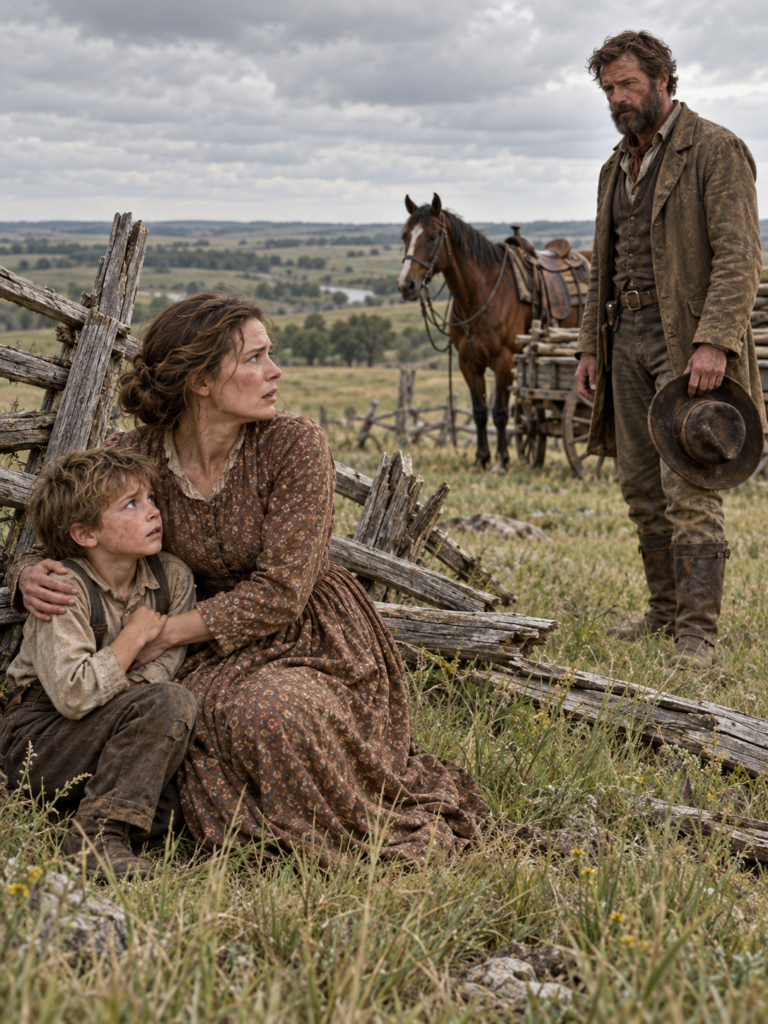
“I won’t promise what isn’t mine to decide,” Ezra said. “A court will hear this matter. But I’ll not hand you over simply because a man comes demanding it.”
Miriam’s grip loosened.
Toby studied the rancher.
“Will you help Mama?”
“If she’ll let me.”
Miriam looked away.
She had grown so accustomed to men making decisions about her family that the question nearly undid her.
“I need to fight this myself,” she said.
“Then we’ll find out what you need to do it.”
Ezra helped Toby settle on the wagon while Miriam climbed up beside him.
He rode alongside them as the afternoon light faded across the Kansas hills.
They traveled slowly.
Toby was exhausted, and Miriam had walked too far on too little food.
When they reached Ezra’s place, he showed them the room behind the barn.
It was modest but sound.
A narrow bed.
A cot.
A small stove.
A table.
A window looking over the yard.
Miriam examined the latch before stepping inside.
Ezra noticed.
“Locks from your side,” he said. “And nobody enters without knocking.”
She nodded.
“Thank you.”
He left them enough firewood for the night and showed her where to draw water.
Then he returned to his own house.
No questions.
No demands.
No expectation that gratitude entitled him to anything.
That night, Miriam sat beside Toby until he slept.
The boy’s hand remained curled around the edge of her sleeve.
Even in sleep, he seemed afraid she might disappear.
Miriam gently freed the cloth.
Then she covered her face.
For eight months she had been strong because she believed she had no other choice.
She had answered Thomas’s letters.
Found whatever work she could.
Kept Toby fed.
Defended her husband’s name.
And endured the humiliation of having a prosperous brother-in-law suggest that poverty made her unworthy of motherhood.
Now a stranger had given her a locked room and a warm stove.
And the kindness frightened her almost as much as the danger.
Because shelter was temporary.
The hearing was not.
By morning, Ezra had already returned to his work.
Miriam swept the room, repaired a loose seam in the wall covering, and set Toby to gathering kindling.
She refused to sit idle.
When Ezra came by, she asked whether there was mending that needed doing.
“There may be,” he said. “But you don’t owe me labor for the room.”
“I know. I’m asking whether anyone pays for it.”
He regarded her.
“Mrs. Pruitt has poor eyesight. She’s been complaining about her sewing for months.”
“I can sew.”
“I expect she’d be glad to pay someone who can.”
For the first time, Miriam’s expression held something beyond fear.
Possibility.
Within the week, Ezra learned that the guardianship hearing had been scheduled for June.
Garrett had retained a lawyer from Topeka.
The man had already begun gathering statements suggesting Miriam was unstable and unable to provide for Toby.
Worse, letters had circulated among local families describing her disappearance with the boy as proof of dangerous judgment.
Miriam listened while Ezra told her.
“That’s why the Ostranders turned us away,” she said. “They were frightened of Garrett’s trouble.”
Ezra sat opposite her at the small table.
“Then hiding won’t help anymore.”
Her face tightened.
“What would you have me do?”
“Let people see who you are.”
“They’ve already heard who Garrett says I am.”
“Then give them something better than his words.”
Miriam folded her hands.
“Such as?”
“Go to church. Take in mending. Let Toby attend school. Show this county the mother who’s been caring for him all along.”
“And if someone comes to take him?”
“Answer the summons. Don’t surrender your right to be heard.”
She stared at him.
“You make it sound simple.”
“It isn’t.”
“Then why do you sound so certain?”
“Because running hasn’t made you safer.”
That hurt.
Mostly because she knew it was true.
She rose and walked to the door.
Outside, Toby was gathering kindling beside the barn.
He looked up and waved.
Miriam waved back.
Then she turned toward Ezra.
“Sunday,” she said quietly. “I’ll take him to church on Sunday.”
Ezra nodded.
But as she reached for the door, she stopped.
“If Garrett’s lawyer asks why you offered us this room, what will you tell him?”
Ezra stood.
“The truth.”
“And what is that?”
He looked toward the repaired fence line beyond the pasture.
“That you needed somewhere safe to stand while you fought for your boy.”
Miriam opened the door.
Then she walked into the yard, took Toby’s hand, and began leading him toward the road that would take them back among the very people she had been hiding from.
Toby stumbled slightly as Miriam guided him toward the road.
She stopped at once.
“Are you tired?”
“No, Mama.”
“Then why are you dragging your feet?”
He looked down at his shoes.
“Will people stare at us in church?”
Miriam felt her courage falter.
She had been thinking about what Garrett’s lawyer might say.
What the congregation might whisper.
Whether someone would question her judgment in front of her child.
She had not considered that Toby was already imagining the same humiliation.
“Perhaps they will,” she admitted.
“Because of Papa?”
“Some may be curious about him.”
Toby considered this.
“Then I’ll tell them he didn’t steal those cows.”
Miriam knelt beside him.
“You don’t have to spend your childhood defending your father to every stranger.”
“But it’s true.”
“I know.”
She held his shoulders gently.
“And the truth doesn’t become less true because somebody refuses to believe it.”
He nodded, though she could see he was not entirely convinced.
They returned to the barn room.
On Sunday morning, Miriam dressed Toby in his cleanest shirt.
She wore the one decent dress she had managed to keep pressed through their journey.
Ezra had offered them a place in his wagon.
She accepted.
When they arrived at the little church in Larkspur Hollow, conversation slowed.
Heads turned.
Miriam heard the rustle of skirts and the scrape of boots as people shifted to look.
A woman near the door whispered something to her companion.
Miriam’s face burned.
For one desperate moment, she wanted to take Toby’s hand and retreat before anyone spoke.
Then she remembered what she had promised herself.
She had run once.
She would not keep running.
She entered the church.
Toby walked beside her.
Ezra remained a respectful distance behind.
He did not make a show of escorting them, nor did he allow his presence to suggest that Miriam required a man to speak for her.
She found a place on a bench.
Toby sat close.
When the congregation began singing, Miriam’s voice shook at first.
By the final verse, it had steadied.
After the service, Mrs. Pruitt approached.
She was a kindly, practical woman with tired eyes and flour on one cuff.
“Ezra tells me you know how to mend clothing.”
“I do, ma’am.”
“Would you be willing to take in some work?”
“Gladly.”
Mrs. Pruitt described several garments needing repair.
Miriam named a modest price.
The older woman accepted without argument.
It was the first honest employment Miriam had found since leaving Coils Crossing.
That evening, she sat beside the barn-room window with a shirt across her lap.
Toby worked through his letters at the table.
Outside, Ezra repaired a harness.
For the first time in weeks, Miriam was not measuring every sound against the possibility of being discovered.
She was working.
Planning.
Preparing.
And earning money of her own.
***
The following weeks passed in a pattern of small, steady accomplishments.
Mrs. Pruitt recommended Miriam to two other households.
Her stitching was neat.
Her prices were fair.
Her work was finished when promised.
She also helped Mrs. Pruitt preserve vegetables, earning payment and a few jars of food.
The money was not much.
But every coin mattered.
Miriam kept it carefully wrapped.
She began imagining a room of her own near the schoolhouse.
Somewhere Toby could walk to lessons.
Somewhere no one could accuse her of surviving entirely upon another man’s charity.
Toby enrolled in the local school.
His first day was difficult.
Other children knew something about his father’s imprisonment.
One boy asked whether Thomas Hale had stolen enough cattle to make the family rich.
Toby came home furious.
Miriam listened.
Then she told him what she had been telling herself.
“You cannot force everybody to understand. But you can give them a chance to know you.”
Within days, he was playing marbles with the other children.
He made friends.
His lessons improved.
And his teacher began noticing that the solemn little boy possessed a quick mind and an extraordinary determination to finish whatever he started.
Ezra remained a steady presence.
Sometimes he brought firewood.
Sometimes he offered to take Toby along while checking a nearby fence, provided Miriam agreed.
He answered the child’s endless questions about cattle and horses.
He did not pretend to be Toby’s father.
When the boy asked whether Ezra intended to marry his mother, the rancher responded plainly.
“Your mother is married, Toby. Your father is still your father.”
“Then why are you helping us?”
Ezra considered.
“Because you needed help, and I had a place to offer.”
Toby thought about that.
“That’s a good reason.”
“I think so.”
The boy returned to his sums.
Miriam, who had heard the exchange from the adjoining room, stood quietly with a half-mended shirt in her hands.
She had feared that accepting Ezra’s kindness might eventually create another obligation.
Instead, he had given her something rare.
Help without a claim.
***
Yet Garrett Hale was not idle.
Word reached Miriam that his attorney was preparing to use her flight as evidence of an unstable household.
The lawyer intended to emphasize Thomas’s imprisonment, the family’s lack of steady income, and the weeks Toby had spent outside normal schooling.
Every fact frightened her because every fact was partly true.
She had run.
She had been poor.
Toby had missed lessons.
The danger lay in the meaning Garrett intended to attach to those things.
One evening, she sat with Ezra outside the barn room.
Toby was inside, practicing his spelling.
“Garrett isn’t simply cruel,” Miriam said.
Ezra waited.
“He spent his life believing Thomas received everything that should have been his.”
“Such as?”
“The family farm. Their father’s approval. A good marriage.”
Ezra looked toward the low hills.
“And he thinks taking your boy will make those old grievances right?”
“I believe he tells himself that.”
She rubbed her hands together.
“Thomas held the title to the family land. Garrett worked beside him for a time before trying to establish his own place. When that failed, he never forgave his brother.”
“Does he have a claim against the property?”
“Perhaps he believes he does. But Toby isn’t land to be divided.”
“No,” Ezra said. “He isn’t.”
Miriam looked at the little room where her son was sleeping.
“What frightens me most is that Garrett believes he’s doing something respectable.”
Ezra nodded.
“A man certain of his own righteousness can be difficult to turn.”
“Especially with a lawyer speaking for him.”
She fell silent.
Then Ezra asked, “Have you heard from Thomas’s attorney?”
“Not recently.”
“What’s his name?”
“Prescott. He works in Topeka.”
Ezra considered the answer.
A few days later, he rode to Coils Crossing and boarded a train for Topeka.
He did not announce a grand plan.
He simply wanted to learn whether Prescott had discovered anything useful.
The trip cost him time away from his cattle and money he could have used elsewhere.
But he knew the difference between offering someone sympathy and helping that person reach those capable of acting.
When he returned, Miriam was hanging clean washing behind the barn.
He handed her a letter.
“From Prescott.”
She stared at the envelope.
“How did you get this?”
“Went to see him.”
“You traveled all the way to Topeka?”
“Yes.”
“Why?”
“Because I wanted to know whether there was anything new.”
Her fingers trembled as she opened the letter.
Inside was the first meaningful development in Thomas’s case for months.
Prescott had discovered a bill of sale connected with two of the missing cattle.
The animals had apparently been sold through a Dodge City commission house under a different brand.
The seller was a man named Silas Rock.
He had worked with the Kessler outfit and left shortly after the cattle disappeared.
Miriam read the passage again.
“Does this prove Thomas didn’t take them?”
“Not yet,” Ezra said.
“But it points somewhere else.”
“It gives Prescott something to investigate.”
She pressed the letter against her chest.
After eight months of helpless uncertainty, there was finally a documented reason to question the story that had sent her husband to prison.
Ezra handed her another page.
Prescott had also obtained information concerning Thomas’s conduct at Lansing.
His record was good.
No serious infractions.
Steady work in the prison gardens.
Repeated reports of orderly behavior.
Miriam’s eyes filled.
“He always liked growing things,” she whispered.
She turned away before Ezra could see her tears.
But he had already seen enough.
He did not attempt to comfort her with promises he could not keep.
He simply waited.
When she recovered her voice, she said, “This won’t bring him home.”
“Not by itself.”
“And it won’t settle the guardianship hearing.”
“No. But it may help the court see that there’s more to your family than Garrett’s account.”
She nodded.
Then she looked at him with an emotion he could not easily name.
“You’ve done more for us than anyone had reason to.”
Ezra shifted uneasily.
“It needed doing.”
“That doesn’t answer why you chose to do it.”
He glanced toward Toby, who was emerging from the barn carrying his schoolbook.
“Perhaps it doesn’t.”
Neither said more.
***
Ten days before the hearing, the evening settled warm and quiet over the ranch.
Ezra came around the barn leading a mare.
He intended to check her stall before returning home.
Then he heard Miriam’s voice through the thin wall of the room.
She was praying.
Not the careful, measured prayer of a church service.
Her voice was broken by exhaustion.
“Lord, I’ve tried to do what’s right.”
Ezra stopped.
“I’ve worked. I’ve kept him fed. I’ve told him his father hasn’t forgotten him.”
He looked toward the small window.
Inside, Toby slept on his cot.
Miriam was kneeling beside the table.
“But I don’t know whether any of it will be enough.”
Her voice cracked.
“They took Thomas from us. Please don’t let them take Toby too.”
Ezra lowered his eyes.
He knew he ought to move away.
This was not a conversation intended for him.
Yet her words struck something deep inside him.
He had seen Miriam work until her fingers ached.
Watched her face the congregation.
Watched her send Toby to school despite her fear.
He had mistaken her growing steadiness for certainty.
Now he understood that courage had not made the terror disappear.
She was frightened every day.
She simply continued doing what needed to be done.
“Please,” Miriam whispered. “If I have to stand before that judge alone, give me the strength. And if you’ve sent someone to help me, don’t let my pride keep me from seeing it.”
Ezra quietly led the mare into her stall.
He did not knock.
He did not interrupt.
And he never mentioned what he had heard.
But the prayer remained with him.
As he walked home beneath the darkening Kansas sky, he thought about the father who had been absent through much of his own childhood.
He remembered how deeply a child could feel that absence.
Toby already had a father.
A father who, according to everything Miriam knew, had been wrongly imprisoned.
Ezra had no intention of replacing him.
But he could stand beside the mother who was fighting to keep the rest of the family together.
He could tell the truth.
He could help her obtain the evidence.
He could refuse to let Garrett’s wealth become the only voice anyone heard.
And he could do all of that without expecting Miriam to repay him with affection, loyalty, or a place in her future.
The next morning, Ezra saddled his horse and rode toward Coils Crossing to learn what witnesses might be willing to speak at the hearing.
Miriam stood in the barn doorway watching him go.
She had no idea he had heard her prayer.
She only knew that the man who had once said he was there merely to fix a fence was now helping her prepare for the most frightening day of her life.
And when the courthouse bell finally rang on the morning of the hearing, Miriam took Toby’s hand and walked toward the doors without turning back.
The courthouse doors stood open, and Miriam Hale stepped through them with Toby’s small hand held firmly in hers.
For a moment, the noise inside seemed to rise around her like water.
Boots scraped across the wooden floor.
Men spoke in low voices.
Women leaned toward one another on crowded benches.
At the front of the room, Garrett Hale sat beside his attorney, Aldis Finn.
Garrett wore a good dark coat.
His hair was neatly combed.
He looked like a prosperous, respectable gentleman who had come to settle a difficult family matter.
Miriam knew how carefully that appearance had been arranged.
Finn opened a leather case and removed several papers.
Garrett looked toward Toby.
The boy drew closer to his mother.
Miriam tightened her grip.
“It’s all right,” she whispered.
She did not promise that everything would end well.
She could not know that.
But she could promise that she would stand beside him.
Across the aisle, Ezra Colton rose from his bench.
He did not hurry toward her or attempt to take charge.
He simply met her eyes and nodded.
Miriam returned the nod.
Then she led Toby to their seats.
***
Judge Calvert Ames entered shortly afterward.
He was an experienced county judge, known for patience and a dislike of unnecessary theatrics.
He listened while the matter was introduced.
Garrett Hale sought guardianship of Toby on the grounds that the child’s father was imprisoned and his mother lacked the means and stability to provide suitable care.
Miriam sat still.
She had heard those accusations before.
But hearing them spoken formally, in a courtroom where they might decide whether her child remained with her, was something altogether different.
Finn stood to present Garrett’s case.
His words were measured.
He did not shout.
He did not need to.
He described Thomas Hale’s conviction.
He spoke of the family’s poverty.
He emphasized Miriam’s flight after learning of the guardianship petition.
He reminded the court that she had hidden with her son in an abandoned line shack.
“These are not the actions of a woman exercising sound judgment,” he concluded.
Miriam felt Toby’s fingers close around hers.
Finn continued.
Garrett and his wife possessed a stable home.
They could provide schooling.
Regular meals.
Financial security.
They offered, the lawyer argued, the sort of respectable upbringing that a child of the Hale family deserved.
Every statement was intended to make Miriam appear less capable.
She had no fine house.
No wealth.
No influential attorney seated beside her.
But she had something she had not possessed when she fled Coils Crossing.
She had people willing to speak truthfully about her life.
And she had begun to believe that her own voice mattered.
When her turn came, Miriam stood.
Her knees trembled.
She steadied herself against the table.
Judge Ames asked why she had avoided the notice.
She answered plainly.
“Because I was frightened.”
Finn looked up sharply.
Miriam continued.
“I believed that if Garrett found me before I could arrange help, I would lose my son. I understand now that running was a mistake.”
The courtroom grew quiet.
“I won’t claim I made every decision wisely. I was exhausted. My husband was in prison. My child was afraid. I had very little money and nowhere certain to go.”
She swallowed.
“But I never stopped caring for him. I never abandoned him. I never stopped trying to find lawful work or to protect his welfare.”
Judge Ames watched her closely.
“And what have you done since arriving in Larkspur Hollow?”
“I found employment mending clothes. I arranged for Toby to attend school. I have earned what I could, accepted help where it was freely offered, and prepared to answer this petition.”
Finn rose.
“Mrs. Hale, is it not true that you currently live in accommodation provided by an unmarried gentleman?”
Miriam’s face warmed.
“Yes.”
“And that this gentleman charges no rent?”
“Yes.”
“Would you describe that as a conventional arrangement?”
“No. I’d describe it as a kindness.”
A few people shifted on the benches.
Finn continued.
“And are you telling the court there is no understanding between you and Mr. Colton beyond this generosity?”
Miriam looked directly at him.
“I am married to Thomas Hale. Mr. Colton has offered shelter to my son and me while I arrange our affairs. He has asked for nothing in return.”
Finn attempted to pursue the suggestion.
But Miriam’s answer did not change.
There was no scandal to uncover.
No promise of marriage.
No secret arrangement.
Only shelter freely given.
When Ezra was called, he confirmed her account.
He explained how he found Miriam and Toby beside the damaged fence.
How they had been living in an abandoned line shack.
How he had offered them the unused room near his barn.
And how Miriam had worked to support herself once she reached Larkspur Hollow.
Finn studied him.
“Mr. Colton, why would you involve yourself so deeply in the difficulties of people who were strangers to you?”
Ezra looked toward Miriam.
Then back at the attorney.
“They needed help. I had the means to offer some.”
“Nothing more?”
“Nothing more was required.”
Finn pressed the matter.
“You traveled to Topeka on Mrs. Hale’s behalf?”
“Yes.”
“At your own expense?”
“Yes.”
“Why?”
“Her husband’s lawyer had information worth obtaining.”
“And you undertook this expense without expecting anything in return?”
Ezra’s expression remained calm.
“Yes.”
The attorney paused.
There was no elaborate explanation to attack.
Ezra had not presented himself as a hero.
He had not claimed special rights over Miriam or Toby.
He had simply stated what he had done.
And why.
***
The court then heard from people who had come to know Miriam during her weeks in Larkspur Hollow.
Mrs. Pruitt described her sewing work.
“She finishes what she promises,” the older woman said. “Charges fairly and does careful stitching.”
The schoolmaster spoke about Toby’s attendance and progress.
He described a boy who had settled into lessons, made friends, and shown steady improvement.
The pastor explained that Miriam had attended church regularly and conducted herself respectably.
Their testimony did not erase her poverty.
It did something more important.
It showed that poverty had not prevented her from caring for her child.
Prescott’s letter was also brought before the court.
The attorney’s investigation into Thomas Hale’s conviction had uncovered a documented sale involving cattle that appeared connected with the missing animals.
The information did not establish Thomas’s innocence.
But it raised a genuine question about whether the original case had accounted for every relevant person and transaction.
The court was also informed of Thomas’s orderly conduct while imprisoned.
Judge Ames made clear that the guardianship proceeding was not a criminal appeal.
He could not overturn Thomas’s conviction.
He could not promise a pardon.
But the material placed before him challenged the simple picture Garrett’s attorney had tried to present.
Thomas Hale was not merely an absent father who had abandoned responsibility.
He was a man serving a sentence, whose conviction was now the subject of further inquiry.
Miriam sat listening, her hands folded tightly.
For eight months she had repeated that her husband was innocent.
Now, for the first time, someone outside the family had found a reason to investigate her belief seriously.
She lowered her eyes.
She was afraid that if she looked at anyone, she would begin to cry.
***
Then Judge Ames asked to hear from Toby.
Miriam’s heart clenched.
Her son rose from his seat.
He wore his freshly washed shirt and the boots she had carefully cleaned the previous evening.
He looked smaller standing before the court than he had beside the fence.
But he did not hide behind her.
The judge spoke gently.
“Toby, do you understand why we’re gathered here?”
The boy thought for a moment.
“Uncle Garrett wants me to live at his house instead of with Mama.”
“And how do you feel about that?”
Toby looked toward his uncle.
Then toward Miriam.
“I want to stay with Mama.”
“Can you tell me why?”
“Because she’s my mama.”
A faint movement passed through the courtroom.
The judge waited.
Toby continued.
“She makes sure I eat. She fixes my shirts. She helps me with letters when they’re hard.”
He paused.
“And she writes to Papa.”
Judge Ames leaned forward slightly.
“Does she speak about your father?”
“Yes, sir.”
“What does she tell you?”
“That he loves me. And that being away doesn’t mean he wanted to leave.”
Miriam pressed her lips together.
Toby looked down.
“Sometimes she cries when she thinks I’m asleep.”
No one moved.
The boy continued in the plain voice of a child who did not understand why honesty could make adults uncomfortable.
“But she gets up in the morning anyway.”
Judge Ames remained silent.
Toby looked toward Garrett again.
“Uncle Garrett didn’t visit much before Papa went away. Now he wants me to live with him.”
“And what do you want?”
“I want my mama. And I want Papa to come home.”
The judge thanked him.
Toby returned to his seat.
Miriam drew him close.
She did not try to hide her tears this time.
They had been spoken about for weeks as though they were problems to be transferred from one household to another.
Now her son had reminded everyone that a child was not a possession.
He was a person.
One with memories.
Loyalties.
Fear.
And a voice of his own.
***
Judge Ames did not issue an immediate decision.
He took the matter under consideration.
Miriam left the courthouse with Toby walking beside her and Ezra following at a respectful distance.
Outside, the June sunlight seemed almost painfully bright.
She felt drained.
Not relieved.
Not victorious.
Simply empty after holding herself upright through hours of questioning.
Ezra waited until they reached the wagon.
“You did well.”
Miriam shook her head.
“I admitted I ran.”
“Because you did.”
“Garrett will use that against me.”
“He already has. The judge needed to hear why.”
She looked at him.
“Do you think we’ll win?”
Ezra took his time answering.
“I think the court heard more truth today than Garrett expected.”
It was not the promise she wanted.
But she trusted him more for refusing to make one.
They returned to Larkspur Hollow.
For the next week, Miriam continued taking in mending.
Toby attended school.
Ezra managed his cattle.
Ordinary work went on despite the uncertainty.
Some nights Miriam slept poorly.
Sometimes she rose before dawn and sat beside the stove, staring at the cooling embers.
She feared the letter that would bring the decision.
She feared Garrett would prevail.
She feared discovering that all her work had changed nothing.
But she did not run.
Not once.
***
The decision came a week later.
Judge Ames denied Garrett Hale’s petition.
The evidence presented did not justify removing Toby from his mother’s care.
Miriam’s earlier flight had been troubling, but it did not establish that she was incapable of raising her child.
The testimony concerning her work, character, and care for Toby weighed strongly in her favor.
Garrett’s financial position alone was not enough to displace her.
Toby would remain with Miriam.
When she heard the ruling, she gripped the edge of the bench.
For a moment, she could not speak.
Then she turned and wrapped both arms around her son.
Toby buried his face against her shoulder.
“Does that mean I stay?”
“Yes,” Miriam whispered.
“With you?”
“With me.”
“Always?”
She closed her eyes.
“As far as this court has decided, nobody is taking you away.”
He held her tighter.
Across the courtroom, Garrett rose angrily.
He began protesting about the Hale family land and the years he had worked beside Thomas.
Judge Ames stopped him.
Any genuine dispute over labor or property, he explained, would require its own proceeding.
It did not determine whether Miriam was a fit mother.
Garrett’s grievance against his brother gave him no entitlement to the boy.
The older Hale brother left the courtroom with his lawyer.
He did not congratulate Miriam.
He did not approach Toby.
And he did not trouble them again.
For Miriam, that silence was enough.
***
The court’s decision did not bring Thomas home.
That truth remained.
His conviction still stood.
Prescott continued investigating the cattle transactions involving Silas Rock.
The information was forwarded for consideration through the appropriate authorities.
A petition seeking executive clemency was prepared.
Nothing about the process was swift.
Miriam learned to live with two truths at once.
She had won the right to continue raising her son.
And her husband remained imprisoned.
She wrote to Thomas describing the hearing.
She told him how bravely Toby had spoken.
How Mrs. Pruitt had testified.
How Ezra had traveled to Topeka and helped secure the attorney’s letter.
She did not conceal her fear.
Nor did she pretend that the decision solved everything.
But when she sealed the letter, she felt something she had not felt for many months.
She was no longer merely enduring what others decided.
She was helping shape what happened next.
***
Six weeks later, the summer evening settled warm over the Pruitt fence line.
Fireflies flickered above the grass.
The split rails Ezra had repaired in spring stood straight and firm.
Beyond them, cattle grazed peacefully.
Ezra sat upon the upper rail, looking out across the pasture.
Miriam approached carrying a folded letter.
He removed his hat.
“Evening.”
“Prescott wrote.”
Ezra turned.
“Good news?”
“Some.”
She unfolded the page.
The request for clemency had reached the governor’s office.
The evidence involving the cattle sale was under review.
Officials had requested further identifying information concerning Silas Rock.
There was no promise.
No pardon.
No date on which Thomas might return home.
But the case was receiving attention.
Ezra listened carefully.
“That’s progress.”
“It is.”
Miriam looked toward the hills.
“I don’t know how long it will take.”
“Nobody does.”
“Thomas has already lost so much time.”
Ezra did not answer.
He knew some losses could not be repaired with kind words.
After a while, Miriam spoke again.
“I’ve been saving what I earn.”
“I know.”
“There’s a small place near the schoolhouse I may be able to rent before winter.”
Ezra nodded.
“That would be convenient for Toby.”
“And I could take in more sewing.”
“Sounds sensible.”
She turned toward him.
“You aren’t going to ask us to stay?”
“Would you want me to?”
“I don’t know.”
He considered that.
“This room was always yours to use until you had somewhere else to go. I won’t turn it into an obligation now.”
Miriam smiled sadly.
“That’s what I’ve come to expect from you.”
“A low standard, I hope.”
“No.”
She looked toward the repaired fence.
“An uncommon one.”
They stood quietly.
Then she told him that Toby had asked again whether he intended to marry her.
Ezra lowered his eyes.
“What did you tell him?”
“That I’m married to his father. And that you are our friend.”
He nodded.
“That’s true.”
Miriam studied him.
She had come to understand the care in his small decisions.
The way he never entered the barn room uninvited.
The way he protected her right to speak for herself.
The way he helped without turning his generosity into a debt.
There had been moments when she wondered whether his feelings were growing beyond friendship.
Perhaps hers were complicated, too.
Gratitude.
Trust.
Affection born of being seen at her most frightened and never made to feel smaller for it.
But her husband was alive.
She still loved him.
And her duty to Thomas was not a burden from which Ezra intended to rescue her.
Ezra spoke quietly.
“Whatever happens with the petition, I won’t be the man who persuades you to abandon your husband while you’re still fighting for him.”
“I know.”
“You and Toby are welcome at my place until you’ve made other arrangements. And afterward, you’ll still have a friend here.”
Miriam’s eyes filled.
“You make it sound very simple.”
“Not simple. Just right.”
She looked away.
The fireflies had begun rising from the grass.
Beyond the fence, the pasture stretched toward a low line of hills.
“There’s something I’ve never told you,” she said.
Ezra waited.
“The night before the hearing, I prayed that God wouldn’t take Toby from me.”
He looked at her.
“I know.”
She turned sharply.
“You know?”
“I was tending a mare beside the barn. Heard a little before I realized what it was.”
Miriam’s face changed.
“You heard me praying?”
“Enough to know you were frightened.”
“Why didn’t you say anything?”
“Wasn’t mine to interrupt.”
She watched him for a long moment.
Then she laughed.
Not a bitter laugh.
Not the sound of someone defending herself.
A small, genuine laugh that seemed to surprise her.
“I spent so many nights asking the Lord to help me stop being afraid.”
Ezra smiled faintly.
“Did He?”
“Not exactly.”
She glanced toward the barn in the distance.
“I was still afraid when I went into that courtroom.”
“Looked to me like you went in anyway.”
“That’s the difference, isn’t it?”
“Sometimes.”
Miriam stood beside the fence.
She thought about the first morning Ezra had found her.
Toby crouching in the grass.
Her own hand covering his mouth.
The terrible expectation that anyone approaching might be another person sent to take something from them.
She had believed survival meant remaining unseen.
Keeping her son close.
Running whenever the danger grew too near.
But hiding had nearly cost her the chance to defend herself.
She had needed more than shelter.
She had needed the courage to stand where people could see her.
And people willing to tell the truth when Garrett tried to make poverty appear shameful.
Ezra had not fought the case for her.
He had helped her find the means to fight it herself.
He had not promised to replace Thomas.
He had respected the family she was trying to preserve.
And when she became strong enough to choose another home, he had accepted that choice without complaint.
Miriam touched the rough upper rail.
“This was the fence you came to mend.”
“Yes.”
“I was terrified of you.”
“Had some suspicion of that.”
“I thought you might be one of Garrett’s men.”
“Instead I was a man with a wagon full of rails.”
She smiled.
“And a habit of helping people who haven’t asked.”
“Only when they let me.”
Behind them, Toby’s voice carried from the barn room.
He was practicing his spelling words near the open window.
The sound was ordinary.
Steady.
Comforting.
Miriam listened.
Months earlier, every unexpected noise had sent fear through her.
Now her son’s voice came through the summer evening without alarm.
He was safe.
He attended school.
He had friends.
He knew his mother would stand beside him.
And he had not forgotten his father.
There was still uncertainty ahead.
Thomas’s case might take months to resolve.
The evidence might prove insufficient.
Miriam might have to spend another winter supporting Toby while Prescott continued his work.
Nothing about the future was guaranteed.
But she was no longer a woman with a child hiding in the grass and nowhere to go.
She had earned money.
Built friendships.
Answered the court.
And kept her son.
Ezra climbed down from the fence.
“Best be getting back before Toby starts wondering where we’ve gone.”
Miriam nodded.
They walked toward the barn at an easy pace.
He did not take her arm.
She did not need him to.
But when the path narrowed beside the last repaired post, he stepped aside to let her pass.
Miriam stopped.
“Ezra?”
“Yes, ma’am?”
“Thank you.”
He looked at her.
“For what?”
She glanced back at the fence.
“For mending what you came to mend. And for knowing there were some things you couldn’t mend for me.”
Ezra considered the words.
Then nodded.
“You’re welcome, Miriam.”
She walked on.
For the first time since Thomas had been taken away, the road before her did not feel like an endless retreat.
It led toward a room where her son was waiting, toward the work she had made for herself, and toward whatever news might eventually come from Topeka.
Behind her stood the fence Ezra Colton had repaired.
Its rails were not beautiful.
They carried tool marks and the rough edges of ordinary timber.
But they held.
And that was enough.
Because Miriam Hale had not needed another man to claim her family or promise her a perfect ending.
She had needed someone to believe she was capable of fighting for the life she already loved.
Someone who would offer help without taking away her choices.
And someone willing to stand nearby while she found the courage to stop running.
The broken fence had led her to that friendship.
The courtroom had given her back the security of keeping her son.
What came next remained unwritten.
But this time, Miriam would meet it standing.


