
married for twenty eight years his stepchildren took the house and fourteen million and gave him fourteen days to vanish until the locked box in his dead wife’s secret country house told him what they feared
Part 1
Leonard Winslow was forty-six the afternoon he met Rosalyn Hale, and he had already made his peace with a small life. He taught American history at Franklin Ridge High, a brick school west of Boston where the radiators knocked and the maps curled at the corners. He drove a twelve-year-old Chevrolet with a rattle in the heater. He rented a narrow house on a side street, and the secondhand books had taken the rooms the way weather takes a field, slowly and without asking. Rosalyn came to the charity book drive he had organized for the underfunded elementary schools out past the highway. She was fifty-two, widowed, and born into the kind of old New England family that treated reputation as something inherited along with the land. She wore a wool coat the color of wet stone and carried a checkbook the way other people carried gloves. Leonard did not know who she was. He handed her a carton of paperbacks and asked if she minded the stairs. She stayed three hours. She stacked books. She listened to a ninth-grader explain why he wanted a dictionary of his own. When the light failed and the volunteers began locking the gym, she looked at Leonard as if she had found something she had not come looking for.
The first Thanksgiving in the big house on Cedar Hill taught him the shape of the work ahead. Rosalyn’s children arrived late, coats smelling of cold air and expensive wool. Mitchell was already in his forties then, tall, careful with his cuffs, the sort of man who spoke as if every sentence had been reviewed. Adrienne came with her husband and a tightness around her mouth. Graham came last, younger, softer at the edges, already in debt to people he did not name. Leonard had spent six hours beside Rosalyn, peeling potatoes, basting the bird, setting the good plates she rarely used. When the food was on the table and the candles were lit, Mitchell lifted the camera.
“Would you mind taking this one?”
He held the camera out. Not unkindly. Not even with much thought. The way a man hands a tool to someone who is useful and not in the picture.
Leonard took it. He smiled. He framed them the way he had framed class photographs for twenty years: Rosalyn in the center, her children close, the grandchildren not yet born but already promised a place. He pressed the button. The flash left a white burn behind his eyes. When he lowered the camera, no one moved to make room.
He remembered birthdays. He drove to graduations and stood in the back. He bought Christmas gifts for grandchildren who called him Leonard, never Grandpa, and who thanked their mother or their grandmother and forgot, or chose not, to thank him. When Adrienne’s marriage collapsed on a January night, Rosalyn said, “She needs us,” and Leonard drove four hours through a snowstorm in the old Chevrolet because the good car was in the shop and Adrienne had not thought to send one. He carried Adrienne’s bags up the stairs. He made coffee at two in the morning. Adrienne thanked her mother. She did not thank him.
Whenever the hurt rose high enough that he could not pretend it was only his imagination, Rosalyn found his hand under the table.
“Give them time,” she whispered.
So he did. Another Christmas. Another birthday. Another year of being the man who took the photograph and then stepped out of the frame.
What he did not know, what he would not know until a wooden box and a dirt road made it impossible not to know, was that Rosalyn had stopped believing time would change her children long before he had.
In the last year of her life she grew quiet in a new way. There were afternoon drives she did not explain. There were calls she ended when he came into the room, her voice dropping from the bright courtesy she used with board members into something lower. Once, near two in the morning, he found her in the study with a dark wooden box he had never seen. The fire had gone to coals. She held the box in both hands as if it had weight beyond wood.
“Rosie.”
She startled. The brass lock clicked under her thumb.
“What is that?”
For several seconds she only looked at him. The lamp cut the lines at the corners of her eyes. She had never been a woman who apologized for her age, and he had loved that in her. She touched his cheek with cold fingers.
“Not yet, Leonard.”
He trusted her enough not to ask again. Six months after that, on a freezing November morning, he woke before sunrise and reached across the bed. Rosalyn’s hand was still warm. She was not breathing. He said her name. He said it again, softer, the way a man speaks to a person who might only be sleeping badly. The room smelled of lavender and the cold that had come in around the old windows. He sat with her until the ambulance lights painted the ceiling. He sat with her until her children arrived and the house filled with a kind of busy grief that had no chair for him. The funeral was held six days later under a sky the color of wet ash. More than three hundred people filled the Old Stone Church: business associates, former board members, cousins from the Cape, people Leonard had met dozens of times and who nodded at him in coatrooms without ever learning what he taught. When he reached the front pew, Mitchell stepped into his path. The black suit was perfect. The voice was low enough that the ushers would not hear.
“We’re keeping the first row for immediate family.”
Leonard looked at him. For a moment neither man spoke. Past Mitchell’s shoulder he saw Adrienne and Graham, their spouses, the grandchildren already seated shoulder to shoulder, coats folded, programs in their laps. There was no space left. Not for the husband. Not for the man who had held her hand while it was still warm.
He sat in the second row alone.
Nine days after the funeral he drove downtown to the office of Malcolm Reeves, who had handled Rosalyn’s affairs longer than Leonard had known her. Mitchell, Graham, and Adrienne were already there. Three leather chairs had been set together on one side of the conference table. One chair sat opposite, as if the furniture had been briefed.
Malcolm read in a careful voice. The publicly disclosed estate came to roughly thirteen million nine hundred thousand dollars. The investment portfolio went to her children. So did her interests in two commercial properties. The family residence on Cedar Hill, valued near two million seven hundred thousand, was to be transferred jointly to Mitchell and Adrienne.
Leonard felt something tighten under his ribs. He had lived in that house for twenty-eight years. He had repaired the porch railings after an ice storm. He had planted the maple beside the kitchen window because Rosalyn said she wanted something that would outlast both of them. He had held her in the front room the week her own mother died.
Malcolm stopped. His eyes found Leonard’s.
“There’s a separate provision concerning you.”
Mitchell leaned back. Adrienne folded her hands. Graham studied the table.
“To my husband, Leonard Winslow, I leave the property located at 18 Brierwood Road, Ashford, Massachusetts, together with all contents therein.”
Graham frowned. “That old place.”
Adrienne glanced at Mitchell. Leonard caught the smallest smile between them, quick as a bird leaving a wire.
Malcolm was not finished. “I further direct that Leonard vacate the Winslow residence within fourteen days of my death.”
“Fourteen days?”
“I’m sorry,” Malcolm said, and his voice did soften. “Those are Rosalyn’s instructions.”
Something hot and humiliating climbed Leonard’s throat. Twenty-eight years. Fourteen days to disappear.
Adrienne spoke at last. “Mother was trying to make things clean.”
Clean. As though he were a stain on a counter.
Mitchell pushed his chair back. “We’ll need the house ready for an appraisal. The sooner your belongings are out, the easier this will be for everyone.”
Leonard looked at the three faces across from him. He did not see grief for what was being done to him. For the first time he wondered whether Rosalyn had known her children at all.
Then Malcolm reached beneath the table and set a dark wooden box in front of him.
Leonard stopped breathing. He knew the scratches along the lid. He knew the small brass lock. It was the box she had been holding at two in the morning, six months before she died.
Mitchell leaned forward. “What is that?”
Malcolm put one hand over it, not dramatic, only firm. “Something your mother specifically instructed me to give only to Leonard.”
The air changed. Adrienne’s smile went out. Malcolm handed Leonard a sealed envelope. On the front, in Rosalyn’s unmistakable hand, were seven words.
Do not open this box in Boston.
Inside was a single sheet.
My darling Leonard, go to Brierwood Road alone. Take the box. Trust no one who follows you, especially my children.
Leonard raised his eyes. Across the table Mitchell was watching him, and for the first time in twenty-eight years Leonard saw something in his stepson’s face that was not amusement and not contempt.
It was fear.
Whatever Rosalyn had hidden inside that box, her children knew enough to be afraid of it.
Part 2
Trust no one who follows you, especially my children.
Ashford lay a little over two hours west, a small town set between wooded hills where the roads narrowed and the phone lost its signal in the hollows. He had never been there. After twenty-eight years of marriage, that fact sat in him like a stone. How did a woman own a house her husband had never heard named?
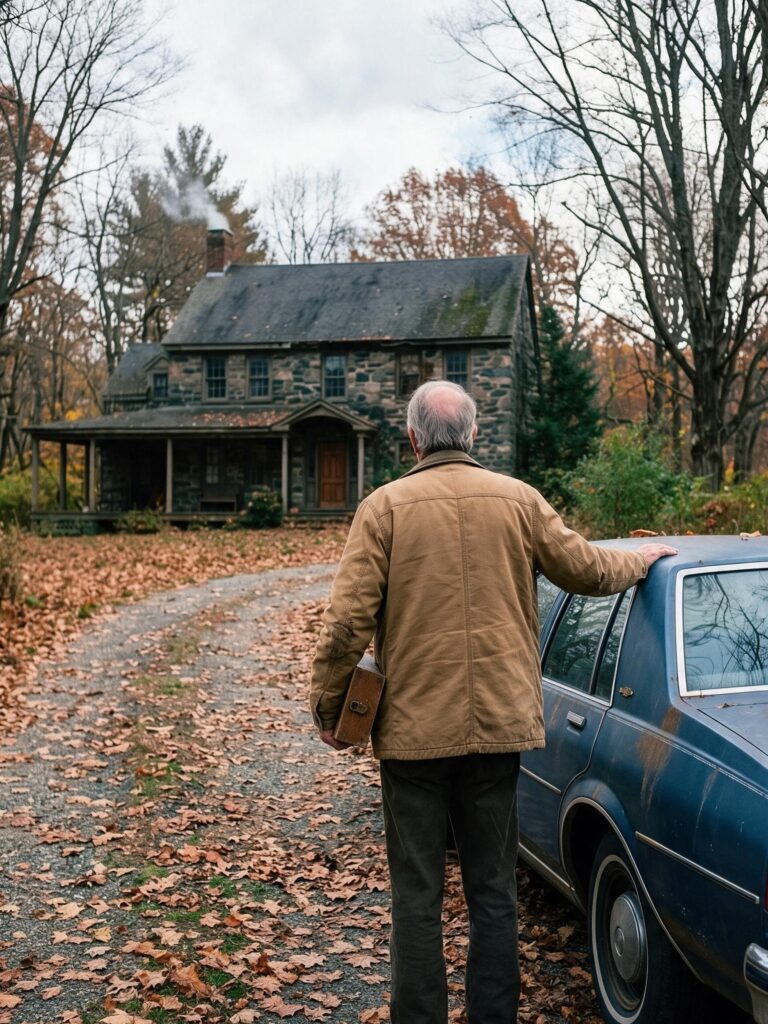
By late morning the pavement gave out. Bare November trees crowded Brierwood Road, branches arching overhead like dark fingers. Leaves the color of old pennies packed the ditches. He drove another mile before an iron gate appeared between two stone pillars. One pillar carried a small brass number, worn by weather: 18. The gate stood open.
Beyond it, a two-story fieldstone house sat among maples and oaks large enough to have been old when Rosalyn was a girl. Ivy climbed one wall. A wide porch faced the woods. Smoke rose from the chimney in a thin, steady line.
Someone was inside.
His hands tightened on the wheel. He almost turned around. Then he remembered the note. Go alone. Not run away.
He drove through.
Before he reached the porch the front door opened. A woman stepped out, late seventies, small, silver-haired, a green cardigan buttoned to the throat and a ring of keys in one hand. She looked at him and smiled as if he were late for an appointment she had kept for years.
“You took your time.”
“Excuse me?”
“You’re Leonard.” It was not a question.
“How do you know who I am?”
The smile eased into something gentler. “Because Rosalyn spent twenty-five years talking about you.”
The ground under the car seemed to shift.
“My name is Miriam Cole. I’ve looked after this place since my husband passed. She started coming here not long after she married you.”
Twenty-five years. All the charity meetings. All the afternoons she said she was visiting old friends. The unexplained drives in the last year, which had not been unexplained at all.
“How often, toward the end?”
Miriam hesitated. The wind moved the bare branches. “Almost every week.”
Something painful turned in his chest. “Don’t judge her yet,” she said. “Not until you’ve seen what she left.”
She opened the door. Warm air came out carrying cedar, old paper, and woodsmoke. Leonard stepped into a living room with exposed beams and a stone fireplace, and then he stopped seeing the room.
The walls were covered with photographs.
Leonard at the chalkboard, sleeve chalked to the elbow. Leonard asleep in a lawn chair with a book open on his chest. Leonard shoveling the Cedar Hill walk in a storm, hat pulled low. Leonard laughing over a lopsided birthday cake the grandchildren had not stayed to finish. Leonard beside Rosalyn on their twentieth anniversary, her hand in his, both of them squinting into sun he did not remember posing for. Small hours. Ordinary hours. Hours he had not known anyone considered worth keeping.
On the shelf beside the fireplace sat a chipped blue coffee mug. White letters, worn at the edges: Mr. Winslow, history is alive. His students had given it to him the year he retired. He had searched the kitchen for months. Rosalyn had said it must have been thrown out by accident with the newspaper.
He picked it up with both hands.
“Why?”
His voice cracked on the word.
Miriam stood a little behind him. “She said this house was where she kept the things her children would never understand.”
“What things?”
“The things she loved without needing their approval.”
He sat down because his knees decided for him. He covered his face. For twenty-eight years he had wondered, in the quiet after company left, whether her silence meant she was ashamed of him. Now he was sitting inside a house that seemed built to say the opposite. Miriam gave him time. Then she said, “There’s one room you need to see.”
She led him down a narrow hall. At the end was a white door. He opened it and forgot, for a moment, how to breathe.
It was his classroom. Not similar. His. The green chalkboard. The wooden teacher’s desk with the drawer that stuck. The faded map of the original thirteen colonies. Even the dented metal filing cabinet the school had thrown out during renovations fifteen years earlier, the one he had wanted and been told was already on the truck. Across the board, in Rosalyn’s hand, were four words.
One last lesson, Leonard.
On the desk sat a cassette recorder and a brass key.
Miriam remained in the doorway. “She told me once you reached this room, I was to leave. What comes next belongs only to you.”
Her steps faded down the hall. The fire cracked somewhere behind him. Leonard stood alone with the smell of chalk dust that should not have been possible and was.
He brought the box in from the car. The brass key fit. Inside were five cassette tapes numbered one through five, a leather notebook, and a smaller key, black, unfamiliar. He picked up the first tape. His fingers trembled as he pushed it into the recorder.
Static. Then an inhale he would have known in a dark room.
“Hello, my love.”
He closed his eyes. For one impossible moment she was alive again, just on the other side of a machine.
“If you’re hearing this, then I am gone. And my children have done exactly what I feared they would do.”
His eyes opened.
“I know they made you feel unwanted. I know they made you believe I chose them over you. Before this is over, you may hate me for allowing that.” Her voice dropped. “But before you decide what kind of woman I was, you need to know what happened five years ago. That was when I discovered Mitchell wasn’t waiting for me to die.”
The tape hissed.
“He was trying to make it happen sooner.”
Leonard went still. Even the fire seemed to step back.
“And Leonard, Mitchell wasn’t acting alone.”
He reached for the stop button and could not make himself press it.
She told it plain, the way she had told him hard news when it had to be told. Five years ago the dizzy spells began. Not dramatic. A few moments of weakness, blurred vision, a confusion that lifted. Mitchell insisted she see a specialist he knew. Leonard remembered. She had told him it was anemia. He had believed her because believing her was the habit of the marriage. The doctor found nothing that explained it. The episodes happened after family dinners.
Then one night she heard Mitchell and Graham in the library.
Graham said, “You’re pushing too fast.”
Mitchell answered, “If we wait, Leonard gets everything.”
Leonard sat down. “I wanted to believe I’d misunderstood,” Rosalyn said. “A mother can become remarkably talented at lying to herself when the truth concerns her own children.”
She hired a private investigator. She changed doctors quietly. She had her blood tested after every unexplained episode. Nothing ever proved poison. She warned him, on the tape, not to make an accusation she herself could not prove. But she found what she could prove. Mitchell had contacted two estate attorneys about challenging her mental capacity. Graham had accumulated nearly nine hundred thousand dollars in debts hidden from the family. Adrienne had pressed Rosalyn’s accountant, more than once, for information about assets she had no legal right to see.
“They weren’t planning my funeral, Leonard. They were planning what happened afterward.”
He lowered his head. Memories rearranged themselves without his permission. Mitchell suddenly insisting on driving her to appointments. Adrienne asking casual questions about signatures. Graham appearing on weekends after years of barely calling. “Why didn’t you tell me?” he whispered at the machine.
She answered as if she had been waiting for the question.
“Because you would have confronted them. And you would have done it kindly. You would have tried to fix us. That’s who you are. I couldn’t let your goodness become the weapon they used against you.”
A long pause. Then the sentence that moved the floor under the last years of his marriage.
“So I let them believe they were winning.”
She had spent five years separating what her children could see from what they could not. The public estate was one layer. Brierwood was another. There were others. The will they heard in Boston had been written to give them exactly what they expected, including the part that hurt him. Fourteen days. The house. The humiliation.
“I am so sorry, my love.” Her voice broke, and he had almost never heard it break. “I knew what those words would do to you. I wrote them anyway because Mitchell needed to believe you had been discarded. If he believed you received something valuable, he would follow you immediately.”
“You could have trusted me.”
The cassette hissed. Then she said, “I did trust you, Leonard. I simply didn’t trust what grief might make you reveal.”
The tape clicked. He thought it was over. Her voice returned.
“There are five recordings. Do not listen to them all tonight. After each one, decide whether you still want the truth. Before you play tape two, use the black key. Go upstairs. Last door on the left. And Leonard, whatever you find there, remember this. I was not preparing to leave you. I was preparing for the possibility that my children would leave you with nothing.”
The tape stopped.
He sat a full minute. Then he took the black key and climbed the stairs. At the end of the hall a narrow door he had not noticed waited. The key turned.
Filing cabinets. Banker’s boxes. Photographs. Legal documents. An entire wall covered by a timeline spanning five years. At the center was a photograph of Mitchell, lines running from him to lawyers, accountants, corporations, properties Leonard had never heard of. Beside it, circled in red, was Adrienne. Under her picture, in Rosalyn’s handwriting, four words.
She knows about Brierwood.
Tires crunched on gravel.
He froze. A car door slammed. Then Rosalyn’s words came back with the force of a hand on his shoulder. Trust no one who follows you.
He moved to the window. A black Mercedes stood beside the Chevrolet. Adrienne stepped out alone, coat collar up, looking at the house as if she had been here in her mind for a long time and was only now arriving in her body.
Part 3
He went downstairs. Adrienne was already on the porch, arms folded against the wind.
“How did you find me?”
She looked past him into the hall. “I’ve known about Brierwood for three years.”
He said nothing.
“Let me in.”
“No.”
The word surprised both of them. He had never denied her anything. Not a ride. Not a guest room. Not the camera.
She stared. Then she lowered her voice. “Mitchell knows you left Boston. He doesn’t know where you went. Yet. He will.”
“Why are you warning me?”
For the first time her composure cracked, not all the way, only enough to show the fear under it. “Because my brother is terrified of what Mother left here.”
She reached into her purse. He stepped back. She took out only a folded document, a photocopy, Rosalyn’s signature at the bottom.
“I found this in her study three years ago. It’s why I knew this place existed.”
He read it on the porch with the cold at his neck. The letter instructed Malcolm to transfer several privately held assets into something called the Winslow Second Chapter Trust. The estimated value, written in Rosalyn’s neat figures, was six million four hundred thousand dollars.
He looked up. “What is this?”
“I was hoping you knew.”
“I don’t.”
She searched his face and found no performance in it. The wind moved her hair. Somewhere in the oaks a crow called and was answered.
“Mitchell thinks she hid money from us,” Adrienne said. “A lot of it.”
“So that’s why you’re here.”
She flinched. He almost admired the honesty of the silence that followed.
“Partly,” she said.
He handed the paper back. “I can’t help you.”
“You don’t understand. Mitchell has already contacted attorneys. He’s going to argue she wasn’t competent in her final years. If he succeeds, anything she transferred can be challenged.”
Leonard thought of the room upstairs. Five years of dates, names, accounts. She had anticipated this too.
“What do you want from me, Adrienne?”
Her eyes filled. He could not tell whether the tears came from fear or shame, and he decided it was not his job, anymore, to sort that out for her.
“I want to know what she knew about us.”
His face hardened before he meant it to. “Maybe you should ask yourself what there was to know.”
She looked away. For once she had no answer ready.
He opened the door wider, not as an invitation, only to show that the conversation had reached its end.
“You should go.”
“Leonard.” She stopped. The name sounded strange in her mouth, as if she had used it for decades without ever hearing it. “Twenty-eight years.”
“I spent twenty-eight years trying not to make you uncomfortable,” he said. His voice did not rise. That seemed to cost her more. “Twenty-eight years pretending I didn’t notice when you left me out of photographs. Out of conversations. Out of holidays. I did that because I loved your mother. But your mother is dead. And I am seventy-four years old. I don’t have enough years left to spend another one begging people to treat me like I matter.”
Something in her face changed. He was not sure what she saw. Maybe not the schoolteacher. Maybe, finally, a man.
She walked back to the Mercedes. Before she got in, she turned.
“Mitchell will come.”
“Then Mitchell will come.”
He closed the door. His hands shook. He was smiling, not because he had won anything. Because he had finally said the sentence that should have been said at a Thanksgiving table twenty-eight years ago, when a camera was held out and he took it.
That evening he returned to the recreated classroom. The five tapes waited. He thought about six million four hundred thousand dollars, enough to change what remained of his life, enough to change other lives if a man were foolish or generous. He picked up tape two. On the underside, three words in her hand: For your future.
Static. Then her voice, and a soft laugh that undid him.
“Leonard. If you’ve reached this recording, you’ve probably discovered the Second Chapter Trust. I can imagine your face.”
Despite everything, he smiled.
“The money is real. And yes, I created it for you. But you cannot have it yet. There is one condition. I chose it because after twenty-eight years I know exactly what kind of man you are. To inherit the trust, you must make a decision about my children.”
The tape hissed.
“If you choose revenge, you lose everything.”
Anger rose faster than grief. “That’s not fair, Rosie.” His voice filled the empty classroom. “You knew what they did. Twenty-eight years of being tolerated. The funeral. The second row. Fourteen days to leave my own home. And now you want me to protect the people who never protected me.”
The tape went on, calm as a teacher who has already heard the objection.
“I know what you’re thinking. You’re thinking I’ve asked you to forgive people who haven’t asked for forgiveness. I haven’t. Forgiveness and surrender are not the same thing. Upstairs you’ll find enough evidence to protect yourself if they challenge you. Some of it may also expose things they would prefer the world never know. You may defend yourself, Leonard. You may not destroy them simply because you can.”
The recording clicked off.
He sat until dark covered the windows and the woods outside became one black wall. Then he went upstairs and opened the files, because not knowing felt worse than knowing.
She had been right. There was enough. Mitchell had moved money through a consulting company without disclosing his personal interest. Graham had borrowed against assets he expected to inherit before Rosalyn was in the ground. Adrienne had copied private financial records while helping her mother organize papers during one of the illnesses. He imagined copies sent to employers, partners, the quiet networks that ran their lives. He imagined Mitchell’s name turning sour in rooms he had never been invited into. Graham losing what credibility he had left. Adrienne watching her careful social world step back. For a few terrible minutes he wanted it. He wanted them to feel small. Unwanted. Outside the photograph.
Then his eye caught a picture pinned near the bottom of the timeline. Nearly twenty years old. Leonard stood beside a teenage boy at a high school graduation, one arm around the boy’s shoulder. Mitchell’s son, Andrew. The boy was smiling. Leonard remembered the year. Andrew had failed history. Every Saturday morning Leonard sat with him at the kitchen table, not because anyone asked, because the boy had looked ashamed and Leonard knew that look. At graduation Andrew had whispered, “I couldn’t have done it without you.” Mitchell never thanked him. Andrew had.
At ten forty-three, headlights swept the living room windows.
He knew before the knock.
Part 4
Mitchell stood on the porch with his expensive coat unbuttoned and his hair, usually exact, fallen across his forehead. “What did she leave you?”
Leonard almost felt sorry for him. Almost.
“Go home, Mitchell.”
“I know there’s another trust.”
Leonard said nothing. Mitchell stepped closer. The porch boards complained under his shoes.
“My mother wasn’t well.”
“She was well enough to know exactly what you were doing.”
The color left Mitchell’s face. That was all Leonard needed.
“You found the files.”
So Mitchell knew about the files. Not everything, maybe. Enough to drive two hours in the dark and stand on a porch he had pretended not to believe in.
“What are you going to do?”
“I haven’t decided.”
Mitchell’s mouth hardened. “If you try to take what’s ours—”
Leonard raised one hand. Mitchell stopped.
“No.” Quiet. Absolute. “You don’t come to my house and threaten me.”
Mitchell stared.
Leonard stepped onto the porch. The cold bit his wrists. “You spent years believing kindness meant weakness. That’s the mistake you made with your mother. And it’s the mistake you made with me.”
“You think because she left you some secret money you’re suddenly part of this family?”
“I don’t need to be part of your family anymore,” Leonard said. “I was part of hers.”
The words struck harder than anger would have. Mitchell blinked. His mouth opened and closed. The woods made their small night sounds. Somewhere down the road a branch let go and hit the ground.
Leonard went inside and closed the door.
In the morning he called Malcolm Reeves from the kitchen phone, an old landline Miriam kept because the hills ate cellular signals when the weather turned.
“I’ve made my decision.”
Malcolm was quiet a moment. “Rosalyn told me you might call.”
“I’ll use the evidence if they challenge the will or come after me. Nothing more. No public humiliation. No calls to employers. No destroying their families.” He looked toward the photograph of himself and Rosalyn beside the fireplace, the one where they were squinting into sun. “I spent too many years being hurt by angry people. I’m not spending whatever time I have left becoming one.”
A long silence. Then Malcolm said, “Good.”
Leonard frowned at the receiver. “Good?”
“That was the condition.”
His hand tightened. “What condition?”
“The Second Chapter Trust was never dependent on you forgiving Rosalyn’s children. It depended on whether you would use what she left you for protection or for punishment.”
“So the trust is mine.”
“Not quite.” Malcolm sounded, faintly, like a man allowing himself half a smile. “There is one final instruction. Tomorrow morning, go back to your old classroom in Boston.”
“The school?”
“Yes.”
“Why?”
“Because six months before Rosalyn died, she purchased something in your name. I was instructed not to tell you what.”
Leonard looked around the fieldstone room. The beams. The photographs. The five tapes. The woman he had thought, after twenty-eight years, he understood.
Malcolm added, quietly, “But Leonard, the six million four hundred thousand isn’t your real inheritance. Rosalyn said the money was only there to find out what you would do with power. What she actually left you was something she believed would give the rest of your life a purpose.”
Part 5
Franklin Ridge looked smaller than he remembered, the way places do when you have been made to leave them and then are allowed back. He had entered through the same red doors for thirty-two years. The hallways seemed narrower. The lockers had been repainted a cheerless gray. Room 214 stood at the end of the corridor where the morning light never quite arrived in November.
The door was unlocked.
The desks were gone. So was the chalkboard. The room had been emptied except for one wooden chair in the center. On the chair sat an envelope. For Leonard. He knew the handwriting before he touched it.
My darling, if you’re reading this, you chose not to become cruel simply because cruel people gave you permission.
Now I can tell you what I really bought.
Inside was a deed. He read the address twice. It was not the school. It was an abandoned retreat twelve miles and forty minutes outside Boston, on a county road he had driven past for years without turning. Twelve acres. Three cottages. A main lodge. A small lake with a dock half gone to weather. Rosalyn had purchased it six months before she died, in his name, and had the trust documents drawn so the place would be called Second Chapter House.
A final letter, longer than the others, explained the rest. Years ago, on a winter night when the Cedar Hill furnace had failed and they were waiting for the repairman, he had told her that retirement frightened him. Not the age. The uselessness. He had spent his adult life helping young people discover what came next, and he did not know what a man did when no one needed the next thing explained. She had remembered. She always remembered the sentences he thought were only weather.
You spent your life teaching children that history does not determine destiny, she wrote. Now I want you to teach that lesson to people our age.
The plan was simple and, once he saw it, inevitable. Second Chapter House would be a place for older adults rebuilding after loss. Widows. Widowers. Retirees. People set down by families they had depended on, or who had depended on them until the money or the health or the patience ran out. The trust would restore the property and fund the first years. He was not merely the beneficiary. She had named him founding director.
He lowered the letter.
“Rosie.”
He drove out to the property that afternoon. The lodge sat back from the road behind a line of white pines. The paint was peeling. One cottage had a broken window patched with plywood. The lake was the color of iron under a low sky. Nine months later the doors opened.
He stood on the repaired porch in the same brown jacket he had worn his last year of teaching. The maples were in leaf. Miriam had come east for the morning and stood beside him without making a speech. The first guest was a seventy-one-year-old widow named Evelyn who had not eaten dinner with another person in almost two years. Then came a retired mechanic whose children lived three states away and called on holidays if the holidays were convenient. Then a former nurse who confessed, on the second evening, that she had stopped making plans because she believed seventy-six was too late to begin anything. Leonard understood every one of them. At dinner twelve strangers sat around one long table. Someone told a joke that was not very good. Evelyn laughed so hard she spilled her coffee, then looked mortified, then laughed again when Leonard spilled his on purpose and said the table had been too clean anyway. He thought of Rosalyn then, not in a hospital bed, not in a casket, but at the charity book drive, sleeves pushed up, listening to a boy explain why he wanted a dictionary.
That was how he wanted to remember her.
A month after the opening, a car came up the drive in the late light. Adrienne stepped out. She did not bring Mitchell. She did not bring papers. Leonard watched from the porch and did not go down to meet her, and he did not go inside.
She approached slowly.
“I didn’t come about the money.”
He waited.
Her eyes filled. “I came to apologize. It isn’t enough. I know it isn’t enough to erase twenty-eight years. Nothing is.”
He had learned something in the months of paint and broken windows and Evelyn’s careful way of setting a table for people she was still afraid to need. Healing did not require pretending the wound had never happened. Sometimes it only meant refusing to keep bleeding from it.
He opened the door.
“Would you like some coffee?”
She nodded.
They sat in the kitchen while the guests played cards in the lodge. She did not ask for forgiveness in a tidy sentence. He did not offer a tidy one. She said she had been afraid of him when she was younger, afraid her mother would love a kind man more than she loved her own children, and that the fear had dressed itself up as manners and exclusion until she could no longer tell them apart. He listened. He told her about the camera at the first Thanksgiving, not to wound her, only because the truth had sat too long in his mouth. She cried without performing it. When she left, she said she might come back. He said the coffee would be on.
That evening, after the lodge had gone quiet, he walked down to the lake with the last cassette in his hand. Tape five. He had carried it for months and had not found the courage. The dock boards were solid under his shoes. Frogs started in the reeds. He set the recorder on the bench he had built from scrap and pressed play.
Static. Then her voice, close as a hand.
“Hello again, my love. If Second Chapter House is open, then you found your way forward. There’s one last thing I never told you. It’s the reason I chose you twenty-eight years ago.”
He leaned in.
“Do you remember the first day we met? Everyone in that room wanted something from me. A donation. A favor. A connection. You didn’t even know who I was.” A quiet laugh. “You asked me to carry boxes. And that was when I knew.”
“You spent your whole life believing you were the lucky one,” she whispered. “But Leonard, I was.”
The tape ended. The recorder clicked. The lake took the sound and kept it.
Mitchell did challenge the transfers. Malcolm met him with the files, not in a newspaper, not in a whisper campaign, only in a conference room with the dates and the undisclosed interests laid out in a row. The challenge withdrew. Graham’s debts remained Graham’s. Adrienne came to the lodge twice more that fall and once brought Andrew, who was a man now, with a son of his own. Andrew hugged Leonard in the kitchen and said, “I still have the notes you made me copy.” Leonard said, “Then you can teach him when he gets to the hard part.” Winter came in hard. The lake froze. Evelyn learned to set the bread dough before bed. The mechanic fixed the lodge’s old truck and refused pay until Leonard put the money in an envelope and left it on the seat. On the coldest night of January, when the wind came across the ice and the furnace knocked the way the school radiators used to knock, Leonard stood on the porch in his brown jacket and watched the windows glow. Twelve people were inside. Some of them had nowhere else. All of them had a place at the table.
He was seventy-four when he lost his wife, his house, and the family he had thought he was earning by patience. Seventy-four was not the end of the story. It was the beginning of the second chapter, and the land held it, and the light in the windows held it, and somewhere in a wooden box the last of her voice had already told him the only secret that still mattered.
She had chosen him because he saw people. He intended to keep seeing them.


