
—and he pulled them from the drawer so sharply that the string cut across his weathered knuckles.
“Did you read these?”
Thomas shook his head.
“No, sir. I was looking for sealing wax.”
“You had no business opening that desk.”
“You’re right.”
The boy’s immediate agreement seemed to leave Josiah with nowhere to direct his anger.
Margaret rose.
“Thomas should have asked permission.”
Josiah looked at her.
She continued, “But he says he didn’t read your letters. I believe him.”
The old man’s mouth tightened.
For several seconds, the only sound came from the kitchen stove.
Then Thomas said quietly, “I’m sorry, Mr. Ward.”
Josiah looked down at the bundle.
“Go finish your work.”
The boy obeyed.
Margaret remained.
She had seen the name Anna written on the uppermost envelope.
She had also noticed a date from nearly nine years earlier.
But questions were not hers to ask simply because another person’s sadness had become visible.
Josiah returned the letters to the drawer.
“Some things are private, Mrs. Hale.”
“Yes,” Margaret replied. “They are.”
She closed her account book.
“And I expect you’ll grant my children the same courtesy.”
His eyes lifted.
For a moment, she thought he might order them out.
Instead, he nodded stiffly.
That night, Margaret heard footsteps downstairs long after the house had settled.
Through the bedroom door came the faint scrape of a drawer opening.
Then closing.
Then opening again.
By morning, the sealing wax had been moved to the kitchen shelf.
The letters remained untouched.
Life continued.
Thomas helped with feeding the cattle.
Grace repaired torn flour sacks beside the stove.
Margaret inspected the winter provisions and discovered that Josiah’s supplies were well stocked, though his methods of carrying them were increasingly dangerous.
His left leg stiffened badly in the cold.
Twice she saw him pause halfway across the yard, waiting for the pain to pass.
Each time, he pretended he had merely stopped to examine the weather.
Margaret did not embarrass him by commenting.
She changed the work instead.
Thomas began lifting the heavier feed sacks.
She moved the ledgers downstairs.
Grace carried smaller supplies between the pantry and kitchen.
Josiah noticed.
Naturally, he objected.
“I managed before you arrived.”
Margaret continued writing.
“And I managed a freight business before my husband died.”
He frowned.
“What’s that supposed to mean?”
“That yesterday’s accomplishments don’t guarantee tomorrow’s strength.”
He stared at her.
Then he left the room.
But the next morning, he allowed Thomas to carry the feed.
It was the closest thing to surrender Margaret had yet witnessed.
A few days before Christmas, Grace found a small unfinished chair behind a stack of boards in the workshop.
Its narrow back had tiny flowers drawn along one rail.
“Whose chair is this?” she asked.
Josiah took it from her.
“Nobody’s.”
Grace studied the flowers.
“Somebody started making it for someone.”
“Well, they didn’t finish.”
He carried the chair away.
That evening, Margaret found him beside the workshop door, looking at the snow.
“Was Anna your daughter?” she asked.
Josiah’s shoulders stiffened.
“Thomas told you the name.”
“He told me the letters existed. Nothing more.”
“Then let it rest.”
Margaret almost turned away.
But something in his voice held her.
“Is she alive?”
“Last I heard.”
“Does she know you’ve been writing?”
Josiah looked at the house.
“No.”
Margaret waited.
After a long silence, he spoke.
“She wanted a life I didn’t approve of. Marriage to a schoolteacher. Moving east.”
“And you objected.”
“I told her if she left the farm, she left everything that belonged to it.”
His mouth worked painfully.
“She went anyway.”
“When?”
“Nine years ago.”
Margaret looked toward the darkened windows.
“And you’ve written all those letters without sending one?”
Josiah’s expression closed.
“An apology ought to be worth something before a man sends it.”
Margaret answered carefully.
“Perhaps the person receiving it should be allowed to decide what it’s worth.”
He said nothing.
She did not press him.
But later, as she crossed the hallway, she saw Josiah take the bundle from his desk.
He placed it on the table.
Selected one envelope.
Then sat staring at it, the old man’s stiff fingers resting over the name of the daughter he had driven away.
When Thomas entered to fetch more firewood, Josiah reached for the envelope as though to hide it.
Then stopped.
“Boy,” he said.
Thomas turned.
Josiah held the unopened letter between two fingers.
“Tell me something.”
“Yes, sir?”
“If a man says something cruel and waits nine years to put it right, does saying sorry still count?”
Thomas considered the question.
“Depends whether he actually says it.”
Josiah lowered his eyes.
Then he reached for his pen.
The pen hovered above the paper.
Josiah Ward could mend harness, calculate the weight of cattle without a scale, and judge an approaching storm by the movement of the clouds.
But he could not easily find the words to address his own daughter.
Thomas stood beside the doorway holding an armful of firewood.
“Should I go, sir?”
Josiah looked at him.
“Yes.”
The boy started away.
“Thomas.”
He stopped again.
Josiah glanced at the letter.
“Don’t tell your mother what I asked.”
Thomas considered that.
“Then you ought not to ask me something she already knows you’re thinking.”
He left before the old man could answer.
For several minutes, Josiah sat alone.
At last he folded the paper and returned it to the desk.
He was not ready.
And for the first time, that excuse troubled him.
Christmas arrived without ceremony.
Margaret prepared a modest supper from what the farm could spare. Grace set out a blue-flowered serving bowl she found in the parlor, while Thomas brought in enough firewood to last through the following morning.
Josiah entered the dining room and stopped.
The bowl belonged to his late wife, Sarah.
For years, it had remained unused.
Grace noticed his expression.
“Should I put it away?”
He looked at the faded flowers.
“No.”
He took his usual chair.
“Food’ll get cold.”
It was a small permission.
But Margaret understood that something had changed.
Over the following weeks, the house began to sound different.
Grace asked Josiah about the piano.
He told her it had belonged to Sarah but that Anna had been the one who played it.
“Do you know how?” she asked.
“Enough to know when somebody’s doing it badly.”
“Then perhaps you could teach me.”
He refused.
The following afternoon, however, Margaret found him standing beside the instrument with its cover removed.
Grace sat on the bench, pressing a hesitant sequence of keys.
“That’s wrong,” Josiah told her.
“Then show me.”
He leaned over and demonstrated a simple passage.
The notes were uneven.
Grace tried again.
This time he did not complain.
Margaret listened from the kitchen.
She did not interrupt.
There were things that grew best when left unobserved.
January brought harder cold.
Josiah’s left knee became so stiff that some mornings he could scarcely cross the kitchen without leaning against the table.
Still, he tried to work outside.
One afternoon Margaret watched him nearly fall beside the well.
His face changed in the instant his leg failed.
For a heartbeat, he looked genuinely afraid.
Then he recovered his balance and pretended to inspect the pump.
That evening, he placed the barn keys beside Thomas’s plate.
“Feeding’s yours until the thaw.”
Thomas looked at the keys.
“All of it?”
“Not the accounts. The work.”
“Yes, sir.”
“Water first. Hay afterward. Check the north gate.”
“Yes, sir.”
Josiah stared at him.
“And don’t make me regret it.”
Thomas picked up the keys.
“I won’t.”
Margaret watched her son’s shoulders straighten.
The gesture mattered more than Josiah seemed to understand.
For months, Thomas had carried the humiliation of losing his father’s business.
He had watched creditors take what William Hale had spent years building.
Now another man was trusting him with something important.
The next morning, Thomas completed the feeding before breakfast.
Josiah inspected every stall.
He found a sticky latch, a poorly stacked fork, and one water bucket that needed filling.
Thomas fixed each problem.
Finally, the boy asked, “Did I do anything right?”
Josiah appeared genuinely confused.
“All the animals are standing, aren’t they?”
Thomas stared at him.
Then he laughed so loudly Margaret heard him from the porch.
It was the first time she had heard laughter coming from the barn since their arrival.
The doctor reached the farm later that month.
He examined Josiah’s injured leg, asked several unpleasant questions, and advised him to avoid ladders and heavy lifting.
Josiah objected to nearly every word.
The doctor ignored him.
Before leaving, he told Margaret, “If he insists on climbing again, hide the ladder.”
She did.
Josiah found it two days later.
Thomas moved it somewhere better.
The old man discovered the conspiracy and became nearly impossible to live with.
For three days, he criticized the cooking, the weather, the state of the fences, and the unfortunate arrangement of the kitchen chairs.
On the fourth, he began repairing harness at the kitchen table.
Margaret handed him a ledger.
“Since you’ve decided to supervise everyone, you may as well make yourself useful.”
He looked at her sharply.
Then at the figures.
“Your feed calculations are wrong.”
“They aren’t.”
He examined the column again.
“Hmm.”
Margaret smiled faintly.
“An apology would be appropriate.”
“For what?”
“Being wrong.”
“I haven’t established that.”
She returned to her work.
Ten minutes later, he pushed the ledger across the table.
“Your figures are sound.”
It was enough.
His farm, Margaret learned, was not failing.
He owned eighty acres, twenty-six cattle, two horses, and sufficient grain and hay to survive a difficult winter.
His accounts were meticulous.
He owed no substantial debt.
His solitude was not the result of poverty.
It was something he had built around himself.
One afternoon, Margaret came across a draft of his will beneath a stack of tax papers.
She recognized the document and immediately set it aside.
Josiah noticed.
“Go on. Read it.”
“It’s yours.”
“You’ve already seen enough.”
“I know you have a will. That doesn’t entitle me to inspect it.”
He sat opposite her.
“Farm goes to the county when I’m gone. They can sell it and put the money toward a school.”
Margaret nodded.
“An honorable enough purpose.”
“You disapprove.”
“I haven’t said so.”
“Everybody has an opinion until I ask for one.”
She met his gaze.
“Then ask.”
He hesitated.
“Should Anna have the farm?”
Margaret put down her pen.
“I don’t know your daughter.”
“You know what happened.”
“I know what you told me.”
He looked away.
She continued, “If you want to help the county, do it. If you’re still trying to punish your daughter, don’t pretend that makes you charitable.”
The words struck him more sharply than an accusation.
He folded the will.
“You’re not a comforting woman, Mrs. Hale.”
“Comfort wasn’t part of our bargain.”
That evening, Josiah sat alone with the newest letter to Anna.
He had drafted it several times.
Every version sounded either too proud or too desperate.
Finally, he began again.
He wrote that he had been wrong to make his daughter’s marriage a test of obedience.
He acknowledged that he had spoken as though her future belonged to him.
He admitted he should have written sooner.
And he did not ask her to come home.
When the mail rider was expected, he carried the envelope to the road himself.
Margaret watched from the kitchen window.
His left leg troubled him badly.
He stopped twice before reaching the gate.
But he did not turn back.
When the rider arrived, Josiah handed over the letter.
For a moment, his fingers remained around it.
Then he released it.
The rider tucked it into his satchel and went on.
Josiah stood beside the road long after the horse disappeared.
Margaret did not go out to congratulate him.
Some victories were too private for witnesses.
Twenty-three days passed.
During that time, Josiah found increasingly elaborate reasons to work near the south-facing window.
He inspected fence posts that did not need inspecting.
He watched the road while drinking coffee.
He asked Thomas whether the mail had come when he knew perfectly well it had not.
Grace finally asked, “Are you waiting for Anna?”
Josiah replied, “I’m waiting for spring.”
She accepted the answer with an expression that suggested she believed none of it.
Then, one afternoon in February, the mail rider arrived with a cream-colored envelope bearing an Ohio postmark.
Josiah took it without a word.
He carried it into the house.
For nearly an hour, the letter lay unopened beside his coffee.
Margaret began preparing supper.
Thomas worked on a broken harness buckle.
Grace practiced quietly at the piano.
At last, Josiah spoke.
“Margaret.”
She turned.
“Yes?”
“Stay a moment.”
He broke the seal.
His daughter’s handwriting was smaller than he remembered.
The letter began politely.
Anna had received his apology.
She was surprised.
She had married Edward Mills, the schoolteacher her father had dismissed as unworthy.
They were living in Ohio.
They had two daughters.
Ruthie was seven.
Caroline was five.
Josiah stopped reading.
Grace leaned forward.
“You have granddaughters?”
He looked up, dazed.
“Apparently.”
“You didn’t know?”
“No.”
She considered this extraordinary failure.
“That’s a long time not to know two people.”
Josiah lowered his eyes to the page.
Anna had not written that she forgave him.
Nine years, she explained, could not be repaired by a single letter.
But she remembered the apple trees.
She remembered the house.
And if he meant what he had written, perhaps she and her family might visit after the roads improved.
Josiah read those sentences three times.
Then he carefully folded the paper.
Without explanation, he rose and went outside.
Margaret found him beneath the bare apple trees.
He was holding the letter with both hands.
“She hasn’t forgiven me,” he said.
“No.”
“She might never come.”
“That’s possible.”
He looked at her.
“You’re not going to tell me everything will be all right?”
“I don’t know that it will.”
His mouth tightened.
“Could have spared me the truth.”
“I thought that was what you wanted from her.”
He looked toward the frozen fields.
“I don’t deserve granddaughters.”
Margaret’s expression changed.
“Children aren’t rewards for good conduct, Josiah.”
He said nothing.
“Neither are daughters.”
He closed his eyes briefly.
Margaret returned to the house, leaving him to consider a future that no longer depended entirely on his wishes.
That evening, he brought the unfinished little chair from the workshop.
He set it beside the stove and examined its rough edges.
For a moment, Margaret thought he would finish it.
Instead, he put it aside.
He did not yet know whether Ruthie or Caroline would want the chair.
For once, he would let someone else decide.
By March, the thaw began loosening the roads.
And with it came news that changed Margaret’s own future.
A freight agent in town had heard about her previous experience.
He needed someone to manage a new depot office.
The salary was modest but dependable.
Two rooms above the station were included.
Margaret inspected the accounts, found several unpaid balances, and impressed the agent enough that he offered her the position immediately.
She accepted.
That evening, she told Josiah.
“My work begins April tenth.”
He looked up from the harness he was repairing.
“At the depot?”
“Yes.”
“Good position.”
“I think so.”
“Road should be clear by then.”
“Most likely.”
There was a pause.
Grace looked down at her plate.
Thomas nodded, as though the matter had been settled from the first snowfall.
Josiah returned to his work.
He did not ask them to remain.
He did not complain.
And Margaret, who had once mistaken such silence for indifference, now understood that he was offering her something important.
The freedom to leave without having to defend her choice.
Still, when she went upstairs that evening, she found herself looking back toward the parlor.
The piano was uncovered.
The child’s slate had been dusted.
Josiah’s newest letter to Anna lay sealed beside the lamp.
And on the table rested a fresh draft of his will.
There was more life in that old farmhouse than when Margaret had arrived.
But she had no intention of sacrificing her own new beginning to remain its keeper.
The next evening, Josiah brought the will to the kitchen table.
“Need a witness,” he said.
Margaret looked at the paper.
“Do you want my advice?”
“No.”
“Then what?”
“Your signature.”
She took the pen.
He showed her where to sign.
Only after the document was properly witnessed did he explain that Anna would inherit the farm if she wished.
If she declined, the property would be sold, with part of the proceeds going to her daughters and part to the county school.
Margaret put down the pen.
“Why did you change it?”
Josiah considered the question.
“The old will acted as though Anna had never lived here.”
He looked toward the hallway slate.
“That wasn’t true.”
Margaret nodded.
No congratulations were necessary.
Josiah had finally made a decision that did not require another person to disappear.
Then he reached for the winter ledgers.
“Now,” he said, “we ought to settle what you owe me before you leave.”
Margaret stared at him.
“You cannot possibly be serious.”
He opened his book.
“Deadly.”
Margaret pulled her own ledger across the table.
“If you intend to calculate every slice of bread my children have eaten since November, Mr. Ward, I suggest you prepare for a lengthy evening.”
Josiah took out his spectacles.
“I have nothing planned.”
Thomas moved his chair closer.
Grace appeared from the parlor, immediately interested.
For months, the two adults had recorded almost every practical exchange between their households.
Margaret had counted food, lodging, lamp oil, and supplies.
Josiah had recorded Thomas’s work, Grace’s sewing, Margaret’s bookkeeping, repairs, nursing, and the use of her wagon when his own wheel required attention.
Now the figures faced one another across the kitchen table.
Margaret began reading.
Josiah interrupted.
She corrected him.
He disagreed.
Thomas discovered an inflated repair charge.
Grace accused both adults of deliberately making the arithmetic impossible.
At last, Josiah announced that his records showed he owed Margaret eleven dollars.
“That cannot be right,” she said.
“Numbers don’t take sides.”
“Yours apparently do.”
Thomas leaned forward.
“You charged twelve dollars for repairing our axle.”
“Skilled work.”
“You refused payment at the time.”
Josiah looked innocent.
“Changed my mind.”
Margaret crossed out the entry.
They argued another twenty minutes before Grace finally put both hands on the table.
“If neither of you stops, I’m putting the books in the fire.”
Josiah regarded her.
“That’s a poor way to keep accounts.”
“It’s an excellent way to end an argument.”
Margaret laughed.
Then, at last, she drew a firm line beneath the final column.
She wrote one word.
Settled.
After a moment, she added two more.
More or less.
Josiah read the page.
His mouth twitched.
“Accurate enough.”
It was perhaps the only complete agreement they had reached all winter.
But Margaret knew the figures had served their purpose.
They had allowed two proud adults to accept assistance without confusing kindness with ownership.
Now the bargain could end without either person feeling diminished.
April tenth arrived with clear skies and muddy roads.
Margaret rose before dawn.
She packed the last of their belongings, folded the blankets, and helped Thomas secure the repaired axle beneath their borrowed wagon.
Grace lingered in the parlor.
The piano stood open.
She touched the keys, playing a short, uneven passage Josiah had spent weeks helping her learn.
When she finished, she closed the lid carefully.
Margaret found her wiping her eyes.
“We can visit,” she said.
Grace nodded.
But the girl looked toward the hallway.
“Will he be alone again?”
“For a while.”
“That’s sad.”
“Perhaps.”
Margaret knelt beside her daughter.
“But we cannot live somebody else’s life in place of our own.”
Grace considered this.
“Can we write to him?”
“Of course.”
That seemed to help.
Outside, Thomas made two unnecessary trips through the barn.
He checked the cattle, inspected the north latch, and hung the keys where Josiah could easily find them.
When he finally emerged, the old rancher was waiting beside the wagon with his cane.
“North gate still sticks,” Thomas reported.
“I know.”
“Needs another drop of oil.”
“I’ll see to it.”
Thomas hesitated.
“I’ll miss working here.”
Josiah looked toward the barn.
“You’ve learned enough to be useful wherever you go.”
The boy’s face changed.
It was the closest thing to praise Josiah had offered him.
“Thank you, sir.”
Josiah extended his hand.
Thomas shook it solemnly.
Then, unexpectedly, he stepped forward and embraced the old man.
Josiah stiffened.
For a moment, he appeared genuinely uncertain what to do with his arms.
Then he patted the boy’s back.
“Mind your mother’s business,” he muttered.
“I will.”
Grace was less restrained.
She hugged Josiah around the waist.
“You have to write back,” she informed him.
“Suppose I don’t?”
“Then I’ll send another letter.”
He looked down at her.
“Persistent little creature.”
“Yes.”
He rested his hand gently on her shoulder.
Margaret watched from beside the wagon.
There was something painful about leaving a place where her children had been safe.
But there was also something deeply satisfying about knowing they were leaving by choice.
Josiah approached her last.
He held out a small envelope.
“What’s this?”
“The balance.”
She opened it.
Eleven dollars.
Margaret looked up.
“I crossed that out.”
“My figures still say I owe it.”
“Your figures are hopeless.”
“So you’ve mentioned.”
She tried to hand the money back.
He refused.
At last she tucked the envelope into her coat.
“I shall spend it irresponsibly.”
“See that you do.”
Margaret climbed onto the wagon.
Thomas took his place beside her.
Grace settled among the blankets.
Josiah stood beneath the apple trees, his cane planted firmly in the damp earth.
“Anna coming?” Margaret asked.
“May, she says.”
“You nervous?”
“No.”
Margaret smiled.
“Liar.”
He gave her an irritated look.
Then lifted one hand.
“Drive carefully.”
She touched the reins.
The wagon rolled down the muddy lane.
When Margaret glanced back, Josiah remained beneath the trees.
He did not follow.
He did not call for her to return.
He simply watched until the wagon passed beyond sight.
For the first time since William’s death, Margaret felt that departure did not have to mean losing everything.
Sometimes it meant taking possession of the future again.
The depot office proved to be exactly the sort of work she had hoped for.
The books were disorganized.
Several accounts were overdue.
The clerk believed a widow could not possibly understand freight charges as well as a man.
Margaret corrected all three problems.
Within her first month, she recovered enough unpaid balances to justify her salary several times over.
The rooms above the station were small.
But they were theirs.
Thomas attended school part of the week and helped at the depot on the remaining days.
Grace found a church teacher who allowed her to practice the piano.
And Margaret discovered that she could enjoy a quiet evening without fearing someone would arrive to take the roof from over her children.
She occasionally thought of Josiah.
Particularly when the station received mail from Ohio.
But she did not return to the farm simply to satisfy her curiosity.
His relationship with Anna belonged to the two of them.
Meanwhile, on May seventeenth, a hired wagon turned into Josiah Ward’s lane.
He was standing beneath the apple trees when it arrived.
He had repaired the porch step twice.
He had cleaned the piano.
He had purchased two peppermint sticks and hidden them in a drawer.
He had also spent several nights wondering whether he ought to have invited anyone at all.
Now the decision was no longer his to undo.
A woman stepped down from the wagon.
She was thirty-one.
Her hair reminded him so strongly of Sarah that he felt an unexpected tightness in his chest.
Anna Ward Mills stood beside the vehicle, looking toward the house where she had grown up.
Her husband climbed down behind her.
Then came two girls.
Ruthie and Caroline.
Josiah looked at the children.
He did not know either face.
Nine years had passed, and his daughter had lived every one of them without his permission.
The thought humbled him.
Permission, he realized, had never been his to give.
Anna approached.
“Hello, Pa.”
Josiah removed his hat.
“Anna.”
She looked past him.
“The apple trees are bigger.”
“So are you.”
She gave him a look.
“That usually happens.”
For a moment, his old instinct returned.
He wanted to explain.
To defend himself.
To make the years smaller than they had been.
Instead, he waited.
Anna turned toward the wagon.
“Girls, this is your grandfather.”
Only then did Josiah lower himself as far as his stiff leg allowed.
“I have peppermint,” he told them.
Ruthie looked at Caroline.
“We like lemon.”
Josiah nodded gravely.
“Already going badly.”
Anna laughed before she could stop herself.
The sound startled them both.
It was not forgiveness.
But it was something they could share without pretending.
The afternoon unfolded slowly.
Edward admired the barn, and Josiah answered his questions about the construction.
Caroline asked whether every cow had a name.
Josiah told her they did not.
Ruthie immediately began naming them.
Later, Anna entered the parlor.
She stopped before the piano.
“You kept it.”
Josiah stood in the doorway.
“Wasn’t mine to throw away.”
She looked at him.
“You told me nothing here belonged to me after I left.”
He swallowed.
“I said that.”
“Yes.”
He had once imagined that a proper apology would settle such matters.
Now he understood that Anna might need to speak about them more than once.
He did not ask her to stop.
“I was wrong,” he said.
Anna studied him.
Then she opened the piano and played several familiar measures.
One note sounded sharply out of tune.
She frowned.
“Still needs work.”
“Grace said the same.”
“Grace?”
“A girl who stayed here over winter.”
He told her about Margaret Hale and her children.
He explained that they had helped with the farm, repaired things, kept accounts, and eventually gone on to their own lives.
Anna listened.
There was no jealousy in her expression.
Margaret’s family had not replaced Anna.
They had occupied a season when the old house badly needed living voices.
That evening, Josiah asked Edward about his school.
“How many pupils?”
“Twenty-eight through winter. More in autumn.”
Josiah nodded.
“And you teach them all yourself?”
Edward smiled.
“With considerable assistance from the older pupils.”
For years, Josiah had considered a schoolteacher an impractical husband for his daughter.
Now he listened as Edward described his work.
And instead of finding fault, he asked another question.
No one announced the change.
That made it more meaningful.
Anna’s visit was not perfect.
Some conversations ended awkwardly.
Some memories hurt.
There were moments when father and daughter sat together without speaking because neither yet knew how.
But they remained in the same house.
And that was more than Josiah had allowed for nine years.
In June, Margaret traveled north on depot business and stopped at the farm to deliver a parcel that had been sent to the wrong address.
As she approached, two unfamiliar little girls were running beneath the apple trees.
Josiah sat on the porch repairing a small wooden chair.
Margaret recognized it immediately.
“Found someone who needs it, have you?”
He looked up.
“Apparently.”
One of the girls was sitting on an overturned bucket while the other occupied the only porch stool.
Josiah had finally decided to finish the chair.
Margaret glanced toward the house.
A woman appeared in the doorway.
Anna.
The two women greeted one another with polite curiosity.
Anna thanked Margaret for helping her father through winter.
Margaret smiled.
“He helped us too. He probably neglected that part.”
Anna looked toward Josiah.
“He’s inclined to leave things out.”
“An inherited talent?”
“Unfortunately.”
They shared a brief laugh.
Margaret felt no need to explain what Josiah had suffered during the years of separation.
Anna had lived those years herself.
Nor did she offer advice about forgiveness.
That was not her place.
Later, as Margaret prepared to leave, Josiah brought out one of the old winter ledgers.
“Found another error,” he announced.
She stared at him.
“You cannot still be counting.”
“Eleven dollars.”
“You’ve already paid me.”
“Then perhaps you owe me.”
“I spent it.”
“On what?”
“Schoolbooks.”
Josiah appeared offended.
“Terrible waste of irresponsible money.”
Margaret laughed.
Then she handed him a small folded paper.
“Grace sent this.”
Inside was a drawing of the farmhouse.
Four figures stood in the yard.
Josiah.
Anna.
And the two little girls.
Margaret had expected Grace might include herself and Thomas.
Instead, her daughter had drawn the family she knew the house was waiting to welcome.
Josiah looked at the picture for a long time.
Then he went inside and placed it beside Anna’s old slate.
Margaret watched him.
She understood that Grace had done something wiser than many grown people might have managed.
She had recognized that affection need not require a permanent place in another person’s household.
Their winter had mattered.
It did not have to last forever.
Before Margaret left, she overheard a brief exchange between Anna and Josiah.
“You always say I left because I wanted Edward more than this family,” Anna told him.
Josiah’s face tightened.
“You did leave.”
“I chose the life you told me I couldn’t have and still be your daughter.”
He opened his mouth.
Then stopped.
He looked toward the yard.
“That’s what I said.”
Anna waited.
“Yes, Pa. It was.”
He nodded.
There was no easy reconciliation in those words.
Only an acknowledgment that could no longer be avoided.
Margaret turned away and gave them privacy.
When she returned to the porch, Ruthie was sitting in the newly repaired little chair.
Josiah knelt awkwardly beside it, shortening one uneven leg so the seat would no longer wobble.
“Too high?” he asked.
“No.”
“Too narrow?”
“No.”
“Then stop moving while I finish.”
Ruthie obediently sat still.
Margaret smiled.
He had spent years making decisions for people who were not there to answer.
Now he was asking a little girl whether a chair suited her before making the final adjustment.
It was a modest transformation.
But a real one.
The summer passed.
Anna and her family returned to Ohio in July.
Josiah did not ask them to remain.
Anna did not promise to come back the following year.
They wrote instead.
The letters were not always affectionate.
Sometimes Anna challenged his version of their past.
Sometimes Josiah defended himself before finally conceding that she remembered the same events differently.
They discussed cattle prices, weather, the girls’ schooling, and Edward’s work.
Their correspondence contained ordinary disagreements.
But unlike the letters that had spent nine years inside his desk, these letters traveled.
Anna could answer.
She could disagree.
She could remain silent for a time.
And Josiah could not control her response by refusing to send his own words.
Margaret continued building her life at the depot.
She became known for maintaining accurate records and refusing to accept excuses from men who assumed a woman could be deceived about freight charges.
In time, she purchased a small share of the business.
She never married again.
That was not because she had ceased to care about companionship or because her grief remained unchanged.
Her life had simply taken a different shape.
She had a livelihood.
She had a home.
She had children growing toward independent futures.
And she had friendships that asked nothing of her freedom.
Thomas eventually became a surveyor, carrying into his profession the careful attention Josiah had demanded of him in the barn.
Grace became a music teacher.
Neither forgot that winter.
Neither needed to return permanently to the farmhouse to prove its importance.
Years passed.
Anna visited Dakota Territory four more times before Josiah died at seventy-three.
She never moved back.
Under his revised will, she inherited the farm.
Afterward, she sold most of the land to a neighboring family, keeping the farmhouse, the orchard, and five acres that included the graves of her mother and infant brother.
Josiah might have objected to the arrangement.
But he had finally learned that leaving something to another person meant accepting that they might use it differently than he would.
On Margaret’s last visit before his death, she found him beneath the apple trees.
His hair had gone almost entirely white.
His hands trembled.
He walked more slowly than ever.
Nearby, Ruthie, now nearly grown, was repairing a harness.
Josiah watched her closely.
“She’s doing that wrong,” he muttered.
Margaret leaned against the fence.
“Have you told her?”
“Twice.”
“Did she listen?”
“No.”
Margaret smiled.
“Sounds familiar.”
He gave her a sour look.
Ruthie continued working.
After a while, she discovered her mistake and corrected it herself.
Josiah said nothing.
Margaret noticed.
The small wooden chair stood on the porch.
Its paint was worn, and one rail bore the marks of years of use.
The piano inside had been tuned.
Anna’s childhood slate still rested on the shelf.
The house was not a monument to perfect reconciliation.
It was a place where imperfect people had found ways to continue speaking to one another.
As the afternoon softened, Josiah turned toward Margaret.
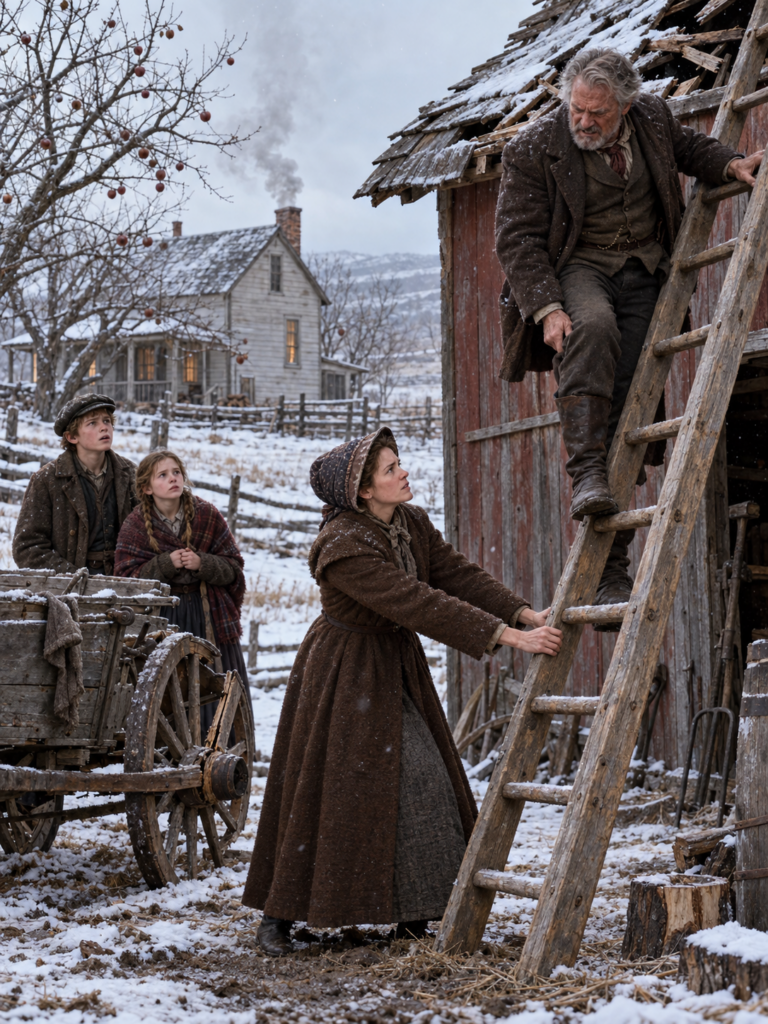
“Remember what you said the day you arrived?”
“That you were about to fall off a ladder?”
“After that.”
She smiled faintly.
“That you had no one to care for you, and my children had no home.”
He nodded.
“You were wrong.”
“Which part?”
“Care.”
Margaret waited.
He looked toward Ruthie, who was now arguing cheerfully with Anna about the harness.
“I thought it meant somebody doing things for me because I couldn’t.”
“Sometimes it does.”
“Not all of it.”
“No,” Margaret replied. “Not all.”
He rested both hands on his cane.
For years, Josiah had imagined that needing people made a man smaller.
Margaret had believed that accepting help might place her family under another person’s power.
Both had been afraid of a debt they could never repay.
And both had learned that not every kindness belonged in an account book.
Sometimes caring meant helping someone repair a wagon without expecting repayment.
Sometimes it meant trusting a boy with the barn keys.
Sometimes it meant letting a child play a piano that had been silent too long.
Sometimes it meant mailing a letter without knowing whether forgiveness would follow.
And sometimes it meant watching people drive away because the lives they wanted lay somewhere beyond your gate.
Margaret stepped toward her wagon.
Josiah raised one hand.
No grand speech followed.
None was necessary.
She climbed onto the seat and took the reins.
As she drove away, the apple leaves stirred above him.
Twelve winters earlier, she had arrived with two frightened children, a broken wagon, and the determination not to owe anyone more than she could repay.
She had left that spring with something she could not enter into her ledger.
A new understanding of dignity.
It was not the ability to stand alone without ever needing help.
Nor was love measured by how tightly a person could hold another.
It was the courage to give without claiming ownership, to receive without surrendering freedom, and to let people choose lives that did not always remain beside your own.
Long afterward, Thomas remembered the two competing winter ledgers.
Neither survived.
Grace used several pages for music exercises.
Josiah burned the remaining paper for kindling during a later winter.
But the things those books had tried so desperately to measure endured.
In Thomas’s willingness to trust others.
In Grace’s music.
In Margaret’s independent livelihood.
In the letters Anna and her father continued exchanging.
In the worn little chair beneath the farmhouse porch.
And in the quiet truth that Josiah Ward had finally learned beneath his apple trees:
A home is not made meaningful by keeping everyone inside it.
Sometimes its greatest purpose is to give people enough warmth, courage, and freedom to open the door—and walk toward the lives they have chosen.


