
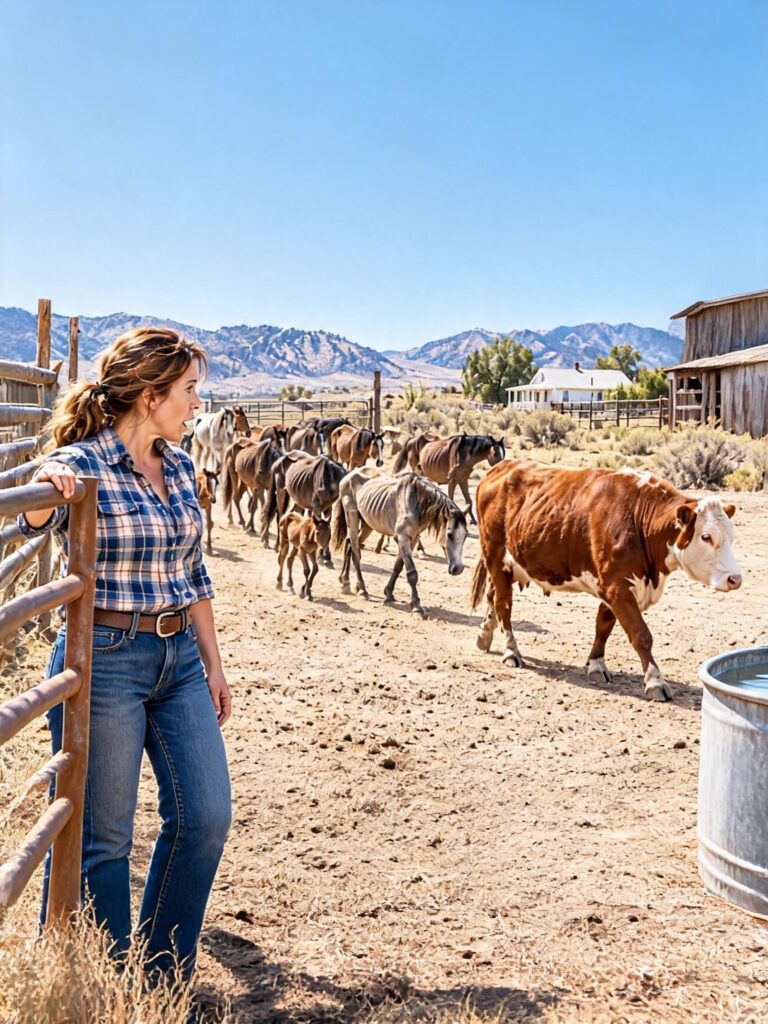
the single mother’s cow vanished into the nevada desert for two days—then came home with 14 starving wild horses and a secret the richest ranching family wanted buried
Part 1
The morning Juniper disappeared, Mara Ellison was standing in her kitchen with a past-due notice in one hand and a cold cup of coffee in the other.
Outside the window, the Nevada sun was already climbing over the eastern mountains, turning the dry grass along her fence line the color of old straw. It wasn’t even seven o’clock, and the heat had begun pressing against the farmhouse walls.
The letter came from the bank in Winnemucca.
Mara had read it three times.
The words were polite. They always were. But she knew what they meant.
Her mortgage was behind. Her operating loan was nearly exhausted. Unless she could demonstrate a reasonable plan for repayment, the bank would have to reconsider its position.
She folded the letter carefully and slipped it beneath the flour canister just as her seventeen-year-old son came through the back door.
“Mom, you seen Juniper?”
Mara looked up.
“What about her?”
“She’s not with the others.”
Cole stood in the doorway wearing dusty jeans and an old high school baseball shirt. His boots were coated with powdery dirt from the east pasture.
Mara set down her coffee.
“Check behind the loafing shed?”
“Yep.”
“The south draw?”
“Rode the fence clear around.”
She glanced toward the barn.
“She might’ve gotten into that little stand of willows.”
“Mom, I checked.”
Something in his voice made her stop.
Juniper was a seven-year-old Hereford cow, broad-backed and red with a white face and a crooked notch in her left ear. She wasn’t valuable breeding stock. She had never won a ribbon or produced an exceptional calf.
But she had one remarkable quality.
She always came home.
In eleven years on Red Hollow Ranch, Mara had seen cattle scatter during thunderstorms, break through wire, and wander miles after fresh grass. Juniper had always been the animal standing at the water trough when the dust settled.
Sometimes half the herd would be following her.
Mara picked up her keys.
“Come on.”
Red Hollow covered 320 acres along the northern edge of Nevada’s high desert. To someone visiting from a city, it looked like an enormous piece of land.
To the ranchers who controlled the surrounding valley, it was barely worth mentioning.
There was a two-story white farmhouse with peeling paint, a barn whose roof leaked above the feed room, a rusted tractor, a cattle chute, several battered outbuildings, and a well that had been running continuously through the worst drought Mara could remember.
Beyond the corrals lay miles of sagebrush, rocky draws, and mountains that turned purple just before sunset.
Mara had once believed she would grow old there beside her husband.
Instead, Daniel had left six years earlier, after a series of failed investments and arguments neither of them knew how to end.
He moved to Boise, found work selling construction equipment, and gradually became a voice on the telephone.
Some months he sent child support.
Some months he sent explanations.
Mara stopped expecting either.
What she had kept was the ranch, the debt attached to it, and a boy who had grown tall enough to look his mother in the eye.
She loved the land fiercely, although lately she had begun wondering whether that love was costing her son too much.
Cole wanted to study diesel mechanics in Elko after graduation. She had found an application tucked inside one of his schoolbooks.
He had never mentioned it.
She hadn’t asked.
The ranch needed him, and they both knew it. But Mara remembered being seventeen, when the world still seemed full of roads leading somewhere new.
She refused to make her boy feel guilty for wanting one.
They spent the morning searching.
Mara drove the old pickup along the north boundary while Cole took the four-wheeler toward the south pasture. They checked the gates, walked stretches of wire, and called Juniper’s name into draws where the dry wind carried their voices away.
By noon, Mara had counted the herd four times.
Forty cattle.
There should have been forty-one.
“Maybe somebody cut the fence,” Cole suggested.
Mara shook her head.
“Every gate’s chained. Not a strand down.”
“Then where’d she go?”
Mara looked west, toward the Blackwood land.
“I don’t know.”
That was the answer she hated most.
The Blackwood family owned more than 60,000 acres across the valley, along with grazing rights reaching into the mountains.
Their trucks traveled the county roads like they belonged there. Their cattle grazed on ranges that seemed to stretch forever. Their name appeared on water district notices, rodeo banners, and the bronze plaque outside the new agricultural building.
Vivien Blackwood, the public face of the operation, had offered to buy Red Hollow four times.
The last visit had come in April.
Mara remembered the spotless white SUV pulling into her yard while she was repairing a broken gate hinge.
Vivien stepped out wearing expensive boots without a mark on them. A real estate broker followed her, holding a folder.
“Mara,” Vivien said pleasantly, “you’ve certainly kept this place going longer than most people expected.”
Mara tightened a bolt before answering.
“Morning, Vivien.”
“We’ve revised our offer.”
“I’m not selling.”
“You haven’t heard the figure.”
“Doesn’t change my answer.”
Vivien glanced toward the barn, then across the dry pasture.
“There’s a point where a parcel becomes too small to operate responsibly. You know that, don’t you?”
Mara straightened.
“My father used to say there are big ranches run badly and little ranches run well.”
“Your father sounds like an optimistic man.”
“He was.”
Vivien smiled, but her eyes stayed cool.
“Well, if your circumstances change, you have my number.”
At the SUV door, she paused.
“Of course, our next offer may not be quite as generous.”
After they left, Mara stood beside the gate until the dust settled.
She had wanted to tell Vivien how many nights she’d spent carrying sick calves into the barn, how often she’d repaired frozen pipes in the dark, how many meals she’d skipped so Cole could have enough.
But she knew those things had no value in Vivien Blackwood’s calculations.
Now, three months later, Mara was missing a cow she couldn’t afford to lose.
By the following afternoon, she was exhausted.
She had slept less than four hours and spent nearly everything left in the fuel can searching the ranch.
At the feed store in town, she bought mineral blocks, fencing staples, and a small sack of grain.
She heard laughter near the front counter.
“Guess the Ellison place has gotten so broke the cattle are leaving on their own.”
The voice belonged to Ray Denton, a manager at one of the Blackwood outfits.
A man beside him chuckled.
“Maybe the cow found herself a better-paying job.”
Mara stopped beside the display of work gloves.
Ray saw her.
For one awkward second, nobody spoke.
Then he grinned.
“Just having some fun, Mara. Heard you lost one.”
“She’s missing,” Mara said.
“Well, hope she turns up.”
He looked at the mineral blocks in her cart.
“Everything’s getting expensive, isn’t it?”
Mara paid without answering.
Outside, she loaded the supplies herself, climbed into her truck, and sat behind the steering wheel.
Her cheeks burned.
She had survived divorce, winter feed shortages, broken equipment, and the humiliation of asking the bank for more time.
Yet those few careless words nearly broke her.
She pressed her palms against the wheel until her breathing steadied.
Then she started the engine.
There was still daylight left.
Juniper might still be alive.
And as long as there was a chance, Mara intended to keep looking.
She drove west.
An old cattle trail crossed the country beyond Red Hollow, winding through sagebrush toward a canyon that had once been known for a year-round spring.
Mara’s father had shown her the trail when she was young.
“Animals remember water,” he told her. “Better than most people remember promises.”
She hadn’t thought about those words in years.
At a dry wash eleven miles from home, she found the first hoofprint.
It was pressed into a patch of hardened mud beneath a limestone shelf.
A cow’s track.
Mara knelt beside it.
The edges were worn, but she could still see the split shape of the hoof.
Farther west, she found another.
Then a third.
Her heart began beating faster.
“Come on, old girl,” she whispered. “Where’d you get yourself to?”
She followed the tracks until the trail reached a new fence of steel posts and heavy wire.
A green sign hung from one post.
BLACKWOOD CATTLE AND LAND.
PRIVATE PROPERTY.
Beyond the wire, the land dropped into a wide basin between steep rock walls.
Mara searched the ground.
There were more hoofprints than she expected.
Some belonged to cattle.
Others were rounder, with the distinct shape of unshod horses.
Dozens of them overlapped in the dust.
She followed the tracks along the fence until evening shadows began filling the drainage.
There was no sign of Juniper.
On the drive home, the mountains vanished behind a reddish haze.
Mara knew she should feel encouraged. At least she had found a trail.
Instead, something troubled her.
Why would an old cow leave familiar pasture and walk eleven miles into the desert during a drought?
And why were so many horse tracks gathered against a fence where no horses were supposed to be?
That evening, Cole had supper waiting beneath a piece of aluminum foil.
Mara ate standing at the counter.
“Any luck?” he asked.
“Found tracks.”
“Juniper’s?”
“I think so.”
“Then she’s alive.”
“She was when she made them.”
Cole watched her for a moment.
“You ought to sleep, Mom.”
Mara glanced at the dark window.
“I keep thinking she’s out there without water.”
Cole pulled out a chair.
“Sit down. I’ll take first feed tomorrow.”
She wanted to argue, but her legs were shaking.
She sat.
For a while they listened to the refrigerator hum.
Then Cole reached across the table and took her rough, sunburned hand.
“We’ll find her.”
Mara squeezed his fingers.
She wished she could believe him.
Before dawn the next morning, a deep, familiar bellow woke her from a troubled sleep.
Mara opened her eyes.
For a moment she thought she was dreaming.
Then it came again.
A cow calling from the yard.
She threw back the blanket, pulled on her boots without tying them, and hurried through the kitchen.
The screen door slammed behind her.
Juniper stood outside the corral gate.
Her white face was gray with dust. There was a scrape across her left knee and another beneath her chest. Her sides were hollow, and her ears drooped with fatigue.
But she was alive.
“Juniper!”
Mara hurried toward her.
“Oh, you foolish old thing.”
She reached through the gate and pressed her forehead against the cow’s warm neck.
For the first time in two days, she cried.
Juniper merely shifted her weight and let out another impatient bellow.
“All right,” Mara whispered, laughing through her tears. “All right. Let’s get you some water.”
She lifted the chain.
Juniper walked through.
Then Mara heard something strange.
Hooves.
Not the slow, heavy tread of a single cow.
A rolling, uneven thunder coming from beyond the rise where the gravel road dipped out of sight.
She turned.
Dust rose in the pale morning light.
A gray horse appeared over the crest.
Then two brown horses.
Then another.
And another.
Mara stood motionless beside the open gate as fourteen wild horses emerged from the desert, following the road toward her home.
They were painfully thin.
Their manes were tangled, their flanks hollow, and their ribs showed beneath dusty coats. Three small foals struggled to keep up with their mothers.
At the front walked a gray mare, her head hanging low.
Juniper continued toward the water trough.
The horses followed.
Mara stepped aside.
The gray mare stopped several yards from the trough and stared at her.
For twenty long seconds, neither moved.
Then the mare lowered her head and took a cautious step.
Another.
Finally she reached the water.
The rest of the band crowded in behind her.
Fourteen desperate animals began drinking.
The sound filled the silent ranch yard.
Mara stood there in her nightshirt, barefoot inside her unlaced boots, unable to understand what she was seeing.
Her missing cow had come home.
And somehow, she had brought half-starved wild horses out of the desert.
Mara had no idea that those horses were carrying a secret powerful enough to turn an entire valley against the richest family in it.
She only knew they were thirsty.
And she wasn’t about to turn them away.
Part 2
By six that morning, Mara had called Wade Carver.
Wade had been the valley veterinarian for thirty-one years. He was a tall, weathered man with silver hair, heavy hands, and a way of speaking only after he had finished thinking.
He arrived in his old veterinary truck just as the sun cleared the mountains.
Mara met him near the cattle guard.
“They’re still here,” she said.
Wade looked toward the corral.
“I can see that.”
“Fourteen.”
He took off his hat.
“Lord have mercy.”
The horses had settled near the water trough, where Mara had opened the outer paddock to give them room. Juniper was back with the cattle, calmly chewing hay as though she hadn’t just returned from an impossible journey.
Wade approached the horses slowly.
He didn’t try to touch them.
Instead, he watched their breathing, their movement, and the condition of their eyes.
The gray mare held her head up when he came near, but she made no attempt to run.
“These animals are in bad shape,” he said.
“How bad?”
“Some of them are close to the edge.”
He pointed toward a bay mare standing beside a small foal.
“See that? She’s nursing, but she’s got almost nothing left to give. Those hip bones shouldn’t be sticking out that way.”
Mara swallowed.
“Can they recover?”
“If we do this right.”
He explained that severely dehydrated horses needed careful observation, steady access to clean water, appropriate forage, and veterinary attention. They could suffer serious complications even after reaching safety.
Mara listened closely.
She had handled cattle her entire adult life, but wild horses were another matter.
“I don’t have enough feed for fourteen more animals,” she admitted.
Wade looked toward the hay barn.
“We’ll figure that out.”
“That’s what people keep saying when they don’t know how.”
He glanced at her.
“Well, I know a little.”
Together they arranged additional water containers and moved a temporary fence panel so the horses could drink without crowding one another.
Wade contacted the appropriate range and wildlife officials to report the band, while Mara photographed their condition from a distance.
Neither of them attempted to claim ownership.
These were wild animals in need of help, and any decision about their long-term management belonged with the proper authorities.
Before leaving, Wade examined Juniper.
He checked her breathing, felt along her legs, and cleaned the scrapes on her knee and brisket.
“Old girl had a rough trip,” he muttered.
Mara leaned against the fence.
“Why would those horses follow a cow?”
Wade looked toward the trough.
“Maybe they were desperate.”
“That’s eleven miles, Wade.”
“I know.”
“And Juniper’s never been much for company.”
He scratched the cow behind her notched ear.
“Sometimes an animal gets itself out of trouble, and another animal figures there’s a reason to follow.”
It was the closest thing to an explanation he could offer.
By midmorning, the first neighbor arrived.
By noon, seven trucks were parked along the county road.
Someone had taken a photograph of Juniper standing near the gray mare. The picture traveled through the valley faster than any news Mara had ever seen.
People wanted to know whether she had trained the cow, whether the horses were tame, and whether she planned to keep them.
One man asked if he could bring his grandchildren inside the fence.
“No,” Mara said.
“They just want to see them.”
“They can see from the road.”
“Seems unfriendly.”
Mara stared at him.
“They’ve been starving. They don’t need an audience.”
The man climbed back into his pickup looking offended.
Cole came home from his morning shift at the tire shop and found three strangers leaning on the gate.
He sent them away, then stayed near the cattle guard to keep more vehicles from driving into the yard.
By afternoon, Mara’s head hurt from answering questions.
Then a familiar white SUV appeared.
Vivien Blackwood stepped out.
She wore dark sunglasses and a pale blouse tucked into tailored jeans. Her hair was neatly arranged despite the wind.
She didn’t smile.
She walked to the corral, stopped beside the fence, and stared at the horses.
Mara watched her face.
Vivien had always seemed completely in command of herself. She could discuss land values, drought losses, or another family’s financial trouble without changing her expression.
But now the color drained from her cheeks.
Her hand tightened around her sunglasses.
“Where did they come from?” she asked.
“Out of the west.”
“Which part?”
“Toward the old spring country.”
Vivien’s gaze shifted toward the mountains.
For a moment, she looked frightened.
Then she turned back to Mara.
“You need to have these animals removed.”
Mara frowned.
“They’ve barely made it to water.”
“They’re a liability. Wild horses can damage your fences, injure your cattle, and create serious legal complications.”
“Wade’s contacted the agencies.”
“That’s good. Let our people coordinate with them.”
“Why your people?”
“We have the equipment and experience.”
Mara glanced at the gray mare.
“Where would you take them?”
Vivien hesitated.
“We would make sure they were handled appropriately.”
“That’s not a place.”
Her voice hardened slightly.
“Mara, you’re already struggling to manage your own operation. You don’t need another problem.”
Mara felt the familiar sting.
“These animals came onto my place needing water. They’re getting water until somebody qualified tells me otherwise.”
“You have no idea what you’re getting involved in.”
“Then maybe you should explain it.”
Vivien stared at her.
For one brief moment, Mara thought she might.
Instead, Vivien put her sunglasses on.
“Just remember that I tried to help.”
She returned to her SUV and drove away.
Mara stood by the fence long after the vehicle disappeared.
Vivien hadn’t asked whether the horses were sick.
She hadn’t asked about the foals.
She hadn’t even seemed surprised that wild horses had appeared so far from their usual range.
She had wanted them gone.
And she had wanted them gone quickly.
That evening, Cole found Mara sitting on the back steps.
“What’s wrong?”
She rubbed her forehead.
“Vivien Blackwood came by.”
“Of course she did.”
“She wanted to take the horses.”
“Did you let her?”
“No.”
Cole sat beside her.
The yard smelled of hot dust, cattle feed, and the faint mineral scent of water overflowing onto dry ground.
“Mom?”
“Yeah?”
“How long can we afford this?”
Mara didn’t answer immediately.
The well pump had run most of the day. Her supply of grass hay was already short. Diesel cost more every week, and she had only enough money in the checking account to cover the electricity and part of the next feed delivery.
“I don’t know,” she said.
Cole nodded.
He didn’t look surprised.
After a while, he said, “I can pick up more hours at the tire shop.”
“No.”
“They need somebody Saturdays.”
“You need to finish school.”
“It’s summer.”
“And you need to have a summer.”
He picked up a pebble and rolled it between his fingers.
“You don’t have to do everything by yourself.”
Mara looked at her son.
He had his father’s dark hair, but the stubborn set of his jaw was hers.
“I know,” she said.
Yet they both understood that she had been doing exactly that for years.
Three days after the horses arrived, the rumors began.
Someone posted an anonymous message on the county community board suggesting Mara was using the animals to attract attention and solicit donations.
Another claimed she intended to sell the horses.
By the weekend, people were repeating that she had somehow arranged the whole thing to save her failing ranch.
At the grocery store, a woman Mara had known for ten years asked whether the horses were really wild.
“Yes.”
“Because my brother said it seemed mighty convenient.”
“Convenient?”
“Well, with your financial troubles and everything.”
Mara set a carton of milk into her basket.
“You think I walked fourteen starving horses eleven miles across the desert to get my name talked about?”
The woman looked embarrassed.
“I’m just telling you what people are saying.”
Mara stepped closer.
“Then next time, ask them whether they’d trade places with me.”
She left without buying the milk.
At home, another letter from the bank waited in the mailbox.
The loan officer wanted updated financial statements and a meeting within thirty days.
Mara sat at her kitchen table that night with the bills spread before her.
The numbers didn’t work.
They hadn’t worked for months, but now they looked worse.
The well electricity, extra hay, and repairs to the paddock had already consumed money she needed for winter.
She took out a sheet of paper and calculated the value of every animal she could sell.
Even if she sold half the herd, she might only buy herself another season.
Beyond the window, the horses shifted in the darkness.
A foal gave a small, frightened whinny.
Mara closed her eyes.
For the first time since Juniper returned, she wondered whether she had made a terrible mistake.
The next morning, Wade arrived with a pickup bed full of hay.
Mara came out before he could unload it.
“I can’t pay for that.”
“Didn’t ask you to.”
“Wade—”
“Had some extra in the back barn.”
“Nobody has extra hay this year.”
He gave her a long look.
“Then I suppose you’d better not waste it.”
She opened her mouth to protest, but he was already lowering the tailgate.
A few minutes later, Cole came out and helped stack the bales.
Mara watched them working together, the old veterinarian and her nearly grown son, neither making a speech about kindness.
Something inside her loosened.
She hadn’t realized how desperately she needed someone to show up without wanting anything in return.
Later that afternoon, Wade asked her to bring Juniper into the cattle alley.
He had been thinking about the cow’s condition.
“Something doesn’t add up,” he said.
Mara secured the gate.
“That’s been the story of my life lately.”
Wade ran a comb through the hair along Juniper’s shoulder.
Small bits of pale dust fell onto his palm.
Then he found dried sagebrush resin and a narrow line of reddish rust worked into the white hair along her back.
He laid the material on the tailgate.
“See this dust?”
Mara nodded.
“Comes off the limestone up near that western basin.”
“Where I found her tracks.”
“That’s right.”
He examined the rust stain.
“She scraped along wire. Close enough to leave this.”
Mara looked at the healing wound beneath Juniper’s chest.
“She went under a fence?”
“Could have.”
“Why would she?”
Wade was quiet.
Then he asked, “How much did she drink when she got home?”
“Not much compared to the horses.”
“That’s what I noticed.”
He looked directly at her.
“That cow wasn’t severely dehydrated, Mara. She’d had water recently.”
Mara stared toward the western mountains.
Juniper had disappeared for two days.
She had traveled through some of the driest country in Nevada.
And she had returned in better condition than the fourteen horses walking behind her.
“So somewhere out there,” Mara said slowly, “Juniper found water.”
Wade nodded.
“And those horses didn’t.”
That night, Mara took her father’s old county map from a drawer beneath the telephone.
She spread it across the kitchen table.
The map was yellowed along the folds, with handwritten notes marking old cattle trails, water holes, and abandoned homesteads.
One name appeared beside a narrow canyon west of the Blackwood property.
Willow Spring.
Her father had circled it in blue pencil decades earlier.
Mara touched the faded circle.
She remembered riding beside him as a child while he explained which draws held snow longest and which springs could be trusted when August turned cruel.
“Don’t ever forget where the water runs,” he had told her.
Now she looked toward the dark window.
The horses were still standing in her paddock.
Somewhere beyond those mountains was a spring that should not have run dry.
And Mara was beginning to believe that Juniper hadn’t simply wandered away.
The old cow had gone looking for something she remembered.
Something that somebody else had taken away.
Part 3
Mara left before sunrise with a saddle horse named Buck, two canteens, her father’s map, and an old pair of binoculars.
Cole met her at the barn.
“You’re going west?”
“Just looking around.”
“That’s what you said when Juniper disappeared.”
Mara tightened the saddle cinch.
“I won’t cross anybody’s property.”
Cole studied her.
“Want me to come?”
“No. Keep an eye on the horses. Wade’ll stop by around ten.”
She mounted, then looked down at him.
“And Cole?”
“Yeah?”
“If the pump starts making that grinding noise again, shut it off. Don’t let it burn itself out.”
He nodded.
She rode out toward the mountains.
The morning air was cool, but by nine the heat had begun rising from the ground. Buck picked his way between sagebrush clumps, his hooves knocking loose stones down the slopes.
Mara followed the old trail until she reached the Blackwood fence.
Then she turned north, keeping to the accessible ground outside the posted boundary.
For nearly two hours, she rode alongside heavy wire and newly driven steel posts.
The fence looked expensive.
Every post stood straight. Every corner was braced. Whoever had built it had used good materials and a great deal of money.
But something about its placement bothered her.
It crossed old drainage routes, cut through natural gaps between ridges, and forced wildlife toward narrow places where the country was already difficult to travel.
Near noon, she found a wash where spring runoff had hollowed out the ground beneath the bottom wire.
Mara dismounted.
The dirt was disturbed and packed hard.
Caught on a rusted strand were several short red-and-white hairs.
She knew that color.
Juniper.
Mara crouched and studied the opening.
A heavy cow could have pushed beneath the wire if she lowered herself enough.
The scraped ground suggested something had done exactly that.
Mara touched the hairs.
“You stubborn old girl.”
Then she noticed hoofprints on the other side.
Horse tracks.
A great many of them.
Near one steel post, the ground had been churned into a shallow trench. The post leaned slightly, and there were marks where the wire had apparently been forced down and repaired.
Mara photographed everything.
Then she climbed a rocky rise overlooking the basin.
What she saw made her stomach tighten.
An enormous water storage tank stood on a graded pad near the western end, with a pump house and pipeline running toward Blackwood’s cattle country.
Beyond it, the canyon narrowed between dark rock walls.
At the bottom lay Willow Spring.
Or what remained of it.
Mara lifted her binoculars.
Where her father had once described a clear pool surrounded by green grass, there was now a broad patch of cracked mud.
A dark stain marked the center.
No open water was visible.
The ground around it was covered in overlapping hoofprints.
Mara lowered the binoculars.
She pictured fourteen exhausted horses returning again and again to a spring that no longer offered enough water to survive.
She imagined the mares standing over their foals, waiting for something that never came.
The thought made her sick.
When she returned home, Wade was waiting.
They spread her photographs across the kitchen table.
He studied them carefully.
“That spring used to run even in a bad year,” he said.
“Now there’s barely a seep.”
Wade pointed toward the tank.
“Looks like they’ve been diverting the flow.”
“Can they do that?”
“Depends on their permits. And how much they’re taking.”
Mara showed him the photographs of the fence.
Wade moved them into a row.
Then he went outside for a pencil and returned to draw a rough map.
The basin had rimrock along the north side and broken lava along the south. Two newer fence lines narrowed the remaining passage toward the canyon.
A horse entering from the open range could follow the last green feed toward Willow Spring.
But once inside, it might find no safe way out.
“The fences weren’t necessarily built to trap horses,” Wade said.
“Doesn’t matter much to a starving horse why it’s trapped.”
“No,” he agreed. “It surely doesn’t.”
He studied Juniper’s red-and-white hairs in the photograph.
“Your cow remembered the old route. Found an opening under the wire. Got into that basin.”
“And found the horses.”
“That’s my guess.”
Mara looked toward the corral.
“Then she crawled back out.”
“And those horses followed until they found a weak place in the fence.”
For a long moment neither spoke.
There was nothing supernatural about what Juniper had done.
She had remembered a trail, found a passage, and kept moving.
The horses had recognized that she knew something they didn’t.
That was enough.
Late that afternoon, the well pump failed.
It happened with a metallic shriek that sent Cole running from the barn.
By the time Mara reached the wellhouse, the pressure gauge had dropped almost to zero.
Cole shut down the motor.
“Bearings,” he said. “Maybe worse.”
Mara stared at the silent pump.
Without it, she couldn’t water the cattle, much less the horses.
They had a reserve tank, but not enough for long.
Cole wiped grease from his hands.
“I can take the motor apart.”
“With what parts?”
“Maybe the tire shop has something that’ll work.”
“You’ve never rebuilt one of these.”
He looked hurt.
“I’ve rebuilt engines harder than this.”
Mara almost snapped at him.
She was tired, frightened, and ashamed that every new problem seemed to land on his shoulders.
Instead, she stepped aside.
“Show me what you think.”
They worked until after midnight.
Cole removed the damaged bearing assembly while Mara cleaned the housing and searched the barn for a spare part she remembered Daniel buying years earlier.
They found it in a coffee can behind the welding supplies.
It wasn’t a perfect match.
Cole made it work.
At one in the morning, the pump rattled, coughed, and started.
Water surged through the pipe.
Mara closed her eyes in relief.
Cole grinned.
“Told you.”
She pulled him into a hug.
“You did.”
For a moment, he was her little boy again, the child who had followed her around the barn carrying a plastic wrench.
Then he stepped back.
“Mom, there’s something I need to tell you.”
Mara looked at him.
“You’re thinking about going to Elko.”
He froze.
“How’d you know?”
“I found the application.”
“I’m not trying to leave you with all this.”
“I know.”
He looked toward the ranch yard.
“I just don’t want to spend my whole life afraid of the next broken thing.”
His words hurt because she understood them.
Mara brushed dirt from his shoulder.
“Then you won’t.”
“But the ranch—”
“The ranch is my responsibility. Your life is yours.”
Cole swallowed.
“You really mean that?”
“More than anything.”
The next morning, Mara rose to find the gray mare standing beside her foal beneath the shade of the loafing shed.
The little horse had stopped shivering. Its eyes were brighter, and it was nursing more strongly.
For the first time, the mare did not move away when Mara approached the outer fence.
Mara stood quietly, holding a bucket.
“I don’t know what happened to you out there,” she whispered. “But I promise somebody’s going to answer for it.”
She wasn’t thinking about revenge.
She was thinking about a dry spring, a repaired fence, and the terrible ease with which powerful people could change a landscape without noticing who depended on it.
That afternoon, she drove to the county office and asked for the old land survey maps.
Part 4
Preston Blackwood arrived at Red Hollow four days later.
He was a heavyset man in his early fifties, with sunburned cheeks and the tired expression of someone who spent his life solving problems other people created.
Unlike his sister, Preston didn’t bother with small talk.
“I hear you’ve been riding along our western fences.”
Mara stood on the porch, wiping her hands on a dish towel.
“I’ve been looking for where my cow went.”
“You’ve been taking photographs.”
“That’s right.”
“Some of that country is private ground.”
“I stayed outside your posted boundary.”
Preston watched her without smiling.
“Then make sure you keep doing that.”
Mara folded the towel.
“Did you know there were horses trapped near Willow Spring?”
His jaw tightened.
“Wild horses get into places they shouldn’t.”
“These couldn’t get out.”
“That’s an opinion.”
“Their condition wasn’t.”
Preston glanced toward the paddock.
After a moment, he reached inside his truck and brought out a folder.
“My sister has authorized a revised offer for Red Hollow.”
Mara didn’t take it.
“We’ve had this conversation.”
“Not at this price.”
He named a figure twenty-five percent higher than Vivien’s last offer.
Mara felt her breath catch.
It was enough to pay the mortgage, settle the equipment loan, and give Cole a real chance at school without spending his evenings repairing a failing ranch.
Preston saw the calculation in her face.
“We can close in thirty days,” he said. “Cash. No waiting on financing.”
“What’s the catch?”
“Allow our contractors to remove the horses with agency approval. Stop making accusations about our operation. Everybody moves on.”
Mara looked down at the folder.
For one terrible moment, she wanted to say yes.
She was so tired.
Tired of worrying about feed, the mortgage, the well, the weather, and whether Cole would someday resent her for choosing the ranch.
Then she remembered the cracked spring and the hoofprints pressed into dry mud.
“Why does my silence cost so much?” she asked.
Preston’s expression changed.
“It’s a business offer.”
“Then why does it mention the horses?”
He returned the folder to his truck.
“You’re making this harder than it needs to be.”
“Maybe.”
“You could lose this place, Mara.”
She looked past him toward the barn.
“I know.”
He drove away without another word.
That evening, Mara took out the bank letter and Preston’s offer, which he had left in her mailbox.
She sat alone for nearly an hour.
Then she called the loan officer and asked for an appointment.
She would not pretend the money didn’t matter.
But she wasn’t selling her home in exchange for keeping quiet about something she believed was wrong.
Two days later, Vivien appeared.
This time her composure was gone.
“Do you understand what you’re risking?” she demanded.
Mara stood beside the corral.
“My ranch?”
“Your reputation. Your finances. Your son’s future.”
“Don’t bring Cole into this.”
“I’m trying to make you see reason.”
“Then tell me why those horses were dying.”
Vivien looked away.
“It’s been an extraordinary drought.”
“Willow Spring didn’t go dry because it forgot how to run.”
“Water management is complicated.”
“Then explain it.”
Vivien’s eyes narrowed.
“You think because you’ve managed forty cattle on three hundred acres, you understand the needs of an operation our size?”
“No,” Mara said. “But I know fourteen thirsty horses when I see them.”
For a moment, neither woman moved.
Then Vivien spoke more quietly.
“You should have taken the offer.”
She left without saying goodbye.
The following morning, Mara returned to the county recorder’s office.
She spent hours comparing old plats, deed descriptions, and photographs of survey monuments.
One marker in her pictures didn’t seem to fit the Blackwood property description.
It stood near the western fence, half hidden beneath stones.
When Mara rode out to inspect it, she found an aluminum cap stamped with a federal survey designation dating back to the 1950s.
She wrote down every number.
Back at the county office, she traced the corresponding boundary lines.
A narrow strip appeared between two Blackwood parcels.
It ran from the open northern range toward Willow Spring.
On newer maps, the strip was difficult to distinguish.
On the older survey, it was unmistakable.
Mara took the documents to an attorney in Elko.
He studied them for nearly an hour.
“If these descriptions are accurate, this may be federal land,” he said.
“All the way to the spring?”
“Possibly. We’d need an official boundary determination.”
“What about the fence?”
“That’s going to depend on the survey and the underlying permits.”
Mara leaned forward.
“Can they keep wild horses from reaching water?”
“That’s a question the land and wildlife agencies need to investigate.”
He looked at her carefully.
“Mara, don’t make public accusations you can’t support. Document what you found. Give the agencies the opportunity to review it.”
She nodded.
It was sensible advice.
But it was difficult to be patient when she could see the horses from her kitchen window.
The situation worsened when an autumn windstorm arrived early.
For two days, hot gusts drove dust across Red Hollow. The loose soil stung Mara’s face whenever she stepped outside.
A section of temporary fencing blew down.
The horses panicked.
One young bay mare struck a post and cut her shoulder.
Cole helped Mara secure the damaged section while Wade came to examine the injury.
By evening, the mare was resting, but Mara was shaking with exhaustion.
She stood alone in the barn doorway, watching dirt sweep across the empty yard.
She had little money left.
The horses still needed care.
The bank meeting was approaching.
And the Blackwoods could afford lawyers, consultants, and time she didn’t have.
For the first time, she considered whether telling the truth might destroy everything she had spent eleven years protecting.
Wade found her sitting on an overturned bucket.
“You look worn out,” he said.
“I am.”
He sat beside her.
After a while, Mara whispered, “What if I can’t save this place?”
Wade rested his elbows on his knees.
“Then you’ll have done what you could.”
“That doesn’t sound like much.”
“It’s more than most people manage.”
Mara wiped her eyes with the back of her hand.
“I keep thinking about that offer.”
“Of course you do.”
“Would you think less of me if I took it?”
Wade shook his head.
“No. But I think you’d have a hard time living with the conditions.”
Outside, the wind rattled the barn roof.
Mara looked toward the horses.
“I don’t want to become like them.”
“Then don’t.”
That was all Wade said.
The next morning, he brought her something unexpected.
Years earlier, the water district had installed a remote wildlife camera overlooking Willow Spring as part of a monitoring project.
Funding had ended, and the equipment had been forgotten.
Wade remembered hearing about it from a former district technician.
He had already contacted the office.
If the camera was still there, its records might show what had happened to the spring before the horses became trapped.
Mara stared at him.
“Do you think it still works?”
“Don’t know.”
“Can somebody check?”
“They’re sending a technician.”
For the first time in weeks, Mara felt something other than fear.
The camera might provide evidence that didn’t depend on her word against the Blackwoods’.
At the same time, the county commission announced a public meeting concerning the western range, the water diversion, and the condition of the horses.
Representatives from multiple agencies would attend.
Vivien Blackwood would speak.
Mara was invited to present her information.
The evening before the meeting, Cole found his mother at the kitchen table with a cardboard box full of maps, photographs, and records.
“You nervous?”
“Terrified.”
He pulled out a chair.
“Want me to come?”
Mara looked at him.
“I was hoping you would.”
Cole nodded.
“Then I’ll be there.”
He examined the photograph of Juniper’s red-and-white hairs caught in the wire.
“Funny, isn’t it?”
“What?”
“Everybody thought that cow was just another mouth to feed.”
Mara glanced toward the dark paddock.
“That’s what they thought about this ranch, too.”
Cole put the photograph back.
“Well, they were wrong about Juniper.”
Mara closed the box.
“Tomorrow,” she said, “we’ll find out how much else they were wrong about.”
Part 5
The public meeting took place on a Thursday evening in August, inside the multipurpose room of the county elementary school.
By six o’clock, every folding chair was occupied.
Ranchers stood along the walls. Neighbors crowded near the doorway. Several people Mara recognized from the feed store avoided looking at her.
Cole sat beside Wade in the second row.
Mara sat near the aisle with her cardboard box beneath her chair.
Vivien Blackwood arrived with an attorney, a range consultant, and a stack of professional maps.
Preston followed several steps behind.
Vivien looked calm again.
She spoke first.
For nearly twenty minutes, she described the history of the Blackwood operation, the hardships created by drought, and the complicated responsibility of managing thousands of cattle across open range.
She expressed sympathy for the horses.
She acknowledged that conditions at Willow Spring deserved review.
Then she turned toward Mara.
“Unfortunately, an emotionally charged misunderstanding has been allowed to become a public accusation against a family that has served this valley for generations.”
Mara kept her hands folded in her lap.
Vivien continued.
“We all care about animals. We all care about the land. But caring doesn’t excuse turning an ordinary livestock incident into a campaign against your neighbors.”
She paused.
“Sometimes a cow simply gets out.”
A few people laughed.
Mara felt Cole stiffen beside Wade.
She remained still.
When Vivien finished, the chairman asked whether anyone wished to present additional evidence.
Mara stood.
Her legs felt unsteady, but her voice was clear.
“I do.”
She carried the box to the front table.
“I’m not here because I dislike the Blackwood family,” she began. “I’m here because fourteen horses came onto my ranch starving, and I wanted to know why.”
She laid out her father’s map.
Then she placed the old survey plat beside it.
“The first question is where those fences were built.”
She showed the photograph of the federal monument and read its stamped designation.
The county survey representative stood and confirmed that the historical records supported Mara’s concern.
A formal review had now identified a continuous strip of federal land running through the western range toward Willow Spring.
Part of the Blackwood fencing crossed it.
A murmur moved through the room.
Mara waited.
Then she displayed the photographs showing the converging fences, steep rimrock, broken lava ground, and dry canyon floor.
“These horses didn’t have a safe route out,” she said. “And the water they came looking for wasn’t there.”
Vivien’s attorney leaned toward her and whispered something.
The chairman called for the next presentation.
A water district technician stood beside the projector.
His office had recovered the forgotten camera from Willow Spring.
The memory card was intact.
The first photograph appeared on the screen.
It showed wild horses standing beside a clear pool in April.
Healthy mares.
Strong foals.
Water reflecting the canyon walls.
The next images showed construction activity near the spring.
Then the pool began shrinking.
By the end of May, almost all the visible standing water was gone.
The technician advanced through the images.
June fourth.
June ninth.
June fourteenth.
Each time, the horses returned thinner.
Each time, they stood around the shrinking seep.
Then came the photograph that silenced the room.
A mare stood beside a foal lying in the mud.
The little animal’s head rested against the ground.
Mara heard someone behind her whisper, “Dear God.”
The technician continued.
The next pictures showed the mare alone.
No one spoke.
The images did not prove every decision that had been made, but they showed the terrible consequences of the changing water conditions.
A range specialist explained that the permitted diversion had been intended to support livestock while maintaining required flow through the natural drainage.
Preliminary measurements indicated that substantially more water had been captured than the authorization contemplated.
The spring had not simply failed because of drought.
Human decisions had helped empty it.
Mara looked toward Vivien.
For the first time that evening, the other woman’s confidence had begun to crack.
Then a man stood near the back wall.
He was in his fifties, with deeply tanned skin and a faded snap-button shirt.
“My name’s Dale Haskins,” he said. “I worked range for Blackwood Cattle and Land until July.”
Preston’s head turned sharply.
Dale looked at the chairman.
“I need to say something.”
He explained that he had found the horses trapped near the western fence on June twenty-seventh.
He had reported their condition in writing.
He had requested permission to open a section of fence.
“And what response did you receive?” the chairman asked.
Dale swallowed.
“I was told to leave it alone until the fall cattle movement.”
The room went silent.
“Who gave that instruction?”
Dale looked toward Preston.
“Mr. Blackwood’s office.”
Preston rose halfway from his chair.
“That’s not the full context.”
Dale’s hands trembled.
“I’ve got the message.”
He handed a printed copy to the chairman.
The instruction had referred to the risk of scattering nearly eighteen hundred cattle if the fence was opened during the grazing rotation.
It had postponed action.
And the horses had remained trapped.
Preston sat down.
Vivien turned toward her brother.
Mara saw something change in her expression.
Vivien had known the horses were in trouble. She had tried to control what happened after their escape.
But now, in front of the whole valley, she was learning exactly how the warning had been handled.
Her face seemed to age ten years.
Mara felt no pleasure in it.
She thought of the dead foal.
She thought of Juniper crawling beneath the wire.
And she thought of how easily a decision made behind a desk could become suffering in a place nobody bothered to visit.
The investigations continued for eleven months.
State and federal authorities determined that the water diversion had exceeded its permitted limits. Blackwood was required to restore minimum flow to Willow Spring.
An official survey confirmed the federal corridor.
More than two miles of fencing were removed or relocated, and wildlife passages were installed so animals entering the basin would not be trapped again.
The company faced penalties and substantial corrective work.
Preston stepped back from daily range management.
Vivien resigned from a water district committee.
But Mara received no large settlement.
Her mortgage did not disappear.
She still woke before sunrise, hauled feed, repaired fences, and worried over every bill.
Then something changed the following spring.
A conservation organization contacted her about Red Hollow.
Her western boundary lay directly beside the newly protected wildlife corridor.
The organization proposed a fifteen-year voluntary habitat agreement that would compensate Mara for maintaining a strip of land and help finance improved water systems.
Mara read the agreement carefully.
She hired an attorney to review it.
She negotiated protections for her cattle operation.
Then she signed.
The annual payments were not enough to make her wealthy.
They were enough to keep the ranch.
By summer, she had refinanced the mortgage, repaired the barn roof, and installed a dependable water storage system.
Cole received his acceptance letter from the diesel mechanics program in Elko.
Mara found him reading it at the kitchen table.
“Well?” she asked.
He grinned.
“I got in.”
She hugged him so tightly he laughed.
A month later, she helped load his belongings into the pickup.
He stood beside the truck, looking toward the pasture.
“You sure you’ll be all right?”
Mara smiled.
“I’ve got forty-one cattle and a veterinarian who shows up whether I invite him or not.”
Cole laughed.
Then his expression grew serious.
“I’ll come home whenever you need me.”
“I know you will.”
She brushed a strand of hair from his forehead.
“But don’t come home because you think you’re supposed to. Come because you want to.”
He hugged her again.
When he drove away, Mara cried in the driveway.
Not because he was leaving.
Because she had finally managed to give him the freedom she had feared she couldn’t afford.
The horses had already returned to the open range.
After veterinary care and the restoration of water at Willow Spring, officials had opened the corrected passage and allowed the band to find its own way.
They departed gradually, following the gray mare west.
Mara watched them from the rise behind the barn.
All fourteen had survived their time at Red Hollow.
One October morning, Vivien Blackwood came up the gravel road for the last time.
She arrived alone.
Mara met her beside the gate.
For several moments, the two women stood looking across the pasture.
“I suppose you won’t be calling about selling,” Vivien finally said.
“No,” Mara answered.
Vivien nodded.
“I didn’t know Preston had ordered them left there.”
Mara looked at her.
“But you knew they were there.”
Vivien’s eyes filled briefly.
“Yes.”
“And you wanted them gone before anybody asked questions.”
Vivien lowered her head.
“I was afraid of what it would do to our family.”
Mara thought carefully before answering.
“Those horses were somebody’s responsibility long before they became somebody’s embarrassment.”
Vivien accepted the words without argument.
“I’m sorry,” she said.
Mara believed she meant it.
That did not erase what had happened.
But Mara no longer needed an apology to feel secure on her own ground.
Vivien returned to her vehicle and drove away.
The dust rose behind her, just as it always had.
Mara watched until the road was empty.
Then she went back to work.
A few weeks later, Wade stopped by to check a heifer.
They finished just after sunrise.
As they walked toward the barn, Mara noticed movement on the western ridge.
Fourteen dark shapes stood against the pale blue sky.
At the front was the gray mare.
She held her head high, watching the valley below.
Behind her stood the others, including the three surviving foals, now stronger and nearly grown.
Mara stood motionless.
The gray mare remained there for almost a minute.
Then she turned and disappeared over the ridge.
The others followed.
Wade removed his hat.
“Well,” he said, “looks like they’re doing all right.”
Mara nodded.
Juniper stood near the water trough, chewing hay with her usual complete indifference.
Wade chuckled.
“That cow caused more trouble in one summer than she’ll ever be worth.”
Mara looked at the notched ear, the broad back, and the scar that remained beneath Juniper’s chest.
“Maybe,” she said softly, “we’ve been putting the wrong prices on things.”
Wade smiled.
He understood.
For years, people had measured Red Hollow by its acreage and its debt.
They had measured Mara by her bank balance and the husband who had left her.
They had measured Juniper by the price she might bring at auction.
And every one of those measurements had missed something important.
The ranch had protected a piece of country that mattered far beyond its fences.
The woman who refused to sell had uncovered a truth the wealthy had tried to bury.
And an ordinary cow had remembered an old route to water when fourteen desperate horses needed it most.
That winter, snow fell across Red Hollow for the first time in months.
Mara stood in the barn doorway one evening, watching white flakes settle over the pasture.
The farmhouse windows glowed warmly behind her.
There was hay stacked beneath the repaired roof.
Water moved through the new system without complaint.
Cole was coming home for Christmas.
And for the first time in years, Mara wasn’t afraid of opening the mailbox.
She crossed the yard to Juniper’s stall.
The old cow lifted her head.
Mara rubbed the familiar notch in her ear.
“You did good, girl.”
Juniper blinked, then returned to her supper.
Mara laughed quietly.
She had once believed she was fighting to keep Red Hollow simply because it was the last thing she had left.
Now she understood something different.
She had stayed because this place was home, because her work had meaning, and because some things were worth protecting even when the world could not see their value.
Outside, snow gathered along the fence rails.
Far beyond the mountains, fourteen wild horses were moving through open country toward water that would no longer be denied them.
Mara closed the barn door against the cold.
Then she walked toward the light of her own home, on land that was still hers, carrying the quiet peace of a woman who had finally proved that being overlooked was not the same as being worthless.

