
I was never really into celebrating my birthday. I never was. Some people throw parties, post countdowns, and hint about gifts for weeks. That was never my thing.
So that night, I was on my couch with a few bottles of beer and a bag of chips I had opened around eleven. The TV was playing quietly, just background noise. I had turned thirty-six, and I was content with the silence.
That was what I kept telling myself.
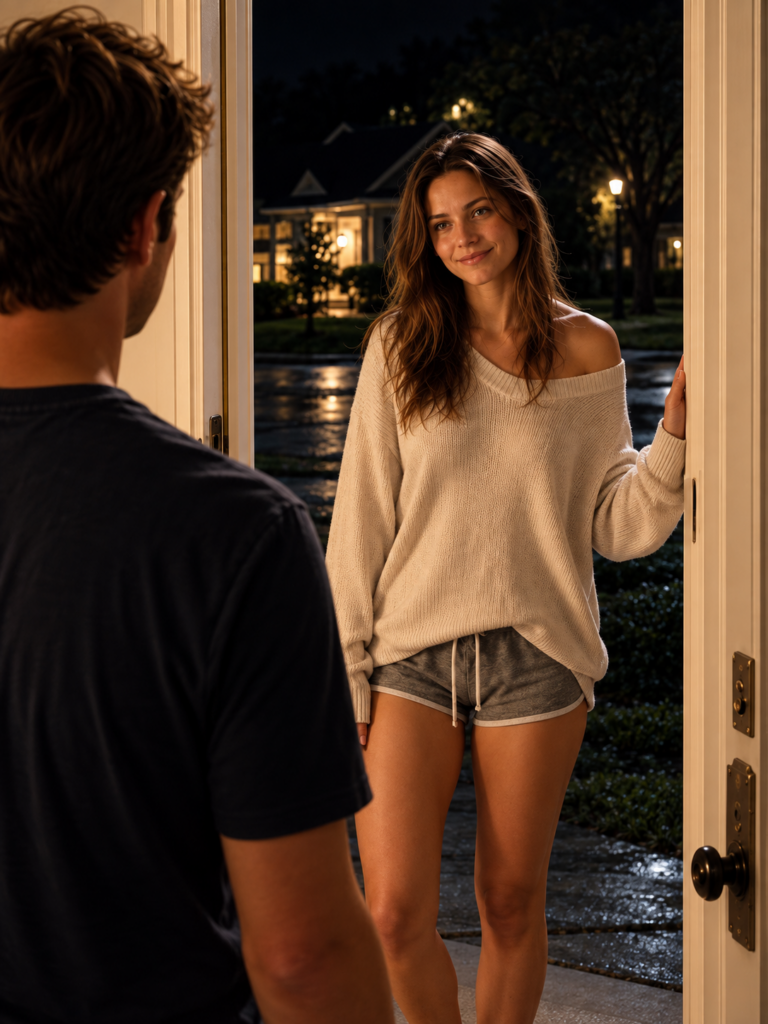
Then, at two in the morning, someone knocked on my door.
I opened it, and Hannah was standing there, holding a small box in both hands.
“Your present is here,” she said, as if it were completely normal.
Maybe I should back up a little.
My name is Ryan Foley. I’m thirty-six years old, and I live in the left half of a duplex on Maple Drive in Denver, Colorado.
I work as a freelance architect. Most of my projects are residential, the kind where people send me pictures of houses they found online and ask me to somehow make their small homes look like coastal cottages.
I don’t mind the work. It keeps me busy, and being busy is something I’ve learned to appreciate over the past two years.
Two years ago, I got divorced. Her name was Brittany. We were married for four years, and I spent most of that time trying to manage her moods more than I focused on design.
She made everything revolve around her. Every conversation, every plan, every room she walked into.
When we finally separated, there wasn’t any drama. One night, she told me she felt like I wasn’t enough for her, and honestly, I didn’t have the energy to argue with her by then.
We signed the papers, divided everything evenly, and I moved into this duplex because it was available, affordable, and nobody I knew lived nearby.
That last part was what appealed to me.
After the divorce, I didn’t fall apart. I just became quiet.
I stopped answering calls I didn’t have to answer. I stopped going to events I didn’t want to attend. Birthdays, holidays, Saturday dinners with people who spent the whole time asking whether I was dating anyone.
I got rid of all of it.
Not because I was broken, but because I was tired of pretending otherwise.
And over time, the quiet started to feel comfortable. Like a room you had finally finished arranging. Nothing extra, nothing missing.
Most nights looked the same. I would finish whatever project I was working on around six or seven, open a beer, maybe put on a game if something good was on, and sit with my sketchbook until I felt sleepy enough to go to bed.
On weekends, I would drive out to Red Rocks or Morrison just to be somewhere that felt bigger than my problems.
I wasn’t unhappy.
I was just quiet, and I thought that was enough.
Then Hannah moved in.
Eight months ago, the right half of the duplex got a new tenant. I heard her before I saw her.
The sound of boxes being set down, a hand truck rolling across the porch, and a voice on the phone saying, “No, the couch goes against the far wall. I already measured the space.”
When I finally stepped outside to get my mail, she was sitting on her front step with a glass of water, catching her breath.
She looked at me and smiled.
Not the automatic polite smile, but the kind that reaches the eyes, the kind that makes you feel like you’ve actually been noticed rather than simply passed by.
“I’m Hannah,” she said. “Looks like we share a wall.”
I nodded. “Ryan. Let me know if you need anything.”
That was it.
I went back inside and assumed she would be the kind of neighbor I waved to once a week without ever really knowing.
I was wrong about that.
Hannah Doyle was thirty-one years old and made a living as an illustrator and handmade card designer.
She ran a small online shop, the kind with a loyal customer base that kept her busy all the time.
Sometimes I could hear her working late at night through the wall. Soft music, scissors cutting through thick paper, the sound of a chair moving away from a desk.
She had set up a workspace in her half of the house, a table near the window where the morning light came in best.
I know this because she kept her curtains open most mornings, and I could see the table from my kitchen while I made coffee.
I wasn’t staring.
The layout of the duplex didn’t leave you much choice.
During those first few weeks, our interactions stayed limited. She knocked once to borrow a measuring tape. Another time, she left a note on my door saying a package had been delivered to her side by mistake. I brought it over.
She thanked me, and that was it.
But even in those brief exchanges, I noticed something about Hannah that was different from most people I had known.
She didn’t fill silence with noise. She didn’t ask questions just to keep a conversation going.
When she looked at you, she actually looked at you.
And when she said something, she meant it.
Nothing wasted, nothing artificial.
I wasn’t used to that.
Brittany had always spoken like she was performing. I didn’t realize then how much that difference would matter.
Our first real conversation happened about six weeks after Hannah moved in.
I was sitting on the porch one evening, my sketchbook in my lap, working on a roof design that had been fighting me all day. The angle of the overhang looked clean on paper, but something about the proportions kept bothering me. The kind of thing a client would never notice, but I couldn’t ignore.
Hannah came outside with a cup of tea and sat on her side of the shared step.
She didn’t say anything for a while.
I could smell chamomile and something faintly sweet coming from her cup.
Then she looked at my drawings and said, “That overhang is going to fight the wind direction if you keep it at that angle.”
I looked at her. “Do you know architecture?”
She shook her head.
“No, but I draw buildings all the time for my cards. You learn things after a while.”
I stared at her for a moment, then looked back at the drawing.
She was right.
I adjusted the angle, and suddenly the whole design settled into place like a piece fitting smoothly where it belonged.
She took a sip of tea and didn’t say another word about it.
That was the moment I started paying attention to Hannah Doyle.
Over the next few months, those porch conversations became a rhythm I hadn’t planned on.
Not every night, but often enough that I started noticing when she wasn’t there.
A Tuesday with an empty step felt different from a Tuesday when she was sitting there, cup in hand, legs crossed, watching the light fade over the rooftops.
We talked about work, about Denver, about nothing in particular.
She told me she had moved from Portland because she needed a change of pace, a new city with different air.
I told her I had moved into the duplex because I needed a little bit of everything.
She nodded at those words as if she understood them on a level most people didn’t, as if she had her own version of “a little bit” and had made peace with it too.
Hannah had a habit I didn’t fully understand at first.
She made these paper lanterns, small ones shaped like stars, folded from thick cardstock with such precision that they almost looked machine-made until you held one and felt the softness of the paper, the slight imperfections that proved it had been made by hand, carefully and deliberately.
Sometimes she hung them outside her door, or I would see a new one sitting on her worktable through the window.
I asked her about them once.
She said she made them for people she cared about, one at a time, always by hand.
“Not for customers?” I asked.
She shook her head. “No. These are personal.”
She didn’t explain further, and I didn’t push.
But I noticed she had never hung one outside my door.
And for reasons I couldn’t quite explain, I noticed that absence more than I should have.
By the third month, I started noticing little things.
Hannah knew I drank my coffee black because one morning she brought me a cup without asking how I took it. She just slid it across the porch divider like it was nothing.
She knew I worked late on Thursdays because around ten she would text and ask if I had eaten.
And the question never felt intrusive.
It was just attention.
She knew my favorite beer because I mentioned it casually while we were talking about a brewery on Colfax, and a week later, six cans appeared on my doorstep with a sticky note that read, “Housewarming gift. Eight months late.”
I laughed at that, but underneath the laughter, something shifted.
Nobody had paid that much attention to me in years.
Not even when I was married.
Especially when I was married.
And that thought bothered me more than I wanted to admit because it raised a question I wasn’t ready to answer.
If this was what it felt like to be noticed, then what had I been settling for before?
Then came the night of the storm.
Late October. A Thursday.
The power went out in our neighborhood around nine, and I was sitting in the dark with a flashlight and an elevation drawing I still hadn’t finished.
The rain was hitting the windows hard enough to make the glass shake.
I heard a knock at the door.
Hannah was standing there holding two candles and a deck of cards.
“My phone is dead, and I can’t work,” she said. “Do you want company, or do you want me to go?”
I should have said I was fine.
That was my usual answer.
Instead, I stepped aside and let her in.
We sat on my living room floor for three hours while the storm beat against the windows and the candles cast long shadows across the walls.
We played cards, rummy, then some game she invented on the spot that I’m still not sure had any real rules.
She told me about the places she had lived before Portland, about her family, about the online shop she had built from nothing during a period of her life when nothing else seemed to be working.
I told her about the divorce.
Not the details, just the shape of it.
What it feels like when you realize that the person you committed your life to sees you as nothing more than a supporting character in their story.
Hannah listened without interrupting.
No filler words, no automatic sympathy.
Real listening.
The kind that makes you realize how rare it is.
When I finished, she stayed quiet for a moment.
Then she said, “You’re not a supporting character, Ryan. You’re just someone who got used to standing in the background.”
I didn’t sleep well that night.
Not because of the storm, but because for the first time in two years, someone had seen me clearly, and I didn’t know what to do with that.
In the weeks that followed, I pulled back.
Not dramatically.
I just stopped lingering on the porch. I answered her messages more slowly, kept conversations shorter, and made sure I was inside before she came out in the evenings.
I told myself it was smart.
That getting close to someone again was a risk I didn’t need to take.
That I was fine with the version of my life I had built, the quiet one, the one without surprises or expectations or anyone close enough to disappoint me.
But Hannah didn’t push.
She didn’t ask why I had become distant. She didn’t come to my door demanding an explanation. She didn’t make some passive-aggressive comment about how I had changed.
She just kept being Hannah.
A cup of tea left on my doorstep when the mornings got cold. A quick wave when we happened to cross paths while taking out the trash. A message on an ordinary Tuesday saying, “There’s a documentary about Frank Lloyd Wright on Channel Nine tonight. Thought of you.”
She gave me space without making me feel punished for needing it.
And that, more than anything else, was what made me start trusting her.
Because I had been surrounded by people who used distance as a weapon, and Hannah didn’t do that.
She did exactly the opposite.
She was proving that closeness didn’t require surrender.
I found out much later that she had noticed my birthday on a package that had accidentally been delivered to her side of the duplex during her second month there.
She never mentioned it.
She never asked about it.
She wrote it down somewhere and quietly kept it, like a seed she wasn’t sure when to plant.
I didn’t know that then.
There was one last moment before everything changed, and I need to tell it accurately because it matters.
It was mid-November, a few weeks before my birthday.
I came home from a work meeting that had gone badly, the kind where the client changes everything at the last minute and then blames you for the schedule being behind.
I sat at my kitchen table with a beer I wasn’t really drinking, staring at a set of plans I didn’t want to look at, feeling the kind of exhaustion that has nothing to do with sleep.
I heard a soft knock at the door.
I opened it, and Hannah was standing there holding a small brown paper bag.
“Snickerdoodles,” she said. “I made too many. Want some?”
I took the bag.
The paper was warm. The cookies smelled like cinnamon and butter, and from their uneven shapes, I could tell she had made them herself, not from some ready-made package.
“How do you always know when to show up?” I asked.
She tilted her head slightly.
“I don’t always know. I just pay attention.”
She smiled, the same smile from that first day, the one that reached her eyes, then went back to her side.
I stood in the doorway for a long time after she left, holding the bag of cookies, thinking, maybe for the first time, that the quiet I had been protecting myself with wasn’t actually peace.
Now I need to tell you about Brittany.
In early December, about a week before my birthday, my phone rang.
I didn’t recognize the number, but I answered anyway.
It was a law office calling about the house Brittany and I had owned together during our marriage.
We had put it up for sale as part of the divorce settlement, and it had been sitting on the market for more than a year without any serious offers.
Apparently, there was a buyer now, and they needed additional signatures from both of us to complete the transfer.
“Routine paperwork,” the lawyer said. “Nothing complicated.”
Brittany was supposed to be in Denver to sign her part, and she could stop by my place so we could finish both sets of paperwork together.
She arrived on a Wednesday afternoon.
I hadn’t seen her in more than a year, and the moment she walked into my side of the duplex, I remembered exactly why I hadn’t missed her.
Brittany had a way of filling a room, not with warmth, but with pressure.
She talked quickly, laughed loudly, and watched everything with an intensity that made you feel like every word you said was being stored for later use.
She looked around my place with an expression that suggested she was already forming opinions, already finding things to criticize.
“Cozy,” she said.
She didn’t mean it as a compliment.
We went over the paperwork at my kitchen table. It was supposed to take twenty minutes.
Brittany stretched it into an hour and a half, asking questions she already knew the answers to and circling back to subjects that had nothing to do with the house.
She asked about my work, how freelancing was going, whether I was making enough to keep the place.
I gave her short answers.
She didn’t like short answers.
She never had.
Short answers meant she wasn’t controlling the conversation, and Brittany needed to control every conversation.
Then she saw Hannah.
It wasn’t dramatic.
Hannah was coming back from a walk, passing my kitchen window, when she glanced over and gave me a small wave.
Just a wave.
Nothing more.
I waved back without thinking.
The kind of automatic reaction you develop when someone has been part of your daily life for months.
Brittany’s eyes followed the entire exchange like a hawk spotting movement in a field.
“Who’s that?” she asked.
“My neighbor,” I said.
“She waved at you like she knows you.”
“She does know me. We share a wall.”
Brittany smiled in that way she had.
The kind that looks pleasant if you don’t know her but hides something colder underneath.
Something calculating.
She didn’t say anything else about Hannah that day.
She signed the remaining papers, told me it had been good seeing me, then left.
I walked her to the door, closed it behind her, and assumed that was the end of it.
It wasn’t.
Three days later, Brittany called me.
She said she had left a folder at my house and needed to come get it.
I checked the kitchen, the living room, and the table where we had worked.
She hadn’t brought a folder that time.
But she came over anyway, and she didn’t even pretend the visit was about paperwork.
She sat on my couch, crossed her legs, and looked at me with an expression I had seen hundreds of times during our marriage.
The one that meant she had something to say and was going to enjoy saying it.
“I talked to some of your neighbors when I was here the other day,” she said casually, like she was talking about the weather. “That woman who lives next door, Hannah, she’s been asking around about you.”
I frowned.
“What do you mean, asking about me?”
“About your work, your business, how much money you make. Two or three people on the street mentioned it to me.”
She shrugged, the way someone shrugs when delivering a blow and wants it to look accidental.
“I just thought you should know. Some people are friendly because they’re nice. Others are friendly because they’ve done their homework on you.”
She let the words hang there.
She let them fill the room the way she had always filled rooms, not with warmth, but with weight.
I wish I could say I saw through her intentions immediately.
That I recognized the game, ignored her, and moved on.
But I didn’t.
Brittany knew exactly where my weak spots were.
She had spent four years mapping them, testing them, figuring out which ones could be exploited and which ones could be ignored.
The fear of being used.
The fear of trusting the wrong person and finding out too late.
The fear that someone’s kindness was nothing more than a strategy wearing a friendly face.
She didn’t need to prove anything.
All she had to do was plant the idea and let me water it with my own doubts.
And that was exactly what happened.
That night, after Brittany left, I sat at my kitchen table and did something I’m not proud of.
I went through my phone and reread every message Hannah had ever sent me.
Every question about how I was doing, every recommendation, every little message that had once felt warm suddenly looked different under the light Brittany had cast over them.
I looked at the note from the six-pack still stuck to my fridge.
“Housewarming gift. Eight months late.”
And I thought, How did she know what kind of beer I liked?
I thought about the bag of snickerdoodles she had brought me the week before.
How did she know I was having a bad day?
Was she watching me?
Was she listening through the wall?
Was she gathering information about me the way an investor studies a company before deciding whether to buy it?
The thoughts were ugly, and I knew they were ugly, but I couldn’t stop them.
That’s what doubt does when it gets planted in soil that has already been turned over.
It grows quickly because the ground is already prepared.
Over the next few days, I replayed every interaction I’d had with Hannah through that poisoned filter.
The coffee.
The messages.
The way she always seemed to show up at exactly the right moment with exactly the right thing.
What if Brittany was right?
What if all of it was calculated?
What if the woman on the other side of my wall had been building a case file on me this entire time, and I was simply too lonely and too grateful to see it?
I hated myself for thinking it.
But I couldn’t stop.
I pulled away again, harder this time.
When Hannah texted me, I answered with one word or didn’t answer at all.
When I saw her on the porch in the evening, I lowered my head and went straight inside.
When she knocked one evening to offer me a plate of food because she had made extra, I opened the door, took the plate, said thank you, and closed it before she could say anything else.
I saw the look on her face in that half-second before the door shut.
She looked like someone who had just been slapped by a hand she never saw coming.
Confusion first, then something worse.
The quiet kind of pain that doesn’t make a sound.
It just settles in the eyes and stays there.
I told myself I was being smart.
I told myself I was protecting myself.
I was lying.
The truth hit me five days later, on my birthday, at two in the morning, when Hannah knocked on my door holding that small box.
I almost didn’t answer.
I was on the couch, three beers in, half-watching a late-night replay of a game I didn’t care about.
I thought about pretending I was asleep.
But the knock came again, soft but steady, patient in a way that felt deliberate, and something inside me moved before my mind could build another wall.
I opened the door.
She was standing there holding a box about the size of a paperback book, simply wrapped in brown kraft paper.
She didn’t look angry about the way I had been treating her.
She didn’t look wounded or expectant or performative.
She just looked like herself.
“Your present is here,” she said.
“How did you know it was my birthday?” I asked.
“A package of yours was delivered to me by mistake about six months ago. Your birthday was printed on the label.”
She paused.
“I wasn’t going to say anything, but I saw your lights were still on, and I thought maybe you shouldn’t be alone tonight.”
I looked at the box in her hands.
“You didn’t have to do that.”
“I know,” she said. “Open it.”
I took the box inside.
She didn’t follow me.
She waited on the porch as if she understood that the invitation had to come from me.
I removed the wrapping paper.
Inside was a small paper lantern shaped like a star, handmade with tight, clean folds, glowing softly from a tiny LED light hidden in the center.
The same kind I had seen on her worktable through the window.
The kind she had told me she only made for people she truly cared about.
Not customers.
Not acquaintances.
People who mattered.
I stood there for a long time holding that lantern, and everything Brittany had said collapsed under the weight of what was actually in front of me.
This wasn’t a strategy.
It wasn’t calculation.
This was a woman who had quietly noticed a date on a package six months earlier and had spent time, real time, making something with her own hands for a man who had been treating her like a stranger for a week.
Not because she wanted something from me.
Because she knew what it felt like to spend a night like this alone.
I went back to the door.
Hannah was still standing there on the porch, her hands at her sides, watching me with steady eyes.
“Come in,” I said.
She hesitated.
“Are you sure?”
“Yeah. I’m sure.”
She came inside, and we sat on the couch.
I asked her what I should have asked weeks earlier instead of listening to someone who had never told me the truth about anything.
“Why do you do all of this? The coffee, the messages, knowing when I’m having a bad day. Why do you care about me so much?”
She was silent for a moment.
Then she said, “My father died six years ago, on the exact date of your birthday. He was fifty-three. Heart attack. No warning. Just gone. One phone call at four in the morning, and the shape of my entire life changed. That first year, I spent the anniversary alone because I thought that was what I was supposed to do. Deal with it. Be strong. It was the worst night of my life. Not because of the grief, but because I chose to carry it alone when I didn’t have to.”
She looked at me.
Her eyes were steady, but I could see the cost of what she was saying.
The weight sitting just behind that calm.
“I don’t do this because I researched you, Ryan. I don’t care about your business or your income or any of that. I’ve never talked to your neighbors about anything except the weather and trash pickup schedules. I do this because I know what it feels like to sit alone on an important night and convince yourself that you’re fine when you’re not.”
She paused.
“The lantern is what I make for people I care about. I don’t make them for customers. I don’t make them for neighbors I wave to. I made that one for you because you’re the first person in a long time who made me feel like I wasn’t carrying everything alone.”
I didn’t say anything for a while.
I just sat there holding the star lantern, watching the light move across the walls of my living room, drawing soft shapes over surfaces I had looked at thousands of times but had never really seen before.
Then I said, “Brittany told me you were asking the neighbors about my finances.”
Hannah blinked.
“I’ve never talked to any of your neighbors about anything like that. Not once.”
I believed her.
Not because she said it convincingly or because she looked offended.
Because I had spent eight months watching this woman, and she had never been anything other than exactly who she appeared to be.
No performance.
No hidden angles.
Just someone who showed up honestly and meant what she said.
“I’m sorry,” I said. “I should have asked you first instead of shutting you out.”
“You should have,” she said.
Then, more softly, “But I understand why you didn’t.”
We sat there until almost four in the morning, talking about nothing and everything at once.
I told her about my divorce in detail this time.
Not just the shape of it, but the sharp edges.
The things Brittany had said that I could still hear in quiet moments.
How it had made me suspicious of anyone who got too close.
She told me about her father, about the years that followed, about why she left Portland and started over in a city where nobody knew her name.
And somewhere in that conversation, in the space between her honesty and mine, the wall I had spent two years building came down.
Not all at once.
Not loudly.
Quietly.
The way a season changes without you noticing.
When she left that night, she stopped at the door and looked at me.
“Happy birthday, Ryan,” she said.
I looked at the star lantern on my table, still glowing softly in the dark room.
“Thank you,” I said.
And I meant it for more than just the gift.
I need to be honest here.
I didn’t wake up the next morning and suddenly become a different person.
I didn’t show up at Hannah’s door with flowers and some grand speech.
Real things don’t work that way.
Real things are slow.
They’re built in ordinary moments that don’t seem special until you line them all up and realize they were everything.
The first thing I did was deal with Brittany.
She called me two days after my birthday, claiming there was another document that needed to be reviewed.
I told her the lawyer could mail it.
She insisted.
I said, “Brittany, I know what you did. You lied about Hannah to mess with my head, and it almost worked. But it didn’t. And I want you to stop making up excuses to contact me.”
There was a long silence on the other end.
Then she said, “You’re making a mistake.”
“Maybe,” I said. “But it’s my mistake to make.”
I hung up.
She never called again.
The second thing I did was slower, but more important.
I stopped pulling away from Hannah.
I started showing up.
Not theatrically.
Not with declarations or gestures designed to impress.
The same way she had been there for me all along.
Quietly.
Consistently.
I brought her coffee one morning, black with one spoonful of sugar, exactly the way I had seen her make it.
One evening, when the sunset turned the Denver sky copper, I sent her a message.
“You should come outside and see this.”
I sat on the porch when I knew she would be there, and I stayed instead of retreating inside.
Small things.
The kind that don’t make headlines but build a life.
Christmas came.
She invited me to dinner.
Nothing fancy.
Just roasted chicken with potatoes and a bottle of wine she had been saving.
We ate at her small kitchen table while the paper lanterns glowed along the windowsill.
I noticed a row of star lanterns hanging on the wall behind her workspace.
Every one was different.
Every one had been made for a specific person.
She told me the stories behind some of them.
One was for a college roommate who had helped her through a difficult semester.
Another was for a cousin who had driven eight hours through the night to attend her father’s funeral.
She said she rarely made them.
Only when it mattered.
I thought about the one she had given me, now sitting on my kitchen counter where I saw it every morning.
And I understood its weight in a way I hadn’t fully understood before.
January came, and we started working side by side some evenings.
I would bring my sketchbook to her table while she worked on her illustrations, and we would sit in comfortable silence for hours.
Sometimes she would lean over and point to something in my drawings the same way she had that first night on the porch.
Sometimes I would watch her fold paper with a precision that made my architectural drawings look messy.
We didn’t define what we were.
We didn’t need to.
It was building itself evening after evening, like a house rising so slowly that you don’t notice the walls until you find yourself standing inside them.
In February, I fixed a leak in her bathroom ceiling.
She made me dinner as a thank-you, and afterward we sat on her couch watching a documentary about a bridge in Norway.
Halfway through the movie, she fell asleep and rested her head on my shoulder.
I didn’t move.
I sat there for forty-five minutes, barely breathing, thinking about how the most meaningful moments of my life were the ones where nothing dramatic happened.
Spring came, and we spent a weekend repairing the shared porch together.
I handled the structural work, replacing posts and leveling floorboards.
She painted the railing a quiet shade of blue that she said matched the Colorado sky at six in the evening.
I told her that was subjective.
She told me to trust her.
I did.
She was right.
While we worked, sawdust on our arms and paint on our hands, she told me she had signed a new wholesale contract for her card line, a big deal with a national retailer.
I told her I had landed my first commercial project, a small brewery in Capitol Hill that wanted an expansion designed.
We celebrated with takeout and cold beer on the freshly painted porch, sitting on the steps we had just rebuilt together.
And for the first time in a long time, I felt like I was exactly where I was supposed to be.
Summer.
She met my mother when she flew in from Tampa for a weekend visit.
They got along immediately, the way two people do when they recognize the same kind of quiet steadiness in each other.
Fall.
I started leaving my door open in the evenings so she could come and go freely.
She started keeping an extra set of art supplies on my kitchen table, pencils, kraft paper, and the bone folder she used for creasing.
The line between her apartment and mine faded until there wasn’t really a line anymore.
Then December came around again.
My birthday.
I spent the whole day working on the brewery project, finishing elevation details, sending emails, the usual routine.
But underneath all of it, I was watching the clock.
Not because I was anxious.
Because I was waiting for two in the morning with a kind of anticipation I hadn’t felt in years.
At eleven, I sat on the couch with a few bottles of beer and some chips, the TV playing quietly.
The same setup as the year before.
But nothing about it felt the same.
At two in the morning, I heard the knock.
Soft but steady.
The same rhythm as the year before.
I was already standing at the door.
I opened it before she could knock a second time.
Hannah was there, holding a small box wrapped in brown kraft paper.
She looked at me and smiled.
“Your present is here,” she said.
I raised my hand.
In it was a paper lantern shaped like a star.
I had spent three weeks learning how to fold it, watching tutorials at my desk between client calls, crumpling failed attempts into the trash, giving myself two paper cuts, and starting over until I finally got it right.
It wasn’t as precise as hers.
The folds were slightly uneven.
The proportions weren’t quite right.
The paper weight wasn’t exactly right either.
But the light inside it was steady.
Hannah looked at the lantern in my hand, and her expression changed.
Not dramatically.
Softly.
Like the sky changing when clouds move and the light comes through.
Like someone who had been carrying something heavy for a long time and was finally allowed to put it down.
“You made it?” she asked.
“It took me about forty tries,” I said. “You make it look easy.”
She carefully took it from my hand and held it up, slowly turning it.
The light moved across her face.
“It’s perfect,” she said.
“It’s crooked.”
“It’s perfect,” she said again.
I stepped toward her and kissed her.
Right there in the doorway at two in the morning, with the cold December air slipping inside and the glow of two paper stars between us.
It wasn’t dramatic.
It wasn’t cinematic.
It was just real.
I’m telling you this story from a place I never thought I would reach.
Not because the road was difficult, although it was.
But because I spent so long convincing myself that I didn’t need anyone that I almost missed the person who had been quietly proving me wrong for months.
There’s a paper star hanging outside our door now.
Not on my side.
Not on hers.
On the door itself.
She made a new one this year, bigger than the others, with our initials folded into the design in a way I still don’t understand no matter how long I look at it.
I told her that was cheating.
She told me it was engineering.
I didn’t argue.
She was right again.
Some gifts don’t come wrapped in shiny paper or delivered at a scheduled time.
Some gifts show up at two in the morning, carefully carried by someone who noticed a date on a package six months earlier and decided you were worth remembering.
Not because of what you have or what you can offer.
Because of who you were when you thought nobody was watching.
I spent years believing loneliness was the same thing as peace.
It isn’t.
Peace isn’t the absence of people.
It’s the presence of the right person.
And sometimes, the right person isn’t the one you’re looking for.
Sometimes she’s on the other side of the wall, waiting for you to stop hiding and open the door.


