
“`text
Chapter 1
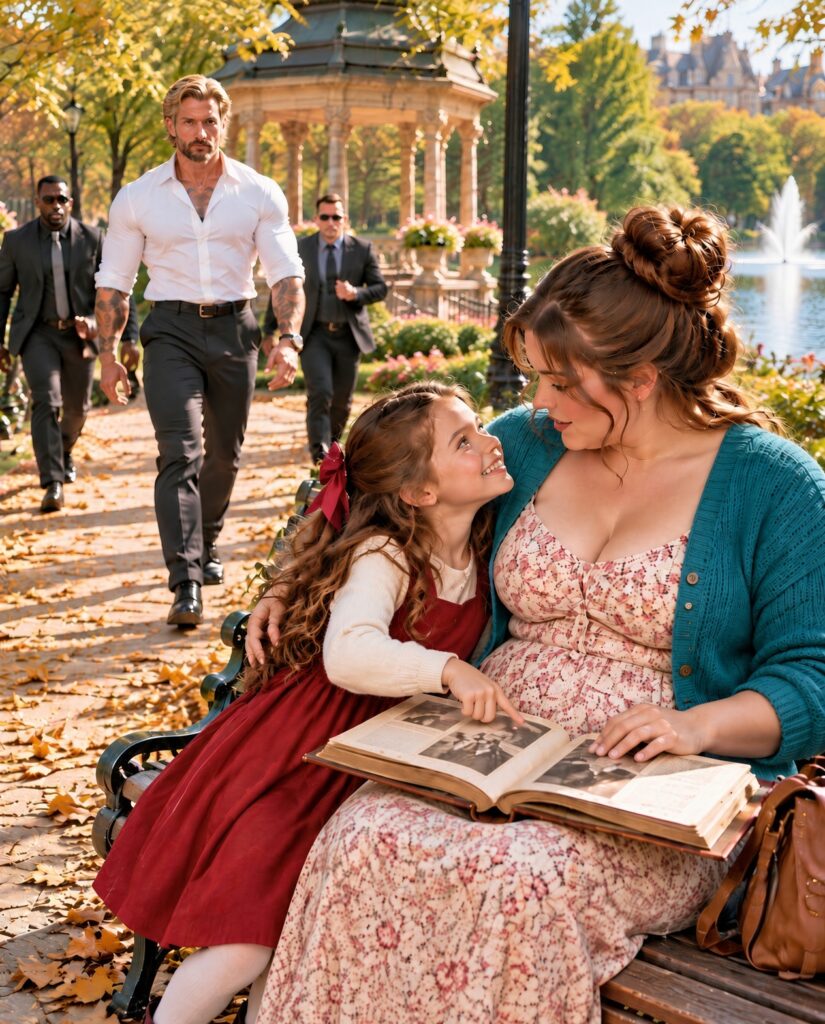
Sunday afternoon in Dearing Oaks Park, and seven-year-old Wren Kessler — who has not let a stranger touch her since her mother died — tears free of her father’s hand and runs.
She runs straight at a woman mending an old photo album beneath a maple tree and locks both arms around her waist.
The woman freezes. The two bodyguards freeze. And Damien Kessler, a man the entire city steps aside for without being asked, stops dead — because he alone understands exactly why his daughter chose her.
On the child’s wrist: a scratched silver star charm. Inside the stranger’s album: the same star.
Wren will not let go. “No,” she whispers.
And somewhere behind the trees, an abandoned greenhouse waits for the one man who never goes inside.
—
I was sitting under a maple tree in Dearing Oaks Park, mending the spine of somebody else’s family album, when a little girl let go of her father’s hand and ran at me.
Not toward me. At me. Like a small, quiet missile in a pale blue coat.
I had a curved needle pinched between my fingers and a bone folder balanced on my knee and no time at all to move either one. She hit my side and wrapped both arms around my waist and pressed her cheek into my cardigan, hard, the way you press into the last warm thing you have.
I went completely still. I’ve learned that much — when a child you don’t know grabs onto you, you do not move, you do not breathe too loudly, you do not become one more adult who doesn’t know what to do.
“Wren,” a man called across the lawn.
Half the park looked up. She didn’t.
I looked up instead, and that’s when I saw him.
He was coming toward us at a walk that was too controlled to be casual. Tall. Platinum hair brushed back off a face that looked like it had been carved by somebody who didn’t like curves. White shirt, sleeves rolled to the forearm, faded Latin script inked down both arms, and old scars underneath the ink the way old scars always sit underneath ink. Two men had been walking behind him. They had stopped the second he lifted one hand.
Nobody in that park had to be told who he was. You could see it in the benches emptying. In the way a man on a bicycle changed lanes twenty feet early.
I didn’t know his name. I want that on the record. I didn’t know his name.
He stopped three feet away. Not closer. Three feet exactly, like it was a number he’d chosen in advance.
“Sweetheart,” I said to the girl, quietly, into the top of her head. “I think your dad wants you back.”
She shook her head against my ribs. “No.”
The man crouched. Not close enough to grab her — that mattered, I noticed it even then, the way he refused to turn it into a tug-of-war. He said something soft in Italian, an endearment, and only then did she turn her face an inch.
I found out later that she hadn’t voluntarily spoken to an unfamiliar adult in weeks.
Then his eyes dropped.
Not to me. To the album open across my lap, the cracked spine I’d been sewing, the customer’s family smiling up out of worn tissue paper. And something moved in his face that I can only describe as a door closing softly rather than a door slamming.
Because the little girl’s sleeve had slipped back when she reached for the page. And around her wrist was a thin silver bracelet with a star-shaped charm hanging off it, so scratched and worn that you could tell it had been touched about ten thousand times.
And taped inside that album — the album I’d been repairing for a stranger named Mrs. Halloway — was a pressed paper star. Same shape. Same five points.
Same star twice, in two different lives, ten feet apart, in a public park.
He saw me see it. That’s the part I keep coming back to. He saw me see it, and he reached over and gently, almost tenderly, pulled Wren’s sleeve down over the bracelet — and that was it. That was the whole conversation. A question asked and a door closed in the same gesture.
Then the girl stepped back and looked up at me with this face — dark lashes, guarded, the face of a child who already knows adults can disappear and simply choose to. She looked at the open album again and said, very quietly, “My mom had one.”
Five words. That’s all.
And her father’s face didn’t break. It didn’t twist. It went still — completely still, the way water goes still when something has just gone under it — and that stillness told me more than crying would have. He looked down at the album cover like he was reading a page that wasn’t in the park at all.
I’ve been around grief. I bind it back together for a living; half the albums that come into my shop are someone trying to hold a dead person’s face in place. I know what it does to a room.
This was different. This was grief with a fence around it.
He thanked me — formally, precisely, like a man signing a receipt — and took her hand and walked her back across the lawn. She looked back at me twice. The second time, he let her.
I sat there long after they were gone, needle still pinched in my fingers, thread trailing off into the grass, and I told myself the thing had unsettled me because of how he looked.
It wasn’t that.
It was the running. It was the fact that she had picked me, out of every safe adult face in that park, and I don’t mean that as flattery. I mean it as a problem. Girls like that don’t run toward people. Girls like that have learned not to.
And as they reached the path, I heard her ask him — small voice, carrying the way children’s voices do when the wind is right —
“Can we see the book lady again?”
He stopped walking. Half a second. Then kept going toward a black SUV with windows so dark they showed me nothing at all.
He didn’t answer her.
I found out why about a week later, when a black SUV was parked under the elms again, and I stood at the edge of the field with a canvas bag on my shoulder and my heart doing something stupid and warm in my chest, and a seven-year-old in two braids looked up at her father and waited for a nod before she came running.
I also found out something else that day. On the north edge of the park, past the iron fence, past where anybody bothered walking — there’s an abandoned greenhouse. Glass clouded, panes missing, ivy crawling in.
And every single Sunday, without fail, Damien Kessler stops thirty feet from the gate and stands there.
He never goes through it. He never touches the door. He just stands and looks at it like it’s an appointment he made with someone who isn’t coming.
Chapter 2
The fourth Sunday, I finally saw what he keeps in his pocket.
Wren had wandered off to collect red leaves. He was standing at his usual thirty feet, back to me, shoulders going rigid the way they always did in front of that greenhouse. Then he reached into his trouser pocket and brought something small out into the light.
A silver star charm. Worn smooth in the same two places. Not a copy — the twin of the one on his daughter’s wrist.
He turned it once between his thumb and forefinger and closed his fist around it.
I could have walked over. I could have asked. Everything in me was leaning toward that question like a plant toward a window, and I made myself look down at my bag and keep buckling it instead. When I looked up, the charm was gone and he was watching me — and I understood that my not asking had bought me something.
He told me his wife’s name two weeks later. Camille. Four years gone. Wren was three. He never said how. I never asked.
But here’s what I can’t put down: a man doesn’t stand outside a locked greenhouse every Sunday holding a dead woman’s charm unless the door means something specific.
I think Camille died in there.
And I think Wren knows.
Chapter 3
I never said it out loud to him.
Some suspicions you carry the way you carry a lit candle through a draft — cupped, careful, aware that the wrong breath puts it out and leaves you standing in the dark holding nothing. All that week the thought sat in me, and all that week I kept my hand around it.
Thursday evening he called just before I turned the sign on the shop door. Not a text. He doesn’t text. He calls the way other men open a door — deliberately, as if announcing himself.
“Several damaged albums,” he said. “And books. At a property in Cape Elizabeth. Can you look at them.”
He did not say it was important, which is exactly how I knew it was.
He drove. That mattered — I’d learned by then that when Damien drives himself, he wants the twenty minutes of road with nobody in the back seat listening. The houses thinned. The pines went dark and closed ranks. Then the Atlantic appeared between the trunks, gray and restless under a sky the color of wet slate, and he turned onto a narrow road that led to a cottage perched above the bluff.
It was nothing like the Kessler estate, where stone walls and cameras made the whole property feel like an argument you weren’t invited into. This house was small. Older. Cedar shingles silvered by salt air. A modest porch, pale blue shutters faded unevenly by years of wind.
“This doesn’t feel like one of your houses,” I said.
His hand paused on the key. Half a second. “It isn’t.”
That was all.
Then he opened the door, and I understood what he’d meant, and I wished he hadn’t brought me.
A photograph of Camille stood on the shelf by the entryway — dark-haired, early thirties, with an open smile and eyes that looked like they’d started laughing before the rest of her face caught up. A navy coat still hung from a brass hook behind the door, as if its owner might come back from the beach in an hour and reach for it. Children’s books were stacked in a crooked pile beside the sofa, covers softened by small hands, one still carrying a faded sticker with WREN written across it in round letters.
The air smelled of old wood and sea salt and the dry stillness of rooms opened too rarely.
I had expected water damage. I had not expected preservation.
Nothing looked abandoned. It looked paused. That was worse. The folded throw blanket. The ceramic mug on a kitchen shelf. The family photographs arranged with almost obsessive care.
“This was Camille’s,” I said softly.
“Ours,” he corrected.
But the word cost him something. I heard the price in it.
The leak had started near an upstairs dormer after days of hard rain, and by the time a neighbor noticed the discoloration under the window, moisture had reached two storage boxes in a bedroom closet. I carried them to the dining table and began separating the contents. Most of the books could be saved. The albums worried me more — old adhesive and photographic paper fuse if you handle them wrong.
He stood across the table and listened with unnerving precision. He asked which pages shouldn’t be separated yet. He asked whether freezing a damp album would do more harm than good. He was not performing interest.
But I noticed where his eyes drifted. Every album with Camille in it. In one photograph she sat barefoot on the cottage steps with three-year-old Wren in her lap, both squinting into the sun. In another, Damien himself looked younger and far less guarded, his head bent toward her while she laughed at something outside the frame.
I looked at the man across the table and felt the distance between those two versions of him like something physical in the room.
Four years had not aged his face much. They had aged the way he occupied a space.
We were nearly finished when a truck pulled up outside, and a knock followed. A roofer — middle-aged, weather-reddened, hands broad and cracked from decades outdoors. He stepped in just long enough to say the temporary patch would hold through the next storm and that a full repair shouldn’t wait for winter.
As he left, another figure appeared on the porch.
She came in without knocking. Tall, narrow-shouldered, dark blonde hair cut just above the collarbone, sharp hazel eyes, and the composed look of a woman who had spent her adult life managing problems other people preferred not to admit existed. Her features echoed his around the cheekbones and mouth. But where his face went cold, hers went tired.
“The roofer called me,” she said.
Damien’s expression tightened. “He shouldn’t have.”
“Someone has to answer when the bills arrive.” She pulled off her gloves and looked around the room the way you look at an argument you’ve had too many times. Taxes up. Insurance up. A roof that needed real work instead of another patch. Then she said the thing that had clearly been waiting behind her teeth for years: sell it, renovate it, let Wren use it when she’s older — but decide.
“No,” he said.
“It was Camille’s house. She isn’t living here now.”
“Enough.”
She stopped. One breath. Then, quieter: “You were ready to leave all of this once. After she died, the Toronto plan was finished. Offices. Schools. Housing. Legal restructuring. You were going to move the legitimate side north and take Wren away from everything connected to this life.”
I looked at him before I could stop myself. He had never mentioned Toronto. Not once.
“Then you cancelled it,” she said. “You stopped living here. You moved Wren back to the estate. And you never sold this place and you never changed one thing inside it.”
“This is not your conversation.”
Her face softened into something closer to grief than anger. “That’s the problem. You make sure nothing is ever anyone’s conversation.”
She collected her gloves, gave me an apologetic nod, and left.
The cottage went quiet in a way that had weight. Outside, waves hit the rocks below the bluff, steady as a metronome. Inside, every object seemed suddenly louder. The clock over the kitchen doorway. The refrigerator motor. The dry whisper of paper under my hand.
I crossed the room slowly and stopped beside him. I didn’t ask about Toronto. I lifted one hand and rested it lightly on his forearm, over the rolled edge of his sleeve.
He stepped back before either of us understood he’d done it.
His eyes dropped to the place my hand had been. Then to my face. Something defensive closed behind them.
“You don’t have to fix me,” he said.
I let my hand fall. It stung more than I wanted it to — not because it was cruel, but because it turned everything I had offered into an attempt at repair.
“I wasn’t trying to,” I said.
He went still. No dry remark. No controlled response waiting behind the silence.
I packed my tools, told him which albums should stay untouched until I could collect them properly, and kept my voice professional, because professional was easier than letting him hear disappointment. He walked me to the door and did not explain himself. On the porch, the wind caught my hair and pulled it across my face. At my car I looked back once. He was still standing in the doorway of a house nobody truly lived in.
I drove home with the heater on and my hands too tight on the wheel.
And it wasn’t until I was back in the shop, late, with the lamps on and Mrs. Halloway’s album open in front of me, that I found it.
I’d finished the spine that morning. But that night I turned the album over to check the hinge, and under the pasted-down endpaper — the paper binders glue inside the back cover to hide the cords — the edge had lifted a little in the damp.
Underneath, pressed into the board, was a star.
Not printed. Not stamped. Pressed by hand, the way you press a leaf, the same five points I’d seen on a girl’s wrist in a park. And beneath it, in ink, tiny and deliberate, two letters.
C.K.
I sat there with the lamp buzzing and the rain starting up against the window, and I understood that the album in my hands had been bound by a dead woman.
Chapter 4
I sat on that discovery for three days.
Three days of cold rain sweeping Portland, of water running down the shop windows in thin silver streams, of me telling myself nothing important had happened at the cottage while the silence between Damien and me followed me into every corner of the room. I worked longer than I needed to. I reorganized drawers that had been organized fine the week before. I restored the cracked spine of an eighteenth-century prayer book with such concentration that I forgot lunch twice.
The shop usually settles me. Leather, wheat paste, old paper, the faint cedar smell of the cabinets; brass lamps throwing warm pools onto the long worktable. That week even the familiar things failed.
I kept hearing him. You don’t have to fix me. Kept seeing how fast he’d stepped back from my hand.
I understand grief. You don’t bind other people’s dead relatives into books for a living without learning that grief has borders and that touching them without asking is a kind of trespass. What bothered me wasn’t the boundary. It was the assumption underneath it — that closeness, to him, must be an attempt at repair.
I hadn’t wanted to repair anything. I had wanted him to know that for one difficult second he didn’t have to stand there alone.
And under all of it, the album. C.K. pressed into the board like a secret the book had been keeping for years.
The bell above the shop door rang a little before five. I looked up expecting a customer collecting a repaired hymnal.
Damien filled the doorway.
Rain had darkened the shoulders of his black overcoat and left tiny drops in his nearly white hair. Jaw freshly shaved except for the pale dark stubble starting along the edges. He looked, as always, like a man who had never once in his life been surprised.
Then I saw what he was holding, and the effect collapsed entirely.
A rectangular box covered in handmade cream paper, decorated with tiny pressed blue flowers. The kind of thing you associate with wedding invitations or elderly women who still write thank-you notes with a fountain pen.
He stepped inside, shut the door, and glanced once at the street before looking back at me.
I folded my arms and studied the box with exaggerated seriousness. “Peace offering?”
He looked down at it as though it had appeared in his hands without his permission. “I was told flowers would be more normal.”
“Who told you?”
“My housekeeper.”
Iris Donnelly had helped raise Wren since the day Camille died. Late sixties. Small, silver-haired, and practical enough to criticize Damien Kessler to his face without fearing his reputation — one of maybe three people alive who still spoke to him like he was just a stubborn man.
“And you ignored her,” I said.
“Yes.”
I laughed before I could stop myself, and something in his shoulders finally let go.
He set the box on the worktable and explained that it was actually for Wren, who had filled her last handmade notebook and wanted something sturdy enough for loose pages. I ran my fingers over the paper and recognized good cotton stock immediately — expensive without being showy, the kind of material he must have spent far too long choosing for a seven-year-old.
“So your apology to me is a present for your daughter.”
He considered that. “I was advised that apologizing directly while holding flowers might appear complicated.”
“And complicated terrifies you.”
“No.” His gray-blue eyes met mine. “Being misunderstood is inefficient.”
I shook my head, smiling despite myself. But he didn’t stop there. He said, quietly, that what he’d said at the cottage had been unfair. That he had spent years getting good at recognizing threats, obligations, favors, and expectations, and that he sometimes mistook kindness for something that needed defending.
I didn’t interrupt. He didn’t tell me he was healed, and I didn’t need him to. What mattered was that he’d come back instead of letting silence harden into something permanent.
“I wasn’t trying to fix you,” I said again, softer.
“I know.”
That simple acknowledgment did more than an elaborate apology could have.
We stayed past closing. I showed him how to reinforce the corners of the box so Wren couldn’t destroy it by carrying it everywhere, and he held pieces in place while I worked adhesive into the seams, his big hands absurdly careful around the delicate paper. The ease came back slowly. Neither of us mentioned how close we were standing at the table, or how often the conversation wandered somewhere that had nothing to do with Wren.
He asked about the unfinished ledger on the drying rack. I asked whether he actually understood the sanitation systems his company installed or just employed people who did. He gave me a look that made me laugh, then spent several minutes explaining why badly designed clean-in-place piping leaves residue and dead legs — proving that behind the reputation and the expensive suits was a man who genuinely understood the engineering under his legitimate business.
I liked that more than I expected. I liked that he knew how things worked. I liked that he didn’t pretend ignorance to seem more powerful.
Most dangerously, I liked how ordinary the evening felt.
Which is exactly why the unopened email on my office computer had been getting heavier all day.
I wiped my hands on a cloth and took a slow breath. “There’s something I should tell you.”
He looked at me instantly, with the alertness of a man used to bad news arriving without warning. I almost smiled. Then I explained: a respected document conservation institute in Boston had contacted me after seeing photographs from a restoration I’d completed last spring. They wanted me to interview for manager of binding restoration — supervising a larger team, working with rare collections I would never touch in my little Portland shop. Nearly double what I paid myself. Humidity-controlled workrooms. Specialized washing equipment. A budget where I wouldn’t have to choose between a new press and the shop’s dying heating system.
“It isn’t an offer yet,” I finished. “It’s an interview. But they sound serious.”
He didn’t answer immediately.
That hesitation made my heart move, because for one unreasonable second I thought he might ask what accepting it would mean. For Sundays. For Wren. For whatever unnamed thing had been forming between us on a blanket under a maple tree.
Instead his expression went thoughtful. Almost professionally calm.
“You should take the interview.”
I waited. He stayed silent. Rain tapped the front windows. Somewhere in the back room the old radiator clicked as it warmed.
I gave him several more seconds, because I knew he was a man who chose words slowly.
Nothing came.
“Right,” I said at last. “That’s what I was thinking.”
He nodded once, satisfied he’d given the correct answer.
And from where he stood, anything else would have been selfish. I’d spent years next to a man who tried to make my ambitions smaller, and Damien had listened closely enough to remember every word of it. The last thing he intended to become was another man asking me to shrink myself because my success complicated his life.
What he didn’t understand was that I had never wanted permission to stay. I didn’t want him to ask me to turn Boston down — if he had, I probably would have resented him. I wanted something simpler and infinitely more frightening. I wanted evidence that the possibility of my leaving mattered. I wanted him to ask what the distance would look like. Whether I meant to move for good. Whether Sundays would disappear. Whether Wren would still see me. Whether he would.
I wanted, once, to know that a man could respect my ambition without becoming indifferent to my absence.
Instead he stood by the worktable and handed me exactly the freedom I’d spent years demanding.
Somehow it felt lonelier than I expected.
I hated myself a little for the contradiction, because I knew his answer was generous. But generous and longing are not the same thing.
He noticed the shift in me before he understood it. I got quieter. I smoothed a piece of paper that was already flat and lined up tools that didn’t need lining up. He considered asking whether something was wrong — and the very instinct that had made him encourage the interview stopped him. He had spent most of his life making decisions for other people because they depended on him, because danger left no room for democracy, because protecting Wren had turned control into something that sometimes felt indistinguishable from love. With me he wanted to do the opposite.
So he read my silence as uncertainty about Boston and deliberately gave me room.
He didn’t know that every extra inch of room felt, to me, like confirmation.
The misunderstanding was almost cruel in its symmetry. He believed distance proved respect. I was beginning to wonder whether distance proved I was easy to lose.
When he finally left, the rain had thinned to mist. He paused at the door and told me to let him know when the interview was scheduled. I promised I would. Then he stepped onto the sidewalk and vanished under the dark umbrella one of his men brought up from the waiting SUV.
I stayed behind the counter and watched the taillights bleed away through the wet glass.
Four years, and a coat still hanging behind a door. A man who survived loss by closing doors around it and walking forward without moving anything inside.
Until that night I’d believed what frightened him most was losing someone again.
Now a worse possibility settled in me: that Damien Kessler had become so practiced at surviving absence that he no longer knew how to ask anyone to stay.
And for the first time since a seven-year-old ran across the grass toward me, I wondered whether he could let me disappear from his life as quietly as he’d once closed that cottage door and learned to keep living.
Chapter 5
Saturday came in under a pale sky, cold sun sliding across the cottage windows, the Atlantic wind pressing steadily against the bluff.
Damien had finally agreed to start sorting Camille’s things. Agreement is not acceptance, and I could see the difference in every movement he made — the rigid concentration of a man dismantling something that might go off.
I worked at the dining table beside Vivienne, dividing photographs, books, letters, and household papers into careful piles while Damien moved between rooms. Wren played outside under Iris Donnelly’s watch. Iris was sixty-eight, short and sturdy, silver hair twisted into a practical bun, warm brown eyes, and the calm authority of a woman who had spent decades telling powerful men they were being foolish. She sat near the porch steps in a thick navy cardigan while Wren gathered red leaves into piles, glancing up at the house every so often to make sure the adults hadn’t found another excuse to stop working.
For the first time, the cottage didn’t feel entirely frozen. Boxes stood open. Cupboards had been emptied. Camille’s possessions were beginning — however reluctantly — to move.
The delivery van arrived shortly after three, carrying roofing materials Damien had ordered once the temporary patch stopped satisfying him. Two men carried bundles of shingles up the gravel path and stacked them beside the porch, boots crunching, voices low. Iris took Wren inside to wash the leaf stains off her hands.
Vivienne used the noise as cover. She set down a stack of letters and said, not looking at me, “He hasn’t touched this room in four years. You know that.”
“I know.”
“You should also know he doesn’t do this. Not for anyone.” She squared the pile in front of her. “I’m not saying it to be kind. I’m saying it because someone in this family should state facts out loud.”
Then Damien called me into the bedroom.
Two more boxes had come down from the closet shelf — the last of it, he said, and his voice was flat in a way that told me exactly how much the sentence cost. I knelt on the floor and lifted the lid off the first.
Books. A child’s primer. A paperback with a cracked spine and a grocery list used as a bookmark. Underneath, wrapped in an old cotton pillowcase, a wooden box.
Not a jewelry box. A workbox. I knew the shape of it the way I know my own hands.
I opened the lid and stopped breathing for a second.
Bone folders. Two of them, one worn pale and curved in the middle from years of pressure. A pin vise. A small brass awl. Three curved needles stuck into a felt pincushion. A spool of waxed linen thread, dark green, half used. A flat tin of wheat paste, dried out but never thrown away. A jar of pressed flowers and leaves waiting for something.
The same tools that were in my bag in the next room.
Not similar. The same. Down to the awl I’d bought secondhand in my twenties, the one with the hairline crack in the handle that you only notice if you hold it wrong.
I heard Damien come in behind me. I couldn’t turn around.
“She did this,” I said. My voice came out strange.
“She restored books.” He said it evenly, like a fact he’d repeated to himself so many times it had gone smooth. “She learned it from her grandmother. When Wren was a baby she converted the greenhouse in the park — the one by the north fence — into a workshop, because she said the light was better than any room in the house and she didn’t want to leave the baby to work. She dried flowers out there. Made her own paper. She pressed a star into the back board of everything she finished. Her grandmother’s mark, she said. Nobody else’s.”
I set the awl down very carefully, because my hands had started to shake and I didn’t want him to see it.
He didn’t see it. He was looking at the box.
At the bottom, under the felt, was one more thing. A photograph, edges soft from handling. A woman in her early thirties with dark hair pinned up and a smear of paste on her forearm, laughing at something out of frame, standing at a long wooden workbench under a canopy of cracked glass.
Behind her, in the background, ivy climbing the corner of the frame.
Damien looked at that photograph for a long time without moving.
“That’s the greenhouse,” I said. “The one in Dearing Oaks. The one you stand in front of every Sunday.”
He didn’t answer.
“She worked in there.”
“She died in there,” he said.
The wind hit the bluff and rattled the window glass. Downstairs, faintly, Wren was laughing at something Iris said.
I hadn’t said it out loud. I hadn’t asked. He had simply put it on the table between us and left it there, and now neither of us could pretend it wasn’t in the room.
I looked at him — at the man who measured exits before entering rooms, who stood thirty feet from a gate and never touched the door — and understood, finally and terribly, that he wasn’t avoiding a place.
He was standing at the exact distance from which he had failed to reach her in time.
And in the next room, in a pale blue coat, a seven-year-old girl who had learned to run at strangers was gathering red leaves with the woman who had raised her.
I didn’t ask how. I didn’t ask who. I only said, “Was Wren with her?”
He turned his head and looked at me.
And he didn’t answer that either.
Chapter 6
He didn’t answer then, and he didn’t answer on the drive back to Portland. He drove with both hands at ten and two and the radio off, and I sat in the passenger seat with the wooden workbox on my knees — Vivienne had pressed it into my hands on the way out, saying only, “These shouldn’t sit in a closet another four years,” and Damien had said nothing at all.
He pulled up outside Whitfield Paper & Bindery. The shop was dark. The street was wet.
“Sunday,” he said.
“Sunday,” I agreed, and got out, and he was gone before I had the key in the lock.
Sunday didn’t happen. Sunday got a text at seven in the morning that was not a text at all, because Damien Kessler does not text — it was Iris, using the house phone, saying Wren had a fever and they were staying home.
Which was true. I found out later it was true. Wren did have a fever.
But Iris called me twice more that week, and both times she led with something small and ordinary and both times she ended by saying, in that flat, practical voice of hers, “He’s got the men doubled on the gate. I don’t know why. He won’t say.”
On Wednesday, I understood.
I was closing up when a black car I’d never seen before pulled into the space across the street and stayed there with its engine running. Twenty minutes. Twenty-five. I stood behind the counter with a book in one hand and didn’t turn off the lights, and eventually it pulled away. When I got to my car, there was a man standing beside it — the dark-haired one, Desmond, who had been walking behind Damien that first Sunday in the park.
“Miss Whitfield.” He opened my door for me. “Mr. Kessler would prefer you don’t close alone this week.”
“Would he.”
“He would.”
“Did he tell you to say it that way?”
Desmond’s mouth moved about a millimeter. “He told me to say it exactly that way.”
I drove home with my hands cold on the wheel. It should have frightened me. And some of it did. But what sat in my chest most heavily was smaller and meaner: after four years of standing outside a greenhouse, this — this — was what got him to move. A threat. Not me.
Because that was the thing I’d been circling all week. Damien Kessler could say you should take the interview in a voice like a man offering me the door, and arrange armed men around my shop three days later, and somehow never once notice that both gestures came from the same place: a man who could not imagine keeping me, and could not imagine letting me be hurt.
He called Friday night, late. Past eleven. I was still at the worktable with Camille’s workbox open beside me, comparing her awl to mine.
“There’s something I should have told you,” he said.
“Yes.”
“Wren was there.”
The lamp buzzed. I didn’t move.
“She was three. It happened in the greenhouse, in the afternoon. She was in the corner where her mother had set up a play mat with her books. I was forty minutes away.” A pause. “Two men came for me and I wasn’t there. They found Camille instead.”
I couldn’t speak for a moment.
“I got there,” he said. “I got to the gate. She was on the floor. Wren was under the workbench, and she was holding this—” He stopped. Started again. “She had one of the charms in her fist, and she had not made a sound. Three years old. Two men in the room, and she did not make a sound, because her mother told her not to.”
“Damien.”
“He came out of there clean,” he said. “There was nothing that put anyone in that greenhouse but the two of them, and the one who did it was never charged. Nobody ever proved it. Four years.”
“Who,” I said.
“I’m not going to say a name to you tonight.” His voice was very level. “I’m going to say this instead. Starting tomorrow, I’d like you to stay away from the estate for a while. And from the park. Just until I’ve finished something.”
“Is that about me, or about you?”
“It’s about both,” he said. “And it isn’t a request I’m enjoying.”
The line went quiet. I could hear him breathing, which meant he was somewhere with the phone pressed close, which meant he was somewhere alone.
“Damien.” I made myself say it plainly. “Are you asking me to stay away, or telling me?”
A long pause. Then, so quietly I almost missed it:
“I don’t know anymore.”
He hung up. I sat in the lamplight with a dead woman’s awl in my hand and understood two things at once — that the man who had told me to take the interview would die before he asked me to stay, and that he was about to go somewhere I wasn’t allowed to follow.
And on the table beside me, in the box that hadn’t been opened in four years, something had been written on the inside of the lid. I hadn’t noticed it before. Small pencil letters, faded but legible, in Camille’s hand:
For the one who picks it up after me.
Chapter 7
Sunday came and I didn’t go to the park.
I drove past it twice, which is worse, and both times I saw the same thing: no black SUV under the elms, no men, nothing. For a week I heard nothing from him. Iris called once to say Wren was over the fever and had asked for me, and then, before I could answer, added, “Don’t tell him I said that,” and hung up.
I threw myself into work in a way I recognized from the week after the cottage and didn’t much like. The prayer book. Three hymnals. A woman’s grandfather’s war journal, which arrived in a shoebox and needed the spine rebuilt from nothing.
The Boston institute sent a date. Ten days out. They wanted me in person, morning session, portfolio and hands-on assessment.
I told myself I’d decide after.
On Thursday, Vivienne Kessler walked into my shop.
She looked around the narrow space the way everyone does — brass lamps, cedar cabinets, the long table — and then sat down on the stool by the counter without being invited, which I respected.
“You look how he looks,” she said. “Which tells me he’s managed it again.”
“Managed what?”
“Vanished into the part of his life he doesn’t think anyone should have to see.” She pushed her dark blonde hair back. “I came to tell you something, and then I’m going to go, and you’re going to work out what to do with it. I’ve spent four years watching my brother keep a museum of my sister-in-law and call it loyalty. I’m not doing it for another four.”
“Vivienne—”
“He’ll never ask you to stay.” She said it without heat, like a doctor giving a diagnosis. “You should understand that about him before you build anything on his doorstep. He was raised to be the one who carries things so nobody else has to. Then Camille died and it turned into a religion. He thinks asking is a form of taking.”
I set down the bone folder.
“You’re telling me to leave him alone.”
“No.” She stood and buttoned her coat. “I’m telling you to stop waiting for permission, because that’s the only language he understands being spoken at him, and it isn’t one he can pronounce. Somebody in this family has to say what they want out loud.”
“He has a driver watching my shop.”
“I know.” She smiled slightly. “That’s not nothing. That’s a man with one hand tied behind his back trying to hold on to something with the other one.”
She left. The bell rang behind her.
I stood there a long time.
And then I did the thing I’d been avoiding for two weeks: I went into the back and took Mrs. Halloway’s album off the shelf and set it on the table, and lifted the corner of the endpaper again, and looked at the star and the two tiny letters.
C.K.
Camille Kessler, who had marked every book she finished, whose awl had a crack in the handle, whose handwriting said for the one who picks it up after me.
Then I took Camille’s wooden workbox down from the shelf where I’d set it and put the two awls side by side on the table. Hers. Mine. Same crack, same place. I’d bought mine at a flea market in my twenties, and now I understood — with the specific cold feeling of a floor moving under your feet — that I had not chosen it. That somewhere at the back of a table in a drafty hall, a man had sold a box of things that came out of a house in Cape Elizabeth, four years ago, after a woman died.
I sat down slowly.
Her tools in my hands. Her mark inside my client’s album. Her stars on a living child’s wrist.
I had never thought of it as a coincidence, exactly. But I had been treating it as an encounter — a girl ran at me in a park. This was not an encounter. This was a set of objects that had been scattered by a death and had failed, somehow, to stay scattered.
That night I called Vivienne.
“Did he ever tell you why Wren ran at me?”
Silence. Then: “Do you want the answer, or do you want him to give it to you?”
“Vivienne.”
“She came home from the park that first day and told Iris that the lady had her mother’s hands.”
I closed my eyes.
“Not her mother’s face,” Vivienne said. “Her mother’s hands. That’s what a seven-year-old said. So no. He didn’t tell me. Wren did.”
I took the train to Boston eight days later with my portfolio in a hard case and the star album wrapped in tissue at the bottom of my bag, and I did not tell Damien I was going, because I had finally understood that I was done waiting to be asked.
The interview was the best I have ever had.
I want that on the record too. I walked into a conservation lab with humidity-controlled rooms and a washing table and a photography station, and four people asked me questions that had nothing to do with my resume, and I talked for two hours about paper fiber and adhesive reversibility and why you never, ever rush a spine, and when I finished, the woman running the lab looked at the album I’d brought — the pressed star, the penciled lid, the work of a woman four years dead — and said, “Whoever taught her, taught her right.”
“She died before she could teach anyone,” I said.
The woman looked at me over her glasses. “Then she taught you anyway.”
I was on the platform at Back Bay with a coffee and a decision sitting in my chest, when my phone rang. Iris. Not the house phone — her own, the number she used for things she didn’t want on a log.
“Miss Whitfield.” Her voice was flat and very steady. “Wren is gone.”
Chapter 8
“Gone where,” I said, and my own voice came back to me from the tile of the station like it belonged to someone else.
“From the estate. An hour, maybe less.” Iris was moving — I could hear doors and wind. “She was in the garden with me, and then she wasn’t. The men are out. He’s out. Nobody’s told me anything and I’m too old to stand in a driveway being managed.”
“Do you think she ran?”
“I think she left,” Iris said. “Different thing.”
I thought of a seven-year-old in a pale blue coat walking through a house that already felt like it was on fire. I thought of a girl who did not let strangers touch her, who had spent four years parked within arm’s reach of adults who loved her and never once asked for anything.
“Iris. Did something happen? This week. Something with a man.”
The line went quiet for two seconds.
“There was a car,” Iris said. “Tuesday. Parked past the gate where it shouldn’t be able to park. Two of the men went out, and by the time they got there it was going. And then Wednesday, she wouldn’t eat, and she wouldn’t say why, and when I asked her she said—” Iris stopped.
“She said what.”
“She said she saw someone at the park.”
All the air went out of the platform.
“She wouldn’t say anything else. Not to me. Not to him.”
I was already walking. “Iris, listen to me. Call him and tell him — tell him to check Dearing Oaks. The north end. Not the parking lot, not the gate. The north end, past the iron fence.”
“What’s at the north end?”
“A greenhouse,” I said.
I got a cab, and then a train, and then my car from the lot in Portland where I’d left it, and by the time I hit the road the sun had gone down and the whole city was blue and orange under the streetlights. I drove too fast on wet roads and didn’t care. There had been cars in my mirror since the turnpike.
Somewhere in that hour Damien Kessler did what I asked him to do, because that is the one thing about him that has always been reliable: he acts.
By the time I reached Dearing Oaks Park, the north end was lit.
I’d never seen it after dark. The park is closed at dusk and the fence is high, but the north end backs onto a dead service road with a rusted gate that nobody fixed, and there were three black SUVs pulled up on the gravel with their lights on and their doors open, and men standing at intervals along the fence line the way you post people around something you’re afraid of, not something you’re looking for.
Desmond caught me at the gate. He didn’t tell me to stay.
“He knows you’re coming,” he said. “He told me to let you through.”
“She’s in there?”
“She’s in there. She’s alive. She won’t come out.”
He pulled the gate open.
The greenhouse was a black shape against a lighter sky, panes clouded and missing, ivy over the whole north corner. In the memory of the photograph it had been warm inside — a workbench, dried flowers, jars of paste. Now it was a husk with a light inside it: one of the men had set a work lamp on a bench at the far end, and the light came out through the broken glass in long cold blades across the grass.
And thirty feet in front of the door, exactly thirty, standing on the worn patch of ground where he had stood every Sunday for four years, was Damien Kessler.
He had his coat off. His sleeves were down for once, and the white shirt was dark at the collar with sweat despite the cold. His hands were loose at his sides, but his whole back was rigid in a way I had never seen — not controlled, held. Like a man standing in a doorway with a grenade in his fist.
He heard me. He didn’t turn.
“She won’t come out,” he said. “She’s been in there forty minutes. She knows I’m here. She keeps saying go away, go away, go away.” A breath. “She’s never been back in this building since it happened. Not once. Not even to look through the door.”
I came up beside him. Through the glass, past the workbench, low down, I could see a small shape. Pale coat. Dark braids. Sitting on the floor with her back against the leg of the bench, both arms around her knees, and on the boards beside her a small rectangle of paper.
She had brought something. She had carried it here.
There was one more thing on the ground near her. Something that had been left, not brought. Near the doorframe, on a flat stone that had obviously been chosen and set down with care, the way you’d put down a thing you wanted found: a small silver star charm on a broken chain.
Not Wren’s. Not the one in his pocket.
I knew what it was the second I saw it. It had been pried off something, and it had been sitting out here long enough to be dulled by weather, and it had been placed where a seven-year-old would walk past it on the way to the one place she was most afraid to go.
To bring her here. To bring him here.
“Damien,” I said.
“I know what it is.” His voice was almost perfectly steady. “It’s hers. It was on Camille’s wrist when I found her. It was missing by the time the police finished.” A pause. “It’s been missing for four years.”
Behind us, out on the dead road, a car engine started somewhere it shouldn’t have, and one of the men at the fence turned and started walking fast toward the gravel.
“One of mine is going to bring me a name in the next ten minutes,” Damien said. “And I need you to take Wren and go.”
“No.”
“She won’t come out for me.”
“She will,” I said, “if I ask her.”
And I walked past him — past the thirty feet he had never once crossed, up the cracked concrete step, to the door of the greenhouse where his wife had died, and I put my hand flat on the frame and pushed it open.
Chapter 9
It smelled of dry rot and cold dirt and, faintly, under everything, of something old and sweet — old paper, old flowers, the ghost of paste.
The work lamp sat on the far bench and threw our shadows long across the floorboards. Trays of dried leaves had rotted down to outlines. The big bench where Camille had stood in the photograph was still there, scarred with cuts and stains, and above it a shelf still held a row of glass jars furred grey with dust.
Wren was under the bench. Exactly where she had been at three years old.
She had heard me come in. Her face was pressed to her knees, so I couldn’t see it, but her small shoulders were shaking in that held-in way children do when they’ve decided not to cry and haven’t been asked.
I didn’t crouch down. I sat down on the floor, in the dirt and the glass, a few feet away, with my back against the bench leg opposite her, so I was low and small and not leaning over her.
“Hi,” I said.
Nothing.
“I’m not going to come any closer. You can stay right there.” I set my bag down. My hands were shaking and I hoped she couldn’t see. “I’m just going to sit here, because it’s cold and I don’t like standing.”
A long time. Wind moved through the broken panes overhead with a sound like paper turning.
Then, muffled, from under the bench: “You went to Boston.”
“I did.”
“You’re going to move.”
I looked at the roof for a second.
“I was,” I said. “I keep saying it like it’s a thing that already happened. But you know what, Wren? I’ve been sitting on that train for two weeks asking myself if I actually want it, and I’ve been too much of a coward to answer.”
“Why.”
“Because if I say I don’t want it,” I said, “then I have to say what I do want. And that’s harder.”
Silence. Then the small shape shifted. One eye appeared over a knee. Gray-blue, exactly like her father’s, and wet.
“You did,” she said.
“Did what?”
“Her hands.”
Everything in my chest went tight.
I looked down at my own hands — full, square, ink-stained, a knuckle scarred from a hot press when I was twenty-four, the right one slightly crooked from twenty years of holding a folder the wrong way.
“You remember her hands,” I said.
“She did the books.” A whisper. “She did it at the table with the light and she let me put the leaves in. She said hold the star first, then put the leaf.”
“That’s right. That’s how you do it.”
“And you do it like her.” The eye disappeared again. “In the park. On the grass. You had the thread.”
I sat with that for a moment. A seven-year-old had seen a woman under a maple tree with waxed thread and curved needles and a bone folder and had, in under two seconds, crossed an entire park.
“Wren,” I said carefully. “Do you know why you came here tonight?”
Nothing for so long that I thought I’d lost her.
Then: “He put it there.”
“Who did?”
“The one from before.”
The cold came up through the floorboards and into me. “You saw him? Today? At the park?”
“I saw him at the gate,” she said. “By the money house.” Money house — I understood her instantly; the estate, where the men stand with the money. “It’s been him. In the car. Three times. I saw his hands.”
Then, so quiet I had to lean, “He had the star. The one that goes with mine. And I wanted to put it back.”
“Put it back where?”
“On her,” Wren said. And then, in one rush, the whole thing, the way it comes out of a child who has been holding it for four years without knowing she was holding it: “Mama told me to sit under the table and not to make a sound and she gave me the star and she was so quiet and then it was quiet and she didn’t come, she didn’t come, she never—”
She came out from under the bench, and straight at me, at my side, arms around my waist, face in my cardigan, and she held on the way she had the first day in the park. And I held her back, all of her, and put my chin on the top of her head, and she cried the way you cry when you’ve finally been somewhere loud enough that it comes out on its own. And I let her.
Behind me I heard the doorframe creak.
Damien had crossed the threshold.
I don’t know what he’d heard. Some of it, all of it. He stood just inside the door of the greenhouse where his wife had died, in the dirt and the broken glass, with the work lamp cutting across his face, and he looked at his daughter crying in a stranger’s arms and there was nothing at all left on his face.
Not stillness. Not control. Nothing.
Then he came, and he knelt down, and he didn’t try to take her from me. He put one hand on her back, and he stayed there, kneeling on the floor of that building, and Wren turned her face and put one arm out and got a fistful of his shirt along with mine.
Nobody spoke. Somewhere outside, men were moving around the SUVs and a radio said something twice, and one engine started.
After a long time, his hand found the fallen star on the boards beside us — the one that had been laid out to bring them here — and he picked it up and turned it in his fingers once, the way I’d seen him do in the park. Then he looked up at me over his daughter’s head, and his eyes were red, and he said, in a voice I had never heard him use:
“Nora. Stay.”
Chapter 10
They took the man on the service road at half past nine that night.
Desmond came to the door of the greenhouse and said one name and one sentence, and Damien listened, and asked two questions, and then said, “Take him, hold him, call the lawyer, do not touch him.”
Desmond hesitated. It was a small hesitation, and it said everything about the four years.
“Sir.”
“I said do not touch him.” Damien straightened with Wren asleep against his shoulder, and his voice was absolutely level. “He does it in a courtroom, with his face on the record, or I spend the rest of my life explaining to her why I finished it the same way he did. That’s the only ending available.”
Desmond looked at him for two seconds. Then he nodded and went, and things began happening outside with the particular quiet competence of men who have been waiting years to be told to do something clean.
Wren woke only once, in the car, long enough to ask if we were going to the cottage. Damien said yes. She put her head back down.
I sat in the back with her and watched the park go dark behind us through the wet glass, and I looked at the greenhouse one last time as the lights swung away from it — a black shape with a broken roof, holding four years of nothing, and a door that stood open.
—
You don’t get one clean ending. You get a lot of small ones, and if you’re paying attention, they add up.
The trial took eleven months and was not loud. Renner — Vane’s man, the one who had never been charged, the one whose hands a child recognized across a parking lot — went away on evidence that had been waiting four years for a witness willing to speak. Wren spoke once, from a small room with a camera in it, for six minutes, and told a stranger exactly what she had seen while a grown man in a shirt with Latin on his forearms sat in the corridor with his hands over his mouth. She came out and wanted a hamburger, and got one, and that was that.
Vivienne sold nothing. What happened instead was that Damien started spending Thursdays at the cottage, actually working on it — new roof, new shutters, a washer in the kitchen, a desk in the second bedroom that isn’t mine yet but has my things on it. The coat still hangs on the brass hook. It’s going to keep hanging there. Both of us understand that it should; there’s a difference between a museum and a memory, and it took him four years and a greenhouse to learn the difference, and I wasn’t going to be the woman who threw his wife’s coat into a bag to prove something.
I did not go to Boston for the job.
I want to be honest about this, because the easy version of this story ends with a woman choosing love and never looking back, and that isn’t what happened. What happened is that I went back one more time, in the spring, and I sat in that humidity-controlled lab with four people who know more about paper than I do, and I told them I couldn’t take the post, and I told them why, and the woman who ran it — the one who said she taught you anyway — asked me for a different answer. So we built one. Six weeks a year in their lab. Their collection, my hands. A consultant’s contract, drawn up on a napkin in a coffee shop on Boylston and typed up the following week.
I still run Whitfield Paper & Bindery. I still pay myself too little. Some things you keep because they’re yours.
And on the Sundays, we go to the park.
That’s the part I have a hard time explaining to people. Half the town assumes nobody would ever go back there. But the park wasn’t the crime; the park was where Wren found me, and it’s where the maples go red at the edges in early autumn, and it’s where a black SUV still parks under the elms, and it’s where a seven-year-old — eight now — sits cross-legged on a blanket threading dark green linen through a notebook, tongue between her teeth, furious at a crooked stitch, while her father sits a few paces off on a bench with his back to the path because old habits die hard and some of them are useful.
It took two years and a lot of money and a man who is very good at getting permits, to make the greenhouse something else.
We kept the frame. You have to keep the frame. New glass in the same panes — all of it, all the way to the ridge, so the whole thing is a room made of light in the middle of a dark park. The ivy is still on the north corner, because Iris pointed out that the woman who worked in there planted it, and told us, in her calm way, that we were not going to be the people who killed it.
Inside, along the long wall where the bench used to be, there are shelves now. Paper. Waxed linen in six colors. Bone folders that get used. On the end of the bench, where two glass jars used to sit furred with dust, there’s a wooden workbox with a cracked awl in it and a lid that has something penciled inside, and nobody has ever suggested putting it in a drawer.
The door has no lock on it. That was Damien’s decision and he made it in one sentence and never revisited it.
And hanging in the window, on a length of the same dark green thread Wren learned to sew with, right at eye level where the afternoon sun comes through the new glass in blades, are two silver stars. Worn smooth in the same two places. One that a three-year-old held in her fist in the dark under a bench without making a sound, and one that her father carried in his pocket for four years, and that spent one more season crumpled in grass at the foot of a doorframe waiting to be picked up.
Most Sundays, they swing a little when the door opens.
Some Sundays, Damien Kessler stands outside and doesn’t come in — because he is a man who has to do things in his own order, and I made peace with that the day I stopped waiting to be asked.
But most Sundays, he comes in.
He comes in and stands by the window with his sleeves rolled up and his hands loose at his sides, watching his daughter teach a stranger’s child how to fold a signature without tearing the fibers — patient, unmoving, letting her get it wrong until she gets it right — and the light goes through the two stars and lands on him in small bright pieces.
And I sit at the end of the bench with a needle in my hand and wait for Wren to ask me for the next page.
THE END
“`


