
Part 1
Amelia first noticed the dog on an ordinary morning, the kind that should have disappeared from memory by lunchtime.
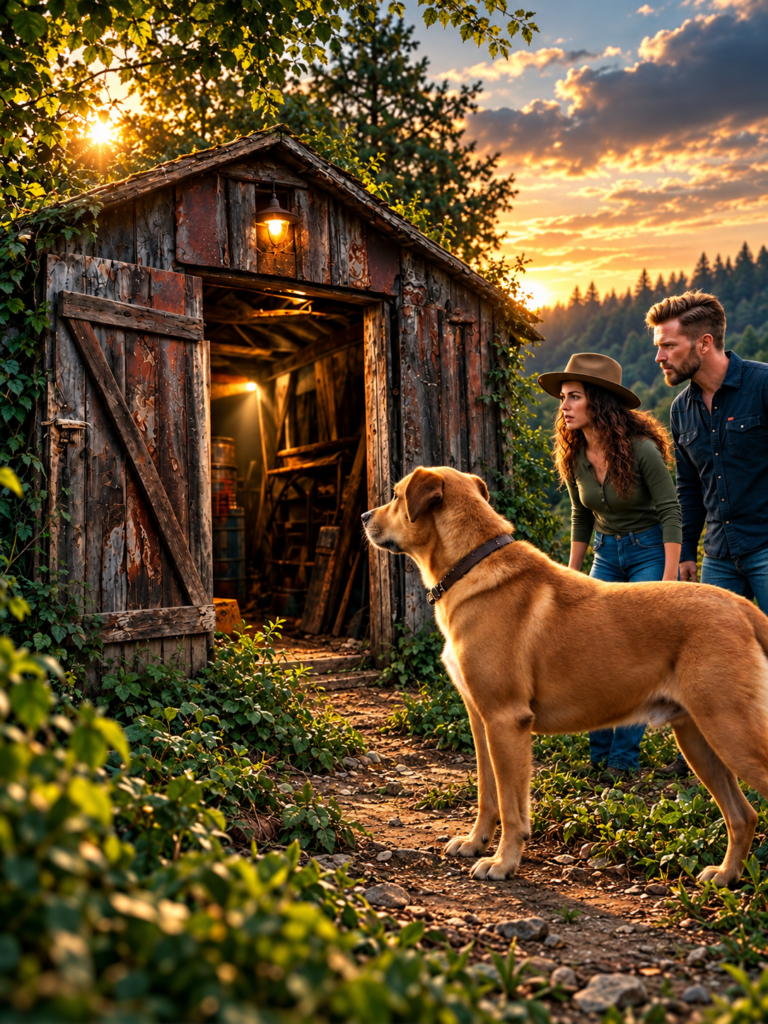
She had finished a few errands and was walking home along a familiar road when she saw him standing in front of an old shed.
The building had been there for years. Amelia had passed it often enough that she rarely looked at it anymore. The paint had faded into dull, uneven patches. Weeds climbed around the lower boards, and the roofline sagged just enough to make the whole place look tired. The large wooden door remained closed.
Nothing about the shed seemed unusual.
The dog did.
He stood several feet from the door, facing it with complete attention.
He was not pacing. He was not sniffing around for food. He was not wandering along the fence like an animal that had lost its way.
He was waiting.
Amelia slowed.
The dog looked healthy and cared for. His coat was in good condition, his posture alert. There was something almost deliberate about the way he held himself.
She stopped a safe distance away.
“Hey,” she said.
His ears moved.
“What are you waiting for?”
The dog turned his head toward her.
For two or three seconds, he studied Amelia with quiet interest. Then he looked back at the door.
That was all.
Amelia smiled to herself, feeling a little foolish for expecting an answer from an animal, and continued toward home.
But the image stayed with her.
The next morning she took the same route.
The dog was there again.
Same shed.
Same door.
Almost the same position.
This time Amelia stopped longer.
He glanced at her, then returned his attention to the building.
Maybe his owner worked nearby, she thought.
Maybe someone fed him there.
Maybe the animal simply liked the shade.
There were dozens of reasonable explanations.
By the third day, those explanations had begun to feel less convincing.
He was still there.
On the fourth morning, Amelia stopped before she had even reached the fence.
The dog noticed her immediately.
For several moments, neither moved.
Then the animal stood.
Instead of turning away, he walked several steps toward the shed door.
He stopped.
Looked back at Amelia.
Walked another few steps.
Looked back again.
Amelia folded her arms.
“You want me to go over there?”
The dog moved toward the door.
That was when curiosity finally defeated caution.
Amelia crossed the distance slowly.
Up close, the shed looked even older than it did from the road. Several boards were weathered nearly gray. Flakes of paint rested among the weeds. The ground beside the walls was uneven from years of rain and neglect.
The door, however, bothered her.
There were marks in the dirt immediately in front of it.
Amelia crouched.
Paw prints.
Some were faint, others sharp.
Recent.
She looked at the dog.
“So you’ve been coming in and out of here.”
His tail moved once against the weeds.
She examined the door, but she did not touch it.
Curiosity was one thing. Walking alone into an abandoned structure was another.
Amelia stood.
“I know somebody who’s better at this than I am.”
The dog remained beside the entrance.
She went home and found Raul.
Raul understood machinery, repairs, old structures, tools—almost anything involving metal, wood, moving parts, or the question of whether something was safe enough to touch. More importantly, he was cautious. He had no interest in proving bravery by reaching blindly into dark spaces or forcing doors that might collapse on him.
When Amelia told him about the dog, Raul listened with the expression of a man waiting for the sensible explanation to appear.
It did not.
“So he’s there every day?” he asked.
“Every time I pass.”
“And he just watches the door?”
“Mostly.”
“Mostly?”
“Today he walked toward it and kept looking back at me.”
Raul considered that.
“As though he wanted you to follow?”
“That’s what it felt like.”
Raul gave her a skeptical look.
Amelia raised both hands.
“I know how it sounds.”
“I didn’t say anything.”
“You didn’t have to.”
He almost smiled.
“Fine. I’ll go with you tomorrow.”
The next morning, Thunder was waiting.
Amelia did not yet understand everything about him, but the name suited the steady dog who watched them approach with an alertness that made it seem as though he had expected Amelia to return—and expected her not to come alone.
The instant he saw Raul beside her, he stood.
He looked at Amelia.
Then Raul.
Then the shed.
Without hesitation, Thunder walked toward the door.
Raul stopped.
“Well,” he said quietly. “That is interesting.”
Thunder placed his front paws against a worn section near the lower portion of the door.
Then he turned his head toward them.
Amelia looked at Raul.
“You see it now?”
“I see a dog who’s very interested in one particular piece of wood.”
“That’s more than you saw yesterday.”
Raul stepped closer.
He ran his fingers lightly along the boards.
One section shifted.
Not much. Barely enough to notice. But the movement was different from the solid resistance of the rest of the door.
Raul crouched.
“Someone—or something—has been working around here.”
He looked at the ground.
There were old tracks mixed with fresher disturbances.
Amelia pointed toward the paw prints.
“Thunder.”
“Probably.”
Raul followed the edge of the doorway until he reached the side where weeds had grown thick against the wall.
He pushed some vegetation aside.
Behind it was a narrow opening.
Too small for Amelia.
Too small for Raul.
Large enough for a dog.
Before either of them said anything, Thunder slipped through.
Amelia leaned toward the opening.
“Thunder?”
They heard movement inside.
A few seconds later he emerged.
Something was held carefully between his teeth.
He walked directly to Amelia and dropped it near her shoes.
Raul picked it up.
It was a piece of metal coated with dust.
“What is it?” Amelia asked.
“Part of something.”
“That narrows it down.”
Raul ignored her.
He turned the piece toward the sunlight and wiped its surface with a cloth from his pocket.
An engraving began to appear.
Faint, but deliberate.
Raul’s expression changed.
Amelia noticed immediately.
“You recognize it?”
“Not exactly.”
“But?”
“This isn’t random scrap.”
He studied the shape again.
“It belongs to a piece of equipment. Old equipment, from the look of it.”
Amelia looked toward the shed.
Thunder had returned to the door.
Raul tried the main entrance.
It did not move.
He leaned into it carefully, tested again, then stopped.
“Stuck.”
“So how do we get inside?”
“Without destroying anything?”
“That would be preferable.”
They walked around the structure.
On one side, Amelia found a small window with broken glass. She kept her hands away from the jagged edges and peered into the dim interior.
At first she could make out little more than shapes.
Then her eyes adjusted.
Boxes.
Shelves.
Tools.
A table.
Dust coated almost everything.
And at the back of the shed stood something large beneath a tarp.
“Raul.”
He came beside her.
“Look.”
She pointed.
He leaned toward the opening.
The hidden object was too large to be ordinary storage. The tarp dropped over a broad frame and uneven mechanical shapes.
Thunder began barking.
Short, insistent bursts.
Not frightened.
Almost impatient.
Raul glanced toward him.
“I’m starting to agree with you.”
“With me about what?”
“He’s trying to show us something.”
Around the opposite side, Raul located another entrance, partially blocked by aging boards.
He tested the surrounding structure before moving anything.
“This section looks stable enough,” he said. “But stay behind me until I check inside.”
He removed one board carefully, then another just enough to create a passage.
Thunder entered first.
Raul followed.
Amelia stepped in after him.
The smell hit her immediately: old wood, dust, dry earth, machine oil that seemed to have soaked into the place years ago and never quite left.
Sunlight entered in narrow shafts through cracks in the walls.
The shed was much larger than it appeared from outside.
Old cabinets lined one side. Hand tools hung from hooks, some rusted, some protected beneath layers of grime. Boxes had been stacked in several corners. A workbench stood beneath the broken window.
And in the center waited the object under the tarp.
Thunder walked toward it and sat down.
Amelia stared at him.
“All right,” she said. “We’re here.”
Raul gripped one edge of the tarp.
“Help me.”
Amelia took the opposite side.
They pulled.
Dust rose as the fabric slid away.
The shape beneath it emerged piece by piece—wheels, metal housing, heavy framework, controls, fittings.
An old agricultural machine.
Amelia stepped back.
“That’s been sitting here this entire time?”
Raul did not answer immediately.
He moved closer.
The machine was old, certainly, but age had not destroyed it. Several components remained surprisingly solid.
Raul brushed dust from a metal surface.
“This was built to last.”
“Could it still work?”
“I don’t know.”
He looked beneath one housing, then at several connections.
“But it might.”
Thunder had already moved away.
He stood near a shelf filled with boxes.
Amelia watched him.
“Raul.”
“What?”
“He’s doing it again.”
Thunder stared at the shelf.
Raul walked over.
He lifted down the first box.
Then another.
Behind them was a narrow metal door.
Amelia blinked.
“There’s a room back there?”
“Looks like it.”
A key hung from an old nail nearby.
Raul tried it.
The lock resisted.
He worked it gently rather than forcing it, turning the key back and forth until the rusted mechanism finally released.
The door opened with a scrape.
The room beyond looked completely different from the main shed.
It was small but organized.
Shelves lined the walls.
Containers had been labeled.
Parts were arranged by size and type. Tools sat inside boxes rather than scattered across tables.
Amelia picked up one container.
“Screws.”
Raul opened another.
“Mechanical components.”
“So whoever worked here planned to keep this stuff.”
“More than that. Somebody maintained equipment here.”
Along one shelf lay several old documents.
Amelia reached toward them.
Raul stopped her gently.
“Not yet.”
“Why?”
“They’re fragile. If the paper’s deteriorated, we could damage them just by moving them.”
Amelia withdrew her hand.
Thunder entered.
He sniffed along the floor, crossed the little room, and stopped in the corner.
Amelia followed.
Another box.
Raul opened it.
Inside were neatly arranged tools.
Some showed age.
Others still appeared usable.
Amelia looked around.
“This isn’t storage.”
Raul nodded.
“It was a workshop.”
That changed something.
Until then, Amelia had thought of the building as an abandoned shed containing an interesting old machine.
Now she noticed the order beneath the dust.
The labeled containers.
The spare parts.
The work surfaces.
Someone had once spent real time here.
Someone had known where every wrench belonged.
Someone had maintained equipment, repaired failures, prepared for the next day’s work.
This had been useful once.
Important, even.
Raul returned to the machine and inspected a metal plate.
He wiped it clean.
“There.”
“What?”
“Identification number.”
He wrote it down.
“If we need information about this machine, that number could help.”
A bark echoed through the shed.
Amelia turned.
Thunder had left the small room.
They found him facing a wall.
Nothing about it seemed unusual at first.
Then Raul noticed a gap beside one board.
He pressed it.
The board moved.
Behind it was a narrow cavity.
Inside sat a large box.
Amelia and Raul exchanged a look.
Thunder waited beside them.
Amelia pointed toward the box.
“Tell me you’re not going to say this is normal.”
“No,” Raul said. “I think we passed normal a while ago.”
He pulled the box into the light.
The lid was stuck.
Raul worked it loose a little at a time until the wood finally released.
Inside were old tools, parts, several small objects—
and a folder wrapped in fabric.
Amelia lifted it carefully.
Raul came closer.
She opened the folder.
The first pages contained technical drawings.
Raul stared at them, then at the machine.
“These are for that.”
“The machine?”
“Yes.”
He carried the drawings to a table and compared them against the equipment.
His finger followed a series of lines and components.
Then he stopped.
“What?”
“The drawing shows a system that isn’t on the machine anymore.”
“Removed?”
“Looks that way.”
“Why?”
“I don’t know.”
“Could the parts still be here?”
Raul looked toward Thunder.
After everything the dog had already found, dismissing the possibility felt unreasonable.
Thunder walked across the shed.
He passed several boxes and stopped beside a pile of old wood.
Raul laughed once under his breath.
“You have got to be kidding.”
They moved the wood.
Behind it stood an old workbench.
Beneath the bench sat a metal box.
Raul dragged it out.
Heavy.
When he opened it, he became very still.
Amelia crouched beside him.
“You know these?”
“Some of them.”
“From the drawing?”
He nodded.
“These are components for that missing system.”
Amelia looked from the parts to the machine.
“So we can put it back together?”
“Maybe.”
Her excitement must have shown, because Raul immediately added, “Maybe does not mean we start bolting pieces on.”
She sighed.
“I knew you were going to say that.”
“Some of these parts are worn. Others might have internal damage we can’t see. We check everything first.”
They spent the rest of the day cataloging what they had found.
Thunder stayed near them.
Gradually, the chaos of discovery became organized piles: tools, machine parts, damaged items, intact components, documents to protect.
Near the bottom of one box, Amelia found a tag.
Its note was simple.
The equipment had been used for years to help several families with their work.
She read the words twice.
Until that moment, the machine had fascinated her because it was hidden.
Now it mattered for another reason.
People had depended on it.
The shed was not a place where somebody had abandoned useless things.
It held the remains of work that had once connected people.
Amelia looked at the machine.
“We shouldn’t just empty this place.”
Raul glanced up.
“I agree.”
“I want to know what happened here.”
“So do I.”
Late in the day, Thunder returned to the main entrance.
He sat in the exact place where Amelia had first seen him.
She watched from inside.
“Maybe that was all he wanted.”
Raul followed her gaze.
“Maybe.”
But one question remained.
They had found the workshop.
They had found the machine.
They had found the hidden parts.
They still had no idea why Thunder knew where any of it was.
The answer came the next morning.
Part 2
When Amelia returned to the shed, Thunder was already there.
But this time he was not alone.
A man stood several yards away, watching the dog.
As Amelia approached, the stranger stepped forward.
“Sorry,” he said. “I’ve been looking for him.”
Amelia stopped.
“You know this dog?”
“I do.”
Thunder walked calmly between them.
The man introduced himself as Sergio.
He explained that his family had cared for Thunder for years.
Amelia looked at the dog, then at the shed.
“Then maybe you can answer something.”
Sergio followed her gaze.
His expression changed before she asked the question.
“Why does he keep coming here?”
For several seconds Sergio said nothing.
Then he walked toward the building.
“Because my father worked here.”
Amelia stared at him.
“Your father?”
Sergio nodded.
“When I was a kid, I came here with him sometimes. There were tools everywhere. Machines. Parts. Work going on all the time.”
“You knew about the shed?”
“I knew about the place. I didn’t know what was still inside.”
Raul arrived while they were talking.
Amelia introduced him.
Then she led Sergio through the side entrance.
The moment he saw the agricultural machine, he stopped.
He said nothing.
His eyes moved over the frame, the wheels, the controls, the pieces Raul had begun cleaning.
Sergio walked closer.
“I remember this.”
Raul stood beside him.
“It worked?”
Sergio gave a quiet laugh.
“It worked very well.”
He rested his hand lightly on the old metal.
“My father talked about this machine all the time.”
Amelia asked, “Why was it left here?”
Sergio looked around the workshop.
“When the work here ended, everything slowed down. He meant to come back. He had put aside parts for maintenance. He always said the machine might be useful again someday.”
Raul pointed toward the organized boxes.
“We found parts.”
Sergio turned.
Amelia showed him the small storage room, the tools, the drawings, the components beneath the workbench.
Sergio opened one container and stared inside.
“These are his.”
“You recognize them?” Amelia asked.
“I remember the labels.”
He picked up another box and smiled.
“He used to complain when anybody put something back in the wrong place.”
Amelia looked at the shelves.
Suddenly the room felt less mysterious.
Not less important.
More human.
The labels had been written by somebody.
The parts had been sorted by somebody.
The workbench had belonged to somebody.
A place that yesterday had seemed abandoned now carried the habits of a man Sergio remembered.
Amelia explained how Thunder had led them from one discovery to another.
Sergio listened without surprise.
When she finished, he looked toward the dog.
“He always did things like that.”
“What do you mean?”
“If he thinks something is being ignored, he stays near it until somebody pays attention.”
Raul glanced at Thunder.
“So he wasn’t waiting for someone to come out of the shed.”
“No,” Sergio said. “I think he was waiting for someone to notice the shed.”
That explanation settled over Amelia.
For days Thunder had stood before the door.
Not lost.
Not confused.
Remembering.
Sergio offered to help.
He could not repair the machine himself, but he knew stories about how it had been used. He remembered certain routines his father followed. He knew which objects had been important and which had simply accumulated over time.
Raul handled the mechanical work.
Amelia organized everything.
Sergio supplied memory.
And Thunder supervised them all.
They began with cleaning.
Years of dust had to be removed before Raul could properly evaluate the machinery.
Amelia wiped shelves, sorted containers, wrote new labels where old ones were difficult to read, and created enough order that they could move without stepping over loose parts.
Sergio identified tools his father had used.
Some memories came quickly.
Others surprised him.
He would pick up a wrench and stare at it.
Or pause beside the workbench because he remembered standing on the other side of it as a boy.
Thunder moved between them, occasionally disappearing into a corner, then returning to the entrance.
Raul disassembled only what needed examination.
He cleaned contact points, inspected housings, tested moving components by hand, and separated parts that were too badly worn to trust.
Amelia was eager to see the machine run.
Raul refused to rush.
“You keep looking at that control panel,” he told her one afternoon.
“I’m just looking.”
“You’re thinking about starting it.”
“I’m thinking about what it would sound like.”
“It’ll sound expensive if we destroy something because we got impatient.”
She smiled.
“Fine.”
“Good.”
They continued.
One worn component could be recovered.
Another needed replacement.
Some parts from the metal box belonged exactly where the technical drawings indicated.
Others no longer appeared safe.
Raul compared every decision against the condition of the machine.
Sergio watched closely.
“My father would like this,” he said.
“Someone refusing to start his machine?” Amelia asked.
“Someone refusing to ruin it.”
That ended her argument.
Days of work passed.
The machine slowly changed.
The dull surfaces became visible beneath the grime. Moving parts that had been frozen by dirt began to turn properly. The floor around it was cleared. Tools returned to shelves.
The shed changed too.
Amelia had begun thinking beyond the machine.
The building had been useful once.
Why should its second life stop with a single restoration?
She did not yet know exactly what it could become, but she liked the feeling of activity returning to a place that had spent years in silence.
Eventually Raul reached the stage Amelia had been waiting for.
He inspected the machine one final time.
Sergio stood several feet away.
Thunder sat near the entrance.
Amelia hovered beside the controls.
Raul looked at her.
“You can try.”
She stared at him.
“Really?”
“If I say stop, you stop.”
“You don’t have to tell me twice.”
“That sentence alone makes me nervous.”
Sergio laughed.
Amelia made the first attempt.
Nothing happened.
Not a click.
Not a shudder.
Nothing.
The silence felt heavier because of everything they had invested in reaching that moment.
Sergio looked down.
Amelia turned toward Raul.
He showed no disappointment.
Instead, he immediately returned to the machine.
“What?”
“Nothing yet.”
“Is something wrong?”
“Yes.”
“That sounds bad.”
“It would be worse if we didn’t expect problems from a machine that’s been sitting in an abandoned shed for years.”
He checked the connections again.
One by one.
Then he found a contact point that needed adjustment.
“There.”
“That’s it?”
“It’s one thing.”
Raul corrected it.
They tried again.
A sound came from inside the machine.
Low.
Mechanical.
Brief.
Amelia’s face broke into a smile.
Sergio lifted his head.
Thunder’s ears came up.
The machine began to respond.
Raul shut it down almost immediately.
Amelia stared at him.
“Why did you stop?”
“Because that was a test.”
“But it worked.”
“Partially.”
“Is partially good?”
Raul finally smiled.
“Partially is excellent.”
They made more adjustments.
Another test.
Another problem.
Another correction.
The machine was not ready for full work, but it had answered.
After years of stillness, its main system could respond.
Sergio stood beside the old frame.
“My father would be happy to see this.”
Amelia looked at him.
“What would he say?”
Sergio considered the question.
Then he smiled.
“He’d probably ask what took us so long.”
Even Raul laughed.
The restoration continued.
Worn pieces were repaired where possible.
A few components were remade.
Others were cleaned and returned to service.
Raul established a maintenance routine before the machine had even completed a proper job.
Amelia teased him about it.
“You made an inspection schedule for something we haven’t used yet.”
“That’s why it may still be working after we use it.”
She stopped teasing him.
Meanwhile, Amelia reorganized the shed.
She did not want to erase its history by making everything new.
The old workbench stayed.
Useful tools remained visible.
Original parts that could no longer be trusted were kept rather than thrown away.
New lighting made the interior safer.
The ground outside was cleared.
The side entrance became usable.
Boxes were labeled.
The old agricultural machine received a clean, open area where it could be inspected from every side.
Thunder began sleeping near the entrance.
He seemed entirely satisfied with himself.
Amelia eventually said what she had been thinking.
“This place could work again.”
Raul looked up from a tool.
“The machine?”
“The shed.”
Sergio listened.
Amelia continued.
“Not exactly the way it did before. But as a maintenance and support space. Repairs. Tools. Maybe some of the same kind of work this machine used to help with.”
Raul considered the room.
“It would have to be organized properly.”
“You say that as though I haven’t spent days organizing it.”
“I mean properly for ongoing work.”
Sergio smiled.
“You should know by now he can turn anything into a checklist.”
“I’ve noticed.”
They began researching which jobs the restored equipment could safely perform.
No one wanted to run it merely to prove that it could move.
If the machine was going to have a second life, it needed a useful one.
Weeks after Amelia first saw Thunder outside the door, the day of the machine’s first real job arrived.
Raul inspected every system again.
Amelia waited.
Sergio stood nearby.
Thunder watched from his place at the entrance.
The machine started.
This time the sound settled into a steady rhythm.
Not a sputtering test.
Not a brief response.
Operation.
For several seconds, nobody spoke.
Amelia looked at Thunder.
“He was right.”
Raul followed her gaze.
“Who?”
“Thunder.”
The dog wagged his tail.
Word spread.
People who remembered the old workshop heard that the shed had been reopened.
Some came because they wanted to see the machine.
Others came because they remembered the property from years earlier.
A few simply wanted to know whether the story about a dog discovering everything was true.
One visitor stood beside the restored equipment and asked Amelia, “So you found this machine?”
“Not exactly.”
“Then who did?”
She pointed toward Thunder.
The visitor laughed.
Then he realized Amelia was serious.
“You mean the dog?”
“Yes.”
She told him about the four mornings.
The door.
The paw prints.
The metal piece carried in Thunder’s mouth.
The hidden room.
The drawings.
The parts.
By the time she finished, the man no longer looked amused.
“If you hadn’t followed him, all of this might still be sitting here.”
Raul, passing behind them, said, “Sometimes paying attention is the first useful thing anybody does.”
The shed became a working space again.
Amelia managed its organization.
Raul handled technical maintenance.
Sergio helped identify old equipment and preserve the story attached to it.
Thunder became the unofficial greeter.
When visitors arrived, he often rose from his place, walked several steps into the workshop, then glanced back.
Come on.
This way.
It seemed impossible that a dog could look proud of a restoration project.
Yet Thunder somehow managed it.
The project continued to grow.
Sergio remembered hearing about other forgotten equipment connected to the old work.
They began gathering information.
They were careful.
The goal was not to collect abandoned things simply because they were old.
They wanted to know where objects came from, how they had been used, and whether they mattered.
History first.
Usefulness second.
Possession was never treated as permission to destroy context.
Amelia liked what the place was becoming.
The shed no longer looked abandoned.
It had light.
Order.
Purpose.
She thought the largest surprises were behind them.
Then one afternoon Thunder left his usual spot and began walking around the outside of the building.
Amelia noticed immediately.
She looked at Raul.
“Oh, no.”
He frowned.
“What?”
She pointed.
“Look at him.”
Thunder moved toward an overgrown section beyond the cleared area.
Raul sighed.
Sergio joined them.
Thunder stopped.
Looked back.
Then continued.
Amelia folded her arms.
“I know that look.”
“So do I,” Raul said.
They followed him into the vegetation.
Part 3
Thunder led them to a small wooden structure almost hidden beneath leaves and overgrowth.
At first it looked unremarkable.
Another forgotten piece of the property.
Raul cleared vegetation from one side.
Beneath it was an old metal plate.
He brushed away dirt.
An identification mark appeared.
Sergio’s expression became serious.
“I know that symbol.”
Amelia turned.
“What is it?”
Sergio stared toward the overgrown ground beyond the structure.
“My father used to mention another storage space.”
Raul looked around.
“You know where?”
“Not exactly.”
Sergio pointed.
“But somewhere over there.”
The three of them began clearing a path.
Thunder moved ahead, waiting whenever they fell too far behind.
Gradually, the shape of another building appeared beneath years of vegetation.
Smaller than the main shed.
Partially hidden.
Its door was closed.
Raul inspected the exterior before anyone entered.
“No obvious structural problem,” he said. “We still go carefully.”
Amelia smiled.
“You really do say that every time.”
“That’s because buildings do not become safer just because you’re curious.”
They opened the entrance.
The air inside was dry and stale.
Old objects filled the room.
Tools.
Parts.
Mechanical components.
Storage boxes.
Thunder walked to the back and stopped beside one of them.
Raul opened it.
Sergio leaned forward.
Inside were additional machine parts.
Raul lifted one.
Then another.
His interest sharpened with each component.
Sergio stared.
“Now I understand.”
Amelia looked at him.
“What?”
“My father wasn’t saving parts for one repair.”
He gestured around the building.
“He was building a complete maintenance set.”
Raul nodded slowly.
“That makes sense.”
He compared several pieces with the records they had already found.
Some were exactly the components they had been missing.
Amelia looked from the box toward the main shed beyond the vegetation.
“So we can improve the machine again?”
“Yes,” Raul said. “But we inspect everything first.”
Amelia laughed.
“I knew that was coming.”
“It keeps being true.”
The discovery expanded the project once more.
Every item was evaluated.
Parts in safe condition could potentially support the restored machine.
Others were too worn for service.
Those were preserved instead of discarded.
Amelia realized that the collection itself told a story.
Not a dramatic story of treasure in the ordinary sense.
There were no piles of money.
No jewels.
No mysterious fortune.
What they had found was evidence of preparation, skill, work, and care.
Someone had known these machines would wear down.
Someone had saved what future workers might need.
Someone had expected the work to continue.
The fact that it had stopped did not erase that intention.
Amelia decided to create a small display area inside the original shed.
Not a formal museum.
Nothing elaborate.
Just a place where people could see some of the old tools, original parts, technical drawings, and examples of how the equipment had been maintained.
Sergio loved the idea.
Raul approved on one condition.
“Nothing important gets placed where somebody can knock it onto the floor.”
Amelia stared at him.
“That was already part of the plan.”
“I’m establishing standards.”
“You’re establishing that you enjoy telling me things I already know.”
Sergio laughed.
Thunder wagged his tail without understanding why.
As the shed became known in the area, more visitors arrived.
Some were interested in mechanics.
Some in restoration.
Some remembered rural equipment like the machine Raul had brought back to operating condition.
Older visitors sometimes recognized tools before Amelia could explain them.
They would point toward an object and say, “We had one of those.”
Then a story followed.
A father who repaired equipment late into the evening.
A neighbor who borrowed tools and returned them sharpened.
A machine that saved several days of labor during a difficult season.
The restored shed became more than Amelia had imagined.
It was useful again.
It was also a place where work that might otherwise have been forgotten could be remembered.
And through all of it, Thunder remained at the entrance.
One afternoon, a visitor watched the dog guide a small group toward the display.
“He acts like he owns the place.”
Amelia smiled.
“I think he believes we work for him.”
The visitor laughed.
“How long did it take you to find all this?”
Amelia pointed at Thunder.
“The first discovery? A few minutes.”
The visitor looked confused.
Amelia told the story.
She had told it many times by then, but she never tired of the moment when people understood that Thunder had not accidentally wandered into the shed.
He had returned deliberately.
Again and again.
“He noticed something nobody else did?” the visitor asked.
“Maybe,” Amelia said. “Or maybe he remembered something everybody else had stopped seeing.”
That distinction mattered to her.
Thunder did not understand technical drawings.
He could not identify machine components.
He did not know what an agricultural machine had once done for several families.
But he understood the place.
He knew it mattered.
That had been enough.
Raul joined them.
“If Amelia hadn’t stopped,” he said, “we might still be walking past it.”
Sergio, standing near his father’s old tools, looked around.
“My father used to say some things don’t need replacing. They just need someone willing to look again.”
The sentence stayed with Amelia.
That evening, after the visitors left, she locked the shed.
Thunder sat beside her.
Light glowed through the cleaned windows.
Inside, the restored machine waited for its next use.
Tools rested where workers could find them.
The old workbench remained scarred and worn exactly as it should.
Amelia lowered one hand to Thunder’s head.
“You really knew what you were doing, didn’t you?”
His tail swept the ground.
She laughed.
“You’re not going to explain yourself?”
Thunder looked toward the door.
Weeks passed.
The workshop settled into a routine.
Raul maintained the machine with the same patience he had used during the restoration.
Amelia handled organization and scheduling.
Sergio continued helping with the history of the objects they found.
People came and went.
Thunder watched them all.
The story should have felt complete.
Yet Sergio arrived one late afternoon with an expression Amelia recognized immediately.
He had learned something.
“I found out more about Thunder.”
Amelia looked toward the dog, who was lying near the door.
“What?”
“I talked to people who remembered when my father worked here.”
Raul put down the part he had been cleaning.
Sergio continued.
“Thunder used to come here with him.”
Amelia stared at the dog.
“How often?”
“Often enough that he knew the routine.”
Sergio walked toward the entrance.
“He knew the paths. The smells. Where people worked. Where my father went during the day.”
Amelia looked around the shed as Thunder might have known it years before.
Not dark.
Not empty.
Busy.
The machine operating.
Tools striking metal.
Doors opening and closing.
People talking.
Sergio’s father moving between the workshop and storage areas.
A younger Thunder following.
“When the place closed,” Sergio said, “Thunder still passed by sometimes.”
“So he remembered.”
“I think so.”
Amelia considered the first morning she had seen him.
His steady posture.
His focus on the door.
The way he had looked at her and then back at the shed.
For days, she had imagined that he might be waiting for someone inside.
Perhaps the explanation was simpler.
He remembered that there had once been something worth entering for.
He knew the place had been part of his life.
He knew people had once gathered there.
Then the people disappeared.
The doors closed.
The weeds grew.
Years passed.
But the dog continued recognizing what everyone else had learned to overlook.
Maybe Thunder had not known the machine was still under the tarp.
Maybe he had not understood that spare parts remained behind shelves and walls.
Maybe he simply knew one thing:
This place mattered.
And nobody was paying attention.
Amelia crouched beside him.
“So that was it.”
Thunder raised his head.
“You wanted somebody to remember.”
Raul appeared at the doorway.
“And somebody finally did.”
Amelia shook her head.
“No.”
She looked into the workshop.
“He did more than that.”
The agricultural machine stood clean and functional.
The technical drawings were protected.
The labeled containers had been organized.
Tools had returned to service.
Other tools, too old to use safely, were preserved.
Sergio’s memories of his father had been given a physical place again.
People who had once worked with similar equipment now came through the doors and told stories of their own.
The shed had become useful without pretending its past had never happened.
Thunder had not merely helped them remember one building.
He had connected past work to present work.
One evening, as Amelia prepared to close up, Thunder walked to the entrance and sat in the exact position where she had first seen him.
She stopped.
Then she laughed.
“You’re doing it again.”
Raul crossed his arms.
“I think that’s his spot now.”
Sergio nodded.
“Probably always was.”
Amelia closed the door behind them.
Before leaving, she looked back.
The shed no longer seemed forgotten.
The walls were still old.
The boards still carried weather marks.
No one had tried to make the building look as though it had been constructed yesterday.
That would have missed the point.
Its age was part of its value.
Its scratches mattered.
The worn bench mattered.
The machine mattered because it had once worked hard enough to become worn, then had been preserved long enough to work again.
Even the useless parts mattered because they showed what the equipment had required from the people who maintained it.
Amelia thought about how easily all of it could have remained hidden.
The first morning, she could have kept walking.
She almost had.
The second morning, she could have dismissed the dog as a coincidence.
The third could have been another.
By the fourth, curiosity had become a question.
Why are you waiting here?
That question opened the door.
Not literally at first.
The main door had been stuck.
But it led Amelia to Raul.
It led Raul to the gap Thunder used.
It led them to the metal part the dog carried out.
To the broken window.
To the tarp.
To the machine.
To the hidden room.
To the documents.
To the technical drawings.
To the missing components.
To Sergio.
To his father’s history.
To the second storage building.
To the complete maintenance collection.
One small observation had become a chain of discoveries.
But Amelia no longer believed the machine was the greatest one.
Objects could be restored.
Buildings could be cleaned.
Parts could be repaired.
The more important recovery was understanding why any of it had mattered in the first place.
The machine had helped families work.
The workshop had supported people.
Sergio’s father had preserved parts because he believed the equipment might be needed again.
Thunder had carried memories of the place in the only way a dog could—through paths, scents, habits, and attachment.
When everyone else moved on, he kept returning.
He had no way to explain what he remembered.
So he waited.
Eventually, someone stopped.
A few days later, Amelia arrived early.
Morning light stretched across the cleared ground.
Thunder walked beside her.
Raul and Sergio followed a short distance behind, talking about maintenance that needed to be done before the next job.
Inside, the old machine waited.
Not as a forgotten relic.
Not merely as something rescued from decay.
As equipment with work left to do.
Raul switched on the lights.
The shed brightened.
Amelia opened the main workspace.
Sergio placed several items back on the display shelf.
Thunder walked to the entrance.
He stood there for a moment, looking outward.
Amelia watched him.
Months earlier, that same pose had seemed mysterious.
Now it made perfect sense.
This was a place he knew.
A place he remembered.
A place other people had finally remembered too.
Thunder turned toward Amelia.
She smiled.
“All right. We’re here.”
His tail moved.
Raul called from beside the machine.
“Are we working today or having another conversation with the dog?”
Amelia looked back at him.
“He started this. I think he gets management privileges.”
Sergio laughed.
Thunder trotted inside.
Behind them, the door remained open.
The End.


