
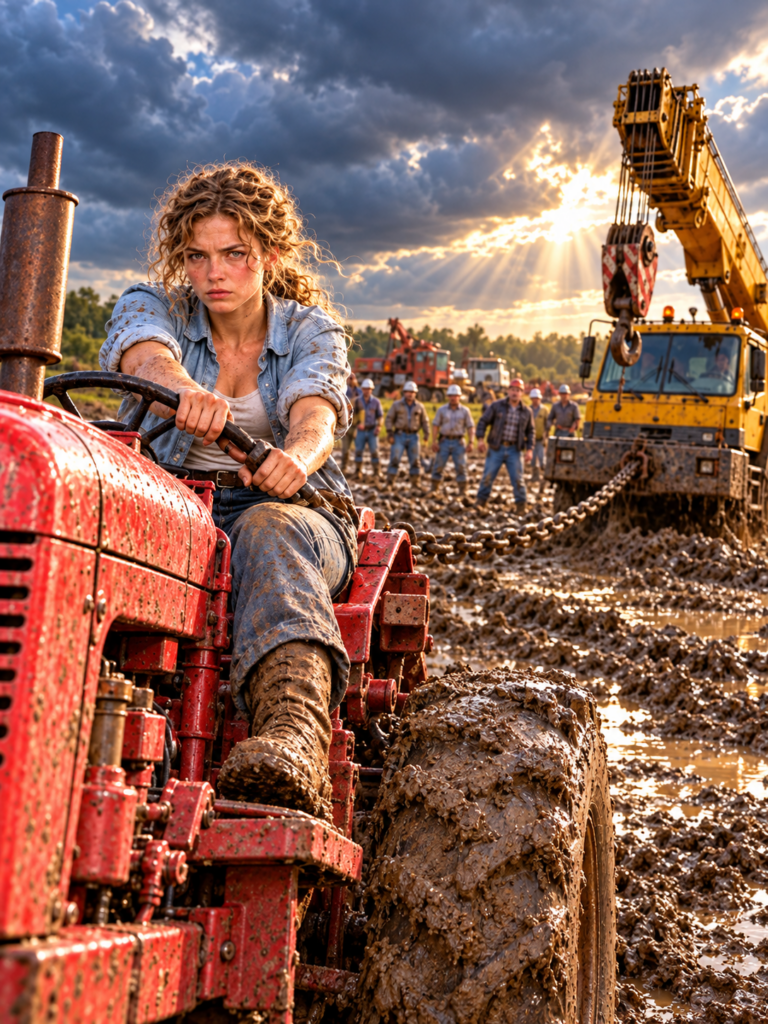
Part 1
Grant Mercer arrived at Bennett Farm on a Tuesday morning with a laminated map under one arm and a convoy waiting behind him on the county road.
The rain had stopped before dawn, but four straight days of it had left the place saturated. Water stood in the shallow cuts along the fence lines. The grass around the farmhouse was dark and flattened. Across the northern field, the earth looked solid from a distance and held water underneath like a soaked sponge.
Grant seemed not to notice.
“Good morning, Miss Bennett.”
Clare stood at the edge of the gravel drive, work boots muddy from the morning, arms loose at her sides.
“I’m Grant Mercer with Horizon.”
“I know who you are.”
That checked him for half a second.
Not enough to change his manner.
Grant set the map across the hood of one of Horizon Pipeline Group’s white trucks and smoothed it flat. A red line crossed the northern portion of Bennett land.
“We have the permits,” he said. “This is the proposed route for the pipeline.”
Clare studied the line.
“It goes through our best ground.”
Grant gave a small nod, as if she had confirmed a detail already entered on a form.
“Horizon holds a historic access corridor through this section. Our equipment is scheduled to begin moving today. We can discuss compensation if you’d like.”
Clare looked past him.
Two company trucks. A survey vehicle. Workers in reflective gear. Farther back, at the county road, an enormous rig idled with a low mechanical pulse she could feel through the soles of her boots.
It had not come for a conversation.
It had come because Grant believed the conversation was already over.
“My attorney hasn’t reviewed any of this,” Clare said. “Nothing moves across my land until she does.”
Grant’s expression remained almost pleasant.
He had the practiced composure of a man accustomed to meeting angry landowners and leaving with the same result anyway.
“We can handle this one of two ways, Clare. You can work with us, or you can work through our attorneys.”
“My answer is the same either way.”
For the first time, he looked directly at her instead of at the map.
Then he glanced at his watch.
It was a small thing, but Clare noticed it.
Her father would have noticed it too.
Thomas Bennett had believed that people revealed themselves most clearly when they thought nothing important was happening.
Grant rolled the map shut.
“Understood.”
He walked back toward the road.
Clare watched him go, uneasy not because of anything he had said but because of the ease with which he had accepted her refusal.
Six weeks earlier, she had buried her father.
Until March, the question of what would happen to Bennett Farm had belonged to some distant future Clare had spent years avoiding.
Thomas had been born in the farmhouse. His father had worked the same fields, and his father before him. The land had never seemed like something the Bennetts possessed so much as something they happened to be responsible for during their turn.
Thomas had not been sentimental about that responsibility.
He repaired equipment long after other farmers would have traded it. He kept his accounts by hand. He checked fences before breakfast and drainage after storms. He could walk across a field and tell from the feel beneath his boots where the water had gone, where a tire would sink, and which strip of ground had been disturbed ten years earlier.
He rarely explained what he knew.
That had frustrated Clare when she was young.
At forty-two, it frustrated her differently.
For nearly eighteen years, she had lived in Minneapolis. She had built a career there, made friends, established routines, and become the kind of person who could go months without thinking about fuel filters, calving weather, tile drainage, or what a hard May rain did to a field.
Then the call came.
Thomas had died quietly in the same house where he had been born.
Clare returned expecting grief, paperwork and decisions.
Everyone else expected a sale.
No one said it outright at first.
A neighbor brought a casserole and talked about how much land prices had risen.
The attorney who read Thomas’s will explained the estate, then left a silence afterward that seemed designed for Clare to ask about listing the farm.
She did not.
The farm was lean. That was true.
Thomas had kept it alive through years when surviving counted as success. There was deferred work in every direction Clare looked. Fence. Machinery. Storage. Drainage. Buildings. Taxes did not care about family history, and neither did fuel suppliers.
Selling would have been reasonable.
But on her second evening home, Clare had walked into the barn and found the old Farmall in its usual place.
Her father’s 1950 tractor still carried the marks of decades of work. The paint had faded. Metal showed through along the places hands and boots had worn it smooth. It leaked in ways Thomas had always classified as “nothing worth losing sleep over.”
Clare had climbed onto the seat as a child.
Thomas had taught her to drive it before she was old enough to reach everything comfortably.
Standing beside it after his funeral, she had felt something inside her settle.
She was staying.
She did not have a plan grand enough to justify the decision.
She simply knew she was not ready to become the Bennett who sold.
Now, six weeks later, Horizon had arrived to test what that decision meant.
Grant reached the convoy.
He lifted a radio.
Clare saw his mouth move.
Then the 76,000-pound rig turned toward the north field.
She started walking before she consciously decided to move.
“Hey!”
No one stopped.
The rig left the firm approach and entered Bennett soil.
Not along the line Grant had shown her.
Clare saw that much even from a distance.
Instead, the driver came in farther west and began cutting across the field.
“Stop!”
The machine kept moving.
For perhaps twenty seconds, nothing happened.
Then its rear wheels sank.
The sound reached Clare before the full shape of the problem did—a deep mechanical strain followed by a heavy, wet settling.
The rig leaned.
Its wheels turned once.
Mud rolled behind them.
The machine dropped farther.
Then everything stopped.
Workers began moving around it.
Grant stood with his radio in one hand.
Clare reached him breathing hard.
“I told you not to move it.”
Grant’s jaw tightened.
“We’ll recover the equipment.”
“You drove it onto my field after I told you not to.”
“We’ll address any damage.”
“You’ll get it off first.”
The first towing company arrived within an hour.
By then, the sky had lowered again into a solid gray ceiling, and a cold wind was moving across the open ground.
The tow operator brought equipment large enough that, under ordinary circumstances, Clare would have expected the problem to end there.
He positioned his heavy wrecker carefully. Outriggers came down. Cable paid out. Men signaled to one another.
The winch line tightened.
The rig did not move.
Instead, one of the wrecker’s outrigger feet began pressing into the saturated ground.
The operator stopped.
He repositioned.
Tried again.
Same result.
The rescue vehicle was beginning to lose its own foundation.
The operator reeled the cable in, packed his gear and left with the compressed silence of a man who did not intend to have his truck become the next thing needing rescue.
Grant made another call.
The second company arrived with two recovery vehicles and a coordinator who spent more time examining the stuck rig before doing anything.
Clare respected that.
For a while she thought he might have a solution.
He set the two vehicles to pull from opposing angles.
Engines rose.
Lines tightened.
Mud shivered around the trapped wheels.
The trailer moved perhaps six inches.
Then its left side settled deeper.
The coordinator raised an arm sharply.
Everything stopped.
He walked over to Grant.
“Keep pulling like that, we could deform the frame. Or bury that side another foot.”
“What do you need?”
“Different conditions.”
“That isn’t an answer.”
“It’s the one I’ve got.”
The coordinator looked toward the field.
“My company isn’t accepting liability for what happens if we keep forcing it.”
The second company left.
By the time the third recovery crew arrived, word had begun traveling.
A couple of pickups had slowed on the county road. Then another. Men who had known Thomas Bennett parked well out of the way and stood with their hands in coat pockets.
Nobody walked onto Clare’s property without permission.
Nobody needed to.
In a rural county, an enormous pipeline rig stuck in a Bennett field was sufficient entertainment from a distance.
The third crew’s site manager never connected a cable.
He paced around the rig, crouched by the ruts, tested the soil and studied the failures left by the crews before him.
Finally he approached Grant.
“We excavate.”
Grant folded his arms. “Explain.”
“Matting, crawler, digging equipment. Relieve the axles. Build a stable working surface. Redistribute the load.”
Grant nodded immediately.
“All right.”
“No,” Clare said.
Both men turned.
The site manager looked uncomfortable. Grant looked irritated.
Clare pointed toward the buried wheels.
“My father spent years rebuilding the drainage in this field. You’re not bringing excavators in here and tearing it apart.”
Grant stared at her.
“We have a piece of specialized equipment immobilized on your property.”
“You put it there.”
“We are trying to remove it.”
“You’re not destroying another acre fixing what you caused on the first one.”
The site manager looked from Grant to Clare, apparently decided he wanted no part of the argument, and began collecting his people.
Soon the third company was gone too.
The rig remained.
Grant stood beside it, arms crossed.
Horizon workers gathered in small groups.
One of them glanced toward the barn.
The doors were open.
Inside sat the Farmall.
The worker smiled.
“Maybe she can tow it out with that old thing.”
Several men heard him.
One laughed.
Clare heard him too.
She did not turn around.
She was looking at the ruts.
Thomas had taught her that tracks were statements.
Cattle tracks told you where a fence had failed before you ever saw the broken wire. Tractor ruts showed where water was sitting underground. A tire that spun left a different mark from one dragged sideways. Mud remembered pressure.
She walked back toward the point where the rig had entered the field.
Something bothered her.
Not the depth.
The direction.
She stood there for a moment, looking from the tracks to the immobilized machine.
Then an old sentence came back to her in her father’s voice.
When mud wins, don’t fight the weight.
Fight what’s holding it.
Clare turned toward the barn.
Behind her, someone chuckled.
She kept walking.
The Farmall started on the third attempt.
That was normal.
The starter turned. The engine coughed once, caught badly, threatened to die, then finally settled into the rough, familiar rhythm Clare remembered from childhood.
She sat for a moment with both hands on the wheel.
For six weeks, nearly everything connected to her father had been an absence.
His coffee cup in the cupboard.
His jacket behind the kitchen door.
His handwriting in the account books.
But the vibration coming through the Farmall’s steering wheel was not an absence.
It was exactly what it had always been.
Clare drove it out of the barn.
People turned.
A Horizon worker raised his phone.
Then another.
Grant began walking toward her.
She continued across the grass.
He stopped near the tractor.
“Clare.”
She looked at him.
“Don’t make this worse.”
His voice was quiet.
Reasonable.
That irritated her more than shouting would have.
She shut off the tractor, climbed down, and walked past him to the rig’s driver.
He had been standing away from the others, hands buried in his jacket pockets.
“Which way did you come in?”
He hesitated.
Then pointed southeast.
Clare looked in the direction he indicated.
She walked the entire path.
The first towing crew had tried pulling the rig back along the line it had traveled.
So had the second.
Their methods had been more sophisticated than anything she could do with the Farmall, but they had all accepted the same assumption.
That the best route out was the route in.
Clare crouched beside one of the deep trenches.
The rig’s tires had kneaded the wet earth until it had packed tightly around the lower portions of the wheels.
Pulling backward along that same line forced the machine to climb through the longest, deepest part of the trench it had created.
The mud was not merely soft anymore.
Under pressure, it had become a grip.
She stood.
Forty-five degrees away from the rig, almost invisible beneath the grass, was an old farm lane.
Thomas had built it decades earlier.
As a girl, Clare had assumed the pale strip through the field was simply another place where grass grew badly.
Later her father showed her what was underneath.
Packed limestone gravel.
He had laid it in the 1970s and never dug it out.
“Still works,” he had once told her when she asked why he kept using a lane no one else could see.
That had been enough explanation for Thomas.
Clare drove the Farmall onto it.
The feel beneath the tractor changed almost immediately.
The rear tires had something firm to bite.
Now she studied the rig itself.
The towing companies had used the obvious high recovery points.
Clare went lower.
She knelt in wet grass, reached under the frame and found a mounting point that would pull nearer the level of the trapped axles.
She threaded her chain through.
By the time she climbed back onto the Farmall, the line ran diagonally across the field.
Nothing about it looked impressive.
If anything, it looked wrong.
An old tractor at an odd angle connected by chain to a machine many times its weight.
Grant said something behind her.
Clare did not hear enough of it to care.
She eased forward until the chain tightened.
Then stopped.
Pulled again.
Released.
Again.
There was no dramatic lurch.
No roar of impossible power.
That was not what Clare wanted.
She was not trying to drag 76,000 pounds through mud.
She was trying to make the mud give up its hold.
Pull.
Release.
Pull.
Release.
Nothing.
Again.
Nothing.
Someone behind her muttered.
Clare kept going.
On the fifth cycle, a sound came from beneath the rig.
Low.
Wet.
Almost like a suction seal breaking.
The trailer shifted.
Barely.
But Clare saw it.
So did the driver.
The men with their phones lowered them slightly.
She pulled again.
This time the rear wheels moved sideways a fraction instead of digging straight back into their own trench.
The driver climbed into the cab without being told.
Clare eased the Farmall forward.
Released.
Pulled again.
The trapped tires climbed several inches toward firmer ground.
The driver applied power.
For a second nothing happened.
Then the rig moved.
Not much.
Enough.
The wheels found purchase.
The trailer followed.
Mud released in heavy slabs.
The rig crawled diagonally across the field and onto ground where its own engine could finally do the work.
Clare felt the chain go slack.
Eight minutes after she had begun, the machine three towing companies had declined to recover was rolling under its own power.
Nobody laughed at the Farmall now.
Clare shut the tractor down.
She removed the chain, carried it back toward the barn and wound it the way Thomas always had—loop by loop, keeping the links from twisting against themselves.
When she returned, Grant was still standing near the field.
“Get the rig off my land.”
For once, he had no immediate answer.
Clare could have gone inside then.
She could have called Rebecca Sloan, her attorney, and let the legal argument begin.
Instead, her eyes returned to the marks in the northern field.
The problem had been solved.
The tracks remained.
And now that the machinery was no longer distracting her, Clare saw what had been bothering her from the beginning.
The rig had not entered where Grant’s red line said it should have entered.
Not even close.
Part 2
Clare walked back to the first set of tire marks.
The rain had softened the edges, but the route itself remained unmistakable.
The rig had entered well west of the corridor on Grant’s map.
From there, the tracks did something no accidental drift would have done.
They curved.
Deliberately.
The driver had taken the machine deep into the field before turning it back toward the proposed corridor.
Clare stood over the first bend.
A vehicle that size did not wander.
Not across open ground.
Not with survey vehicles and company supervisors present.
She found the driver beside his cab preparing to leave.
“Who told you to come in this way?”
His eyes shifted toward Grant.
That answered part of the question before he spoke.
“I had a route.”
“From who?”
The driver studied the mud on his boots.
“Mercer.”
“Grant gave it to you?”
He nodded.
“This morning?”
Another nod.
Clare looked toward Grant.
He was speaking to one of Horizon’s employees near the road.
“The route he gave you,” Clare said. “Was it the line on the map?”
“No.”
That was enough.
She did not press him.
She went inside and called Rebecca Sloan.
Rebecca had represented Thomas on ordinary farm matters before his death and had been helping Clare sort through the estate. She was careful by temperament, almost aggressively unimpressed by urgency, which made her one of the few people Clare trusted when everyone else seemed to be moving too fast.
Clare explained what had happened.
Rebecca listened without interrupting.
When Clare finished, there was a pause.
“Photograph everything.”
“I already started.”
“Wide shots first. Then every entry point. Every rut. Anything showing where the equipment traveled relative to fences, lanes and fixed landmarks.”
“The recovery companies should have reports.”
“Get names if you can. Don’t argue with Horizon about the legal theory today.”
“They drove onto my land after I told them not to.”
“I know. Let them explain themselves on paper.”
That evening, Clare walked the field until the light became too poor to take useful photographs.
The damage was worse than it had looked from the yard.
The rig had carved deep wounds into the northern section. The recovery attempts had widened them. Water collected in the compacted depressions.
Clare found herself getting angry all over again.
Then she forced herself to look at the ground the way Thomas would have.
Not as an insult.
As evidence.
Within days, Rebecca began finding the reason Horizon cared so much about Bennett Farm.
Buried in project filings was a fact Grant had never mentioned while standing beside his laminated map.
The northern edge of Bennett land sat beside a connection point around which a significant portion of Horizon’s regional project had been designed.
The corridor was not merely convenient.
The company had built its plans around it.
Without access through the Bennett property, major portions of the route would have to be reconsidered. Engineering work could require revision. Permits across multiple counties might need attention. Construction schedules could move by months.
And delay at that scale meant money.
A great deal of it.
Rebecca spread documents across her desk while Clare sat opposite.
“They planned this like they already owned the access.”
“They don’t.”
“That’s what we need to establish.”
“You think that’s why Grant sent the rig through?”
Rebecca chose her words carefully.
“I think the actual route matters. I think the timing matters. They arrived prepared to move before you had resolved the dispute. And I think we should preserve every record showing physical use of ground outside whatever corridor they claim.”
Clare understood.
The stuck rig had accidentally created a record.
What had looked like Horizon’s embarrassment could become evidence of how the company had behaved when challenged.
For several days, that knowledge gave Clare a sense of control.
Then Horizon’s attorneys sent Rebecca a document bearing Thomas Bennett’s signature.
Clare recognized it immediately.
Not the document.
The handwriting.
Her father’s name slanted across the page in the same restrained hand she had seen on checks, account books and feed invoices her entire life.
The survey map was years old.
Horizon claimed it demonstrated Thomas’s prior agreement to use of the northern land.
Clare read the signature twice.
Then a third time.
“Is it his?”
Rebecca asked.
“Yes.”
“You’re certain?”
“Yes.”
The room seemed smaller.
Until that moment, Clare had believed the dispute could be divided neatly.
Bennett versus Horizon.
Landowner versus company.
Her father’s intentions on one side, Grant’s conduct on the other.
The signature destroyed that simplicity.
Thomas had known.
Not just generally.
He had known Horizon wanted access badly enough to produce formal paperwork.
And he had never told Clare.
The question followed her home.
Thomas had not been a man who discussed every problem, but this was not a broken hydraulic line or a low grain price.
Horizon had apparently been circling Bennett Farm for years.
Why had he kept it to himself?
Had he intended to sell eventually?
Had he already agreed to something and left Clare to discover the consequences after his death?
The thought angered her.
Then it made her feel guilty for being angry.
Thomas was dead.
There would be no kitchen-table conversation. No opportunity to ask why. No irritated shrug from him while he searched for the shortest possible answer.
Meanwhile, the farm continued needing money.
Legal bills began arriving.
Harvest approached.
The field Horizon had damaged still needed attention.
And then a collector called about the Farmall.
The man had heard through someone in the county that Clare might have inherited an early 1950 model in working condition.
He offered enough money to matter.
Not enough to transform her life.
Enough to pay bills.
Enough to relieve pressure.
Enough to make keeping an old tractor feel irresponsible.
Clare told him she would think about it.
For the next two days, she avoided the barn.
On the third evening, she stood in its doorway looking at the Farmall as sunset pushed long shadows across the floor.
A machine was a machine.
Thomas himself would have said that.
Probably.
Maybe.
Clare no longer trusted her ability to guess what her father would have done.
She told herself she should at least clear the workshop before the collector came.
There were four decades of accumulation inside—wrenches worn smooth at the edges, coffee cans of bolts, old belts, filters, receipts, broken parts Thomas had kept because something on them might still be useful.
Clare started against the back wall.
Two hours later, covered in dust, she dragged an old cabinet several inches away from the boards behind it.
Something metallic scraped.
She stopped.
There was a box behind the cabinet.
Not a decorative box.
Not anything meant to be discovered by accident.
It was positioned flush against the wall, protected by the cabinet’s depth.
Clare pulled it free.
Inside were deeds, survey maps and legal correspondence.
Some papers were older than she was.
Others were not.
Near the bottom, she found a folder marked with Horizon Pipeline Group’s name.
She sat on the workshop floor.
The correspondence began more than a decade earlier.
Horizon’s first offer to Thomas was substantial.
He declined.
His response was short, civil and final.
They came back with more money.
He declined again.
The third offer made Clare stop.
She reread the amount.
Thomas could have accepted it and erased nearly every financial strain Clare had seen in his records.
He could have repaired everything.
Paid debts.
Stopped worrying about operating margins.
He could have worked because he wanted to rather than because every year depended on the one before it.
He said no.
Again.
Clare placed the letter on the floor beside her.
So the signature Horizon had produced had not been the beginning of some quiet agreement.
Thomas had been refusing them.
Repeatedly.
Why, then, had he signed anything?
She continued through the box.
At the back was another letter in Thomas’s handwriting.
A copy, perhaps, of something intended for his attorney.
A small, worn note had been pressed against the folder.
One word was written on it.
Clare.
Her throat tightened.
She opened the letter.
Thomas wrote about the offers without drama.
He wrote the way he had always spoken—plainly, as though emotion became less reliable when given too many words.
If he sold the easement, he wrote, Clare would inherit money.
Then there was a space.
The next sentence was shorter.
If he kept the land, she would inherit a choice.
Clare sat perfectly still.
Outside, wind moved against the barn siding.
For years she had taken Thomas’s refusal to explain himself as stubbornness.
Sometimes it had been.
But not here.
He had known Clare might never return to Bennett Farm.
He had known she might sell it the first month after he died.
He had known that keeping the land for her did not guarantee she would keep it for herself.
That was precisely the point.
He had refused to decide what her inheritance meant.
If Thomas had taken Horizon’s money, the question would have been settled before Clare ever came home.
She would inherit cash and property already burdened by a permanent decision he had made.
By refusing, he left something harder.
Leverage.
Risk.
Responsibility.
Choice.
Clare carried the entire box into the farmhouse that night.
The next morning, she drove it to Rebecca Sloan’s office.
Rebecca took one look at the contents and cleared the center of her desk.
For two days she worked through the records.
Then she called Clare.
“You need to come in.”
Clare found her with Horizon’s survey document placed beside Thomas’s older files.
Rebecca tapped the signature.
“This is genuine.”
Clare waited.
“And?”
“And it isn’t what Horizon says it is.”
Rebecca turned the document around.
Thomas had granted temporary access for surveying.
One season.
A specific section of the northern field.
Measurements only.
No permanent corridor.
No right-of-way.
No continuing claim.
More importantly, the permit contained language stating that temporary survey access created no future property right.
Clare read the clause herself.
Once.
Then again.
“So they know this?”
“They possess the document.”
“That isn’t what I asked.”
Rebecca leaned back.
“I can’t tell you what every person at Horizon knows. I can tell you their legal position becomes much more difficult when the document they’re relying on expressly limits what Thomas granted.”
Clare looked at her father’s signature.
The same mark that had frightened her a week earlier now meant almost the opposite of what Horizon had suggested.
Thomas had let them measure.
He had never let them take.
Rebecca continued.
“And now we have more.”
She listed it.
The years of rejected easement offers.
The project documents showing Horizon’s dependence on the Bennett corridor.
The records from the recovery crews.
Photographs of the rig’s actual path.
The driver’s statement about Grant directing the route.
Clare felt the balance shifting again.
Not toward certainty.
Toward leverage.
Rebecca gathered the papers into one clean stack.
“I want one final meeting.”
“At your office?”
“No.”
Clare looked at her.
Rebecca smiled slightly.
“At Bennett Farm.”
Part 3
Grant Mercer returned to the farmhouse with two attorneys.
This time, no convoy followed him.
No heavy rig waited at the road.
No workers stood around pretending the outcome had already been decided.
The four of them sat at Thomas Bennett’s kitchen table.
Clare had eaten breakfast there as a child. She had completed homework at one end while her father entered figures in a ledger at the other. Thomas had repaired small parts on that table despite repeated complaints from Clare’s mother years before.
Now Horizon’s attorneys arranged folders across its scarred wooden surface.
Grant looked tired.
The change was subtle.
His clothes were still neat. His voice remained controlled. But some of the certainty had drained out of him.
The company’s lead attorney began.
“We believe there is a reasonable resolution available to all parties.”
Clare said nothing.
He spoke about project continuity.
Existing understandings.
Compensation.
Community benefit.
Operational necessity.
Clare let him finish.
Then Rebecca nodded.
Clare placed a copy of Thomas’s temporary survey permit on the table.
Grant’s eyes moved toward it.
Next came the Horizon project records showing how central the Bennett route was to the larger design.
Then the recovery reports.
Then photographs of the tire tracks.
Clare rested one hand on the final folder.
“The first day you came here,” she said, looking at Grant, “you told me Horizon had the right to cross this farm.”
Grant shifted slightly.
“You showed me a line on a map and told me the equipment was moving whether I agreed or not.”
One attorney began to speak.
Rebecca raised a hand.
Clare continued.
“You did not have a permanent easement. My father never gave you one.”
The room stayed quiet.
“The only signed permission he gave Horizon was for temporary survey access. Limited location. Limited time. Limited purpose. It says plainly that it creates no future right-of-way.”
The lead attorney folded his hands.
“We may differ on the interpretation of the historical relationship—”
“No.”
Clare’s voice was not loud.
That made the word carry farther.
“We can differ on what your company hoped it meant. The document says what it says.”
Grant looked toward the window.
The northern field was visible beyond it.
Clare followed his glance.
“The day you moved that rig, I specifically told you not to.”
“Clare—”
“You sent it anyway.”
Grant turned back.
“The operator deviated—”
“The operator said you gave him his route.”
That ended whatever sentence Grant had prepared.
Clare opened the photograph folder.
She did not spread the images dramatically across the table.
She simply pushed them toward Horizon’s attorneys.
“The route is documented.”
Rebecca added, “So are the recovery reports.”
The lead attorney studied the first photograph.
Clare waited.
Weeks earlier, Grant had stood beside his truck and behaved as if Bennett Farm were an inconvenience inside an already approved plan.
Now everyone at the table understood the central fact.
Horizon did not own what it needed.
It needed something Clare owned.
Those were not the same thing.
The attorney closed the folder.
“We are prepared to make a substantial offer for a permanent easement.”
He slid a document across the table.
Clare looked at the number.
Twelve months earlier, it would have seemed impossible.
Even now, it represented security on a scale the farm had not known in years.
She could replace machinery.
Repair buildings.
Strengthen operating reserves.
Remove the pressure that accompanied nearly every decision.
The figure was large enough to make refusal look foolish.
Clare thought about Thomas sitting at this same table, receiving offers of his own.
Three times he had been given the opportunity to make the future easier.
Three times he had refused.
Not because land could never be used.
Not because money was corrupt.
Not because change itself was the enemy.
He had refused because permanence mattered.
A sale was not simply income.
It was a decision made for everyone who came afterward.
Clare pushed Horizon’s offer back.
“The land isn’t for sale.”
Grant’s expression changed.
Not dramatically.
Just enough.
He had prepared for argument over price.
He had not prepared for the possibility that price was not the question.
The lead attorney looked at Rebecca.
“Then I’m not sure there is a basis for further discussion.”
“There is,” Clare said.
She took another document from Rebecca’s folder.
“Access.”
Grant looked at her.
“Access can be negotiated.”
The distinction filled the room.
Clare was not giving Horizon ownership.
She was not pretending their need did not exist either.
The project had value.
Her land had value.
The damage already done had value.
So did the legal position Thomas had spent more than a decade preserving.
The next two hours were unlike the first meeting in every possible way.
Grant did not issue instructions.
Horizon asked questions.
Clare answered some.
Rebecca answered others.
When the company proposed broad language, Clare narrowed it.
When they suggested reasonable restoration obligations, Rebecca demanded measurable ones.
When Horizon wanted flexibility in the construction corridor, Clare required defined boundaries.
The final agreement provided for a limited-use easement rather than surrender of the property itself.
Horizon would pay a significant sum upfront.
The company would reimburse Clare’s documented legal expenses.
Crop damage would be compensated.
Areas disturbed by construction would receive restoration of drainage infrastructure and topsoil at Horizon’s expense.
The corridor would be precisely defined.
Future construction damage would trigger binding remediation obligations.
Most important to Clare, ownership of every square foot of Bennett Farm would remain exactly where it had been.
With Bennett Farm.
Horizon could use what it genuinely needed under agreed conditions.
It could not turn that use into ownership.
The alternative for the company remained what its own planning documents showed: major engineering revisions, permitting complications across three counties and delay their schedule could not easily absorb.
By the end of the meeting, no one pretended Horizon was doing Clare a favor.
They signed.
After the attorneys left, Rebecca gathered her copies.
Clare remained at the table.
“You all right?” Rebecca asked.
Clare looked toward the window.
“I think so.”
“You got a good agreement.”
“My father turned down more.”
Rebecca paused.
“Yes.”
“Three times.”
“Yes.”
Clare ran one thumb along a scratch in the old tabletop.
For a few weeks, she had wondered whether Thomas had expected her to stay.
Now she understood that had been the wrong question.
He had not known what she would do.
That was why he had protected the choice.
He had spent years refusing to lock her into his answer.
Clare looked at Rebecca.
“He could’ve fixed everything.”
“With the money?”
“The buildings. Debt. Equipment. All of it.”
“He could have.”
“And he didn’t.”
Rebecca waited.
Clare nodded slowly.
“He thought the decision was worth more.”
Four years later, Bennett Farm no longer looked like a place surviving one season at a time.
Clare had not transformed it overnight.
There had been no miraculous harvest and no sudden escape from risk.
Farming still obeyed weather, machinery and numbers.
But the easement agreement gave her room.
She used it carefully.
The fields were operating better than they had during Thomas’s final years.
Storage capacity increased.
Drainage work was completed where it was needed.
Equipment that had become expensive to keep alive was replaced when replacement made sense.
On the eastern edge of the property, Clare built a repair workshop.
At first she imagined it as something small.
A place to maintain farm equipment without improvising space in Thomas’s old barn.
Then neighbors began asking whether she could take a look at their machines.
One repair became three.
Three became schedules.
Before long, six people worked there, most from families Clare had known since childhood.
Some had been standing along the county road the day Horizon’s rig buried itself in the northern field.
They remembered the Farmall.
Everyone did.
The story grew in the retelling, as stories do.
According to one version, Clare had dragged the entire 76,000-pound rig half a mile using nothing but an antique tractor and stubbornness.
According to another, Grant Mercer had offered to buy the Farmall on the spot.
Neither was true.
Clare corrected people for a while.
Eventually she stopped.
The truth mattered in the places where it mattered.
She knew the tractor had not overpowered the rig.
It had not needed to.
She had read the ground correctly.
That difference became one of the principles she taught in the apprenticeship program she later started at the workshop.
The apprentices were mostly young people from farming families.
Some wanted to become mechanics.
Others wanted to run their own operations someday.
Clare taught them equipment repair, maintenance planning and the business side of keeping land productive.
She also taught them to look before they forced something.
Machines gave warnings.
Ground gave warnings.
People did too.
One October afternoon, an eighteen-year-old apprentice named Dana stood in the old barn doorway.
The air had the clean edge of autumn. Sunlight came through the opening at a low angle, catching dust around the rafters.
Outside, newer equipment sat in the yard.
Inside was the Farmall.
Clare had never restored it.
Collectors occasionally asked.
A man once offered considerably more than the first collector had.
She declined.
Not because she wanted it polished for display.
She did not.
There was no rope around it.
No plaque.
No perfect coat of red paint.
The tractor still carried scratches, worn metal and the stains of ordinary work.
It still leaked a little.
It still tended to start on the third try.
Dana walked around it.
“You really still use this?”
“Yes.”
“With everything you’ve got outside?”
“Yes.”
Dana looked toward the newer machines.
Then back at the tractor.
“Why?”
Clare rested one hand on the steering wheel.
Years earlier, she might have answered differently.
She might have said it had belonged to her father.
She might have said she had learned to drive on it.
She might have described the day three towing companies left a rig sitting axle-deep in mud and an old Farmall helped free it.
All of those answers were true.
None was the whole truth.
“My father didn’t leave me something old,” Clare said.
Dana waited.
“He left me something other people didn’t know how to value.”
The young woman considered that.
Clare climbed onto the seat.
She turned the ignition.
The starter rolled.
The engine coughed.
Once.
Twice.
On the third attempt, it caught.
The familiar vibration moved through the steering wheel into Clare’s hands.
For a moment she saw Thomas beside her—not as a ghost, not as some sentimental figure returned to approve of what she had done, but as the man he had actually been.
Practical.
Quiet.
Often infuriating.
Patient enough to lay limestone under a lane and leave it there for decades because useful things did not stop being useful merely because people stopped noticing them.
Patient enough to refuse money three times.
Patient enough to leave his daughter a problem he trusted her to solve for herself.
Clare guided the Farmall out of the barn.
The autumn sun struck the hood.
Behind her stood the old workshop, the house and the generations of things Thomas had repaired instead of discarding.
Ahead were the newer buildings, the employees finishing their day, the apprentices learning work that might someday keep another farm alive.
Farther north lay the field where the Horizon rig had sunk.
The drainage had been restored.
The scars had disappeared into productive ground.
Somewhere beneath the grass, the old limestone lane still crossed at an angle, exactly where Thomas had put it in the 1970s.
Clare knew where it was.
That was enough.
She did not look back.
Everything behind her had already given her what it could.
The land remained Bennett land.
The Farmall remained a working tractor.
And the choice Thomas had protected for all those years had become something larger than a refusal to sell.
It had become the life Clare chose to build.


